

IEC 60092-509:2011
(Main)Electrical installations in ships - Part 509: Operation of electrical installations
General Information
- Abstract
IEC 60092-509:2011(E) is applicable to all operation of and work activity on electrical generation, conversion and distribution systems and electrical equipment in ships, including all a.c and d.c. voltages. This standard sets out the requirements for the safe operation of work and activity on, with, or near electrical installations. These requirements apply to operational, working and maintenance activities. It applies to all electrical work activities as well as non-electrical work activities such as structural work near electrical equipment and cables. This standard does not apply to ordinary persons when using installations and equipment, provided that the installations and equipment are designed and installed for use by ordinary persons and comply with relevant requirements of the IEC 60092 series.
- Status
- Published
- Publication Date
- 10-May-2011
- Drafting Committee
- PT 60092-509 - TC 18/PT 60092-509
- Current Stage
- PPUB - Publication issued
- Start Date
- 11-May-2011
- Completion Date
- 15-May-2011


Overview
IEC 60092-509:2011 - Electrical installations in ships - Part 509: Operation of electrical installations - is an international standard that defines requirements for the safe operation, work and maintenance of shipboard electrical generation, conversion and distribution systems. It covers all a.c. and d.c. voltages and applies to electrical and non-electrical activities carried out on, with, or near ship electrical installations. The standard is part of the IEC 60092 series and complements SOLAS-related ship electrical practice by providing procedures and safety rules for operational, working and maintenance tasks.
Key Topics and Requirements
- Scope and definitions: Terminology for live parts, working zones, personnel and protective devices (references IEC 60092-101).
- Basic principles: Safe operation, responsibilities of personnel, organization and communication, work location controls, approved tools and devices, up-to-date drawings and records, signage and emergency procedures.
- Standard operational procedures: Normal ship operations, isolating for maintenance, earthing and requirements for functional checks, measurements, testing, inspection and surveys.
- Working procedures:
- Dead working: complete isolation, securing against re-connection, verification that installations are dead, earthing/short-circuiting and protection against adjacent live parts.
- Live working: rules for permitted live work, required tools/equipment, environmental conditions and organization of work. Annexes provide additional guidance for safe live working.
- Working in the vicinity: protection by barriers, insulating coverings or safe distances; defined air distances and zones for tasks.
- Maintenance activities: personnel qualifications, repair/replacement procedures (e.g., fuses, lamps), end-of-maintenance checks and hand-back procedures.
- Permits and forms: informative annexes include templates and guidance for electrical permit-to-work regimes (noting thresholds such as 1 000 V a.c. and 1 500 V d.c. where specific permit forms apply), limitation-of-access and test sanctions.
Practical Applications - Who Uses IEC 60092-509?
- Shipowners and operators implementing safe shipboard electrical procedures
- Marine electrical engineers and designers integrating operational safety into system design
- Shipyards and contractors conducting maintenance, repairs and commissioning
- Chief electricians, electro-technical officers (ETOs), HSSE managers and crews performing live/dead work
- Classification societies and auditors assessing compliance with ship electrical safety practices
Related Standards
- IEC 60092-101:2002 - Definitions and general requirements for electrical installations in ships
- IEC 61310-2 - Marking and indication requirements referenced for signage
- Other parts of the IEC 60092 series covering design, installation and equipment selection
IEC 60092-509 is essential for establishing a formal permit-to-work, isolation, earthing and safety culture on board ships and should be consulted alongside ship-specific procedures and national/regulatory requirements.
Get Certified
Connect with accredited certification bodies for this standard

DNV
DNV is an independent assurance and risk management provider.

Lloyd's Register
Lloyd's Register is a global professional services organisation specialising in engineering and technology.

FSC International
Forest Stewardship Council certification.
Sponsored listings
Frequently Asked Questions
IEC 60092-509:2011 is a standard published by the International Electrotechnical Commission (IEC). Its full title is "Electrical installations in ships - Part 509: Operation of electrical installations". This standard covers: IEC 60092-509:2011(E) is applicable to all operation of and work activity on electrical generation, conversion and distribution systems and electrical equipment in ships, including all a.c and d.c. voltages. This standard sets out the requirements for the safe operation of work and activity on, with, or near electrical installations. These requirements apply to operational, working and maintenance activities. It applies to all electrical work activities as well as non-electrical work activities such as structural work near electrical equipment and cables. This standard does not apply to ordinary persons when using installations and equipment, provided that the installations and equipment are designed and installed for use by ordinary persons and comply with relevant requirements of the IEC 60092 series.
IEC 60092-509:2011(E) is applicable to all operation of and work activity on electrical generation, conversion and distribution systems and electrical equipment in ships, including all a.c and d.c. voltages. This standard sets out the requirements for the safe operation of work and activity on, with, or near electrical installations. These requirements apply to operational, working and maintenance activities. It applies to all electrical work activities as well as non-electrical work activities such as structural work near electrical equipment and cables. This standard does not apply to ordinary persons when using installations and equipment, provided that the installations and equipment are designed and installed for use by ordinary persons and comply with relevant requirements of the IEC 60092 series.
IEC 60092-509:2011 is classified under the following ICS (International Classification for Standards) categories: 47.020.60 - Electrical equipment of ships and of marine structures. The ICS classification helps identify the subject area and facilitates finding related standards.
IEC 60092-509:2011 is available in PDF format for immediate download after purchase. The document can be added to your cart and obtained through the secure checkout process. Digital delivery ensures instant access to the complete standard document.
Standards Content (Sample)
IEC 60092-509 ®
Edition 1.0 2011-05
INTERNATIONAL
STANDARD
Electrical installations in ships –
Part 509: Operation of electrical installations
All rights reserved. Unless otherwise specified, no part of this publication may be reproduced or utilized in any form
or by any means, electronic or mechanical, including photocopying and microfilm, without permission in writing from
either IEC or IEC's member National Committee in the country of the requester.
If you have any questions about IEC copyright or have an enquiry about obtaining additional rights to this publication,
please contact the address below or your local IEC member National Committee for further information.
IEC Central Office
3, rue de Varembé
CH-1211 Geneva 20
Switzerland
Email: inmail@iec.ch
Web: www.iec.ch
About the IEC
The International Electrotechnical Commission (IEC) is the leading global organization that prepares and publishes
International Standards for all electrical, electronic and related technologies.
About IEC publications
The technical content of IEC publications is kept under constant review by the IEC. Please make sure that you have the
latest edition, a corrigenda or an amendment might have been published.
Catalogue of IEC publications: www.iec.ch/searchpub
The IEC on-line Catalogue enables you to search by a variety of criteria (reference number, text, technical committee,…).
It also gives information on projects, withdrawn and replaced publications.
IEC Just Published: www.iec.ch/online_news/justpub
Stay up to date on all new IEC publications. Just Published details twice a month all new publications released. Available
on-line and also by email.
Electropedia: www.electropedia.org
The world's leading online dictionary of electronic and electrical terms containing more than 20 000 terms and definitions
in English and French, with equivalent terms in additional languages. Also known as the International Electrotechnical
Vocabulary online.
Customer Service Centre: www.iec.ch/webstore/custserv
If you wish to give us your feedback on this publication or need further assistance, please visit the Customer Service
Centre FAQ or contact us:
Email: csc@iec.ch
Tel.: +41 22 919 02 11
Fax: +41 22 919 03 00
IEC 60092-509 ®
Edition 1.0 2011-05
INTERNATIONAL
STANDARD
Electrical installations in ships –
Part 509: Operation of electrical installations
INTERNATIONAL
ELECTROTECHNICAL
COMMISSION
PRICE CODE
V
ICS 47.020.60 ISBN 978-2-88912-480-0
– 2 – 60092-509 IEC:2011(E)
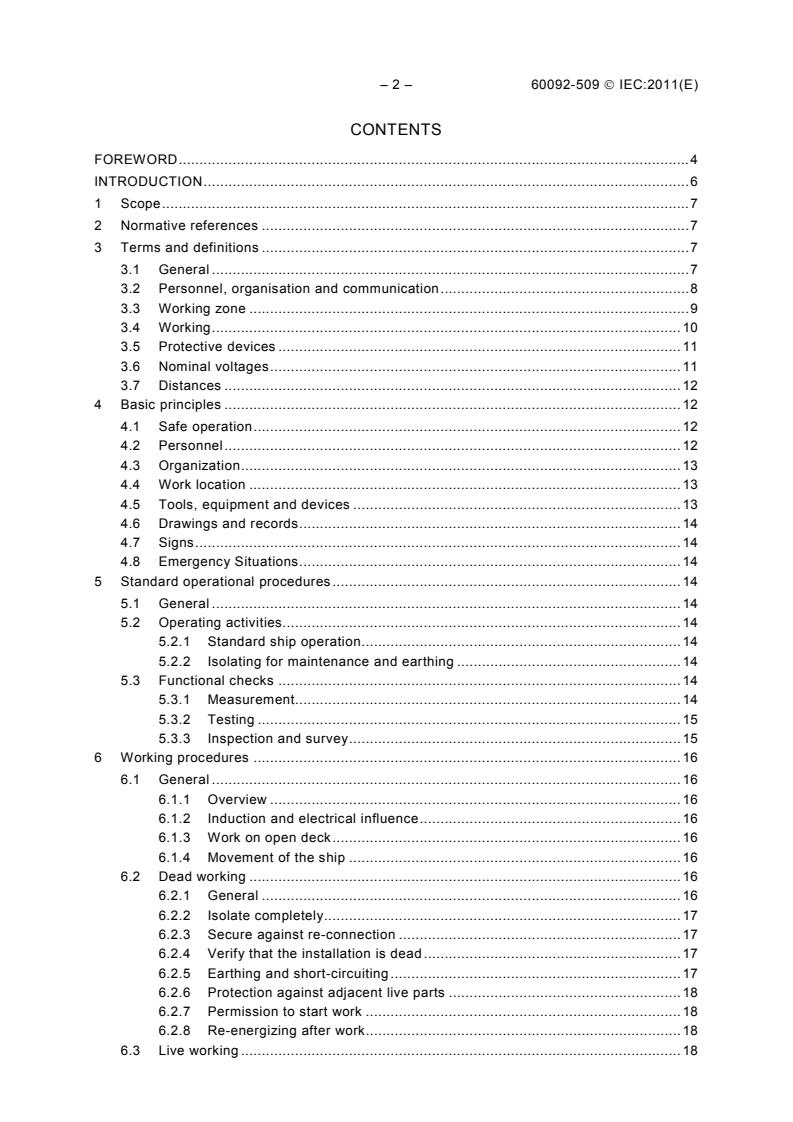
CONTENTS
FOREWORD . 4
INTRODUCTION . 6
1 Scope . 7
2 Normative references . 7
3 Terms and definitions . 7
3.1 General . 7
3.2 Personnel, organisation and communication . 8
3.3 Working zone . 9
3.4 Working . 10
3.5 Protective devices . 11
3.6 Nominal voltages . 11
3.7 Distances . 12
4 Basic principles . 12
4.1 Safe operation . 12
4.2 Personnel . 12
4.3 Organization . 13
4.4 Work location . 13
4.5 Tools, equipment and devices . 13
4.6 Drawings and records . 14
4.7 Signs . 14
4.8 Emergency Situations . 14
5 Standard operational procedures . 14
5.1 General . 14
5.2 Operating activities. 14
5.2.1 Standard ship operation. 14
5.2.2 Isolating for maintenance and earthing . 14
5.3 Functional checks . 14
5.3.1 Measurement. 14
5.3.2 Testing . 15
5.3.3 Inspection and survey . 15
6 Working procedures . 16
6.1 General . 16
6.1.1 Overview . 16
6.1.2 Induction and electrical influence . 16
6.1.3 Work on open deck . 16
6.1.4 Movement of the ship . 16
6.2 Dead working . 16
6.2.1 General . 16
6.2.2 Isolate completely . 17
6.2.3 Secure against re-connection . 17
6.2.4 Verify that the installation is dead . 17
6.2.5 Earthing and short-circuiting . 17
6.2.6 Protection against adjacent live parts . 18
6.2.7 Permission to start work . 18
6.2.8 Re-energizing after work. 18
6.3 Live working . 18
60092-509 IEC:2011(E) – 3 –
6.3.1 General . 18
6.3.2 Tools, equipment and devices . 19
6.3.3 Environmental conditions . 19
6.3.4 Organization of work . 19
6.3.5 Specific requirements for extra-low voltage installations . 20
6.3.6 Low voltage installations . 20
6.4 Working in the vicinity of live parts . 20
6.4.1 General . 20
6.4.2 Protection by screen, barrier, enclosure or insulating covering . 21
6.4.3 Protection by safe distance and supervision . 21
7 Maintenance activities . 21
7.1 General . 21
7.2 Personnel . 21
7.3 Repair work . 22
7.4 Replacement work . 22
7.4.1 Replacement of fuses . 22
7.4.2 Replacement of lamps and accessories . 22
7.5 End of maintenance work . 22
Annex A (informative) Guidance for air distances for working procedures . 23
Annex B (informative) Information for safe live working . 25
Annex C (informative) Electrical permit to work (1 000 V a.c. and 1 500 V d.c. or more) . 28
Annex D (informative) Electrical permit to work on live installations (below 1 000 V a.c.
and 1 500 V d.c.) . 29
Annex E (informative) Limitation of access form (1 000 V a.c. and 1 500 V d.c. or
more) . 30
Annex F (informative) Sanction for test (1 000 V a.c. and 1 500 V d.c. or more) . 31
Bibliography . 32
Figure 1 – Air distances and zones for working procedures . 19
Figure 2 – Limitation of the live working zone by the use of an insulating protective
device . 19
Table A.1 – Guidance for distances D and D . 24
L V
– 4 – 60092-509 IEC:2011(E)
INTERNATIONAL ELECTROTECHNICAL COMMISSION
_____________
ELECTRICAL INSTALLATIONS IN SHIPS –
Part 509: Operation of electrical installations
FOREWORD
1) The International Electrotechnical Commission (IEC) is a worldwide organization for standardization comprising
all national electrotechnical committees (IEC National Committees). The object of IEC is to promote
international co-operation on all questions concerning standardization in the electrical and electronic fields. To
this end and in addition to other activities, IEC publishes International Standards, Technical Specifications,
Technical Reports, Publicly Available Specifications (PAS) and Guides (hereafter referred to as “IEC
Publication(s)”). Their preparation is entrusted to technical committees; any IEC National Committee interested
in the subject dealt with may participate in this preparatory work. International, governmental and non-
governmental organizations liaising with the IEC also participate in this preparation. IEC collaborates closely
with the International Organization for Standardization (ISO) in accordance with conditions determined by
agreement between the two organizations.
2) The formal decisions or agreements of IEC on technical matters express, as nearly as possible, an international
consensus of opinion on the relevant subjects since each technical committee has representation from all
interested IEC National Committees.
3) IEC Publications have the form of recommendations for international use and are accepted by IEC National
Committees in that sense. While all reasonable efforts are made to ensure that the technical content of IEC
Publications is accurate, IEC cannot be held responsible for the way in which they are used or for any
misinterpretation by any end user.
4) In order to promote international uniformity, IEC National Committees undertake to apply IEC Publications
transparently to the maximum extent possible in their national and regional publications. Any divergence
between any IEC Publication and the corresponding national or regional publication shall be clearly indicated in
the latter.
5) IEC itself does not provide any attestation of conformity. Independent certification bodies provide conformity
assessment services and, in some areas, access to IEC marks of conformity. IEC is not responsible for any
services carried out by independent certification bodies.
6) All users should ensure that they have the latest edition of this publication.
7) No liability shall attach to IEC or its directors, employees, servants or agents including individual experts and
members of its technical committees and IEC National Committees for any personal injury, property damage or
other damage of any nature whatsoever, whether direct or indirect, or for costs (including legal fees) and
expenses arising out of the publication, use of, or reliance upon, this IEC Publication or any other IEC
Publications.
8) Attention is drawn to the Normative references cited in this publication. Use of the referenced publications is
indispensable for the correct application of this publication.
9) Attention is drawn to the possibility that some of the elements of this IEC Publication may be the subject of
patent rights. IEC shall not be held responsible for identifying any or all such patent rights.
International Standard IEC 60092-509 has been prepared by IEC technical committee 18:
Electrical installations of ships and of mobile and fixed offshore units.
The text of this standard is based on the following documents:
FDIS Report on voting
18/1196/FDIS 18/1207/RVD
Full information on the voting for the approval of this standard can be found in the report on
voting indicated in the above table.
This publication has been drafted in accordance with the ISO/IEC Directives, Part 2.
A list of all parts of the IEC 60092 series, published under the general title Electrical
installations in ships, can be found on the IEC web site.
60092-509 IEC:2011(E) – 5 –
The committee has decided that the contents of this publication will remain unchanged until
the stability date indicated on the IEC web site under "http://webstore.iec.ch" in the data
related to the specific publication. At this date, the publication will be
• reconfirmed,
• withdrawn,
• replaced by a revised edition, or
• amended.
A bilingual version of this publication may be issued at a later date.
– 6 – 60092-509 IEC:2011(E)
INTRODUCTION
The different parts of IEC 60092 form a series of international standards for electrical
installations in sea-going ships, incorporating good practice and co-ordinating, as far as
possible, existing rules. These standards form a code of practical interpretation and
amplification of the requirements of the International Convention on Safety of Life at Sea
(SOLAS 74/88) a guide for future regulations which may be prepared and a statement of
practice for use by ship owners, shipbuilders and appropriate organizations.
60092-509 IEC:2011(E) – 7 –
ELECTRICAL INSTALLATIONS IN SHIPS –
Part 509: Operation of electrical installations
1 Scope
This part of IEC 60092 is applicable to all operation of and work activity on electrical
generation, conversion and distribution systems and electrical equipment in ships, including
all a.c and d.c voltages.
This standard sets out the requirements for the safe operation of work and activity on, with, or
near electrical installations. These requirements apply to operational, working and
maintenance activities. It applies to all electrical work activities as well as non-electrical work
activities such as structural work near electrical equipment and cables.
This standard does not apply to ordinary persons when using installations and equipment,
provided that the installations and equipment are designed and installed for use by ordinary
persons and comply with relevant requirements of the IEC 60092 series.
2 Normative references
The following referenced documents are indispensable for the application of this document.
For dated references, only the edition cited applies. For undated references, the latest edition
of the referenced document (including any amendments) applies.
IEC 60092-101:2002, Electrical installations in ships – Part 101: Definitions and general
requirements
IEC 61310-2, Safety of machinery – Indication, marking and actuation – Part 2: Requirements
for marking
3 Terms and definitions
For the purposes of this document, the terms and definitions given in IEC 60092-101:2002
and the following apply.
3.1 General
3.1.1
electrical installation
installation including all the electrical equipment which provides for the generation,
transmission, conversion, distribution and use of electrical energy. It includes energy sources
such as batteries, capacitors and all other sources of stored electrical energy
[IEC 60050-651:1999, 651-01-04, modified]
3.1.2
live part
conductor or conductive part intended to be energized in normal operation, including a neutral
conductor. Not, by convention, a PEN conductor, combining the functions of both a protective
earthing conductor and a neutral conductor; or a PEM conductor, combining the functions of
both a protective earthing conductor and a mid-point conductor or a PEL conductor,
combining the functions of both a protective earthing conductor and a line conductor
– 8 – 60092-509 IEC:2011(E)
[IEC 60050-651: 1999, 651-01-03]
[IEC 60050-195: 1998, 195-01–12, 195-01-13, 195-01-14, modified]
NOTE This concept does not necessarily imply a risk of electrical shock.
3.1.3
operation
all activities including work activities necessary to permit the electrical installation to function.
These activities include such matters as switching, controlling, monitoring and maintenance
as well as both electrical and non-electrical work
[IEC 60050-151:2001, 151-11-28, modified]
3.1.4
electrical risk
combination of the probability and the degree of the possible injury or damage to health of a
person exposed to a hazard or to hazards
[IEC 60050-651:1999, 651-01-31, modified]
3.1.5
electrical hazard
source of possible injury or damage to health in the presence of electrical energy from an
electrical installation
[IEC 60050-651:1999, 651-01-30, modified]
3.1.6
electrical danger
risk of injury from an electrical installation
3.1.7
measurement
all activities to measure physical data within electrical installations
3.1.8
inspection
process of verifying that an electrical installation is in accordance with specified technical
and safety requirements of the relevant standards and may include verification of the normal
state of that installation
3.1.9
survey
process of verifying that an electrical installation is in accordance with specified technical and
safety requirements and regulations of the appropriate authority
3.2 Personnel, organisation and communication
3.2.1
nominated person in control of an electrical installation
that person who has been nominated in writing to be the person with direct management
responsibility for the electrical installation
[IEC 60050-651:1999, 651-01-37]
NOTE Parts of this responsibility may be delegated to others as required. In general, this will be the chief
engineer. The person who makes the nomination should be appropriately qualified with knowledge of electrical
work practices.
60092-509 IEC:2011(E) – 9 –
3.2.2
nominated person in control of a work activity
that person who has been nominated in writing to be the person with management
responsibility for the work activity
[IEC 60050-651:1999, 651-01-36, modified]
NOTE Parts of this responsibility may be delegated to others as required. In general, this will be the chief
engineer or the electrical officer, if available on board, or the head of the service team. The person who makes the
nomination should be appropriately qualified with knowledge of electrical work practices.
3.2.3
electrically skilled person
electrically qualified person (US)
person with relevant education and experience to enable him or her to perceive risks and to
avoid hazards which electricity can create
[IEC 60050-651:1999, 651-01-33]
3.2.4
(electrically) instructed person
(electrically) trained person (US)
person adequately advised or supervised by electrically skilled persons to enable him or her
to perceive electrical risks and to avoid hazards which electricity can create
[IEC 60050-651:1999, 651-01-34]
3.2.5
ordinary person
person who is neither a skilled person nor an instructed person
[IEC 60050-651:1999, 651-01-35]
3.2.6
supervision
to watch over, by an electrically skilled or nominated person, an activity or task being carried
out by personnel and to ensure that it is performed correctly and safely
3.2.7
notification
messages or instructions which are either verbal or in writing associated with operation of any
electrical installation
3.3 Working zone
3.3.1
work location
site(s), place(s) or area(s) where a work activity is to be, is being, or has been carried out
[IEC 60050-651:1999, 651-01-08, modified]
3.3.2
vicinity zone
limited space surrounding the live working zone (see Figures 1 and 2)
[IEC 60050-651:1999, 651-01-07, modified]
3.3.3
live working zone
space around live parts in which the insulation level to prevent electrical danger is not
assured when encroaching it without protective measures (see Figures 1 and 2)
– 10 – 60092-509 IEC:2011(E)
[IEC 60050-651:1999, 651-01-06, modified]
3.4 Working
3.4.1
work activity
any form of electrical or non-electrical work where there is the possibility of an electrical
hazard
3.4.2
electrical work
work on, with or near an electrical installation such as testing and measurement, repairing,
replacing, modifying, extending, erection and inspection
[IEC 60050-651:1999, 651-01-12, modified]
3.4.3
non-electrical work
work near to an electrical installation such as construction, cleaning, painting, etc
[IEC 60050-651:1999, 651-01-13, modified]
3.4.4
live working
all work in which a worker makes contact with live parts or reaches into the live working zone
with either parts of his or her body or with tools, equipment or devices being handled
[IEC 60050-651:1999, 651-01-01 modified]
3.4.5
working in the vicinity of live parts
all work activity in which a worker with part of his or her body, with a tool or with any other
object enters into the vicinity zone without encroaching into the live working zone
[IEC 60050-651:1999, 651-01-02]
3.4.6
isolate
disconnect completely a device or circuit from other devices and circuits
[IEC 60050-151:2001, 151-15-37]
3.4.7
dead
qualifies a conductive part when it is not energized
[IEC 60050-151:2001, 151-15-59]
3.4.8
dead working
work activity on electrical installations which are neither live nor charged, carried out after
having taken all measures to prevent electrical danger
3.4.9
earthing
grounding (US)
short circuit proof connection from de-energized live parts to the ship’s hull or protective
conductor so that work may be performed without danger of electrical shock
[adapted from IEC 60050-195:1998, 195-01-12]
60092-509 IEC:2011(E) – 11 –
3.4.10
earthing for work
grounding for work (US)
earthing de-energized live parts so that work may be performed without danger of electric
shock
[IEC 60050-195:1998, 195-01-12]
3.5 Protective devices
3.5.1
(electrically) protective screen
any device, which may be insulated or not, which is used to prevent approach to any
equipment or part of electrical installation which presents electrical danger
[Adapted from IEC 60050-826:2004, 826-12-23]
3.5.2
(electrically) protective barrier
part providing protection against direct contact from any usual direction of access
[IEC 60050-826:2004, 826-12-23]
3.5.3
insulating covering
rigid or flexible cover of insulating material made for and used to cover live and/or un-
energized parts and/or adjacent parts in order to prevent accidental contact
3.5.4
(electrically) protective enclosure
electrical enclosure surrounding internal parts of equipment to prevent access to hazardous-
live-parts from any direction
[IEC 60050-826:2004, 826-12-22]
3.6 Nominal voltages
3.6.1
extra-low voltage (ELV)
not exceeding 50 V alternating current (a.c.) or 120 V ripple free direct current (d.c.) whether
between conductors or to earth, this includes SELV, PELV and FELV
3.6.2
low voltage (LV)
voltage not exceeding 1 000 V a.c. or 1 500 V d.c.
3.6.3
high voltage (HV)
voltage exceeding 1 000 V a.c. or 1 500 V d.c.
3.6.4 SELV system
electric system in which the voltage cannot exceed the value of extra-low voltage:
– under normal conditions and
– under single fault conditions, including earth faults in other electric circuits
NOTE SELV is the abbreviation for safety extra low voltage.
[IEC 60050-826:2004, 826-12-31]
– 12 – 60092-509 IEC:2011(E)
3.6.5 PELV system
electric system in which the voltage cannot exceed the value of extra-low voltage:
– under normal conditions and
– under single fault conditions, except earth faults in other electric circuits
NOTE PELV is the abbreviation for protective extra low voltage.
[IEC 60050-826:2004, 826-12-32]
3.7 Distances
3.7.1
minimum working distance
minimum working distance in air to be maintained between any part of the body of a worker,
including any conductive tool being directly handled
[IEC 60050-651:1999, 651-01-20, modified]
3.7.2
electrical distance
the distance in air which protects against electrical breakdown during live working
NOTE In generic terms, the electrical distance is the minimum distance between two electrodes, which represent
live and/or earthed parts, required to ensure that the probability of electrical breakdown is negligible when
subjected to the most severe electrical stress likely to arise under the conditions prescribed.
[IEC 60050-651:1999, 651-01-21, modified]
4 Basic principles
4.1 Safe operation
Routine operations shall be covered by general/standard instructions.
An assessment of the electrical risks shall be made before carrying out any complex
operation of or work activity on, with, or near an electrical installation. This assessment shall
specify how the operation or work activity shall be carried out to ensure safety.
Before any work activity starts, the nominated person in control of the electrical installation
shall be informed and shall agree to the intended work.
4.2 Personnel
All personnel involved in a work activity on, with, or near an electrical installation shall be
instructed in the safety requirements, safety rules and company instructions applicable to
their work. These instructions shall be repeated during the course of the work where the work
is long or complex. The personnel shall be required to comply with these requirements, rules
and instructions.
Before any work activity is started and during that work activity, the nominated person in
control of that work activity shall ensure that all relevant requirements, rules and instructions
are complied with and the bridge or engine room watchkeeper notified as appropriate.
No person shall undertake any work activity where technical knowledge or experience is
needed to prevent electrical danger or injury, unless that person has such technical
knowledge or experience, or is under such supervision as is necessary for the work
undertaken.
60092-509 IEC:2011(E) – 13 –
Where there are no requirements for competence set out by the appropriate authority, i.e. the
Flag State Administration, the following criteria shall be used in assessing the competence of
persons:
• knowledge of electricity;
• experience of electrical work;
• understanding the types of installations to be worked on and practical experience of
that work;
• understanding the hazards which can arise during the work and the precautions to be
observed;
• ability to recognize at all times whether it is safe to continue working.
NOTE This assessment should result in a written authority, for each person, according to 3.2.2 to
3.2.5.
4.3 Organization
Each electrical installation shall be placed under the responsibility of a person, the nominated
person in control of the electrical installation. Where two or more installations come together,
it is essential that there are formal arrangements between the nominated persons in control of
each of those installations.
The nominated person in control of the electrical installation and the nominated person in
control of the work activity can be one and the same person, except on high voltage
installations.
A sufficient number of persons who are required to work on, with, or near an electrical
installation shall be provided with training and information so that they are able to give
appropriate first aid treatment for electric shock and/or burns.
NOTE It is recommended that guidance on first-aid is provided on posters or charts displayed at the work location
or in leaflets or safety documents issued to workers as appropriate to the circumstances.
There shall be arrangements in place such that any worker who objects for reasons of safety
to carrying out any instruction or work activity can report those objections immediately to the
nominated person in control of the work activity. The nominated person shall have the matters
investigated, and if necessary consult a higher authority for a decision.
4.4 Work location
The work location shall be defined and marked clearly. Adequate working space, means of
access and lighting shall be provided at all parts of an electrical installation on, with, or near
which any work activity is to be carried out. When necessary, the access to the work location
shall be marked clearly. Ordinary persons shall be restricted from entering the working
location.
4.5 Tools, equipment and devices
Tools, equipment, devices and personal protective equipment shall be used in accordance
with the instructions and/or guidance provided by the manufacturer, the supplier or national
requirements. These instructions and/or guidance shall be in the language or languages
appropriate to the users.
Any tools, equipment and devices provided for the purpose of safe operation of, or work on,
with, or near electrical installations shall be suitable for that use, be maintained in a condition
suitable for that use, and be properly used.
NOTE ”Maintained in a condition suitable for use" means periodic visual inspections and electrical testing where
necessary, including after repairs and/or modification to verify the electrical integrity and mechanical properties of
the tools, equipment and devices.
– 14 – 60092-509 IEC:2011(E)
All special tools, equipment and devices used during operation of, or work on, with, or near an
electrical installation shall be properly stored.
4.6 Drawings and records
There shall be available up-to-date drawings and records for the electrical installation. Where
changes are made to the ship’s electrical system, drawings and records shall be updated.
NOTE Drawings and records should be in a language appropriate to the users.
4.7 Signs
During any work or operations, adequate signs shall be displayed to draw attention to any
relevant hazard as necessary. The signs shall comply with IEC 61310-2 or those of the
appropriate authority where such signs exist.
4.8 Emergency Situations
The principles of this standard are to be followed in emergency situations, as far as is
practicable.
5 Standard operational procedures
5.1 General
In the case of activities as specified in 5.2 and 5.3, as appropriate, tools and equipment as
specified in 4.5 shall be used so that electrical danger to persons is prevented.
5.2 Operating activities
5.2.1 Standard ship operation
This operation is intended to start or stop equipment in normal use.
The equipment shall be designed to be used without risk as far as reasonable and practical.
5.2.2 Isolating for maintenance and earthing
This operation is meant to ensure safe work on electrical installations.
Isolating for maintenance and earthing of equipment shall be carried out exclusively by skilled
persons.
5.3 Functional checks
5.3.1 Measurement
Measurement shall be carried out by skilled or instructed persons, or ordinary persons under
the control and supervision of a skilled person only.
When carrying out measurements within electrical installations, suitable and calibrated
measuring instruments shall be used.
If there is a risk of contact with bare live parts, the personnel carrying out the measurements
shall use personal protective equipment and take precautions against electric shocks, and the
effects of short-circuit and arcing. The person carrying out the tests shall be accompanied by
a person, trained to recognise danger, how to switch off and if necessary give assistance in
the event of an emergency.
60092-509 IEC:2011(E) – 15 –
NOTE In some cases it may be possible to make only a section of the electrical installation dead, secure this
section, prove the absence of voltage on this section and connect the measuring devices, then restore power and
do the measurements if it can be done safely without adverse effects on the ship’s operations.
5.3.2 Testing
Testing includes all activities designed to check the operation or the electrical, mechanical or
thermal condition of an electrical installation. Testing includes also activities to prove the
effectiveness of, for example, electrical protective and safety circuits.
Test instruments, equipment and accessories shall be rated for circuits and equipment to
which they will be connected.
Test instruments, equipment and accessories shall be designed for the environment to which
they will be exposed, and for the manner in which they will be used.
Test instruments and equipment and all associated test leads, cables, power cords, probes
and connectors shall be visually inspected for external defects and damage before the
equipment is used. If there is a defect or evidence of damage, such as cracked cases, cut or
pinched leads, or damaged probe tips, the instrument shall be removed from service, repaired
and tested before it is used. Test leads shall be fused for energy limitation and the probe tips
of the insulated type. The use of multimeters, which can be set to the wrong function, is not
recommended for proving dead. Instruments shall be tested before and after use.
Testing shall be carried out by skilled or instructed persons, or ordinary persons under the
control and supervision of a skilled person only.
Testing an installation which has been made dead shall be carried out in accordance with the
rules of dead working. If it is necessary to open or remove earthing and short-circuiting
devices, suitable precautions shall be taken to prevent the installation being re-energized
from any possible source of supply and to prevent electric shock for the personnel.
When testing under normal supply the relevant requirements of 6.2 shall apply.
5.3.3 Inspection and survey
New electrical installations as well as modifications and extensions of existing installations
shall be inspected and surveyed prior to their being brought into operation.
Electrical installations shall be inspected at suitable intervals. The purpose of periodic
inspections is to discover defects which can occur after commissioning and may impede the
operation or generate hazards.
The inspection may include:
• visual examination;
• measuring and/or testing in accordance with the requirements of 5.3.1 and 5.3.2.
Inspections shall be carried out with reference to required electrical drawings (see 4.6) and
specifications and scheduled on the basis of manufacturer’s maintenance instructions or the
results of condition based maintenance assessments.
Defective equipment or parts which constitute an immediate danger shall be isolated and
secured against re-connection without delay.
Inspections shall be carried out by at least electrically instructed persons with experience in
the inspection of similar installations.
– 16 – 60092-509 IEC:2011(E)
Inspections shall be carried out with suitable equipment in such a way as to prevent danger
whilst taking into account, if necessary, the constraints imposed by the presence of bare live
parts.
The result of an inspection shall be recorded. Suitable corresponding remedial actions shall
be taken.
6 Working procedures
6.1 General
6.1.1 Overview
Working procedures are divided into three different procedures: dead working (see 6.2), live
working (see 6.3), working in the vicinity of live parts (see 6.4). All these procedures are
based on the use of protective measures against electric shock and/or the effects of short-
circuits and arcing.
If the requirements of 6.2 (dead working) or 6.4 (working in the vicinity of live parts) cannot be
fully met then the requirements of 6.3 (live working) shall be observed.
6.1.2 Induction and electrical influence
Conductors or conductive parts in the proximity of live conductors may be electrically
influenced. Where working on electrical cables and equipment which may be influenced by
induction, in addition to the requirements of 6.2 and 6.4, specific precautions, such as
earthing, in order to reduce the potential between cables and/or equipment and earth to a
safe level, shall be taken.
6.1.3 Work on open deck
Work shall not be carried out in the event of adverse environmental conditions, for example a
near approach of a lightning storm and/or bad visibility.
6.1.4 Movement of the ship
For all working procedures, the influences of movements of the ship shall be taken into
account.
6.2 Dead working
6.2.1 General
After the respective electrical installations have been identified the following five essential
requirements shall be undertaken in the specified order unless there are essential reasons for
doing otherwise:
• isolate completely;
• secure against re-connection;
• verify that the installation is dead;
• carry out earthing and short-circuiting;
• provide protection against adjacent live parts.
Permission to start work shall be given by the nominated person in control of the electrical
installation to the nominated person or persons in control of any work activity. Any person
engaged in this work activity shall be skilled or instructed or shall be supervised by such a
person.
60092-509 IEC:2011(E) – 17 –
6.2.2 Isolate completely
The part of the installation on which work is to be carried out shall be isolated from all sources
of supply.
NOTE To isolate completely, i.e. electrical isolation from all sources of supply, these three essential steps as
follows:
• determine all possible sources of electrical supply to the specific equipment or installation;
• after properly interrupting the load current, open the isolating device(s) for each source, and
• wherever possible, visually verify that all blades of the isolating device(s) are fully open or that drawout-
type circuit breakers are withdrawn to the fully isolated position.
6.2.3 Secure against re-connection
All switching devices that have been used to isolate the electrical installation for the work
activity shall be secured against re-connection, preferably by locking the operating
mechanism. If an auxiliary power source is required for operation of the switching device, this
power source shall be made inoperative. If a means of locking is not provided, tagging can be
used as an option.
NOTE The application of any lockout devices should be in accordance with a documented and established
procedure.
6.2.4 Verify that the installation is dead
The dead condition shall be verified on all phases of the electrical installation, at, or, as near
as, practicable to the work location.
In the case of cable connected electrical installations the cables shall be positively identified
at the work location.
6.2.5 Earthing and short-circuiting
6.2.5.1 General
At the work location for all high and some low voltage installations and extra low voltage (see
6.2.5.2), all parts which are to be worked on shall be earthed and short-circuited. Earthing
and short-circuiting equipment or devices shall be first connected to the earthing point and
then to the components to be earthed. The earthing and short-circuiting equipment or devices
shall be visible, whenever possible, from the work location.
In all cases it shall be ensured that the earthing and short-circuiting equipment or devices and
cables and connectors for earthing used for this purpose are suitable and adequately matched
to the fault rating of the electrical installation where they are installed. Precautions shall be
taken to ensure that the earths remain secure during the time the work is in progress. If
during measurement or testing the earth connections are removed, special precautions to
prevent danger shall be taken.
6.2.5.2 Requirements for extra low and low voltage installations
Earthing and short-circuiting may not be necessary in extra low and low voltage installations,
except if there is a risk of the installation being made live, for example
• back feed from a transformer;
• by a stand-by-generator.
Any transformer or bus-tie/transfer breaker which can back feed the equipment in question
shall be isolated in accordance with the requirements of 6.2.
Any stand-by-generator which can directly feed the equipment on which work is to be carried
out shall be prevented from starting.
– 18 – 60092-509 IEC:2011(E)
6.2.6 Protection against adjacent live parts
If there are parts of an electrical installation in the vicinity o
...