


IEC 60534-2-3:2015
(Main)Industrial-process control valves - Part 2-3: Flow capacity - Test procedures
General Information
- Abstract
IEC 60534-2-3:2015 is applicable to industrial-process control valves and provides the flow capacity test procedures for determining the following variables used in the equations given in IEC 60534-2-1:
a) flow coefficient C;
b) liquid pressure recovery factor without attached fittings FL;
c) combined liquid pressure recovery factor and piping geometry factor of a control valve with attached fittings FLP;
d) piping geometry factor FP;
e) pressure differential ratio factors xT and xTP;
f) valve style modifier Fd;
g) Reynolds number factor FR.
This third edition cancels and replaces the second edition published in 1997, of which it constitutes a technical revision. This edition includes the following significant technical changes with respect to the previous edition:
a) Addition of informative Annexes B, C, D, E and F.
b) Organizational and formatting changes were made to group technically related subject matter.
- Status
- Published
- Publication Date
- 15-Dec-2015
- Technical Committee
- SC 65B - Measurement and control devices
- Drafting Committee
- WG 9 - TC 65/SC 65B/WG 9
- Current Stage
- PPUB - Publication issued
- Start Date
- 16-Dec-2015
- Completion Date
- 31-Dec-2015
Buy Documents
IEC 60534-2-3:2015 - Industrial-process control valves - Part 2-3: Flow capacity - Test procedures Released:12/16/2015
IEC 60534-2-3:2015 - Industrial-process control valves - Part 2-3: Flow capacity - Test procedures Released:7/23/2020
Overview
IEC 60534-2-3:2015 - "Industrial-process control valves - Part 2-3: Flow capacity - Test procedures" defines standardized test procedures for measuring the flow performance of industrial control valves. This third edition (2015) updates the 1997 edition, adds informative Annexes B–F and reorganizes content for clarity. The standard supports the flow equations given in IEC 60534-2-1 by providing the experimental methods to determine the variables used in valve sizing and performance prediction.
Key topics and requirements
- Scope of tests: Procedures cover both incompressible and compressible fluids and the required test system setup.
- Measured variables: Formal test methods to determine:
- Flow coefficient (C)
- Liquid pressure recovery factor without fittings (FL)
- Combined liquid pressure recovery factor and piping geometry factor with fittings (FLP)
- Piping geometry factor (FP)
- Pressure differential ratio factors (xT and xTP)
- Valve style modifier (Fd)
- Reynolds number factor (FR)
- Test system and instrumentation: Guidance on test specimen installation, test section piping, throttling valves, flow and pressure measurement, temperature and travel measurement, and recommended pressure tap locations.
- Accuracy and data evaluation: Requirements for measurement accuracy, data reduction, and calculation methods for choked and non-choked flow conditions.
- Annexes (informative): Engineering data, derivation of valve style modifier, laminar flow discussion, long-form F test procedure, and guidance on matching pipe/valve port diameters.
Practical applications
- Valve manufacturers: validate product performance, publish certified flow coefficients and pressure recovery data for catalogues.
- Test laboratories: conduct repeatable, standardized flow tests for acceptance, R&D and compliance.
- Process engineers and specifiers: use measured C, FL/FLP, FP, xT/xTP, Fd, and FR values to improve valve sizing accuracy, predict noise and cavitation risk, and optimize piping geometry.
- Procurement and quality assurance: verify supplier claims and ensure consistent valve selection across projects.
Benefits and keywords
Using IEC 60534-2-3:2015 ensures consistent, repeatable valve testing and reliable input data for valve sizing, flow capacity, and performance modeling. Relevant keywords: industrial-process control valves, flow coefficient C, pressure recovery factor, valve test procedures, Reynolds number factor, piping geometry factor, IEC 60534 series.
Related standards
- IEC 60534-2-1 (flow equations and sizing) - the test results from 60534-2-3 are used directly with 2-1 equations.
- Other parts of the IEC 60534 series covering valve characterization and application guidance.
Relations
- Effective Date
- 25-Aug-2026
- Revises
IEC 60534-2-3:1997 - Industrial-process control valves - Part 2-3: Flow capacity - Test procedures - Effective Date
- 05-Sep-2023
Buy Documents
IEC 60534-2-3:2015 - Industrial-process control valves - Part 2-3: Flow capacity - Test procedures Released:12/16/2015
IEC 60534-2-3:2015 - Industrial-process control valves - Part 2-3: Flow capacity - Test procedures Released:7/23/2020
Get Certified
Connect with accredited certification bodies for this standard

National Aerospace and Defense Contractors Accreditation Program (NADCAP)
Global cooperative program for special process quality in aerospace.
Institut za varilstvo d.o.o. (Welding Institute)
Slovenia's leading welding institute since 1952. ISO 3834, EN 1090, pressure equipment certification, NDT personnel, welder qualification. Only IIW Au
CARES (UK Certification Authority for Reinforcing Steels)
UK certification for reinforcing steels and construction.
Sponsored listings
Frequently Asked Questions
IEC 60534-2-3:2015 is a standard published by the International Electrotechnical Commission (IEC). Its full title is "Industrial-process control valves - Part 2-3: Flow capacity - Test procedures". This standard covers: IEC 60534-2-3:2015 is applicable to industrial-process control valves and provides the flow capacity test procedures for determining the following variables used in the equations given in IEC 60534-2-1: a) flow coefficient C; b) liquid pressure recovery factor without attached fittings FL; c) combined liquid pressure recovery factor and piping geometry factor of a control valve with attached fittings FLP; d) piping geometry factor FP; e) pressure differential ratio factors xT and xTP; f) valve style modifier Fd; g) Reynolds number factor FR. This third edition cancels and replaces the second edition published in 1997, of which it constitutes a technical revision. This edition includes the following significant technical changes with respect to the previous edition: a) Addition of informative Annexes B, C, D, E and F. b) Organizational and formatting changes were made to group technically related subject matter.
IEC 60534-2-3:2015 is applicable to industrial-process control valves and provides the flow capacity test procedures for determining the following variables used in the equations given in IEC 60534-2-1: a) flow coefficient C; b) liquid pressure recovery factor without attached fittings FL; c) combined liquid pressure recovery factor and piping geometry factor of a control valve with attached fittings FLP; d) piping geometry factor FP; e) pressure differential ratio factors xT and xTP; f) valve style modifier Fd; g) Reynolds number factor FR. This third edition cancels and replaces the second edition published in 1997, of which it constitutes a technical revision. This edition includes the following significant technical changes with respect to the previous edition: a) Addition of informative Annexes B, C, D, E and F. b) Organizational and formatting changes were made to group technically related subject matter.
IEC 60534-2-3:2015 is classified under the following ICS (International Classification for Standards) categories: 23.060.40 - Pressure regulators; 25.040.40 - Industrial process measurement and control. The ICS classification helps identify the subject area and facilitates finding related standards.
IEC 60534-2-3:2015 has the following relationships with other standards: It is inter standard links to EN ISO 23553-1:2022, IEC 60534-2-3:1997. Understanding these relationships helps ensure you are using the most current and applicable version of the standard.
IEC 60534-2-3:2015 is available in PDF format for immediate download after purchase. The document can be added to your cart and obtained through the secure checkout process. Digital delivery ensures instant access to the complete standard document.
Standards Content (Sample)
IEC 60534-2-3 ®
Edition 3.0 2015-12
INTERNATIONAL
STANDARD
colour
inside
Industrial-process control valves –
Part 2-3: Flow capacity – Test procedures
All rights reserved. Unless otherwise specified, no part of this publication may be reproduced or utilized in any form
or by any means, electronic or mechanical, including photocopying and microfilm, without permission in writing from
either IEC or IEC's member National Committee in the country of the requester. If you have any questions about IEC
copyright or have an enquiry about obtaining additional rights to this publication, please contact the address below or
your local IEC member National Committee for further information.
IEC Central Office Tel.: +41 22 919 02 11
3, rue de Varembé Fax: +41 22 919 03 00
CH-1211 Geneva 20 info@iec.ch
Switzerland www.iec.ch
About the IEC
The International Electrotechnical Commission (IEC) is the leading global organization that prepares and publishes
International Standards for all electrical, electronic and related technologies.
About IEC publications
The technical content of IEC publications is kept under constant review by the IEC. Please make sure that you have the
latest edition, a corrigenda or an amendment might have been published.
IEC Catalogue - webstore.iec.ch/catalogue Electropedia - www.electropedia.org
The stand-alone application for consulting the entire The world's leading online dictionary of electronic and
bibliographical information on IEC International Standards, electrical terms containing more than 30 000 terms and
Technical Specifications, Technical Reports and other definitions in English and French, with equivalent terms in 15
documents. Available for PC, Mac OS, Android Tablets and additional languages. Also known as the International
iPad. Electrotechnical Vocabulary (IEV) online.
IEC publications search - www.iec.ch/searchpub IEC Glossary - std.iec.ch/glossary
The advanced search enables to find IEC publications by a More than 60 000 electrotechnical terminology entries in
variety of criteria (reference number, text, technical English and French extracted from the Terms and Definitions
committee,…). It also gives information on projects, replaced clause of IEC publications issued since 2002. Some entries
and withdrawn publications. have been collected from earlier publications of IEC TC 37,
77, 86 and CISPR.
IEC Just Published - webstore.iec.ch/justpublished
Stay up to date on all new IEC publications. Just Published IEC Customer Service Centre - webstore.iec.ch/csc
details all new publications released. Available online and If you wish to give us your feedback on this publication or
also once a month by email. need further assistance, please contact the Customer Service
Centre: csc@iec.ch.
IEC 60534-2-3 ®
Edition 3.0 2015-12
INTERNATIONAL
STANDARD
colour
inside
Industrial-process control valves –
Part 2-3: Flow capacity – Test procedures
INTERNATIONAL
ELECTROTECHNICAL
COMMISSION
ICS 23.060.40; 25.040.40 ISBN 978-2-8322-3055-8
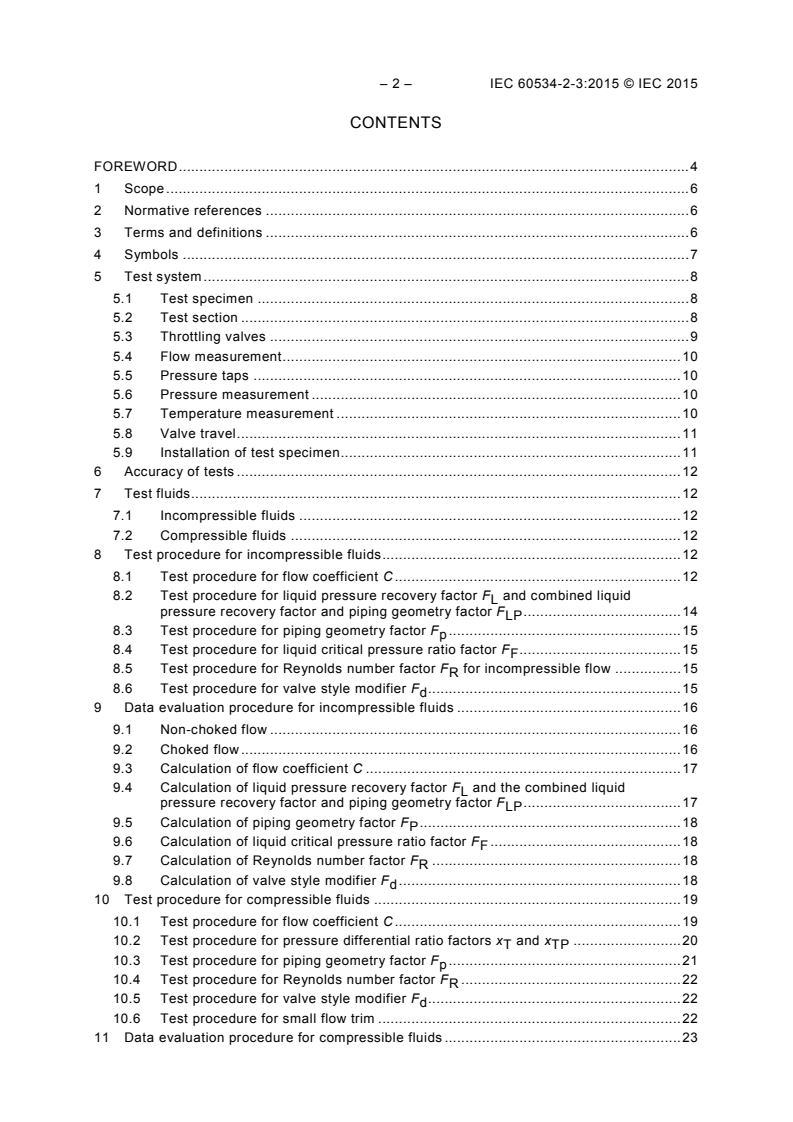
– 2 – IEC 60534-2-3:2015 © IEC 2015
CONTENTS
FOREWORD . 4
1 Scope . 6
2 Normative references . 6
3 Terms and definitions . 6
4 Symbols . 7
5 Test system . 8
5.1 Test specimen . 8
5.2 Test section . 8
5.3 Throttling valves . 9
5.4 Flow measurement . 10
5.5 Pressure taps . 10
5.6 Pressure measurement . 10
5.7 Temperature measurement . 10
5.8 Valve travel . 11
5.9 Installation of test specimen . 11
6 Accuracy of tests . 12
7 Test fluids . 12
7.1 Incompressible fluids . 12
7.2 Compressible fluids . 12
8 Test procedure for incompressible fluids . 12
8.1 Test procedure for flow coefficient C . 12
8.2 Test procedure for liquid pressure recovery factor F and combined liquid
L
pressure recovery factor and piping geometry factor F . 14
LP
8.3 Test procedure for piping geometry factor F . 15
p
8.4 Test procedure for liquid critical pressure ratio factor F . 15
F
8.5 Test procedure for Reynolds number factor F for incompressible flow . 15
R
8.6 Test procedure for valve style modifier F . 15
d
9 Data evaluation procedure for incompressible fluids . 16
9.1 Non-choked flow . 16
9.2 Choked flow . 16
9.3 Calculation of flow coefficient C . 17
9.4 Calculation of liquid pressure recovery factor F and the combined liquid
L
pressure recovery factor and piping geometry factor F . 17
LP
9.5 Calculation of piping geometry factor F . 18
P
9.6 Calculation of liquid critical pressure ratio factor F . 18
F
9.7 Calculation of Reynolds number factor F . 18
R
9.8 Calculation of valve style modifier F . 18
d
10 Test procedure for compressible fluids . 19
10.1 Test procedure for flow coefficient C . 19
10.2 Test procedure for pressure differential ratio factors x and x . 20
T TP
10.3 Test procedure for piping geometry factor F . 21
p
10.4 Test procedure for Reynolds number factor F . 22
R
10.5 Test procedure for valve style modifier F . 22
d
10.6 Test procedure for small flow trim . 22
11 Data evaluation procedure for compressible fluids . 23
11.1 Flow equation . 23
11.2 Calculation of flow coefficient C . 23
11.3 Calculation of pressure differential ratio factor x . 23
T
11.4 Calculation of pressure differential ratio factor x . 24
TP
11.5 Calculation of piping geometry factor F . 24
p
11.6 Calculation of Reynolds number factor F for compressible fluids . 24
R
11.7 Calculation of valve style modifier F . 24
d
11.8 Calculation of flow coefficient C for small flow trim . 24
Annex A (normative) Typical examples of test specimens showing appropriate
pressure tap locations . 26
Annex B (informative) Engineering data . 28
Annex C (informative) Derivation of the valve style modifier, F . 31
d
Annex D (informative) Laminar flow test discussion. 35
Annex E (informative) Long form F test procedure . 36
L
E.1 General . 36
E.2 Test procedure . 36
E.3 Graphical data reduction . 36
Annex F (informative) Calculation of F to help determine if pipe/valve port diameters
P
are adequately matched . 39
Bibliography . 41
Figure 1 – Basic flow test system . 8
Figure 2 – Test section piping requirements . 9
Figure 3 – Recommended pressure tap connection . 11
Figure A.1 – Typical examples of test specimens showing appropriate pressure tap
locations . 27
Figure B.1 – Dynamic viscosity of water . 28
Figure C.1 – Single seated, parabolic plug (flow tending to open) . 34
Figure C.2 – Swing-through butterfly valve . 34
Figure E.1 – Typical flow results . 37
Table 1 – Test specimen alignment . 11
Table 2 – Minimum inlet absolute test pressure in kPa (bar) as related to F and ∆p . 13
L
Table 3 – Numerical constants N . 25
Table B.1 – Properties for water . 28
Table B.2 – Properties of air . 29
Table B.3 – Test section piping . 30
Table C.1 – Numerical constant, N . 34
Table F.1 – Tabulated values of F if upstream and downstream pipe the same size . 40
P
Table F.2 – Tabulated values of F if downstream pipe larger than valve . 40
P
– 4 – IEC 60534-2-3:2015 © IEC 2015
INTERNATIONAL ELECTROTECHNICAL COMMISSION
____________
INDUSTRIAL-PROCESS CONTROL VALVES –
Part 2-3: Flow capacity – Test procedures
FOREWORD
1) The International Electrotechnical Commission (IEC) is a worldwide organization for standardization comprising
all national electrotechnical committees (IEC National Committees). The object of IEC is to promote
international co-operation on all questions concerning standardization in the electrical and electronic fields. To
this end and in addition to other activities, IEC publishes International Standards, Technical Specifications,
Technical Reports, Publicly Available Specifications (PAS) and Guides (hereafter referred to as “IEC
Publication(s)”). Their preparation is entrusted to technical committees; any IEC National Committee interested
in the subject dealt with may participate in this preparatory work. International, governmental and non-
governmental organizations liaising with the IEC also participate in this preparation. IEC collaborates closely
with the International Organization for Standardization (ISO) in accordance with conditions determined by
agreement between the two organizations.
2) The formal decisions or agreements of IEC on technical matters express, as nearly as possible, an international
consensus of opinion on the relevant subjects since each technical committee has representation from all
interested IEC National Committees.
3) IEC Publications have the form of recommendations for international use and are accepted by IEC National
Committees in that sense. While all reasonable efforts are made to ensure that the technical content of IEC
Publications is accurate, IEC cannot be held responsible for the way in which they are used or for any
misinterpretation by any end user.
4) In order to promote international uniformity, IEC National Committees undertake to apply IEC Publications
transparently to the maximum extent possible in their national and regional publications. Any divergence
between any IEC Publication and the corresponding national or regional publication shall be clearly indicated in
the latter.
5) IEC itself does not provide any attestation of conformity. Independent certification bodies provide conformity
assessment services and, in some areas, access to IEC marks of conformity. IEC is not responsible for any
services carried out by independent certification bodies.
6) All users should ensure that they have the latest edition of this publication.
7) No liability shall attach to IEC or its directors, employees, servants or agents including individual experts and
members of its technical committees and IEC National Committees for any personal injury, property damage or
other damage of any nature whatsoever, whether direct or indirect, or for costs (including legal fees) and
expenses arising out of the publication, use of, or reliance upon, this IEC Publication or any other IEC
Publications.
8) Attention is drawn to the Normative references cited in this publication. Use of the referenced publications is
indispensable for the correct application of this publication.
9) Attention is drawn to the possibility that some of the elements of this IEC Publication may be the subject of
patent rights. IEC shall not be held responsible for identifying any or all such patent rights.
International Standard IEC 60534-2-3 has been prepared by subcommittee 65B: Measurement
and control devices, of IEC technical committee 65: Industrial-process measurement, control
and automation.
The third edition cancels and replaces the second edition published in 1997, of which it
constitutes a technical revision.
This edition includes the following significant technical changes with respect to the previous
edition:
a) Addition of informative Annexes B, C, D, E and F.
b) Organizational and formatting changes were made to group technically related subject
matter.
The text of this standard is based on the following documents:
FDIS Report on voting
65B/1025/FDIS 65B/1028/RVD
Full information on the voting for the approval of this standard can be found in the report on
voting indicated in the above table.
This publication has been drafted in accordance with the ISO/IEC Directives, Part 2.
A list of all parts in the IEC 60534 series, published under the general title Industrial-process
control valves, can be found on the IEC website.
The committee has decided that the contents of this publication will remain unchanged until
the stability date indicated on the IEC web site under "http://webstore.iec.ch" in the data
related to the specific publication. At this date, the publication will be
• reconfirmed,
• withdrawn,
• replaced by a revised edition, or
• amended.
A bilingual version of this publication may be issued at a later date.
IMPORTANT – The 'colour inside' logo on the cover page of this publication indicates
that it contains colours which are considered to be useful for the correct
understanding of its contents. Users should therefore print this document using a
colour printer.
– 6 – IEC 60534-2-3:2015 © IEC 2015
INDUSTRIAL-PROCESS CONTROL VALVES –
Part 2-3: Flow capacity – Test procedures
1 Scope
This part of IEC 60534 is applicable to industrial-process control valves and provides the flow
capacity test procedures for determining the following variables used in the equations given in
IEC 60534-2-1:
a) flow coefficient C;
b) liquid pressure recovery factor without attached fittings F ;
L
c) combined liquid pressure recovery factor and piping geometry factor of a control valve
with attached fittings F ;
LP
d) piping geometry factor F ;
P
e) pressure differential ratio factors x and x ;
T TP
f) valve style modifier F ;
d
g) Reynolds number factor F .
R
2 Normative references
The following documents, in whole or in part, are normatively referenced in this document and
are indispensable for its application. For dated references, only the edition cited applies. For
undated references, the latest edition of the referenced document (including any
amendments) applies.
IEC 60534-1, Industrial-process control valves – Part 1: Control valve terminology and
general considerations
IEC 60534-2-1:2011, Industrial-process control valves – Part 2-1: Flow capacity – Sizing
equations for fluid flow under installed conditions
IEC 60534-8-2, Industrial-process control valves – Part 8-2: Noise considerations –
Laboratory measurement of noise generated by hydrodynamic flow through control valves
IEC 61298-1, Process measurement and control devices – General methods and procedures
for evaluating performance – Part 1: General considerations
IEC 61298-2, Process measurement and control devices – General methods and procedures
for evaluating performance – Part 2: Tests under reference conditions
3 Terms and definitions
For the purposes of this document, the terms and definitions given in IEC 60534-1,
IEC 60534-2-1, IEC 61298-1, and IEC 61298-2 apply.
4 Symbols
Symbol Description Unit
C Flow coefficient (K , C ) Various (see IEC 60534-1)
v v
C Flow coefficient at rated travel Various (see IEC 60534-1)
R
d Nominal valve size (DN) mm
F Valve style modifier 1
d
F Liquid critical pressure ratio factor 1
F
F Liquid pressure recovery factor of a control valve without attached 1
L
fittings
F Combined liquid pressure recovery factor and piping geometry factor of 1
LP
a control valve with attached fittings
F Piping geometry factor 1
P
F Reynolds number factor 1
R
F Specific heat ratio factor 1
γ
M Molecular mass of flowing fluid kg/kmol
N Numerical constants (see Table 3) Various (see Note 1)
p Thermodynamic critical pressure kPa or bar (see Note 2)
c
p Vapour pressure of liquid at inlet temperature kPa or bar
v
p Inlet absolute static pressure measured at the upstream pressure tap kPa or bar
p Outlet absolute static pressure measured at the downstream pressure kPa or bar
tap
Differential pressure (p – p ) between upstream and downstream kPa or bar
∆p
1 2
pressure taps
Maximum pressure differential kPa or bar
∆p
max
kPa or bar
∆p Maximum effective ∆p without attached fittings
max(L)
kPa or bar
∆p Maximum effective ∆p with attached fittings
max(LP)
Q Volumetric flow rate m /h (see Note 3)
Q Maximum volumetric flow rate (choked flow conditions) m /h
max
Q Maximum volumetric flow rate for incompressible fluids (choked flow m /h
max(L)
conditions without attached fittings)
Q Maximum volumetric flow rate for incompressible fluids (choked flow m /h
max(LP)
conditions with attached fittings)
Q Maximum volumetric flow rate for compressible fluids (choked flow m /h
max(T)
conditions without attached fittings)
Q Maximum volumetric flow rate for compressible fluids (choked flow m /h
max(TP)
conditions with attached fittings)
Re Valve Reynolds number 1
v
T Inlet absolute temperature K
t Reference temperature for standard conditions
°C
s
X 1
Ratio of pressure differential to inlet absolute pressure (∆p/p )
x Pressure differential ratio factor of a control valve without attached 1
T
fittings for choked flow
x Pressure differential ratio factor of a control valve with attached fittings 1
TP
for choked flow
Y Expansion factor 1
Z Compressibility factor (Z = 1 for gases that exhibit ideal gas behaviour) 1
Specific heat ratio 1
γ
ν
Kinematic viscosity m /s (see Note 4)
ζ Velocity head loss coefficient of a reducer, expander or other fitting 1
attached to a control valve
ρ /ρ Relative density (ρ /ρ = 1 for water at 15 °C)
1 o 1 o
– 8 – IEC 60534-2-3:2015 © IEC 2015
NOTE 1 To determine the units for the numerical constants, dimensional analysis may be performed on the
appropriate equations using the units given in Table 1.
2 5
NOTE 2 1 bar = 10 kPa = 10 Pa.
NOTE 3 Compressible fluid volumetric flow rates in m /h, identified by the symbol Q, refer to standard
conditions which are an absolute pressure of 101,325 kPa (1,013 25 bar) and a temperature of either 0 °C or
15 °C (see Table 3).
–6 2
NOTE 4 1 centistoke = 10 m /s.
5 Test system
5.1 Test specimen
The test specimen is any valve or combination of valve, pipe reducer, and expander or other
devices attached to the valve body for which test data are required. See Annex A for
additional examples of test specimens representative of typical field installations.
Additional considerations apply when testing certain styles of high-capacity control valves,
e.g., ball or butterfly valves. These valves may produce free jets in the downstream test
section impacting the location of the pressure recovery zone. See Clause 6 for expected
accuracies.
Fractional C valves (valves where C << N ) are addressed in 8.1.2.
Physical or computer-based modelling of control valves as the basis for flow coefficient
determination is permissible but is outside the scope of this standard. When modelling, it is
incumbent on the practitioner to employ suitable modelling techniques to validate the model
and scaling relationships to actual flow data, and to document the nature of the model.
5.2 Test section
A basic flow test system is shown in Figure 1.
IEC
Figure 1 – Basic flow test system
The upstream and downstream piping adjacent to the test specimen should conform to the
nominal size of the test specimen connection and to the straight length requirements of
Figure 2. The inlet and outlet piping shall be suitable for the maximum respective pressures
that can be applied by the test system (Table B.3 provides data for commonly used pipe).
The inside diameter (ID) of the pipe normally should be within ± 2 % of the actual inside
diameter of the inlet and outlet of the test specimen for all valve sizes. As the C/d ratio (of
the test valve) increases, the mismatch in diameters becomes more problematic. Potential
pressure losses associated with the inlet and outlet joints become significant in comparison to
the loss associated the valve. Also, a significant discontinuity at the valve outlet could affect
the downstream (p ) pressure measurement. One indication of the significance of mismatched
diameters is the value of the piping geometry factor (F ) based on the internal diameters. This
P
value approaches unity for a standard test, i.e., for equal line and specimen inside diameters.
Therefore, to ensure the proper accuracy for the test, it shall be demonstrated by either
calculation or test that 0,99 ≤ F ≤ 1,01. If F < 0,99, or F > 1,01 it shall be so noted in the
P P P
test data (see 8.1.5 or 10.1.5). See Annex F for a sample calculation.
The inside surfaces shall be reasonably free of flaking rust or mill scale and without
irregularities that could cause excessive fluid frictional losses.
5.3 Throttling valves
The upstream and downstream throttling valves are used to control the pressure differential
across the test section pressure taps and to maintain a specific upstream or downstream
pressure. There are no restrictions as to style of these valves. However, the downstream
valve should be of sufficient capacity, and may be larger than the nominal size of the test
specimen, to ensure that choked flow can be achieved at the test specimen for both
compressible and incompressible flow. Vaporization at the upstream throttling valve shall be
avoided when testing with liquids.
Standard test section configuration
IEC
Key
l Two times nominal pipe diameter
l Six times nominal pipe diameter
l Eighteen times nominal pipe diameter minimum
l One times nominal pipe diameter minimum
NOTE 1 Straightening vanes may be used where beneficial. If employed, the length l may be reduced to not
less than eight times the nominal pipe diameter. Information concerning flow conditioning can be found in ASME
Performance Test Code PTC 19.5-2004, “Flow Measurement”.
NOTE 2 The location of the pressure taps are upstream and downstream of the test specimen as a whole. The
test specimen may be simply the control valve or the control valve with any combination of attached fittings (see
Annex A).
NOTE 3 If upstream flow disturbance consists of two elbows in series and they are in different planes,
additional flow conditioning is required. See ASME Fluid meters for additional guidelines for line length.
Figure 2 – Test section piping requirements
– 10 – IEC 60534-2-3:2015 © IEC 2015
5.4 Flow measurement
The flow measuring instrument may be located upstream or downstream of the test section,
and may be any device which meets the specified accuracy. The accuracy rating of the
instrument shall be ±2 % of actual output reading. The resolution and repeatability of the
instrument shall be within ±0,5 %. The measuring instrument shall be calibrated as frequently
as necessary to maintain specified accuracy. All guidelines specific to the flow-measuring
instrument regarding flow conditioning (e.g., the number of straight pipe diameters, upstream
and downstream of the instrument, etc.) shall be followed.
5.5 Pressure taps
Pressure taps shall be provided on the test section piping in accordance with the
requirements listed in Figure 3. These pressure taps shall conform to the construction
illustrated in Figure 3. The edge of of the pressure tap hole shall be clean and sharp (i.e.,
check for corrosion and/or erosion) or slightly rounded, free from burrs, wire edges or other
irregularities. In no case shall any fitting protrude inside the pipe.
Orientation:
Incompressible fluids – Tap centrelines should be located horizontally to reduce the
possibility of air entrapment or dirt collection in the pressure taps.
Compressible fluids – Tap centrelines should be oriented horizontally or vertically above
pipe to reduce the possibility of dirt or condensate entrapment.
For butterfly and other rotary valves, the pressure taps shall be aligned (parallel) to the main
shaft of the valve to reduce the effect of the velocity head of the flowing fluid on the pressure
measurement.
Multiple pressure taps can be used on each test section for averaging pressure
measurements. Each tap shall conform to the requirements in Figure 3.
See 5.9 for other installation guidelines.
5.6 Pressure measurement
All pressure and pressure differential measurements shall be made using instruments with an
accuracy rating of ±2 % of actual output reading. Pressure-measuring devices shall be
calibrated as frequently as necessary to maintain specified accuracy.
If individual pressure measurements (p , p ) are used in lieu of a single differential pressure
1 2
measurement (∆p), care shall be taken to select instruments which are accurate enough that
the calculated pressure differential value (p p ) is known with an accuracy at least as good
–
1 2
as the accuracy rating stated above for pressure differential measurements.
5.7 Temperature measurement
The fluid temperature shall be measured using an instrument with an accuracy rating of ±1 °C
(±2 °F) of actual output reading. The temperature measuring probe should be chosen and
positioned to have minimum effect on the flow and pressure measurements. Thermocouples
used for temperature measurement should be at least Class B according to IEC 60751.
The inlet fluid temperature shall remain constant within ±3 °C (±5 °F) over the time interval
during which the test data is recorded for each specific test point. The flowing system should
be allowed to stabilize for a period of time that exceeds the time constant of the measuring
device to ensure that the correct temperature is being recorded.
5.8 Valve travel
The valve travel shall be fixed within ±0,5 % of the rated travel during any one specific flow
test.
The accuracy rating of the travel-measuring instrument shall be ±0,2 % of rated travel.
5.9 Installation of test specimen
Alignment between the centreline of the test section piping and the centreline of the inlet and
outlet of the test specimen shall be within (see Table 1 and Figure 3):
Table 1 – Test specimen alignment
Pipe size Allowable misalignment
DN 15 through DN 25 0,8 mm
DN 32 through DN 150 1,6 mm
DN 200 and larger 0,01 nominal pipe diameter
The inside diameter of each gasket shall be sized and the gasket positioned so that it does
not protrude inside the pipe.
IEC
NOTE 1 Any suitable method of making the physical connection is acceptable if above recommendations are
adhered to.
NOTE 2 Reference: ASME Performance Test Code PTC 19.5-1972, “Applications. Part II of Fluid Meters, Interim
Supplement on Instruments and Apparatus.”
Size of pipe “b” Not exceeding “b” Not less than
Less than 50 mm 6 mm 3 mm
50 mm to 75 mm 9 mm 3 mm
100 mm to 200 mm 13 mm 3 mm
250 mm and greater 19 mm 3 mm
Figure 3 – Recommended pressure tap connection
– 12 – IEC 60534-2-3:2015 © IEC 2015
6 Accuracy of tests
C
< 0,047
Valves having an and x < 0,84 at tested travel will have a calculated flow
T
N d
coefficient, C, of the test specimen within a tolerance of ± 5 %. The tolerance for valves that
do not meet these criteria may exceed 5 %. These accuracy statements apply when fully
turbulent flow can be established. See Annex D for further information when this is not the
case.
See cautions presented in 5.1.
7 Test fluids
7.1 Incompressible fluids
–6
Fresh water that is free of appreciable entrained solids (i.e., < 1 000 × 10 dissolved salts;
-6
< 1 000 × 10 entrained solids) shall be the basic fluid used in this procedure. Inhibitors may
be used to prevent or retard corrosion and to prevent the growth of organic matter. The
aggregate effect of additives and all contaminants on density or viscosity shall be evaluated
by computation using the equations in this standard. The sizing coefficient shall not be
affected by more than 0,1 %. Test fluids other than fresh water may be required for obtaining
F and F . Test fluid temperature range for fresh water should be 5 °C to 40 °C.
R F
7.2 Compressible fluids
Air or some other compressible fluid shall be used as the basic fluid in this test procedure.
The test fluid shall fall in the ideal gas behaviour range under test conditions, and therefore
shall have a ratio of specific heats that falls in the range 1,2 ≤ γ ≤ 1,6 (see Cunningham,
Driskell, in the Bibliography). Vapours that may approach their condensation points at the
vena contracta of the specimen are not acceptable as test fluids. Care should be taken to
avoid internal icing during the test.
8 Test procedure for incompressible fluids
8.1 Test procedure for flow coefficient C
8.1.1 Install the test specimen without attached fittings in accordance with piping
requirements in Figure 2.
8.1.2 Flow tests shall include flow measurements at three widely spaced pressure
differentials (but not less than 0,1 bar) within the turbulent, non-vaporizing region. The
suggested differential pressures are
a) just below the onset of cavitation (incipient cavitation) or the maximum available in the
test facility, whichever is less (see IEC 60534-8-2);
b) about 50 % of the pressure differential of a);
c) about 10 % of the pressure differential of a).
The pressures shall be measured across the test section pressure taps with the valve at the
selected travel.
For very small valve capacities, non-turbulent flow may occur at the recommended pressure
differentials. In this case, larger pressure differentials shall be used to ensure turbulent flow.
Flow tests should be conducted at conditions where the valve Reynolds Number, Re ,
v
(see equation (13)) is 100 000 or higher. If it is not possible to attain a minimum valve
Reynolds Number of 100 000, then a compressible flow coefficient test should be considered
(also see Annex D). Deviations and reason for the deviations from standard requirements
shall be recorded.
For large valves where flow source limitations are reached, lower pressure differentials may
be used optionally as long as turbulent flow is maintained. Deviations from standard
requirements shall be recorded and the reasons for the deviations shall be indicated.
8.1.3 In order to keep the downstream portion of the test section filled with liquid and to
prevent vaporization of the liquid, the absolute upstream pressure shall be maintained at a
minimum of 2∆p/F or p +0,14 bar, whichever is greater. If the liquid pressure recovery
atm
L
factor, F , of the test specimen is unknown, a conservative (i.e. low) estimate may be used.
L
See Annex E of IEC 60534-2-1: 2011 for typical F values. Table 2 provides the minimum
L
upstream pressures for selected values of ∆p and F . The line velocity should not exceed
L
13,7 m/s to avoid vaporization in fresh water.
8.1.4 Flow tests shall be performed to determine:
a) the rated flow coefficient C using 100 % of rated travel;
R
b) inherent flow characteristics (optional), using 5 %, 10 %, 20 %, 30 %, 40 %, 50 %, 60 %,
70 %, 80 %, 90 % and 100 % of rated travel.
NOTE To determine the inherent flow characteristic more fully, flow tests may be performed at travel intervals
less than 5 % of rated travel.
Table 2 – Minimum inlet absolute test pressure
in kPa (bar) as related to F and ∆p
L
Minimum inlet absolute test pressure – kPa
(bar)
35 40 45 50 55 60 65 70 75
∆p kPa
(bar)→
(0,35) (0,40) (0,45) (0,50) (0,55) (0,60) (0,65) (0,70) (0,75)
F ↓
L
0,5 280 320 360 400 440 480 520 560 600
(2,8) (3,2) (3,6) (4,0) (4,4) (4,8) (5,2) (5,6) (6,0)
0,6 190 220 250 270 300 330 360 380 410
(1,9) (2,2) (2,5) (2,7) (3,0) (3,3) (3,6) (3,8) (4,1)
0,7 150 160 180 200 220 240 260 280 300
(1,5) (1,6) (1,8) (2,0) (2,2) (2,4) (2,6) (2,8) (3,0)
0,8 150 160 160 170 170 190 200 220 230
(1,5) (1,6) (1,6) (1,7) (1,7) (1,9) (2,0) (2,2) (2,3)
0,9 150 160 160 170 170 180 180 190 190
(1,5) (1,6) (1,6) (1,7) (1,7) (1,8) (1,8) (1,9) (1,9)
NOTE 1 For large valves where flow source limitations are reached, lower pressure differentials may be used
optionally as long as turbulent flow is maintained and differential pressure measurement accuracy is within
specification.
NOTE 2 For pressures not listed, use the following equation to calculate the upstream pressure: p =
1,min
2∆p/F .
L
8.1.5 Record the following data:
a) valve travel;
b) inlet pressure p
1;
c) pressure differential (p – p ) across the pressure taps;
1 2
– 14 – IEC 60534-2-3:2015 © IEC 2015
d) fluid inlet temperature T ;
e) volumetric flow rate Q;
f) barometric pressure;
g) physical description of test specimen (i.e. type of valve, nominal size, pressure rating, flow
direction);
h) physical description of test system and test fluid;
i) any deviations from the provisions of this standard.
Data shall be evaluated using the procedure in 9.3.
8.2 Test procedure for liquid pressure recovery factor F and combined liquid
L
pressure recovery factor and piping geometry factor F
LP
8.2.1 The maximum flow rate Q (referred to as choked flow) is required in the
max
calculation of the factors F (for a given test specimen without attached fittings) and F (for a
L LP
given test specimen which includes attached fittings). With fixed inlet conditions, choked flow
is evidenced by the failure of increasing pressure differentials to produce further increases in
the flow rate. The following test procedure shall be used to determine Q . The data
max
evaluation procedure is found in 9.4. The tests for F and corresponding C shall be conducted
L
at identical valve travel. Hence, the tests for both of these factors at any valve travel shall be
made while the valve is locked in a fixed position.
8.2.2 Install the test specimen without reducers or other attached devices in accordance
with piping requirements in Figure 2 and Table B.3. A separate test shall be performed for
each of the travels identified per 8.1.4. In each test the throttling element shall be positioned
and secured at the desired value of travel.
8.2.3 The downstream throttling valve shall be in the wide-open position. With a
preselected inlet pressure, the flow rate shall be measured and the inlet and outlet pressures
recorded. This test establishes the maximum pressure differential (p – p ) for the test
1 2
specimen in this test system. With the same inlet pressure, a second test shall be conducted
with the pressure differential reduced to 90 % of the pressure differential determined in the
first test. If the flow rate in the second test is within 2 % of the flow rate in the first test, the
flow rate measured in the first test may be taken as Q .
max
If not, repeat the test procedure at a higher inlet pressure. If Q cannot be achieved at the
max
highest inlet pressure for the test system, use the following procedure. Calculate a value of F
L
substituting the flow rate obtained at maximum obtainable values of inlet pressure and
pressure differential. For the valve under test, report that F is greater than the value
L
calculated as described in the previous sentence. See Annex E for a more detailed “long
form” procedure.
8.2.4 Record the following data:
a) valve travel;
b) inlet pressure p ;
c) outlet pressure p ;
d) fluid inlet temperature T ;
e) volumetric flow rate Q;
f) barometric pressure;
g) physical description of test specimen (i.e. type of valve, nominal size, pressure rating, flow
direction);
h) physical description of test system and test fluid;
i) Any deviations from the provisions of this standard.
8.3 Test procedure for piping geometry factor F
p
The piping geometry factor modifies the valve flow coefficient C for fittings attached to the
valve. The factor F is the ratio of C for a valve installed with attached fittings to the rated C
p
of the valve installed without attached fittings and tested under identical service conditions.
To obtain this factor, replace the valve with the desired combination of valve and attached
fittings. Conduct flow tests according to 8.1 treating the combination as the test specimen for
the purpose of determining test section pipe size. For example, a DN 100 valve between a
reducer and an expander in a DN 150 line would use pressure tap locations based on a DN
150 line.
The data evaluation procedure is found in 9.5.
8.4 Test procedure for liquid critical pressure ratio factor F
F
The liquid critical pressure ratio factor F is almost exclusively a property of the fluid and its
F
temperature. It is the ratio of the apparent vena contracta pressure at choked flow conditions
to the vapour pressure of liquid at inlet temperature.
The quantity of F may be determined experimentally by using a test specimen for which F
F L
and C are known. The valve without attached fittings is installed in accordance with the piping
requirements in Figure 2. The test procedure outlined in 8.2 for obtaining Q shall be used
max
with the fluid of interest as the test fluid.
The data evaluation procedure is found in 9.6.
8.5 Test procedure for Reynolds number factor F for incompressible flow
R
To produce values of the Reynolds number factor F , non-turbulent flow conditions shall be
R
established through the test valve. Such conditions will require low pressure differentials, high
viscosity fluids, small values of C or F , or some combination of these. With the exception of
d
valves with very small values of C, turbulent flow will always exist when flowing tests are
performed in accordance with the procedure outlined in 8.1, and F under these conditions
R
will have the value of 1,0.
Determine values of F by performing flowing tests with the valve installed in the standard
R
test section without attached fittings. These tests should follow the procedure for C
determination except that
a) test pressure differentials may be any appropriate values provided that no vaporization of
the test fluid occurs within the test valve;
b) minimum upstream test pressure values shown in Table 2 may not apply if the test fluid is
not fresh water at 20 °C ± 14 °C;
c) the test fluid shall be a Newtonian fluid with a recommended viscosity considerably
greater than that of water unless instrumentation is available for accurately measuring
very low pressure differentials.
Perform a sufficient number of tests at each selected valve travel by varying the pressure
differential across the valve so that the entire range of con
...
IEC 60534-2-3 ®
Edition 3.0 2015-12
INTERNATIONAL
STANDARD
NORME
INTERNATIONALE
colour
inside
Industrial-process control valves –
Part 2-3: Flow capacity – Test procedures
Vannes de régulation des processus industriels –
Partie 2-3: Capacité d’écoulement – Procédures d’essai
All rights reserved. Unless otherwise specified, no part of this publication may be reproduced or utilized in any form
or by any means, electronic or mechanical, including photocopying and microfilm, without permission in writing from
either IEC or IEC's member National Committee in the country of the requester. If you have any questions about IEC
copyright or have an enquiry about obtaining additional rights to this publication, please contact the address below or
your local IEC member National Committee for further information.
Droits de reproduction réservés. Sauf indication contraire, aucune partie de cette publication ne peut être reproduite
ni utilisée sous quelque forme que ce soit et par aucun procédé, électronique ou mécanique, y compris la photocopie
et les microfilms, sans l'accord écrit de l'IEC ou du Comité national de l'IEC du pays du demandeur. Si vous avez des
questions sur le copyright de l'IEC ou si vous désirez obtenir des droits supplémentaires sur cette publication, utilisez
les coordonnées ci-après ou contactez le Comité national de l'IEC de votre pays de résidence.
IEC Central Office Tel.: +41 22 919 02 11
3, rue de Varembé info@iec.ch
CH-1211 Geneva 20 www.iec.ch
Switzerland
About the IEC
The International Electrotechnical Commission (IEC) is the leading global organization that prepares and publishes
International Standards for all electrical, electronic and related technologies.
About IEC publications
The technical content of IEC publications is kept under constant review by the IEC. Please make sure that you have the
latest edition, a corrigendum or an amendment might have been published.
IEC publications search - webstore.iec.ch/advsearchform Electropedia - www.electropedia.org
The advanced search enables to find IEC publications by a The world's leading online dictionary on electrotechnology,
variety of criteria (reference number, text, technical containing more than 22 000 terminological entries in English
committee,…). It also gives information on projects, replaced and French, with equivalent terms in 16 additional languages.
and withdrawn publications. Also known as the International Electrotechnical Vocabulary
(IEV) online.
IEC Just Published - webstore.iec.ch/justpublished
Stay up to date on all new IEC publications. Just Published IEC Glossary - std.iec.ch/glossary
details all new publications released. Available online and 67 000 electrotechnical terminology entries in English and
once a month by email. French extracted from the Terms and Definitions clause of
IEC publications issued since 2002. Some entries have been
IEC Customer Service Centre - webstore.iec.ch/csc collected from earlier publications of IEC TC 37, 77, 86 and
If you wish to give us your feedback on this publication or CISPR.
need further assistance, please contact the Customer Service
Centre: sales@iec.ch.
A propos de l'IEC
La Commission Electrotechnique Internationale (IEC) est la première organisation mondiale qui élabore et publie des
Normes internationales pour tout ce qui a trait à l'électricité, à l'électronique et aux technologies apparentées.
A propos des publications IEC
Le contenu technique des publications IEC est constamment revu. Veuillez vous assurer que vous possédez l’édition la
plus récente, un corrigendum ou amendement peut avoir été publié.
Recherche de publications IEC - Electropedia - www.electropedia.org
webstore.iec.ch/advsearchform Le premier dictionnaire d'électrotechnologie en ligne au
La recherche avancée permet de trouver des publications IEC monde, avec plus de 22 000 articles terminologiques en
en utilisant différents critères (numéro de référence, texte, anglais et en français, ainsi que les termes équivalents dans
comité d’études,…). Elle donne aussi des informations sur les 16 langues additionnelles. Egalement appelé Vocabulaire
projets et les publications remplacées ou retirées. Electrotechnique International (IEV) en ligne.
IEC Just Published - webstore.iec.ch/justpublished Glossaire IEC - std.iec.ch/glossary
Restez informé sur les nouvelles publications IEC. Just 67 000 entrées terminologiques électrotechniques, en anglais
Published détaille les nouvelles publications parues. et en français, extraites des articles Termes et Définitions des
Disponible en ligne et une fois par mois par email. publications IEC parues depuis 2002. Plus certaines entrées
antérieures extraites des publications des CE 37, 77, 86 et
Service Clients - webstore.iec.ch/csc CISPR de l'IEC.
Si vous désirez nous donner des commentaires sur cette
publication ou si vous avez des questions contactez-nous:
sales@iec.ch.
IEC 60534-2-3 ®
Edition 3.0 2015-12
INTERNATIONAL
STANDARD
NORME
INTERNATIONALE
colour
inside
Industrial-process control valves –
Part 2-3: Flow capacity – Test procedures
Vannes de régulation des processus industriels –
Partie 2-3: Capacité d’écoulement – Procédures d’essai
INTERNATIONAL
ELECTROTECHNICAL
COMMISSION
COMMISSION
ELECTROTECHNIQUE
INTERNATIONALE
ICS 23.060.40; 25.040.40 ISBN 978-2-8322-8666-1
– 2 – IEC 60534-2-3:2015 © IEC 2015
CONTENTS
FOREWORD . 4
1 Scope . 6
2 Normative references . 6
3 Terms and definitions . 6
4 Symbols . 7
5 Test system . 8
5.1 Test specimen . 8
5.2 Test section . 8
5.3 Throttling valves . 9
5.4 Flow measurement . 10
5.5 Pressure taps . 10
5.6 Pressure measurement . 10
5.7 Temperature measurement . 10
5.8 Valve travel . 11
5.9 Installation of test specimen . 11
6 Accuracy of tests . 12
7 Test fluids . 12
7.1 Incompressible fluids . 12
7.2 Compressible fluids . 12
8 Test procedure for incompressible fluids . 12
8.1 Test procedure for flow coefficient C . 12
8.2 Test procedure for liquid pressure recovery factor F and combined liquid
L
pressure recovery factor and piping geometry factor F . 14
LP
8.3 Test procedure for piping geometry factor F . 15
p
8.4 Test procedure for liquid critical pressure ratio factor F . 15
F
8.5 Test procedure for Reynolds number factor F for incompressible flow . 15
R
8.6 Test procedure for valve style modifier F . 15
d
9 Data evaluation procedure for incompressible fluids . 16
9.1 Non-choked flow . 16
9.2 Choked flow . 16
9.3 Calculation of flow coefficient C . 17
9.4 Calculation of liquid pressure recovery factor F and the combined liquid
L
pressure recovery factor and piping geometry factor F . 17
LP
9.5 Calculation of piping geometry factor F . 18
P
9.6 Calculation of liquid critical pressure ratio factor F . 18
F
9.7 Calculation of Reynolds number factor F . 18
R
9.8 Calculation of valve style modifier F . 18
d
10 Test procedure for compressible fluids . 19
10.1 Test procedure for flow coefficient C . 19
10.2 Test procedure for pressure differential ratio factors x and x . 20
T TP
10.3 Test procedure for piping geometry factor F . 21
p
10.4 Test procedure for Reynolds number factor F . 22
R
10.5 Test procedure for valve style modifier F . 22
d
10.6 Test procedure for small flow trim . 22
11 Data evaluation procedure for compressible fluids . 23
11.1 Flow equation . 23
11.2 Calculation of flow coefficient C . 23
11.3 Calculation of pressure differential ratio factor x . 23
T
11.4 Calculation of pressure differential ratio factor x . 24
TP
11.5 Calculation of piping geometry factor F . 24
p
11.6 Calculation of Reynolds number factor F for compressible fluids . 24
R
11.7 Calculation of valve style modifier F . 24
d
11.8 Calculation of flow coefficient C for small flow trim . 25
Annex A (normative) Typical examples of test specimens showing appropriate
pressure tap locations . 26
Annex B (informative) Engineering data . 28
Annex C (informative) Derivation of the valve style modifier, F . 31
d
Annex D (informative) Laminar flow test discussion. 35
Annex E (informative) Long form F test procedure . 36
L
E.1 General . 36
E.2 Test procedure . 36
E.3 Graphical data reduction . 36
Annex F (informative) Calculation of F to help determine if pipe/valve port diameters
P
are adequately matched . 38
Bibliography . 40
Figure 1 – Basic flow test system . 8
Figure 2 – Test section piping requirements . 9
Figure 3 – Recommended pressure tap connection . 11
Figure A.1 – Typical examples of test specimens showing appropriate pressure tap
locations . 27
Figure B.1 – Dynamic viscosity of water . 28
Figure C.1 – Single seated, parabolic plug (flow tending to open) . 34
Figure C.2 – Swing-through butterfly valve . 34
Figure E.1 – Typical flow results . 37
Table 1 – Test specimen alignment . 11
Table 2 – Minimum inlet absolute test pressure in kPa (bar) as related to F and ∆p . 13
L
Table 3 – Numerical constants N . 25
Table B.1 – Properties for water . 28
Table B.2 – Properties of air . 29
Table B.3 – Test section piping . 30
Table C.1 – Numerical constant, N . 34
Table F.1 – Tabulated values of F if upstream and downstream pipe the same size . 39
P
Table F.2 – Tabulated values of F if downstream pipe larger than valve . 39
P
– 4 – IEC 60534-2-3:2015 © IEC 2015
INTERNATIONAL ELECTROTECHNICAL COMMISSION
____________
INDUSTRIAL-PROCESS CONTROL VALVES –
Part 2-3: Flow capacity – Test procedures
FOREWORD
1) The International Electrotechnical Commission (IEC) is a worldwide organization for standardization comprising
all national electrotechnical committees (IEC National Committees). The object of IEC is to promote
international co-operation on all questions concerning standardization in the electrical and electronic fields. To
this end and in addition to other activities, IEC publishes International Standards, Technical Specifications,
Technical Reports, Publicly Available Specifications (PAS) and Guides (hereafter referred to as “IEC
Publication(s)”). Their preparation is entrusted to technical committees; any IEC National Committee interested
in the subject dealt with may participate in this preparatory work. International, governmental and non-
governmental organizations liaising with the IEC also participate in this preparation. IEC collaborates closely
with the International Organization for Standardization (ISO) in accordance with conditions determined by
agreement between the two organizations.
2) The formal decisions or agreements of IEC on technical matters express, as nearly as possible, an international
consensus of opinion on the relevant subjects since each technical committee has representation from all
interested IEC National Committees.
3) IEC Publications have the form of recommendations for international use and are accepted by IEC National
Committees in that sense. While all reasonable efforts are made to ensure that the technical content of IEC
Publications is accurate, IEC cannot be held responsible for the way in which they are used or for any
misinterpretation by any end user.
4) In order to promote international uniformity, IEC National Committees undertake to apply IEC Publications
transparently to the maximum extent possible in their national and regional publications. Any divergence
between any IEC Publication and the corresponding national or regional publication shall be clearly indicated in
the latter.
5) IEC itself does not provide any attestation of conformity. Independent certification bodies provide conformity
assessment services and, in some areas, access to IEC marks of conformity. IEC is not responsible for any
services carried out by independent certification bodies.
6) All users should ensure that they have the latest edition of this publication.
7) No liability shall attach to IEC or its directors, employees, servants or agents including individual experts and
members of its technical committees and IEC National Committees for any personal injury, property damage or
other damage of any nature whatsoever, whether direct or indirect, or for costs (including legal fees) and
expenses arising out of the publication, use of, or reliance upon, this IEC Publication or any other IEC
Publications.
8) Attention is drawn to the Normative references cited in this publication. Use of the referenced publications is
indispensable for the correct application of this publication.
9) Attention is drawn to the possibility that some of the elements of this IEC Publication may be the subject of
patent rights. IEC shall not be held responsible for identifying any or all such patent rights.
International Standard IEC 60534-2-3 has been prepared by subcommittee 65B: Measurement
and control devices, of IEC technical committee 65: Industrial-process measurement, control
and automation.
The third edition cancels and replaces the second edition published in 1997, of which it
constitutes a technical revision.
This edition includes the following significant technical changes with respect to the previous
edition:
a) Addition of informative Annexes B, C, D, E and F.
b) Organizational and formatting changes were made to group technically related subject
matter.
The text of this standard is based on the following documents:
FDIS Report on voting
65B/1025/FDIS 65B/1028/RVD
Full information on the voting for the approval of this standard can be found in the report on
voting indicated in the above table.
This publication has been drafted in accordance with the ISO/IEC Directives, Part 2.
A list of all parts in the IEC 60534 series, published under the general title Industrial-process
control valves, can be found on the IEC website.
The committee has decided that the contents of this publication will remain unchanged until
the stability date indicated on the IEC web site under "http://webstore.iec.ch" in the data
related to the specific publication. At this date, the publication will be
• reconfirmed,
• withdrawn,
• replaced by a revised edition, or
• amended.
IMPORTANT – The 'colour inside' logo on the cover page of this publication indicates
that it contains colours which are considered to be useful for the correct
understanding of its contents. Users should therefore print this document using a
colour printer.
– 6 – IEC 60534-2-3:2015 © IEC 2015
INDUSTRIAL-PROCESS CONTROL VALVES –
Part 2-3: Flow capacity – Test procedures
1 Scope
This part of IEC 60534 is applicable to industrial-process control valves and provides the flow
capacity test procedures for determining the following variables used in the equations given in
IEC 60534-2-1:
a) flow coefficient C;
b) liquid pressure recovery factor without attached fittings F ;
L
c) combined liquid pressure recovery factor and piping geometry factor of a control valve
with attached fittings F ;
LP
d) piping geometry factor F ;
P
e) pressure differential ratio factors x and x ;
T TP
f) valve style modifier F ;
d
g) Reynolds number factor F .
R
2 Normative references
The following documents, in whole or in part, are normatively referenced in this document and
are indispensable for its application. For dated references, only the edition cited applies. For
undated references, the latest edition of the referenced document (including any
amendments) applies.
IEC 60534-1, Industrial-process control valves – Part 1: Control valve terminology and
general considerations
IEC 60534-2-1:2011, Industrial-process control valves – Part 2-1: Flow capacity – Sizing
equations for fluid flow under installed conditions
IEC 60534-8-2, Industrial-process control valves – Part 8-2: Noise considerations –
Laboratory measurement of noise generated by hydrodynamic flow through control valves
IEC 61298-1, Process measurement and control devices – General methods and procedures
for evaluating performance – Part 1: General considerations
IEC 61298-2, Process measurement and control devices – General methods and procedures
for evaluating performance – Part 2: Tests under reference conditions
3 Terms and definitions
For the purposes of this document, the terms and definitions given in IEC 60534-1,
IEC 60534-2-1, IEC 61298-1, and IEC 61298-2 apply.
4 Symbols
Symbol Description Unit
C Flow coefficient (K , C ) Various (see IEC 60534-1)
v v
C Flow coefficient at rated travel Various (see IEC 60534-1)
R
d Nominal valve size (DN) mm
F Valve style modifier 1
d
F Liquid critical pressure ratio factor 1
F
F Liquid pressure recovery factor of a control valve without attached 1
L
fittings
F Combined liquid pressure recovery factor and piping geometry factor of 1
LP
a control valve with attached fittings
F Piping geometry factor 1
P
F Reynolds number factor 1
R
F Specific heat ratio factor 1
γ
M Molecular mass of flowing fluid kg/kmol
N Numerical constants (see Table 3) Various (see Note 1)
p Thermodynamic critical pressure kPa or bar (see Note 2)
c
p Vapour pressure of liquid at inlet temperature kPa or bar
v
p Inlet absolute static pressure measured at the upstream pressure tap kPa or bar
p Outlet absolute static pressure measured at the downstream pressure kPa or bar
tap
Differential pressure (p – p ) between upstream and downstream kPa or bar
∆p
1 2
pressure taps
∆p Maximum pressure differential kPa or bar
max
kPa or bar
∆p Maximum effective ∆p without attached fittings
max(L)
kPa or bar
∆p Maximum effective ∆p with attached fittings
max(LP)
Q Volumetric flow rate m /h (see Note 3)
Q Maximum volumetric flow rate (choked flow conditions) m /h
max
Q Maximum volumetric flow rate for incompressible fluids (choked flow m /h
max(L)
conditions without attached fittings)
Q Maximum volumetric flow rate for incompressible fluids (choked flow m /h
max(LP)
conditions with attached fittings)
Q Maximum volumetric flow rate for compressible fluids (choked flow m /h
max(T)
conditions without attached fittings)
Q Maximum volumetric flow rate for compressible fluids (choked flow m /h
max(TP)
conditions with attached fittings)
Re Valve Reynolds number 1
v
T Inlet absolute temperature K
t Reference temperature for standard conditions
°C
s
X 1
Ratio of pressure differential to inlet absolute pressure (∆p/p )
x Pressure differential ratio factor of a control valve without attached 1
T
fittings for choked flow
x Pressure differential ratio factor of a control valve with attached fittings 1
TP
for choked flow
Y Expansion factor 1
Z Compressibility factor (Z = 1 for gases that exhibit ideal gas behaviour) 1
Specific heat ratio 1
γ
ν
Kinematic viscosity m /s (see Note 4)
ζ Velocity head loss coefficient of a reducer, expander or other fitting 1
attached to a control valve
ρ /ρ Relative density (ρ /ρ = 1 for water at 15 °C)
1 o 1 o
– 8 – IEC 60534-2-3:2015 © IEC 2015
NOTE 1 To determine the units for the numerical constants, dimensional analysis may be performed on the
appropriate equations using the units given in Table 1.
2 5
NOTE 2 1 bar = 10 kPa = 10 Pa.
NOTE 3 Compressible fluid volumetric flow rates in m /h, identified by the symbol Q, refer to standard
conditions which are an absolute pressure of 101,325 kPa (1,013 25 bar) and a temperature of either 0 °C or
15 °C (see Table 3).
–6 2
NOTE 4 1 centistoke = 10 m /s.
5 Test system
5.1 Test specimen
The test specimen is any valve or combination of valve, pipe reducer, and expander or other
devices attached to the valve body for which test data are required. See Annex A for
additional examples of test specimens representative of typical field installations.
Additional considerations apply when testing certain styles of high-capacity control valves,
e.g., ball or butterfly valves. These valves may produce free jets in the downstream test
section impacting the location of the pressure recovery zone. See Clause 6 for expected
accuracies.
Fractional C valves (valves where C << N ) are addressed in 8.1.2.
Physical or computer-based modelling of control valves as the basis for flow coefficient
determination is permissible but is outside the scope of this standard. When modelling, it is
incumbent on the practitioner to employ suitable modelling techniques to validate the model
and scaling relationships to actual flow data, and to document the nature of the model.
5.2 Test section
A basic flow test system is shown in Figure 1.
IEC
Figure 1 – Basic flow test system
The upstream and downstream piping adjacent to the test specimen should conform to the
nominal size of the test specimen connection and to the straight length requirements of
Figure 2. The inlet and outlet piping shall be suitable for the maximum respective pressures
that can be applied by the test system (Table B.3 provides data for commonly used pipe).
The inside diameter (ID) of the pipe normally should be within ± 2 % of the actual inside
diameter of the inlet and outlet of the test specimen for all valve sizes. As the C/d ratio (of
the test valve) increases, the mismatch in diameters becomes more problematic. Potential
pressure losses associated with the inlet and outlet joints become significant in comparison to
the loss associated the valve. Also, a significant discontinuity at the valve outlet could affect
the downstream (p ) pressure measurement. One indication of the significance of mismatched
diameters is the value of the piping geometry factor (F ) based on the internal diameters. This
P
value approaches unity for a standard test, i.e., for equal line and specimen inside diameters.
Therefore, to ensure the proper accuracy for the test, it shall be demonstrated by either
calculation or test that 0,99 ≤ F ≤ 1,01. If F < 0,99, or F > 1,01 it shall be so noted in the
P P P
test data (see 8.1.5 or 10.1.5). See Annex F for a sample calculation.
The inside surfaces shall be reasonably free of flaking rust or mill scale and without
irregularities that could cause excessive fluid frictional losses.
5.3 Throttling valves
The upstream and downstream throttling valves are used to control the pressure differential
across the test section pressure taps and to maintain a specific upstream or downstream
pressure. There are no restrictions as to style of these valves. However, the downstream
valve should be of sufficient capacity, and may be larger than the nominal size of the test
specimen, to ensure that choked flow can be achieved at the test specimen for both
compressible and incompressible flow. Vaporization at the upstream throttling valve shall be
avoided when testing with liquids.
Standard test section configuration
IEC
Key
l Two times nominal pipe diameter
l Six times nominal pipe diameter
l Eighteen times nominal pipe diameter minimum
l One times nominal pipe diameter minimum
NOTE 1 Straightening vanes may be used where beneficial. If employed, the length l may be reduced to not
less than eight times the nominal pipe diameter. Information concerning flow conditioning can be found in ASME
Performance Test Code PTC 19.5-2004, “Flow Measurement”.
NOTE 2 The location of the pressure taps are upstream and downstream of the test specimen as a whole. The
test specimen may be simply the control valve or the control valve with any combination of attached fittings (see
Annex A).
NOTE 3 If upstream flow disturbance consists of two elbows in series and they are in different planes,
additional flow conditioning is required. See ASME Fluid meters for additional guidelines for line length.
Figure 2 – Test section piping requirements
– 10 – IEC 60534-2-3:2015 © IEC 2015
5.4 Flow measurement
The flow measuring instrument may be located upstream or downstream of the test section,
and may be any device which meets the specified accuracy. The accuracy rating of the
instrument shall be ±2 % of actual output reading. The resolution and repeatability of the
instrument shall be within ±0,5 %. The measuring instrument shall be calibrated as frequently
as necessary to maintain specified accuracy. All guidelines specific to the flow-measuring
instrument regarding flow conditioning (e.g., the number of straight pipe diameters, upstream
and downstream of the instrument, etc.) shall be followed.
5.5 Pressure taps
Pressure taps shall be provided on the test section piping in accordance with the
requirements listed in Figure 3. These pressure taps shall conform to the construction
illustrated in Figure 3. The edge of of the pressure tap hole shall be clean and sharp (i.e.,
check for corrosion and/or erosion) or slightly rounded, free from burrs, wire edges or other
irregularities. In no case shall any fitting protrude inside the pipe.
Orientation:
Incompressible fluids – Tap centrelines should be located horizontally to reduce the
possibility of air entrapment or dirt collection in the pressure taps.
Compressible fluids – Tap centrelines should be oriented horizontally or vertically above
pipe to reduce the possibility of dirt or condensate entrapment.
For butterfly and other rotary valves, the pressure taps shall be aligned (parallel) to the main
shaft of the valve to reduce the effect of the velocity head of the flowing fluid on the pressure
measurement.
Multiple pressure taps can be used on each test section for averaging pressure
measurements. Each tap shall conform to the requirements in Figure 3.
See 5.9 for other installation guidelines.
5.6 Pressure measurement
All pressure and pressure differential measurements shall be made using instruments with an
accuracy rating of ±2 % of actual output reading. Pressure-measuring devices shall be
calibrated as frequently as necessary to maintain specified accuracy.
, p ) are used in lieu of a single differential pressure
If individual pressure measurements (p
1 2
measurement (∆p), care shall be taken to select instruments which are accurate enough that
the calculated pressure differential value (p p ) is known with an accuracy at least as good
–
1 2
as the accuracy rating stated above for pressure differential measurements.
5.7 Temperature measurement
The fluid temperature shall be measured using an instrument with an accuracy rating of ±1 °C
(±2 °F) of actual output reading. The temperature measuring probe should be chosen and
positioned to have minimum effect on the flow and pressure measurements. Thermocouples
used for temperature measurement should be at least Class B according to IEC 60751.
The inlet fluid temperature shall remain constant within ±3 °C (±5 °F) over the time interval
during which the test data is recorded for each specific test point. The flowing system should
be allowed to stabilize for a period of time that exceeds the time constant of the measuring
device to ensure that the correct temperature is being recorded.
5.8 Valve travel
The valve travel shall be fixed within ±0,5 % of the rated travel during any one specific flow
test.
The accuracy rating of the travel-measuring instrument shall be ±0,2 % of rated travel.
5.9 Installation of test specimen
Alignment between the centreline of the test section piping and the centreline of the inlet and
outlet of the test specimen shall be within (see Table 1 and Figure 3):
Table 1 – Test specimen alignment
Pipe size Allowable misalignment
DN 15 through DN 25 0,8 mm
DN 32 through DN 150 1,6 mm
DN 200 and larger 0,01 nominal pipe diameter
The inside diameter of each gasket shall be sized and the gasket positioned so that it does
not protrude inside the pipe.
IEC
NOTE 1 Any suitable method of making the physical connection is acceptable if above recommendations are
adhered to.
NOTE 2 Reference: ASME Performance Test Code PTC 19.5-1972, “Applications. Part II of Fluid Meters, Interim
Supplement on Instruments and Apparatus.”
Size of pipe “b” Not exceeding “b” Not less than
Less than 50 mm 6 mm 3 mm
50 mm to 75 mm 9 mm 3 mm
100 mm to 200 mm 13 mm 3 mm
250 mm and greater 19 mm 3 mm
Figure 3 – Recommended pressure tap connection
– 12 – IEC 60534-2-3:2015 © IEC 2015
6 Accuracy of tests
C
Valves having an < 0,047 and x < 0,84 at tested travel will have a calculated flow
T
N d
coefficient, C, of the test specimen within a tolerance of ± 5 %. The tolerance for valves that
do not meet these criteria may exceed 5 %. These accuracy statements apply when fully
turbulent flow can be established. See Annex D for further information when this is not the
case.
See cautions presented in 5.1.
7 Test fluids
7.1 Incompressible fluids
–6
Fresh water that is free of appreciable entrained solids (i.e., < 1 000 × 10 dissolved salts;
-6
< 1 000 × 10 entrained solids) shall be the basic fluid used in this procedure. Inhibitors may
be used to prevent or retard corrosion and to prevent the growth of organic matter. The
aggregate effect of additives and all contaminants on density or viscosity shall be evaluated
by computation using the equations in this standard. The sizing coefficient shall not be
affected by more than 0,1 %. Test fluids other than fresh water may be required for obtaining
and F . Test fluid temperature range for fresh water should be 5 °C to 40 °C.
F
R F
7.2 Compressible fluids
Air or some other compressible fluid shall be used as the basic fluid in this test procedure.
The test fluid shall fall in the ideal gas behaviour range under test conditions, and therefore
shall have a ratio of specific heats that falls in the range 1,2 ≤ γ ≤ 1,6 (see Cunningham,
Driskell, in the Bibliography). Vapours that may approach their condensation points at the
vena contracta of the specimen are not acceptable as test fluids. Care should be taken to
avoid internal icing during the test.
8 Test procedure for incompressible fluids
8.1 Test procedure for flow coefficient C
8.1.1 Install the test specimen without attached fittings in accordance with piping
requirements in Figure 2.
8.1.2 Flow tests shall include flow measurements at three widely spaced pressure
differentials (but not less than 0,1 bar) within the turbulent, non-vaporizing region. The
suggested differential pressures are
a) just below the onset of cavitation (incipient cavitation) or the maximum available in the
test facility, whichever is less (see IEC 60534-8-2);
b) about 50 % of the pressure differential of a);
c) about 10 % of the pressure differential of a).
The pressures shall be measured across the test section pressure taps with the valve at the
selected travel.
For very small valve capacities, non-turbulent flow may occur at the recommended pressure
differentials. In this case, larger pressure differentials shall be used to ensure turbulent flow.
Flow tests should be conducted at conditions where the valve Reynolds Number, Re ,
v
(see equation (13)) is 100 000 or higher. If it is not possible to attain a minimum valve
Reynolds Number of 100 000, then a compressible flow coefficient test should be considered
(also see Annex D). Deviations and reason for the deviations from standard requirements
shall be recorded.
For large valves where flow source limitations are reached, lower pressure differentials may
be used optionally as long as turbulent flow is maintained. Deviations from standard
requirements shall be recorded and the reasons for the deviations shall be indicated.
8.1.3 In order to keep the downstream portion of the test section filled with liquid and to
prevent vaporization of the liquid, the absolute upstream pressure shall be maintained at a
minimum of 2∆p/F or p +0,14 bar, whichever is greater. If the liquid pressure recovery
atm
L
factor, F , of the test specimen is unknown, a conservative (i.e. low) estimate may be used.
L
See Annex E of IEC 60534-2-1: 2011 for typical F values. Table 2 provides the minimum
L
upstream pressures for selected values of ∆p and F . The line velocity should not exceed
L
13,7 m/s to avoid vaporization in fresh water.
8.1.4 Flow tests shall be performed to determine:
a) the rated flow coefficient C using 100 % of rated travel;
R
b) inherent flow characteristics (optional), using 5 %, 10 %, 20 %, 30 %, 40 %, 50 %, 60 %,
70 %, 80 %, 90 % and 100 % of rated travel.
NOTE To determine the inherent flow characteristic more fully, flow tests may be performed at travel intervals
less than 5 % of rated travel.
Table 2 – Minimum inlet absolute test pressure
in kPa (bar) as related to F and ∆p
L
Minimum inlet absolute test pressure – kPa
(bar)
∆p kPa 35 40 45 50 55 60 65 70 75
(bar)→
(0,35) (0,40) (0,45) (0,50) (0,55) (0,60) (0,65) (0,70) (0,75)
F ↓
L
0,5 280 320 360 400 440 480 520 560 600
(2,8) (3,2) (3,6) (4,0) (4,4) (4,8) (5,2) (5,6) (6,0)
0,6 190 220 250 270 300 330 360 380 410
(1,9) (2,2) (2,5) (2,7) (3,0) (3,3) (3,6) (3,8) (4,1)
0,7 150 160 180 200 220 240 260 280 300
(1,5) (1,6) (1,8) (2,0) (2,2) (2,4) (2,6) (2,8) (3,0)
0,8 150 160 160 170 170 190 200 220 230
(1,5) (1,6) (1,6) (1,7) (1,7) (1,9) (2,0) (2,2) (2,3)
0,9 150 160 160 170 170 180 180 190 190
(1,5) (1,6) (1,6) (1,7) (1,7) (1,8) (1,8) (1,9) (1,9)
NOTE 1 For large valves where flow source limitations are reached, lower pressure differentials may be used
optionally as long as turbulent flow is maintained and differential pressure measurement accuracy is within
specification.
NOTE 2 For pressures not listed, use the following equation to calculate the upstream pressure: p =
1,min
2∆p/F .
L
8.1.5 Record the following data:
a) valve travel;
b) inlet pressure p
1;
c) pressure differential (p – p ) across the pressure taps;
1 2
d) fluid inlet temperature T ;
e) volumetric flow rate Q;
f) barometric pressure;
– 14 – IEC 60534-2-3:2015 © IEC 2015
g) physical description of test specimen (i.e. type of valve, nominal size, pressure rating, flow
direction);
h) physical description of test system and test fluid;
i) any deviations from the provisions of this standard.
Data shall be evaluated using the procedure in 9.3.
8.2 Test procedure for liquid pressure recovery factor F and combined liquid
L
pressure recovery factor and piping geometry factor F
LP
8.2.1 The maximum flow rate Q (referred to as choked flow) is required in the
max
calculation of the factors F (for a given test specimen without attached fittings) and F (for a
L LP
given test specimen which includes attached fittings). With fixed inlet conditions, choked flow
is evidenced by the failure of increasing pressure differentials to produce further increases in
the flow rate. The following test procedure shall be used to determine Q . The data
max
evaluation procedure is found in 9.4. The tests for F and corresponding C shall be conducted
L
at identical valve travel. Hence, the tests for both of these factors at any valve travel shall be
made while the valve is locked in a fixed position.
8.2.2 Install the test specimen without reducers or other attached devices in accordance
with piping requirements in Figure 2 and Table B.3. A separate test shall be performed for
each of the travels identified per 8.1.4. In each test the throttling element shall be positioned
and secured at the desired value of travel.
8.2.3 The downstream throttling valve shall be in the wide-open position. With a
preselected inlet pressure, the flow rate shall be measured and the inlet and outlet pressures
recorded. This test establishes the maximum pressure differential (p – p ) for the test
1 2
specimen in this test system. With the same inlet pressure, a second test shall be conducted
with the pressure differential reduced to 90 % of the pressure differential determined in the
first test. If the flow rate in the second test is within 2 % of the flow rate in the first test, the
flow rate measured in the first test may be taken as Q .
max
If not, repeat the test procedure at a higher inlet pressure. If Q cannot be achieved at the
max
highest inlet pressure for the test system, use the following procedure. Calculate a value of F
L
substituting the flow rate obtained at maximum obtainable values of inlet pressure and
pressure differential. For the valve under test, report that F is greater than the value
L
calculated as described in the previous sentence. See Annex E for a more detailed “long
form” procedure.
8.2.4 Record the following data:
a) valve travel;
b) inlet pressure p ;
c) outlet pressure p ;
d) fluid inlet temperature T ;
e) volumetric flow rate Q;
f) barometric pressure;
g) physical description of test specimen (i.e. type of valve, nominal size, pressure rating, flow
direction);
h) physical description of test system and test fluid;
i) Any deviations from the provisions of this standard.
8.3 Test procedure for piping geometry factor F
p
The piping geometry factor modifies the valve flow coefficient C for fittings attached to the
valve. The factor F is the ratio of C for a valve installed with attached fittings to the rated C
p
of the valve installed without attached fittings and tested under identical service conditions.
To obtain this factor, replace the valve with the desired combination of valve and attached
fittings. Conduct
...