

IEC 60679-4:1997
(Main)Quartz crystal controlled oscillators of assessed quality - Part 4: Sectional Specification - Capability approval
General Information
- Abstract
IEC 60679-4:1997 applies to quartz crystal controlled oscillators as custom built products or as standard catalogue items and whose quality is assessed on the basis of capability approval. It prescribes the preferred ratings and characteristics, with appropriate tests and measuring methods contained in the generic specification, IEC 60679-1, and gives the general performance requirements to be used in detail specifications for quartz crystal controlled oscillators.
- Status
- Published
- Publication Date
- 27-Nov-1997
- Technical Committee
- TC 49 - Piezoelectric, dielectric and electrostatic devices and associated materials for frequency control, selection and detection
- Drafting Committee
- WG 7 - TC 49/WG 7
- Current Stage
- PPUB - Publication issued
- Start Date
- 28-Nov-1997
- Completion Date
- 31-Dec-1997
Overview
IEC 60679-4:1997 defines international standards for quartz crystal controlled oscillators that meet assessed quality criteria through capability approval. This standard applies to oscillators offered as custom-built or catalogue items, establishing preferred ratings, performance requirements, and assessment procedures. It is part of a series under the IEC 60679 framework, focusing on quality assurance for precision frequency control devices used globally.
The standard aims to ensure consistent quality and reliability by prescribing:
- Preferred ratings and characteristics for quartz crystal oscillators
- Detailed testing and measuring methods aligned with IEC 60679-1 (generic specification)
- Procedures for capability approval to verify manufacturing and design competence
- Requirements for documentation and quality control processes
Manufacturers and users of quartz oscillators rely on IEC 60679-4 to guarantee performance stability, conformity, and maintainability over the product lifecycle.
Key Topics
- Scope and Application: Targets quartz-controlled oscillators with quality assessed through capability approval, applicable to both custom and standard products.
- Preferred Ratings and Characteristics: Defines optimum operational parameters such as frequency stability, input/output requirements, temperature range, and frequency adjustment capabilities.
- Capability Approval Procedures: Details eligibility criteria, structural similarity rules, and comprehensive test plans to assess manufacturing proficiency and product quality.
- Capability Qualifying Components (CQCs): Identification and inspection requirements of critical components that influence oscillator performance; these CQCs undergo rigorous testing, including climatic, aging, frequency stability, and mechanical integrity tests.
- Documentation and Manuals: Requirements for capability manuals documenting processes, controls, and quality standards, supporting transparency and traceability.
- Maintenance and Modifications: Guidelines for maintaining approval status after modifications, repairs, or reworks, ensuring ongoing conformity to quality standards.
- Test and Measurement Methods: Standardized procedures for measuring frequency characteristics, environmental resistance, lifespan performance, and output stability aligned with the IEC 60679-1.
Applications
IEC 60679-4:1997 is critical for industries where quartz crystal controlled oscillators play a pivotal role in frequency control and timing, such as:
- Telecommunications: Ensuring stable and reliable signal generation in network infrastructure, base stations, and communication devices.
- Aerospace and Defense: Providing highly accurate oscillators that meet strict environmental and performance criteria essential for navigation and communication systems.
- Instrumentation and Measurement: Used in precision test equipment requiring assured oscillator performance for accurate measurements.
- Consumer Electronics: Guaranteeing stable frequency sources for devices like GPS receivers, radios, and digital systems.
- Industrial Control: Supporting automation, robotics, and control systems where frequency precision impacts operational accuracy.
By complying with IEC 60679-4, manufacturers deliver components that meet international quality benchmarks, facilitating global trade and system interoperability.
Related Standards
IEC 60679-4:1997 is part of the broader IEC 60679 series and relates to several other standards and references:
- IEC 60679-1: Generic specification for quartz crystal controlled oscillators – outlines fundamental test methods and performance criteria.
- IEC 60050: International Electrotechnical Vocabulary providing standard terminology related to electrotechnical components.
- IEC 60027 / IEC 60417 / IEC 60617: Standards covering letter symbols, graphical symbols for electrical and electronic equipment documentation.
- IECQ System: The IEC Quality Assessment System for Electronic Components, under which capability approvals form a key component for quality assurance.
Manufacturers and quality assurance teams often refer to these interlinked standards to achieve holistic compliance and enhance product reliability.
Keywords: IEC 60679-4, quartz crystal oscillator standard, capability approval, oscillator quality assurance, quartz oscillator testing, frequency control components, IEC quartz oscillator standards, quartz oscillator performance, capability qualifying components, IEC quality standards.
Frequently Asked Questions
IEC 60679-4:1997 is a standard published by the International Electrotechnical Commission (IEC). Its full title is "Quartz crystal controlled oscillators of assessed quality - Part 4: Sectional Specification - Capability approval". This standard covers: IEC 60679-4:1997 applies to quartz crystal controlled oscillators as custom built products or as standard catalogue items and whose quality is assessed on the basis of capability approval. It prescribes the preferred ratings and characteristics, with appropriate tests and measuring methods contained in the generic specification, IEC 60679-1, and gives the general performance requirements to be used in detail specifications for quartz crystal controlled oscillators.
IEC 60679-4:1997 applies to quartz crystal controlled oscillators as custom built products or as standard catalogue items and whose quality is assessed on the basis of capability approval. It prescribes the preferred ratings and characteristics, with appropriate tests and measuring methods contained in the generic specification, IEC 60679-1, and gives the general performance requirements to be used in detail specifications for quartz crystal controlled oscillators.
IEC 60679-4:1997 is classified under the following ICS (International Classification for Standards) categories: 31.140 - Piezoelectric devices. The ICS classification helps identify the subject area and facilitates finding related standards.
IEC 60679-4:1997 is available in PDF format for immediate download after purchase. The document can be added to your cart and obtained through the secure checkout process. Digital delivery ensures instant access to the complete standard document.
Standards Content (Sample)
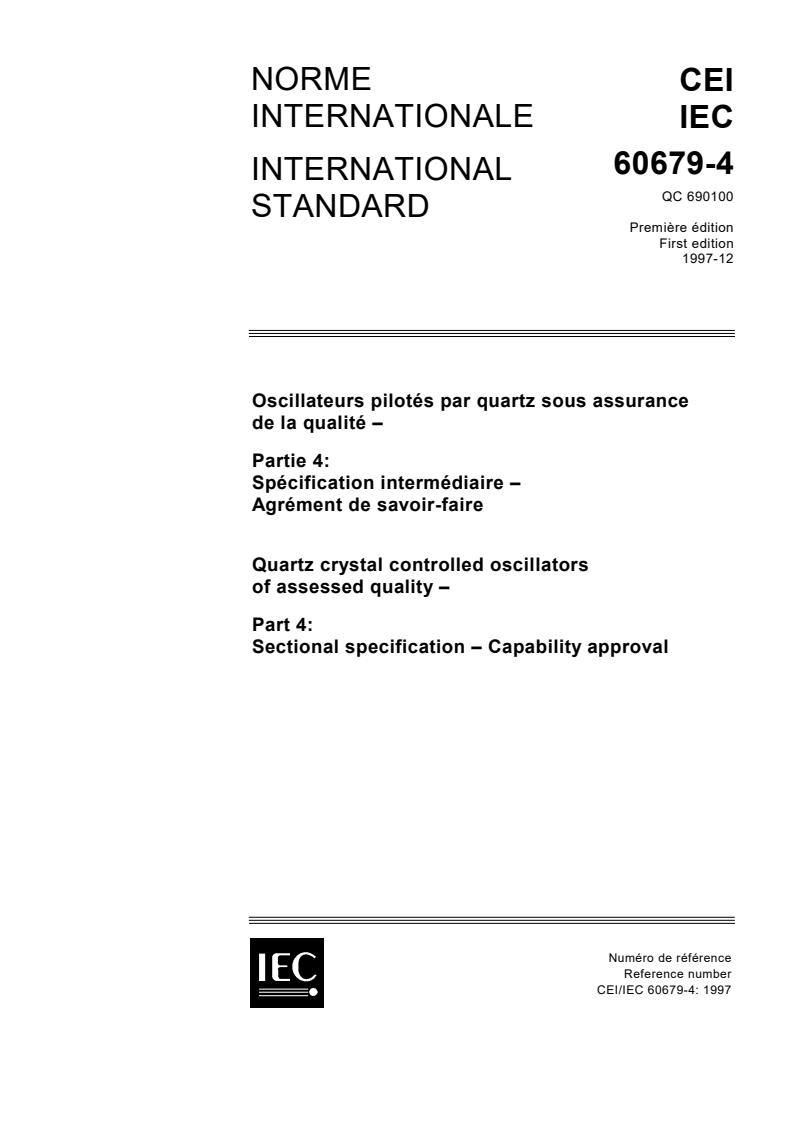
NORME
CEI
INTERNATIONALE
IEC
60679-4
INTERNATIONAL
QC 690100
STANDARD
Première édition
First edition
1997-12
Oscillateurs pilotés par quartz sous assurance
de la qualité –
Partie 4:
Spécification intermédiaire –
Agrément de savoir-faire
Quartz crystal controlled oscillators
of assessed quality –
Part 4:
Sectional specification – Capability approval
Numéro de référence
Reference number
CEI/IEC 60679-4: 1997
Numéros des publications Numbering
Depuis le 1er janvier 1997, les publications de la CEI As from the 1st January 1997 all IEC publications are
sont numérotées à partir de 60000. issued with a designation in the 60000 series.
Publications consolidées Consolidated publications
Les versions consolidées de certaines publications de Consolidated versions of some IEC publications
la CEI incorporant les amendements sont disponibles. including amendments are available. For example,
Par exemple, les numéros d’édition 1.0, 1.1 et 1.2 edition numbers 1.0, 1.1 and 1.2 refer, respectively, to
indiquent respectivement la publication de base, la the base publication, the base publication
publication de base incorporant l’amendement 1, et la incorporating amendment 1 and the base publication
publication de base incorporant les amendements 1 incorporating amendments 1 and 2.
et 2.
Validité de la présente publication Validity of this publication
Le contenu technique des publications de la CEI est The technical content of IEC publications is kept under
constamment revu par la CEI afin qu'il reflète l'état constant review by the IEC, thus ensuring that the
actuel de la technique. content reflects current technology.
Des renseignements relatifs à la date de Information relating to the date of the reconfirmation of
reconfirmation de la publication sont disponibles dans the publication is available in the IEC catalogue.
le Catalogue de la CEI.
Les renseignements relatifs à ces révisions, à l'établis- Information on the revision work, the issue of revised
sement des éditions révisées et aux amendements editions and amendments may be obtained from
peuvent être obtenus auprès des Comités nationaux de IEC National Committees and from the following
la CEI et dans les documents ci-dessous: IEC sources:
• Bulletin de la CEI • IEC Bulletin
• Annuaire de la CEI • IEC Yearbook
Accès en ligne* On-line access*
• Catalogue des publications de la CEI • Catalogue of IEC publications
Publié annuellement et mis à jour régulièrement Published yearly with regular updates
(Accès en ligne)* (On-line access)*
Terminologie, symboles graphiques Terminology, graphical and letter
et littéraux symbols
En ce qui concerne la terminologie générale, le lecteur For general terminology, readers are referred to
se reportera à la CEI 60050: Vocabulaire Electro- IEC 60050: International Electrotechnical Vocabulary
technique International (VEI). (IEV).
Pour les symboles graphiques, les symboles littéraux For graphical symbols, and letter symbols and signs
et les signes d'usage général approuvés par la CEI, le approved by the IEC for general use, readers are
referred to publications IEC 60027: Letter symbols to
lecteur consultera la CEI 60027: Symboles littéraux à
utiliser en électrotechnique, la CEI 60417: Symboles be used in electrical technology, IEC 60417: Graphical
graphiques utilisables sur le matériel. Index, relevé et symbols for use on equipment. Index, survey and
compilation des feuilles individuelles, et la CEI 60617: compilation of the single sheets and IEC 60617:
Symboles graphiques pour schémas. Graphical symbols for diagrams.
Publications de la CEI établies par IEC publications prepared by the same
le même comité d'études technical committee
L'attention du lecteur est attirée sur les listes figurant The attention of readers is drawn to the end pages of
à la fin de cette publication, qui énumèrent les this publication which list the IEC publications issued
publications de la CEI préparées par le comité by the technical committee which has prepared the
d'études qui a établi la présente publication. present publication.
* Voir adresse «site web» sur la page de titre. * See web site address on title page.
NORME
CEI
INTERNATIONALE
IEC
60679-4
INTERNATIONAL
QC 690100
STANDARD
Première édition
First edition
1997-12
Oscillateurs pilotés par quartz sous assurance
de la qualité –
Partie 4:
Spécification intermédiaire –
Agrément de savoir-faire
Quartz crystal controlled oscillators
of assessed quality –
Part 4:
Sectional specification – Capability approval
IEC 1997 Droits de reproduction réservés Copyright - all rights reserved
Aucune partie de cette publication ne peut être reproduite ni No part of this publication may be reproduced or utilized in
utilisée sous quelque forme que ce soit et par aucun any form or by any means, electronic or mechanical,
procédé, électronique ou mécanique, y compris la photo- including photocopying and microfilm, without permission in
copie et les microfilms, sans l'accord écrit de l'éditeur. writing from the publisher.
International Electrotechnical Commission 3, rue de Varembé Geneva, Switzerland
Telefax: +41 22 919 0300 e-mail: inmail@iec.ch IEC web site http: //www.iec.ch
CODE PRIX
Commission Electrotechnique Internationale
PRICE CODE U
International Electrotechnical Commission
Pour prix, voir catalogue en vigueur
For price, see current catalogue
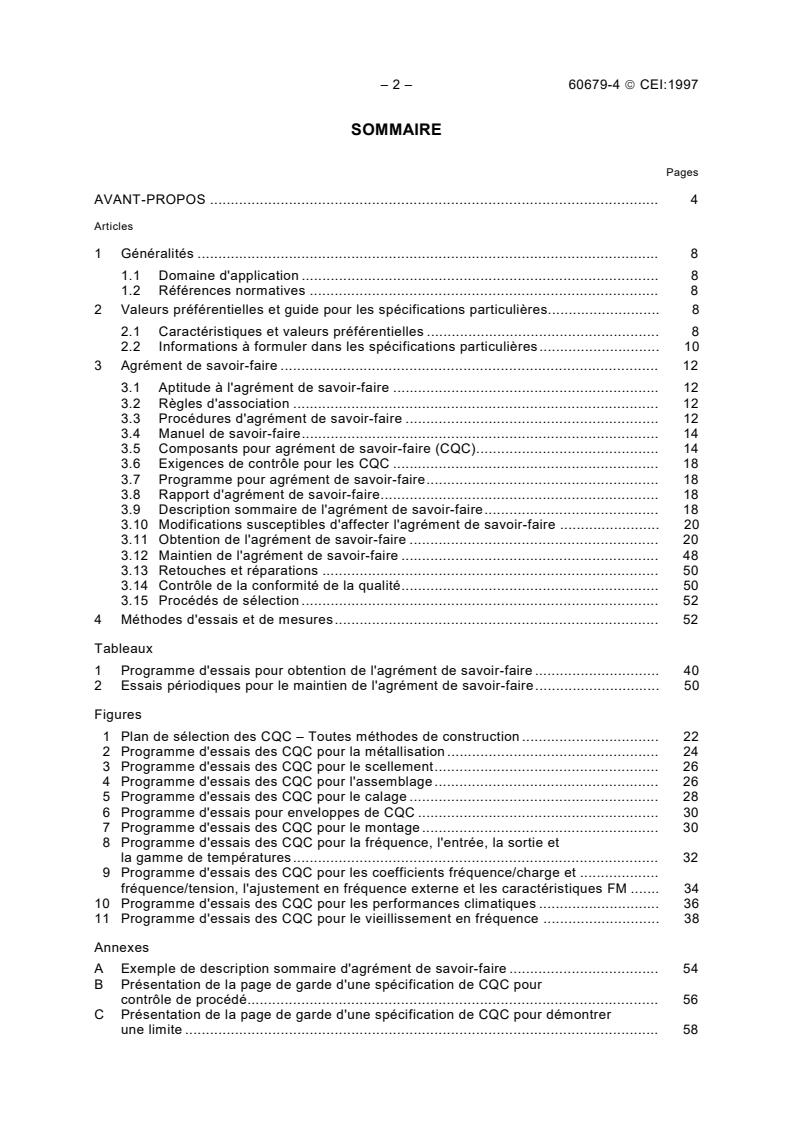
– 2 – 60679-4 CEI:1997
SOMMAIRE
Pages
AVANT-PROPOS . 4
Articles
1 Généralités . 8
1.1 Domaine d'application . 8
1.2 Références normatives . 8
2 Valeurs préférentielles et guide pour les spécifications particulières. 8
2.1 Caractéristiques et valeurs préférentielles . 8
2.2 Informations à formuler dans les spécifications particulières. 10
3 Agrément de savoir-faire . 12
3.1 Aptitude à l'agrément de savoir-faire . 12
3.2 Règles d'association . 12
3.3 Procédures d'agrément de savoir-faire . 12
3.4 Manuel de savoir-faire. 14
3.5 Composants pour agrément de savoir-faire (CQC). 14
3.6 Exigences de contrôle pour les CQC . 18
3.7 Programme pour agrément de savoir-faire. 18
3.8 Rapport d'agrément de savoir-faire. 18
3.9 Description sommaire de l'agrément de savoir-faire. 18
3.10 Modifications susceptibles d'affecter l'agrément de savoir-faire . 20
3.11 Obtention de l'agrément de savoir-faire . 20
3.12 Maintien de l'agrément de savoir-faire . 48
3.13 Retouches et réparations . 50
3.14 Contrôle de la conformité de la qualité. 50
3.15 Procédés de sélection . 52
4 Méthodes d'essais et de mesures. 52
Tableaux
1 Programme d'essais pour obtention de l'agrément de savoir-faire . 40
2 Essais périodiques pour le maintien de l'agrément de savoir-faire. 50
Figures
1 Plan de sélection des CQC – Toutes méthodes de construction . 22
2 Programme d'essais des CQC pour la métallisation . 24
3 Programme d'essais des CQC pour le scellement. 26
4 Programme d'essais des CQC pour l'assemblage . 26
5 Programme d'essais des CQC pour le calage . 28
6 Programme d'essais pour enveloppes de CQC . 30
7 Programme d'essais des CQC pour le montage . 30
8 Programme d'essais des CQC pour la fréquence, l'entrée, la sortie et
la gamme de températures. 32
9 Programme d'essais des CQC pour les coefficients fréquence/charge et .
fréquence/tension, l'ajustement en fréquence externe et les caractéristiques FM . 34
10 Programme d'essais des CQC pour les performances climatiques . 36
11 Programme d'essais des CQC pour le vieillissement en fréquence . 38
Annexes
A Exemple de description sommaire d'agrément de savoir-faire . 54
B Présentation de la page de garde d'une spécification de CQC pour
contrôle de procédé. 56
C Présentation de la page de garde d'une spécification de CQC pour démontrer
une limite . 58
60679-4 IEC:1997 – 3 –
CONTENTS
Page
FOREWORD . 5
Clause
1 General. 9
1.1 Scope . 9
1.2 Normative references. 9
2 Preferred values for ratings and guidance on detail specifications. 9
2.1 Preferred values for ratings and characteristics . 9
2.2 Information to be prescribed in detail specifications . 11
3 Capability approval. 13
3.1 Eligibility for capability approval. 13
3.2 Structural similarity . 13
3.3 Procedures for capability approval. 13
3.4 Capability manual. 15
3.5 Capability qualifying components (CQC). 15
3.6 Inspection requirements for CQCs. 19
3.7 Programme for capability approval . 19
3.8 Capability approval report. 19
3.9 Abstract of description of capability approval . 19
3.10 Modifications likely to affect the capability approval . 21
3.11 Initial capability approval . 21
3.12 Maintenance of capability approval . 49
3.13 Rework and repair work. 51
3.14 Quality conformance inspection. 51
3.15 Screening procedures . 53
4 Test and measurement procedures . 53
Tables
1 Test schedule for initial capability approval . 41
2 Periodic tests for maintenance of capability approval . 51
Figures
1 Selection of CQCs – All methods of construction . 23
2 Test plan for deposition for electrode material CQCs . 25
3 Test plan for bonding CQCs . 27
4 Test plan for component assembly CQCs . 27
5 Test plan for alignment CQCs. 29
6 Test plan for enclosures of CQCs. 31
7 Test plan for mounting CQCs . 31
8 Test plan for frequency, input, output and temperature range CQCs . 33
9 Test plan for frequency/load coefficient, frequency/voltage coefficient,
external frequency adjustment and FM characteristics CQCs . 35
10 Test plans for climatic performance CQCs. 37
11 Test plan for frequency ageing CQCs . 39
Annexes
A Example of layout of an abstract of description of capability approval. 55
B Layout of the front page of a CQC specification for process control. 57
C Layout of the front page of a CQC specification to demonstrate a boundary or limit. 59
– 4 – 60679-4 CEI:1997
COMMISSION ÉLECTROTECHNIQUE INTERNATIONALE
___________
OSCILLATEURS PILOTÉS PAR QUARTZ SOUS ASSURANCE
DE LA QUALITÉ –
Partie 4: Spécification intermédiaire – Agrément de savoir-faire
AVANT-PROPOS
1) La CEI (Commission Electrotechnique Internationale) est une organisation mondiale de normalisation composée
de l'ensemble des comités électrotechniques nationaux (Comités nationaux de la CEI). La CEI a pour objet de
favoriser la coopération internationale pour toutes les questions de normalisation dans les domaines de
l'électricité et de l'électronique. A cet effet, la CEI, entre autres activités, publie des Normes internationales.
Leur élaboration est confiée à des comités d'études, aux travaux desquels tout Comité national intéressé par le
sujet traité peut participer. Les organisations internationales, gouvernementales et non gouvernementales, en
liaison avec la CEI, participent également aux travaux. La CEI collabore étroitement avec l'Organisation
Internationale de Normalisation (ISO), selon des conditions fixées par accord entre les deux organisations.
2) Les décisions ou accords officiels de la CEI concernant les questions techniques représentent, dans la mesure
du possible un accord international sur les sujets étudiés, étant donné que les Comités nationaux intéressés
sont représentés dans chaque comité d’études.
3) Les documents produits se présentent sous la forme de recommandations internationales. Ils sont publiés
comme normes, rapports techniques ou guides et agréés comme tels par les Comités nationaux.
4) Dans le but d'encourager l'unification internationale, les Comités nationaux de la CEI s'engagent à appliquer de
façon transparente, dans toute la mesure possible, les Normes internationales de la CEI dans leurs normes
nationales et régionales. Toute divergence entre la norme de la CEI et la norme nationale ou régionale
correspondante doit être indiquée en termes clairs dans cette dernière.
5) La CEI n’a fixé aucune procédure concernant le marquage comme indication d’approbation et sa responsabilité
n’est pas engagée quand un matériel est déclaré conforme à l’une de ses normes.
6) L’attention est attirée sur le fait que certains des éléments de la présente Norme internationale peuvent faire
l’objet de droits de propriété intellectuelle ou de droits analogues. La CEI ne saurait être tenue pour
responsable de ne pas avoir identifié de tels droits de propriété et de ne pas avoir signalé leur existence.
La Norme internationale CEI 60679-4 a été établie par le comité d'études 49 de la CEI:
Dispositifs piézoélectriques et diélectriques pour la commande et le choix de la fréquence.
Cette norme est fondée sur le EN 169100: 1993, Oscillateurs pilotés par quartz (Agrément de
savoir-faire) du CECC.
Elle forme la partie 4 d'une série de normes pour les oscillateurs pilotés par quartz et constitue
une spécification dans le Système CEI d'assurance de la qualité des composants électroniques
(IECQ) où elle forme la spécification intermédiaire – Agrément de savoir-faire.
Le texte de cette norme est issu des documents suivants:
FDIS Rapport de vote
49/386/FDIS 49/390/RVD
Le rapport de vote indiqué dans le tableau ci-dessus donne toute information sur le vote ayant
abouti à l'approbation de cette norme.
60679-4 IEC:1997 – 5 –
INTERNATIONAL ELECTROTECHNICAL COMMISSION
___________
QUARTZ CRYSTAL CONTROLLED OSCILLATORS
OF ASSESSED QUALITY –
Part 4: Sectional specification – Capability approval
FOREWORD
1) The IEC (International Electrotechnical Commission) is a worldwide organization for standardization comprising
all national electrotechnical committees (IEC National Committees). The object of the IEC is to promote
international co-operation on all questions concerning standardization in the electrical and electronic fields. To
this end and in addition to other activities, the IEC publishes International Standards. Their preparation is
entrusted to technical committees; any IEC National Committee interested in the subject dealt with may
participate in this preparatory work. International, governmental and non-governmental organizations liaising
with the IEC also participate in this preparation. The IEC collaborates closely with the International Organization
for Standardization (ISO) in accordance with conditions determined by agreement between the two
organizations.
2) The formal decisions or agreements of the IEC on technical matters express, as nearly as possible, an
international consensus of opinion on the relevant subjects since each technical committee has representation
from all interested National Committees.
3) The documents produced have the form of recommendations for international use and are published in the form
of standards, technical reports or guides and they are accepted by the National Committees in that sense.
4) In order to promote international unification, IEC National Committees undertake to apply IEC International
Standards transparently to the maximum extent possible in their national and regional standards. Any
divergence between the IEC Standard and the corresponding national or regional standard shall be clearly
indicated in the latter.
5) The IEC provides no marking procedure to indicate its approval and cannot be rendered responsible for any
equipment declared to be in conformity with one of its standards.
6) Attention is drawn to the possibility that some of the elements of this International Standard may be the subject
of patent rights. The IEC shall not be held responsible for identifying any or all such patent rights.
International Standard IEC 60679-4 has been prepared by IEC technical committee 49:
Piezoelectric and dielectric devices for frequency control and selection.
This International Standard has been based on EN 169100: 1993, Quartz crystal controlled
oscillators (Capability approval) of the CECC.
It forms part 4 of a series of standards for quartz crystal controlled oscillators and also
constitutes a specification in the IEC Quality Assessment System for electronic components
(IECQ) where it forms the sectional specification – Capability approval.
The text of this standard is based on the following documents:
FDIS Report on voting
49/386/FDIS 49/390/RVD
Full information on the voting for the approval of this standard can be found in the report on
voting indicated in the above table.
– 6 – 60679-4 CEI:1997
La CEI 60679 comprend les parties suivantes présentées sous le titre général, Oscillateurs
pilotés par quartz sous assurance de la qualité:
– Partie 1: Spécification générique (CEI 60679-1)
– Partie 2: Guide pour l'utilisation des oscillateurs pilotés par quartz (CEI 60679-2)
– Partie 3: Encombrements normalisés et connexions des sorties (CEI 60679-3)
– Partie 4: Spécification intermédiaire – Agrément de savoir-faire (CEI 60679-4)
– Partie 4-1: Spécification particulière cadre – Agrément de savoir-faire (CEI 60679-4-1)
– Partie 5: Spécification intermédiaire – Homologation (CEI 60679-5)
– Partie 5-1: Spécification particulière cadre – Homologation (CEI 60679-5-1)
Le numéro QC qui figure sur la page de couverture de la présente publication est le numéro de
spécification dans le Système CEI d'assurance de la qualité des composants électroniques
(IECQ).
Les annexes A, B et C font partie intégrante de cette norme.
60679-4 IEC:1997 – 7 –
IEC 60679 consists of the following parts under the general title Quartz controlled oscillators of
assessed quality:
– Part 1: Generic specification (IEC 60679-1)
– Part 2: Guide to the use of quartz crystal controlled oscillators (IEC 60679-2)
– Part 3: Standard outlines and lead connections (IEC 60679-3)
– Part 4: Sectional specification – Capability approval (IEC 60679-4)
– Part 4-1: Blank detail specification – Capability approval (IEC 60679-4-1)
– Part 5: Sectional specification – Qualification approval (IEC 60679-5)
– Part 5-1: Blank detail specification – Qualification approval (IEC 60679-5-1)
The QC number which appears on the front cover of this publication is the specification number
in the IEC Quality Assessment System for Electronic Components (IECQ).
Annexes A, B and C form an integral part of this standard.
– 8 – 60679-4 CEI:1997
OSCILLATEURS PILOTÉS PAR QUARTZ SOUS ASSURANCE
DE LA QUALITÉ –
Partie 4: Spécification intermédiaire – Agrément de savoir-faire
1 Généralités
1.1 Domaine d'application
La présente partie de la CEI 60679 s'applique à des oscillateurs pilotés par quartz; ceux-ci sont
fabriqués à la demande ou sont des articles standards sur catalogue et leur qualité est évaluée
sur la base de l'agrément de savoir-faire.
Elle prescrit les caractéristiques et valeurs préférentielles accompagnées des essais
appropriés et méthodes de mesures contenus dans la spécification générique, CEI 60679-1.
Par ailleurs, y figurent les exigences de performance générales qui doivent être employées
dans les spécifications particulières pour les oscillateurs pilotés par quartz.
Le concept de valeurs préférentielles est directement applicable aux articles standard sur
catalogue mais ne s'applique pas nécessairement aux produits fabriqués à la demande.
1.2 Références normatives
Les documents normatifs suivants contiennent des dispositions qui, par suite de la référence
qui y est faite, constituent des dispositions valables pour la présente partie de la CEI 60679.
Au moment de la publication, les éditions indiquées étaient en vigueur. Tout document normatif
est sujet à révision et les parties prenantes aux accords fondés sur la présente partie de la
CEI 60679 sont invitées à rechercher la possibilité d'appliquer les éditions les plus récentes
des documents normatifs indiqués ci-après. Les membres de la CEI et de l'ISO possèdent le
registre des Normes internationales en vigueur.
Résonateurs à quartz – Spécification dans le Système CEI d'assurance de
CEI 61178-1:1993,
la qualité des composants électroniques (IECQ) – Partie 1: Spécification générique
CEI 60679-1:1997, Oscillateurs pilotés par quartz sous assurance de la qualité – Partie 1:
Spécification générique
CEI 60679-4-1– Oscillateurs pilotés par quartz sous assurance de la qualité – Partie 4-1:
1)
Spécification particulière cadre – Agrément de savoir-faire
2 Valeurs préférentielles et guide pour les spécifications particulières
2.1 Caractéristiques et valeurs préférentielles
Les valeurs données dans les spécifications particulières doivent être choisies de préférence
parmi celles figurant en 2.3 de la spécification générique CEI 60679-1.
________
1)
A publier.
60679-4 IEC:1997 – 9 –
QUARTZ CRYSTAL CONTROLLED OSCILLATORS
OF ASSESSED QUALITY –
Part 4: Sectional specification – Capability approval
1 General
1.1 Scope
This part of IEC 60679 applies to quartz crystal controlled oscillators as custom built products
or as standard catalogue items and whose quality is assessed on the basis of capability
approval.
It prescribes the preferred ratings and characteristics, with appropriate tests and measuring
methods contained in the generic specification, IEC 60679-1, and gives the general
performance requirements to be used in detail specifications for quartz crystal controlled
oscillators.
The concept of preferred values is directly applicable to standard catalogue items but does not
necessarily apply to custom built products.
1.2 Normative references
The following normative documents contain provisions which, through reference in this text,
constitute provisions of this part of IEC 60679. At the time of publication, the editions indicated
were valid. All normative documents are subject to revision, and parties to agreements based
on this part of IEC 60679 are encouraged to investigate the possibility of applying the most
recent editions of the normative documents indicated below. Members of IEC and ISO maintain
registers of currently valid International Standards.
IEC 61178-1:1993, Quartz crystal units – A specification in the IEC quality assessment system
for electronic components (IECQ) – Part 1: Generic specification
IEC 60679-1:1997, Quartz crystal controlled oscillators of assessed quality – Part 1: Generic
specification
IEC 60679-4-1– Quartz crystal controlled oscillators of assessed quality – Part 4-1: Blank detail
1)
specification – Capability approval
2 Preferred values for ratings and guidance on detail specifications
2.1 Preferred values for ratings and characteristics
The values given in detail specifications shall preferably be selected from those stated in 2.3 of
the generic specification IEC 60679-1.
________
1)
To be published.
– 10 – 60679-4 CEI:1997
2.2 Informations à formuler dans les spécifications particulières
(Aussi bien pour les produits standard sur catalogue que pour les produits fabriqués à la
demande.)
Un guide pour la rédaction des spécifications particulières est donné dans la spécification
particulière cadre, CEI 60679-4-1.
Chaque spécification particulière doit stipuler tous les essais et mesures nécessaires au
contrôle. Pour les articles standard, cela inclut au minimum d'y voir figurer les essais
correspondants donnés dans la spécification particulière cadre, avec les méthodes et les
sévérités.
Les informations suivantes doivent être données dans chaque spécification particulière.
2.2.1 Dessin d'encombrement et dimensions
La spécification particulière doit comprendre un dessin indiquant les dimensions de l'oscillateur
et/ou la référence à une norme internationale appropriée afin d'en faciliter la reconnaissance et
d'apporter les informations nécessaires aux procédures de dimensions et de mesures.
Les dimensions doivent inclure les dimensions complètes de l'enveloppe du composant, ainsi
que la taille et l'écartement des sorties. Toutes les dimensions doivent être indiquées en
millimètres.
Les connexions des sorties doivent être précisées pour toutes les enveloppes.
Quand une spécification particulière couvre plus d'une enveloppe, les dimensions et leurs
tolérances associées doivent être présentées sous forme d'un tableau placé au-dessous du
dessin.
Quand la configuration est différente de celle décrite ci-dessus, la spécification particulière doit
mentionner les informations dimensionnelles nécessaires pour décrire l'oscillateur à quartz de
façon adéquate.
2.2.2 Marquage
La spécification particulière doit décrire le contenu du marquage de l'oscillateur à quartz et de
l'emballage de base selon 2.4 de la CEI 60679-1.
2.2.3 Informations pour la commande
La spécification particulière doit préciser que les informations suivantes sont nécessaires lors
de la commande d'un oscillateur à quartz:
a) la quantité;
b) le numéro de la spécification particulière, le numéro et la date d'édition, et si ces données
sont applicables;
c) le type d'oscillateur (par exemple oscillateur à quartz simple en boîtier, oscillateur à quartz
commandé par une tension, oscillateur à quartz à compensation de température, etc.);
d) la fréquence nominale en kilohertz ou mégahertz;
e) la ou les tolérances sur la fréquence et la gamme de températures de fonctionnement;
f) la description complète de toute autre exigence pour identifier l'oscillateur.
60679-4 IEC:1997 – 11 –
2.2 Information to be prescribed in detail specifications
(Applies to both custom built and standard catalogue items.)
Guidance on the preparation of detail specifications is given in the future blank detail
specification, IEC 60679-4-1.
Each detail specification shall state all the tests and measurements required for inspection. For
standard catalogue items this shall, as a minimum, include the relevant tests given in the blank
detail specification, with methods and severities.
The following information shall be given in each detail specification.
2.2.1 Outline drawing and dimensions
The detail specification shall include a dimensional drawing of the crystal controlled oscillator,
and/or reference to an appropriate international standard, to permit easy recognition and to
provide information for dimensioning and gauging procedures.
The dimensions shall include the overall dimensions of the body of the component, and the
size and spacing of the terminations. All dimensions shall be stated in millimetres.
Terminal connections shall be identified for all enclosures.
When a detail specification covers more than one enclosure, the dimensions and their
associated tolerances shall be placed in a table below the drawing.
When the configuration is other than described above, the detail specification shall state such
dimensional information as will adequately describe the crystal controlled oscillator.
2.2.2 Marking
The detail specification shall prescribe the content of the marking on the crystal controlled
oscillator and on the primary package in accordance with 2.4 of IEC 60679-1.
2.2.3 Ordering information
The detail specification shall prescribe that the following information is required when ordering
a crystal controlled oscillator:
a) quantity;
b) detail specification number, issue number and date, and where applicable;
c) type of oscillator (e.g. SPXO, VCXO, TCXO, etc.);
d) nominal frequency in kilohertz or megahertz;
e) frequency tolerance(s) and operating temperature range;
f) full description of any additional requirements to identify the oscillator.
– 12 – 60679-4 CEI:1997
2.2.4 Informations supplémentaires (non soumises au contrôle)
La spécification particulière peut inclure des informations que la procédure de contrôle n'exige
pas normalement de vérifier, telles que schémas de fonctionnement, courbes, schémas et
notes nécessaires à la clarification.
3 Agrément de savoir-faire
3.1 Aptitude à l'agrément de savoir-faire
Avant de faire une demande d'agrément de savoir-faire, un fabricant doit obtenir l'agrément de
fabricant conformément à 10.2 de la CEI QC 001002.
L'étape initiale de fabrication doit être fixée comme défini en 3.1 de la CEI 60679-1.
3.2 Règles d'association
Les règles d'association ne sont pas applicables à l'agrément de savoir-faire. Cependant elles
sont applicables aux lots de livraison comme cela est défini en 3.14.1 de la présente
spécification.
3.3 Procédures d'agrément de savoir-faire
3.3.1 Généralités
L'agrément de savoir-faire pour la technologie des oscillateurs à quartz comprend
– l'ensemble des paramètres de conception, les techniques de fabrication et de préparation
des matériaux, y compris les procédures d'essais et de contrôle,
– les limites de performance énoncées pour les procédés et produits, c'est-à-dire ceux
spécifiés pour les composants pour agrément de savoir-faire (CQC),
– la gamme des structures mécaniques pour laquelle l'agrément est accordé.
3.3.2 Demande d'agrément de savoir-faire
Afin d'obtenir l'agrément de savoir-faire, le fabricant doit appliquer les règles de procédure
données en 11.7 de la CEI QC 001002.
Dans une demande d'agrément de savoir-faire, le fabricant doit définir les limites du savoir-
faire pour lequel il demande l'agrément, conformément à 3.5 de la présente spécification.
3.3.3 Attribution de l'agrément de savoir-faire
L'agrément de savoir-faire doit être accordé au fabricant quand celui-ci a
– préparé un manuel d'agrément de savoir-faire décrivant le savoir-faire pour lequel il
demande l'agrément, en accord avec l'ONS (Organisme National de Surveillance),
– obtenu l'approbation de l'ONS sur la gamme de CQC, selon la définition de 11.7.2 de la
CEI QC 001002, qu'il convient d'employer pour l'évaluation du savoir-faire,
– démontré avec succès qu'il peut concevoir et fabriquer des composants qui sont à même
de satisfaire aux exigences de cette spécification intermédiaire, dans les limites de ce
savoir-faire,
– préparé un rapport d'essais pour agrément de savoir-faire satisfaisant l'ONS.
60679-4 IEC:1997 – 13 –
2.2.4 Additional information (not for inspection purposes)
The detail specification may include information which is not normally required to be verified by
the inspection procedure, such as circuit diagrams, curves, drawings and notes needed for
clarification.
3 Capability approval
3.1 Eligibility for capability approval
Prior to making an application for capability approval a manufacturer shall first obtain
manufacturer's inspection approval in accordance with 10.2 of IEC QC 001002.
The primary stage of manufacture shall be as defined in 3.1 of IEC 60679-1.
3.2 Structural similarity
Structural similarity is not applicable to capability approval. However, it is applicable to
released lots as defined in 3.14.1 of this specification.
3.3 Procedures for capability approval
3.3.1 General
Capability approval in quartz crystal controlled oscillator technology covers
– the complete design, material preparation and manufacturing techniques, including control
procedures and tests,
– the performance limits claimed for the processes and products, that is those specified for
the capability qualifying components (CQCs),
– the range of mechanical structures for which approval is granted.
3.3.2 Application for capability approval
In order to obtain capability approval the manufacturer shall apply the rules of procedure given
in 11.7 of IEC QC 001002.
In an application for capability approval the manufacturer shall define the boundaries of the
capability for which approval is sought, in accordance with 3.5 of this specification.
3.3.3 Granting of capability approval
Capability approval shall be granted when the manufacturer has
– prepared a capability manual describing the capability for which he wishes to be approved,
to the satisfaction of the National Supervising Inspectorate (NSI),
– agreed with the NSI the range of CQCs, as defined in 11.7.2 of IEC QC 001002, to be used
for the assessment of the capability,
– successfully demonstrated that he can design and manufacture components which satisfy
the requirements of this sectional specification, within the limits of this capability,
– prepared a capability approval test report to the satisfaction of the NSI.
– 14 – 60679-4 CEI:1997
3.4 Manuel de savoir-faire
Le fabricant doit préparer un manuel décrivant son savoir-faire (voir 11.7.2 de la
CEI QC 001002) relatif aux technologies impliquées.
Le manuel doit être approuvé par l'ONS, qui doit garantir qu'il constitue un énoncé vrai et
complet des procédés utilisés par le fabricant pour la conception, la production, les essais, le
contrôle et la recette de ses produits. Ce manuel doit être considéré comme un document
confidentiel commerce.
Le manuel doit comprendre au minimum les points suivants:
– une introduction générale et une description des technologies impliquées;
– les aspects des relations avec la clientèle incluant la fourniture de règles de conception
(s'il y a lieu) et l'assistance à la clientèle quant à la formulation de ses besoins;
– une description détaillée des règles de conception à employer;
– la procédure qui permettra de vérifier que les règles de conception sont respectées pour
les oscillateurs à quartz fabriqués selon une spécification particulière;
– une liste de tous les matériaux employés, avec références aux spécifications d'achat et au
contrôle d'entrée;
– un plan de travail de tous les procédés indiquant les points de contrôle de qualité et les
circuits de retouche autorisés, et faisant apparaître les références de tous les moyens et
procédés de contrôle de qualité;
– une déclaration des procédés pour lesquels l'agrément a été demandé, conformément
à 3.5.1;
– une déclaration des limites pour lesquelles l'agrément a été demandé, conformément
à 3.5.2;
– une liste des composants pour agrément de savoir-faire (CQC) employés pour évaluer le
savoir-faire, comportant une description générale de chacun avec, à l'appui, un tableau
détaillé faisant apparaître à quel stade les limites de savoir-faire déclarées sont vérifiées
par un CQC particulier;
– une spécification particulière pour chaque CQC. Ces spécifications doivent être produites
en accord avec l'ONS (voir annexes B et C).
3.5 Composants pour agrément de savoir-faire (CQC)
Parmi les méthodes fondamentales de construction des oscillateurs pilotés par quartz on
trouve
a) les techniques des composants avec fils,
qui recouvrent l'assemblage des composants à sorties par fils pour cartes imprimées,
b) les techniques des composants pour montage en surface,
qui recouvrent l'assemblage des composants conçus pour un montage en surface,
c) les techniques des pellicules minces et épaisses,
qui recouvrent l'assemblage des composants à pellicules épaisses ou minces sur les
substrats,
d) les techniques de montage mécanique ou par collage,
qui recouvrent l'assemblage des composants mécaniquement ou par fils.
Ces méthodes de construction ou les combinaisons de ces méthodes peuvent comprendre soit
des résonateurs étanches, soit des résonateurs sans enveloppe.
60679-4 IEC:1997 – 15 –
3.4 Capability manual
The manufacturer shall prepare a manual describing his capability (see 11.7.2 of
IEC QC 001002) in relation to the technologies involved.
The manual shall be approved by the NSI, who shall ensure that it is a true and complete
record of the procedures carried out by the manufacturer during the design, production, testing,
inspection, and release of his products. The manual is a document that shall be treated as
commercial in confidence.
The manual shall include the following as a minimum:
– a general introduction and description of the technologies involved;
– aspects of customer liaison, including provisions of design rules (if appropriate), and
assistance to customers in the formulation of their requirements;
– a detailed description of the design rules to be used;
– the procedure for checking that the design rules are complied with for quartz crystal
controlled oscillators manufactured to a detail specification;
– a list of all materials used, with references to the corresponding purchasing specifications
and goods inward inspection;
– a flow chart for the total process showing quality control points and permitted rework loops,
and containing references to all process and quality control procedures;
– a declaration of processes for which approval has been sought, in accordance with 3.5.1;
– a declaration of boundaries for which approval has been sought, in accordance with 3.5.2;
– a list of capability qualifying components (CQCs) used to assess the capability, with a
general description of each, supported by a detailed table showing where the declared
boundaries of capability are demonstrated by a particular CQC;
– a detail specification for each CQC. These specifications shall be produced to the
satisfaction of the NSI (see annexes B and C).
3.5 Capability qualifying components (CQC)
There are basic methods of construction of quartz crystal controlled oscillators which include
a) leaded component techniques,
comprising assembly of wire leaded components in printed circuit board (PCB) laminates,
b) surface mounting techniques,
comprising assembly of components designed for surface mounting,
c) thick and thin film techniques,
comprising assembly of components in either thick or thin film on substrates,
d) die and wire bond techniques,
comprising assembly of components by die attach and wire bonding.
These methods of construction, or combinations thereof, may incorporate either sealed crystal
units or unencapsulated crystal units.
– 16 – 60679-4 CEI:1997
Dans le cadre de l'agrément de savoir-faire, c'est la méthode de construction qui doit être
considérée en premier et les spécimens doivent comprendre les sous-familles d'oscillateurs
pour lesquels on demande l'agrément.
La classification donnée ci-dessus couvre toutes les sous-familles d'oscillateurs, par exemple
les oscillateurs à quartz simple en boîtier, les oscillateurs à quartz commandés par une
tension, les oscillateurs à quartz à compensation de température et les oscillateurs à quartz à
enceinte à température régulée. Dans le cadre de l'agrément de savoir-faire, la méthode doit
comprendre toutes les sous-familles d'oscillateurs pour lesquels on demande l'agrément. La
réunion des sous-familles n'est pas autorisée quand il s'agit de valider la conception et les
performances selon 3.11.5.
Le fabricant doit se mettre d'accord avec l'ONS sur la gamme de CQC nécessaires selon le
plan général (voir 3.11.2), spécifiée dans le manuel de savoir-faire. Les CQC doivent satisfaire
aux exigences suivantes:
a) la gamme de CQC employée doit couvrir tous les procédés, tous les types de composants
et toutes les limites du savoir-faire déclaré;
b) les CQC doivent être
– soit des véhicules d'essais conçus pour évaluer un procédé ou une gamme de
procédés,
– soit des oscillateurs à quartz en production,
– soit une combinaison des deux, à condition que les exigences de a) soient satisfaites.
Lorsque les CQC sont conçus et produits uniquement pour l'agrément de savoir-faire, le
fabricant doit assurer à l'ONS que les mêmes règles de conception, matériaux et procédés de
fabrication seront appliquées aux produits recettés.
Les spécifications des CQC peuvent s'appuyer sur la documentation des méthodes de contrôle
interne qui décrit les méthodes d'essais de production et l'enregistrement des relevés de
mesures, afin d'attester le contrôle et la maintenance des procédés et des limites.
3.5.1 Procédés
Dans la rédaction des spécifications des CQC, les procédés donnés ci-dessous, dont la liste
n'est pas exhaustive, doivent être vérifiés:
– métallisation de la l
...