IEC 62305-2:2024/COR1:2024
(Corrigendum)Corrigendum 1 - Protection against lightning - Part 2: Risk management
Corrigendum 1 - Protection against lightning - Part 2: Risk management
IEC 62305-2:2024 is applicable to the risk management of a structure due to lightning flashes to earth.
Its purpose is to provide a procedure for the evaluation of such a risk. Once an upper tolerable limit for the risk has been selected, this procedure provides a means for the selection of appropriate protection measures to be adopted to reduce the risk to or below the tolerable limit.
This third edition cancels and replaces the second edition, published in 2010. This edition constitutes a technical revision.
This edition includes the following significant technical changes with respect to the previous edition:
a) The concept of a single risk, to combine loss of human life and loss due to fire, has been introduced.
b) The concept of frequency of damage that can impair the availability of the internal systems within the structure has been introduced.
c) The lightning ground strike-point density NSG has been introduced replacing the lightning flash density NG in the evaluation of expected average annual number of dangerous events.
d) Reduction of a few risk components can be achieved by the use of preventive temporary measures activated by means of a thunderstorm warning system (TWS) compliant with IEC 62793. The risk of direct strike to people in open areas has been introduced, considering the reduction of that risk using a TWS.
Corrigendum 1 - Protection contre la foudre - Partie 2: Évaluation des risques
L'IEC 62305-2:2024 s'applique à l'évaluation des risques auxquels une structure est exposée en raison des coups de foudre à la terre.
Elle est destinée à proposer une procédure d'évaluation d'un tel risque. Lorsque la limite supérieure du risque tolérable est fixée, la procédure permet de choisir les mesures de protection appropriées pour réduire le risque à une valeur inférieure ou égale à la valeur limite tolérable.
Cette troisième édition annule et remplace la deuxième édition parue en 2010. Cette édition constitue une révision technique.
Cette édition inclut les modifications techniques majeures suivantes par rapport à l'édition précédente:
a) adoption du concept de risque unique, afin de combiner les pertes de vies humaines et les pertes dues à un incendie;
b) adoption du concept de fréquence des dommages qui peuvent influencer la disponibilité des réseaux internes à la structure;
c) adoption de la densité de points d'impact au sol de la foudre NSG en remplacement de la densité des coups de foudre NG dans l'évaluation du nombre moyen annuel d'événements dangereux prévisibles;
d) la réduction de quelques composantes de risque peut être obtenue par l'utilisation de mesures préventives temporaires activées par un système d'alerte aux orages (TWS) conforme à l'IEC 62793. Le risque que des personnes soient directement frappées par la foudre dans des espaces ouverts a été décrit, en tenant compte de la réduction de ce risque au moyen d'un TWS.
General Information
Relations
Standards Content (Sample)
© IEC 2024
INTERNATIONAL ELECTROTECHNICAL COMMISSION
COMMISSION ÉLECTROTECHNIQUE INTERNATIONALE
____________
IEC 62305-2 IEC 62305-2
Edition 3.0 2024-09 Édition 3.0 2024-09
PROTECTION AGAINST LIGHTNING PROTECTION CONTRE LA FOUDRE
Part 2: Risk management Partie 2: Évaluation des risques
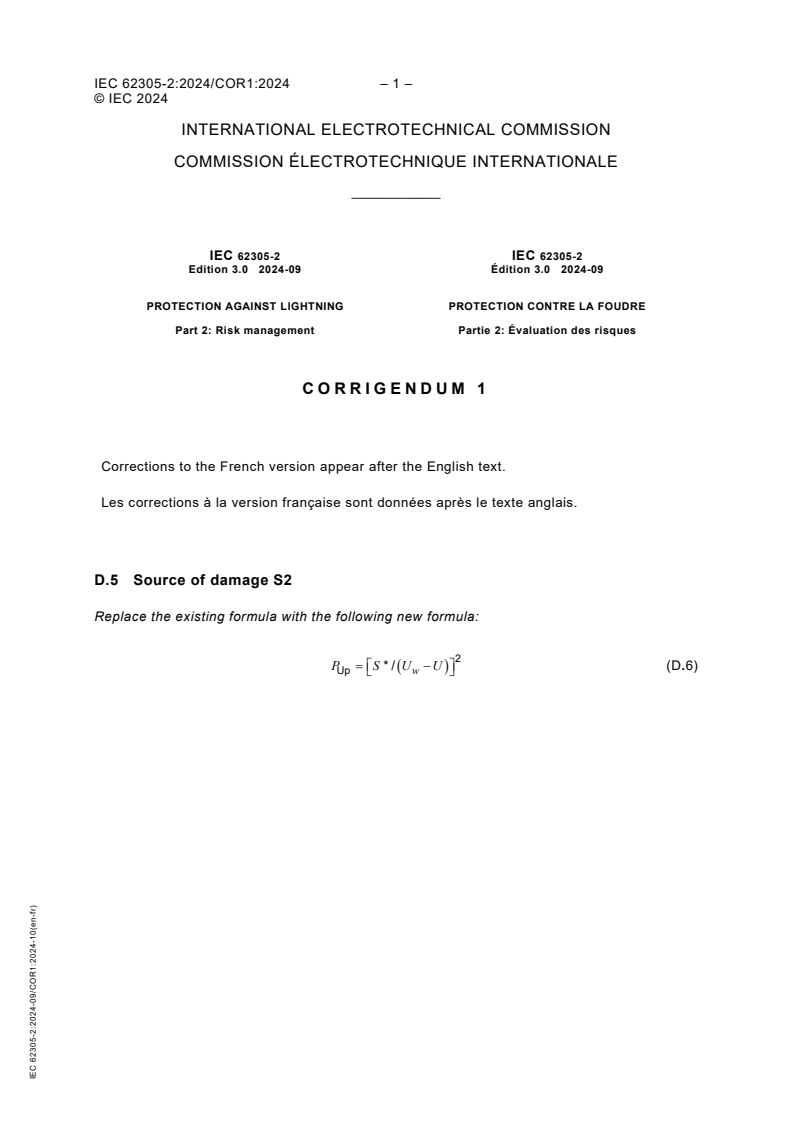
CO RRI G E NDUM 1
Corrections to the French version appear after the English text.
Les corrections à la version française sont données après le texte anglais
...
Frequently Asked Questions
IEC 62305-2:2024/COR1:2024 is a standard published by the International Electrotechnical Commission (IEC). Its full title is "Corrigendum 1 - Protection against lightning - Part 2: Risk management". This standard covers: IEC 62305-2:2024 is applicable to the risk management of a structure due to lightning flashes to earth. Its purpose is to provide a procedure for the evaluation of such a risk. Once an upper tolerable limit for the risk has been selected, this procedure provides a means for the selection of appropriate protection measures to be adopted to reduce the risk to or below the tolerable limit. This third edition cancels and replaces the second edition, published in 2010. This edition constitutes a technical revision. This edition includes the following significant technical changes with respect to the previous edition: a) The concept of a single risk, to combine loss of human life and loss due to fire, has been introduced. b) The concept of frequency of damage that can impair the availability of the internal systems within the structure has been introduced. c) The lightning ground strike-point density NSG has been introduced replacing the lightning flash density NG in the evaluation of expected average annual number of dangerous events. d) Reduction of a few risk components can be achieved by the use of preventive temporary measures activated by means of a thunderstorm warning system (TWS) compliant with IEC 62793. The risk of direct strike to people in open areas has been introduced, considering the reduction of that risk using a TWS.
IEC 62305-2:2024 is applicable to the risk management of a structure due to lightning flashes to earth. Its purpose is to provide a procedure for the evaluation of such a risk. Once an upper tolerable limit for the risk has been selected, this procedure provides a means for the selection of appropriate protection measures to be adopted to reduce the risk to or below the tolerable limit. This third edition cancels and replaces the second edition, published in 2010. This edition constitutes a technical revision. This edition includes the following significant technical changes with respect to the previous edition: a) The concept of a single risk, to combine loss of human life and loss due to fire, has been introduced. b) The concept of frequency of damage that can impair the availability of the internal systems within the structure has been introduced. c) The lightning ground strike-point density NSG has been introduced replacing the lightning flash density NG in the evaluation of expected average annual number of dangerous events. d) Reduction of a few risk components can be achieved by the use of preventive temporary measures activated by means of a thunderstorm warning system (TWS) compliant with IEC 62793. The risk of direct strike to people in open areas has been introduced, considering the reduction of that risk using a TWS.
IEC 62305-2:2024/COR1:2024 is classified under the following ICS (International Classification for Standards) categories: 29.020 - Electrical engineering in general; 91.120.40 - Lightning protection. The ICS classification helps identify the subject area and facilitates finding related standards.
IEC 62305-2:2024/COR1:2024 has the following relationships with other standards: It is inter standard links to IEC 62305-2:2024. Understanding these relationships helps ensure you are using the most current and applicable version of the standard.
You can purchase IEC 62305-2:2024/COR1:2024 directly from iTeh Standards. The document is available in PDF format and is delivered instantly after payment. Add the standard to your cart and complete the secure checkout process. iTeh Standards is an authorized distributor of IEC standards.
La norme IEC 62305-2:2024/COR1:2024, qui traite de la gestion des risques liés aux impacts de la foudre, représente une avancée significative dans le domaine de la protection contre la foudre. Son champ d'application est clair : il s'agit d'évaluer le risque pour une structure en raison des éclairs qui frappent le sol. Ce corrigendum apporte des modifications techniques notables, renforçant ainsi la pertinence de cette norme pour les professionnels du secteur. Parmi les points forts de cette norme, on constate l'introduction du concept de risque unique, qui combine la perte de vie humaine et les pertes causées par les incendies. Cette approche holistique permet une meilleure évaluation des dommages potentiels, ce qui est essentiel pour une gestion efficace des risques. De plus, l'intégration du concept de fréquence des dommages, pouvant impacter la disponibilité des systèmes internes d'une structure, est un ajout pertinent qui souligne l'importance de la résilience des infrastructures. La norme introduit également la densité des points de frappe de la foudre (NSG), remplaçant la densité des éclairs (NG) dans l'évaluation de l'annuel moyen des événements dangereux. Ce changement souligne une approche plus précise et adaptée aux réalités actuelles des catastrophes naturelles et permet une évaluation plus robuste des risques liés à la foudre. Un autre aspect notable est l'inclusion de mesures préventives temporaires qui peuvent être activées par un système d'alerte de tempête (TWS) conforme à la norme IEC 62793. Cela ouvre la voie à une réduction proactive des risques, en particulier concernant les impacts directs sur les personnes se trouvant en plein air. L'importance de cette mesure ne peut être sous-estimée dans des contextes où la sécurité humaine est une priorité. En conclusion, le corrigendum 1 de la norme IEC 62305-2:2024 apporte des améliorations substantielles et des mises à jour qui renforcent sa pertinence dans la gestion des risques liés à la foudre. Les ajouts techniques et l'approche intégrée permettent une évaluation plus précise et une meilleure protection des structures, ce qui est essentiel dans un monde où les événements climatiques extrêmes deviennent de plus en plus fréquents.
Die Norm IEC 62305-2:2024/COR1:2024 stellt eine wesentliche Grundlage für das Risikomanagement von Gebäuden im Hinblick auf Blitzeinschläge dar. Der Umfang der Norm bezieht sich auf die systematische Bewertung von Risiken, die durch Blitzeinschläge verursacht werden können, und bietet eine strukturierte Vorgehensweise zur Einführung angemessener Schutzmaßnahmen. Dies ist besonders relevant für Ingenieure, Architekten und Sicherheitsbeauftragte, die für den Schutz von Menschen und Sachwerten verantwortlich sind. Eine der herausragenden Stärken dieser Norm ist die Einführung eines integrierten Konzepts zur Risikobewertung, das den Verlust von Menschenleben sowie die finanziellen Verluste durch Feuer berücksichtigt. Durch die Berücksichtigung von Frequenzen von Schäden, die die Verfügbarkeit interner Systeme beeinträchtigen können, zeigt die Norm ein tieferes Verständnis der komplexen Zusammenhänge zwischen Holzschaden und dem sicherheitsrelevanten Betrieb. Die Überarbeitung bringt auch wesentliche technische Neuerungen mit sich. Beispielsweise wird die Blitz-Standortdichte (NSG) anstelle der zuvor verwendeten Blitzfrequenz (NG) eingeführt, was eine präzisere Einschätzung der erwarteten durchschnittlichen jährlichen Anzahl gefährlicher Ereignisse ermöglicht. Außerdem unterstützt die Norm die Reduktion von Risikokomponenten durch den Einsatz präventiver temporärer Maßnahmen, die durch ein Gewitterwarnsystem (TWS) aktiviert werden – ein wichtiger Fortschritt, um das Risiko von direkten Blitzeinschlägen auf Personen in offenen Bereichen zu minimieren. Die Norm veranschaulicht somit nicht nur die Notwendigkeit eines strategischen Ansatzes im Risikomanagement, sondern bringt auch innovative Konzepte ein, die an die aktuellen Technologien und Bedürfnisse angepasst sind. Die IEC 62305-2:2024/COR1:2024 ist daher eine unverzichtbare Ressource für alle, die sich mit dem Schutz gegen Blitzeinschläge beschäftigen, und hat erhebliche Relevanz für die Verbesserung der Sicherheit von Strukturen in zunehmend gestörten Wetterbedingungen.
IEC 62305-2:2024/COR1:2024 presents a comprehensive framework for the effective risk management of structures susceptible to lightning strikes. The standard's primary focus is to evaluate the risks posed by lightning flashes to earth, which is crucial given the potential for loss of life and property damage. This updated edition marks a significant technical revision from its predecessor, offering enhanced methodologies and concepts for risk assessment. One of the standout strengths of IEC 62305-2:2024 is its introduction of the single risk concept, merging considerations of human life loss with fire-related losses. This holistic approach allows for a more integrated evaluation of risks, ultimately enabling better-informed decision-making regarding protective measures. Additionally, the standard's incorporation of the frequency of damage metric further refines risk assessment by factoring in how often damage could disrupt internal systems, which is vital for maintaining operational integrity within a structure. The revision also replaces the earlier terminology for evaluating the expected average annual number of dangerous events. The introduction of lightning ground strike-point density (NSG) instead of lightning flash density (NG) represents a crucial advancement in precision, enhancing the reliability of risk evaluations. Furthermore, the standard acknowledges the potential mitigative effect of preventive measures, specifically through the use of a thunderstorm warning system (TWS), compliant with IEC 62793. This innovative strategy introduces a proactive element to risk management, allowing for temporary protective measures to be enacted during storm events. In summary, IEC 62305-2:2024/COR1:2024 is an essential document for professionals in the field, combining advanced technical concepts with practical applications for managing lightning risk. Its updated guidelines ensure that stakeholders can effectively reduce risks to acceptable limits, making it highly relevant in today's context of heightening awareness around lightning-related dangers.
IEC 62305-2:2024/COR1:2024の標準のレビューでは、その範囲、強み、そして関連性に焦点を当てます。 この標準は、構造物に対する雷によるリスク管理に適用されます。雷が地面に落ちることによるリスクを評価する手順を提供することを目的としており、許容可能なリスクの上限を選定した後には、そのリスクを許容限界以下になるように適切な保護措置を選定するための手段を提供します。この第3版は、2010年に発行された第2版を廃止し、置き換えるものであり、技術的な改訂がなされています。 この版には、前版に対する以下の重要な技術的変更が含まれています。まず、人的生命の喪失と火災による損失を統合するための単一リスクの概念が導入されました。また、構造物内の内部システムの可用性を損なう可能性のある損害の頻度の概念も新たに加えられています。雷が落ちる地点の密度(NSG)が導入され、予期される年間危険事象の平均数の評価において、従来の雷閃光密度(NG)が置き換えられています。 さらに、IEC 62793に準拠した雷雨警報システム(TWS)を活用することで、いくつかのリスク要素を軽減することが可能になることが示されています。特に、屋外にいる人々に対する直接的な雷撃リスクが導入され、TWSを用いることでそのリスクの軽減が検討されています。 これらの特徴は、IEC 62305-2:2024/COR1:2024が現代における雷保護の重要性を反映し、リスク管理の実践において非常に関連性が高いことを示しています。標準が提供する明確な手順と体系的アプローチは、構造物への保護をより強固にするための基盤を築くものとなっており、その意義は極めて大きいと言えます。
IEC 62305-2:2024/COR1:2024는 번개에 의한 위험 관리를 위한 표준으로, 구조물에 대한 번개로 인한 위험을 평가하는 절차를 제공합니다. 이 표준의 주요 목적은 허용 가능한 위험 한계를 설정하고, 이를 기준으로 적절한 보호 조치를 선택하여 위험을 최소화하는 것입니다. 이번 표준의 강점 중 하나는 인간 생명 손실과 화재로 인한 손실을 통합하는 단일 위험 개념의 도입입니다. 이를 통해 위험을 보다 포괄적으로 평가할 수 있으며, 다양한 사례에 적합한 방안을 제시할 수 있습니다. 또한, 구조물 내부 시스템의 가용성에 영향을 미치는 손상의 빈도 개념이 도입되어, 보다 정확한 위험 평가가 가능해졌습니다. 기술적으로는, 예상되는 평균 연간 위험 사건 수의 평가에서 번개 표적 밀도(NSG)를 도입함으로써 기존의 번개 플래시 밀도(NG)를 대체했습니다. 이러한 변화는 더 신뢰할 수 있는 위험 분석을 가능하게 하여, 사용자들이 보다 나은 보호 전략을 개발할 수 있도록 합니다. 또한, IEC 62793에 부합하는 천둥 경고 시스템(TWS)을 이용한 예방적 임시 조치의 사용으로 몇 가지 위험 요소를 줄일 수 있는 방법이 제시되었습니다. 이는 특히 개방 공간에서 사람에 대한 직접적인 번개 위험을 줄이는 데 도움을 줄 수 있습니다. IEC 62305-2:2024/COR1:2024는 이러한 기술적 개선을 통해, 번개로 인한 위험 관리를 위한 기준을 제공하며, 현대 구조물의 안전성을 보장하는 데 중요한 역할을 합니다. 따라서 이 표준은 위험 관리를 체계적으로 접근하는 데 있어 필수적이며, 매우 relevant한 자료입니다.


Questions, Comments and Discussion
Ask us and Technical Secretary will try to provide an answer. You can facilitate discussion about the standard in here.
Loading comments...