

IEC 60317-0-1:2013/AMD2:2026
(Amendment)Amendment 2 - Specifications for particular types of winding wires - Part 0-1: General requirements - Enamelled round copper wire
- Status
- Published
- Publication Date
- 20-Aug-2026
- Technical Committee
- TC 55 - Winding wires
- Drafting Committee
- WG 1 - Specification sheets
- Current Stage
- PPUB - Publication issued - 60 Publication
- Start Date
- 21-Aug-2026
- Due Date
- 11-Sep-2026
- Completion Date
- 11-Sep-2026
Buy Documents
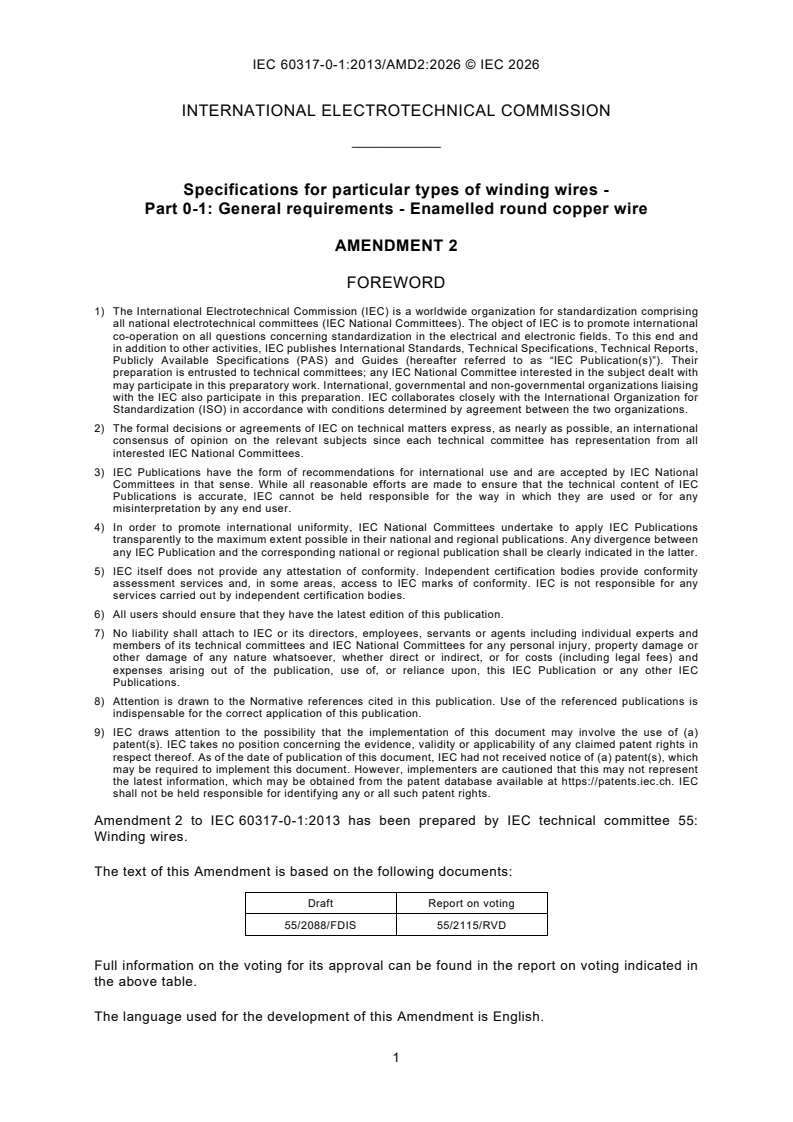
IEC 60317-0-1:2013/AMD2:2026 - Amendment 2 - Specifications for particular types of winding wires - Part 0-1: General requirements - Enamelled round copper wire
iec60317-0-1-amd2{ed4.0}fr - Amendement 2 - Spécifications pour types particuliers de fils de bobinage - Partie 0-1: Exigences générales - Fil de section circulaire en cuivre émaillé
IEC 60317-0-1:2013/AMD2:2026 is an IEC amendment to the general requirements for enamelled round copper wire used in winding wires. It updates the electrical resistance provisions and the minimum breakdown-voltage tables for conductor diameters, and it revises Annex C with resistance limits at 20 °C for larger conductors. It is aimed at manufacturers, purchasers, and test laboratories that specify or verify enamelled round copper wire.
What does IEC 60317-0-1:2013/AMD2:2026 specify?
IEC 60317-0-1:2013/AMD2:2026 amends IEC 60317-0-1 for enamelled round copper wire. The amendment is organized as targeted changes to Clause 5, Clause 13.2, Tables 8 and 9, and Annex C Table C.1.
| Part of the document | What it covers |
|---|---|
| Clause 5 | Electrical resistance, including when measurements may be agreed between buyer and supplier |
| Clause 13.2 | Nominal conductor diameters used for breakdown-voltage requirements |
| Table 8 | Minimum breakdown voltage for preferred diameters (R 20) |
| Table 9 | Minimum breakdown voltage for intermediate diameters (R 40) |
| Annex C, Table C.1 | Electrical resistance limits at 20 °C for larger conductor diameters |
What are the key requirements of IEC 60317-0-1:2013/AMD2:2026?
Electrical resistance
- Clause 5 allows electrical resistance measurements for nominal conductor diameters greater than 0.280 mm only when buyer and supplier agree. In practice, this means the resistance check should be written into the purchase specification or test agreement before ordering.
- When that agreement exists, the resistance at 20 °C must fall within the limits in Annex C. This gives a clear acceptance criterion for larger wires and avoids disputes over test results.
Breakdown voltage
- Clause 13.2 extends the diameter range covered by the breakdown-voltage table to nominal conductor diameters up to 0.500 mm. Users who work with thicker wire need to apply the revised limits, not the older narrower range.
- Table 8 gives the minimum breakdown voltage at ambient temperature for preferred conductor diameters (R 20) from 0.018 mm to 0.500 mm, for Grade 1, Grade 2, Grade 3, and grades 1B and 2B. This is the main selection table for standard sizes.
- Table 9 gives the same type of minimum breakdown-voltage values for intermediate conductor diameters (R 40) from 0.019 mm to 0.475 mm. The table note says these values come from linear interpolation of Table 8, which matters when specifying non-preferred sizes.
Annex C resistance limits
- Annex C Table C.1 replaces the resistance values for nominal conductor diameters greater than 0.280 mm up to 5.000 mm. It gives minimum, nominal, and maximum resistance values at 20 °C where applicable.
- For procurement and inspection, Table C.1 is the reference that links a measured resistance result to acceptance. That helps align supplier testing, incoming inspection, and qualification testing on the same limits.
What terms does IEC 60317-0-1:2013/AMD2:2026 define?
- Enamelled round copper wire - a round copper conductor with enamel insulation, used as winding wire in electrical equipment.
- Nominal diameter of conductor - the referenced wire diameter used to choose the applicable limits in the tables.
- Breakdown voltage - the minimum voltage the insulation must withstand at ambient temperature without failure.
- Resistance at 20 °C - the electrical resistance value used for comparison and acceptance in the resistance tables.
- Grade 1, Grade 2, Grade 3, Grade 1B, Grade 2B - insulation grades used to identify which minimum breakdown-voltage limits apply.
- R 20 / R 40 - preferred and intermediate diameter series used in Tables 8 and 9.
Who uses IEC 60317-0-1:2013/AMD2:2026?
IEC 60317-0-1:2013/AMD2:2026 is used by winding-wire manufacturers, motor and transformer makers, coil producers, buyers, and test laboratories. They use it to specify conductor diameters, set dielectric-strength acceptance limits, and agree on resistance testing for larger wire sizes. Quality managers also use it when checking supplier conformity against agreed electrical properties.
What changed in IEC 60317-0-1:2013/AMD2:2026 from the previous edition?
IEC 60317-0-1:2013/AMD2:2026 updates IEC 60317-0-1:2013 with these changes:
- Clause 5 now allows agreed resistance measurements for nominal diameters greater than 0.280 mm and points to Annex C for the limits.
- Clause 13.2 changes the diameter range covered by the breakdown-voltage table.
- Table 8 is replaced with updated minimum breakdown-voltage values for preferred diameters.
- Table 9 is replaced with updated minimum breakdown-voltage values for intermediate diameters.
- Annex C Table C.1 is replaced with updated resistance limits for larger conductor diameters up to 5.000 mm.
What does the IEC 60317-0-1:2013/AMD2:2026 document contain?
IEC 60317-0-1:2013/AMD2:2026 is a short amendment document focused on technical tables and replacement wording. It contains revised text for one resistance clause, an updated diameter range in Clause 13.2, and replacement tables for breakdown voltage and resistance. The tables are used for specification, incoming inspection, and type or routine testing of enamelled round copper wire. The annex material provides the resistance limits that support agreed testing for larger diameters.
Relations
- Effective Date
- 05-Sep-2023
Buy Documents
IEC 60317-0-1:2013/AMD2:2026 - Amendment 2 - Specifications for particular types of winding wires - Part 0-1: General requirements - Enamelled round copper wire
iec60317-0-1-amd2{ed4.0}fr - Amendement 2 - Spécifications pour types particuliers de fils de bobinage - Partie 0-1: Exigences générales - Fil de section circulaire en cuivre émaillé
Get Certified
Connect with accredited certification bodies for this standard

IMQ S.p.A. (Certification)
Italian electrical product certification.

SLG Prüf- und Zertifizierungs GmbH
German testing and certification body.

UL Solutions
Global safety science company with testing, inspection and certification.
Sponsored listings
Frequently Asked Questions
IEC 60317-0-1:2013/AMD2:2026 is a standard published by the International Electrotechnical Commission (IEC). Its full title is "Amendment 2 - Specifications for particular types of winding wires - Part 0-1: General requirements - Enamelled round copper wire". This standard covers: Amendment 2 - Specifications for particular types of winding wires - Part 0-1: General requirements - Enamelled round copper wire
Amendment 2 - Specifications for particular types of winding wires - Part 0-1: General requirements - Enamelled round copper wire
IEC 60317-0-1:2013/AMD2:2026 is classified under the following ICS (International Classification for Standards) categories: 29.060.10 - Wires. The ICS classification helps identify the subject area and facilitates finding related standards.
IEC 60317-0-1:2013/AMD2:2026 has the following relationships with other standards: It is inter standard links to IEC 60317-0-1:2013. Understanding these relationships helps ensure you are using the most current and applicable version of the standard.
IEC 60317-0-1:2013/AMD2:2026 is available in PDF format for immediate download after purchase. The document can be added to your cart and obtained through the secure checkout process. Digital delivery ensures instant access to the complete standard document.
Standards Content (Sample)
Contents
- FOREWORD
- 5 Electrical resistance
- 13.2 Nominal conductor diameters up to and including 0,100 mm
FOREWORD
1) The International Electrotechnical Commission (IEC) is a worldwide organization for standardization comprising all national electrotechnical committees (IEC National Committees). The object of IEC is to promote international co-operation on all questions concerning standardization in the electrical and electronic fields. To this end and in addition to other activities, IEC publishes International Standards, Technical Specifications, Technical Reports, Publicly Available Specifications (PAS) and Guides (hereafter referred to as “IEC Publication(s)”). Their preparation is entrusted to technical committees; any IEC National Committee interested in the subject dealt with may participate in this preparatory work. International, governmental and non-governmental organizations liaising with the IEC also participate in this preparation. IEC collaborates closely with the International Organization for Standardization (ISO) in accordance with conditions determined by agreement between the two organizations. 2) The formal decisions or agreements of IEC on technical matters express, as nearly as possible, an international consensus of opinion on the relevant subjects since each technical committee has representation from all interested IEC National Committees.
3) IEC Publications have the form of recommendations for international use and are accepted by IEC National Committees in that sense. While all reasonable efforts are made to ensure that the technical content of IEC Publications is accurate, IEC cannot be held responsible for the way in which they are used or for any misinterpretation by any end user.
4) In order to promote international uniformity, IEC National Committees undertake to apply IEC Publications transparently to the maximum extent possible in their national and regional publications. Any divergence between any IEC Publication and the corresponding national or regional publication shall be clearly indicated in the latter. 5) IEC itself does not provide any attestation of conformity. Independent certification bodies provide conformity assessment services and, in some areas, access to IEC marks of conformity. IEC is not responsible for any services carried out by independent certification bodies.
...
Contents
- AVANT-PROPOS
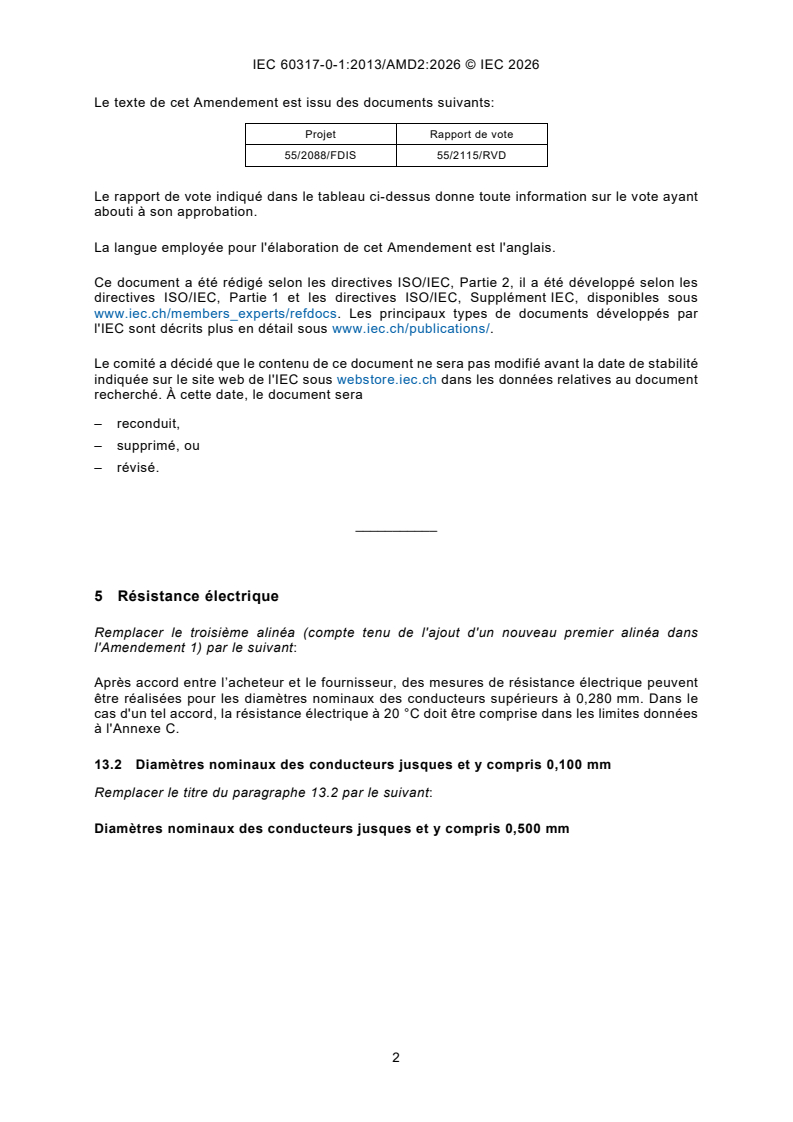
- 5 Résistance électrique
- 13.2 Diamètres nominaux des conducteurs jusques et y compris 0,100 mm
AVANT-PROPOS
1) La Commission Électrotechnique Internationale (IEC) est une organisation mondiale de normalisation composée de l'ensemble des comités électrotechniques nationaux (Comités nationaux de l'IEC). L'IEC a pour objet de favoriser la coopération internationale pour toutes les questions de normalisation dans les domaines de l'électricité et de l'électronique. À cet effet, l'IEC – entre autres activités – publie des Normes internationales, des Spécifications techniques, des Rapports techniques, des Spécifications accessibles au public (PAS) et des Guides (ci-après dénommés "Publication(s) de l'IEC"). Leur élaboration est confiée à des comités d'études, aux travaux desquels tout Comité national intéressé par le sujet traité peut participer. Les organisations internationales, gouvernementales et non gouvernementales, en liaison avec l'IEC, participent également aux travaux. L'IEC collabore étroitement avec l'Organisation Internationale de Normalisation (ISO), selon des conditions fixées par accord entre les deux organisations.
2) Les décisions ou accords officiels de l'IEC concernant les questions techniques représentent, dans la mesure du possible, un accord international sur les sujets étudiés, étant donné que les Comités nationaux de l'IEC intéressés sont représentés dans chaque comité d'études.
3) Les Publications de l'IEC se présentent sous la forme de recommandations internationales et sont agréées comme telles par les Comités nationaux de l'IEC. Tous les efforts raisonnables sont entrepris afin que l'IEC s'assure de l'exactitude du contenu technique de ses publications; l'IEC ne peut pas être tenue responsable de l'éventuelle mauvaise utilisation ou interprétation qui en est faite par un quelconque utilisateur final. 4) Dans le but d'encourager l'uniformité internationale, les Comités nationaux de l'IEC s'engagent, dans toute la mesure possible, à appliquer de façon transparente les Publications de l'IEC dans leurs publications nationales et régionales. Toutes divergences entre toutes Publications de l'IEC et toutes publications nationales ou régionales correspondantes doivent être indiquées en termes clairs dans ces dernières. 5) L'IEC elle-même ne fournit aucune attestation de conformité. Des organismes de certification indépendants fournissent des services d'évaluation de conformité et, dans certains secteurs, accèdent aux marques de conformité de l'IEC. L'IEC n'est responsable d'aucun des services effectués par les organismes de certification indépendants.
...