


IEC TS 61334-5-3:2001
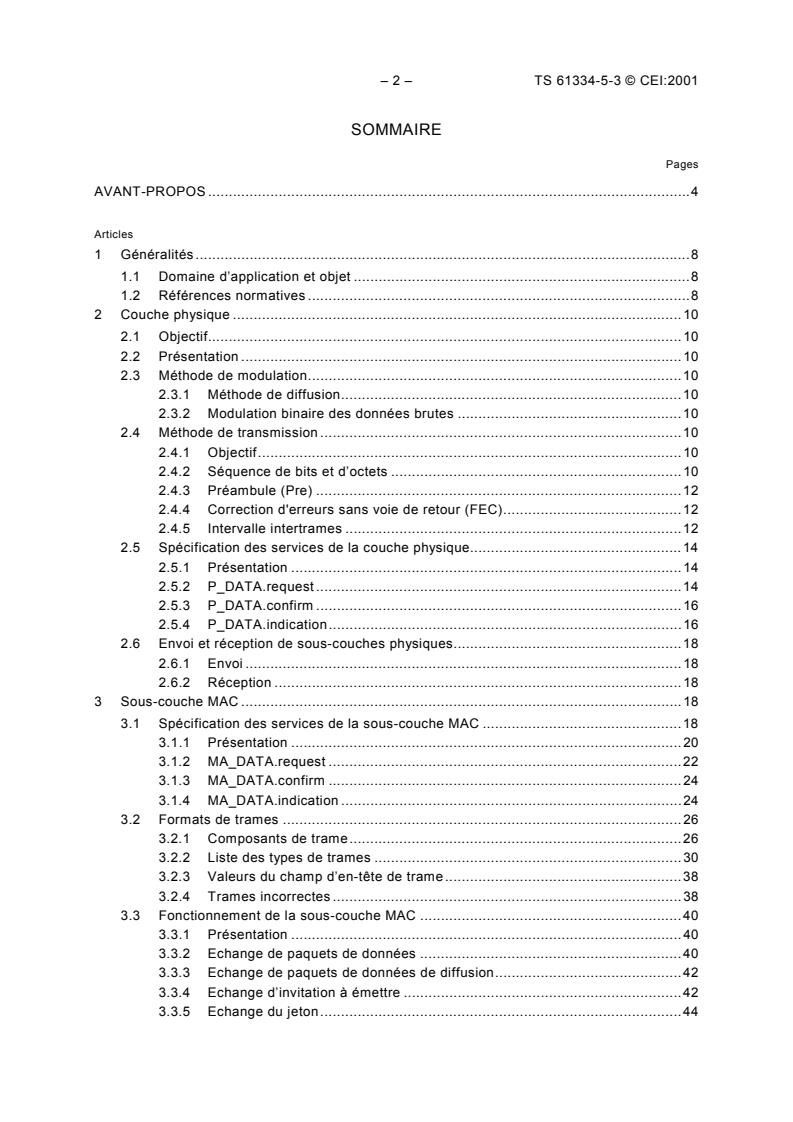
(Main)Distribution automation using distribution line carrier systems - Part 5-3: Lower-layer profiles - Spread spectrum adaptive wideband (SS-AW) profile
Distribution automation using distribution line carrier systems - Part 5-3: Lower-layer profiles - Spread spectrum adaptive wideband (SS-AW) profile
Describes the requirements of the spread spectrum adaptive wideband (SS-AW) approach which incorporates the services provided by the physical layer entity and the MAC sublayer. The MAC sublayer described in this specification interfaces with the logical link control (LLC) layer described in IEC 61334-4-32.
This publication is of high relevance for Smart Grid.
Automatisation de la distribution à l'aide de systèmes de communication à courants porteurs - Partie 5-3: Profils des couches basses - Profil SS-AW (Spread Spectrum Adaptive Wideband)
Décrit les exigences de l'approche SS-AW (Spread Spectrum Adaptive Wideband) qui intègre les services fournis par la couche physique et la sous-couche MAC (Medium Access Control, contrôle d'accès au support). La sous-couche MAC décrite dans cette spécification sert d'interface avec la couche LLC (Logical Link Control, contrôle de liaison logique) décrite dans la CEI 61334-4-32.
General Information
- Status
- Published
- Publication Date
- 23-Jan-2001
- Technical Committee
- TC 57 - Power systems management and associated information exchange
- Drafting Committee
- WG 9 - TC 57/WG 9
- Current Stage
- PPUB - Publication issued
- Start Date
- 24-Jan-2001
- Completion Date
- 31-Oct-2000
Overview
IEC TS 61334-5-3:2001 is a technical specification established by the International Electrotechnical Commission (IEC) for distribution automation using distribution line carrier (DLC) systems. This document specifically addresses Part 5-3: Lower-layer profiles - Spread Spectrum Adaptive Wideband (SS-AW) profile. It focuses on the architectural and functional requirements for the SS-AW approach, which integrates services offered by the physical layer and the medium access control (MAC) sublayer for efficient, robust communication over electrical distribution networks, notably at the medium-voltage (MV) and low-voltage (LV) levels.
The SS-AW profile is specifically designed to cope with the challenging noise and signal attenuation conditions characteristic of MV and LV electricity distribution networks, making it highly relevant for Smart Grid applications. The specification ensures interoperability and reliable transfer of data through a hierarchical approach combining adaptive spread spectrum physical layer techniques, error control, synchronization, and advanced media access protocols.
Key Topics
Spread Spectrum Adaptive Wideband (SS-AW) Approach
- Utilizes a spread spectrum physical layer with fast synchronization and adaptive equalization
- Designed for robust operation in noisy and time-varying power line communication channels
Physical Layer and MAC Sublayer Integration
- Defines clear interfaces and service primitives between the physical layer and MAC sublayer
- Ensures reliable encapsulation, transmission, and reception of data units
Adaptability and Error Correction
- Adaptive equalization compensates for changing channel conditions using quality metrics from received frames
- Forward Error Correction (FEC) enhances data integrity and prevents data loss due to errors
Hierarchical Communication Architecture
- MAC sublayer supports low-level link protocols and interfaces seamlessly with the LLC (Logical Link Control) layer, as specified in IEC 61334-4-32
- Protocol architecture is designed for cost and performance optimization, allowing for compatibility and future enhancements
Protocol Efficiency
- Fast preamble synchronization and optimized interframe gaps improve channel utilization
- Use of binary phase shift keying (BPSK) with non-return-to-zero level (NRZ-L) modulation ensures reliable data transfer
Applications
The IEC TS 61334-5-3:2001 standard is vital for organizations involved in smart grid technology, distribution automation, and utility communication infrastructure. Typical applications include:
Remote Metering and Monitoring
- Data collection from smart meters and sensors distributed across electric networks
Grid Automation and Control
- Automatic control of substations, breakers, and distribution points for improved efficiency and reliability
Fault Detection and Restoration
- Enabling rapid communication for the management of faults and restoration processes across complex grid topologies
Interoperability in Smart Grid Deployments
- Ensures compatibility between diverse vendors’ equipment in multi-vendor environments
Secure and Reliable Power Line Communication
- Robust communication over existing power lines without the need for new cabling infrastructure
Related Standards
Implementing IEC TS 61334-5-3:2001 often involves coordination with several other IEC standards to ensure seamless data link operations and system integration:
- IEC 61334-4-32 - Defines the Logical Link Control (LLC) layer for distribution line carrier systems, providing upper-layer protocol support
- IEC 61334 Series - Collection of standards dealing with distribution automation using DLC systems
- IEC 61968/61970 - Standards for application integration and data exchange related to distribution management and operation in smart grids
Conclusion
Standardizing the use of spread spectrum adaptive wideband (SS-AW) for lower communication layers, as established in IEC TS 61334-5-3:2001, is fundamental to achieving robust, scalable, and interoperable distribution automation networks. This technical specification delivers a practical foundation for the development, deployment, and operation of smart grid solutions and fosters reliable power line communication, essential for the modern electric utility infrastructure.
Buy Documents
IEC TS 61334-5-3:2001 - Distribution automation using distribution line carrier systems - Part 5-3: Lower-layer profiles - Spread spectrum adaptive wideband (SS-AW) profile Released:1/24/2001
Get Certified
Connect with accredited certification bodies for this standard

ANCE
Mexican certification and testing association.

Intertek Slovenia
Intertek testing, inspection, and certification services in Slovenia.

LNE (Laboratoire National de Métrologie et d'Essais)
French national laboratory for metrology and testing.
Sponsored listings
Frequently Asked Questions
IEC TS 61334-5-3:2001 is a technical specification published by the International Electrotechnical Commission (IEC). Its full title is "Distribution automation using distribution line carrier systems - Part 5-3: Lower-layer profiles - Spread spectrum adaptive wideband (SS-AW) profile". This standard covers: Describes the requirements of the spread spectrum adaptive wideband (SS-AW) approach which incorporates the services provided by the physical layer entity and the MAC sublayer. The MAC sublayer described in this specification interfaces with the logical link control (LLC) layer described in IEC 61334-4-32. This publication is of high relevance for Smart Grid.
Describes the requirements of the spread spectrum adaptive wideband (SS-AW) approach which incorporates the services provided by the physical layer entity and the MAC sublayer. The MAC sublayer described in this specification interfaces with the logical link control (LLC) layer described in IEC 61334-4-32. This publication is of high relevance for Smart Grid.
IEC TS 61334-5-3:2001 is classified under the following ICS (International Classification for Standards) categories: 33.200 - Telecontrol. Telemetering. The ICS classification helps identify the subject area and facilitates finding related standards.
IEC TS 61334-5-3:2001 is available in PDF format for immediate download after purchase. The document can be added to your cart and obtained through the secure checkout process. Digital delivery ensures instant access to the complete standard document.
Standards Content (Sample)
SPÉCIFICATION CEI
TECHNIQUE IEC
TS 61334-5-3
TECHNICAL
Première édition
SPECIFICATION
First edition
2001-01
Automatisation de la distribution à l'aide de
systèmes de communication à courants porteurs –
Partie 5-3:
Profils des couches basses – Profil SS-AW
(Spread Spectrum Adaptive Wideband)
Distribution automation using distribution line
carrier systems –
Part 5-3:
Lower-layer profiles – Spread spectrum adaptive
wideband (SS-AW) profile
Numéro de référence
Reference number
IEC/TS 61334-5-3:2001
Numérotation des publications Publication numbering
Depuis le 1er janvier 1997, les publications de la CEI As from 1 January 1997 all IEC publications are
sont numérotées à partir de 60000. Ainsi, la CEI 34-1 issued with a designation in the 60000 series. For
devient la CEI 60034-1. example, IEC 34-1 is now referred to as IEC 60034-1.
Editions consolidées Consolidated editions
Les versions consolidées de certaines publications de la The IEC is now publishing consolidated versions of its
CEI incorporant les amendements sont disponibles. Par publications. For example, edition numbers 1.0, 1.1
exemple, les numéros d’édition 1.0, 1.1 et 1.2 indiquent and 1.2 refer, respectively, to the base publication,
respectivement la publication de base, la publication de the base publication incorporating amendment 1 and
base incorporant l’amendement 1, et la publication de the base publication incorporating amendments 1
base incorporant les amendements 1 et 2. and 2.
Informations supplémentaires Further information on IEC publications
sur les publications de la CEI
Le contenu technique des publications de la CEI est The technical content of IEC publications is kept
constamment revu par la CEI afin qu'il reflète l'état under constant review by the IEC, thus ensuring that
actuel de la technique. Des renseignements relatifs à the content reflects current technology. Information
cette publication, y compris sa validité, sont dispo- relating to this publication, including its validity, is
nibles dans le Catalogue des publications de la CEI available in the IEC Catalogue of publications
(voir ci-dessous) en plus des nouvelles éditions, (see below) in addition to new editions, amendments
amendements et corrigenda. Des informations sur les and corrigenda. Information on the subjects under
sujets à l’étude et l’avancement des travaux entrepris consideration and work in progress undertaken by the
par le comité d’études qui a élaboré cette publication, technical committee which has prepared this
ainsi que la liste des publications parues, sont publication, as well as the list of publications issued,
également disponibles par l’intermédiaire de: is also available from the following:
• Site web de la CEI (www.iec.ch) • IEC Web Site (www.iec.ch)
• Catalogue des publications de la CEI • Catalogue of IEC publications
Le catalogue en ligne sur le site web de la CEI The on-line catalogue on the IEC web site
(www.iec.ch/catlg-f.htm) vous permet de faire des (www.iec.ch/catlg-e.htm) enables you to search
recherches en utilisant de nombreux critères, by a variety of criteria including text searches,
comprenant des recherches textuelles, par comité technical committees and date of publication. On-
d’études ou date de publication. Des informations line information is also available on recently
en ligne sont également disponibles sur les issued publications, withdrawn and replaced
nouvelles publications, les publications rempla- publications, as well as corrigenda.
cées ou retirées, ainsi que sur les corrigenda.
• IEC Just Published
• IEC Just Published
Ce résumé des dernières publications parues
This summary of recently issued publications
(www.iec.ch/JP.htm) est aussi disponible par
(www.iec.ch/JP.htm) is also available by email.
courrier électronique. Veuillez prendre contact
Please contact the Customer Service Centre (see
avec le Service client (voir ci-dessous) pour plus
below) for further information.
d’informations.
• Service clients
• Customer Service Centre
Si vous avez des questions au sujet de cette
If you have any questions regarding this
publication ou avez besoin de renseignements
publication or need further assistance, please
supplémentaires, prenez contact avec le Service
contact the Customer Service Centre:
clients:
Email: custserv@iec.ch
Email: custserv@iec.ch
Tél: +41 22 919 02 11
Tel: +41 22 919 02 11
Fax: +41 22 919 03 00
Fax: +41 22 919 03 00
.
SPÉCIFICATION CEI
TECHNIQUE IEC
TS 61334-5-3
TECHNICAL
Première édition
SPECIFICATION
First edition
2001-01
Automatisation de la distribution à l'aide de
systèmes de communication à courants porteurs –
Partie 5-3:
Profils des couches basses – Profil SS-AW
(Spread Spectrum Adaptive Wideband)
Distribution automation using distribution line
carrier systems –
Part 5-3:
Lower-layer profiles – Spread spectrum adaptive
wideband (SS-AW) profile
IEC 2001 Droits de reproduction réservés Copyright - all rights reserved
Aucune partie de cette publication ne peut être reproduite ni No part of this publication may be reproduced or utilized in
utilisée sous quelque forme que ce soit et par aucun procédé, any form or by any means, electronic or mechanical,
électronique ou mécanique, y compris la photocopie et les including photocopying and microfilm, without permission in
microfilms, sans l'accord écrit de l'éditeur. writing from the publisher.
International Electrotechnical Commission 3, rue de Varembé Geneva, Switzerland
Telefax: +41 22 919 0300 e-mail: inmail@iec.ch IEC web site http://www.iec.ch
CODE PRIX
Commission Electrotechnique Internationale
S
PRICE CODE
International Electrotechnical Commission
Pour prix, voir catalogue en vigueur
For price, see current catalogue
– 2 – TS 61334-5-3 © CEI:2001
SOMMAIRE
Pages
AVANT-PROPOS .4
Articles
1 Généralités.8
1.1 Domaine d’application et objet .8
1.2 Références normatives .8
2 Couche physique .10
2.1 Objectif.10
2.2 Présentation .10
2.3 Méthode de modulation.10
2.3.1 Méthode de diffusion.10
2.3.2 Modulation binaire des données brutes .10
2.4 Méthode de transmission .10
2.4.1 Objectif.10
2.4.2 Séquence de bits et d’octets .10
2.4.3 Préambule (Pre) .12
2.4.4 Correction d'erreurs sans voie de retour (FEC).12
2.4.5 Intervalle intertrames .12
2.5 Spécification des services de la couche physique.14
2.5.1 Présentation .14
2.5.2 P_DATA.request .14
2.5.3 P_DATA.confirm .16
2.5.4 P_DATA.indication.16
2.6 Envoi et réception de sous-couches physiques.18
2.6.1 Envoi .18
2.6.2 Réception .18
3 Sous-couche MAC .18
3.1 Spécification des services de la sous-couche MAC .18
3.1.1 Présentation .20
3.1.2 MA_DATA.request .22
3.1.3 MA_DATA.confirm .24
3.1.4 MA_DATA.indication .24
3.2 Formats de trames .26
3.2.1 Composants de trame.26
3.2.2 Liste des types de trames .30
3.2.3 Valeurs du champ d’en-tête de trame.38
3.2.4 Trames incorrectes .38
3.3 Fonctionnement de la sous-couche MAC .40
3.3.1 Présentation .40
3.3.2 Echange de paquets de données .40
3.3.3 Echange de paquets de données de diffusion.42
3.3.4 Echange d’invitation à émettre .42
3.3.5 Echange du jeton.44
TS 61334-5-3 IEC:2001 – 3 –
CONTENTS
Page
FOREWORD.5
Clause
1 General .9
1.1 Scope and object.9
1.2 Normative references .9
2 Physical layer .11
2.1 Purpose.11
2.2 Overview .11
2.3 Modulation method .11
2.3.1 Spreading method.11
2.3.2 Raw data bit modulation.11
2.4 Transmission method .11
2.4.1 Purpose.11
2.4.2 Bit and byte ordering.11
2.4.3 Preamble (Pre) .13
2.4.4 Forward error correction (FEC) .13
2.4.5 Interframe gap .13
2.5 Physical layer services specification.15
2.5.1 Overview .15
2.5.2 P_DATA.request .15
2.5.3 P_DATA.confirm .17
2.5.4 P_DATA.indication.17
2.6 Sending and receiving physical sublayer .19
2.6.1 Sending .19
2.6.2 Receiving.19
3 Medium access control (MAC) sublayer.19
3.1 MAC sublayer service specification .19
3.1.1 Overview .21
3.1.2 MA_DATA.request .23
3.1.3 MA_DATA.confirm .25
3.1.4 MA_DATA.indication .25
3.2 Frame formats.27
3.2.1 Frame components .27
3.2.2 Enumeration of frame types .31
3.2.3 Frame header field values.39
3.2.4 Invalid Frames .39
3.3 MAC sublayer operation.41
3.3.1 Overview .41
3.3.2 Data packet exchange .41
3.3.3 Broadcast data packet exchange.43
3.3.4 Polling Exchange .43
3.3.5 Token exchange .45
– 4 – TS 61334-5-3 © CEI:2001
COMMISSION ÉLECTROTECHNIQUE INTERNATIONALE
____________
AUTOMATISATION DE LA DISTRIBUTION À L'AIDE
DE SYSTÈMES DE COMMUNICATION À COURANTS PORTEURS –
Partie 5-3: Profils des couches basses –
Profil SS-AW (Spread Spectrum Adaptive Wideband)
AVANT-PROPOS
1) La CEI (Commission Électrotechnique Internationale) est une organisation mondiale de normalisation composée
de l'ensemble des comités électrotechniques nationaux (Comités nationaux de la CEI). La CEI a pour objet de
favoriser la coopération internationale pour toutes les questions de normalisation dans les domaines de
l'électricité et de l'électronique. A cet effet, la CEI, entre autres activités, publie des Normes internationales.
Leur élaboration est confiée à des comités d'études, aux travaux desquels tout Comité national intéressé par le
sujet traité peut participer. Les organisations internationales, gouvernementales et non gouvernementales, en
liaison avec la CEI, participent également aux travaux. La CEI collabore étroitement avec l'Organisation
Internationale de Normalisation (ISO), selon des conditions fixées par accord entre les deux organisations.
2) Les décisions ou accords officiels de la CEI concernant les questions techniques représentent, dans la mesure
du possible, un accord international sur les sujets étudiés, étant donné que les Comités nationaux intéressés
sont représentés dans chaque comité d’études.
3) Les documents produits se présentent sous la forme de recommandations internationales. Ils sont publiés
comme normes, spécifications techniques, rapports techniques ou guides et agréés comme tels par les Comités
nationaux.
4) Dans le but d'encourager l'unification internationale, les Comités nationaux de la CEI s'engagent à appliquer de
façon transparente, dans toute la mesure possible, les Normes internationales de la CEI dans leurs normes
nationales et régionales. Toute divergence entre la norme de la CEI et la norme nationale ou régionale
correspondante doit être indiquée en termes clairs dans cette dernière.
5) La CEI n’a fixé aucune procédure concernant le marquage comme indication d’approbation et sa responsabilité
n’est pas engagée quand un matériel est déclaré conforme à l’une de ses normes.
6) L’attention est attirée sur le fait que certains des éléments de la présente spécification technique peuvent faire
l’objet de droits de propriété intellectuelle ou de droits analogues. La CEI ne saurait être tenue pour
responsable de ne pas avoir identifié de tels droits de propriété et de ne pas avoir signalé leur existence.
La tâche principale des comités d’études de la CEI est l’élaboration des Normes inter-
nationales. Exceptionnellement, un comité d’études peut proposer la publication d’une
spécification technique
• lorsqu’en dépit de maints efforts, l’accord requis ne peut être réalisé en faveur de la
publication d’une Norme internationale, ou
• lorsque le sujet en question est encore en cours de développement technique ou quand,
pour une raison quelconque, la possibilité d’un accord pour la publication d’une Norme
internationale peut être envisagée pour l’avenir mais pas dans l’immédiat.
La CEI 61334-5-3, qui est une spécification technique, a été établie par le comité d’études 57
de la CEI: Conduite des systèmes de puissance et communications associées.
Le texte de cette spécification technique est issu des documents suivants:
Projet d’enquête Rapport de vote
57/423/CDV 57/475/RVC
Le rapport de vote indiqué dans le tableau ci-dessus donne toute information sur le vote ayant
abouti à l'approbation de cette spécification technique.
Cette publication a été rédigée selon les Directives ISO/CEI, Partie 3.
TS 61334-5-3 IEC:2001 – 5 –
INTERNATIONAL ELECTROTECHNICAL COMMISSION
____________
DISTRIBUTION AUTOMATION USING
DISTRIBUTION LINE CARRIER SYSTEMS –
Part 5-3: Lower-layer profiles –
Spread spectrum adaptive wideband (SS-AW) profile
FOREWORD
1) The IEC (International Electrotechnical Commission) is a worldwide organization for standardization comprising
all national electrotechnical committees (IEC National Committees). The object of the IEC is to promote
international co-operation on all questions concerning standardization in the electrical and electronic fields. To
this end and in addition to other activities, the IEC publishes International Standards. Their preparation is
entrusted to technical committees; any IEC National Committee interested in the subject dealt with may
participate in this preparatory work. International, governmental and non-governmental organizations liaising
with the IEC also participate in this preparation. The IEC collaborates closely with the International Organization
for Standardization (ISO) in accordance with conditions determined by agreement between the two
organizations.
2) The formal decisions or agreements of the IEC on technical matters express, as nearly as possible, an
international consensus of opinion on the relevant subjects since each technical committee has representation
from all interested National Committees.
3) The documents produced have the form of recommendations for international use and are published in the form
of standards, technical specifications, technical reports or guides and they are accepted by the National
Committees in that sense.
4) In order to promote international unification, IEC National Committees undertake to apply IEC International
Standards transparently to the maximum extent possible in their national and regional standards. Any
divergence between the IEC Standard and the corresponding national or regional standard shall be clearly
indicated in the latter.
5) The IEC provides no marking procedure to indicate its approval and cannot be rendered responsible for any
equipment declared to be in conformity with one of its standards.
6) Attention is drawn to the possibility that some of the elements of this technical specification may be the subject
of patent rights. The IEC shall not be held responsible for identifying any or all such patent rights.
The main task of IEC technical committees is to prepare International Standards. In
exceptional circumstances, a technical committee may propose the publication of a technical
specification when
• the required support cannot be obtained for the publication of an International Standard,
despite repeated efforts, or
• the subject is still under technical development or where, for any other reason, there is the
future but no immediate possibility of an agreement on an International Standard.
IEC 61334-5-3, which is a technical specification, has been prepared by IEC technical
committee 57: Power system control and associated communications.
The text of this technical specification is based on the following documents:
Enquiry draft Report on voting
57/423/CDV 57/475/RVC
Full information on the voting for the approval of this technical specification can be found in the
report on voting indicated in the above table.
This publication has been drafted in accordance with the ISO/IEC Directives, Part 3.
– 6 – TS 61334-5-3 © CEI:2001
Le comité a décidé que le contenu de cette publication ne sera pas modifié avant 2004. A cette
date, la publication sera
• transformée en Norme internationale;
• reconduite;
• supprimée;
• remplacée par une édition révisée, ou
• amendée.
TS 61334-5-3 IEC:2001 – 7 –
The committee has decided that the contents of this publication will remain unchanged until
2004. At this date, the publication will be
• transformed into an International Standard;
• reconfirmed;
• withdrawn;
• replaced by a revised edition, or
• amended.
– 8 – TS 61334-5-3 © CEI:2001
AUTOMATISATION DE LA DISTRIBUTION À L'AIDE
DE SYSTÈMES DE COMMUNICATION À COURANTS PORTEURS –
Partie 5-3: Profils des couches basses –
Profil SS-AW (Spread Spectrum Adaptive Wideband)
1 Généralités
1.1 Domaine d’application et objet
Cette spécification technique décrit les exigences de l’approche SS-AW (Spread Spectrum
Adaptive Wideband) qui intègre les services fournis par la couche physique et la sous-couche
MAC (Medium Access Control, contrôle d'accès au support). Il est supposé que le support de
transmission constitue le réseau de distribution sur les niveaux MT et BT. La sous-couche
MAC décrite dans cette spécification sert d’interface avec la couche LLC (Logical Link Control,
contrôle de liaison logique) décrite dans la CEI 61334-4-32.
Les caractéristiques d’atténuation de bruit et de signal des réseaux MT et BT requièrent une
approche hiérarchique, où les méthodes de modulation/démodulation, de synchronisation,
d’égalisation, de codage du contrôle d’erreurs et de contrôle d'accès au support sont
spécifiquement conçues pour cet environnement de communications hostile. Cette approche
inclut un protocole de liaison bas niveau au sein de la sous-couche MAC, qui intègre certaines
fonctions généralement associées à une procédure de commande de la liaison de données.
Cette spécification décrit une approche hiérarchique, basée sur une couche physique à large
spectre dotée d’une synchronisation rapide permettant des transmissions de courte durée et
une égalisation automatique. Le tout associé à un protocole de liaison bas niveau, une
utilisation efficace de la correction et de la détection d’erreurs et une gestion sûre de l’accès
au support fournit une plate-forme fiable et sûre pour la sous-couche LLC.
L’adaptabilité de cette approche se réfère à la méthode d’égalisation utilisée pour compenser
les variations temporelles caractérisant les altérations des canaux de communication. Il faut
que le récepteur sélectionne les valeurs d’égalisation appropriées pour s’adapter aux
fluctuations des caractéristiques du canal, qui peuvent être spécifiques au nœud, sur la base
d’une trame, pour atteindre des performances optimales. Les paramètres d’égalisation sont
ajustés en fonction de diverses mesures de qualité disponibles fournies par la trame reçue, par
exemple la distance de Hamming du préambule de synchronisation, le statut sans erreur de
l’en-tête de trame et du bloc de données, le cas échéant, ou l’échec de réception de la réponse
attendue. Ces méthodes d’égalisation sont réputées et la méthode précise est définie par la
mise en application particulière de cette spécification, permettant ainsi un équilibre entre les
coûts et les performances et des améliorations futures sans perte de compatibilité.
1.2 Références normatives
Les documents normatifs suivants contiennent des dispositions qui, par suite de la référence
qui y est faite, constituent des dispositions valables pour la présente partie de la CEI 61334.
Pour les références datées, les amendements ultérieurs ou les révisions de ces publications ne
s’appliquent pas. Toutefois, les parties prenantes aux accords fondés sur la présente partie de
la CEI 61334 sont invitées à rechercher la possibilité d'appliquer les éditions les plus récentes
des documents normatifs indiqués ci-après. Pour les références non datées, la dernière édition
du document normatif en référence s’applique. Les membres de la CEI et de l'ISO possèdent
le registre des Normes internationales en vigueur.
CEI 61334-4-32:1996, Automatisation de la distribution à l'aide de systèmes de communication
à courants porteurs – Partie 4: Protocoles de communication de données – Section 32: Couche
liaison de données – Contrôle de liaison logique (LLC)
TS 61334-5-3 IEC:2001 – 9 –
DISTRIBUTION AUTOMATION USING
DISTRIBUTION LINE CARRIER SYSTEMS –
Part 5-3: Lower-layer profiles –
Spread spectrum adaptive wideband (SS-AW) profile
1 General
1.1 Scope and object
This specification describes the requirements of the spread spectrum adaptive wideband (SS-
AW) approach which incorporates the services provided by the physical layer entity and the
MAC sublayer. The transmission medium is assumed to be the distribution network on both the
MV or LV level. The MAC sublayer described in this specification interfaces with the logical link
control (LLC) layer described in IEC 61334-4-32.
The noise and signal attenuation characteristics of the MV and LV networks require a
hierarchical approach, where methods for modulation/demodulation, synchronization, equaliza-
tion, error control coding, and media access control are designed specifically for this hostile
communications environment. This approach includes a low-level link protocol within the MAC
sublayer that incorporates some functions generally associated with a data link control
procedure. This specification describes such a hierarchical approach based on a spread
spectrum physical layer with fast synchronization enabling short-duration transmissions and
adaptive equalization. This coupled with a low-level link protocol, the effective utilization of
error correction and detection, and robust medium access management provides a robust,
reliable platform for the LLC sublayer.
The adaptive component of this approach refers to the equalization method used to
compensate for the time-varying nature of the communication channel impairments. The
receiver must select appropriate equalization values to adapt to the changing channel
characteristics, which can be node-specific, on a frame basis to achieve optimal performance.
The equalization parameters are adjusted based on various quality metrics available from the
received frame, for example, the Hamming distance of the synchronization preamble, the error-
free status of the frame header and data block, if present, or the failure to receive an expected
response. The equalization methods are well-known and the precise method is determined by
the particular implementation of this specification. This allows cost/performance trade-offs and
future improvements to occur without losing compatibility.
1.2 Normative references
The following normative documents contain provisions which, through reference in this text,
constitute provisions of this part of IEC 61334. For dated references, subsequent amendments
to, or revisions of, any of these publications do not apply. However, parties to agreements
based on this part of IEC 61334 are encouraged to investigate the possibility of applying the
most recent editions of the normative documents indicated below. For undated references, the
latest edition of the normative document referred to applies. Members of IEC and ISO maintain
registers of currently valid International Standards.
IEC 61334-4-32:1996, Distribution automation using distribution line carrier systems – Part 4:
Data communication protocols – Section 32: Data link layer – Logical link control (LLC)
– 10 – TS 61334-5-3 © CEI:2001
2 Couche physique
2.1 Objectif
Le présent article décrit les services requis par la couche physique au niveau de l'interface
logique avec la sous-couche MAC. Elle définit également le mode de transmission utilisé pour
transmettre le flux d'informations via le réseau de distribution basse tension.
2.2 Présentation
La couche physique fournit l'interface avec la sous-couche MAC permettant de transmettre des
unités de données vers le support physique.
2.3 Méthode de modulation
L'émetteur doit générer un signal à large bande correspondant au signal défini aux
paragraphes 2.3.1 et 2.3.2 avec une fréquence centrale f et une largeur de bande de signal
nul-à-nul comprise entre f /2 et 3/2×f , où, par exemple, f peut être égal à 47,5 kHz.
0 0 0
2.3.1 Méthode de diffusion
Une forme d'onde antisymétrique est synthétisée numériquement à l'aide de 16 bits (puces)
d'une horloge avec une fréquence de 16 × f . Deux périodes de cette onde (correspondant à
32 puces de l'horloge) définissent un intervalle binaire de données brutes. Cet intervalle peut
être constitué, par exemple, de deux cycles d'une onde sinusoïdale.
2.3.2 Modulation binaire des données brutes
Chaque intervalle binaire de données brutes représente une phase binaire générée par
décalage (BPSK) utilisant un format de niveau sans retour à zéro (NRZ-L) générant un débit
binaire des données brutes égal à f /2.
2.4 Méthode de transmission
2.4.1 Objectif
Afin de garantir des performances optimales, toutes les unités de données MAC reçues pour la
transmission comprennent un préambule et sont codées avec un code FEC (correction
d'erreurs sans voie de retour). Le paramètre PHY_frame comprend ce qui suit:
• le paramètre P_sdu (comprenant entre 6 octets et 26 octets), identique au paramètre
M_pdu (comprenant entre 3 octets et 13 octets), transmis par la sous-couche MAC et codé
avec le code FEC (voir 2.4.4);
• un préambule (5 octets) et un intervalle intertrames (1 octet).
Préambule P_sdu Intervalle intertrames
5 octets de 6 à 26 octets 1 octet
IEC 2663/2000
Figure 1 – Structure d'une trame physique
2.4.2 Séquence de bits et d’octets
Les octets sont envoyés selon l'ordre suivant: de l'octet le plus significatif (MSB) vers l'octet le
moins significatif (LSB). Par convention, l'octet de poids fort correspond à l'octet de gauche. La
même convention est appliquée aux bits: le premier bit d'un octet est le bit de poids fort.
TS 61334-5-3 IEC:2001 – 11 –
2 Physical layer
2.1 Purpose
This clause details the services required of the physical layer at the logical interface with the
MAC sublayer. Also defined is the transmission method used to provide the information flow
through the low-voltage distribution network.
2.2 Overview
The physical layer provides the interface to the MAC sublayer for the transmission of data units
onto the physical medium.
2.3 Modulation method
The transmitter shall generate a wideband signal to conform to the signal defined in 2.3.1 and
2.3.2 with a centre frequency of f and a null-to-null signal bandwidth of f /2 to 3/2 × f , where
0 0 0
for example f can be 47,5 kHz.
2.3.1 Spreading method
An anti-symmetric waveform is digitally synthesized using 16 bits (chips) of a 16 × f clock.
Two periods of the anti-symmetric waveform (corresponding to 32 chips of the clock) define
one raw data bit interval; for example, one raw data bit interval can consist of two cycles of a
sine wave.
2.3.2 Raw data bit modulation
Each raw data bit interval is binary phase shift keyed (BPSK) using a non-return-to-zero level
(NRZ-L) format, resulting in a raw data bit rate of f /2.
2.4 Transmission method
2.4.1 Purpose
In order to ensure optimum performance, all MAC data-units received for transmission are
encapsulated with a preceding preamble and encoded with a forward error correcting code
(FEC). A PHY_frame consists of
• a P_sdu (from 6 bytes to 26 bytes) the same as the M_pdu (from 3 bytes to 13 bytes)
transmitted by the MAC sublayer and encoded with the FEC (see 2.4.4 );
• a preceding preamble (5 bytes) and a succeeding interframe gap (1 byte).
Preamble P_sdu Interframe gap
5 bytes 6 to 26 bytes 1 byte
IEC 2663/2000
Figure 1 – Physical frame structure
2.4.2 Bit and byte ordering
The bytes are sent from most significant byte (MSB) to least significant byte (LSB). By
convention, the most significant byte corresponds to the leftmost byte. Bit fields are packed
with the same convention as byte fields. That is, the first bit in an octet is the most significant
(leftmost) bit.
– 12 – TS 61334-5-3 © CEI:2001
2.4.3 Préambule (Pre)
Le préambule, précédant chaque trame transmise, délimite le début d'une trame correcte. Il
contient les séquences nécessaires permettant au récepteur d'effectuer une synchronisation
avec la trame transmise. Il comprend quatre octets de synchronisation (Sync), suivis d'un octet
de fin de synchronisation (EOS). Les valeurs des champs du préambule sont définies dans le
tableau 2.
Sync Sync Sync Sync EOS
IEC 2664/2000
Figure 2 – Structure d'un préambule
2.4.4 Correction d'erreurs sans voie de retour (FEC)
Tous les octets contenus dans une trame, à l'exception de ceux du préambule, sont codés
avec le code de correction des erreurs (8,4) du tableau 1. Le codage de chaque quartet est
effectué en deux étapes: dans un premier temps, un décalage croissant est ajouté au quartet;
le quartet résultant est alors codé avec le code du tableau 1. Le décalage est remis à 0 au
début de chaque trame; il est ensuite augmenté par 3 modulo 16 pour chaque quartet
successif. Le premier octet codé est le moins significatif. Par exemple, la valeur 70 00 (hex)
est codée comme suit:
Tableau 1 – Code de correction des erreurs (8,4)
1. 0 + 0 = 0; ECC(0) = 5A (quartet le moins significatif de 70)
2. 7 + 3 = A; ECC(A) = 96 ( quartet le plus significatif de 70)
3. 0 + 6 = 6; ECC(6) = 2E (quartet le moins significatif de 00)
4. 0 + 9 = 9; ECC(9) = 89 (quartet le plus significatif de 00)
Information Valeur du code
(hexadécimal)
05A
15D
2A5
4BC
62E
7D1
A96
B76
CA2
DCE
E44
FBB
2.4.5 Intervalle intertrames
Cet intervalle comprend un champ de 8 bits sans transmission.
Il a pour but d'allouer au récepteur le temps nécessaire au décodage et au traitement des
données avant de recevoir la trame suivante ou de transmettre une réponse.
TS 61334-5-3 IEC:2001 – 13 –
2.4.3 Preamble (Pre)
The preamble, which precedes every transmitted frame, delimits the start of a valid frame. It
contains the necessary sequences to allow the receiver to synchronize to the transmitted
frame. It consists of four synchronization (Sync) bytes followed by one end of synchronization
(EOS) byte. Preamble field values are defined in table 2.
Sync Sync Sync Sync EOS
IEC 2664/2000
Figure 2 – Preamble structure
2.4.4 Forward error correction (FEC)
All bytes contained in a frame, except for the preamble bytes, are encoded using the (8,4) error
correcting code of table 1. The encoding of each nibble follows a two-step process. First, an
increasing offset is added to the nibble; second, the resulting nibble is encoded using the code
of table 1. The offset is initialized to 0 at the start of each frame, and is increased by 3 modulo
16 for each successive nibble. Bytes are encoded least significant nibble first. For example, the
value 70 00 (hex) is encoded as follows:
Table 1 – (8,4) Error correcting code
1. 0 + 0 = 0; ECC(0) = 5A (least significant nibble of 70)
2. 7 + 3 = A; ECC(A) = 96 ( most significant nibble of 70)
3. 0 + 6 = 6; ECC(6) = 2E (least significant nibble of 00)
4. 0 + 9 = 9; ECC(9) = 89 ( most significant nibble of 00)
Information Code value
(hexadecimal)
05A
15D
2A5
4BC
62E
7D1
A96
B76
CA2
DCE
E44
FBB
2.4.5 Interframe gap
The interframe gap consists of an 8-bit field with no transmission.
The purpose of the inter-frame gap is to give the receiver time to perform decoding and data
processing before it is ready to receive the next frame or transmit a response.
– 14 – TS 61334-5-3 © CEI:2001
2.5 Spécification des services de la couche physique
2.5.1 Présentation
Les services P_Data fournis par la couche physique permettent à la sous-couche MAC
d'échanger des informations avec une ou des sous-couches MAC identiques via le réseau de
distribution basse tension.
Il existe trois primitives de service:
– P_Data.request
– P_Data.confirm
– P_Data.indication
Sous-couche Couche Couche Sous-couche
MAC physique physique MAC
P_Data.request
P_Data.indication
P_Data.confirm
STATION LOCALE STATION DISTANTE
IEC 2665/2000
Figure 3 – Services P_Data
2.5.2 P_DATA.request
2.5.2.1 Fonction
Cette primitive définit le transfert des données depuis une sous-couche MAC locale vers une
ou des sous-couches MAC identiques dans le cas d'un groupe d'adresses.
2.5.2.2 Structure
La sémantique de cette primitive est la suivante:
P_Data.request (
P_sdu
)
2.5.2.3 Utilisation
Cette primitive est générée par la sous-couche MAC lors de toute transmission de données
vers une ou des sous-couches MAC identiques. Elle peut être générée en réponse à une
demande émanant de couches supérieures du protocole.
TS 61334-5-3 IEC:2001 – 15 –
2.5 Physical layer services specification
2.5.1 Overview
The P_Data services provided by the physical layer allow the MAC sublayer entity to exchange
information with a peer MAC sublayer entity (ies) using the low-voltage distribution network as
the transport medium.
There are three service primitives:
– P_Data.request
– P_Data.confirm
– P_Data.indication
MAC Physical Physical MAC
sublayer layer layer sublayer
P_Data.request
P_Data.indication
P_Data.confirm
LOCAL STATION REMOTE STATION
IEC 2665/2000
Figure 3 – P_Data services
2.5.2 P_DATA.request
2.5.2.1 Function
This primitive defines the transfer of data from a local MAC sublayer entity to a single peer
MAC entity or multiple peer MAC entities in the case of a group address.
2.5.2.2 Structure
The semantics of the primitive are as follows:
P_Data.request (
P_sdu
)
2.5.2.3 Use
This primitive is generated by the MAC sublayer entity whenever data shall be transmitted to a
peer MAC entity or entities. This can be in response to a request from higher layers of protocol.
– 16 – TS 61334-5-3 © CEI:2001
La réception de cette primitive engendre la création d'une trame physique (PHY_frame) par la
couche physique, comme décrit dans la figure 1, ainsi que son transfert vers une ou des
couches physiques identiques.
2.5.3 P_DATA.confirm
2.5.3.1 Fonction
Cette primitive n'est utilisée que localement et fournit une réponse appropriée à la sous-couche
MAC qui a généré une primitive P_Data.request. La primitive P_Data.confirm indique à la
sous-couche MAC si le paramètre PHY_frame de la précédente primitive P_Data.request a été
transmis.
2.5.3.2 Structure
La sémantique de cette primitive est la suivante:
P_Data.confirm (
Transmission_status)
Le paramètre Transmission_status est utilisé pour transmettre les informations relatives à l'état
vers la sous-couche MAC locale émettant la demande. Il permet d'indiquer si la précédente
primitive P_Data.request associée a abouti ou a échoué.
Les valeurs de ce paramètre sont définies dans la couche de liaison de données (DLL).
2.5.3.3 Utilisation
Cette primitive est générée en réponse à une primitive P_Data.request émanant de la
sous-couche MAC locale.
Les informations nécessaires doivent être disponibles pour permettre à la sous-couche MAC
d'associer la confirmation à la demande correspondante.
2.5.4 P_DATA.indication
2.5.4.1 Fonction
Cette primitive définit le transfert des données de la sous-couche physique vers la sous-
couche MAC.
2.5.4.2 Structure
La sémantique de cette primitive est la suivante:
P_Data.indication (
P_sdu
)
2.5.4.3 Utilisation
La primitive P_Data.indication est transmise de la sous-couche physique vers la sous-couche
MAC pour indiquer l'arrivée d'une trame vers la sous-couche physique locale.
TS 61334-5-3 IEC:2001 – 17 –
The receipt of this primitive will cause the PHY entity to construct a PHY_frame as described in
figure 1 and its transfer to the peer PHY layer entity or entities.
2.5.3 P_DATA.confirm
2.5.3.1 Function
This primitive has only local significance and provides an appropriate response to the MAC
sublayer entity which initiated a P_Data.request primitive. The P_Data.confirm primitive tells
the MAC sublayer entity whether the PHY_frame of the previous P_Data.request has been
transmitted on the medium.
2.5.3.2 Structure
The semantics of the primitive are as follows:
P_Data.confirm (
Transmission_status)
The Transmission_status parameter is used to pass status information back to the local
requesting MAC sublayer entity. It is used to indicate the success or failure of the previous
associated P_Data.request.
Transmission_status values are defined in the data link layer (DLL).
2.5.3.3 Use
This primitive is generated in response to a P_Data.request from the local MAC sublayer entity.
It is assumed that sufficient information is available to the MAC sublayer to associate the
confirm with the appropriate request.
2.5.4 P_DATA.indication
2.5.4.1 Function
This primitive defines the transfer of data from the PHY sublayer entity to the MAC sublayer
entity.
2.5.4.2 Structure
The semantics of the primitive are as follows:
P_Data.indication (
P_sdu
)
2.5.4.3 Use
The P_Data.indication is passed from the PHY sublayer entity to the MAC sublayer entity to
indicate the arrival of a frame to the local PHY sublayer entity.
– 18 – TS 61334-5-3 © CEI:2001
2.6 Envoi et réception de sous-couches physiques
2.6.1 Envoi
La couche physique reçoit une primitive P_data.request de la sous-couche MAC, uniquement
lorsqu'elle dispose du jeton et dirige, par conséquent, la communication DLC. Elle vérifie en
premier la longueur du paramètre P_sdu reçu. Si la longueur maximale autorisée est
dépassée, une primitive P_Data.confirm négative est immédiatement envoyée à la sous-
couche MAC.
Si la longueur est correcte, la couche physique transmet en premier lieu le préambule, tel qu'il
est défini en 2.4.3, puis le paramètre P_sdu codé provenant de la sous-couche MAC. Ce
paramètre est codé dans la couche physique.
Au terme de la transmission
...
Questions, Comments and Discussion
Ask us and Technical Secretary will try to provide an answer. You can facilitate discussion about the standard in here.
Loading comments...