

IEC 60674-3-1:2021
(Main)Plastic films for electrical purposes - Part 3: Specifications for individual materials - Sheet 1: Biaxially oriented polypropylene (PP) films for capacitors
- Abstract
IEC 60674-3-1:2021 gives the requirements for biaxially oriented polypropylene film having a smooth or rough surface, corona treated when required for vacuum metallization. The films are for use as dielectric in capacitors. Materials which conform to this specification meet established levels of performance. However, the selection of a material by a user for a specific application is based on the actual requirements necessary for adequate performance in that application and not based on this specification alone. Safety warning: It is the responsibility of the user of the methods contained or referred to in this document to ensure that they are used in a safe manner. This second edition cancels and replaces the first edition published in 1998 and Amendment 1:2011. This edition constitutes a technical revision. This edition includes the following significant technical changes with respect to the previous edition:
- this document has been completely revised editorially and technically and included in the IEC 60674 series of standards;
- the test methods have been updated to reflect today’s state of the art.
- Status
- Published
- Publication Date
- 24-Aug-2021
- Technical Committee
- TC 15 - Solid electrical insulating materials
- Drafting Committee
- MT 3 - TC 15/MT 3
- Current Stage
- PPUB - Publication issued
- Start Date
- 25-Aug-2021
- Completion Date
- 23-Sep-2021
Buy Documents
IEC 60674-3-1:2021 RLV - Plastic films for electrical purposes - Part 3: Specifications for individual materials - Sheet 1: Biaxially oriented polypropylene (PP) films for capacitors Released:8/25/2021
IEC 60674-3-1:2021 - Plastic films for electrical purposes - Part 3: Specifications for individual materials - Sheet 1: Biaxially oriented polypropylene (PP) films for capacitors Released:8/25/2021
Overview
IEC 60674-3-1:2021 specifies the requirements for biaxially oriented polypropylene (PP) films used as dielectric materials in capacitors. These plastic films may have smooth or rough surfaces, and can be corona treated to enable vacuum metallization when necessary. Part of the IEC 60674 series, this standard ensures that polypropylene films, when manufactured and tested according to its criteria, achieve consistent and reliable performance for electrical insulation applications, particularly within capacitors.
The 2021 edition of IEC 60674-3-1 includes comprehensive editorial and technical revisions, as well as updates to test methods aligned with the latest industry practices. Compliance with this standard safeguards material quality during production and provides a framework for manufacturers and users in the global capacitor industry.
Key Topics
- Material Scope and Application: Defines biaxially oriented polypropylene films tailored for dielectric use in various capacitor types, including metallized and impregnated designs.
- Film Classification: Outlines three main types of polypropylene films (Type 1 - smooth, Type 2 - rough, Type 3 - high electric strength for thin film) and further identification based on surface treatment and thickness.
- Physical and Electrical Properties: Establishes criteria for density, melting point, tensile strength, elongation, electrical resistivity, dissipation factor, dimensional stability, and permittivity.
- Treatment and Compatibility: Describes corona treatment requirements for vacuum metallization and ensures compatibility with common capacitor impregnants.
- Testing and Quality Assurance: Details updated test methods for thickness, width, surface properties, roll characteristics, and identification and control of electrical weak spots.
- Safety Note: Highlights the user’s responsibility to follow safety protocols when conducting test methods outlined or referenced in the standard.
Applications
IEC 60674-3-1:2021 is crucial for various sectors within electronics manufacturing and design, particularly:
- Capacitor Manufacturing: Provides manufacturers with specifications to select and process polypropylene films ensuring stable electrical performance, durability, and consistent quality in both power and signal capacitors.
- Electrical Insulation: Used by manufacturers and engineers to choose films with optimal dielectric properties for insulation layers in electronic assemblies.
- Quality Control: Offers standards for acceptance criteria of film rolls, enabling rigorous quality assurance and reducing device failures due to sub-standard dielectric layers.
- Research and Development: Serves as a foundational standard for developing new capacitor types or advanced electrical insulation materials, helping researchers benchmark performance.
- Global Trade and Procurement: Assists buyers and suppliers in verifying material compliance, thus facilitating transparent international trade of capacitor-grade plastic films.
Manufacturers, designers, and quality control professionals applying IEC 60674-3-1 ensure that polypropylene film products meet recognized international levels of safety, performance, and reliability tailored to specific capacitor and electronic component needs.
Related Standards
- IEC 60674-1: Plastic films for electrical purposes - Definitions and general requirements.
- IEC 60674-2: Plastic films for electrical purposes - Methods of test.
- IEC 61074: Determination of heats and temperatures of melting and crystallization of electrically insulating materials by differential scanning calorimetry.
- ISO 534: Paper and board - Determination of thickness and apparent bulk density or apparent sheet density.
- ISO 11357-3: Plastics - Differential scanning calorimetry (DSC) - Part 3: Determination of temperature and enthalpy of melting and crystallization.
Integrating IEC 60674-3-1 with these related international standards supports a comprehensive approach to plastic film selection, testing, and quality management for electrical applications.
Keywords: IEC 60674-3-1, biaxially oriented polypropylene film, capacitor dielectric, electrical insulation, capacitor manufacturing, plastic films for electrical purposes, polypropylene film standard.
Relations
- Effective Date
- 17-Jan-2025
- Effective Date
- 05-Sep-2023
- Effective Date
- 05-Sep-2023
Buy Documents
IEC 60674-3-1:2021 RLV - Plastic films for electrical purposes - Part 3: Specifications for individual materials - Sheet 1: Biaxially oriented polypropylene (PP) films for capacitors Released:8/25/2021
IEC 60674-3-1:2021 - Plastic films for electrical purposes - Part 3: Specifications for individual materials - Sheet 1: Biaxially oriented polypropylene (PP) films for capacitors Released:8/25/2021
Get Certified
Connect with accredited certification bodies for this standard

IMQ S.p.A. (Certification)
Italian electrical product certification.

SLG Prüf- und Zertifizierungs GmbH
German testing and certification body.

UL Solutions
Global safety science company with testing, inspection and certification.
Sponsored listings
Frequently Asked Questions
IEC 60674-3-1:2021 is a standard published by the International Electrotechnical Commission (IEC). Its full title is "Plastic films for electrical purposes - Part 3: Specifications for individual materials - Sheet 1: Biaxially oriented polypropylene (PP) films for capacitors". This standard covers: IEC 60674-3-1:2021 gives the requirements for biaxially oriented polypropylene film having a smooth or rough surface, corona treated when required for vacuum metallization. The films are for use as dielectric in capacitors. Materials which conform to this specification meet established levels of performance. However, the selection of a material by a user for a specific application is based on the actual requirements necessary for adequate performance in that application and not based on this specification alone. Safety warning: It is the responsibility of the user of the methods contained or referred to in this document to ensure that they are used in a safe manner. This second edition cancels and replaces the first edition published in 1998 and Amendment 1:2011. This edition constitutes a technical revision. This edition includes the following significant technical changes with respect to the previous edition: - this document has been completely revised editorially and technically and included in the IEC 60674 series of standards; - the test methods have been updated to reflect today’s state of the art.
IEC 60674-3-1:2021 gives the requirements for biaxially oriented polypropylene film having a smooth or rough surface, corona treated when required for vacuum metallization. The films are for use as dielectric in capacitors. Materials which conform to this specification meet established levels of performance. However, the selection of a material by a user for a specific application is based on the actual requirements necessary for adequate performance in that application and not based on this specification alone. Safety warning: It is the responsibility of the user of the methods contained or referred to in this document to ensure that they are used in a safe manner. This second edition cancels and replaces the first edition published in 1998 and Amendment 1:2011. This edition constitutes a technical revision. This edition includes the following significant technical changes with respect to the previous edition: - this document has been completely revised editorially and technically and included in the IEC 60674 series of standards; - the test methods have been updated to reflect today’s state of the art.
IEC 60674-3-1:2021 is classified under the following ICS (International Classification for Standards) categories: 29.035.20 - Plastics and rubber insulating materials. The ICS classification helps identify the subject area and facilitates finding related standards.
IEC 60674-3-1:2021 has the following relationships with other standards: It is inter standard links to IEC 60674-3-1:2026, IEC 60674-3-1:1998, IEC 60674-3-1:1998/AMD1:2011. Understanding these relationships helps ensure you are using the most current and applicable version of the standard.
IEC 60674-3-1:2021 is available in PDF format for immediate download after purchase. The document can be added to your cart and obtained through the secure checkout process. Digital delivery ensures instant access to the complete standard document.
Standards Content (Sample)
IEC 60674-3-1 ®
Edition 2.0 2021-08
REDLINE VERSION
INTERNATIONAL
STANDARD
colour
inside
Plastic films for electrical purposes –
Part 3: Specifications for individual materials – Sheet 1: Biaxially oriented
polypropylene (PP) films for capacitors
All rights reserved. Unless otherwise specified, no part of this publication may be reproduced or utilized in any form
or by any means, electronic or mechanical, including photocopying and microfilm, without permission in writing from
either IEC or IEC's member National Committee in the country of the requester. If you have any questions about IEC
copyright or have an enquiry about obtaining additional rights to this publication, please contact the address below or
your local IEC member National Committee for further information.
IEC Central Office Tel.: +41 22 919 02 11
3, rue de Varembé info@iec.ch
CH-1211 Geneva 20 www.iec.ch
Switzerland
About the IEC
The International Electrotechnical Commission (IEC) is the leading global organization that prepares and publishes
International Standards for all electrical, electronic and related technologies.
About IEC publications
The technical content of IEC publications is kept under constant review by the IEC. Please make sure that you have the
latest edition, a corrigendum or an amendment might have been published.
IEC publications search - webstore.iec.ch/advsearchform IEC online collection - oc.iec.ch
The advanced search enables to find IEC publications by a Discover our powerful search engine and read freely all the
variety of criteria (reference number, text, technical publications previews. With a subscription you will always
committee, …). It also gives information on projects, replaced have access to up to date content tailored to your needs.
and withdrawn publications.
Electropedia - www.electropedia.org
IEC Just Published - webstore.iec.ch/justpublished
The world's leading online dictionary on electrotechnology,
Stay up to date on all new IEC publications. Just Published
containing more than 22 000 terminological entries in English
details all new publications released. Available online and
and French, with equivalent terms in 18 additional languages.
once a month by email.
Also known as the International Electrotechnical Vocabulary
(IEV) online.
IEC Customer Service Centre - webstore.iec.ch/csc
If you wish to give us your feedback on this publication or
need further assistance, please contact the Customer Service
Centre: sales@iec.ch.
IEC 60674-3-1 ®
Edition 2.0 2021-08
REDLINE VERSION
INTERNATIONAL
STANDARD
colour
inside
Plastic films for electrical purposes –
Part 3: Specifications for individual materials – Sheet 1: Biaxially oriented
polypropylene (PP) films for capacitors
INTERNATIONAL
ELECTROTECHNICAL
COMMISSION
ICS 29.035.20 ISBN 978-2-8322-4373-2
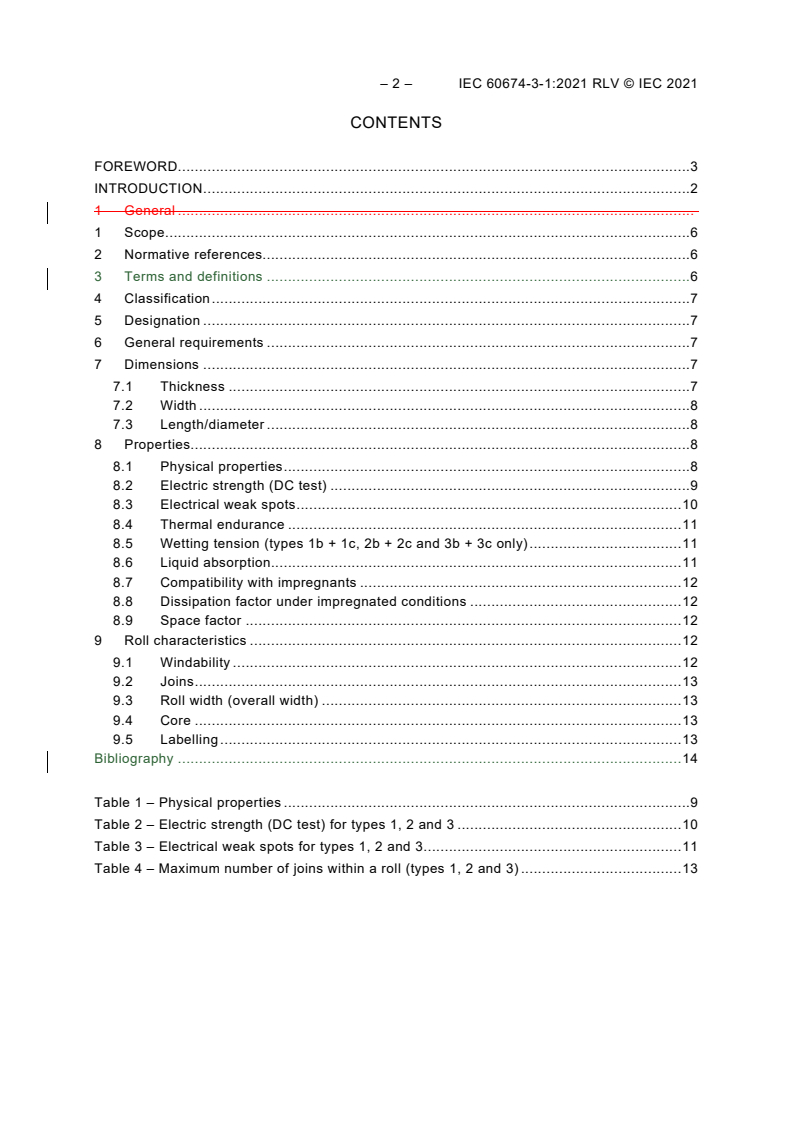
– 2 – IEC 60674-3-1:2021 RLV © IEC 2021
CONTENTS
FOREWORD . 3
INTRODUCTION . 2
1 General .
1 Scope . 6
2 Normative references. 6
3 Terms and definitions . 6
4 Classification . 7
5 Designation . 7
6 General requirements . 7
7 Dimensions . 7
7.1 Thickness . 7
7.2 Width . 8
7.3 Length/diameter . 8
8 Properties. 8
8.1 Physical properties . 8
8.2 Electric strength (DC test) . 9
8.3 Electrical weak spots . 10
8.4 Thermal endurance . 11
8.5 Wetting tension (types 1b + 1c, 2b + 2c and 3b + 3c only) . 11
8.6 Liquid absorption . 11
8.7 Compatibility with impregnants . 12
8.8 Dissipation factor under impregnated conditions . 12
8.9 Space factor . 12
9 Roll characteristics . 12
9.1 Windability . 12
9.2 Joins . 13
9.3 Roll width (overall width) . 13
9.4 Core . 13
9.5 Labelling . 13
Bibliography . 14
Table 1 – Physical properties . 9
Table 2 – Electric strength (DC test) for types 1, 2 and 3 . 10
Table 3 – Electrical weak spots for types 1, 2 and 3 . 11
Table 4 – Maximum number of joins within a roll (types 1, 2 and 3) . 13
INTERNATIONAL ELECTROTECHNICAL COMMISSION
____________
PLASTIC FILMS FOR ELECTRICAL PURPOSES –
Part 3: Specifications for individual materials –
Sheet 1: Biaxially oriented polypropylene (PP) films for capacitors
FOREWORD
1) The International Electrotechnical Commission (IEC) is a worldwide organization for standardization comprising
all national electrotechnical committees (IEC National Committees). The object of IEC is to promote international
co-operation on all questions concerning standardization in the electrical and electronic fields. To this end and
in addition to other activities, IEC publishes International Standards, Technical Specifications, Technical Reports,
Publicly Available Specifications (PAS) and Guides (hereafter referred to as “IEC Publication(s)”). Their
preparation is entrusted to technical committees; any IEC National Committee interested in the subject dealt with
may participate in this preparatory work. International, governmental and non-governmental organizations liaising
with the IEC also participate in this preparation. IEC collaborates closely with the International Organization for
Standardization (ISO) in accordance with conditions determined by agreement between the two organizations.
2) The formal decisions or agreements of IEC on technical matters express, as nearly as possible, an international
consensus of opinion on the relevant subjects since each technical committee has representation from all
interested IEC National Committees.
3) IEC Publications have the form of recommendations for international use and are accepted by IEC National
Committees in that sense. While all reasonable efforts are made to ensure that the technical content of IEC
Publications is accurate, IEC cannot be held responsible for the way in which they are used or for any
misinterpretation by any end user.
4) In order to promote international uniformity, IEC National Committees undertake to apply IEC Publications
transparently to the maximum extent possible in their national and regional publications. Any divergence between
any IEC Publication and the corresponding national or regional publication shall be clearly indicated in the latter.
5) IEC itself does not provide any attestation of conformity. Independent certification bodies provide conformity
assessment services and, in some areas, access to IEC marks of conformity. IEC is not responsible for any
services carried out by independent certification bodies.
6) All users should ensure that they have the latest edition of this publication.
7) No liability shall attach to IEC or its directors, employees, servants or agents including individual experts and
members of its technical committees and IEC National Committees for any personal injury, property damage or
other damage of any nature whatsoever, whether direct or indirect, or for costs (including legal fees) and
expenses arising out of the publication, use of, or reliance upon, this IEC Publication or any other IEC
Publications.
8) Attention is drawn to the Normative references cited in this publication. Use of the referenced publications is
indispensable for the correct application of this publication.
9) Attention is drawn to the possibility that some of the elements of this IEC Publication may be the subject of patent
rights. IEC shall not be held responsible for identifying any or all such patent rights.
This redline version of the official IEC Standard allows the user to identify the changes made to
the previous edition IEC 60674-3-1:1998+AMD1:2011 CSV. A vertical bar appears in the margin
wherever a change has been made. Additions are in green text, deletions are in strikethrough
red text.
– 4 – IEC 60674-3-1:2021 RLV © IEC 2021
IEC 60674-3-1 has been prepared by IEC technical committee 15: Solid electrical insulating
materials.
This second edition cancels and replaces the first edition published in 1998 and
Amendment 1:2011. This edition constitutes a technical revision.
This edition includes the following significant technical changes with respect to the previous
edition:
a) this document has been completely revised editorially and technically and included in the
IEC 60674 series of standards;
b) the test methods have been updated to reflect today’s state of the art.
The text of this International Standard is based on the following documents:
Draft Report on voting
15/909/CDV 15/925/RVC
Full information on the voting for its approval can be found in the report on voting indicated in
the above table.
The language used for the development of this International Standard is English.
This document was drafted in accordance with ISO/IEC Directives, Part 2, and developed in
accordance with ISO/IEC Directives, Part 1 and ISO/IEC Directives, IEC Supplement, available
at www.iec.ch/members_experts/refdocs. The main document types developed by IEC are
described in greater detail at www.iec.ch/standardsdev/publications.
A list of all parts in the IEC 60674 series, published under the general title Plastic films for
electrical purposes, can be found on the IEC website.
Future standards in this series will carry the new general title as cited above. Titles of existing
standards in this series will be updated at the time of the next edition.
The committee has decided that the contents of this document will remain unchanged until the
stability date indicated on the IEC website under webstore.iec.ch in the data related to the
specific document. At this date, the document will be
• reconfirmed,
• withdrawn,
• replaced by a revised edition, or
• amended.
IMPORTANT – The 'colour inside' logo on the cover page of this publication indicates that it
contains colours which are considered to be useful for the correct understanding of its
contents. Users should therefore print this document using a colour printer.
INTRODUCTION
This standard is one of a series which deals with plastic films for electrical purposes. The series
will consist of three parts:
Part 1: Definitions and general requirements (IEC 60674-1);
Part 2: Methods of test (IEC 60674-2);
Part 3: Specifications for individual materials (IEC 60674-3).
This standard contains one of the sheets comprising Part 3, as follows:
Sheet 1: Biaxially oriented (PP) polypropylene films for capacitors.
– 6 – IEC 60674-3-1:2021 RLV © IEC 2021
PLASTIC FILMS FOR ELECTRICAL PURPOSES –
Part 3: Specifications for individual materials –
Sheet 1: Biaxially oriented polypropylene (PP) films for capacitors
1 General
1 Scope
This sheet of IEC 60674-3 gives the requirements for biaxially oriented polypropylene film
having a smooth or rough surface, corona treated when required for vacuum metallization. The
films are for use as dielectric in capacitors.
Materials which conform to this specification meet established levels of performance. However,
the selection of a material by a user for a specific application should be is based on the actual
requirements necessary for adequate performance in that application and not based on this
specification alone.
Safety warning: It is the responsibility of the user of the methods contained or referred to in this
document to ensure that they are used in a safe manner.
2 Normative references
The following documents are referred to in the text in such a way that some or all of their content
constitutes requirements of this document. For dated references, only the edition cited applies.
For undated references, the latest edition of the referenced document (including any
amendments) applies.
IEC 60674-1:1980, Specification for plastic films for electrical purposes – Part 1: Definitions
and general requirements
IEC 60674-2:19882016, Specification for plastic films for electrical purposes – Part 2: Methods
of test
IEC 61074:1991, Determination of heats and temperatures of melting and crystallization of electrically
insulating materials by differential scanning calorimetry
ISO 534:1988, Paper and board – Determination of thickness and apparent bulk density or apparent
sheet density
ISO 11357-3, Plastics – Differential scanning calorimetry (DSC) – Part 3:Determination of temperature
and enthalpy of melting and crystallization
3 Terms and definitions
No terms and definitions are listed in this document.
ISO and IEC maintain terminological databases for use in standardization at the following
addresses:
• IEC Electropedia: available at http://www.electropedia.org/
• ISO Online browsing platform: available at http://www.iso.org/obp
4 Classification
The polypropylene film shall be of the following types:
Type 1: having smooth surfaces (space factor <5 %, see 8.9);
Type 1a: not corona treated;
Type 1b: one side pre-treated to facilitate the vacuum deposition of metal;
Type 1c: both sides pre-treated;
Type 2: having at least one rough surface (space factor ≥5 %, see 8.9);
Type 2a: not corona treated;
Type 2b: one side pre-treated to facilitate the vacuum deposition of metal;
Type 2c: both sides pre-treated.
Type 3: having high electric strength for thin film (film thickness ≤ 3,5 µm);
Type 3a: not corona treated;
Type 3b: one side pre-treated to facilitate the vacuum deposition of metal;
Type 3c: both sides pre-treated.
5 Designation
The plastic film shall be identified by the following designation:
Designation of the film – IEC 60674-3-1 – PP – type – thickness in micrometres – width in
millimetres – length in metres.
EXAMPLE
Polypropylene film – IEC 60674-3-1 – PP – 1a – 6 – 100 – 3000.
6 General requirements
The materials shall be made essentially from isotactic type polypropylene homopolymer and
shall conform to the requirements laid down in IEC 60674-1.
7 Dimensions
7.1 Thickness
The film thickness shall be measured in accordance with the requirements of 4.3.2 of IEC 60674-
2:2016. This is in general the gravimetric thickness, but for type 2 distinction shall be made
between thickness determined by weighing (t = gravimetric thickness) and thickness measured
g
by micrometer method (t = bulking thickness).
b
Gravimetric thickness shall be measured in accordance with the requirements of 4.3.2 of
IEC 60674-2:2016.
Bulking (micrometric) thickness shall be measured in accordance with ISO 534, except that the
four test pieces are initially made up of 12 film layers, the layers being cut together using a
suitable template (preferably 250 mm × 200 mm, the 200 mm dimension being in the machine
direction) from a blanket of film about 0,5 mm thick taken from the outer surface of the roll being
sampled. Discard the first and last layer of each pack or test piece just prior to imposing the
pack between the open pressure faces of the micrometer.
– 8 – IEC 60674-3-1:2021 RLV © IEC 2021
Bulking (micrometric) thickness shall be measured according to 4.2.3 of IEC 60674-2:2016.
There are no requirements for thickness in this document, but preferred gravimetric thicknesses
are as follows:
Type 1: 4,0 µm; 5,0 µm; 6,0 µm; 7,0 µm; 8,0 µm; 10,0 µm; 12,0 µm; 15,0 µm; 18,0 µm;
20,0 µm and 25 µm.
Type 2: 7,4 µm; 9,0 µm; 10,1; 11,0 µm; 12,0 µm; 12,7 µm; 13,6 µm; 14,4 µm; 15,2 µm;
16,2 µm and 17,8 µm.
Type 3: 2,5 µm; 2,8 µm; 3,0 µm and 3,5 µm.
The thickness tolerance shall comply with the requirements of 4.1 of IEC 60674-1:1980 unless
otherwise specified.
7.2 Width
The film width shall be measured in accordance with the requirements of Clause 6 of
IEC 60674‑2:2016.
Preferred widths cannot be given on account of the great variety of applications and different
requirements throughout the capacitor industry.
The tolerance on the width shall comply with the requirements of 4.2 of IEC 60674-1:1980.
7.3 Length/diameter
There are no requirements in this document for length or diameters of rolls. These should be
subject to purchase contract.
8 Properties
8.1 Physical properties
See Table 1.
Table 1 – Physical properties
Property Test method Unit Requirement Remarks
Density IEC 60674-2, Mg/m³ 0,91 ± 0,01 This method is only suitable for film
clause 4, method D
thickness >12 µm. The recommended
kg/dm
mixture is methanol/ethylene glycol
ISO 1183-2:2019
(g/cm )
Melting point IEC 61074 °C 165 to 175 DSC method
ISO 11357-3:2018
Tensile strength IEC 60674-2:2016, MPa Minimum Specimen width (15 ± 3) mm,
(either direction) Clause 12 Type 1: 120 rate of extension (100 ± 2) mm/min,
Type 2: 90 reference lines with the initial grip
Type 3: 120 separation (100 ± 2) mm apart
Elongation at break % Minimum
(either direction) Type 1: 40
Type 2: 30
Type 3: 30
Surface resistivity IEC 60674-2:2016, Ω The test voltages are
≥10
a
Clause 16 100 V for thicknesses >10 µm
and 10 V for thicknesses ≤10 µm
Volume resistivity IEC 60674-2:2016, Ωm
>10
a
The test voltages are (100 ± 10) V
Clause 17
for thicknesses >10 µm and (10 ± 1) V
for thicknesses ≤10 µm
Dissipation factor IEC 60674-2:2016,
Use evaporated metal electrodes or non-
at 23 °C and 18.2 or 18.3 contacting electrodes
–4
48 Hz – 62 Hz: (18.2.4 or 18.2.5)
≤3 × 10
–4
1 kHz:
≤3 × 10
Permittivity IEC 60674-2:2016, 2,2 ± 0,1 Use evaporated metal electrodes or non-
18.2 contacting electrodes
(18.2.4 or 18.2.5)
Dimensional change IEC 60674-2:2016, Shrinkage shall be agreed between buyer
for shrinkage: Clause 25 supplier and seller purchaser
– Machine direction %
– Transverse %
direction
NOTE Although the potential effects of certain properties such as crystallinity, orientation and isotactic/ atactic
content on the performance of the film are recognized, no recommendations regarding the determination of these
parameters have been made, particularly as no suitable test methods are available in IEC 60674-2.
a
Measurement conditions: (23 ± 2) °C and (50 ± 5) % relative humidity after at least 24 h exposure.
8.2 Electric strength (DC test)
Electric strength shall be measured according to 20.2 of IEC 60674-2:2016. The central value
shall be not less than the value given in Table 2. The winding tension shall
2 2
2,5 N/mm ± 0,5 N/mm .
– 10 – IEC 60674-3-1:2021 RLV © IEC 2021
Table 2 – Electric strength (DC test) for types 1, 2 and 3
Nominal film thickness Type Electric strength Not more than 1 of 21 results
(central value) shall be below
V/µm V/µm
µm
23 °C 105 °C 23 °C 105 °C
2,5 250 125 150 75
2,8 250 125 150 75
3,0 250 125 150 75
3,5 250 125 150 75
4 120 - 40 -
5 150 - 60 -
6 190 - 80 -
7 and 7,4 230 - 100 -
8 250 - 120 -
9 1 and 2 270 - 145 -
10 and 10,1 290 - 165 -
11 300 - 175 -
12 310 - 185 -
12,7 315 - 195 -
320 - 200 -
>12,7 to 25
8.3 Electrical weak spots
Electrical weak spots shall be measured according to 21.4 of IEC 60674-2:2016 with a test
voltage of 150 V/µm for types 1 and 2, and 250 V/µm for type 3, based on the nominal thickness of
the film.
The number of faults counted shall not exceed the numbers given in Table 3. A minimum surface
area of 5 m is to be tested.
Compliance with any one of two method criteria shall constitute compliance with this document.
Table 3 – Electrical weak spots for types 1, 2 and 3
Nominal thickness Type
Fault count/m²
µm
2,5 2,6
2,8 2,6
3,0 2,6
3,5 2,6
4 2,6
5 2,3
6 1,8
7 and 7,4 1,7
8 and 1,5
9 1,3
10 and 10,1 1,2
11 1,1
1,0
≥12
Nominal Method C1 Method C3
Type
thickness
(Aluminium foil electrodes) (Metal electrode with air gap)
21.4.2.2 of IEC 60674-2:2016 21.4.2.4 of IEC 60674-2:2016
Fault Test voltage Fault Test voltage
2 2
µm V/µm V/µm
count/m count/m
2,5
2,8
3 2,6 250 2,0 200
3,0
3,5
4 2,6 1,0 350
5 2,3 300
6 1,8 300
7 and 7,4 1,7 250
8 1 and 2 1,5 150 250
0,5
9 1,3 230
10 and 10,1 1,2 230
11 1,1 220
≥12 1,0 200
8.4 Thermal endurance
There is no requirement in this document for thermal endurance.
8.5 Wetting tension (types 1b + 1c, 2b + 2c and 3b + 3c only)
When tested in accordance with Clause 11 of IEC 60674-2:2016, the wetting tension of the
–1
tested surface shall not be less than 35 mN⋅m .
8.6 Liquid absorption
For satisfactory construction of impregnated capacitors, the absorption of the impregnant by
the film may need to be controlled within certain limits. If required, the method of measurement,
– 12 – IEC 60674-3-1:2021 RLV © IEC 2021
the time and the temperature used and the absorption limits shall be agreed between supplier
and purchaser .
The preferred method shall conform with Clause 33 of IEC 60674-2:2016.
8.7 Compatibility with impregnants
The compatibility of the film with selected dielectric fluids shall be determined using a method
agreed upon between the supplier and the purchaser. This method may, for example, be based
on swelling or solubility of the film in the fluid, or on contamination of the fluid or the film .
8.8 Dissipation factor under impregnated conditions
The impregnants and the methods of testing used throughout the capacitor industry vary widely
and many of the materials and procedures are proprietary. Where the dissipation factor of the
film under impregnated conditions must be to an agreed standard, the limiting values and the
method of measurement should be agreed between supplier and purchaser .
8.9 Space factor
Space factor: Caused by surface roughness, space factor is the percentage increase in bulking
(micrometric) thickness over gravimetric thickness.
Space factor shall be measured according to Clause 9 of IEC 60674-2:2016.
There are no requirements for space factor in this document but the preferred space factor
value of type 2 is SF = (10 ± 3 5) %.
Space factor is calculated using the following formula:
t − t
b g
SF = × 100 (%)
t
g
where
t is the bulking thickness in micrometres;
b
t is the gravimetric thickness in micrometres.
g
9 Roll characteristics
9.1 Windability
The windability shall be measured according to Clause 7 of IEC 60674-2:2016.
Two methods exist:
a) for reels of width less than 150 mm, method A shall be used.
Bias/camber <10 mm
Sag (tension 5 MN/m ) <2 mm
b) for reels of width 150 mm and above, method B shall be used.
Bias/camber <10 mm
___________
In view of the wide variety of impregnants available today and under development for capacitor application, no
specific tests and/or limits can be given in this document for liquid absorption (8.6), compatibility with dielectric
fluids (8.7) and dissipation factor under impregnated conditions (8.8).
Sag (tension 5 MN/m ) <2 mm
The extension required to achieve bias/camber and sag limit shall be not more than 0,1 %.
9.2 Joins
Where joins (splices) are permitted, their construction shall conform to the requirements given
in 3.3 of IEC 60674-1:1980. Breaks (unjoined pieces) shall also be indicated so as to be clearly
visible when viewed from the end faces of the roll. The offset of either edge at a join shall not
exceed 0,5 mm.
The number of joins (splices) or breaks in each roll shall not exceed the values given
in Table 4.
Table 4 – Maximum number of joins within a roll (types 1, 2 and 3)
Nominal Number of joins within a roll Number of joins within a roll
film thickness of width >350 mm, of width ≤350 mm,
µm core diameter = 150 mm and core diameter = 76 mm and
outer diameter outer diameter <250 mm
≤300 mm >300 mm >400 mm
≤400 mm ≤500 mm
≤3,5 1 1 1 1
4 3 4 – 3
5 2 3 4 3
6 2 3 4 2
7 and 7,4 2 2 3 2
8 2 2 3 2
≥9 2 2 2 1
9.3 Roll width (overall width)
The overall width is the distance between roll end faces measured between the outermost points
of each end face (see 3.2 of IEC 60674-1:1980). The difference between the film width
measured according to Clause 6 of IEC 60674-2:2016 and the roll width excluding the core shall
be not greater than:
– 0,5 mm for film width ≤150 mm;
– 1,0 mm for film width >150 mm and <300 mm;
– 2,0 mm for film width ≥300 mm.
9.4 Core
The preferred inner diameters of cores are 76 mm and 150 mm.
9.5 Labelling
Films pre-treated on one side shall have the pre-treated side indicated on the label.
– 14 – IEC 60674-3-1:2021 RLV © IEC 2021
Bibliography
IEC 60674-3 (all parts), Plastic films for electrical purposes – Part 3: Specifications for
individual materials
ISO 1183-2:2019, Plastics – Methods for determining the density of non-cellular plastics –
Part 2: Density gradient column method
ISO 11357-3:2018, Plastics – Differential scanning calorimetry (DSC) – Part 3: Determination
of temperature and enthalpy of melting and crystallization
___________
IEC 60674-3-1 ®
Edition 2.0 2021-08
INTERNATIONAL
STANDARD
NORME
INTERNATIONALE
Plastic films for electrical purposes –
Part 3: Specifications for individual materials – Sheet 1: Biaxially oriented
polypropylene (PP) films for capacitors
Films plastiques à usages électriques –
Partie 3: Spécifications pour matériaux particuliers – Feuille 1: Films de
polypropylène biorienté (PP) pour condensateurs
– 2 – IEC 60674-3-1:2021 © IEC 2021
CONTENTS
FOREWORD . 3
INTRODUCTION . 5
1 Scope . 6
2 Normative references. 6
3 Terms and definitions . 6
4 Classification . 6
5 Designation . 7
6 General requirements . 7
7 Dimensions . 7
7.1 Thickness . 7
7.2 Width . 8
7.3 Length/diameter . 8
8 Properties. 8
8.1 Physical properties . 8
8.2 Electric strength (DC test) . 9
8.3 Electrical weak spots . 9
8.4 Thermal endurance . 10
8.5 Wetting tension (types 1b + 1c, 2b + 2c and 3b + 3c only) . 10
8.6 Liquid absorption . 10
8.7 Compatibility with impregnants . 10
8.8 Dissipation factor under impregnated conditions . 10
8.9 Space factor . 11
9 Roll characteristics . 11
9.1 Windability . 11
9.2 Joins . 11
9.3 Roll width (overall width) . 12
9.4 Core . 12
9.5 Labelling . 12
Bibliography . 13
Table 1 – Physical properties . 8
Table 2 – Electric strength (DC test) for types 1, 2 and 3 . 9
Table 3 – Electrical weak spots for types 1, 2 and 3 . 10
Table 4 – Maximum number of joins within a roll (types 1, 2 and 3) . 11
INTERNATIONAL ELECTROTECHNICAL COMMISSION
____________
PLASTIC FILMS FOR ELECTRICAL PURPOSES –
Part 3: Specifications for individual materials –
Sheet 1: Biaxially oriented polypropylene (PP) films for capacitors
FOREWORD
1) The International Electrotechnical Commission (IEC) is a worldwide organization for standardization comprising
all national electrotechnical committees (IEC National Committees). The object of IEC is to promote international
co-operation on all questions concerning standardization in the electrical and electronic fields. To this end and
in addition to other activities, IEC publishes International Standards, Technical Specifications, Technical Reports,
Publicly Available Specifications (PAS) and Guides (hereafter referred to as “IEC Publication(s)”). Their
preparation is entrusted to technical committees; any IEC National Committee interested in the subject dealt with
may participate in this preparatory work. International, governmental and non-governmental organizations liaising
with the IEC also participate in this preparation. IEC collaborates closely with the International Organization for
Standardization (ISO) in accordance with conditions determined by agreement between the two organizations.
2) The formal decisions or agreements of IEC on technical matters express, as nearly as possible, an international
consensus of opinion on the relevant subjects since each technical committee has representation from all
interested IEC National Committees.
3) IEC Publications have the form of recommendations for international use and are accepted by IEC National
Committees in that sense. While all reasonable efforts are made to ensure that the technical content of IEC
Publications is accurate, IEC cannot be held responsible for the way in which they are used or for any
misinterpretation by any end user.
4) In order to promote international uniformity, IEC National Committees undertake to apply IEC Publications
transparently to the maximum extent possible in their national and regional publications. Any divergence between
any IEC Publication and the corresponding national or regional publication shall be clearly indicated in the latter.
5) IEC itself does not provide any attestation of conformity. Independent certification bodies provide conformity
assessment services and, in some areas, access to IEC marks of conformity. IEC is not responsible for any
services carried out by independent certification bodies.
6) All users should ensure that they have the latest edition of this publication.
7) No liability shall attach to IEC or its directors, employees, servants or agents including individual experts and
members of its technical committees and IEC National Committees for any personal injury, property damage or
other damage of any nature whatsoever, whether direct or indirect, or for costs (including legal fees) and
expenses arising out of the publication, use of, or reliance upon, this IEC Publication or any other IEC
Publications.
8) Attention is drawn to the Normative references cited in this publication. Use of the referenced publications is
indispensable for the correct application of this publication.
9) Attention is drawn to the possibility that some of the elements of this IEC Publication may be the subject of patent
rights. IEC shall not be held responsible for identifying any or all such patent rights.
IEC 60674-3-1 has been prepared by IEC technical committee 15: Solid electrical insulating
materials.
This second edition cancels and replaces the first edition published in 1998 and
Amendment 1:2011. This edition constitutes a technical revision.
This edition includes the following significant technical changes with respect to the previous
edition:
a) this document has been completely revised editorially and technically and included in the
IEC 60674 series of standards;
b) the test methods have been updated to reflect today’s state of the art.
– 4 – IEC 60674-3-1:2021 © IEC 2021
The text of this International Standard is based on the following documents:
Draft Report on voting
15/909/CDV 15/925/RVC
Full information on the voting for its approval can be found in the report on voting indicated in
the above table.
The language used for the development of this International Standard is English.
This document was drafted in accordance with ISO/IEC Directives, Part 2, and developed in
accordance with ISO/IEC Directives, Part 1 and ISO/IEC Directives, IEC Supplement, available
at www.iec.ch/members_experts/refdocs. The main document types developed by IEC are
described in greater detail at www.iec.ch/standardsdev/publications.
A list of all parts in the IEC 60674 series, published under the general title Plastic films for
electrical purposes, can be found on the IEC website.
Future standards in this series will carry the new general title as cited above. Titles of existing
standards in this series will be updated at the time of the next edition.
The committee has decided that the contents of this document will remain unchanged until the
stability date indicated on the IEC website under webstore.iec.ch in the data related to the
specific document. At this date, the document will be
• reconfirmed,
• withdrawn,
• replaced by a revised edition, or
• amended.
INTRODUCTION
This standard is one of a series which deals with plastic films for electrical purposes. The series
will consist of three parts:
Part 1: Definitions and general requirements (IEC 60674-1);
Part 2: Methods of test (IEC 60674-2);
Part 3: Specifications for individual materials (IEC 60674-3).
This standard contains one of the sheets comprising Part 3, as follows:
Sheet 1: Biaxially oriented (PP) polypropylene films for capacitors.
– 6 – IEC 60674-3-1:2021 © IEC 2021
PLASTIC FILMS FOR ELECTRICAL PURPOSES –
Part 3: Specifications for individual materials –
Sheet 1: Biaxially oriented polypropylene (PP) films for capacitors
1 Scope
This sheet of IEC 60674-3 gives the requirements for biaxially oriented polypropylene film
having a smooth or rough surface, corona treated when required for vacuum metallization. The
films are for use as dielectric in capacitors.
Materials which conform to this specification meet established levels of performance. However,
the selection of a material by a user for a specific application is based on the actual
requirements necessary for adequate performance in that application and not based on this
specification alone.
Safety warning: It is the responsibility of the user of the methods contained or referred to in this
document to ensure that they are used in a safe manner.
2 Normative references
The following documents are referred to in the text in such a way that some or all of their content
constitutes requirements of this document. For dated references, only the edition cited applies.
For undated references, the latest edition of the referenced document (including any
amendments) applies.
IEC 60674-1:1980, Specification for plastic films for electrical purposes – Part 1: Definitions
and general requirements
IEC 60674-2:2016, Specification for plastic films for electrical purposes – Part 2: Methods of
test
3 Terms and definitions
No terms and definitions are listed in this document.
ISO and IEC maintain terminological databases for use in standardization at the following
addresses:
• IEC Electropedia: available at http://www.electropedia.org/
• ISO Online browsing platform: available at http://www.iso.org/obp
4 Classification
The polypropylene film shall be of the following types:
Type 1: having smooth surfaces (space factor <5 %, see 8.9);
Type 1a: not corona treated;
Type 1b: one side pre-treated to facilitate the vacuum deposition of metal;
Type 1c: both sides pre-treated;
Type 2: having at least one rough surface (space factor ≥5 %, see 8.9);
Type 2a: not corona treated;
Type 2b: one side pre-treated to facilitate the vacuum deposition of metal;
Type 2c: both sides pre-treated.
Type 3: having high electric strength for thin film (film thickness ≤ 3,5 µm);
Type 3a: not corona treated;
Type 3b: one side pre-treated to facilitate the vacuum deposition of metal;
Type 3c: both sides pre-treated.
5 Designation
The plastic film shall be identified by the following designation:
Designation of the film – IEC 60674-3-1 – PP – type – thickness in micrometres – width in
millimetres – length in metres.
EXAMPLE
Polypropylene film – IEC 60674-3-1 – PP – 1a – 6 – 100 – 3000.
6 General requirements
The materials shall be made essentially from isotactic type polypropylene homopolymer and
shall conform to the requirements laid down in IEC 60674-1.
7 Dimensions
7.1 Thickness
The film thickness shall be measured in accordance with the requirements of 4.3.2 of IEC 60674-
2:2016. This is in general the gravimetric thickness, but for type 2 distinction shall be made
between thickness determined by weighing (t = gravimetric thickness) and thickness measured
g
by micrometer method (t = bulking thickness).
b
Gravimetric thickness shall be measured in accordance with the requirements of 4.3.2 of
IEC 60674-2:2016.
Bulking (micrometric) thickness shall be measured according to 4.2.3 of IEC 60674-2:2016.
There are no requirements for thickness in this document, but preferred gravimetric thicknesses
are as follows:
Type 1: 4,0 µm; 5,0 µm; 6,0 µm; 7,0 µm; 8,0 µm; 10,0 µm; 12,0 µm; 15,0 µm; 18,0 µm;
20,0 µm and 25 µm.
Type 2: 7,4 µm; 9,0 µm; 10,1; 11,0 µm; 12,0 µm; 12,7 µm; 13,6 µm; 14,4 µm; 15,2 µm;
16,2 µm and 17,8 µm.
Type 3: 2,5 µm; 2,8 µm; 3,0 µm and 3,5 µm.
The thickness tolerance shall comply with the requirements of 4.1 of IEC 60674-1:1980 unless
otherwise specified.
– 8 – IEC 60674-3-1:2021 © IEC 2021
7.2 Width
The film width shall be measured in accordance with the requirements of Clause 6 of
IEC 60674‑2:2016.
Preferred widths cannot be given on account of the great variety of applications and different
requirements throughout the capacitor industry.
The tolerance on the width shall comply with the requirements of 4.2 of IEC 60674-1:1980.
7.3 Length/diameter
There are no requirements in this document for length or diameters of rolls. These should be
subject to purchase contract.
8 Properties
8.1 Physical properties
See Table 1.
Table 1 – Physical properties
Property Test method Unit Requirement Remarks
Density ISO 1183-2:2019 0,91 ± 0,01 This method is only suitable for film
kg/dm
thickness >12 µm. The recommended
(
...
IEC 60674-3-1 ®
Edition 2.0 2021-08
INTERNATIONAL
STANDARD
NORME
INTERNATIONALE
Plastic films for electrical purposes –
Part 3: Specifications for individual materials – Sheet 1: Biaxially oriented
polypropylene (PP) films for capacitors
Films plastiques à usages électriques –
Partie 3: Spécifications pour matériaux particuliers – Feuille 1: Films de
polypropylène biorienté (PP) pour condensateurs
All rights reserved. Unless otherwise specified, no part of this publication may be reproduced or utilized in any form
or by any means, electronic or mechanical, including photocopying and microfilm, without permission in writing from
either IEC or IEC's member National Committee in the country of the requester. If you have any questions about IEC
copyright or have an enquiry about obtaining additional rights to this publication, please contact the address below or
your local IEC member National Committee for further information.
Droits de reproduction réservés. Sauf indication contraire, aucune partie de cette publication ne peut être reproduite ni
utilisée sous quelque forme que ce soit et par aucun procédé, électronique ou mécanique, y compris la photocopie et
les microfilms, sans l'accord écrit de l'IEC ou du Comité national de l'IEC du pays du demandeur. Si vous avez des
questions sur le copyright de l'IEC ou si vous désirez obtenir des droits supplémentaires sur cette publication, utilisez
les coordonnées ci-après ou contactez le Comité national de l'IEC de votre pays de résidence.
IEC Central Office Tel.: +41 22 919 02 11
3, rue de Varembé info@iec.ch
CH-1211 Geneva 20 www.iec.ch
Switzerland
About the IEC
The International Electrotechnical Commission (IEC) is the leading global organization that prepares and publishes
International Standards for all electrical, electronic and related technologies.
About IEC publications
The technical content of IEC publications is kept under constant review by the IEC. Please make sure that you have the
latest edition, a corrigendum or an amendment might have been published.
IEC publications search - webstore.iec.ch/advsearchform IEC online collection - oc.iec.ch
The advanced search enables to find IEC publications by a Discover our powerful search engine and read freely all the
variety of criteria (reference number, text, technical publications previews. With a subscription you will always have
committee, …). It also gives information on projects, replaced access to up to date content tailored to your needs.
and withdrawn publications.
Electropedia - www.electropedia.org
IEC Just Published - webstore.iec.ch/justpublished
The world's leading online dictionary on electrotechnology,
Stay up to date on all new IEC publications. Just Published
containing more than 22 000 terminological entries in English
details all new publications released. Available online and once
and French, with equivalent terms in 18 additional languages.
a month by email.
Also known as the International Electrotechnical Vocabulary
(IEV) online.
IEC Customer Service Centre - webstore.iec.ch/csc
If you wish to give us your feedback on this publication or need
further assistance, please contact the Customer Service
Centre: sales@iec.ch.
A propos de l'IEC
La Commission Electrotechnique Internationale (IEC) est la première organisation mondiale qui élabore et publie des
Normes internationales pour tout ce qui a trait à l'électricité, à l'électronique et aux technologies apparentées.
A propos des publications IEC
Le contenu technique des publications IEC est constamment revu. Veuillez vous assurer que vous possédez l’édition la
plus récente, un corrigendum ou amendement peut avoir été publié.
Recherche de publications IEC - Découvrez notre puissant moteur de recherche et consultez
webstore.iec.ch/advsearchform gratuitement tous les aperçus des publications. Avec un
La recherche avancée permet de trouver des publications IEC abonnement, vous aurez toujours accès à un contenu à jour
en utilisant différents critères (numéro de référence, texte, adapté à vos besoins.
comité d’études, …). Elle donne aussi des informations sur les
projets et les publications remplacées ou retirées. Electropedia - www.electropedia.org
Le premier dictionnaire d'électrotechnologie en ligne au monde,
IEC Just Published - webstore.iec.ch/justpublished
avec plus de 22 000 articles terminologiques en anglais et en
Restez informé sur les nouvelles publications IEC. Just
français, ainsi que les termes équivalents dans 16 langues
Published détaille les nouvelles publications parues.
additionnelles. Egalement appelé Vocabulaire
Disponible en ligne et une fois par mois par email.
Electrotechnique International (IEV) en ligne.
Service Clients - webstore.iec.ch/csc
Si vous désirez nous donner des commentaires sur cette
publication ou si vous avez des questions contactez-nous:
sales@iec.ch.
IEC online collection - oc.iec.ch
IEC 60674-3-1 ®
Edition 2.0 2021-08
INTERNATIONAL
STANDARD
NORME
INTERNATIONALE
Plastic films for electrical purposes –
Part 3: Specifications for individual materials – Sheet 1: Biaxially oriented
polypropylene (PP) films for capacitors
Films plastiques à usages électriques –
Partie 3: Spécifications pour matériaux particuliers – Feuille 1: Films de
polypropylène biorienté (PP) pour condensateurs
INTERNATIONAL
ELECTROTECHNICAL
COMMISSION
COMMISSION
ELECTROTECHNIQUE
INTERNATIONALE
ICS 29.035.20 ISBN 978-2-8322-1017-4
– 2 – IEC 60674-3-1:2021 © IEC 2021
CONTENTS
FOREWORD . 3
INTRODUCTION . 5
1 Scope . 6
2 Normative references. 6
3 Terms and definitions . 6
4 Classification . 6
5 Designation . 7
6 General requirements . 7
7 Dimensions . 7
7.1 Thickness . 7
7.2 Width . 8
7.3 Length/diameter . 8
8 Properties. 8
8.1 Physical properties . 8
8.2 Electric strength (DC test) . 9
8.3 Electrical weak spots . 9
8.4 Thermal endurance . 10
8.5 Wetting tension (types 1b + 1c, 2b + 2c and 3b + 3c only) . 10
8.6 Liquid absorption . 10
8.7 Compatibility with impregnants . 10
8.8 Dissipation factor under impregnated conditions . 10
8.9 Space factor . 11
9 Roll characteristics . 11
9.1 Windability . 11
9.2 Joins . 11
9.3 Roll width (overall width) . 12
9.4 Core . 12
9.5 Labelling . 12
Bibliography . 13
Table 1 – Physical properties . 8
Table 2 – Electric strength (DC test) for types 1, 2 and 3 . 9
Table 3 – Electrical weak spots for types 1, 2 and 3 . 10
Table 4 – Maximum number of joins within a roll (types 1, 2 and 3) . 11
INTERNATIONAL ELECTROTECHNICAL COMMISSION
____________
PLASTIC FILMS FOR ELECTRICAL PURPOSES –
Part 3: Specifications for individual materials –
Sheet 1: Biaxially oriented polypropylene (PP) films for capacitors
FOREWORD
1) The International Electrotechnical Commission (IEC) is a worldwide organization for standardization comprising
all national electrotechnical committees (IEC National Committees). The object of IEC is to promote international
co-operation on all questions concerning standardization in the electrical and electronic fields. To this end and
in addition to other activities, IEC publishes International Standards, Technical Specifications, Technical Reports,
Publicly Available Specifications (PAS) and Guides (hereafter referred to as “IEC Publication(s)”). Their
preparation is entrusted to technical committees; any IEC National Committee interested in the subject dealt with
may participate in this preparatory work. International, governmental and non-governmental organizations liaising
with the IEC also participate in this preparation. IEC collaborates closely with the International Organization for
Standardization (ISO) in accordance with conditions determined by agreement between the two organizations.
2) The formal decisions or agreements of IEC on technical matters express, as nearly as possible, an international
consensus of opinion on the relevant subjects since each technical committee has representation from all
interested IEC National Committees.
3) IEC Publications have the form of recommendations for international use and are accepted by IEC National
Committees in that sense. While all reasonable efforts are made to ensure that the technical content of IEC
Publications is accurate, IEC cannot be held responsible for the way in which they are used or for any
misinterpretation by any end user.
4) In order to promote international uniformity, IEC National Committees undertake to apply IEC Publications
transparently to the maximum extent possible in their national and regional publications. Any divergence between
any IEC Publication and the corresponding national or regional publication shall be clearly indicated in the latter.
5) IEC itself does not provide any attestation of conformity. Independent certification bodies provide conformity
assessment services and, in some areas, access to IEC marks of conformity. IEC is not responsible for any
services carried out by independent certification bodies.
6) All users should ensure that they have the latest edition of this publication.
7) No liability shall attach to IEC or its directors, employees, servants or agents including individual experts and
members of its technical committees and IEC National Committees for any personal injury, property damage or
other damage of any nature whatsoever, whether direct or indirect, or for costs (including legal fees) and
expenses arising out of the publication, use of, or reliance upon, this IEC Publication or any other IEC
Publications.
8) Attention is drawn to the Normative references cited in this publication. Use of the referenced publications is
indispensable for the correct application of this publication.
9) Attention is drawn to the possibility that some of the elements of this IEC Publication may be the subject of patent
rights. IEC shall not be held responsible for identifying any or all such patent rights.
IEC 60674-3-1 has been prepared by IEC technical committee 15: Solid electrical insulating
materials.
This second edition cancels and replaces the first edition published in 1998 and
Amendment 1:2011. This edition constitutes a technical revision.
This edition includes the following significant technical changes with respect to the previous
edition:
a) this document has been completely revised editorially and technically and included in the
IEC 60674 series of standards;
b) the test methods have been updated to reflect today’s state of the art.
– 4 – IEC 60674-3-1:2021 © IEC 2021
The text of this International Standard is based on the following documents:
Draft Report on voting
15/909/CDV 15/925/RVC
Full information on the voting for its approval can be found in the report on voting indicated in
the above table.
The language used for the development of this International Standard is English.
This document was drafted in accordance with ISO/IEC Directives, Part 2, and developed in
accordance with ISO/IEC Directives, Part 1 and ISO/IEC Directives, IEC Supplement, available
at www.iec.ch/members_experts/refdocs. The main document types developed by IEC are
described in greater detail at www.iec.ch/standardsdev/publications.
A list of all parts in the IEC 60674 series, published under the general title Plastic films for
electrical purposes, can be found on the IEC website.
Future standards in this series will carry the new general title as cited above. Titles of existing
standards in this series will be updated at the time of the next edition.
The committee has decided that the contents of this document will remain unchanged until the
stability date indicated on the IEC website under webstore.iec.ch in the data related to the
specific document. At this date, the document will be
• reconfirmed,
• withdrawn,
• replaced by a revised edition, or
• amended.
INTRODUCTION
This standard is one of a series which deals with plastic films for electrical purposes. The series
will consist of three parts:
Part 1: Definitions and general requirements (IEC 60674-1);
Part 2: Methods of test (IEC 60674-2);
Part 3: Specifications for individual materials (IEC 60674-3).
This standard contains one of the sheets comprising Part 3, as follows:
Sheet 1: Biaxially oriented (PP) polypropylene films for capacitors.
– 6 – IEC 60674-3-1:2021 © IEC 2021
PLASTIC FILMS FOR ELECTRICAL PURPOSES –
Part 3: Specifications for individual materials –
Sheet 1: Biaxially oriented polypropylene (PP) films for capacitors
1 Scope
This sheet of IEC 60674-3 gives the requirements for biaxially oriented polypropylene film
having a smooth or rough surface, corona treated when required for vacuum metallization. The
films are for use as dielectric in capacitors.
Materials which conform to this specification meet established levels of performance. However,
the selection of a material by a user for a specific application is based on the actual
requirements necessary for adequate performance in that application and not based on this
specification alone.
Safety warning: It is the responsibility of the user of the methods contained or referred to in this
document to ensure that they are used in a safe manner.
2 Normative references
The following documents are referred to in the text in such a way that some or all of their content
constitutes requirements of this document. For dated references, only the edition cited applies.
For undated references, the latest edition of the referenced document (including any
amendments) applies.
IEC 60674-1:1980, Specification for plastic films for electrical purposes – Part 1: Definitions
and general requirements
IEC 60674-2:2016, Specification for plastic films for electrical purposes – Part 2: Methods of
test
3 Terms and definitions
No terms and definitions are listed in this document.
ISO and IEC maintain terminological databases for use in standardization at the following
addresses:
• IEC Electropedia: available at http://www.electropedia.org/
• ISO Online browsing platform: available at http://www.iso.org/obp
4 Classification
The polypropylene film shall be of the following types:
Type 1: having smooth surfaces (space factor <5 %, see 8.9);
Type 1a: not corona treated;
Type 1b: one side pre-treated to facilitate the vacuum deposition of metal;
Type 1c: both sides pre-treated;
Type 2: having at least one rough surface (space factor ≥5 %, see 8.9);
Type 2a: not corona treated;
Type 2b: one side pre-treated to facilitate the vacuum deposition of metal;
Type 2c: both sides pre-treated.
Type 3: having high electric strength for thin film (film thickness ≤ 3,5 µm);
Type 3a: not corona treated;
Type 3b: one side pre-treated to facilitate the vacuum deposition of metal;
Type 3c: both sides pre-treated.
5 Designation
The plastic film shall be identified by the following designation:
Designation of the film – IEC 60674-3-1 – PP – type – thickness in micrometres – width in
millimetres – length in metres.
EXAMPLE
Polypropylene film – IEC 60674-3-1 – PP – 1a – 6 – 100 – 3000.
6 General requirements
The materials shall be made essentially from isotactic type polypropylene homopolymer and
shall conform to the requirements laid down in IEC 60674-1.
7 Dimensions
7.1 Thickness
The film thickness shall be measured in accordance with the requirements of 4.3.2 of IEC 60674-
2:2016. This is in general the gravimetric thickness, but for type 2 distinction shall be made
between thickness determined by weighing (t = gravimetric thickness) and thickness measured
g
by micrometer method (t = bulking thickness).
b
Gravimetric thickness shall be measured in accordance with the requirements of 4.3.2 of
IEC 60674-2:2016.
Bulking (micrometric) thickness shall be measured according to 4.2.3 of IEC 60674-2:2016.
There are no requirements for thickness in this document, but preferred gravimetric thicknesses
are as follows:
Type 1: 4,0 µm; 5,0 µm; 6,0 µm; 7,0 µm; 8,0 µm; 10,0 µm; 12,0 µm; 15,0 µm; 18,0 µm;
20,0 µm and 25 µm.
Type 2: 7,4 µm; 9,0 µm; 10,1; 11,0 µm; 12,0 µm; 12,7 µm; 13,6 µm; 14,4 µm; 15,2 µm;
16,2 µm and 17,8 µm.
Type 3: 2,5 µm; 2,8 µm; 3,0 µm and 3,5 µm.
The thickness tolerance shall comply with the requirements of 4.1 of IEC 60674-1:1980 unless
otherwise specified.
– 8 – IEC 60674-3-1:2021 © IEC 2021
7.2 Width
The film width shall be measured in accordance with the requirements of Clause 6 of
IEC 60674‑2:2016.
Preferred widths cannot be given on account of the great variety of applications and different
requirements throughout the capacitor industry.
The tolerance on the width shall comply with the requirements of 4.2 of IEC 60674-1:1980.
7.3 Length/diameter
There are no requirements in this document for length or diameters of rolls. These should be
subject to purchase contract.
8 Properties
8.1 Physical properties
See Table 1.
Table 1 – Physical properties
Property Test method Unit Requirement Remarks
Density ISO 1183-2:2019 0,91 ± 0,01 This method is only suitable for film
kg/dm
thickness >12 µm. The recommended
(g/cm )
mixture is methanol/ethylene glycol
Melting point ISO 11357-3:2018 °C 165 to 175 DSC method
Tensile strength IEC 60674-2:2016, MPa Minimum Specimen width (15 ± 3) mm,
(either direction) Clause 12 Type 1: 120 rate of extension (100 ± 2) mm/min,
Type 2: 90 reference lines with the initial grip
Type 3: 120 separation (100 ± 2) mm apart
Elongation at break % Minimum
(either direction) Type 1: 40
Type 2: 30
Type 3: 30
Surface resistivity IEC 60674-2:2016, Ω The test voltages are
≥10
a
100 V for thicknesses >10 µm
Clause 16
and 10 V for thicknesses ≤10 µm
Volume resistivity IEC 60674-2:2016, Ωm
>10
a
Clause 17
Dissipation factor IEC 60674-2:2016, Use evaporated metal electrodes or non-
at 23 °C and 18.2 or 18.3 contacting electrodes
–4
48 Hz – 62 Hz: (18.2.4 or 18.2.5)
≤3 × 10
–4
1 kHz:
≤3 × 10
Permittivity IEC 60674-2:2016, 2,2 ± 0,1 Use evaporated metal electrodes or non-
18.2 contacting electrodes
(18.2.4 or 18.2.5)
Dimensional change IEC 60674-2:2016, Shrinkage shall be agreed between
for shrinkage: Clause 25 supplier and purchaser
– Machine direction %
– Transverse %
direction
NOTE Although the potential effects of certain properties such as crystallinity, orientation and isotactic/ atactic
content on the performance of the film are recognized, no recommendations regarding the determination of these
parameters have been made, particularly as no suitable test methods are available in IEC 60674-2.
a
Measurement conditions: (23 ± 2) °C and (50 ± 5) % relative humidity after at least 24 h exposure.
8.2 Electric strength (DC test)
Electric strength shall be measured according to 20.2 of IEC 60674-2:2016. The central value
shall be not less than the value given in Table 2. The winding tension shall
2 2
2,5 N/mm ± 0,5 N/mm .
Table 2 – Electric strength (DC test) for types 1, 2 and 3
Nominal film thickness Type Electric strength Not more than 1 of 21 results
(central value) shall be below
V/µm V/µm
µm
23 °C 105 °C 23 °C 105 °C
2,5 250 125 150 75
2,8 250 125 150 75
3,0 250 125 150 75
3,5 250 125 150 75
4 120 - 40 -
5 150 - 60 -
6 190 - 80 -
7 and 7,4 230 - 100 -
8 250 - 120 -
9 1 and 2 270 - 145 -
10 and 10,1 290 - 165 -
11 300 - 175 -
12 310 - 185 -
12,7 315 - 195 -
320 - 200 -
>12,7 to 25
8.3 Electrical weak spots
Electrical weak spots shall be measured according to 21.4 of IEC 60674-2:2016.
The number of faults counted shall not exceed the numbers given in Table 3. A minimum surface
area of 5 m is to be tested.
Compliance with any one of two method criteria shall constitute compliance with this document.
– 10 – IEC 60674-3-1:2021 © IEC 2021
Table 3 – Electrical weak spots for types 1, 2 and 3
Nominal Method C1 Method C3
Type
thickness
(Aluminium foil electrodes) (Metal electrode with air gap)
21.4.2.2 of IEC 60674-2:2016 21.4.2.4 of IEC 60674-2:2016
Fault Test voltage Fault Test voltage
2 2
µm V/µm V/µm
count/m count/m
2,5
2,8
3 2,6 250 2,0 200
3,0
3,5
4 2,6 1,0 350
5 2,3 300
6 1,8 300
7 and 7,4 1,7 250
8 1 and 2 1,5 150 250
0,5
9 1,3 230
10 and 10,1 1,2 230
11 1,1 220
≥12 1,0 200
8.4 Thermal endurance
There is no requirement in this document for thermal endurance.
8.5 Wetting tension (types 1b + 1c, 2b + 2c and 3b + 3c only)
When tested in accordance with Clause 11 of IEC 60674-2:2016, the wetting tension of the
–1
tested surface shall not be less than 35 mN⋅m .
8.6 Liquid absorption
For satisfactory construction of impregnated capacitors, the absorption of the impregnant by
the film may need to be controlled within certain limits. If required, the method of measurement,
the time and the temperature used and the absorption limits shall be agreed between supplier
and purchaser .
The preferred method shall conform with Clause 33 of IEC 60674-2:2016.
8.7 Compatibility with impregnants
The compatibility of the film with selected dielectric fluids shall be determined using a method
agreed upon between the supplier and the purchaser. This method may, for example, be based
on swelling or solubility of the film in the fluid, or on contamination of the fluid or the film .
8.8 Dissipation factor under impregnated conditions
The impregnants and the methods of testing used throughout the capacitor industry vary widely
and many of the materials and procedures are proprietary. Where the dissipation factor of the
___________
In view of the wide variety of impregnants available today and under development for capacitor application, no
specific tests and/or limits can be given in this document for liquid absorption (8.6), compatibility with dielectric
fluids (8.7) and dissipation factor under impregnated conditions (8.8).
film under impregnated conditions must be to an agreed standard, the limiting values and the
method of measurement should be agreed between supplier and purchaser .
8.9 Space factor
Caused by surface roughness, space factor is the percentage increase in bulking (micrometric)
thickness over gravimetric thickness.
Space factor shall be measured according to Clause 9 of IEC 60674-2:2016.
There are no requirements for space factor in this document but the preferred space factor
value of type 2 is SF = (10 ± 5) %.
9 Roll characteristics
9.1 Windability
The windability shall be measured according to Clause 7 of IEC 60674-2:2016.
Two methods exist:
a) for reels of width less than 150 mm, method A shall be used.
Bias/camber <10 mm
Sag (tension 5 MN/m ) <2 mm
b) for reels of width 150 mm and above, method B shall be used.
Bias/camber <10 mm
Sag (tension 5 MN/m ) <2 mm
The extension required to achieve bias/camber and sag limit shall be not more than 0,1 %.
9.2 Joins
Where joins (splices) are permitted, their construction shall conform to the requirements given
in 3.3 of IEC 60674-1:1980. Breaks (unjoined pieces) shall also be indicated so as to be clearly
visible when v
...