


IEC 61000-4-13:2002+AMD1:2009 CSV
(Main)Electromagnetic compatibility (EMC) - Part 4-13: Testing and measurement techniques - Harmonics and interharmonics including mains signalling at a.c. power port, low frequency immunity tests
Electromagnetic compatibility (EMC) - Part 4-13: Testing and measurement techniques - Harmonics and interharmonics including mains signalling at a.c. power port, low frequency immunity tests
IEC 61000-4-13:2002+A1:2009 defines the immunity test methods and range of recommended basic test levels for electrical and electronic equipment with rated current up to 16 A per phase at disturbance frequencies up to and including 2 kHz (for 50 Hz mains) and 2,4 kHz (for 60 Hz mains) for harmonics and interharmonics on low voltage power networks. It establishes a common reference for evaluating the functional immunity of electrical and electronic equipment when subjected to harmonics and inter-harmonics and mains signalling frequencies. The test method documented in this part of IEC 61000 describes a consistent method to assess the immunity of an equipment or system against a defined phenomenon.
This consolidated version consists of the first edition (2002) and its amendment 1 (2009). Therefore, no need to order amendments in addition to this publication.
Compatibilité électromagnétique (CEM) - Partie 4-13: Techniques d'essai et de mesure - Essais d'immunité basse fréquence aux harmoniques et inter-harmoniques incluant les signaux transmis sur le réseau électrique alternatif
La CEI 61000-4-13:2002+A1:2009 définit les méthodes d'essai d'immunité ainsi que la gamme des niveaux d'essais fondamentaux recommandés pour les matériels électriques et électroniques dont le courant assigné d'entrée est inférieur à 16 A par phase, à des fréquences de perturbation allant jusqu'à et y compris 2 kHz (pour réseau 50 Hz) et 2,4 kHz (pour réseau 60 Hz) pour des harmoniques et inter-harmoniques sur réseaux d'alimentation basse tension. Elle établit une référence commune pour l'évaluation de l'immunité fonctionnelle des matériels électriques et électroniques soumis aux harmoniques et inter-harmoniques et aux fréquences des signaux transmis sur le réseau. La méthode d'essai décrite dans cette partie de la CEI 61000 décrit une méthode robuste pour estimer l'immunité d'un matériel ou d'un système à un phénomène prédéfini.
Cette version consolidée comprend la première édition (2002) et son amendement 1 (2009). Il n'est donc pas nécessaire de commander les amendements avec cette publication.
General Information
- Status
- Published
- Publication Date
- 29-Jul-2009
- Technical Committee
- SC 77A - EMC - Low frequency phenomena
- Current Stage
- PPUB - Publication issued
- Start Date
- 30-Jul-2009
- Completion Date
- 30-Jul-2009
Overview
IEC 61000-4-13:2002+AMD1:2009 CSV is an international standard developed by the International Electrotechnical Commission (IEC) covering electromagnetic compatibility (EMC) testing and measurement techniques. Specifically, it addresses harmonics and interharmonics, including mains signalling at the a.c. power port with low-frequency immunity tests. The standard applies to electrical and electronic equipment with a rated current up to 16 A per phase, focusing on disturbance frequencies up to 2 kHz for 50 Hz mains and 2.4 kHz for 60 Hz mains. This consolidated version includes the original 2002 edition and its 2009 amendment.
IEC 61000-4-13 provides a unified method for evaluating how equipment operates when subjected to harmonic, interharmonic, and mains signalling frequencies on low-voltage power networks. It is categorized as a basic EMC publication and acts as a reference for product committees and manufacturers when specifying EMC immunity requirements and test protocols.
Key Topics
Harmonics and Interharmonics:
Defines disturbances that are integer (harmonic) and non-integer (interharmonic) multiples of the fundamental frequency, originating from sources like non-linear loads and frequency converters.Mains Signalling:
Addresses immunity to low-frequency signals used for control and communication within power networks, typically found between standard harmonic frequencies.Immunity Test Levels:
Specifies recommended test levels for harmonics, interharmonics, and mains signalling frequencies, organized by equipment class (1, 2, 3, and X).Test Setup and Procedures:
Provides guidelines for test equipment, including test generators, analyzers, and measurement instruments. Details protocols to ensure accurate, repeatable immunity assessments.Equipment Under Test (EUT):
Details requirements for setting up and monitoring EUT during tests to evaluate performance under well-defined electromagnetic disturbances.
Applications
IEC 61000-4-13 is essential for:
Product Development and Compliance:
Assists manufacturers of electrical and electronic equipment in designing products with robust immunity to harmonics, interharmonics, and mains signalling disturbances.Type Testing and Certification:
Used by testing laboratories to verify that products meet required EMC immunity standards before entering global markets.Quality Assurance:
Supports ongoing compliance in production lines by providing repeatable test methods for control and periodic evaluation.Safety and Reliability:
Reduces risks of electromagnetic disturbances that may cause malfunction, ensuring the safe operation of devices in residential, commercial, and light industrial environments.Reference for Product Committees:
Serves as a foundation for other IEC standards that specify EMC requirements for specific product categories, systems, or applications.
Related Standards
For comprehensive EMC compliance, IEC 61000-4-13 should be considered alongside related standards, including:
IEC 61000-2-2:
Compatibility levels for low-frequency conducted disturbances and signalling in public low-voltage power supply systems.IEC 61000-3-2:
Limits for harmonic current emissions (equipment input current ≤ 16 A per phase).IEC 61000-4-7:
Measurement techniques for harmonics and interharmonics.IEC Guide 107:
Provides principles for the application of basic EMC publications within the IEC system.
By adhering to IEC 61000-4-13 and its related standards, organizations can ensure high levels of EMC immunity, market acceptance, and the reliable performance of their electrical and electronic products in real-world environments.
Keywords: Electromagnetic compatibility, EMC, harmonics, interharmonics, mains signalling, low frequency immunity tests, IEC 61000-4-13, electrical equipment testing, EMC compliance.
Buy Documents
IEC 61000-4-13:2002+AMD1:2009 CSV - Electromagnetic compatibility (EMC) - Part 4-13: Testing and measurement techniques - Harmonics and interharmonics including mains signalling at a.c. power port, low frequency immunity tests
Get Certified
Connect with accredited certification bodies for this standard

ANCE
Mexican certification and testing association.

Intertek Slovenia
Intertek testing, inspection, and certification services in Slovenia.

LNE (Laboratoire National de Métrologie et d'Essais)
French national laboratory for metrology and testing.
Sponsored listings
Frequently Asked Questions
IEC 61000-4-13:2002+AMD1:2009 CSV is a standard published by the International Electrotechnical Commission (IEC). Its full title is "Electromagnetic compatibility (EMC) - Part 4-13: Testing and measurement techniques - Harmonics and interharmonics including mains signalling at a.c. power port, low frequency immunity tests". This standard covers: IEC 61000-4-13:2002+A1:2009 defines the immunity test methods and range of recommended basic test levels for electrical and electronic equipment with rated current up to 16 A per phase at disturbance frequencies up to and including 2 kHz (for 50 Hz mains) and 2,4 kHz (for 60 Hz mains) for harmonics and interharmonics on low voltage power networks. It establishes a common reference for evaluating the functional immunity of electrical and electronic equipment when subjected to harmonics and inter-harmonics and mains signalling frequencies. The test method documented in this part of IEC 61000 describes a consistent method to assess the immunity of an equipment or system against a defined phenomenon. This consolidated version consists of the first edition (2002) and its amendment 1 (2009). Therefore, no need to order amendments in addition to this publication.
IEC 61000-4-13:2002+A1:2009 defines the immunity test methods and range of recommended basic test levels for electrical and electronic equipment with rated current up to 16 A per phase at disturbance frequencies up to and including 2 kHz (for 50 Hz mains) and 2,4 kHz (for 60 Hz mains) for harmonics and interharmonics on low voltage power networks. It establishes a common reference for evaluating the functional immunity of electrical and electronic equipment when subjected to harmonics and inter-harmonics and mains signalling frequencies. The test method documented in this part of IEC 61000 describes a consistent method to assess the immunity of an equipment or system against a defined phenomenon. This consolidated version consists of the first edition (2002) and its amendment 1 (2009). Therefore, no need to order amendments in addition to this publication.
IEC 61000-4-13:2002+AMD1:2009 CSV is classified under the following ICS (International Classification for Standards) categories: 33.100.20 - Immunity. The ICS classification helps identify the subject area and facilitates finding related standards.
IEC 61000-4-13:2002+AMD1:2009 CSV is available in PDF format for immediate download after purchase. The document can be added to your cart and obtained through the secure checkout process. Digital delivery ensures instant access to the complete standard document.
Standards Content (Sample)
IEC 61000-4-13 ®
Edition 1.1 2009-07
INTERNATIONAL
STANDARD
NORME
INTERNATIONALE
colour
inside
BASIC EMC PUBLICATION
PUBLICATION FONDAMENTALE EN CEM
Electromagnetic compatibility (EMC) –
Part 4-13: Testing and measurement techniques – Harmonics and
interharmonics including mains signalling at a.c. power port, low frequency
immunity tests
Compatibilité électromagnétique (CEM) –
Partie 4-13: Techniques d’essai et de mesure – Essais d’immunité basse
fréquence aux harmoniques et inter-harmoniques incluant les signaux transmis
sur le réseau électrique alternatif
IEC 61000-4-13:2002+A1:2009
All rights reserved. Unless otherwise specified, no part of this publication may be reproduced or utilized in any form or by
any means, electronic or mechanical, including photocopying and microfilm, without permission in writing from either IEC or
IEC's member National Committee in the country of the requester.
If you have any questions about IEC copyright or have an enquiry about obtaining additional rights to this publication,
please contact the address below or your local IEC member National Committee for further information.
Droits de reproduction réservés. Sauf indication contraire, aucune partie de cette publication ne peut être reproduite
ni utilisée sous quelque forme que ce soit et par aucun procédé, électronique ou mécanique, y compris la photocopie
et les microfilms, sans l'accord écrit de la CEI ou du Comité national de la CEI du pays du demandeur.
Si vous avez des questions sur le copyright de la CEI ou si vous désirez obtenir des droits supplémentaires sur cette
publication, utilisez les coordonnées ci-après ou contactez le Comité national de la CEI de votre pays de résidence.
IEC Central Office
3, rue de Varembé
CH-1211 Geneva 20
Switzerland
Email: inmail@iec.ch
Web: www.iec.ch
About the IEC
The International Electrotechnical Commission (IEC) is the leading global organization that prepares and publishes
International Standards for all electrical, electronic and related technologies.
About IEC publications
The technical content of IEC publications is kept under constant review by the IEC. Please make sure that you have the
latest edition, a corrigenda or an amendment might have been published.
ƒ Catalogue of IEC publications: www.iec.ch/searchpub
The IEC on-line Catalogue enables you to search by a variety of criteria (reference number, text, technical committee,…).
It also gives information on projects, withdrawn and replaced publications.
ƒ IEC Just Published: www.iec.ch/online_news/justpub
Stay up to date on all new IEC publications. Just Published details twice a month all new publications released. Available
on-line and also by email.
ƒ Electropedia: www.electropedia.org
The world's leading online dictionary of electronic and electrical terms containing more than 20 000 terms and definitions
in English and French, with equivalent terms in additional languages. Also known as the International Electrotechnical
Vocabulary online.
ƒ Customer Service Centre: www.iec.ch/webstore/custserv
If you wish to give us your feedback on this publication or need further assistance, please visit the Customer Service
Centre FAQ or contact us:
Email: csc@iec.ch
Tel.: +41 22 919 02 11
Fax: +41 22 919 03 00
A propos de la CEI
La Commission Electrotechnique Internationale (CEI) est la première organisation mondiale qui élabore et publie des
normes internationales pour tout ce qui a trait à l'électricité, à l'électronique et aux technologies apparentées.
A propos des publications CEI
Le contenu technique des publications de la CEI est constamment revu. Veuillez vous assurer que vous possédez
l’édition la plus récente, un corrigendum ou amendement peut avoir été publié.
ƒ Catalogue des publications de la CEI: www.iec.ch/searchpub/cur_fut-f.htm
Le Catalogue en-ligne de la CEI vous permet d’effectuer des recherches en utilisant différents critères (numéro de référence,
texte, comité d’études,…). Il donne aussi des informations sur les projets et les publications retirées ou remplacées.
ƒ Just Published CEI: www.iec.ch/online_news/justpub
Restez informé sur les nouvelles publications de la CEI. Just Published détaille deux fois par mois les nouvelles
publications parues. Disponible en-ligne et aussi par email.
ƒ Electropedia: www.electropedia.org
Le premier dictionnaire en ligne au monde de termes électroniques et électriques. Il contient plus de 20 000 termes et
définitions en anglais et en français, ainsi que les termes équivalents dans les langues additionnelles. Egalement appelé
Vocabulaire Electrotechnique International en ligne.
ƒ Service Clients: www.iec.ch/webstore/custserv/custserv_entry-f.htm
Si vous désirez nous donner des commentaires sur cette publication ou si vous avez des questions, visitez le FAQ du
Service clients ou contactez-nous:
Email: csc@iec.ch
Tél.: +41 22 919 02 11
Fax: +41 22 919 03 00
IEC 61000-4-13 ®
Edition 1.1 2009-07
INTERNATIONAL
STANDARD
NORME
INTERNATIONALE
colour
inside
BASIC EMC PUBLICATION
PUBLICATION FONDAMENTALE EN CEM
Electromagnetic compatibility (EMC) –
Part 4-13: Testing and measurement techniques – Harmonics and
interharmonics including mains signalling at a.c. power port, low frequency
immunity tests
Compatibilité électromagnétique (CEM) –
Partie 4-13: Techniques d’essai et de mesure – Essais d’immunité basse
fréquence aux harmoniques et inter-harmoniques incluant les signaux transmis
sur le réseau électrique alternatif
INTERNATIONAL
ELECTROTECHNICAL
COMMISSION
COMMISSION
ELECTROTECHNIQUE
PRICE CODE
INTERNATIONALE
CL
CODE PRIX
ICS 33.100.20 ISBN 978-2-88910-380-5
– 2 – 61000-4-13 © IEC:2002+A1:2009
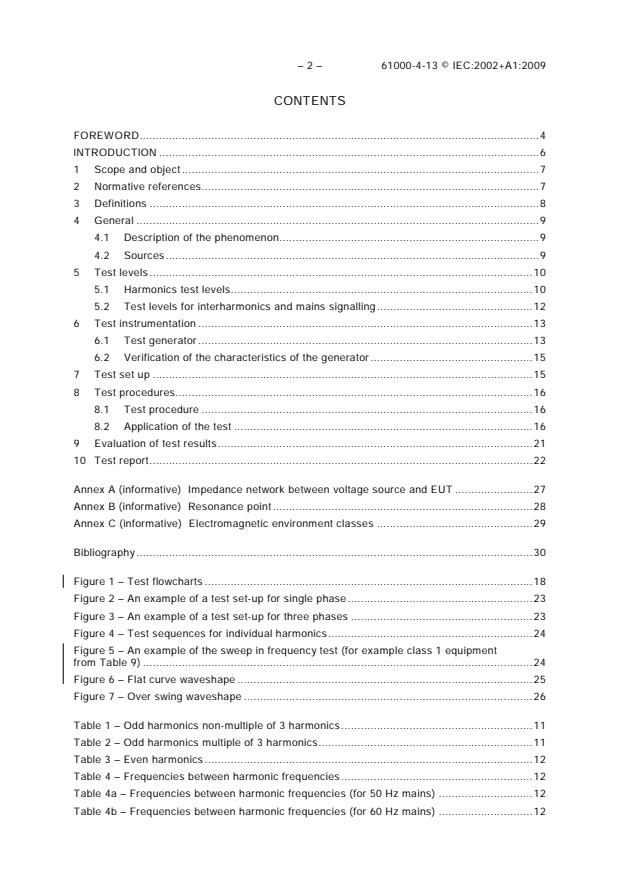
CONTENTS
FOREWORD.4
lNTRODUCTlON .6
1 Scope and object .7
2 Normative references.7
3 Definitions.8
4 General.9
4.1 Description of the phenomenon.9
4.2 Sources.9
5 Test levels.10
5.1 Harmonics test levels.10
5.2 Test levels for interharmonics and mains signalling.12
6 Test instrumentation .13
6.1 Test generator.13
6.2 Verification of the characteristics of the generator .15
7 Test set up .15
8 Test procedures.16
8.1 Test procedure.16
8.2 Application of the test .16
9 Evaluation of test results.21
10 Test report.22
Annex A (informative) Impedance network between voltage source and EUT .27
Annex B (informative) Resonance point .28
Annex C (informative) Electromagnetic environment classes .29
Bibliography .30
Figure 1 – Test flowcharts .18
Figure 2 – An example of a test set-up for single phase.23
Figure 3 – An example of a test set-up for three phases .23
Figure 4 – Test sequences for individual harmonics.24
Figure 5 – An example of the sweep in frequency test (for example class 1 equipment
from Table 9) .24
Figure 6 – Flat curve waveshape .25
Figure 7 – Over swing waveshape .26
Table 1 – Odd harmonics non-multiple of 3 harmonics.11
Table 2 – Odd harmonics multiple of 3 harmonics.11
Table 3 – Even harmonics .12
Table 4 – Frequencies between harmonic frequencies.12
Table 4a – Frequencies between harmonic frequencies (for 50 Hz mains) .12
Table 4b – Frequencies between harmonic frequencies (for 60 Hz mains) .12
61000-4-13 © IEC:2002+A1:2009 – 3 –
Table 5 – Characteristics of the test generator.14
Table 6 – Maximum harmonic voltage distortion .15
Table 7 – Time related function, "flat curve".19
Table 8 – Harmonic combination, "over swing" .19
Table 9 – Sweep in frequency test levels .20
Table 10 – Frequency step sizes for interharmonics and Meister curve .20
Table 11 – Meister curve test levels .21
– 4 – 61000-4-13 © IEC:2002+A1:2009
INTERNATIONAL ELECTROTECHNICAL COMMISSION
____________
ELECTROMAGNETIC COMPATIBILITY (EMC) –
Part 4-13 : Testing and measurement techniques –
Harmonics and interharmonics including mains signalling at
a.c. power port, low frequency immunity tests
FOREWORD
1) The International Electrotechnical Commission (IEC) is a worldwide organization for standardization comprising
all national electrotechnical committees (IEC National Committees). The object of IEC is to promote
international co-operation on all questions concerning standardization in the electrical and electronic fields. To
this end and in addition to other activities, IEC publishes International Standards, Technical Specifications,
Technical Reports, Publicly Available Specifications (PAS) and Guides (hereafter referred to as “IEC
Publication(s)”). Their preparation is entrusted to technical committees; any IEC National Committee interested
in the subject dealt with may participate in this preparatory work. International, governmental and non-
governmental organizations liaising with the IEC also participate in this preparation. IEC collaborates closely
with the International Organization for Standardization (ISO) in accordance with conditions determined by
agreement between the two organizations.
2) The formal decisions or agreements of IEC on technical matters express, as nearly as possible, an international
consensus of opinion on the relevant subjects since each technical committee has representation from all
interested IEC National Committees.
3) IEC Publications have the form of recommendations for international use and are accepted by IEC National
Committees in that sense. While all reasonable efforts are made to ensure that the technical content of IEC
Publications is accurate, IEC cannot be held responsible for the way in which they are used or for any
misinterpretation by any end user.
4) In order to promote international uniformity, IEC National Committees undertake to apply IEC Publications
transparently to the maximum extent possible in their national and regional publications. Any divergence
between any IEC Publication and the corresponding national or regional publication shall be clearly indicated in
the latter.
5) IEC provides no marking procedure to indicate its approval and cannot be rendered responsible for any
equipment declared to be in conformity with an IEC Publication.
6) All users should ensure that they have the latest edition of this publication.
7) No liability shall attach to IEC or its directors, employees, servants or agents including individual experts and
members of its technical committees and IEC National Committees for any personal injury, property damage or
other damage of any nature whatsoever, whether direct or indirect, or for costs (including legal fees) and
expenses arising out of the publication, use of, or reliance upon, this IEC Publication or any other IEC
Publications.
8) Attention is drawn to the Normative references cited in this publication. Use of the referenced publications is
indispensable for the correct application of this publication.
9) Attention is drawn to the possibility that some of the elements of this IEC Publication may be the subject of
patent rights. IEC shall not be held responsible for identifying any or all such patent rights.
International Standard IEC 61000-4-13 has been prepared by subcommittee 77A: Low
frequency phenomena, of IEC technical committee 77: Electromagnetic compatibility.
This consolidated version of IEC 61000-4-13 consists of the first edition (2002) [documents
77A/368/FDIS and 77A/377/RVD] and its amendment 1 (2009) [documents 77A/668/CDV and
77A/684/RVC].
The technical content is therefore identical to the base edition and its amendment and has
been prepared for user convenience.
It bears the edition number 1.1.
A vertical line in the margin shows where the base publication has been modified by
amendment 1.
61000-4-13 © IEC:2002+A1:2009 – 5 –
This standard has the status of a basic EMC publication in accordance with lEC Guide 107.
Annexes A, B, and C, are for information only.
The committee has decided that the contents of the base publication and its amendments will
remain unchanged until the maintenance result date indicated on the IEC web site under
"http://webstore.iec.ch" in the data related to the specific publication. At this date,
the publication will be
• reconfirmed,
• withdrawn,
• replaced by a revised edition, or
• amended.
IMPORTANT – The “colour inside” logo on the cover page of this publication indicates
that it contains colours which are considered to be useful for the correct understanding
of its contents. Users should therefore print this publication using a colour printer.
– 6 – 61000-4-13 © IEC:2002+A1:2009
lNTRODUCTlON
IEC 61000 is published in separate parts according to the following structure :
Part 1: General
General considerations (introduction, fundamental principles)
Definitions, terminology
Part 2: Environment
Description of the environment
Classification of the environment
Compatibility levels
Part 3: Limits
Emission limits
Immunity limits (in so far as they do not fall under the responsibility of the product
committees)
Part 4: Testing and measurement techniques
Measurement techniques
Testing techniques
Part 5: Installation and mitigation guidelines
Installation guidelines
Mitigation methods and devices
Part 6: Generic Standards
Part 9: Miscellaneous
Each part is further subdivided into several parts, published either as International Standards
or as technical specifications or technical reports, some of which have already been published
as sections. Others will be published with the part number followed by a dash and a second
number identifying the subdivision (example: 61000-6-1).
This part is an EMC basic standard which gives immunity requirements and test procedures
related to harmonics and interharmonics including mains signalling at a.c. power port.
61000-4-13 © IEC:2002+A1:2009 – 7 –
ELECTROMAGNETIC COMPATIBILITY (EMC) –
Part 4-13: Testing and measurement techniques –
Harmonics and interharmonics including mains signalling at
a.c. power port, low frequency immunity tests
1 Scope and object
This part of IEC 61000 defines the immunity test methods and range of recommended basic
test levels for electrical and electronic equipment with rated current up to 16 A per phase at
disturbance frequencies up to and including 2 kHz (for 50 Hz mains) and 2,4 kHz (for 60 Hz
mains) for harmonics and interharmonics on low voltage power networks.
It does not apply to electrical and electronic equipment connected to 16 2/3 Hz , or to 400 Hz
a.c. networks. Tests for these networks will be covered by future standards.
The object of this standard is to establish a common reference for evaluating the functional
immunity of electrical and electronic equipment when subjected to harmonics and inter-
harmonics and mains signalling frequencies. The test method documented in this part of IEC
61000 describes a consistent method to assess the immunity of an equipment or system
against a defined phenomenon. As described in IEC Guide 107, this is a basic EMC publication
for use by product committees of the IEC. As also stated in Guide 107, the IEC product
committees are responsible for determining whether this immunity test standard should be
applied or not, and if applied, they are responsible for determining the appropriate test levels
and performance criteria. TC 77 and its sub-committees are prepared to co-operate with
product committees in the evaluation of the value of particular immunity tests for their products.
The verification of the reliability of electrical components (for example capacitors, filters, etc.)
is not in the scope of the present standard. Long term thermal effects (greater than 15 min) are
not considered in this standard.
The levels proposed are more adapted for residential, commercial and light industry
environments. For heavy industrial environments the product committees are responsible for
the definition of a class X with the necessary levels. They have also the possibility of defining
more complex waveforms for their own need. Nevertheless, the simple waveforms proposed
have been mainly observed on several networks (flat curve more often for single phase
system) and also on industrial networks (overswing curve more for three phase systems).
2 Normative references
The following referenced documents are indispensable for the application of this document. For
dated references, only the edition cited applies. For undated references, the latest edition of
the referenced document (including any amendments) applies.
IEC 60050(161), International Electrotechnical Vocabulary (IEV) – Chapter 161: Electro-
magnetic compatibility
IEC 61000-2-2, Electromagnetic compatibility (EMC) – Part 2-2: Environment – Compatibility
levels for low-frequency conducted disturbances and signalling in public low-voltage power
supply systems
– 8 – 61000-4-13 © IEC:2002+A1:2009
IEC 61000-3-2, Electromagnetic compatibility (EMC) – Part 3-2: Limits – Limits for harmonic
current emissions (equipment input current ≤ 16 A per phase)
IEC 61000-4-7, Electromagnetic compatibility (EMC) – Part 4-7: Testing and measurement
techniques – General guide on harmonics and interharmonics measurements and
instrumentation, for power supply systems and equipment connected thereto
3 Definitions
For the purposes of this part of IEC 61000, the following definitions and terms apply as well as
the definitions of IEC 60050(161):
3.1
immunity
ability of a device, equipment or system to perform without degradation in the presence of an
electromagnetic disturbance
[IEV 161-01-20]
3.2
harmonic (component)
component of order greater than 1 of the Fourier series of a periodic quantity
[IEV 161-02-18]
3.3
fundamental (component)
component of order 1 of the Fourier series of a periodic quantity
[IEV 161-02-17]
3.4
flat curve waveshape
waveform that follows a time related function in which each half-wave consists of three parts:
Part 1: starts from zero and follows a pure sine function up to the specified value;
Part 2: is a constant value;
Part 3: follows a pure sine function down to zero
3.5
overswing waveshape
rd th
and the 5
waveform which consists of discrete values of the fundamental harmonic, the 3
harmonics with the specified phase shift
3.6
f1
fundamental frequency
3.7
mains signalling frequencies
signal frequencies between harmonics for control and communication
3.8
EUT
equipment under test
61000-4-13 © IEC:2002+A1:2009 – 9 –
4 General
4.1 Description of the phenomenon
4.1.1 Harmonics
Harmonics are sinusoidal voltages and currents with frequencies that are integer multiples of
the frequency at which the supply system operates.
Harmonic disturbances are generally caused by equipment with non-linear voltage – current
characteristics or by periodic and line-synchronised switching of loads. Such equipment may be
regarded as sources of harmonic currents.
The harmonic currents from the different sources produce harmonic voltage drops across the
impedance of the network.
As a result of cable capacitance, line inductance and the connection of power factor correction
capacitors, parallel or series resonance may occur in the network and cause a harmonic
voltage amplification even at a remote point from the distorting load. The waveforms proposed
are the result of the summation of different harmonic orders of one or several harmonic
sources.
4.1.2 Interharmonics
Between the harmonics of the power frequency voltage and current, further frequencies can be
observed which are not an integer multiple of the fundamental. They can appear as discrete
frequencies or as a wide-band spectrum. Summation of different interharmonic sources is not
likely and is not taken into account in this standard.
4.1.3 Mains signalling (ripple control)
Signal frequencies ranging from 110 Hz to 3 kHz used in networks or parts of them in order to
transfer information from a sending point to one or more receiving points.
For the scope of this standard, the frequency range is limited to 2 kHz/50 Hz (2,4 kHz/60 Hz).
4.2 Sources
4.2.1 Harmonics
Harmonic currents are generated to a small extent by generation, transmission and distribution
equipment and to a greater extent by industrial and residential loads. Sometimes, there are
only a few sources generating significant harmonic currents in a network; the individual
harmonic level of the majority of the other devices is low, nevertheless these may make a
relatively high contribution to the harmonic voltage distortion, at least for low order harmonics
due to their summation.
Significant harmonic currents in a network can be generated by non-linear loads, for example:
– controlled and uncontrolled rectifiers, especially with capacitive smoothing (for example
used in television, indirect and direct static frequency converters, and self-ballasted lamps),
because these harmonics are in approximately the same phase from different sources and
there is only poor compensation in the network;
– phase controlled equipment, some types of computers and UPS equipment.
Sources may produce harmonics at a constant or varying level, depending on the method of
operation.
– 10 – 61000-4-13 © IEC:2002+A1:2009
4.2.2 Interharmonics
Sources of interharmonics can be found in low-voltage networks as well as in medium-voltage
and high voltage networks. The interharmonics produced in the medium-voltage/high voltage
networks flow in the low-voltage networks they supply and vice versa.
The main sources are indirect and direct static frequency converters, welding machines and
arc furnaces.
4.2.3 Mains signalling (ripple control)
Sources of mains signalling frequencies covered by this standard are transmitters operating
mostly in the 110 Hz to 2 kHz (2,4 kHz) frequency range in order for the public supplier to
control equipment in the supply network (public lighting, tariffs for meters, etc.). The transmitter
energy is coupled into the system on HV, MV, or LV level. The transmitters operate with
interrupted signals, and normally for a short time only. The frequencies used lie normally in
between the harmonics.
5 Test levels
The test level is the harmonic voltage specified as a percentage of the fundamental voltage.
The voltages given in this standard have the nominal power supply network voltage (U
fundamental) as a basis.
It is essential that the r.m.s. voltage of the resultant waveforms remain at the nominal value
during the application of these tests by adjusting the voltage values of fundamental and
harmonics according to the percentages indicated in the corresponding tables (for example
230 V r.m.s., 120 V r.m.s.).
5.1 Harmonics test levels
The preferential range of test levels for individual harmonics are given in tables 1 to 3.
Harmonic voltages at a test level of 3 % and higher, up to the 9th harmonic, shall be applied
using a phase shift of both 0° and 180° with respect to the positive zero-crossing of the
fundamental. Harmonic voltages at a test level of less than 3 % shall be applied using no
phase-shift with respect to the positive zero-crossing of the fundamental.
For compatibility levels see IEC 61000-2-2 using factor k. Immunity levels have to be higher
(for example times 1,5 additionally).
The application of the test to a multiphase EUT is given in 8.2.5.
61000-4-13 © IEC:2002+A1:2009 – 11 –
Table 1 – Odd harmonics non-multiple of 3 harmonics
h Class 1 Class 2 Class 3 Class X
Test levels % U Test levels % U Test levels % U Test levels % U
1 1 1 1
5 4,5 9 12 Open
7 4,5 7,5 10 Open
11 4,5 5 7 Open
13 4 4,5 7 Open
17 3 3 6 Open
19 2 2 6 Open
23 2 2 6 Open
25 2 2 6 Open
29 1,5 1,5 5 Open
31 1,5 1,5 3 Open
35 1,5 1,5 3 Open
37 1,5 1,5 3 Open
NOTE 1 Classes 1, 2, and 3 are defined in annex C.
NOTE 2 The levels given for class X are open. These levels shall be defined by the product committees. However,
for equipment supplied by low voltage public supply systems, the values shall not be lower than those of class 2.
Table 2 – Odd harmonics multiple of 3 harmonics
h Class 1 Class 2 Class 3 Class X
Test levels % U Test levels % U Test levels % U Test levels % U
1 1 1 1
3 4,5 8 9 Open
9 2 2,5 4 Open
15 No test No test 3 Open
21 No test No test 2 Open
27 No test No test 2 Open
33 No test No test 2 Open
39 No test No test 2 Open
NOTE 1 Classes 1, 2, and 3 are defined in annex C.
NOTE 2 The levels given for class X are open. These levels shall be defined by the product committees. However,
for equipment supplied by low voltage public supply systems the values shall not be lower than those of class 2.
– 12 – 61000-4-13 © IEC:2002+A1:2009
Table 3 – Even harmonics
h Class 1 Class 2 Class 3 Class X
Test levels % U Test levels % U Test levels % U Test levels % U
1 1 1 1
2 3 3 5 Open
4 1,5 1,5 2 Open
6 No test No test 1,5 Open
8 No test No test 1,5 Open
10 No test No test 1,5 Open
12-40 No test No test 1,5 Open
NOTE 1 Classes 1, 2, and 3 are defined in annex C.
NOTE 2 The levels given for class X are open. These levels shall be defined by the product committees. However,
for equipment supplied by low voltage public supply systems the values shall not be lower than those of class 2.
5.2 Test levels for interharmonics and mains signalling
The preferential ranges of test levels are given in tables 4a and 4b.
Table 4 – Frequencies between harmonic frequencies
Table 4a – Frequencies between harmonic frequencies (for 50 Hz mains)
Frequency range Class 1 Class 2 Class 3 Class X
Hz Test levels % U Test levels % U Test levels % U Test levels % U
1 1 1 1
16 – 100 no test 2,5 4 Open
100 – 500 no test 5 9 Open
500 – 750 no test 3,5 5 Open
750 – 1 000 no test 2 3 Open
1 000 – 2 000 no test 1,5 2 Open
NOTE 1 Classes 1, 2, and 3 are defined in annex C.
NOTE 2 The levels for class X are open. These levels shall be defined by the product committees.
Table 4b – Frequencies between harmonic frequencies (for 60 Hz mains)
Frequency range Class 1 Class 2 Class 3 Class X
Hz Test levels % U Test levels % U Test levels % U Test levels % U
1 1 1 1
20 – 120 no test 2,5 4 Open
120 – 600 no test 5 7,5 Open
600 – 900 no test 3,5 5 Open
900 – 1200 no test 2 3 Open
1200 – 2400 no test 1,5 2 Open
NOTE 1 Classes1, 2, and 3 are defined in annex C.
NOTE 2 The levels given for class X are open. These levels shall be defined by the product committees.
61000-4-13 © IEC:2002+A1:2009 – 13 –
Immunity test levels for interharmonics above 100 Hz are based on the mains signalling levels
or by the Meister curve levels defined in 8.2.4 depending on the class of equipment being
tested. Mains signalling levels are in the range of 2 % to 6 % of U . Discrete interharmonic
frequencies have a level of about 0,5 % of the fundamental frequency voltage U (in absence
of resonance). In class 3 for industrial networks, these levels can be considerably higher.
6 Test instrumentation
6.1 Test generator
The test generator shall have the ability to generate a signal with a 50 Hz or 60 Hz fundamental
frequency and to superimpose the required frequencies (harmonics and frequencies between
the harmonics).
The test generator shall have sufficient filtering such that the harmonic and interharmonic
disturbances do not influence any auxiliary equipment which may be used to perform the test.
The test levels according to tables 1 to 4 shall be applied at the terminals of the EUT
connected as in normal conditions (single or three phase) and operating as specified in the
relevant product standard.
The test generator shall have the following specifications:
– 14 – 61000-4-13 © IEC:2002+A1:2009
Table 5 – Characteristics of the test generator
Output current per phase at rated voltage Necessary to fulfil the requirements at the operating
EUT (see note 1)
Fundamental voltage:
- Magnitude U Nominal mains voltage ± 2 % single phase
Nominal mains voltage ± 2 % three phase
- Frequency 50 Hz ± 0,5 % or 60 Hz ± 0,5 %
- Angle between phases 120° ± 1,5° (star connection)
Preselectable individual harmonics: See note 2
- Order 2 to 40
- Magnitude U
h
z Range 0 % to 14 % U
z Accuracy The larger of ± 5,0 % U or 0,1 % U
h
- Phase angle ϕ
h
0°; 180° (see also note 6)
z h = 2 to 9
z Accuracy of zero phase crossing displacement ± 2° of the fundamental
with respect to fundamental
See note 3
Combination of harmonics:
Frequencies between the harmonics: See note 2
- Magnitude
z Range 0 % to 10 % U
z Accuracy The larger of ± 5,0 % U or 0,1 % U
h
- Frequency
z Range
0,33 × f to 40 × f
1 1
z Steps for adjusting
f = (0,33 to 2) × f = 0,1 × f
1 1
f = (2 to 20) × f = 0,2 × f
1 1
f > 20 × f = 0,5 × f
1 1
z Maximum error of adjusted value ± 0,5 % f
Output impedance See note 4
External impedance network See note 5
NOTE 1 The generator equipment shall provide an output which is sufficient to test the EUT or to a maximum rated
input current of 16 A r.m.s. per phase. Other values may be given by the product standard or product specification.
NOTE 2 The generator shall provide control inputs for selection of magnitude, frequency, phase-angle, and
sequence type of the superimposed voltage.
NOTE 3 The generator equipment shall provide the option to superimpose more than one voltage in each phase.
NOTE 4 No output impedance is defined since the internal voltage source has to be controlled so that the voltage
drop across the internal impedance is compensated and the set values are met at the terminals of the EUT. The
connections shall be as short as possible.
NOTE 5 An external series impedance network may be used, but only to find possible resonance excited by
harmonics. The IEC 60725 impedance network is suggested. Annex A is included in this standard for guidance.
NOTE 6 ϕ is the phase difference between the positive zero crossing of the fundamental voltage and the positive
h
zero crossing of the harmonics voltage expressed in degrees of the harmonics frequency.
61000-4-13 © IEC:2002+A1:2009 – 15 –
6.2 Verification of the characteristics of the generator
The generator output characteristics shall be verified at the terminals of the source prior to the
test. For this purpose, the terminal voltage shall be monitored by a harmonic analyser
according to IEC 61000-4-7, accuracy class A, and the superimposed values shall be stored
and/or printed. An oscilloscope may be used in addition for a rough overview.
The maximum harmonic voltage distortion of the generator shall be in accordance with
IEC 61000-3-2 (when no harmonic/inter-harmonic is selected). The maximum distortion limits
while delivering power to the EUT are given in table 6.
Table 6 – Maximum harmonic voltage distortion
Harmonic number % of U
3 0,9
5 0,4
7 0,3
9 0,2
2 to 10 (even harmonics) 0,2
11-40 0,1
The peak value of the test voltage shall be within 1,40 and 1,42 times its rms value and shall
be reached within 87° to 93° after the zero crossing. The maximum output voltage change
between no load and rated current of an EUT shall be ±2 % of the nominal voltage.
The characteristics of the generator specified in 6.1 lead to generators with low internal
impedance. To simplify the procedure, the verification of the characteristics of the generator in
accordance with 6.2 shall be performed in the absence of an external impedance network.
7 Test set up
In addition to the test generator, the following test equipment may be needed for the immunity
test:
– analyser for harmonics and interharmonics according to IEC 61000-4-7 for the verification
of the test voltage at the terminals of the EUT;
– control unit to provide the sequence of the selected superimposed voltages during a test;
– printer or plotter for the documentation of the test voltage sequence;
– oscilloscope for monitoring the supply voltage on the EUT.
Some of these items may be combined in one unit.
Examples of test arrangements are given:
– in figure 2 for a single phase EUT;
– in figure 3 for a three phase EUT.
– 16 – 61000-4-13 © IEC:2002+A1:2009
8 Test procedures
8.1 Test procedure
8.1.1 Climatic conditions
Unless otherwise specified by the committee responsible for the generic or product standard,
the climatic conditions in the laboratory shall be within any limits specified for the operation of
the EUT and the test equipment by their respective manufacturers.
Tests shall not be performed if the relative humidity is so high as to cause condensation on the
EUT or the test equipment.
NOTE Where it is considered that there is sufficient evidence to demonstrate that the effects of the phenomenon
covered by this standard are influenced by climatic conditions, this should be brought to the attention of the
committee responsible for this standard.
8.1.2 Test plan
Before starting the test of a given equipment, a test plan shall be prepared.
It is recommended that the test plan comprises of the following items:
– the description of the EUT;
– information on possible connections (plugs, terminals, etc.) corresponding cables and
peripherals;
– input power port of equipment to be tested;
– representative operational modes of the EUT for the test;
– type of tests/test levels;
– performance criteria under test conditions as specified by the standard or manufacturer;
– description of the test set up.
If the auxiliary equipment is not available for the EUT, it may be simulated.
For each test, any degradation of performance must be recorded. The monitoring equipment
should be capable of displaying the status of the operational mode of the EUT during and after
the tests. After each group of tests a relevant check will be performed.
8.2 Application of the test
Figures 1a and 1b have been added to give guidance on how to optimise test time with a high
confidence of test performance. The test levels in the «harmonic combinations» test and the
«sweep in frequencies» test exceed the test levels of the «individual harmonics» test.
61000-4-13 © IEC:2002+A1:2009 – 17 –
Start - Class 1/2:
Determine appropriate test
configuration
Perform 8.2.1 Test
"harmonic combination"
Any functional
No Class 2 required? Yes
anomalies?
No
Perform 8.2.2 Test Perform 8.2.4 Test
"sweep in frequencies" "Meister curve"
Any functional Any functional
anomalies? anomalies?
Yes
Yes No
No
Perform 8.2.3 Test
"individual harmonics/
interharmonics"
Yes
Test completed Any functional Test completed
Yes No
FAIL - Record results anomalies? PASS - Record results
IEC 668/09
Figure 1a – Test flowchart class 1 and class 2
– 18 – 61000-4-13 © IEC:2002+A1:2009
Start - Class 3:
Determine appropriate test
configuration
Perform test 8.2.1
"harmonic combination"
Any functional Perform test 8.2.2
No
anomalies? "sweep in frequencies"
Any functional
Yes
anomalies?
No
Perform test 8.2.3
Yes
"individual harmonics/
interharmonics"
Test completed Any functional Test completed
Yes No
FAIL - record results anomalies? PASS - record results
IEC 669/09
Figure 1b – Test flowchart class 3
Figure 1 – Test flowcharts
61000-4-13 © IEC:2002+A1:2009 – 19 –
8.2.1 Harmonic combination test flat curve and over swing
The two harmonic combination tests to be carried out are flat curve and over swing. The EUT
shall be tested for each harmonic combination, according to Tables 7 and 8 for 2 min. The
time-domain waveforms are shown in Figures 6 and 7 for the flat curve and over swing tests
respectively.
Flat curve: the voltage follows a time related function in which each half-wave consists of three
parts. See Figure 6.
– Part 1 starts from zero, it follows a pure sine function up to 95% of the peak value for Class
1, 90 % of the peak value for Class 2 and up to 80 % for Class 3.
– Part 2 is a constant voltage.
– Part 3 is equivalent to Part 1 (following a pure sine function).
The r.m.s. value of the resultant waveform shall be maintained at nominal voltage during the
application of this test. This means that the sinusoidal part of the waveform has to be
increased in amplitude by the factor K shown in Table 7.
y
Table 7 – Time related function, "flat curve"
Voltage
Function
Ratio
Voltage (Parts 1 and 3) Function (Part 2) Voltage (Part 2) Class
(Parts 1 and 3)
K
y
1,013 3 1
0 ≤ |sin(ωt)| ≤ 0,95 u = U × K × √2 × sin(ωt) 0,95 ≤ |sin(ωt)| ≤ 1 u = ±0,95 × U × K × √2
1 1 1 1
0 ≤ |sin(ωt)| ≤ 0,9 1,037 9 u = U × K × √2 × sin(ωt) 0,9 ≤ |sin(ωt)| ≤ 1 u = ±0,9 × U × K × √2 2
1 2 1 2
1,111 7 3
0 ≤ |sin(ωt)| ≤ 0,8 u = U × K × √2 × sin(ωt) 0,8 ≤ |sin(ωt)| ≤ 1 u = ±0,8 × U × K × √2
1 3 1 3
X X
0 ≤ |sin(ωt)| ≤ X u = U × K × √2 × sin(ωt) X ≤ |sin(ωt)| ≤ 1 u = ±X × U × K × √2
1 x 1 x
NOTE 1 Classes 1, 2, and 3 are defined in Annex C.
NOTE 2 The levels given for class X are open. The level must be defined by the product committees. However, for
equipment for use in public supply systems the values must not be lower than those of class 2.
NOTE 3 Maximum deviation: Δu = ±(0,01 × U × √2 + 0,005 × u).
rd
Over swing: Over swing is generated by adding a discrete value of the 3 harmonic and also of
th
the 5 harmonic both with a corresponding phase relationship.
Table 8 – Harmonic combination, "over swing"
h 3 5 Class
% of U 4 % / 180° 3 % / 0° 1
% of U 6 % / 180° 4 % / 0° 2
% of U 8 % / 180° 5 % / 0° 3
% of U X / 180° X / 0° X
NOTE 1 Classes 1, 2, and 3 are defined in Annex C.
NOTE 2 The levels given for class X are open. Thee level has to be defined by the product committees. However,
for equipment for use in public supply systems, the values must not be lower than those of class 2.
– 20 – 61000-4-13 © IEC:2002+A1:2009
8.2.2 Test method "Sweep in frequencies"
The equipment set-up for sweep frequency tests are shown in Figures 2 and 3. The amplitude
of the sweep frequencies depends on the frequency range (see Table 9 and Figure 5). The
sweep (analogue) or step rate (digital) should be such that the time taken per decade is no less
than 5 min, as shown in Figure 5. The frequency sweep will dwell at frequencies where
performance anomalies are detected. At each dwell point, the test time should be at least
120 s.
NOTE Anomalies can also be caused by resonances. Further details are described in Annex B.
Table 9 – Sweep in frequency test levels
Frequency range Frequency step Class 1 Class 2 Class 3 Class X
f Δf Test levels % U Test levels % U Test levels % U Test levels % U
1 1 1 1
2 3 4,5 Open
0,33 × f to 2 × f 0,1 × f
1 1 1
5 9 14 Open
2 × f to 10 × f 0,2 × f
1 1 1
4 4,5 9 Open
10 × f to 20 × f 0,2 × f
1 1 1
2 2 6 Open
20 × f to 30 × f 0,5 × f
1 1 1
2 2 4 Open
30 × f to 40 × f 0,5 × f
1 1 1
NOTE 1 Classes 1, 2, and 3 are defined in annex C.
NOTE 2 The levels given for class X are open. These levels shall be defined by the product committees. However, for
equipment for use in public supply systems the values shall not be lower than those of class 2.
8.2.3 Individual harmonics and interharmonics with a specified test level sequence
In the frequency range 2 × f to 40 × f , single sinusoidal voltages with magnitude according to
1 1
tables 1 to 3 shall be superimposed on the fundamental voltage U . Each frequency shall be
applied for 5 s with a one second interval to the next one (see figure 4) whereas the r.m.s.
value of the resultant voltage shall be kept constant during the duration of the whole test.
For the interharmonics test, in the frequency ranges shown in tables 4a and 4b, the frequency
step sizes are dictated in table 10. Each step point shall be applied for 5 s with a one second
interval to the next one whereas the r.m.s. value of the resultant waveform shall be kept
constant during the duration of the whole test.
Table 10 – Frequency step sizes for interharmonics and Meister curve
Frequency range Frequency step
f
Δ f
0,33 × f to 2 × f
...
Questions, Comments and Discussion
Ask us and Technical Secretary will try to provide an answer. You can facilitate discussion about the standard in here.
Loading comments...