

ISO/IEC 30187:2026
(Main)Internet of Things (IoT) - Evaluation indicators for IoT systems
General Information
- Abstract
ISO/IEC 30187:2026 specifies the evaluation indicators for IoT systems.
This document is applicable to the compilation of the evaluation indicators for IoT systems in specific industries.
NOTE The indicators identified in this document are typical indicators but are not a comprehensive list; and conversely, not every indicator listed applies to every IoT system.
- Status
- Published
- Publication Date
- 12-May-2026
- Technical Committee
- ISO/IEC JTC 1/SC 41 - Internet of Things and Digital Twin
- Drafting Committee
- WG 5 - ISO/IEC JTC 1/SC 41/WG 5
- Current Stage
- PPUB - Publication issued
- Start Date
- 13-May-2026
- Completion Date
- 05-Jun-2026
Overview
ISO/IEC 30187:2026, titled Internet of Things (IoT) – Evaluation indicators for IoT systems, is an international standard developed by the International Electrotechnical Commission (IEC) and International Organization for Standardization (ISO). This standard defines a structured set of typical evaluation indicators for IoT systems, providing a systematic approach for assessing IoT solutions in various industry sectors. It serves as a critical reference for developing, deploying, and monitoring IoT systems, enabling stakeholders to select relevant metrics for performance evaluation, quality assurance, and system benchmarking.
Key Topics
1. Indicator Scheme Framework
- The document categorizes evaluation indicators into three main groups:
- System Architecture Indicators: Focus on system management, scalability, and compatibility/interoperability.
- System Functional Indicators: Address aspects such as flexibility, sensing/control, service support, resource sharing, maintenance, and user interaction.
- System Quality Indicators: Cover trustworthiness, information security, privacy protection, reliability, resilience, and physical security.
2. Industry Applicability
- ISO/IEC 30187:2026 is designed to be flexible, supporting industry-specific adaptation of indicators. For example, sectors like energy, agriculture, manufacturing, finance, and environmental protection can tailor these indicators to their unique requirements.
3. Evaluation Process Guidance
- The standard provides a step-by-step methodology for IoT system assessment, including:
- Defining the system and evaluation environment
- Reviewing existing standards for minimum requirements
- Compiling and selecting relevant indicators
- Choosing observable items and gathering data
- Setting evaluation criteria and methods
- Conducting comprehensive system evaluation
4. Application and Expansion
- The indicators can be applied in planning, real-time monitoring, or after-deployment assessment. The document also explains how profiles can be extended by including indicators for advanced features such as artificial intelligence, digital twins, or specific vertical domain requirements.
Applications
ISO/IEC 30187:2026 offers practical value in several areas:
- System Development & Design: Provides a structured framework for specifying requirements and targets during the design and planning phases of IoT projects.
- Evaluation & Benchmarking: Enables objective comparison of multiple IoT solutions, facilitating decision-making for technology selection and procurement.
- Quality Assurance & Compliance: Assists organizations in identifying gaps and ensuring ongoing compliance with international benchmarks and best practices for IoT implementations.
- Lifecycle Management: Supports monitoring, validation, and continual improvement of IoT system performance throughout its lifecycle.
- Cross-industry Adaptation: Customizable for vertical industries, allowing broader adoption with domain-specific extensions.
Use Case Example:
- The Annex in ISO/IEC 30187:2026 details the practical application of these indicators for evaluating a vehicle recognition parking IoT system, demonstrating adaptable evaluation processes and the creation of reference models for other sectors.
Related Standards
For comprehensive and harmonized IoT system evaluation, consider referencing the following related international standards:
- ISO/IEC 20924 – Internet of Things (IoT) – Vocabulary
- ISO/IEC 21823 Series – IoT Interoperability (including semantic and syntactic interoperability)
- ISO/IEC 30141 – IoT Reference Architecture
- ISO/IEC/IEEE 15289 – System and software engineering – Content of life-cycle information products
- ISO/IEC/IEEE 15939 – Systems and software engineering – Measurement process
Visit the IEC Webstore or IEC Electropedia for more publications and up-to-date international standards on IoT and digital transformation.
With ISO/IEC 30187:2026, organizations gain a practical, standards-based approach to evaluating and improving IoT systems, facilitating interoperability, quality, and regulatory compliance across industries.
Get Certified
Connect with accredited certification bodies for this standard

BSI Group
BSI (British Standards Institution) is the business standards company that helps organizations make excellence a habit.

NYCE
Mexican standards and certification body.
Sponsored listings
Frequently Asked Questions
ISO/IEC 30187:2026 is a standard published by the International Electrotechnical Commission (IEC). Its full title is "Internet of Things (IoT) - Evaluation indicators for IoT systems". This standard covers: ISO/IEC 30187:2026 specifies the evaluation indicators for IoT systems. This document is applicable to the compilation of the evaluation indicators for IoT systems in specific industries. NOTE The indicators identified in this document are typical indicators but are not a comprehensive list; and conversely, not every indicator listed applies to every IoT system.
ISO/IEC 30187:2026 specifies the evaluation indicators for IoT systems. This document is applicable to the compilation of the evaluation indicators for IoT systems in specific industries. NOTE The indicators identified in this document are typical indicators but are not a comprehensive list; and conversely, not every indicator listed applies to every IoT system.
ISO/IEC 30187:2026 is classified under the following ICS (International Classification for Standards) categories: 35.020 - Information technology (IT) in general. The ICS classification helps identify the subject area and facilitates finding related standards.
ISO/IEC 30187:2026 is available in PDF format for immediate download after purchase. The document can be added to your cart and obtained through the secure checkout process. Digital delivery ensures instant access to the complete standard document.
Standards Content (Sample)
ISO/IEC 30187
Edition 1.0 2026-05
INTERNATIONAL
STANDARD
Internet of Things (IoT) - Evaluation indicators for IoT systems
ICS 35.020 ISBN 978-2-8327-1239-9
ISO/IEC 30187: 2026-05(en)
All rights reserved. Unless otherwise specified, no part of this publication may be reproduced or utilized in any form or
by any means, electronic or mechanical, including photocopying and microfilm, without permission in writing from either
IEC or IEC's member National Committee in the country of the requester. If you have any questions about IEC copyright
or have an enquiry about obtaining additional rights to this publication, please contact the address below or your local
IEC member National Committee for further information.
IEC Secretariat Tel.: +41 22 919 02 11
3, rue de Varembé info@iec.ch
CH-1211 Geneva 20 www.iec.ch
Switzerland
About the IEC
The International Electrotechnical Commission (IEC) is the leading global organization that prepares and publishes
International Standards for all electrical, electronic and related technologies.
About IEC publications
The technical content of IEC publications is kept under constant review by the IEC. Please make sure that you have the
latest edition, a corrigendum or an amendment might have been published.
IEC publications search - IEC Products & Services Portal - products.iec.ch
webstore.iec.ch/advsearchform Discover our powerful search engine and read freely all the
The advanced search enables to find IEC publications by a publications previews, graphical symbols and the glossary.
variety of criteria (reference number, text, technical With a subscription you will always have access to up to date
committee, …). It also gives information on projects, content tailored to your needs.
replaced and withdrawn publications.
Electropedia - www.electropedia.org
The world's leading online dictionary on electrotechnology,
IEC Just Published - webstore.iec.ch/justpublished
Stay up to date on all new IEC publications. Just Published containing more than 22 500 terminological entries in English
details all new publications released. Available online and and French, with equivalent terms in 25 additional languages.
once a month by email. Also known as the International Electrotechnical Vocabulary
(IEV) online.
IEC Customer Service Centre - webstore.iec.ch/csc
If you wish to give us your feedback on this publication or
need further assistance, please contact the Customer
Service Centre: sales@iec.ch.
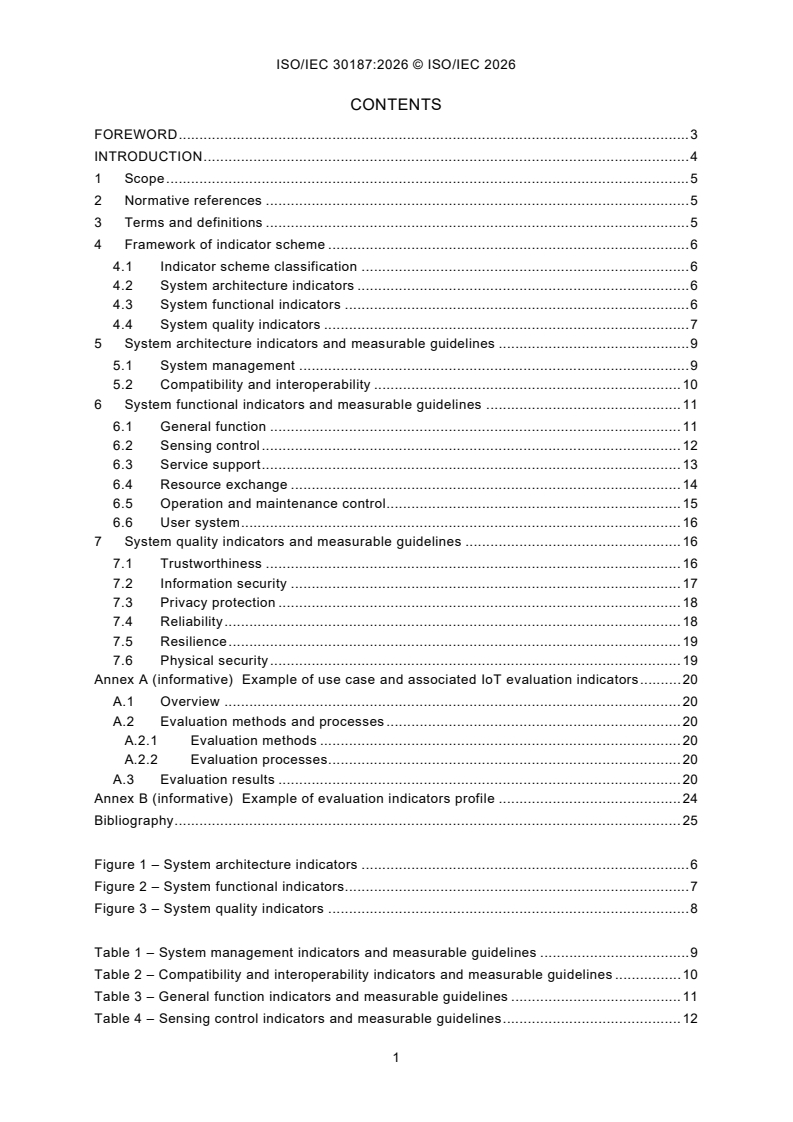
CONTENTS
FOREWORD . 3
INTRODUCTION . 4
1 Scope . 5
2 Normative references . 5
3 Terms and definitions . 5
4 Framework of indicator scheme . 6
4.1 Indicator scheme classification . 6
4.2 System architecture indicators . 6
4.3 System functional indicators . 6
4.4 System quality indicators . 7
5 System architecture indicators and measurable guidelines . 9
5.1 System management . 9
5.2 Compatibility and interoperability . 10
6 System functional indicators and measurable guidelines . 11
6.1 General function . 11
6.2 Sensing control . 12
6.3 Service support . 13
6.4 Resource exchange . 14
6.5 Operation and maintenance control . 15
6.6 User system . 16
7 System quality indicators and measurable guidelines . 16
7.1 Trustworthiness . 16
7.2 Information security . 17
7.3 Privacy protection . 18
7.4 Reliability . 18
7.5 Resilience . 19
7.6 Physical security . 19
Annex A (informative) Example of use case and associated IoT evaluation indicators . 20
A.1 Overview . 20
A.2 Evaluation methods and processes . 20
A.2.1 Evaluation methods . 20
A.2.2 Evaluation processes . 20
A.3 Evaluation results . 20
Annex B (informative) Example of evaluation indicators profile . 24
Bibliography . 25
Figure 1 – System architecture indicators . 6
Figure 2 – System functional indicators . 7
Figure 3 – System quality indicators . 8
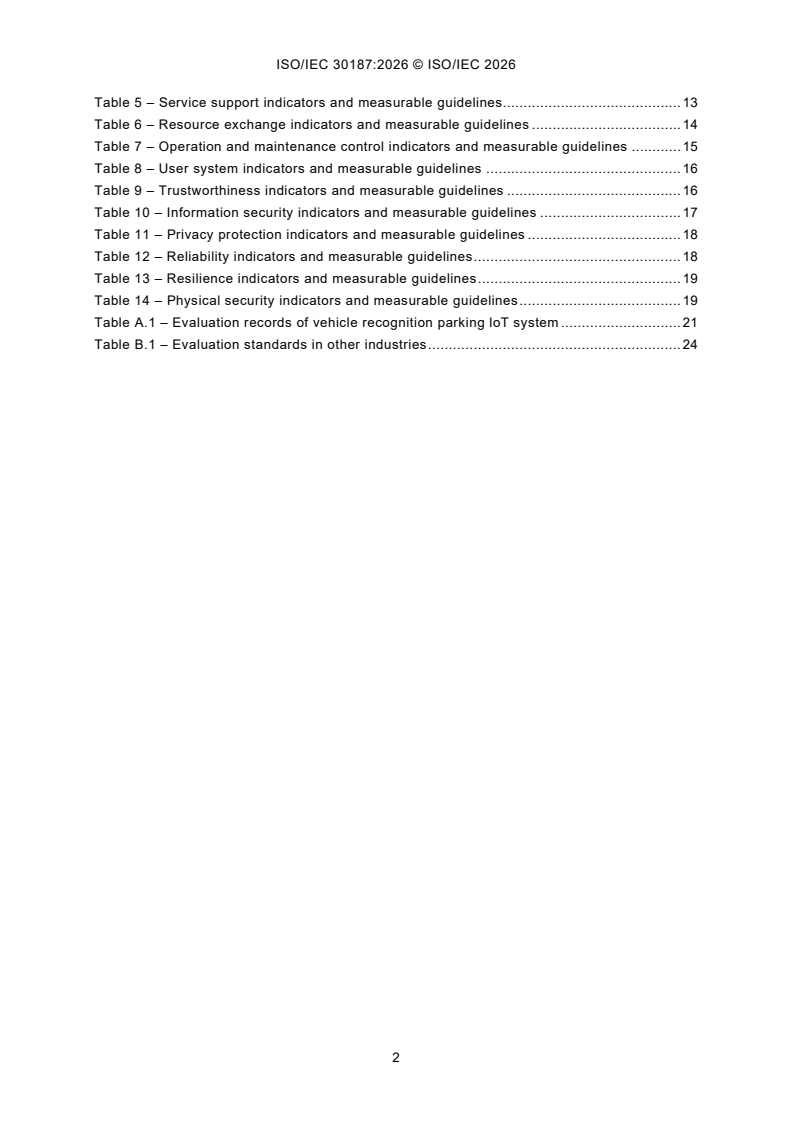
Table 1 – System management indicators and measurable guidelines . 9
Table 2 – Compatibility and interoperability indicators and measurable guidelines . 10
Table 3 – General function indicators and measurable guidelines . 11
Table 4 – Sensing control indicators and measurable guidelines . 12
Table 5 – Service support indicators and measurable guidelines. 13
Table 6 – Resource exchange indicators and measurable guidelines . 14
Table 7 – Operation and maintenance control indicators and measurable guidelines . 15
Table 8 – User system indicators and measurable guidelines . 16
Table 9 – Trustworthiness indicators and measurable guidelines . 16
Table 10 – Information security indicators and measurable guidelines . 17
Table 11 – Privacy protection indicators and measurable guidelines . 18
Table 12 – Reliability indicators and measurable guidelines . 18
Table 13 – Resilience indicators and measurable guidelines . 19
Table 14 – Physical security indicators and measurable guidelines . 19
Table A.1 – Evaluation records of vehicle recognition parking loT system . 21
Table B.1 – Evaluation standards in other industries . 24
Internet of Things (IoT) -
Evaluation indicators for IoT systems
FOREWORD
1) ISO (the International Organization for Standardization) and IEC (the International Electrotechnical Commission)
form the specialized system for worldwide standardization. National bodies that are members of ISO or IEC
participate in the development of International Standards through technical committees established by the
respective organization to deal with particular fields of technical activity. ISO and IEC technical committees
collaborate in fields of mutual interest. Other international organizations, governmental and non-governmental,
in liaison with ISO and IEC, also take part in the work.
2) The formal decisions or agreements of IEC and ISO on technical matters express, as nearly as possible, an
international consensus of opinion on the relevant subjects since each technical committee has representation
from all interested IEC and ISO National bodies.
3) IEC and ISO documents have the form of recommendations for international use and are accepted by IEC and
ISO National bodies in that sense. While all reasonable efforts are made to ensure that the technical content of
IEC and ISO documents is accurate, IEC and ISO cannot be held responsible for the way in which they are used
or for any misinterpretation by any end user.
4) In order to promote international uniformity, IEC and ISO National bodies undertake to apply IEC and ISO
documents transparently to the maximum extent possible in their national and regional publications. Any
divergence between any IEC and ISO document and the corresponding national or regional publication shall be
clearly indicated in the latter.
5) IEC and ISO do not provide any attestation of conformity. Independent certification bodies provide conformity
assessment services and, in some areas, access to IEC and ISO marks of conformity. IEC and ISO are not
responsible for any services carried out by independent certification bodies.
6) All users should ensure that they have the latest edition of this document.
7) No liability shall attach to IEC and ISO or their directors, employees, servants or agents including individual
experts and members of its technical committees and IEC and ISO National bodies for any personal injury,
property damage or other damage of any nature whatsoever, whether direct or indirect, or for costs (including
legal fees) and expenses arising out of the publication, use of, or reliance upon, this ISO/IEC document or any
other IEC and ISO documents.
8) Attention is drawn to the Normative references cited in this document. Use of the referenced publications is
indispensable for the correct application of this document.
9) IEC and ISO draw attention to the possibility that the implementation of this document may involve the use of (a)
patent(s). IEC and ISO take no position concerning the evidence, validity or applicability of any claimed patent
rights in respect thereof. As of the date of publication of this document, IEC and ISO had not received notice of
(a) patent(s), which may be required to implement this document. However, implementers are cautioned that this
may not represent the latest information, which may be obtained from the patent database available at
https://patents.iec.ch and www.iso.org/patents. IEC and ISO shall not be held responsible for identifying any or
all such patent rights.
ISO/IEC 30187 has been prepared by subcommittee 41: Internet of Things and Digital Twin, of
ISO/IEC Joint Technical Committee 1: Information technology. It is an International Standard.
The text of this International Standard is based on the following documents:
Draft Report on voting
JTC1-SC41/584/FDIS JTC1-SC41/602/RVD
Full information on the voting for its approval can be found in the report on voting indicated in
the above table.
The language used for the development of this International Standard is English.
This document was drafted in accordance with ISO/IEC Directives, Part 2, and developed in
accordance with ISO/IEC Directives, Part 1, and the ISO/IEC Directives, JTC 1 Supplement
available at www.iec.ch/members_experts/refdocs and www.iso.org/directives.
INTRODUCTION
System evaluation is a method used to review and select newly developed or rebuilt systems
through systematic analysis, considering aspects such as technology, economy, society, and
ecology. The system evaluation is carried out according to predetermined system objectives.
The purpose is to evaluate the most suitable solution for the application or use case.
An IoT system evaluation usually includes the following steps:
– defining the system of interest and the associated environment,
– reviewing existing relevant standards to set appropriate minimum requirements,
– determining the evaluation items and the resulting list of indicators,
– determining the observable items and collecting relevant information,
– determining the methods and criteria for evaluation, and
– conducting the evaluation.
The conclusion of the evaluation indicator scheme is the basis of the system evaluation process,
which can provide evaluation criteria for the objective IoT systems.
IoT systems are being widely used in energy, agriculture, manufacturing, finance,
environmental protection and other industries. To identify the advantages and disadvantages
among IoT systems, it is important to develop a standard to help users to select appropriate
indicators when evaluating the performance of targeted systems.
The set of evaluation indicators described in this document can be considered as a profile,
which can be used for the evaluation of IoT systems in the planning phase, the real-time
monitoring phase, or the phase after deployment. The specification of other profiles depends
on the system that is evaluated. For instance, if an IoT system includes artificial intelligence or
digital twin capabilities, additional indicators can be added. Likewise, if an IoT system
corresponds to a vertical domain (e.g. health, manufacturing, energy), additional indicators can
be added.
1 Scope
This document specifies the evaluation indicators for IoT systems.
This document is applicable to the compilation of the evaluation indicators for IoT systems in
specific industries.
NOTE The indicators identified in this document are typical indicators but are not a comprehensive list; and
conversely, not every indicator listed applies to every IoT system.
2 Normative references
There are no normative references in this document.
3 Terms and definitions
For the purposes of this document, the following terms and definitions apply.
ISO and IEC maintain terminological databases for use in standardization at the following
addresses:
– IEC Electropedia: available at http://www.electropedia.org/
– ISO Online browsing platform: available at http://www.iso.org/obp
3.1
IoT system
system providing functionalities of IoT
Note 1 to entry: An IoT system can include, but not be limited to, IoT devices, IoT gateways, sensors, and actuators.
[SOURCE: ISO/IEC 20924:2024 [1], 3.2.15]
3.2
indicator
measure that provides an estimate or evaluation of specified attributes derived from a model
with respect to defined information needs
[SOURCE: ISO/IEC/IEEE 15939:2017 [2], 3.10]
3.3
indicator scheme
collection including catalogued indicator defined by common features
Note 1 to entry: The indicator scheme is a systematic and coherent set of indicators that reflects the entire
evaluation object.
3.4
criteria
rules on which a judgment or decision can be based, or by which a product, service, result, or
process can be evaluated
[SOURCE: ISO/IEC/IEEE 15289:2019 [3], 3.1.6]
4 Framework of indicator scheme
4.1 Indicator scheme classification
Indicators are grouped according to the following categories:
– system architecture indicators;
– system functional indicators;
– system quality indicators.
Each category is further structured into subcategories.
EXAMPLE System management is a subcategory of system architecture.
The following referencing scheme is used.
– Categories are identified as follows: A.
– Subcategories are identified as follows: A-B.
– Indicators are identified as follows: A-B-C.
, , and indicate serial numbers to identify themselves. This referencing scheme is
applied consistently in Table 1 to Table 14.
4.2 System architecture indicators
The system architecture indicators category includes two subcategories: system management
(with three indicators), and compatibility and interoperability (with four indicators). These
subcategories encompass a total of seven indicators, as shown in Figure 1.
Figure 1 – System architecture indicators
4.3 System functional indicators
The system functional indicators category includes six subcategories: general function (with
three indicators), sensing control (with six indicators), service support (with three indicators),
resource exchange (with four indicators), operation and maintenance control (with four
indicators), and user system (with two indicators). These subcategories encompass a total of
22 indicators, as shown in Figure 2.
Figure 2 – System functional indicators
4.4 System quality indicators
The system quality indicators category includes six subcategories: trustworthiness (with three
indicators), information security (with eight indicators), privacy protection (with two indicators),
reliability (with four indicators), resilience (with three indicators), and physical security (with
four indicators). These subcategories encompass a total of 24 indicators, as shown in Figure 3.
Figure 3 – System quality indicators
For the practical application of the indicator scheme framework specified in this Clause 4, a
specific use case and associated evaluation process are provided in Annex A, which details the
application of system architecture indicators, system functional indicators, and system quality
indicators in the evaluation of a vehicle recognition parking IoT system. The evaluation records
and score calculation methods in Annex A can serve as a reference for the formulation and
implementation of evaluation plans for IoT systems in other vertical industries.
In addition to the core indicator categories specified in this Clause 4, Annex B provides
extended evaluation criteria and references to cross-industry standards.
5 System architecture indicators and measurable guidelines
5.1 System management
Table 1 provides the system management indicators (A1-B1), which include separation of
function and management (A1-B1-C1), distributed collaboration (A1-B1-C2) and scalability
(A1-B1-C3).
Table 1 – System management indicators and measurable guidelines
Indicator Indicator
Indicator description Measurable guidelines
number name
The functional design and management of
an IoT system should be carried out in
The functional interfaces and
three dimensions. Firstly, there is the user
capabilities of IoT components
interface (UI), which is related to how users
(such as devices) are completely
interact with the system. Secondly, there is
separated from the management
the process dimension, mainly involving the
Separation of interfaces and capabilities of the
A1-B1- sequence and logic of data collection,
function and component. The management
C1 transmission, processing, and the
capabilities are handled by
management
collaborative work of various devices within
different software components
the system. Thirdly, there is the priority
requiring different access
dimension, which means clarifying the
credentials rather than functional
importance levels of different functions,
interfaces.
tasks, and devices in the system and
determining their execution order.
a) Data should be stored flexibly at the
most suitable and optimized locations,
An IoT system is a distributed
such as on the terminal nodes at the
system. It is an integrated system
edge of the network, or on the
from a functional perspective and
background server or cloud platform.
contains multiple subsystems.
A1-B1- Distributed These subsystems can be
b) It should be possible to process the
C2 collaboration physically separated from each
relevant data at the most suitable and
other and geographically
optimized location including the terminal
dispersed. These subsystems are
nodes at the edge of the network,
generally connected via
background server or cloud platform,
communication links.
IoT gateway, sensors and controllers
based on the specific circumstances.
The functional components of an IoT
system should achieve composability and
modularity. In terms of composability, it is
important to ensure that each component
can be freely combined and integrated as
needed based on unified interface
standards and interaction protocols. This
enables the system to quickly construct
diverse functional combinations according
to different application scenarios and
business requirements, and the
combination process does not require
large-scale customized development and
When the size and complexity of
in-depth adaptation work.
A1-B1- the system, or the workload of the
Scalability
C3 system increases, the system can
In terms of modularity, each component
continue to work effectively.
should have a high degree of
independence, with clear and definite
functional definitions and boundaries. It
should be able to achieve independent
development, testing, deployment, and
updating. At the same time, when
performing operations such as function
optimization, fault troubleshooting, or
replacement on a single component, it will
not have a significant impact on the
operation of other components, ensuring
the stability and maintainability of the
overall system architecture.
5.2 Compatibility and interoperability
Table 2 provides the system compatibility and interoperability indicators (A1-B2), which include
transport interoperability (A1-B2-C1), semantic interoperability (A1-B2-C2), syntactic
interoperability (A1-B2-C3) and behaviour interoperability (A1-B2-C4).
Table 2 – Compatibility and interoperability indicators and measurable guidelines
Indicator Indicator
Indicator description Measurable guidelines
number name
The components in an IoT
system communicate with each
other through network links,
including but not limited to LAN,
An IoT system should include networks of
WAN, and wireless
different sizes such as LAN for short-distance
connections. Wired or wireless
or local connectivity and WAN for wider
Transport
A1-B2-C1 connections are used between
coverage to the Internet.
interoperability
components. The network
Heterogeneous devices should be connected
structure of an IoT system can
through gateways or similar components.
be static or dynamic, and can
also have capabilities such as
service quality assurance,
encryption, and authentication.
Components of an IoT system For the evaluation of the semantic
interoperability of an IoT system, the specific
Semantic should be able to understand
A1-B2-C2
interoperability and interpret the meaning of requirements of ISO/IEC 21823-3:2021 [4]
exchanged data.
should be taken as the evaluation criteria.
The components of an IoT
system involved in For the evaluation of the syntactic
Syntactic communication have the ability interoperability of an IoT system, the specific
A1-B2-C3
interoperability to mutually understand the requirements of ISO/IEC 21823-4:2022 [5]
format of the information should be taken as the evaluation criteria.
exchanged.
The ontologies (formal behaviour models) of
the components should be consistent. The
actual results after an IoT system executes
The components in an IoT specific behaviours should conform to the
Behaviour system are interoperable so expected results. The definitions of the pre-
A1-B2-C4
interoperability that the actual result achieves conditions required for executing the
the expected outcome. behaviours should be complete and accurate,
and the actual post-conditions achieved after
executing the behaviours should be consistent
with the predefined post-conditions.
___________
Numbers in square brackets refer to the Bibliography.
6 System functional indicators and measurable guidelines
6.1 General function
Table 3 provides the system general function indicators (A2-B1), which include flexibility
(A2-B1-C1), execution duration of operations, functions, or services (A2-B1-C2) and
discoverability (A2-B1-C3).
Table 3 – General function indicators and measurable guidelines
Indicator Indicator
Indicator description Measurable guidelines
number name
a) IoT devices and components should
have programmable and expandable
capabilities to increase flexibility.
An IoT system, service, device or
b) When an IoT device is added to an IoT
component can provide different
system, it can provide a self-description
A2-B1-C1 Flexibility grades of functionality according
to the IoT system or related components.
to needs and application
scenarios.
c) When an IoT system is adjusted as
needed, components such as devices
and networks should be able to be added
and deleted adaptively.
Calculate the time of executing operations,
Execution
functions or services. According to the time
duration of Executing operations, functions
accuracy, the grade level of response time
A2-B1-C2 operations, and services within a specified
is divided into an agreed upon unit such as,
functions, or time.
but not limited to, milliseconds, seconds,
services
and minutes.
a) Users, services or devices should be
able to discover other devices, services,
interfaces, performance, configuration of
operating parameters, etc. according to
the predefined privileges.
Allowing users, services, or
devices to discover devices on
b) When dynamically configuring an IoT
the network and the capabilities
A2-B1-C3 Discoverability system, the newly added or to be deleted
and services they provide at any
IoT entities should be discoverable and
time, including device positioning
identifiable.
and identification.
c) An IoT system should be able to provide
a discovery mechanism for multiple
protocols, software solutions or system
architectures.
6.2 Sensing control
Table 4 provides the system sensing control indicators (A2-B2), which include sensing accuracy
(A2-B2-C1), control accuracy (A2-B2-C2), recognition success rate (A2-B2-C3), control
success rate (A2-B2-C4), continuous working time (battery powered) (A2-B2-C5) and energy
consumption (A2-B2-C6).
Table 4 – Sensing control indicators and measurable guidelines
Indicator
Indicator name Indicator description Measurable guidelines
number
The sensing information obtained by an IoT
system should be compared with the real
A quality which characterizes
information obtained by a calibrated device
Sensing the ability to provide sensed
A2-B2-C1 accurate within specified limits. The smaller
a
accuracy information close to the real
the difference, the higher the sensing
information.
accuracy, and the larger the difference, the
lower the accuracy.
The control commands issued by an IoT
system should be compared with the real
A quality which characterizes
information obtained through a calibrated
the ability to provide the
A2-B2-C2 Control accuracy device accurate within specified limits. The
control capability close to the
smaller the difference, the higher the
required capability.
control accuracy, and the larger the
difference, the lower the accuracy.
The ratio of the number of times an IoT
The probability that an IoT system successfully obtains the sensing
Recognition
A2-B2-C3 system successfully obtains information to the total number of times the
success rate
the sensing information. sensing information is requested should be
counted.
The ratio of the number of times an IoT
The probability that an IoT system successfully controls the execution
Control success
A2-B2-C4 system successfully controls terminal to the total number of times the
rate
the executing terminal. execution terminal executes a command
should be counted.
Under the continuous working The continuous working time of the terminal
Continuous
conditions of the system and (the time interval from when the terminal
working time
A2-B2-C5 the terminal, the battery can starts to work until it cannot work normally)
(battery
support the normal working shall be able to meet the requirements of
powered)
time of the terminal. the system and terminal application design.
Under the continuous working
Energy The energy consumption of the end node
conditions of the system and
under normal operation should be able to
consumption
A2-B2-C6 the end node, the battery
(battery meet the requirements of system design
energy consumed by the end
powered) and terminal application scenarios.
node in unit time.
a
Sensing accuracy is a critical characteristic of sensors for their role in data value chains and it is important
that sensing accuracy be represented by a type-safe representation that is expressed in terms of the sensor’s
characteristics to be considered interoperable.
6.3 Service support
Table 5 provides the system service support indicators (A2-B3), which include content-aware
(A2-B3-C1), environment-aware (A2-B3-C2) and service subscription (A2-B3-C3).
Table 5 – Service support indicators and measurable guidelines
Indicator Indicator
Indicator description Measurable guidelines
number name
Specific requirements on the timeliness, security,
and privacy protection of information and data
The characteristics of obtaining (such as health services, monitoring systems,
Content- sufficient knowledge from the and emergency services) should have content-
A2-B3-C1
aware metadata associated with IoT aware function to adapt interfaces, extract
components. application data, improve information retrieval
accuracy, discover services, and allow
appropriate user interaction.
a) The system should be able to obtain
environment information from the sensing
terminal, stored historical background
The characteristics of the IoT
information or user-set input, etc.
devices, services, or systems
that can monitor their own
b) The system should be able to correlate the
Environment operating environment and
A2-B3-C2 acquired environment information.
-aware events in the environment to
determine information about the
c) The system should be able to automatically
physical world, such as time,
provide different services based on the
place, or sequence of events.
application background informat
...