

IEC TS 62876-3-2:2026
(Main)Nanomanufacturing - Reliability and durability assessment - Part 3-2: Graphene - Ellipsometry measurement of graphene
General Information
- Abstract
IEC TS 62876-3-2:2026 which is a Technical Specification, establishes a standardized method to determine
• volume fraction
for graphene by
• ellipsometry.
Thickness/composition measurements are evaluated by ellipsometry before and after the stability test. By model calculation, the volume fraction of graphene can be evaluated. Since the test method is non‑destructive, it can be used to assess the reliability and durability of graphene films on production lines.
• For graphene-capped copper for Cu interconnects in a semiconductor engineering, for example, the reliability and durability of the capping layer are evaluated.
• Gas sensors, gas barriers, transparent electrodes for solar cells, etc. are being researched and developed.
• This method is useful for non-destructive and quantitative evaluation of the volume fraction of graphene to assess the reliability and durability.
- Status
- Published
- Publication Date
- 26-Apr-2026
- Technical Committee
- TC 113 - Nanotechnology for electrotechnical products and systems
- Drafting Committee
- WG 7 - TC 113/WG 7
- Current Stage
- PPUB - Publication issued
- Start Date
- 27-Apr-2026
- Completion Date
- 24-Apr-2026
Overview
IEC TS 62876-3-2:2026 is a technical specification developed by the International Electrotechnical Commission (IEC) focused on advancing nanomanufacturing by standardizing the reliability and durability assessment of graphene. This specification specifically describes the use of ellipsometry for the precise, non-destructive measurement of graphene film properties, enabling quantitative evaluation of the volume fraction of graphene layers. The method enhances industrial quality control by providing consistent and reproducible evaluation criteria essential for modern nanomaterial applications.
Key Topics
- Standardized Ellipsometry for Graphene: Establishes a non-destructive procedure to determine the volume fraction, thickness, and composition of graphene films using ellipsometry, a sophisticated optical measurement technique.
- Measurement Protocol: Details procedures for sample preparation, system checks, environmental documentation, and data interpretation. The protocol emphasizes system calibration with reference samples and meticulous sample handling to ensure accuracy.
- Reliability and Durability Testing: Specifies the requirements for testing graphene films before and after stability assessments (such as temperature and humidity storage). Ellipsometry results enable the identification and quantification of physical and compositional changes in graphene films under stress.
- Data Analysis and Validation: Outlines model-fitting procedures for ellipsometry data, including multilayer and interface considerations, rigorous data fitting, and validation for dependable quantitative results.
- Practical Recommendations: Includes protocols for minimizing data variation through optimal measurement angles and wavelength ranges, ensuring results are robust and traceable.
Applications
The standard addresses practical needs in industries leveraging graphene’s unique properties for advanced technologies:
- Semiconductor Engineering: Facilitates assessment of graphene-capped copper (Cu) for interconnect reliability and longevity, crucial in preventing oxidation and resisting environmental degradation in nanoelectronics.
- Sensors and Barriers: Supports non-destructive evaluation in the development of gas sensors and gas barrier layers, where graphene's impermeability and durability are key to product performance.
- Transparent Electrodes: Aids in research and production of transparent graphene electrodes for use in solar cells, where maintaining high conductivity and stability under environmental stress is vital.
- Production Line Quality Control: Enables rapid, repeatable, and in-line measurement of graphene film quality, maximizing manufacturing yield and reducing process variability.
Related Standards
For broader and in-depth understanding, the following international standards and guidelines are relevant:
- IEC 62876 Series: Additional parts of this series address broader aspects of nanomanufacturing reliability and durability assessment.
- ISO/TS 80004-1: Core vocabulary for nanotechnologies.
- IEC TR 63258: Guidelines for ellipsometry application in the evaluation of nanoscale film thickness.
- ISO 23131: Fundamental principles of ellipsometry.
- ISO/TS 21356-1: Structural characterization of graphene from powders and dispersions.
Summary
IEC TS 62876-3-2:2026 delivers a robust, internationally harmonized approach for non-destructive, quantitative measurement of graphene film properties using ellipsometry. It ensures reliability and durability assessments meet industry demands for precision and repeatability, supporting innovation in nanotechnology and microelectronics manufacturing. This standard is a critical reference for professionals seeking to optimize graphene integration in advanced material systems and products.
Frequently Asked Questions
IEC TS 62876-3-2:2026 is a technical specification published by the International Electrotechnical Commission (IEC). Its full title is "Nanomanufacturing - Reliability and durability assessment - Part 3-2: Graphene - Ellipsometry measurement of graphene". This standard covers: IEC TS 62876-3-2:2026 which is a Technical Specification, establishes a standardized method to determine • volume fraction for graphene by • ellipsometry. Thickness/composition measurements are evaluated by ellipsometry before and after the stability test. By model calculation, the volume fraction of graphene can be evaluated. Since the test method is non‑destructive, it can be used to assess the reliability and durability of graphene films on production lines. • For graphene-capped copper for Cu interconnects in a semiconductor engineering, for example, the reliability and durability of the capping layer are evaluated. • Gas sensors, gas barriers, transparent electrodes for solar cells, etc. are being researched and developed. • This method is useful for non-destructive and quantitative evaluation of the volume fraction of graphene to assess the reliability and durability.
IEC TS 62876-3-2:2026 which is a Technical Specification, establishes a standardized method to determine • volume fraction for graphene by • ellipsometry. Thickness/composition measurements are evaluated by ellipsometry before and after the stability test. By model calculation, the volume fraction of graphene can be evaluated. Since the test method is non‑destructive, it can be used to assess the reliability and durability of graphene films on production lines. • For graphene-capped copper for Cu interconnects in a semiconductor engineering, for example, the reliability and durability of the capping layer are evaluated. • Gas sensors, gas barriers, transparent electrodes for solar cells, etc. are being researched and developed. • This method is useful for non-destructive and quantitative evaluation of the volume fraction of graphene to assess the reliability and durability.
IEC TS 62876-3-2:2026 is classified under the following ICS (International Classification for Standards) categories: 07.120 - Nanotechnologies. The ICS classification helps identify the subject area and facilitates finding related standards.
IEC TS 62876-3-2:2026 is available in PDF format for immediate download after purchase. The document can be added to your cart and obtained through the secure checkout process. Digital delivery ensures instant access to the complete standard document.
Standards Content (Sample)
IEC TS 62876-3-2 ®
Edition 1.0 2026-04
TECHNICAL
SPECIFICATION
Nanomanufacturing - Reliability and durability assessment -
Part 3-2: Graphene - Ellipsometry measurement of graphene
ICS 07.120 ISBN 978-2-8327-1169-9
All rights reserved. Unless otherwise specified, no part of this publication may be reproduced or utilized in any form or
by any means, electronic or mechanical, including photocopying and microfilm, without permission in writing from either
IEC or IEC's member National Committee in the country of the requester. If you have any questions about IEC copyright
or have an enquiry about obtaining additional rights to this publication, please contact the address below or your local
IEC member National Committee for further information.
IEC Secretariat Tel.: +41 22 919 02 11
3, rue de Varembé info@iec.ch
CH-1211 Geneva 20 www.iec.ch
Switzerland
About the IEC
The International Electrotechnical Commission (IEC) is the leading global organization that prepares and publishes
International Standards for all electrical, electronic and related technologies.
About IEC publications
The technical content of IEC publications is kept under constant review by the IEC. Please make sure that you have the
latest edition, a corrigendum or an amendment might have been published.
IEC publications search - IEC Products & Services Portal - products.iec.ch
webstore.iec.ch/advsearchform Discover our powerful search engine and read freely all the
The advanced search enables to find IEC publications by a publications previews, graphical symbols and the glossary.
variety of criteria (reference number, text, technical With a subscription you will always have access to up to date
committee, …). It also gives information on projects, content tailored to your needs.
replaced and withdrawn publications.
Electropedia - www.electropedia.org
The world's leading online dictionary on electrotechnology,
IEC Just Published - webstore.iec.ch/justpublished
Stay up to date on all new IEC publications. Just Published containing more than 22 500 terminological entries in English
details all new publications released. Available online and and French, with equivalent terms in 25 additional languages.
once a month by email. Also known as the International Electrotechnical Vocabulary
(IEV) online.
IEC Customer Service Centre - webstore.iec.ch/csc
If you wish to give us your feedback on this publication or
need further assistance, please contact the Customer
Service Centre: sales@iec.ch.
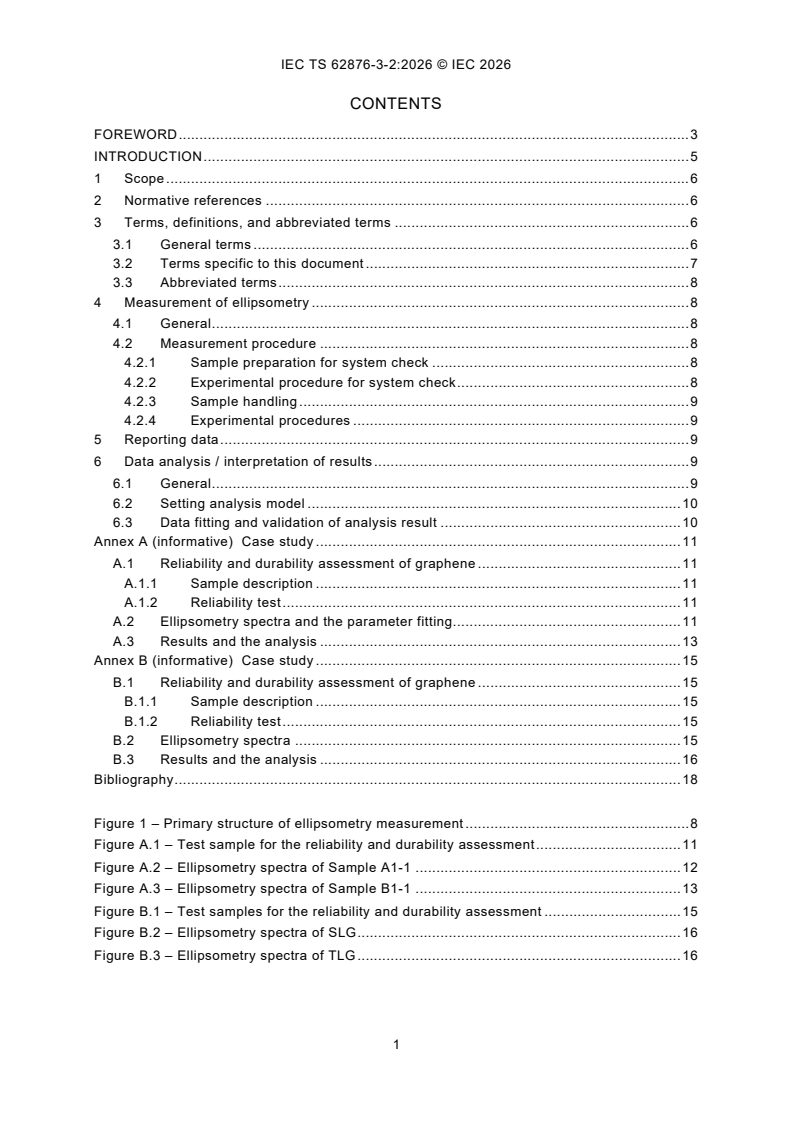
CONTENTS
FOREWORD . 3
INTRODUCTION . 5
1 Scope . 6
2 Normative references . 6
3 Terms, definitions, and abbreviated terms . 6
3.1 General terms . 6
3.2 Terms specific to this document . 7
3.3 Abbreviated terms . 8
4 Measurement of ellipsometry . 8
4.1 General . 8
4.2 Measurement procedure . 8
4.2.1 Sample preparation for system check . 8
4.2.2 Experimental procedure for system check . 8
4.2.3 Sample handling . 9
4.2.4 Experimental procedures . 9
5 Reporting data . 9
6 Data analysis / interpretation of results . 9
6.1 General . 9
6.2 Setting analysis model . 10
6.3 Data fitting and validation of analysis result . 10
Annex A (informative) Case study . 11
A.1 Reliability and durability assessment of graphene . 11
A.1.1 Sample description . 11
A.1.2 Reliability test . 11
A.2 Ellipsometry spectra and the parameter fitting. 11
A.3 Results and the analysis . 13
Annex B (informative) Case study . 15
B.1 Reliability and durability assessment of graphene . 15
B.1.1 Sample description . 15
B.1.2 Reliability test . 15
B.2 Ellipsometry spectra . 15
B.3 Results and the analysis . 16
Bibliography . 18
Figure 1 – Primary structure of ellipsometry measurement . 8
Figure A.1 – Test sample for the reliability and durability assessment . 11
Figure A.2 – Ellipsometry spectra of Sample A1-1 . 12
Figure A.3 – Ellipsometry spectra of Sample B1-1 . 13
Figure B.1 – Test samples for the reliability and durability assessment . 15
Figure B.2 – Ellipsometry spectra of SLG . 16
Figure B.3 – Ellipsometry spectra of TLG . 16
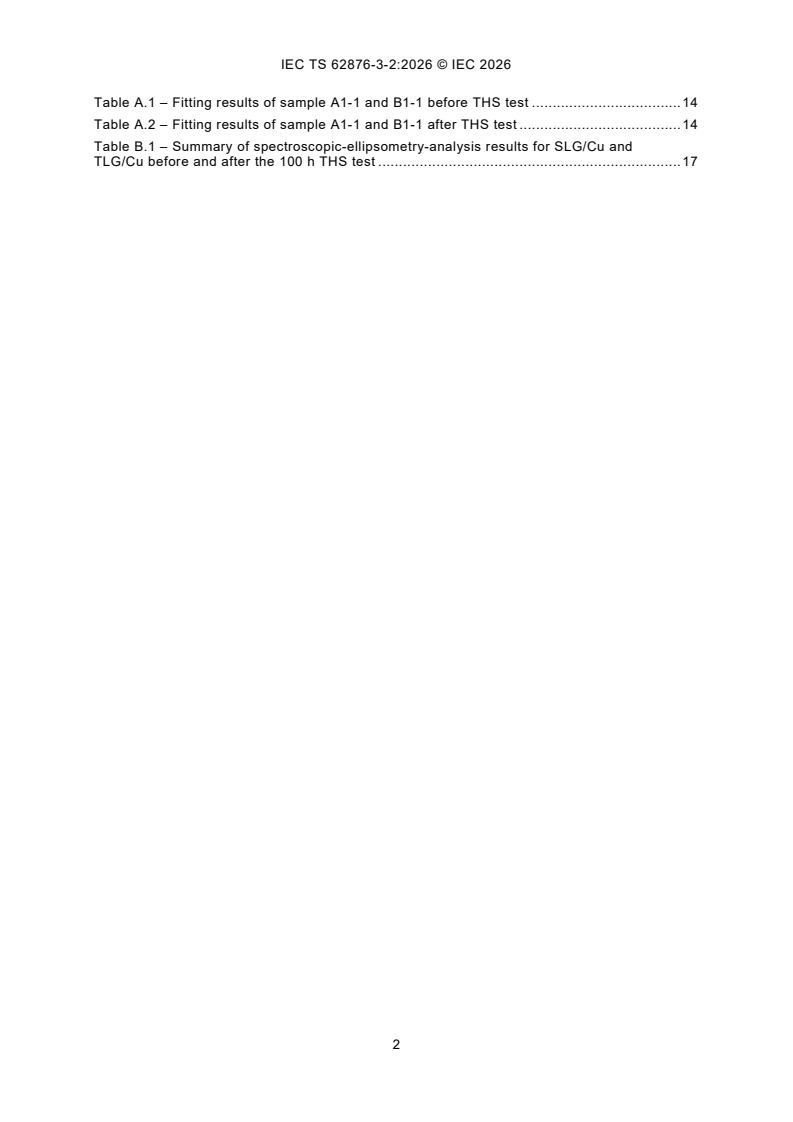
Table A.1 – Fitting results of sample A1-1 and B1-1 before THS test . 14
Table A.2 – Fitting results of sample A1-1 and B1-1 after THS test . 14
Table B.1 – Summary of spectroscopic-ellipsometry-analysis results for SLG/Cu and
TLG/Cu before and after the 100 h THS test . 17
INTERNATIONAL ELECTROTECHNICAL COMMISSION
____________
Nanomanufacturing - Reliability and durability assessment -
Part 3-2: Graphene - Ellipsometry measurement of graphene
FOREWORD
1) The International Electrotechnical Commission (IEC) is a worldwide organization for standardization comprising
all national electrotechnical committees (IEC National Committees). The object of IEC is to promote international
co-operation on all questions concerning standardization in the electrical and electronic fields. To this end and
in addition to other activities, IEC publishes International Standards, Technical Specifications, Technical Reports,
Publicly Available Specifications (PAS) and Guides (hereafter referred to as "IEC Publication(s)"). Their
preparation is entrusted to technical committees; any IEC National Committee interested in the subject dealt with
may participate in this preparatory work. International, governmental and non-governmental organizations liaising
with the IEC also participate in this preparation. IEC collaborates closely with the International Organization for
Standardization (ISO) in accordance with conditions determined by agreement between the two organizations.
2) The formal decisions or agreements of IEC on technical matters express, as nearly as possible, an international
consensus of opinion on the relevant subjects since each technical committee has representation from all
interested IEC National Committees.
3) IEC Publications have the form of recommendations for international use and are accepted by IEC National
Committees in that sense. While all reasonable efforts are made to ensure that the technical content of IEC
Publications is accurate, IEC cannot be held responsible for the way in which they are used or for any
misinterpretation by any end user.
4) In order to promote international uniformity, IEC National Committees undertake to apply IEC Publications
transparently to the maximum extent possible in their national and regional publications. Any divergence between
any IEC Publication and the corresponding national or regional publication shall be clearly indicated in the latter.
5) IEC itself does not provide any attestation of conformity. Independent certification bodies provide conformity
assessment services and, in some areas, access to IEC marks of conformity. IEC is not responsible for any
services carried out by independent certification bodies.
6) All users should ensure that they have the latest edition of this publication.
7) No liability shall attach to IEC or its directors, employees, servants or agents including individual experts and
members of its technical committees and IEC National Committees for any personal injury, property damage or
other damage of any nature whatsoever, whether direct or indirect, or for costs (including legal fees) and
expenses arising out of the publication, use of, or reliance upon, this IEC Publication or any other IEC
Publications.
8) Attention is drawn to the Normative references cited in this publication. Use of the referenced publications is
indispensable for the correct application of this publication.
9) IEC draws attention to the possibility that the implementation of this document may involve the use of (a)
patent(s). IEC takes no position concerning the evidence, validity or applicability of any claimed patent rights in
respect thereof. As of the date of publication of this document, IEC had not received notice of (a) patent(s), which
may be required to implement this document. However, implementers are cautioned that this may not represent
the latest information, which may be obtained from the patent database available at https://patents.iec.ch. IEC
shall not be held responsible for identifying any or all such patent rights.
IEC TS 62876-3-2 has been prepared by IEC technical committee 113: Nanotechnology for
electrotechnical products and systems. It is a Technical Specification.
The text of this Technical Specification is based on the following documents:
Draft Report on voting
113/942/DTS 113/966/RVDTS
Full information on the voting for its approval can be found in the report on voting indicated in
the above table.
The language used for the development of this Technical Specification is English.
This document was drafted in accordance with ISO/IEC Directives, Part 2, and developed in
accordance with ISO/IEC Directives, Part 1 and ISO/IEC Directives, IEC Supplement, available
at www.iec.ch/members_experts/refdocs. The main document types developed by IEC are
described in greater detail at www.iec.ch/publications.
A list of all parts in the IEC 62876 series, published under the general title Nanomanufacturing -
Reliability and durability assessment, can be found on the IEC website.
The committee has decided that the contents of this document will remain unchanged until the
stability date indicated on the IEC website under webstore.iec.ch in the data related to the
specific document. At this date, the document will be
– reconfirmed,
– withdrawn, or
– revised.
INTRODUCTION
Graphene, a single layer of carbon atoms with each atom bound to three neighbours in a
honeycomb structure, is an important building block of many carbon nano-objects, and
possesses the excellent characteristics for various nanoelectronics devices, such as the high
conductivity in the 2-dimensional structure. Graphene is also a promising candidate for
atomically thin, flexible and transparent optoelectronic devices, various sensors, and the
capping material on the electronic transport in ultra-scaled interconnects. Ellipsometry is a
non-destructive optical tool to evaluate the dielectric properties, namely the complex index of
refractive, of thin-film-shaped materials. Ellipsometry has the advantage of being able to
evaluate a relatively large area of the film. Ellipsometry can be used to characterize thickness,
roughness, composition, crystalline nature, and other properties of graphene.
This document offers the test method of ellipsometry to evaluate the reliability and the durability
of graphene layers on a substrate.
1 Scope
This part of 62876 establishes a standardized method to determine
– volume fraction
for graphene by
– ellipsometry.
Thickness/composition measurements are evaluated by ellipsometry before and after the
stability test. By model calculation, the volume fraction of graphene can be evaluated. Since
the test method is non-destructive, it can be used to assess the reliability and durability of
graphene films on production lines.
– For graphene-capped copper for Cu interconnects in a semiconductor engineering, for
example, the reliability and durability of the capping layer are evaluated.
– Gas sensors, gas barriers, transparent electrodes for solar cells, etc. are being researched
and developed.
– This method is useful for non-destructive and quantitative evaluation of the volume fraction
of graphene to assess the reliability and durability.
2 Normative references
The following documents are referred to in the text in such a way that some or all of their content
constitutes requirements of this document. For dated references, only the edition cited applies.
For undated references, the latest edition of the referenced document (including any
amendments) applies.
ISO/TS 80004-1, Nanotechnologies - Vocabulary - Part 1: Core vocabulary
3 Terms, definitions, and abbreviated terms
For the purposes of this document, the terms and definitions given in ISO/TS 80004-1 and the
following apply.
ISO and IEC maintain terminological databases for use in standardization at the following
addresses:
– IEC Electropedia: available at http://www.electropedia.org/
– ISO Online browsing platform: available at http://www.iso.org/obp
3.1 General terms
3.1.1
graphene
planar single layer of carbon atoms with each atom bound to three neighbours in a honeycomb
structure
[SOURCE: ISO/TS 21356-1:2021 [1], 3.1, modified - "Planar" has been added to the definition
and the Notes to entry have been deleted.]
3.2 Terms specific to this document
3.2.1
film thickness
distance between top and bottom boundary of the laminar film, where the boundary is
determined as the interface at which the refractive index changes
3.2.2
polarization
direction of the electric field vector of an optical beam
Note 1 to entry: The plane of polarization is the plane containing the electric field
...