

IEC 61904:2000
(Main)Video recording - Helical-scan digital component video cassette recording format using 12,65 mm magnetic tape and incorporating data compression (Format digital-L)
General Information
- Abstract
Applies to video cassette recording of digital component video signals and associated digital audio and related control signals on 12,65 mm magnetic tape. Specifies characteristics of the cassettes, the tape, the recording patterns, the processes of digital audio and video coding, data compression, error protection and channel coding, all required to ensure interchangeability.
- Status
- Published
- Publication Date
- 27-Apr-2000
- Technical Committee
- TC 100 - Audio, video and multimedia systems and equipment
- Drafting Committee
- WG 2 - TC 100/WG 2
- Current Stage
- PPUB - Publication issued
- Start Date
- 28-Apr-2000
- Completion Date
- 15-May-2000
Buy Documents
IEC 61904:2000 - Video recording - Helical-scan digital component video cassette recording format using 12,65 mm magnetic tape and incorporating data compression (Format digital-L) Released:4/28/2000
Overview
IEC 61904:2000 is an international standard published by the International Electrotechnical Commission (IEC) that defines the specifications for a helical-scan digital component video cassette recording format. This format uses 12.65 mm magnetic tape and incorporates data compression techniques. Known as Format Digital-L, the standard ensures interchangeability and quality in the recording and playback of digital component video signals, along with associated digital audio and control signals.
This standard applies broadly to the physical cassette, magnetic tape, recording patterns, and critical signal processing elements such as data compression, error protection, and channel coding. By defining these parameters, IEC 61904:2000 facilitates compatibility across different digital video recording equipment and promotes the reliable storage of high-quality video content.
Key Topics
Tape and Cassette Mechanics: Defines the key mechanical parameters of the 12.65 mm magnetic tape and cassette body to ensure durability and precise operation during helical-scan recording.
Helical-Scan Recording: Specifies tape speed, track locations, azimuth angles, and tolerance zones for the helical tracks, which are essential to achieving high-fidelity digital video recording.
Data Layout and Coding: Details the arrangement of data within program tracks and video/audio sectors, including sector labeling and data shuffling to optimize recording efficiency and error resilience.
Compression and Signal Processing:
- Discrete Cosine Transform (DCT): Utilized for video compression to reduce data size without significant loss of quality.
- Quantization and Variable Length Coding (VLC): Improve coding efficiency to optimize storage capacity.
Error Protection and Channel Coding: Implements outer error correcting codes (ECC) and channel coding techniques to reduce data errors and maintain playback integrity.
Audio-Video Interface: Defines how digital audio signals are synchronized and integrated with the digital video signals within the cassette format.
Longitudinal Tracks: Covers control tracks used for synchronization, cueing, time codes, and other control signals crucial for tape operation management.
Applications
IEC 61904:2000 is primarily targeted for use in professional and broadcast video recording environments that require reliable digital recording of component video signals on magnetic tape. Key applications include:
Broadcast Video Recording: Ensures standardized recording format for component digital video and high-fidelity audio, widely applicable in TV studios and video production.
Archival and Mastering: Provides a high-quality, compressed digital format suitable for long-term storage and preservation of video content.
Video Equipment Manufacturing: Serves as a technical guideline for manufacturers to develop compatible recording and playback devices.
Post-Production: Facilitates standardized tape interchangeability, enabling seamless editing and processing workflows across different equipment brands.
Related Standards
IEC 60050: International Electrotechnical Vocabulary - Provides terminology definitions used in this and other IEC standards.
IEC 60027 / IEC 60417 / IEC 60617 - These standards define graphical and letter symbols referenced within IEC 61904 for electrical and electronic apparatus.
Other Video Recording Standards - Related digital tape formats specified by IEC and other bodies address various tape widths and recording methods, offering options suited to diverse professional video recording needs.
By adhering to IEC 61904:2000, organizations benefit from a comprehensive framework for efficient, interoperable, and high-quality digital video cassette recording, leveraging robust data compression and error correction technologies to safeguard video and audio signal integrity on 12.65 mm magnetic tape.
Buy Documents
IEC 61904:2000 - Video recording - Helical-scan digital component video cassette recording format using 12,65 mm magnetic tape and incorporating data compression (Format digital-L) Released:4/28/2000
Get Certified
Connect with accredited certification bodies for this standard

ANCE
Mexican certification and testing association.

Intertek Slovenia
Intertek testing, inspection, and certification services in Slovenia.

LNE (Laboratoire National de Métrologie et d'Essais)
French national laboratory for metrology and testing.
Sponsored listings
Frequently Asked Questions
IEC 61904:2000 is a standard published by the International Electrotechnical Commission (IEC). Its full title is "Video recording - Helical-scan digital component video cassette recording format using 12,65 mm magnetic tape and incorporating data compression (Format digital-L)". This standard covers: Applies to video cassette recording of digital component video signals and associated digital audio and related control signals on 12,65 mm magnetic tape. Specifies characteristics of the cassettes, the tape, the recording patterns, the processes of digital audio and video coding, data compression, error protection and channel coding, all required to ensure interchangeability.
Applies to video cassette recording of digital component video signals and associated digital audio and related control signals on 12,65 mm magnetic tape. Specifies characteristics of the cassettes, the tape, the recording patterns, the processes of digital audio and video coding, data compression, error protection and channel coding, all required to ensure interchangeability.
IEC 61904:2000 is classified under the following ICS (International Classification for Standards) categories: 33.160.40 - Video systems. The ICS classification helps identify the subject area and facilitates finding related standards.
IEC 61904:2000 is available in PDF format for immediate download after purchase. The document can be added to your cart and obtained through the secure checkout process. Digital delivery ensures instant access to the complete standard document.
Standards Content (Sample)
NORME CEI
INTERNATIONALE IEC
INTERNATIONAL
Première édition
STANDARD
First edition
2000-04
Enregistrement vidéo –
Format d'enregistrement numérique à composantes
à cassette à balayage hélicoïdal utilisant la bande
magnétique de 12,65 mm avec compression
de données
(Format numérique L)
Video recording –
Helical-scan digital component video cassette
recording format using 12,65 mm magnetic
tape and incorporating data compression
(Format digital-L)
Numéro de référence
Reference number
CEI/IEC 61904:2000
Numéros des publications Numbering
Depuis le 1er janvier 1997, les publications de la CEI As from 1 January 1997 all IEC publications are
sont numérotées à partir de 60000. issued with a designation in the 60000 series.
Publications consolidées Consolidated publications
Les versions consolidées de certaines publications de Consolidated versions of some IEC publications
la CEI incorporant les amendements sont disponibles. including amendments are available. For example,
Par exemple, les numéros d’édition 1.0, 1.1 et 1.2 edition numbers 1.0, 1.1 and 1.2 refer, respectively, to
indiquent respectivement la publication de base, la the base publication, the base publication incor-
publication de base incorporant l’amendement 1, et la porating amendment 1 and the base publication
publication de base incorporant les amendements 1 incorporating amendments 1 and 2.
et 2.
Validité de la présente publication Validity of this publication
Le contenu technique des publications de la CEI est The technical content of IEC publications is kept
constamment revu par la CEI afin qu'il reflète l'état under constant review by the IEC, thus ensuring that
actuel de la technique. the content reflects current technology.
Des renseignements relatifs à la date de reconfir- Information relating to the date of the reconfirmation
mation de la publication sont disponibles dans le of the publication is available in the IEC catalogue.
Catalogue de la CEI.
Les renseignements relatifs à des questions à l’étude et Information on the subjects under consideration and
des travaux en cours entrepris par le comité technique work in progress undertaken by the technical
qui a établi cette publication, ainsi que la liste des committee which has prepared this publication, as well
publications établies, se trouvent dans les documents ci- as the list of publications issued, is to be found at the
dessous: following IEC sources:
• «Site web» de la CEI* • IEC web site*
• Catalogue des publications de la CEI • Catalogue of IEC publications
Publié annuellement et mis à jour Published yearly with regular updates
régulièrement (On-line catalogue)*
(Catalogue en ligne)*
• IEC Bulletin
• Bulletin de la CEI Available both at the IEC web site* and
Disponible à la fois au «site web» de la CEI* as a printed periodical
et comme périodique imprimé
Terminologie, symboles graphiques Terminology, graphical and letter
et littéraux
symbols
En ce qui concerne la terminologie générale, le lecteur For general terminology, readers are referred to
se reportera à la CEI 60050: Vocabulaire Electro-
IEC 60050: International Electrotechnical Vocabulary
technique International (VEI).
(IEV).
Pour les symboles graphiques, les symboles littéraux For graphical symbols, and letter symbols and signs
et les signes d'usage général approuvés par la CEI, le approved by the IEC for general use, readers are
lecteur consultera la CEI 60027: Symboles littéraux à referred to publications IEC 60027: Letter symbols to
utiliser en électrotechnique, la CEI 60417: Symboles
be used in electrical technology, IEC 60417: Graphical
graphiques utilisables sur le matériel. Index, relevé et
symbols for use on equipment. Index, survey and
compilation des feuilles individuelles, et la CEI 60617: compilation of the single sheets and IEC 60617:
Symboles graphiques pour schémas. Graphical symbols for diagrams.
* Voir adresse «site web» sur la page de titre.
* See web site address on title page.
NORME CEI
INTERNATIONALE IEC
INTERNATIONAL
Première édition
STANDARD
First edition
2000-04
Enregistrement vidéo –
Format d'enregistrement numérique à composantes
à cassette à balayage hélicoïdal utilisant la bande
magnétique de 12,65 mm avec compression
de données
(Format numérique L)
Video recording –
Helical-scan digital component video cassette
recording format using 12,65 mm magnetic
tape and incorporating data compression
(Format digital-L)
IEC 2000 Droits de reproduction réservés Copyright - all rights reserved
Aucune partie de cette publication ne peut être reproduite ni No part of this publication may be reproduced or utilized in
utilisée sous quelque forme que ce soit et par aucun procédé, any form or by any means, electronic or mechanical,
électronique ou mécanique, y compris la photocopie et les including photocopying and microfilm, without permission in
microfilms, sans l'accord écrit de l'éditeur. writing from the publisher.
International Electrotechnical Commission 3, rue de Varembé Geneva, Switzerland
Telefax: +41 22 919 0300 e-mail: inmail@iec.ch IEC web site http://www.iec.ch
CODE PRIX
Commission Electrotechnique Internationale
XC
PRICE CODE
International Electrotechnical Commission
Pour prix, voir catalogue en vigueur
For price, see current catalogue
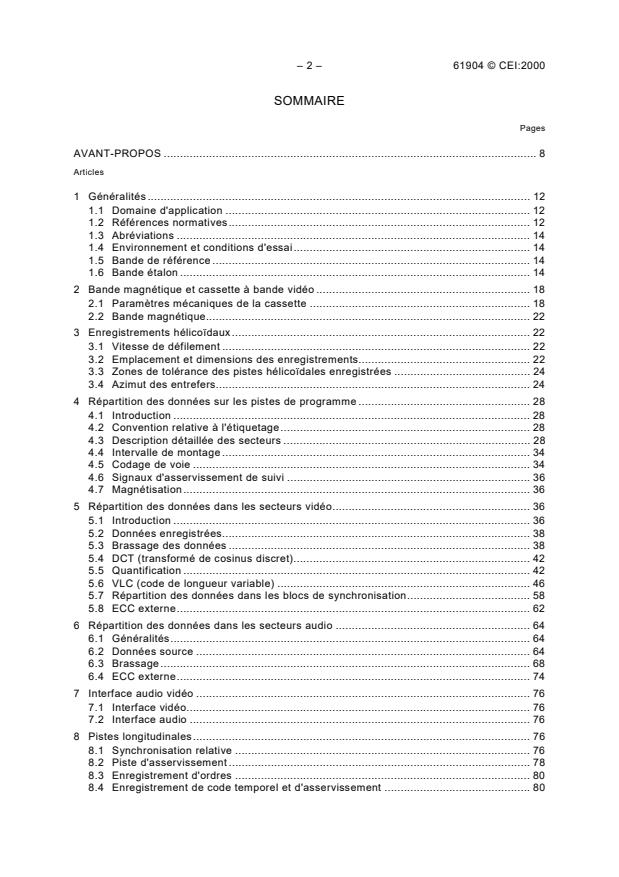
– 2 – 61904 © CEI:2000
SOMMAIRE
Pages
AVANT-PROPOS . 8
Articles
1 Généralités . 12
1.1 Domaine d'application . 12
1.2 Références normatives. 12
1.3 Abréviations . 14
1.4 Environnement et conditions d'essai. 14
1.5 Bande de référence . 14
1.6 Bande étalon . 14
2 Bande magnétique et cassette à bande vidéo . 18
2.1 Paramètres mécaniques de la cassette . 18
2.2 Bande magnétique. 22
3 Enregistrements hélicoïdaux. 22
3.1 Vitesse de défilement . 22
3.2 Emplacement et dimensions des enregistrements. 22
3.3 Zones de tolérance des pistes hélicoïdales enregistrées . 24
3.4 Azimut des entrefers. 24
4 Répartition des données sur les pistes de programme . 28
4.1 Introduction . 28
4.2 Convention relative à l'étiquetage. 28
4.3 Description détaillée des secteurs . 28
4.4 Intervalle de montage . 34
4.5 Codage de voie . 34
4.6 Signaux d'asservissement de suivi . 36
4.7 Magnétisation. 36
5 Répartition des données dans les secteurs vidéo. 36
5.1 Introduction . 36
5.2 Données enregistrées. 38
5.3 Brassage des données . 38
5.4 DCT (transformé de cosinus discret). 42
5.5 Quantification . 42
5.6 VLC (code de longueur variable) . 46
5.7 Répartition des données dans les blocs de synchronisation. 58
5.8 ECC externe. 62
6 Répartition des données dans les secteurs audio . 64
6.1 Généralités. 64
6.2 Données source . 64
6.3 Brassage. 68
6.4 ECC externe. 74
7 Interface audio vidéo . 76
7.1 Interface vidéo. 76
7.2 Interface audio . 76
8 Pistes longitudinales. 76
8.1 Synchronisation relative . 76
8.2 Piste d'asservissement . 78
8.3 Enregistrement d'ordres . 80
8.4 Enregistrement de code temporel et d'asservissement . 80
61904 © IEC:2000 – 3 –
CONTENTS
Page
FOREWORD . 9
Clause
1 General . 13
1.1 Scope. 13
1.2 Normative references . 13
1.3 Abbreviations . 15
1.4 Environment and test conditions . 15
1.5 Reference tape. 15
1.6 Calibration tape . 15
2 Videotape cassette and tape. 19
2.1 Mechanical parameters of cassette. 19
2.2 Magnetic tape. 23
3 Helical recordings . 23
3.1 Tape speed . 23
3.2 Record location and dimensions . 23
3.3 Helical track record tolerance zones . 25
3.4 Gap azimuth. 25
4 Programme track data arrangement. 29
4.1 Introduction . 29
4.2 Labelling convention. 29
4.3 Sector details . 29
4.4 Edit gap. 35
4.5 Channel coding . 35
4.6 Tracking servo signals. 37
4.7 Magnetization. 37
5 Data arrangement in video sectors. 37
5.1 Introduction . 37
5.2 Recorded data. 39
5.3 Data shuffling . 39
5.4 DCT (discrete cosine transform) . 43
5.5 Quantization . 43
5.6 VLC (variable length code) . 47
5.7 Data arrangement in sync blocks. 59
5.8 Outer ECC. 63
6 Data arrangement in audio sectors . 65
6.1 General . 65
6.2 Source data. 65
6.3 Shuffling. 69
6.4 Outer ECC. 75
7 Video audio interface . 77
7.1 Video interface . 77
7.2 Audio interface . 77
8 Longitudinal tracks. 77
8.1 Relative timing. 77
8.2 Control track. 79
8.3 Cue recording. 81
8.4 Time and control code recording. 81
– 4 – 61904 © CEI:2000
Pages
Annexe A (informative) Transport de bande et dispositif de balayage. 154
Annexe B (informative) Compatibilité avec le type L analogique . 164
Bibliographie . 166
Figure 1 – Vue de dessus et vue latérale de la cassette S .82
Figure 2 – Vue de dessous de la cassette S .84
Figure 3 – Surfaces de référence, zones de support et guides de bande .88
Figure 4 – Emplacement des bobines prêtes pour la rotation .90
Figure 5 – Couvercle de protection .92
Figure 6 – Bobine .94
Figure 7 – Hauteur des bobines prêtes pour la rotation.94
Figure 8 – Zone d'introduction du levier de déverrouillage .96
Figure 9 – Force de déverrouillage du couvercle.98
Figure 10 – Force d'ouverture du couvercle .98
Figure 11 – Force du ressort de la bobine.98
Figure 12 – Résistance du bouchon de sécurité. 100
Figure 13 – Force d'extraction (F1, F2) et couple de friction. 100
Figure 14 – Vue de dessus et vue de côté de la cassette L. 102
Figure 15 – Vue de dessous de la cassette L. 104
Figure 16 – Surfaces de référence, zones de support et guides de bande. 108
Figure 17 – Emplacement des bobines prête pour la rotation. 110
Figure 18 – Couvercle de protection . 112
Figure 19 – Bobine . 114
Figure 20 – Hauteur des bobines prête pour la rotation. 114
Figure 21 – Zone d'introduction du levier de déverrouillage. 116
Figure 22 – Force de verrouillage du couvercle . 118
Figure 23 – Force d'ouverture du couvercle . 118
Figure 24 – Force du ressort de la bobine. 118
Figure 25 – Résistance du bouchon de sécurité. 120
Figure 26 – Force d'extraction (F1, F2) et couple de friction. 120
Figure 27 – Position et dimensions des pistes enregistrées . 122
Figure 28 – Position et dimensions des zones de tolérance des enregistrements de pistes
hélicoïdales . 124
Figure 29 – Répartition des secteurs sur les pistes hélicoïdales pour systèmes 525/60
et 625/50 . 126
Figure 30 – Format de bloc de synchronisation. 128
Figure 31 – Numéros de piste, de segment et de champ. 128
Figure 32 – Relation de synchronisation analogique à numérique (système 525/60) . 130
Figure 33 – Relation de synchronisation analogique à numérique (système 625/50) . 130
Figure 34 – Suppression verticale numérique (système 525/60) . 132
Figure 35 – Suppression verticale numérique (système 625/50) . 132
Figure 36 – Brassage (distribution des secteurs) . 134
61904 © IEC:2000 – 5 –
Page
Annex A (informative) Tape transport and scanner. 155
Annex B (informative) Compatibility with analogue type-L . 165
Bibliography . 167
Figure 1 – Top view and side view of S cassette. 83
Figure 2 – Bottom view of S cassette. 85
Figure 3 – Datum spots, supporting areas and tape guides . 89
Figure 4 – Location of reels ready for rotation. 91
Figure 5 – Protecting lid . 93
Figure 6 – Reel. 95
Figure 7 – Height of reels ready for rotation. 95
Figure 8 – Unlocking lever insertion area. 97
Figure 9 – Lid unlocking force . 99
Figure 10 – Lid opening force. 99
Figure 11 – Reel spring force . 99
Figure 12 – Strength of safety plug.101
Figure 13 – Extraction force (F1, F2) and friction torque.101
Figure 14 – Top view and side view of L cassette .103
Figure 15 – Bottom view of L cassette .105
Figure 16 – Datum spots, supporting areas and tape guides .109
Figure 17 – Location of reels ready for rotation.111
Figure 18 – Protecting lid .113
Figure 19 – Reel .115
Figure 20 – Height of reels ready for rotation .115
Figure 21 – Unlocking lever insertion area.117
Figure 22 – Lid unlocking force .119
Figure 23 – Lid opening force.119
Figure 24 – Reel spring force .119
Figure 25 – Strength of safety plug.121
Figure 26 – Extraction force (F1, F2) and friction torque.121
Figure 27 – Locations and dimensions of recorded tracks .123
Figure 28 – Locations and dimensions of tolerance zones of helical track records .125
Figure 29 – Sector arrangement on helical tracks for 525/60 and 625/50 systems .127
Figure 30 – Sync block format.129
Figure 31 – Track, segment and field numbers .129
Figure 32 – Analogue to digital timing relationship (525/60 system).131
Figure 33 – Analogue to digital timing relationship (625/50 system).131
Figure 34 – Digital vertical blanking (525/60 system) .133
Figure 35 – Digital vertical blanking (625/50 system) .133
Figure 36 – Shuffling (sector distribution) .135
– 6 – 61904 © CEI:2000
Pages
Figure 37 – Structure du groupe VLC . 136
Figure 38 – Structure des grappes de coefficients . 136
Figure 39 – Construction de blocs de synchronisation . 138
Figure 40 – Entrelacement de blocs vidéo pour système 525/60. 140
Figure 41 – Entrelacement de blocs vidéo pour système 625/50. 142
Figure 42 – Synchronisation vidéo audio . 144
Figure 43 – Attribution de mot de données audio . 144
Figure 44 – Données auxiliaires. 144
Figure 45 – Attribution de mot de données . 144
Figure 46 – Brassage à l'intérieur d'un champ pour système 525/60 . 146
Figure 47 – Brassage de blocs pour système 525/60 . 146
Figure 48 – Brassage à l'intérieur d'un champ pour système 625/50 . 148
Figure 49 – Brassage de blocs pour système 625/50 . 148
Figure 50 – Brassage de secteurs de voies . 150
Figure 51 – Synchronisation de la forme d'onde d'ordre enregistrée pour système 525/60 . 152
Figure 52 – Synchronisation de la forme d'onde d'ordre enregistrée pour système 625/50 . 152
Figure A.1 – Configuration possible de dispositif de balayage (système 525/60) . 156
Figure A.2 – Configuration possible de dispositif de balayage (système 625/50) . 158
Figure A.3 – Emplacements possibles des têtes dans la direction longitudinale et angle
d'enregistrement (système 525/60). 160
Figure A.4 – Emplacement possible des têtes dans la direction longitudinale et angle
d'enregistrement (système 625/50). 162
Tableau 1 – Longueur de bande et temps de lecture .18
Tableau 2 – Emplacements et dimensions des enregistrements pour systèmes 525/60
et 625/50 .26
Tableau 3 – Numéro de bloc de synchronisation ID0 .30
Tableau 4 – Décalage de secteur pour les systèmes 525/60 et 625/50 .40
Tableau 5 – Quantification.44
Tableau 6 – Conversion de catégorie .48
Tableau 7 – VLC pour composante de luminance .50
Tableau 8 – VLC pour composantes de chrominance .54
Tableau A.1 – Paramètres pour une conception possible de dispositif de balayage . 154
Tableau A.2 – Débit de données et longueur d'onde . 154
Tableau B.1 – Comparaison des paramètres d'enregistrement numérique L/analogique L.164
61904 © IEC:2000 – 7 –
Page
Figure 37 – Structure of VLC group .137
Figure 38 – Structure of coefficient clusters .137
Figure 39 – Sync blocks construction .139
Figure 40 – Video block interleave for 525/60 system .141
Figure 41 – Video block interleave for 625/50 system .143
Figure 42 – Audio video timing .145
Figure 43 – Audio data word assignment .145
Figure 44 – Ancillary data .145
Figure 45 – Data word allocation .145
Figure 46 – Intra-field shuffling for 525/60 system.147
Figure 47 – Block shuffling for 525/60 system.147
Figure 48 – Intra-field shuffling for 625/50 system.149
Figure 49 – Block shuffling for 625/50 system.149
Figure 50 – Channel sector shuffling .151
Figure 51 – Recorded control code waveform for 525/60 system .153
Figure 52 – Recorded control code waveform for 625/50 system .153
Figure A.1 – Possible scanner configuration (525/60 system).157
Figure A.2 – Possible scanner configuration (625/50 system).159
Figure A.3 – Possible longitudinal head location and tape wrap (525/60 system) .161
Figure A.4 – Possible longitudinal head location and tape wrap (625/50 system) .163
Table 1 – Tape length and play time. 19
Table 2 – Record location and dimensions for 525/60 and 625/50 systems . 27
Table 3 – ID0 Sync block number . 31
Table 4 – Sector offset for 525/60 and 625/50 systems . 41
Table 5 – Quantization . 45
Table 6 – Category conversion. 49
Table 7 – VLC for luminance component . 51
Table 8 – VLC for chrominance components . 55
Table A.1 – Parameters for a possible scanner design . 155
Table A.2 – Data rate and wavelength. 155
Table B.1 – Comparison of digital-L/analogue type-L recording parameters. 165
– 8 – 61904 © CEI:2000
COMMISSION ÉLECTROTECHNIQUE INTERNATIONALE
____________
ENREGISTREMENT VIDÉO –
FORMAT D'ENREGISTREMENT NUMÉRIQUE À COMPOSANTES
À CASSETTE À BALAYAGE HÉLICOÏDAL UTILISANT
LA BANDE MAGNÉTIQUE DE 12,65 mm AVEC
COMPRESSION DE DONNÉES
(FORMAT NUMÉRIQUE L)
AVANT-PROPOS
1) La CEI (Commission Electrotechnique Internationale) est une organisation mondiale de normalisation
composée de l'ensemble des comités électrotechniques nationaux (Comités nationaux de la CEI). La CEI a
pour objet de favoriser la coopération internationale pour toutes les questions de normalisation dans les
domaines de l'électricité et de l'électronique. A cet effet, la CEI, entre autres activités, publie des Normes
internationales. Leur élaboration est confiée à des comités d'études, aux travaux desquels tout Comité national
intéressé par le sujet traité peut participer. Les organisations internationales, gouvernementales et non
gouvernementales, en liaison avec la CEI, participent également aux travaux. La CEI collabore étroitement
avec l'Organisation Internationale de Normalisation (ISO), selon des conditions fixées par accord entre les
deux organisations.
2) Les décisions ou accords officiels de la CEI concernant les questions techniques représentent, dans la mesure
du possible un accord international sur les sujets étudiés, étant donné que les Comités nationaux intéressés
sont représentés dans chaque comité d’études.
3) Les documents produits se présentent sous la forme de recommandations internationales. Ils sont publiés
comme normes, spécifications techniques, rapports techniques ou guides et agréés comme tels par les
Comités nationaux.
4) Dans le but d'encourager l'unification internationale, les Comités nationaux de la CEI s'engagent à appliquer de
façon transparente, dans toute la mesure possible, les Normes internationales de la CEI dans leurs normes
nationales et régionales. Toute divergence entre la norme de la CEI et la norme nationale ou régionale
correspondante doit être indiquée en termes clairs dans cette dernière.
5) La CEI n’a fixé aucune procédure concernant le marquage comme indication d’approbation et sa responsabilité
n’est pas engagée quand un matériel est déclaré conforme à l’une de ses normes.
6) L’attention est attirée sur le fait que certains des éléments de la présente Norme internationale peuvent faire
l’objet de droits de propriété intellectuelle ou de droits analogues. La CEI ne saurait être tenue pour
responsable de ne pas avoir identifié de tels droits de propriété et de ne pas avoir signalé leur existence.
La Norme internationale CEI 61904 a été établie par le sous-comité 100B: Systèmes de
stockage pour informations audio, vidéo et multimédia, du comité d'études 100 de la CEI:
Systèmes et appareils audio, vidéo et multimédia.
Le texte de cette norme est issu des documents suivants:
FDIS Rapport de vote
100B/248/FDIS 100B/264/RVD
Le rapport de vote indiqué dans le tableau ci-dessus donne toute information sur le vote ayant
abouti à l'approbation de cette norme.
Cette publication a été rédigée selon les Directives ISO/CEI, Partie 3.
61904 © IEC:2000 – 9 –
INTERNATIONAL ELECTROTECHNICAL COMMISSION
____________
VIDEO RECORDING –
HELICAL-SCAN DIGITAL COMPONENT VIDEO CASSETTE RECORDING
FORMAT USING 12,65 mm MAGNETIC TAPE AND
INCORPORATING DATA COMPRESSION
(FORMAT DIGITAL-L)
FOREWORD
1) The IEC (International Electrotechnical Commission) is a worldwide organization for standardization comprising
all national electrotechnical committees (IEC National Committees). The object of the IEC is to promote
international co-operation on all questions concerning standardization in the electrical and electronic fields. To
this end and in addition to other activities, the IEC publishes International Standards. Their preparation is
entrusted to technical committees; any IEC National Committee interested in the subject dealt with may
participate in this preparatory work. International, governmental and non-governmental organizations liaising
with the IEC also participate in this preparation. The IEC collaborates closely with the International
Organization for Standardization (ISO) in accordance with conditions determined by agreement between the
two organizations.
2) The formal decisions or agreements of the IEC on technical matters express, as nearly as possible, an
international consensus of opinion on the relevant subjects since each technical committee has representation
from all interested National Committees.
3) The documents produced have the form of recommendations for international use and are published in the form
of standards, technical specifications, technical reports or guides and they are accepted by the National
Committees in that sense.
4) In order to promote international unification, IEC National Committees undertake to apply IEC International
Standards transparently to the maximum extent possible in their national and regional standards. Any
divergence between the IEC Standard and the corresponding national or regional standard shall be clearly
indicated in the latter.
5) The IEC provides no marking procedure to indicate its approval and cannot be rendered responsible for any
equipment declared to be in conformity with one of its standards.
6) Attention is drawn to the possibility that some of the elements of this International Standard may be the subject
of patent rights. The IEC shall not be held responsible for identifying any or all such patent rights.
International Standard IEC 61904 has been prepared by subcommittee 100B: Audio, video
and multimedia information storage systems, of IEC technical committee 100: Audio, video
and multimedia systems and equipment.
The text of this standard is based on the following documents:
FDIS Report on voting
100B/248/FDIS 100B/264/RVD
Full information on the voting for the approval of this standard can be found in the report on
voting indicated in the above table.
This publication has been drafted in accordance with the ISO/IEC Directives, Part 3.
– 10 – 61904 © CEI:2000
Les annexes A et B sont données uniquement à titre d'information.
Le comité a décidé que le contenu de cette publication ne sera pas modifié avant 2005.
A cette date, la publication sera
• reconduite;
• supprimée;
• remplacée par une édition révisée, ou
• amendée.
61904 © IEC:2000 – 11 –
Annexes A and B are for information only.
The committee has decided that the contents of this publication will remain unchanged
until 2005. At this date, the publication will be
• reconfirmed;
• withdrawn;
• replaced by a revised edition, or
• amended.
– 12 – 61904 © CEI:2000
ENREGISTREMENT VIDÉO –
FORMAT D'ENREGISTREMENT NUMÉRIQUE À COMPOSANTES
À CASSETTE À BALAYAGE HÉLICOÏDAL UTILISANT
LA BANDE MAGNÉTIQUE DE 12,65 mm AVEC
COMPRESSION DE DONNÉES
(FORMAT NUMÉRIQUE L)
1 Généralités
1.1 Domaine d'application
La présente Norme internationale s’applique au format pour l'enregistrement sur cassette de
signaux vidéo à composante numérique et de signaux audionumériques associés ainsi que de
signaux de commande associés utilisant la bande magnétique de 12,65 mm. Les données
vidéo sont enregistrées avec réduction de débit binaire.
La présente norme spécifie les caractéristiques des cassettes, la bande, les configurations
d'enregistrement sur la bande, les processus de codages audio et vidéo numériques, la
réduction du débit binaire, le codage de protection d'erreur et de voie qui constituent des
prescriptions essentielles pour l'interchangeabilité des enregistrements.
1.2 Références normatives
Les documents normatifs suivants contiennent des dispositions qui, par suite de la référence
qui y est faite, constituent des dispositions valables pour la présente Norme internationale.
Pour les références datées, les amendements ultérieurs ou les révisions de ces publications
ne s’appliquent pas. Toutefois, les parties prenantes aux accords fondés sur la présente
Norme internationale sont invitées à rechercher la possibilité d'appliquer les éditions les plus
récentes des documents normatifs indiqués ci-après. Pour les références non datées, la
dernière édition du document normatif en référence s’applique. Les membres de l'ISO et de
la CEI possèdent le registre des Normes internationales en vigueur.
CEI 60461:1986, Code temporel de commande pour les magnétoscopes
CEI 60958:1989, Interface audionumérique
CEI 61213:1993, Enregistrement audio-analogique sur bande vidéo – Polarité de
magnétisation
CEI 61237-1:1994, Magnétoscopes de radiodiffusion – Méthodes de mesure – Partie 1:
Mesures mécaniques
UIT-R Recommandation BT.601-5:1995, Paramètres de codage en studio de la télévision
numérique pour les formats standard d'image 4:3 (normalisé) et 16:9 (écran panoramique)
UIT-R Recommandation BS.647-2:1992, Interface audionumérique pour les studios de radio-
diffusion
UIT-R Recommandation BT.656-4:1998, Interfaces pour signaux vidéo à composante numé-
rique dans les systèmes de télévision 525-lignes et 625-lignes fonctionnant au niveau 4:2:2
de la Recommandation BT.601 (partie A)
EBU Recommandation technique R68:1995, Alignment level in digital audio production
equipment and in digital audio recorders
61904 © IEC:2000 – 13 –
VIDEO RECORDING –
HELICAL-SCAN DIGITAL COMPONENT VIDEO CASSETTE RECORDING
FORMAT USING 12,65 mm MAGNETIC TAPE AND
INCORPORATING DATA COMPRESSION
(FORMAT DIGITAL-L)
1 General
1.1 Scope
This International Standard applies to the format for video cassette recording of digital
component video signals and associated digital audio signals and related control signals,
using 12,65 mm magnetic tape. The video data are recorded using data compression.
This standard specifies characteristics of the cassettes, the tape, the recording patterns on
the tape, the processes of digital audio and video coding, data compression, error protection
and channel coding which are the essential requirements for interchangeability of recordings.
1.2 Normative references
The following normative documents contain provisions whic
...