


IEC 60839-7-2:2001
(Main)Alarm systems - Part 7-2: Message formats and protocols for serial data interfaces in alarm transmission systems - Common application layer protocol
General Information
- Abstract
Specifies a common application layer protocol (message structure, formats and transmission procedures) to be used at standard interfaces in alarm transmission systems. Should be used at all such interfaces where equipment from one supplier is intended to inter-work with equipment from other suppliers.
- Status
- Withdrawn
- Publication Date
- 08-Mar-2001
- Withdrawal Date
- 13-Oct-2022
- Technical Committee
- TC 79 - Alarm and electronic security systems
- Drafting Committee
- WG 5 - TC 79/WG 5
- Current Stage
- WPUB - Publication withdrawn
- Start Date
- 14-Oct-2022
- Completion Date
- 14-Oct-2022
Buy Documents
IEC 60839-7-2:2001 - Alarm systems - Part 7-2: Message formats and protocols for serial data interfaces in alarm transmission systems - Common application layer protocol Released:3/9/2001


IEC 60839-7-2:2001 - Alarm systems - Part 7-2: Message formats and protocols for serial data interfaces in alarm transmission systems - Common application layer protocol Released:3/9/2001
Buy Documents
IEC 60839-7-2:2001 - Alarm systems - Part 7-2: Message formats and protocols for serial data interfaces in alarm transmission systems - Common application layer protocol Released:3/9/2001
IEC 60839-7-2:2001 - Alarm systems - Part 7-2: Message formats and protocols for serial data interfaces in alarm transmission systems - Common application layer protocol Released:3/9/2001
Get Certified
Connect with accredited certification bodies for this standard

CIS Institut d.o.o.
Personal Protective Equipment (PPE) certification body. Notified Body NB-2890 for EU Regulation 2016/425 PPE.

Kiwa BDA Testing
Building and construction product certification.
Kmetijski inštitut Slovenije
Agricultural Institute of Slovenia. Soil testing, plant health, agricultural product analysis.
Sponsored listings
Frequently Asked Questions
IEC 60839-7-2:2001 is a standard published by the International Electrotechnical Commission (IEC). Its full title is "Alarm systems - Part 7-2: Message formats and protocols for serial data interfaces in alarm transmission systems - Common application layer protocol". This standard covers: Specifies a common application layer protocol (message structure, formats and transmission procedures) to be used at standard interfaces in alarm transmission systems. Should be used at all such interfaces where equipment from one supplier is intended to inter-work with equipment from other suppliers.
Specifies a common application layer protocol (message structure, formats and transmission procedures) to be used at standard interfaces in alarm transmission systems. Should be used at all such interfaces where equipment from one supplier is intended to inter-work with equipment from other suppliers.
IEC 60839-7-2:2001 is classified under the following ICS (International Classification for Standards) categories: 13.320 - Alarm and warning systems. The ICS classification helps identify the subject area and facilitates finding related standards.
IEC 60839-7-2:2001 is available in PDF format for immediate download after purchase. The document can be added to your cart and obtained through the secure checkout process. Digital delivery ensures instant access to the complete standard document.
Standards Content (Sample)
INTERNATIONAL IEC
STANDARD
60839-7-2
First edition
2001-03
Alarm systems –
Part 7-2:
Message formats and protocols for serial data
interfaces in alarm transmission systems –
Common application layer protocol
Systèmes d'alarme –
Partie 7-2:
Formats de message et protocoles pour les interfaces de
données série dans les systèmes de transmission d'alarme –
Protocole de la couche commune d'application
Reference number
Publication numbering
As from 1 January 1997 all IEC publications are issued with a designation in the
60000 series. For example, IEC 34-1 is now referred to as IEC 60034-1.
Consolidated editions
The IEC is now publishing consolidated versions of its publications. For example,
edition numbers 1.0, 1.1 and 1.2 refer, respectively, to the base publication, the
base publication incorporating amendment 1 and the base publication incorporating
amendments 1 and 2.
Further information on IEC publications
The technical content of IEC publications is kept under constant review by the IEC,
thus ensuring that the content reflects current technology. Information relating to
this publication, including its validity, is available in the IEC Catalogue of
publications (see below) in addition to new editions, amendments and corrigenda.
Information on the subjects under consideration and work in progress undertaken
by the technical committee which has prepared this publication, as well as the list
of publications issued, is also available from the following:
• IEC Web Site (www.iec.ch)
• Catalogue of IEC publications
The on-line catalogue on the IEC web site (www.iec.ch/catlg-e.htm) enables
you to search by a variety of criteria including text searches, technical
committees and date of publication. On-line information is also available on
recently issued publications, withdrawn and replaced publications, as well as
corrigenda.
• IEC Just Published
This summary of recently issued publications (www.iec.ch/JP.htm) is also
available by email. Please contact the Customer Service Centre (see below) for
further information.
• Customer Service Centre
If you have any questions regarding this publication or need further assistance,
please contact the Customer Service Centre:
Email: custserv@iec.ch
Tel: +41 22 919 02 11
Fax: +41 22 919 03 00
INTERNATIONAL IEC
STANDARD
60839-7-2
First edition
2001-03
Alarm systems –
Part 7-2:
Message formats and protocols for serial data
interfaces in alarm transmission systems –
Common application layer protocol
Systèmes d'alarme –
Partie 7-2:
Formats de message et protocoles pour les interfaces de
données série dans les systèmes de transmission d'alarme –
Protocole de la couche commune d'application
IEC 2001 Copyright - all rights reserved
No part of this publication may be reproduced or utilized in any form or by any means, electronic or
mechanical, including photocopying and microfilm, without permission in writing from the publisher.
International Electrotechnical Commission 3, rue de Varembé Geneva, Switzerland
Telefax: +41 22 919 0300 e-mail: inmail@iec.ch IEC web site http://www.iec.ch
Commission Electrotechnique Internationale
PRICE CODE
U
International Electrotechnical Commission
For price, see current catalogue
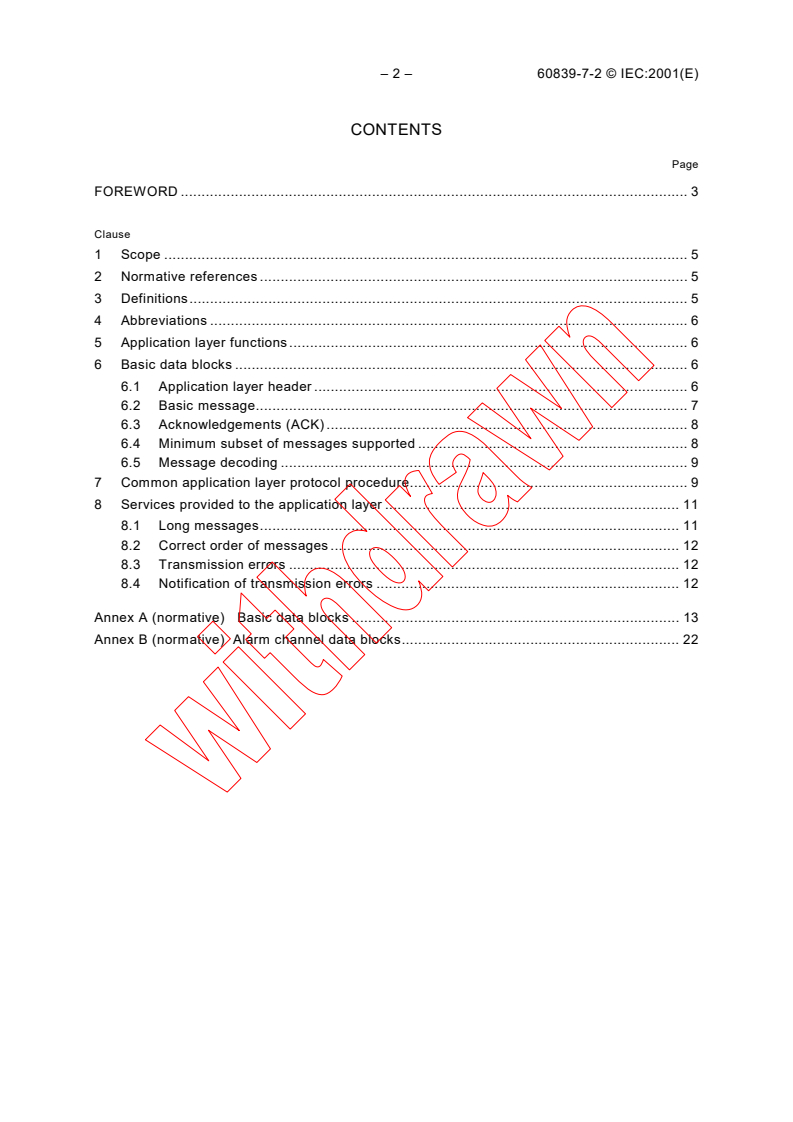
– 2 – 60839-7-2 © IEC:2001(E)
CONTENTS
Page
FOREWORD . 3
Clause
1 Scope . 5
2 Normative references . 5
3 Definitions. 5
4 Abbreviations . 6
5 Application layer functions. 6
6 Basic data blocks . 6
6.1 Application layer header . 6
6.2 Basic message. 7
6.3 Acknowledgements (ACK) . 8
6.4 Minimum subset of messages supported . 8
6.5 Message decoding . 9
7 Common application layer protocol procedure. 9
8 Services provided to the application layer . 11
8.1 Long messages. 11
8.2 Correct order of messages . 12
8.3 Transmission errors . 12
8.4 Notification of transmission errors . 12
Annex A (normative) Basic data blocks . 13
Annex B (normative) Alarm channel data blocks. 22
60839-7-2 © IEC:2001(E) – 3 –
INTERNATIONAL ELECTROTECHNICAL COMMISSION
––––––––
ALARM SYSTEMS –
Part 7-2: Message formats and protocols for serial data interfaces
in alarm transmission systems –
Common application layer protocol
FOREWORD
1) The IEC (International Electrotechnical Commission) is a worldwide organization for standardization comprising
all national electrotechnical committees (IEC National Committees). The object of the IEC is to promote
international co-operation on all questions concerning standardization in the electrical and electronic fields. To
this end and in addition to other activities, the IEC publishes International Standards. Their preparation is
entrusted to technical committees; any IEC National Committee interested in the subject dealt with may
participate in this preparatory work. International, governmental and non-governmental organizations liaising
with the IEC also participate in this preparation. The IEC collaborates closely with the International Organization
for Standardization (ISO) in accordance with conditions determined by agreement between the two
organizations.
2) The formal decisions or agreements of the IEC on technical matters express, as nearly as possible, an
international consensus of opinion on the relevant subjects since each technical committee has representation
from all interested National Committees.
3) The documents produced have the form of recommendations for international use and are published in the form
of standards, technical specifications, technical reports or guides and they are accepted by the National
Committees in that sense.
4) In order to promote international unification, IEC National Committees undertake to apply IEC International
Standards transparently to the maximum extent possible in their national and regional standards. Any
divergence between the IEC Standard and the corresponding national or regional standard shall be clearly
indicated in the latter.
5) The IEC provides no marking procedure to indicate its approval and cannot be rendered responsible for any
equipment declared to be in conformity with one of its standards.
6) Attention is drawn to the possibility that some of the elements of this International Standard may be the subject
of patent rights. The IEC shall not be held responsible for identifying any or all such patent rights.
International Standard IEC 60839-7-2 has been prepared by IEC technical committee 79: Alarm
systems.
The text of this standard is based on the following documents:
FDIS Report on voting
79/199/FDIS 79/209/RVD
Full information on the voting for the approval of this standard can be found in the report on
voting indicated in the above table.
This publication has been drafted in accordance with the ISO/IEC Directives, Part 3.
Annexes A and B form an integral part of this standard.
The committee has decided that the contents of this publication will remain unchanged until
2004. At this date, the publication will be
reconfirmed;
withdrawn;
replaced by a revised edition, or
amended.
– 4 – 60839-7-2 © IEC:2001(E)
A bilingual version of this standard may be issued at a later date.
IEC 60839-7-2 forms one of a number of related parts presented under the general title: Alarm
systems – Part 7: Message formats and protocols for serial data interfaces in alarm
transmission systems:
IEC 60839-7-1: General
IEC 60839-7-2: Common application layer protocol
IEC 60839-7-3: Common data link layer protocol
IEC 60839-7-4: Common transport layer protocol
IEC 60839-7-5: Alarm system interfaces employing a two-wire configuration in accordance
with ISO/IEC 8482
IEC 60839-7-6: Alarm system interfaces employing ITU-T Recommendation V.24/V.28
signalling
IEC 60839-7-7: Alarm system interfaces for plug-in alarm system transceivers
IEC 60839-7-11: Serial protocol for use by digital communicator systems using ITU-T
Recommendation V.23 signalling at interfaces with the PSTN
IEC 60839-7-12: PTT interfaces for dedicated communications using ITU-T
Recommendation V.23 signalling
IEC 60839-7-20: Terminal interfaces employing ITU-T Recommendation V.24/V.28
signalling
60839-7-2 © IEC:2001(E) – 5 –
ALARM SYSTEMS –
Part 7-2: Message formats and protocols for serial data interfaces
in alarm transmission systems –
Common application layer protocol
1 Scope
This part of IEC 60839 specifies a common application layer protocol (message structure,
formats and transmission procedures) to be used at standard interfaces in alarm transmission
systems. This should be used at all such interfaces where equipment from one supplier is
intended to inter-work with equipment from other suppliers, where the underlying system
architecture does not impose its own application layer on the interface (e.g. as in some bus
systems).
The structure follows the OSI recommendations for a layered protocol to allow flexibility in the
choice and use of lower level transmission media and protocols.
The common application layer protocol defined has a minimum subset that should be provided
by all equipment which supports this standard, and has defined extensions which may be
offered. The protocol is also designed such that it can be extended beyond the messages
defined herein in order to provide further facilities and manufacturer specific extensions.
This standard applies equally to the transmission of alarms and other messages to/from
intrusion, fire and social alarm systems, and to the transmission of information to/from other
similar systems.
2 Normative references
The following normative documents contain provisions which, through reference in this text,
constitute provisions of this part of IEC 60839. For dated references, subsequent amendments
to, or revisions of, any of these publications do not apply. However, parties to agreements
based on this part of IEC 60839 are encouraged to investigate the possibility of applying the
most recent editions of the normative documents indicated below. For undated references, the
latest edition of the normative document referred to applies. Members of IEC and ISO maintain
registers of currently valid International Standards.
IEC 60839-7-1, Alarm systems – Part 7-1: Message formats and protocols for serial data
interfaces in alarm transmission systems – General
IEC 60839-7-4, Alarm systems – Part 7-4: Message formats and protocols for serial data
interfaces in alarm transmission systems – Common transport layer protocol
ISO/IEC 8859-1, Information technology – 8-bit single-byte coded graphic character sets –
Part 1: Latin alphabet No. 1
3 Definitions
For the purpose of this part of IEC 60839, the definitions in IEC 60839-7-1 apply.
– 6 – 60839-7-2 © IEC:2001(E)
4 Abbreviations
The definitions in IEC 60839-7-1 apply.
5 Application layer functions
The application layer is responsible for the formatting of the basic messages required to
transmit data through the alarm transmission system. It must also respond to basic messages
from the remote application layer.
The following facilities, protocol, message structure and formats meet the basic requirements
for serial data interfaces.
6 Basic data blocks
Alarms and other information to be transmitted shall be formatted into basic data blocks. These
shall comprise a two or more 8-bit octets. The first octet shall always be the number of octets
in the block following the length octet, and the second shall be a block type descriptor.
Details of these basic data blocks are given in annex A. Where a date/time basic data block is
included it shall refer to the data blocks that follow it in a message (where appropriate) until the
end of the message block or until another date/time basic data block is encountered.
6.1 Application layer header
Each basic message shall be formatted into an application layer message by it with an
application layer header, as follows:
BASIC MESSAGE
APPLICATION LAYER HEADER
FLAGS SOURCE ID DESTINATION ID
(FIRST OCTET)
7 0
bit 0 : 1 = Acknowledge required
0 = No Acknowledge required
bit 1 : 1 = Source identity follows
0 = No source identity included
bit 2 : 1 = Destination identity follows
0 = No destination identity included
bit 3 : 1 = Basic message encrypted
0 = Basic message not encrypted
bit 4 :
bit 5 : SEQUENCE NUMBER
bit 6 :
bit 7 : Reserved ( must be unset (=0) )
NOTE Bit 7 of the first octet is the end of the transport layer header (or a null transport layer – see IEC 60839-7-4)
and will be set to 0 to indicate that an application layer header follows.
60839-7-2 © IEC:2001(E) – 7 –
The sequence number may be initialized at any value. It shall be incremented by one for each
successive application layer message transmitted (mod 8). A separate set of sequence
numbers shall be used for each destination and for each direction of transmission.
The application layer header may include the source identity, the destination identity, both or
neither as defined in the first octet of the header.
Where both identities are included the source identity shall always be first.
The format of the identity is as follows:
74307430 7430
No of 1st 2nd 3rd
nibbles digit digit digit
The first nibble (bits 4-7 of the first octet) is the number of digits in the address. The actual
identity digits shall be contained in subsequent nibbles in HEX format, starting with the lower
nibble of the first octet. The identity shall contain only sufficient octets to include the number of
digits required. If the number of digits is even, the last nibble (bits 0-3 of the last octet) shall be
zero.
As an example, if the identity is 1234, this would be transmitted as follows:
0 100 000 100 100 011 010 000 00
4 digits 1 2 3 4
6.2 Basic message
One or more basic data blocks may be concatenated together to form a basic message,
subject to the maximum message length of 228 octets.
Within the application layer the basic data block may be further subdivided in order to provide
one or more alarm channel data blocks. This is shown below:
– 8 – 60839-7-2 © IEC:2001(E)
Alarm Channel Data Block
Data
1111 Length Data
Type
15-222
or
Alarm Channel Data Block
Data
Length
Data
Type
0-14
Alarm Channel
Length 10 Alarm Channel Data
Number
224 octets max.
Basic Data Block
Optional Data
Length Type
0-226 octets
1-227
228 octets max.
6.3 Acknowledgements (ACK)
The application layer may transmit messages not requiring to be acknowledged by the remote
application layer provided that the underlying layers and network can accept them.
The application layer may request an acknowledgement from the remote application layer for
an individual message (either always or as required) by setting bit 0 (acknowledge required) in
the layer message header.
Where an acknowledgement is requested, not more than four messages may be transmitted
without their corresponding acknowledgement having been received (i.e. the window size is 4).
In a series of messages, the recipient must only acknowledge messages in sequence, and
must not acknowledge a message if the previous message (as identified by its sequence
number) has not been received.
If an acknowledgement is not received for one message of a sequence of messages requiring
acknowledgements then that message, together with all messages which have been sub-
sequently sent shall be re-transmitted with the original sequence number.
Where an acknowledgement is received which does not contain the next expected sequence
number, it may be assured that previous outstanding messages are acknowledged.
6.4 Minimum subset of messages supported
Equipment claiming to have an interface that complies with this standard need not be capable
of supporting all of the basic data blocks defined in annex A.
However, in order to ensure successful transmission of basic alarm messages, the correct
handling of faults and a proper response to messages that are not supported by all equipment
at an interface, the following shall apply.
60839-7-2 © IEC:2001(E) – 9 –
a) All equipment shall be capable of transmitting and receiving basic data blocks of type 78
(reception error) and type 79 (transmission error detected) at any standard interface.
b) Equipment shall be capable of transmitting basic data blocks of type 70 (Acknowledgement)
at interfaces which are towards the alarm system.
c) Equipment shall be capable of receiving basic data blocks of type 70 (Acknowledgement) at
interfaces which are towards the alarm receiving centre or monitoring centre.
d) Equipment shall be capable of transmitting basic data blocks of type 10 (alarm system
status) and type 12 (change of state) at interfaces which are towards the alarm receiving
centre or monitoring centre.
e) Equipment shall be capable of receiving basic data blocks of type 10 (alarm status) and
type 12 (change of state) at interfaces which are towards the alarm system.
For (d) and (e), equipment shall be capable of transmitting or receiving alarm channel data
blocks of type 1 (alarm event/status data) with up to three data octets (see annex B).
6.5 Message decoding
Where a valid message is received each included data block should be examined. Where a
basic data block is received which cannot be decoded (either because the block type is not
supported by the receiver, or because the block contains more data than is supported), a
message (basic data block reception error or transmission error detected) shall be returned to
the sender to indicate the mismatch and what action, if any, has been taken.
7 Common application layer protocol procedure
The following message sequences apply to the transmission and reception of all message
types.
One or more messages form a sequence which shall obey the following rules. The initial
message is considered to be generated spontaneously and presented to the lower layers for
transmission. Subsequent messages are generated as an immediate response to received
messages or to a failure in the system as described below.
Messages which are generated as a result of a received message, but which require
processing in the application layer before a decision as to the format or the reply should not be
considered as part of the sequence; they should be considered as being the start of a new
sequence.
The reception of a basic message which does not have an acknowledgement request bit set in
the application layer header shall not result in the return of an acknowledgement basic data
block (as defined in annex A).
SOURCE DESTINATION
MESSAGE
ACK not set
no reply
The reception of a basic data block which has the acknowledgement request bit set in the
application layer header shall initiate the transmission of an acknowledgement basic data block
to the sender of the received message or a specific response message, provided that the
received message type is understood and that its length can be processed.
– 10 – 60839-7-2 © IEC:2001(E)
SOURCE DESTINATION
MESSAGE
with ACK set
ACK set
ACK
When a message requiring an ACK is sent and an acknowledgement basic data block is not
received within a given time, the original message may be repeated. This time will depend
upon the transmission medium. A number of such re-tries may be attempted.
SOURCE DESTINATION
MESSAGE with ACK set
No reply within timeout
MESSAGE with ACK set
When a message is presented for transmission, and the ISO layers 1-6 determine that the
message cannot be transmitted or that a transmission or an attempted transmission has failed,
a transmission error detected basic data block shall be generated and returned to the
application layer that generated the message.
SOURCE DESTINATION
MESSAGE
ERROR
Where an incoming message is detected but errors in the message do not allow the data
blocks within it to be successfully decoded, a transmission error detected basic data block shall
be generated and sent to the network monitoring centre or to the intended destination of the
received message in addition to that returned to the source.
SOURCE DESTINATION
MESSAGE
ERROR
ERROR
Where the lower layers at the destination detect an error in the transmission path a
transmission error detected basic data block shall be generated and sent to the application
layer (for example as a result of failure of the monitoring of incoming lines).
SOURCE DESTINATION
ERROR
or
ERROR
Where an incoming message is successfully decoded but the received data block is of an
unknown or unrecognized type, a reception error basic data block shall be returned and shall
be available for the application at the destination.
60839-7-2 © IEC:2001(E) – 11 –
SOURCE DESTINATION
MESSAGE
ERROR
ERROR
Where an incoming message is successfully decoded and is of a supported type but the
received data block is longer than is supported, a reception error basic data block a shall
be returned and shall be available for the application at the destination.
SOURCE DESTINATION
MESSAGE
ERROR
ERROR
If a sequence of data blocks are being sent (for example a log) it may be aborted or interrupted
to allow the transmission of one or more messages that are not part of the sequence. These
messages shall then be sent in the normal manner.
If the sequence was interrupted it shall be resumed immediately after sending the last
message.
DESTINATION
SOURCE
LOG START
LOG MESSAGE
LOG MESSAGE
inc. date and time alarm
LOG MESSAGE
d
CHANGE OF STATE
MESSAGE TO BE SENT
LOG INTERRUPTED
CHANGE OF STATE ACK if requested
LOG RESUME ACK if requested
LOG MESSAGE
LOG FINISH
8 Services provided to the application layer
The following basic facilities shall be provided to the application layer by the transport layer
(and lower layers) in an alarm transmission system.
8.1 Long messages
Where the underlying network is not capable of transmitting messages up to 255 octets long,
the lower layers shall divide messages into separate blocks for transmission and reassemble
them in the proper order at the destination.
– 12 – 60839-7-2 © IEC:2001(E)
8.2 Correct order of messages
Messages sent from a source to a single destination shall be delivered in the order in which
they were transmitted.
8.3 Transmission errors
Messages with detected transmission errors shall not be passed to the application layer. Such
errors should be corrected by the lower layers by the use of error correction algorithms or by
re-transmission of the message or such other techniques as are suitable for the transmission
medium used.
8.4 Notification of transmission errors
Where a message cannot be transmitted due to a failure in the transmission system a message
shall be generated to indicate the failure and sent to the sender of the message. A message
may also be sent to the network monitoring centre.
Where a message cannot be successfully transmitted due to an error in the transmission which
cannot be corrected, a message shall be generated to indicate the failure. This shall be sent to
the sender of the message. Where the failure is detected on reception of a message by a
transceiver at the supervised premise or at the alarm receiving centre, then a message shall be
generated to indicate that a message has been received with detected transmission errors.
60839-7-2 © IEC:2001(E) – 13 –
Annex A
(normative)
Basic data blocks
List of basic data block types
Type (HEX) Basic data block Basic data block
number
01 A.1 Date and time
02 A.2 Elapsed time counter
10 A.3 Alarm system status
12 A.4 Change of state
18 A.5 Name / address
19 A6. Name / address (extended
...
IEC 60839-7-2
Edition 1.0 2001-03
INTERNATIONAL
STANDARD
NORME
INTERNATIONALE
Alarm systems –
Part 7-2: Message formats and protocols for serial data interfaces in alarm
transmission systems – Common application layer protocol
Systèmes d’alarme –
Partie 7-2: Formats de message et protocoles pour les interfaces de données
série dans les systèmes de transmission d’alarme – Protocole de la couche
commune d’application
All rights reserved. Unless otherwise specified, no part of this publication may be reproduced or utilized in any form or by
any means, electronic or mechanical, including photocopying and microfilm, without permission in writing from either IEC or
IEC's member National Committee in the country of the requester.
If you have any questions about IEC copyright or have an enquiry about obtaining additional rights to this publication,
please contact the address below or your local IEC member National Committee for further information.
Droits de reproduction réservés. Sauf indication contraire, aucune partie de cette publication ne peut être reproduite
ni utilisée sous quelque forme que ce soit et par aucun procédé, électronique ou mécanique, y compris la photocopie
et les microfilms, sans l'accord écrit de la CEI ou du Comité national de la CEI du pays du demandeur.
Si vous avez des questions sur le copyright de la CEI ou si vous désirez obtenir des droits supplémentaires sur cette
publication, utilisez les coordonnées ci-après ou contactez le Comité national de la CEI de votre pays de résidence.
IEC Central Office
3, rue de Varembé
CH-1211 Geneva 20
Switzerland
Email: inmail@iec.ch
Web: www.iec.ch
About the IEC
The International Electrotechnical Commission (IEC) is the leading global organization that prepares and publishes
International Standards for all electrical, electronic and related technologies.
About IEC publications
The technical content of IEC publications is kept under constant review by the IEC. Please make sure that you have the
latest edition, a corrigenda or an amendment might have been published.
ƒ Catalogue of IEC publications: www.iec.ch/searchpub
The IEC on-line Catalogue enables you to search by a variety of criteria (reference number, text, technical committee,…).
It also gives information on projects, withdrawn and replaced publications.
ƒ IEC Just Published: www.iec.ch/online_news/justpub
Stay up to date on all new IEC publications. Just Published details twice a month all new publications released. Available
on-line and also by email.
ƒ Electropedia: www.electropedia.org
The world's leading online dictionary of electronic and electrical terms containing more than 20 000 terms and definitions
in English and French, with equivalent terms in additional languages. Also known as the International Electrotechnical
Vocabulary online.
ƒ Customer Service Centre: www.iec.ch/webstore/custserv
If you wish to give us your feedback on this publication or need further assistance, please visit the Customer Service
Centre FAQ or contact us:
Email: csc@iec.ch
Tel.: +41 22 919 02 11
Fax: +41 22 919 03 00
A propos de la CEI
La Commission Electrotechnique Internationale (CEI) est la première organisation mondiale qui élabore et publie des
normes internationales pour tout ce qui a trait à l'électricité, à l'électronique et aux technologies apparentées.
A propos des publications CEI
Le contenu technique des publications de la CEI est constamment revu. Veuillez vous assurer que vous possédez
l’édition la plus récente, un corrigendum ou amendement peut avoir été publié.
ƒ Catalogue des publications de la CEI: www.iec.ch/searchpub/cur_fut-f.htm
Le Catalogue en-ligne de la CEI vous permet d’effectuer des recherches en utilisant différents critères (numéro de référence,
texte, comité d’études,…). Il donne aussi des informations sur les projets et les publications retirées ou remplacées.
ƒ Just Published CEI: www.iec.ch/online_news/justpub
Restez informé sur les nouvelles publications de la CEI. Just Published détaille deux fois par mois les nouvelles
publications parues. Disponible en-ligne et aussi par email.
ƒ Electropedia: www.electropedia.org
Le premier dictionnaire en ligne au monde de termes électroniques et électriques. Il contient plus de 20 000 termes et
définitions en anglais et en français, ainsi que les termes équivalents dans les langues additionnelles. Egalement appelé
Vocabulaire Electrotechnique International en ligne.
ƒ Service Clients: www.iec.ch/webstore/custserv/custserv_entry-f.htm
Si vous désirez nous donner des commentaires sur cette publication ou si vous avez des questions, visitez le FAQ du
Service clients ou contactez-nous:
Email: csc@iec.ch
Tél.: +41 22 919 02 11
Fax: +41 22 919 03 00
IEC 60839-7-2
Edition 1.0 2001-03
INTERNATIONAL
STANDARD
NORME
INTERNATIONALE
Alarm systems –
Part 7-2: Message formats and protocols for serial data interfaces in alarm
transmission systems – Common application layer protocol
Systèmes d’alarme –
Partie 7-2: Formats de message et protocoles pour les interfaces de données
série dans les systèmes de transmission d’alarme – Protocole de la couche
commune d’application
INTERNATIONAL
ELECTROTECHNICAL
COMMISSION
COMMISSION
ELECTROTECHNIQUE
PRICE CODE
INTERNATIONALE
U
CODE PRIX
ICS 13.320 ISBN 2-8318-6013-X
– 2 – 60839-7-2 © CEI:2001
SOMMAIRE
AVANT-PROPOS .4
1 Domaine d’application.8
2 Références normatives .8
3 Définitions .8
4 Abréviations.10
5 Fonctions de la couche d’application .10
6 Blocs fondamentaux de données.10
6.1 En-tête de la couche d’application.10
6.2 Message fondamental.12
6.3 Acquittements (ACK) .14
6.4 Sous-ensemble minimal de messages supporté .14
6.5 Décodage de message .16
7 Procédure de protocole de couche commune d’application.16
8 Services fournis à la couche d’application .20
8.1 Messages longs.20
8.2 Ordre correct des messages.22
8.3 Erreurs de transmission.22
8.4 Notification des erreurs de transmission.22
Annexe A (normative) Blocs fondamentaux de données.24
Annexe B (normative) Blocs de données de voie d’alarme .42
60839-7-2 © IEC:2001 – 3 –
CONTENTS
FOREWORD.5
1 Scope.9
2 Normative references.9
3 Definitions .9
4 Abbreviations.11
5 Application layer functions .11
6 Basic data blocks.11
6.1 Application layer header.11
6.2 Basic message .13
6.3 Acknowledgements (ACK) .15
6.4 Minimum subset of messages supported.15
6.5 Message decoding.17
7 Common application layer protocol procedure .17
8 Services provided to the application layer.21
8.1 Long messages .21
8.2 Correct order of messages .23
8.3 Transmission errors.23
8.4 Notification of transmission errors.23
Annex A (normative) Basic data blocks.25
Annex B (normative) Alarm channel data blocks .43
– 4 – 60839-7-2 © CEI:2001
COMMISSION ÉLECTROTECHNIQUE INTERNATIONALE
____________
SYSTÈMES D'ALARME –
Partie 7-2: Formats de message et protocoles pour les interfaces
de données série dans les systèmes de transmission d'alarme –
Protocole de la couche commune d’application
AVANT-PROPOS
1) La CEI (Commission Electrotechnique Internationale) est une organisation mondiale de normalisation composée
de l'ensemble des comités électrotechniques nationaux (Comités nationaux de la CEI). La CEI a pour objet de
favoriser la coopération internationale pour toutes les questions de normalisation dans les domaines de
l'électricité et de l'électronique. A cet effet, la CEI, entre autres activités, publie des Normes internationales.
Leur élaboration est confiée à des comités d'études, aux travaux desquels tout Comité national intéressé par le
sujet traité peut participer. Les organisations internationales, gouvernementales et non gouvernementales, en
liaison avec la CEI, participent également aux travaux. La CEI collabore étroitement avec l'Organisation
Internationale de Normalisation (ISO), selon des conditions fixées par accord entre les deux organisations.
2) Les décisions ou accords officiels de la CEI concernant les questions techniques représentent, dans la mesure
du possible un accord international sur les sujets étudiés, étant donné que les Comités nationaux intéressés
sont représentés dans chaque comité d’études.
3) Les documents produits se présentent sous la forme de recommandations internationales. Ils sont publiés
comme normes, rapports techniques ou guides et agréés comme tels par les Comités nationaux.
4) Dans le but d'encourager l'unification internationale, les Comités nationaux de la CEI s'engagent à appliquer de
façon transparente, dans toute la mesure possible, les Normes internationales de la CEI dans leurs normes
nationales et régionales. Toute divergence entre la norme de la CEI et la norme nationale ou régionale
correspondante doit être indiquée en termes clairs dans cette dernière.
5) La CEI n’a fixé aucune procédure concernant le marquage comme indication d’approbation et sa responsabilité
n’est pas engagée quand un matériel est déclaré conforme à l’une de ses normes.
6) L’attention est attirée sur le fait que certains des éléments de la présente Norme internationale peuvent faire
l’objet de droits de propriété intellectuelle ou de droits analogues. La CEI ne saurait être tenue pour
responsable de ne pas avoir identifié de tels droits de propriété et de ne pas avoir signalé leur existence.
La Norme internationale CEI 60839-7-2 a été établie par le comité d'études 79 de la CEI:
Systèmes d’alarme.
La présente version bilingue, publiée en 2001-11, correspond à la version anglaise.
Le texte anglais de cette norme est basé sur les documents 79/199/FDIS et 79/209/RVD.
Le rapport de vote 79/209/RVD donne toute information sur le vote ayant abouti à l'approbation
de cette norme.
La version française de cette norme n'a pas été soumise au vote.
Cette publication a été rédigée selon les Directives ISO/CEI, Partie 3.
Les annexes A et B font partie intégrante de cette norme.
Le comité a décidé que le contenu de cette publication ne sera pas modifié avant 2004. A cette
date, la publication sera
• reconduite;
• supprimée;
• remplacée par une édition révisée, ou
• amendée.
60839-7-2 © IEC:2001 – 5 –
INTERNATIONAL ELECTROTECHNICAL COMMISSION
____________
ALARM SYSTEMS –
Part 7-2: Message formats and protocols for serial data interfaces
in alarm transmission systems –
Common application layer protocol
FOREWORD
1) The IEC (International Electrotechnical Commission) is a worldwide organization for standardization comprising
all national electrotechnical committees (IEC National Committees). The object of the IEC is to promote
international co-operation on all questions concerning standardization in the electrical and electronic fields. To
this end and in addition to other activities, the IEC publishes International Standards. Their preparation is
entrusted to technical committees; any IEC National Committee interested in the subject dealt with may
participate in this preparatory work. International, governmental and non-governmental organizations liaising
with the IEC also participate in this preparation. The IEC collaborates closely with the International Organization
for Standardization (ISO) in accordance with conditions determined by agreement between the two
organizations.
2) The formal decisions or agreements of the IEC on technical matters express, as nearly as possible, an
international consensus of opinion on the relevant subjects since each technical committee has representation
from all interested National Committees.
3) The documents produced have the form of recommendations for international use and are published in the form
of standards, technical specifications, technical reports or guides and they are accepted by the National
Committees in that sense.
4) In order to promote international unification, IEC National Committees undertake to apply IEC International
Standards transparently to the maximum extent possible in their national and regional standards. Any
divergence between the IEC Standard and the corresponding national or regional standard shall be clearly
indicated in the latter.
5) The IEC provides no marking procedure to indicate its approval and cannot be rendered responsible for any
equipment declared to be in conformity with one of its standards.
6) Attention is drawn to the possibility that some of the elements of this International Standard may be the subject
of patent rights. The IEC shall not be held responsible for identifying any or all such patent rights.
International Standard IEC 60839-7-2 has been prepared by IEC technical committee 79: Alarm
systems.
This bilingual version, published in 2001-11, corresponds to the English version.
The text of this standard is based on the following documents:
FDIS Report on voting
79/199/FDIS 79/209/RVD
Full information on the voting for the approval of this standard can be found in the report on
voting indicated in the above table.
This publication has been drafted in accordance with the ISO/IEC Directives, Part 3.
Annexes A and B form an integral part of this standard.
The committee has decided that the contents of this publication will remain unchanged
until 2004. At this date, the publication will be
• reconfirmed;
• withdrawn;
• replaced by a revised edition, or
• amended.
– 6 – 60839-7-2 © CEI:2001
La CEI 60839-7-2 constitue une partie d'une série de publications présentées sous le titre
général: Systèmes d'alarme – Partie 7: Formats de message et protocoles pour les interfaces
de données série dans les systèmes de transmission d'alarme.
CEI 60839-7-1: Généralités
CEI 60839-7-2: Protocole de la couche commune d'application
CEI 60839-7-3: Protocole de la couche commune de liaison de données
CEI 60839-7-4: Protocole de la couche commune de transport
CEI 60839-7-5: Interfaces des systèmes d'alarme utilisant une configuration bifilaire
conforme à l'ISO/CEI 8482
CEI 60839-7-6: Interfaces des systèmes d'alarme utilisant la recommandation UIT-T V.24/V.28
pour la signalisation
CEI 60839-7-7: Interfaces des systèmes d'alarme pour les transmetteurs de systèmes
d'alarme enfichables
CEI 60839-7-11: Protocole série à utiliser par les systèmes numériques de communication
utilisant la recommandation UIT-T V.23 pour la signalisation au niveau des
interfaces avec le RTPC
CEI 60839-7-12: Interfaces PTT pour les voies de communication dédiées utilisant la
recommandation UIT-T V.23 pour la signalisation
CEI 60839-7-20: Interfaces d'extrémité utilisant la recommandation UIT-T V.24/V.28 pour la
signalisation
60839-7-2 © IEC:2001 – 7 –
IEC 60839-7-2 forms one of a series of publications presented under the general title: Alarm
systems – Part 7: Message formats and protocols for serial data interfaces in alarm
transmission systems.
IEC 60839-7-1: General
IEC 60839-7-2: Common application layer protocol
IEC 60839-7-3: Common data link layer protocol
IEC 60839-7-4: Common transport layer protocol
IEC 60839-7-5: Alarm system interfaces employing a two-wire configuration in accordance
with ISO/IEC 8482
IEC 60839-7-6: Alarm system interfaces employing ITU-T Recommendation V.24/V.28
signalling
IEC 60839-7-7: Alarm system interfaces for plug-in alarm system transceivers
IEC 60839-7-11: Serial protocol for use by digital communicator systems using ITU-T
Recommendation V.23 signalling at interfaces with the PSTN
IEC 60839-7-12: PTT interfaces for dedicated communications using ITU-T Recommen-
dation V.23 signalling
IEC 60839-7-20: Terminal interfaces employing ITU-T Recommendation V.24/V.28 signalling
– 8 – 60839-7-2 © CEI:2001
SYSTÈMES D'ALARME –
Partie 7-2: Formats de message et protocoles pour les interfaces
de données série dans les systèmes de transmission d'alarme –
Protocole de la couche commune d’application
1 Domaine d’application
La présente partie de la CEI 60839 spécifie un protocole de couche commune d’application
(structure de message, formats et procédures de transmission) à utiliser au niveau des
interfaces normalisées dans les systèmes de transmission d’alarme. Il convient de l’utiliser au
niveau de toutes ces interfaces lorsque le matériel d’un fournisseur est destiné à interagir avec
le matériel d’autres fournisseurs, lorsque l’architecture du système sous-jacent n’impose pas
sa propre couche d’application sur l’interface (par exemple comme dans certains systèmes de
bus).
La structure suit les recommandations de l’OSI pour le protocole à couches pour permettre de
la souplesse dans le choix et l’utilisation des moyens et des protocoles de transmission de bas
niveau.
Le protocole de la couche commune d’application défini possède un sous-ensemble minimal
devant être assuré par tous les matériels qui supportent cette norme et les extensions définies
qui peuvent être offertes. Le protocole est également conçu de telle manière qu’il puisse être
étendu au-delà des messages définis ici pour fournir d’autres fonctions et des extensions
spécifiques aux fabricants.
Cette norme s'applique également à la transmission d'alarmes et d'autres messages destinés
ou provenant de systèmes d’alarme d’intrusion, d’incendie et d’alarme sociale, ainsi qu'à la
transmission d'informations destinées ou provenant d'autres systèmes similaires.
2 Références normatives
Les documents de référence suivants sont indispensables pour l'application du présent
document. Pour les références datées, seule l'édition citée s'applique. Pour les références non
datées, la dernière édition du document de référence s'applique (y compris les éventuels
amendements).
CEI 60839-7-1, Systèmes d'alarme – Partie 7-1: Formats de message et protocoles pour les
interfaces de données série dans les systèmes de transmission d'alarme – Généralités
CEI 60839-7-4, Systèmes d'alarme – Partie 7-4: Formats de message et protocoles pour les
interfaces de données série dans les systèmes de transmission d'alarme – Protocole de la
couche commune de transport
ISO/CEI 8859-1, Technologies de l’information – Jeux de caractères graphiques codés sur un
seul octet – Partie 1: Alphabet latin N° 1
3 Définitions
Pour les besoins de cette partie de la CEI 60839, les définitions de la CEI 60839-7-1
s’appliquent.
60839-7-2 © IEC:2001 – 9 –
ALARM SYSTEMS –
Part 7-2: Message formats and protocols for serial data interfaces
in alarm transmission systems –
Common application layer protocol
1 Scope
This part of IEC 60839 specifies a common application layer protocol (message structure,
formats and transmission procedures) to be used at standard interfaces in alarm transmission
systems. This should be used at all such interfaces where equipment from one supplier is
intended to inter-work with equipment from other suppliers, where the underlying system
architecture does not impose its own application layer on the interface (for example as in some
bus systems).
The structure follows the OSI recommendations for a layered protocol to allow flexibility in the
choice and use of lower level transmission media and protocols.
The common application layer protocol defined has a minimum subset that should be provided
by all equipment which supports this standard, and has defined extensions which may be
offered. The protocol is also designed such that it can be extended beyond the messages
defined herein in order to provide further facilities and manufacturer specific extensions.
This standard applies equally to the transmission of alarms and other messages to/from
intrusion, fire and social alarm systems, and to the transmission of information to/from other
similar systems.
2 Normative references
The following referenced documents are indispensable for the application of this document. For
dated references, only the edition cited applies. For undated references, the latest edition of
the referenced document (including any amendments) applies.
IEC 60839-7-1, Alarm systems – Part 7-1: Message formats and protocols for serial data
interfaces in alarm transmission systems – General
IEC 60839-7-4, Alarm systems – Part 7-4: Message formats and protocols for serial data
interfaces in alarm transmission systems – Common transport layer protocol
ISO/IEC 8859-1, Information technology – 8-bit single-byte coded graphic character sets –
Part 1: Latin alphabet No. 1
3 Definitions
For the purpose of this part of IEC 60839, the definitions in IEC 60839-7-1 apply.
– 10 – 60839-7-2 © CEI:2001
4 Abréviations
Les définitions de la CEI 60839-7-1 s’appliquent.
5 Fonctions de la couche d’application
La couche d’application est responsable du formatage des messages fondamentaux néces-
saires pour transmettre les données par le système de transmission d’alarme. Il faut également
qu’elle réponde aux messages fondamentaux provenant de la couche d’application distante.
Les fonctions, protocole, structure de message et formats suivants satisfont aux exigences
fondamentales pour les interfaces de données série.
6 Blocs fondamentaux de données
Les alarmes et les autres informations à transmettre doivent être formatées sous forme de
blocs fondamentaux de données. Celles-ci doivent se composer d’au moins deux octets de huit
bits. Le premier octet doit toujours correspondre au nombre d’octets du bloc qui suit l’octet de
longueur et le deuxième doit être un descripteur de type de bloc.
Les détails concernant ces blocs fondamentaux de données sont indiqués à l’annexe A.
Lorsqu’un bloc fondamental de données date/heure est inclus, il doit faire référence aux blocs
de données qui le suivent dans un message (le cas échéant) jusqu’à la fin du bloc de message
ou jusqu’à ce qu'un autre bloc fondamental de données date/heure soit rencontré.
6.1 En-tête de la couche d’application
Chaque message fondamental doit être formaté sous forme de message de couche
d’application avec un en-tête de couche d’application, comme suit:
MESSAGE FONDAMENTAL
EN-TÊTE DE COUCHE APPLICATION
DRAPEAUX
ID SOURCE ID DESTINATION
(1ER OCTET)
7 0
bit 0 : 1 = acquittement exigé
0 = pas d’acquittement exigé
bit 1 : 1 = identité source suit
0 = pas d’identité source
bit 2 : 1 = identité destination suit
0 = pas d’identité destination
1 = message fondamental codé
bit 3 :
0 = message fondamental non codé
bit 4 :
bit 5 : NUMÉRO DE SÉQUENCE
bit 6 :
bit 7 : Réservé (doit être désactivé (=0) )
NOTE Le bit 7 du premier octet est la fin de l’en-tête de la couche de transport (ou une couche de transport nulle –
voir CEI 60839-7-4) et sera mis à 0 pour indiquer qu’une en-tête de couche d’application suit.
60839-7-2 © IEC:2001 – 11 –
4 Abbreviations
The definitions in IEC 60839-7-1 apply.
5 Application layer functions
The application layer is responsible for the formatting of the basic messages required to
transmit data through the alarm transmission system. It must also respond to basic messages
from the remote application layer.
The following facilities, protocol, message structure and formats meet the basic requirements
for serial data interfaces.
6 Basic data blocks
Alarms and other information to be transmitted shall be formatted into basic data blocks. These
shall comprise a two or more 8-bit octets. The first octet shall always be the number of octets
in the block following the length octet, and the second shall be a block type descriptor.
Details of these basic data blocks are given in annex A. Where a date/time basic data block is
included it shall refer to the data blocks that follow it in a message (where appropriate) until the
end of the message block or until another date/time basic data block is encountered.
6.1 Application layer header
Each basic message shall be formatted into an application layer message by it with an
application layer header, as follows:
BASIC MESSAGE
APPLICATION LAYER HEADER
SOURCE ID DESTINATION ID
FLAGS
(FIRST OCTET)
7 0
bit 0 : 1 = Acknowledge required
0 = No Acknowledge required
bit 1 : 1 = Source identity follows
0 = No source identity included
bit 2 : 1 = Destination identity follows
0 = No destination identity included
bit 3 : 1 = Basic message encrypted
0 = Basic message not encrypted
bit 4 :
bit 5 : SEQUENCE NUMBER
bit 6 :
bit 7 : Reserved ( must be unset (=0) )
NOTE Bit 7 of the first octet is the end of the transport layer header (or a null transport layer – see IEC 60839-7-4)
and will be set to 0 to indicate that an application layer header follows.
– 12 – 60839-7-2 © CEI:2001
Le numéro de séquence peut être initialisé à toute valeur. Il doit être augmenté de un pour
chaque message de couche d’application transmis (modulo 8) successif. Un ensemble séparé
de numéros de séquences doit être utilisé pour chaque destination et pour chaque sens de
transmission.
L’en-tête de la couche d’application peut inclure l’identité de la source, l’identité de la
destination, ces deux identités ou aucune d’elles étant celles définies dans le premier octet de
l’en-tête.
Lorsque les deux identités sont incluses, l’identité de la source doit toujours être placée en tête.
Le format d’identité est le suivant:
74307430 7430
er ème ème
Nombre de 1 2 3
demi-octets chiffre chiffre chiffre
Le premier demi-octet (bits 4 à 7 du premier octet) correspond au nombre de chiffres dans
l’adresse. Les chiffres réels de l’identité doivent être contenus dans les demi-octets suivants
en format HEX, en commençant par le demi-octet le plus faible du premier octet. L’identité doit
uniquement contenir le nombre d’octets suffisant pour inclure le nombre de chiffres exigé. Si le
nombre de chiffres est pair, le dernier demi-octet (bits 0 à 3 du dernier octet) doit être zéro.
Par exemple, si l’identité est 1234, elle sera transmise de la manière suivante:
0 100 000 100 100 011 010 000 00
4 chiffres 1 2 3 4
6.2 Message fondamental
On peut concaténer un ou plusieurs blocs fondamentaux de données pour former un message
fondamental, en respectant la longueur maximale du message fixée à 228 octets.
Dans la couche d’application, le bloc fondamental de données peut encore être subdivisé pour
donner un ou plusieurs blocs de données de voie d’alarme. Ceci est représenté ci-dessous:
60839-7-2 © IEC:2001 – 13 –
The sequence number may be initialized at any value. It shall be incremented by one for each
successive application layer message transmitted (mod 8). A separate set of sequence
numbers shall be used for each destination and for each direction of transmission.
The application layer header may include the source identity, the destination identity, both or
neither as defined in the first octet of the header.
Where both identities are included the source identity shall always be first.
The format of the identity is as follows:
74307430 7430
No of 1st 2nd 3rd
nibbles digit digit digit
The first nibble (bits 4-7 of the first octet) is the number of digits in the address. The actual
identity digits shall be contained in subsequent nibbles in HEX format, starting with the lower
nibble of the first octet. The identity shall contain only sufficient octets to include the number of
digits required. If the number of digits is even, the last nibble (bits 0-3 of the last octet) shall be
zero.
As an example, if the identity is 1234, this would be transmitted as follows:
0 100 000 100 100 011 010 000 00
4 digits 1 2 3 4
6.2 Basic message
One or more basic data blocks may be concatenated together to form a basic message,
subject to the maximum message length of 228 octets.
Within the application layer the basic data block may be further subdivided in order to provide
one or more alarm channel data blocks. This is shown below:
– 14 – 60839-7-2 © CEI:2001
Bloc de données de voie d’alarme
Type
1111 Longueur Données
donnée
15-222
ou
Bloc de données de voie d’alarme
Type
Longueur Données
donnée
0-14
Nombre de voie
Données de voie d’alarme
Longueur
d’alarme
224 octets max.
Bloc fond. données
Données opt.
Type
Longueur
0 à 226 octets
1-227
228 octets max.
6.3 Acquittements (ACK)
La couche d’application peut transmettre des messages qui ne nécessitent pas d’acquittement
de la couche d’application distante si les couches inférieures et le réseau peuvent les accepter.
La couche d’application peut demander un acquittement à la couche d’application distante pour
un message individuel (soit systématiquement soit à la demande) en activant le bit 0 (acquit-
tement exigé) dans l’en-tête du message de couche.
Lorsqu’un acquittement est demandé, il ne peut pas y avoir plus de quatre messages de
transmis tant que les acquittements correspondants n’ont pas été reçus (cela signifie que la
taille de fenêtre est de 4). Dans une série de messages, le récepteur doit seulement acquitter
les messages dans l’ordre et ne doit pas acquitter un message tant que le message précédent
(tel qu’il est identifié par son numéro dans la séquence) n’a pas été reçu.
Si un acquittement n’est pas reçu pour un message appartenant à une série de messages
nécessitant des acquittements, ce message, ainsi que tous les messages envoyés après lui,
doit être retransmis avec le numéro d’origine dans la séquence.
Si un acquittement est reçu et qu’il ne contient pas le numéro suivant dans la séquence
prévue, on peut s’assurer que les messages précédents en cours sont acquittés.
6.4 Sous-ensemble minimal de messages supportés
Il n’est pas nécessaire que les matériels dont l’interface est réputée conforme à la présente
norme soient capables de supporter tous les blocs fondamentaux de données définis dans
l’annexe A.
Cependant, pour assurer une transmission réussie des messages d’alarme fondamentaux, le
traitement correct des dérangements et une réponse adéquate aux messages qui ne sont pas
supportés par tous les matériels à l’interface, les points suivants doivent s’appliquer:
a) Tous les matériels doivent être capables de transmettre et de recevoir des blocs fonda-
mentaux de données de type 78 (erreur de réception) et de type 79 (erreur de transmission
détectée) au niveau de toute interface normalisée.
60839-7-2 © IEC:2001 – 15 –
Alarm Channel Data Block
Data
1111 Length Data
Type
15-222
or
Alarm Channel Data Block
Data
Length
Data
Type
0-14
Alarm Channel
Length 10
Alarm Channel Data
Number
224 octets max.
Basic Data Block
Optional Data
Length Type
0-226 octets
1-227
228 octets max.
6.3 Acknowledgements (ACK)
The application layer may transmit messages not requiring to be acknowledged by the remote
application layer provided that the underlying layers and network can accept them.
The application layer may request an acknowledgement from the remote application layer for
an individual message (either always or as required) by setting bit 0 (acknowledge required) in
the layer message header.
Where an acknowledgement is requested, not more than four messages may be transmitted
without their corresponding acknowledgement having been received (i.e. the window size is 4).
In a series of messages, the recipient must only acknowledge messages in sequence, and
must not acknowledge a message if the previous message (as identified by its sequence
number) has not been received.
If an acknowledgement is not received for one message of a sequence of messages requiring
acknowledgements then that message, together with all messages which have been sub-
sequently sent shall be re-transmitted with the original sequence number.
Where an acknowledgement is received which does not contain the next expected sequence
number, it may be assured that previous outstanding messages are acknowledged.
6.4 Minimum subset of messages supported
Equipment claiming to have an interface that complies with this standard need not be capable
of supporting all of the basic data blocks defined in annex A.
However, in order to ensure successful transmission of basic alarm messages, the correct
handling of faults and a proper response to messages that are not supported by all equipment
at an interface, the following shall apply.
a) All equipment shall be capable of transmitting and receiving basic data blocks of type 78
(reception error) and type 79 (transmission error detected) at any standard interface.
– 16 – 60839-7-2 © CEI:2001
b) Les matériels doivent être capables de transmettre des blocs fondamentaux de données de
type 70 (Acquittement) au niveau des interfaces vers le système d’alarme.
c) Les matériels doivent être capables de recevoir des blocs fondamentaux de données de
type 70 (Acquittement) au niveau des interfaces vers le centre de réception ou le centre de
surveillance d’alarme.
d) Les matériels doivent être capables de transmettre des blocs fondamentaux de données de
type 10 (statut de système d’alarme) et de type 12 (changement d’état) au niveau des
interfaces vers le centre de réception ou le centre de surveillance d’alarme.
e) Les matériels doivent être capables de recevoir des blocs fondamentaux de données de
type 10 (statut de système d’alarme) et de type 12 (changement d’état) au niveau des
interfaces vers le système d’alarme.
Pour (d) et (e), les matériels doivent être capables de transmettre ou de recevoir des blocs de
données de voie d’alarme de type 1 (événement d’alarme/données de statut) jusqu’à trois
octets de données (voir annexe B).
6.5 Décodage de message
Lorsqu’un message valable est reçu, il convient d’examiner chaque bloc de données inclus.
Lorsqu’un bloc fondamental de données est reçu et qu’il ne peut pas être décodé (soit parce
que le type de bloc n’est pas supporté par le récepteur, soit parce que le bloc contient plus de
données que ce qui est supporté), un message (une erreur de réception de bloc fondamental
de données ou erreur de transmission détectée) doit être renvoyé à l’émetteur pour indiquer le
désaccord ainsi que l’action, le cas échéant, qui a été réalisée.
7 Procédure de protocole de couche commune d’application
Les séquences de messages suivantes s’appliquent à la transmission et à la réception de tous
les types de messages.
Un ou plusieurs messages forment une séquence qui doit obéir aux règles suivantes. Le
message initial est considéré comme étant généré de manière spontanée et est présenté aux
couches inférieures pour transmission. Les messages qui suivent sont générés comme une
réponse immédiate aux messages reçus ou à une défaillance du système comme cela est
décrit ci-dessous.
Il convient que les messages qui sont générés à la suite de la réception d’un message, mais
qui nécessitent un traitement dans la couche d’application avant une décision de format ou de
réponse ne soient pas considérés comme faisant partie de la séquence; il convient de les
considérer comme le début d’une nouvelle séquence.
La réception d’un message fondamental sans bit de demande d’acquittement dans l’en-tête de
la couche d’application ne doit pas donner lieu en retour à un bloc fondamental de données
d’acquittement (comme défini à l’annexe A).
SOURCE DESTINATION
MESSAGE
ACK pas activé
Pas de réponse
La réception d’un bloc fondamental de données avec bit de demande d’acquittement dans l’en-
tête de la couche d’application doit initier la transmission d’un bloc fondamental de données
d’acquittement vers l’émetteur du message reçu ou un message spécifique de réponse si le
type de message reçu est compris et que sa longueur peut être traitée.
60839-7-2 © IEC:2001 – 17 –
b) Equipment shall be capable of transmitting basic data blocks of type 70 (Acknowledgement)
at interfaces which are towards the alarm system.
c) Equipment shall be capable of receiving basic data blocks of type 70 (Acknowledgement) at
interfaces which are towards the alarm receiving centre or monitoring centre.
d) Equipment shall be capable of transmitting basic data blocks of type 10 (alarm system
status) and type 12 (change of state) at interfaces which are towards the alarm receiving
centre or monitoring centre.
e) Equipment shall be capable of receiving basic data blocks of type 10 (alarm status) and
type 12 (change of state) at interfaces which are towards the alarm system.
For (d) and (e), equipment shall be capable of transmitting or receiving alarm channel data
blocks of type 1 (alarm event/status data) with up to three data octets (see annex B).
6.5 Message decoding
Where a valid message is received each included data block should be examined. Where a
basic data block is received which cannot be decoded (either because the block type is not
supported by the receiver, or because the block contains more data than is supported), a
message (basic data block reception error or transmission error detected) shall be returned to
the sender to indicate the mismatch and what action, if any, has been taken.
7 Common application layer protocol procedure
The following message sequences apply to the transmission and reception of all message
types.
One or more messages form a sequence which shall obey the following rules. The initial
message is considered to be generated spontaneously and presented to the lower layers for
transmission. Subsequent messages are generated as an immediate response to received
messages or to a failure in the system as described below.
Messages which are generated as a result of a received message, but which require
processing in the application layer before a decision as to the format or the reply should not be
considered as part of the sequence; they should be considered as being the start of a new
sequence.
The reception of a basic message which does not have an acknowledgement request bit set in
the application layer header shall not result in the return of an acknowledgement basic data
block (as defined in annex A).
SOURCE DESTINATION
MESSAGE
ACK not set
no reply
The reception of a basic data block which has the acknowledgement request bit set in the
application layer header shall initiate the transmission of an acknowledgement basic data block
to the sender of the received message or a specific response message, provided that the
received message type is understood and that its length can be processed.
– 18 – 60839-7-2 © CEI:2001
SOURCE DESTINATION
MESSAGE
avec ACK activé
ACK activé
ACK
Lorsqu’un message nécessitant un ACK est envoyé et qu’un bloc fondamental de données
d’acquittement n’est pas reçu dans un temps donné, le message d’origine peut être répété. Ce
laps de temps dépendra du moyen de transmission. Un certain nombre de nouvelles tentatives
peuvent être essayées.
SOURCE DESTINATION
MESSAGE avec ACK activé
Pas de réponse pendant la temporisation
MESSAGE avec ACK activé
Lorsqu’un message est présenté pour transmission et que les couches ISO 1 à 6 déterminent
que ce message ne peut pas être transmis ou qu’une transmission ou une tentative de
transmission a échoué, un bloc fondamental de données erreur de transmission détectée doit
être généré et renvoyé à la couche d’application qui a généré le message.
SOURCE DESTINATION
MESSAGE
ERREUR
Lorsqu’un message entrant est détecté mais que des erreurs dans le message ne permettent
pas aux blocs de données qui le composent d’être décodés avec succès, un bloc fondamental
de données erreur de transmission détectée doit être généré et envoyé au centre de
surveillance du réseau ou au destinataire prévu du message reçu en plus de celui renvoyé à la
source.
SOURCE DESTINATION
MESSAGE
ERREUR
ERREUR
Lorsque les couches inférieures à destination détectent une erreur dans le chemin de
transmission, un bloc fondamental de données erreur de transmission détectée doit être
généré et envoyé à la couche d’application (par exemple en cas de défaillance de surveillance
des lignes entrantes).
SOURCE DESTINATION
ERREUR
ou
ERREUR
Lorsqu’un message entrant est décodé avec succès mais que le bloc de données reçu est d’un
type inconnu ou non reconnu, un bloc fondamental de données erreur de réception doit être
renvoyé et doit être à la disposition de l’application de destination.
60839-7-2 © IEC:2001 – 19 –
SOURCE DESTINATION
MESSAGE
with ACK set
ACK set
ACK
When a message requiring an ACK is sent and an acknowledgement basic data block is not
received within a given time, the original message may be repeated. This time will depend
upon the transmission medium. A number of such re-tries may be attempted.
SOURCE DESTINATION
MESSAGE with ACK set
No reply within timeout
MESSAGE with ACK set
When
...