

IEC 62885-2:2021
(Main)Surface cleaning appliances - Part 2: Dry vacuum cleaners for household or similar use - Methods for measuring the performance
General Information
- Abstract
IEC 62885-2:2021 is applicable for measurements of the performance of mains-operated dry vacuum cleaners, including water filter vacuum cleaners for household or similar use.
The purpose of this document is to specify essential performance characteristics of dry vacuum cleaners which are of interest to users and to describe methods for measuring these characteristics.
Due to the influence of environmental conditions, variations in time, origin of test materials and proficiency of the operator, some of the described test methods will give more reliable results when applied for comparative testing of a number of appliances at the same time, in the same laboratory and by the same operator.
The methods here can be applied with modifications for surface-cleaning product types or technologies not currently covered within the scope.
For safety requirements, reference is made to IEC 60335-1.
A recommendation on information for the consumer at the point of sale is given in Annex B.
This second edition of IEC 62885-2 cancels and replaces the first edition published in 2016. This edition constitutes a technical revision.
This second edition includes the following significant technical changes with respect to the previous edition:
a) Inclusion of requirements for water filter vacuum cleaners throughout document
b) Clause 4.6 on operation of the dry vacuum cleaner has been revised.
c) Add new paragraph 4.11, consolidating test area and stroke length from 5.1.2, 5.3.2, 6.2.2 and 6.16.2.2. Added new 4.12 for stroke speed.
d) Added debris pick-up test for hard floor and carpet. Includes new Annex E.
e) Clause 6.2.2 – Clarification of the carpet to be used; reference 4.11 for test area. Remove restriction limiting carpets to motion resistance only. Clarify the use of a mechanical operator.
f) A durability test for secondary hoses has been included.
g) The two informative annexes relating to the description and maintenance of the reference vacuum cleaner system RSB have been revised.
- Status
- Published
- Publication Date
- 12-Oct-2021
- Technical Committee
- SC 59F - Surface cleaning appliances
- Drafting Committee
- WG 3 - TC 59/SC 59F/WG 3
Overview
IEC 62885-2:2021 is an international standard developed by the International Electrotechnical Commission (IEC) that specifies methods for measuring the performance of dry vacuum cleaners intended for household or similar use. This standard applies to mains-operated dry vacuum cleaners, including those equipped with water filters. The purpose of the document is to define essential performance characteristics relevant to end-users and to establish standardized test procedures for evaluating these features.
This second edition, published in 2021, replaces the first edition from 2016 and introduces significant technical revisions such as the inclusion of water filter vacuum cleaner requirements and new test methods for debris pick-up on various surfaces. IEC 62885-2:2021 serves as a vital framework for manufacturers, testing laboratories, and regulatory bodies to ensure consistent and reliable performance assessments of dry vacuum cleaners.
Key Topics
Scope and Applicability
Focuses on mains-operated dry vacuum cleaners, including those with water filtering systems, designed for household or similar environments.Performance Characteristics
Defines essential parameters including dust and debris removal efficiency on hard floors and carpets, fiber and thread removal, dust re-emission, and filtration efficiency.Test Methods
Covers comprehensive testing procedures under controlled environmental conditions, such as:- Dust removal from various floor types
- Debris pick-up from hard floors and carpets
- Measurement of vacuum cleaner motion resistance
- Durability testing for secondary hoses
- Performance with loaded dust receptacles
- Airflow and suction pressure measurements
Environmental and Operational Conditions
Details on atmospheric conditioning, test materials, voltage/frequency settings, and mechanical operators to ensure repeatability and reliability of results.Consumer Information
Annex B provides recommendations for information that should be presented to consumers at the point of sale, helping them make informed purchasing decisions.Updates in 2021 Edition
- Inclusion of water filter vacuum cleaner requirements
- Revised procedures for operation and testing of vacuum cleaners
- New debris pick-up tests and durability tests
- Clarifications related to test carpeting and mechanical operators
Applications
IEC 62885-2:2021 is crucial for various stakeholders involved in the design, manufacturing, testing, certification, and retail of dry vacuum cleaners. Key applications include:
Manufacturers
To design and validate vacuum cleaners that meet international performance benchmarks and improve product competitiveness.Testing Laboratories
For standardized assessment of vacuum cleaner cleaning efficiency, durability, and other functional parameters ensuring consistency across labs worldwide.Regulatory Bodies and Certification Agencies
To adopt unified performance measurement protocols facilitating fair market regulations and consumer protection.Retailers and Consumers
To enable transparency in performance claims, assist in product comparisons, and promote better-informed purchase decisions.Research and Development
Supports innovation in vacuum cleaner technology and promotes development of new testing techniques tailored for emerging surface cleaning products.
Related Standards
IEC 60335-1: Safety requirements for household and similar electrical appliances – referenced for safety compliance in vacuum cleaners.
IEC 62885-1: Surface cleaning appliances – Part 1: Common test methods for surface cleaning appliances – provides foundational test methods complementing this part.
IEC 62885-3 and subsequent parts: Cover other categories of surface cleaning appliances including wet vacuum cleaners and steam cleaners.
Other Electrotechnical Safety and Performance Standards: For comprehensive product evaluation incorporating safety, energy efficiency, and electromagnetic compatibility.
Keywords: IEC 62885-2, dry vacuum cleaner testing, household vacuum cleaners, vacuum cleaner performance measurement, water filter vacuum cleaners, debris removal test, dust re-emission, filtration efficiency, vacuum cleaner standards, IEC vacuum cleaner test methods, surface cleaning appliance standards.
Relations
- Effective Date
- 05-Sep-2023
- Effective Date
- 05-Sep-2023
Frequently Asked Questions
IEC 62885-2:2021 is a standard published by the International Electrotechnical Commission (IEC). Its full title is "Surface cleaning appliances - Part 2: Dry vacuum cleaners for household or similar use - Methods for measuring the performance". This standard covers: IEC 62885-2:2021 is applicable for measurements of the performance of mains-operated dry vacuum cleaners, including water filter vacuum cleaners for household or similar use. The purpose of this document is to specify essential performance characteristics of dry vacuum cleaners which are of interest to users and to describe methods for measuring these characteristics. Due to the influence of environmental conditions, variations in time, origin of test materials and proficiency of the operator, some of the described test methods will give more reliable results when applied for comparative testing of a number of appliances at the same time, in the same laboratory and by the same operator. The methods here can be applied with modifications for surface-cleaning product types or technologies not currently covered within the scope. For safety requirements, reference is made to IEC 60335-1. A recommendation on information for the consumer at the point of sale is given in Annex B. This second edition of IEC 62885-2 cancels and replaces the first edition published in 2016. This edition constitutes a technical revision. This second edition includes the following significant technical changes with respect to the previous edition: a) Inclusion of requirements for water filter vacuum cleaners throughout document b) Clause 4.6 on operation of the dry vacuum cleaner has been revised. c) Add new paragraph 4.11, consolidating test area and stroke length from 5.1.2, 5.3.2, 6.2.2 and 6.16.2.2. Added new 4.12 for stroke speed. d) Added debris pick-up test for hard floor and carpet. Includes new Annex E. e) Clause 6.2.2 – Clarification of the carpet to be used; reference 4.11 for test area. Remove restriction limiting carpets to motion resistance only. Clarify the use of a mechanical operator. f) A durability test for secondary hoses has been included. g) The two informative annexes relating to the description and maintenance of the reference vacuum cleaner system RSB have been revised.
IEC 62885-2:2021 is applicable for measurements of the performance of mains-operated dry vacuum cleaners, including water filter vacuum cleaners for household or similar use. The purpose of this document is to specify essential performance characteristics of dry vacuum cleaners which are of interest to users and to describe methods for measuring these characteristics. Due to the influence of environmental conditions, variations in time, origin of test materials and proficiency of the operator, some of the described test methods will give more reliable results when applied for comparative testing of a number of appliances at the same time, in the same laboratory and by the same operator. The methods here can be applied with modifications for surface-cleaning product types or technologies not currently covered within the scope. For safety requirements, reference is made to IEC 60335-1. A recommendation on information for the consumer at the point of sale is given in Annex B. This second edition of IEC 62885-2 cancels and replaces the first edition published in 2016. This edition constitutes a technical revision. This second edition includes the following significant technical changes with respect to the previous edition: a) Inclusion of requirements for water filter vacuum cleaners throughout document b) Clause 4.6 on operation of the dry vacuum cleaner has been revised. c) Add new paragraph 4.11, consolidating test area and stroke length from 5.1.2, 5.3.2, 6.2.2 and 6.16.2.2. Added new 4.12 for stroke speed. d) Added debris pick-up test for hard floor and carpet. Includes new Annex E. e) Clause 6.2.2 – Clarification of the carpet to be used; reference 4.11 for test area. Remove restriction limiting carpets to motion resistance only. Clarify the use of a mechanical operator. f) A durability test for secondary hoses has been included. g) The two informative annexes relating to the description and maintenance of the reference vacuum cleaner system RSB have been revised.
IEC 62885-2:2021 is classified under the following ICS (International Classification for Standards) categories: 97.080 - Cleaning appliances. The ICS classification helps identify the subject area and facilitates finding related standards.
IEC 62885-2:2021 has the following relationships with other standards: It is inter standard links to IEC 62885-2:2016, IEC 62885-2:2026. Understanding these relationships helps ensure you are using the most current and applicable version of the standard.
IEC 62885-2:2021 is available in PDF format for immediate download after purchase. The document can be added to your cart and obtained through the secure checkout process. Digital delivery ensures instant access to the complete standard document.
Standards Content (Sample)
IEC 62885-2 ®
Edition 2.0 2021-10
INTERNATIONAL
STANDARD
NORME
INTERNATIONALE
colour
inside
Surface cleaning appliances –
Part 2: Dry vacuum cleaners for household or similar use – Methods for
measuring the performance
Appareils de nettoyage des sols –
Partie 2: Aspirateurs à sec à usage domestique ou analogue – Méthodes de
mesure de l’aptitude à la fonction
All rights reserved. Unless otherwise specified, no part of this publication may be reproduced or utilized in any form
or by any means, electronic or mechanical, including photocopying and microfilm, without permission in writing from
either IEC or IEC's member National Committee in the country of the requester. If you have any questions about IEC
copyright or have an enquiry about obtaining additional rights to this publication, please contact the address below or
your local IEC member National Committee for further information.
Droits de reproduction réservés. Sauf indication contraire, aucune partie de cette publication ne peut être reproduite
ni utilisée sous quelque forme que ce soit et par aucun procédé, électronique ou mécanique, y compris la photocopie
et les microfilms, sans l'accord écrit de l'IEC ou du Comité national de l'IEC du pays du demandeur. Si vous avez des
questions sur le copyright de l'IEC ou si vous désirez obtenir des droits supplémentaires sur cette publication, utilisez
les coordonnées ci-après ou contactez le Comité national de l'IEC de votre pays de résidence.
IEC Central Office Tel.: +41 22 919 02 11
3, rue de Varembé info@iec.ch
CH-1211 Geneva 20 www.iec.ch
Switzerland
About the IEC
The International Electrotechnical Commission (IEC) is the leading global organization that prepares and publishes
International Standards for all electrical, electronic and related technologies.
About IEC publications
The technical content of IEC publications is kept under constant review by the IEC. Please make sure that you have the
latest edition, a corrigendum or an amendment might have been published.
IEC publications search - webstore.iec.ch/advsearchform IEC online collection - oc.iec.ch
The advanced search enables to find IEC publications by a Discover our powerful search engine and read freely all the
variety of criteria (reference number, text, technical publications previews. With a subscription you will always
committee, …). It also gives information on projects, replaced have access to up to date content tailored to your needs.
and withdrawn publications.
Electropedia - www.electropedia.org
IEC Just Published - webstore.iec.ch/justpublished
The world's leading online dictionary on electrotechnology,
Stay up to date on all new IEC publications. Just Published
containing more than 22 000 terminological entries in English
details all new publications released. Available online and
and French, with equivalent terms in 18 additional languages.
once a month by email.
Also known as the International Electrotechnical Vocabulary
(IEV) online.
IEC Customer Service Centre - webstore.iec.ch/csc
If you wish to give us your feedback on this publication or
need further assistance, please contact the Customer Service
Centre: sales@iec.ch.
A propos de l'IEC
La Commission Electrotechnique Internationale (IEC) est la première organisation mondiale qui élabore et publie des
Normes internationales pour tout ce qui a trait à l'électricité, à l'électronique et aux technologies apparentées.
A propos des publications IEC
Le contenu technique des publications IEC est constamment revu. Veuillez vous assurer que vous possédez l’édition la
plus récente, un corrigendum ou amendement peut avoir été publié.
Recherche de publications IEC - IEC online collection - oc.iec.ch
webstore.iec.ch/advsearchform Découvrez notre puissant moteur de recherche et consultez
La recherche avancée permet de trouver des publications IEC gratuitement tous les aperçus des publications. Avec un
en utilisant différents critères (numéro de référence, texte, abonnement, vous aurez toujours accès à un contenu à jour
comité d’études, …). Elle donne aussi des informations sur adapté à vos besoins.
les projets et les publications remplacées ou retirées.
Electropedia - www.electropedia.org
IEC Just Published - webstore.iec.ch/justpublished
Le premier dictionnaire d'électrotechnologie en ligne au
Restez informé sur les nouvelles publications IEC. Just
monde, avec plus de 22 000 articles terminologiques en
Published détaille les nouvelles publications parues.
anglais et en français, ainsi que les termes équivalents dans
Disponible en ligne et une fois par mois par email.
16 langues additionnelles. Egalement appelé Vocabulaire
Electrotechnique International (IEV) en ligne.
Service Clients - webstore.iec.ch/csc
Si vous désirez nous donner des commentaires sur cette
publication ou si vous avez des questions contactez-nous:
sales@iec.ch.
IEC 62885-2 ®
Edition 2.0 2021-10
INTERNATIONAL
STANDARD
NORME
INTERNATIONALE
colour
inside
Surface cleaning appliances –
Part 2: Dry vacuum cleaners for household or similar use – Methods for
measuring the performance
Appareils de nettoyage des sols –
Partie 2: Aspirateurs à sec à usage domestique ou analogue – Méthodes de
mesure de l’aptitude à la fonction
INTERNATIONAL
ELECTROTECHNICAL
COMMISSION
COMMISSION
ELECTROTECHNIQUE
INTERNATIONALE
ICS 97.080 ISBN 978-2-8322-1035-0
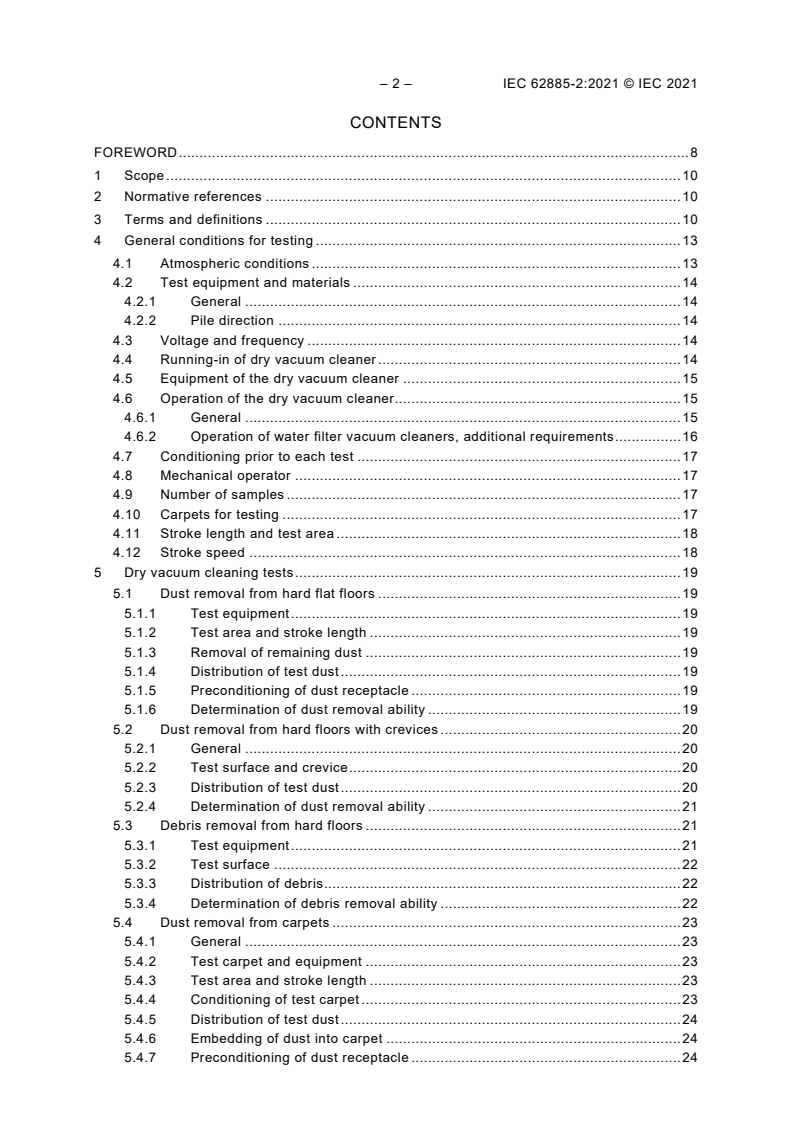
– 2 – IEC 62885-2:2021 © IEC 2021
CONTENTS
FOREWORD . 8
1 Scope . 10
2 Normative references . 10
3 Terms and definitions . 10
4 General conditions for testing . 13
4.1 Atmospheric conditions . 13
4.2 Test equipment and materials . 14
4.2.1 General . 14
4.2.2 Pile direction . 14
4.3 Voltage and frequency . 14
4.4 Running-in of dry vacuum cleaner . 14
4.5 Equipment of the dry vacuum cleaner . 15
4.6 Operation of the dry vacuum cleaner . 15
4.6.1 General . 15
4.6.2 Operation of water filter vacuum cleaners, additional requirements . 16
4.7 Conditioning prior to each test . 17
4.8 Mechanical operator . 17
4.9 Number of samples . 17
4.10 Carpets for testing . 17
4.11 Stroke length and test area . 18
4.12 Stroke speed . 18
5 Dry vacuum cleaning tests . 19
5.1 Dust removal from hard flat floors . 19
5.1.1 Test equipment . 19
5.1.2 Test area and stroke length . 19
5.1.3 Removal of remaining dust . 19
5.1.4 Distribution of test dust . 19
5.1.5 Preconditioning of dust receptacle . 19
5.1.6 Determination of dust removal ability . 19
5.2 Dust removal from hard floors with crevices . 20
5.2.1 General . 20
5.2.2 Test surface and crevice . 20
5.2.3 Distribution of test dust . 20
5.2.4 Determination of dust removal ability . 21
5.3 Debris removal from hard floors . 21
5.3.1 Test equipment . 21
5.3.2 Test surface . 22
5.3.3 Distribution of debris . 22
5.3.4 Determination of debris removal ability . 22
5.4 Dust removal from carpets . 23
5.4.1 General . 23
5.4.2 Test carpet and equipment . 23
5.4.3 Test area and stroke length . 23
5.4.4 Conditioning of test carpet . 23
5.4.5 Distribution of test dust . 24
5.4.6 Embedding of dust into carpet . 24
5.4.7 Preconditioning of dust receptacle . 24
5.4.8 Determination of dust removal ability . 24
5.5 Debris removal from carpet . 25
5.5.1 Test equipment . 25
5.5.2 Distribution of debris . 26
5.5.3 Determination of debris removal ability . 26
5.6 Dust removal along walls . 27
5.6.1 Test equipment and materials . 27
5.6.2 Distribution of test dust . 27
5.6.3 Determination of dust removal ability along walls . 27
5.7 Fibre removal from carpets . 28
5.7.1 General . 28
5.7.2 Test carpet . 28
5.7.3 Distribution of fibres . 28
5.7.4 Determination of fibre removal ability from carpets . 29
5.8 Fibre removal from upholstery . 30
5.8.1 General . 30
5.8.2 Test cushion . 31
5.8.3 Distribution of fibres . 31
5.8.4 Determination of fibre removal ability from upholstery . 32
5.9 Thread removal from carpets . 33
5.9.1 Test carpet . 33
5.9.2 Distribution of threads. 33
5.9.3 Determination of thread removal ability . 34
5.10 Maximum usable volume of the dust receptacle . 34
5.10.1 General . 34
5.10.2 Conditions for test . 34
5.10.3 Introduction of moulding granules . 35
5.10.4 Determination of maximum usable volume of dust receptacle . 35
5.11 Air data . 35
5.11.1 Purpose . 35
5.11.2 Conditions for test . 36
5.11.3 Test equipment . 36
5.11.4 Mounting dry vacuum cleaner to test chamber for air data test. 36
5.11.5 Determination of air data . 37
5.12 Performance with loaded dust receptacle . 38
5.12.1 Purpose . 38
5.12.2 Determination of suction pressure change with loaded dust receptacle . 38
5.12.3 Throttling to simulate loaded dust receptacle . 40
5.12.4 Determination of performance with loaded dust receptacle . 40
5.13 Total emissions while vacuum cleaning . 41
5.13.1 Purpose . 41
5.13.2 Test conditions . 41
5.13.3 Test equipment . 41
5.13.4 Test carpet . 41
5.13.5 Test chamber setup and conditioning . 41
5.13.6 Test sample and material setup . 41
5.13.7 Positioning the test unit . 42
5.13.8 Test procedure . 42
5.13.9 Reporting . 42
– 4 – IEC 62885-2:2021 © IEC 2021
5.14 Dust re-emission and fractional filtration efficiency of the dry vacuum cleaner . 43
5.14.1 General . 43
5.14.2 Test conditions . 43
5.14.3 Determining the test dust quantity. 43
5.14.4 Dust re-emission for the entire range of particle size . 43
5.14.5 Fractional filtration efficiency . 49
6 Miscellaneous tests . 51
6.1 General . 51
6.2 Motion resistance . 52
6.2.1 Purpose . 52
6.2.2 Test carpet, hard floor surface, and test equipment . 52
6.2.3 Determination of motion resistance . 52
6.3 Cleaning under furniture . 52
6.3.1 Purpose . 52
6.3.2 Distribution of test dust . 53
6.3.3 Determination of free furniture height . 53
6.4 Radius of operation . 53
6.4.1 Purpose . 53
6.4.2 Conditions for measurement . 53
6.4.3 Determination of radius of operation . 53
6.5 Impact resistance for detachable cleaning heads . 54
6.5.1 Purpose . 54
6.5.2 Test equipment . 54
6.5.3 Determination of impact resistance . 54
6.6 Deformation of hose and connecting tubes . 54
6.6.1 Purpose . 54
6.6.2 Test equipment . 54
6.6.3 Determination of permanent deformation . 54
6.7 Bump test . 55
6.7.1 Purpose . 55
6.7.2 Test equipment . 55
6.7.3 Test cycle . 56
6.7.4 Test procedure . 57
6.8 Flexibility of the hose . 57
6.8.1 Purpose . 57
6.8.2 Preparation of test object . 57
6.8.3 Determination of the flexibility of the hose . 58
6.9 Durability of suction hoses . 58
6.9.1 Primary hose testing . 58
6.9.2 Secondary hose testing . 61
6.10 Ability to maintain air flow performance . 61
6.10.1 Purpose . 61
6.10.2 Test dust . 62
6.10.3 Procedure . 62
6.11 Mass . 62
6.12 Weight in hand . 62
6.13 Specific cleaning time . 63
6.14 Dimensions . 63
6.15 Airborne acoustical noise . 63
6.16 Energy consumption . 63
6.16.1 General . 63
6.16.2 Energy consumption when vacuuming carpets . 64
6.16.3 Energy consumption with vacuuming of hard floors and hard floors with
crevices . 66
6.16.4 Energy consumption of cordless active nozzles . 66
6.17 Operational motor life-time test . 68
6.17.1 Purpose . 68
6.17.2 Procedure . 68
7 Test material and equipment . 69
7.1 General . 69
7.2 Material for tests . 69
7.2.1 Test carpets . 69
7.2.2 Mineral dust – Type 4 . 69
7.2.3 Fibre material . 69
7.2.4 Thread material . 70
7.2.5 Moulding granules . 70
7.2.6 Test cushion . 70
7.2.7 Debris . 70
7.3 Equipment for tests . 71
7.3.1 Floor test plate . 71
7.3.2 Test plate with crevice . 71
7.3.3 Carpet-beating machine . 71
7.3.4 Hold-downs and guides . 72
7.3.5 Mechanical dust spreader (optional) . 72
7.3.6 Rollers for embedding . 73
7.3.7 Equipment for air data test . 74
7.3.8 Test equipment for determining the fractional filtration efficiency and
dust re-emission of the dry vacuum cleaner . 80
7.3.9 Device for motion resistance test . 85
7.3.10 Device for impact test . 85
7.3.11 Device for determination of deformation of hoses and connecting tubes . 86
7.3.12 Mechanical operator . 87
7.3.13 Weighing machine . 88
7.3.14 Total emissions test . 88
7.3.15 Dust collection box . 89
7.3.16 Secondary hose test equipment . 90
8 Instructions for use . 91
Annex A (informative) Information on materials . 92
Annex B (informative) Information at the point of sale . 93
Annex C (informative) Reference vacuum cleaner system RSB . 94
C.1 Purpose of the RSB . 94
C.2 General description of the RSB . 94
C.3 Specification of the RSB . 95
C.4 Installation and use of the RSB . 96
C.5 Use of RSB for correction of DPU values . 96
Annex D (informative) Maintenance of the RSB. 97
D.1 Procedure for the adjustment at the manufacturer SLG . 97
D.2 Correction method for adjustment . 97
– 6 – IEC 62885-2:2021 © IEC 2021
D.3 Recorded DPU values at re-adjustment. 98
D.4 Procedure for checking the air-technical data by the user . 99
Annex E (normative) Hard floorboard realization, floor support and floor pattern . 101
Annex F (informative) Maximum operational power . 103
Bibliography . 104
Figure 1 – Right-angled T . 27
Figure 2 – Determination of cleaning area . 28
Figure 3 – Stencil for distribution of fibres on test carpets . 29
Figure 4 – Zigzag stroke pattern . 30
Figure 5 – Frame for test cushion . 31
Figure 6 – Stencil for distribution of fibres on upholstery . 32
Figure 7 – Arrangement of threads in the thread removal test . 33
Figure 8 – Stroke length in tests . 34
Figure 9 – Air data curves . 37
Figure 10 – Connecting tube opening . 38
Figure 11 – Test dust for loading dust receptacle . 39
Figure 12 – Insertion depth . 53
Figure 13 – Position of test object and cross-section for measurement of deformation . 55
Figure 14 – Profile of threshold . 56
Figure 15 – Arrangements for bump test . 56
Figure 16 – Preparation of hoses for testing flexibility . 58
Figure 17 – Configurations of vacuum cleaners with primary or secondary hoses . 59
Figure 18 – Interconnecting hose . 60
Figure 19 – Equipment for repeated bending of hoses . 60
Figure 20 – Test plate with crevice . 71
Figure 21 – Carpet-beating machine . 72
Figure 22 – Carpet hold-downs and guides . 73
Figure 23 – Dust spreader and roller for embedding dust into carpets . 73
Figure 24 – Alternative A equipment for air data tests . 74
Figure 25 – Measuring box for alternative A . 75
Figure 26 – Alternative B equipment for air data tests . 77
Figure 27 – Test hood . 81
Figure 28 – Intake aerosol channel with sampling probe . 82
Figure 29 – Exhaust channel with sampling probe . 82
Figure 30 – Equipment diagram for filtration / dust re-emission testing . 83
Figure 31 – Modified test hood . 84
Figure 32 – Drum for impact test . 86
Figure 33 – Device for testing deformation of hoses and connecting tubes . 87
Figure 34 – Mechanical operator for the measurement of dust removal from carpets
and of motion resistance . 88
Figure 35 – Dust collection box . 90
Figure 36 – Equipment for durability testing of secondary hoses . 91
Figure C.1 – RSB with passive and active nozzle and vacuum measuring box . 95
Figure E.1 – Dimensions of the floorboard and mounting on a test rig . 101
Figure E.2 – Pattern of hard floor planks . 102
Table 1 – Confidence limits of a Poisson distribution for 95 % confidence range . 48
Table 2 – Nominal diameters of orifices . 77
Table 3 – Graduation of eight size classes for particle sizes 0,3 µm to 10 µm . 85
– 8 – IEC 62885-2:2021 © IEC 2021
INTERNATIONAL ELECTROTECHNICAL COMMISSION
____________
SURFACE CLEANING APPLIANCES –
Part 2: Dry vacuum cleaners for household or similar use –
Methods for measuring the performance
FOREWORD
1) The International Electrotechnical Commission (IEC) is a worldwide organization for standardization comprising
all national electrotechnical committees (IEC National Committees). The object of IEC is to promote
international co-operation on all questions concerning standardization in the electrical and electronic fields. To
this end and in addition to other activities, IEC publishes International Standards, Technical Specifications,
Technical Reports, Publicly Available Specifications (PAS) and Guides (hereafter referred to as "IEC
Publication(s)"). Their preparation is entrusted to technical committees; any IEC National Committee interested
in the subject dealt with may participate in this preparatory work. International, governmental and non-
governmental organizations liaising with the IEC also participate in this preparation. IEC collaborates closely
with the International Organization for Standardization (ISO) in accordance with conditions determined by
agreement between the two organizations.
2) The formal decisions or agreements of IEC on technical matters express, as nearly as possible, an international
consensus of opinion on the relevant subjects since each technical committee has representation from all
interested IEC National Committees.
3) IEC Publications have the form of recommendations for international use and are accepted by IEC National
Committees in that sense. While all reasonable efforts are made to ensure that the technical content of IEC
Publications is accurate, IEC cannot be held responsible for the way in which they are used or for any
misinterpretation by any end user.
4) In order to promote international uniformity, IEC National Committees undertake to apply IEC Publications
transparently to the maximum extent possible in their national and regional publications. Any divergence
between any IEC Publication and the corresponding national or regional publication shall be clearly indicated in
the latter.
5) IEC itself does not provide any attestation of conformity. Independent certification bodies provide conformity
assessment services and, in some areas, access to IEC marks of conformity. IEC is not responsible for any
services carried out by independent certification bodies.
6) All users should ensure that they have the latest edition of this publication.
7) No liability shall attach to IEC or its directors, employees, servants or agents including individual experts and
members of its technical committees and IEC National Committees for any personal injury, property damage or
other damage of any nature whatsoever, whether direct or indirect, or for costs (including legal fees) and
expenses arising out of the publication, use of, or reliance upon, this IEC Publication or any other IEC
Publications.
8) Attention is drawn to the Normative references cited in this publication. Use of the referenced publications is
indispensable for the correct application of this publication.
9) Attention is drawn to the possibility that some of the elements of this IEC Publication may be the subject of
patent rights. IEC shall not be held responsible for identifying any or all such patent rights.
International Standard IEC 62885-2 has been prepared by subcommittee 59F: Surface
cleaning appliances, of IEC technical committee 59: Performance of household and similar
electrical appliances.
This second edition of IEC 62885-2 cancels and replaces the first edition published in 2016.
This edition constitutes a technical revision.
This second edition includes the following significant technical changes with respect to the
previous edition:
a) Inclusion of requirements for water filter vacuum cleaners throughout document
b) Clause 4.6 on operation of the dry vacuum cleaner has been revised.
c) Add new paragraph 4.11, consolidating test area and stroke length from 5.1.2, 5.3.2,
6.2.2 and 6.16.2.2. Added new 4.12 for stroke speed.
d) Added debris pick-up test for hard floor and carpet. Includes new Annex E.
e) Clause 6.2.2 – Clarification of the carpet to be used; reference 4.11 for test area. Remove
restriction limiting carpets to motion resistance only. Clarify the use of a mechanical
operator.
f) A durability test for secondary hoses has been included.
g) The informative annexes relating to the description and maintenance of the reference
vacuum cleaner system RSB have been updated.
The text of this standard is based on the following documents:
Draft Report on voting
59F/434/FDIS 59F/438/RVD
Full information on the voting for its approval can be found in the report on voting indicated in
the above table.
The language used for the development of this International Standard is English.
A list of all the parts in the IEC 62885 series, under the general title Surface cleaning
appliances, can be found on the IEC website.
In this standard, the following print types are used:
• terms defined in Clause 3: bold type.
This document was drafted in accordance with ISO/IEC Directives, Part 2, and developed in
accordance with ISO/IEC Directives, Part 1 and ISO/IEC Directives, IEC Supplement,
available at www.iec.ch/members_experts/refdocs. The main document types developed by
IEC are described in greater detail at www.iec.ch/standardsdev/publications.
The committee has decided that the contents of this document will remain unchanged until the
stability date indicated on the IEC website under webstore.iec.ch in the data related to the
specific document. At this date, the document will be
• reconfirmed,
• withdrawn,
• replaced by a revised edition, or
• amended.
IMPORTANT – The "colour inside" logo on the cover page of this publication
indicates that it contains colours which are considered to be useful for the correct
understanding of its contents. Users should therefore print this publication using a
colour printer.
– 10 – IEC 62885-2:2021 © IEC 2021
SURFACE CLEANING APPLIANCES –
Part 2: Dry vacuum cleaners for household or similar use –
Methods for measuring the performance
1 Scope
This part of IEC 62885 is applicable for measurements of the performance of mains-operated
dry vacuum cleaners, including water filter vacuum cleaners for household or similar use.
NOTE 1 Measurements of the performance of mains-operated commercial dry vacuum cleaners are found in
IEC 62885-8.
The purpose of this document is to specify essential performance characteristics of dry
vacuum cleaners which are of interest to users and to describe methods for measuring these
characteristics.
NOTE 2 Due to the influence of environmental conditions, variations in time, origin of test materials and
proficiency of the operator, some of the described test methods will give more reliable results when applied for
comparative testing of a number of appliances at the same time, in the same laboratory and by the same operator.
NOTE 3 The methods here can be applied with modifications for surface-cleaning product types or technologies
not currently covered within the scope.
For safety requirements, reference is made to IEC 60335-1.
A recommendation on information for the consumer at the point of sale is given in Annex B.
2 Normative references
The following documents, in whole or in part, are normatively referenced in this document and
are indispensable for its application. For dated references, only the edition cited applies. For
undated references, the latest edition of the referenced document (including any
amendments) applies.
IEC 60688, Electrical measuring transducers for converting A.C. and D.C. electrical quantities
to analogue or digital signals
IEC 60704-2-1, Household and similar electrical appliances – Test code for the determination
of airborne acoustical noise – Part 2-1: Particular requirements for vacuum cleaners
IEC TS 62885-1:2020, Surface cleaning appliances – Part 1: General requirements on test
material and test equipment
ISO 5167-1, Measurement of fluid flow by means of pressure differential devices inserted in
circular cross-section conduits running full – Part 1: General principles and requirements
ISO 12103-1, Road vehicles – Test dust for filter evaluation – Part 1: Arizona test dust
3 Terms and definitions
For the purposes of this document, the following terms and definitions apply.
ISO and IEC maintain terminological databases for use in standardization at the following
addresses:
• IEC Electropedia: available at http://www.electropedia.org/
• ISO Online browsing platform: available at http://www.iso.org/obp
3.1
active depth of the cleaning head
distance from the front edge of the cleaning head to its rear edge or a line 10 mm behind the
rear edge of the suction opening on the underside of the cleaning head, whichever is the
shortest
3.2
active nozzle
cleaning head provided with a driven agitation device to assist dirt removal
Note 1 to entry: The agitation device can be driven by an incorporated electric motor (motorized nozzle), an
incorporated turbine powered by the air flow (air-turbine nozzle), or an incorporated friction or gear mechanism
actuated by moving the cleaning head over the surface to be cleaned (mechanical nozzle).
3.3
cleaning head
p
...