

IEC 60704-2-1:2026
(Main)Household and similar electrical appliances - Test code for the determination of airborne acoustical noise - Part 2-1: Particular requirements for dry vacuum cleaners
- Abstract
IEC 60704-2-1:2026 specifies the determination of airborne acoustical noise of mains operated and cordless dry vacuum cleaners including their accessories and docking stations for household use or under conditions similar to those in households. For wet and dry vacuum cleaners, the dry cleaning function applies. The wet cleaning function is measured in accordance with IEC 60704-2-20. Particular requirements for floor cleaning robots are specified in IEC 60704-2-17 . This document describes the determination of the noise emission of dry vacuum cleaners under normal operating conditions on carpet and hard floor in accordance with IEC 62885-2. This fifth edition cancels and replaces the fourth edition published in 2020. This edition constitutes a technical revision.
This edition includes the following significant technical changes with respect to the previous edition:
a) alignment with IEC 60704 1:2021;
b) addressing consumer relevant testing aspects;
c) robustness of standards and closing potential loopholes
d) enlarged scope to include noise measurement on docking stations.
This document is intended to be used in conjunction with IEC 60704-1:2021, Household and similar electrical appliances - Test code for the determination of airborne acoustical noise - Part 1: General requirements.
- Status
- Published
- Publication Date
- 10-Jun-2026
- Technical Committee
- SC 59F - Surface cleaning appliances
- Drafting Committee
- JWG 2 - TC 59/JWG 2
- Current Stage
- PPUB - Publication issued
- Start Date
- 11-Jun-2026
- Completion Date
- 03-Jul-2026
Buy Documents
IEC 60704-2-1:2026 EXV - Household and similar electrical appliances - Test code for the determination of airborne acoustical noise - Part 2-1: Particular requirements for dry vacuum cleaners
iec60704-2-1{ed5.0}en - Household and similar electrical appliances - Test code for the determination of airborne acoustical noise - Part 2-1: Particular requirements for dry vacuum cleaners
iec60704-2-1{ed5.0}fr - Appareils électrodomestiques et analogues - Code d'essai pour la détermination du bruit aérien - Partie 2-1: Exigences particulieres pour les aspirateurs a sec
IEC 60704-2-1:2026 is an International Standard from the IEC for measuring airborne acoustical noise from dry vacuum cleaners. It covers mains-operated and cordless dry vacuum cleaners for household use or similar use, including accessories and docking stations. The document specifies how to determine and report the noise emission of these appliances under normal operating conditions, and it is intended to be used with IEC 60704-1:2021.
What does IEC 60704-2-1:2026 specify?
IEC 60704-2-1:2026 specifies the test code for airborne acoustical noise from dry vacuum cleaners, including their accessories and docking stations. For wet and dry vacuum cleaners, it applies only to the dry-cleaning function, while the wet-cleaning function is covered by IEC 60704-2-20.
The standard is organized as a part of the IEC 60704 series and follows the usual test-code structure:
- Clause 1 - scope
- Clause 2 - normative references
- Clause 3 - terms and definitions
- Clause 4 - measurement methods and acoustic environments
- Clause 5 - apparatus
- Clause 6 - operation and positioning of the appliances under test
- Clause 7 - sound pressure level measurements
- Clause 8 - calculation of sound pressure and sound power levels
- Clause 10 - information to record
- Annex A - normative, titled standardized test table
- Bibliography
In practice, this means the document tells a laboratory not only what to measure, but also how to prepare the appliance, where to place it, what operating mode to use, and what to record so results can be compared between tests and laboratories.
What are the key requirements of IEC 60704-2-1:2026?
Measurement method and acoustic environment
Clause 4 allows direct and comparison methods for measuring emitted noise, with ISO 3743-1, ISO 3743-2 and ISO 3744 used as the reference acoustical environments. If the appliance produces audible pure tones, the setup may need additional microphone or source positions.
Clause 4 also treats the operator as part of the test environment when human operation is needed. In practice, the operator must be positioned consistently because the operator can affect the sound field and therefore the result.
Clause 4.5 provides estimated standard deviations for carpet tests, hard-floor tests, and for declaration and verification. These figures matter when comparing results, judging repeatability, or checking whether a declared sound emission value is realistic.
Preparation and conditioning of the appliance
Clause 6 requires the appliance to be used with the cleaning configuration intended for the surface under test. Disposable dust containers are replaced before each measurement, and reusable dust containers and removable filters are cleaned according to the manufacturer’s instructions.
For new appliances, Clause 6 requires conditioning before the first test. Corded appliances are run in, cordless appliances are fully charged and discharged in a defined way, and docking stations are prepared through repeated operating cycles. In practice, this reduces the effect of early-life behavior and battery state on the noise result.
Clause 6 also requires stabilization after storage or interruption. This is important because a vacuum cleaner that has just been switched on after a long pause may not behave the same as one already at steady operating temperature.
Operating mode and test surface
Clauses 6.4.2.101 to 6.4.2.104 define how the appliance is operated on carpet, hard floor, and at the docking station. The same configuration must be kept for all tests on a given surface, and the selected settings must be the ones intended by the manufacturer for that surface.
If the appliance has multiple settings and the correct one is not clear, the standard directs the tester to use the product markings and then, if needed, the manufacturer’s guidance. If the setup is still ambiguous, the setting that provides maximum continuous airflow is used. In practice, the standard tries to avoid arbitrary lab choices.
For appliances with dust-detection control, the highest power in the dusty range is used. For docking stations, all operating modes are considered, and the loudest mode must at least be measured.
Positioning on carpet and hard floor
Clause 6.5.2.101 and 6.5.2.102 define how the appliance, hose, tubes, handle and cleaning head are arranged on the test surface. Figures 101 and 102 illustrate the two common geometries: a cleaning head directly attached to the appliance, and a cleaning head connected by hose and tube.
On carpet, the test uses the standardized Wilton carpet specified in IEC TS 62885-1. For active cleaning heads, the carpet is fixed down to avoid vibration noise from the carpet itself.
On hard floor, the reference surface must have low acoustic absorption and sufficient surface density. If the surface does not meet the reference conditions, a polished marble or similar natural-stone plate can be used. The purpose is to make the measured noise come from the vacuum cleaner, not from an unsuitable floor surface.
Measuring, calculating and reporting
Clause 7 requires time-averaged A-weighted sound pressure measurements for the appliance, and it sets a separate measurement approach for docking stations. If sound prompts or voice messages are present, they should be disabled if possible; otherwise, they are included only when they occur during a measured operating mode.
Clause 8 states that the final results for dry vacuum cleaners are sound power levels reported separately for the standardized carpet and the reference hard floor. For docking stations, the final result comes from the measurement defined for the operating mode.
Clause 10 requires the report to identify the cleaning head, the carpet model, batch and sample, the floor type, the cleaning-head setting, and the state of the suction openings. It also requires each measured value to be clearly linked to the surface type used.
What terms does IEC 60704-2-1:2026 define?
- Dry vacuum cleaner - An electrically powered appliance that removes dry material from a surface by airflow and separates the collected material inside the appliance.
- Wet and dry vacuum cleaner - An appliance designed to remove liquid as well as perform dry vacuum cleaning.
- Cleaning head - The nozzle or brush, including a powered nozzle, that is applied to the surface being cleaned.
- Active nozzle - A cleaning head with a driven agitation device that helps remove dust.
- Standardized Wilton test carpet - The Wilton carpet used as the carpet test surface for measurements.
- Reference hard floor - The hard-floor test surface used for measurements and positioning.
- Docking station - The base unit that may charge the battery, empty dust, process data, or provide other support functions.
Who uses IEC 60704-2-1:2026?
IEC 60704-2-1:2026 is used by vacuum cleaner manufacturers, acoustic test laboratories, certification bodies, and quality teams. It supports product development, type testing, conformity assessment, and the verification of declared sound emission values.
It is also useful to buyers and technical assessors who need to compare models on the same basis. Because the standard separates carpet and hard-floor testing, it helps people check whether a vacuum cleaner noise claim matches the intended use surface.
What changed in IEC 60704-2-1:2026 from the previous edition?
This fifth edition cancels and replaces the fourth edition published in 2020. It is described as a technical revision.
The changes stated for this edition are:
- alignment with IEC 60704-1:2021
- attention to consumer-relevant testing aspects
- improved robustness of the standard and closure of possible loopholes
- extended scope to include noise measurement on docking stations
Which standards are used with IEC 60704-2-1:2026?
| Standard | Contribution in IEC 60704-2-1:2026 |
|---|---|
| IEC 60704-1:2021 | General requirements for the airborne acoustical noise test code used with this part |
| IEC 60704-2-20 | Noise measurement for the wet-cleaning function of wet and dry vacuum cleaners |
| IEC TS 62885-1 | Test material and test equipment, including the specification for the Wilton test carpet |
| IEC 62885-2 | Cleaning performance methods and the normal operating conditions referenced for carpet and hard-floor testing |
| IEC 60704-2-17 | Particular requirements for floor cleaning robots, noted as a separate document |
| IEC 60704-3 | Declaration and verification of declared sound emission values |
| ISO 3743-1 | Comparison method and related acoustical environment |
| ISO 3743-2 | Direct method and related acoustical environment |
| ISO 3744 | Additional acoustical environment referenced for emitted-noise measurements |
What does the IEC 60704-2-1:2026 document contain?
IEC 60704-2-1:2026 contains the operating rules, positioning rules, measurement methods, and reporting items needed to measure airborne acoustical noise from dry vacuum cleaners. It includes separate treatment of carpet and hard-floor testing, plus dedicated measurement provisions for docking stations.
The document also contains two explanatory figures showing appliance placement, four tables for uncertainty and declaration support, and clause-by-clause instructions for preparation, measurement, calculation, and reporting. Annex A is identified as a normative standardized test table, and the bibliography points to the related floor-cleaning-robot standard.
Relations
- Effective Date
- 14-Jun-2024
Buy Documents
IEC 60704-2-1:2026 EXV - Household and similar electrical appliances - Test code for the determination of airborne acoustical noise - Part 2-1: Particular requirements for dry vacuum cleaners
iec60704-2-1{ed5.0}en - Household and similar electrical appliances - Test code for the determination of airborne acoustical noise - Part 2-1: Particular requirements for dry vacuum cleaners
iec60704-2-1{ed5.0}fr - Appareils électrodomestiques et analogues - Code d'essai pour la détermination du bruit aérien - Partie 2-1: Exigences particulieres pour les aspirateurs a sec
Get Certified
Connect with accredited certification bodies for this standard

BSMI (Bureau of Standards, Metrology and Inspection)
Taiwan's standards and inspection authority.
Sponsored listings
Frequently Asked Questions
IEC 60704-2-1:2026 is a standard published by the International Electrotechnical Commission (IEC). Its full title is "Household and similar electrical appliances - Test code for the determination of airborne acoustical noise - Part 2-1: Particular requirements for dry vacuum cleaners". This standard covers: IEC 60704-2-1:2026 specifies the determination of airborne acoustical noise of mains operated and cordless dry vacuum cleaners including their accessories and docking stations for household use or under conditions similar to those in households. For wet and dry vacuum cleaners, the dry cleaning function applies. The wet cleaning function is measured in accordance with IEC 60704-2-20. Particular requirements for floor cleaning robots are specified in IEC 60704-2-17 . This document describes the determination of the noise emission of dry vacuum cleaners under normal operating conditions on carpet and hard floor in accordance with IEC 62885-2. This fifth edition cancels and replaces the fourth edition published in 2020. This edition constitutes a technical revision. This edition includes the following significant technical changes with respect to the previous edition: a) alignment with IEC 60704 1:2021; b) addressing consumer relevant testing aspects; c) robustness of standards and closing potential loopholes d) enlarged scope to include noise measurement on docking stations. This document is intended to be used in conjunction with IEC 60704-1:2021, Household and similar electrical appliances - Test code for the determination of airborne acoustical noise - Part 1: General requirements.
IEC 60704-2-1:2026 specifies the determination of airborne acoustical noise of mains operated and cordless dry vacuum cleaners including their accessories and docking stations for household use or under conditions similar to those in households. For wet and dry vacuum cleaners, the dry cleaning function applies. The wet cleaning function is measured in accordance with IEC 60704-2-20. Particular requirements for floor cleaning robots are specified in IEC 60704-2-17 . This document describes the determination of the noise emission of dry vacuum cleaners under normal operating conditions on carpet and hard floor in accordance with IEC 62885-2. This fifth edition cancels and replaces the fourth edition published in 2020. This edition constitutes a technical revision. This edition includes the following significant technical changes with respect to the previous edition: a) alignment with IEC 60704 1:2021; b) addressing consumer relevant testing aspects; c) robustness of standards and closing potential loopholes d) enlarged scope to include noise measurement on docking stations. This document is intended to be used in conjunction with IEC 60704-1:2021, Household and similar electrical appliances - Test code for the determination of airborne acoustical noise - Part 1: General requirements.
IEC 60704-2-1:2026 is classified under the following ICS (International Classification for Standards) categories: 17.140.20 - Noise emitted by machines and equipment; 97.080 - Cleaning appliances. The ICS classification helps identify the subject area and facilitates finding related standards.
IEC 60704-2-1:2026 has the following relationships with other standards: It is inter standard links to IEC 60704-2-1:2020. Understanding these relationships helps ensure you are using the most current and applicable version of the standard.
IEC 60704-2-1:2026 is available in PDF format for immediate download after purchase. The document can be added to your cart and obtained through the secure checkout process. Digital delivery ensures instant access to the complete standard document.
Standards Content (Sample)
IEC 60704-2-1 ®
Edition 5.0 2026-06
INTERNATIONAL
STANDARD
EXTENDED VERSION
This full version of IEC 60704-2-1:2026 includes the content of the references made to
IEC 60704-1:2021
Household and similar electrical appliances - Test code for the determination of
airborne acoustical noise -
Part 2-1: Particular requirements for dry vacuum cleaners
ICS 17.140.20; 97.080 ISBN 978-2-8327-1336-5
All rights reserved. Unless otherwise specified, no part of this publication may be reproduced or utilized in any form or
by any means, electronic or mechanical, including photocopying and microfilm, without permission in writing from either
IEC or IEC's member National Committee in the country of the requester. If you have any questions about IEC copyright
or have an enquiry about obtaining additional rights to this publication, please contact the address below or your local
IEC member National Committee for further information.
IEC Secretariat Tel.: +41 22 919 02 11
3, rue de Varembé info@iec.ch
CH-1211 Geneva 20 www.iec.ch
Switzerland
About the IEC
The International Electrotechnical Commission (IEC) is the leading global organization that prepares and publishes
International Standards for all electrical, electronic and related technologies.
About IEC publications
The technical content of IEC publications is kept under constant review by the IEC. Please make sure that you have the
latest edition, a corrigendum or an amendment might have been published.
IEC publications search - IEC Products & Services Portal - products.iec.ch
webstore.iec.ch/advsearchform Discover our powerful search engine and read freely all the
The advanced search enables to find IEC publications by a publications previews, graphical symbols and the glossary.
variety of criteria (reference number, text, technical With a subscription you will always have access to up to date
committee, …). It also gives information on projects, content tailored to your needs.
replaced and withdrawn publications.
Electropedia - www.electropedia.org
The world's leading online dictionary on electrotechnology,
IEC Just Published - webstore.iec.ch/justpublished
Stay up to date on all new IEC publications. Just Published containing more than 22 500 terminological entries in English
details all new publications released. Available online and and French, with equivalent terms in 25 additional languages.
once a month by email. Also known as the International Electrotechnical Vocabulary
(IEV) online.
IEC Customer Service Centre - webstore.iec.ch/csc
If you wish to give us your feedback on this publication or
need further assistance, please contact the Customer
Service Centre: sales@iec.ch.
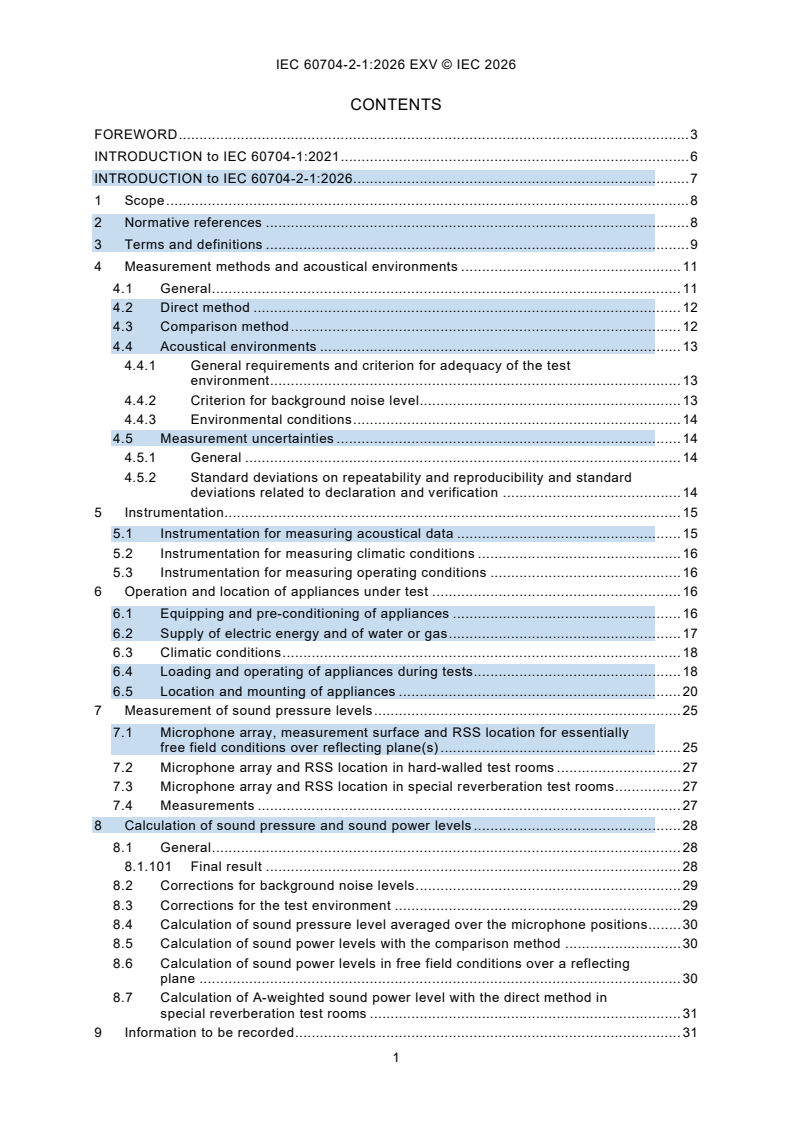
CONTENTS
FOREWORD . 3
INTRODUCTION to IEC 60704-1:2021 . 6
INTRODUCTION to IEC 60704-2-1:2026 . 7
1 Scope . 8
2 Normative references . 8
3 Terms and definitions . 9
4 Measurement methods and acoustical environments . 11
4.1 General . 11
4.2 Direct method . 12
4.3 Comparison method . 12
4.4 Acoustical environments . 13
4.4.1 General requirements and criterion for adequacy of the test
environment . 13
4.4.2 Criterion for background noise level . 13
4.4.3 Environmental conditions . 14
4.5 Measurement uncertainties . 14
4.5.1 General . 14
4.5.2 Standard deviations on repeatability and reproducibility and standard
deviations related to declaration and verification . 14
5 Instrumentation. 15
5.1 Instrumentation for measuring acoustical data . 15
5.2 Instrumentation for measuring climatic conditions . 16
5.3 Instrumentation for measuring operating conditions . 16
6 Operation and location of appliances under test . 16
6.1 Equipping and pre-conditioning of appliances . 16
6.2 Supply of electric energy and of water or gas . 17
6.3 Climatic conditions . 18
6.4 Loading and operating of appliances during tests . 18
6.5 Location and mounting of appliances . 20
7 Measurement of sound pressure levels . 25
7.1 Microphone array, measurement surface and RSS location for essentially
free field conditions over reflecting plane(s) . 25
7.2 Microphone array and RSS location in hard-walled test rooms . 27
7.3 Microphone array and RSS location in special reverberation test rooms . 27
7.4 Measurements . 27
8 Calculation of sound pressure and sound power levels . 28
8.1 General . 28
8.1.101 Final result . 28
8.2 Corrections for background noise levels . 29
8.3 Corrections for the test environment . 29
8.4 Calculation of sound pressure level averaged over the microphone positions . 30
8.5 Calculation of sound power levels with the comparison method . 30
8.6 Calculation of sound power levels in free field conditions over a reflecting
plane . 30
8.7 Calculation of A-weighted sound power level with the direct method in
special reverberation test rooms . 31
9 Information to be recorded . 31
9.1 General data . 31
9.2 Description of appliance under test . 31
9.3 Measurement method . 32
9.4 Acoustical test environment . 32
9.5 Instrumentation . 32
9.6 Equipment and pre-conditioning of appliance under test . 32
9.7 Electric supply, water supply, etc. . 33
9.8 Climatic conditions . 33
9.9 Operation of the appliance under test . 33
9.10 Location and mounting of the appliance under test . 33
9.11 Microphone array . 33
9.12 Measurement data . 33
9.13 Calculated sound pressure and sound power levels . 34
9.14 Reporting . 34
10 Information to be reported . 34
10.1 General data . 34
10.2 Appliance under test . 34
10.3 Test conditions for the appliance. 34
10.4 Acoustical data . 35
Annex A (normative) Standard test table . 36
Annex B (normative) Test enclosure . 37
Annex C (informative) Guidelines for the design of simple test rooms with essentially
free field conditions . 38
Bibliography . 39
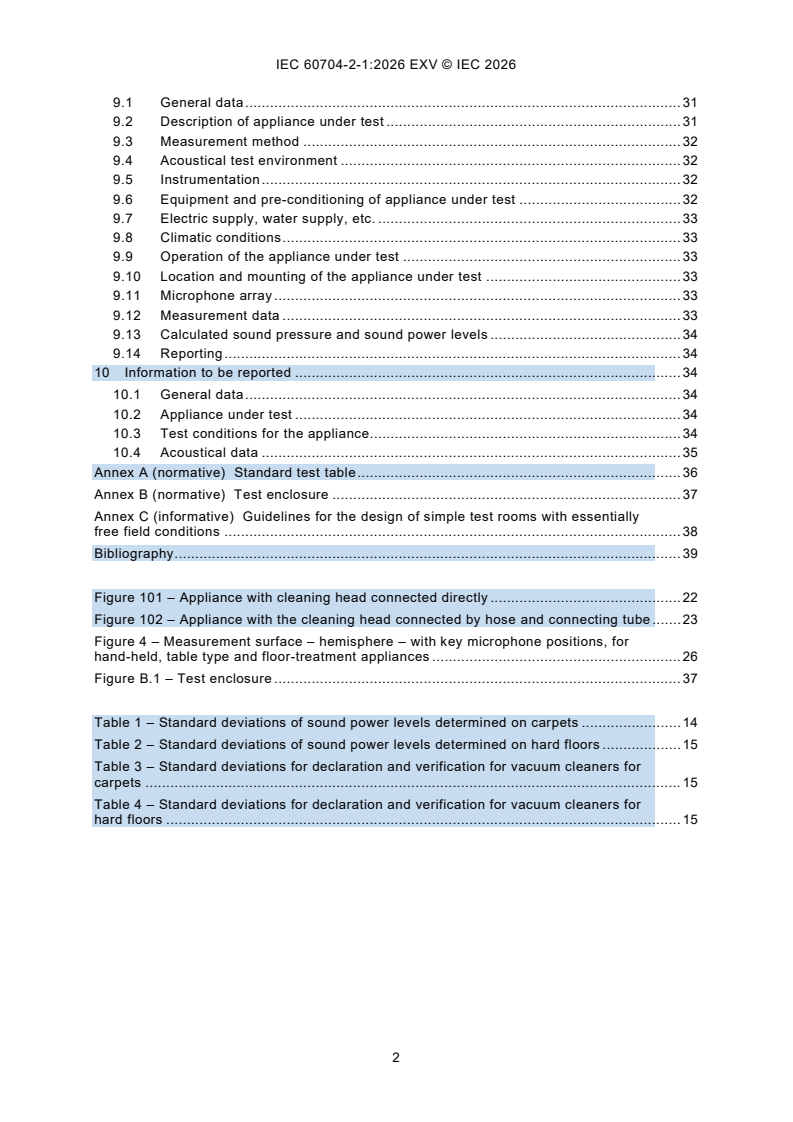
Figure 101 – Appliance with cleaning head connected directly . 22
Figure 102 – Appliance with the cleaning head connected by hose and connecting tube . 23
Figure 4 – Measurement surface – hemisphere – with key microphone positions, for
hand-held, table type and floor-treatment appliances . 26
Figure B.1 – Test enclosure . 37
Table 1 – Standard deviations of sound power levels determined on carpets . 14
Table 2 – Standard deviations of sound power levels determined on hard floors . 15
Table 3 – Standard deviations for declaration and verification for vacuum cleaners for
carpets . 15
Table 4 – Standard deviations for declaration and verification for vacuum cleaners for
hard floors . 15
INTERNATIONAL ELECTROTECHNICAL COMMISSION
____________
Household and similar electrical appliances -
Test code for the determination of airborne acoustical noise -
Part 2-1: Particular requirements for dry vacuum cleaners
FOREWORD
1) The International Electrotechnical Commission (IEC) is a worldwide organization for standardization comprising
all national electrotechnical committees (IEC National Committees). The object of IEC is to promote
international co-operation on all questions concerning standardization in the electrical and electronic fields. To
this end and in addition to other activities, IEC publishes International Standards, Technical Specifications,
Technical Reports, Publicly Available Specifications (PAS) and Guides (hereafter referred to as "IEC
Publication(s)"). Their preparation is entrusted to technical committees; any IEC National Committee interested
in the subject dealt with may participate in this preparatory work. International, governmental and non-
governmental organizations liaising with the IEC also participate in this preparation. IEC collaborates closely
with the International Organization for Standardization (ISO) in accordance with conditions determined by
agreement between the two organizations.
2) The formal decisions or agreements of IEC on technical matters express, as nearly as possible, an international
consensus of opinion on the relevant subjects since each technical committee has representation from all
interested IEC National Committees.
3) IEC Publications have the form of recommendations for international use and are accepted by IEC National
Committees in that sense. While all reasonable efforts are made to ensure that the technical content of IEC
Publications is accurate, IEC cannot be held responsible for the way in which they are used or for any
misinterpretation by any end user.
4) In order to promote international uniformity, IEC National Committees undertake to apply IEC Publications
transparently to the maximum extent possible in their national and regional publications. Any divergence
between any IEC Publication and the corresponding national or regional publication shall be clearly indicated in
the latter.
5) IEC itself does not provide any attestation of conformity. Independent certification bodies provide conformity
assessment services and, in some areas, access to IEC marks of conformity. IEC is not responsible for any
services carried out by independent certification bodies.
6) All users should ensure that they have the latest edition of this publication.
7) No liability shall attach to IEC or its directors, employees, servants or agents including individual experts and
members of its technical committees and IEC National Committees for any personal injury, property damage or
other damage of any nature whatsoever, whether direct or indirect, or for costs (including legal fees) and
expenses arising out of the publication, use of, or reliance upon, this IEC Publication or any other IEC
Publications.
8) Attention is drawn to the Normative references cited in this publication. Use of the referenced publications is
indispensable for the correct application of this publication.
9) IEC draws attention to the possibility that the implementation of this document may involve the use of (a)
patent(s). IEC takes no position concerning the evidence, validity or applicability of any claimed patent rights in
respect thereof. As of the date of publication of this document, IEC had not received notice of (a) patent(s),
which may be required to implement this document. However, implementers are cautioned that this may not
represent the latest information, which may be obtained from the patent database available at
https://patents.iec.ch. IEC shall not be held responsible for identifying any or all such patent rights.
This extended version (EXV) of the official IEC Standard provides the user with the full
content of the Standard.
IEC 60704-1:2021.
The specific content of IEC 60704-2-1:2026 is displayed on a blue background.
IEC 60704-2-1 has been prepared by subcommittee 59F: Surface cleaning appliances, of IEC
technical committee 59: Performance of household and similar electrical appliances. It is an
International Standard.
This fifth edition cancels and replaces the fourth edition published in 2020. This edition
constitutes a technical revision.
This edition includes the following significant technical changes with respect to the previous
edition:
a) alignment with IEC 60704-1:2021;
b) addressing consumer relevant testing aspects;
c) robustness of standards and closing potential loopholes
d) enlarged scope to include noise measurement on docking stations.
The text of this International Standard is based on the following documents:
Draft Report on voting
59F/567/FDIS 59F/573/RVD
Full information on the voting for its approval can be found in the report on voting indicated in
the above table.
The language used for the development of this International Standard is English.
This document was drafted in accordance with ISO/IEC Directives, Part 2, and developed in
accordance with ISO/IEC Directives, Part 1 and ISO/IEC Directives, IEC Supplement,
available at www.iec.ch/members_experts/refdocs. The main document types developed by
IEC are described in greater detail at www.iec.ch/publications.
This document is intended to be used in conjunction with IEC 60704-1:2021, Household and
similar electrical appliances - Test code for the determination of airborne acoustical noise -
Part 1: General requirements.
The relevant text of IEC 60704-1:2021 as amended by this document establishes the test
code for dry vacuum cleaners.
This document supplements or modifies the corresponding clauses in IEC 60704-1:2021.
When a particular subclause of IEC 60704-1:2021 is not mentioned in this document, that
subclause is applicable as far as reasonable. Where this standard states "addition",
"modification" or "replacement", the relevant requirements, test specifications or explanatory
matter in Part 1 should be adapted accordingly.
Subclauses, tables, and figures that are additional to those in IEC 60704-1:2021 are
numbered starting from 101. Additional annexes are lettered AA, BB, etc.
Unless notes are in a new subclause or involve notes in IEC 60704-1:2021, they are
numbered starting from 101, including those in a replaced clause or subclause.
In this standard, the following print types are used:
– terms defined in Clause 3: bold type.
A list of all the parts in the IEC 60704 series, published under the general title Household and
similar electrical appliances - Test code for the determination of airborne acoustical noise,
can be found on the IEC website.
The committee has decided that the contents of this document will remain unchanged until the
stability date indicated on the IEC website under webstore.iec.ch in the data related to the
specific document. At this date, the document will be
– reconfirmed,
– withdrawn, or
– revised.
INTRODUCTION to IEC 60704-1:2021
Although the noise emitted by household appliances does not generally present a hazard to
the hearing of the operator and other exposed persons, the need for standardization
procedures for the determination of the noise emitted has been recognized for a long time.
Such procedures should be specified, not only for special types of appliances, but also the
principles should be applicable to the majority of appliances in general use.
Generally, the determination of noise levels is only part of a comprehensive testing procedure
covering many aspects of the properties and performances of the appliance. It is therefore
important that the requirements for noise measurements (such as test environment,
instrumentation, and amount of labour involved) be kept at a modest level.
The results of noise measurements are used for many purposes, for example for noise
declaration, as well as for comparing the noise emitted by a specific appliance to the noise
emitted by other appliances of the same family. In other cases, the results are taken as a
basis for engineering action in the development stages of new pieces of equipment, or in
deciding on means for sound insulation. For all purposes, it is important to specify procedures
with known accuracy so that the results of measurements taken by different laboratories can
be compared.
These conditions have, as far as possible, been taken into account in the preparation of this
test code. The acoustic measuring methods are based on those described in
ISO 3743‑1:2010, ISO 3743-2:2018 and ISO 3744:2010.
The adoption of these methods permits the use of hemi-anechoic rooms, special reverberation
test rooms and hard-walled test rooms. The result of the measurements is the sound power
level of the appliance. Within the measuring uncertainty specific to these methods, the results
from the determination under free field conditions over a reflecting plane are equal to those
obtained in reverberant fields.
The use of intensity methods as described in ISO 9614-1:1993, ISO 9614-2:1996, and
ISO 9614-3:2002 is applicable under special conditions, which are described in specific parts
of the IEC 60704-2 series.
This test code is concerned with airborne noise only. In some cases, structure-borne noise,
for example transmitted to the adjoining room, can be of importance.
INTRODUCTION to IEC 60704-2-1:2026
The measuring conditions specified in this document provide for sufficient accuracy in
determining the noise emitted and comparing the results of measurements taken by different
laboratories, whilst simulating as far as possible the practical use of dry vacuum cleaners.
It is recommended to consider the determination of noise levels as part of a comprehensive
testing procedure covering many aspects of properties and performance of household vacuum
cleaners.
NOTE As stated in the introduction to IEC 60704-1, this test code is concerned with airborne noise only.
1 Scope
This part of IEC 60704 applies to electric appliances (including their accessories or
components) for household and similar use, supplied from mains or from batteries.
By "similar use" is understood the use in conditions similar to those found in households, for
example in inns, coffee houses, tea rooms, hotels, barber or hairdresser shops, launderettes,
etc., if not otherwise specified in the IEC 60704-2 series.
This document does not apply to
– appliances, equipment, or machines designed exclusively for industrial or professional
purposes;
– appliances that are integrated parts of a building or its installations, such as equipment for
air conditioning, heating and ventilating (except household fans, cooker hoods, free-
standing heating appliances, dehumidifiers, air cleaners, and stand-alone water heaters),
oil burners for central heating, pumps for water supply and for sewage systems;
– separate motors or generators and
– appliances exclusively for outdoor use.
For determining and verifying noise emission values declared in product specifications, see
IEC 60704-3:2019.
This document specifies the determination of airborne acoustical noise of mains operated and
cordless dry vacuum cleaners including their accessories and docking stations for
household use or under conditions similar to those in households.
For wet and dry vacuum cleaners, the dry cleaning function applies. The wet cleaning
function is measured in accordance with IEC 60704-2-20.
NOTE 101 Particular requirements for floor cleaning robots are specified in IEC 60704-2-17 .
This document describes the determination of the noise emission of dry vacuum cleaners
under normal operating conditions on carpet and hard floor in accordance with
IEC 62885-2:—, 4.6 .
2 Normative references
The following documents are referred to in the text in such a way that some or all of their
content constitutes requirements of this document. For dated references, only the edition
cited applies. For undated references, the latest edition of the referenced document (including
any amendments) applies.
IEC 60704-2 (all parts), Household and similar electrical appliances – Test code for the
determination of airborne acoustical noise
IEC 60704-2-20, Household and similar electrical appliances - Test code for the determination
of airborne acoustical noise - Part 2-20: Particular requirements for wet hard floor cleaning
appliances
—————————
Under preparation. Stage at the date of publication: IEC/CDV 60704-2-17:2026.
Under preparation. Stage at the date of publication: IEC/FDIS 62885-2:2026.
IEC 60704-3:2019, Household and similar electrical appliances – Test code for the
determination of airborne acoustical noise – Part 3: Procedure for determining and verifying
declared noise emission values
IEC 61260-1:2014, Electroacoustics – Octave-band and fractional-octave-band filters – Part
1: Specifications
IEC 61672-1:2013, Electroacoustics – Sound level meters – Part 1: Specifications
IEC TS 62885-1, Surface cleaning appliances - Part 1: General requirements on test material
and test equipment
IEC 62885-2:—, Surface cleaning appliances - Part 2: Dry vacuum cleaners for household
and similar use - Methods for measuring the performance
ISO 3743-1:2010, Acoustics – Determination of sound power levels of noise sources –
Engineering methods for small, movable sources in reverberant fields – Part 1: Comparison
method for hard-walled test rooms
ISO 3743-2:2018, Acoustics – Determination of sound power levels of noise sources using
sound pressure – Engineering methods for small, movable sources in reverberant fields –
Part 2: Methods for special reverberation test rooms
ISO 3744:2010, Acoustics – Determination of sound power levels of noise sources using
sound pressure – Engineering method in an essentially free field over a reflecting plane
ISO 9614-1:1993, Acoustics – Determination of sound power levels of noise sources using
sound intensity – Part 1: Measurement at discrete points
ISO 9614-2:1996, Acoustics – Determination of sound power levels of noise sources using
sound intensity – Part 2: Measurement by scanning
ISO 9614-3:2002, Acoustics – Determination of sound power levels of noise sources using
sound intensity – Part 3: Precision method for measurement by scanning
ISO 6926:2016, Acoustics – Requirements for the performance and calibration of reference
sound sources used for the determination of sound power levels
ISO 12001:1996, Acoustics – Noise emitted by machinery and equipment – Rules for the
drafting and presentation of a noise test code
3 Terms and definitions
For the purposes of this document, the following terms and definitions apply. Terms and
definitions pertinent to the determination of sound power levels can be found in ISO 3743-
1:2010, ISO 3743-2:2018 and ISO 3744:2010.
ISO and IEC maintain terminological databases for use in standardization at the following
addresses:
• IEC Electropedia: available at http://www.electropedia.org/
• ISO Online browsing platform: available at http://www.iso.org/obp
3.1
measurement time interval
portion or a multiple of an operational period or operational cycle for which the sound power
levels are determined
3.2
operational period
interval of time during which a specified process is accomplished by the appliance under test
(for example, washing or rinsing or drying for a dishwasher)
3.3
operational cycle
specific sequence of operational periods occurring while the appliance under test performs a
complete work cycle
Note 1 to entry: During the operational cycle, each operational period is associated with a specific process that
can occur only once, or can be repeated (for example, washing and rinsing and drying for a dishwasher).
3.4
time history
continuous recording of the sound pressure level (for a distinct microphone position) as a
function of time, which is obtained during one or more operational periods of an operational
cycle
3.5
reference box
hypothetical right parallelepiped terminating on the reflecting plane(s) on which the noise
source under test is located, that just encloses the source including all the significant sound
radiating components and any test table on which the source is mounted
[SOURCE: ISO 3744:2010, 3.10, modified – The note has been omitted.]
3.6
test enclosure
enclosure used for simulating the typical acoustic built-in or/and mounting conditions
3.101
dry vacuum cleaner
electrically operated appliance that removes dry material (for example, dust, fibre, threads,
and debris) from the surface to be cleaned by an air flow created by a vacuum developed
within the unit, the removed material being separated in the appliance and the cleaned
suction air being returned to the ambient air
[SOURCE: IEC 62885-2: —, 3.8]
3.102
wet and dry vacuum cleaner
appliance designed to remove liquid in combination with the functionality of a dry vacuum
cleaner
3.103
cleaning head
plain nozzle or brush attached to a connecting tube, or a power nozzle, separate or part of the
cleaner housing, and that part of a dry vacuum cleaner which is applied to a surface to be
cleaned
[SOURCE: IEC 62885-2: —, 3.3]
3.104
active nozzle
cleaning head provided with a driven agitation device to assist dirt removal
Note 1 to entry: The agitation device can be driven by an incorporated electric motor (motorized nozzle), an
incorporated turbine powered by the air flow (air-turbine nozzle) or an incorporated friction or gear mechanism
actuated by moving the cleaning head over the surface to be cleaned (mechanical nozzle).
[SOURCE: IEC 62885-2: —, 3.2]
3.105
standard Wilton test carpet
Wilton carpet on which the dry vacuum cleaner and its cleaning head is placed for the
measurement
Note 1 to entry: The specification of the standard Wilton test carpet can be found in IEC TS 62885-1.
3.106
standard hard floor
hard floor on which the dry vacuum cleaner and its cleaning head is placed for the
measurement
3.107
docking station
base unit
unit that can provide manual or automatic battery charging facilities, dust removal from the
dry vacuum cleaner, data processing facility or other support functions
4 Measurement methods and acoustical environments
4.1 General
This document is concerned with objective methods of engineering accuracy grade 2 in
accordance with ISO 12001:1996 for determining sound power levels L , expressed in
W
decibels (dB), with reference to a sound power of one picowatt (1 pW), of airborne acoustical
noise within the specified frequency range of interest (generally including the octave-bands
with centre frequencies from 125 Hz to 8 000 Hz), and for prescribed operating conditions of
the appliance to be measured.
Methods for determining sound power levels with precision accuracy grade 1 in accordance
with ISO 12001:1996, as specified for example in ISO 3741 and ISO 3745, are not included in
this document. They may, however, be applied if the appropriate test environment and
instrumentation are available.
NOTE 1 The noise values obtained under the described conditions of this document will not necessarily
correspond to the noise experienced under the operational conditions of practical use.
NOTE 2 For quality control during production etc., simplified methods can be appropriate. For noise reduction
purposes, other measurement methods employing, for example, narrow-band analysis or intensity techniques
usually have to be applied. These methods are not covered by this document.
The total noise emitted by machinery or equipment and radiated in all directions to the space
surrounding the machine can be characterized by the sound power of the machine. Within the
accuracy range of this document, the sound power of a machine is basically independent of
the environment in which the machine is installed
Therefore, the concept of sound power level has been chosen for expressing the noise
emission of appliances for household and similar purposes.
The preferred noise emission quantity is the A-weighted sound power level, L , in dB
WA
(re 1 pW).
According to this document, two principal methods exist, the direct method and the
comparison method, as described in 4.2 and 4.3. These two methods can be used
alternatively.
Different types of environments, as described in 4.4, may be used. A part of the IEC 60704-2
series may, if necessary, exclude one or several combinations among those available.
4.2 Direct method
The direct method can be used only for measurements in qualified test environments in
accordance with ISO 3744:2010 for free field conditions over reflecting plane(s), and in
accordance with ISO 3743-2:2018 for special reverberation test rooms.
With this method, the sound power level is determined
– in free field conditions over reflecting plane(s), from time-averaged sound pressure levels
(on a mean-square basis) over the measurement surface and from the area of the
measurement surface, S, or
– in reverberation and special reverberation test rooms, from averaged sound pressure
levels, and from the reverberation time and the volume of the test room.
If for a measurement in a free field, reverberation or special reverberation room is not
possible because the appliance cannot be placed or operated in such an environment, the
intensity method in accordance with ISO 9614-1:1993, ISO 9614-2:1996, and ISO 9614-
3:2002 shall be applied. For the intensity method, the standard deviations given in the parts of
the IEC 60704-2 series and IEC 60704-3:2019 are not applicable unless stated explicitly.
These methods yield results expressed in A-weighted sound power levels (and in octave- or
1/3 octave-band sound power levels, if required) that are calculated directly from measured
sound pressure levels.
NOTE This method can also be used in conjunction with more precise methods, such as those given in ISO 3741
and ISO 3745.
If audible discrete tones are present in the noise emitted by the source, the estimated
standard deviation of the measured sound pressure levels in the special reverberation room
can increase. In such cases, additional microphone positions or source positions can be
necessary, as specified in ISO 3743-2.
If an operator is necessary, it is considered as part of the test environment. Therefore, the
operator shall be present also during the reverberation time measurement with the RSS. The
position of the operator shall be approximately at the same position as in the measurement
with the test sample.
4.3 Comparison method
The comparison method for measurement is explicitly described in ISO 3743-1:2010 and in
ISO 3743-2:2018.
NOTE The term "comparison method" is not explicitly given in ISO 3744:2010, but when applying the "absolute
comparison test" for the determination of the environmental correction given in A.3 of ISO 3744:2010, by using a
reference sound source, the procedure is, in fact, a comparison method.
With this method, the sound power level is determined by comparing the averaged values (on
a mean-square basis) of the sound pressure levels produced by the source in the test room to
the averaged values of the sound pressure levels produced in the same room by a calibrated
reference sound source (RSS) of known sound power output, complying with the requirements
of ISO 6926:2016. The difference in sound pressure levels is equal to the difference in sound
power levels when conditions are the same for both sets of measurements.
This method yields results expressed in octave- or 1/3 octave-band sound power levels, and
the A-weighted sound power level is calculated from the octave- or 1/3 octave-band sound
power levels.
To check whether there is a systematic difference between results obtained in different
environments, the use of the comparison method is recommended.
If audible discrete tones are present in the noise emitted by the source, the estimated
standard deviation of the measured sound pressure levels in the hard-walled test room or in
the special reverberation room can increase. In such cases, additional microphone positions
or source positions can be necessary, as specified in ISO 3743-1 or ISO 3743-2.
If an operator is necessary, it is considered as part of the test environment. Therefore, the
operator shall be present also during the comparison measurement with the RSS. The
position of the operator shall be approximately at the same position as in the measurement
with the test sample.
4.4 Acoustical environments
4.4.1 General requirements and criterion for adequacy of the test environment
They are given in the following clauses:
– Clause 4 of ISO 3743-1:2010 for hard-walled test rooms;
– Clause 5 of ISO 3743-2:2018 for special reverberation test rooms and
– Clause 4 of ISO 3744:2010 for free-field conditions over a reflecting plane.
A classification of different types of noise is given in ISO 12001:1996. The method specified
in ISO 3744:2010 is suitable for measurements of all types of noise emitted by household
appliances. The methods specified in ISO 3743-1:2010 and ISO 3743-2:2018 are suitable for
all types of noise, except for sources of impulsive noise consisting of short-duration noise
bursts. This will be taken into account in the preparation of parts of the IEC 60704-2 series.
The method specified in ISO 3744:2010 is applicable to noise sources of any size. Limitations
for the size of the source are given in 4.2 of ISO 3743-1:2010 and in Clause 5 of
ISO 3743-2:2018. This will be taken into account in the preparation of parts of the
IEC 60704-2 series.
NOTE For free-field conditions over a reflecting plane, the absolute comparison test for the qualification of the
environment, described in Clause A.2 of ISO 3744:2010, is preferred.
Guidelines for the design of simple test rooms with free-field conditions are given in Annex C.
Guidelines for the design of a suitable special reverberation test room are given in
ISO 3743-2:2018, Annex A.
The methods specified in ISO 3743-1, ISO 3743-2 and ISO 3744 can be used for measuring
noise emitted by electric vacuum cleaners.
4.4.2 Criterion for background noise level
Requirements for the background noise level are given in 4.5 of ISO 3743-1:2010, in 6.5 of
ISO 3743-2:2018 and in 4.2 of ISO 3744:2010. Averaged over the microphone positions, the
background noise level shall be at least 6 dB below, and preferably more than 15 dB below,
the sound pressure level to be measured.
NOTE If the difference between the sound pressure levels of the background noise and the appliance noise is
less than 6 dB, see 8.2.
4.4.3 Environmental conditions
Environmental conditions having an adverse effect on the microphone used for the
measurements (for example, strong electric or magnetic fields, wind, impingement of air
discharge from the equipment being tested, high or low temperatures) shall be avoided by
proper selection or positioning of the microphone.
The instructions of the manufacturers of the measurement instruments regarding adverse
environmental conditions shall be followed. The microphone shall always be oriented in such
a way that the angle of incidence of the sound waves is that for which the microphone is
calibrated.
4.5 Measurement uncertainties
4.5.1 General
The estimated values of the standard deviations of reproducibility of sound power levels
determined in accordance with this document are given in 9.1 of ISO 3743-1:2010, in 11.1 of
ISO 3743‑2:2018 and in 9.1 of ISO 3744:2010. But for a particular family of appliances of
similar size with similar operating conditions, the standard deviations of reproducibility can be
smaller than these values. Hence, in the IEC 60704-2 series, standard deviations smaller than
those listed in ISO standards can be stated if substantiation is available from the results of
suitable interlaboratory tests.
In the case of discrepancies between the measurements where the results normally remain
inside the foreseen standard deviation, it can be helpful to perform measurements according
to the upper grade of accuracy: grade 1, laboratory or precision, as described in ISO 3741 or
ISO 3745.
4.5.2 Standard deviations on repeatability and reproducibility and standard
deviations related to declaration and verification
For dry vacuum cleaners designed for cleaning carpets, the estimated values of standard
deviations of sound power levels determined in accordance with this document are provided
in Table 1.
Table 1 – Standard deviations of sound power levels determined on carpets
Standard deviation
(dB)
σ (repeatability) σ (reproducibility)
r R
0,3 0,8
For dry vacuum cleaners designed for cleaning hard floors, the estimated values of standard
deviations of sound power levels determined in accordance with this document are provided
in Table 2.
Table 2 – Standard deviations of sound power levels determined on hard floors
Standard deviation
(dB)
σ (repeatability) σ (reproducibility)
r R
0,2 0,6
NOTE 101 The values in Table 1 and Table 2 are derived from the results of a round robin test (RRT) conducted
in 2010/2011 with 4 different vacuum cleaners (passive and active) in 8 participating laboratories.
NOTE 102 For docking stations, the standard deviations are under consideration.
For the purpose of determining and verifying declared noise emission values for dry vacuum
cleaners designed for cleaning carpets, in accordance with IEC 60704-3, the following values
provided in Table 3 apply.
Table 3 – Standard deviations for declaration and verification
for vacuum cleaners for carpets
Standard deviation
(dB)
σ (production) σ (total) σ (reference)
P t M
0,5 to 1,0 0,9 to 1,3 1,5
For the purpose of determining and verifying declared noise emission values for dry vacuum
cleaners designed for cleaning hard floors, in accordance with IEC 60704-3, the following
values provided in Table 4 apply.
Table 4 – Standard deviations for declaration and verification
for vacuum cleaners for hard floors
Standard deviation
(dB)
σ (production) σ (total) σ (reference)
P t M
0,5 to 1,0 0,8 to 1,2 1,5
5 Instrumentation
5.1 Instrumentation for measuring acoustical data
Requirements for the instrumentation system and for its calibration are given in Clause 5 of
ISO 3743-1:2010, in Clause 7 of ISO 3743-2:2018 and in Clause 5 of ISO 3744:2010.
The instrumentation system shall meet the requirements for a type 1 instrument laid down in
IEC 61672-1:2013, in accordance with the basic standard used. For measurements in octave-
and 1/3 octave-bands, the instrumentation system shall meet the requirements of
IEC 61260‑1:2014.
RSS shall meet the requirements of ISO 6926:2016, and shall be calibrated annually.
The use of windscreens is recommended. If necessary, the observed sound pressure level
shall be corrected for changes in the
...
IEC 60704-2-1 ®
Edition 5.0 2026-06
INTERNATIONAL
STANDARD
Household and similar electrical appliances - Test code for the determination of
airborne acoustical noise -
Part 2-1: Particular requirements for dry vacuum cleaners
ICS 17.140.20; 97.080 ISBN 978-2-8327-1281-8
All rights reserved. Unless otherwise specified, no part of this publication may be reproduced or utilized in any form or
by any means, electronic or mechanical, including photocopying and microfilm, without permission in writing from either
IEC or IEC's member National Committee in the country of the requester. If you have any questions about IEC copyright
or have an enquiry about obtaining additional rights to this publication, please contact the address below or your local
IEC member National Committee for further information.
IEC Secretariat Tel.: +41 22 919 02 11
3, rue de Varembé info@iec.ch
CH-1211 Geneva 20 www.iec.ch
Switzerland
About the IEC
The International Electrotechnical Commission (IEC) is the leading global organization that prepares and publishes
International Standards for all electrical, electronic and related technologies.
About IEC publications
The technical content of IEC publications is kept under constant review by the IEC. Please make sure that you have the
latest edition, a corrigendum or an amendment might have been published.
IEC publications search - IEC Products & Services Portal - products.iec.ch
webstore.iec.ch/advsearchform Discover our powerful search engine and read freely all the
The advanced search enables to find IEC publications by a publications previews, graphical symbols and the glossary.
variety of criteria (reference number, text, technical With a subscription you will always have access to up to date
committee, …). It also gives information on projects, content tailored to your needs.
replaced and withdrawn publications.
Electropedia - www.electropedia.org
The world's leading online dictionary on electrotechnology,
IEC Just Published - webstore.iec.ch/justpublished
Stay up to date on all new IEC publications. Just Published containing more than 22 500 terminological entries in English
details all new publications released. Available online and and French, with equivalent terms in 25 additional languages.
once a month by email. Also known as the International Electrotechnical Vocabulary
(IEV) online.
IEC Customer Service Centre - webstore.iec.ch/csc
If you wish to give us your feedback on this publication or
need further assistance, please contact the Customer
Service Centre: sales@iec.ch.
CONTENTS
FOREWORD . 2
INTRODUCTION . 4
1 Scope . 5
2 Normative references . 5
3 Terms and definitions . 5
4 Measurement methods and acoustical environments . 6
4.2 Direct method . 6
4.3 Comparison method . 7
4.4 Acoustical environment . 7
4.5 Measurement uncertainties . 7
5 Instrumentation. 8
5.1 Instrumentation for measuring acoustical data . 8
6 Operation and location of appliances under test . 9
6.1 Equipping and pre-conditioning of appliances . 9
6.2 Supply of electric energy and of water or gas . 10
6.4 Loading and operating of appliances during tests . 10
6.5 Location and mounting of appliances . 12
7 Measurement of sound pressure levels . 17
8 Calculation of sound pressure and sound power levels . 17
10 Information to be reported . 17
Annex A (normative) Standard test table . 19
Bibliography . 20
Figure 101 – Appliance with cleaning head connected directly . 14
Figure 102 – Appliance with the cleaning head connected by hose and connecting tube . 15
Table 1 – Standard deviations of sound power levels determined on carpets . 7
Table 2 – Standard deviations of sound power levels determined on hard floors . 8
Table 3 – Standard deviations for declaration and verification for vacuum cleaners for
carpets . 8
Table 4 – Standard deviations for declaration and verification for vacuum cleaners for
hard floors . 8
INTERNATIONAL ELECTROTECHNICAL COMMISSION
____________
Household and similar electrical appliances -
Test code for the determination of airborne acoustical noise -
Part 2-1: Particular requirements for dry vacuum cleaners
FOREWORD
1) The International Electrotechnical Commission (IEC) is a worldwide organization for standardization comprising
all national electrotechnical committees (IEC National Committees). The object of IEC is to promote international
co-operation on all questions concerning standardization in the electrical and electronic fields. To this end and
in addition to other activities, IEC publishes International Standards, Technical Specifications, Technical Reports,
Publicly Available Specifications (PAS) and Guides (hereafter referred to as "IEC Publication(s)"). Their
preparation is entrusted to technical committees; any IEC National Committee interested in the subject dealt with
may participate in this preparatory work. International, governmental and non-governmental organizations liaising
with the IEC also participate in this preparation. IEC collaborates closely with the International Organization for
Standardization (ISO) in accordance with conditions determined by agreement between the two organizations.
2) The formal decisions or agreements of IEC on technical matters express, as nearly as possible, an international
consensus of opinion on the relevant subjects since each technical committee has representation from all
interested IEC National Committees.
3) IEC Publications have the form of recommendations for international use and are accepted by IEC National
Committees in that sense. While all reasonable efforts are made to ensure that the technical content of IEC
Publications is accurate, IEC cannot be held responsible for the way in which they are used or for any
misinterpretation by any end user.
4) In order to promote international uniformity, IEC National Committees undertake to apply IEC Publications
transparently to the maximum extent possible in their national and regional publications. Any divergence between
any IEC Publication and the corresponding national or regional publication shall be clearly indicated in the latter.
5) IEC itself does not provide any attestation of conformity. Independent certification bodies provide conformity
assessment services and, in some areas, access to IEC marks of conformity. IEC is not responsible for any
services carried out by independent certification bodies.
6) All users should ensure that they have the latest edition of this publication.
7) No liability shall attach to IEC or its directors, employees, servants or agents including individual experts and
members of its technical committees and IEC National Committees for any personal injury, property damage or
other damage of any nature whatsoever, whether direct or indirect, or for costs (including legal fees) and
expenses arising out of the publication, use of, or reliance upon, this IEC Publication or any other IEC
Publications.
8) Attention is drawn to the Normative references cited in this publication. Use of the referenced publications is
indispensable for the correct application of this publication.
9) IEC draws attention to the possibility that the implementation of this document may involve the use of (a)
patent(s). IEC takes no position concerning the evidence, validity or applicability of any claimed patent rights in
respect thereof. As of the date of publication of this document, IEC had not received notice of (a) patent(s), which
may be required to implement this document. However, implementers are cautioned that this may not represent
the latest information, which may be obtained from the patent database available at https://patents.iec.ch. IEC
shall not be held responsible for identifying any or all such patent rights.
IEC 60704-2-1 has been prepared by subcommittee 59F: Surface cleaning appliances, of IEC
technical committee 59: Performance of household and similar electrical appliances. It is an
International Standard.
This fifth edition cancels and replaces the fourth edition published in 2020. This edition
constitutes a technical revision.
This edition includes the following significant technical changes with respect to the previous
edition:
a) alignment with IEC 60704-1:2021;
b) addressing consumer relevant testing aspects;
c) robustness of standards and closing potential loopholes
d) enlarged scope to include noise measurement on docking stations.
The text of this International Standard is based on the following documents:
Draft Report on voting
59F/567/FDIS 59F/573/RVD
Full information on the voting for its approval can be found in the report on voting indicated in
the above table.
The language used for the development of this International Standard is English.
This document was drafted in accordance with ISO/IEC Directives, Part 2, and developed in
accordance with ISO/IEC Directives, Part 1 and ISO/IEC Directives, IEC Supplement, available
at www.iec.ch/members_experts/refdocs. The main document types developed by IEC are
described in greater detail at www.iec.ch/publications.
This document is intended to be used in conjunction with IEC 60704-1:2021, Household and
similar electrical appliances - Test code for the determination of airborne acoustical noise -
Part 1: General requirements.
The relevant text of IEC 60704-1:2021 as amended by this document establishes the test code
for dry vacuum cleaners.
This document supplements or modifies the corresponding clauses in IEC 60704-1:2021. When
a particular subclause of IEC 60704-1:2021 is not mentioned in this document, that subclause
is applicable as far as reasonable. Where this standard states "addition", "modification" or
"replacement", the relevant requirements, test specifications or explanatory matter in Part 1
should be adapted accordingly.
Subclauses, tables, and figures that are additional to those in IEC 60704-1:2021 are numbered
starting from 101. Additional annexes are lettered AA, BB, etc.
Unless notes are in a new subclause or involve notes in IEC 60704-1:2021, they are numbered
starting from 101, including those in a replaced clause or subclause.
In this standard, the following print types are used:
– terms defined in Clause 3: bold type.
A list of all the parts in the IEC 60704 series, published under the general title Household and
similar electrical appliances - Test code for the determination of airborne acoustical noise, can
be found on the IEC website.
The committee has decided that the contents of this document will remain unchanged until the
stability date indicated on the IEC website under webstore.iec.ch in the data related to the
specific document. At this date, the document will be
– reconfirmed,
– withdrawn, or
– revised.
INTRODUCTION
The measuring conditions specified in this document provide for sufficient accuracy in
determining the noise emitted and comparing the results of measurements taken by different
laboratories, whilst simulating as far as possible the practical use of dry vacuum cleaners.
It is recommended to consider the determination of noise levels as part of a comprehensive
testing procedure covering many aspects of properties and performance of household vacuum
cleaners.
NOTE As stated in the introduction to IEC 60704-1, this test code is concerned with airborne noise only.
1 Scope
Addition:
This document specifies the determination of airborne acoustical noise of mains operated and
cordless dry vacuum cleaners including their accessories and docking stations for household
use or under conditions similar to those in households.
For wet and dry vacuum cleaners, the dry cleaning function applies. The wet cleaning function
is measured in accordance with IEC 60704-2-20.
NOTE 101 Particular requirements for floor cleaning robots are specified in IEC 60704-2-17 .
This document describes the determination of the noise emission of dry vacuum cleaners
under normal operating conditions on carpet and hard floor in accordance with IEC 62885-2:—,
4.6 .
2 Normative references
Addition:
IEC 60704-2-20, Household and similar electrical appliances - Test code for the determination
of airborne acoustical noise - Part 2-20: Particular requirements for wet hard floor cleaning
appliances
IEC TS 62885-1, Surface cleaning appliances - Part 1: General requirements on test material
and test equipment
IEC 62885-2:—, Surface cleaning appliances - Part 2: Dry vacuum cleaners for household and
similar use - Methods for measuring the performance
3 Terms and definitions
Addition:
3.101
dry vacuum cleaner
electrically operated appliance that removes dry material (for example, dust, fibre, threads, and
debris) from the surface to be cleaned by an air flow created by a vacuum developed within the
unit, the removed material being separated in the appliance and the cleaned suction air being
returned to the ambient air
[SOURCE: IEC 62885-2: —, 3.8]
3.102
wet and dry vacuum cleaner
appliance designed to remove liquid in combination with the functionality of a dry vacuum
cleaner
___________
Under preparation. Stage at the date of publication: IEC/CDV 60704-2-17:2026.
Under preparation. Stage at the date of publication: IEC/FDIS 62885-2:2026.
3.103
cleaning head
plain nozzle or brush attached to a connecting tube, or a power nozzle, separate or part of the
cleaner housing, and that part of a dry vacuum cleaner which is applied to a surface to be
cleaned
[SOURCE: IEC 62885-2: —, 3.3]
3.104
active nozzle
cleaning head provided with a driven agitation device to assist dirt removal
Note 1 to entry: The agitation device can be driven by an incorporated electric motor (motorized nozzle), an
incorporated turbine powered by the air flow (air-turbine nozzle) or an incorporated friction or gear mechanism
actuated by moving the cleaning head over the surface to be cleaned (mechanical nozzle).
[SOURCE: IEC 62885-2: —, 3.2]
3.105
standard Wilton test carpet
Wilton carpet on which the dry vacuum cleaner and its cleaning head is placed for the
measurement
Note 1 to entry: The specification of the standard Wilton test carpet can be found in IEC TS 62885-1.
3.106
standard hard floor
hard floor on which the dry vacuum cleaner and its cleaning head is placed for the
measurement
3.107
docking station
base unit
unit that can provide manual or automatic battery charging facilities, dust removal from the dry
vacuum cleaner, data processing facility or other support functions
4 Measurement methods and acoustical environments
4.2 Direct method
Addition:
If audible discrete tones are present in the noise emitted by the source, the estimated standard
deviation of the measured sound pressure levels in the special reverberation room can increase.
In such cases, additional microphone positions or source positions can be necessary, as
specified in ISO 3743-2.
If an operator is necessary, it is considered as part of the test environment. Therefore, the
operator shall be present also during the reverberation time measurement with the RSS. The
position of the operator shall be approximately at the same position as in the measurement with
the test sample.
4.3 Comparison method
Addition:
If audible discrete tones are present in the noise emitted by the source, the estimated standard
deviation of the measured sound pressure levels in the hard-walled test room or in the special
reverberation room can increase. In such cases, additional microphone positions or source
positions can be necessary, as specified in ISO 3743-1 or ISO 3743-2.
If an operator is necessary, it is considered as part of the test environment. Therefore, the
operator shall be present also during the comparison measurement with the RSS. The position
of the operator shall be approximately at the same position as in the measurement with the test
sample.
4.4 Acoustical environment
4.4.1 General requirements and criterion for adequacy of the test environment
Addition:
The methods specified in ISO 3743-1, ISO 3743-2 and ISO 3744 can be used for measuring
noise emitted by electric vacuum cleaners.
4.5 Measurement uncertainties
4.5.2 Standard deviations on repeatability and reproducibility and standard
deviations related to declaration and verification
Replacement:
For dry vacuum cleaners designed for cleaning carpets, the estimated values of standard
deviations of sound power levels determined in accordance with this document are provided in
Table 1.
Table 1 – Standard deviations of sound power levels determined on carpets
Standard deviation
(dB)
σ (repeatability) σ (reproducibility)
r R
0,3 0,8
For dry vacuum cleaners designed for cleaning hard floors, the estimated values of standard
deviations of sound power levels determined in accordance with this document are provided in
Table 2.
Table 2 – Standard deviations of sound power levels determined on hard floors
Standard deviation
(dB)
σ (repeatability) σ (reproducibility)
r R
0,2 0,6
NOTE 101 The values in Table 1 and Table 2 are derived from the results of a round robin test (RRT) conducted in
2010/2011 with 4 different vacuum cleaners (passive and active) in 8 participating laboratories.
NOTE 102 For docking stations, the standard deviations are under consideration.
For the purpose of determining and verifying declared noise emission values for dry vacuu
...
IEC 60704-2-1 ®
Edition 5.0 2026-06
NORME
INTERNATIONALE
Appareils électrodomestiques et analogues - Code d'essai pour la détermination
du bruit aérien -
Partie 2-1: Exigences particulières pour les aspirateurs à sec
ICS 17.140.20; 97.080 ISBN 978-2-8327-1281-8
Droits de reproduction réservés. Sauf indication contraire, aucune partie de cette publication ne peut être reproduite ni
utilisée sous quelque forme que ce soit et par aucun procédé, électronique ou mécanique, y compris la photocopie et
les microfilms, sans l'accord écrit de l'IEC ou du Comité national de l'IEC du pays du demandeur. Si vous avez des
questions sur le copyright de l'IEC ou si vous désirez obtenir des droits supplémentaires sur cette publication, utilisez
les coordonnées ci-après ou contactez le Comité national de l'IEC de votre pays de résidence.
IEC Secretariat Tel.: +41 22 919 02 11
3, rue de Varembé info@iec.ch
CH-1211 Geneva 20 www.iec.ch
Switzerland
A propos de l'IEC
La Commission Electrotechnique Internationale (IEC) est la première organisation mondiale qui élabore et publie des
Normes internationales pour tout ce qui a trait à l'électricité, à l'électronique et aux technologies apparentées.
A propos des publications IEC
Le contenu technique des publications IEC est constamment revu. Veuillez vous assurer que vous possédez l’édition la
plus récente, un corrigendum ou amendement peut avoir été publié.
Recherche de publications IEC - IEC Products & Services Portal - products.iec.ch
webstore.iec.ch/advsearchform Découvrez notre puissant moteur de recherche et consultez
La recherche avancée permet de trouver des publications gratuitement tous les aperçus des publications, symboles
IEC en utilisant différents critères (numéro de référence, graphiques et le glossaire. Avec un abonnement, vous aurez
texte, comité d’études, …). Elle donne aussi des toujours accès à un contenu à jour adapté à vos besoins.
informations sur les projets et les publications remplacées
ou retirées. Electropedia - www.electropedia.org
Le premier dictionnaire d'électrotechnologie en ligne au
IEC Just Published - webstore.iec.ch/justpublished monde, avec plus de 22 500 articles terminologiques en
Restez informé sur les nouvelles publications IEC. Just anglais et en français, ainsi que les termes équivalents
dans 25 langues additionnelles. Egalement appelé
Published détaille les nouvelles publications parues.
Disponible en ligne et une fois par mois par email. Vocabulaire Electrotechnique International (IEV) en ligne.
Service Clients - webstore.iec.ch/csc
Si vous désirez nous donner des commentaires sur cette
publication ou si vous avez des questions contactez-
nous: sales@iec.ch.
SOMMAIRE
AVANT-PROPOS . 2
INTRODUCTION . 5
1 Domaine d'application . 6
2 Références normatives . 6
3 Termes et définitions . 6
4 Méthodes de mesure et environnements acoustiques . 7
4.2 Méthode directe . 7
4.3 Méthode de comparaison . 8
4.4 Environnement acoustique . 8
4.5 Incertitudes de mesure . 8
5 Appareillage . 9
5.1 Appareillage pour le mesurage des données acoustiques . 9
6 Fonctionnement et emplacement des appareils en essai . 10
6.1 Équipement et conditionnement préalable des appareils . 10
6.2 Alimentation en énergie électrique et en eau ou gaz . 11
6.4 Charge et fonctionnement des appareils pendant les essais . 11
6.5 Emplacement et montage des appareils . 13
7 Mesurages des niveaux de pression acoustique . 18
8 Calcul des niveaux de pression acoustique et de puissance acoustique . 18
10 Informations à consigner . 18
Annexe A (normative) Table d'essai normalisée . 20
Bibliographie . 21
Figure 101 – Appareil avec tête de nettoyage reliée directement . 15
Figure 102 – Appareil avec tête de nettoyage reliée par un tuyau et un tube de
raccordement . 16
Tableau 1 – Écarts-types des niveaux de puissance acoustique déterminés sur les
tapis . 8
Tableau 2 – Écarts-types des niveaux de puissance acoustique déterminés sur les
sols durs . 9
Tableau 3 – Écarts-types pour la déclaration et la vérification dans le cas des
aspirateurs pour les tapis . 9
Tableau 4 – Écarts-types pour la déclaration et la vérification dans le cas des
aspirateurs pour les sols durs . 9
COMMISSION ÉLECTROTECHNIQUE INTERNATIONALE
____________
Appareils électrodomestiques et analogues -
Code d'essai pour la détermination du bruit aérien -
Partie 2-1: Exigences particulières pour les aspirateurs à sec
AVANT-PROPOS
1) La Commission Électrotechnique Internationale (IEC) est une organisation mondiale de normalisation composée
de l'ensemble des comités électrotechniques nationaux (Comités nationaux de l'IEC). L'IEC a pour objet de
favoriser la coopération internationale pour toutes les questions de normalisation dans les domaines de
l'électricité et de l'électronique. À cet effet, l'IEC – entre autres activités – publie des Normes internationales,
des Spécifications techniques, des Rapports techniques, des Spécifications accessibles au public (PAS) et des
Guides (ci-après dénommés "Publication(s) de l'IEC"). Leur élaboration est confiée à des comités d'études, aux
travaux desquels tout Comité national intéressé par le sujet traité peut participer. Les organisations
internationales, gouvernementales et non gouvernementales, en liaison avec l'IEC, participent également aux
travaux. L'IEC collabore étroitement avec l'Organisation Internationale de Normalisation (ISO), selon des
conditions fixées par accord entre les deux organisations.
2) Les décisions ou accords officiels de l'IEC concernant les questions techniques représentent, dans la mesure du
possible, un accord international sur les sujets étudiés, étant donné que les Comités nationaux de l'IEC intéressés
sont représentés dans chaque comité d'études.
3) Les Publications de l'IEC se présentent sous la forme de recommandations internationales et sont agréées
comme telles par les Comités nationaux de l'IEC. Tous les efforts raisonnables sont entrepris afin que l'IEC
s'assure de l'exactitude du contenu technique de ses publications; l'IEC ne peut pas être tenue responsable de
l'éventuelle mauvaise utilisation ou interprétation qui en est faite par un quelconque utilisateur final.
4) Dans le but d'encourager l'uniformité internationale, les Comités nationaux de l'IEC s'engagent, dans toute la
mesure possible, à appliquer de façon transparente les Publications de l'IEC dans leurs publications nationales
et régionales. Toutes divergences entre toutes Publications de l'IEC et toutes publications nationales ou
régionales correspondantes doivent être indiquées en termes clairs dans ces dernières.
5) L'IEC elle-même ne fournit aucune attestation de conformité. Des organismes de certification indépendants
fournissent des services d'évaluation de conformité et, dans certains secteurs, accèdent aux marques de
conformité de l'IEC. L'IEC n'est responsable d'aucun des services effectués par les organismes de certification
indépendants.
6) Tous les utilisateurs doivent s'assurer qu'ils sont en possession de la dernière édition de cette publication.
7) Aucune responsabilité ne doit être imputée à l'IEC, à ses administrateurs, employés, auxiliaires ou mandataires,
y compris ses experts particuliers et les membres de ses comités d'études et des Comités nationaux de l'IEC,
pour tout préjudice causé en cas de dommages corporels et matériels, ou de tout autre dommage de quelque
nature que ce soit, directe ou indirecte, ou pour supporter les coûts (y compris les frais de justice) et les dépenses
découlant de la publication ou de l'utilisation de cette Publication de l'IEC ou de toute autre Publication de l'IEC,
ou au crédit qui lui est accordé.
8) L'attention est attirée sur les références normatives citées dans cette publication. L'utilisation de publications
référencées est obligatoire pour une application correcte de la présente publication.
9) L'IEC attire l'attention sur le fait que la mise en application du présent document peut entraîner l'utilisation d'un
ou de plusieurs brevets. L'IEC ne prend pas position quant à la preuve, à la validité et à l'applicabilité de tout
droit de brevet revendiqué à cet égard. À la date de publication du présent document, l'IEC n'avait pas reçu
notification qu'un ou plusieurs brevets pouvaient être nécessaires à sa mise en application. Toutefois, il y a lieu
d'avertir les responsables de la mise en application du présent document que des informations plus récentes
sont susceptibles de figurer dans la base de données de brevets, disponible à l'adresse https://patents.iec.ch.
L'IEC ne saurait être tenue pour responsable de ne pas avoir identifié de tels droits de brevets.
L'IEC 60704-2-1 a été établie par le sous-comité 59F: Appareils de nettoyage des sols, du
comité d'études 59 de l'IEC: Aptitude à la fonction des appareils électrodomestiques et
analogues. Il s'agit d'une Norme internationale.
Cette cinquième édition annule et remplace la quatrième édition parue en 2020. Cette édition
constitue une révision technique.
Cette édition inclut les modifications techniques majeures suivantes par rapport à l'édition
précédente:
a) alignement sur l'IEC 60704-1:2021;
b) traitement des aspects des essais pertinents pour les consommateurs;
c) robustesse des normes et élimination des éventuelles failles;
d) élargissement du domaine d'application pour inclure le mesurage du bruit sur les stations
d'accueil.
Le texte de cette Norme internationale est issu des documents suivants:
Projet Rapport de vote
59F/567/FDIS 59F/573/RVD
Le rapport de vote indiqué dans le tableau ci-dessus donne toute information sur le vote ayant
abouti à son approbation.
La langue employée pour l'élaboration de cette Norme internationale est l'anglais.
Ce document a été rédigé selon les Directives ISO/IEC, Partie 2, il a été développé selon les
Directives ISO/IEC, Partie 1 et les Directives ISO/IEC, Supplément IEC, disponibles sous
www.iec.ch/members_experts/refdocs. Les principaux types de documents développés par
l'IEC sont décrits plus en détail sous www.iec.ch/publications.
Le présent document est destiné à être utilisé conjointement avec l'IEC 60704-1:2021,
Appareils électrodomestiques et analogues - Code d'essai pour la détermination du bruit
aérien - Partie 1: Exigences générales.
Le texte correspondant de l'IEC 60704-1:2021, modifié par le présent document, établit le code
d'essai pour les aspirateurs à sec.
Le présent document complète ou modifie les articles correspondants de l'IEC 60704-1:2021.
Lorsqu'un paragraphe particulier de l'IEC 60704-1:2021 n'est pas mentionné dans le présent
document, ce paragraphe est applicable pour autant que cela soit raisonnable. Lorsque la
présente norme spécifie "addition", "modification" ou "remplacement", il convient d'adapter en
conséquence les exigences, les spécifications d'essai ou les explications correspondantes de
la Partie 1.
Les paragraphes, tableaux et figures qui s'ajoutent à ceux de l'IEC 60704-1:2021 sont
numérotés à partir de 101. Les annexes qui sont ajoutées sont désignées AA, BB, etc.
À l'exception de celles qui sont dans un nouveau paragraphe ou de celles qui concernent des
notes de l'IEC 60704-1:2021, les notes sont numérotées à partir de 101, y compris celles des
articles ou paragraphes qui sont remplacés.
Dans la présente norme, les caractères d'imprimerie suivants sont utilisés:
– termes définis à l'Article 3: caractères gras.
Une liste de toutes les parties de la série IEC 60704, publiées sous le titre général Appareils
électrodomestiques et analogues - Code d'essai pour la détermination du bruit aérien, se trouve
sur le site web de l'IEC.
Le comité a décidé que le contenu de ce document ne sera pas modifié avant la date de stabilité
indiquée sur le site web de l'IEC sous webstore.iec.ch dans les données relatives au document
recherché. À cette date, le document sera
– reconduit,
– supprimé, ou
– révisé.
INTRODUCTION
Les conditions de mesure spécifiées dans le présent document sont prévues pour assurer une
exactitude suffisante pour la détermination du bruit émis et la comparaison des résultats de
mesures obtenus par différents laboratoires tout en simulant, dans la mesure du possible,
l'utilisation pratique des aspirateurs à sec.
Il est recommandé de prendre en considération la détermination des niveaux de bruit comme
faisant partie d'une procédure d'essai complète qui couvre de nombreux aspects des
caractéristiques et des performances des aspirateurs à usage domestique.
NOTE Comme cela est indiqué dans l'introduction de l'IEC 60704-1, ce code d'essai concerne uniquement le bruit
aérien.
1 Domaine d'application
Addition:
Le présent document spécifie la détermination du bruit aérien des aspirateurs à sec qui
fonctionnent sur secteur et des aspirateurs à sec sans cordon, y compris leurs accessoires et
les stations d'accueil, destinés à un usage domestique ou dans des conditions analogues à
celles des foyers domestiques.
Pour les aspirateurs humides et à sec, la fonction de nettoyage à sec s'applique. La fonction
de nettoyage avec de l'eau est mesurée conformément à l'IEC 60704-2-20.
NOTE 101 Les exigences particulières pour les robots de nettoyage humide sont spécifiées dans
l'IEC 60704-2-17 .
Le présent document décrit la méthode utilisée pour déterminer le bruit émis par les
aspirateurs à sec qui fonctionnent dans les conditions normales d'utilisation sur tapis et sur
sol dur conformément à l'IEC 62885-2:—, 4.6 .
2 Références normatives
Addition:
IEC 60704-2-20, Appareils électrodomestiques et analogues - Code d'essai pour la
détermination du bruit aérien - Partie 2-20: Exigences particulières pour les appareils de
nettoyage des sols durs et mouillés
IEC TS 62885-1, Surface cleaning appliances - Part 1: General requirements on test material
and test equipment (disponible en anglais seulement)
IEC 62885-2:—, Appareils de nettoyage des sols - Partie 2: Aspirateurs à sec à usage
domestique ou analogue - Méthodes de mesure de l'aptitude à la fonction
3 Termes et définitions
Addition:
3.101
aspirateur à sec
appareil électrique permettant d'éliminer des matériaux à sec (par exemple de la poussière,
des fibres, des fils et des débris) de la surface à nettoyer à l'aide d'un débit d'air créé par un
vide développé à l'intérieur de l'unité, les matériaux éliminés étant séparés dans l'appareil et
l'air aspiré nettoyé étant renvoyé dans l'air ambiant
[SOURCE: IEC 62885-2: —, 3.8]
3.102
aspirateur humide et à sec
appareil conçu pour éliminer le liquide en combinaison avec la fonctionnalité d'un aspirateur à
sec
___________
En cours d'élaboration. Stade à la date de publication: IEC/CDV 60704-2-17:2026.
En cours d'élaboration. Stade à la date de publication: IEC/FDIS 62885-2:2026.
3.103
tête de nettoyage
suceur simple ou brosse fixé(e) à un tube de raccordement, ou suceur motorisé, individuel ou
faisant partie du corps de l'aspirateur, et partie d'un aspirateur à sec qui est appliquée sur la
surface à nettoyer
[SOURCE: IEC 62885-2: —, 3.3]
3.104
suceur actif
tête de nettoyage équipée d'un dispositif d'agitation entraîné et destiné à faciliter le
dépoussiérage
Note 1 à l'article: Le dispositif d'agitation peut être entraîné par un moteur électrique intégré (suceur motorisé), une
turbine intégrée alimentée par le débit d'air (suceur à turbine à air) ou un mécanisme d'engrenage ou de friction
intégré actionné en déplaçant la tête de nettoyage sur la surface à nettoyer (suceur mécanique).
[SOURCE: IEC 62885-2: —, 3.2]
3.105
tapis d'essai normalisé Wilton
tapis Wilton sur lequel l'aspirateur à sec et sa tête de nettoyage sont placés pour le mesurage
Note 1 à l'article: La spécification du tapis d'essai normalisé Wilton peut être consultée dans l'IEC TS 62885-1.
3.106
sol dur de référence
sol dur sur lequel l'aspirateur à sec et sa tête de nettoyage sont placés pour le mesurage
3.107
station d'accueil
unité de base
unité qui peut proposer des fonctions de charge manuelle ou automatique de la batterie, le
dépoussiérage de l'aspirateur à sec, une fonctionnalité de traitement de données ou d'autres
fonctions d'appui
4 Méthodes de mesure et environnements acoustiques
4.2 Méthode directe
Addition:
Si le bruit émis par la source comporte des sons purs audibles, l'écart-type estimé des niveaux
de pression acoustique mesurés dans la salle réverbérante spéciale peut augmenter. Dans de
tels cas, des positions de microphones ou des positions de sources supplémentaires peuvent
être nécessaires, comme cela est spécifié dans l'ISO 3743-2.
Si un opérateur est nécessaire, il est considéré comme faisant partie de l'environnement
d'essai. Par conséquent, l'opérateur doit également être présent pendant le mesurage du temps
de réverbération avec la RSS. La position de l'opérateur doit être située approximativement à
la même position utilisée pour le mesurage avec l'échantillon d'essai.
4.3 Méthode de comparaison
Addition:
Si le bruit émis par la source comporte des sons purs audibles, l'écart-type estimé des niveaux
de pression acoustique mesurés dans la salle d'essai à parois dures ou dans la salle
réverbérante spéciale peut augmenter. Dans de tels cas, des positions de microphones ou des
positions de sources supplémentaires peuvent être nécessaires, comme cela est spécifié dans
l'ISO 3743-1 ou l'ISO 3743-2.
Si un opérateur est nécessaire, il est considéré comme faisant partie de l'environnement
d'essai. Par conséquent, l'opérateur doit être présent pendant le mesurage comparatif avec la
RSS. La position de l'opérateur doit être située approximativement à la même position utilisée
pour le mesurage avec l'échantillon d'essai.
4.4 Environnement acoustique
4.4.1 Exigences générales et critère d'adéquation avec l'environnement d'essai
Addition:
Les méthodes spécifiées dans l'ISO 3743-1, l'ISO 3743-2 et l'ISO 3744 peuvent être utilisées
pour mesurer le bruit émis par les aspirateurs électriques.
4.5 Incertitudes de mesure
4.5.2 Écarts-types sur la répétabilité et la reproductibilité et écarts-types liés à la
déclaration et à la vérification
Remplacement:
Pour les aspirateurs à sec conçus pour le nettoyage des tapis, les valeurs estimées des
écarts-types des niveaux de puissance acoustique, déterminées conformément au présent
document, sont fournies dans le Tableau 1.
Tableau 1 – Écarts-types des niveaux de puissance acoustique déterminés sur les tapis
Écart-type
(dB)
σ (répétabilité) σ (reproductibilité)
r R
0,3 0,8
Pour les aspirateurs à sec conçus pour le nettoyage des sols durs, les valeurs estimées des
écarts-types des niveaux de puissance acoustique, déterminées conformément au présent
document, sont fournies dans le Tableau 2.
Tableau 2 – Écarts-types des niveaux
de puissance acoustique déterminés sur les sols durs
Écart-type
(dB)
σ (répétabilité) σ (reproductibilité)
r R
0,2 0,6
NOTE 101 Les valeurs du Tableau 1 et du Tableau 2 sont issues des résultats d'essais interlaboratoires réalisés
en 2010/2011 à l'aide de quatre aspirateurs différents (passifs et actifs) dans huit laboratoires participants.
NOTE 102 Pour les stations d'accueil, les écarts-types sont à l'étude.
Dans le but de déterminer et de vérifier les valeurs déclarées d'émission sonore pour les
aspirateurs à sec conçus pour le nettoyage des tapis, conformément à l'IEC 60704-3, les
valeurs suivantes fournies dans le Tableau 3 s'appliquent:
Tableau 3 – Écarts-types pour la déclaration
et la vérification dans le cas des aspirateurs pour les tapis
Écart-type
(dB)
σ (production) σ (total) σ (référence)
P t M
0,5 à 1,0 0,9 à 1,3 1,5
Dans le but de déterminer et de vérifier les valeurs déclarées d'émission
...