


IEC 61340-4-6:2010
(Main)Electrostatics - Part 4-6: Standard test methods for specific applications - Wrist straps
General Information
- Abstract
IEC 61340-4-6:2010 provides electrical and mechanical test methods and performance limits for evaluation, acceptance and functional testing of wrist straps. This standard is intended for testing wrist straps and wrist strap systems used for the grounding of personnel engaged in working with ESD sensitive assemblies and devices. It does not address constant monitoring systems.
- Status
- Published
- Publication Date
- 13-Jan-2010
- Technical Committee
- TC 101 - Electrostatics
- Drafting Committee
- WG 5 - TC 101/WG 5
- Current Stage
- DELPUB - Deleted Publication
- Start Date
- 20-May-2015
- Completion Date
- 28-Aug-2026
Buy Documents
IEC 61340-4-6:2010 - Electrostatics - Part 4-6: Standard test methods for specific applications - Wrist straps Released:1/14/2010
IEC 61340-4-6:2010 - Electrostatics - Part 4-6: Standard test methods for specific applications - Wrist straps Released:1/14/2010
Overview
IEC 61340-4-6:2010 - “Electrostatics - Part 4-6: Standard test methods for specific applications - Wrist straps” specifies electrical and mechanical test methods and performance limits for evaluating wrist straps and wrist strap systems used to ground personnel working with ESD-sensitive devices. Published by the IEC Technical Committee 101 (Electrostatics), the standard covers evaluation, acceptance and functional testing but does not address constant (continuous) monitoring systems.
Note: Always consult the official IEC publication for the authoritative text, latest edition, corrigenda and any amendments.
Key topics and technical requirements
The standard defines test methods, acceptance criteria and marking requirements for wrist straps. Key technical areas include:
Continuity and resistance testing
- Measures the current-limiting resistance and continuity of the wrist strap assembly (test apparatus and procedure specified).
- Table values in the standard list resistance limits (see official text for exact numeric values and tolerances).
Cuff resistance
- Interior and exterior cuff resistance tests to ensure reliable skin contact and appropriate electrical behavior.
Mechanical tests
- Cuff size requirements (self-adjusting or “one-size-fits-all” criteria).
- Breakaway force - minimum and maximum pull-off force limits to protect the user and equipment.
- Connection integrity and ground cord extendibility - tests to verify connectors and cord durability.
- Bending life test - longevity test (example requirement: ≥16 000 cycles for evaluation testing).
System tests and marking
- Wrist strap system continuity test for in-use functional checks (pass/fail or user-defined limits).
- Manufacturer identification and marking of non-standard resistance values.
Testing levels
- Evaluation testing (laboratory performance measurement), Acceptance testing (incoming inspection), and Functional testing (end-user in-service checks).
Practical applications
IEC 61340-4-6 is intended to ensure personnel grounding products perform reliably in ESD control programs. Typical applications:
- Incoming inspection and qualification of wrist straps and cords.
- Laboratory evaluation and comparative testing for product development and QA.
- Routine shop-floor functional checks to confirm operator grounding before handling ESD-sensitive assemblies.
- Supplier and procurement specifications to ensure compliance with defined electrical and mechanical limits.
Who should use this standard
- ESD program managers and engineers in electronics manufacturing and repair.
- Quality assurance and incoming inspection teams.
- Test labs evaluating wrist straps and grounding accessories.
- Product designers and manufacturers of wrist straps, ground cords and associated components.
Related standards
- IEC 61340 series (general electrostatics standards)
- ANSI/ESD S1.1-2006 (this IEC text is based on it)
- ESD Association glossary (ESD ADV1.0)
For purchase and the full normative text, consult the IEC webstore or your national IEC member body.
Relations
- Effective Date
- 05-Sep-2023
Buy Documents
IEC 61340-4-6:2010 - Electrostatics - Part 4-6: Standard test methods for specific applications - Wrist straps Released:1/14/2010
IEC 61340-4-6:2010 - Electrostatics - Part 4-6: Standard test methods for specific applications - Wrist straps Released:1/14/2010
Get Certified
Connect with accredited certification bodies for this standard

IMQ S.p.A. (Certification)
Italian electrical product certification.

SLG Prüf- und Zertifizierungs GmbH
German testing and certification body.

UL Solutions
Global safety science company with testing, inspection and certification.
Sponsored listings
Frequently Asked Questions
IEC 61340-4-6:2010 is a standard published by the International Electrotechnical Commission (IEC). Its full title is "Electrostatics - Part 4-6: Standard test methods for specific applications - Wrist straps". This standard covers: IEC 61340-4-6:2010 provides electrical and mechanical test methods and performance limits for evaluation, acceptance and functional testing of wrist straps. This standard is intended for testing wrist straps and wrist strap systems used for the grounding of personnel engaged in working with ESD sensitive assemblies and devices. It does not address constant monitoring systems.
IEC 61340-4-6:2010 provides electrical and mechanical test methods and performance limits for evaluation, acceptance and functional testing of wrist straps. This standard is intended for testing wrist straps and wrist strap systems used for the grounding of personnel engaged in working with ESD sensitive assemblies and devices. It does not address constant monitoring systems.
IEC 61340-4-6:2010 is classified under the following ICS (International Classification for Standards) categories: 17.200.99 - Other standards related to thermodynamics; 19.040 - Environmental testing; 29.020 - Electrical engineering in general. The ICS classification helps identify the subject area and facilitates finding related standards.
IEC 61340-4-6:2010 has the following relationships with other standards: It is inter standard links to IEC 61340-4-6:2015. Understanding these relationships helps ensure you are using the most current and applicable version of the standard.
IEC 61340-4-6:2010 is available in PDF format for immediate download after purchase. The document can be added to your cart and obtained through the secure checkout process. Digital delivery ensures instant access to the complete standard document.
Standards Content (Sample)
IEC 61340-4-6 ®
Edition 1.0 2010-01
INTERNATIONAL
STANDARD
Electrostatics –
Part 4-6: Standard test methods for specific applications – Wrist straps
All rights reserved. Unless otherwise specified, no part of this publication may be reproduced or utilized in any form
or by any means, electronic or mechanical, including photocopying and microfilm, without permission in writing from
either IEC or IEC's member National Committee in the country of the requester.
If you have any questions about IEC copyright or have an enquiry about obtaining additional rights to this publication,
please contact the address below or your local IEC member National Committee for further information.
IEC Central Office
3, rue de Varembé
CH-1211 Geneva 20
Switzerland
Email: inmail@iec.ch
Web: www.iec.ch
About the IEC
The International Electrotechnical Commission (IEC) is the leading global organization that prepares and publishes
International Standards for all electrical, electronic and related technologies.
About IEC publications
The technical content of IEC publications is kept under constant review by the IEC. Please make sure that you have the
latest edition, a corrigenda or an amendment might have been published.
ƒ Catalogue of IEC publications: www.iec.ch/searchpub
The IEC on-line Catalogue enables you to search by a variety of criteria (reference number, text, technical committee,…).
It also gives information on projects, withdrawn and replaced publications.
ƒ IEC Just Published: www.iec.ch/online_news/justpub
Stay up to date on all new IEC publications. Just Published details twice a month all new publications released. Available
on-line and also by email.
ƒ Electropedia: www.electropedia.org
The world's leading online dictionary of electronic and electrical terms containing more than 20 000 terms and definitions
in English and French, with equivalent terms in additional languages. Also known as the International Electrotechnical
Vocabulary online.
ƒ Customer Service Centre: www.iec.ch/webstore/custserv
If you wish to give us your feedback on this publication or need further assistance, please visit the Customer Service
Centre FAQ or contact us:
Email: csc@iec.ch
Tel.: +41 22 919 02 11
Fax: +41 22 919 03 00
IEC 61340-4-6 ®
Edition 1.0 2010-01
INTERNATIONAL
STANDARD
Electrostatics –
Part 4-6: Standard test methods for specific applications – Wrist straps
INTERNATIONAL
ELECTROTECHNICAL
COMMISSION
PRICE CODE
R
ICS 17.200.99; 29.020 ISBN 978-2-88910-503-8
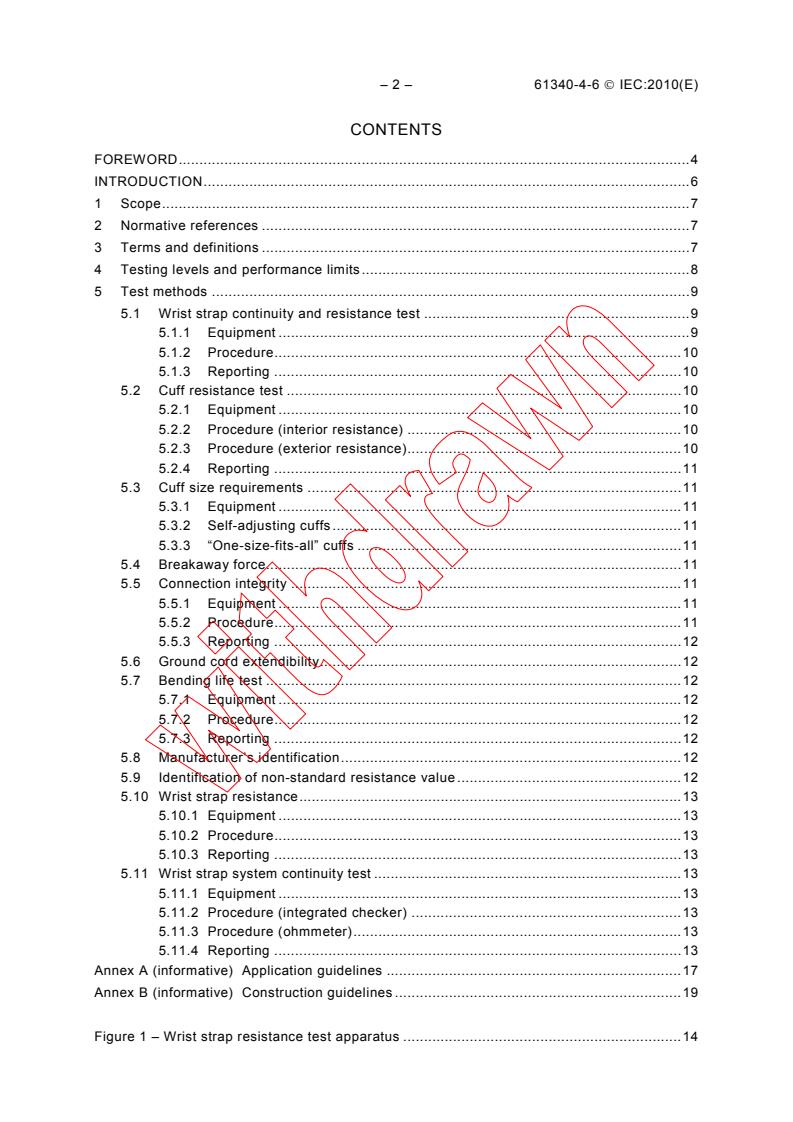
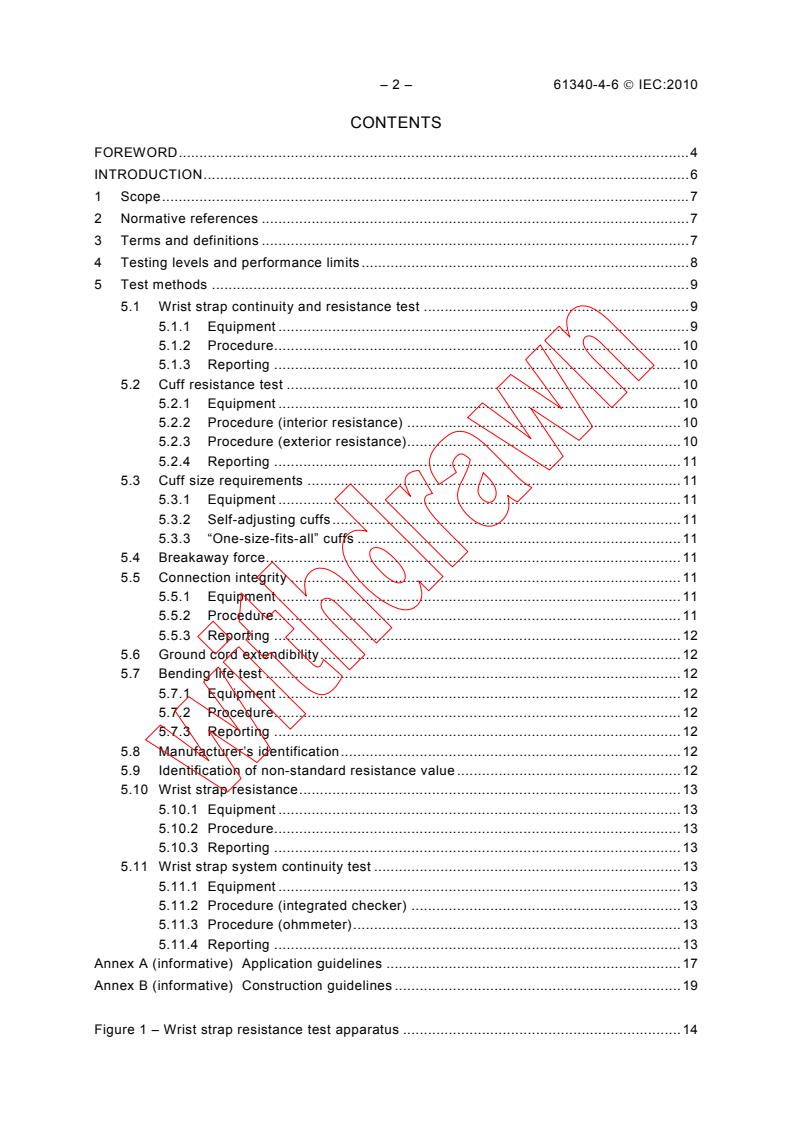
– 2 – 61340-4-6 © IEC:2010(E)
CONTENTS
FOREWORD.4
INTRODUCTION.6
1 Scope.7
2 Normative references .7
3 Terms and definitions .7
4 Testing levels and performance limits.8
5 Test methods .9
5.1 Wrist strap continuity and resistance test .9
5.1.1 Equipment .9
5.1.2 Procedure.10
5.1.3 Reporting .10
5.2 Cuff resistance test .10
5.2.1 Equipment .10
5.2.2 Procedure (interior resistance) .10
5.2.3 Procedure (exterior resistance).10
5.2.4 Reporting .11
5.3 Cuff size requirements .11
5.3.1 Equipment .11
5.3.2 Self-adjusting cuffs.11
5.3.3 “One-size-fits-all” cuffs .11
5.4 Breakaway force.11
5.5 Connection integrity .11
5.5.1 Equipment .11
5.5.2 Procedure.11
5.5.3 Reporting .12
5.6 Ground cord extendibility.12
5.7 Bending life test .12
5.7.1 Equipment .12
5.7.2 Procedure.12
5.7.3 Reporting .12
5.8 Manufacturer’s identification.12
5.9 Identification of non-standard resistance value .12
5.10 Wrist strap resistance.13
5.10.1 Equipment .13
5.10.2 Procedure.13
5.10.3 Reporting .13
5.11 Wrist strap system continuity test .13
5.11.1 Equipment .13
5.11.2 Procedure (integrated checker) .13
5.11.3 Procedure (ohmmeter).13
5.11.4 Reporting .13
Annex A (informative) Application guidelines .17
Annex B (informative) Construction guidelines .19
Figure 1 – Wrist strap resistance test apparatus .14
61340-4-6 © IEC:2010(E) – 3 –
Figure 2 – Flex test apparatus .15
Figure 3 – Wrist strap system resistance test.16
Table 1 – Evaluation testing.9
Table 2 – Acceptance testing.9
Table 3 – Functional testing.9
– 4 – 61340-4-6 © IEC:2010(E)
INTERNATIONAL ELECTROTECHNICAL COMMISSION
______________
ELECTROSTATICS –
Part 4-6: Standard test methods for specific applications –
Wrist straps
FOREWORD
1) The International Electrotechnical Commission (IEC) is a worldwide organization for standardization comprising
all national electrotechnical committees (IEC National Committees). The object of IEC is to promote
international co-operation on all questions concerning standardization in the electrical and electronic fields. To
this end and in addition to other activities, IEC publishes International Standards, Technical Specifications,
Technical Reports, Publicly Available Specifications (PAS) and Guides (hereafter referred to as “IEC
Publication(s)”). Their preparation is entrusted to technical committees; any IEC National Committee interested
in the subject dealt with may participate in this preparatory work. International, governmental and non-
governmental organizations liaising with the IEC also participate in this preparation. IEC collaborates closely
with the International Organization for Standardization (ISO) in accordance with conditions determined by
agreement between the two organizations.
2) The formal decisions or agreements of IEC on technical matters express, as nearly as possible, an international
consensus of opinion on the relevant subjects since each technical committee has representation from all
interested IEC National Committees.
3) IEC Publications have the form of recommendations for international use and are accepted by IEC National
Committees in that sense. While all reasonable efforts are made to ensure that the technical content of IEC
Publications is accurate, IEC cannot be held responsible for the way in which they are used or for any
misinterpretation by any end user.
4) In order to promote international uniformity, IEC National Committees undertake to apply IEC Publications
transparently to the maximum extent possible in their national and regional publications. Any divergence
between any IEC Publication and the corresponding national or regional publication shall be clearly indicated in
the latter.
5) IEC itself does not provide any attestation of conformity. Independent certification bodies provide conformity
assessment services and, in some areas, access to IEC marks of conformity. IEC is not responsible for any
services carried out by independent certification bodies.
6) All users should ensure that they have the latest edition of this publication.
7) No liability shall attach to IEC or its directors, employees, servants or agents including individual experts and
members of its technical committees and IEC National Committees for any personal injury, property damage or
other damage of any nature whatsoever, whether direct or indirect, or for costs (including legal fees) and
expenses arising out of the publication, use of, or reliance upon, this IEC Publication or any other IEC
Publications.
8) Attention is drawn to the Normative references cited in this publication. Use of the referenced publications is
indispensable for the correct application of this publication.
9) Attention is drawn to the possibility that some of the elements of this IEC Publication may be the subject of
patent rights. IEC shall not be held responsible for identifying any or all such patent rights.
International Standard IEC 61340-4-6 has been prepared by IEC technical committee 101:
Electrostatics.
The text of this standard is based on ANSI/ESD S1.1-2006. It was submitted to the National
Committees for voting under the Fast Track Procedure.
The text of this standard is also based on the following documents:
FDIS Report on voting
101/291/FDIS 101/296/RVD
Full information on the voting for the approval of this standard can be found in the report on
voting indicated in the above table.
61340-4-6 © IEC:2010(E) – 5 –
This publication has been drafted in accordance with the ISO/IEC Directives, Part 2.
A list of all parts in the IEC 61340 series, under the general title Electrostatics, can be found
on the IEC website.
The committee has decided that the contents of this publication will remain unchanged until
the maintenance result date indicated on the IEC web site under "http://webstore.iec.ch" in
the data related to the specific publication. At this date, the publication will be
• reconfirmed,
• withdrawn,
• replaced by a revised edition, or
• amended.
A bilingual version of this publication may be issued at a later date.
– 6 – 61340-4-6 © IEC:2010(E)
INTRODUCTION
This part of IEC 61340 has been developed to establish test methods for evaluating the
electrical and mechanical attributes of wrist straps used in an electrostatic control program.
Wrist straps are intended to connect the user to electrical ground, thus preventing
electrostatic charge on a user’s body from attaining a level that may damage ESD susceptible
devices or assemblies.
Test methods and performance limits for evaluation, acceptance, and functional testing are
provided. Application and construction guidance is included in the annexes.
61340-4-6 © IEC:2010(E) – 7 –
ELECTROSTATICS –
Part 4-6: Standard test methods for specific applications –
Wrist straps
1 Scope
This part of IEC 61340 provides electrical and mechanical test methods and performance
limits for evaluation, acceptance and functional testing of wrist straps.
This standard is intended for testing wrist straps and wrist strap systems used for the
grounding of personnel engaged in working with ESD sensitive assemblies and devices.
It does not address constant monitoring systems.
2 Normative references
The following referenced documents are indispensable for the application of this document.
For dated references, only the edition cited applies. For undated references, the latest edition
of the referenced document (including any amendments) applies.
ESD ADV1.0, Glossary of terms
3 Terms and definitions
For the purposes of this document, the following terms and definitions, in addition to those
specified in the ESD association glossary of terms, shall apply.
3.1
wrist strap
assembled device consisting of a wrist cuff and ground cord that provides electrical
connection of a person’s skin to ground
3.2
wrist strap system
wrist strap when properly worn by a person, where the electrical path includes the person, the
cuff and the ground cord
3.3
cuff
portion of the wrist strap worn on the wrist
NOTE The cuff maintains electrical contact with a person’s skin.
3.4
ground cord
portion of the wrist strap that provides flexibility of movement while completing the electrical
circuit between the cuff and ground
___________
ESD Association, 7900 Turin Rd, Bldg. 3, Ste. 2, Rome, NY 13440-2069, 315-339-6937, www.esda.org
– 8 – 61340-4-6 © IEC:2010(E)
3.5
evaluation testing
stringent testing of a wrist strap to determine its electrical and mechanical performance
abilities
NOTE Data are in the form of values from laboratory testing.
3.6
acceptance testing
incoming tests to confirm proper marking and electrical functionality
NOTE Data are in the form of visual inspection records, and values or pass/fail notation.
3.7
functional testing
end-use testing to confirm electrical functionality
NOTE Data are in the form of pass/fail notation or values.
3.8
current-limiting resistance
resistance value incorporated in series with the wrist strap’s electrical path to ground
NOTE This resistance limits electrical current that could pass through the ground cord in the event of inadvertent
user contact with electrical potential.
3.9
resistance range
user-specified upper and lower resistance values which define the user-acceptable resistance
values of a wrist st
...
IEC 61340-4-6 ®
Edition 1.0 2010-01
INTERNATIONAL
STANDARD
NORME
INTERNATIONALE
Electrostatics –
Part 4-6: Standard test methods for specific applications – Wrist straps
Electrostatique –
Partie 4-6: Méthodes d’essai normalisées pour des applications spécifiques –
Bracelets de conduction dissipative
All rights reserved. Unless otherwise specified, no part of this publication may be reproduced or utilized in any form or by
any means, electronic or mechanical, including photocopying and microfilm, without permission in writing from either IEC or
IEC's member National Committee in the country of the requester.
If you have any questions about IEC copyright or have an enquiry about obtaining additional rights to this publication,
please contact the address below or your local IEC member National Committee for further information.
Droits de reproduction réservés. Sauf indication contraire, aucune partie de cette publication ne peut être reproduite
ni utilisée sous quelque forme que ce soit et par aucun procédé, électronique ou mécanique, y compris la photocopie
et les microfilms, sans l'accord écrit de la CEI ou du Comité national de la CEI du pays du demandeur.
Si vous avez des questions sur le copyright de la CEI ou si vous désirez obtenir des droits supplémentaires sur cette
publication, utilisez les coordonnées ci-après ou contactez le Comité national de la CEI de votre pays de résidence.
IEC Central Office
3, rue de Varembé
CH-1211 Geneva 20
Switzerland
Email: inmail@iec.ch
Web: www.iec.ch
About the IEC
The International Electrotechnical Commission (IEC) is the leading global organization that prepares and publishes
International Standards for all electrical, electronic and related technologies.
About IEC publications
The technical content of IEC publications is kept under constant review by the IEC. Please make sure that you have the
latest edition, a corrigenda or an amendment might have been published.
Catalogue of IEC publications: www.iec.ch/searchpub
The IEC on-line Catalogue enables you to search by a variety of criteria (reference number, text, technical committee,…).
It also gives information on projects, withdrawn and replaced publications.
IEC Just Published: www.iec.ch/online_news/justpub
Stay up to date on all new IEC publications. Just Published details twice a month all new publications released. Available
on-line and also by email.
Electropedia: www.electropedia.org
The world's leading online dictionary of electronic and electrical terms containing more than 20 000 terms and definitions
in English and French, with equivalent terms in additional languages. Also known as the International Electrotechnical
Vocabulary online.
Customer Service Centre: www.iec.ch/webstore/custserv
If you wish to give us your feedback on this publication or need further assistance, please visit the Customer Service
Centre FAQ or contact us:
Email: csc@iec.ch
Tel.: +41 22 919 02 11
Fax: +41 22 919 03 00
A propos de la CEI
La Commission Electrotechnique Internationale (CEI) est la première organisation mondiale qui élabore et publie des
normes internationales pour tout ce qui a trait à l'électricité, à l'électronique et aux technologies apparentées.
A propos des publications CEI
Le contenu technique des publications de la CEI est constamment revu. Veuillez vous assurer que vous possédez
l’édition la plus récente, un corrigendum ou amendement peut avoir été publié.
Catalogue des publications de la CEI: www.iec.ch/searchpub/cur_fut-f.htm
Le Catalogue en-ligne de la CEI vous permet d’effectuer des recherches en utilisant différents critères (numéro de référence,
texte, comité d’études,…). Il donne aussi des informations sur les projets et les publications retirées ou remplacées.
Just Published CEI: www.iec.ch/online_news/justpub
Restez informé sur les nouvelles publications de la CEI. Just Published détaille deux fois par mois les nouvelles
publications parues. Disponible en-ligne et aussi par email.
Electropedia: www.electropedia.org
Le premier dictionnaire en ligne au monde de termes électroniques et électriques. Il contient plus de 20 000 termes et
définitions en anglais et en français, ainsi que les termes équivalents dans les langues additionnelles. Egalement appelé
Vocabulaire Electrotechnique International en ligne.
Service Clients: www.iec.ch/webstore/custserv/custserv_entry-f.htm
Si vous désirez nous donner des commentaires sur cette publication ou si vous avez des questions, visitez le FAQ du
Service clients ou contactez-nous:
Email: csc@iec.ch
Tél.: +41 22 919 02 11
Fax: +41 22 919 03 00
IEC 61340-4-6 ®
Edition 1.0 2010-01
INTERNATIONAL
STANDARD
NORME
INTERNATIONALE
Electrostatics –
Part 4-6: Standard test methods for specific applications – Wrist straps
Electrostatique –
Partie 4-6: Méthodes d’essai normalisées pour des applications spécifiques –
Bracelets de conduction dissipative
INTERNATIONAL
ELECTROTECHNICAL
COMMISSION
COMMISSION
ELECTROTECHNIQUE
PRICE CODE
INTERNATIONALE
CODE PRIX R
ICS 17.200.99; 29.020 ISBN 978-2-88912-472-5
– 2 – 61340-4-6 IEC:2010
CONTENTS
FOREWORD . 4
INTRODUCTION . 6
1 Scope . 7
2 Normative references . 7
3 Terms and definitions . 7
4 Testing levels and performance limits . 8
5 Test methods . 9
5.1 Wrist strap continuity and resistance test . 9
5.1.1 Equipment . 9
5.1.2 Procedure . 10
5.1.3 Reporting . 10
5.2 Cuff resistance test . 10
5.2.1 Equipment . 10
5.2.2 Procedure (interior resistance) . 10
5.2.3 Procedure (exterior resistance) . 10
5.2.4 Reporting . 11
5.3 Cuff size requirements . 11
5.3.1 Equipment . 11
5.3.2 Self-adjusting cuffs . 11
5.3.3 “One-size-fits-all” cuffs . 11
5.4 Breakaway force. 11
5.5 Connection integrity . 11
5.5.1 Equipment . 11
5.5.2 Procedure . 11
5.5.3 Reporting . 12
5.6 Ground cord extendibility . 12
5.7 Bending life test . 12
5.7.1 Equipment . 12
5.7.2 Procedure . 12
5.7.3 Reporting . 12
5.8 Manufacturer’s identification . 12
5.9 Identification of non-standard resistance value . 12
5.10 Wrist strap resistance . 13
5.10.1 Equipment . 13
5.10.2 Procedure . 13
5.10.3 Reporting . 13
5.11 Wrist strap system continuity test . 13
5.11.1 Equipment . 13
5.11.2 Procedure (integrated checker) . 13
5.11.3 Procedure (ohmmeter) . 13
5.11.4 Reporting . 13
Annex A (informative) Application guidelines . 17
Annex B (informative) Construction guidelines . 19
Figure 1 – Wrist strap resistance test apparatus . 14
61340-4-6 IEC:2010 – 3 –
Figure 2 – Flex test apparatus . 15
Figure 3 – Wrist strap system resistance test . 16
Table 1 – Evaluation testing . 9
Table 2 – Acceptance testing . 9
Table 3 – Functional testing . 9
– 4 – 61340-4-6 IEC:2010
INTERNATIONAL ELECTROTECHNICAL COMMISSION
______________
ELECTROSTATICS –
Part 4-6: Standard test methods for specific applications –
Wrist straps
FOREWORD
1) The International Electrotechnical Commission (IEC) is a worldwide organization for standardization comprising
all national electrotechnical committees (IEC National Committees). The object of IEC is to promote
international co-operation on all questions concerning standardization in the electrical and electronic fields. To
this end and in addition to other activities, IEC publishes International Standards, Technical Specifications,
Technical Reports, Publicly Available Specifications (PAS) and Guides (hereafter referred to as “IEC
Publication(s)”). Their preparation is entrusted to technical committees; any IEC National Committee interested
in the subject dealt with may participate in this preparatory work. International, governmental and non-
governmental organizations liaising with the IEC also participate in this preparation. IEC collaborates closely
with the International Organization for Standardization (ISO) in accordance with conditions determined by
agreement between the two organizations.
2) The formal decisions or agreements of IEC on technical matters express, as nearly as possible, an international
consensus of opinion on the relevant subjects since each technical committee has representation from all
interested IEC National Committees.
3) IEC Publications have the form of recommendations for international use and are accepted by IEC National
Committees in that sense. While all reasonable efforts are made to ensure that the technical content of IEC
Publications is accurate, IEC cannot be held responsible for the way in which they are used or for any
misinterpretation by any end user.
4) In order to promote international uniformity, IEC National Committees undertake to apply IEC Publications
transparently to the maximum extent possible in their national and regional publications. Any divergence
between any IEC Publication and the corresponding national or regional publication shall be clearly indicated in
the latter.
5) IEC itself does not provide any attestation of conformity. Independent certification bodies provide conformity
assessment services and, in some areas, access to IEC marks of conformity. IEC is not responsible for any
services carried out by independent certification bodies.
6) All users should ensure that they have the latest edition of this publication.
7) No liability shall attach to IEC or its directors, employees, servants or agents including individual experts and
members of its technical committees and IEC National Committees for any personal injury, property damage or
other damage of any nature whatsoever, whether direct or indirect, or for costs (including legal fees) and
expenses arising out of the publication, use of, or reliance upon, this IEC Publication or any other IEC
Publications.
8) Attention is drawn to the Normative references cited in this publication. Use of the referenced publications is
indispensable for the correct application of this publication.
9) Attention is drawn to the possibility that some of the elements of this IEC Publication may be the subject of
patent rights. IEC shall not be held responsible for identifying any or all such patent rights.
International Standard IEC 61340-4-6 has been prepared by IEC technical committee 101:
Electrostatics.
The text of this standard is based on ANSI/ESD S1.1-2006. It was submitted to the National
Committees for voting under the Fast Track Procedure.
This bilingual version (2011-04) replaces the English version.
61340-4-6 IEC:2010 – 5 –
The text of this standard is also based on the following documents:
FDIS Report on voting
101/291/FDIS 101/296/RVD
Full information on the voting for the approval of this standard can be found in the report on
voting indicated in the above table.
The French version of this standard has not been voted upon.
This publication has been drafted in accordance with the ISO/IEC Directives, Part 2.
A list of all parts in the IEC 61340 series, under the general title Electrostatics, can be found
on the IEC website.
Le comité a décidé que le contenu de cette publication ne sera pas modifié avant la date de
stabilité indiquée sur le site web de la CEI sous "http://webstore.iec.ch" dans les données
relatives à la publication recherchée. A cette date, la publication sera
• reconduite,
• supprimée,
• remplacée par une édition révisée, ou
• amendée.
– 6 – 61340-4-6 IEC:2010
INTRODUCTION
This part of IEC 61340 has been developed to establish test methods for evaluating the
electrical and mechanical attributes of wrist straps used in an electrostatic control program.
Wrist straps are intended to connect the user to electrical ground, thus preventing
electrostatic charge on a user’s body from attaining a level that may damage ESD susceptible
devices or assemblies.
Test methods and performance limits for evaluation, acceptance, and functional testing are
provided. Application and construction guidance is included in the annexes.
61340-4-6 IEC:2010 – 7 –
ELECTROSTATICS –
Part 4-6: Standard test methods for specific applications –
Wrist straps
1 Scope
This part of IEC 61340 provides electrical and mechanical test methods and performance
limits for evaluation, acceptance and functional testing of wrist straps.
This standard is intended for testing wrist straps and wrist strap systems used for the
grounding of personnel engaged in working with ESD sensitive assemblies and devices.
It does not address constant monitoring systems.
2 Normative references
The following referenced documents are indispensable for the application of this document.
For dated references, only the edition cited applies. For undated references, the latest edition
of the referenced document (including any amendments) applies.
ESD ADV1.0, Glossary of terms
3 Terms and definitions
For the purposes of this document, the following terms and definitions, in addition to those
specified in the ESD association glossary of terms, shall apply.
3.1
wrist strap
assembled device consisting of a wrist cuff and ground cord that provides electrical
connection of a person’s skin to ground
3.2
wrist strap system
wrist strap when properly worn by a person, where the electrical path includes the person, the
cuff and the ground cord
3.3
cuff
portion of the wrist strap worn on the wrist
NOTE The cuff maintains electrical contact with a person’s skin.
3.4
ground cord
portion of the wrist strap that provides flexibility of movement while completing the electrical
circuit between the cuff and ground
___________
ESD Association, 7900 Turin Rd, Bldg. 3, Ste. 2, Rome, NY 13440-2069, 315-339-6937, www.esda.org
– 8 – 61340-4-6 IEC:2010
3.5
evaluation testing
stringent testing of a wrist strap to determine its electrical and mechanical performance
abilities
NOTE Data are in the form of values from laboratory testing.
3.6
acceptance testing
incoming tests to confirm proper marking and electrical functionality
NOTE Data are in the form of visual inspection records, and values or pass/fail notation.
3.7
functional testing
end-use testing to confirm electrical functionality
NOTE Data are in the form of pass/fail notation or values.
3.8
current-limiting resistance
resistance value incorporated in series with the wrist strap’s electrical path to ground
NOTE This resistance limits electrical current that could pass through the ground cord in the event of inadvertent
user contact with electrical potential.
3.9
resistance range
user-specified upper and lower resistance values which define the user-acceptable resistance
values of a wrist strap or wrist strap system
3.10
strain relief
construction feature designed to protect the connections and cord from premature failure
3.11
breakaway force
force required to disconnect the ground cord from the cuff
4 Testing levels and performance limits
This part of IEC 61340 specifies different types of testing for wrist straps. Tables 1, 2 and 3
detail the three types of testing with the associated limits and paragraph references to test
methods. The methods provide appropriate tests for the different levels of wrist strap
examination. The “evaluation tests” are laboratory tests for measuring the performance of a
wrist strap or for the comparison of wrist straps. “Acceptance tests” provide methods for
incoming goods inspection. Finally, the “functional test” is a simple check of electrical
continuity. This test shall be used on a regular, user-defined basis, to ensure that the wrist
strap is electrically functional.
61340-4-6 IEC:2010 – 9 –
Table 1 – Evaluation testing
Electrical Limit Test ref.
Wrist strap continuity and resistance 1 mΩ ± 20 %, or user defined value 5.1
Cuff resistance Interior:
≤100 kΩ or user defined value 5.2
Exterior:
≥10 mΩ
Mechanical Limit Test ref.
Cuff size Defined 5.3
Breakaway force 5.4
> 0,45 kg (1 lb), < 2,3 kg (5 lb)
Connector and cord integrity > 2,3 kg (5 lb) and > 66 % of cord strength 5.5
Ground cord extendibility Extension to manufacturer’s specified 5.6
length with no continuity loss
Bending life ≥ 16 000 cycles 5.7
Marking Limit Test ref.
Manufacturer’s identification Logo and/or name 5.8
Identification of non-standard Red feature. Value marked 5.9
Resistance value
Table 2 – Acceptance testing
Electrical Limit Test ref.
Wrist strap resistance 1 mΩ ± 20 %, or user defined value 5.10
Marking Limit Test ref.
Manufacturer’s identification Logo and/or name 5.8
Identification of non-standard Red feature. Value marked 5.9
Resistance value
Table 3 – Functional testing
Electrical Limit Test ref.
Wrist strap system continuity 5.11
“Pass” or ≤ 10 mΩ, or user defined value
5 Test methods
Refer to Tables 1, 2 and 3 for test method applications.
5.1 Wrist strap continuity and resistance test
This test measures the value of the current-limiting resistance and assures continuity between
the discrete parts of the wrist strap.
5.1.1 Equipment
The equipment shall consist of the following:
– 10 – 61340-4-6 IEC:2010
• A test fixture (see Figure 1) comprising an insulative stand and two 2,54 cm (1 “) diameter
stainless steel cylinders, with one cylinder fixed to the stand directly above the second.
The second cylinder will weigh 0,11 kg (0,25 lb) and is mounted in a slot in the stand that
allows free vertical movement;
• an ohmmeter or other instrument(s) capable of reading from at least 50 kΩ to at least
100 m mΩ with a test voltage of 7 V to 30 V DC open circuit;
• six samples of wrist straps.
5.1.2 Procedure
Using the fixture shown in Figure 1, place the cuff around the cylinders with the cuff interior
toward the cylinders and the ground cord connector on the right side and parallel to the
cylinders, evenly spaced between the cylinders. Allow the 0,11 kg (0,25 lb) cylinder to move
freely and stress the cuff.
Connect the ground cord to the cuff.
Connect the ohmmeter to the top cylinder and to the ground connector of the ground cord.
Measure and record the resistance.
Repeat the test for a total of six wrist straps.
5.1.3 Reporting
Report the resistance for each wrist strap.
5.2 Cuff resistance test
Resistance of the cuff interior and exterior is determined.
5.2.1 Equipment
See 5.1.1.
5.2.2 Procedure (interior resistance)
Using the test fixture from 5.1.1, Figure 1, place a cuff around the cylinders with the cuff
interior toward the cylinders and the ground cord connector on the right side and parallel to
the cylinders, evenly spaced between the cylinders. Allow the 0,11 kg (0,25 lb) cylinder to
move freely and stress the cuff.
Connect the ohmmeter to the top cylinder and the ground cord connector on the cuff. Measure
and record the resistance value.
Repeat procedure for a total of six cuffs.
5.2.3 Procedure (exterior resistance)
Place a cuff around the cylinders (Figure 1) with the cuff exterior toward the cylinders and the
ground cord connector on the right side and parallel to the cylinders, evenly spaced between
the cylinders. Allow the 0,11 kg (0,25 lb) cylinder to move freely and stress the cuff.
Connect the ohmmeter to the top cylinder and the ground cord connector on the cuff. Measure
and record the resistance value.
Repeat procedure for a total of six cuffs.
61340-4-6 IEC:2010 – 11 –
5.2.4 Reporting
Report the interior resistance and exterior resistance of each cuff.
5.3 Cuff size requirements
Cuff sizes are determined by the cuff’s ability to fit over a specifically sized cylinder. A cuff’s
ability to expand to fit over a hand, yet contract to fit snugly around a wrist is determined by
fitting the cuff over specifically sized large and small cylinders.
5.3.1 Equipment
The equipment shall consist of the following:
• 1 cylinder having an outside diameter of 4,3 cm (1,70 “)
• 1 cylinder having an outside diameter of 5,3 cm (2,10")
• 1 cylinder having an outside diameter of 8,25 cm (3,25")
• 1 cylinder having an outside diameter of 8,9 cm (3,50")
5.3.2 Self-adjusting cuffs
“Large”-sized self-adjustable expanding metal or fabric cuffs shall fit snugly onto a 5,3 cm
(2,10") diameter cylinder, and be capable of easily fitting over a 8,9 cm (3,50") diameter
cylinder.
“Small”-sized self-adjustable expanding metal or fabric cuffs shall fit snugly onto a 4,3 cm
(170") diameter cylinder, and be capable of easily fitting over a 8,25 cm (3,25") diameter
cylinder.
5.3.3 “One-size-fits-all” cuffs
“One-size-fits-all” cuffs shall fit snugly on a 4,3 cm (1,70") diameter cylinder and be capable of
sufficient expansion to fit over a 8,9 cm (3,5") cylinder.
5.4 Breakaway force
With the ground cord connected to the cuff in a normal manner, a force of ≥ 0,45 kg (1 lb) but
≤ 2,3 kg (5 lb) applied to the ground cord, in the normal disconnect direction, shall be required
to separate the ground cord from the cuff.
5.5 Connection integrity
The strengths of the ground cord, the ground cord’s attachment to the ground, and cuff
connectors are determined.
5.5.1 Equipment
The equipment shall consist of the following:
• tensile tester capable of 6,35 cm (2,5") per minute travel;
• grippers for tensile tester;
• chart recorder.
5.5.2 Procedure
Using the tensile tester and chart recorder, test and record the tensile strength (breaking point)
of the ground cord, the ground connector to the ground cord, and the cuff connector to the
cord. Repeat the test for a total of six ground cords.
– 12 – 61340-4-6 IEC:2010
5.5.3 Reporting
Report the tensile strength of each connector.
5.6 Ground cord extendibility
Retractable-type ground cords shall be capable of being extended to the manufacturer’s
specified length without pulling the cuff away from the user’s wrist to the extent that electrical
continuity, as measured in 5.11, is interrupted.
5.7 Bending life test
Ground cord flex life is determined.
5.7.1 Equipment
The equipment shall consist of the following:
• mechanical ground cord flex tester: this is a machine that drives a rocker plate through an
arc of 120° at a rate of approximately 2 000 cycles per hour (see Figure 2);
NOTE 1 A flex tester with a larger number of rocker plates is acceptable.
NOTE 2 Ground cords are attached to the rocker plates by means of a mounting that simulates alternately
the cuff connector and the ground connector.
• 45 kg (1 lb) weights;
• resistance meter with a test voltage ≤ 30 V.
5.7.2 Procedure
Attach one end of a ground cord to a rocker plate. Connect the opposite end to a 0,45 kg (1 lb)
weight and allow the ground cord to hang freely. Connect the resistance monitoring cable to
the ground cord conductor at the weighted end.
Start the flex tester.
Six cords shall be tested with the cuff connection attached to rocker plate and six cords shall
be tested with the ground connection attached to rocker plate.
5.7.3 Reporting
Ground cord failure is defined as the total resistance of the circuit exceeding 1,25 mΩ (or user
defined value), or when there is visible evidence of mechanical failure in the cord jacket or
strain relief. Each ground cord shall have a minimum life of at least 8 000 cycles and the
average of all samples tested shall have a minimum life of 16 000 cycles.
5.8 Manufacturer’s identification
Wrist straps shall have the manufacturer’s name or logo embossed, molded or otherwise
permanently marked in a prominent location.
5.9 Identification of non-standard resistance value
Wrist straps incorporating a resistance of non-standard value (other than 1,0 mΩ ± 20 %)
shall be identified by having a prominent feature, red in colour, on the wrist strap. Additionally,
the value of the non-standard resistance shall be marked on the portion of the wrist strap that
contains the resistance. Only wrist straps incorporating a non-standard value shall use the
colour red on any portion of the wrist strap.
61340-4-6 IEC:2010 – 13 –
5.10 Wrist strap resistance
This test determines the resistance of the wrist strap.
5.10.1 Equipment
The equipment shall consist of the following:
• an mΩ or other instrument(s) capable of reading from 50 kΩ to at least 100 mΩ with a test
voltage of 7 V to 30 V DC open circuit.
5.10.2 Procedure
Connect the cuff to the ground cord. Attach the ground cord to an ohmmeter lead. Connect
the skin contact area of the cuff to the other ohmmeter lead. Measure the resistance of the
wrist strap. Repeat the test for a total of six wrist straps.
5.10.3 Reporting
Report the resistance value of each wrist strap.
5.11 Wrist strap system continuity test
This verifies the acceptability of the resistance path of the wrist strap system using an
integrated wrist strap checker or an ohmmeter. This test shall be performed with the wrist
strap on the intended user(s) wrist. This test includes the wrist strap user’s resistance as part
of the total system resistance.
5.11.1 Equipment
The equipment shall consist of the following:
• an integrated wrist strap system checker
– OR –
• an ohmmeter or other instrument(s) capable of reading from 50 kΩ to at least 100 mΩ with
a test voltage of 7 V to 30 V DC open circuit.
• a stainless steel cylinder 15,24 cm (6" in length and 2,54 cm (1" in diameter (Figure 3).
5.11.2 Procedure (integrated checker)
Place the cuff on the user’s wrist, attach the ground cord to the cuff, and attach the ground
cord to the integrated checker. Touch the body contact area on the checker with the hand
closest to the cuff, and activate the checker per the manufacturer’s instructions. Record the
“pass” or “fail” indication.
5.11.3 Procedure (ohmmeter)
Place the cuff on the user’s wrist, attach the ground cord to the cuff, and attach the ground
cord to the common terminal (-) of the ohmmeter. Connect the stainless steel cylinder to the
positive terminal (+) of the ohmmeter. Grasp the cylinder with the hand closest to the cuff.
Measure and record the resistance of the wrist strap system (see Figure 3).
5.11.4 Reporting
A “pass” indication from the integrated checker indicates that the resistance of the wrist strap
system is acceptable for use. A value of ≤ 10 mΩ or a reading falling within the user-specified
resistance range indicates that the wrist strap system is acceptable for use.
NOTE See Annex A for troubleshooting guidance about correcting “failing” wrist straps.
– 14 – 61340-4-6 IEC:2010
Fixed metal cylinder test probe,
Cuff test fixture
13,9 cm
2,54 cm (1") diameter
construction
(5,5")
Hole for banana plug
Movable metal cylinder test
weight, 2,54 cm (1") diameter,
Insulative
0,11 kg (0,25 lb)
12,7 cm
(5,0")
0,97 cm
(0,38") 10,2 cm
(4,0")
Ohmmeter
Test method
(1 mΩ min.)
Cuff
Clip connects
to meter
IEC 2581/09
Figure 1 – Wrist strap resistance test apparatus
61340-4-6 IEC:2010 – 15 –
360° rotation
(direction
Counter
optional)
Rocker
plate
Resistance
monitor
device
Snap mount for cuff
termination and/or
0°
alternate mount for
60°
60°
ground termination
Cord length
varies
0,45 kg (1 lb) weight
IEC 2582/09
Figure 2 – Flex test apparatus
– 16 – 61340-4-6 IEC:2010
Ohmmeter
Wrist strap #304 stainless steel
electrode
Positive lead
Ground lead
IEC 2583/09
Figure 3 – Wrist strap system resistance test
61340-4-6 IEC:2010 – 17 –
Annex A
(informative)
Application guidelines
A.1 Ground fault protection
The use of ground fault current interrupters (GFCI) should be considered whenever personnel
are likely to come into contact with electrical power sources.
A.2 Breakaway force
The connection(s) should not prevent a person’s easy and rapid departure from the work area.
A.3 Frequency of functional testing
The wrist strap system should be tested daily to ensure proper electrical value. Nominally, the
upper resistance reading should be ≤10 mΩ or a user-defined value. Daily testing may be
omitted if constant monitoring is used.
NOTE Integrated wrist strap checker’s operation should be verified per the manufacturer’s instructions.
A.4 Grounding considerations
Connections to ground beneath the front edge of a work bench or to a common ground point
connection on a work mat are convenient means of wrist strap grounding. Static dissipative
mats should not be placed in series with the electrical path of a wrist strap.
When handling ESD sensitive devices or assemblies in installed equipment, the wrist strap
should be connected to a proper or identified ground point.
A.5 Fabric cuff washing / cleaning
Occasional washing of expandable fabric cuffs will remove skin oils and other contaminates
that may increase contact resistance. Excessive washings or severe washings may shorten
the life of the cuff. Washing should be performed per the manufacturer’s instructions.
Functional testing should be performed after washing and drying the fabric cuff.
A.6 Troubleshooting
The following steps may indicate the cause of a “fail” condition, or an unacceptable resistance
reading as determined in 5.11.4:
a) Cuff fit
Visually examine the wrist strap cuff to ensure that it is adjusted snugly to the skin and
fitted per the manufacturer’s instructions.
b) Wrist strap components
Replace the cuff with a new cuff and repeat the test in 5.11.
Replace the ground cord with a new ground cord and repeat the test in 5.11.
c) Skin contact resistance
– 18 – 61340-4-6 IEC:2010
If steps a) and b) are not effective, and the wrist strap in question functions on a different
person, the “failing” person’s skin may have a high electrical resistance. The use of an
expandable metal cuff and/or dissipative lotion or gel may reduce the person’s skin
contact resistance.
61340-4-6 IEC:2010 – 19 –
Annex B
(informative)
Construction guidelines
B.1 Current-limiting resistance
A resistance of sufficient resitance to limit current to less than 0,000 5 A (0,5 mA), at the
highest voltage that may be encountered, should be incorporated into the wrist strap.
Nominally, 800 000 Ω (800 kΩ) are sufficient for voltages of up to 240 Ω alternating current.
The value of 1 mΩ is specified because it is a standard value discrete resistor. Special
situations may dictate the use of values above or below the 1 Ω value. Wrist straps with
nominal resistances other than 1 Ω should be marked in accordance with 5.9.
Discrete current-limiting resistors should be located near the connection between the ground
cord and the cuff.
B.2 Cuff outside surface
To reduce the possibility of a wrist strap wearer inadvertently conducting an electrical current
through the cuff exterior to the skin, the resistance of the cuff exterior should be > 10 mΩ.
___________
– 20 – 61340-4-6 CEI:2010
SOMMAIRE
AVANT-PROPOS . 22
INTRODUCTION . 24
1 Domaine d’application . 25
2 Références normatives . 25
3 Termes et définitions . 25
4 Niveaux d’essai et limites de performances . 26
5 Méthodes d’essai . 27
5.1 Essai de continuité et résistance du bracelet de conduction dissipative . 27
5.1.1 Equipement . 28
5.1.2 Mode opératoire . 28
5.1.3 Rapport . 28
5.2 Essai de résistance de la bande . 28
5.2.1 Equipement . 28
5.2.2 Mode opératoire (résistance intérieure) . 28
5.2.3 Mode opératoire (résistance extérieure) . 28
5.2.4 Rapport . 29
5.3 Exigences concernant la taille de la bande . 29
5.3.1 Equipement . 29
5.3.2 Bandes auto-ajustables . 29
5.3.3 Bandes à “taille unique” . 29
5.4 Force de détachement . 29
5.5 Intégrité de connexion . 29
5.5.1 Equipement . 29
5.5.2 Mode opératoire . 30
5.5.3 Rapport . 30
5.6 Extensibilité du cordon de terre . 30
5.7 Essai de durée de vie en flexion . 30
5.7.1 Equipement . 30
5.7.2 Mode opératoire . 30
5.7.3 Rapport . 30
5.8 Identification du fabricant . 31
5.9 Identification de la valeur de résistance non-conforme . 31
5.10 Résistance du bracelet antistatique . 31
5.10.1 Equipement . 31
5.10.2 Mode opératoire . 31
5.10.3 Rapport . 31
5.11 Essai de continuité du système de bracelet antistatique . 31
5.11.1 Equipement . 31
5.11.2 Mode opératoire (dispositif de contrôle intégré) . 32
5.11.3 Mode opératoire (ohmmètre) . 32
5.11.4 Rapport . 32
Annexe A (informative) Lignes directrices d’application . 36
Annexe B (informative) Lignes directrices de construction . 38
Figure 1 – Appareil d’essai de la résistance des bracelets de conduction dissipative . 33
Figure 2 – Appareil d’essai en flexion . 34
61340-4-6 CEI:2010 – 21 –
Figure 3 – Essai de résistance d’un système de bracelet de conduction dissipative . 35
Tableau 1 – Essais d’évaluation . 27
Tableau 2 – Essais d’acceptation . 27
Tableau 3 – Essais fonctionnels . 27
– 22 – 61340-4-6 CEI:2010
COMMISSION ÉLECTROTECHNIQUE INTERNATIONALE
______________
ÉLECTROSTATIQUE –
Partie 4-6: Méthodes d’essai normalisées
pour des applications spécifiques –
Bracelets de conduction dissipative
AVANT-PROPOS
1) La Commission Electrotechnique Internationale (CEI) est une organisation mondiale de normalisation
composée de l'ensemble des comités électrotechniques nationaux (Comités nationaux de la CEI). La CEI a
pour objet de favoriser la coopération internationale pour toutes les questions de normalisation dans les
domaines de l'électricité et de l'électronique. A cet effet, la CEI – entre autres activités – publie des Normes
internationales, des Spécifications techniques, des Rapports techniques, des Spécifications accessibles au
public (PAS) et des Guides (ci-après dénommés "Publication(s) de la CEI"). Leur élaboration est confiée à des
comités d'études, aux travaux desquels tout Comité national intéressé par le sujet traité peut participer. Les
organisations internationales, gouvernementales et non gouvernementales, en liaison avec la CEI, participent
également aux travaux. La CEI collabore étroitement avec l'Organisation Internationale de Normalisation (ISO),
selon des conditions fixées par accord entre les deux organisations.
2) Les décisions ou accords officiels de la CEI concernant les questions techniques représentent, dans la mesure
du possible, un accord international sur les sujets étudiés, étant donné que les Comités nationaux de la CEI
intéressés sont représentés dans chaque comité d’études.
3) Les Publications de la CEI se présentent sous la forme de recommandations internationales et sont agréées
comme telles par les Comités nationaux de la CEI. Tous les efforts raisonnables sont entrepris afin que la CEI
s'assure de l'exactitude du contenu technique de ses publications; la CEI ne peut pas être tenue responsable
de l'éventuelle mauvaise utilisation ou interprétation qui en est faite par un quelconque utilisateur final.
4) Dans le but d'encourager l'uniformité internationale, les Comités nationaux de la CEI s'engagent, dans toute la
mesure possible, à appliquer de façon transparente les Publications de la CEI dans leurs publications
nationales et régionales. Toutes divergences entre toutes Publications de la CEI et toutes publications
nationales ou
...