


IEC 61158-2:2014
(Main)Industrial communication networks - Fieldbus specifications - Part 2: Physical layer specification and service definition
Industrial communication networks - Fieldbus specifications - Part 2: Physical layer specification and service definition
IEC 61158-2:2014 specifies the requirements for fieldbus component parts. It also specifies the media and network configuration requirements necessary to ensure agreed levels of data integrity before data-link layer error checking and interoperability between devices at the physical layer. The fieldbus physical layer conforms to layer 1 of the OSI 7-layer model as defined by ISO 7498 with the exception that, for some types, frame delimiters are in the physical layer while for other types they are in the data-link layer. This sixth edition cancels and replaces the fifth edition published in 2010. It constitutes a technical revision. This edition includes the following changes:
- new Type 20 specification;
- new Type 24 specification;
- RS232 media specification for Type 4 removed.
Réseaux de communication industriels - Spécifications des bus de terrain - Partie 2: Spécification et définition des services de la couche physique
L'IEC 61158-2:2014 spécifie les exigences applicables aux composants de bus de terrain. Elle spécifie également les exigences de configuration des supports et des réseaux requises pour garantir un niveau d'intégrité des données avant vérification d'erreur de la couche liaison de données et l'interopérabilité entre appareils au niveau de la couche physique. La couche physique des bus de terrain est conforme à la couche 1 du modèle OSI à 7 couches, telle que définie dans l'ISO/CEI 7498, à l'exception du fait que, pour certains types, les délimiteurs de trame se trouvent dans la couche physique tandis que pour d'autres types, ils se trouvent dans la couche liaison de données. Cette sixième édition annule et remplace la cinquième édition parue en 2010. Elle constitue une révision technique. Elle inclut les modifications suivantes:
- nouvelle spécification de Type 20;
- nouvelle spécification de Type 24;
- spécification des supports RS232 pour Type 4 retirée.
General Information
- Status
- Published
- Publication Date
- 16-Jul-2014
- Technical Committee
- SC 65C - Industrial networks
- Drafting Committee
- WG 9 - TC 65/SC 65C/WG 9
- Current Stage
- DELPUB - Deleted Publication
- Start Date
- 09-Mar-2023
- Completion Date
- 15-May-2020
Relations
- Effective Date
- 05-Sep-2023
- Effective Date
- 05-Sep-2023
Overview
IEC 61158-2:2014 is an international standard published by the International Electrotechnical Commission (IEC) that defines the physical layer specifications and service definitions for industrial communication networks using fieldbus technology. This sixth edition of the standard serves as a technical revision, replacing the previous 2010 edition, and provides updated requirements essential for fieldbus component parts and their interoperability at the physical layer
The standard aligns with layer 1 of the OSI 7-layer model according to ISO 7498, with specific adaptations in how frame delimiters are handled between the physical and data-link layers for various fieldbus types. Importantly, IEC 61158-2:2014 ensures that all specified media and network configurations achieve required data integrity before error checking at higher layers.
Key Topics
Physical Layer Requirements: Comprehensive details for designing and implementing the physical layer components necessary for fieldbus networks, including media types and configurations.
Media Types and Network Configurations: Specifications cover various media types such as twisted-pair wire, coaxial cable, optical media, and specialized wire media across different fieldbus types (e.g., Type 1, Type 2, Type 3, Type 4, Type 8, Type 12, Type 16, Type 18, Type 20, Type 24).
Service Definitions and Interfaces: Defines the service primitives and interface requirements between the physical layer and the data link layer to facilitate communication integrity and device interoperability.
New and Updated Specifications: Introduction of new Type 20 and Type 24 media specifications, with the removal of the RS232 media spec for Type 4, reflecting advancements in fieldbus physical layer technologies.
Compliance with OSI Model: Consistent with layer 1 of the OSI 7-layer model, promoting standardization across fieldbus physical layer implementations.
Applications
IEC 61158-2:2014 is critical for developers, engineers, and manufacturers involved in industrial automation and communications. The standard’s physical layer specifications enable:
Reliable Fieldbus Communications: Facilitates robust and high-integrity communication between industrial devices such as sensors, actuators, controllers, and fieldbus gateways.
Interoperability Across Devices: Ensures that devices from different vendors can operate seamlessly on the same physical communication infrastructure.
Design of Industrial Network Hardware: Provides technical guidance necessary for designing physical media components and interfaces compatible with fieldbus networks.
Compliance and Certification: Assists companies in meeting global compliance requirements for industrial communication products associated with fieldbus networks.
Scalable Industrial Network Solutions: Supports various network sizes and configurations, including use cases with optical media or wired connections based on application requirements.
Related Standards
IEC 61158 (Parts 1 to 7) - Encompasses comprehensive fieldbus standards covering application, data-link, and other layers.
ISO 7498 - Defines the OSI Reference Model for Open Systems Interconnection, which IEC 61158-2 follows for the physical layer.
IEC 61784 - Specifies profiles for industrial communication networks using fieldbus technologies, complementing the physical layer definitions.
IEC 61850 - Focuses on communication networks and systems in substations, often integrating with fieldbus standards for intricate automation systems.
Summary
IEC 61158-2:2014 plays a vital role in standardizing physical layer components for industrial communication networks. By specifying precise requirements for fieldbus media and physical interfaces, it guarantees interoperability, reliable data exchange, and integrity at the foundational network layer. This standard is indispensable for stakeholders in industrial automation seeking to implement or maintain robust and compliant fieldbus systems.
Frequently Asked Questions
IEC 61158-2:2014 is a standard published by the International Electrotechnical Commission (IEC). Its full title is "Industrial communication networks - Fieldbus specifications - Part 2: Physical layer specification and service definition". This standard covers: IEC 61158-2:2014 specifies the requirements for fieldbus component parts. It also specifies the media and network configuration requirements necessary to ensure agreed levels of data integrity before data-link layer error checking and interoperability between devices at the physical layer. The fieldbus physical layer conforms to layer 1 of the OSI 7-layer model as defined by ISO 7498 with the exception that, for some types, frame delimiters are in the physical layer while for other types they are in the data-link layer. This sixth edition cancels and replaces the fifth edition published in 2010. It constitutes a technical revision. This edition includes the following changes: - new Type 20 specification; - new Type 24 specification; - RS232 media specification for Type 4 removed.
IEC 61158-2:2014 specifies the requirements for fieldbus component parts. It also specifies the media and network configuration requirements necessary to ensure agreed levels of data integrity before data-link layer error checking and interoperability between devices at the physical layer. The fieldbus physical layer conforms to layer 1 of the OSI 7-layer model as defined by ISO 7498 with the exception that, for some types, frame delimiters are in the physical layer while for other types they are in the data-link layer. This sixth edition cancels and replaces the fifth edition published in 2010. It constitutes a technical revision. This edition includes the following changes: - new Type 20 specification; - new Type 24 specification; - RS232 media specification for Type 4 removed.
IEC 61158-2:2014 is classified under the following ICS (International Classification for Standards) categories: 25.040.40 - Industrial process measurement and control; 35.100.20 - Data link layer; 35.240.50 - IT applications in industry. The ICS classification helps identify the subject area and facilitates finding related standards.
IEC 61158-2:2014 has the following relationships with other standards: It is inter standard links to IEC 61158-2:2010, IEC 61158-2:2023. Understanding these relationships helps ensure you are using the most current and applicable version of the standard.
You can purchase IEC 61158-2:2014 directly from iTeh Standards. The document is available in PDF format and is delivered instantly after payment. Add the standard to your cart and complete the secure checkout process. iTeh Standards is an authorized distributor of IEC standards.
Standards Content (Sample)
IEC 61158-2 ®
Edition 6.0 2014-07
INTERNATIONAL
STANDARD
NORME
INTERNATIONALE
colour
inside
Industrial communication networks – Fieldbus specifications –
Part 2: Physical layer specification and service definition
Réseaux de communication industriels – Spécifications des bus de terrain –
Partie 2: Spécification et définition des services de la couche physique
All rights reserved. Unless otherwise specified, no part of this publication may be reproduced or utilized in any form
or by any means, electronic or mechanical, including photocopying and microfilm, without permission in writing from
either IEC or IEC's member National Committee in the country of the requester. If you have any questions about IEC
copyright or have an enquiry about obtaining additional rights to this publication, please contact the address below or
your local IEC member National Committee for further information.
Droits de reproduction réservés. Sauf indication contraire, aucune partie de cette publication ne peut être reproduite
ni utilisée sous quelque forme que ce soit et par aucun procédé, électronique ou mécanique, y compris la photocopie
et les microfilms, sans l'accord écrit de l'IEC ou du Comité national de l'IEC du pays du demandeur. Si vous avez des
questions sur le copyright de l'IEC ou si vous désirez obtenir des droits supplémentaires sur cette publication, utilisez
les coordonnées ci-après ou contactez le Comité national de l'IEC de votre pays de résidence.
IEC Central Office Tel.: +41 22 919 02 11
3, rue de Varembé Fax: +41 22 919 03 00
CH-1211 Geneva 20 info@iec.ch
Switzerland www.iec.ch
About the IEC
The International Electrotechnical Commission (IEC) is the leading global organization that prepares and publishes
International Standards for all electrical, electronic and related technologies.
About IEC publications
The technical content of IEC publications is kept under constant review by the IEC. Please make sure that you have the
latest edition, a corrigenda or an amendment might have been published.
IEC Catalogue - webstore.iec.ch/catalogue Electropedia - www.electropedia.org
The stand-alone application for consulting the entire The world's leading online dictionary of electronic and
bibliographical information on IEC International Standards, electrical terms containing more than 30 000 terms and
Technical Specifications, Technical Reports and other definitions in English and French, with equivalent terms in 14
documents. Available for PC, Mac OS, Android Tablets and additional languages. Also known as the International
iPad. Electrotechnical Vocabulary (IEV) online.
IEC publications search - www.iec.ch/searchpub IEC Glossary - std.iec.ch/glossary
The advanced search enables to find IEC publications by a More than 55 000 electrotechnical terminology entries in
variety of criteria (reference number, text, technical English and French extracted from the Terms and Definitions
committee,…). It also gives information on projects, replaced clause of IEC publications issued since 2002. Some entries
and withdrawn publications. have been collected from earlier publications of IEC TC 37,
77, 86 and CISPR.
IEC Just Published - webstore.iec.ch/justpublished
Stay up to date on all new IEC publications. Just Published IEC Customer Service Centre - webstore.iec.ch/csc
details all new publications released. Available online and If you wish to give us your feedback on this publication or
also once a month by email. need further assistance, please contact the Customer Service
Centre: csc@iec.ch.
A propos de l'IEC
La Commission Electrotechnique Internationale (IEC) est la première organisation mondiale qui élabore et publie des
Normes internationales pour tout ce qui a trait à l'électricité, à l'électronique et aux technologies apparentées.
A propos des publications IEC
Le contenu technique des publications IEC est constamment revu. Veuillez vous assurer que vous possédez l’édition la
plus récente, un corrigendum ou amendement peut avoir été publié.
Catalogue IEC - webstore.iec.ch/catalogue Electropedia - www.electropedia.org
Application autonome pour consulter tous les renseignements
Le premier dictionnaire en ligne de termes électroniques et
bibliographiques sur les Normes internationales,
électriques. Il contient plus de 30 000 termes et définitions en
Spécifications techniques, Rapports techniques et autres
anglais et en français, ainsi que les termes équivalents dans
documents de l'IEC. Disponible pour PC, Mac OS, tablettes
14 langues additionnelles. Egalement appelé Vocabulaire
Android et iPad.
Electrotechnique International (IEV) en ligne.
Recherche de publications IEC - www.iec.ch/searchpub
Glossaire IEC - std.iec.ch/glossary
Plus de 55 000 entrées terminologiques électrotechniques, en
La recherche avancée permet de trouver des publications IEC
en utilisant différents critères (numéro de référence, texte, anglais et en français, extraites des articles Termes et
comité d’études,…). Elle donne aussi des informations sur les Définitions des publications IEC parues depuis 2002. Plus
projets et les publications remplacées ou retirées. certaines entrées antérieures extraites des publications des
CE 37, 77, 86 et CISPR de l'IEC.
IEC Just Published - webstore.iec.ch/justpublished
Service Clients - webstore.iec.ch/csc
Restez informé sur les nouvelles publications IEC. Just
Published détaille les nouvelles publications parues. Si vous désirez nous donner des commentaires sur cette
Disponible en ligne et aussi une fois par mois par email. publication ou si vous avez des questions contactez-nous:
csc@iec.ch.
IEC 61158-2 ®
Edition 6.0 2014-07
INTERNATIONAL
STANDARD
NORME
INTERNATIONALE
colour
inside
Industrial communication networks – Fieldbus specifications –
Part 2: Physical layer specification and service definition
Réseaux de communication industriels – Spécifications des bus de terrain –
Partie 2: Spécification et définition des services de la couche physique
INTERNATIONAL
ELECTROTECHNICAL
COMMISSION
COMMISSION
ELECTROTECHNIQUE
PRICE CODE
INTERNATIONALE
CODE PRIX XH
ICS 25.040; 35.100; 35.240.50 ISBN 978-2-8322-1747-4
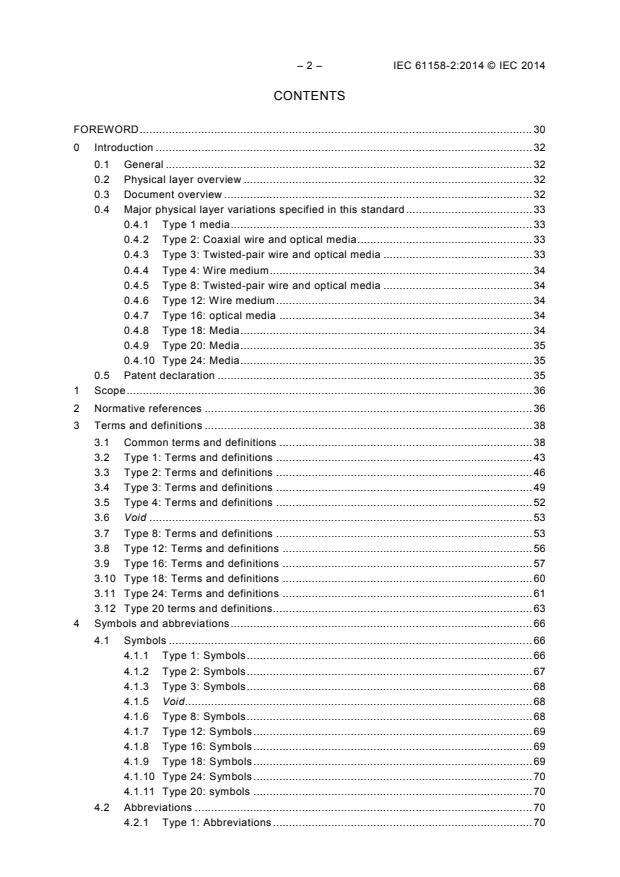
– 2 – IEC 61158-2:2014 © IEC 2014
CONTENTS
FOREWORD . 30
0 Introduction . 32
0.1 General . 32
0.2 Physical layer overview . 32
0.3 Document overview . 32
0.4 Major physical layer variations specified in this standard . 33
0.4.1 Type 1 media . 33
0.4.2 Type 2: Coaxial wire and optical media . 33
0.4.3 Type 3: Twisted-pair wire and optical media . 33
0.4.4 Type 4: Wire medium . 34
0.4.5 Type 8: Twisted-pair wire and optical media . 34
0.4.6 Type 12: Wire medium . 34
0.4.7 Type 16: optical media . 34
0.4.8 Type 18: Media . 34
0.4.9 Type 20: Media . 35
0.4.10 Type 24: Media . 35
0.5 Patent declaration . 35
1 Scope . 36
2 Normative references . 36
3 Terms and definitions . 38
3.1 Common terms and definitions . 38
3.2 Type 1: Terms and definitions . 43
3.3 Type 2: Terms and definitions . 46
3.4 Type 3: Terms and definitions . 49
3.5 Type 4: Terms and definitions . 52
3.6 Void . 53
3.7 Type 8: Terms and definitions . 53
3.8 Type 12: Terms and definitions . 56
3.9 Type 16: Terms and definitions . 57
3.10 Type 18: Terms and definitions . 60
3.11 Type 24: Terms and definitions . 61
3.12 Type 20 terms and definitions . 63
4 Symbols and abbreviations . 66
4.1 Symbols . 66
4.1.1 Type 1: Symbols . 66
4.1.2 Type 2: Symbols . 67
4.1.3 Type 3: Symbols . 68
4.1.5 Void . 68
4.1.6 Type 8: Symbols . 68
4.1.7 Type 12: Symbols . 69
4.1.8 Type 16: Symbols . 69
4.1.9 Type 18: Symbols . 69
4.1.10 Type 24: Symbols . 70
4.1.11 Type 20: symbols . 70
4.2 Abbreviations . 70
4.2.1 Type 1: Abbreviations . 70
4.2.2 Type 2: Abbreviations . 71
4.2.3 Type 3: Abbreviations . 72
4.2.4 Type 4: Abbreviations . 74
4.2.5 Void . 74
4.2.6 Type 8: Abbreviations . 74
4.2.7 Type 12: Abbreviations . 75
4.2.8 Type 16: Abbreviations . 76
4.2.9 Type 18: Abbreviations . 76
4.2.10 Type 24: Abbreviations . 77
4.2.11 Type 20: Abbreviations . 77
5 DLL – PhL interface . 77
5.1 General . 77
5.2 Type 1: Required services . 78
5.2.1 Primitives of the PhS . 78
5.2.2 Notification of PhS characteristics . 79
5.2.3 Transmission of Ph-user-data . 80
5.2.4 Reception of Ph-user-data . 80
5.3 Type 2: Required services . 80
5.3.1 General . 80
5.3.2 M_symbols . 80
5.3.3 PH-LOCK indication . 81
5.3.4 PH-FRAME indication . 81
5.3.5 PH-CARRIER indication . 81
5.3.6 PH-DATA indication . 81
5.3.7 PH-STATUS indication . 81
5.3.8 PH-DATA request . 82
5.3.9 PH-FRAME request . 82
5.3.10 PH-JABBER indication . 82
5.3.11 Ph-JABBER-CLEAR request . 82
5.3.12 Ph-JABBER-TYPE request . 82
5.4 Type 3: Required services . 83
5.4.1 Synchronous transmission . 83
5.4.2 Asynchronous transmission . 83
5.5 Type 4: Required services . 84
5.5.1 General . 84
5.5.2 Primitives of the PhS . 84
5.5.3 Transmission of Ph-user data . 85
5.6 Void . 86
5.7 Type 8: Required services . 86
5.7.1 General . 86
5.7.2 Primitives of the PhS . 86
5.7.3 Overview of the Interactions . 87
5.8 Type 12: Required services . 94
5.8.1 Primitives of the PhS . 94
5.8.2 Notification of PhS characteristics . 95
5.8.3 Transmission of Ph-user-data . 95
5.8.4 Reception of Ph-user-data . 95
5.9 Type 16: Required services . 95
5.9.1 Primitives of the PhS . 95
– 4 – IEC 61158-2:2014 © IEC 2014
5.9.2 Transmission of Ph-user-data . 96
5.9.3 Reception of Ph-user-data . 96
5.10 Type 18: Required services . 97
5.10.1 General . 97
5.10.2 Primitives of the PhS . 97
5.10.3 Transmission of Ph-user-data . 98
5.10.4 Reception of Ph-user-data . 98
5.11 Type 24: Required services . 98
5.11.1 General . 98
5.11.2 DL_Symbols . 98
5.11.3 PLS_CARRIER indication . 99
5.11.4 PLS_SIGNAL indication . 99
5.11.5 PLS_DATA_VALID indication . 99
5.11.6 PLS_DATA indication . 99
5.11.7 PLS_DATA request . 99
5.12 Type 20: Required services . 99
5.12.1 Facilities of the physical layer services . 99
5.12.2 Sequence of primitives . 99
5.12.3 PH-START service . 100
5.12.4 PH-DATA service . 101
5.12.5 PH-END service . 101
6 Systems management – PhL interface . 101
6.1 General . 101
6.2 Type 1: Systems management – PhL interface . 102
6.2.1 Required services . 102
6.2.2 Service primitive requirements . 102
6.3 Type 3: Systems management – PhL interface . 103
6.3.1 Synchronous transmission . 103
6.3.2 Asynchronous transmission . 103
6.4 Type 4: Systems management – PhL interface . 109
6.4.1 Required Services . 109
6.4.2 Service primitive requirements . 109
6.5 Void . 110
6.6 Type 8: Systems management – PhL interface . 110
6.6.1 Functionality of the PhL Management . 110
6.6.2 PhL-PNM1 Interface . 110
6.7 Type 12: Systems management – PhL interface . 115
6.7.1 Required service . 115
6.7.2 Service primitive PH-RESET request . 115
6.8 Type 18: Systems management – PhL interface . 115
6.8.1 General . 115
6.8.2 Required services . 115
6.8.3 Service primitive requirements . 115
6.9 Type 24: Systems management – PhL interface . 116
7 DCE independent sublayer (DIS) . 116
7.1 General . 116
7.2 Type 1: DIS . 116
7.3 Type 3: DIS . 117
7.3.1 Synchronous transmission . 117
7.3.2 Asynchronous transmission . 117
7.4 Void . 117
7.5 Type 8: DIS . 117
7.5.1 General . 117
7.5.2 Function . 117
7.5.3 Serial transmission . 117
7.5.4 MDS coupling . 117
7.6 Type 12: DIS . 118
8 DTE – DCE interface and MIS-specific functions . 119
8.1 General . 119
8.2 Type 1: DTE – DCE interface . 119
8.2.1 Services . 119
8.2.2 Signaling interfaces . 120
8.3 Type 3: DTE – DCE interface . 130
8.3.1 Synchronous transmission . 130
8.3.2 Asynchronous transmission . 130
8.4 Type 8: MIS – MDS interface . 130
8.4.1 General . 130
8.4.2 Services . 131
8.4.3 Interface signals . 132
8.4.4 Converting the services to the interface signals . 132
8.5 Type 12: DTE – DCE interface . 140
9 Medium dependent sublayer (MDS) . 140
9.1 General . 140
9.2 Type 1: MDS: Wire and optical media . 140
9.2.1 PhPDU . 140
9.2.2 Encoding and decoding . 141
9.2.3 Polarity detection . 142
9.2.4 Start of frame delimiter . 142
9.2.5 End of frame delimiter . 142
9.2.6 Preamble . 143
9.2.7 Synchronization . 143
9.2.8 Post-transmission gap . 143
9.2.9 Inter-channel signal skew . 144
9.3 Void . 144
9.4 Type 2: MDS: Wire and optical media . 144
9.4.1 Clock accuracy . 144
9.4.2 Data recovery . 144
9.4.3 Data encoding rules . 144
9.5 Type 3: MDS: Wire and optical media . 145
9.5.1 Synchronous transmission . 145
9.5.2 Asynchronous transmission . 145
9.6 Type 4: MDS: Wire medium . 145
9.6.1 Half-duplex . 145
9.6.2 Full-duplex . 147
9.6.3 Full-duplex UDP . 149
9.7 Void . 150
9.8 Type 8: MDS: Wire and optical media . 150
9.8.1 Function . 150
– 6 – IEC 61158-2:2014 © IEC 2014
9.8.2 PhPDU formats . 151
9.8.3 Idle states . 155
9.8.4 Reset PhPDU . 155
9.8.5 MAU coupling . 156
9.9 Type 12: MDS: Wire media . 157
9.9.1 PhPDU . 157
9.9.2 Encoding and decoding . 158
9.9.3 Polarity detection . 159
9.9.4 SOF . 159
9.9.5 EOF . 159
9.9.6 Idle . 159
9.9.7 Synchronization . 159
9.9.8 Inter frame gap . 160
9.10 Type 16: MDS: Optical media . 160
9.10.1 Data encoding rules . 160
9.10.2 Telegrams and fill characters . 160
9.11 Type 18: MDS: Wire media . 161
9.11.1 Overview . 161
9.11.2 Transmission . 161
9.11.3 Reception . 161
9.12 Type 24: MDS: Twisted-pair wire . 161
9.12.1 General . 161
9.12.2 Clock accuracy . 161
9.12.3 Data recovery . 162
9.12.4 Data encoding rules . 162
10 MDS – MAU interface . 163
10.1 General . 163
10.2 Type 1: MDS – MAU interface: Wire and optical media . 163
10.2.1 Services . 163
10.2.2 Service specifications . 163
10.2.3 Signal characteristics . 164
10.2.4 Communication mode . 164
10.2.5 Timing characteristics . 164
10.3 Void . 164
10.4 Type 2: MDS – MAU interface: Wire and optical media . 165
10.4.1 MDS-MAU interface: general . 165
10.4.2 MDS-MAU interface: 5 Mbit/s, voltage-mode, coaxial wire . 165
10.4.3 MDS – MAU interface 5 Mbit/s, optical medium . 166
10.4.4 MDS – MAU interface Network Access Port (NAP) . 167
10.5 Type 3: MDS – MAU interface: Wire and optical media . 167
10.5.1 Synchronous transmission . 167
10.5.2 Asynchronous transmission . 167
10.6 Type 8: MDS – MAU interface: Wire and optical media . 167
10.6.1 Overview of the services. 167
10.6.2 Description of the services . 167
10.6.3 Time response . 168
10.6.4 Transmission mode . 169
10.7 Type 18: MDS – MAU interface: Wire media . 169
10.7.1 General . 169
10.7.2 Services . 169
10.7.3 Service specifications . 169
10.7.4 Signal characteristics . 170
10.7.5 Communication mode . 170
10.7.6 Timing characteristics . 170
10.8 Type 24: MDS – MAU interface: Twisted-pair wire medium . 170
10.8.1 Overview of service . 170
10.8.2 Description of the services . 171
11 Types 1 and 7: Medium attachment unit: voltage mode, linear-bus-topology 150 Ω
twisted-pair wire medium . 171
11.1 General . 171
11.2 Bit-rate-dependent quantities . 172
11.3 Network specifications . 172
11.3.1 Components . 172
11.3.2 Topologies . 172
11.3.3 Network configuration rules . 173
11.3.4 Power distribution rules for network configuration . 174
11.4 MAU transmit circuit specification . 174
11.4.1 Summary . 174
11.4.2 MAU test configuration . 175
11.4.3 MAU output level requirements . 176
11.4.4 MAU output timing requirements . 177
11.4.5 Signal polarity . 178
11.5 MAU receive circuit specification . 179
11.5.1 Summary . 179
11.5.2 Input impedance . 179
11.5.3 Receiver sensitivity and noise rejection . 180
11.5.4 Received bit cell jitter . 180
11.5.5 Interference susceptibility and error rates . 180
11.6 Jabber inhibit . 181
11.7 Power distribution . 181
11.7.1 Overview . 181
11.7.2 Supply voltage . 182
11.7.3 Powered via signal conductors . 182
11.7.4 Powered separately from signal conductors . 183
11.7.5 Electrical isolation . 183
11.8 Medium specifications . 184
11.8.1 Connector . 184
11.8.2 Standard test cable . 184
11.8.3 Coupler . 185
11.8.4 Splices . 185
11.8.5 Terminator . 185
11.8.6 Shielding rules . 185
11.8.7 Grounding (earthing) rules . 186
11.8.8 Color coding of cables . 186
12 Types 1 and 3: Medium attachment unit: 31,25 kbit/s, voltage-mode with low-power
option, bus- and tree-topology, 100 Ω wire medium . 186
12.1 General . 186
12.2 Transmitted bit rate . 187
– 8 – IEC 61158-2:2014 © IEC 2014
12.3 Network specifications . 187
12.3.1 Components . 187
12.3.2 Topologies . 187
12.3.3 Network configuration rules . 188
12.3.4 Power distribution rules for network configuration . 189
12.4 MAU transmit circuit specification . 190
12.4.1 Summary . 190
12.4.2 MAU test configuration . 190
12.4.3 MAU output level requirements . 190
12.4.4 Output timing requirements . 191
12.4.5 Signal polarity . 192
12.4.6 Transition from receive to transmit . 192
12.5 MAU receive circuit specification . 192
12.5.1 Summary . 192
12.5.2 Input impedance . 193
12.5.3 Receiver sensitivity and noise rejection . 193
12.5.4 Received bit cell jitter . 193
12.5.5 Interference susceptibility and error rates . 193
12.6 Jabber inhibit . 194
12.7 Power distribution . 194
12.7.1 General . 194
12.7.2 Supply voltage . 195
12.7.3 Powered via signal conductors . 195
12.7.4 Power supply impedance . 197
12.7.5 Powered separately from signal conductors . 200
12.7.6 Electrical isolation . 200
12.8 Medium specifications . 200
12.8.1 Connector . 200
12.8.2 Standard test cable . 201
12.8.3 Coupler . 201
12.8.4 Splices . 202
12.8.5 Terminator . 202
12.8.6 Shielding rules . 203
12.8.7 Grounding (earthing) rules .
...
The article discusses IEC 61158-2:2014, which is a specification for fieldbus component parts in industrial communication networks. It outlines the requirements for media and network configuration to ensure data integrity and interoperability at the physical layer. The physical layer of the fieldbus follows the OSI 7-layer model, with frame delimiters differing between types. This edition includes new specifications for Type 20 and Type 24, while removing the RS232 media specification for Type 4. It is a technical revision of the previous edition published in 2010.
記事のタイトル:IEC 61158-2:2014 - インダストリアル コミュニケーション ネットワーク - フィールドバスの仕様 - 第2部:物理レイヤーの仕様およびサービス定義 記事の内容:IEC 61158-2:2014は、フィールドバスのコンポーネント部品の要件を規定しています。また、データリンク層のエラーチェック前のデータの整合性と物理層でのデバイス間の相互運用性を確保するために必要なメディアおよびネットワーク構成の要件を規定しています。 フィールドバスの物理レイヤーは、ISO 7498で定義されているOSI 7層モデルのレイヤー1に準拠しており、ただし、一部のタイプではフレーム区切り子が物理レイヤーにある一方、他のタイプではデータリンク層に存在します。この第6版は、2010年に発行された第5版を取り消し、改訂版となっています。 この版には、以下の変更が含まれています: - 新しいタイプ20の仕様; - 新しいタイプ24の仕様; - タイプ4のRS232メディア仕様の削除。
제목: IEC 61158-2:2014 - 산업 통신망 - 필드버스 사양 - 제 2 부: 물리 계층 사양 및 서비스 정의 내용: IEC 61158-2:2014는 필드버스 부품에 대한 요구 사항을 규정합니다. 또한 데이터 링크 계층 오류 확인 이전의 데이터 무결성 및 물리 계층에서의 기기간 상호 운용성을 보장하기 위한 미디어 및 네트워크 구성 요구 사항을 규정합니다. 필드버스의 물리 계층은 ISO 7498에서 정의한 OSI 7계층 모델의 1계층에 준한다는 것을 제외하고는 이 모델을 준수합니다. 일부 유형의 경우, 프레임 구분자가 물리 계층에 있고, 다른 유형의 경우 데이터 링크 계층에 있습니다. 이 6판은 2010년에 출판된 5판을 대체하고 기술 수정이 포함되어 있습니다. 이 판은 다음과 같은 변경 사항을 포함합니다: - 새로운 유형 20 사양; - 새로운 유형 24 사양; - 유형 4의 RS232 미디어 사양 제거.
Questions, Comments and Discussion
Ask us and Technical Secretary will try to provide an answer. You can facilitate discussion about the standard in here.
Loading comments...