

IEC 60370:2017
(Main)Test procedure for thermal endurance of insulating resins and varnishes for impregnation purposes - Electric breakdown methods
General Information
- Abstract
IEC 60370:2017 covers methods of test for the determination of thermal endurance (temperature index) of electrical insulating resins and varnishes for impregnation purposes. It is done by means of impregnating glass cloth and measuring electric strength or breakdown voltage before and after heat ageing. It covers the materials described in IEC 60455-3-5 and IEC 60464-3-2 and similar materials. This second edition cancels and replaces the first edition published in 1971. This edition constitutes a technical revision. This edition includes the following significant technical changes with respect to the previous edition: - this document is now describing two methods, the existing one, following ASTM D1932 and new a method following the requirements of IEC 60455-2 and IEC 60464-2; - the theoretical background and way of calculation were removed, and replaced by reference to IEC 60216; - the layout and numbering system was updated; - for better understanding and illustration purposes examples were added. Keywords: thermal endurance testing
- Status
- Published
- Publication Date
- 12-Dec-2017
- Technical Committee
- TC 15 - Solid electrical insulating materials
- Drafting Committee
- WG 7 - TC 15/WG 7
- Current Stage
- PPUB - Publication issued
- Start Date
- 13-Dec-2017
- Completion Date
- 05-Jan-2018
Overview
IEC 60370:2017 is an internationally recognized standard that specifies test procedures for determining the thermal endurance of insulating resins and varnishes used for impregnation purposes in electrical equipment. This edition, published by the International Electrotechnical Commission (IEC), replaces the earlier 1971 version, introducing significant technical revisions to align with contemporary testing methods and harmonize with related standards.
The standard focuses on evaluating the temperature index of electrical insulating materials by impregnating glass cloth with the resins or varnishes and then measuring their electric strength or breakdown voltage before and after controlled heat ageing. This approach provides reliable data on the durability and performance of insulation materials under thermal stress.
Key Topics
Thermal endurance testing: The standard outlines two primary electric breakdown methods to assess the thermal life of insulating materials:
- Curved electrode system (per ASTM D1932)
- Ball to plate method (following IEC 60455-2 and IEC 60464-2 requirements)
Materials covered: IEC 60370 applies to materials specified in IEC 60455-3-5 (unsaturated polyester-based resins) and IEC 60464-3-2 (hot curing impregnating varnishes), as well as similar compounds intended for electrical insulation.
Test specimen preparation: Specimens consist of glass cloth impregnated with the resin or varnish under controlled conditions to ensure consistent results.
Ageing process: Specimens are subjected to elevated temperatures in precision ovens for predetermined times to simulate long-term thermal ageing effects.
Electrical measurement: After ageing, specimens are tested for electric strength or breakdown voltage, and the thermal endurance (temperature index) is calculated based on the degradation of electrical properties.
References and harmonization: The standard refers to IEC 60216 for theoretical background and methodology, ensuring coherence across thermal endurance assessments for electrical insulating materials.
Applications
IEC 60370:2017 is essential for manufacturers, testing laboratories, and quality assurance teams involved in the production and evaluation of:
Electrical insulating resins and varnishes used in transformer windings, motors, and other electrical devices requiring impregnation for enhanced insulation.
Quality control and product development: The standard helps determine the thermal durability limits of insulation materials, guiding material selection and formulation for high-performance electrical components.
Safety and compliance testing: By establishing a standardized procedure for thermal ageing and electric breakdown assessment, IEC 60370 supports ensuring compliance with international safety and reliability requirements.
Research and comparative analysis: Enables comparative studies of thermal endurance characteristics between different insulating products or batches to optimize material performance.
Related Standards
IEC 60370:2017 is closely linked to several other IEC and ISO standards, including:
IEC 60455-3-5: Specifications for unsaturated polyester-based impregnating resins.
IEC 60464-3-2: Specifications for hot curing impregnating varnishes.
IEC 60216 (all parts): General standard for thermal endurance properties and ageing procedures of electrical insulating materials.
IEC 60243-1: Test methods for electric strength of insulating materials at power frequencies.
IEC 60216-4 series: Specifications for ageing ovens used in thermal endurance tests.
ISO 2078 and ISO 2113: Specifications for textile glass yarns and woven fabrics, related to the glass cloth used in specimen preparation.
These interconnected standards ensure comprehensive guidelines for testing and assessing electrical insulating materials under thermal stress, facilitating global uniformity and quality assurance.
Keywords: IEC 60370, thermal endurance testing, insulating resins, varnishes, impregnation, electric breakdown methods, temperature index, electrical insulation, heat ageing, glass cloth impregnation, thermal life, electrical insulating materials.
Get Certified
Connect with accredited certification bodies for this standard

IMQ S.p.A. (Certification)
Italian electrical product certification.

SLG Prüf- und Zertifizierungs GmbH
German testing and certification body.

UL Solutions
Global safety science company with testing, inspection and certification.
Sponsored listings
Frequently Asked Questions
IEC 60370:2017 is a standard published by the International Electrotechnical Commission (IEC). Its full title is "Test procedure for thermal endurance of insulating resins and varnishes for impregnation purposes - Electric breakdown methods". This standard covers: IEC 60370:2017 covers methods of test for the determination of thermal endurance (temperature index) of electrical insulating resins and varnishes for impregnation purposes. It is done by means of impregnating glass cloth and measuring electric strength or breakdown voltage before and after heat ageing. It covers the materials described in IEC 60455-3-5 and IEC 60464-3-2 and similar materials. This second edition cancels and replaces the first edition published in 1971. This edition constitutes a technical revision. This edition includes the following significant technical changes with respect to the previous edition: - this document is now describing two methods, the existing one, following ASTM D1932 and new a method following the requirements of IEC 60455-2 and IEC 60464-2; - the theoretical background and way of calculation were removed, and replaced by reference to IEC 60216; - the layout and numbering system was updated; - for better understanding and illustration purposes examples were added. Keywords: thermal endurance testing
IEC 60370:2017 covers methods of test for the determination of thermal endurance (temperature index) of electrical insulating resins and varnishes for impregnation purposes. It is done by means of impregnating glass cloth and measuring electric strength or breakdown voltage before and after heat ageing. It covers the materials described in IEC 60455-3-5 and IEC 60464-3-2 and similar materials. This second edition cancels and replaces the first edition published in 1971. This edition constitutes a technical revision. This edition includes the following significant technical changes with respect to the previous edition: - this document is now describing two methods, the existing one, following ASTM D1932 and new a method following the requirements of IEC 60455-2 and IEC 60464-2; - the theoretical background and way of calculation were removed, and replaced by reference to IEC 60216; - the layout and numbering system was updated; - for better understanding and illustration purposes examples were added. Keywords: thermal endurance testing
IEC 60370:2017 is classified under the following ICS (International Classification for Standards) categories: 29.035.01 - Insulating materials in general. The ICS classification helps identify the subject area and facilitates finding related standards.
IEC 60370:2017 is available in PDF format for immediate download after purchase. The document can be added to your cart and obtained through the secure checkout process. Digital delivery ensures instant access to the complete standard document.
Standards Content (Sample)
IEC 60370 ®
Edition 2.0 2017-12
INTERNATIONAL
STANDARD
NORME
INTERNATIONALE
colour
inside
Test procedure for thermal endurance of insulating resins and varnishes for
impregnation purposes – Electric breakdown methods
Méthode d’essai pour l’évaluation de l’endurance thermique des résines et
vernis isolants d’imprégnation – Méthodes de claquage électrique
All rights reserved. Unless otherwise specified, no part of this publication may be reproduced or utilized in any form
or by any means, electronic or mechanical, including photocopying and microfilm, without permission in writing from
either IEC or IEC's member National Committee in the country of the requester. If you have any questions about IEC
copyright or have an enquiry about obtaining additional rights to this publication, please contact the address below or
your local IEC member National Committee for further information.
Droits de reproduction réservés. Sauf indication contraire, aucune partie de cette publication ne peut être reproduite
ni utilisée sous quelque forme que ce soit et par aucun procédé, électronique ou mécanique, y compris la photocopie
et les microfilms, sans l'accord écrit de l'IEC ou du Comité national de l'IEC du pays du demandeur. Si vous avez des
questions sur le copyright de l'IEC ou si vous désirez obtenir des droits supplémentaires sur cette publication, utilisez
les coordonnées ci-après ou contactez le Comité national de l'IEC de votre pays de résidence.
IEC Central Office Tel.: +41 22 919 02 11
3, rue de Varembé Fax: +41 22 919 03 00
CH-1211 Geneva 20 info@iec.ch
Switzerland www.iec.ch
About the IEC
The International Electrotechnical Commission (IEC) is the leading global organization that prepares and publishes
International Standards for all electrical, electronic and related technologies.
About IEC publications
The technical content of IEC publications is kept under constant review by the IEC. Please make sure that you have the
latest edition, a corrigenda or an amendment might have been published.
IEC Catalogue - webstore.iec.ch/catalogue Electropedia - www.electropedia.org
The stand-alone application for consulting the entire The world's leading online dictionary of electronic and
bibliographical information on IEC International Standards, electrical terms containing 20 000 terms and definitions in
Technical Specifications, Technical Reports and other English and French, with equivalent terms in 16 additional
documents. Available for PC, Mac OS, Android Tablets and languages. Also known as the International Electrotechnical
iPad. Vocabulary (IEV) online.
IEC publications search - www.iec.ch/searchpub IEC Glossary - std.iec.ch/glossary
The advanced search enables to find IEC publications by a 65 000 electrotechnical terminology entries in English and
variety of criteria (reference number, text, technical French extracted from the Terms and Definitions clause of
committee,…). It also gives information on projects, replaced IEC publications issued since 2002. Some entries have been
and withdrawn publications. collected from earlier publications of IEC TC 37, 77, 86 and
CISPR.
IEC Just Published - webstore.iec.ch/justpublished
Stay up to date on all new IEC publications. Just Published IEC Customer Service Centre - webstore.iec.ch/csc
details all new publications released. Available online and If you wish to give us your feedback on this publication or
also once a month by email. need further assistance, please contact the Customer Service
Centre: csc@iec.ch.
A propos de l'IEC
La Commission Electrotechnique Internationale (IEC) est la première organisation mondiale qui élabore et publie des
Normes internationales pour tout ce qui a trait à l'électricité, à l'électronique et aux technologies apparentées.
A propos des publications IEC
Le contenu technique des publications IEC est constamment revu. Veuillez vous assurer que vous possédez l’édition la
plus récente, un corrigendum ou amendement peut avoir été publié.
Catalogue IEC - webstore.iec.ch/catalogue Electropedia - www.electropedia.org
Application autonome pour consulter tous les renseignements
Le premier dictionnaire en ligne de termes électroniques et
bibliographiques sur les Normes internationales,
électriques. Il contient 20 000 termes et définitions en anglais
Spécifications techniques, Rapports techniques et autres
et en français, ainsi que les termes équivalents dans 16
documents de l'IEC. Disponible pour PC, Mac OS, tablettes
langues additionnelles. Egalement appelé Vocabulaire
Android et iPad.
Electrotechnique International (IEV) en ligne.
Recherche de publications IEC - www.iec.ch/searchpub
Glossaire IEC - std.iec.ch/glossary
65 000 entrées terminologiques électrotechniques, en anglais
La recherche avancée permet de trouver des publications IEC
en utilisant différents critères (numéro de référence, texte, et en français, extraites des articles Termes et Définitions des
comité d’études,…). Elle donne aussi des informations sur les publications IEC parues depuis 2002. Plus certaines entrées
projets et les publications remplacées ou retirées. antérieures extraites des publications des CE 37, 77, 86 et
CISPR de l'IEC.
IEC Just Published - webstore.iec.ch/justpublished
Service Clients - webstore.iec.ch/csc
Restez informé sur les nouvelles publications IEC. Just
Published détaille les nouvelles publications parues. Si vous désirez nous donner des commentaires sur cette
Disponible en ligne et aussi une fois par mois par email. publication ou si vous avez des questions contactez-nous:
csc@iec.ch.
IEC 60370 ®
Edition 2.0 2017-12
INTERNATIONAL
STANDARD
NORME
INTERNATIONALE
colour
inside
Test procedure for thermal endurance of insulating resins and varnishes for
impregnation purposes – Electric breakdown methods
Méthode d’essai pour l’évaluation de l’endurance thermique des résines et
vernis isolants d’imprégnation – Méthodes de claquage électrique
INTERNATIONAL
ELECTROTECHNICAL
COMMISSION
COMMISSION
ELECTROTECHNIQUE
INTERNATIONALE
ICS 29.035.01 ISBN 978-2-8322-5108-9
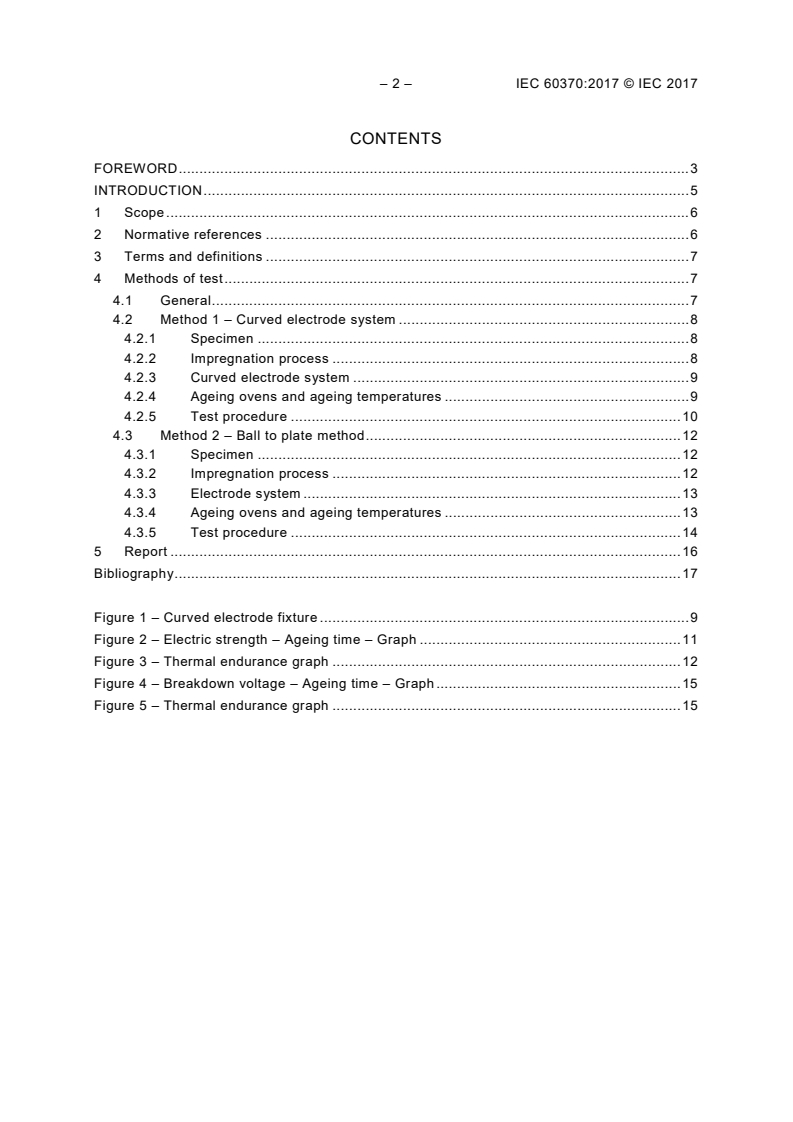
– 2 – IEC 60370:2017 © IEC 2017
CONTENTS
FOREWORD . 3
INTRODUCTION . 5
1 Scope . 6
2 Normative references . 6
3 Terms and definitions . 7
4 Methods of test . 7
4.1 General . 7
4.2 Method 1 – Curved electrode system . 8
4.2.1 Specimen . 8
4.2.2 Impregnation process . 8
4.2.3 Curved electrode system . 9
4.2.4 Ageing ovens and ageing temperatures . 9
4.2.5 Test procedure . 10
4.3 Method 2 – Ball to plate method . 12
4.3.1 Specimen . 12
4.3.2 Impregnation process . 12
4.3.3 Electrode system . 13
4.3.4 Ageing ovens and ageing temperatures . 13
4.3.5 Test procedure . 14
5 Report . 16
Bibliography . 17
Figure 1 – Curved electrode fixture . 9
Figure 2 – Electric strength – Ageing time – Graph . 11
Figure 3 – Thermal endurance graph . 12
Figure 4 – Breakdown voltage – Ageing time – Graph . 15
Figure 5 – Thermal endurance graph . 15
INTERNATIONAL ELECTROTECHNICAL COMMISSION
____________
TEST PROCEDURE FOR THERMAL ENDURANCE OF INSULATING
RESINS AND VARNISHES FOR IMPREGNATION PURPOSES –
ELECTRIC BREAKDOWN METHODS
FOREWORD
1) The International Electrotechnical Commission (IEC) is a worldwide organization for standardization comprising
all national electrotechnical committees (IEC National Committees). The object of IEC is to promote
international co-operation on all questions concerning standardization in the electrical and electronic fields. To
this end and in addition to other activities, IEC publishes International Standards, Technical Specifications,
Technical Reports, Publicly Available Specifications (PAS) and Guides (hereafter referred to as “IEC
Publication(s)”). Their preparation is entrusted to technical committees; any IEC National Committee interested
in the subject dealt with may participate in this preparatory work. International, governmental and non-
governmental organizations liaising with the IEC also participate in this preparation. IEC collaborates closely
with the International Organization for Standardization (ISO) in accordance with conditions determined by
agreement between the two organizations.
2) The formal decisions or agreements of IEC on technical matters express, as nearly as possible, an international
consensus of opinion on the relevant subjects since each technical committee has representation from all
interested IEC National Committees.
3) IEC Publications have the form of recommendations for international use and are accepted by IEC National
Committees in that sense. While all reasonable efforts are made to ensure that the technical content of IEC
Publications is accurate, IEC cannot be held responsible for the way in which they are used or for any
misinterpretation by any end user.
4) In order to promote international uniformity, IEC National Committees undertake to apply IEC Publications
transparently to the maximum extent possible in their national and regional publications. Any divergence
between any IEC Publication and the corresponding national or regional publication shall be clearly indicated in
the latter.
5) IEC itself does not provide any attestation of conformity. Independent certification bodies provide conformity
assessment services and, in some areas, access to IEC marks of conformity. IEC is not responsible for any
services carried out by independent certification bodies.
6) All users should ensure that they have the latest edition of this publication.
7) No liability shall attach to IEC or its directors, employees, servants or agents including individual experts and
members of its technical committees and IEC National Committees for any personal injury, property damage or
other damage of any nature whatsoever, whether direct or indirect, or for costs (including legal fees) and
expenses arising out of the publication, use of, or reliance upon, this IEC Publication or any other IEC
Publications.
8) Attention is drawn to the Normative references cited in this publication. Use of the referenced publications is
indispensable for the correct application of this publication.
9) Attention is drawn to the possibility that some of the elements of this IEC Publication may be the subject of
patent rights. IEC shall not be held responsible for identifying any or all such patent rights.
International Standard IEC 60370 has been prepared by IEC technical committee 15: Solid
electrical insulating materials.
This second edition cancels and replaces the first edition published in 1971. This edition
constitutes a technical revision.
This edition includes the following significant technical changes with respect to the previous
edition:
a) this document is now describing two methods, the existing one, following ASTM D1932
and new a method following the requirements of IEC 60455-2 and IEC 60464-2;
b) the theoretical background and way of calculation were removed, and replaced by
reference to IEC 60216;
c) the layout and numbering system was updated;
d) for better understanding and illustration purposes examples were added.
– 4 – IEC 60370:2017 © IEC 2017
The text of this International Standard is based on the following documents:
FDIS Report on voting
15/812/FDIS 15/819/RVD
Full information on the voting for the approval of this International Standard can be found in
the report on voting indicated in the above table.
This document has been drafted in accordance with the ISO/IEC Directives, Part 2.
The committee has decided that the contents of this document will remain unchanged until the
stability date indicated on the IEC website under "http://webstore.iec.ch" in the data related to
the specific document. At this date, the document will be
• reconfirmed,
• withdrawn,
• replaced by a revised edition, or
• amended.
IMPORTANT – The 'colour inside' logo on the cover page of this publication indicates
that it contains colours which are considered to be useful for the correct
understanding of its contents. Users should therefore print this document using a
colour printer.
INTRODUCTION
This document describes methods for thermal endurance testing. The methods described are
in line with IEC 60216 (all parts). More information about the theory of thermal endurance,
calculation methods and other possible methods can be found in IEC 60216 (all parts).
– 6 – IEC 60370:2017 © IEC 2017
TEST PROCEDURE FOR THERMAL ENDURANCE OF INSULATING
RESINS AND VARNISHES FOR IMPREGNATION PURPOSES –
ELECTRIC BREAKDOWN METHODS
1 Scope
This International Standard covers methods of test for the determination of thermal endurance
(temperature index) of electrical insulating resins and varnishes for impregnation purposes.
It is done by means of impregnating glass cloth and measuring electric strength or breakdown
voltage before and after heat ageing.
It covers the materials described in IEC 60455-3-5 and IEC 60464-3-2 and similar materials.
2 Normative references
The following documents are referred to in the text in such a way that some or all of their
content constitutes requirements of this document. For dated references, only the edition
cited applies. For undated references, the latest edition of the referenced document (including
any amendments) applies.
IEC 60212, Standard conditions for use prior to and during the testing of solid electrical
insulating materials
IEC 60216 (all parts), Electrical insulating materials – Thermal endurance properties
IEC 60216-4-1, Electrical insulating materials – Thermal endurance properties –
Part 4-1: Ageing ovens – Single-chamber ovens
IEC 60216-4-2, Electrical insulating materials – Thermal endurance properties – Part 4-2:
Ageing ovens – Precision ovens for use up to 300 °C
IEC 60216-4-3, Electrical insulating materials – Thermal endurance properties –
Part 4-3: Ageing ovens – Multi-chamber ovens
IEC 60243-1, Electric strength of insulating materials – Test methods – Part 1: Tests at power
frequencies
IEC 60455-3-5, Resin based reactive compounds used for electrical insulation – Part 3:
Specifications for individual materials – Sheet 5: Unsaturated polyester based impregnating
resins
IEC 60464-3-2, Varnishes used for electrical insulation – Part 3: Specifications for individual
materials – Sheet 2: Hot curing impregnating varnishes
IEC 60641-3-1, Pressboard and presspaper for electrical purposes – Part 3: Specifications for
individual materials – Sheet 1: Requirements for pressboard, types B.0.1, B.0.3, B.2.1, B.2.3,
B.3.1, B.3.3, B.4.1, B.4.3, B.5.1, B.5.3 and B.6.1
ISO 2078, Textile glass – Yarns – Designation
ISO 2113, Reinforcement fibers – Woven fabrics – Basis for a specification
3 Terms and definitions
For the purposes of this document, the following terms and definitions apply.
ISO and IEC maintain terminological databases for use in standardization at the following
addresses:
• IEC Electropedia: available at http://www.electropedia.org/
• ISO Online browsing platform: available at http://www.iso.org/obp
3.1
resin
mixture of a reactive polymer with other reactive components such as hardener accelerator,
inhibitor or reactive diluent, and with or without filler and additives, whereby virtually no
volatile matter is released during the subsequent curing reaction
Note 1 to entry: Resins are solvent free.
Note 2 to entry: Small quantities of by-products can be evolved during the cure of selected resins. In the case
where a reactive diluent is used, small quantities of monomeric diluent can evaporate during cure manly due to the
application conditions used.
3.2
varnish
solution or emulsion of one or more resins in a solvent or carrier liquid
Note 1 to entry: Other components may be present, such as driers, catalysts, reactive diluents, dyestuffs,
pigments or co-solvents.
Note 2 to entry: The solvents and by-products are released during the drying/curing process and at the same time
the active components are polymerized and/or cross-linked forming a solid product.
4 Methods of test
4.1 General
In these test procedures, specimens are aged in ovens at elevated temperatures for specified
periods. The specimens are then removed from the oven, cooled and tested electrically. At
each temperature the thermal life is determined as the ageing time necessary for the electric
property to decrease to a preselected value. This value may be selected on the basis of some
functional characteristic of the material for the intended application. The thermal endurance is
then determined as a curve showing the relationship between ageing temperature and thermal
life.
Two alternative methods are given:
– Method 1: a curved electrode system designed to elongate the outer surface of the varnish
specimen of approximately 2 %. This simulates flexing to which the varnish may be
subjected in service.
The property measured is electric strength, the end point criterion is 12 kV/mm.
– Method 2: a ball to plate electrode arrangement is used to avoid mechanical stress. In
many cases, the specimens are no longer plan after ageing and a curved electrode system
or a plate to plate arrangement is causing additional undefined mechanical stress.
The property measured is breakdown voltage, the end point criterion is 3 kV.
– 8 – IEC 60370:2017 © IEC 2017
4.2 Method 1 – Curved electrode system
4.2.1 Specimen
The specimens shall consist of panels of continuous filament, woven glass cloth impregnated
with the material under test by dipping.
The glass cloth panels shall be cut from continuous filament, woven glass 0,1 mm to 0,18 mm
2 2
thick with a weight per unit area of 90 g/m to 140 g/m and with 20 to 26 ends and 16 to
24 picks per centimetre. (Where glass cloth having the specified picks and ends is not
available in the country making the test, the nearest standard cloth of that country shall be
used.)
The dimensions of the curved electrode were designed to give an approximate 2 % elongation
to the outer surface of a 0,1 mm thick glass cloth impregnated to 0,175 mm to 0,185 mm total
thickness. It should be noted, therefore, that greater thicknesses will increase the elongation
which, in turn, can significantly affect the ageing results.
The glass cloth shall be heat cleaned to remove binders.
NOTE A suggested heat cleaning procedure consists of heating the cloth 24 h at 250 °C and 24 h at 400 °C.
Caution: heating above 450 °C can damage the cloth.
Each panel of glass cloth shall be 15 cm x 30 cm with the 30 cm dimension parallel to the
warp threads of the cloth. Each panel shall be mounted and fastened in a suitable
specimen-holding frame.
A set of twelve or more panels is required for each ageing temperature. A suitable fixture
shall be used for holding the specimen frames in the oven in a vertical position with a
minimum spacing of 2,5 cm.
4.2.2 Impregnation process
4.2.2.1 General
Test specimens shall be prepared by dipping the mounted glass cloth panels in the resin or
varnish. The specimen shall be prepared at room atmosphere or preferably at standard
atmosphere B according to IEC 60212 (23 °C ± 2 K and 50 % ± 10 % relative humidity).
4.2.2.2 Varnishes
The consistency of a varnish shall be adjusted by trial, using the recommended thinner so that
two or more impregnations will give an overall increase in thickness of 0,08 mm ± 0,005 mm
over the cloth thickness. The panel shall be immersed in the varnish in the direction of the
30 cm length until bubbling stops. It shall be mechanically withdrawn at a uniform rate of
10 cm/min, and allowed to drain for 1 h.
Specimens shall be reversed endwise between subsequent dips to provide a more uniform
impregnation. After each dip, the specimens shall be cured in the same vertical position as
the last dip and at the temperature and time specified by the manufacturer.
4.2.2.3 Resins
The consistency of a resin shall be adjusted by trial using reactive diluent so that the
impregnation will give an overall thickness of 0,180 mm ± 0,005 mm. One impregnation
process may be sufficient. The panel shall be immersed in the resin in the direction of the
30 cm length until bubbling stops. It shall be mechanically withdrawn at a uniform rate of
10 cm/min, and allowed to drain for 1 h. If the unadjusted resin leads to specimens below
0,180 mm thickness, a second or more impregnations may be necessary.
Specimens shall be reversed endwise between subsequent dips to provide a more uniform
impregnation. After each dip, the specimens shall be cured in the same vertical position as
the last dip and at the temperature and time specified by the resin manufacturer.
4.2.3 Curved electrode system
The curved electrode system shall be in accordance with the dimensions shown in Figure 1.
The electrodes shall be of polished brass. The upper (movable) electrode shall have a total
mass of 1,8 kg. Provisions shall be made to allow sufficient movement of the upper electrode
or lower electrode so that intimate contact between the specimen and both electrodes is
assured. This may be done by placing a soft rubber pad under the lower electrode.
The fixture shall be in accordance with the dimensions shown in Figure 1.
Dimensions in millimetres
Total mass of
electrode
Electrode
system: 1,8 kg
supports
Spherical ends
Upper electrode
8,7 ±0,05
19 ±0,05
45° ±1°
R4,55 ±0,05
Lower electrode
38 ±1
50 ±1
IEC
Figure 1 – Curved electrode fixture
4.2.4 Ageing ovens and ageing temperatures
Ovens according to IEC 60216-4-1, IEC 60216-4-2 and IEC 60216-4-3 shall be used.
– 10 – IEC 60370:2017 © IEC 2017
At least three ageing temperatures shall be used, preferably more. The ageing temperatures
shall differ by 10 K to 20 K. The lowest ageing temperature shall give a thermal life of at least
5 000 h. An ageing temperature giving a thermal life of less than 100 h shall not be used.
4.2.5 Test procedure
4.2.5.1 Specimen thickness
The thickness shall be measured with a screw-type micrometer or a device with similar
accuracy prior to heat ageing. At least five measurements evenly distributed across the
specimen shall be done and the mean shall be used.
4.2.5.2 Electric strength testing
The electric strength test set shall be in accordance with IEC 60243-1, but using the curved
electrode system.
The rate of voltage rise shall be 500 V/s. The electric strength testing shall be done 40 mm
apart from the edge of the specimen and 45 mm apart from a previous measurement. The
specimen shall be inserted in the curved electrode fixture (see Figure 1) so that the warp
threads are bent; the electrode is lowered slowly taking care to avoid injury to the specimen.
Six breakdown voltage measurements have to be done. The mean shall be used. For
electrical strength, divide the mean breakdown voltage by the mean thickness.
4.2.5.3 Ageing and sequence of testing
One specimen shall be conditioned for at least 4 h at standard atmosphere B according to
IEC 60212 (23 °C ± 2 K and 50 % ± 10 % relative humidity) and then tested for electric
strength.
Five specimens shall be tagged with aluminium foil or otherwise permanently identified and
placed in the specimen holding frames. The fixture containing the specimen frames shall then
be placed in the ageing oven and positioned so that it is at least 10 cm from the walls at any
point and the specimens are held parallel to the direction of the air flow. One specimen shall
be removed at the end of each of three ageing times equal to 25 %, 50 % and 100 % of the
estimated thermal life at the selected ageing temperature. After removal, the specimens shall
be conditioned for at least 4 h at standard atmosphere B according to IEC 60212 (23 °C ± 2 K
and 50 % ± 10 % relative humidity) and then tested for electric strength.
At the time of 50 % of estimated thermal life, five additional specimens shall be tagged and
placed in the oven. Similarly, at the time of 75 % of thermal life, the remaining specimens
shall be placed in the oven. Plot a graph of the electric strength of each specimen as the
ordinate, corresponding to the ageing time as the abscissa. If the thermal life has been
underestimated, one specimen of the first group remaining in the oven shall be removed at
150 % of the estimated thermal life and tested. With information now available on aged
specimens, each of the remaining specimens shall be removed at chosen intervals so as to
establish a curve of electric strength versus exposure time.
This may require filling in between established points or extending beyond if necessary. This
procedure assures that sufficient specimens are available to complete the ageing process.
The ageing shall be continued until an average electric strength of < 8 kV/mm (based on
original average thickness) is reached or heat ageing has progressed to 10 000 h.
Repeat the same procedure with all temperatures.
4.2.5.4 Calculations
The end point criterion is 12 kV/mm. The selection of this end point is arbitrary and based
upon experience showing that this value correlates with actual service life. However when
agreed upon, other end points, such as a percentage of the initial average unaged electric
strength, may also be used.
Plot all mean data in an electric strength – ageing time – graph and draw a regression curve
for each temperature set as shown in Figure 2. This may be done manually or numerically.
Determine for each curve the end of life time (intersection with the end point criterion).
Example
End point 780 h 1 848 h 4 908 h 9 845 h
criterion
185 °C
230 °C 215 °C 200 °C
0 50 100 150 200 250 300 350 400 450
10 000 h
Ageing time (days)
IEC
Figure 2 – Electric strength – Ageing time – Graph
Plot the end of life time and ageing temperatures in a graph using a logarithmic time scale as
ordinate and the reciprocal of absolute temperature as the abscissa (thermal endurance
graph, see Figure 3). Following the requirements of IEC 60216 (all parts), the data points
shall give a straight line in this diagram. The calculation of the temperature index shall be
done in accordance with IEC 60216 (all parts).
Electric strength (kV/mm)
– 12 – IEC 60370:2017 © IEC 2017
Example
100 000
TI = 175
20 000 h
10 000
1 000
275 260 245 230 215 200 185 170 155 140 125
Ageing temperature (°C)
IEC
Figure 3 – Thermal endurance graph
4.3 Method 2 – Ball to plate method
4.3.1 Specimen
Unless otherwise specified, textile glass fabric of a plain weave with (21 ± 3 ) yarns each for
2 2
warp and weft and with a mass of 40 g/m to 60 g/m in accordance with ISO 2113 shall be
used. The yarn employed for this glass fabric shall be identical for warp and weft and shall be
of type EC5, EC6 or EC7 in accordance with ISO 2078.
EXAMPLE 1 Yarn of the type “EC5 5,5 Z 40 x 2 S 150” is a folded (plied) yarn having identical components, which
are twisted 150 times per metre and consist of single continuous-filament yarn according to ISO 2078 of the
type EC5 5,5 Z 40. This type is made of continuous filaments of 5 µm thickness, which are twisted 40 times per
meter. The linear density of the single yarn is 5,5 tex. “E” stands for “good electrical properties” and “C” stands for
“continuous filament”. The letters “S” and “Z” indicate opposite directions of twist. “Tex” is a measure of linear
density (mg/m) of the tex system single continuous filament yarn (see ISO 1144).
EXAMPLE 2 Yarn of the type “EC5 11 is a single continuous-filament yarn according to ISO 2078. This type is
made of continuous filament of 5 µm thickness. The linear density of the single yarn is 11 tex.
The glass fabric shall be de-sized by means of thermal treatment to less than 0,1 % of the
original amount. The glass fabric shall be made of glass, which is practically free of alkalis
with an alkali content less than 0,5 % ( Na O + K O < 0,5 %). Pieces of about 180 mm x
2 2
280 mm shall be cut from the glass fabric.
For easy handling, strips of pressboard of for instance type B.2.2 according to IEC 60641-3-1
shall be stapled to the smaller edges of each piece of glass fabric. Strips of about 250 mm x
15 mm x 0,7 mm have been found helpful. The glass fabric shall be impregnated and/or
coated.
4.3.2 Impregnation process
4.3.2.1 General
The impregnation and/or coating of the glass fabric shall be in accordance with the
manufacturer’s recommendations or agreed between the participating parties. This includes
the impregnation and/or coating process, with respect to temperature and time, the draining
End of life time (h)
period and the curing conditions with respect to temperature and time or temperature-time
programme and annealing and cooling.
4.3.2.2 Varnishes
Unless otherwise specified, the glass fabric shall be immersed into the varnish in a vertical
position and at a speed sufficiently low to prevent voids of air adhering to the surface of the
glass fabric. The glass fabric shall be kept in the varnish for at least 5 min and shall then be
removed from the varnish at a uniform speed of not more than 2 mm/s.
The glass fabric shall then be drained, and dried and/or cured and otherwise treated in
accordance with the agreed schedule in the vertical position. For drying and/or curing the
oven shall be specially designed for drying painted or varnished parts, which may have large
surfaces and substantial amounts of solvent evaporation. The coating or impregnation
process shall be repeated by dipping, draining and drying and/or curing the glass fabric in the
reverse direction.
The final thickness of the impregnated glass fabric shall be of not more than 0,180 mm. If the
final thickness is greater than 0,180 mm the consistency of the varnish shall be adjusted by
trial, using the recommended thinner.
After the impregnation process, two final specimens ((100 ± 1) mm x (100 ± 1) mm) shall be
cut from each peace. For mounting in frames and easier handling, four holes of about 6 mm in
diameter may be punched in the corners (paper punch).
4.3.2.3 Resins
Unless otherwise specified, the glass fabric shall be immersed into the resin in a vertical
position and at a speed sufficiently low to prevent voids of air adhering to the surface of the
glass fabric. The glass fabric shall be kept in the resin for at least 5 min and shall then be
removed from the varnish at a uniform speed of not more than 2 mm/s.
The glass fabric shall then be drained, and cured and otherwise treated in accordance with
the agreed schedule in the vertical position. For curing the oven shall be specially designed
for drying painted or varnished parts, which may have large surfaces and substantial amounts
of solvent evaporation.
The final thickness of the impregnated glass fabric shall be of not more than 0,180 mm. If the
final thickness is greater than 0,180 mm the draining and/or curing process shall be adjusted
by trial.
After the impregnation process, two final specimens ((100 ± 1) mm x (100 ± 1) mm) shall be
cut from each peace. For mounting in frames and easier handling, four holes of about 6 mm in
diameter may be punched in the corners (paper punch).
4.3.3 Electrode system
The electrode arrangement shall be the ball to plate type. The high voltage electrode shall
consist of a polished steel ball with a radius of (10 ± 0,000 5) mm. Polished steel balls with a
surface roughness of less than 0,001 mm as used in ball bearings (class III) are easily
available and have been found adequate for the purpose. The earth electrode shall be a plate
with a diameter of (75 ± 1) mm and with rounded edge of a radius of (3 ± 0,1) mm.
4.3.4 Ageing ovens and ageing temperatures
Ovens according to IEC 60216-4-1, IEC 60216-4-2 and IEC 60216-4-3 shall be used.
– 14 – IEC 60370:2017 © IEC 2017
At least three ageing temperatures shall be used, preferably more. The ageing temperatures
shall differ by 10 K to 20 K. The lowest ageing temperature shall give a thermal life of at least
5 000 h. An ageing temperature giving a thermal life of less than 100 h shall not be used.
4.3.5 Test procedure
4.3.5.1 Specimen thickness
The thickness shall be measured with a screw-type micrometer or a device with similar
accuracy prior to heat ageing. At least five measurements evenly distributed across the
specimen shall be done and the mean shall be used.
4.3.5.2 Electric strength testing
The electric strength test set shall be in accordance with IEC 60243-1. The rate of voltage
rise shall be 500 V/s. The electric strength testing shall be done 20 mm apart from the edge of
the specimen and 30 mm apart from a previous measurement. The electrode shall be placed
on the specimen without causing unnecessary mechanical stress. Five breakdown voltage
measurements have to be done. The mean shall be used.
4.3.5.3 Ageing and test procedure
One specimen ((100 ± 1) mm x (100 ± 1) mm) shall be conditioned for at least 4 h at standard
atmosphere B according to IEC 60212 (23 °C ± 2 K and 50 % ± 10 % relative humidity) and
then tested for breakdown voltage.
Sufficient specimens shall be tagged with aluminium foil or otherwise permanently identified
and mounted in frames. The frames with the specimen shall then be placed in the ageing
oven. Specimens shall be removed at pre-planned times ensuring to have at least two
measurements close before and one after reaching the end point criteria. If the results have a
great scatter, more measurements may be necessary. After removal, the specimen shall be
conditioned for at least 4 h at standard atmosphere B according to IEC 60212 (23 °C ± 2 K
and 50 % ± 10 % relative humidity) and then tested for breakdown voltage. For controlling the
ageing process, planning additional measurements and calculation of the end of life time, a
graph of the breakdown voltage of each specimen as the ordinate, corresponding to the log
ageing time as the abscissa has been found helpful.
Repeat the same procedure with all temperatures.
4.3.5.4 Calculations
The end point criterion is 3 kV. The selection of this end point is arbitrary and based upon
experience showing that this value correlates with actual service life. However when agreed
upon, other end points, such as a percentage of the initial average unaged electric strength,
may also be used.
Plot all mean data in a breakdown voltage – log ageing time – graph and draw a regression
curve for each temperature set (see example in Figure 4). This may be done manually or
numerically. Determine for each curve the end of life time (intersection with the end point
criterion).
Example
744 h 1 344 h 4 320 h 9 120 h
End point
criterion
185 °C
200 °C
215 °C
230 °C
1 10 100 1 000
Ageing time (days)
IEC
Figure 4 – Breakdown voltage – Ageing time – Graph
Plot the end of life time and ageing temperatures in a graph using a logarithmic time scale as
ordinate and the reciprocal of absolute temperature as the abscissa (thermal endurance
graph, see Figure 5). Following the requirements of IEC 60216 (all parts), the data points
shall give a straight line in this diagram. The calculation of the temperature index shall be
done in accordance with IEC 60216 (all parts).
Example
100 000
TI = 174
10 000
1 000
275 260 245 230 215 200 185 170 155 140 125
Ageing temperature (°C)
IEC
Figure 5 – Thermal endurance graph
End of life time (h)
Breakdown voltage (kV)
– 16 – IEC 60370:2017 © IEC 2017
5 Report
The report shall contain the following information:
– description of resin or varnish (type, manufacturer, physical properties, etc.);
– glass cloth used;
– specimen preparation und curing conditions;
– average thickness of the specimen;
– method used including measured property and end point criteria;
– mean initial values and all mean values for each ageing temperature and time inclusive
graph;
– end of life time for each temperature;
– thermal endurance graph with temperature index (TI);
– all relevant observations during testing.
Bibliography
IEC 60455-2, Resin based reactive compounds used for electrical insulation – Part 2:
Methods of test
IEC 60464-2, Varnishes used for electrical insulation – Part 2: Methods of test
ISO 1144:1973, Textiles – Universal system for designating linear density (Tex System)
ASTM D1932, Standard Test Method for Thermal Endurance of Flexible Electrical Insulating
Varnishes
___________
– 18 – IEC 60370:2017 © IEC 2017
SOMMAIRE
AVANT-PROPOS . 19
INTRODUCTION . 21
1 Domaine d’application . 22
2 Références normatives . 22
3 Termes et définitions . 23
4 Méthodes d’essai . 23
4.1 Généralités . 23
4.2 Méthode 1 – Système d’électrodes courbes . 24
4.2.1 Éprouvette . 24
4.2.2 Processus d’imprégnation . 24
4.2.3 Système d’électrodes courbes . 25
4.2.4 Étuves de vieillissement et températures de vieillissement . 26
4.2.5 Méthode d’essai . 26
4.3 Méthode 2 – Méthode à bille pour plaque . 29
4.3.1 Éprouvette . 29
4.3.2 Processus d’imprégnation . 29
4.3.3 Système d’électrodes . 30
4.3.4 Étuves de vieillissement et températures de vieillissement . 31
4.3.5 Méthode d’essai . 31
5 Rapport d’essai . 33
Bibliographie . 34
Figure 1 – Montage d’électrodes courbes . 26
Figure 2 – Rigidité diélectrique – Temps de vieillissement – Graphique . 28
Figure 3 – Graphique d’endurance thermique . 29
Figure 4 – Tension de claquage – Temps vieillissement – Graphique . 32
Figure 5 – Graphique d’endurance thermique . 33
COMMISSION ÉLECTROTECHNIQUE INTERNATIONALE
____________
MÉTHODE D’ESSAI POUR L’ÉVALUATION DE L’ENDURANCE THERMIQUE
DES RÉSINES ET VERNIS ISOLANTS D’IMPRÉGNATION –
MÉTHODES DE CLAQUAGE ÉLECTRIQUE
AVANT-PROPOS
1) La Commission Electrotechnique Internationale (IEC) est une organisation mondiale de normalisation
composée de l'ensemble des comités électrotechniques nationaux (Comités nationaux de l’IEC). L’IEC a pour
objet de favoriser la coopération internationale pour toutes les questions de normalisation dans les domaines
de l'électricité et de l'électronique. A cet effet, l’IEC – entre autres activités – publie des Normes
internationales, des Spécifications techniques, des Rapports techniques, des Spécifications accessibles au
public (PAS) et des Guides (ci-ap
...