


ISO/FDIS 6721-10
(Main)Plastics — Determination of dynamic mechanical properties — Part 10: Complex shear viscosity using a parallel-plate and a cone-and-plate oscillatory rheometer
Plastics — Determination of dynamic mechanical properties — Part 10: Complex shear viscosity using a parallel-plate and a cone-and-plate oscillatory rheometer
This document specifies the general principles of a method for determining the dynamic rheological properties of polymer melts at angular frequencies typically in the range of 0,01 rad·s-1 to 100 rad·s-1 by means of an oscillatory rheometer with a parallel-plate or a cone-and-plate geometry. Angular frequencies outside this range can also be used (see Note 1). The method is used to determine values of the following dynamic rheological properties: complex shear viscosity η*, dynamic shear viscosity η', the out-of-phase component of the complex shear viscosity η”, complex shear modulus G*, shear loss modulus G”, and shear storage modulus G'. It is suitable for measuring complex shear viscosity values typically up to ~10 MPa·s (see Note 2).
Plastiques — Détermination des propriétés mécaniques dynamiques — Partie 10: Viscosité complexe en cisaillement à l'aide d'un rhéomètre à oscillations à plateaux parallèles ou à géométrie cône/plan
General Information
Relations
Buy Standard
Standards Content (Sample)
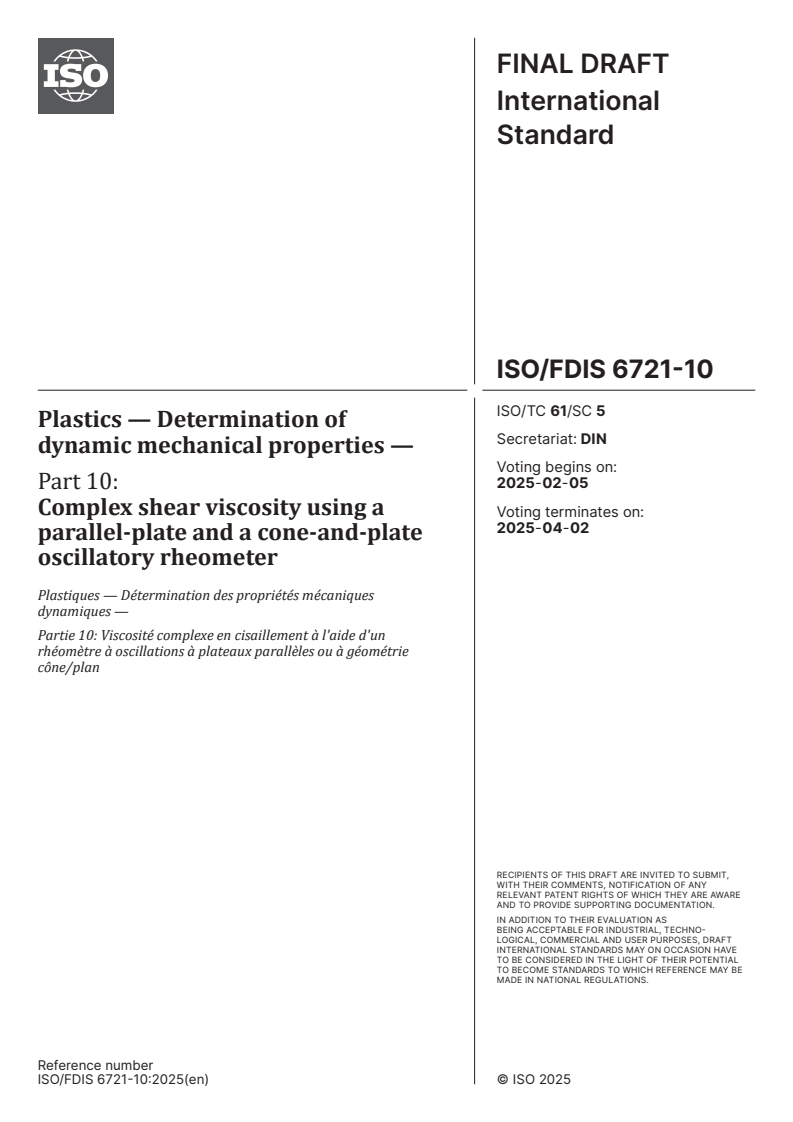
FINAL DRAFT
International
Standard
ISO/TC 61/SC 5
Plastics — Determination of
Secretariat: DIN
dynamic mechanical properties —
Voting begins on:
2025-02-05
Part 10:
Complex shear viscosity using a
Voting terminates on:
2025-04-02
parallel-plate and a cone-and-plate
oscillatory rheometer
Plastiques — Détermination des propriétés mécaniques
dynamiques —
Partie 10: Viscosité complexe en cisaillement à l'aide d'un
rhéomètre à oscillations à plateaux parallèles ou à géométrie
cône/plan
RECIPIENTS OF THIS DRAFT ARE INVITED TO SUBMIT,
WITH THEIR COMMENTS, NOTIFICATION OF ANY
RELEVANT PATENT RIGHTS OF WHICH THEY ARE AWARE
AND TO PROVIDE SUPPOR TING DOCUMENTATION.
IN ADDITION TO THEIR EVALUATION AS
BEING ACCEPTABLE FOR INDUSTRIAL, TECHNO-
LOGICAL, COMMERCIAL AND USER PURPOSES, DRAFT
INTERNATIONAL STANDARDS MAY ON OCCASION HAVE
TO BE CONSIDERED IN THE LIGHT OF THEIR POTENTIAL
TO BECOME STAN DARDS TO WHICH REFERENCE MAY BE
MADE IN NATIONAL REGULATIONS.
Reference number
FINAL DRAFT
International
Standard
ISO/TC 61/SC 5
Plastics — Determination of
Secretariat: DIN
dynamic mechanical properties —
Voting begins on:
Part 10:
Complex shear viscosity using a
Voting terminates on:
parallel-plate and a cone-and-plate
oscillatory rheometer
Plastiques — Détermination des propriétés mécaniques
dynamiques —
Partie 10: Viscosité complexe en cisaillement à l'aide d'un
rhéomètre à oscillations à plateaux parallèles ou à géométrie
cône/plan
RECIPIENTS OF THIS DRAFT ARE INVITED TO SUBMIT,
WITH THEIR COMMENTS, NOTIFICATION OF ANY
RELEVANT PATENT RIGHTS OF WHICH THEY ARE AWARE
AND TO PROVIDE SUPPOR TING DOCUMENTATION.
© ISO 2025
IN ADDITION TO THEIR EVALUATION AS
All rights reserved. Unless otherwise specified, or required in the context of its implementation, no part of this publication may
BEING ACCEPTABLE FOR INDUSTRIAL, TECHNO-
LOGICAL, COMMERCIAL AND USER PURPOSES, DRAFT
be reproduced or utilized otherwise in any form or by any means, electronic or mechanical, including photocopying, or posting on
INTERNATIONAL STANDARDS MAY ON OCCASION HAVE
the internet or an intranet, without prior written permission. Permission can be requested from either ISO at the address below
TO BE CONSIDERED IN THE LIGHT OF THEIR POTENTIAL
or ISO’s member body in the country of the requester.
TO BECOME STAN DARDS TO WHICH REFERENCE MAY BE
MADE IN NATIONAL REGULATIONS.
ISO copyright office
CP 401 • Ch. de Blandonnet 8
CH-1214 Vernier, Geneva
Phone: +41 22 749 01 11
Email: copyright@iso.org
Website: www.iso.org
Published in Switzerland Reference number
ii
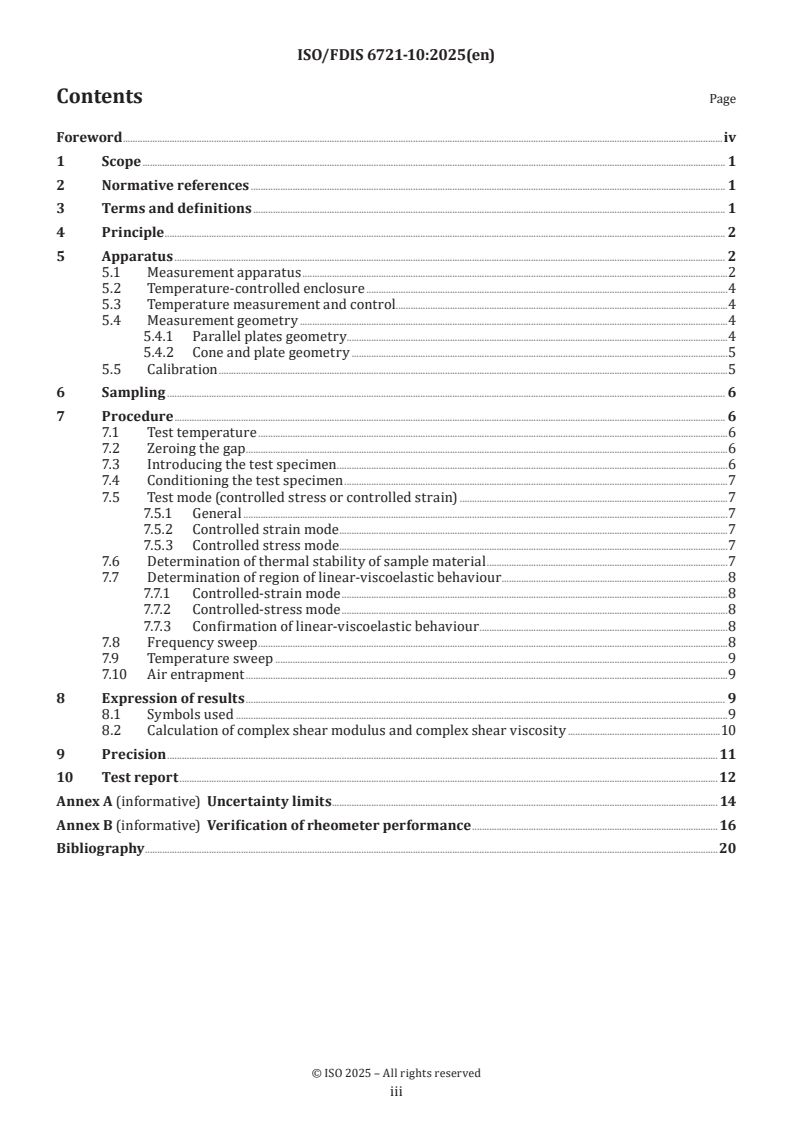
Contents Page
Foreword .iv
1 Scope . 1
2 Normative references . 1
3 Terms and definitions . 1
4 Principle . 2
5 Apparatus . 2
5.1 Measurement apparatus .2
5.2 Temperature-controlled enclosure .4
5.3 Temperature measurement and control .4
5.4 Measurement geometry .4
5.4.1 Parallel plates geometry.4
5.4.2 Cone and plate geometry .5
5.5 Calibration .5
6 Sampling . 6
7 Procedure . 6
7.1 Test temperature .6
7.2 Zeroing the gap .6
7.3 Introducing the test specimen .6
7.4 Conditioning the test specimen .7
7.5 Test mode (controlled stress or controlled strain) .7
7.5.1 General .7
7.5.2 Controlled strain mode .7
7.5.3 Controlled stress mode . .7
7.6 Determination of thermal stability of sample material .7
7.7 Determination of region of linear-viscoelastic behaviour .8
7.7.1 Controlled-strain mode .8
7.7.2 Controlled-stress mode .8
7.7.3 Confirmation of linear-viscoelastic behaviour .8
7.8 Frequency sweep .8
7.9 Temperature sweep .9
7.10 Air entrapment .9
8 Expression of results . 9
8.1 Symbols used .9
8.2 Calculation of complex shear modulus and complex shear viscosity .10
9 Precision .11
10 Test report .12
Annex A (informative) Uncertainty limits . 14
Annex B (informative) Verification of rheometer performance .16
Bibliography .20
iii
Foreword
ISO (the International Organization for Standardization) is a worldwide federation of national standards
bodies (ISO member bodies). The work of preparing International Standards is normally carried out through
ISO technical committees. Each member body interested in a subject for which a technical committee
has been established has the right to be represented on that committee. International organizations,
governmental and non-governmental, in liaison with ISO, also take part in the work. ISO collaborates closely
with the International Electrotechnical Commission (IEC) on all matters of electrotechnical standardization.
The procedures used to develop this document and those intended for its further maintenance are described
in the ISO/IEC Directives, Part 1. In particular, the different approval criteria needed for the different types
of ISO document should be noted. This document was drafted in accordance with the editorial rules of the
ISO/IEC Directives, Part 2 (see www.iso.org/directives).
ISO draws attention to the possibility that the implementation of this document may involve the use of (a)
patent(s). ISO takes no position concerning the evidence, validity or applicability of any claimed patent
rights in respect thereof. As of the date of publication of this document, ISO had not received notice of (a)
patent(s) which may be required to implement this document. However, implementers are cautioned that
this may not represent the latest information, which may be obtained from the patent database available at
www.iso.org/patents. ISO shall not be held responsible for identifying any or all such patent rights.
Any trade name used in this document is information given for the convenience of users and does not
constitute an endorsement.
For an explanation of the voluntary nature of standards, the meaning of ISO specific terms and expressions
related to conformity assessment, as well as information about ISO's adherence to the World Trade
Organization (WTO) principles in the Technical Barriers to Trade (TBT), see www.iso.org/iso/foreword.html.
This document was prepared by Technical Committee ISO/TC 61, Plastics, Subcommittee SC 5, Physical-
chemical properties.
This fourth edition cancels and replaces the third edition (ISO 6721-10:2015), which has been technically
revised.
The main changes are as follows:
— rheometer geometry has been described in detail for both parallel-plate and cone-and-plate geometry;
— in 7.5, controlled stress mode and controlled strain mode have been defined in separate subclauses.
A list of all parts in the ISO 6721 series can be found on the ISO website.
Any feedback or questions on this document should be directed to the user’s national standards body. A
complete listing of these bodies can be found at www.iso.org/members.html.
iv
FINAL DRAFT International Standard ISO/FDIS 6721-10:2025(en)
Plastics — Determination of dynamic mechanical
properties —
Part 10:
Complex shear viscosity using a parallel-plate and a cone-
and-plate oscillatory rheometer
1 Scope
This document specifies the general principles of a method for determining the dynamic rheological
-1 -1
properties of polymer melts at angular frequencies typically in the range of 0,01 rad s to 100 rad s by
means of an oscillatory rheometer with a parallel-plate or a cone-and-plate geometry. Angular frequencies
outside this range can also be used.
The method is applicable for determining values of the following dynamic rheological properties: complex
shear viscosity η*, dynamic shear viscosity η', the out-of-phase component of the complex shear viscosity η”,
complex shear modulus G*, shear loss modulus G”, shear storage modulus G', phase angle δ, and loss factor
tanδ. It is suitable for measuring complex shear viscosity values typically up to ~10 M
...
Style Definition
...
Formatted: Font: 14 pt, French (Switzerland)
ISO /TC 61/SC 5/WG 8
Formatted: Right: 1.5 cm, Bottom: 1 cm, Gutter: 0 cm,
Section start: New page, Header distance from edge:
Secretariat: DIN
1.27 cm, Footer distance from edge: 1.27 cm
Formatted: French (Switzerland)
Date: 2025-01-22
Formatted: zzCover large
Formatted
...
Formatted
...
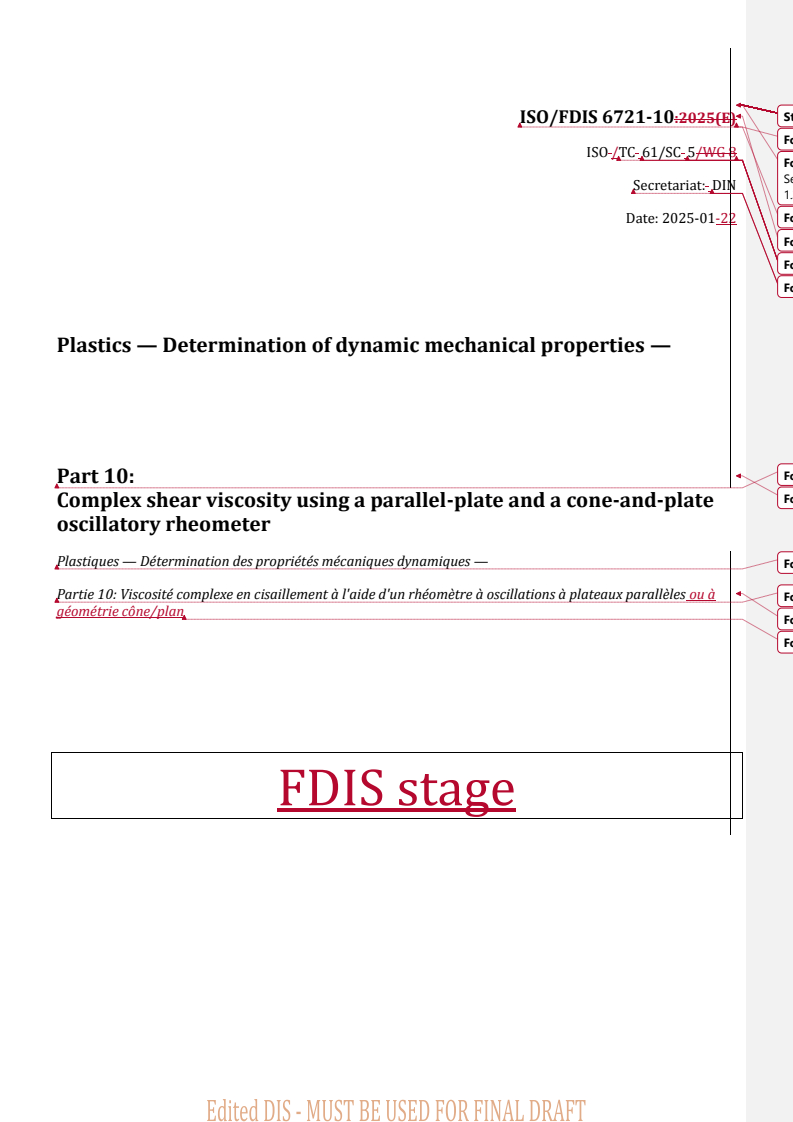
Plastics — Determination of dynamic mechanical properties —
Formatted: Regular
Part 10:
Formatted: Cover Title_A2
Complex shear viscosity using a parallel-plate and a cone-and-plate
oscillatory rheometer
Plastiques — Détermination des propriétés mécaniques dynamiques —
Formatted: French (France)
Partie 10: Viscosité complexe en cisaillement à l'aide d'un rhéomètre à oscillations à plateaux parallèles ou à
Formatted: French (France)
géométrie cône/plan
Formatted: Cover Title_B
Formatted: French (France)
FDIS stage
Formatted: Font: 11 pt
Formatted: HeaderCentered, Space After: 0 pt, Line
spacing: single
Formatted: Font: 11 pt
Formatted: Indent: Left: 0 cm, Right: 0 cm, Space
All rights reserved. Unless otherwise specified, or required in the context of its implementation, no part of this publication
Before: 0 pt, No page break before, Adjust space
may be reproduced or utilized otherwise in any form or by any means, electronic or mechanical, including photocopying,
between Latin and Asian text, Adjust space between
or posting on the internet or an intranet, without prior written permission. Permission can be requested from either ISO
Asian text and numbers
at the address below or ISO’s member body in the country of the requester.
Formatted: Default Paragraph Font
ISO copyright office
CP 401 • Ch. de Blandonnet 8
CH-1214 Vernier, Geneva
Phone: + 41 22 749 01 11
Formatted: French (Switzerland)
EmailE-mail: copyright@iso.org
Formatted: French (Switzerland)
Website: www.iso.orgwww.iso.org
Formatted: French (Switzerland)
Published in Switzerland
Formatted: French (Switzerland)
Formatted: English (United Kingdom)
Formatted: FooterPageRomanNumber
ii © ISO 2023 – All rights reserved
ii
Formatted: HeaderCentered, Left, Space After: 0 pt,
Line spacing: single
Formatted: Font: 11 pt
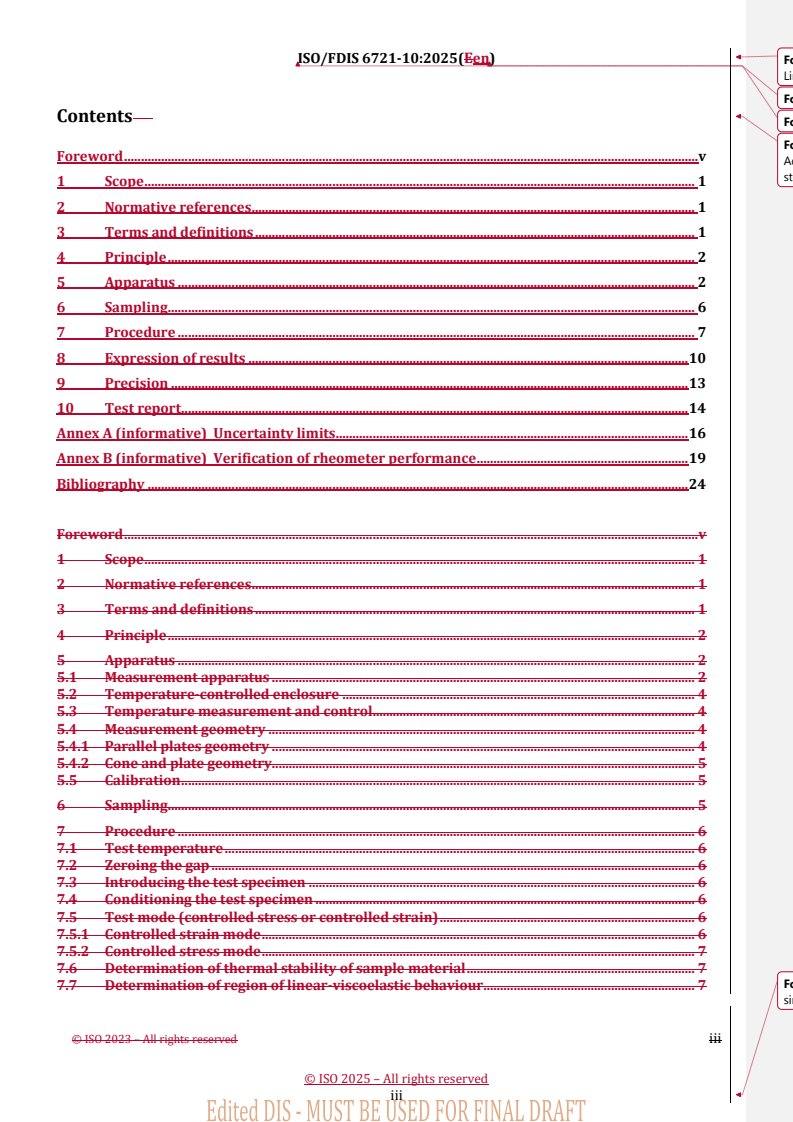
Contents
Formatted: Font: 11 pt
Formatted: Adjust space between Latin and Asian text,
Foreword . v
Adjust space between Asian text and numbers, Tab
stops: Not at 13.41 cm
1 Scope . 1
2 Normative references . 1
3 Terms and definitions . 1
4 Principle . 2
5 Apparatus . 2
6 Sampling . 6
7 Procedure . 7
8 Expression of results . 10
9 Precision . 13
10 Test report . 14
Annex A (informative) Uncertainty limits . 16
Annex B (informative) Verification of rheometer performance . 19
Bibliography . 24
Foreword . v
1 Scope . 1
2 Normative references . 1
3 Terms and definitions . 1
4 Principle . 2
5 Apparatus . 2
5.1 Measurement apparatus . 2
5.2 Temperature-controlled enclosure . 4
5.3 Temperature measurement and control . 4
5.4 Measurement geometry . 4
5.4.1 Parallel plates geometry . 4
5.4.2 Cone and plate geometry. 5
5.5 Calibration . 5
6 Sampling . 5
7 Procedure . 6
7.1 Test temperature . 6
7.2 Zeroing the gap . 6
7.3 Introducing the test specimen . 6
7.4 Conditioning the test specimen . 6
7.5 Test mode (controlled stress or controlled strain) . 6
7.5.1 Controlled strain mode . 6
7.5.2 Controlled stress mode . 7
7.6 Determination of thermal stability of sample material . 7
Formatted: FooterPageRomanNumber, Line spacing:
7.7 Determination of region of linear-viscoelastic behaviour . 7
single
iii
Formatted: Font: 11 pt
Formatted: HeaderCentered, Space After: 0 pt, Line
spacing: single
7.7.1 In the controlled-strain mode . 7
Formatted: Font: 11 pt
7.7.2 In the controlled-stress mode . 7
7.7.3 Confirmation of linear-viscoelastic behaviour . 8
7.8 Frequency sweep . 8
7.9 Temperature sweep . 8
7.10 Air entrapment . 8
8 Expression of results . 8
8.1 Symbols used . 8
8.2 Calculation of complex shear modulus and complex shear viscosity . 9
9 Precision . 10
10 Test report . 12
Annex A (informative) Uncertainty limits. 13
Annex B (informative) Verification of rheometer performance . 16
B.1 General. 16
B.2 Verification of the gap separation of the rheometer plates or cone and plate . 16
B.3 Verification of the strain amplitude . 17
B.4 Verification of the frequency response . 17
B.5 Verification of angular velocity . 17
B.6 Verification of torque measurement . 18
B.6.1 Verification of torque measurement using mechanical means . 18
B.6.2 Verification of torque measurement using reference fluids . 18
B.7 Verification of temperature measurement . 18
B.8 Verification of the phase shift . 19
B.9 Verification of the rheometer using reference fluids . 19
B.9.1 General. 19
B.9.2 Newtonian fluids . 19
B.9.3 Non-Newtonian fluids . 20
Bibliography . 21
Formatted: FooterPageRomanNumber
iv © ISO 2023 – All rights reserved
iv
Formatted: Font: 11 pt
Formatted: HeaderCentered, Left, Space After: 0 pt,
Line spacing: single
Foreword
Formatted: Font: 11 pt
ISO (the International Organization for Standardization) is a worldwide federation of national standards
bodies (ISO member bodies). The work of preparing International Standards is normally carried out through
ISO technical committees. Each member body interested in a subject for which a technical committee has been
established has the right to be represented on that committee. International organizations, governmental and
non-governmental, in liaison with ISO, also take part in the work. ISO collaborates closely with the
International Electrotechnical Commission (IEC) on all matters of electrotechnical standardization.
The procedures used to develop this document and those intended for its further maintenance are described
in the ISO/IEC Directives, Part 1. In particular, the different approval criteria needed for the different types of
ISO document should be noted. This document was drafted in accordance with the editorial rules of the
ISO/IEC Directives, Part 2 (see www.iso.org/directives).
Formatted: English (United Kingdom)
ISO draws attention to the possibility that the implementation of this document may involve the use of (a)
patent(s). ISO takes no position concerning the evidence, validity or applicability of any claimed patent rights
in respect thereof. As of the date of publication of this document, ISO had n
...
Questions, Comments and Discussion
Ask us and Technical Secretary will try to provide an answer. You can facilitate discussion about the standard in here.