

ISO/FDIS 28022
(Main)Security and resilience ― Security management systems ― Guidelines on security management system (SMS) processes
- Abstract
This document provides a process reference model (PRM) for a security management system (SMS) aligned with ISO 28000, which will meet the criteria defined in ISO/IEC 33004 for process reference models. It provides guidelines for users of ISO 28000 on the establishment, implementation, maintenance and improvement of the SMS. It is intended to guide users in the operation of a SMS aligned with ISO 28000 and explain this SMS with a process-oriented view. This document is applicable to all types and sizes of organizations (e. g. commercial enterprises, government or other public agencies and non-profit organizations) which intend to establish, implement, apply, maintain and improve a security management system. It provides a holistic and common approach and is not industry or sector specific. This document can be used throughout the life of the organization and can be applied to any activity, internal or external, at all levels.
- Status
- Not Published
- Technical Committee
- ISO/TC 292 - Security and resilience
- Drafting Committee
- ISO/TC 292/WG 8 - Supply chain security
- Current Stage
- 5020 - Proof sent to secretariat or FDIS ballot initiated: 8 weeks - 50 Approval
- Start Date
- 28-Sep-2026
- Due Date
- 28-Sep-2026
- Completion Date
- 28-Sep-2026
Buy Documents

ISO/FDIS 28022 - Security and resilience ― Security management systems ― Guidelines on security management system (SMS) processes
REDLINE ISO/FDIS 28022 - Security and resilience ― Security management systems ― Guidelines on security management system (SMS) processes
ISO/FDIS 28022 is an ISO draft International Standard that gives guidelines for security management system (SMS) processes. It provides a process reference model (PRM) for an SMS aligned with ISO 28000 and intended for organizations that want to establish, implement, maintain, and improve security management in a process-oriented way.
What does ISO/FDIS 28022 specify?
ISO/FDIS 28022 specifies how to design and implement the processes of an SMS based on ISO 28000:2022. It is a guidelines document, not a requirements document, and it is written for organizations of all types and sizes.
The standard applies across the life of an organization and to internal or external activities at all levels. It is not industry- or sector-specific, so the same process model can be tailored for commercial enterprises, public bodies, and non-profit organizations.
Its structure follows the PDCA cycle:
- Clause 5 - management system processes for the SMS, the Plan step
- Clause 6 - operational planning and control processes, the Do step
- Clause 7 - evaluation processes, the Check step
- Clause 8 - improvement processes, the Act step
- Clause 9 - implementation and integration
Annex A provides a statement of conformity to ISO/IEC 33004:2015.
| Annex | What it covers |
|---|---|
| A | Statement of conformity to ISO/IEC 33004:2015 |
What are the key requirements of ISO/FDIS 28022?
ISO/FDIS 28022 does not add requirements to ISO 28000; it gives process guidance for meeting ISO 28000 in practice. The most useful way to read it is as a process map for building, running, checking, and improving an SMS.
Clause 4 sets the process model and its use. The PRM is fully aligned with ISO 28000 and is organized around PDCA. In practice, this means an organization can use the document to structure its SMS work from initial design through day-to-day operation and continual improvement.
Clause 5.2 establishes context. The organization should identify its internal and external environment, interested parties, legal and regulatory obligations, and other relevant requirements. This matters because SMS planning must reflect real business conditions, not a generic template.
Clause 5.3 applies the principles of SMS. The organization should analyze how the principles in ISO 28000 affect security and how security affects the organization, then turn that analysis into activities. In practice, principles only help if they are translated into operating decisions and actions.
Clause 5.4 defines the SMS scope. The scope should be established, communicated, and available as documented information, including control of externally provided processes and assigned responsibilities. This tells a reader what parts of the organization and supply chain are inside the SMS boundary.
Clause 5.5 and 5.7 place responsibility on top management and support functions. Top management should establish the security policy and objectives, ensure resources are available, assign roles and responsibilities, and provide communication and documented information control. In practice, security management cannot work without visible leadership, staffing, time, and clear ownership.
Clause 5.6 drives strategical planning. The organization should identify security-related risks and opportunities, plan actions, and manage changes to the SMS. This is the bridge between the context of the organization and the concrete security actions that follow.
Clause 6.3 defines risk assessment and treatment. The organization should identify, analyze, evaluate, and prioritize security-related risks, identify risk owners, and select treatment options and plans. This gives a repeatable method for deciding what needs attention first and who is accountable.
Clauses 6.4 and 6.5 turn risk decisions into operational readiness. ISO/FDIS 28022 calls for strategies, procedures, and treatments, then for security plans that cover warning and communication, response structure, standing down, and restoration. In practice, this means an SMS needs pre-planned actions for incidents, not improvised reactions.
Clauses 7 and 8 close the loop. Performance evaluation, internal audit, management review, and improvement should feed corrective action and continual improvement. This matters because an SMS is expected to stay current as risks, incidents, and business conditions change.
Clause 9 supports integration. The processes can be designed as part of an integrated management system (IMS). For many organizations, this is the practical route to avoid duplicate procedures and to share resources across management systems.
What terms does ISO/FDIS 28022 define?
ISO/FDIS 28022 uses terms from ISO 22300, and Clause 3 gives one explicit definition.
- Process reference model (PRM) - a set of processes that together support the main aims of a community of interest, with relationships between those processes.
- Security management system (SMS) - the collection of interacting processes used to establish and operate security management in a structured way.
- Plan-Do-Check-Act (PDCA) - the cycle used by the standard to organize planning, operation, evaluation, and improvement.
- Integrated management system (IMS) - a management system where SMS processes can be combined with other management system processes.
- Risk owner - the role that analyzes and evaluates identified security-related risks and helps select treatment.
- Interested parties - the people or groups whose needs and expectations are considered when defining context, scope, and communication.
- Internal audit - an independent audit of SMS processes used to assess effectiveness and identify nonconformities and improvement options.
Who uses ISO/FDIS 28022?
ISO/FDIS 28022 is used by organizations that want to establish, implement, apply, maintain, and improve an SMS aligned with ISO 28000. It is suitable for commercial enterprises, government and other public agencies, and non-profit organizations.
In practice, the standard is useful for:
- top management setting policy, objectives, and direction
- security managers designing the SMS
- risk owners and process owners running risk assessment, treatment, and controls
- internal auditors checking effectiveness and conformity
- quality or integrated management system teams combining SMS with other systems
- assessors and consultants reviewing an SMS against ISO 28000 and ISO/IEC 33004
Which standards are used with ISO/FDIS 28022?
ISO/FDIS 28022 is built around ISO 28000:2022 and uses other ISO and IEC documents for vocabulary, process modeling, risk, and auditing support.
- ISO 28000:2022 - the requirements standard that this PRM supports
- ISO 22300 - the vocabulary used for terms and definitions
- ISO/IEC 33004:2015 - the criteria for process reference models and the basis for Annex A
- ISO/IEC/IEEE 24774:2021 - guidance considered when describing processes
- ISO 31000:2018 - referenced for risk management concepts used in risk assessment and treatment
- ISO 19011:2018 - referenced for guidance on internal auditing of management systems
What does the ISO/FDIS 28022 document contain?
ISO/FDIS 28022 contains a process model made up of EPC-style process descriptions, process profiles, and a conformity annex. Each process profile gives the purpose, inputs, activities, results, and informative references for one SMS process.
The main body includes a PRM overview figure and detailed process profiles in Tables 1 to 14. Those tables cover the context, principles, scope, leadership, planning, support, operational control, risk assessment, strategies and treatment, security plans, performance evaluation, internal audit, management review, and improvement.
The process descriptions are written as practical guidance for design and implementation. They show what each process is for, what information it needs, and what output it should produce, which makes the document useful for planning, documentation, audits, and SMS integration.
Annex A explains how the model meets the criteria for a PRM in ISO/IEC 33004:2015.
Buy Documents
ISO/FDIS 28022 - Security and resilience ― Security management systems ― Guidelines on security management system (SMS) processes
REDLINE ISO/FDIS 28022 - Security and resilience ― Security management systems ― Guidelines on security management system (SMS) processes
Get Certified
Connect with accredited certification bodies for this standard

BSI Group
BSI (British Standards Institution) is the business standards company that helps organizations make excellence a habit.

Bureau Veritas
Bureau Veritas is a world leader in laboratory testing, inspection and certification services.

DNV
DNV is an independent assurance and risk management provider.
Sponsored listings
Frequently Asked Questions
ISO/FDIS 28022 is a draft published by the International Organization for Standardization (ISO). Its full title is "Security and resilience ― Security management systems ― Guidelines on security management system (SMS) processes". This standard covers: This document provides a process reference model (PRM) for a security management system (SMS) aligned with ISO 28000, which will meet the criteria defined in ISO/IEC 33004 for process reference models. It provides guidelines for users of ISO 28000 on the establishment, implementation, maintenance and improvement of the SMS. It is intended to guide users in the operation of a SMS aligned with ISO 28000 and explain this SMS with a process-oriented view. This document is applicable to all types and sizes of organizations (e. g. commercial enterprises, government or other public agencies and non-profit organizations) which intend to establish, implement, apply, maintain and improve a security management system. It provides a holistic and common approach and is not industry or sector specific. This document can be used throughout the life of the organization and can be applied to any activity, internal or external, at all levels.
This document provides a process reference model (PRM) for a security management system (SMS) aligned with ISO 28000, which will meet the criteria defined in ISO/IEC 33004 for process reference models. It provides guidelines for users of ISO 28000 on the establishment, implementation, maintenance and improvement of the SMS. It is intended to guide users in the operation of a SMS aligned with ISO 28000 and explain this SMS with a process-oriented view. This document is applicable to all types and sizes of organizations (e. g. commercial enterprises, government or other public agencies and non-profit organizations) which intend to establish, implement, apply, maintain and improve a security management system. It provides a holistic and common approach and is not industry or sector specific. This document can be used throughout the life of the organization and can be applied to any activity, internal or external, at all levels.
ISO/FDIS 28022 is classified under the following ICS (International Classification for Standards) categories: 03.100.01 - Company organization and management in general; 03.100.70 - Management systems. The ICS classification helps identify the subject area and facilitates finding related standards.
ISO/FDIS 28022 is available in PDF format for immediate download after purchase. The document can be added to your cart and obtained through the secure checkout process. Digital delivery ensures instant access to the complete standard document.
Standards Content (Sample)
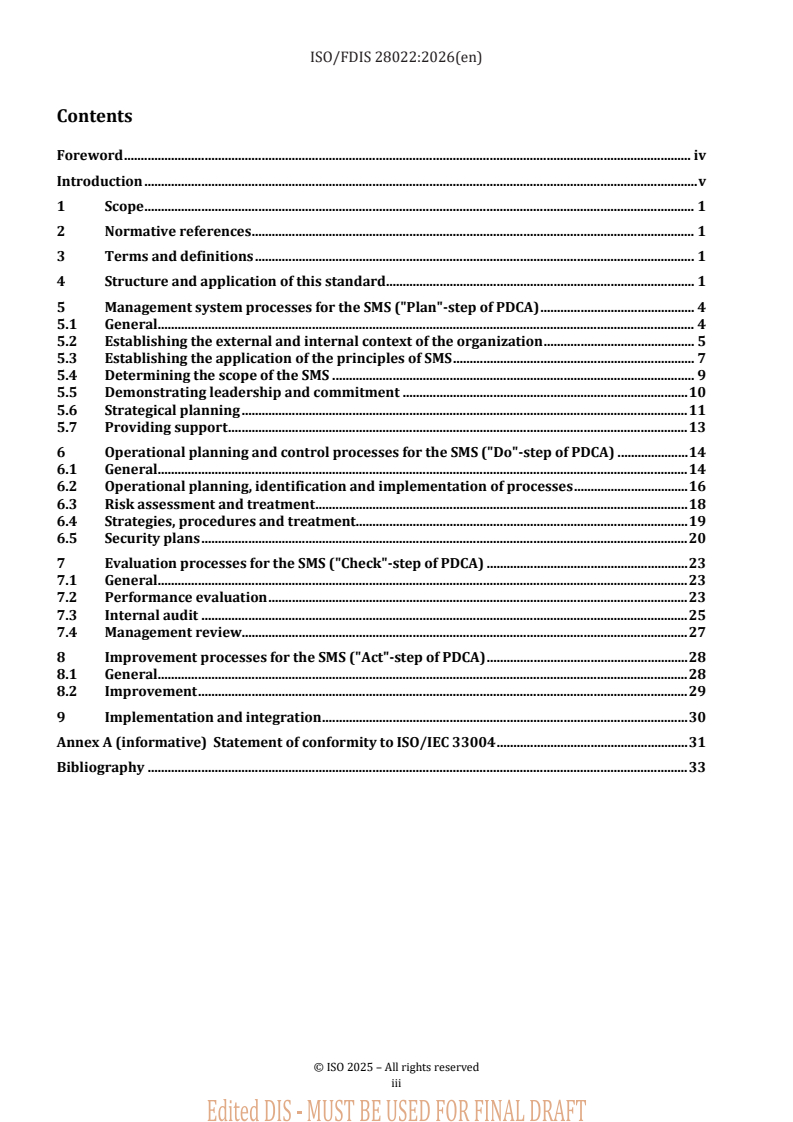
Contents
- Introduction
- 1 Scope
- 2 Normative references
- 3 Terms and definitions
- 3.1 process reference model
- 4 Structure and application of this standard
- 5 Management system processes for the SMS ("Plan"-step of PDCA)
- 5.1 General
- 5.2 Establishing the external and internal context of the organization
- 5.3 Establishing the application of the principles of SMS
- 5.4 Determining the scope of the SMS
- 5.5 Demonstrating leadership and commitment
- 5.6 Strategical planning
- 5.7 Providing support
- 6 Operational planning and control processes for the SMS ("Do"-step of PDCA)
- 6.1 General
- 6.2 Operational planning, identification and implementation of processes
- 6.3 Risk assessment and treatment
- 6.4 Strategies, procedures and treatment
- 6.5 Security plans
- 7 Evaluation processes for the SMS ("Check"-step of PDCA)
- 7.1 General
- 7.2 Performance evaluation
- 7.3 Internal audit
- 7.4 Management review
- 8 Improvement processes for the SMS ("Act"-step of PDCA)
- 8.1 General
- 8.2 Improvement
- 9 Implementation and integration
- Annex A
- Bibliography
Introduction
A security management system (SMS) consists of a collection of interacting processes and is operated by performing those processes. As an implementation guideline, this document provides a process reference model (PRM) for security management including a detailed but generic structure for the core processes of a SMS compliant to ISO 28000.
The SMS-PRM should be used as a prototype for a SMS, which should be tailored to the objectives, needs and individual requirements of the designing and implementing organization. The tailoring of the PRM may omit some of the listed processes, where they are inapplicable or would be reduced to vestigial form. The process orientation of the PRM also supports the transition from designing and implementing a SMS (project phase) to the operation of the SMS (performing the processes). The process orientation also supports and allows the integration of the SMS processes in further domains of an integrated management system.
NOTE For further guidelines on how to integrate management systems, see Integrated management systems – A [10] practical guide (IMS PG).
The PRM does not attempt to place the processes in any specific environment, nor does it pre-determine any level of process capability/maturity required to fulfil the requirements specified in ISO 28000:2022. Each process of this PRM is described in terms of:
- Category
- Overview
- Purpose and objective
- Input, activities and results
- References
FINAL DRAFT International Standard ISO/FDIS 28022:2026(en) Security and resilience ― Security management systems ― Guidelines on security management system (SMS) processes
1 Scope
This document provides guidelines on the design and implementation of processes of a security management system (SMS) based on ISO 28000:2022 in the form of a process reference model (PRM) for a SMS. The PRM in this document meets the criteria defined in ISO/IEC 33004:2015 for process reference models. This document provides guidelines for organizations on how to fulfil the requirements of ISO 28000:2022 with a process-oriented and operational point of view.
This document is applicable to all types and sizes of organizations (e.g. commercial enterprises, government or other public agencies and non-profit organizations) which intend to establish, implement, apply, maintain and improve a security management system. It provides a holistic and common approach and is not industry or sector specific.
This document can be used throughout the life of the organization and can be applied to any activity, internal or external, at all levels. No requirements (whether additional or not) are included in this document.
2 Normative references
The following documents are referred to in the text in such a way that some or all of their content constitutes requirements of this document. For dated references, only the edition cited applies. For undated references, the latest edition of the referenced document (including any amendments) applies. ISO 22300, Security and resilience — Vocabulary
3 Terms and definitions
For the purposes of this document, the terms and definitions given in ISO 22300 apply. ISO and IEC maintain terminology databases for use in standardization at the following addresses:
- ISO Online browsing platform: available at https:// www .iso .org/ obp
- IEC Electropedia: available at https:// www .electropedia .org/
3.1 process reference model
set of processes that collectively support the primary aims of a community of interest described in terms of process purpose and outcomes, together with an architecture describing the relationships between the processes Note 1 to entry: A process reference model can provide the basis for one or more process assessment models.
4 Structure and application of this standard
This document is fully aligned to the security management requirements contained in ISO 28000. Processes of the SMS are differentiated in this document as follows.
- Management system processes for the SMS (Clause 5): The management system processes represent the “Plan”-step within the PDCA-Cycle of the SMS aligned to ISO 28000:2022 and should ensure its alignment with the overall objectives and needs of the organization and its stakeholders.
ISO/FDIS 28022:2026(en) - Operational planning and control processes for the SMS (Clause 6): The operational planning and control processes represent the “Do”-step within the PDCA-Cycle of the SMS aligned to ISO 28000:2022 and should ensure its operation’s alignment with the overall security objectives and needs of the organization and its interested parties.
- Evaluation processes for the SMS (Clause 7): The evaluation processes represent the “Check”-step within the PDCA-Cycle of the SMS aligned to ISO 28000:2022 and should ensure its operation’s alignment with the security policy and its principles as well as the overall security objectives and needs of the organization and its stakeholders.
- Improvement process for the SMS (Clause 8): The overarching principle of all ISO management system standards is the concept of continual improvement, which should be achieved by implementing an improvement process.
The PRM also meets the criteria defined in ISO/IEC 33004:2015 for process reference models in information technology. A detailed statement of conformity to ISO/IEC 33004:2015 is provided in Annex A of this document.
The fundamental elements of a PRM are the descriptions of the processes within the scope of the model. The process descriptions in the PRM incorporate a statement of the purpose of the process, which describes at a high level the overall objectives of performing the process.
A SMS incorporates sub-processes as shown in Figure 1. The listed sub-processes illustrate key topics that should be considered during the process design phase when designing and implementing a SMS. For every SMS process, the necessary maturity level should be determined, implemented and operated. A possible result of determining the necessary maturity level of a process can be that the process should not be implemented at all (maturity level zero).
SMS processes should be integrated into existing management systems and processes. This is not displayed in Figure 1 to ensure readability and due to existing management systems differing too much in practice. Interfaces to the SMS processes are described within the detailed process profiles in the Tables 1 to 14.
ISO/FDIS 28022:2026(en) Figure 1 — Overview of the PRM for security management In Clauses 5 to 8, all processes are designed as a simplified event-driven process chain (EPC) showing only the situations starting and ending the process and the activities as steps to follow. The EPC is followed by a table with the process profile.
5 Management system processes for the SMS ("Plan"-step of PDCA)
5.1 General
The management system processes represent the “Plan”-step within the PDCA-Cycle of the SMS aligned to ISO 28000:2022. The SMS should ensure its alignment with the overall objectives and needs of the organization and its stakeholders.
Key to satisfying the SMS objectives is an up-to-date understanding of the needs and expectations of interested parties relevant to the security of the organization and its SMS. This understanding should encompass the process of establishing the context, which should specify relevant legal, statutory, regulatory and any other (e.g. contractual) requirements of the organization. The guidelines regarding the management system processes include the process of demonstrating leadership which includes the establishment of the SMS Policy, the process for planning including planning of changes to the SMS the process for support including resource management, general communications and creating and controlling documented information.
ISO/FDIS 28022:2026(en) The overall roadmap to security management as part of resilience and the processes of a security management system (SMS) starts with the decision by the top management to initiate the establishment of an SMS with the six following processes:
- Context (5.2)
- Principles (5.3)
- Scope of the SMS (5.4)
- Leadership and commitment (5.5)
- Strategical planning (5.6)
- Support (5.7)
5.2 Establishing the external and internal context of the organization
Figure 2 contains an EPC on how the process to establish the external and internal context of the organization should be designed and implemented. Table 1 describes and provides guidelines on the corresponding process profile.
Figure 2 — EPC 1: Process to establish the external and internal context of the organization
ISO/FDIS 28022:2026(en) Table 1 — Process to establish the external and internal context of the organization Process to establish the external and internal context of the organization Process category Management system process This process ensures that security is managed based on the external and internal environment relevant for the security of the organization taking into account the interested parties and their Brief description requirements and the applicable legal, regulatory and other requirements to which the organization subscribes. Purpose and ob- Purpose and objectives of this process are to ensure alignment of the SMS with the objectives jectives and needs of the organization.
- The security policy established by top management
- Strategic objectives of the organization
- Already existing management system(s)
- Laws, regulations and requirements of relevant interested parties Input — Already existing documented information
- Identified and prioritized security related risks
- General, contractual or specific security requirements
- Identified security related vulnerabilities
- Incident reports
- Top management should identify the purpose, mission and vision of the organization
- The organization should identify the external and internal environment of the organization
- The organization should identify relevant interested parties and their needs and expectations Activities
- The organization should identify legal, regulatory and other requirements to which it subscribes, reviewed and approved by top management
- The organization’s approach to meeting requirements should be documented
- The list of requirements (e.g. feedback from the administration or other interested parties) should be continually reviewed and updated
- Purpose, vision and mission of the SMS and its scope
- Input for strategical planning and the processes of the SMS, in particular assessment and treatment of security related risks and responses to security related threats Results and violations
- Input for support processes (e.g. resource requirements)
- Input for warning and communication and response processes References ISO 28000:2022, Clauses 4 and 5
5.3 Establishing the application of the principles of SMS
Figure 3 contains an EPC on the process to establish the application of the principles of SMS should be designed and implemented. Table 2 describes and provides guidelines on the corresponding process profile.
ISO/FDIS 28022:2026(en) Figure 3 — EPC 2: Process to establish the application of the principles of SMS Table 2 — Process to establish the application of the principles of SMS Process to establish the application of the principles of SMS Process category Management system process This process ensures that vital principles are taken into account in security management to Brief description create and protect value.
Purpose and objec- To ensure alignment of the SMS with the principles laid out in ISO 28000. tives - Principles laid out in ISO 28000:2022, Figure 2 and 4.2.3.2 to 4.2.3.9 Input - Analysis of ISO 28000:2022, 4.2.3 and the implications of the analysis of security risk and violations together with staff - The organization should determine how the principles can be affected by and can affect the security of the organization.
- The organization should determine how the principles can be applied in the organization’s security management.
Activities - Activities for the application of each principle appropriate for the organization should be identified.
- Identified activities should be established and implemented. Results — Each principle is applied and value created and protected. References ISO 28000:2022, 4.2.3
5.4 Determining the scope of the SMS
Figure 4 contains an EPC on how the process to determine the scope of the SMS should be designed and implemented. Table 3 describes and provides guidelines the corresponding process profile. Figure 4 — EPC 3: Process to determine the scope of the SMS
ISO/FDIS 28022:2026(en) Table 3 — Process to determine the scope of the SMS Process to determine the scope of the SMS Process category Management system process Brief description This process ensures that the boundaries and applicability of the SMS are determined. To ensure the scope of the SMS Purpose and - is established and objectives - available as documented information.
- The external environment of the organization
- The internal environment of the organization Input
- The issues referred to in ISO 28000:2022, 4.1
- The requirements referred to in ISO 28000:2022, 4.2
- Input should be considered and the scope should be determined.
- Documented information on the scope should be made available. Activities
- The organization should ensure that externally provided processes are controlled and responsibilities identified within the SMS.
The scope of the SMS is:
- established, Results
- communicated and
- applied.
References ISO 28000:2022, 4.3
5.5 Demonstrating leadership and commitment
Figure 5 contains an EPC on how the process to demonstrate leadership and commitment should be designed and implemented. Table 4 describes and provides guidelines on the corresponding process profile. Figure 5 — EPC 4: Process to demonstrate leadership and commitment
ISO/FDIS 28022:2026(en) Table 4 — Process to demonstrate leadership and commitment Process to demonstrate leadership and commitment Process category Management system process Within the process to demonstrate leadership, the top management demonstrates commitment, including establishing the security policy and objectives, ensuring that the context is established, Brief description the principles are applied, resources are available, and roles, responsibilities and authorities are assigned.
To ensure that the commitment of top management aligns with appropriate policies, standards, Purpose and objec- procedures and guidelines. The policy regarding security is developed, maintained, available and tives understood by the target group of the policy. Roles, responsibilities and authorities are assigned and necessary resources are provided.
- The results of relevant processes
- Appropriate documented information Input
- Information on any changes that happened or are pending
- Purpose, vision and mission of the organization and the scope of its SMS
- Security policy and objectives should be established.
- Formal approval (if needed) for the policy should be obtained and this approval should be communicated by the organization.
- The organization should ensure that the context is established. Activities
- The organization should ensure that the resources needed are available.
- The organization should ensure that staff are directed and supported adequately.
- The organization should be ensure that top management assigns relevant roles, responsibilities and authorities and communicates them.
- The security policy of the organization
- Appropriate (sufficient) resources (e.g. funding, time, material, staff, training) Results
- Appropriate communication and actions (walk as they talk) of top management
- Endorsement of appropriate contracts for outsourced products and services References ISO 28000:2022, Clauses 4 and 5
...
Contents
- Introduction
- 1 Scope
- 2 Normative references
- 3 Terms and definitions
- 3.1 process reference model
- 4 Structure and application of this standard
- 5 Management system processes for the SMS (("Plan"-step of PDCA-Step Plan)
- 5.1 General
- 5.2 EstablishEstablishing the external and internal context of the organization
- 5.3 EstablishEstablishing the application of the principles of SMS
- 4.2.3.9 Input
- 5.4 DetermineDetermining the scope of the SMS
- 5.5 DemonstrateDemonstrating leadership and commitment
- 5.6 Strategical planning
- 5.7 ProvideProviding support
- 6 Operational planning and control processes for the SMS (("Do"-step of PDCA-Step
- 6.1 General
- 6.2 Operational planning, identification and implementation of processes
- 6.3 Risk assessment and treatment
- 6.4 Strategies, procedures and treatment
- 6.5 Security plans
- 7 Evaluation processes for the SMS (PDCA-Step ("Check"-step of PDCA)
- 7.1 General
- 7.2 Performance evaluation
- 7.3 Internal Auditaudit
- 7.4 Management review
- 8 Improvement processes for the SMS (("Act"-step of PDCA-Step Act)
- 8.1 General
- 8.2 Improvement
- 9 Implementation and integration
- Annex A
- Bibliography
Introduction
A security management system (SMS) consists of a collection of interacting processes and is operated by performing those processes. As an implementation guideline, this document provides a process reference model (PRM) for security management including a detailed but generic structure for the core processes of a SMS compliant to ISO 28000.
The SMS-PRM should be used as a prototype for a SMS, which should be tailored to the objectives, needs and individual requirements of the designing and implementing organization. The tailoring of the PRM may omit some of the listed processes, where they are inapplicable or would be reduced to vestigial form. The process orientation of the PRM also supports the transition from designing and implementing a SMS (project phase) to the operation of the SMS (performing the processes). The process orientation also supports and allows the integration of the SMS processes in further domains of an integrated management system. NOTE For further guidelines on how to integrate management systems, see the ISO handbook “The Integrated Use [10] of Management System Standards (IUMSS)”.management systems – A practical guide (IMS PG). The PRM does not attempt to place the processes in any specific environment, nor does it pre-determine any level of process capability/maturity required to fulfil the requirements specified in ISO 28000:2022. Each process of this PRM is described in terms of:
- — Category
- — Overview
- — Purpose and objective
- — Input, activities and results
- — Informative references
ISO/FDIS 28022:2026(en) - References
Final DRAFT International Standard ISO/FDIS 28022:2026(en)
Security and resilience ― Security management systems ― Guidelines on security management system (SMS) processes
1 Scope
This document provides guidelines on the design and implementation of processes of a security management system (SMS) based on ISO 28000:2022 in the form of a process reference model (PRM) for a SMS. The PRM in this document meets the criteria defined in ISO/IEC 33004:2015 for process reference models. This document provides guidelines for organizations on how to fulfil the requirements of ISO 28000:2022 with a process-oriented and operational point of view.
This document is applicable to all types and sizes of organizations (e.g. commercial enterprises, government or other public agencies and non-profit organizations) which intend to establish, implement, apply, maintain and improve a security management system. It provides a holistic and common approach and is not industry or sector specific.
This document can be used throughout the life of the organization and can be applied to any activity, internal or external, at all levels. No requirements (whether additional or not) are included in this document.
2 Normative references
The following documents are referred to in the text in such a way that some or all of their content constitutes recommendationsrequirements of this document. For dated references, only the edition cited applies. For undated references, the latest edition of the referenced document (including any amendments) applies. ISO 22300, Security and resilience — Vocabulary
3 Terms and definitions
For the purposes of this document, the terms and definitions given in ISO 22300 apply. ISO and IEC maintain terminology databases for use in standardization at the following addresses:
- — ISO Online browsing platform: available at https://www.iso.org/obp
- — IEC Electropedia: available at https://www.electropedia.org/
3.1 process reference model
set of processes that collectively support the primary aims of a community of interest described in terms of process purpose and outcomes, together with an architecture describing the relationships between the processes Note 1 to entry: A process reference model can provide the basis for one or more process assessment models.
4 Structure and application of this standard
This document is fully aligned to the security management requirements contained in ISO 28000. Processes of the SMS are differentiated in this document as follows.
ISO/FDIS 28022:2026(en) - — Management System Processessystem processes for the SMS (Clause 5-): The management system processes represent the “Plan”-step within the PDCA-Cycle of the SMS aligned to ISO 28000:2022 and should ensure its alignment with the overall objectives and needs of the organization and its stakeholders. - — Operational planning and control processes for the SMS (Clause 6-): The operational planning and control processes represent the “DODo”-step within the PDCA-Cycle of the SMS aligned to ISO 28000:2022 and should ensure its operation’s alignment with the overall security objectives and needs of the organization and its interested parties.
- — Evaluation processes for the SMS (Clause 7-): The evaluation processes represent the “Check”-step within the PDCA-Cycle of the SMS aligned to ISO 28000:2022 and should ensure its operation’s alignment with the security policy and its principles as well as the overall security objectives and needs of the organization and its stakeholders.
- — Improvement process for the SMS (Clause 8-): The overarching principle of all ISO Management System Standardsmanagement system standards is the concept of continual improvement, which should be achieved by implementing an improvement process.
The PRM also meets the criteria defined in ISO/IEC 33004:2015 for process reference models in information technology. A detailed statement of conformity to ISO/IEC 33004:2015 is provided in Annex AAnnex A of this document.
The fundamental elements of a PRM are the descriptions of the processes within the scope of the model. The process descriptions in the PRM incorporate a statement of the purpose of the process, which describes at a high level the overall objectives of performing the process.
A SMS incorporates sub-processes as shown in Figure 1Figure 1.. The listed sub-processes illustrate key topics that should be considered during the process design phase when designing and implementing a SMS. For every SMS process, the necessary maturity level should be determined, implemented and operated. A possible result of determining the necessary maturity level of a process can be that the process should not be implemented at all (maturity level zero).
SMS processes should be integrated into existing management systems and processes. This is not displayed in Figure 1Figure 1 to ensure readability and due to existing management systems differing too much in practice. Interfaces to the SMS processes are described within the detailed process profiles in the Tables 1 to 14..
ISO/FDIS 28022:2026(en)
ISO/FDIS 28022:2026(en)
Figure 1 — Overview of the PRM for security management In Clauses 5 to 8For a quick overview and understanding, in the following, all processes are designed as a simplified event-driven process chain (EPC) showing only the situations starting and ending the process and the activities as steps to follow. ThisThe EPC is followed by a table with the process profile.
5 Management system processes for the SMS (("Plan"-step of PDCA-Step Plan)
5.1 General
In the following presented guidelines onThe management system processes represent the “Plan”-step within the PDCA-Cycle of the SMS aligned to ISO 28000:2022 and. The SMS should ensure its alignment with the overall objectives and needs of the organization and its stakeholders. The concepts and purposes embodied in these exemplary processes should be considered uring the Plan-step of an SMS development and implementation project.
Key to satisfying the SMS objectives is an up-to-date understanding of the needs and expectations of interested parties relevant to the security of the organization and its SMS. This understanding should be realized withinencompass the process of establishing the context, which should specify input for therelevant legal, statutory, regulatory and any other (e.g. contractual) requirements of the organization.
ISO/FDIS 28022:2026(en) The guidelines regarding the management system processes include the process of demonstrating leadership which includes the establishment of the SMS Policy, the process for planning including planning of changes to the SMS the process for support including resource management, general communications and creating and controlling documented information.
The overall roadmap to security management as part of resilience and the processes of a security management system (SMS) starts with the decision by the top management to initiate the establishment of an SMS with the six following processes:
- — Context (5.2(5.2))
- — Principles (5.3(5.3))
- — Scope of the SMS (5.4(5.4))
- — Leadership and commitment (5.5(5.5))
- — Strategical planning (5.6(5.6))
- — Support (5.7(5.7))
5.2 EstablishEstablishing the external and internal context of the organization
Figure 2Figure 2 contains an EPC on how the process to establish the external and internal context of the organization should be designed and implemented. Table 1Table 1 describes and provides guidelines on the corresponding process profile.
ISO/FDIS 28022:2026(en)
Figure 2 — EPC 1: Process to establish the external and internal context of the organization Table 1 — Process to establish the external and internal context of the organization Process to establish the external and internal context of the organization Process category Management system process This process ensures that security is managed based on the external and internal environment relevant for the security of the organization taking into account the interested parties and their Brief description requirements and the applicable legal, regulatory and other requirements to which the organization subscribes to.
Purpose &and Purpose and objectives of this process isare to ensure alignment of the SMS with the objectives objectives and needs of the organization.
- — The security policy established by top management
- — Strategic objectives of the organization
- — Already existing management system(s)
- — Laws, regulations and requirements of relevant interested parties
- — Already existing documented information Input
- — Identified and prioritized security related risks
- — General, contractual or specific security requirements
- — Identified security related vulnerabilities
- — Incident reports
- — Top management should identify the purpose, mission and vision of the
organization - — The organization should identify the external and internal environment of the Activities organization - — The organization should identify relevant interested parties and their needs and expectations
ISO/FDIS 28022:2026(en) - — The organization should identify legal, regulatory and other requirements to which it subscribes to –, reviewed and approved by top management - — The organization’s approach to meetmeeting requirements should be documented - — The list of requirements (e.g. feedback from the administration or other interested parties) should be continually reviewed and updated - — Purpose, vision and mission of the SMS and its scope
- — Input for strategical planning and the processes of the SMS, in particular assessment and treatment of security related risks and responses to security related threats and violations Results
- — Input for support processes (e.g. resource requirements)
- — Input for warning and communication and response processes Informative ISO 28000:2022 – clauses, Clauses 4 and 5 referencesRefere nces
5.3 EstablishEstablishing the application of the principles of SMS
Figure 3Figure 3 contains an EPC on how the process to establish the application of the principles of SMS should be designed and implemented. Table 2Table 2 describes and provides guidelines on the corresponding process profile.
ISO/FDIS 28022:2026(en)
Figure 3 — EPC 2: Process to establish the application of the principles of SMS Table 2 — Process to establish the application of the principles of SMS Process to establish the application of the principles of SMS Process category Management system process This process ensures that vital principles are taken into account in security management to Brief description create and protect value.
Purpose &and Purpose and objectives of this process is toTo ensure alignment of the SMS with the objectives principles laid out in ISO 28000.
- — Principles laid out in ISO 28000:2022 figure, Figure 2 and clauses 4.2.3.2 –to
4.2.3.9 Input
- — Analysis of ISO 28000:2022, 4.2.3 and the implications of the analysis of security risk and violations together with staff
- — ItThe organization should be determineddetermine how the principles can be
Activities affected by and can affect the security of the organization.
ISO/FDIS 28022:2026(en) - — ItThe organization should be determineddetermine how the principles can be applied in the organization’s security management.
- — Activities for the application of each principle appropriate for the organization should be identified.
- — Identified activities should be established and implemented.
- Results — — Each principle is applied and value created and protected.
Informative ISO 28000:2022 – clause , 4.2.3 referencesReferenc es
5.4 DetermineDetermining the scope of the SMS
Figure 4Figure 4 contains an EPC on how the process to determine the scope of the SMS should be designed and implemented. Table 3Table 3 describes and provides guidelines the corresponding process profile.
Figure 4 — EPC 3: Process to determine the scope of the SMS Table 3 — Process to determine the scope of the SMS Process to determine the scope of the SMS Process Management system process category Brief This process ensures that the boundaries and applicability of the SMS are determined. description The To ensure the scope of the SMS - — is established and Purpose &and
objectives - — available as documented information.
- — The external environment of the organization
Input - — The internal environment of the organization
ISO/FDIS 28022:2026(en) - — The issues referred to in ISO 28000, clause :2022, 4.1 - — The requirements referred to in ISO 28000:2022 clause , 4.2 - — Input should be considered and the scope should be determined.
- — Documented information on the scope should be made available. Activities
- — ItThe organization should be ensuredensure that externally provided processes are controlled and responsibilities identified within the SMS.
The scope of the SMS is:
- — established,
Results - — communicated and - — applied.
Informative ISO 28000:2022 clause , 4.3 referencesRefer ences
5.5 DemonstrateDemonstrating leadership and commitment
Figure 5Figure 5 contains an EPC on how the process to demonstrate leadership and commitment should be designed and implemented. Table 4Table 4 describes and provides guidelines on the corresponding process profile.
Figure 5 — EPC 4: Process to demonstrate leadership and commitment Table 4 — Process to demonstrate leadership and commitment Process to demonstrate leadership and commitment Process category Management system process Within the process to demonstrate leadership, the top management demonstrates Brief description commitment, including establishing the security policy and objectives, ensuring that the
ISO/FDIS 28022:2026(en) context is established and, the principles are applied and, resources are available, and roles, responsibilities and authorities are assigned.
EnsureTo ensure that the commitment of top management aligns with appropriate policies, Purpose &and standards, procedures and guidelines. The policy regarding security is developed, maintained, objectives available and understood by the target group of the policy. Roles, responsibilities and authorities are assigned and necessary resources are provided. - — The results of relevant processes
- — Appropriate documented information Input
- — Information on any changes that happened or are pending
- — Purpose, vision and mission of the organization and the scope of its SMS
- — Security policy and objectives should be established.
- — Formal approval (if needed) for the policy should be obtained and itthis approval should be communicated by the organization.
- — ItThe organization should be ensuredensure that the context is established.
- — ItThe organization should be ensuredensure that the resources needed are Activities available.
- — ItThe organization should be ensuredensure that staff isare directed and supported adequately.
- — ItThe organization should be ensuredensure that top management assigns relevant roles, responsibilities and authorities and communicates them.
- — The security policy of the organization
- — Appropriate (sufficient) resources (e.g. funding, time, material, staff, training) Results
- — Appropriate communication and actions (walk as they talk) of top management
- — Endorsement of appropriate contracts for outsourced products and services Informative ISO 28000:2022 clauses, Clauses 4 and 5 referencesRefere nces
5.6 Strategical planning
Figure 6Figure 6 contains an EPC on how the process for strategical planning should be designed and implemented. Table 5Table 5 describes and provides guidelines on the corresponding process profile.
ISO/FDIS 28022:2026(en)
...