

ISO 247-2:2018
(Main)Rubber — Determination of ash — Part 2: Thermogravimetric analysis (TGA)
General Information
- Abstract
This document specifies two methods for the determination of ash from raw rubbers, compounded rubbers and vulcanizates using a thermogravimetric analyser (TGA). The methods are applicable to raw, compounded or vulcanized rubbers of the M, O, R and U families described in ISO 1629: — Method A is applicable for the determination of the ash from raw rubbers. — Method B is applicable for the determination of the ash from compounded or vulcanized rubbers. The methods are not applicable for the determination of the ash from raw rubbers, compounded or vulcanized rubbers containing chlorine, bromine or iodine. This document does not cover the interpretation of the ash results from the inorganic chemical contents of compounded or vulcanized rubbers.
- Status
- Published
- Publication Date
- 24-Jul-2018
- Technical Committee
- ISO/TC 45/SC 2 - Testing and analysis
- Drafting Committee
- ISO/TC 45/SC 2/WG 5 - Chemical tests
- Current Stage
- 9093 - International Standard confirmed
- Start Date
- 05-Jan-2024
- Completion Date
- 29-Aug-2026
Buy Documents
ISO 247-2:2018 - Rubber -- Determination of ash
ISO 247-2:2018 - Rubber — Determination of ash — Part 2: Thermogravimetric analysis (TGA)/25/2018
Overview
ISO 247-2:2018 - "Rubber - Determination of ash - Part 2: Thermogravimetric analysis (TGA)" specifies two TGA-based methods for measuring ash content in raw rubbers, compounded rubbers and vulcanizates. The standard applies to rubbers of the M, O, R and U families (ISO 1629 nomenclature). It describes sample preparation, instrument settings, calibration, test procedures (Method A for raw rubber; Method B for compounded/vulcanized rubber) and expression of results. Note: the methods are not applicable to rubbers containing chlorine, bromine or iodine, and the standard does not interpret ash in terms of inorganic chemistry.
Key topics and technical requirements
- Test principle: Thermogravimetric analysis - the sample is heated under nitrogen to decompose polymeric material, then switched to oxygen/air to burn carbonaceous residue; the remaining mass is reported as ash.
- Methods:
- Method A - for raw rubbers. Typical TGA program: heat to 500 °C in N2, then to 550 °C in O2/air until constant mass.
- Method B - for compounded or vulcanized rubbers. Typical program: heat to 550 °C in N2, then to 650 °C (or up to 850 °C for inorganic fillers like CaCO3) in O2/air until constant mass.
- Sample size & prep: Test portions typically 10–20 mg taken from homogenized or milled material per ISO 1795 and ISO 248-1 guidance.
- Apparatus & gases:
- Thermogravimetric analyser with thermo-balance, furnace, temperature programmer and gas flow control.
- Sample pans (platinum or alumina); analytical balance capable of 0.1 mg.
- Dry nitrogen and oxygen (or dry air) with ≥ 99.99% purity.
- Calibration & precision: Temperature and mass calibration per manufacturer; recommended periodic mass calibration (e.g., monthly). The standard includes precision data from an interlaboratory study.
- Reporting: Include reference to ISO 247-2:2018, method used, heating rates, final temperatures, apparatus type, results and any deviations.
Applications and who uses it
- Quality control laboratories performing routine rubber testing and incoming inspection.
- Rubber manufacturers and compounders verifying ash (inorganic residue) levels in raw materials, compounds and finished vulcanizates.
- R&D and formulation teams assessing filler and inorganic content effects on performance (note: ISO 247-2 does not provide chemical interpretation of ash).
- Third‑party testing and certification bodies requiring standardized, reproducible ash determinations using TGA.
Related standards
- ISO 1629 - Rubber nomenclature (M, O, R, U families)
- ISO 248-1 - Determination of volatile-matter content (hot‑mill/oven)
- ISO 1795 - Sampling and preparative procedures
- ISO 19983 - Precision of rubber test methods
Keywords: ISO 247-2:2018, thermogravimetric analysis, TGA, ash determination, rubber testing, compounded rubbers, vulcanizates, rubber quality control, TGA calibration.
Relations
- Effective Date
- 25-Aug-2026
- Effective Date
- 06-Jun-2022
Buy Documents
ISO 247-2:2018 - Rubber -- Determination of ash
ISO 247-2:2018 - Rubber — Determination of ash — Part 2: Thermogravimetric analysis (TGA)/25/2018
Get Certified
Connect with accredited certification bodies for this standard

DIN CERTCO
DIN Group product certification.

Smithers Quality Assessments
US management systems and product certification.
Sponsored listings
Frequently Asked Questions
ISO 247-2:2018 is a standard published by the International Organization for Standardization (ISO). Its full title is "Rubber — Determination of ash — Part 2: Thermogravimetric analysis (TGA)". This standard covers: This document specifies two methods for the determination of ash from raw rubbers, compounded rubbers and vulcanizates using a thermogravimetric analyser (TGA). The methods are applicable to raw, compounded or vulcanized rubbers of the M, O, R and U families described in ISO 1629: — Method A is applicable for the determination of the ash from raw rubbers. — Method B is applicable for the determination of the ash from compounded or vulcanized rubbers. The methods are not applicable for the determination of the ash from raw rubbers, compounded or vulcanized rubbers containing chlorine, bromine or iodine. This document does not cover the interpretation of the ash results from the inorganic chemical contents of compounded or vulcanized rubbers.
This document specifies two methods for the determination of ash from raw rubbers, compounded rubbers and vulcanizates using a thermogravimetric analyser (TGA). The methods are applicable to raw, compounded or vulcanized rubbers of the M, O, R and U families described in ISO 1629: — Method A is applicable for the determination of the ash from raw rubbers. — Method B is applicable for the determination of the ash from compounded or vulcanized rubbers. The methods are not applicable for the determination of the ash from raw rubbers, compounded or vulcanized rubbers containing chlorine, bromine or iodine. This document does not cover the interpretation of the ash results from the inorganic chemical contents of compounded or vulcanized rubbers.
ISO 247-2:2018 is classified under the following ICS (International Classification for Standards) categories: 83.060 - Rubber. The ICS classification helps identify the subject area and facilitates finding related standards.
ISO 247-2:2018 has the following relationships with other standards: It is inter standard links to CEN/TR 15990:2021, ISO 11607-1:2019/Amd 1:2023. Understanding these relationships helps ensure you are using the most current and applicable version of the standard.
ISO 247-2:2018 is available in PDF format for immediate download after purchase. The document can be added to your cart and obtained through the secure checkout process. Digital delivery ensures instant access to the complete standard document.
Standards Content (Sample)
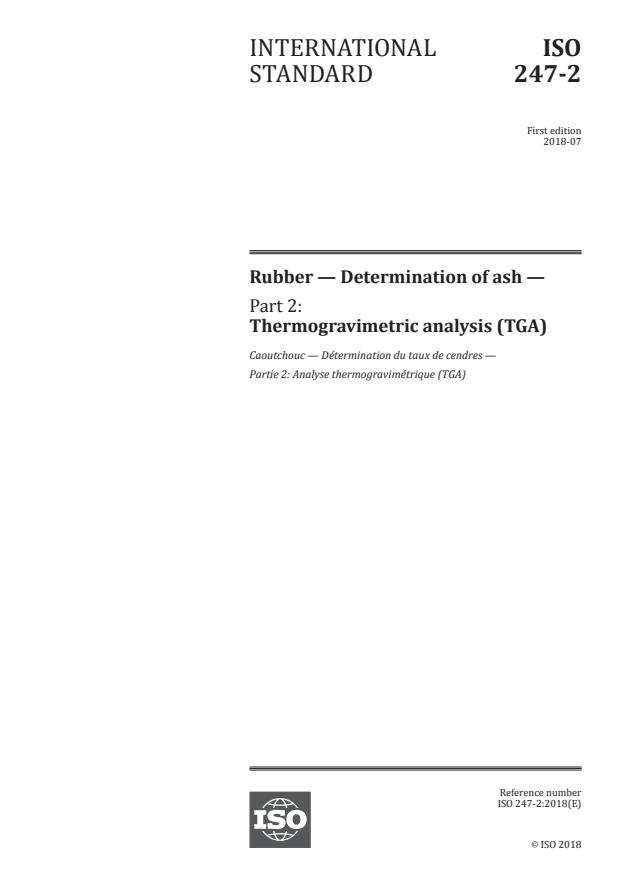
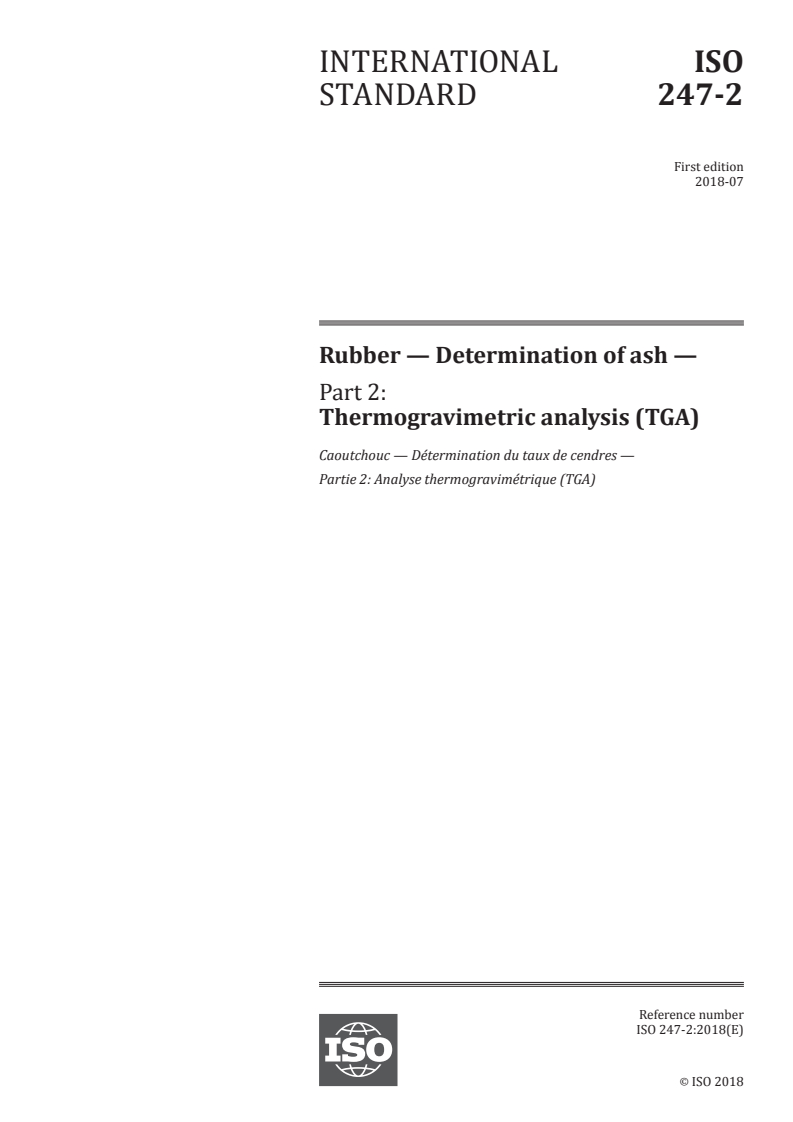
INTERNATIONAL ISO
STANDARD 247-2
First edition
2018-07
Rubber — Determination of ash —
Part 2:
Thermogravimetric analysis (TGA)
Caoutchouc — Détermination du taux de cendres —
Partie 2: Analyse thermogravimétrique (TGA)
Reference number
©
ISO 2018
© ISO 2018
All rights reserved. Unless otherwise specified, or required in the context of its implementation, no part of this publication may
be reproduced or utilized otherwise in any form or by any means, electronic or mechanical, including photocopying, or posting
on the internet or an intranet, without prior written permission. Permission can be requested from either ISO at the address
below or ISO’s member body in the country of the requester.
ISO copyright office
CP 401 • Ch. de Blandonnet 8
CH-1214 Vernier, Geneva
Phone: +41 22 749 01 11
Fax: +41 22 749 09 47
Email: copyright@iso.org
Website: www.iso.org
Published in Switzerland
ii © ISO 2018 – All rights reserved
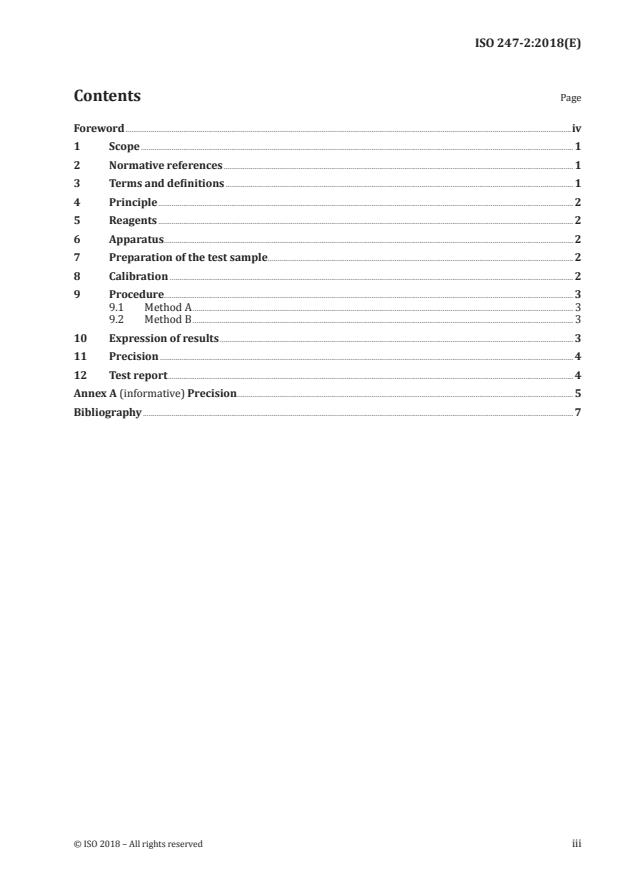
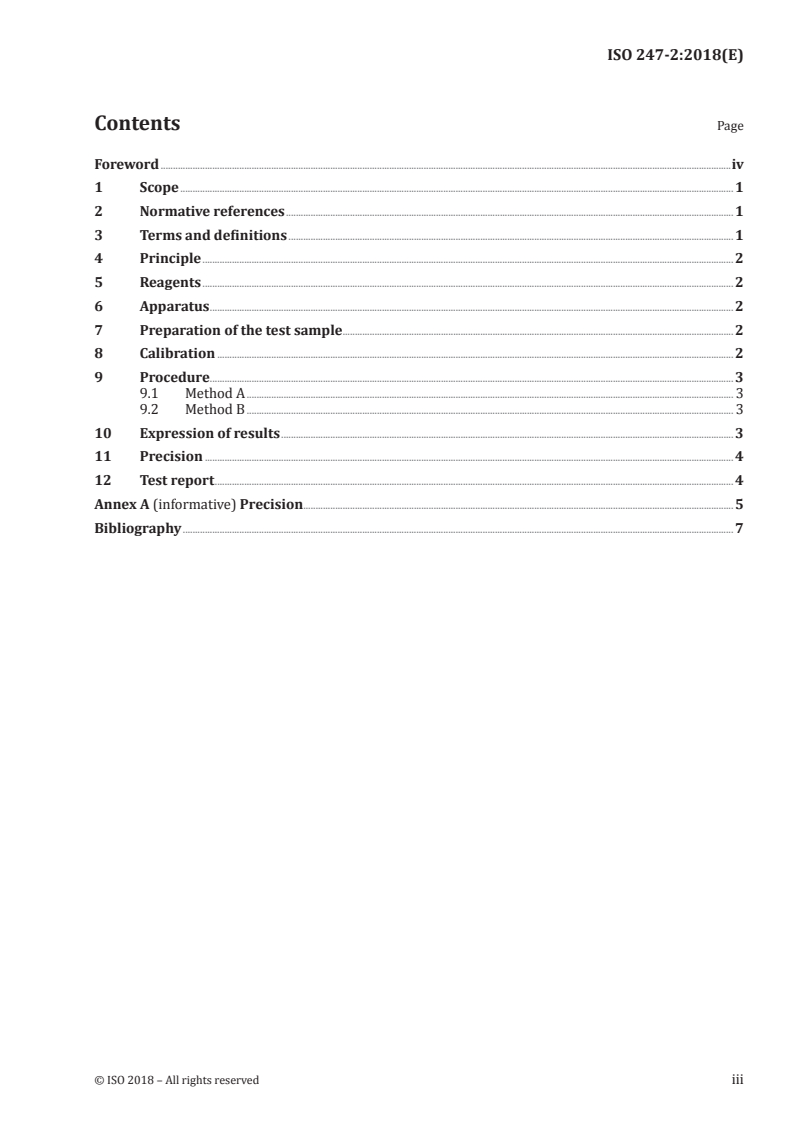
Contents Page
Foreword .iv
1 Scope . 1
2 Normative references . 1
3 Terms and definitions . 1
4 Principle . 2
5 Reagents . 2
6 Apparatus . 2
7 Preparation of the test sample . 2
8 Calibration . 2
9 Procedure. 3
9.1 Method A . 3
9.2 Method B . 3
10 Expression of results . 3
11 Precision . 4
12 Test report . 4
Annex A (informative) Precision . 5
Bibliography . 7
Foreword
ISO (the International Organization for Standardization) is a worldwide federation of national standards
bodies (ISO member bodies). The work of preparing International Standards is normally carried out
through ISO technical committees. Each member body interested in a subject for which a technical
committee has been established has the right to be represented on that committee. International
organizations, governmental and non-governmental, in liaison with ISO, also take part in the work.
ISO collaborates closely with the International Electrotechnical Commission (IEC) on all matters of
electrotechnical standardization.
The procedures used to develop this document and those intended for its further maintenance are
described in the ISO/IEC Directives, Part 1. In particular the different approval criteria needed for the
different types of ISO documents should be noted. This document was drafted in accordance with the
editorial rules of the ISO/IEC Directives, Part 2 (see www .iso .org/directives).
Attention is drawn to the possibility that some of the elements of this document may be the subject of
patent rights. ISO shall not be held responsible for identifying any or all such patent rights. Details of
any patent rights identified during the development of the document will be in the Introduction and/or
on the ISO list of patent declarations received (see www .iso .org/patents).
Any trade name used in this document is information given for the convenience of users and does not
constitute an endorsement.
For an explanation on the voluntary nature of standards, the meaning of ISO specific terms and
expressions related to conformity assessment, as well as information about ISO's adherence to the
World Trade Organization (WTO) principles in the Technical Barriers to Trade (TBT) see the following
URL: www .iso .org/iso/foreword .html.
This document was prepared by Technical Committee ISO/TC 45, Rubber and rubber products,
Subcommittee SC 2, Testing and analysis.
A list of all parts in the ISO 247 series can be found on the ISO website.
iv © ISO 2018 – All rights reserved
INTERNATIONAL STANDARD ISO 247-2:2018(E)
Rubber — Determination of ash —
Part 2:
Thermogravimetric analysis (TGA)
WARNING 1 — Persons using this document should be familiar with normal laboratory practice.
This document does not purport to address all of the safety problems, if any, associated with its
use. It is the responsibility of the user to establish appropriate safety and health practices and to
determine the applicability of any other restrictions.
WARNING 2 — Certain procedures specified in this document might involve the use or generation
of substances, or the generation of waste, that could constitute a local environmental hazard.
Reference should be made to appropriate documentation on safe handling and disposal after use.
1 Scope
This document specifies two methods for the determination of ash from raw rubbers, compounded
rubbers and vulcanizates using a thermogravimetric analyser (TGA).
The methods are applicable to raw, compounded or vulcanized rubbers of the M, O, R and U families
described in ISO 1629:
— Method A is applicable for the determination of the ash from raw rubbers.
— Method B is applicable for the determination of the ash from compounded or vulcanized rubbers.
The methods are not applicable for the determination of the ash from raw rubbers, compounded or
vulcanized rubbers containing chlorine, bromine or iodine.
This document does not cover the interpretation of the ash results from the inorganic chemical contents
of compounded or vulcanized rubbers.
2 Normative references
The following documents are referred to in the text in such a way that some or all of the
...
INTERNATIONAL ISO
STANDARD 247-2
First edition
2018-07
Rubber — Determination of ash —
Part 2:
Thermogravimetric analysis (TGA)
Caoutchouc — Détermination du taux de cendres —
Partie 2: Analyse thermogravimétrique (TGA)
Reference number
©
ISO 2018
© ISO 2018
All rights reserved. Unless otherwise specified, or required in the context of its implementation, no part of this publication may
be reproduced or utilized otherwise in any form or by any means, electronic or mechanical, including photocopying, or posting
on the internet or an intranet, without prior written permission. Permission can be requested from either ISO at the address
below or ISO’s member body in the country of the requester.
ISO copyright office
CP 401 • Ch. de Blandonnet 8
CH-1214 Vernier, Geneva
Phone: +41 22 749 01 11
Fax: +41 22 749 09 47
Email: copyright@iso.org
Website: www.iso.org
Published in Switzerland
ii © ISO 2018 – All rights reserved
Contents Page
Foreword .iv
1 Scope . 1
2 Normative references . 1
3 Terms and definitions . 1
4 Principle . 2
5 Reagents . 2
6 Apparatus . 2
7 Preparation of the test sample . 2
8 Calibration . 2
9 Procedure. 3
9.1 Method A . 3
9.2 Method B . 3
10 Expression of results . 3
11 Precision . 4
12 Test report . 4
Annex A (informative) Precision . 5
Bibliography . 7
Foreword
ISO (the International Organization for Standardization) is a worldwide federation of national standards
bodies (ISO member bodies). The work of preparing International Standards is normally carried out
through ISO technical committees. Each member body interested in a subject for which a technical
committee has been established has the right to be represented on that committee. International
organizations, governmental and non-governmental, in liaison with ISO, also take part in the work.
ISO collaborates closely with the International Electrotechnical Commission (IEC) on all matters of
electrotechnical standardization.
The procedures used to develop this document and those intended for its further maintenance are
described in the ISO/IEC Directives, Part 1. In particular the different approval criteria needed for the
different types of ISO documents should be noted. This document was drafted in accordance with the
editorial rules of the ISO/IEC Directives, Part 2 (see www .iso .org/directives).
Attention is drawn to the possibility that some of the elements of this document may be the subject of
patent rights. ISO shall not be held responsible for identifying any or all such patent rights. Details of
any patent rights identified during the development of the document will be in the Introduction and/or
on the ISO list of patent declarations received (see www .iso .org/patents).
Any trade name used in this document is information given for the convenience of users and does not
constitute an endorsement.
For an explanation on the voluntary nature of standards, the meaning of ISO specific terms and
expressions related to conformity assessment, as well as information about ISO's adherence to the
World Trade Organization (WTO) principles in the Technical Barriers to Trade (TBT) see the following
URL: www .iso .org/iso/foreword .html.
This document was prepared by Technical Committee ISO/TC 45, Rubber and rubber products,
Subcommittee SC 2, Testing and analysis.
A list of all parts in the ISO 247 series can be found on the ISO website.
iv © ISO 2018 – All rights reserved
INTERNATIONAL STANDARD ISO 247-2:2018(E)
Rubber — Determination of ash —
Part 2:
Thermogravimetric analysis (TGA)
WARNING 1 — Persons using this document should be familiar with normal laboratory practice.
This document does not purport to address all of the safety problems, if any, associated with its
use. It is the responsibility of the user to establish appropriate safety and health practices and to
determine the applicability of any other restrictions.
WARNING 2 — Certain procedures specified in this document might involve the use or generation
of substances, or the generation of waste, that could constitute a local environmental hazard.
Reference should be made to appropriate documentation on safe handling and disposal after use.
1 Scope
This document specifies two methods for the determination of ash from raw rubbers, compounded
rubbers and vulcanizates using a thermogravimetric analyser (TGA).
The methods are applicable to raw, compounded or vulcanized rubbers of the M, O, R and U families
described in ISO 1629:
— Method A is applicable for the determination of the ash from raw rubbers.
— Method B is applicable for the determination of the ash from compounded or vulcanized rubbers.
The methods are not applicable for the determination of the ash from raw rubbers, compounded or
vulcanized rubbers containing chlorine, bromine or iodine.
This document does not cover the interpretation of the ash results from the inorganic chemical contents
of compounded or vulcanized rubbers.
2 Normative references
The following documents are referred to in the text in such a way that some or all of the
...