

ISO 26945:2011
(Main)Metallic and other inorganic coatings — Electrodeposited coatings of tin-cobalt alloy
General Information
- Abstract
ISO 26945:2011 specifies electrodeposited coatings of tin-cobalt alloy of approximate composition 75 % (mass fraction) to 80 % (mass fraction) tin, remainder cobalt, as a substitute for decorative chromium coatings of 0,1 µm to 0,3 µm thickness. Hardness and wear resistance properties of the coatings obtained are not equivalent to those of chromium coatings, but similar to those of tin-nickel alloy coatings. Tin-cobalt alloy coatings can be applied by rack or barrel plating processes. ISO 26945:2011 does not specify requirements for the surface condition of the basis metal prior to electroplating.
- Status
- Published
- Publication Date
- 30-Jan-2011
- Technical Committee
- ISO/TC 107 - Metallic and other inorganic coatings
- Drafting Committee
- ISO/TC 107 - Metallic and other inorganic coatings
- Current Stage
- 9093 - International Standard confirmed
- Start Date
- 09-Jun-2022
- Completion Date
- 29-Aug-2026
Buy Documents
ISO 26945:2011 - Metallic and other inorganic coatings — Electrodeposited coatings of tin-cobalt alloy Released:1/31/2011
ISO 26945:2011 - Revetements métalliques et autres revetements inorganiques — Dépôts électrolytiques d'alliage étain-cobalt Released:1/31/2011
ISO 26945:2011 - Metallic and other inorganic coatings — Electrodeposited coatings of tin-cobalt alloy Released:4/2/2013
Overview
ISO 26945:2011 - Metallic and other inorganic coatings - Electrodeposited coatings of tin‑cobalt alloy - specifies requirements for electrodeposited tin‑cobalt (Sn–Co) alloy coatings (approximately 75 %–80 % tin, remainder cobalt) as a decorative alternative to thin chromium finishes. The standard covers composition, designation, thickness ranges, basic process options and quality-control topics for coatings applied by rack or barrel plating. It clarifies that hardness and wear resistance are not equivalent to chromium but are similar to tin‑nickel alloys.
Key topics and requirements
- Composition: Tin‑cobalt alloy ≈ 75–80 % tin, balance cobalt.
- Intended use: Decorative substitute for chromium coatings of about 0.1 µm to 0.3 µm (surface lustre focus).
- Thickness: Specifies minimum coating thickness requirements and methods to indicate thickness in designations. Examples in the standard show typical values (e.g., 2–3 µm) used in practice.
- Application methods: Suitable for rack and barrel plating; high current efficiency (>70 %) makes it practical for complicated shapes (nuts, bolts, rivets).
- Undercoats & pretreatment: Undercoats (Cu, Ni) are recommended for certain base metals to ensure adhesion and corrosion resistance. Thicker undercoats (10–25 µm) may be required on Al, Mg or Zn alloys. The standard does not prescribe the basis‑metal surface condition - purchaser and processor must agree.
- Appearance & defects: Significant surfaces must be free of visible defects (blisters, pits, roughness, uncoated areas); finish samples can be specified.
- Heat treatments & embrittlement control: Designations allow stress‑relief (SR) before plating and hydrogen‑embrittlement‑relief (ER) after plating (e.g., SR(200)3, ER(190)12).
- Testing & measurement: Includes provisions for adhesion, quality‑evaluation tests and references methods for coating‑thickness measurement and sampling.
Practical applications
- Decorative finishing where chromium look is desired but a chromium process is unsuitable or restricted.
- Hardware and fasteners (nuts, bolts, rivets), small components produced in large batches via barrel plating.
- Industries requiring bright, corrosion‑resistant surface finishes with good processing efficiency: automotive small parts, consumer hardware, electrical contacts (subject to compatibility checks).
Who should use this standard
- Plating processors and surface‑finishing shops specifying tin‑cobalt deposits.
- OEMs and purchasers writing coating specifications or purchase orders.
- Materials, quality and corrosion engineers specifying tests, thicknesses and post‑treatments.
- Fastener and hardware manufacturers using rack or barrel plating lines.
Related standards
- ISO 2179 (tin‑nickel coatings - referenced for comparative properties)
- ISO 1463, ISO 2064, ISO 3497, ISO 4519, ISO 9587, ISO 9588, ISO 10587, ISO 15724 (measurement, sampling, pretreatment and embrittlement control methods)
For procurement or process specification, include ISO 26945 in purchase orders and indicate basis metal, undercoat, finish, thickness, heat‑treatment and sampling/acceptance criteria to ensure compliant tin‑cobalt electrodeposited coatings.
Relations
- Effective Date
- 12-Feb-2026
- Effective Date
- 06-Jun-2022
- Effective Date
- 05-Jun-2010
Buy Documents
ISO 26945:2011 - Metallic and other inorganic coatings — Electrodeposited coatings of tin-cobalt alloy Released:1/31/2011
ISO 26945:2011 - Revetements métalliques et autres revetements inorganiques — Dépôts électrolytiques d'alliage étain-cobalt Released:1/31/2011
ISO 26945:2011 - Metallic and other inorganic coatings — Electrodeposited coatings of tin-cobalt alloy Released:4/2/2013
Get Certified
Connect with accredited certification bodies for this standard

DVS-ZERT GmbH
German welding certification society.
CARES (UK Certification Authority for Reinforcing Steels)
UK certification for reinforcing steels and construction.
EWF/IIW (European/International Welding Federation)
International welding personnel certification.
Sponsored listings
Frequently Asked Questions
ISO 26945:2011 is a standard published by the International Organization for Standardization (ISO). Its full title is "Metallic and other inorganic coatings — Electrodeposited coatings of tin-cobalt alloy". This standard covers: ISO 26945:2011 specifies electrodeposited coatings of tin-cobalt alloy of approximate composition 75 % (mass fraction) to 80 % (mass fraction) tin, remainder cobalt, as a substitute for decorative chromium coatings of 0,1 µm to 0,3 µm thickness. Hardness and wear resistance properties of the coatings obtained are not equivalent to those of chromium coatings, but similar to those of tin-nickel alloy coatings. Tin-cobalt alloy coatings can be applied by rack or barrel plating processes. ISO 26945:2011 does not specify requirements for the surface condition of the basis metal prior to electroplating.
ISO 26945:2011 specifies electrodeposited coatings of tin-cobalt alloy of approximate composition 75 % (mass fraction) to 80 % (mass fraction) tin, remainder cobalt, as a substitute for decorative chromium coatings of 0,1 µm to 0,3 µm thickness. Hardness and wear resistance properties of the coatings obtained are not equivalent to those of chromium coatings, but similar to those of tin-nickel alloy coatings. Tin-cobalt alloy coatings can be applied by rack or barrel plating processes. ISO 26945:2011 does not specify requirements for the surface condition of the basis metal prior to electroplating.
ISO 26945:2011 is classified under the following ICS (International Classification for Standards) categories: 25.220.40 - Metallic coatings. The ICS classification helps identify the subject area and facilitates finding related standards.
ISO 26945:2011 has the following relationships with other standards: It is inter standard links to EN ISO 26945:2011, ISO 12168-1:2001, ISO 26945:2008. Understanding these relationships helps ensure you are using the most current and applicable version of the standard.
ISO 26945:2011 is available in PDF format for immediate download after purchase. The document can be added to your cart and obtained through the secure checkout process. Digital delivery ensures instant access to the complete standard document.
Standards Content (Sample)
INTERNATIONAL ISO
STANDARD 26945
Second edition
2011-02-15
Metallic and other inorganic coatings —
Electrodeposited coatings of tin-cobalt
alloy
Revêtements métalliques et autres revêtements inorganiques — Dépôts
électrolytiques d'alliage étain-cobalt
Reference number
©
ISO 2011
PDF disclaimer
This PDF file may contain embedded typefaces. In accordance with Adobe's licensing policy, this file may be printed or viewed but
shall not be edited unless the typefaces which are embedded are licensed to and installed on the computer performing the editing. In
downloading this file, parties accept therein the responsibility of not infringing Adobe's licensing policy. The ISO Central Secretariat
accepts no liability in this area.
Adobe is a trademark of Adobe Systems Incorporated.
Details of the software products used to create this PDF file can be found in the General Info relative to the file; the PDF-creation
parameters were optimized for printing. Every care has been taken to ensure that the file is suitable for use by ISO member bodies. In
the unlikely event that a problem relating to it is found, please inform the Central Secretariat at the address given below.
© ISO 2011
All rights reserved. Unless otherwise specified, no part of this publication may be reproduced or utilized in any form or by any means,
electronic or mechanical, including photocopying and microfilm, without permission in writing from either ISO at the address below or
ISO's member body in the country of the requester.
ISO copyright office
Case postale 56 • CH-1211 Geneva 20
Tel. + 41 22 749 01 11
Fax + 41 22 749 09 47
E-mail copyright@iso.org
Web www.iso.org
Published in Switzerland
ii © ISO 2011 – All rights reserved
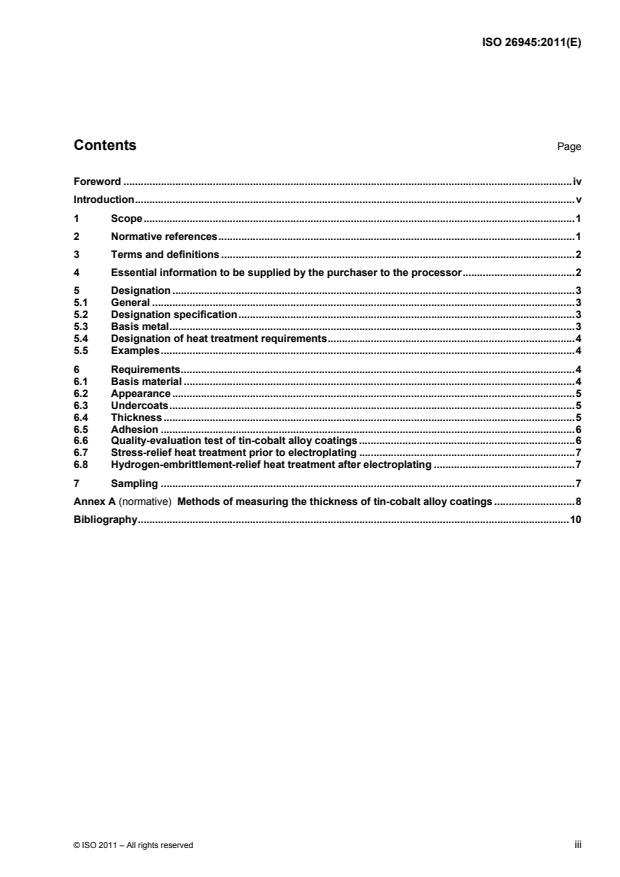
Contents Page
Foreword .iv
Introduction.v
1 Scope.1
2 Normative references.1
3 Terms and definitions .2
4 Essential information to be supplied by the purchaser to the processor.2
5 Designation .3
5.1 General .3
5.2 Designation specification.3
5.3 Basis metal.3
5.4 Designation of heat treatment requirements.4
5.5 Examples.4
6 Requirements.4
6.1 Basis material .4
6.2 Appearance .5
6.3 Undercoats.5
6.4 Thickness .5
6.5 Adhesion .6
6.6 Quality-evaluation test of tin-cobalt alloy coatings .6
6.7 Stress-relief heat treatment prior to electroplating .7
6.8 Hydrogen-embrittlement-relief heat treatment after electroplating .7
7 Sampling .7
Annex A (normative) Methods of measuring the thickness of tin-cobalt alloy coatings .8
Bibliography.10
Foreword
ISO (the International Organization for Standardization) is a worldwide federation of national standards bodies
(ISO member bodies). The work of preparing International Standards is normally carried out through ISO
technical committees. Each member body interested in a subject for which a technical committee has been
established has the right to be represented on that committee. International organizations, governmental and
non-governmental, in liaison with ISO, also take part in the work. ISO collaborates closely with the
International Electrotechnical Commission (IEC) on all matters of electrotechnical standardization.
International Standards are drafted in accordance with the rules given in the ISO/IEC Directives, Part 2.
The main task of technical committees is to prepare International Standards. Draft International Standards
adopted by the technical committees are circulated to the member bodies for voting. Publication as an
International Standard requires approval by at least 75 % of the member bodies casting a vote.
Attention is drawn to the possibility that some of the elements of this document may be the subject of patent
rights. ISO shall not be held responsible for identifying any or all such patent rights.
ISO 26945 was prepared by Technical Committee ISO/TC 107, Metallic and other inorganic coatings.
This second edition cancels and replaces the first edition (ISO 26945:2008), of which it constitutes a minor
revision.
iv © ISO 2011 – All rights reserved
Introduction
Electrodeposited coating of tin-cobalt alloy is characterized by its bright surface which is similar to decorative
chromium coating. Hardness and wear-resistance properties of tin-cobalt alloy coatings are not equivalent to
those of chromium coatings, but are similar to those of tin-nickel alloy coatings (see ISO 2179). Thus,
tin-cobalt coatings may be regarded, as far as surface lustre is concerned, as one of the possible alternatives
to chromium coating. Due to its higher current efficiency (more than 70 %), tin-cobalt alloy coatings can be
applied by rack-and-barrel plating processes to a wide range of complicated shapes and sizes, e.g. nuts, bolts,
rivets, etc.
INTERNATIONAL STANDARD ISO 26945:2011(E)
Metallic and other inorganic coatings — Electrodeposited
coatings of tin-cobalt alloy
WARNING — This International Standard may not be compliant with some countries' health and safety
legislations and calls for the use of substances and/or procedures that may be injurious to health if
adequate safety measures are not taken. This International Standard does not address any health
hazards, safety or environmental matters and legislations associated with its use. It is the
responsibility of the user of this International Standard to establish appropriate health, safety and
environmentally acceptable practices and take suitable actions to comply with any national and
international regulations. Compliance with this International Standard does not in itself confer
immunity from legal obligations.
1 Scope
This International Standard specifies electrodeposited coatings of tin-cobalt alloy of approximate composition
75 % (mass fraction) to 80 % (mass fraction) tin, remainder cobalt, as a substitute for decorative chromium
coatings of 0,1 µm to 0,3 µm thickness. Hardness and wear resistance properties of the coatings obtained are
not equivalent to those of chromium coatings, but similar to those of tin-nickel alloy coatings.
Tin-cobalt alloy coatings can be applied by rack or barrel plating processes.
This International Standard does not specify requirements for the surface condition of the basis metal prior to
electroplating.
2 Normative references
The following referenced documents are indispensable for the application of this document. For dated
references, only the edition cited applies. For undated references, the latest edition of the referenced
document (including any amendments) applies.
ISO 1463, Metallic and oxide coatings — Measurement of coating thickness — Microscopical method
ISO 2064, Metallic and other inorganic coatings — Definitions and conventions concerning the measurement
of thickness
ISO 2080, Metallic and other inorganic coatings — Surface treatment, metallic and other inorganic coatings —
Vocabulary
ISO 2819, Metallic coatings on metallic substrates — Electrodeposited and chemically deposited coatings —
Review of methods available for testing adhesion
ISO 3497, Metallic coatings — Measurement of coating thickness — X-ray spectrometric methods
ISO 4519, Electrodeposited metallic coatings and related finishes — Sampling procedures for inspection by
attributes
ISO 4541, Metallic and other non-organic coatings — Corrodkote corrosion test (CORR test)
ISO 9220, Metallic coatings — Measurement of coating thickness — Scanning electron microscope method
ISO 9587, Metallic and other inorganic coatings — Pretreatment of iron or steel to reduce the risk of hydrogen
embrittlement
ISO 9588, Metallic and other inorganic coatings — Post-coating treatments of iron or steel to reduce the risk
of hydrogen embrittlement
ISO 10289, Methods for corrosion testing of metallic and other inorganic coatings on metallic substrates —
Rating of test specimens and manufactured articles subjected to corrosion tests
ISO 10587, Metallic and other inorganic coatings — Test for residual embrittlement in both metallic-coated
and uncoated externally-threaded articles and rods — Inclined wedge method
ISO 15724, Metallic and other inorganic coatings — Electrochemical measurement of diffusible hydrogen in
steels — Barnacle electrode method
3 Terms and definitions
For the purposes of this document, the terms and definitions given in ISO 2064, ISO 2080, ISO 9587 and
ISO 9588 apply.
4 Essential information to be supplied by the purchaser to the processor
When ordering articles to be processed in accordance with this International Standard, the purchaser shall
provide the following information in writing, in, for example, the contract, purchase order, or on the engineering
drawing:
a) the number of this International Standard, ISO 26945, and article designation;
b) the nature, condition and finish of the basis metal if they are likely to affect the serviceability and/or
appearance of the coating (see 6.1);
c) the significant surface of the article to be electroplated, indicated, for example, by drawings or by the
provision of suitably marked samples;
d) additional part of surfaces where the minimum thickness requirements apply;
e) positions where unavoidable contact marks and other defects are acceptable (see 6.2);
f) any requirements for special pretreatment (see 6.1);
g) tensile strength of parts and requirements for heat treatment before and/or after electrodeposition (see
6.7 and 6.8);
h) requirements, nature and thickness of undercoats (see 6.1 and 6.3);
i) requirements for thickness, quality-evaluation test for controlling the quality and continuity of the coating
and test method(s) to be used, and adhesion testing (see 6.4, 6.5 and 6.6);
j) finish required, e.g. bright, dull or another type, accompanied by approved samples of the finish (see 6.2);
k) the sampling plan to be adopted, and the acceptance levels (see Clause 7);
l) any additional essential information.
2 © ISO 2011 – All rights reserved
5 Designation
5.1 General
The designation shall appear on engineering drawings, in the purchase order, the contract or in the detailed
product specification.
The designation specifies, in the following order, the basis metal, the specific alloy (optional), stress-relief
requirements, the type and thickness of undercoats (when present), the thickness and composition of alloy
coating or coatings (when double or multilayer coatings are specified), and supplementary treatments, such as
heat treatment to reduce susceptibility to hydrogen embrittlement.
5.2 Designation specification
The designation shall comprise the following:
a) the term “Electrodeposited coating”;
b) the number of this International Standard, ISO 26945;
c) a hyphen;
d) the chemical symbol of the basis metal (see 5.3), e.g. Fe (iron or steel), followed by a solidus (/);
e) the chemical symbol of the undercoat, e.g. Cu (copper) or Ni (nickel);
f) stress-relief (SR) designation (see 5.4);
g) a solidus (/);
h) the chemical symbol(s) for the metal or alloy or coating(s);
i) a number indicating the minimum local thickness, in micrometres, of the coating(s) followed by a solidus
(/);
j) hydrogen-embrittlement-relief (ER) designation (see 5.4);
k) if appropriate, codes indicating the type of any supplementary coating, followed by a solidus (/);
l) if appropriate, codes designating any supplementary treatments.
See 5.5 for examples of designations.
5.3 Basis metal
The basis metal shall be designated by its chemical symbol, or its principal constituent, if it is an alloy. For
example, Fe for iron and steel; Zn for zinc alloys; Cu for copper and copper alloys; Al for aluminium and
aluminium alloys; Sn for tin and tin alloys; and Co for cobalt. In the case of non-metallic materials, the letters,
NM, shall be used.
It is recommended that the specific alloy be identified by its standard designation; for example, its UNS
number or the local, national equivalent placed between the symbols <>. For example, Fe is the
UNS designation for one high-strength steel (see Bibliography, Reference [1]).
...
NORME ISO
INTERNATIONALE 26945
Deuxième édition
2011-02-15
Revêtements métalliques et autres
revêtements inorganiques — Dépôts
électrolytiques d'alliage étain-cobalt
Metallic and other inorganic coatings — Electrodeposited coatings of
tin-cobalt alloy
Numéro de référence
©
ISO 2011
PDF – Exonération de responsabilité
Le présent fichier PDF peut contenir des polices de caractères intégrées. Conformément aux conditions de licence d'Adobe, ce fichier
peut être imprimé ou visualisé, mais ne doit pas être modifié à moins que l'ordinateur employé à cet effet ne bénéficie d'une licence
autorisant l'utilisation de ces polices et que celles-ci y soient installées. Lors du téléchargement de ce fichier, les parties concernées
acceptent de fait la responsabilité de ne pas enfreindre les conditions de licence d'Adobe. Le Secrétariat central de l'ISO décline toute
responsabilité en la matière.
Adobe est une marque déposée d'Adobe Systems Incorporated.
Les détails relatifs aux produits logiciels utilisés pour la création du présent fichier PDF sont disponibles dans la rubrique General Info
du fichier; les paramètres de création PDF ont été optimisés pour l'impression. Toutes les mesures ont été prises pour garantir
l'exploitation de ce fichier par les comités membres de l'ISO. Dans le cas peu probable où surviendrait un problème d'utilisation,
veuillez en informer le Secrétariat central à l'adresse donnée ci-dessous.
DOCUMENT PROTÉGÉ PAR COPYRIGHT
© ISO 2011
Droits de reproduction réservés. Sauf prescription différente, aucune partie de cette publication ne peut être reproduite ni utilisée sous
quelque forme que ce soit et par aucun procédé, électronique ou mécanique, y compris la photocopie et les microfilms, sans l'accord écrit
de l'ISO à l'adresse ci-après ou du comité membre de l'ISO dans le pays du demandeur.
ISO copyright office
Case postale 56 • CH-1211 Geneva 20
Tel. + 41 22 749 01 11
Fax + 41 22 749 09 47
E-mail copyright@iso.org
Web www.iso.org
Publié en Suisse
ii © ISO 2011 – Tous droits réservés
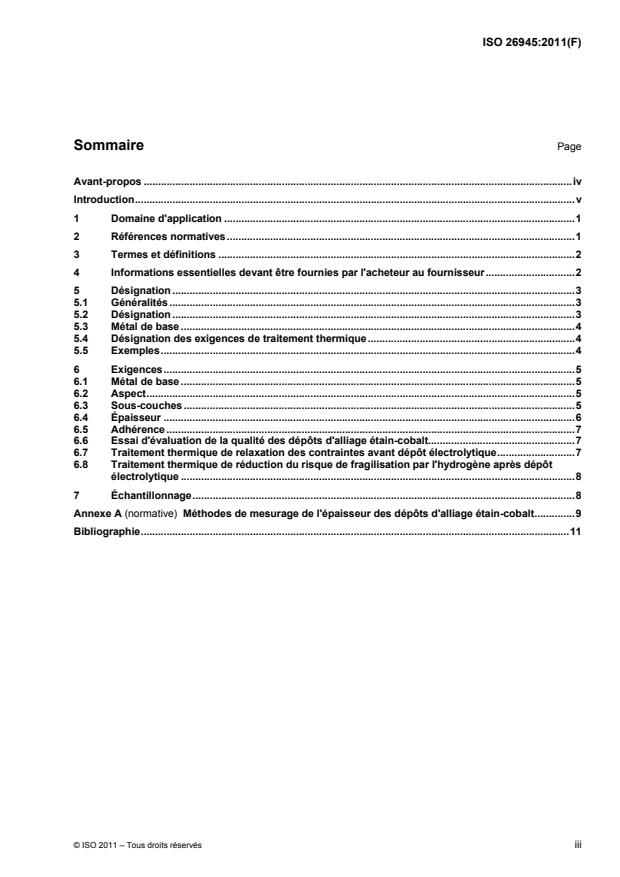
Sommaire Page
Avant-propos .iv
Introduction.v
1 Domaine d'application .1
2 Références normatives.1
3 Termes et définitions .2
4 Informations essentielles devant être fournies par l'acheteur au fournisseur.2
5 Désignation .3
5.1 Généralités .3
5.2 Désignation .3
5.3 Métal de base .4
5.4 Désignation des exigences de traitement thermique.4
5.5 Exemples.4
6 Exigences.5
6.1 Métal de base .5
6.2 Aspect.5
6.3 Sous-couches .5
6.4 Épaisseur .6
6.5 Adhérence .7
6.6 Essai d'évaluation de la qualité des dépôts d'alliage étain-cobalt.7
6.7 Traitement thermique de relaxation des contraintes avant dépôt électrolytique.7
6.8 Traitement thermique de réduction du risque de fragilisation par l'hydrogène après dépôt
électrolytique .8
7 Échantillonnage.8
Annexe A (normative) Méthodes de mesurage de l'épaisseur des dépôts d'alliage étain-cobalt.9
Bibliographie.11
Avant-propos
L'ISO (Organisation internationale de normalisation) est une fédération mondiale d'organismes nationaux de
normalisation (comités membres de l'ISO). L'élaboration des Normes internationales est en général confiée
aux comités techniques de l'ISO. Chaque comité membre intéressé par une étude a le droit de faire partie du
comité technique créé à cet effet. Les organisations internationales, gouvernementales et non
gouvernementales, en liaison avec l'ISO participent également aux travaux. L'ISO collabore étroitement avec
la Commission électrotechnique internationale (CEI) en ce qui concerne la normalisation électrotechnique.
Les Normes internationales sont rédigées conformément aux règles données dans les Directives ISO/CEI,
Partie 2.
La tâche principale des comités techniques est d'élaborer les Normes internationales. Les projets de Normes
internationales adoptés par les comités techniques sont soumis aux comités membres pour vote. Leur
publication comme Normes internationales requiert l'approbation de 75 % au moins des comités membres
votants.
L'attention est appelée sur le fait que certains des éléments du présent document peuvent faire l'objet de
droits de propriété intellectuelle ou de droits analogues. L'ISO ne saurait être tenue pour responsable de ne
pas avoir identifié de tels droits de propriété et averti de leur existence.
L'ISO 26945 a été élaborée par le comité technique ISO/TC 107, Revêtements métalliques et autres
revêtements inorganiques.
Cette deuxième édition annule et remplace la première édition (ISO 26945:2008), dont elle constitue une
révision mineure.
iv © ISO 2011 – Tous droits réservés
Introduction
Les dépôts électrolytiques d'alliage étain-cobalt se caractérisent par leur surface brillante similaire à celle des
dépôts de chrome décoratifs. Les propriétés de dureté et de résistance à l'usure de ces dépôts ne sont en
revanche pas équivalentes à celles des dépôts de chrome mais plutôt à celles des dépôts électrolytiques
d'alliage étain-nickel (voir l'ISO 2179). Les dépôts électrolytiques d'alliage étain-cobalt peuvent ainsi être
considérés comme l'une des alternatives possibles aux dépôts de chrome pour ce qui est du lustre superficiel.
Compte tenu de leur rendement supérieur en courant (plus de 70 %), les dépôts d'alliage étain-cobalt peuvent
être appliqués par la technique du dépôt électrolytique à l'attache et au tonneau sur tout un éventail de
produits de formes et de dimensions compliquées, par exemple les écrous, les boulons, les rivets, etc.
NORME INTERNATIONALE ISO 26945:2011(F)
Revêtements métalliques et autres revêtements inorganiques —
Dépôts électrolytiques d'alliage étain-cobalt
AVERTISSEMENT — La présente Norme internationale peut ne pas être conforme à la législation de
certains pays en matière de santé et de sécurité et exige l'utilisation de substances et/ou de modes
opératoires qui peuvent s'avérer préjudiciables pour la santé si des mesures de sécurité adéquates ne
sont pas prises. La présente Norme internationale ne traite pas des dangers pour la santé, des
questions de sécurité ou d'environnement et de la législation associée à son utilisation. Il appartient à
l'utilisateur de la présente Norme internationale d'établir des pratiques appropriées acceptables en
termes de santé, de sécurité et d'environnement et de prendre des mesures adéquates pour satisfaire
aux réglementations nationales et internationales. La présomption de conformité à la présente Norme
internationale ne dispense pas en soi de respecter les obligations légales.
1 Domaine d'application
La présente Norme internationale spécifie des revêtements électrolytiques d'alliage étain-cobalt dont la
composition est approximativement de 75 % (fraction massique) à 80 % (fraction massique) d'étain et le reste
de cobalt, pouvant remplacer des dépôts de chrome décoratifs de 0,1 μm à 0,3 µm d'épaisseur. Les
propriétés de dureté et de résistance à l'usure des revêtements d'alliage étain-cobalt ne sont pas équivalentes
à celles des dépôts de chrome mais elles sont similaires à celles des dépôts d'alliage étain-nickel.
Les revêtements d'alliage étain-cobalt peuvent être appliqués par la technique de dépôt à l'attache et au
tonneau.
La présente Norme internationale ne spécifie aucune exigence concernant l'état de surface du métal de base
avant dépôt électrolytique.
2 Références normatives
Les documents de référence suivants sont indispensables pour l'application du présent document. Pour les
références datées, seule l'édition citée s'applique. Pour les références non datées, la dernière édition du
document de référence s'applique (y compris les éventuels amendements).
ISO 1463, Revêtements métalliques et couches d'oxyde — Mesurage de l'épaisseur de revêtement —
Méthode par coupe micrographique
ISO 2064, Revêtements métalliques et autres revêtements inorganiques — Définitions et principes
concernant le mesurage de l'épaisseur
ISO 2080, Revêtements métalliques et autres revêtements inorganiques — Traitement de surface,
revêtements métalliques et autres revêtements inorganiques — Vocabulaire
ISO 2819, Revêtements métalliques sur bases métalliques — Dépôts électrolytiques et dépôts par voie
chimique — Liste des différentes méthodes d'essai d'adhérence
ISO 3497, Revêtements métalliques — Mesurage de l'épaisseur du revêtement — Méthodes par
spectrométrie de rayons X
ISO 4519, Dépôts électrolytiques et finitions apparentées — Méthodes d'échantillonnage pour le contrôle par
attributs
ISO 4541, Revêtements métalliques et autres revêtements non organiques — Essai de corrosion Corrodkote
(Essai CORR)
ISO 9220, Revêtements métalliques — Mesurage de l'épaisseur de revêtement — Méthode au microscope
électronique à balayage
ISO 9587, Revêtements métalliques et autres revêtements inorganiques — Prétraitements du fer ou de l'acier
visant à réduire le risque de fragilisation par l'hydrogène
ISO 9588, Revêtements métalliques et autres revêtements inorganiques — Traitements après revêtements
sur fer ou acier pour diminuer le risque de fragilisation par l'hydrogène
ISO 10289, Méthodes d'essai de corrosion des revêtements métalliques et inorganiques sur substrats
métalliques — Cotation des éprouvettes et des articles manufacturés soumis aux essais de corrosion
ISO 10587, Revêtements métalliques et autres revêtements inorganiques — Essai de fragilisation résiduelle
des articles et tiges filetés avec et sans revêtement métallique extérieur — Méthode de la cale biaise
ISO 15724, Revêtements métalliques et autres revêtements inorganiques — Mesurage électrochimique de
l'hydrogène diffusible dans les aciers — Méthodes par électrode anatife
3 Termes et définitions
Pour les besoins du présent document, les termes et définitions donnés dans l'ISO 2064, l'ISO 2080,
l'ISO 9587 et l'ISO 9588 s'appliquent.
4 Informations essentielles devant être fournies par l'acheteur au fournisseur
Lors de sa commande d'articles à traiter conformément à la présente Norme internationale, l'acheteur doit
fournir les informations suivantes par écrit, par exemple dans le contrat, le bon de commande ou sur le dessin
technique de l'article:
a) le numéro de la présente Norme internationale, c'est-à-dire ISO 26945, et la désignation de l'article;
b) la nature, l'état et la finition du métal de base, si cela est de nature à affecter l'aptitude à l'emploi et/ou
l'aspect du revêtement (voir 6.1);
c) la surface significative de l'article à revêtir, indiquée par exemple sur des dessins techniques ou sur des
échantillons convenablement marqués;
d) les parties de la surface où des exigences d'épaisseur minimale s'appliquent;
e) les positions où des marques de contact inévitables et d'autres défauts sont acceptables (voir 6.2);
f) les exigences concernant les prétraitements spéciaux (voir 6.1);
g) la résistance à la traction des pièces et les exigences relatives au traitement thermique avant et/ou après
dépôt électrolytique (voir 6.7 et 6.8);
h) les exigences relatives aux sous-couches et la nature et l'épaisseur de celles-ci (voir 6.1 et 6.3);
i) les exigences relatives à l'épaisseur, à l'essai d'évaluation de la qualité pour le contrôle de la qualité et de
la continuité du revêtement et la ou les méthodes d'essai à utiliser, et aux essais d'adhérence (voir 6.4,
6.5 et 6.6);
2 © ISO 2011 – Tous droits réservés
j) la finition requise, par exemple brillante, mate ou autre, avec des échantillons approuvés de cette finition
(voir 6.2);
k) le plan d'échantillonnage à adopter et les niveaux d'acceptation (voir l'Article 7);
l) toutes autres informations essentielles.
5 Désignation
5.1 Généralités
La désignation doit apparaître sur les dessins techniques, le bon de commande, le contrat ou dans la
spécification détaillée du produit.
La désignation spécifie, dans l'ordre, le métal de base, l'alliage particulier (facultatif), les exigences relatives à
la relaxation des contraintes, le type et l'épaisseur des sous-couches (lorsqu'il y en a), l'épaisseur et la
composition du ou des dépôts d'alliage (en cas de spécification de dépôts double ou multicouches), et les
traitements supplémentaires, tels que le traitement thermique permettant de réduire la sensibilité à la
fragilisation par l'hydrogène.
5.2 Désignation
La désignation doit comprendre ce qui suit:
a) le terme «Dépôt électrolytique»;
b) le numéro de la présente Norme internationale, ISO 26945;
c) un tiret;
d) le symbole chimique du métal de base (voir 5.3) par exemple Fe (fer ou acier), suivi d'une barre
oblique (/);
e) le symbole chimique de la sous-couche, par exemple Cu (cuivre) ou Ni (nickel);
f) la désignation SR pour traitement de relaxation des contraintes (voir 5.4);
g) une barre oblique (/);
h) le symbole chimique du métal, de l'alliage ou du dépôt;
i) un chiffre indiquant l'épaisseur locale minimale, en micromètres, du dépôt électrolytique, suivi d'une barre
oblique (/);
j) la désignation ER pour traitement de réduction du risque de fragilisation par l'hydrogène (voir 5.4);
k) le cas échéant, les codes indiquant le type de tout dépôt supplémentaire, suivis d'une barre oblique;
l) le cas échéant, les codes des traitements supplémentaires éventuels.
Voir 5.5 pour les exemples de désignations.
5.3 Métal de base
Le métal de base doit être désigné par son symbole chimique ou par son principal constituant s'il s'agit d'un
alliage. Par exemple Fe pour le fer et l'acier, Zn pour les alliages de zinc, Cu pour le cuivre et les alliages de
cuivre, Al pour l'aluminium et les alliages d'aluminium, Sn pour l'étain et les alliages d'étain et Co pour le
cobalt. Dans le cas des matériaux non métalliques, les lettres NM doivent être utilisées.
Il est recommandé d'identifier l'alliage spécifique par sa désignation normalisée, par exemple son numéro
UNS ou son équivalent local, national, placé entre les symboles < >. Par exemple Fe est la
désignation UNS d'un acier à haut
...
МЕЖДУНАРОДНЫЙ ISO
СТАНДАРТ 26945
Второе издание
2011-02-15
Металлические и другие
неорганические покрытия.
Электролитические покрытия
оловянно-кобальтового сплава
Metallic and other inorganic coatings. Electrodeposited coatings of tin-
cobalt alloy
Ответственность за подготовку русской версии несёт GOST R
(Российская Федерация) в соответствии со статьёй 18.1 Устава ISO
Ссылочный номер
©
ISO 2011
Отказ от ответственности при работе в PDF
Настоящий файл PDF может содержать интегрированные шрифты. В соответствии с условиями лицензирования, принятыми
фирмой Adobe, этот файл можно распечатать или смотреть на экране, но его нельзя изменить, пока не будет получена
лицензия на установку интегрированных шрифтов в компьютере, на котором ведется редактирование. В случае загрузки
настоящего файла заинтересованные стороны принимают на себя ответственность за соблюдение лицензионных условий
фирмы Adobe. Центральный секретариат ISO не несет никакой ответственности в этом отношении.
Adobe - торговый знак фирмы Adobe Systems Incorporated.
Подробности, относящиеся к программным продуктам, использованным для создания настоящего файла PDF, можно найти в
рубрике General Info файла; параметры создания PDF были оптимизированы для печати. Были приняты во внимание все
меры предосторожности с тем, чтобы обеспечить пригодность настоящего файла для использования комитетами-членами
ISO. В редких случаях возникновения проблемы, связанной со сказанным выше, просьба проинформировать Центральный
секретариат по адресу, приведенному ниже.
ДОКУМЕНТ ЗАЩИЩЕН АВТОРСКИМ ПРАВОМ
© ISO 2011
Все права сохраняются. Если не указано иное, никакую часть настоящей публикации нельзя копировать или использовать в
какой-либо форме или каким-либо электронным или механическим способом, включая фотокопии и микрофильмы, без
предварительного письменного согласия ISO, которое должно быть получено после запроса о разрешении, направленного по
адресу, приведенному ниже, или в комитет-член ISO в стране запрашивающей стороны.
ISO copyright office
Case postale 56 • CH-1211 Geneva 20
Tel. + 41 22 749 01 11
Fax + 41 22 749 09 47
E-mail copyright@iso.org
Web www.iso.org
Опубликовано в Швейцарии
ii © ISO 2011 - Все права сохраняются
Содержание Страница
Предисловие .iv
Введение .v
1 Область применения .1
2 Нормативные ссылки .1
3 Термины и определения .2
4 Основная информация, представляемая заказчиком изготовителю.2
5 Обозначение.3
5.1 Общие положения .3
5.2 Спецификация обозначений .3
5.3 Основной металл.4
5.4 Обозначение требований к термической обработке.4
5.5 Примеры.4
6 Требования .4
6.1 Основной материал .4
6.2 Внешний вид.5
6.3 Подложки.5
6.4 Толщина.6
6.5 Сцепление.6
6.6 Испытание по оценке качества покрытий из сплава олова с кобальтом.6
6.7 Термообработка для снятия напряжений перед нанесением электролитического
покрытия .7
6.8 Термообработка для снятия водородной хрупкости после нанесения
электролитического покрытия .7
7 Отбор образцов .7
Приложение A (нормативное) Методы измерения толщины покрытий сплавом олова с
кобальтом .8
Библиография.10
Предисловие
Международная организация по стандартизации (ISO) является всемирной федерацией национальных
организаций по стандартизации (комитетов-членов ISO). Разработка международных стандартов
обычно осуществляется техническими комитетами ISO. Каждый комитет-член, заинтересованный в
деятельности, для которой был создан технический комитет, имеет право быть представленным в этом
комитете. Международные правительственные и неправительственные организации, имеющие связи с
ISO, также принимают участие в работах. ISO работает в тесном сотрудничестве с Международной
электротехнической комиссией (IEC) по всем вопросам стандартизации в области электротехники.
Международные стандарты разрабатываются в соответствии с правилами, установленными в
Директивах ISO/IEC, Часть 2.
Основная задача технических комитетов состоит в подготовке международных стандартов. Проекты
международных стандартов, одобренные техническими комитетами, рассылаются комитетам-членам
на голосование. Их опубликование в качестве международных стандартов требует одобрения, по
меньшей мере, 75 % комитетов-членов, принимающих участие в голосовании.
Следует иметь в виду, что некоторые элементы этого документа могут быть объектом патентных прав.
Организация ISO не должна нести ответственность за идентификацию какого-либо одного или всех
патентных прав.
ISO 26945 подготовлен Техническим комитетом ISO/TC 107, Металлические и другие неорганические
покрытия.
Настоящее второе издание отменяет и заменяет первое (ISO 26945:2008), и представляет его
незначительный пересмотр.
iv © ISO 2011 - Все права сохраняются
Введение
Электролитическое покрытие из сплава олова с кобальтом сплава характеризуется своей блестящей
поверхностью, подобной декоративному покрытию хромом. Твердость и износостойкость оловянно-
кобальтовых покрытий несравнима с хромистыми покрытиями, а подобна покрытиям из сплава олова с
никелем (см. ISO 2179). Поэтому, оловянно-кобальтовые покрытия можно рассматривать по блеску
поверхности как одну из возможных альтернатив хромистому покрытию. Благодаря своим более
высоким коэффициентам использования тока (более 70 %), оловянно-кобальтовые покрытия могут
наноситься методами электроосаждения с применением подвесок и барабанов к широкому ряду
сложных форм и размеров, таких как гайки, болты, заклепки и пр.
МЕЖДУНАРОДНЫЙ СТАНДАРТ ISO 26945:2011(R)
Металлические и другие неорганические покрытия.
Электролитические покрытия оловянно-кобальтового
сплава
ПРЕДУПРЕЖДЕНИЕ — Данный международный стандарт может не соответствовать законам о
здравоохранении и безопасности некоторых стран и требует использования веществ и/или
технологий, которые не могут быть вредными для здоровья, если не приняты
соответствующие меры. Данный международный стандарт не относится ни к каким-либо
опасностям, связанным со здоровьем, ни к вопросам безопасности или вопросам окружающей
среды и законам, связанным с его применением. Пользователь данного международного
стандарта несет ответственность за установление приемлемых инструкций по охране здоровья
и безопасности и окружающей среды и принятие соответствующих действий для выполнения
всех национальных и международных правил. Соответствие данному международному
стандарту само по себе не дает освобождения от правовых обязательств.
1 Область применения
Настоящий международный стандарт распространяется на электролитические покрытия оловянно-
кобальтового сплава с приблизительным содержанием от 75 % (массовая доля) до 80 % (массовая
доля) олова и остальным кобальтом, в качестве замены декоративному хромистому покрытию
толщиной от 0,1 мкм до 0,3 мкм. Получаемая твердость и износостойкость покрытий не эквивалентна
этим свойствам хромистых покрытий, а подобна покрытиям из сплава олова с никелем.
Покрытия оловянно-кобальтового сплава могут наноситься барабанным или подвесным методом.
Данный международный стандарт не устанавливает требования к состоянию поверхности основного
металла перед нанесением гальванического покрытия.
2 Нормативные ссылки
Следующие ссылочные нормативные документы являются обязательными для применения
настоящего документа. Для жестких ссылок применяется только цитируемое издание документа. Для
плавающих ссылок необходимо использовать самое последнее издание нормативного ссылочного
документа (включая любые изменения).
ISO 1463, Покрытия металлические и окисные. Измерение толщины покрытия. Микроскопический
метод
ISO 2064, Покрытия металлические и другие неорганические покрытия. Определения и понятия,
относящиеся к измерению толщины
ISO 2080, Металлические и другие неорганические покрытия. Поверхностная обработка. Словарь
ISO 2819, Покрытия металлические на металлических подложках. Электроосажденные и химически
осажденные покрытия. Обзор методов испытаний на прочность сцепления
ISO 3497, Покрытия металлические. Измерение толщины покрытия. Спектрометрические
рентгеновские методы
ISO 4519, Покрытия электролитические металлические и соответствующая отделка. Методики
отбора проб для контроля по качественным признакам
ISO 4541, Покрытия металлические и другие неорганические. Коррозионные испытания методом
Корродкот (CORR test)
ISO 9220, Покрытия металлические. Измерение толщины покрытия. Метод с применением
сканирующего электронного микроскопа
ISO 9587, Покрытия металлические и другие неорганические покрытия. Предварительная
обработка чугуна или стали для снижения риска водородного охрупчивания
ISO 9588, Покрытия металлические и другие неорганические покрытия. Обработка чугуна или
стали после нанесения покрытия для снижения риска водородного охрупчивания
ISO 10289, Методы коррозионных испытаний металлических и других неорганических покрытий на
металлических подложках. Оценка испытательных образцов и готовых изделий, подвергаемых
коррозионным испытаниям
ISO 10587, Покрытия металлические и другие неорганические покрытия. Испытание на
остаточное охрупчивание изделий и прутков с наружной резьбой с металлическим покрытием и без
покрытия. Метод клина со скошенной стороной
ISO 15724, Металлические и другие неорганические покрытия. Электрохимическое измерение
диффундирующего водорода в сталях. Метод с применением задающего электрода
3 Термины и определения
Для данного документа применяются термины и определения, приведенные в ISO 2064, ISO 2080,
ISO 9587 и ISO 9588.
4 Основная информация, представляемая заказчиком изготовителю
При заказе пунктов, которые должны быть выполнены в соответствии с данным международным
стандартом, заказчик должен представить следующую информацию в письменном виде, например, в
виде контракта, заказа или на техническом чертеже:
a) номер данного международного стандарта, ISO 26945, и обозначение пункта;
b) свойство материала, состояние и качество отделки основного металла, если они могут повлиять
на пригодность к эксплуатации и/или внешний вид покрытия (см. 6.1);
c) указание поверхности изделия, на которую наносится электролитическое покрытие, например, на
чертежах или по представление соответственно маркированных образцов;
d) дополнительные части поверхностей, где применяются требования к минимальной толщине;
e) положения, где неизбежны контактные заметки или другие допустимые дефекты (см. 6.2);
f) любые требования к специальной предварительной обработке (см. 6.1);
g) прочность на растяжение деталей и требования к термической обработке до и/или после
нанесения электролитического покрытия (см. 6.7 и 6.8);
h) требования к свойствам и толщине подложки (см. 6.1 и 6.3);
2 © ISO 2011 - Все права сохраняются
i) требования к толщине, испытанию оценки качества при контроле качества и сплошности покрытия
и к используемому методу (методам) испытания, и к испытанию на прочность сцепления (см. 6.4,
6.5 и 6.6);
j) требуемая отделка покрытия, т. е. блестящее, матовое или другой тип, в сопровождении
утвержденных образцов качества (см. 6.2);
k) принимаемый план выборки и уровни приемки (см. Раздел 7);
l) любая важная дополнительная информация.
5 Обозначение
5.1 Общие положения
Обозначения должны присутствовать на технических чертежах, в заказе заказчика или в подробной
спецификации изделия.
Обозначение устанавливает, в следующем порядке, основной металл, специальный сплав (по выбору),
требования к снятию напряжения, тип и толщину подложки (если имеется), толщину и состав сплава
электрически осаждённого покрытия или покрытий (в случае двойных или многослойных покрытий), и
дополнительные обработки, типа термообработки снижения склонности к водородной хрупкости.
5.2 Спецификация обозначений
Обозначение должно включать следующее:
a) термин “Электролитическое покрытие”;
b) номер настоящего международного стандарта, ISO 26945;
c) дефис;
d) химический знак основного металла (см. 5.3), т.н. Fe (железо или сталь), за ним следует косая
черта (/);
e) химический знак подложки, т.н. Cu (медь) или Ni (никель);
f) обозначение снятия напряжения (SR) (см. 5.4);
g) косая черта (/);
h) химический знак (и) для металла или сплава покрытия (покрытий);
i) число, указывающее минимальную местную толщину покрытия (покрытий), в микронах, с
последующей косой чертой (/);
j) обозначение снятия водородной хрупкости (ER) (см. 5.4);
k) если уместно, коды, указывающие тип любого дополнительного покрытия с последующей косой чертой (/);
l) если уместно, коды, обозначающие любые дополнительные обработки.
Примеры обозначения см. 5.5.
5.3 Основной металл
Основной металл должен обозначаться его химическим знаком или знаком его основного
составляющего элемента, если это сплав. Например, Fe для железа и стали; Zn для цинковых сплавов;
Cu для меди и медных сплавов; Al для алюминия и алюминиевых сплавов; Sn олова и сплавов олова;
и Co для коба
...