


ISO/TS 23521:2021
(Main)Road vehicles - Calibration procedure for displacement devices
Road vehicles - Calibration procedure for displacement devices
This document establishes a procedure to calibrate 1D displacement transducers with nearly linear transfer functions. This procedure is tailored to the needs of sensors used in crash tests. The calibration is carried out with the sensor disassembled from the dummy or test system. The procedure is valid for sensors with analogue as well as digital output.
Véhicules routiers — Procédés de calibration pour les dispositifs de déplacement
General Information
Overview
ISO/TS 23521:2021 - Road vehicles - Calibration procedure for displacement devices - defines a repeatable, traceable procedure to calibrate 1D displacement transducers with nearly linear transfer functions, specifically tailored for sensors used in automotive crash tests. The method applies to sensors removed from dummies or test systems and is valid for both analogue and digital outputs. The specification focuses on point‑to‑point calibration against a traceable reference and provides guidance on data collection, processing and reporting of key performance metrics.
Key topics and requirements
- Calibration environment
- Perform in a temperature‑controlled laboratory between 20 °C and 25 °C.
- Measurement system and sensor must be connected and warmed up as in normal operation.
- Mechanical setup
- Secure sensor to a linear calibration fixture; use fixation components that may differ from in‑service assembly.
- Eliminate mechanical play (loose screws, interfaces) before calibration.
- Calibration range and starting point
- Establish a zero displacement point (DS) similar to the application; if unknown, set DS < 2% of full scale (FS).
- Calibration range may be defined close to the application range (not necessarily the channel amplitude class in ISO 6487).
- Data collection
- At least 10 measurement points distributed over the calibration range (increasing).
- At least 5 additional repetitions between zero point and a relevant application point from the same direction to assess repeatability.
- Data processing and metrics
- Calculate a 1st‑order interpolation function (least squares) per ISO 6487 and determine:
- Interpolation error (max absolute deviation from linear fit)
- Hysteresis (max difference between increasing and decreasing readings)
- Repeatability (standard deviation at repetition point)
- Sensitivity (linear term of the 1st‑order fit)
- Optionally use 3rd‑order fits for transfer function estimation and refined error/hysteresis evaluation.
- Calculate a 1st‑order interpolation function (least squares) per ISO 6487 and determine:
- Uncertainty
- Include calibration system CMC and sensor contributions (interpolation error, hysteresis, repeatability) to calculate combined and expanded uncertainty (example provided in Annex A).
Applications and users
- Calibration labs and automotive test houses performing crash testing and ATD (anthropomorphic test device) instrumentation.
- Sensor manufacturers and OEMs validating displacement transducers used in knee‑sliders, chest potentiometers, and other impact‑test sensors.
- Quality, metrology and R&D teams responsible for sensor traceability, performance verification and uncertainty reporting.
Related standards
- ISO 6487 - Measurement techniques in impact tests - Instrumentation (referenced for definitions and methods)
- SAE J2570 and SAE J2517 - Performance and calibration practices for ATD transducers (processing options reference SAE 2570 terminal line)
Keywords: ISO/TS 23521:2021, displacement transducers calibration, crash test sensors, interpolation error, hysteresis, repeatability, calibration procedure.
Standards Content (Sample)
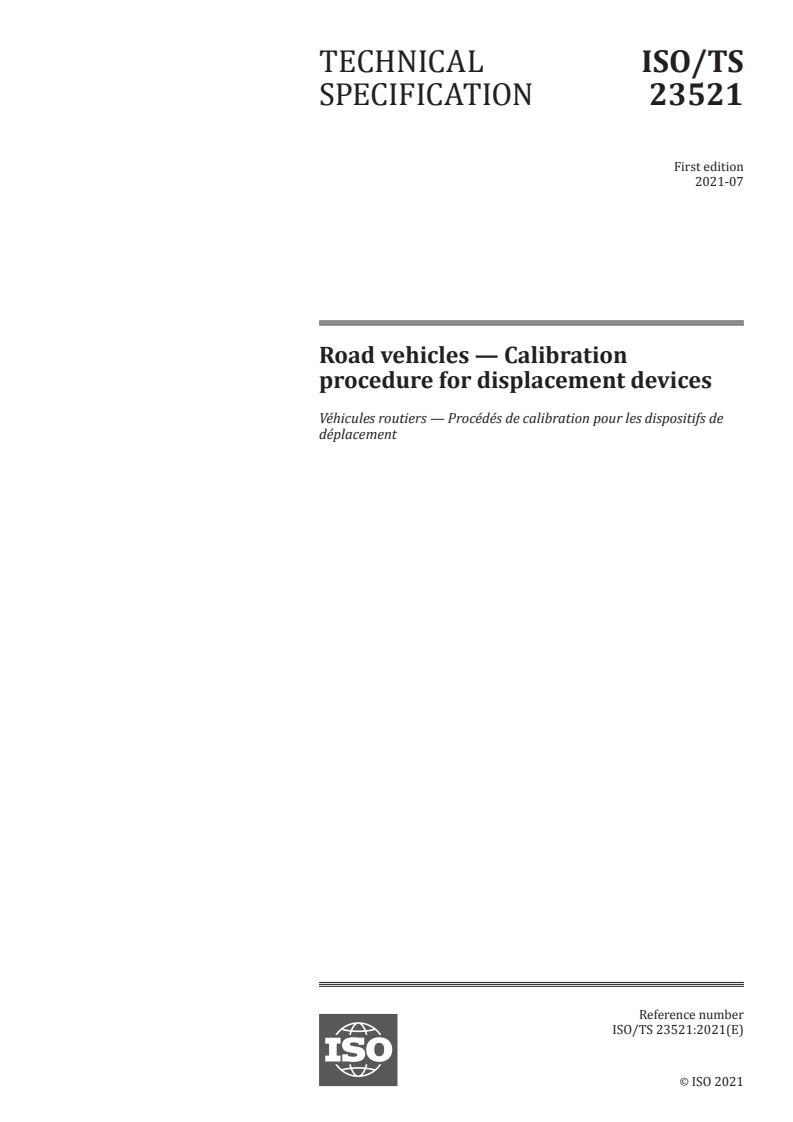
TECHNICAL ISO/TS
SPECIFICATION 23521
First edition
2021-07
Road vehicles — Calibration
procedure for displacement devices
Véhicules routiers — Procédés de calibration pour les dispositifs de
déplacement
Reference number
©
ISO 2021
© ISO 2021
All rights reserved. Unless otherwise specified, or required in the context of its implementation, no part of this publication may
be reproduced or utilized otherwise in any form or by any means, electronic or mechanical, including photocopying, or posting
on the internet or an intranet, without prior written permission. Permission can be requested from either ISO at the address
below or ISO’s member body in the country of the requester.
ISO copyright office
CP 401 • Ch. de Blandonnet 8
CH-1214 Vernier, Geneva
Phone: +41 22 749 01 11
Email: copyright@iso.org
Website: www.iso.org
Published in Switzerland
ii © ISO 2021 – All rights reserved
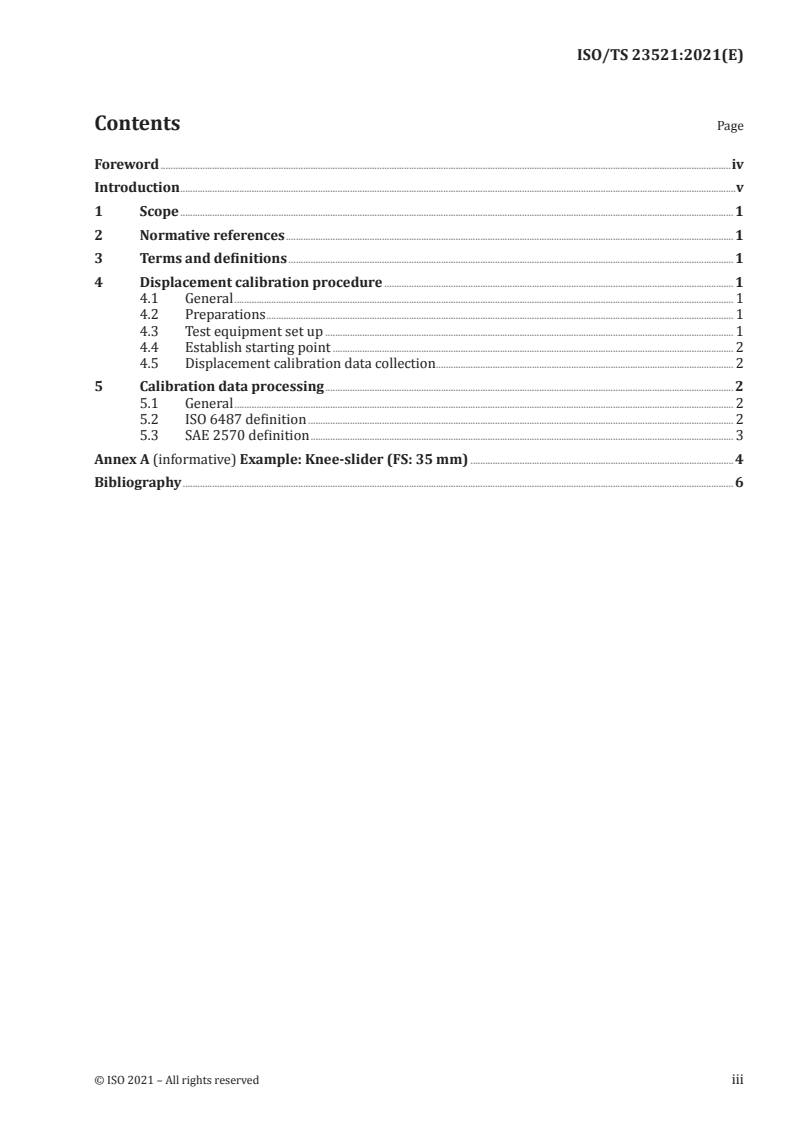
Contents Page
Foreword .iv
Introduction .v
1 Scope . 1
2 Normative references . 1
3 Terms and definitions . 1
4 Displacement calibration procedure . 1
4.1 General . 1
4.2 Preparations . 1
4.3 Test equipment set up . 1
4.4 Establish starting point . 2
4.5 Displacement calibration data collection . 2
5 Calibration data processing . 2
5.1 General . 2
5.2 ISO 6487 definition . 2
5.3 SAE 2570 definition . 3
Annex A (informative) Example: Knee-slider (FS: 35 mm) . 4
Bibliography . 6
Foreword
ISO (the International Organization for Standardization) is a worldwide federation of national standards
bodies (ISO member bodies). The work of preparing International Standards is normally carried out
through ISO technical committees. Each member body interested in a subject for which a technical
committee has been established has the right to be represented on that committee. International
organizations, governmental and non-governmental, in liaison with ISO, also take part in the work.
ISO collaborates closely with the International Electrotechnical Commission (IEC) on all matters of
electrotechnical standardization.
The procedures used to develop this document and those intended for its further maintenance are
described in the ISO/IEC Directives, Part 1. In particular, the different approval criteria needed for the
different types of ISO documents should be noted. This document was drafted in accordance with the
editorial rules of the ISO/IEC Directives, Part 2 (see www .iso .org/ directives).
Attention is drawn to the possibility that some of the elements of this document may be the subject of
patent rights. ISO shall not be held responsible for identifying any or all such patent rights. Details of
any patent rights identified during the development of the document will be in the Introduction and/or
on the ISO list of patent declarations received (see www .iso .org/ patents).
Any trade name used in this document is information given for the convenience of users and does not
constitute an endorsement.
For an explanation of the voluntary nature of standards, the meaning of ISO specific terms and
expressions related to conformity assessment, as well as information about ISO's adherence to the
World Trade Organization (WTO) principles in the Technical Barriers to Trade (TBT), see www .iso .org/
iso/ foreword .html.
This document was prepared by Technical Committee ISO/TC 22, Road vehicles, Subcommittee SC 36,
Safety and impact testing.
Any feedback or questions on this document should be directed to the user’s national standards body. A
complete listing of these bodies can be found at www .iso .org/ members .html.
iv © ISO 2021 – All rights reserved
Introduction
This document was written to address the need of the automotive crash testing community for a well-
defined calibration method of displacement sensors.
TECHNICAL SPECIFICATION ISO/TS 23521:2021(E)
Road vehicles — Calibration procedure for displacement
devices
1 Scope
This document establishes a procedure to calibrate 1D displacement transducers with nearly linear
transfer functions. This procedure is tailored to the needs of sensors used in crash tests. The calibration
is carried out with the sensor disassembled from the dummy or test system. The procedure is valid for
sensors with analogue as well as digital output.
2 Normative references
There are no normative references in this document.
3 Terms and definitions
For the purposes of this document, the following terms and definitions apply.
ISO
...
Frequently Asked Questions
ISO/TS 23521:2021 is a technical specification published by the International Organization for Standardization (ISO). Its full title is "Road vehicles - Calibration procedure for displacement devices". This standard covers: This document establishes a procedure to calibrate 1D displacement transducers with nearly linear transfer functions. This procedure is tailored to the needs of sensors used in crash tests. The calibration is carried out with the sensor disassembled from the dummy or test system. The procedure is valid for sensors with analogue as well as digital output.
This document establishes a procedure to calibrate 1D displacement transducers with nearly linear transfer functions. This procedure is tailored to the needs of sensors used in crash tests. The calibration is carried out with the sensor disassembled from the dummy or test system. The procedure is valid for sensors with analogue as well as digital output.
ISO/TS 23521:2021 is classified under the following ICS (International Classification for Standards) categories: 43.020 - Road vehicles in general. The ICS classification helps identify the subject area and facilitates finding related standards.
You can purchase ISO/TS 23521:2021 directly from iTeh Standards. The document is available in PDF format and is delivered instantly after payment. Add the standard to your cart and complete the secure checkout process. iTeh Standards is an authorized distributor of ISO standards.
Questions, Comments and Discussion
Ask us and Technical Secretary will try to provide an answer. You can facilitate discussion about the standard in here.
Loading comments...