

ISO/IEC 24931-1
(Main)Information technology — Metaverse — Part 1: Concepts, characteristics and technology
- Abstract
This document will: • provide an overview of the Metaverse • define terms and terminology used for the Metaverse • define concepts for the Metaverse
- Status
- Not Published
- Current Stage
- 6000 - International Standard under publication
- Start Date
- 08-Aug-2026
- Completion Date
- 10-Oct-2026
Buy Documents


ISO/IEC FDIS 24931-1 - Information technology — Metaverse — Part 1: Concepts, characteristics and technology
REDLINE ISO/IEC FDIS 24931-1 - Information technology — Metaverse — Part 1: Concepts, characteristics and technology
ISO/IEC 24931-1 is an ISO/IEC standard on the metaverse from ISO/IEC JTC 1/SC 24. It gives a shared technical overview of metaverse concepts, characteristics, terminology and enabling technologies for people who design, assess, build or govern metaverse-related systems and services.
What does ISO/IEC 24931-1 specify?
ISO/IEC 24931-1 provides an overview of the metaverse and defines fundamental terms and concepts for it. It focuses on the common language and the main technical ideas around metaverse systems, rather than on a product profile or a test method.
The document is organized as follows.
| Clause | What it covers |
|---|---|
| 1 Scope | Overview, fundamental terms, concepts, participation and oversight |
| 2 Normative references | No normative references |
| 3 Terms, definitions and abbreviated terms | Definitions and abbreviations used throughout the document |
| 4 Metaverse overview and characteristics | General overview, characteristics, and relevant standards |
| 5 Metaverse concepts | Core concepts such as worlds, identity, avatars, decentralisation and interoperability |
| 6 Metaverse participation and oversight | Content creation, access, safety, security, ethics and governance |
| 7 Metaverse enabling technologies | VR, AR, AI, DLT, cloud, edge, networks and related technologies |
| Bibliography | Reference list used by the document |
The introduction also positions ISO/IEC 24931-1 as the first part of a planned multi-part series, with future parts intended for framework and architecture, use cases, reference model, information model and governance.
What are the key requirements of ISO/IEC 24931-1?
ISO/IEC 24931-1 is mainly a conceptual standard, so its most important content is the set of definitions, characteristic descriptions and organizing ideas that give teams a common basis for discussion and design.
Clause 4 - what the metaverse is and what it must support
Clause 4 describes the metaverse as a persistent, effectively unlimited set of computer-generated virtual worlds and virtual spaces that people access through human computer interaction (HCI) and user interfaces (UI). In practice, that means the metaverse is treated as a networked environment, not a single application.
Clause 4 also identifies four main characteristics: realism, ubiquity, interoperability and scalability. These matter because they are the main yardsticks for judging whether a platform feels convincing, can be reached by many users, can exchange data across systems and can grow without losing performance.
Clause 5 - the core concepts to use consistently
Clause 5 defines the concepts that make the metaverse discussion precise: virtual world, virtual space, virtual presence, telepresence, digital identity, avatar, decentralisation, digital twin (DTw), interoperability, social media, virtual economy and digital products. For a project team, this section is the vocabulary you need to avoid mixing up display technology, identity, platform control and commercial models.
A particularly useful point in Clause 5 is the breakdown of interoperability into five dimensions: avatar, asset, content, identity and interaction interoperability. In practice, this tells organizations what has to move across platforms if users, items or experiences are meant to work beyond one closed environment.
Clause 6 - participation, access and oversight
Clause 6 covers content creation, access to the metaverse, safety and security, and ethics and governance. This is where the standard connects metaverse concepts with practical operation - who makes content, how users enter, and what risks and rules need attention.
The access discussion matters because ISO/IEC 24931-1 recognizes gateways, portals and access points, including VR headsets, AR and MR gear, large-screen immersive environments, gaming consoles, computers, tablets and smartphones. It also notes that accessibility and participation for users with disabilities must be considered.
Clause 7 - the enabling technology stack
Clause 7 identifies the principal technologies that support metaverse systems: VR and AR, other immersive media technologies, AI, DLT, cloud and edge computing, spatial computing, 3D modelling and reconstruction, IoT, networks and computing, dataspace technologies and emerging technologies. This helps readers map the metaverse concept to the systems they already manage, such as graphics, cloud services, sensors, identity systems and data platforms.
What terms does ISO/IEC 24931-1 define?
ISO/IEC 24931-1 defines the vocabulary that underpins the rest of the document. These terms are central because they shape how metaverse systems are described, compared and specified.
- Metaverse - a set of universal, immersive virtual worlds enhanced by VR and AR.
- Virtual world - a spatial organization of multiple virtual objects, often interactive and accessible by multiple users.
- Virtual presence - the ability of a user to feel present in a virtual location through technologies such as VR or AR.
- Avatar - a visual representation of a user inside virtual environments.
- Digital identity - information used by computer systems to represent an external agent such as a person, organization, application or device.
- Digital twin (DTw) - a digital representation of a target entity with data connections that support convergence between physical and digital states.
- Distributed ledger technology (DLT) - technology that enables distributed ledgers to operate and be used.
- Digital product - a product offered through digital hardware or software technology, including network communication.
Who uses ISO/IEC 24931-1?
ISO/IEC 24931-1 is useful to engineers, architects, product teams, content creators, platform operators, quality and governance teams, and buyers who need a shared language for metaverse-related work.
It is especially relevant in industries and application areas mentioned in the document, including gaming, education, enterprise, industrial uses, commercial environments and social media contexts. It also supports teams working with VR, AR, digital twins, AI, DLT, IoT, networks, accessibility and governance, where clear definitions are needed before architecture or procurement decisions are made.
What does the ISO/IEC 24931-1 document contain?
ISO/IEC 24931-1 contains a large terminology section, with detailed definitions in Clause 3 and a list of abbreviated terms in Clause 3.2. It also includes a metaverse overview, characteristic descriptions, and concept explanations covering worlds, presence, identity, avatars, decentralisation, digital economy, and governance.
The document includes a table of ISO/IEC JTC 1 standards relevant to metaverse application areas and another table describing eight domains of a sustainable metaverse implementation. It also uses figures to illustrate the metaverse concept, key characteristics, avatar use, access paths and enabling technologies.
Clause 6 discusses access points and gives examples of devices and interfaces used to connect to metaverse environments. Clause 7 describes the technology categories that support metaverse systems, including immersive media, AI, DLT, cloud and edge computing, 3D reconstruction, networks and dataspace technologies.
Buy Documents
ISO/IEC FDIS 24931-1 - Information technology — Metaverse — Part 1: Concepts, characteristics and technology
REDLINE ISO/IEC FDIS 24931-1 - Information technology — Metaverse — Part 1: Concepts, characteristics and technology
Get Certified
Connect with accredited certification bodies for this standard

BSI Group
BSI (British Standards Institution) is the business standards company that helps organizations make excellence a habit.

NYCE
Mexican standards and certification body.
Sponsored listings
Frequently Asked Questions
ISO/IEC 24931-1 is a draft published by the International Organization for Standardization (ISO). Its full title is "Information technology — Metaverse — Part 1: Concepts, characteristics and technology". This standard covers: This document will: • provide an overview of the Metaverse • define terms and terminology used for the Metaverse • define concepts for the Metaverse
This document will: • provide an overview of the Metaverse • define terms and terminology used for the Metaverse • define concepts for the Metaverse
ISO/IEC 24931-1 is classified under the following ICS (International Classification for Standards) categories: 01.040.35 - Information technology (Vocabularies); 35.240.95 - Internet applications. The ICS classification helps identify the subject area and facilitates finding related standards.
ISO/IEC 24931-1 is available in PDF format for immediate download after purchase. The document can be added to your cart and obtained through the secure checkout process. Digital delivery ensures instant access to the complete standard document.
Standards Content (Sample)
FINAL DRAFT
International
Standard
ISO/IEC
FDIS
24931-1
ISO/IEC JTC 1/SC 24
Information technology —
Secretariat: BSI
Metaverse —
Voting begins on:
2026-06-12
Part 1:
Concepts, characteristics and
Voting terminates on:
2026-08-07
technology
RECIPIENTS OF THIS DRAFT ARE INVITED TO SUBMIT,
WITH THEIR COMMENTS, NOTIFICATION OF ANY
RELEVANT PATENT RIGHTS OF WHICH THEY ARE AWARE
AND TO PROVIDE SUPPOR TING DOCUMENTATION.
IN ADDITION TO THEIR EVALUATION AS
BEING ACCEPTABLE FOR INDUSTRIAL, TECHNO
LOGICAL, COMMERCIAL AND USER PURPOSES, DRAFT
INTERNATIONAL STANDARDS MAY ON OCCASION HAVE
TO BE CONSIDERED IN THE LIGHT OF THEIR POTENTIAL
TO BECOME STAN DARDS TO WHICH REFERENCE MAY BE
MADE IN NATIONAL REGULATIONS.
Reference number
ISO/IEC FDIS 249311:2026(en) © ISO/IEC 2026
FINAL DRAFT
ISO/IEC FDIS 24931-1:2026(en)
International
Standard
ISO/IEC
FDIS
24931-1
ISO/IEC JTC 1/SC 24
Information technology —
Secretariat: BSI
Metaverse —
Voting begins on:
Part 1:
Concepts, characteristics and
Voting terminates on:
technology
RECIPIENTS OF THIS DRAFT ARE INVITED TO SUBMIT,
WITH THEIR COMMENTS, NOTIFICATION OF ANY
RELEVANT PATENT RIGHTS OF WHICH THEY ARE AWARE
AND TO PROVIDE SUPPOR TING DOCUMENTATION.
© ISO/IEC 2026
IN ADDITION TO THEIR EVALUATION AS
All rights reserved. Unless otherwise specified, or required in the context of its implementation, no part of this publication may
BEING ACCEPTABLE FOR INDUSTRIAL, TECHNO
LOGICAL, COMMERCIAL AND USER PURPOSES, DRAFT
be reproduced or utilized otherwise in any form or by any means, electronic or mechanical, including photocopying, or posting on
INTERNATIONAL STANDARDS MAY ON OCCASION HAVE
the internet or an intranet, without prior written permission. Permission can be requested from either ISO at the address below
TO BE CONSIDERED IN THE LIGHT OF THEIR POTENTIAL
or ISO’s member body in the country of the requester.
TO BECOME STAN DARDS TO WHICH REFERENCE MAY BE
MADE IN NATIONAL REGULATIONS.
ISO copyright office
CP 401 • Ch. de Blandonnet 8
CH-1214 Vernier, Geneva
Phone: +41 22 749 01 11
Email: copyright@iso.org
Website: www.iso.org
Published in Switzerland Reference number
ISO/IEC FDIS 249311:2026(en) © ISO/IEC 2026
© ISO/IEC 2026 – All rights reserved
ii
ISO/IEC FDIS 24931-1:2026(en)
Contents Page
Foreword .iv
Introduction .v
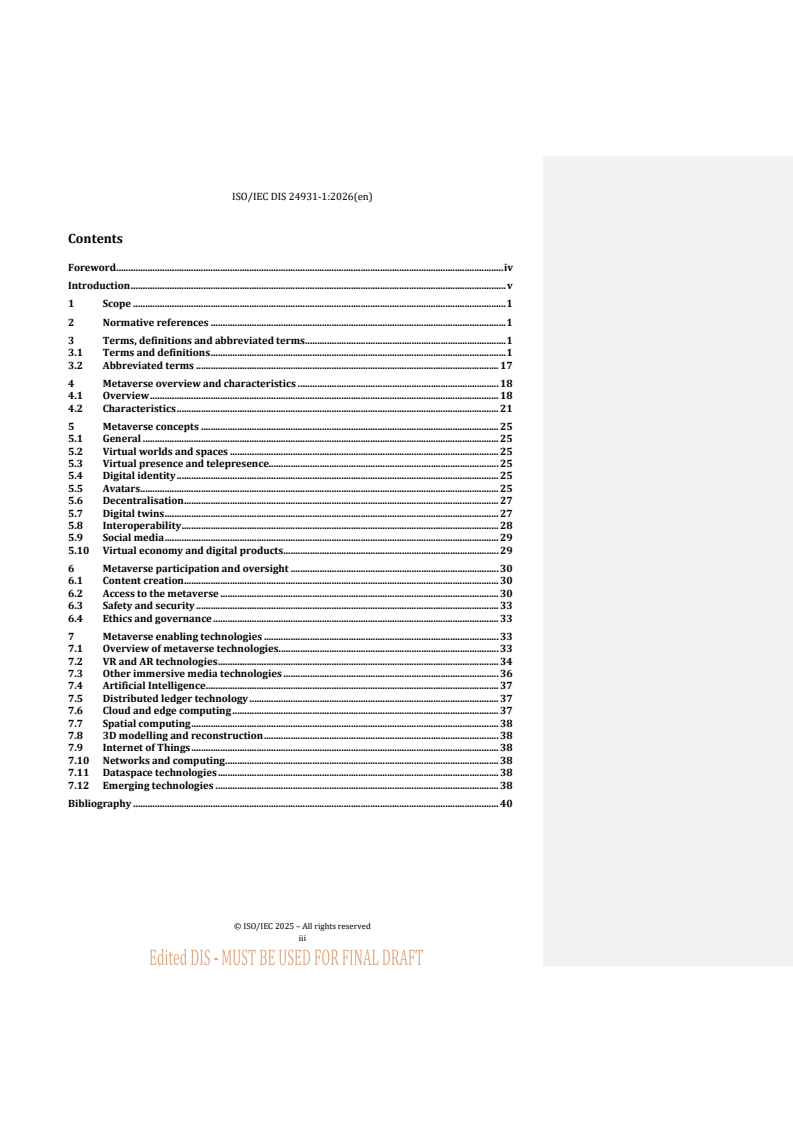
1 Scope . 1
2 Normative references . 1
3 Terms, definitions and abbreviated terms . 1
3.1 Terms and definitions .1
3.2 Abbreviated terms .16
4 Metaverse overview and characteristics . 17
4.1 Overview .17
4.2 Characteristics.19
5 Metaverse concepts . .22
5.1 General . 22
5.2 Virtual worlds and spaces . 22
5.3 Virtual presence and telepresence . 22
5.4 Digital identity . 22
5.5 Avatars . 23
5.6 Decentralisation . 23
5.7 Digital twins .24
5.8 Interoperability.24
5.9 Social media . 25
5.10 Virtual economy and digital products . 25
6 Metaverse participation and oversight .26
6.1 Content creation . 26
6.2 Access to the metaverse . 26
6.3 Safety and security . 28
6.4 Ethics and governance . 28
7 Metaverse enabling technologies .28
7.1 Overview of metaverse technologies . . 28
7.2 VR and AR technologies . . 29
7.3 Other immersive media technologies . 30
7.4 Artificial Intelligence . 30
7.5 Distributed ledger technology . 30
7.6 Cloud and edge computing . 30
7.7 Spatial computing .31
7.8 3D modelling and reconstruction .31
7.9 Internet of Things .31
7.10 Networks and computing .31
7.11 Dataspace technologies .31
7.12 Emerging technologies .31
Bibliography .33
© ISO/IEC 2026 – All rights reserved
iii
ISO/IEC FDIS 24931-1:2026(en)
Foreword
ISO (the International Organization for Standardization) and IEC (the International Electrotechnical
Commission) form the specialized system for worldwide standardization. National bodies that are
members of ISO or IEC participate in the development of International Standards through technical
committees established by the respective organization to deal with particular fields of technical activity.
ISO and IEC technical committees collaborate in fields of mutual interest. Other international organizations,
governmental and non-governmental, in liaison with ISO and IEC, also take part in the work.
The procedures used to develop this document and those intended for its further maintenance are described
in the ISO/IEC Directives, Part 1. In particular, the different approval criteria needed for the different types
of document should be noted. This document was drafted in accordance with the editorial rules of the ISO/
IEC Directives, Part 2 (see www.iso.org/directives or www.iec.ch/members_experts/refdocs).
ISO and IEC draw attention to the possibility that the implementation of this document may involve the
use of (a) patent(s). ISO and IEC take no position concerning the evidence, validity or applicability of any
claimed patent rights in respect thereof. As of the date of publication of this document, ISO and IEC had not
received notice of (a) patent(s) which may be required to implement this document. However, implementers
are cautioned that this may not represent the latest information, which may be obtained from the patent
database available at www.iso.org/patents and https://patents.iec.ch. ISO and IEC shall not be held
responsible for identifying any or all such patent rights.
Any trade name used in this document is information given for the convenience of users and does not
constitute an endorsement.
For an explanation of the voluntary nature of standards, the meaning of ISO specific terms and expressions
related to conformity assessment, as well as information about ISO's adherence to the World Trade
Organization (WTO) principles in the Technical Barriers to Trade (TBT) see www.iso.org/iso/foreword.html.
In the IEC, see www.iec.ch/understanding-standards.
This document was prepared by Joint Technical Committee ISO/IEC JTC 1, Information technology,
Subcommittee SC 24, Computer graphics, image processing and environmental date representation.
A list of all parts in the ISO/IEC 24931 series can be found on the ISO and IEC websites.
Any feedback or questions on this document should be directed to the user’s national standards
body. A complete listing of these bodies can be found at www.iso.org/members.html and
www.iec.ch/national-committees.
© ISO/IEC 2026 – All rights reserved
iv
ISO/IEC FDIS 24931-1:2026(en)
Introduction
The metaverse is a conceptual extension of the internet envisioned as a persistent, universal, immersive,
interactive and socially engaging virtual environment that can be facilitated by virtual reality (VR) and
[1]
augmented reality (AR) . The term metaverse was first introduced in the 1992 science fiction novel Snow
[2]
Crash where people access a virtual urban environment from VR goggles or public terminals.
The metaverse comprises a set of digitally-constructed virtual worlds that may be accessed via various
modalities. The metaverse is intended to be a decentralized 3D virtual environment, in contrast to the
current predominantly 2D internet. Similar to the internet, it is always operational even though some parts
may be non-operational for maintenance reasons.
VR provides immersion into the metaverse while AR enables metaverse elements to be layered onto the real
world. In addition to these immersive technologies, access can also be achieved using conventional devices
like keyboards, mice and screens to provide a less immersive and interactive experience.
Numerous organizations are actively engaged in shaping and establishing the metaverse. This document is
intended to provide a general overview of the metaverse and define the foundational terms and concepts. It
is intended to be the first of a series on aspects of the metaverse. Future parts are planned for framework
and architecture, use cases, reference model, information model and governance.
© ISO/IEC 2026 – All rights reserved
v
FINAL DRAFT International Standard ISO/IEC FDIS 24931-1:2026(en)
Information technology — Metaverse —
Part 1:
Concepts, characteristics and technology
1 Scope
This document provides an overview and defines fundamental terms and concepts for the metaverse.
This document specifies the following functionalities:
a) overview of the metaverse with description of its characteristics and technologies;
b) fundamental concepts;
c) terminology and definitions;
d) participation and oversight.
2 Normative references
There are no normative references in this document.
3 Terms, definitions and abbreviated terms
3.1 Terms and definitions
For the purposes of this document, the following terms and definitions apply.
ISO and IEC maintain terminology databases for use in standardization at the following addresses:
— ISO Online browsing platform: available at https:// www .iso .org/ obp
— IEC Electropedia: available at https:// www .electropedia .org/
3.1.1
reality
set of facts, beliefs and rules that are accepted as true
[SOURCE: ISO 9241-820:2024, 3.2.1]
3.1.2
real world
physical world
natural world as experienced by the user
[SOURCE: ISO 9241-820:2024, 3.2.3]
© ISO/IEC 2026 – All rights reserved
ISO/IEC FDIS 24931-1:2026(en)
3.1.3
virtual world
virtual environment
spatial organization of multiple virtual objects (3.1.5), potentially including global behaviour
Note 1 to entry: The simulated environments are often interactive and can be accessed by multiple users through
online interfaces.
Note 2 to entry: The physical world in which people live and its related characteristics is referred to as the real world
(3.1.2) to differentiate it from a virtual world.
[SOURCE: ISO/IEC 18039:2019, 3.1.25]
3.1.4
virtual space
any digital environment or interface, which may or may not be interactive
Note 1 to entry: A virtual space is a broader concept than a virtual world (3.1.3). It can refer to any computer-generated
setting.
3.1.5
virtual object
computer-generated entity that is designated for augmentation in association with a physical object (3.1.6)
data representation
Note 1 to entry: In the context of MAR, it usually has perceptual (e.g. visual, aural) characteristics and, optionally,
dynamic reactive behaviour.
[SOURCE: ISO/IEC 18039:2019, 3.1.24]
3.1.6
physical object
real object
object that exists in the real world
[SOURCE: ISO/IEC 18039:2019, 3.1.15]
3.1.7
virtual reality
VR
set of artificial conditions created by computer and dedicated electronic devices that simulate visual images
and possibly other sensory information of a user’s surroundings with which the user is allowed to interact
Note 1 to entry: The artificial conditions do not reflect a user’s real-time physical environment.
[SOURCE: ISO 9241-394:2020, 3.8]
3.1.8
augmented reality
AR
interactive experience of a real world (3.1.2) environment whereby the objects that reside in the real world
(3.1.2) are augmented by computer-generated perceptual information
[SOURCE: ISO/IEC 18038:2020, 3.2]
3.1.9
mixed and augmented reality
MAR
integration of real world (3.1.2) and virtual worlds (3.1.3) including mixed reality (3.1.10) and augmented
reality (3.1.8)
Note 1 to entry: MAR is often used interchangeably with MR (3.1.10).
© ISO/IEC 2026 – All rights reserved
ISO/IEC FDIS 24931-1:2026(en)
[SOURCE: ISO/IEC 18038:2020, 3.13]
3.1.10
mixed reality
MR
display continuum in which both real and virtual images are combined in some way and in some proportion
Note 1 to entry: Augmented reality (AR) (3.1.8) and virtual reality (VR) (3.1.7) are considered to be on the mixed reality
[7]
continuum .
[SOURCE: ISO/IEC TR 23843:2020, 3.4]
3.1.11
XR
real-and-virtual combined environments and human-machine interactions generated by computer
technology and wearables
Note 1 to entry: Within this document, XR is used as an umbrella term encapsulating AR (3.1.8), VR (3.1.7), MR (3.1.10)
and other environments.
[SOURCE: ISO/IEC 5927:2024, 3.1.5]
3.1.12
simulation
use of a similar or equivalent system to imitate a real system, so that it behaves like or appears to be the real
system
[SOURCE: ISO 16781:2021, 3.1.9]
3.1.13
physics engine
software component that models the laws of physics inside a digital environment so objects behave in a way
that feels physically plausible.
3.1.14
presentation engine
real time rendering component or components of a game, rendering, or other software engine relevant for
creating the visual, audio and/or tactile representations of the media on behalf of the system
Note 1 to entry: The presentation engine is especially relevant for immersive display processing systems that leverage
the capabilities of the engine to provide visual rendering capabilities of an immersive display.
[SOURCE: ISO/IEC TR 23090-27:2025, 3.17]
3.1.15
game engine
relevant libraries for functions such as a physics engine (3.1.13) and presentation engine (3.1.14) for the
presentation of visual, audio and or haptic aspects of the media comprising the games
[SOURCE: ISO/IEC TR 23090-27:2025, 3.10]
3.1.16
presence
psychological sense of being in a particular environment
Note 1 to entry: Presence is about physical engagement, while virtual presence (3.1.17) is about engaging with others
via digital interaction (3.1.57).
[SOURCE: ISO 9241-820:2024, 3.1.2, modified — Note 1 to entry has been added]
© ISO/IEC 2026 – All rights reserved
ISO/IEC FDIS 24931-1:2026(en)
3.1.17
virtual presence
ability of a user to feel that they are present in a virtual location such as an immersive simulation using
technologies such as virtual reality (VR) (3.1.7) or augmented reality (AR) (3.1.8)
Note 1 to entry: Refer to presence (3.1.16) for the distinction between presence and virtual presence.
3.1.18
telepresence
set of technologies that allows a person to feel as if they are present at a place other than their true location
Note 1 to entry: Telepresence typically involves technologies such as video conferencing and VR (3.1.7) to create a
realistic experience for users interacting with remote locations or other users. These remote locations and users are
generally real environments and people, in contract to virtual presence (3.1.17) where simulated environments are
involved.
3.1.19
immersion
experience and participation in a particular environment
[SOURCE: ISO 9241-820:2024, 3.1.1]
3.1.20
agent
entity that takes programmed actions, such as software or a device
Note 1 to entry: Agents can provide recommendations, help with tasks, or facilitate interactions (3.1.57). Agents
operate behind the scenes, unlike avatars (3.1.23), using AI (3.1.42) to analyse user behaviour and preferences. They
can also manage environments and automate processes, making the metaverse (3.1.29) more dynamic.
Note 2 to entry: A chatbot (3.1.25) is an example of an agent.
Note 3 to entry: Software agent (3.1.21) is an example of an agent.
[SOURCE: ISO 27789:2021, 3.4, modified — Notes to entry added.]
3.1.21
software agent
agent (3.1.20) that perceives its environment and takes actions that maximise its chance of successfully
achieving its goals
[SOURCE: ISO/IEC TR 29119-11:2020, 3.1.73, modified — "Digital entity" replaced with agent.]
3.1.22
AI agent
automated entity that senses and responds to its environment and takes actions to achieve its goals
Note 1 to entry: A chatbot (3.1.25) is an example of an AI agent.
[SOURCE: ISO/IEC 22989:2022, 3.1.1, modified — Note 1 to entry added.]
3.1.23
avatar
entity that can be used as a (visual) representation of the user inside the virtual environments
EXAMPLE A player's representation in a video game and human or fantastic representation of a person’s self in
online worlds.
Note 1 to entry: Avatars may represent humans, non-humans (aliens) and other living creatures (e.g. animals including
pets).
[SOURCE: ISO/IEC 23005-4:2018, 3.1.1, modified — Note 1 to entry added.]
© ISO/IEC 2026 – All rights reserved
ISO/IEC FDIS 24931-1:2026(en)
3.1.24
AI avatar
avatar (3.1.23) controlled by an AI system (3.1.43)
Note 1 to entry: AI avatars are interactive, personalised and adaptable, making them suitable for a variety of
applications whereas NPCs (3.1.26) are primarily designed to enrich the gaming experience with fixed roles and
behaviours.
3.1.25
chatbot
software application that is designed to mimic human conversation through text or voice interactions
(3.1.57)
3.1.26
non-player character
NPC
digital character controlled by software, sometimes including AI (3.1.42), and not by a human
Note 1 to entry: NPCs are designed to populate the metaverse (3.1.29) and engage users in various ways. They can
serve specific roles to enrich the narrative.
Note 2 to entry: NPCs often have scripted behaviours.
3.1.27
hologram
three-dimensional photographic representation produced by an arranged interference between coherent
light beams
[SOURCE: ISO 5127:2017, 3.3.3.23]
3.1.28
holographic display
three-dimensional display that renders a complex optical wavefront
Note 1 to entry: A holographic display may or may not use a hologram (3.1.27).
[SOURCE: ISO/IEC 21794-1:2020, 3.15]
3.1.29
metaverse
set of universal, immersive virtual worlds (3.1.3) that can be enhanced by virtual reality (VR) (3.1.7) and
augmented reality (AR) (3.1.8)
Note 1 to entry: As the metaverse concept continues to evolve, a range of definitions has emerged across different
[18]
domains and stakeholder communities .
Note 2 to entry: Common metaverse themes are industrial, commercial, gaming, education and enterprise. A metaverse
virtual world (3.1.3) may combine several of these themes.
Note 3 to entry: VR (3.1.7) and AR (3.1.8) offer novel interaction modalities, however their adoption has been constrained
by user comfort, accessibility and physiological factors. Accordingly, anchoring metaverse implementations to 3D
vision — rather than supporting inclusive 2D renderings of 3D environments — can limit accessibility and market
viability.
3.1.30
metaverse system
group of interacting or interrelated elements that act according to a set of rules to form a unified whole
within the metaverse (3.1.29)
© ISO/IEC 2026 – All rights reserved
ISO/IEC FDIS 24931-1:2026(en)
3.1.31
metaverse platform
persistent, real-time rendered 3D world and simulation that supports continuity of identity, objects, history,
payments, and entitlements, and can be experienced synchronously by an effectively unlimited number of
users, each with an individual sense of presence (3.1.16)
Note 1 to entry: There are many prototype metaverse platforms.
3.1.32
digital twin
DTw
digital representation of a target entity with data connections that enable convergence between the physical
and digital states at an appropriate rate of synchronization
Note 1 to entry: Digital twin has some or all of the capabilities of connection, integration, analysis, simulation,
visualization, optimization and collaboration.
Note 2 to entry: A digital twin can provide an integrated view of the target entity throughout its life cycle.
Note 3 to entry: A digital twin manifests when data is exchanged between an existing physical object (3.1.6) and its
digital model in both directions and is fully integrated. The digital model acts as a controlling representation of the
physical object (3.1.6). Within the physical object (3.1.6) or digital model, there can be objects, real or virtual, that
induce changes of state. Hence, a change in the physical object (3.1.6) immediately leads to a change in the digital
[19]
model or virtual environment (3.1.3), and vice versa .
[SOURCE: ISO/IEC 30173:2023, 3.1.1, modified — Note 1 to entry added collaboration, Note 2 to entry
modified, Note 3 to entry added.]
3.1.33
liminal space
boundary between two points in time, space, or both
Note 1 to entry: In the metaverse (3.1.29), liminal spaces will be required to enable users to transition smoothly
between virtual spaces (3.1.4) without experiencing psychological issues such as anxiety.
3.1.34
walled garden
closed ecosystem in which only a limited set of users have access to their software or hardware technology
Note 1 to entry: Most current social media platforms can be considered walled gardens since users are restricted to
the specific platform’s environment.
3.1.35
Web 1.0
first version of the internet mainly serving the use of e-mail and the posting and consultation of static HTML
pages
[SOURCE: ISO 5127:2017, 3.1.9.04]
3.1.36
Web 2.0
loosely defined model of interactive internet services and information sharing
Note 1 to entry: See Web 1.0 (3.1.35).
[SOURCE: ISO 5127:2017, 3.1.9.05, modified — Note 1 to entry added.]
© ISO/IEC 2026 – All rights reserved
ISO/IEC FDIS 24931-1:2026(en)
3.1.37
Web 3.0
semantic web
version of the internet following Web 2.0 (3.1.36) which rather than simply connecting internet addresses
and data in their formal form additionally does effect data linking through and in favour of their semantic
content or meaning thus providing enriched and enlarged information answering requests
Note 1 to entry: ISO refers to Web 3.0 as the semantic web.
[SOURCE: ISO 5127:2017, 3.1.9.06, modified — “Web 3.0” made the preferred term and Note 1 to entry
replaced.]
3.1.38
Web3
version of internet where users control their data and identity, free from centralised authorities
Note 1 to entry: Web3 incorporates concepts such as decentralisation, blockchain (3.1.76) and NFTs (3.1.83).
Note 2 to entry: Web3 is focussed on decentralisation concepts, whereas Web 3.0 (3.1.37) aims for a linked and
intelligent internet.
Note 3 to entry: A proposed Web 4.0 will integrate Web3 and Web 3.0 (3.1.37) and also include advanced AI (3.1.42),
immersive technologies and real time contextual awareness.
3.1.39
content creation
act of developing content for the metaverse (3.1.29)
Note 1 to entry: This content can take many forms ranging from single 3D assets (3.1.84) such as avatars (3.1.23) to
large events such as concerts that are wholly online.
3.1.40
content creator
person who develops content for the metaverse (3.1.29)
3.1.41
user generated content
UGC
content created by users rather than professionals
3.1.42
artificial intelligence
AI
research and development of mechanisms and applications of AI systems (3.1.43)
Note 1 to entry: Research and development in AI can take place across any number of fields such as computer science,
data science, humanities, mathematics and natural sciences.
[SOURCE: ISO/IEC 22989:2022, 3.1.3, modified — "in AI" added to Note 1 to entry.]
3.1.43
artificial intelligence system
AI system
engineered system that generates outputs such as content, forecasts, recommendations or decisions for a
given set of human-defined objectives
Note 1 to entry: The engineered system can use various techniques and approaches related to artificial intelligence to
develop a model to represent data, knowledge, processes, etc. which can be used to conduct tasks.
Note 2 to entry: AI systems are designed to operate with varying levels of automation.
[SOURCE: ISO/IEC 22989:2022, 3.1.4]
© ISO/IEC 2026 – All rights reserved
ISO/IEC FDIS 24931-1:2026(en)
3.1.44
large language model
LLM
computer AI (3.1.42) model that can achieve general purpose language understanding and generation
3.1.45
generative AI
AI (3.1.42) that can generate content such as text, imagery or video using reproductive models
Note 1 to entry: Most generative AI systems use large language models (3.1.44).
Note 2 to entry: LLMs (3.1.44) are trained on vast amounts of data, enabling them to perform a wide range of natural
language processing (NLP) tasks such as text generation, translation, summarization and question answering.
3.1.46
cloud computing
paradigm for enabling network access to a scalable and elastic pool of shareable physical or virtual resources
with self-service provisioning and administration on demand
[SOURCE: ISO/IEC 22123-1:2023, 3.1.1]
3.1.47
edge computing
distributed computing in which processing and storage take place at or near the edge, where the nearness is
defined by the system's requirements
[SOURCE: ISO/IEC TR 17903:2024, 3.25]
3.1.48
spatial computing
human interaction (3.1.57) with a machine in which the machine retains and manipulates referents to real
objects and spaces
[24]
Note 1 to entry: The term spatial computing comes from Greenwold’s 2003 Yale thesis .
3.1.49
microservice
independently deployable artefact providing a service implementing a specific functional part of an
application
[SOURCE: ISO/IEC TS 23167:2020, 3.15]
3.1.50
Internet of Things
IoT
infrastructure of interconnected entities, people, systems and information resources, together with services
which process and react to information from the physical world (3.1.2) and the virtual world (3.1.3)
[SOURCE: ISO/IEC 20924:2024, 3.2.8]
3.1.51
access point
device, technology, or interface that enables users to enter or interact with the metaverse (3.1.29)
Note 1 to entry: Access point, gateway (3.1.52) and portal (3.1.53) are frequently used interchangeably.
Note 2 to entry: An access point includes the physical device (for example a VR (3.1.7) headset) and also the firmware
and software (for example a games platform) to integrate the user into a metaverse (3.1.29)virtual world (3.1.3).
Note 3 to entry: Typical access points are shown in Figure 6.
© ISO/IEC 2026 – All rights reserved
ISO/IEC FDIS 24931-1:2026(en)
3.1.52
gateway
means of connecting to, and interacting with, the metaverse (3.1.29)
Note 1 to entry: Access point (3.1.51), gateway and portal (3.1.53) are frequently used interchangeably. However,
gateway is a broader concept that refers to any interface or system that connects to the metaverse (3.1.29), while
portal refers to accessing a particular area of the metaverse generally through a metaverse platform (3.1.31).
Note 2 to entry: An example of a gateway is a specific virtual reality (3.1.7) platform that can provide access to other
virtual spaces (3.1.4) or digital experiences, including games, social spaces, or digital marketplaces (3.1.95).
3.1.53
portal
entry or exit point into or from a virtual world (3.1.3) or virtual space (3.1.4) within the broader metaverse
(3.1.29)
Note 1 to entry: In a virtual game world, a portal may lead a player from one area or level to another, or from a social
space into a specific interactive game zone.
3.1.54
human computer interaction
HCI
discipline concerned with the design, evaluation and implementation of interactive computing systems
for human use and with the study of major phenomena surrounding the interaction between humans and
computers
[SOURCE: ISO/TR 4419:2026, 3.13]
3.1.55
user interface
UI
set of all components of an interactive system that provide information and controls for the user to
accomplish specific tasks with the interactive system
[SOURCE: ISO 9241-110:2020, 3.10]
3.1.56
brain-computer interface
BCI
brain-machine interface
BMI
technology designed to enable direct exchange of information between the central
nervous system and the software and/or hardware
Note 1 to entry: A BCI allows single or bi-directional communication between the brain and external devices, enabling
controlling and/or feedback capabilities.
Note 2 to entry: BCIs can be set up between human-human or human-animal(s) through software and/or hardware.
Note 3 to entry: Non-invasive systems are generally referred to as BCIs and invasive systems using implanted sensors
are often referred to as BMIs.
[SOURCE: ISO/IEC 8663, 3.1.2, modified — Definition slightly adjusted and Note 3 to entry added.]
3.1.57
interaction
exchange of information between a user and a system via the human-system interface to achieve the
intended goal
[SOURCE: ISO 11064-5:2008, 3.20, modified — term "dialogue" was removed.]
© ISO/IEC 2026 – All rights reserved
ISO/IEC FDIS 24931-1:2026(en)
3.1.58
interaction
interaction (3.1.57) in the metaverse (3.1.29)
3.1.59
social interaction
process by which people communicate, respond and relate to one another through shared behaviours,
expressions and social cues
3.1.60
interoperability
ability of two or more systems or applications to exchange information and to mutually use the information
that has been exchanged
Note 1 to entry: Interoperability is a critical enabler for the metaverse (3.1.29) where many different systems will be
required to interact seamlessly.
[SOURCE: ISO/IEC 19941:2017, 3.1.1, modified — Note 1 to entry added.]
3.1.61
scalability
ability of infrastructure to support expanding numbers of uses, applications and immersive experiences
without degradation of service
3.1.62
open source
freely available for modification and distribution
Note 1 to entry: open source generally refers to computer software that is developed as a public, open collaboration
and made freely available to the public.
Note 2 to entry: Open source software can be used to: (1) create 3D assets (3.1.84), virtual environments (3.1.3) or user
interfaces (3.1.55), (2) provide infrastructure for asset management and (3) enable user engagement.
Note 3 to entry: Since open source software is free of licensing fees, its use may encourage greater participation in
metaverse (3.1.29)content creation (3.1.39).
[SOURCE: ISO/IEC 20243-1:2023, 3.31]
3.1.63
photogrammetry
technique of measurement using photographs, for example aerial photographs, to determine, primarily,
geometric properties such as size, location and form of objects
Note 1 to entry: Photogrammetric measurement is often used for mapping, but also has some engineering applications.
[SOURCE: ISO 7078:2020, 3.1.5]
3.1.64
Light Detection and Ranging
LiDAR
terrestrial or airborne system to collect data to develop ground elevations or profiles using lasers
[SOURCE: ISO 10903:2025, 3.1.16]
3.1.65
gaussian splat
three-dimensional gaussian function used as an explicit, spatially-located element for representing and
rendering a scene, typically characterised by a position, shape, colour, and opacity, and projected into two
dimensions for real-time visualization
[34]
Note 1 to entry: Gaussian splatting was introduced by Lee Westover in the early 1990s .
© ISO/IEC 2026 – All rights reserved
ISO/IEC FDIS 24931-1:2026(en)
3.1.66
binaural sound
method of recording sound that uses two microphones, arranged with the intent to create a 3D stereo sound
sensation for the listener of actually being in the room with the performers or instruments
Note 1 to entry: Binaural sound is also known as binaural audio.
3.1.67
binocular parallax
apparent difference in the direction of a point as seen separately by one eye and the other, while the head
remains in a fixed position
Note 1 to entry: Binocular parallax is equivalent to the optic angle between the visual axes of both eyes, when they are
fixated to a single point.
[SOURCE: ISO/TR 9241-331:2012, 2.21]
3.1.68
haptics
tactile sensations
[SOURCE: ISO/IEC 23090-31:2025, 3.1.8]
3.1.69
haptic feedback
technology that allows users to feel tactile sensations through their devices
3.1.70
wearable device
IoT (3.1.50) device designed for operation near to, on, or inside a body
Note 1 to entry: Wearable devices often have a variety of sensing abilities, but limited power capacity constraining
communication and data processing abilities. As critical devices of the IoT (3.1.50), it is considered that the
communication between wearable devices and a network may not require any human intervention. Wearable devices
include electronic devices usable by humans, animals and other organisms.
[SOURCE: ISO/IEC 20924:2024, 3.1.35]
3.1.71
stereoscopic display
3D display where depth perception is induced by binocular parallax (3.1.67)
[SOURCE: ISO/TR 9241-331:2012, 2.1]
3.1.72
olfaction
ability to detect and interpret airborne compounds through sensory cells in the nose
3.1.73
motion base
mechanical platform designed to simulate real-world movement by physically displacing users or equipment
in various directions.
Note 1 to entry: Motion bases are used in flight and driving training simulators to replicate the sensation of movement.
3.1.74
distributed ledger
ledger that is shared across a set of distributed ledger technology (DLT) (3.1.75) nodes and synchronised
between these nodes using a consensus mechanism
Note 1 to entry: A distributed ledger is designed to be immutable, tamper-resistant, tamper-evident and append-only,
containing final and definitive ledger records of confirmed and validated transactions.
© ISO/IEC 2026 – All rights reserved
ISO/IEC FDIS 24931-1:2026(en)
[SOURCE: ISO 22739:2024, 3.23]
3.1.75
distributed ledger technology
DLT
technology that enables the operation and use of distributed ledgers (3.1.74)
[SOURCE: ISO 22739:2024, 3.25]
3.1.76
blockchain
distributed ledger (3.1.74) with confirmed blocks (3.1.80) organized in an append-only, sequential chain using
cryptographic links (3.1.86)
Note 1 to entry: Blockchains are designed to be tamper-resistant and to create final, definitive and immutable ledger
records.
[SOURCE: ISO 22739:2024, 3.6, modified — "Hash links" replaced with "cryptographic links", Note 1 to entry
added.]
3.1.77
block
sequence of bits whose length is the block size (3.1.79) of the block cipher (3.1.78)
[SOURCE: ISO/IEC 29167-10:2026, 3.1.16, modified — Preferred term "data block" removed from term]
3.1.78
block cipher
family of permutations that is parameterised by a cryptographic key and, optionally, the block size (3.1.79)
[SOURCE: ISO/IEC 29167-22:2018, 3.1.2]
3.1.79
block size
length of a block
Note 1 to entry: The block size is typically measured in bytes.
3.1.80
confirmed block
block (3.1.77) that has been confirmed
Note 1 to entry: “Confirmed” means accepted as authentic by the blockchain (3.1.76) network.
[SOURCE: ISO 22739:2024, 3.10, modified — Note 1 to entry added.]
3.1.81
token
asset (3.1.84) that represents a collection of entitlements
[SOURCE: ISO 22739:2024, 3.92]
3.1.82
non-fungible
not capable of mutual substitution among individual units
Note 1 to entry: The individual units can be digital assets (3.1.85), e.g. tokens (3.1.81).
[SOURCE: ISO 22739:2024, 3.63]
© ISO/IEC 2026 – All rights reserved
ISO/IEC FDIS 24931-1:2026(en)
3.1.83
non-fungible token
NFT
token (3.1.81) that is non-fungible (3.1.82)
Note 1 to entry: An NFT cannot be copied, substituted, or subdivided.
Note 2 to entry: An NFT is stored on a distributed ledger (3.1.74) or blockchain (3.1.76)
[SOURCE: ISO 22739:2024, 3.64, modified — Notes to entry added.]
3.1.84
asset
anything that has value to a stakeholder
[SOURCE: ISO 22739:2024, 3.1]
3.1.85
digital asset
asset (3.1.84) that exists only in digital form or which is the digital representation of another asset (3.1.84)
[SOURCE: ISO 24165-1:2021, 3.21]
3.1.86
cryptographic link
reference to data, constructed by applying a hash function (3.1.87) to the data
Note 1 to entry: A cryptographic link is used in the block (3.1.77) header to reference the previous block in order to
create the append-only, sequential chain that forms a blockchain (3.1.76).
Note 2 to entry: A cryptographic link allows for the detection of changes in the data to which it refers.
[SOURCE: ISO 22739:2024, 3.47, modified — Preferred term "hash link" removed.]
3.1.87
hash function
cryptographic hash function
function that maps strings of bits of variable (but usually upper bounded) length to fixed-length strings of
bits, satisfying the following properties:
— for a given output, it is computationally infeasible to find an input which maps to this output;
— for a given input, it is computationally infeasible to find a second input which maps to the same output;
— it is computationally infeasible to find any two distinct inputs that map to the same output
Note 1 to entry: Computational feasibility depends on the specific security requirements and environment. Refer to
ISO/IEC 10118-1:2016, Annex C.
[SOURCE: ISO/IEC 10118-1:2016, 3.46; ISO 22739:2024, 3.46]
3.1.88
cryptoasset
crypto-asset
digital asset (3.1.85) implemented using cryptographic techniques
Note 1 to entry: A distributed ledger technology (DLT)system (3.1.75) can be used to manage or transfer cryptoassets.
[SOURCE: ISO 22739:2024, 3.14]
© ISO/IEC 2026 – All rights reserved
ISO/IEC FDIS 24931-1:2026(en)
3.1.89
cryptocurrency
cryptoasset (3.1.88) designed to work as a medium of payment or value exchange
Note 1 to entry: Cryptocurrency uses decentralised control and cryptography to secure transactions, manage the
creation of additional assets (3.1.84) and verify the transfer of assets (3.1.84) in a distributed ledger technology (DLT)
system (3.1.75).
[SOURCE: ISO 22739:2024, 3.15]
3.1.90
digital money
digital currency
digital representation of monetary value
Note 1 to entry: Cryptocurrency (3.1.8
...
ISO/IEC DISFDIS 24931-1:2026(en)
ISO/IEC JTC 1/SC 24/WG 10
Secretariat: BSI
Date: 2026-03-0405-29
Information technology — Metaverse — —
Part 1:
Concepts, Characteristicscharacteristics and Technologytechnology
FDIS stage
© ISO/IEC 20252026
All rights reserved. Unless otherwise specified, or required in the context of its implementation, no part of this
publication may be reproduced or utilized otherwise in any form or by any means, electronic or mechanical,
including photocopying, or posting on the internet or an intranet, without prior written permission. Permission can
be requested from either ISO at the address below or ISO’s member body in the country of the requester.
ISO copyright office
CP 401 • Ch. de Blandonnet 8
CH-1214 Vernier, Geneva
Phone: + 41 22 749 01 11
EmailE-mail: copyright@iso.org
Website: www.iso.org
Published in Switzerland
ISO/IEC DIS 24931-1:2026(en)
Contents
Foreword . iv
Introduction . v
1 Scope . 1
2 Normative references . 1
3 Terms, definitions and abbreviated terms . 1
3.1 Terms and definitions . 1
3.2 Abbreviated terms . 17
4 Metaverse overview and characteristics . 18
4.1 Overview . 18
4.2 Characteristics . 21
5 Metaverse concepts . 25
5.1 General . 25
5.2 Virtual worlds and spaces . 25
5.3 Virtual presence and telepresence. 25
5.4 Digital identity . 25
5.5 Avatars . 25
5.6 Decentralisation . 27
5.7 Digital twins . 27
5.8 Interoperability . 28
5.9 Social media . 29
5.10 Virtual economy and digital products . 29
6 Metaverse participation and oversight . 30
6.1 Content creation . 30
6.2 Access to the metaverse . 30
6.3 Safety and security . 33
6.4 Ethics and governance . 33
7 Metaverse enabling technologies . 33
7.1 Overview of metaverse technologies. 33
7.2 VR and AR technologies . 34
7.3 Other immersive media technologies . 36
7.4 Artificial Intelligence . 37
7.5 Distributed ledger technology . 37
7.6 Cloud and edge computing . 37
7.7 Spatial computing . 38
7.8 3D modelling and reconstruction . 38
7.9 Internet of Things . 38
7.10 Networks and computing . 38
7.11 Dataspace technologies . 38
7.12 Emerging technologies . 38
Bibliography . 40
© ISO/IEC 2025 – All rights reserved
iii
Foreword
ISO (the International Organization for Standardization) and IEC (the International Electrotechnical
Commission) form the specialized system for worldwide standardization. National bodies that are
members of ISO or IEC participate in the development of International Standards through technical
committees established by the respective organization to deal with particular fields of technical activity.
ISO and IEC technical committees collaborate in fields of mutual interest. Other international
organizations, governmental and non-governmental, in liaison with ISO and IEC, also take part in the
work.
The procedures used to develop this document and those intended for its further maintenance are
described in the ISO/IEC Directives, Part 1. In particular, the different approval criteria needed for the
different types of document should be noted. This document was drafted in accordance with the editorial
rules of the ISO/IEC Directives, Part 2 (see www.iso.org/directives or
www.iec.ch/members_experts/refdocs).
ISO and IEC draw attention to the possibility that the implementation of this document may involve the
use of (a) patent(s). ISO and IEC take no position concerning the evidence, validity or applicability of any
claimed patent rights in respect thereof. As of the date of publication of this document, ISO and IEC had
not received notice of (a) patent(s) which may be required to implement this document. However,
implementers are cautioned that this may not represent the latest information, which may be obtained
from the patent database available at www.iso.org/patents and https://patents.iec.ch. ISO and IEC shall
not be held responsible for identifying any or all such patent rights.
Any trade name used in this document is information given for the convenience of users and does not
constitute an endorsement.
For an explanation of the voluntary nature of standards, the meaning of ISO specific terms and
expressions related to conformity assessment, as well as information about ISO's adherence to the World
Trade Organization (WTO) principles in the Technical Barriers to Trade (TBT) see
www.iso.org/iso/foreword.html. In the IEC, see www.iec.ch/understanding-standards.
This document was prepared by Joint Technical Committee ISO/IEC JTC 1, Information technology,
Subcommittee SC 24, Computer graphics, image processing and environmental date representation.
A list of all parts in the ISO/IEC 24931 series can be found on the ISO and IEC websites.
Any feedback or questions on this document should be directed to the user’s national standards body. A
complete listing of these bodies can be found at www.iso.org/members.html and www.iec.ch/national-
committees.
ISO/IEC DIS 24931-1:2026(en)
Introduction
The metaverse is a conceptual extension of the internet envisioned as a persistent, universal, immersive,
interactive and socially engaging virtual environment that can be facilitated by virtual reality (VR) and
[1]
augmented reality (AR) ). The term metaverse was first introduced in the 1992 science fiction novel
[2]
Snow Crash where people access a virtual urban environment from VR goggles or public terminals.
The metaverse comprises a set of digitally-constructed virtual worlds that may be accessed via various
modalities. The metaverse is intended to be a decentralized 3D virtual environment, in contrast to the
current predominantly 2D Internetinternet. Similar to the internet, it is always operational even though
some parts may be non-operational for maintenance reasons.
VR provides immersion into the metaverse while AR enables metaverse elements to be layered onto the
real world. In addition to these immersive technologies, access can also be achieved using conventional
devices like keyboards, mice and screens to provide a less immersive and interactive experience.
Numerous organizations are actively engaged in shaping and establishing the metaverse. This document
is intended to provide a general overview of the metaverse and define the foundational terms and
concepts. It is intended to be the first of a multi-part standardseries on aspects of the metaverse. Future
parts are planned for framework and architecture, use cases, reference model, information model and
governance.
© ISO/IEC 2025 – All rights reserved
v
ISO/IEC FDIS 24931-1:2026(en)
Computer Graphics, image processing and environmental data representation
© ISO/IEC 2026 – All rights reserved
vi
ISO/IEC FDIS 24931-1:2026(en)
Information technology — Metaverse — —
Part 1:
Concepts, Characteristicscharacteristics and Technologytechnology
1 Scope
This document provides an overview and defines fundamental terms and concepts for the metaverse.
This document specifies the following functionalities:
a) a) overview of the metaverse with description of its characteristics and technologies;
b) b) fundamental concepts;
c) c) terminology and definitions;
d) d) participation and oversight.
2 Normative references
There are no normative references in this document.
3 Terms, definitions and abbreviated terms
3.1 Terms and definitions
For the purposes of this document, the following terms and definitions apply.
ISO and IEC maintain terminologicalterminology databases for use in standardization at the following
addresses:
— — ISO Online browsing platform: available at https://www.iso.org/obp
— — IEC Electropedia: available at https://www.electropedia.org/
3.1.1
reality
set of facts, beliefs and rules that are accepted as true
[SOURCE: ISO 9241-820:2024(en),, 3.2.1]]
3.1.2
real world
physical world
natural world as experienced by the user
[SOURCE: ISO 9241-820:2024, 3.2.3]
3.1.3
virtual world
virtual environment
spatial organization of multiple virtual objects (3.1.5), potentially including global behaviour
© ISO/IEC 2026 – All rights reserved
ISO/IEC FDIS 24931-1:2026(en)
Note 1 to entry: The simulated environments are often interactive and can be accessed by multiple users through online
interfaces.
Note 2 to entry: The physical world in which people live and its related characteristics is referred to as the real world
(3.1.2) to differentiate it from a virtual world.
Field Code Changed
[SOURCE: ISO/IEC 18039:2019(en),, 3.1.25]]
3.1.4
virtual space
any digital environment or interface, which may or may not be interactive
Note 1 to entry: A virtual space is a broader concept than a virtual world (3.1.3). It can refer to any computer-generated
setting.
3.1.5
virtual object
computer-generated entity that is designated for augmentation in association with a physical object (3.1.6)
Field Code Changed
data representation
Note 1 to entry: In the context of MAR, it usually has perceptual (e.g. visual, aural) characteristics and, optionally, dynamic
reactive behaviour.
[SOURCE: ISO/IEC 18039:2019(en),, 3.1.24]]
3.1.6
physical object
real object
object that exists in the real world
[SOURCE: ISO/IEC 18039:2019(en),, 3.1.15]]
3.1.7
virtual reality
VR
set of artificial conditions created by computer and dedicated electronic devices that simulate visual images
and possibly other sensory information of a user’s surroundings with which the user is allowed to interact
Note 1 to entry: The artificial conditions do not reflect a user’s real-time physical environment.
[SOURCE: ISO 9241-394:2020, 3.8]]
3.1.8
augmented reality
AR
interactive experience of a real world (3.1.2) environment whereby the objects that reside in the real world
(3.1.2) are augmented by computer-generated perceptual information
[SOURCE: ISO/IEC 18038:2020, 3.2]]
3.1.9
mixed and augmented reality
MAR
integration of real world (3.1.2) and virtual worlds (3.1.3) including mixed reality (3.1.10) and augmented
reality (3.1.8)
Field Code Changed
Note 1 to entry: MAR is often used interchangeably with MR (3.1.10).
Field Code Changed
© ISO/IEC 2026 – All rights reserved
ISO/IEC FDIS 24931-1:2026(en)
[SOURCE: ISO/IEC 18038:2020, 3.13]]
3.1.10
mixed reality
MR
display continuum in which both real and virtual images are combined in some way and in some proportion
Note 1 to entry: Augmented reality (AR) (3.1.8) and virtual reality (VR) (3.1.7) are considered to be on the mixed reality
[7]
continuum .
[SOURCE: ISO/IEC TR 23843:2020, 3.4]]
3.1.11
XR
real-and-virtual combined environments and human-machine interactions generated by computer technology
and wearables
Note 1 to entry: Within this document, XR is used as an umbrella term encapsulating AR (),(3.1.8 ), VR (3.1.7), MR (3.1.10)
and other environments.
[SOURCE: ISO/IEC 5927:2024, 3.1.5]]
3.1.12
simulation
use of a similar or equivalent system to imitate a real system, so that it behaves like or appears to be the real
system
[SOURCE: ISO 16781:2021, 3.1.9]]
3.1.13
physics engine
software component that models the laws of physics inside a digital environment so objects behave in a way
that feels physically plausible.
3.1.14
presentation engine
real time rendering component or components of a game, rendering, or other software engine relevant for
creating the visual, audio and/or tactile representations of the media on behalf of the system
Note 1 to entry: The presentation engine is especially relevant for immersive display processing systems that leverage
the capabilities of the engine to provide visual rendering capabilities of an immersive display.
[SOURCE: ISO/IEC TR 23090-27:2025(en),, 3.17]]
3.1.15
game engine
software framework primarily designed for the development of video games that generally includes relevant
libraries for functions such as a physics engine (3.1.13) and presentation engine (3.1.14) for the presentation
of visual, audio and or haptic aspects of the media comprising the games
[SOURCE: ISO/IEC TR 23090-27:2025(en),, 3.10]]
3.1.16
presence
psychological sense of being in a particular environment
© ISO/IEC 2026 – All rights reserved
ISO/IEC FDIS 24931-1:2026(en)
Note 1 to entry: Presence is about physical engagement, while virtual presence (3.1.17) is about engaging with others via
digital interaction (3.1.57).
Field Code Changed
[SOURCE: ISO 9241-820:2024, 3.1.2, modified –— Note 1 to entry has been added]]
3.1.17
virtual presence
ability of a user to feel that they are present in a virtual location such as an immersive simulation using
technologies such as virtual reality (VR) (3.1.7) or augmented reality (AR) (3.1.8)
Field Code Changed
Note 1 to entry: Refer to presence (3.1.16) for the distinction between presence and virtual presence.
3.1.18
telepresence
set of technologies that allows a person to feel as if they are present at a place other than their true location
Note 1 to entry: Telepresence typically involves technologies such as video conferencing and VR (3.1.7) to create a
realistic experience for users interacting with remote locations or other users. These remote locations and users are
generally real environments and people, in contract to virtual presence (3.1.17) where simulated environments are
involved.
3.1.19
immersion
experience and participation in a particular environment
[SOURCE: ISO 9241-820:2024(en), 3.1.1]]
3.1.20
agent
entity that takes programmed actions, such as software or a device
Note 1 to entry: Agents can provide recommendations, help with tasks, or facilitate interactions (3.1.57). Agents operate
behind the scenes, unlike avatars (3.1.23), using AI (3.1.42) to analyse user behaviour and preferences. They can also
manage environments and automate processes, making the metaverse (3.1.29) more dynamic.
Field Code Changed
Note 2 to entry: A chatbot (3.1.25) is an example of an agent.
Note 3 to entry: Software agent (3.1.21) is an example of an agent.
[SOURCE: ISO 2278927789:2021(en),, 3.6.4], modified — Notes to entry added.]
3.1.21
software agent
agent (3.1.20) that perceives its environment and takes actions that maximise its chance of successfully
achieving its goals
[SOURCE: ISO/IEC TR 29119-11:2020, 3.173]1.73, modified — "Digital entity" replaced with agent.]
3.1.22
AI agent
automated entity that senses and responds to its environment and takes actions to achieve its goals
[SOURCE: ISO/IEC 22989:2022(en), 3.1.1]Note 1 to entry: A chatbot (3.1.25) is an example of an AI agent.
[SOURCE: ISO/IEC 22989:2022, 3.1.1, modified — Note 1 to entry added.]
© ISO/IEC 2026 – All rights reserved
ISO/IEC FDIS 24931-1:2026(en)
3.1.23
avatar
entity that can be used as a (visual) representation of the user inside the virtual environments
EXAMPLE : A player's representation in a video game and human or fantastic representation of a person’s self in
online worlds.
Note 1 to entry: Avatars may represent humans, non-humans (aliens) and other living creatures (e.g. animals including
pets).
[SOURCE: ISO/IEC 23005-4:2018, 3.1.1, modified — Note 1 to entry added].]
3.1.24
AI avatar
avatar (3.1.23) controlled by an AI system (3.1.43)
Field Code Changed
Note 1 to entry: AI avatars are interactive, personalised and adaptable, making them suitable for a variety of applications
whereas NPCs (3.1.26) are primarily designed to enrich the gaming experience with fixed roles and behaviours.
3.1.25
chatbot
software application that is designed to mimic human conversation through text or voice interactions (3.1.57)
Field Code Changed
3.1.26
non-player character
NPC
digital character controlled by software, sometimes including AI (3.1.42), and not by a human
Field Code Changed
Note 1 to entry: NPCs are designed to populate the metaverse (3.1.29) and engage users in various ways. They can serve
specific roles to enrich the narrative.
Note 2 to entry: NPCs often have scripted behaviours.
3.1.27
hologram
three-dimensional photographic representation produced by an arranged interference between coherent
light beams
[SOURCE: ISO 5127:2017, 3.3.3.23]]
3.1.28
holographic display
three-dimensional display that renders a complex optical wavefront
Note 1 to entry: A holographic display may or may not use a hologram (3.1.27).
Field Code Changed
[SOURCE: ISO/IEC 21794-1:2020(en),, 3.15]]
3.1.29
metaverse
set of universal, immersive virtual worlds (3.1.3) that can be enhanced by virtual reality (VR) (3.1.7) and
augmented reality (AR) (3.1.8)
Field Code Changed
Note 1 to entry: As the metaverse concept continues to evolve, a range of definitions has emerged across different
[18]
domains and stakeholder communities .
© ISO/IEC 2026 – All rights reserved
ISO/IEC FDIS 24931-1:2026(en)
Note 2 to entry: Common metaverse themes are industrial, commercial, gaming, education and enterprise. A metaverse
virtual world (3.1.3) may combine several of these themes.
Field Code Changed
Note 3 to entry: VR (3.1.7) and AR (3.1.8) offer novel interaction modalities, however their adoption has been
constrained by user comfort, accessibility and physiological factors. Accordingly, anchoring metaverse implementations
to 3D vision— — rather than supporting inclusive 2D renderings of 3D environments—may — can limit accessibility and
market viability.
3.1.30
metaverse system
group of interacting or interrelated elements that act according to a set of rules to form a unified whole within
the metaverse (3.1.29)
Field Code Changed
3.1.31
metaverse platform
persistent, real-time rendered 3D world and simulation that supports continuity of identity, objects, history,
payments, and entitlements, and can be experienced synchronously by an effectively unlimited number of
users, each with an individual sense of presence (3.1.16)
Field Code Changed
Note 1 to entry: There are many prototype metaverse platforms.
3.1.32
digital twin
DTw
digital representation of a target entity with data connections that enable convergence between the physical
and digital states at an appropriate rate of synchronisationsynchronization
Note 1 to entry: Digital twin has some or all of the capabilities of connection, integration, analysis, simulation,
visualization, optimization and collaboration.
Note 2 to entry: A digital twin can provide an integrated view of the target entity throughout its life cycle.
Note 3 to entry: A digital twin manifests when data is exchanged between an existing physical object (3.1.6) and its digital
model in both directions and is fully integrated. The digital model acts as a controlling representation of the physical
object (3.1.6). Within the physical object (3.1.6) or digital model, there can be objects, real or virtual, that induce changes
of state. Hence, a change in the physical object (3.1.6) immediately leads to a change in the digital model or virtual
[19]
environment (3.1.3), and vice versa .
[SOURCE: ISO/IEC 30173:2023, 3.1.1, modified — Note 1 to entry added collaboration, Note 2 to entry
modified, Note 3 to entry added.]
3.1.33
liminal space
boundary between two points in time, space, or both
Note 1 to entry: In the metaverse (3.1.29), liminal spaces will be required to enable users to transition smoothly between
virtual spaces (3.1.4) without experiencing psychological issues such as anxiety.
3.1.34
walled garden
closed ecosystem in which only a limited set of users have access to their software or hardware technology
Note 1 to entry: Most current social media platforms can be considered walled gardens since users are restricted to the
specific platform’s environment.
© ISO/IEC 2026 – All rights reserved
ISO/IEC FDIS 24931-1:2026(en)
3.1.35
Web 1.0
first version of the internet mainly serving the use of e-mail and the posting and consultation of static HTML
pages
[SOURCE: ISO 5127:2017(en),, 3.1.9.04]]
3.1.36
Web 2.0
loosely defined model of interactive internet services and information sharing
Note 1 to entry: See Web 1.0 (3.1.35).
[SOURCE: ISO 5127:2017(en),, 3.1.9.05], modified — Note 1 to entry added.]
3.1.37
Web 3.0
semantic web
version of the internet following Web 2.0 (3.1.36) which rather than simply connecting internet addresses and
data in their formal form additionally does effect data linking through and in favour of their semantic content
or meaning thus providing enriched and enlarged information answering requests
Note 1 to entry: ISO refers to Web 3.0 as the semantic web.
[SOURCE: ISO 5127:2017(en),, 3.1.9.06, modified –— “Web 3.0” made the preferred term and Note 1 to entry
replaced.].]
3.1.38
Web3
Versionversion of internet where users control their data and identity, free from centralised authorities
Note 1 to entry: Web3 incorporates concepts such as decentralisation, blockchain (3.1.76) and NFTs (3.1.83).
Field Code Changed
Note 2 to entry: Web 3 Web3 is focussed on decentralisation concepts, whereas Web 3.0 (3.1.37) aims for a linked and
intelligent internet.
Note 3 to entry: A proposed Web 4.0 will integrate Web3 and Web 3.0 (3.1.37) and also include advanced AI (3.1.42),
immersive technologies and real time contextual awareness.
3.1.39
content creation
act of developing content for the metaverse (3.1.29)
Field Code Changed
Note 1 to entry: This content can take many forms ranging from single 3D assets (3.1.84) such as avatars ( (3.1.23) to
large events such as concerts that are wholly online.
3.1.40
content creator
person who develops content for the metaverse (3.1.29)
Field Code Changed
3.1.41
user generated content
UGC
content created by users rather than professionals
© ISO/IEC 2026 – All rights reserved
ISO/IEC FDIS 24931-1:2026(en)
3.1.42
artificial intelligence
AI
research and development of mechanisms and applications of AI systems (3.1.43)
Note 1 to entry: Research and development in AI can take place across any number of fields such as computer science,
data science, natural sciences, humanities, mathematics and natural sciences.
[SOURCE: ISO/IEC 22989:2022, 3.1.3], modified — "in AI" added to Note 1 to entry.]
3.1.43
artificial intelligence system
AI system
engineered system that generates outputs such as content, forecasts, recommendations or decisions for a
given set of human-defined objectives
Note 1 to entry: The engineered system can use various techniques and approaches related to artificial intelligence to
develop a model to represent data, knowledge, processes, etc. which can be used to conduct tasks.
Note 2 to entry: AI systems are designed to operate with varying levels of automation.
[SOURCE: ISO/IEC 22989:2022, 3.1.4]]
3.1.44
large language model
LLM
computer AI (3.1.42) model that can achieve general purpose language understanding and generation
3.1.45
generative AI
AI (3.1.42) that can generate content such as text, imagery or video using reproductive models
Note 1 to entry: Most generative AI systems use large language models (3.1.44).
Field Code Changed
Note 2 to entry: LLMs (3.1.44) are trained on vast amounts of data, enabling them to perform a wide range of natural
language processing (NLP) tasks such as text generation, translation, summarization and question answering.
3.1.46
cloud computing
paradigm for enabling network access to a scalable and elastic pool of shareable physical or virtual resources
with self-service provisioning and administration on demand
[SOURCE: ISO/IEC 22123-1:2023(en),, 3.1.1]]
3.1.47
edge computing
distributed computing in which processing and storage take place at or near the edge, where the nearness is
defined by the system's requirements
[SOURCE: ISO/IEC TR 17903:2024(en),, 3.25]]
3.1.48
spatial computing
human interaction (3.1.57) with a machine in which the machine retains and manipulates referents to real
objects and spaces
[24]
Note 1 to entry: The term spatial computing comes from Greenwold’s 2003 Yale thesis .
© ISO/IEC 2026 – All rights reserved
ISO/IEC FDIS 24931-1:2026(en)
3.1.49
microservice
independently deployable artefact providing a service implementing a specific functional part of an
application
[SOURCE: ISO/IEC TS 23167:2020(en),, 3.15]]
3.1.50
Internet of Things
IoT
infrastructure of interconnected entities, people, systems and information resources, together with services
which process and react to information from the physical world (3.1.2) and the virtual world (3.1.3)
Field Code Changed
[SOURCE: ISO/IEC 20924:2024, 3.2.8]]
3.1.51
access point
device, technology, or interface that enables users to enter or interact with the metaverse (3.1.29)
Field Code Changed
Note 1 to entry: Access point, gateway (3.1.52) and portal (3.1.53) are frequently used interchangeably.
Note 2 to entry: An access point includes the physical device (for example a VR (3.1.7) headset) and also the firmware
and software (for example a games platform) to integrate the user into a metaverse (3.1.29) virtual world (3.1.3).
Field Code Changed
Note 3 to entry: Typical access points are shown in Figure 6.
3.1.52
gateway
means of connecting to, and interacting with, the metaverse (3.1.29)
Note 1 to entry: Access point (3.1.51), gateway and portal (3.1.53) are frequently used interchangeably. However,
gateway is a broader concept that refers to any interface or system that connects to the metaverse (3.1.29), while portal
refers to accessing a particular area of the metaverse generally through a metaverse platform (3.1.31).
Field Code Changed
Note 2 to entry: An example of a gateway is a specific virtual reality (3.1.7) platform that can provide access to other
virtual spaces (3.1.4) or digital experiences, including games, social spaces, or digital marketplaces (3.1.95).
3.1.53
portal
entry or exit point into or from a virtual world (3.1.3) or virtual space (3.1.4) within the broader metaverse
(3.1.29)
Field Code Changed
Note 1 to entry: In a virtual game world, a portal may lead a player from one area or level to another, or from a social
space into a specific interactive game zone.
3.1.54
human computer interaction
HCI
discipline concerned with the design, evaluation and implementation of interactive computing systems for
human use and with the study of major phenomena surrounding the interaction between humans and
computers
[SOURCE: ISO/TR 4419:2026(en),, 3.13]]
© ISO/IEC 2026 – All rights reserved
ISO/IEC FDIS 24931-1:2026(en)
3.1.55
user interface
UI
set of all components of an interactive system that provide information and controls for the user to accomplish
specific tasks with the interactive system
[SOURCE: ISO 9241-110:2020, 3.10]]
3.1.56
brain-computer interface
BCI
brain-machine interface
BMI
technology designed to enable direct exchange of information between the central
nervous system and the software and/or hardware
Note 1 to entry: A BCI allows single or bi-directional communication between the brain and external devices, enabling
controlling and/or feedback capabilities.
Note 2 to entry: BCIs can be set up between human-human or human-animal(s) through software and/or hardware.
Note 3 to entry: Non-invasive systems are generally referred to as BCIs and invasive systems using implanted sensors
are often referred to as BMIs.
[SOURCE: ISO/IEC 8663, 3.1.2], modified — Definition slightly adjusted and Note 3 to entry added.]
3.1.57
interaction
exchange of information between a user and a system via the human-system interface to achieve the intended
goal
[SOURCE: ISO 11064-5:2008, 3.20, modified — term "dialogue" was removed.].]
3.1.58
interaction
interaction (3.1.57) in the metaverse (3.1.29)
3.1.59
social interaction
process by which people communicate, respond and relate to one another through shared behaviours,
expressions and social cues
3.1.60
interoperability
ability of two or more systems or applications to exchange information and to mutually use the information
that has been exchanged
Note 1 to entry: Interoperability is a critical enabler for the metaverse (3.1.29) where many different systems will be
required to interact seamlessly.
[SOURCE: ISO/IEC 19941:2017, 3.1.1], modified — Note 1 to entry added.]
3.1.61
scalability
ability of infrastructure to support expanding numbers of uses, applications and immersive experiences
without degradation of service
© ISO/IEC 2026 – All rights reserved
ISO/IEC FDIS 24931-1:2026(en)
3.1.62
open source
freely available for modification and distribution
Note 1 to entry: open source generally refers to computer software that is developed as a public, open collaboration and
made freely available to the public.
Note 2 to entry: Open source software can be used to: (1) create 3D assets (3.1.84), virtual environments (3.1.3) or user
interfaces (3.1.55), (2) provide infrastructure for asset management and (3) enable user engagement.
Note 3 to entry: Since open source software is free of licensing fees, its use may encourage greater participation in
metaverse (3.1.29) content creation (3.1.39).
Field Code Changed
[SOURCE: ISO/IEC 20243-1:2023(en),, 3.31]]
3.1.63
photogrammetry
technique of measurement using photographs, for example aerial photographs, to determine, primarily,
geometric properties such as size, location and form of objects
Note 1 to entry: Photogrammetric measurement is often used for mapping, but also has some engineering applications.
[SOURCE: ISO 7078:2020(en),, 3.1.5]]
3.1.64
Light Detection and Ranging
LiDAR
terrestrial or airborne system to collect data to develop ground elevations or profiles using lasers
[SOURCE: ISO 10903:2025(en),, 3.1.16]]
3.1.65
gaussian splat
three-dimensional gaussian function used as an explicit, spatially-located element for representing and
rendering a scene, typically characterised by a position, shape, colour, and opacity, and projected into two
dimensions for real-time visualization
[34]
Note 1 to entry: Gaussian splatting was introduced by Lee Westover in the early 1990s .
3.1.66
binaural sound
method of recording sound that uses two microphones, arranged with the intent to create a 3D stereo sound
sensation for the listener of actually being in the room with the performers or instruments
Note 1 to entry: binaural Binaural sound is also known as binaural audio.
3.1.67
binocular parallax
apparent difference in the direction of a point as seen separately by one eye and the other, while the head
remains in a fixed position
Note 1 to entry: Binocular parallax is equivalent to the optic angle between the visual axes of both eyes, when they are
fixated to a single point.
[SOURCE: ISO/TR 9241-331:2012, 2.21]]
© ISO/IEC 2026 – All rights reserved
ISO/IEC FDIS 24931-1:2026(en)
3.1.68
haptics
tactile sensations
[SOURCE: ISO/IEC 23090-31:2025(en),, 3.1.8]]
3.1.69
haptic feedback
technology that allows users to feel tactile sensations through their devices
3.1.70
wearable device
IoT (3.1.50) device designed for operation near to, on, or inside a body
Note 1 to entry: Wearable devices often have a variety of sensing abilities, but limited power capacity constraining
communication and data processing abilities. As critical devices of the IoT (3.1.50), it is considered that the
communication between wearable devices and a network may not require any human intervention. Wearable devices
include electronic devices usable by humans, animals and other organisms.
[SOURCE: ISO/IEC 20924:2024, 3.1.35]]
3.1.71
stereoscopic display
3D display where depth perception is induced by binocular parallax (3.1.67)
[SOURCE: ISO/TR 9241-331:2012, 2.1]]
3.1.72
olfaction
ability to detect and interpret airborne compounds through sensory cells in the nose
3.1.73
motion base
mechanical platform designed to simulate real-world movement by physically displacing users or equipment
in various directions.
Note 1 to entry: Motion bases are used in flight and driving training simulators to replicate the sensation of movement.
3.1.74
distributed ledger
ledger that is shared across a set of distributed ledger technology ( DLT) (3.1.75) nodes and synchronised
Field Code Changed
between these nodes using a consensus mechanism
Note 1 to entry: A distributed ledger is designed to be immutable, tamper-resistant, tamper-evident and append-only,
containing final and definitive ledger records of confirmed and validated transactions.
[SOURCE: ISO 22739:2024, 3.23]]
3.1.75
distributed ledger technology
DLT
technology that enables the operation and use of distributed ledgers (3.1.74)
Field Code Changed
[SOURCE: ISO 22739:2024, 3.25]]
© ISO/IEC 2026 – All rights reserved
ISO/IEC FDIS 24931-1:2026(en)
3.1.76
blockchain
distributed ledger (3.1.74) with confirmed blocks (3.1.80) organized in an append-only, sequential chain using
cryptographic links (3.1.86)
Note 1 to entry: Blockchains are designed to be tamper-resistant and to create final, definitive and immutable ledger
records.
[SOURCE: ISO 22739:2024, 3.6], modified — "Hash links" replaced with "cryptographic links", Note 1 to entry
added.]
3.1.77
block
sequence of bits whose length is the block size (3.1.79) of the block cipher (3.1.78)
Field Code Changed
[SOURCE: ISO/IEC 29167-10:20172026, 3.1.16], modified — Preferred term "data block" removed from term]
3.1.78
block cipher
family of permutations that is parameterised by a cryptographic key and, optionally, the block size (3.1.79)
Field Code Changed
[SOURCE: ISO/IEC 29167-22:2018(en),, 3.1.2]]
3.1.79
block size
length of a block
Note 1 to entry: The block size is typically measured in bytes.
3.1.80
confirmed block
block (3.1.77) that has been confirmed
Note 1 to entry: “confirmed “Confirmed” means “accepted as authentic by the blockchain (3.1.76) network.
[SOURCE: ISO 22739:2024, 3.10], modified — Note 1 to entry added.]
3.1.81
token
asset (3.1.84) that represents a collection of entitlements
[SOURCE: ISO 22739:2024, 3.92]]
3.1.82
non-fungible
not capable of mutual substitution among individual units
Note 1 to entry: The individual units can be digital assets (3.1.85), e.g. tokens (3.1.81).
Field Code Changed
[SOURCE: ISO 22739:2024, 3.63]]
3.1.83
non-fungible token
NFT
token (3.1.81) that is non-fungible (3.1.82)
Field Code Changed
Note 1 to entry: An NFT cannot be copied, substituted, or subdivided.
© ISO/IEC 2026 – All rights reserved
ISO/IEC FDIS 24931-1:2026(en)
Note 2 to entry: An NFT is stored on a distributed ledger (3.1.74) or blockchain (3.1.76)
Field Code Changed
[SOURCE: ISO 22739:2024, 3.64], modified — Notes to entry added.]
3.1.84
asset
anything that has value to a stakeholder
[SOURCE: ISO 22739:2024, 3.1]]
3.1.85
digital asset
asset (3.1.84) that exists only in digital form or which is the digital representation of another asset (3.1.84)
Field Code Changed
[SOURCE: ISO 24165-1:2021, 3.21]]
3.1.86
cryptographic link
reference to data, constructed by applying a hash function (3.1.87) to the data
Note 1 to entry: A cryptographic link is used in the block (3.1.77) header to reference the previous block () in order to
create the append-only, sequential chain that forms a blockchain (3.1.76).
Field Code Changed
Note 2 to entry: A cryptographic link allows for the detection of changes in the data to which it refers.
[SOURCE: ISO 22739:2024(en),, 3.47], modified — Preferred term "hash link" removed.]
3.1.87
hash function
cryptographic hash function
function that maps strings of bits of variable (but usually upper bounded) length to fixed-length strings of bits,
satisfying the following properties:
— for a given output, it is computationally infeasible to find an input which maps to this output;
— for a given input, it is computationally infeasible to find a second input which maps to the same output;
— it is computationally infeasible to find any two distinct inputs that map to the same output
Note 1 to entry: Computational feasibility depends on the specific security requirements and environment. Refer to
ISO/IEC 10118-1:2016, Annex C.
[SOURCE: ISO/IEC 10118-1:2016, 3.46.]
[SOURCE:; ISO 22739:2024(en),, 3.46]]
3.1.88
cryptoasset
crypto-asset
digital asset (3.1.85) implemented using cryptographic techniques
Note 1 to entry: A distributed ledger technology (DLT) system (3.1.75) can be used to manage or transfer cryptoassets.
[SOURCE: ISO 22739:2024, 3.14]]
© ISO/IEC 2026 – All rights reserved
ISO/IEC FDIS 24931-1:2026(en)
3.1.89
cryptocurrency
cryptoasset (3.1.88) designed to work as a medium of payment or value exchange
Note 1 to entry: Cryptocurrency uses decentralised control and cryptography to secure transactions, manage the
creation of additional assets (3.1.84) and verify the transfer of assets (3.1.84) in a distributed ledger technology (DLT)
system (3.1.75).
Field Code Changed
[SOURCE: ISO 22739:2024, 3.15]]
3.1.90
digital money
digital currency
digital representation of monetary value
Note 1 to entry: Cryptocurrency (3.1.89) is one form of digital money or digital currency that uses cryptography for
enhanced financial security.
[SOURCE: ISO/TS 23526:2023(en),, 3.5]]
3.1.91
virtual economy
emergent economy existing in a virtual world (3.1.3), usually exchanging virtual goods
3.1.92
digital economy
economic and social activities reliant on, or significantly enhanced by, the use of digital inputs
Note 1 to entry: Digital economy includes digital technologies, digital infrastructure, digital services and data.
Note 2 to entry: Digital economy refers to all producers and consumers, including governments, utilising these digital
inputs in their economic activities.
[SOURCE: ISO 25556:2025(en),, 3.6]]
3.1.93
decentralised finance
DeFi
system that provided financial instruments without relying on intermediaries such as brokerages, exchanges,
or banks by using smart contracts on a blockchain (3.1.76))
3.1.94
digital product
product offered by one party to another party by means of digital hardware or software technology, or both,
including communication over a network
Note 1 to entry: Many products are available in digital form such as documents, music and video.
Note 2 to entry: An NFT (3.1.83) is another example of a digital product.
[SOURCE: ISO/IEC 25389-2025(en),, 3.10]]
3.1.95
digital marketplace
decentralised platform where users can trade digital products (3.1.94)
© ISO/IEC 2026 – All rights reserved
ISO/IEC FDIS 24931-1:2026(en)
3.1.96
digital wallet
application that stores and manages digital credentials and keys and can use them upon request
Note 1 to entry: An application is a software component that can be installed and run on hardware such as a smartphone,
a tablet, or other electroni
...