

ISO 30301
(Main)Information and documentation — Management systems for records — Requirements
- Abstract
This document specifies requirements to be met by a management system for records (MSR) in order to support an organization in the achievement of its mandate, mission, strategy and goals. It addresses the development and implementation of a records policy and objectives and gives information on measuring and monitoring performance. An MSR can be established by an organization or across organizations that share business activities. Throughout this document, the term "organization" is not limited to one organization but also includes other organizational structures. This document is applicable to any organization that wishes to: — establish, implement, maintain and improve an MSR to support its business; — ensure itself of conformity with its stated records policy; — demonstrate conformity with this document by undertaking a self-assessment and self-declaration, or seeking confirmation of its self-declaration by a party external to the organization, or seeking certification of its MSR by an external party.
- Status
- Not Published
- Technical Committee
- ISO/TC 46/SC 11 - Archives/records management
- Drafting Committee
- ISO/TC 46/SC 11/WG 8 - Management systems for records
- Current Stage
- 6000 - International Standard under publication - 60 Publication
- Start Date
- 16-Nov-2026
Buy Documents

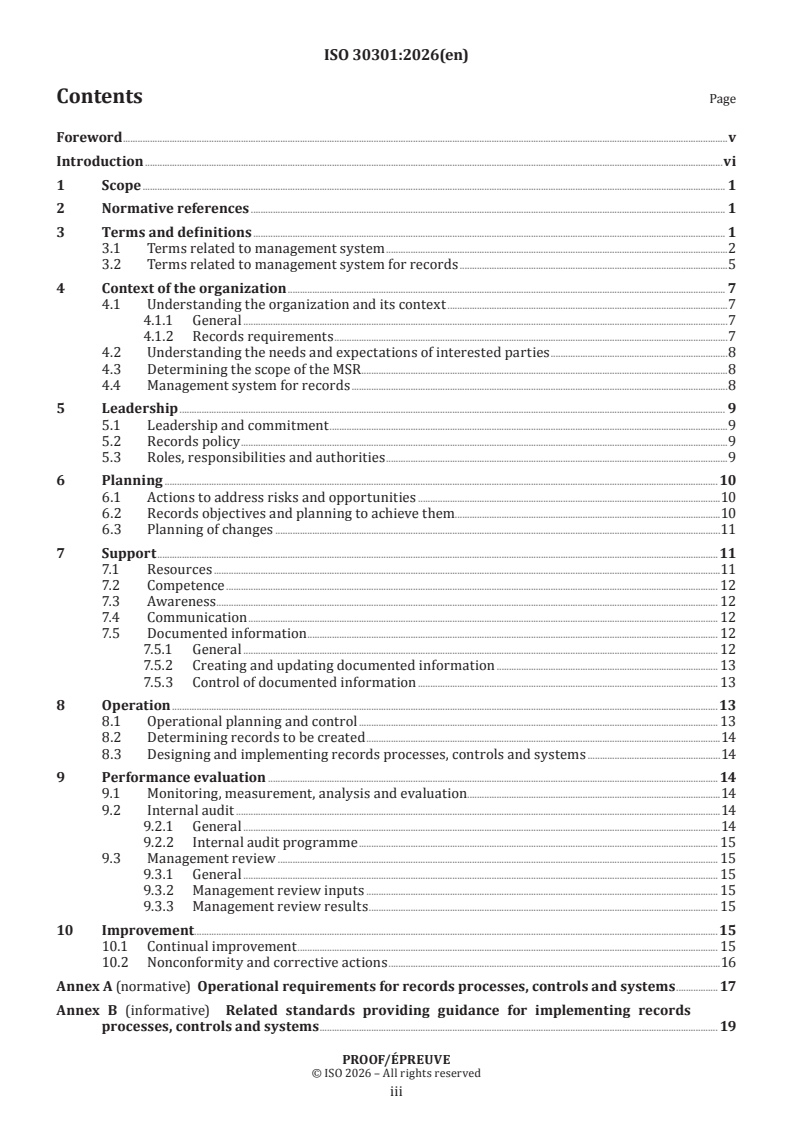

ISO/PRF 30301 - Information and documentation — Management systems for records — Requirements

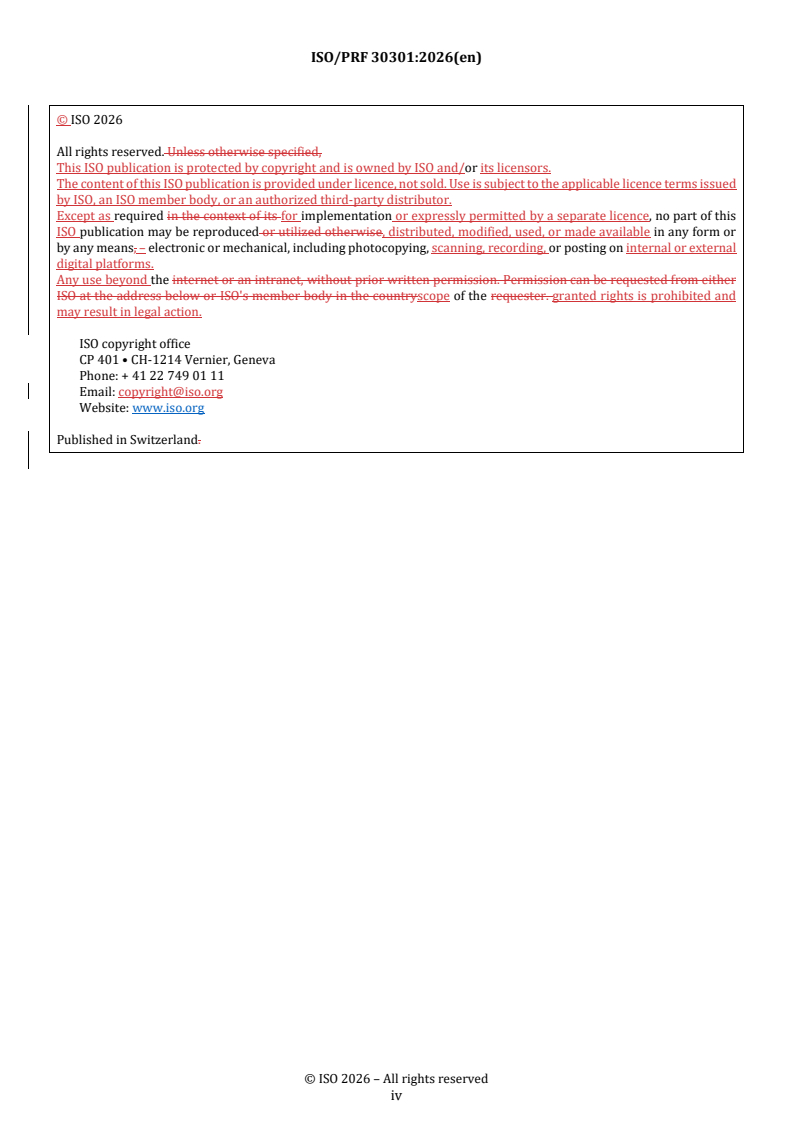
REDLINE ISO/PRF 30301 - Information and documentation — Management systems for records — Requirements
ISO 30301 is an ISO standard for information and documentation. It specifies requirements for a management system for records (MSR) so an organization can support its mandate, mission, strategy and goals. It is written for any organization, or group of organizations with shared business activities, that wants to establish, implement, maintain, improve, assess, or certify an MSR.
What does ISO 30301 specify?
ISO 30301 specifies the requirements for an MSR and how it connects records work to organizational goals, policy, objectives, performance monitoring, and continual improvement. It applies to one organization or to several organizations working with shared business activities, and it uses the term “organization” in that broad sense.
The document is organized as follows:
| Part | What it covers |
|---|---|
| Clause 1 | Scope |
| Clause 2 | Normative references |
| Clause 3 | Terms and definitions |
| Clause 4 | Context of the organization |
| Clause 5 | Leadership |
| Clause 6 | Planning |
| Clause 7 | Support |
| Clause 8 | Operation |
| Clause 9 | Performance evaluation |
| Clause 10 | Improvement |
| Annex A | Normative operational requirements for records processes, controls and systems |
| Annex B | Informative links to related standards for implementation |
For a buyer or implementer, this structure matters because the standard is not only about records policy. It also sets out how to govern the MSR, run it, measure it, and improve it.
What are the key requirements of ISO 30301?
ISO 30301 requires an organization to define why it needs records, set a policy and objectives, run records processes under control, and review performance. The requirements follow the same management system pattern used across ISO management system standards, so the MSR can fit into wider governance, risk, quality, or information management arrangements.
Context, scope, and governance
- Clause 4 requires the organization to determine external and internal issues, including whether climate change is relevant, and to identify business, legal, regulatory, and other records requirements. In practice, this means the MSR starts from the organization’s real operating context, not from a generic records template.
- Clause 4.3 requires the scope of the MSR to be defined and kept as documented information. This matters because it tells people which business processes, parts of the organization, or shared activities the MSR covers.
- Clause 4.4 requires the organization to establish, implement, maintain, and continually improve the MSR. This means the system is expected to be managed as an ongoing operating system, not a one-time project.
Leadership and planning
- Clause 5.1 requires top management to show leadership, align the records policy and objectives with strategic direction, provide resources, and promote continual improvement. In practice, records management is a leadership responsibility, not only an archive or IT task.
- Clause 5.2 requires a records policy that is appropriate to the organization, provides a framework for objectives, and includes commitments to meet applicable requirements and improve the MSR. The policy must be documented, communicated, and available to interested parties as appropriate.
- Clause 5.3 requires responsibilities and authorities to be assigned and communicated, including a senior manager for the MSR and a specific records operational representative. This helps avoid unclear ownership when records issues cross departments.
Planning, support, and operation
- Clause 6 requires the organization to address risks and opportunities, set measurable records objectives where practicable, and plan changes to the MSR in a controlled way. This is where the organization decides what success looks like and how to avoid disruptions when systems, staff, or business practices change.
- Clause 7 requires resources, competence, awareness, communication, and controlled documented information. In practice, the organization must be able to show that people are trained, information is controlled, and the MSR has the support it needs to work consistently.
- Clause 8 requires planned and controlled records processes, including deciding what records must be created, captured, and managed, and designing records processes, controls, and systems in line with the records requirements and Annex A. This is the operational core of the standard.
Performance evaluation and improvement
- Clause 9 requires monitoring, measurement, internal audit, and management review. That means the organization must check whether the MSR is working, not just assume it is.
- Clause 10 requires continual improvement and corrective action for nonconformities. In practice, the organization must fix problems, look for root causes, and update the MSR when needed.
What terms does ISO 30301 define?
ISO 30301 uses the core management system terms from ISO 30300 and adds records-specific terms.
- Organization - a person or group of people with its own functions, responsibilities, authorities, and relationships to achieve objectives.
- Interested party - a person or organization that can affect, be affected by, or perceive itself to be affected by a decision or activity.
- Management system - a set of interrelated or interacting elements used to establish policy and objectives and achieve them.
- Record - information created or received and maintained as evidence and as an asset by an organization.
- Records objective - a result to be achieved by the creation, capture, and management of records.
- Records policy - the organization’s intentions and direction in relation to records, formally expressed by top management.
- Records requirement - a requirement for evidence of a business function, activity, or transaction and for records processes, including how long records need to be kept.
- Management system for records (MSR) - a management system used to govern records.
Who uses ISO 30301?
ISO 30301 is used by top management and by the people who design, operate, and audit records-related controls. The introduction names roles such as risk management, auditing, records management, information technology, data management, and information security.
It is relevant to organizations of any type and size, and to groups of organizations with shared business activities. In practice, it supports people who need to set records policy, define responsibilities, run records processes, manage records systems, measure performance, and prepare for self-assessment, external confirmation, or certification.
What changed in ISO 30301 from the previous edition?
ISO 30301 is the third edition, and it cancels and replaces ISO 30301:2019. It also incorporates Amendment ISO 30301:2019/Amd. 1:2024.
The stated changes are:
- a new informative Annex B for linking operational requirements with other standards
- Annex A redrafted for clarity
- updates to follow the common text of the Harmonized Structure for ISO management system standards
- improvements to the understanding of requirements
Which standards are used with ISO 30301?
ISO 30301 has one normative reference:
| Standard | What it contributes |
|---|---|
| ISO 30300 | Core concepts and vocabulary for records management |
The document also points to related standards and technical reports that help with implementation:
| Standard | What it contributes |
|---|---|
| ISO 30302 | Guidelines for implementing the requirements of ISO 30301 |
| ISO 15489-1 | Foundation standard for records management operations and a principal tool for designing and improving records processes and controls |
| ISO/TR 21946 | Appraisal for managing records |
| ISO/TR 26122 | Work process analysis for records |
| ISO 18128 | Records risk assessment |
| ISO 23081-1 and ISO 23081-2 | Metadata for managing records |
| ISO 13008 | Digital records conversion and migration process |
| ISO/TS 16175-2 | Guidance for selecting, designing, implementing and maintaining software for managing records |
| ISO/TS 7538 | Functional requirements for disposition of records |
| ISO/TR 13028 | Implementation guidelines for digitization |
| ISO/TR 21965 | Records management in enterprise architecture |
| ISO 19011 | Guidelines for auditing management systems |
What does the ISO 30301 document contain?
ISO 30301 contains the full management system structure for records, from scope and terms through leadership, planning, support, operation, evaluation, and improvement. It also includes a normative Annex A with operational requirements for creating, capturing, classifying, storing, migrating, converting, retaining, disposing of, and controlling records.
Annex B maps those operational requirements to related standards that can guide implementation. The document also includes figures showing the structure of MSR in a process approach and the wider set of MSR standards, which helps users see how ISO 30301 fits into records governance, implementation, and audit work.
Relations
- Effective Date
- 15-Jun-2024
- Revises
ISO 30301:2019 - Information and documentation — Management systems for records — Requirements - Effective Date
- 15-Jun-2024
Buy Documents
ISO/PRF 30301 - Information and documentation — Management systems for records — Requirements
REDLINE ISO/PRF 30301 - Information and documentation — Management systems for records — Requirements
Frequently Asked Questions
ISO 30301 is a draft published by the International Organization for Standardization (ISO). Its full title is "Information and documentation — Management systems for records — Requirements". This standard covers: This document specifies requirements to be met by a management system for records (MSR) in order to support an organization in the achievement of its mandate, mission, strategy and goals. It addresses the development and implementation of a records policy and objectives and gives information on measuring and monitoring performance. An MSR can be established by an organization or across organizations that share business activities. Throughout this document, the term "organization" is not limited to one organization but also includes other organizational structures. This document is applicable to any organization that wishes to: — establish, implement, maintain and improve an MSR to support its business; — ensure itself of conformity with its stated records policy; — demonstrate conformity with this document by undertaking a self-assessment and self-declaration, or seeking confirmation of its self-declaration by a party external to the organization, or seeking certification of its MSR by an external party.
This document specifies requirements to be met by a management system for records (MSR) in order to support an organization in the achievement of its mandate, mission, strategy and goals. It addresses the development and implementation of a records policy and objectives and gives information on measuring and monitoring performance. An MSR can be established by an organization or across organizations that share business activities. Throughout this document, the term "organization" is not limited to one organization but also includes other organizational structures. This document is applicable to any organization that wishes to: — establish, implement, maintain and improve an MSR to support its business; — ensure itself of conformity with its stated records policy; — demonstrate conformity with this document by undertaking a self-assessment and self-declaration, or seeking confirmation of its self-declaration by a party external to the organization, or seeking certification of its MSR by an external party.
ISO 30301 is classified under the following ICS (International Classification for Standards) categories: 01.140.20 - Information sciences. The ICS classification helps identify the subject area and facilitates finding related standards.
ISO 30301 has the following relationships with other standards: It is inter standard links to ISO 30301:2019/Amd 1:2024, ISO 30301:2019. Understanding these relationships helps ensure you are using the most current and applicable version of the standard.
ISO 30301 is available in PDF format for immediate download after purchase. The document can be added to your cart and obtained through the secure checkout process. Digital delivery ensures instant access to the complete standard document.
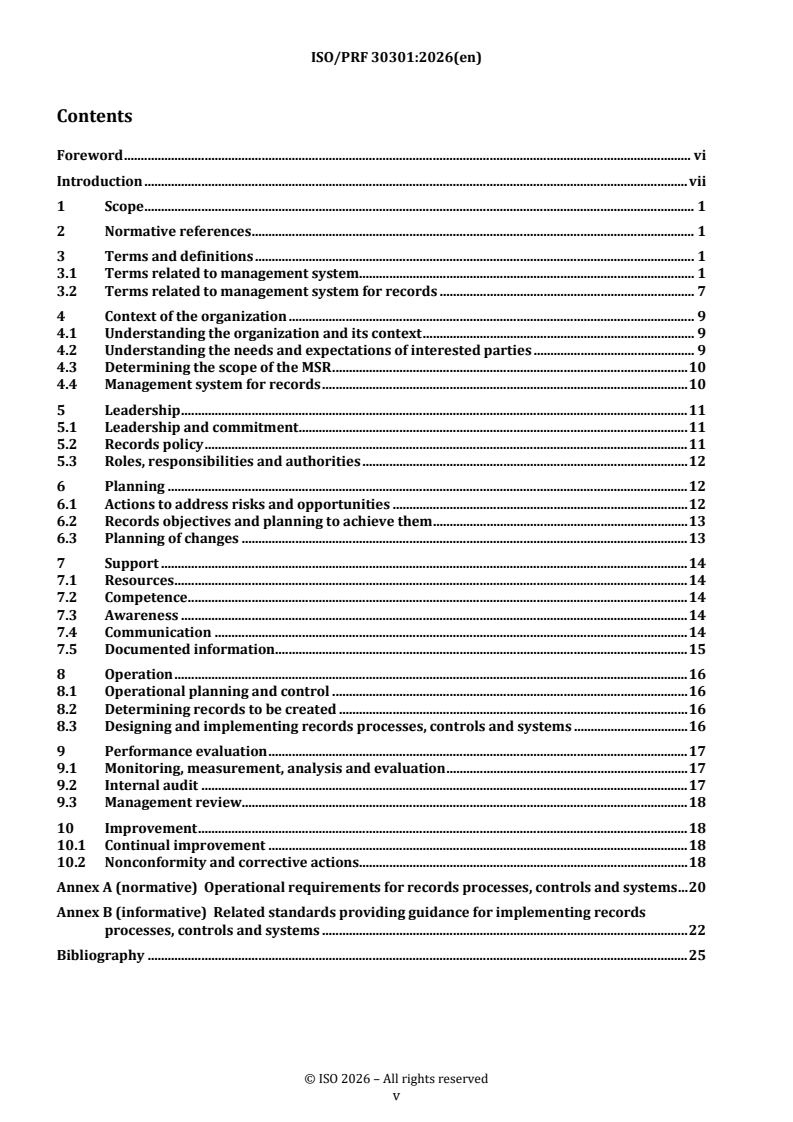
Standards Content (Sample)
Contents
- Introduction
- 0.1 General
- 0.2 Management system
- 0.4 Documents on MSR
- 0.5 Relationship and compatibility with other management system standards
- 1 Scope
- 2 Normative references
- 3 Terms and definitions
- 3.1 Terms related to management system
- 3.1.1 organization
- 3.1.2 interested party (preferred term)
- 3.1.3 top management
- 3.1.4 management system
- 3.1.5 policy
- 3.1.6 objective
- 3.1.7 risk
- 3.1.8 process
- 3.1.9 competence
- 3.1.10 documented information
- 3.1.11 performance
- 3.1.12 continual improvement
- 3.1.13 effectiveness
- 3.1.14 requirement
- 3.1.15 conformity
- 3.1.16 nonconformity
- 3.1.17 corrective action
- 3.1.18 audit
- 3.1.19 measurement
- 3.1.20 monitoring
- 3.2 Terms related to management system for records
- 3.2.1 record
- 3.2.2 evidence
- 3.2.3 asset
- 3.2.4 information
- 3.2.5 data
- 3.2.6 records objective
- 3.2.7 records policy
- 3.2.8 appraisal
- 3.2.9 records requirement
- 3.2.10 records process
- 3.2.11 records control
- 3.2.12 records system
- 3.2.13 records management
- 3.2.14 management system for records
- 3.2.15 information system
- 3.2.16 system
- 4 Context of the organization
- 4.1 Understanding the organization and its context
- 4.2 Understanding the needs and expectations of interested parties
- 4.3 Determining the scope of the MSR
- 4.4 Management system for records
- 5 Leadership
- 5.1 Leadership and commitment
- 5.2 Records policy
- 5.3 Roles, responsibilities and authorities
- 6 Planning
- 6.1 Actions to address risks and opportunities
- 6.2 Records objectives and planning to achieve them
- 6.3 Planning of changes
- 7 Support
- 7.1 Resources
- 7.2 Competence
- 7.3 Awareness
- 7.4 Communication
- 7.5 Documented information
- 8 Operation
- 8.1 Operational planning and control
- 8.2 Determining records to be created
- 8.3 Designing and implementing records processes, controls and systems
- 9 Performance evaluation
- 9.1 Monitoring, measurement, analysis and evaluation
- 9.2 Internal audit
- 9.3 Management review
- 10 Improvement
- 10.1 Continual improvement
- 10.2 Nonconformity and corrective actions
- Annex A
- Annex B
- 5.8 ISO/TR 26122:2008, 7.1.2
- 9.5.1 A.1.5. Capturing records Versions ISO 15489-1:2016, 9.3
Introduction
0.1 General
Organizational success largely depends upon implementing and maintaining a management system that is designed to continually improve performance while addressing the needs of all interested parties. Management systems offer methodologies to make decisions and manage resources in order to achieve the organization's goals.
Creation and management of records are integral to any organization's activities, processes and systems. They enable business efficiency, transparency, accountability, risk management and business continuity. They also enable organizations to capitalize on the value of their information resources and to contribute to the preservation of collective memory.
This document applies the harmonized approach as published in the ISO/IEC Directives related to the development of management system standards (MSS). The intention is to support alignment and facilitate the integration of the requirements and recommendations of one or more MSS into an organization’s management system.
For more information, please see https://www.iso.org/management-system-standards.html.
0.2 Management system
Management system standards (MSS) provide tools to implement a systematic and verifiable approach to organizational control and to support an environment that encourages good business practices. ISO 30301 [Management System for Records (MSR)] is designed to assist organizations of all types and sizes, or groups of organizations with shared business activities, to implement, operate and achieve a strategic and systematic approach to records management by implementing an MSR. The MSR enables an organization to establish a policy and objectives with regard to records, and to achieve those objectives.
This is done through the use of:
- defined roles and responsibilities;
- systematic processes;
- measurement and evaluation;
- continual review and improvement.
ISO 30301 is one of the documents on management systems for records developed by ISO/TC 46. ISO 30302 is the guidelines standard for implementing the requirements of ISO 30301. Implementation of an MSR, soundly based on the organization's requirements, will ensure that authoritative and reliable information about, and evidence of, business activities is created, managed and made accessible to those who need it for as long as required. Successful implementation of records policy and objectives results in records and records systems adequate for all of an organization's purposes. 0.3 Relationship with other standards from ISO TC 46/SC 11 The standards on MSR are developed within the MSS framework to be compatible and to share elements and methodology with other MSS. ISO 15489-1, together with other International Standards and Technical Reports, are the principal tools for designing, implementing, monitoring and improving records processes and controls, which operate under the governance of an MSR. Organizations can also use elements of an MSR when implementing another MSS (such as ISO 9001).
NOTE ISO 15489-1 is the foundation standard which codifies best practice for records management operations. PROOF/ÉPREUVE
ISO 30301:2026(en) The structure of standards on MSR and the most relevant products for implementing records processes and controls, both published or under preparation, is shown in Figure 1. Annex B shows the links of operational requirements and other ISO TC 46/SC 11 standards, specifications and technical reports. NOTE Titles of some products and technical reports are susceptible to change when they are revised. Titles in this figure represent the subject or domain, not the complete official titles of published International Standards and technical reports. An updated figure with new products is available at https://committee.iso.org/home/tc46sc11. Figure 1 — Standards on MSR and related International Standards and technical reports Other standards (ISO and non-ISO) can be useful in the implementation of MSR (see Bibliography), however ISO 30301 is the authoritative standard for MSR.
0.4 Documents on MSR
The documents on MSR developed by ISO/TC 46 are intended to be used in support of:
a) decisions by top management regarding the establishment and implementation of management systems within their organization; b) people responsible for the implementation of MSR, such as professionals in the areas of risk management, auditing, management of records, information technology, data management and information security. The process approach incorporated in a management system for records emphasizes the importance of:
- identifying an organization’s records requirements, including interested parties' needs;
- establishing policy and objectives for records;
- controls for managing an organization’s risks in relation to its records;
- measurement and evaluation of the MSR;
- continual review and improvement.
Figure 2 represents the structure of this document in process approach. PROOF/ÉPREUVE
ISO 30301:2026(en) Figure 2 — Structure of MSR in process approach
0.5 Relationship and compatibility with other management system standards
This document conforms to ISO’s requirements for management system standards. These requirements include a high-level structure, identical core text and common terms with core definitions designed to benefit users implementing multiple ISO management system standards. The term “documented information” is one of the core terms for MSS. Requirements related to documented information are given in 7.5 in all MSS. This document, apart from constituting an MSS itself, can support organizations to understand and implement the documented information requirements of other management systems. For more information, see https://committee.iso.org/home/tc46sc11. PROOF/ÉPREUVE
International Standard ISO 30301:2026(en) Information and documentation — Management systems for records — Requirements
1 Scope
This document specifies requirements to be met by a management system for records (MSR) in order to support an organization in the achievement of its mandate, mission, strategy and goals. It addresses the development and implementation of a records policy and objectives and gives information on measuring and monitoring performance.
An MSR can be established by an organization or across organizations that share business activities. Throughout this document, the term “organization” is not limited to one organization but also includes other organizational structures.
This document is applicable to any organization that wishes to:
- establish, implement, maintain and improve an MSR to support its business;
- ensure itself of conformity with its stated records policy and records requirements;
- demonstrate conformity with this document by:
- undertaking a self-assessment and self-declaration, or
- seeking confirmation of its self-declaration by a party external to the organization, or
- seeking certification of its MSR by an external party.
2 Normative references
The following documents are referred to in the text in such a way that some or all of their content constitutes requirements of this document. For dated references, only the edition cited applies. For undated references, the latest edition of the referenced document (including any amendments) applies. ISO 30300, Information and documentation — Records management — Core concepts and vocabulary
3 Terms and definitions
For the purposes of this document, the terms and definitions given in ISO 30300 and the following apply. ISO and IEC maintain terminology databases for use in standardization at the following addresses:
- ISO Online browsing platform: available at https:// www .iso .org/ obp
- IEC Electropedia: available at https:// www .electropedia .org/ PROOF/ÉPREUVE
ISO 30301:2026(en)
3.1 Terms related to management system
3.1.1 organization
person or group of people that has its own functions with responsibilities, authorities and relationships to achieve its objectives (3.1.6) Note 1 to entry: The concept of organization includes, but is not limited to, sole-trader, company, corporation, firm, enterprise, authority, partnership, charity or institution, or part or combination thereof, whether incorporated or not, public or private.
Note 2 to entry: If the organization is part of a larger entity, the term “organization” refers only to the part of the larger entity that is within the scope of the MSR (3.1.4).
Note 3 to entry: This term is part of the harmonized structure's core terms and definitions for management system stated in ISO/IEC Directives, Part 1:2024, Annex SL.
3.1.2 interested party (preferred term)
person or organization (3.1.1) that can affect, be affected by, or perceive itself to be affected by a decision or activity Note 1 to entry: This term is part of the harmonized structure's core terms and definitions for management system stated in ISO/IEC Directives, Part 1:2024, Annex SL.
3.1.3 top management
person or group of people who directs and controls an organization (3.1.1) at the highest level Note 1 to entry: Top management has the power to delegate authority and provide resources within the organization. Note 2 to entry: If the scope of the management system (3.1.4) covers only part of an organization, then top management refers to those who direct and control that part of the organization. Note 3 to entry: This term is part of the harmonized structure's core terms and definitions for management system stated in ISO/IEC Directives, Part 1:2024, Annex SL.
3.1.4 management system
set of interrelated or interacting elements of an organization (3.1.1) to establish policies (3.1.5) and objectives (3.1.6), as well as processes (3.1.8) to achieve those objectives Note 1 to entry: A management system can address a single discipline or several disciplines. Note 2 to entry: The management system elements include the organization’s structure, roles and responsibilities, planning and operation.
Note 3 to entry: This term is part of the harmonized structure's core terms and definitions for management system stated in ISO/IEC Directives, Part 1:2024, Annex SL.
3.1.5 policy
intentions and direction of an organization (3.1.1) as formally expressed by its top management (3.1.3) Note 1 to entry: This term is part of the harmonized structure's core terms and definitions for management system stated in ISO/IEC Directives, Part 1:2024, Annex SL.
3.1.6 objective
result to be achieved Note 1 to entry: An objective can be strategic, tactical, or operational. PROOF/ÉPREUVE
ISO 30301:2026(en) Note 2 to entry: Objectives can relate to different disciplines (such as finance, health and safety, and environment). They can be, for example, organization-wide or specific to a project, product, service or process (3.1.8). Note 3 to entry: An objective can be expressed in other ways, e.g. as an intended result, as a purpose, as an operational criterion, as a records objective (3.2.6) or by the use of other words with similar meaning (e.g. aim, goal, or target). Note 4 to entry: In the context of MSR (3.1.4), records objectives (3.2.6) are set by the organization (3.1.1), consistent with the records policy (3.2.7) to achieve specific results.
Note 5 to entry: This term is part of the harmonized structure's core terms and definitions for management system stated in ISO/IEC Directives, Part 1:2024, Annex SL.
3.1.7 risk
effect of uncertainty Note 1 to entry: An effect is a deviation from the expected — positive or negative. Note 2 to entry: Uncertainty is the state, even partial, of deficiency of information related to, understanding or knowledge of, an event, its consequence, or likelihood.
Note 3 to entry: Risk is often characterized by reference to potential events and consequences or a combination of these.
Note 4 to entry: Risk is often expressed in terms of a combination of the consequences of an event (including changes in circumstances) and the associated likelihood of occurrence. Note 5 to entry: This term is part of the harmonized structure's core terms and definitions for management system stated in ISO/IEC Directives, Part 1:2024, Annex SL.
3.1.8 process
set of interrelated or interacting activities that uses or transforms inputs to deliver a result Note 1 to entry: Whether the result of a process is called an output, a product or a service depends on the context of the reference.
Note 2 to entry: This term is part of the harmonized structure's core terms and definitions for management system stated in ISO/IEC Directives, Part 1:2024, Annex SL.
3.1.9 competence
ability to apply knowledge and skills to achieve intended results Note 1 to entry: This term is part of the harmonized structure's core terms and definitions for management system stated in ISO/IEC Directives, Part 1:2024, Annex SL.
3.1.10 documented information
information required to be controlled and maintained by an organization (3.1.1) and the medium on which it is contained Note 1 to entry: Documented information can be in any format and media and from any source. Note 2 to entry: Documented information can refer to:
- the management system (3.1.4), including related processes (3.1.8);
- information created in order for the organization to operate (documentation);
- evidence of results achieved (records).
Note 3 to entry: This term is part of the harmonized structure's core terms and definitions for management system stated in ISO/IEC Directives, Part 1:2024, Annex SL.
PROOF/ÉPREUVE
ISO 30301:2026(en)
3.1.11 performance
measurable result Note 1 to entry: Performance can relate either to quantitative or qualitative findings. Note 2 to entry: Performance can relate to managing activities, processes (3.1.8), products, services, systems (3.2.16) or organizations (3.1.1).
Note 3 to entry: This term is part of the harmonized structure's core terms and definitions for management system stated in ISO/IEC Directives, Part 1:2024, Annex SL.
3.1.12 continual improvement
recurring activity to enhance performance (3.1.11) Note 1 to entry: This term is part of the harmonized structure's core terms and definitions for management system stated in ISO/IEC Directives, Part 1:2024, Annex SL.
3.1.13 effectiveness
extent to which planned activities are realized and planned results are achieved Note 1 to entry: This term is part of the harmonized structure's core terms and definitions for management system stated in ISO/IEC Directives, Part 1:2024, Annex SL.
3.1.14 requirement
need or expectation that is stated, generally implied or obligatory Note 1 to entry: “Generally implied” means that it is custom or common practice for the organization (3.1.1) and interested parties (3.1.2) that the need or expectation under consideration is implied. Note 2 to entry: A specified requirement is one that is stated, e.g. in documented information (3.1.10). Note 3 to entry: This term is part of the harmonized structure's core terms and definitions for management system stated in ISO/IEC Directives, Part 1:2024, Annex SL.
3.1.15 conformity
fulfilment of a requirement (3.1.14) Note 1 to entry: This term is part of the harmonized structure's core terms and definitions for management system stated in ISO/IEC Directives, Part 1:2024, Annex SL.
3.1.16 nonconformity
non-fulfilment of a requirement (3.1.14) Note 1 to entry: This term is part of the harmonized structure's core terms and definitions for management system stated in ISO/IEC Directives, Part 1:2024, Annex SL.
3.1.17 corrective action
action to eliminate the cause(s) of a nonconformity (3.1.16) and to prevent recurrence Note 1 to entry: This term is part of the harmonized structure's core terms and definitions for management system stated in ISO/IEC Directives, Part 1:2024, Annex SL.
PROOF/ÉPREUVE
ISO 30301:2026(en)
3.1.18 audit
systematic and independent process (3.1.8) for obtaining evidence and evaluating it objectively to determine the extent to which the audit criteria are fulfilled Note 1 to entry: An audit can be an internal audit (first party) or an external audit (second party or third party), and it can be a combined audit (combining two or more disciplines).
Note 2 to entry: An internal audit is conducted by the organization (3.1.1) itself, or by an external party on its behalf. Note 3 to entry: “Audit evidence” and “audit criteria” are defined in ISO 19011. Note 4 to entry: Note 4to entry: This term is part of the harmonized structure's core terms and definitions for management system stated in ISO/IEC Directives, Part 1:2024, Annex SL.
3.1.19 measurement
process (3.1.8) to determine a value Note 1 to entry: This term is part of the harmonized structure's core terms and definitions for management system stated in ISO/IEC Directives, Part 1:2024, Annex SL.
3.1.20 monitoring
determining the status of a system, a process (3.1.8) or an activity Note 1 to entry: To determine the status, there can be a need to check, supervise or critically observe. Note 2 to entry: This term is part of the harmonized structure's core terms and definitions for management system stated in ISO/IEC Directives, Part 1:2024, Annex SL.
3.2 Terms related to management system for records
3.2.1 record
information created or received and maintained as evidence (3.2.2) and as an asset (3.2.3) by an organization (3.1.1), in pursuit of legal obligations or in the course of conducting business Note 1 to entry: Records are normally used in plural.
Note 2 to entry: In a management system standard (MSS) implementation, the records created to conduct and direct the management system and to document its implementation are called documented information. [SOURCE: ISO 30300:2020, 3.2.10]
3.2.2 evidence
information (3.2.4) that can be used either by itself or in conjunction with other information (3.2.4), to establish proof about an event or action Note 1 to entry: Evidence can be shown to be inviolate and complete. It is not limited to the legal sense of the term. [SOURCE: ISO 30300:2020, 3.2.6]
3.2.3 asset
item, thing or entity that has potential or actual value EXAMPLE Examples of assets include information, software, computers, services, people, competences, skills, experience, reputation and image.
Note 1 to entry: Through time, the asset can have a different value to the organization. [SOURCE: ISO 30300:2020, 3.2.1] PROOF/ÉPREUVE
ISO 30301:2026(en)
...
Contents
- Introduction
- 1 Scope
- 2 Normative references
- 3 Terms and definitions
- 3.1 Terms related to management system
- 3.1.1 3.1.1
- 3.1.2 3.1.2
- 3.1.3 3.1.3
- 3.1.4 3.1.4
- 3.1.6 3.1.6
- 3.1.7 3.1.7
- 3.1.8 process
- 3.1.10 documented information
- 3.1.8 process
- 3.1.9 competence
- 3.1.12 continual improvement
- 3.1.10 documented information
- 3.1.11 performance
- 3.1.16 nonconformity
- 3.1.14 requirement
- 3.1.15 conformity
- 3.1.16 nonconformity
- 3.1.17 corrective action
- 3.1.18 audit
- 3.1.19 measurement
- 3.1.20 monitoring
- 3.2 Terms related to management system for records
- 4 Context of the organization
- 4.1 Understanding the organization and its context
- 4.2 Understanding the needs and expectations of interested parties
- 4.3 Determining the scope of the MSR
- 4.4 Management system for records
- 5 Leadership
- 5.1 Leadership and commitment
- 5.2 Records policy
- 5.3 Roles, responsibilities and authorities
- 6 Planning
- 6.1 Actions to address risks and opportunities
- 6.2 Records objectives and planning to achieve them
- 6.3 Planning of changes
- 7 Support
- 7.1 Resources
- 7.2 Competence
- 7.3 Awareness
- 7.4 Communication
- 7.5 Documented information
- 8 Operation
- 8.1 Operational planning and control
- 8.2 Determining records to be created
- 8.3 Designing and implementing records processes, controls and systems
- 9 Performance evaluation
- 9.1 Monitoring, measurement, analysis and evaluation
- 9.2 Internal audit
- 9.3 Management review
- 10 Improvement
- 10.1 Continual improvement
- 10.2 Nonconformity and corrective actions
- Annex A
- Annex B
- 5.8 ISO/TR 26122:2008, 7.1.2
- 6.4.3 ISO/TR 13028:2010, 6.5.3
- 6.4.4.2 A.2 Records controls
- 10.3 A.3.2. Technologies Selection of technologies ISO/TR 21946:2018, 5.6
- Bibliography
Introduction
0.1 0.1 General Organizational success largely depends upon implementing and maintaining a management system that is designed to continually improve performance while addressing the needs of all interested parties. Management systems offer methodologies to make decisions and manage resources in order to achieve the organization's goals.
Creation and management of records are integral to any organization's activities, processes and systems. They enable business efficiency, transparency, accountability, risk management and business continuity. They also enable organizations to capitalize on the value of their information resources and to contribute to the preservation of collective memory.
This document applies the harmonized approach as published in the ISO/IEC Directives related to the development of management system standards (MSS). The intention is to support alignment and facilitate the integration of the requirements and recommendations of one or more MSS into an organization’s management system.
For more information, please see https://www.iso.org/management-system-standards.html. 0.2 0.2 Management system Management system standards (MSS) provide tools to implement a systematic and verifiable approach to organizational control and to support an environment that encourages good business practices. ISO 30301 [Management System for Records (MSR)] is designed to assist organizations of all types and sizes, or groups of organizations with shared business activities, to implement, operate and achieve a strategic and systematic approach to records management by implementing an MSR. The MSR enables an organization to establish a policy and objectives with regard to records, and to achieve those objectives.
This is done through the use of:
- — defined roles and responsibilities;
- — systematic processes;
- — measurement and evaluation;
- — continual review and improvement.
ISO 30301 is one of the documents on management systems for records developed by ISO/TC 46. ISO 30302 is the guidelines standard for implementing the requirements of ISO 30301. Implementation of an MSR, soundly based on the organization's requirements, will ensure that authoritative and reliable information about, and evidence of, business activities is created, managed and made accessible to those who need it for as long as required. Successful implementation of records policy and objectives results in records and records systems adequate for all of an organization's purposes. 0.3 0.3 Relationship with other standards from ISO TC 46/SC11 The standards on MSR are developed within the MSS framework to be compatible and to share elements and methodology with other MSS. ISO 15489-1, together with other International Standards and Technical
ISO/PRF 30301:2026(en) Reports, are the principal tools for designing, implementing, monitoring and improving records processes and controls, which operate under the governance of an MSR. Organizations can also use elements of an MSR when implementing another MSS (such as ISO 9001).
NOTE ISO 15489-1 is the foundation standard which codifies best practice for records management operations. The structure of standards on MSR and the most relevant products for implementing records processes and controls, both published or under preparation, is shown in Figure 1Figure 1. Annex B. Annex B shows the links of operational requirements and other ISO TC 46/SC 11 standards, specifications and technical reports.
ISO/PRF 30301:2026(en)
NOTE Titles of some products and technical reports are susceptible to change when they are revised. Titles in this figure represent the subject or domain, not the complete official titles of published International Standards and technical reports. An updated figure with new products is available at https://committee.iso.org/home/tc46sc11. Figure 1 — Standards on MSR and related International Standards and technical reports Other standards (ISO and non-ISO) can be useful in the implementation of MSR (see Bibliography), however ISO 30301 is the authoritative standard for MSR.
0.4 0.4 Documents on MSR The documents on MSR developed by ISO/TC 46 are intended to be used in support of:
a) a) decisions by top management regarding the establishment and implementation of management systems within their organization; b) b) people responsible for the implementation of MSR, such as professionals in the areas of risk management, auditing, management of records, information technology, data management and information security.
The process approach incorporated in a management system for records emphasizes the importance of:
- — identifying an organization’s records requirements, including interested parties' needs;
- establishing policy and objectives for records;
- — controls for managing an organization’s risks in relation to its records;
- — measurement and evaluation of the MSR;
- — continual review and improvement.
ISO/PRF 30301:2026(en) Figure 2Figure 2 represents the structure of this document in process approach.
ISO/PRF 30301:2026(en)
Figure 2 — Structure of MSR in process approach 0.5 0.5 Relationship and compatibility with other management system standards This document conforms to ISO’s requirements for management system standards. These requirements include a high-level structure, identical core text and common terms with core definitions designed to benefit users implementing multiple ISO management system standards.
The term “documented information” is one of the core terms for MSS. Requirements related to documented information are given in 7.57.5 in all MSS. This document, apart from constituting an MSS itself, can support organizations to understand and implement the documented information requirements of other management systems. For more information, see https://committee.iso.org/home/tc46sc11.
ISO/PRF 30301:2026(en) Information and documentation — Management systems for records - Requirements
1 Scope
This document specifies requirements to be met by a management system for records (MSR) in order to support an organization in the achievement of its mandate, mission, strategy and goals. It addresses the development and implementation of a records policy and objectives and gives information on measuring and monitoring performance.
An MSR can be established by an organization or across organizations that share business activities. Throughout this document, the term “organization” is not limited to one organization but also includes other organizational structures.
This document is applicable to any organization that wishes to:
- — establish, implement, maintain and improve an MSR to support its business;
- — ensure itself of conformity with its stated records policy and records requirements;
- — demonstrate conformity with this document by:
- — undertaking a self-assessment and self-declaration, or
- — seeking confirmation of its self-declaration by a party external to the organization, or
- — seeking certification of its MSR by an external party.
2 Normative references
The following documents are referred to in the text in such a way that some or all of their content constitutes requirements of this document. For dated references, only the edition cited applies. For undated references, the latest edition of the referenced document (including any amendments) applies. ISO 30300, Information and documentation — Records management — Core concepts and vocabulary
3 Terms and definitions
For the purposes of this document, the terms and definitions given in ISO 30300 and the following apply. ISO and IEC maintain terminology databases for use in standardization at the following addresses:
- — ISO Online browsing platform: available at https://www.iso.org/obp
- — IEC Electropedia: available at https://www.electropedia.org/
3.1 Terms related to management system
3.1.1 3.1.1
organization person or group of people that has its own functions with responsibilities, authorities and relationships to achieve its objectives (3.1.6(3.1.6) )
ISO/PRF 30301:2026(en) Note 1 to entry: The concept of organization includes, but is not limited to, sole-trader, company, corporation, firm, enterprise, authority, partnership, charity or institution, or part or combination thereof, whether incorporated or not, public or private.
Note 2 to entry: If the organization is part of a larger entity, the term “organization” refers only to the part of the larger entity that is within the scope of the MSR (3.1.4(3.1.4). ).
Note 3 to entry: This term is part of the harmonized structure's core terms and definitions for management system stated in ISO/IEC Directives, Part 1:2024, Annex SL.
3.1.2 3.1.2
interested party (preferred term) person or organization (3.1.1(3.1.1)) that can affect, be affected by, or perceive itself to be affected by a decision or activity Note 1 to entry: This term is part of the harmonized structure's core terms and definitions for management system stated in ISO/IEC Directives, Part 1:2024, Annex SL.
3.1.3 3.1.3
top management person or group of people who directs and controls an organization (3.1.1(3.1.1)) at the highest level Note 1 to entry: Top management has the power to delegate authority and provide resources within the organization. Note 2 to entry: If the scope of the management system (3.1.4(3.1.4)) covers only part of an organization, then top management refers to those who direct and control that part of the organization. Note 3 to entry: This term is part of the harmonized structure's core terms and definitions for management system stated in ISO/IEC Directives, Part 1:2024, Annex SL.
3.1.4 3.1.4
management system set of interrelated or interacting elements of an organization (3.1.1(3.1.1)) to establish policies (3.1.5(3.1.5)) and objectives (3.1.6(3.1.6),), as well as processes (3.1.8(3.1.8)) to achieve those objectives Note 1 to entry: A management system can address a single discipline or several disciplines. Note 2 to entry: The management system elements include the organization’s structure, roles and responsibilities, planning and operation.
Note 3 to entry: This term is part of the harmonized structure's core terms and definitions for management system stated in ISO/IEC Directives, Part 1:2024, Annex SL.
3.1.5 3.1.5 policy intentions and direction of an organization (3.1.1(3.1.1)) as formally expressed by its top management (3.1.3(3.1.3) ) Note 1 to entry: This term is part of the harmonized structure's core terms and definitions for management system stated in ISO/IEC Directives, Part 1:2024, Annex SL.
3.1.6 3.1.6
objective result to be achieved
ISO/PRF 30301:2026(en) Note 1 to entry: An objective can be strategic, tactical, or operational. Note 2 to entry: Objectives can relate to different disciplines (such as finance, health and safety, and environment). They can be, for example, organization-wide or specific to a project, product, service or process (3.1.8(3.1.8). ). Note 3 to entry: An objective can be expressed in other ways, e.g. as an intended result, as a purpose, as an operational criterion, as a records objective (3.2.6(3.2.6)) or by the use of other words with similar meaning (e.g. aim, goal, or target). Note 4 to entry: In the context of MSR (3.1.4(3.1.4),), records objectives (3.2.6(3.2.6)) are set by the organization (3.1.1(3.1.1),), consistent with the records policy (3.2.7(3.2.5)) to achieve specific results. Note 5 to entry: This term is part of the harmonized structure's core terms and definitions for management system stated in ISO/IEC Directives, Part 1:2024, Annex SL.
3.1.7 3.1.7
risk effect of uncertainty Note 1 to entry: An effect is a deviation from the expected — positive or negative. Note 2 to entry: Uncertainty is the state, even partial, of deficiency of information related to, understanding or knowledge of, an event, its consequence, or likelihood.
Note 3 to entry: Risk is often characterized by reference to potential events and consequences or a combination of these. Note 4 to entry: Risk is often expressed in terms of a combination of the consequences of an event (including changes in circumstances) and the associated likelihood of occurrence.
Note 5 to entry: This term is part of the harmonized structure's core terms and definitions for management system stated in ISO/IEC Directives, Part 1:2024, Annex SL.
3.1.8 process
Note 5 to entry: set of interrelated or interacting activities that uses or transforms inputs to deliver a result Note 1 to entry: Whether the result of a process is called an output, a product or a service depends on the context of the reference.
Note 2 to entry: This term is part of the harmonized structure's core terms and definitions for management system stated in ISO/IEC Directives, Part 1:2024, Annex SL.
3.1.81.1.1 3.1.9 competenceability to apply knowledge and skills to achieve intended results Note 1 to entry: This term is part of the harmonized structure's core terms and definitions for management system stated in ISO/IEC Directives, Part 1:2024, Annex SL.
3.1.10 documented information
information required to be controlled and maintained by an organization (3.1.1) and the medium on which it is contained Note 1 to entry: Documented information can be in any format and media and from any source. Note 2 to entry: Documented information can refer to:
ISO/PRF 30301:2026(en) - the management system (3.1.4), including related processes (3.1.8); - information created in order for the organization to operate (documentation);evidence of results achieved (records). Note 3 to entry: This term is part of the harmonized structure's core terms and definitions for management system stated in ISO/IEC Directives, Part 1:2024, Annex SL.
3.1.8 process
set of interrelated or interacting activities that uses or transforms inputs to deliver a result3.1.11 Note 1 to entry: Whether the result of a process is called an output, a product or a service depends on the context of the reference.
3.1.91.1.1 Note 2 to entry:
performancemeasurable result Note 1 to entry: Performance can relate either to quantitative or qualitative findings. Note 2 to entry: Performance can relate to managing activities, processes (3.1.8), products, services, systems (3.2.12) or organizations (3.1.1).
Note 3 to entry: This term is part of the harmonized structure's core terms and definitions for management system stated in ISO/IEC Directives, Part 1:2024, Annex SL.
3.1.9 competence
ability to apply knowledge and skills to achieve intended results
3.1.12 continual improvement
recurring activity to enhance performance (3.1.11) Note 1 to entry: This term is part of the harmonized structure's core terms and definitions for management system stated in ISO/IEC Directives, Part 1:2024, Annex SL.
3.1.10 documented information
information required to be controlled and maintained by an organization (3.1.13.1.13 ) and the medium on which it is contained effectivenessextent to which planned activities are realized and planned results are achievedNote 1 to entry: Documented information can be in any format and media and from any source. Note 2 to entry: Documented information can refer to:
- the management system (3.1.4), including related processes (3.1.8);
- information created in order for the organization to operate (documentation);
- evidence of results achieved (records).
Note 3 to entry: This term is part of the harmonized structure's core terms and definitions for management system stated in ISO/IEC Directives, Part 1:2024, Annex SL.
ISO/PRF 30301:2026(en)
3.1.11 performance
measurable result Note 1 to entry: Performance can relate either to quantitative or qualitative findings. Note 2 to entry: Performance can relate to managing activities, processes (3.1.8), products, services, systems (3.2.16) or organizations (3.1.13.1.14).
3.1.101.1.1 requirementneed or expectation that is stated, generally implied or obligatory Note 1 to entry: “Generally implied” means that it is custom or common practice for the organization (3.1.1) and interested parties (3.1.2) that the need or expectation under consideration is implied. Note 2 to entry: A specified requirement is one that is stated, e.g. in documented information (3.1.10). Note 2 3 to entry: This term is part of the harmonized structure's core terms and definitions for management system stated in ISO/IEC Directives, Part 1:2024, Annex SL.
3.1.113.1.12 continual improvement recurring activity to enhance performance (3.1.113.1.15
conformity fulfilment of a requirement (3.1.14) Note 1 to entry: This term is part of the harmonized structure's core terms and definitions for management system stated in ISO/IEC Directives, Part 1:2024, Annex SL.
3.1.123.1.13 effectiveness extent to which planned activities are realized and planned results are achieved
3.1.16 nonconformity
non-fulfilment of a requirement (3.1.14) Note 1 to entry: This term is part of the harmonized structure's core terms and definitions for management system stated in ISO/IEC Directives, Part 1:2024, Annex SL.
3.1.14 requirement
need or expectation that is stated, generally implied or obligatory3. Note 1 to entry: “Generally implied” means that it is custom or common practice for the organization (3.1.1) and interested parties (3.1.2) that the need or expectation under consideration is implied. Note 2 to entry: A specified requirement is one that is stated, e.g. in documented information (3.1.10). Note 3 to entry: This term is part of the harmonized structure's core terms and definitions for management system stated in ISO/IEC Directives, Part 1:2024, Annex SL.
3.1.15 conformity
fulfilment of a requirement (3.1.14)
ISO/PRF 30301:2026(en) Note 1 to entry: This term is part of the harmonized structure's core terms and definitions for management system stated in ISO/IEC Directives, Part 1:2024, Annex SL.
3.1.16 nonconformity
non-fulfilment of a requirement (3.1.14.17
Note 1 to entry: This term is part of the harmonized structure's core terms and definitions for management system stated in ISO/IEC Directives, Part 1:2024, Annex SL.
3.1.17 corrective action
action to eliminate the cause(s) of a nonconformity (3.1.16(3.1.16)) and to prevent recurrence Note 1 to entry: This term is part of the harmonized structure's core terms and definitions for management system stated in ISO/IEC Directives, Part 1:2024, Annex SL.
3.1.133.1.18
3.1.18 audit
systematic and independent process (3.1.8(3.1.8)) for obtaining evidence and evaluating it objectively to determine the extent to which the audit criteria are fulfilled Note 1 to entry: An audit can be an internal audit (first party) or an external audit (second party or third party), and it can be a combined audit (combining two or more disciplines).
Note 2 to entry: An internal audit is conducted by the organization (3.1.1(3.1.1)) itself, or by an external party on its behalf.
Note 3 to entry: “Audit evidence” and “audit criteria” are defined in ISO 19011. Note 4 to entry: Note 4to entry: This term is part of the harmonized structure's core terms and definitions for management system stated in ISO/IEC Directives, Part 1:2024, Annex SL. 3.1.143.1.19
3.1.19 measurement
process (3.1.8(3.1.8)) to determine a value Note 1 to entry: This term is part of the harmonized structure's core terms and definitions for management system stated in ISO/IEC Directives, Part 1:2024, Annex SL.
3.1.153.1.20
...