

ISO/TR 23081-4:2026
(Main)Information and documentation — Metadata for records — Part 4: Report on metadata element sets
- Abstract
This document provides an overview of the metadata element sets, developed in different countries and by different organizations according to the ISO 23081 series of standards.
- Status
- Published
- Publication Date
- 23-Jun-2026
- Technical Committee
- ISO/TC 46/SC 11 - Archives/records management
- Drafting Committee
- ISO/TC 46/SC 11/WG 1 - Metadata
- Current Stage
- 6060 - International Standard published
- Start Date
- 24-Jun-2026
- Due Date
- 10-Jun-2027
- Completion Date
- 24-Jun-2026
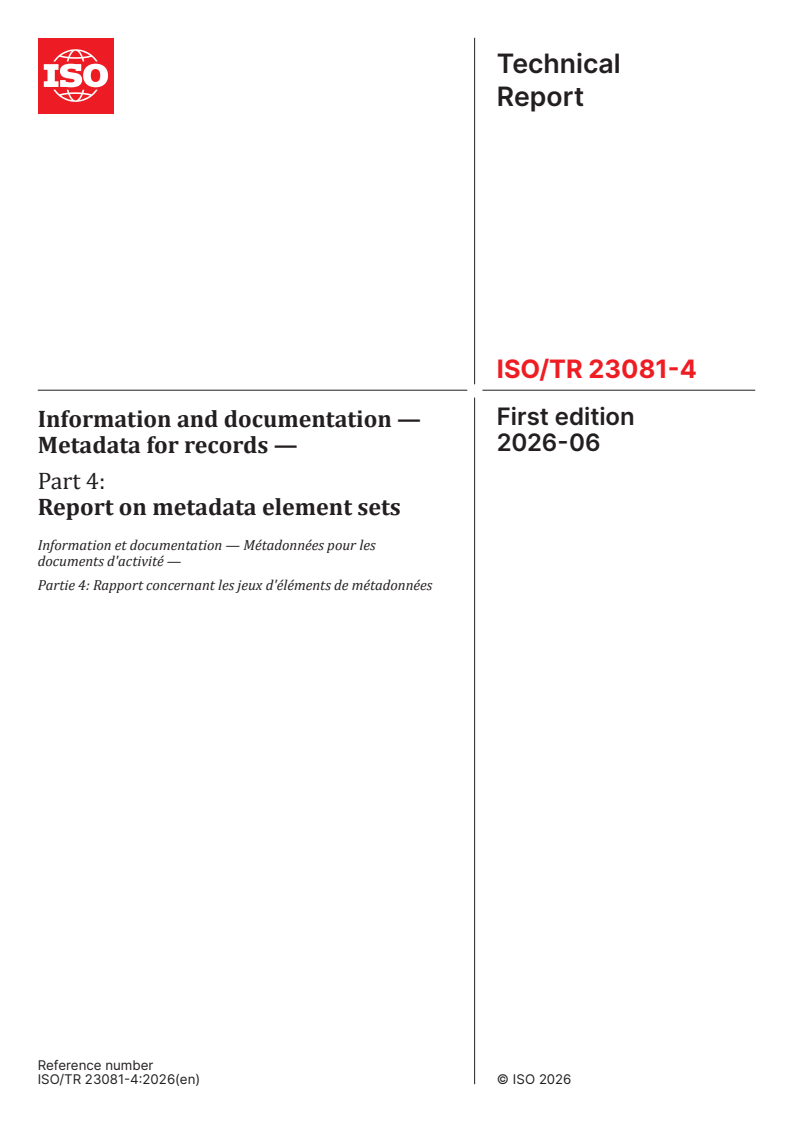
ISO/TR 23081-4:2026 is an ISO Technical Report prepared by ISO/TC 46/SC 11, Archives/records management. It gives an overview of metadata element sets used for records, and compares sets developed by different countries and organizations within the ISO 23081 series. It is aimed at people who design, assess, or harmonize metadata for records systems.
What does ISO/TR 23081-4:2026 specify?
ISO/TR 23081-4:2026 specifies the scope, context, methodology, and findings of a report on commonly used records metadata element sets. It is organized as a short report: scope, normative references, terms and definitions, context, steps and methodology, and a bibliography.
| Clause | What it covers |
|---|---|
| 1 | Scope |
| 2 | Normative references |
| 3 | Terms and definitions |
| 4 | Context |
| 5 | Steps and methodology |
| 5.1 | Collection of metadata element sets |
| 5.2 | Methodology |
| 5.3 | Conclusions |
| Bibliography | Background references and examples of metadata sets |
Clause 4 explains that the report was prepared to bring together metadata elements commonly used in records systems under the ISO 23081 framework. In practice, that makes the document a comparison aid for organizations that want to develop or review records metadata schemas.
What are the key points of ISO/TR 23081-4:2026?
ISO/TR 23081-4:2026 is a comparative report, not a prescriptive schema. Its main value is that it shows which metadata elements recur across many records systems and how those elements are grouped in the ISO 23081 framework.
- Clause 4 states the purpose: to inform countries and organizations that want to develop records metadata schemas about similar element sets used around the world. This helps readers compare their own schema with common practice.
- Clause 5.1 reports that experts collected 25 metadata element sets since 2015 from international bodies, national organizations, business systems, and records-management environments. This means the conclusions are based on a broad mix of real-world sets.
- Clause 5.2 explains the method: the collected metadata were mapped to ISO 23081 categories, and recurrence was analysed to find the most common elements. In practice, this is a structured way to identify baseline metadata.
- Clause 5.3.1 shows the most frequently used elements across all 25 sets, including identifier, title, language, creator, description, date and time, format, security and access, subject, and location. These are the elements a designer is most likely to see treated as core records metadata.
- Clause 5.3.1 also shows the most often cited mandatory metadata, which include event history, type, relation, and disposition as well as the elements above. That helps schema authors decide which fields may need to be required.
- Clause 5.3.2 focuses on records in business systems and shows a smaller pattern centered on identifier, date and time, event history, creator, title, description, and relation. The report also warns that this subset is limited, so it should be used carefully.
- Clause 5.3.3 compares 21 EDRMS and records-management sets and shows strong repetition of core metadata such as identifier, title, creator, language, format, description, security and access, subject, location, and date and time. This is useful when aligning an EDRMS metadata model with records-management practice.
What terms does ISO/TR 23081-4:2026 define?
ISO/TR 23081-4:2026 gives working definitions for records metadata terms used throughout the report.
- Identifier - data, string, or pointer that establishes the identity of an item, organization, or person.
- Creator - any entity that created, accumulated, and/or maintained records in the course of activity.
- Relation - a direct relationship between records, or between levels of aggregation.
- Preservation - measures taken to maintain usability, authenticity, reliability, and integrity of records over time.
- Digital signature - a cryptographic signature used to verify the signer’s identity and the integrity of the data.
- Dissemination limiting marker (DLM) - a label that denotes the sensitivity of a record, mandate, or business.
- Document form - the structure of a record that reflects its transactional purpose.
Who uses ISO/TR 23081-4:2026?
ISO/TR 23081-4:2026 is used by records managers, archivists, metadata architects, EDRMS implementers, public-sector information teams, and organizations designing business-system metadata. It is especially useful for people comparing national metadata schemes, building a new schema, or checking whether a records system uses the common elements seen across ISO 23081-based practice.
Which standards are used with ISO/TR 23081-4:2026?
Clause 2 cites ISO 30300 as the normative reference. It supplies the core concepts and vocabulary for records management used in the report.
The bibliography also points to related standards and sources that support the report’s terminology and comparisons:
- ISO 23081-1:2017 - the framework for metadata for records.
- ISO 15489-1 - records management concepts and principles.
- ISO 15836-1:2017 - Dublin Core core elements.
- ISO 17523:2025 - source for the digital signature definition.
- ISO 5127:2017 - foundation vocabulary used for several term definitions.
What does the ISO/TR 23081-4:2026 document contain?
ISO/TR 23081-4:2026 contains a collection and analysis of metadata element sets, a description of the mapping method used against ISO 23081 categories, and frequency tables showing how often specific elements appear. It includes a statistics table for usage of metadata elements, separate ranked results for all 25 sets and for business systems, and figures that visualize mandatory versus optional mentions.
The document also gives a focused comparison of metadata used in EDRMS and in business systems, which helps readers understand where practice is stable and where it varies. For a buyer or implementer, the useful output is the list of recurring metadata elements and the way the report groups them by records-system context.
Frequently Asked Questions
ISO/TR 23081-4:2026 is a technical report published by the International Organization for Standardization (ISO). Its full title is "Information and documentation — Metadata for records — Part 4: Report on metadata element sets". This standard covers: This document provides an overview of the metadata element sets, developed in different countries and by different organizations according to the ISO 23081 series of standards.
This document provides an overview of the metadata element sets, developed in different countries and by different organizations according to the ISO 23081 series of standards.
ISO/TR 23081-4:2026 is classified under the following ICS (International Classification for Standards) categories: 01.140.20 - Information sciences. The ICS classification helps identify the subject area and facilitates finding related standards.
ISO/TR 23081-4:2026 is available in PDF format for immediate download after purchase. The document can be added to your cart and obtained through the secure checkout process. Digital delivery ensures instant access to the complete standard document.
Standards Content (Sample)
Technical
Report
ISO/TR 23081-4
First edition
Information and documentation —
2026-06
Metadata for records —
Part 4:
Report on metadata element sets
Information et documentation — Métadonnées pour les
documents d'activité —
Partie 4: Rapport concernant les jeux d'éléments de métadonnées
Reference number
© ISO 2026
All rights reserved. Unless otherwise specified, or required in the context of its implementation, no part of this publication may
be reproduced or utilized otherwise in any form or by any means, electronic or mechanical, including photocopying, or posting on
the internet or an intranet, without prior written permission. Permission can be requested from either ISO at the address below
or ISO’s member body in the country of the requester.
ISO copyright office
CP 401 • Ch. de Blandonnet 8
CH-1214 Vernier, Geneva
Phone: +41 22 749 01 11
Email: copyright@iso.org
Website: www.iso.org
Published in Switzerland
ii
Contents Page
Foreword .iv
1 Scope . 1
2 Normative references . 1
3 Terms and definitions . 1
4 Context . 4
5 Steps and methodology . 4
5.1 Collection of metadata element sets.4
5.2 Methodology .5
5.3 Conclusions .6
Bibliography .12
iii
Foreword
ISO (the International Organization for Standardization) is a worldwide federation of national standards
bodies (ISO member bodies). The work of preparing International Standards is normally carried out through
ISO technical committees. Each member body interested in a subject for which a technical committee
has been established has the right to be represented on that committee. International organizations,
governmental and non-governmental, in liaison with ISO, also take part in the work. ISO collaborates closely
with the International Electrotechnical Commission (IEC) on all matters of electrotechnical standardization.
The procedures used to develop this document and those intended for its further maintenance are described
in the ISO/IEC Directives, Part 1. In particular, the different approval criteria needed for the different types
of ISO documents should be noted. This document was drafted in accordance with the editorial rules of the
ISO/IEC Directives, Part 2 (see www.iso.org/directives).
ISO draws attention to the possibility that the implementation of this document may involve the use of (a)
patent(s). ISO takes no position concerning the evidence, validity or applicability of any claimed patent
rights in respect thereof. As of the date of publication of this document, ISO had not received notice of (a)
patent(s) which may be required to implement this document. However, implementers are cautioned that
this may not represent the latest information, which may be obtained from the patent database available at
www.iso.org/patents. ISO shall not be held responsible for identifying any or all such patent rights.
Any trade name used in this document is information given for the convenience of users and does not
constitute an endorsement.
For an explanation of the voluntary nature of standards, the meaning of ISO specific terms and expressions
related to conformity assessment, as well as information about ISO's adherence to the World Trade
Organization (WTO) principles in the Technical Barriers to Trade (TBT), see www.iso.org/iso/foreword.html.
This document was prepared by Technical Committee ISO/TC 46, Information and documentation,
Subcommittee SC 11, Archives/records management.
A list of all parts in the ISO 23081 series can be found on the ISO website.
Any feedback or questions on this document should be directed to the user’s national standards body. A
complete listing of these bodies can be found at www.iso.org/members.html.
iv
Technical Report ISO/TR 23081-4:2026(en)
Information and documentation — Metadata for records —
Part 4:
Report on metadata element sets
1 Scope
This document provides an overview of the metadata element sets, developed in different countries and by
different organizations according to the ISO 23081 series of standards.
2 Normative references
The following documents are referred to in the text in such a way that some or all of their content constitutes
requirements of this document. For dated references, only the edition cited applies. For undated references,
the latest edition of the referenced document (including any amendments) applies.
ISO 30300, Information and documentation — Records management — Core concepts and vocabulary
3 Terms and definitions
For the purposes of this document, the terms and definitions given in ISO 30300 and the following apply.
ISO and IEC maintain terminology databases for use in standardization at the following addresses:
— ISO Online browsing platform: available at https:// www .iso .org/ obp
— IEC Electropedia: available at https:// www .electropedia .org/
3.1
identifier
data, string or pointer that establishes the identity of an item, organization or person, alone or in combination
with other elements
3.2
title
name given to a record, folder or class
3.3
subject
word or phrase indicating a topic associated with a registry object Typically, subject will be expressed as
keywords, key phrases or classification codes from a controlled vocabulary or formal classification scheme.
3.4
description
creation of a representation of an object and its component parts
3.5
creator
any entity (corporate body, family or person) that created, accumulated and/or maintained records
in the conduct of personal or corporate activity
[SOURCE: ISO 5127:2017, 3.7.1.06]
3.6
type
recognized form a record takes, which governs its internal structure and relates to its transactional purpose
or to the action or activity it documents
3.7
relation
identifies instances in which a record has a direct relationship with another record, either through content
or a direct business process, or clarifies how a record at one level of aggregation relates to records at other
levels
3.8
function
group of activities aimed at achieving one or more goals of an organization
[SOURCE: ISO 30300:2020, 3.1.12]
3.9
aggregation
any accumulation of record entities at a level above record object
[SOURCE: ISO 23081-1:2017, 3.2]
3.10
location
place where a record or resource is stored or held
3.11
security and access
security classification restrictions and permissions governing access to records
3.12
disposition
range of records processes associated with implementing records retention, destruction or transfer
decisions which are documented in disposition authorities or other instruments
[SOURCE: ISO 30300:2020, 3.4.8]
3.13
preservation
measures taken to maintain the usability, authenticity, reliability and integrity of records over time
Note 1 to entry: Measures include principles, policies, rules, strategies, processes and operations.
[SOURCE: ISO 30300:2020, 3.4.11]
3.14
accessibility
usability of a product, service, environment or facility by people with the widest range of capabilities
[SOURCE: ISO 5127:2017, 3.11.1.02]
3.15
publisher
entity responsible for making the resource available
Note 1 to entry: Examples of a Publisher include a person, an organization, or a service.
Note 2 to entry: Publisher http:// purl .org/ dc/ elements/ 1 .1/ publisher.
[SOURCE: ISO 15836-1:2017, 3.3.5]
3.16
source
external resource from which the present resource is derived
3.17
digital signature
signature based upon cryptographic methods of originator authentication, computed by using a set of rules
and a set of parameters such that the identity of the signer and the integrity of the data can be verified
Note 1 to entry: Digital signatures employ a type of asymmetric cryptography. For messages sent through an insecure
channel, a properly implemented digital signature gives the receiver reason to believe the message was sent by the
claimed sender.
[SOURCE: ISO 17523:2025, 3.4]
3.18
coverage
extent or scope of the content of the resource
3.19
mandate
legal, regulatory or business rules governing the organization
Note 1 to entry: In the records management field, mandates affect the records processes.
[SOURCE: ISO 30300:2020, 2.1.14]
3.20
medium
physical ‘carrier’ on which a digital record is stored.
Note 1 to entry: For physical records, the material of the record.
3.21
integrity check
method for determining whether the bits that make up a digital record have been changed in the course of
transmission or storage
Note 1 to en
...