

ISO 25188:2026
(Main)Glass fibre — Determination of density
- Abstract
This document specifies two methods for the determination of the density of glass fibre: Method A: Gas pycnometer method; Method B: Liquid pycnometer method.
- Status
- Published
- Publication Date
- 12-Nov-2026
- Technical Committee
- ISO/TC 61/SC 13 - Composites and reinforcement fibres
- Drafting Committee
- ISO/TC 61/SC 13/WG 1 - Reinforcements and reinforcement products
- Current Stage
- 6060 - International Standard published
- Start Date
- 13-Nov-2026
- Completion Date
- 13-Nov-2026
ISO 25188 is an ISO standard for measuring the density of glass fibre. It specifies two pycnometer-based methods for glass fibre tested as a yarn: a gas pycnometer method and a liquid pycnometer method. The document is written for laboratories, manufacturers, and users who need a practical way to determine density for material characterization and composite work.
What does ISO 25188 specify?
ISO 25188 specifies how to determine the density of glass fibre using Method A, the gas pycnometer method, or Method B, the liquid pycnometer method. The scope applies to glass fibre tested as a yarn, and the methods are also described for powder, chopped fibre, yarn, and roving.
The document is organized into six clauses: Scope, Normative references, Terms and definitions, Conditioning and test conditions, Test methods, and Test report. Clause 5 contains the two measurement routes, while Clause 6 states what the report has to record so results can be traced and compared.
What are the key requirements of ISO 25188?
ISO 25188 focuses on consistent specimen preparation, controlled temperature and humidity, and a defined calculation route for each method. In practice, that means the laboratory must control conditioning, choose the right sample preparation for the fibre form, and record the method details needed to make the result usable.
Conditioning and test atmosphere
Clause 4 requires test specimens to be conditioned in the standard test atmosphere from ISO 291, and the apparatus and specimens are then kept at the same conditions during testing. The preferred conditions are 23 C and 50 % relative humidity, which matters because density measurements are sensitive to temperature and moisture.
Method A - gas pycnometer method
Clause 5.1 bases Method A on Boyle's law and uses a gas pycnometer to determine specimen volume from pressure changes. Helium is preferred because it penetrates small pores more effectively, but nitrogen is also allowed if it is non-corrosive and non-adsorbing.
ISO 25188 requires the gas pycnometer to comply with ISO 12154:2014 and to be calibrated as specified there. The sample chamber is weighed before and after filling, the chamber is checked for leaks, the air is replaced by measurement gas or removed with a vacuum pump, and pressure readings are taken for the calculation. The result is the mean of five density values once their standard deviation is below 0.000 5 g/cm3, so the operator has a repeatability check built into the method.
Method B - liquid pycnometer method
Clause 5.2 uses Archimedes' law and a liquid pycnometer filled with distilled water. This method is built around the displaced-water volume of the fibre, so the preparation steps are important for removing size and air.
The document calls for size removal, grinding the specimen to a short fibre length, washing with water and ethanol, drying, and cooling in a desiccator before weighing. The pycnometer is then filled with debubbled distilled water and held at 23 C for at least 1 hour before the final weighing steps. The calculation uses the density of distilled water at the measured temperature, so temperature control is part of the measurement, not just a background condition.
Test report
Clause 6 requires the report to identify the fibre sample, state whether Method A or B was used, note whether the fibre was size-free and, if it was desized, give the calcination temperature. It also records the gas used or the density of distilled water, the number of specimens, the mean density, any extra operations or incidents, and the test date.
What terms does ISO 25188 define?
ISO 25188 defines density as mass per unit volume at a specified temperature. That definition matters because the result is only meaningful when the temperature is stated.
The document also uses these working terms:
- Desized - size has been removed from the fibre, typically by calcination as referenced in ISO 1887.
- Size-free - fibre that has had its size removed.
- Gas pycnometer - an instrument that determines specimen volume from the pressure change of a confined gas.
- Liquid pycnometer - a pycnometer used with distilled water to determine volume by liquid displacement.
- Standard test atmosphere - the conditioning atmosphere taken from ISO 291.
- Reference chamber - the known calibrated volume used with the sample chamber in Method A.
- Sample chamber - the chamber that holds the fibre specimen during the gas pycnometer measurement.
Who uses ISO 25188?
ISO 25188 is used by glass fibre manufacturers, composite material laboratories, and quality control teams that need density data for glass fibre products. It also supports users who calculate mechanical properties, fibre volume content, and composite structural design parameters. Buyers and suppliers can use it to agree on a common test method when density data forms part of material acceptance or comparison.
Which standards are used with ISO 25188?
ISO 25188 cites several companion standards that support the test methods:
- ISO 291 - provides the standard atmosphere for conditioning and testing.
- ISO 1887 - provides the calcination method used to remove size.
- ISO 3696 - specifies the distilled water used in Method B.
- ISO 12154:2014 - gives the gas pycnometer basis and calibration method used in Method A.
What does the ISO 25188 document contain?
ISO 25188 contains two complete measurement procedures, each with its own principle, apparatus list, specimen preparation, calculation route, and reporting items. It includes a gas-pycnometer formula based on chamber masses and pressures, and a liquid-pycnometer formula based on pycnometer masses and the density of water.
The document also gives practical operating details such as leak checking, conditioning, gas purity, temperature control, removal of air bubbles, and the repeatability rule for Method A. For Method B, it provides the sequence for cleaning, drying, filling, equilibrating, and weighing the pycnometer.
Get Certified
Connect with accredited certification bodies for this standard

Control Union Certifications
Global certification for agriculture and sustainability.

Hohenstein Institut
Textile testing and certification.

Bureau Veritas Bangladesh
Bureau Veritas certification services in Bangladesh.
Sponsored listings
Frequently Asked Questions
ISO 25188:2026 is a standard published by the International Organization for Standardization (ISO). Its full title is "Glass fibre — Determination of density". This standard covers: This document specifies two methods for the determination of the density of glass fibre: Method A: Gas pycnometer method; Method B: Liquid pycnometer method.
This document specifies two methods for the determination of the density of glass fibre: Method A: Gas pycnometer method; Method B: Liquid pycnometer method.
ISO 25188:2026 is classified under the following ICS (International Classification for Standards) categories: 59.100.10 - Textile glass materials. The ICS classification helps identify the subject area and facilitates finding related standards.
ISO 25188:2026 is available in PDF format for immediate download after purchase. The document can be added to your cart and obtained through the secure checkout process. Digital delivery ensures instant access to the complete standard document.
Standards Content (Sample)
International
Standard
ISO 25188
First edition
Glass fibre — Determination of
2026-11
density
Fibre de verre — Détermination de la masse volumique
Reference number
© ISO 2026
All rights reserved.
This ISO publication is protected by copyright and is owned by ISO and/or its licensors.
The content of this ISO publication is provided under licence, not sold. Use is subject to the applicable licence terms issued by ISO,
an ISO member body, or an authorized third-party distributor.
Except as required for implementation or expressly permitted by a separate licence, no part of this ISO publication may be
reproduced, distributed, modified, used, or made available in any form or by any means – electronic or mechanical, including
photocopying, scanning, recording, or posting on internal or external digital platforms.
Any use beyond the scope of the granted rights is prohibited and may result in legal action.
ISO copyright office
CP 401 • CH-1214 Vernier, Geneva
Phone: +41 22 749 01 11
Email: copyright@iso.org
Website: www.iso.org
Published in Switzerland
ii
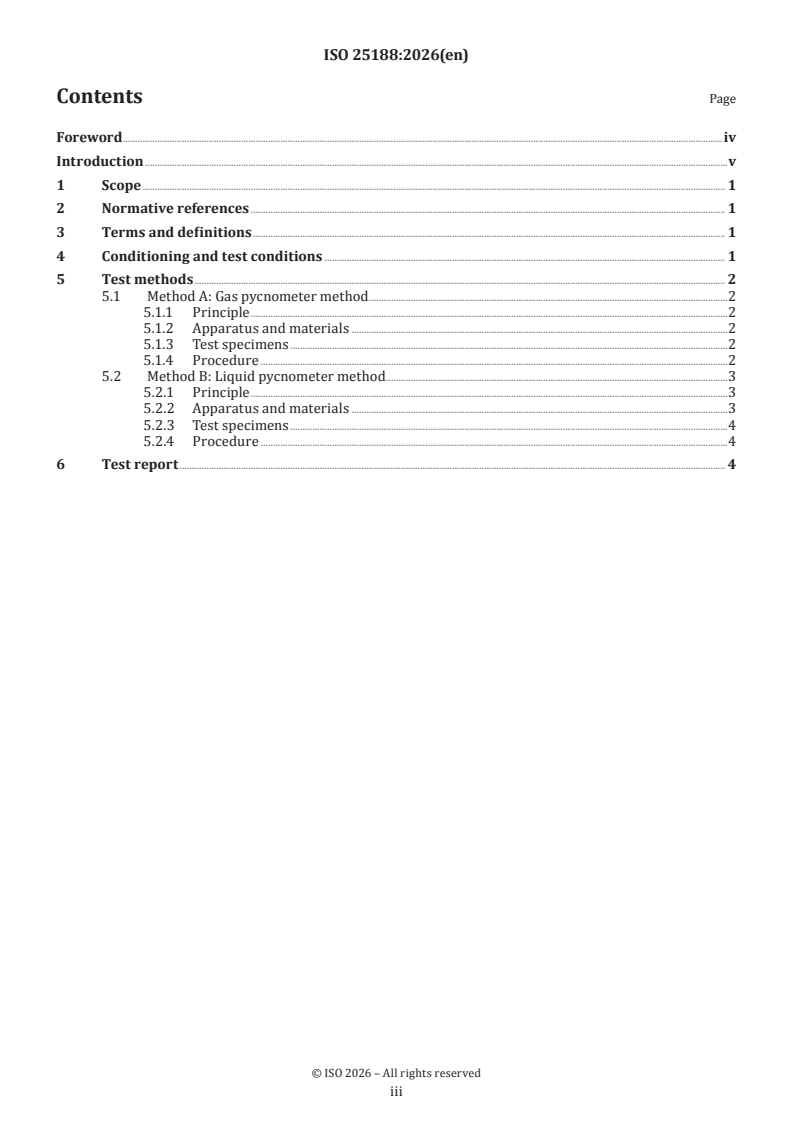
Contents Page
Foreword .iv
Introduction .v
1 Scope . 1
2 Normative references . 1
3 Terms and definitions . 1
4 Conditioning and test conditions . 1
5 Test methods . 2
5.1 Method A: Gas pycnometer method .2
5.1.1 Principle .2
5.1.2 Apparatus and materials .2
5.1.3 Test specimens .2
5.1.4 Procedure .2
5.2 Method B: Liquid pycnometer method .3
5.2.1 Principle .3
5.2.2 Apparatus and materials .3
5.2.3 Test specimens .4
5.2.4 Procedure .4
6 Test report . 4
iii
Foreword
ISO (the International Organization for Standardization) is a worldwide federation of national standards
bodies (ISO member bodies). The work of preparing International Standards is normally carried out through
ISO technical committees. Each member body interested in a subject for which a technical committee
has been established has the right to be represented on that committee. International organizations,
governmental and non-governmental, in liaison with ISO, also take part in the work. ISO collaborates closely
with the International Electrotechnical Commission (IEC) on all matters of electrotechnical standardization.
The procedures used to develop this document and those intended for its further maintenance are described
in the ISO/IEC Directives, Part 1. In particular, the different approval criteria needed for the different types
of ISO document should be noted. This document was drafted in accordance with the editorial rules of the
ISO/IEC Directives, Part 2 (see www.iso.org/directives).
ISO draws attention to the possibility that the implementation of this document may involve the use of (a)
patent(s). ISO takes no position concerning the evidence, validity or applicability of any claimed patent
rights in respect thereof. As of the date of publication of this document, ISO had not received notice of (a)
patent(s) which may be required to implement this document. However, implementers are cautioned that
this may not represent the latest information, which may be obtained from the patent database available at
www.iso.org/patents. ISO shall not be held responsible for identifying any or all such patent rights.
Any trade name used in this document is information given for the convenience of users and does not
constitute an endorsement.
For an explanation of the voluntary nature of standards, the meaning of ISO specific terms and expressions
related to conformity assessment, as well as information about ISO's adherence to the World Trade
Organization (WTO) principles in the Technical Barriers to Trade (TBT), see www.iso.org/iso/foreword.html.
This document was prepared by Technical Committee ISO/TC 61, Plastics, Subcommittee SC 13, Composites
and reinforcement fibres.
Any feedback or questions on this document should be directed to the user’s national standards body. A
complete listing of these bodies can be found at www.iso.org/members.html.
iv
Introduction
The density of glass fibres is an important parameter for determining the physical properties of glass fibres
and for calculating the mechanical properties of glass fibre composites. Determination of the density of glass
fibres affects the characterization of the strength and modulus of glass fibres and composites, the testing
and calculation of the volume content of fibres in composites, and the structural design of composites.
Glass fibre manufacturers can measure the density of glass before it is made into fibre. In addition, glass
fibre users can measure the density of glass fibre according to ISO 12154. However, since ISO 12154 gives a
general method for measuring the skeleton density of a solid material samples and is not optimized for glass
fibre including pre-treatment, a density measurement standard for glass fibre should be established.
The two test methods given in this document are applicable to the glass fibre powder, chopped fibre, yarn
and roving.
v
International Standard ISO 25188:2026(en)
Glass fibre — Determination of density
1 Scope
This document specifies two methods for the determination of the density of glass fibre:
— Method A: Gas pycnometer method;
— Method B: Liquid pycnometer method.
2 Normative references
The following documents are referred to in the text in such a way that some or all of their content constitutes
requirements of this document. For dated references, only the edition cited applies. For undated references,
the latest edition of the referenced document (including any amendments) applies.
ISO 291, Plastics — Standard atmospheres for conditioning and testing
ISO 1887, Textile glass — Determination of combustible-matter content
ISO 3696, Water f
...