

ISO/FDIS 17889-3
(Main)Ceramic tiling systems — Sustainability for ceramic tiles and installation materials — Part 3: Requirements for the application and verification of ISO 17889-1 and 17889-2
- Abstract
This document is intended for parties involved in the application, assessment, and verification of the requirements specified in ISO 17889-1 and ISO 17889-2. These activities may be performed by first‑, second‑, or third‑party entities, including manufacturers, verification and validation bodies, and certification bodies, where certification is the selected conformity assessment pathway. This document includes relevant documentation needed for verification. Each describes and links to the requirements in ISO 17889-1 and ISO 17889-2, whether mandatory or voluntary (see Annex A for additional information).
- Status
- Not Published
- Technical Committee
- ISO/TC 189 - Ceramic tile
- Drafting Committee
- ISO/TC 189 - Ceramic tile
- Current Stage
- 5020 - FDIS ballot initiated: 2 months. Proof sent to secretariat
- Start Date
- 26-Aug-2026
- Completion Date
- 26-Aug-2026
Buy Documents


ISO/FDIS 17889-3 - Ceramic tiling systems — Sustainability for ceramic tiles and installation materials — Part 3: Requirements for the application and verification of ISO 17889-1 and 17889-2
REDLINE ISO/FDIS 17889-3 - Ceramic tiling systems — Sustainability for ceramic tiles and installation materials — Part 3: Requirements for the application and verification of ISO 17889-1 and 17889-2
ISO/FDIS 17889-3 is an ISO draft International Standard for ceramic tiling systems sustainability. It specifies the requirements and recommended practices for applying and verifying ISO 17889-1 and ISO 17889-2, including the documentation used in verification and validation. It is written for first-, second- and third-party entities such as manufacturers, verification and validation bodies, and certification bodies when certification is the chosen conformity assessment route.
What does ISO/FDIS 17889-3 specify?
ISO/FDIS 17889-3 sets out how to apply, assess and verify the sustainability requirements defined in ISO 17889-1 and ISO 17889-2 for ceramic tiles and installation materials. It focuses on the process around the sustainability statement: the criteria to use, the evidence to gather, how to form an opinion, and how to document the work.
The document is organized into these main parts:
- Clause 4 - principles for impartiality, evidence-based work, fair presentation and documentation
- Clause 5 - requirements for verification/validation engagements
- Clause 6 - verification planning, execution and completion
- Clause 7 - validation planning, execution and completion
- Clause 8 - independent review and opinion content
- Clause 9 - facts discovered after the verification/validation opinion
- Annex A - informative application of ISO 17889-1 and ISO 17889-2
Annex A is the practical bridge between the two sustainability specifications and the evidence used to check them. It links clause topics to the kinds of records, declarations, reports and other documents a verifier or validator may need.
What are the key requirements of ISO/FDIS 17889-3?
Principles and engagement setup
Clause 4 requires impartiality, an evidence-based approach, fair presentation and thorough documentation. In practice, the verifier or validator must stay objective, rely on suitable evidence, report findings honestly, and keep a record that supports the conclusion.
Clause 5.1 requires the parties to agree the type of engagement, its objectives, its scope, the criteria and the materiality threshold. For verification, they also agree the level of assurance before the work starts. This matters because it defines what product, site, period and sustainability statement are being checked, and how deep the evidence review must go.
Clause 5.1.5 requires the criteria to be relevant, complete, reliable and understandable, and available to the intended user. For a buyer, customer or other user, that means the statement is being judged against criteria that are visible and usable, not internal assumptions.
Competence, evidence and communication
Clause 5.2 requires a team with the necessary skills and competences. Clause 5.3 lists the evidence-gathering techniques: observation, inquiry, confirmation, recalculation, examination, retracing, tracing, sampling and cross-checking. In practice, the reviewer is expected to use more than one method so the conclusion is not based on a single data source.
Clause 5.4 requires prompt communication of clarification requests, material misstatements and nonconformities to the responsible party, and sometimes to the client. If there is not enough information to support the statement, the verifier or validator must ask for more; if sufficient information still cannot be obtained, no opinion is issued. The same clause also requires records of the engagement terms, plans, evidence, communications and conclusions.
Verification planning and site work
Clause 6 starts with strategic analysis and risk assessment. The verifier considers sector information, the nature of operations, the boundaries and time period of the statement, data sources, controls, previous verifications and the risk of misstatement. This means the verification plan is tailored to the product and reporting system instead of using a generic checklist.
Clause 6 also requires the verifier to design evidence-gathering activities that match the risks, including checking data trails and the data aggregation process. Site or facility visits are planned when appropriate, and are required in defined circumstances such as an initial verification, a major scope change, ownership change, or significant data-management changes. During visits, the verifier checks operations, controls, infrastructure, equipment traceability, process flows and quality controls.
Clause 6.3 requires the verifier to assess whether the evidence is sufficient and appropriate, evaluate material misstatements and nonconformities, and then issue a conclusion and report. The report must identify the responsible party, the criteria, the scope, the procedures used and the verifier’s opinion.
Validation planning and disclosure
Clause 7 follows the same structure for validation, but it focuses on the reasonableness of assumptions, limitations and methods that support a statement about future activities. The validator also evaluates whether the statement is properly disclosed and whether the disclosure is accurate, complete, fair and free from unintended bias.
This matters when a sustainability claim is forward-looking or depends on planned performance. The validator must judge not only the evidence, but also whether the intended user can rely on how the future statement is presented.
Opinions, review and later facts
Clause 8 allows an unmodified, modified or adverse opinion, or a disclaimer of opinion if sufficient appropriate evidence cannot be obtained. The opinion must identify the activity, the statement, the responsible party, the criteria and the conclusion, and state the date.
Clause 9 requires action if new facts are found after the opinion date and those facts could materially affect the conclusion. The verifier or validator must communicate the issue as soon as practicable to the responsible party and may also alert other interested parties.
What terms does ISO/FDIS 17889-3 define?
- Organization - a person or group with its own functions, responsibilities, authorities and relationships to achieve objectives.
- Responsible party - the person or people responsible for providing the statement.
- Intended user - the person or organization identified as relying on the sustainability information to make decisions.
- Statement - the factual and objective declaration that is being verified or validated.
- Verification - the process of evaluating a statement of historical data and information to decide whether it is materially correct and conforms to criteria.
- Validation - the process of evaluating whether the assumptions, limitations and methods supporting a statement about future activities are reasonable.
- Level of assurance - the degree of confidence in the statement.
- Nonconformity - a failure to meet a requirement.
Who uses ISO/FDIS 17889-3?
ISO/FDIS 17889-3 is used by manufacturers, verification and validation bodies, and certification bodies involved in sustainability claims for ceramic tiles and installation materials. It is also relevant to first-party, second-party and third-party assessments, depending on who is checking the statement.
In practice, it supports:
- manufacturers preparing evidence for sustainability ratings or claims
- verification and validation teams planning site work, sampling and report drafting
- certification bodies when certification is the chosen pathway
- quality, sustainability and compliance teams assembling documents and records
- buyers, design professionals and contractors who need a verified basis for product selection
Which standards are used with ISO/FDIS 17889-3?
ISO/FDIS 17889-3 refers to these companion parts as the criteria it helps apply and verify:
- ISO 17889-1 - the sustainability specification for ceramic tiles
- ISO 17889-2 - the sustainability specification for tile installation materials
Annex A uses these two parts as the structure for mapping documentary evidence to the relevant sustainability requirements.
What does the ISO/FDIS 17889-3 document contain?
The document gives a process framework for sustainability verification and validation, from pre-engagement checks through to the final opinion. Clauses 4 to 9 cover principles, engagement setup, planning, evidence gathering, conclusions, report content and follow-up after the opinion date.
Annex A is the main practical annex. It maps ISO 17889-1 and ISO 17889-2 clause topics to supporting evidence for raw materials, manufacture, distribution and installation, use, end of life, environmental labelling, product quality and performance, dust suction and filtration, information given to users, and labour agreements.
The annex tables point to the kinds of documents that can support each topic, such as declarations, registers, reports, certifications, websites and product declarations. That makes the standard useful both for preparing a sustainability file and for checking whether a claimed rating can be verified.
Buy Documents
ISO/FDIS 17889-3 - Ceramic tiling systems — Sustainability for ceramic tiles and installation materials — Part 3: Requirements for the application and verification of ISO 17889-1 and 17889-2
REDLINE ISO/FDIS 17889-3 - Ceramic tiling systems — Sustainability for ceramic tiles and installation materials — Part 3: Requirements for the application and verification of ISO 17889-1 and 17889-2
Get Certified
Connect with accredited certification bodies for this standard

DIBt (Deutsches Institut für Bautechnik)
German Institute for Building Technology.
DIN CERTCO
DIN Group product certification.

Aboma Certification B.V.
Specialized in construction, metal, and transport sectors.
Sponsored listings
Frequently Asked Questions
ISO/FDIS 17889-3 is a draft published by the International Organization for Standardization (ISO). Its full title is "Ceramic tiling systems — Sustainability for ceramic tiles and installation materials — Part 3: Requirements for the application and verification of ISO 17889-1 and 17889-2". This standard covers: This document is intended for parties involved in the application, assessment, and verification of the requirements specified in ISO 17889-1 and ISO 17889-2. These activities may be performed by first‑, second‑, or third‑party entities, including manufacturers, verification and validation bodies, and certification bodies, where certification is the selected conformity assessment pathway. This document includes relevant documentation needed for verification. Each describes and links to the requirements in ISO 17889-1 and ISO 17889-2, whether mandatory or voluntary (see Annex A for additional information).
This document is intended for parties involved in the application, assessment, and verification of the requirements specified in ISO 17889-1 and ISO 17889-2. These activities may be performed by first‑, second‑, or third‑party entities, including manufacturers, verification and validation bodies, and certification bodies, where certification is the selected conformity assessment pathway. This document includes relevant documentation needed for verification. Each describes and links to the requirements in ISO 17889-1 and ISO 17889-2, whether mandatory or voluntary (see Annex A for additional information).
ISO/FDIS 17889-3 is classified under the following ICS (International Classification for Standards) categories: 91.100.23 - Ceramic tiles. The ICS classification helps identify the subject area and facilitates finding related standards.
ISO/FDIS 17889-3 is available in PDF format for immediate download after purchase. The document can be added to your cart and obtained through the secure checkout process. Digital delivery ensures instant access to the complete standard document.
Standards Content (Sample)
FINAL DRAFT
International
Standard
ISO/TC 189
Ceramic tiling systems —
Secretariat: ANSI
Sustainability for ceramic tiles and
Voting begins on:
installation materials —
2026-08-26
Part 3:
Voting terminates on:
2026-10-21
Requirements for the application
and verification of ISO 17889-1 and
17889-2
RECIPIENTS OF THIS DRAFT ARE INVITED TO SUBMIT,
WITH THEIR COMMENTS, NOTIFICATION OF ANY
RELEVANT PATENT RIGHTS OF WHICH THEY ARE AWARE
AND TO PROVIDE SUPPOR TING DOCUMENTATION.
IN ADDITION TO THEIR EVALUATION AS
BEING ACCEPTABLE FOR INDUSTRIAL, TECHNO-
LOGICAL, COMMERCIAL AND USER PURPOSES, DRAFT
INTERNATIONAL STANDARDS MAY ON OCCASION HAVE
TO BE CONSIDERED IN THE LIGHT OF THEIR POTENTIAL
TO BECOME STAN DARDS TO WHICH REFERENCE MAY BE
MADE IN NATIONAL REGULATIONS.
Reference number
FINAL DRAFT
International
Standard
ISO/TC 189
Ceramic tiling systems —
Secretariat: ANSI
Sustainability for ceramic tiles and
Voting begins on:
installation materials —
Part 3:
Voting terminates on:
Requirements for the application
and verification of ISO 17889-1 and
17889-2
RECIPIENTS OF THIS DRAFT ARE INVITED TO SUBMIT,
WITH THEIR COMMENTS, NOTIFICATION OF ANY
RELEVANT PATENT RIGHTS OF WHICH THEY ARE AWARE
AND TO PROVIDE SUPPOR TING DOCUMENTATION.
© ISO 2026
IN ADDITION TO THEIR EVALUATION AS
All rights reserved. Unless otherwise specified, or required in the context of its implementation, no part of this publication may
BEING ACCEPTABLE FOR INDUSTRIAL, TECHNO-
LOGICAL, COMMERCIAL AND USER PURPOSES, DRAFT
be reproduced or utilized otherwise in any form or by any means, electronic or mechanical, including photocopying, or posting on
INTERNATIONAL STANDARDS MAY ON OCCASION HAVE
the internet or an intranet, without prior written permission. Permission can be requested from either ISO at the address below
TO BE CONSIDERED IN THE LIGHT OF THEIR POTENTIAL
or ISO’s member body in the country of the requester.
TO BECOME STAN DARDS TO WHICH REFERENCE MAY BE
MADE IN NATIONAL REGULATIONS.
ISO copyright office
CP 401 • Ch. de Blandonnet 8
CH-1214 Vernier, Geneva
Phone: +41 22 749 01 11
Email: copyright@iso.org
Website: www.iso.org
Published in Switzerland Reference number
ii
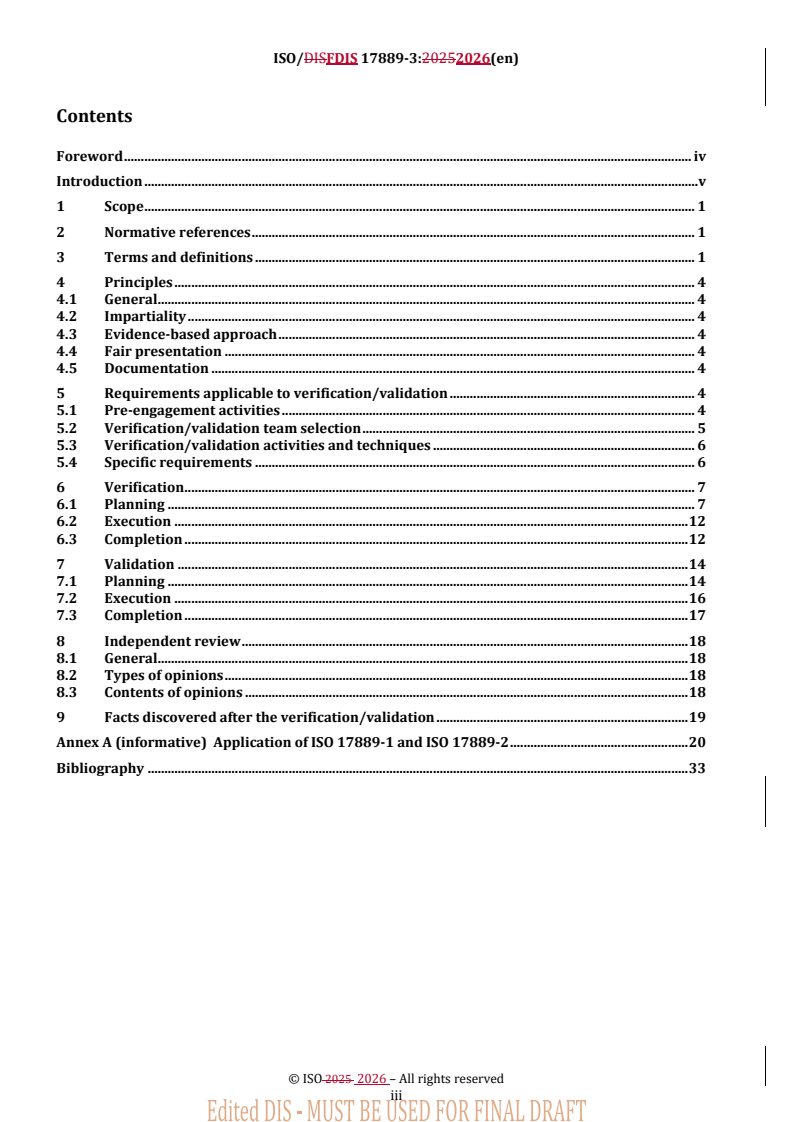
Contents Page
Foreword .v
Introduction .vi
1 Scope . 1
2 Normative references . 1
3 Terms and definitions . 1
4 Principles . 3
4.1 General .3
4.2 Impartiality .3
4.3 Evidence-based approach .3
4.4 Fair presentation .3
4.5 Documentation .4
5 Requirements applicable to verification/validation . 4
5.1 Pre-engagement activities .4
5.1.1 General .4
5.1.2 Type of engagement .4
5.1.3 Level of assurance in the case of verification .4
5.1.4 Objectives .4
5.1.5 Criteria .4
5.1.6 Scope .4
5.1.7 Materiality thresholds .5
5.2 Verification/validation team selection .5
5.3 Verification/validation activities and techniques .5
5.4 Specific requirements .5
5.4.1 Verifier/validator communication . .5
5.4.2 Sufficiency of evidence .6
5.4.3 Intentional misstatement .6
5.4.4 Documented information .6
6 Verification . 6
6.1 Planning .6
6.1.1 Strategic analysis .6
6.1.2 Risk assessment .7
6.1.3 Evidence-gathering activities .8
6.1.4 Site visits .9
6.1.5 Verification plan . . .10
6.1.6 Evidence-gathering plan .10
6.1.7 Approval of verification and evidence-gathering plans .10
6.2 Execution .11
6.3 Completion .11
6.3.1 Evaluation of the statement.11
6.3.2 Conclusion and draft opinion .11
6.3.3 Verification report . 12
7 Validation . .12
7.1 Planning . 12
7.1.1 Strategic analysis . 12
7.1.2 Materiality thresholds . 13
7.1.3 Validation plan . 13
7.1.4 Evidence-gathering plan . 13
7.1.5 Approval of validation and evidence-gathering plans .14
7.1.6 Amendments to validation and evidence-gathering plans .14
7.2 Execution .14
7.2.1 General .14
7.2.2 Evaluation of the statement.14
iii
7.2.3 Proper disclosure . .14
7.3 Completion .14
7.3.1 General .14
7.3.2 Opinion . 15
8 Independent review . .15
8.1 General . 15
8.2 Types of opinions . 15
8.3 Contents of opinions .16
9 Facts discovered after the verification/validation .16
Annex A (informative) Application of ISO 17889-1 and ISO 17889-2 . 17
Bibliography .26
iv
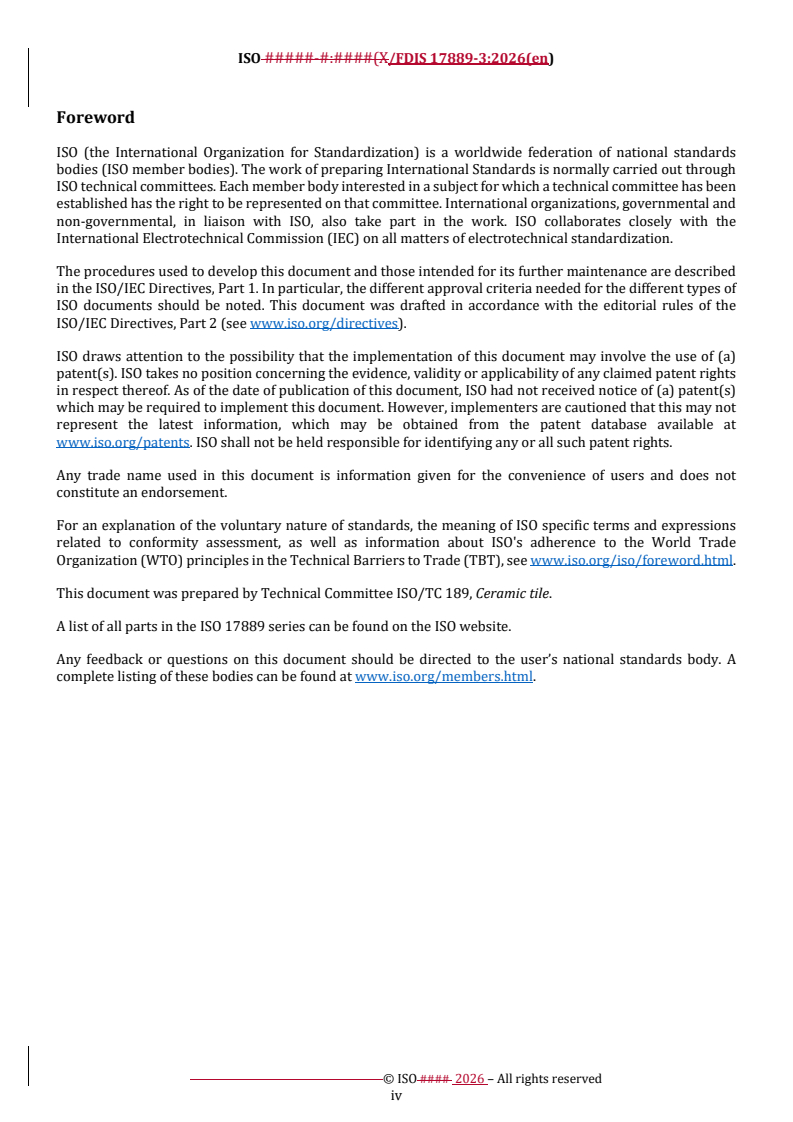
Foreword
ISO (the International Organization for Standardization) is a worldwide federation of national standards
bodies (ISO member bodies). The work of preparing International Standards is normally carried out through
ISO technical committees. Each member body interested in a subject for which a technical committee
has been established has the right to be represented on that committee. International organizations,
governmental and non-governmental, in liaison with ISO, also take part in the work. ISO collaborates closely
with the International Electrotechnical Commission (IEC) on all matters of electrotechnical standardization.
The procedures used to develop this document and those intended for its further maintenance are described
in the ISO/IEC Directives, Part 1. In particular, the different approval criteria needed for the different types
of ISO documents should be noted. This document was drafted in accordance with the editorial rules of the
ISO/IEC Directives, Part 2 (see www.iso.org/directives).
ISO draws attention to the possibility that the implementation of this document may involve the use of (a)
patent(s). ISO takes no position concerning the evidence, validity or applicability of any claimed patent
rights in respect thereof. As of the date of publication of this document, ISO had not received notice of (a)
patent(s) which may be required to implement this document. However, implementers are cautioned that
this may not represent the latest information, which may be obtained from the patent database available at
www.iso.org/patents. ISO shall not be held responsible for identifying any or all such patent rights.
Any trade name used in this document is information given for the convenience of users and does not
constitute an endorsement.
For an explanation of the voluntary nature of standards, the meaning of ISO specific terms and expressions
related to conformity assessment, as well as information about ISO's adherence to the World Trade
Organization (WTO) principles in the Technical Barriers to Trade (TBT), see www.iso.org/iso/foreword.html.
This document was prepared by Technical Committee ISO/TC 189, Ceramic tile.
A list of all parts in the ISO 17889 series can be found on the ISO website.
Any feedback or questions on this document should be directed to the user’s national standards body. A
complete listing of these bodies can be found at www.iso.org/members.html.
v
Introduction
This document provides requirements and recommended practices for sustainable tiles and installation
materials including environmental, economic and social criteria, in order to:
— promote the development and use of sustainable ceramic tiles and installation materials;
— guide all stakeholders in environmental responsibility throughout the supply chain for tiles and
installation materials;
— provide a verifiable resource for tile product specification and for design professionals, contractors and
consumers to identify sustainable tiles and installation materials;
— increase the value of sustainable tiles and installation materials throughout the supply chain by creating
greater market awareness and demand.
This document is intended for parties involved in the application, assessment, and verification of the
requirements specified in ISO 17889-1 and ISO 17889-2. These activities may be performed by first-, second-,
or third-party entities, including manufacturers, verification and validation bodies, and certification bodies,
where certification is the selected conformity assessment pathway.
This document includes relevant documentation needed for verification. Each describes and links to the
requirements in ISO 17889-1 and ISO 17889-2, whether mandatory or voluntary (see Annex A for additional
information).
vi
FINAL DRAFT International Standard ISO/FDIS 17889-3:2026(en)
Ceramic tiling systems — Sustainability for ceramic tiles and
installation materials —
Part 3:
Requirements for the application and verification of ISO
17889-1 and 17889-2
1 Scope
This document provides requirements and recommended practices for sustainable tiles and installation
materials.
This document specifies a series of environmental, social and economic procedures and documentation for
the implementation of ISO 17889-1 and ISO 17889-2 and the verification of the rating on a product.
2 Normative references
The following documents are referred to in the text in such a way that some or all of their content constitutes
requirements of this document. For dated references, only the edition cited applies. For undated references,
the latest edition of the referenced document (including any amendments) applies.
ISO 17889-1, Ceramic tiling systems — Sustainability for ceramic tiles and installation materials — Part 1:
Specification for ceramic tiles
ISO 17889-2, Ceramic tiling systems — Sustainability for ceramic tiles and installation materials — Part 2:
Specification for tile installation materials
3 Terms and definitions
For the purposes of this document, the following terms and definitions apply.
ISO and IEC maintain terminology databases for use in standardization at the following addresses:
— ISO Online browsing platform: available at https:// www .iso .org/ obp
— IEC Electropedia: available at https:// www .electropedia .org/
3.1
organization
person or group of people that has its own functions with responsibilities, authorities and relationships to
achieve its objectives
Note 1 to entry: The concept of organization includes: sole-trader, company, corporation, firm, enterprise, authority,
partnership, association, charity or institution, or part or combination thereof, whether incorporated or not, public or
private.
[SOURCE: ISO 14001:2015, 3.1.4].
3.2
responsible party
person or persons responsible for the provision of the statement (3.4) and the supporting information
Note 1 to entry: The responsible party can be either individuals or representatives of an organization (3.1), or project,
and can be the party who engages the verifier (3.6) or validator (3.7).
3.3
intended user
individual or organization (3.1) identified by those reporting sustainability information as being the one
who relies on that information to make decisions
Note 1 to entry: The intended user can be the client, the responsible party, programme owners, the general public or
other interested parties.
3.4
statement
factual and objective declaration that provides the subject matter for the verification (3.9) or validation (3.10)
3.5
client
organization (3.1) or person requesting verification (3.9) or validation (3.10)
Note 1 to entry: The client can be the responsible party, programme owner, intended user (3.3) or other interested
party.
3.6
verifier
competent and impartial person with responsibility for performing and reporting on a verification (3.9)
3.7
validator
competent and impartial person with responsibility for performing and reporting on a validation (3.10)
3.8
engagement
arrangement between two parties, with the terms usually specified in a contract, to perform services
3.9
verification
process for evaluating a statement of historical data and information to determine if the statement is
materially correct and conforms to criteria (3.12)
3.10
validation
process for evaluating the reasonableness of the assumptions, limitations and methods that support a
statement about the outcome of future activities
3.11
level of assurance
degree of confidence in the statement (3.4)
3.12
criteria
policy, procedure or requirement used as a reference against which the statement (3.4) is compared
Note 1 to entry: Criteria can be established by governments, regulators, environmental information programmes,
voluntary reporting initiatives, standards, codes of practice, or internal procedures.
3.13
controls
responsible party’s (3.2) policies and procedures that help ensure that the statement (3.4) is free from
material misstatements (3.16) and conforms to the criteria (3.12)
3.14
site
location where an organization (3.1) carries out work or a service
Note 1 to entry: A site can include one or several facilities (3.16).
3.15
facility
single installation, set of installations or production processes (stationary or mobile), which can be defined
within a single geographical boundary, organizational unit or production process
3.16
misstatement
errors, omissions, misreporting or misrepresentations in the statement (3.4)
Note 1 to entry: Misstatement can be qualitative or quantitative.
3.17
risk assessment
process of identifying, analysing and evaluating risks associated with activities or systems
3.18
material misstatement
individual misstatement (3.16) or the aggregate of actual misstatements in the statement (3.4) that can affect
the decisions of the intended users (3.3)
3.19
verification/validation opinion
formal written declaration to the intended user (3.3) that provides confidence on the statement (3.4) in the
responsible party’s (3.2) report and confirms conformity with the criteria (3.12)
3.20
nonconformity
non-fulfilment of a requirement
4 Principles
4.1 General
The application of the principles outlined in this clause is essential for guaranteeing the accuracy and
fairness of sustainability-related information. These principles serve as the foundation and direct the
implementation through guidance and recommended practices.
4.2 Impartiality
Develop and implement the verification/validation process in a manner that ensures objectivity and does
not introduce bias.
4.3 Evidence-based approach
Guarantee that the verification/validation engagement utilizes a rational approach to achieve reliable and
reproducible verification/validation outcomes, supported by adequate and appropriate evidence.
4.4 Fair presentation
Ensure that the verification/validation activities, findings, conclusions and opinions are accurately and
impartially presented. Report any significant obstacles encountered during the process, as well as any
unresolved or divergent opinions among verifiers or validators, to both the responsible party and the client.
4.5 Documentation
Document the verification/validation process comprehensively, ensuring it establishes the foundation for
the conclusion and conformity with the specified criteria.
5 Requirements applicable to verification/validation
5.1 Pre-engagement activities
5.1.1 General
The verifier/validator shall confirm the following aspects of the engagement:
a) type;
b) objectives: verification/validation;
c) scope: boundary, period;
d) criteria: materiality, level of assurance, etc.
5.1.2 Type of engagement
The verifier/validator and the client shall mutually agree on the type of engagement and take into account
the requirements of the intended user. The verifier/validator shall evaluate the suitability of the proposed
engagement type.
5.1.3 Level of assurance in the case of verification
For verification, the verifier and the client shall agree on the level of assurance to be applied and shall
consider the needs of the intended user. The verifier shall assess the appropriateness of the level of assurance
which shall not be changed during the verification; however, the engagement may be terminated, and a new
engagement initiated with a different level of assurance. The level of assurance shall be specified prior to the
start of the verification because the level of assurance establishes the nature, extent and timing (the design)
of the evidence-gathering activities.
5.1.4 Objectives
The verifier/validator and client shall agree on the verification/validation objectives at the beginning of the
verification/validation engagement.
Verification objectives shall include reaching a conclusion about the accuracy of the sustainability statement
and the conformity of the statement with criteria.
5.1.5 Criteria
The verifier/validator and client shall agree on the criteria, in accordance with the principles and
requirements of ISO 17889-1 and ISO 17889-2 (see Annex A for additional information).
Criteria shall be relevant, complete, reliable and understandable. It shall be available to the intended user.
The criteria shall be referenced in the opinion.
5.1.6 Scope
The verifier/validator and client shall agree on the verification/validation scope at the beginning of the
verification/validation process. The scope, as a minimum, shall include the following:
a) boundaries;
b) product or product line;
c) facilities, physical infrastructure, activities, technologies and processes;
d) time period.
5.1.7 Materiality thresholds
The verifier/validator shall confirm the materiality threshold as required by the intended users. In cases
where no materiality threshold has been specified by the intended users, the verifier/validator shall
establish materiality threshold(s) and convey them to the client.
Qualitative materiality refers to intangible issues. Examples include:
a) control issues that undermine the verifier’s confidence in the reported data;
b) poorly managed documented information;
c) difficulty in locating requested information.
5.2 Verification/validation team selection
A team shall be selected that has the necessary skills and competences to undertake the verification/
validation.
5.3 Verification/validation activities and techniques
Verifiers/validators shall use one or more of the following evidence-gathering activities and techniques in
the verification/validation:
a) observation;
b) inquiry;
c) confirmation;
d) recalculation;
e) examination;
f) retracing;
g) tracing;
h) sampling;
i) cross-checking.
5.4 Specific requirements
5.4.1 Verifier/validator communication
The verifier/validator shall promptly communicate requests for clarification, material misstatements and
nonconformities to the responsible party as soon as it is feasible. If a material adjustment to the statement is
necessary, the verifier/validator shall inform the responsible party of the need for the adjustment.
If, in the verifier’s/validator’s judgement, the responsible party does not respond appropriately within a
reasonable period, the verifier/validator shall inform the client, if different from the responsible party.
If, in the verifier’s/validator’s judgement, the client does not respond appropriately within a reasonable
period, the verifier/validator shall:
a) issue a modified or adverse verification/validation opinion; or
b) withdraw from the verification/validation.
The verifier/validator should communicate non-material misstatements to the responsible party.
5.4.2 Sufficiency of evidence
If the verifier/validator determines that there is insufficient information to support the statement, the
verifier/validator shall request additional information. If sufficient information cannot be obtained and
the information is necessary for the verifier/validator to form a conclusion, the verifier/validator shall not
proceed with the verification/validation and shall disclaim the issuance of an opinion.
5.4.3 Intentional misstatement
If the verifier’s/validator’s suspects the existence of intentional misstatement or noncompliance by the
responsible party with laws and regulations, the verifier/validator shall promptly communicate the matter
to the appropriate parties.
5.4.4 Documented information
The verifier/validator shall maintain the following records:
a) engagement terms;
b) verification/validation plan;
c) evidence-gathering plan;
d) who performed the evidence-gathering activities and when they were performed;
e) collected evidence;
f) requests for clarification, material misstatements and nonconformities arising from the verification/
validation and the conclusions reached;
g) communication with the responsible party on material misstatements;
h) the conclusions reached and opinions by the verifier/validator.
6 Verification
6.1 Planning
6.1.1 Strategic analysis
6.1.1.1 General
The verifier shall perform a strategic analysis to understand the activities and complexity of the organization,
project or product, and to determine the nature and extent of the verification activities.
The strategic analysis shall consider:
a) relevant sector information;
b) the nature of operations of the facility(ies) or project or product;
c) the requirements of the criteria;
d) the intended user’s materiality threshold;
e) the likely accuracy and completeness of the information;
f) the scope and related boundaries of the statement;
g) the time boundary for data;
h) appropriateness of quantification and reporting methods, and any changes;
i) sources of information;
j) data management information system and controls;
k) management oversight of the responsible party’s reporting data and supporting processes;
l) the availability of evidence for the responsible party's information and statement;
m) the results of previous verifications, if any;
n) other relevant information.
6.1.2 Risk assessment
6.1.2.1 General
The verifier shall conduct a risk assessment of the statement to identify the likelihood of a material
misstatement or nonconformity with the criteria. This assessment shall take into account the findings of the
materiality assessment. Furthermore, the verifier shall evaluate the risk of misstatement and decide on the
type and scope of evidence-gathering activities necessary. Performance materiality shall be determined by
considering the materiality threshold established by the intended user. The verifier shall identify qualitative
matters that can be material.
6.1.2.2 Types of risks
Inherent risks, control risks and detection risks shall be identified and assessed for the statement. These
risks shall be identified as: occurrence, completeness, accuracy, cut-off and classification.
6.1.2.3 Risk assessment considerations
The risk assessment shall consider the following:
a) the likelihood of intentional misstatement in the statement;
b) the likelihood of omission of potentially significant information;
c) the nature of operations specific to an organization, facility, project or product;
d) the degree of complexity in determining the organizational or project boundary or product system
boundary and whether related parties are involved;
e) any changes from prior periods;
f) the likelihood of non-compliance with applicable laws and regulations;
g) any significant economic or regulatory changes;
h) selection, quality and sources of data;
i) the level of detail of the available documentation;
j) the nature and complexity of quantification methods;
k) the degree of subjectivity;
l) any significant estimates and the data on which they are based;
m) the characteristics of the data management information system and controls;
n) the apparent effectiveness of the responsible party’s control system in identifying and preventing errors
or omissions;
o) any controls used to monitor and report of data;
p) the experience, skills and training of personnel.
6.1.2.4 Information sources for risk assessment
The verifier may perform an initial site visit to obtain data and information for the risk assessment.
6.1.2.5 Uses for risk assessment information
The risk assessment shall be used in developing the verification and evidence-gathering plans. Any input
into the risk assessment shall be recorded.
The risk assessment output may address how the verification is planned with respect to the following:
a) boundaries;
b) data management details;
c) management controls.
6.1.3 Evidence-gathering activities
6.1.3.1 General
The verifier shall design evidence-gathering activities to collect sufficient and appropriate evidence
upon which to base the conclusion. The verifier shall obtain more persuasive evidence the higher the risk
of misstatement. The verifier shall consider inherent risk and detection risk in designing the evidence-
gathering activities.
The verifier shall develop evidence-gathering activities that determine whether the statement conforms to
the criteria, in accordance with the principles of ISO 17889-1 and ISO 17889-2.
6.1.3.2 Data trail
The verifier shall design evidence-gathering activities to determine the existence of data trails.
6.1.3.3 Data aggregation process
The verifier shall develop evidence-gathering activities that focus on the data aggregation process, including
reconciling the statement with the underlying records and examining material adjustments made during
the course of preparing the statement.
6.1.3.4 Application of selected verification activities and techniques
The verifier shall design and execute evidence-gathering activities to assess the operational efficiency
of controls. In cases where deviations are identified, the verifier shall evaluate whether these deviations
impact the reliance on those controls, determine if additional tests of controls are warranted, and consider
applying other types of evidence-gathering activities as necessary.
If the nature of the data necessitates solely tests of control, the verifier shall develop and execute evidence-
gathering activities to verify the operational effectiveness of those controls. In the event of deviations, the
verifier shall evaluate whether these deviations impact the reliability of those controls and determine if
additional tests of controls are required.
6.1.4 Site visits
6.1.4.1 Site and facility selection
Site visits shall be planned and performed as appropriate to gather information needed to reduce verification
risk and to aid in the design of evidence-gathering activities.
On the basis of the risk assessment, the verifier shall identify the need to visit sites and facilities, including
the number and location of individual locations to be visited, considering:
a) the results of the risk assessment and efficiencies in collecting evidence;
b) the number and size of sites and facilities associated with the product/line of product;
c) the diversity of activities at each site and facility;
d) the degree of confidence in the data management system;
e) any risks identified through the risk assessment indicating the need to visit specific locations;
f) the results of prior verifications or validations, if any.
6.1.4.2 Circumstances requiring a site or facility visit
The verifier shall perform a site or facility visit under any of the following circumstances:
a) an initial verification;
b) a subsequent verification for which the verifier does not have knowledge of the prior verification
activities and results;
c) a verification where there has been a change of ownership of a site or facility;
d) when misstatements are identified during the verification that indicate a need to visit a site or facility;
e) material changes in scope or boundary of reporting;
f) significant changes in the data management involving the specific site or facility.
The verifier may determine that the circumstances specified in a) through f) do not require a site or facility
visit based on the results of the risk assessment and evidence-gathering plan and considering the results of
any prior verification to the same site or facility.
If a verifier determines that a site or facility visit is not necessary, the verifier shall justify and document the
decision.
6.1.4.3 Activities to perform during site visits
The verifier shall perform evidence-gathering activities at the site or facility to assess, as determined by the
risk assessment:
a) relevant operations and activities;
b) data management and control systems;
c) physical infrastructure;
d) equipment, such as measuring devices and instruments, to establish traceability to applicable calibration
and monitoring information;
e) processes and material flows;
f) scope and boundaries;
g) conformity with operational and data collection procedures;
h) quality control and quality assurance procedures in place to prevent or identify and correct any errors
or omissions in the reported parameters.
6.1.5 Verification plan
The verifier shall develop a verification plan that describes verification activities and schedules. The
verification plan shall be revised as necessary during the verification.
The verification plan shall address the following:
a) the scope and objectives;
b) identification of the verification team and their roles on the team;
c) client/responsible party contact;
d) schedule of verification activities;
e) level of assurance;
f) verification criteria;
g) materiality;
h) schedule for site visits.
The verifier shall communicate the verification plan to the responsible party and ensure that relevant
responsible party’s personnel are notified prior to the beginning of any site visit.
6.1.6 Evidence-gathering plan
The evidence-gathering plan shall be based on the results of the verifier’s risk assessment. It shall be
designed to lower the verification risk to an acceptable level. The evidence-gathering plan shall specify the
type and extent of evidence-gathering activities. The evidence-gathering plan should not be communicated
to the client or responsible party.
6.1.7 Approval of verification and evidence-gathering plans
The verification plan and evidence-gathering plan shall be approved by the team leader.
Amendments to the verification plan and evidence-gathering plan shall be approved by the team leader in
the following circumstances:
a) change in scope or timing of verification activities;
b) change in evidence-gathering procedures;
c) change in locations and sources of information for evidence-gathering;
d) the identification during the verification process of new risks or concerns that can lead to material
misstatements or nonconformities.
6.2 Execution
The verifier shall conduct the verification according to the verification plan and conduct the evidence-
gathering activities according to the evidence-gathering plan.
Whenever the responsible party makes changes to the statement as a result of requests for clarification,
misstatements and nonconformities, the verifier shall assess these changes.
6.3 Completion
6.3.1 Evaluation of the statement
6.3.1.1 Evaluation of changes
The verifier shall evaluate any changes in risks and materiality threshold that can have occurred over the
course of the verification.
6.3.1.2 Evaluation of sufficiency and appropriateness of evidence
The verifier shall determine whether the evidence collected is sufficient and appropriate to reach a
conclusion. If not, the verifier shall develop additional evidence-gathering activities.
6.3.1.3 Evaluation of material misstatements and conformity with criteria
The verifier shall evaluate and document material misstatements and any nonconformity with the standards.
6.3.1.4 Evaluation of changes from prior periods
The verifier shall evaluate whether any changes from prior periods that make the periods incomparable
have been disclosed properly by the responsible party.
6.3.2 Conclusion and draft opinion
6.3.2.1 General
The verifier shall reach a conclusion based on the evidence gathered and draft a verification opinion.
6.3.2.2 Unmodified opinion
In order to draft an unmodified opinion, the verifier shall ensure that:
a) there is sufficient and appropriate evidence to support the information;
b) the criteria are applied appropriately for material emissions, removals or storage;
c) the effectiveness of controls has been evaluated when the verifier intends to rely on those controls.
6.3.2.3 Modified opinion
To draft a modified opinion, the verifier shall ensure there is no material misstatement. If there are
misstatements or limitations, the verifier shall decide on the appropriate modification. The verifier shall
consider how the misstatement affects the usefulness of the report, whether the effects can be determined,
and if the report can be misleading even with the verifier’s opinion.
A modified opinion shall inform users of any problems. For minor errors, they shall be limited to specific
parts of the report.
6.3.2.4 Adverse opinion
To draft an adverse opinion, the veri
...
ISO/DISFDIS 17889-3:2025(en)
ISO/TC 189
Secretariat: ANSI
Date: 2026-02-2908-12
Ceramic tiling systems — Sustainability for ceramic tiles and
installation materials — —
Part 3:
Requirements for the application and verification of ISO 17889-1 and
17889-2
FDIS stage
ISO #####-#:####(X/FDIS 17889-3:2026(en)
All rights reserved. Unless otherwise specified, or required in the context of its implementation, no part of this publication
may be reproduced or utilized otherwise in any form or by any means, electronic or mechanical, including photocopying,
or posting on the internet or an intranet, without prior written permission. Permission can be requested from either ISO
at the address below or ISO’s member body in the country of the requester.
ISO copyright office
CP 401 • Ch. de Blandonnet 8
CH-1214 Vernier, Geneva
Phone: + 41 22 749 01 11
EmailE-mail: copyright@iso.org
Website: www.iso.org
Published in Switzerland
© ISO #### 2026 – All rights reserved
ii
ISO/DISFDIS 17889-3:20252026(en)
Contents
Foreword . iv
Introduction . v
1 Scope . 1
2 Normative references . 1
3 Terms and definitions . 1
4 Principles . 4
4.1 General . 4
4.2 Impartiality . 4
4.3 Evidence-based approach . 4
4.4 Fair presentation . 4
4.5 Documentation . 4
5 Requirements applicable to verification/validation . 4
5.1 Pre-engagement activities . 4
5.2 Verification/validation team selection . 5
5.3 Verification/validation activities and techniques . 6
5.4 Specific requirements . 6
6 Verification . 7
6.1 Planning . 7
6.2 Execution . 12
6.3 Completion . 12
7 Validation . 14
7.1 Planning . 14
7.2 Execution . 16
7.3 Completion . 17
8 Independent review . 18
8.1 General . 18
8.2 Types of opinions . 18
8.3 Contents of opinions . 18
9 Facts discovered after the verification/validation . 19
Annex A (informative) Application of ISO 17889-1 and ISO 17889-2 . 20
Bibliography . 33
iii
ISO #####-#:####(X/FDIS 17889-3:2026(en)
Foreword
ISO (the International Organization for Standardization) is a worldwide federation of national standards
bodies (ISO member bodies). The work of preparing International Standards is normally carried out through
ISO technical committees. Each member body interested in a subject for which a technical committee has been
established has the right to be represented on that committee. International organizations, governmental and
non-governmental, in liaison with ISO, also take part in the work. ISO collaborates closely with the
International Electrotechnical Commission (IEC) on all matters of electrotechnical standardization.
The procedures used to develop this document and those intended for its further maintenance are described
in the ISO/IEC Directives, Part 1. In particular, the different approval criteria needed for the different types of
ISO documents should be noted. This document was drafted in accordance with the editorial rules of the
ISO/IEC Directives, Part 2 (see www.iso.org/directives).
ISO draws attention to the possibility that the implementation of this document may involve the use of (a)
patent(s). ISO takes no position concerning the evidence, validity or applicability of any claimed patent rights
in respect thereof. As of the date of publication of this document, ISO had not received notice of (a) patent(s)
which may be required to implement this document. However, implementers are cautioned that this may not
represent the latest information, which may be obtained from the patent database available at
www.iso.org/patents. ISO shall not be held responsible for identifying any or all such patent rights.
Any trade name used in this document is information given for the convenience of users and does not
constitute an endorsement.
For an explanation of the voluntary nature of standards, the meaning of ISO specific terms and expressions
related to conformity assessment, as well as information about ISO's adherence to the World Trade
Organization (WTO) principles in the Technical Barriers to Trade (TBT), see www.iso.org/iso/foreword.html.
This document was prepared by Technical Committee ISO/TC 189, Ceramic tile.
A list of all parts in the ISO 17889 series can be found on the ISO website.
Any feedback or questions on this document should be directed to the user’s national standards body. A
complete listing of these bodies can be found at www.iso.org/members.html.
© ISO #### 2026 – All rights reserved
iv
ISO/DISFDIS 17889-3:20252026(en)
Introduction
This document provides guidancerequirements and recommended practices for sustainable tiles and
installation materials including environmental, economic and social criteria, in order to:
— — promote the development and use of sustainable ceramic tiles and installation materials;
— — guide all stakeholders in environmental responsibility throughout the supply chain for tiles and
installation materials;
— — provide a verifiable resource for tile product specification and for design professionals, contractors and
consumers to identify sustainable tiles and installation materials;
— — increase the value of sustainable tiles and installation materials throughout the supply chain by creating
greater market awareness and demand.
v
Ceramic tiling systems — Sustainability for ceramic tiles and
installation materials — Part 3: Requirements for the application and
verification of ISO 17889-1 and 17889-2
1 Scope
This document is intended for parties involved in the application, assessment, and verification of the
requirements specified in ISO 17889-1 and ISO 17889-2. These activities may be performed by first-, second-,
or third-party entities, including manufacturers, verification and validation bodies, and certification bodies,
where certification is the selected conformity assessment pathway.
This document includes relevant documentation needed for verification. Each describes and links to the
requirements in ISO 17889-1 and ISO 17889-2, whether mandatory or voluntary (see Annex AAnnex A for
additional information).
vi
DRAFT International Standard ISO/DIS 17889-3:2025(en)
Ceramic tiling systems — Sustainability for ceramic tiles and
installation materials —
Part 3:
Requirements for the application and verification of ISO 17889-1 and
17889-2
1 Scope
This document provides requirements and recommended practices for sustainable tiles and installation
materials.
This document specifies a series of environmental, social and economic procedures and documentation for
the implementation of ISO 17889-1 and ISO 17889-2 and the verification of the rating on a product.
2 Normative references
The following documents are referred to in the text in such a way that some or all of their content constitutes
requirements of this document. For dated references, only the edition cited applies. For undated references,
the latest edition of the referenced document (including any amendments) applies.
ISO 17889--1, Ceramic tiling systems — Sustainability for ceramic tiles and installation materials — Part 1:
Specification for ceramic tiles
ISO 17889--2, Ceramic tiling systems — Sustainability for ceramic tiles and installation materials — Part 2:
Specification for tile installation materials
3 Terms and definitions
For the purposes of this document, the following terms and definitions apply.
ISO and IEC maintain terminology databases for use in standardization at the following addresses:
— — ISO Online browsing platform: available at https://www.iso.org/obp
— — IEC Electropedia: available at https://www.electropedia.org/
3.1 3.1
organization
person or group of people that has its own functions with responsibilities, authorities and relationships to
achieve its objectives
Note 1 to entry: The concept of organization includes: sole-trader, company, corporation, firm, enterprise, authority,
partnership, association, charity or institution, or part or combination thereof, whether incorporated or not, public or
private.
[SOURCE: ISO 14001:2015, 3.1.4].
ISO #####-#:####(X/FDIS 17889-3:2026(en)
3.2 3.2
responsible party
)) and the supporting information
person or persons responsible for the provision of the statement (3.4(3.4
Note 1 to entry: The responsible party can be either individuals or representatives of an organization (3.1(3.1),), or
project, and can be the party who engages the verifier (3.6(3.6)) or validator (3.7(3.7).).
3.3 3.3
intended user
individual or organization (3.1(3.1)) identified by those reporting sustainability information as being the one
who relies on that information to make decisions
Note 1 to entry: The intended user can be the client, the responsible party, programme owners, the general public or
other interested parties.
3.4 3.4
statement
factual and objective declaration that provides the subject matter for the verification (3.9(3.11)) or validation
(3.10(3.12))
3.5 3.5
client
organization (3.1(3.1)) or person requesting verification (3.9(3.10)) or validation (3.10(3.11))
Note 1 to entry: The client can be the responsible party, programme owner, intended user (3.3(3.3)) or other interested
party.
3.6 3.6
verifier
competent and impartial person with responsibility for performing and reporting on a verification (3.9(3.10))
3.7 3.7
validator
competent and impartial person with responsibility for performing and reporting on a validation (3.10(3.11))
3.8 3.9
engagement
arrangement between two parties, with the terms usually specified in a contract, to perform services
3.9 3.10
verification
process for evaluating a statement of historical data and information to determine if the statement is
materially correct and conforms to criteria (3.12(3.13))
3.10 3.11
validation
process for evaluating the reasonableness of the assumptions, limitations and methods that support a
statement about the outcome of future activities
© ISO #### 2026 – All rights reserved
ISO/DISFDIS 17889-3:20252026(en)
3.11 3.12
level of assurance
degree of confidence in the statement (3.4(3.4))
3.12 3.13
criteria
policy, procedure or requirement used as a reference against which the statement (3.4(3.4)) is compared
Note 1 to entry: Criteria maycan be established by governments, regulators, environmental information programmes,
voluntary reporting initiatives, standards, codes of practice, or internal procedures.
3.13 3.14
controls
responsible party’s (3.2(3.2)) policies and procedures that help ensure that the statement (3.4(3.4)) is free
from material misstatements (3.16(3.19)) and conforms to the criteria (3.12(3.13))
3.14 3.15
site
location where an organization (3.1(3.1)) carries out work or a service
Note 1 to entry: A site maycan include one or several facilities (3.16(3.16).).
3.15 3.16
facility
single installation, set of installations or production processes (stationary or mobile), which can be defined
within a single geographical boundary, organizational unit or production process
3.16 3.17
misstatement
errors, omissions, misreporting or misrepresentations in the statement (3.4(3.4))
Note 1 to entry: Misstatement can be qualitative or quantitative.
3.17 3.18
risk assessment
process of identifying, analysing and evaluating risks associated with activities or systems
3.18 3.19
material misstatement
individual misstatement (3.16(3.17)) or the aggregate of actual misstatements in the statement (3.4(3.4)) that
can affect the decisions of the intended users (3.3(3.3))
3.19 3.20
verification/validation opinion
formal written declaration to the intended user (3.3(3.3)) that provides confidence on the statement (3.4(3.4))
in the responsible party’s (3.2(3.2)) report and confirms conformity with the criteria (3.12(3.13))
3.20 3.21
nonconformity
non-fulfilment of a requirement
ISO #####-#:####(X/FDIS 17889-3:2026(en)
4 Principles
4.1 General
The application of the principles outlined in this clause is essential for guaranteeing the accuracy and fairness
of sustainability-related information. These principles serve as the foundation and direct the implementation
through guidance and recommended practices.
4.2 Impartiality
Develop and implement the verification/validation process in a manner that ensures objectivity and does not
introduce bias.
4.3 Evidence-based approach
Guarantee that the verification/validation engagement utilizes a rational approach to achieve reliable and
reproducible verification/validation outcomes, supported by adequate and appropriate evidence.
4.4 Fair presentation
Ensure that the verification/validation activities, findings, conclusions and opinions are accurately and
impartially presented. Report any significant obstacles encountered during the process, as well as any
unresolved or divergent opinions among verifiers or validators, to both the responsible party and the client.
4.5 Documentation
Document the verification/validation process comprehensively, ensuring it establishes the foundation for the
conclusion and conformity with the specified criteria.
5 Requirements applicable to verification/validation
5.1 Pre-engagement activities
5.1.1 General
The verifier/validator shall confirm the following aspects of the engagement:
a) a) type;
b) b) objectives: verification/validation;
c) c) scope: boundary, period;
d) d) criteria: materiality, level of assurance, etc.
5.1.2 Type of engagement
The verifier/validator and the client shall mutually agree on the type of engagement and take into account the
requirements of the intended user. The verifier/validator shall evaluate the suitability of the proposed
engagement type.
© ISO #### 2026 – All rights reserved
ISO/DISFDIS 17889-3:20252026(en)
5.1.3 Level of assurance in the case of verification
For verification, the verifier and the client shall agree on the level of assurance to be applied and shall consider
the needs of the intended user. The verifier shall assess the appropriateness of the level of assurance which
shall not be changed during the verification; however, the engagement may be terminated, and a new
engagement initiated with a different level of assurance. The level of assurance shall be specified prior to the
start of the verification because the level of assurance establishes the nature, extent and timing (the design)
of the evidence-gathering activities.
5.1.4 Objectives
The verifier/validator and client shall agree on the verification/validation objectives at the beginning of the
verification/validation engagement.
Verification objectives shall include reaching a conclusion about the accuracy of the sustainability statement
and the conformity of the statement with criteria.
5.1.5 Criteria
The verifier/validator and client shall agree on the criteria, in accordance with the principles and
requirements of ISO 17889-1 and ISO 17889-2 (see Annex AAnnex A for additional information).
Criteria shall be relevant, complete, reliable and understandable. It shall be available to the intended user. The
criteria shall be referenced in the opinion.
5.1.6 Scope
The verifier/validator and client shall agree on the verification/validation scope at the beginning of the
verification/validation process. The scope, as a minimum, shall include the following:
a) a) boundaries;
b) b) product or product line;
c) c) facilities, physical infrastructure, activities, technologies and processes;
d) d) time period.
5.1.7 Materiality thresholds
The verifier/validator shall confirm the materiality threshold as required by the intended users. In cases
where no materiality threshold has been specified by the intended users, the verifier/validator shall establish
materiality threshold(s) and convey them to the client.
Qualitative materiality refers to intangible issues. Examples include:
a) a) control issues that undermine the verifier’s confidence in the reported data;
b) b) poorly managed documented information;
c) c) difficulty in locating requested information.
5.2 Verification/validation team selection
A team shall be selected that has the necessary skills and competences to undertake the
verification/validation.
ISO #####-#:####(X/FDIS 17889-3:2026(en)
5.3 Verification/validation activities and techniques
Verifiers/validators shall use one or more of the following evidence-gathering activities and techniques in the
verification/validation:
a) a) observation;
b) b) inquiry;
c) c) confirmation;
d) d) recalculation;
e) e) examination;
f) f) retracing;
g) g) tracing;
h) h) sampling;
i) i) cross-checking.
5.4 Specific requirements
5.4.1 Verifier/validator communication
The verifier/validator shall promptly communicate requests for clarification, material misstatements and
nonconformities to the responsible party as soon as it is feasible. If a material adjustment to the statement is
necessary, the verifier/validator shall inform the responsible party of the need for the adjustment.
If, in the verifier’s/validator’s judgement, the responsible party does not respond appropriately within a
reasonable period, the verifier/validator shall inform the client, if different from the responsible party.
If, in the verifier’s/validator’s judgement, the client does not respond appropriately within a reasonable
period, the verifier/validator shall:
a) a) issue a modified or adverse verification/validation opinion; or
b) b) withdraw from the verification/validation.
The verifier/validator should communicate non-material misstatements to the responsible party.
5.4.2 Sufficiency of evidence
If the verifier/validator determines that there is insufficient information to support the statement, the
verifier/validator shall request additional information. If sufficient information cannot be obtained and the
information is necessary for the verifier/validator to form a conclusion, the verifier/validator shall not
proceed with the verification/validation and shall disclaim the issuance of an opinion.
© ISO #### 2026 – All rights reserved
ISO/DISFDIS 17889-3:20252026(en)
5.4.3 Intentional misstatement
If the verifier’s/validator’s suspects the existence of intentional misstatement or noncompliance by the
responsible party with laws and regulations, the verifier/validator shall promptly communicate the matter to
the appropriate parties.
5.4.4 Documented information
The verifier/validator shall maintain the following records:
a) a) engagement terms;
b) b) verification/validation plan;
c) c) evidence-gathering plan;
d) d) who performed the evidence-gathering activities and when they were performed;
e) e) collected evidence;
f) f) requests for clarification, material misstatements and nonconformities arising from the
verification/validation and the conclusions reached;
g) g) communication with the responsible party on material misstatements;
h) h) the conclusions reached and opinions by the verifier/validator.
6 Verification
6.1 Planning
6.1.1 Strategic analysis
6.1.1.1 General
The verifier shall perform a strategic analysis to understand the activities and complexity of the organization,
project or product, and to determine the nature and extent of the verification activities.
The strategic analysis shall consider:
a) a) relevant sector information;
b) b) the nature of operations of the facility(ies) or project or product;
c) c) the requirements of the criteria;
d) d) the intended user’s materiality threshold;
e) e) the likely accuracy and completeness of the information;
f) f) the scope and related boundaries of the statement;
g) g) the time boundary for data;
h) h) appropriateness of quantification and reporting methods, and any changes;
ISO #####-#:####(X/FDIS 17889-3:2026(en)
i) i) sources of information;
j) j) data management information system and controls;
k) k) management oversight of the responsible party’s reporting data and supporting processes;
l) l) the availability of evidence for the responsible party's information and statement;
m) m) the results of previous verifications, if any;
n) n) other relevant information.
6.1.2 Risk assessment
6.1.2.1 General
The verifier shall conduct a risk assessment of the statement to identify the likelihood of a material
misstatement or nonconformity with the criteria. This assessment shall take into account the findings of the
materiality assessment. Furthermore, the verifier shall evaluate the risk of misstatement and decide on the
type and scope of evidence-gathering activities necessary. Performance materiality shall be determined by
considering the materiality threshold established by the intended user. The verifier shall identify qualitative
matters that can be material.
6.1.2.2 Types of risks
Inherent risks, control risks and detection risks shall be identified and assessed for the statement. These risks
shall be identified as: occurrence, completeness, accuracy, cut-off and classification.
6.1.2.3 Risk assessment considerations
The risk assessment shall consider the following:
a) a) the likelihood of intentional misstatement in the statement;
b) b) the likelihood of omission of potentially significant information;
c) c) the nature of operations specific to an organization, facility, project or product;
d) d) the degree of complexity in determining the organizational or project boundary or product
system boundary and whether related parties are involved;
e) e) any changes from prior periods;
f) f) the likelihood of non-compliance with applicable laws and regulations;
g) g) any significant economic or regulatory changes;
h) h) selection, quality and sources of data;
i) i) the level of detail of the available documentation;
© ISO #### 2026 – All rights reserved
ISO/DISFDIS 17889-3:20252026(en)
j) j) the nature and complexity of quantification methods;
k) k) the degree of subjectivity;
l) l) any significant estimates and the data on which they are based;
m) m) the characteristics of the data management information system and controls;
n) n) the apparent effectiveness of the responsible party’s control system in identifying and
preventing errors or omissions;
o) o) any controls used to monitor and report of data;
p) p) the experience, skills and training of personnel.
6.1.2.4 Information sources for risk assessment
The verifier may perform an initial site visit to obtain data and information for the risk assessment.
6.1.2.5 Uses for risk assessment information
The risk assessment shall be used in developing the verification and evidence-gathering plans. Any input into
the risk assessment shall be recorded.
The risk assessment output may address how the verification is planned with respect to the following:
a) a) boundaries;
b) b) data management details;
c) c) management controls.
6.1.3 Evidence-gathering activities
6.1.3.1 General
The verifier shall design evidence-gathering activities to collect sufficient and appropriate evidence upon
which to base the conclusion. The verifier shall obtain more persuasive evidence the higher the risk of
misstatement. The verifier shall consider inherent risk and detection risk in designing the evidence-gathering
activities.
The verifier shall develop evidence-gathering activities that determine whether the statement conforms to the
criteria, in accordance with the principles of ISO 17889-1 and ISO 17889-2.
6.1.3.2 Data trail
The verifier shall design evidence-gathering activities to determine the existence of data trails.
6.1.3.3 Data aggregation process
The verifier shall develop evidence-gathering activities that focus on the data aggregation process, including
reconciling the statement with the underlying records and examining material adjustments made during the
course of preparing the statement.
ISO #####-#:####(X/FDIS 17889-3:2026(en)
6.1.3.4 Application of selected verification activities and techniques
The verifier shall design and execute evidence-gathering activities to assess the operational efficiency of
controls. In cases where deviations are identified, the verifier shall evaluate whether these deviations impact
the reliance on those controls, determine if additional tests of controls are warranted, and consider applying
other types of evidence-gathering activities as necessary.
If the nature of the data necessitates solely tests of control, the verifier shall develop and execute evidence-
gathering activities to verify the operational effectiveness of those controls. In the event of deviations, the
verifier shall evaluate whether these deviations impact the reliability of those controls and determine if
additional tests of controls are required.
6.1.4 Site visits
6.1.4.1 Site and facility selection
Site visits shall be planned and performed as appropriate to gather information needed to reduce verification
risk and to aid in the design of evidence-gathering activities.
On the basis of the risk assessment, the verifier shall identify the need to visit sites and facilities, including the
number and location of individual locations to be visited, considering:
a) a) the results of the risk assessment and efficiencies in collecting evidence;
b) b) the number and size of sites and facilities associated with the product/line of product;
c) c) the diversity of activities at each site and facility;
d) d) the degree of confidence in the data management system;
e) e) any risks identified through the risk assessment indicating the need to visit specific locations;
f) f) the results of prior verifications or validations, if any.
6.1.4.2 Circumstances requiring a site or facility visit
The verifier shall perform a site or facility visit under any of the following circumstances:
a) a) an initial verification;
b) b) a subsequent verification for which the verifier does not have knowledge of the prior
verification activities and results;
c) c) a verification where there has been a change of ownership of a site or facility;
d) d) when misstatements are identified during the verification that indicate a need to visit a site or
facility;
e) e) material changes in scope or boundary of reporting;
© ISO #### 2026 – All rights reserved
ISO/DISFDIS 17889-3:20252026(en)
f) f) significant changes in the data management involving the specific site or facility.
The verifier may determine that the circumstances specified in a) through f) do not require a site or facility
visit based on the results of the risk assessment and evidence-gathering plan and considering the results of
any prior verification to the same site or facility.
If a verifier determines that a site or facility visit is not necessary, the verifier shall justify and document the
decision.
6.1.4.3 Activities to perform during site visits
The verifier shall perform evidence-gathering activities at the site or facility to assess, as determined by the
risk assessment:
a) a) relevant operations and activities;
b) b) data management and control systems;
c) c) physical infrastructure;
d) d) equipment, such as measuring devices and instruments, to establish traceability to applicable
calibration and monitoring information;
e) e) processes and material flows;
f) f) scope and boundaries;
g) g) conformity with operational and data collection procedures;
h) h) quality control and quality assurance procedures in place to prevent or identify and correct
any errors or omissions in the reported parameters.
6.1.5 Verification plan
The verifier shall develop a verification plan that describes verification activities and schedules. The
verification plan shall be revised as necessary during the verification.
The verification plan shall address the following:
a) a) the scope and objectives;
b) b) identification of the verification team and their roles on the team;
c) c) client/responsible party contact;
d) d) schedule of verification activities;
e) e) level of assurance;
f) f) verification criteria;
g) g) materiality;
h) h) schedule for site visits.
ISO #####-#:####(X/FDIS 17889-3:2026(en)
The verifier shall communicate the verification plan to the responsible party and ensure that relevant
responsible party’s personnel are notified prior to the beginning of any site visit.
6.1.6 Evidence-gathering plan
The evidence-gathering plan shall be based on the results of the verifier’s risk assessment. It shall be designed
to lower the verification risk to an acceptable level. The evidence-gathering plan shall specify the type and
extent of evidence-gathering activities. The evidence-gathering plan should not be communicated to the client
or responsible party.
6.1.7 Approval of verification and evidence-gathering plans
The verification plan and evidence-gathering plan shall be approved by the team leader.
Amendments to the verification plan and evidence-gathering plan shall be approved by the team leader in the
following circumstances:
a) a) change in scope or timing of verification activities;
b) b) change in evidence-gathering procedures;
c) c) change in locations and sources of information for evidence-gathering;
d) d) the identification during the verification process of new risks or concerns that can lead to
material misstatements or nonconformities.
6.2 Execution
The verifier shall conduct the verification according to the verification plan and conduct the evidence-
gathering activities according to the evidence-gathering plan.
Whenever the responsible party makes changes to the statement as a result of requests for clarification,
misstatements and nonconformities, the verifier shall assess these changes.
6.3 Completion
6.3.1 Evaluation of the statement
6.3.1.1 Evaluation of changes
The verifier shall evaluate any changes in risks and materiality threshold that can have occurred over the
course of the verification.
6.3.1.2 Evaluation of sufficiency and appropriateness of evidence
The verifier shall determine whether the evidence collected is sufficient and appropriate to reach a conclusion.
If not, the verifier shall develop additional evidence-gathering activities.
© ISO #### 2026 – All rights reserved
ISO/DISFDIS 17889-3:20252026(en)
6.3.1.3 Evaluation of material misstatements and conformity with criteria
The verifier shall evaluate and document material misstatements and any nonconformity with the standards.
6.3.1.4 Evaluation of changes from prior periods
The verifier shall evaluate whether any changes from prior periods that make the periods incomparable have
been disclosed properly by the responsible party.
6.3.2 Conclusion and draft opinion
6.3.2.1 General
The verifier shall reach a conclusion based on the evidence gathered and draft a verification opinion.
6.3.2.2 Unmodified opinion
In order to draft an unmodified opinion, the verifier shall ensure that:
a) a) there is sufficient and appropriate evidence to support the information;
b) b) the criteria are applied appropriately for material emissions, removals or storage;
c) c) the effectiveness of controls has been evaluated when the verifier intends to rely on those
controls.
6.3.2.3 Modified opinion
To draft a modified opinion, the verifier shall ensure there is no material misstatement. If there are
misstatements or limitations, the verifier shall decide on the appropriate modification. The verifier shall
consider how the misstatement affects the usefulness of the report, whether the effects can be determined,
and if the report can be misleading even with the verifier’s opinion.
A modified opinion shall inform users of any problems. For minor errors, they shall be limited to specific parts
of the report.
6.3.2.4 Adverse opinion
To draft an adverse opinion, the verifier shall conclude that there is insufficient or inappropriate evidence to
support an unmodified or modified opinion, or that the criteria are not appropriately applied and reliable.
Additionally, the verifier shall conclude that the effectiveness of controls cannot be determined when they
intend to rely on those controls.
If the responsible party does not correct any material misstatement or nonconformity within an agreed period
of time, the verifier shall take this into consideration when reaching the conclusion.
6.3.2.5 Disclaiming the issuance of an opinion
In order to disclaim the issuance of an opinion, the verifier shall ensure that they have been unable to obtain
sufficient appropriate evidence and can conclude that the possible effects on the statement of undetected
material misstatements are material and pervasive.
6.3.3 Verification report
The verifier shall draft a verification report. A verification report shall include as a minimum:
a) a) an appropriate title;
ISO #####-#:####(X/FDIS 17889-3:2026(en)
b) b) an addressee;
c) c) a statement that the responsible party is responsible for the preparation and fair presentation
of the statement in accordance with the criteria;
d) d) a statement that the verifier is responsible for expressing an opinion on the statement based
on the verification;
e) e) a description of the verification evidence-gathering procedures used to assess the statement;
f) f) the verification opinion;
g) g) the date of the report;
h) h) the verifier’s location;
i) i) the verifier’s signature;
j) j) a summary of the statement;
k) k) reference to the verification criteria;
l) l) verification scope.
7 Validation
7.1 Planning
7.1.1 Strategic analysis
The validator shall have a sufficient understanding of the activities and its relevant sector information to plan
and conduct the validation. This shall enable the validator to:
— — identify the types of potential material misstatements and their likelihood of occurrence;
— — select the evidence-gathering procedures that will provide the validator for their assessment and
conclusions.
The strategic analysis shall consider:
a) a) relevant sector information;
b) b) the nature of operations;
c) c) the requirements of the criteria;
d) d) the intended user’s materiality threshold;
e) e) the likely accuracy and completeness of the statement;
© ISO #### 2026 – All rights reserved
ISO/DISFDIS 17889-3:20252026(en)
f) f) the proper disclosure of the statement;
g) g) the scope of the statement and related boundaries;
h) h) the time boundary for data;
i) i) appropriateness of reporting methods, and any changes;
j) j) sources of information;
k) k) data management information system and controls;
l) l) management oversight of the responsible party’s reporting data and supporting processes;
m) m) the availability of evidence for the responsible party's information and statement;
n) n) other relevant information.
7.1.2 Materiality thresholds
The validator shall identify materiality thresholds for the purposes of concluding on the statement. The
validator shall identify qualitative matters that can be material.
NOTE See also 5.1.75.1.7.
7.1.3 Validation plan
The validator shall develop a validation plan that addresses the following:
a) a) scope and objectives;
b) b) identification of the validation team and the roles of team members;
c) c) client/responsible party contact;
d) d) schedule of validation activities;
e) e) validation criteria;
f) f) materiality;
g) g) schedule for site visits, if any.
The validator shall communicate the validation plan to the responsible party and ensure that relevant
responsible party personnel are notified prior to the beginning of any site visit.
7.1.4 Evidence-gathering plan
The validator shall design evidence-gathering activities to collect adequate and relevant evidence for each
characteristic of the activity to substantiate their conclusion. Except in cases where the validator chooses to
examine all evidence, the validator shall use a risk-based process to identify evidence to be collected for each
characteristic of the activity. The validator shall incorporate any validation activities or techniques, including
site visits, into the design of the evidence-gathering plan.
ISO #####-#:####(X/FDIS 17889-3:2026(en)
7.1.5 Approval of validation and evidence-gathering plans
The validation plan and evidence-gathering plan shall be approved by the team leader.
Amendments to the validation plan and evidence-gathering plan shall be approved by the team leader in the
following circumstances:
a) a) change in scope or timing of validation activities;
b) b) change in evidence-gathering procedures;
c) c) change in locations and sources of information for evidence-gathering;
d) d) the identification during the validation process of new risks or concerns that can lead to
material misstatements or nonconformities.
7.1.6 Amendments to validation and evidence-gathering plans
If evidence collected indicates a material misstatement(s) or identifies a nonconformity with the criteria, the
validator shall modify the validation plan and evidence-gathering plan, as required.
7.2 Execution
7.2.1 General
The validator shall conduct the validation according to the validation plan and the evidence-gathering
activities according to the evidence-gathering plan.
7.2.2 Evaluation of the statement
The validator shall utilize their assessments, evaluations and the gathered evidence to evaluate the
responsible party's statement against validation criteria. The validator shall assess whether uncorrected
misstatements are material to the statement. Furthermore, the validator shall evaluate conformity with the
criteria and re-evaluate recognition accordingly.
7.2.3 Proper disclosure
The validator shall evaluate the statement for proper disclosure and shall ensure that material disclosures
occur. In assessing proper disclosure, the validator shall:
a) a) assess whether the statement is accurate and complete;
b) b) assess whether the disclosure is a fair reflection of the activity;
c) c) assess whether the disclosure contains unintended bias;
d) d) assess whether the disclosure addressed the intended users’ requirements and needs.
© ISO #### 2026 – All rights reserved
ISO/DISFDIS 17889-3:20252026(en)
7.3 Completion
7.3.1 General
The validator shall reach a conclusion based on their evaluation of the statement and whether it has been
properly disclosed. If the responsible party does not correct any material misstatement or nonconformity in
an agreed period of time, the validator shall take this into consideration when reaching the conclusion.
7.3.2 Opinion
7.3.2.1 General
The validator shall draft a validation opinion based on the evidence gathered during the validation and choose
one of the options in 7.3.2.27.3.2.2 to 7.3.2.5.
7.3.2.2 Unmodified opinion
In order to draft an unmodified opinion, the validator shall ensure:
a) a) there is sufficient and appropriate evidence to support the future estimate;
b) b) the criteria meet the needs of the intended user;
c) c) the criteria are appropriately applied for material emissions, removals or storage.
7.3.2.3 Modified opinion
I
...