


ISO 3166-2:2020
(Main)Codes for the representation of names of countries and their subdivisions - Part 2: Country subdivision code
Codes for the representation of names of countries and their subdivisions - Part 2: Country subdivision code
This document specifies basic guidelines for the implementation and maintenance of country subdivision codes. This code is intended for use in any application requiring the expression of current country subdivision names in coded form.
Codes pour la représentation des noms de pays et de leurs subdivisions — Partie 2: Code pour les subdivisions de pays
Le présent document spécifie les principes directeurs pour la mise en application et la mise à jour des codes pour les subdivisions de pays. Ces codes sont destinés à toute application nécessitant l'expression des noms de subdivisions de pays sous une forme codée.
Kode za predstavljanje imen držav in njihovih podrejenih enot - 2. del: Kode podrejenih enot države
General Information
- Status
- Published
- Publication Date
- 24-Aug-2020
- Technical Committee
- ISO/TC 46 - Information and documentation
- Drafting Committee
- ISO/TC 46/WG 2 - Coding of country names and related entities
- Current Stage
- 9093 - International Standard confirmed
- Start Date
- 21-May-2025
- Completion Date
- 13-Dec-2025
Relations
- Effective Date
- 10-Dec-2016
Overview
ISO 3166-2:2020 defines the rules and guidelines for creating and maintaining country subdivision codes - the standardized codes that represent principal administrative divisions (states, provinces, regions, etc.) of countries listed in ISO 3166‑1. This fourth edition formalizes the shift to a database-centric model, aligns character usage with ISO/IEC 10646 (Unicode), and uses UTF-8 encoding for consistent, international data exchange. The code format is specified (see Key Topics).
Key Topics
- Scope and purpose: Provides basic guidelines for implementation and maintenance of current country subdivision names in coded form for any application requiring coded subdivisions.
- Code structure: Country subdivision code elements are composed of an alpha‑2 country code, a hyphen-minus, then up to 3 characters (A–Z, 0–9) - maximum length 6 characters in total.
- Language and scripts: Guidance on choice of language, romanization systems and character sets; references to ISO 639 language codes and ISO 15924 script codes are included.
- Data model and database: Codes and descriptive text moved to a single database paradigm; ISO Online Browsing Platform (ISO OBP) is the public interface for the code data.
- Maintenance and governance: Updates and stewardship are managed by the ISO 3166 Maintenance Agency (ISO 3166/MA) with procedures for name changes, code alterations, reservations and change tracking.
- Interoperability: Principles for relating subdivision codes to national/international coding systems and for ensuring one‑to‑one correspondence between names and code elements.
- Character consistency: All characters (including diacritics) checked against Unicode (ISO/IEC 10646) for consistent usage.
Applications
ISO 3166-2:2020 is used wherever standardized representation of administrative areas is needed:
- Data exchange and integration between government agencies and international organizations
- Addressing, postal services, customs and trade declarations
- Geographic Information Systems (GIS) and mapping services
- Business analytics, reporting and statistical aggregation
- E‑commerce, logistics and supply‑chain management
- Database design and APIs requiring reliable subdivision identifiers
Who uses this standard
- IT architects, database designers and developers
- National standards bodies and government administrations
- International organizations, customs and postal operators
- GIS professionals, statisticians and data analysts
- Software vendors and e‑commerce platforms
Related Standards
- ISO 3166‑1 (country codes)
- ISO 3166‑3 (codes for formerly used country names)
- ISO 639 (language codes)
- ISO/IEC 10646 (Universal Coded Character Set / Unicode)
- ISO 15924 (script codes)
Using ISO 3166‑2:2020 ensures consistent, interoperable subdivision identifiers across systems, languages and borders - essential for reliable international data exchange and geographic referencing.


ISO 3166-2:2020 - Codes for the representation of names of countries and their subdivisions — Part 2: Country subdivision code Released:8/25/2020
ISO 3166-2:2020 - Codes pour la représentation des noms de pays et de leurs subdivisions — Partie 2: Code pour les subdivisions de pays Released:8/25/2020
Related Packages

Frequently Asked Questions
ISO 3166-2:2020 is a standard published by the International Organization for Standardization (ISO). Its full title is "Codes for the representation of names of countries and their subdivisions - Part 2: Country subdivision code". This standard covers: This document specifies basic guidelines for the implementation and maintenance of country subdivision codes. This code is intended for use in any application requiring the expression of current country subdivision names in coded form.
This document specifies basic guidelines for the implementation and maintenance of country subdivision codes. This code is intended for use in any application requiring the expression of current country subdivision names in coded form.
ISO 3166-2:2020 is classified under the following ICS (International Classification for Standards) categories: 01.140.30 - Documents in administration, commerce and industry. The ICS classification helps identify the subject area and facilitates finding related standards.
ISO 3166-2:2020 has the following relationships with other standards: It is inter standard links to ISO 3166-2:2013. Understanding these relationships helps ensure you are using the most current and applicable version of the standard.
You can purchase ISO 3166-2:2020 directly from iTeh Standards. The document is available in PDF format and is delivered instantly after payment. Add the standard to your cart and complete the secure checkout process. iTeh Standards is an authorized distributor of ISO standards.
Standards Content (Sample)
SLOVENSKI STANDARD
01-december-2020
Nadomešča:
SIST ISO 3166-2:2016
Kode za predstavljanje imen držav in njihovih podrejenih enot - 2. del: Kode
podrejenih enot države
Codes for the representation of names of countries and their subdivisions -- Part 2:
Country subdivision code
Codes pour la représentation des noms de pays et de leurs subdivisions -- Partie 2:
Code pour les subdivisions de pays
Ta slovenski standard je istoveten z: ISO 3166-2:2020
ICS:
01.140.20 Informacijske vede Information sciences
01.140.30 Dokumenti v upravi, trgovini Documents in administration,
in industriji. commerce and industry
2003-01.Slovenski inštitut za standardizacijo. Razmnoževanje celote ali delov tega standarda ni dovoljeno.
INTERNATIONAL ISO
STANDARD 3166-2
Fourth edition
2020-08
Codes for the representation of names
of countries and their subdivisions —
Part 2:
Country subdivision code
Codes pour la représentation des noms de pays et de leurs
subdivisions —
Partie 2: Code pour les subdivisions de pays
Reference number
©
ISO 2020
© ISO 2020
All rights reserved. Unless otherwise specified, or required in the context of its implementation, no part of this publication may
be reproduced or utilized otherwise in any form or by any means, electronic or mechanical, including photocopying, or posting
on the internet or an intranet, without prior written permission. Permission can be requested from either ISO at the address
below or ISO’s member body in the country of the requester.
ISO copyright office
CP 401 • Ch. de Blandonnet 8
CH-1214 Vernier, Geneva
Phone: +41 22 749 01 11
Email: copyright@iso.org
Website: www.iso.org
Published in Switzerland
ii © ISO 2020 – All rights reserved
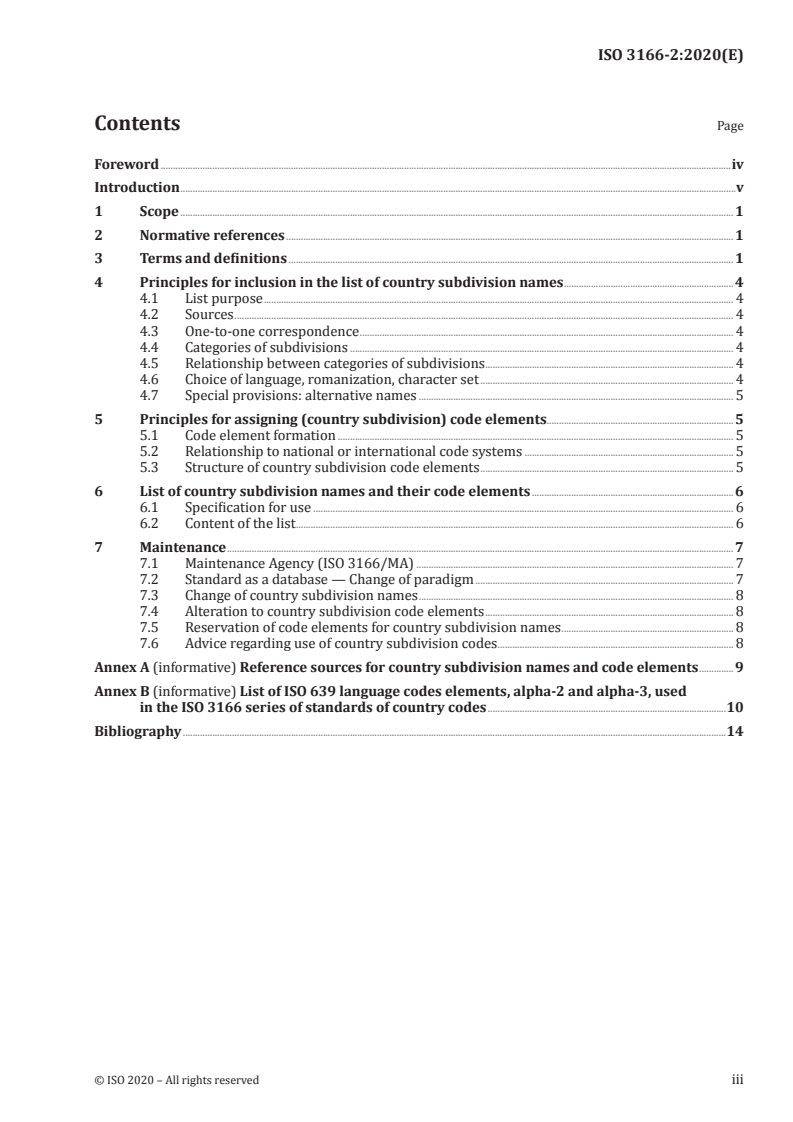
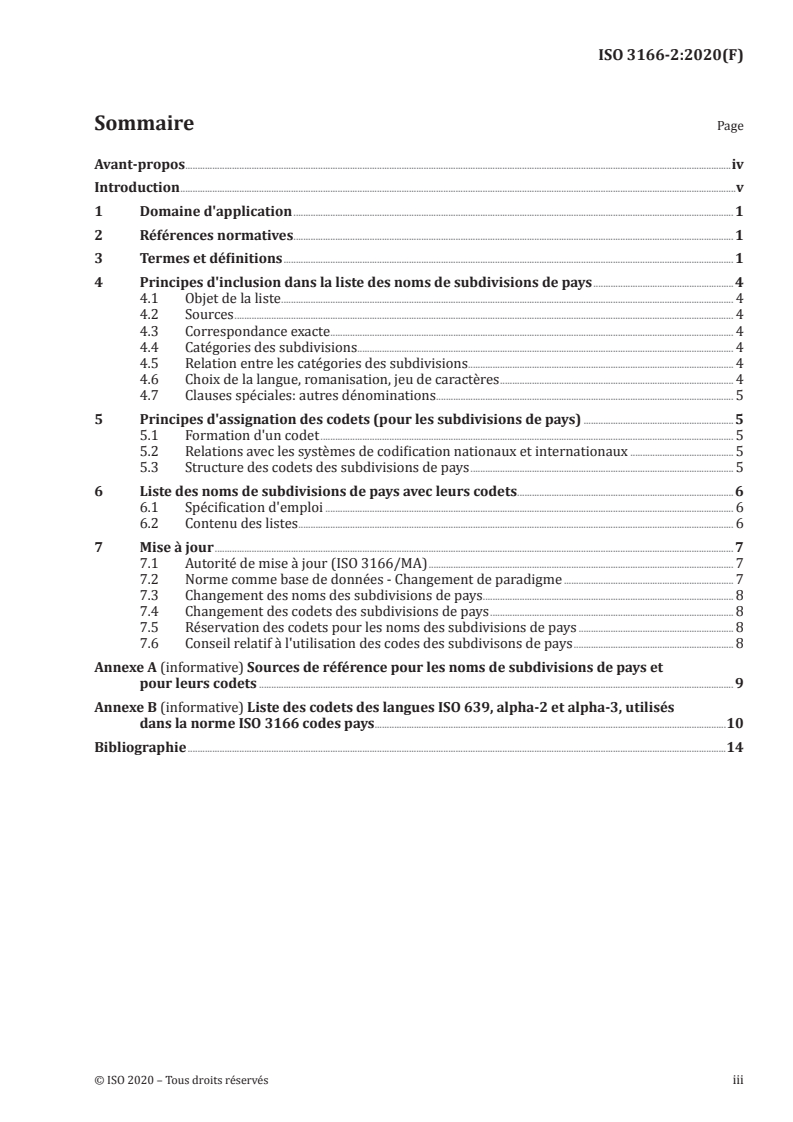
Contents Page
Foreword .iv
Introduction .v
1 Scope . 1
2 Normative references . 1
3 Terms and definitions . 1
4 Principles for inclusion in the list of country subdivision names . 4
4.1 List purpose . 4
4.2 Sources . 4
4.3 One-to-one correspondence . 4
4.4 Categories of subdivisions . 4
4.5 Relationship between categories of subdivisions . 4
4.6 Choice of language, romanization, character set . 4
4.7 Special provisions: alternative names . 5
5 Principles for assigning (country subdivision) code elements. 5
5.1 Code element formation . 5
5.2 Relationship to national or international code systems . 5
5.3 Structure of country subdivision code elements . 5
6 List of country subdivision names and their code elements . 6
6.1 Specification for use . 6
6.2 Content of the list . 6
7 Maintenance . 7
7.1 Maintenance Agency (ISO 3166/MA) . 7
7.2 Standard as a database — Change of paradigm . 7
7.3 Change of country subdivision names . 8
7.4 Alteration to country subdivision code elements . 8
7.5 Reservation of code elements for country subdivision names . 8
7.6 Advice regarding use of country subdivision codes . 8
Annex A (informative) Reference sources for country subdivision names and code elements .9
Annex B (informative) List of ISO 639 language codes elements, alpha-2 and alpha-3, used
in the ISO 3166 series of standards of country codes .10
Bibliography .14
Foreword
ISO (the International Organization for Standardization) is a worldwide federation of national standards
bodies (ISO member bodies). The work of preparing International Standards is normally carried out
through ISO technical committees. Each member body interested in a subject for which a technical
committee has been established has the right to be represented on that committee. International
organizations, governmental and non-governmental, in liaison with ISO, also take part in the work.
ISO collaborates closely with the International Electrotechnical Commission (IEC) on all matters of
electrotechnical standardization.
The procedures used to develop this document and those intended for its further maintenance are
described in the ISO/IEC Directives, Part 1. In particular, the different approval criteria needed for the
different types of ISO documents should be noted. This document was drafted in accordance with the
editorial rules of the ISO/IEC Directives, Part 2 (see www .iso .org/ directives).
Attention is drawn to the possibility that some of the elements of this document may be the subject of
patent rights. ISO shall not be held responsible for identifying any or all such patent rights. Details of
any patent rights identified during the development of the document will be in the Introduction and/or
on the ISO list of patent declarations received (see www .iso .org/ patents).
Any trade name used in this document is information given for the convenience of users and does not
constitute an endorsement.
For an explanation of the voluntary nature of standards, the meaning of ISO specific terms and
expressions related to conformity assessment, as well as information about ISO's adherence to the
World Trade Organization (WTO) principles in the Technical Barriers to Trade (TBT) see www .iso .org/
iso/ foreword .html.
This document was prepared by Technical Committee ISO/TC 46, Information and documentation.
This fourth edition cancels and replaces the third edition (ISO 3166-2:2013), which has been technically
revised.
The main changes compared to the previous edition are as follows.
— The codes have been moved to the database format.
— The components of the codes have been defined by descriptors, not by column or line numbers.
— The status of each alpha-2 country code element has been made explicit, as it is the main resource
managed by ISO 3166/MA, necessary for traceability over time.
— All characters in the database, specifically those with diacritical marks, have been checked with the
Universal Coded Character Set, ISO/IEC 10646, and are used consistently.
— The database encoding is UTF-8 (Universal Character Set Transformation Format - 8 bits) from
ISO/IEC 10646, and the same has been used in many applications.
— The three parts — three codes — belong to the same database, updates are done only once for
all parts.
A list of all parts in the ISO 3166 series can be found on the ISO website.
Any feedback or questions on this document should be directed to the user's national standards body. A
complete listing of these bodies can be found at www .iso .org/ members .html.
iv © ISO 2020 – All rights reserved
Introduction
The initial edition of the International Standard ISO 3166 was prepared by Technical Committee
ISO/TC 46, in collaboration with the following International Organizations: Customs Cooperation
Council (CCC), [since 1995: World Customs Organization (WCO)], United Nations Economic Commission
for Europe (ECE), Food and Agriculture Organization of the United Nations (FAO), International
Atomic Energy Agency (IAEA), International Air Transport Association (IATA), International Chamber
of Commerce (ICC), International Chamber of Shipping (ICS), International Federation of Library
Associations (IFLA), International Labour Office (ILO), International Telecommunication Union (ITU),
International Union of Railways (UIC), United Nations Organization (UN), United Nations Conference
on Trade and Development (UNCTAD), Universal Postal Union (UPU), World Intellectual Property
Organization (WIPO), and World Health Organization (WHO).
ISO 3166 was first published in 1974, subsequent editions in 1981, 1988 and 1993. In 1997, it was
divided into three parts.
— Editions of ISO 3166-1: ISO 3166-1:1997, ISO 3166-1:2006, ISO 3166-1:2013.
— Editions of ISO 3166-2: ISO 3166-2:1998, ISO 3166-2:2007, ISO 3166-2:2013.
— Editions of ISO 3166-3: ISO 3166-3:1999, ISO 3166-3:2013.
ISO 3166 provides universally applicable coded representations of names of countries (current and
non-current), dependencies, and other areas of particular geopolitical interest and their subdivisions.
ISO 3166-1 establishes codes that represent the current names of countries, dependencies, and other
areas of particular geopolitical interest, on the basis of country names obtained from the United
Nations.
ISO 3166-2 establishes a code that represents the names of the principal administrative divisions, or
similar areas, of the countries and entities included in ISO 3166-1.
ISO 3166-3 establishes a code that represents non-current country names, i.e. the country names
deleted from ISO 3166 since its first publication in 1974.
The ISO 3166 series do not express any opinion whatsoever concerning the legal status of any country,
dependency, or other area named herein, or concerning its frontiers or boundaries.
The 2013 edition of the ISO 3166 series has been the last one published as paper standard, with the
descriptive text, and the codes together.
At the end of 2013, the split had happened: ISO 3166 codes have been moved to the database format
(de facto merging three contents together), with access from ISO Online Browsing Platform, while the
descriptive text have been awaiting updates.
This 2020 edition of the ISO 3166 series includes an update of the descriptive text (description of the
codes) from 2013, for each of three parts. It takes into account the stricter database rules imposed on
the code itself, as opposed to paper documents.
The International Standard ISO 3166 has been the very first ISO achievement of the concept of
"standard as a database", implemented in the end of 2013. The ISO Online Browsing Platform (ISO OBP)
is an application to visualise ISO3166 codes on the web interface, the data being stored in the unseen
database.
The International Standard ISO 3166, for each of its three parts - three codes - is formed of two
components: documented description of its content, and its related content inside a database.
Both terms "this document" and "the code corresponding to this document" are used throughout this
2020 edition of the ISO 3166 series.
INTERNATIONAL STANDARD ISO 3166-2:2020(E)
Codes for the representation of names of countries and
their subdivisions —
Part 2:
Country subdivision code
1 Scope
This document specifies basic guidelines for the implementation and maintenance of country
subdivision codes.
This code is intended for use in any application requiring the expression of current country subdivision
names in coded form.
2 Normative references
There are no normative references in this document.
3 Terms and definitions
For the purposes of this document, the following terms and definitions apply.
ISO and IEC maintain terminological databases for use in standardization at the following addresses:
— ISO Online browsing platform: available at https:// www .iso .org/ obp
— IEC Electropedia: available at http:// www .electropedia .org/
3.1
code
set of data transformed or represented in different forms according to a pre-established set of rules
[SOURCE: ISO 5127:2017, 3.1.13.10]
3.2
code element
result of applying a code to an element of a coded set
Note 1 to entry: In the country subdivision code part, a code element represents a country subdivision name.
[SOURCE: ISO/IEC 2382:2015, 2121555]
3.3
country code
list of country names with their representations by code elements
Note 1 to entry: The country code types are alpha-2, alpha-3 and num-3.
3.4
country name
name of a country, dependency, or other area of particular geopolitical interest
3.5
script
set of graphic characters used for the written form of one or more languages
Note 1 to entry: Codes for the representation of names of scripts are defined in ISO 15924 standard.
[SOURCE: ISO/IEC 10646-1:2017, 3.50]
3.6
language of the ISO 3166 standard
language in which the terminology has been defined, the terminology shall be maintained current
Note 1 to entry: English and French are the main languages of the ISO 3166 standard.
3.7
administrative language of the country
written language used by the administration of the country at the national level
3.11
alpha-2 country code element
alphabetic 2 character (alpha-2) code
Note 1 to entry: An alpha-2 code is generally recommended to represent country names.
3.14
short NAME of country
short form of the country name, distinctive word first
Note 1 to entry: In language of the ISO 3166 standard.
Note 2 to entry: This item might be inverted, allowing the distinctive word to appear first, so that items can be
easily found in an alphabetical list.
3.20
alpha-2 language code element
alpha-2 ISO 639 language code element of each administrative language of the country (3.7)
Note 1 to entry: With a hyphen-minus when the code element is missing.
3.21
alpha-3 language code element
alpha-3 ISO 639 language code element ("T" terminological version) of each administrative language of
the country (3.7)
Note 1 to entry: When an alpha-3 language code element for a language name used in the ISO 3166 is missing in
ISO 639-2 and in ISO 639-3, it is indicated with a number, such is 002.
3.22
local short name of country
short name of country given in an administrative language of the country.
Note 1 to entry: It might be noted in language of the ISO 3166 standard as remark part 1 (3.18).
EXAMPLE 1
Schweiz (die) is local short country name in German language for the Switzerland.
Svizzera (la) is local short country name in Italian language for the Switzerland.
Magyarország is local short country name in Hungarian language for Hungary.
EXAMPLE 2
2 © ISO 2020 – All rights reserved
Zhongguo is local short country name in Chinese language for China, with Romanization system National 1958 =
ISO 7098:2015 = UN III/8 1977, used to convert Han (Simplified variant) script to Latin script.
Qaţar is local short country name in Arabic language for Qatar, with Romanization system BGN/PCGN 1956, used
to convert Arab script to Latin script.
3.23
romanization system used
conversion of writing system from a different writing system to the Roman (Latin) script
Note 1 to entry: If the administrative language so requires.
Note 2 to entry: In language of the ISO 3166 standard.
3.24
description of the subdivision
description of the subdivision of the country
Note 1 to entry: With the relevant term in English, in French and in the administrative language, with the
corresponding counters.
3.25
list source of the subdivision
reference to the source of the list
3.26
code source of the subdivision
reference to the source of the code
3.27
remarks part 2
remarks concerning subdivision
Note 1 to entry: In language of the ISO 3166 standard.
3.28
country subdivision code
coded representation of country subdivision names
Note 1 to entry: The country subdivision code is composed of a maximum length of 6 characters, starting with
alpha-2 country code, followed by a hyphen-minus, and up to 3 characters from A-Z;0-9 as a code within the
country.
3.29
country subdivision name
name of a unit resulting from the division of a country, dependency, or other area of special geopolitical
interest contained in ISO 3166-1
Note 1 to entry: In written language used by the administration of the country for this subdivision.
Note 2 to entry: In exceptional cases, variants of the same country subdivision name are shown in square
brackets beside that name.
3.30
parent subdivision
code of another level of regional subdivision not used as part of the subdivision code element
Note 1 to entry: Optional information, when available.
3.31
country subdivision name local variant
name of a unit resulting from the division of a country, dependency, or other area of special geopolitical
interest contained in the ISO 3166-1
3.32
sorting order
of an administrative language
Note 1 to entry: Optional information, when available.
4 Principles for inclusion in the list of country subdivision names
4.1 List purpose
The list of country subdivision names in part 2 of the ISO 3166 database includes those required to
satisfy the broadest possible range of applications.
4.2 Sources
The country subdivision names included in part 2 of the ISO 3166 database shall be those that properly
reflect the subdivisions of the countries included in ISO 3166-1 of the ISO 3166 database. Names reflect
the complete currently known subdivision of the countries, without overlaps, as notified by the national
authorities concerned or otherwise obtained from sources to which reference is given (see Annex A).
4.3 One-to-one correspondence
A one-to-one correspondence with country names in part 1 of the ISO 3166 database is maintained.
Each alpha-2 code element assigned to a country name in part 1 of the ISO 3166 database is also shown
in part 2 of the ISO 3166 database.
4.4 Categories of subdivisions
Where different terms are used to categorize country subdivisions, they are included. Country
subdivision names are listed within their category. The terms used to describe such categories are
those used by the countries concerned, with their approximate equivalents in English and in French, if
required and available. In some cases, a subdivision term is consistently included as its omission would
change the grammatical form of the subdivision name.
EXAMPLE LT-VL Vilniaus Aps
...
INTERNATIONAL ISO
STANDARD 3166-2
Fourth edition
2020-08
Codes for the representation of names
of countries and their subdivisions —
Part 2:
Country subdivision code
Codes pour la représentation des noms de pays et de leurs
subdivisions —
Partie 2: Code pour les subdivisions de pays
Reference number
©
ISO 2020
© ISO 2020
All rights reserved. Unless otherwise specified, or required in the context of its implementation, no part of this publication may
be reproduced or utilized otherwise in any form or by any means, electronic or mechanical, including photocopying, or posting
on the internet or an intranet, without prior written permission. Permission can be requested from either ISO at the address
below or ISO’s member body in the country of the requester.
ISO copyright office
CP 401 • Ch. de Blandonnet 8
CH-1214 Vernier, Geneva
Phone: +41 22 749 01 11
Email: copyright@iso.org
Website: www.iso.org
Published in Switzerland
ii © ISO 2020 – All rights reserved
Contents Page
Foreword .iv
Introduction .v
1 Scope . 1
2 Normative references . 1
3 Terms and definitions . 1
4 Principles for inclusion in the list of country subdivision names . 4
4.1 List purpose . 4
4.2 Sources . 4
4.3 One-to-one correspondence . 4
4.4 Categories of subdivisions . 4
4.5 Relationship between categories of subdivisions . 4
4.6 Choice of language, romanization, character set . 4
4.7 Special provisions: alternative names . 5
5 Principles for assigning (country subdivision) code elements. 5
5.1 Code element formation . 5
5.2 Relationship to national or international code systems . 5
5.3 Structure of country subdivision code elements . 5
6 List of country subdivision names and their code elements . 6
6.1 Specification for use . 6
6.2 Content of the list . 6
7 Maintenance . 7
7.1 Maintenance Agency (ISO 3166/MA) . 7
7.2 Standard as a database — Change of paradigm . 7
7.3 Change of country subdivision names . 8
7.4 Alteration to country subdivision code elements . 8
7.5 Reservation of code elements for country subdivision names . 8
7.6 Advice regarding use of country subdivision codes . 8
Annex A (informative) Reference sources for country subdivision names and code elements .9
Annex B (informative) List of ISO 639 language codes elements, alpha-2 and alpha-3, used
in the ISO 3166 series of standards of country codes .10
Bibliography .14
Foreword
ISO (the International Organization for Standardization) is a worldwide federation of national standards
bodies (ISO member bodies). The work of preparing International Standards is normally carried out
through ISO technical committees. Each member body interested in a subject for which a technical
committee has been established has the right to be represented on that committee. International
organizations, governmental and non-governmental, in liaison with ISO, also take part in the work.
ISO collaborates closely with the International Electrotechnical Commission (IEC) on all matters of
electrotechnical standardization.
The procedures used to develop this document and those intended for its further maintenance are
described in the ISO/IEC Directives, Part 1. In particular, the different approval criteria needed for the
different types of ISO documents should be noted. This document was drafted in accordance with the
editorial rules of the ISO/IEC Directives, Part 2 (see www .iso .org/ directives).
Attention is drawn to the possibility that some of the elements of this document may be the subject of
patent rights. ISO shall not be held responsible for identifying any or all such patent rights. Details of
any patent rights identified during the development of the document will be in the Introduction and/or
on the ISO list of patent declarations received (see www .iso .org/ patents).
Any trade name used in this document is information given for the convenience of users and does not
constitute an endorsement.
For an explanation of the voluntary nature of standards, the meaning of ISO specific terms and
expressions related to conformity assessment, as well as information about ISO's adherence to the
World Trade Organization (WTO) principles in the Technical Barriers to Trade (TBT) see www .iso .org/
iso/ foreword .html.
This document was prepared by Technical Committee ISO/TC 46, Information and documentation.
This fourth edition cancels and replaces the third edition (ISO 3166-2:2013), which has been technically
revised.
The main changes compared to the previous edition are as follows.
— The codes have been moved to the database format.
— The components of the codes have been defined by descriptors, not by column or line numbers.
— The status of each alpha-2 country code element has been made explicit, as it is the main resource
managed by ISO 3166/MA, necessary for traceability over time.
— All characters in the database, specifically those with diacritical marks, have been checked with the
Universal Coded Character Set, ISO/IEC 10646, and are used consistently.
— The database encoding is UTF-8 (Universal Character Set Transformation Format - 8 bits) from
ISO/IEC 10646, and the same has been used in many applications.
— The three parts — three codes — belong to the same database, updates are done only once for
all parts.
A list of all parts in the ISO 3166 series can be found on the ISO website.
Any feedback or questions on this document should be directed to the user's national standards body. A
complete listing of these bodies can be found at www .iso .org/ members .html.
iv © ISO 2020 – All rights reserved
Introduction
The initial edition of the International Standard ISO 3166 was prepared by Technical Committee
ISO/TC 46, in collaboration with the following International Organizations: Customs Cooperation
Council (CCC), [since 1995: World Customs Organization (WCO)], United Nations Economic Commission
for Europe (ECE), Food and Agriculture Organization of the United Nations (FAO), International
Atomic Energy Agency (IAEA), International Air Transport Association (IATA), International Chamber
of Commerce (ICC), International Chamber of Shipping (ICS), International Federation of Library
Associations (IFLA), International Labour Office (ILO), International Telecommunication Union (ITU),
International Union of Railways (UIC), United Nations Organization (UN), United Nations Conference
on Trade and Development (UNCTAD), Universal Postal Union (UPU), World Intellectual Property
Organization (WIPO), and World Health Organization (WHO).
ISO 3166 was first published in 1974, subsequent editions in 1981, 1988 and 1993. In 1997, it was
divided into three parts.
— Editions of ISO 3166-1: ISO 3166-1:1997, ISO 3166-1:2006, ISO 3166-1:2013.
— Editions of ISO 3166-2: ISO 3166-2:1998, ISO 3166-2:2007, ISO 3166-2:2013.
— Editions of ISO 3166-3: ISO 3166-3:1999, ISO 3166-3:2013.
ISO 3166 provides universally applicable coded representations of names of countries (current and
non-current), dependencies, and other areas of particular geopolitical interest and their subdivisions.
ISO 3166-1 establishes codes that represent the current names of countries, dependencies, and other
areas of particular geopolitical interest, on the basis of country names obtained from the United
Nations.
ISO 3166-2 establishes a code that represents the names of the principal administrative divisions, or
similar areas, of the countries and entities included in ISO 3166-1.
ISO 3166-3 establishes a code that represents non-current country names, i.e. the country names
deleted from ISO 3166 since its first publication in 1974.
The ISO 3166 series do not express any opinion whatsoever concerning the legal status of any country,
dependency, or other area named herein, or concerning its frontiers or boundaries.
The 2013 edition of the ISO 3166 series has been the last one published as paper standard, with the
descriptive text, and the codes together.
At the end of 2013, the split had happened: ISO 3166 codes have been moved to the database format
(de facto merging three contents together), with access from ISO Online Browsing Platform, while the
descriptive text have been awaiting updates.
This 2020 edition of the ISO 3166 series includes an update of the descriptive text (description of the
codes) from 2013, for each of three parts. It takes into account the stricter database rules imposed on
the code itself, as opposed to paper documents.
The International Standard ISO 3166 has been the very first ISO achievement of the concept of
"standard as a database", implemented in the end of 2013. The ISO Online Browsing Platform (ISO OBP)
is an application to visualise ISO3166 codes on the web interface, the data being stored in the unseen
database.
The International Standard ISO 3166, for each of its three parts - three codes - is formed of two
components: documented description of its content, and its related content inside a database.
Both terms "this document" and "the code corresponding to this document" are used throughout this
2020 edition of the ISO 3166 series.
INTERNATIONAL STANDARD ISO 3166-2:2020(E)
Codes for the representation of names of countries and
their subdivisions —
Part 2:
Country subdivision code
1 Scope
This document specifies basic guidelines for the implementation and maintenance of country
subdivision codes.
This code is intended for use in any application requiring the expression of current country subdivision
names in coded form.
2 Normative references
There are no normative references in this document.
3 Terms and definitions
For the purposes of this document, the following terms and definitions apply.
ISO and IEC maintain terminological databases for use in standardization at the following addresses:
— ISO Online browsing platform: available at https:// www .iso .org/ obp
— IEC Electropedia: available at http:// www .electropedia .org/
3.1
code
set of data transformed or represented in different forms according to a pre-established set of rules
[SOURCE: ISO 5127:2017, 3.1.13.10]
3.2
code element
result of applying a code to an element of a coded set
Note 1 to entry: In the country subdivision code part, a code element represents a country subdivision name.
[SOURCE: ISO/IEC 2382:2015, 2121555]
3.3
country code
list of country names with their representations by code elements
Note 1 to entry: The country code types are alpha-2, alpha-3 and num-3.
3.4
country name
name of a country, dependency, or other area of particular geopolitical interest
3.5
script
set of graphic characters used for the written form of one or more languages
Note 1 to entry: Codes for the representation of names of scripts are defined in ISO 15924 standard.
[SOURCE: ISO/IEC 10646-1:2017, 3.50]
3.6
language of the ISO 3166 standard
language in which the terminology has been defined, the terminology shall be maintained current
Note 1 to entry: English and French are the main languages of the ISO 3166 standard.
3.7
administrative language of the country
written language used by the administration of the country at the national level
3.11
alpha-2 country code element
alphabetic 2 character (alpha-2) code
Note 1 to entry: An alpha-2 code is generally recommended to represent country names.
3.14
short NAME of country
short form of the country name, distinctive word first
Note 1 to entry: In language of the ISO 3166 standard.
Note 2 to entry: This item might be inverted, allowing the distinctive word to appear first, so that items can be
easily found in an alphabetical list.
3.20
alpha-2 language code element
alpha-2 ISO 639 language code element of each administrative language of the country (3.7)
Note 1 to entry: With a hyphen-minus when the code element is missing.
3.21
alpha-3 language code element
alpha-3 ISO 639 language code element ("T" terminological version) of each administrative language of
the country (3.7)
Note 1 to entry: When an alpha-3 language code element for a language name used in the ISO 3166 is missing in
ISO 639-2 and in ISO 639-3, it is indicated with a number, such is 002.
3.22
local short name of country
short name of country given in an administrative language of the country.
Note 1 to entry: It might be noted in language of the ISO 3166 standard as remark part 1 (3.18).
EXAMPLE 1
Schweiz (die) is local short country name in German language for the Switzerland.
Svizzera (la) is local short country name in Italian language for the Switzerland.
Magyarország is local short country name in Hungarian language for Hungary.
EXAMPLE 2
2 © ISO 2020 – All rights reserved
Zhongguo is local short country name in Chinese language for China, with Romanization system National 1958 =
ISO 7098:2015 = UN III/8 1977, used to convert Han (Simplified variant) script to Latin script.
Qaţar is local short country name in Arabic language for Qatar, with Romanization system BGN/PCGN 1956, used
to convert Arab script to Latin script.
3.23
romanization system used
conversion of writing system from a different writing system to the Roman (Latin) script
Note 1 to entry: If the administrative language so requires.
Note 2 to entry: In language of the ISO 3166 standard.
3.24
description of the subdivision
description of the subdivision of the country
Note 1 to entry: With the relevant term in English, in French and in the administrative language, with the
corresponding counters.
3.25
list source of the subdivision
reference to the source of the list
3.26
code source of the subdivision
reference to the source of the code
3.27
remarks part 2
remarks concerning subdivision
Note 1 to entry: In language of the ISO 3166 standard.
3.28
country subdivision code
coded representation of country subdivision names
Note 1 to entry: The country subdivision code is composed of a maximum length of 6 characters, starting with
alpha-2 country code, followed by a hyphen-minus, and up to 3 characters from A-Z;0-9 as a code within the
country.
3.29
country subdivision name
name of a unit resulting from the division of a country, dependency, or other area of special geopolitical
interest contained in ISO 3166-1
Note 1 to entry: In written language used by the administration of the country for this subdivision.
Note 2 to entry: In exceptional cases, variants of the same country subdivision name are shown in square
brackets beside that name.
3.30
parent subdivision
code of another level of regional subdivision not used as part of the subdivision code element
Note 1 to entry: Optional information, when available.
3.31
country subdivision name local variant
name of a unit resulting from the division of a country, dependency, or other area of special geopolitical
interest contained in the ISO 3166-1
3.32
sorting order
of an administrative language
Note 1 to entry: Optional information, when available.
4 Principles for inclusion in the list of country subdivision names
4.1 List purpose
The list of country subdivision names in part 2 of the ISO 3166 database includes those required to
satisfy the broadest possible range of applications.
4.2 Sources
The country subdivision names included in part 2 of the ISO 3166 database shall be those that properly
reflect the subdivisions of the countries included in ISO 3166-1 of the ISO 3166 database. Names reflect
the complete currently known subdivision of the countries, without overlaps, as notified by the national
authorities concerned or otherwise obtained from sources to which reference is given (see Annex A).
4.3 One-to-one correspondence
A one-to-one correspondence with country names in part 1 of the ISO 3166 database is maintained.
Each alpha-2 code element assigned to a country name in part 1 of the ISO 3166 database is also shown
in part 2 of the ISO 3166 database.
4.4 Categories of subdivisions
Where different terms are used to categorize country subdivisions, they are included. Country
subdivision names are listed within their category. The terms used to describe such categories are
those used by the countries concerned, with their approximate equivalents in English and in French, if
required and available. In some cases, a subdivision term is consistently included as its omission would
change the grammatical form of the subdivision name.
EXAMPLE LT-VL Vilniaus Apskritis
Omitting Apskritis (meaning county in Lithuanian) would result in changing the subdivision name to
Vilnius (the city name).
4.5 Relationship between categories of subdivisions
In part 2 of the ISO 3166 database, whenever several levels occur, the existing relationship between
them is documented.
4.6 Choice of language, romanization, character set
A country's administrative language is a written language used by the administration of the country at
the national level.
The country name and the subdivision name of the country are given
...
NORME ISO
INTERNATIONALE 3166-2
Quatrième édition
2020-08
Codes pour la représentation
des noms de pays et de leurs
subdivisions —
Partie 2:
Code pour les subdivisions de pays
Codes for the representation of names of countries and their
subdivisions —
Part 2: Country subdivision code
Numéro de référence
©
ISO 2020
DOCUMENT PROTÉGÉ PAR COPYRIGHT
© ISO 2020
Tous droits réservés. Sauf prescription différente ou nécessité dans le contexte de sa mise en œuvre, aucune partie de cette
publication ne peut être reproduite ni utilisée sous quelque forme que ce soit et par aucun procédé, électronique ou mécanique,
y compris la photocopie, ou la diffusion sur l’internet ou sur un intranet, sans autorisation écrite préalable. Une autorisation peut
être demandée à l’ISO à l’adresse ci-après ou au comité membre de l’ISO dans le pays du demandeur.
ISO copyright office
Case postale 401 • Ch. de Blandonnet 8
CH-1214 Vernier, Genève
Tél.: +41 22 749 01 11
E-mail: copyright@iso.org
Web: www.iso.org
Publié en Suisse
ii © ISO 2020 – Tous droits réservés
Sommaire Page
Avant-propos .iv
Introduction .v
1 Domaine d'application . 1
2 Références normatives . 1
3 Termes et définitions . 1
4 Principes d'inclusion dans la liste des noms de subdivisions de pays .4
4.1 Objet de la liste . 4
4.2 Sources . 4
4.3 Correspondance exacte . 4
4.4 Catégories des subdivisions . 4
4.5 Relation entre les catégories des subdivisions . . 4
4.6 Choix de la langue, romanisation, jeu de caractères . 4
4.7 Clauses spéciales: autres dénominations . 5
5 Principes d'assignation des codets (pour les subdivisions de pays) .5
5.1 Formation d'un codet . 5
5.2 Relations avec les systèmes de codification nationaux et internationaux . 5
5.3 Structure des codets des subdivisions de pays . 5
6 Liste des noms de subdivisions de pays avec leurs codets . 6
6.1 Spécification d'emploi . 6
6.2 Contenu des listes . 6
7 Mise à jour . 7
7.1 Autorité de mise à jour (ISO 3166/MA) . 7
7.2 Norme comme base de données - Changement de paradigme . 7
7.3 Changement des noms des subdivisions de pays . 8
7.4 Changement des codets des subdivisions de pays . 8
7.5 Réservation des codets pour les noms des subdivisions de pays . 8
7.6 Conseil relatif à l'utilisation des codes des subdivisons de pays . 8
Annexe A (informative) Sources de référence pour les noms de subdivisions de pays et
pour leurs codets . 9
Annexe B (informative) Liste des codets des langues ISO 639, alpha-2 et alpha-3, utilisés
dans la norme ISO 3166 codes pays . .10
Bibliographie .14
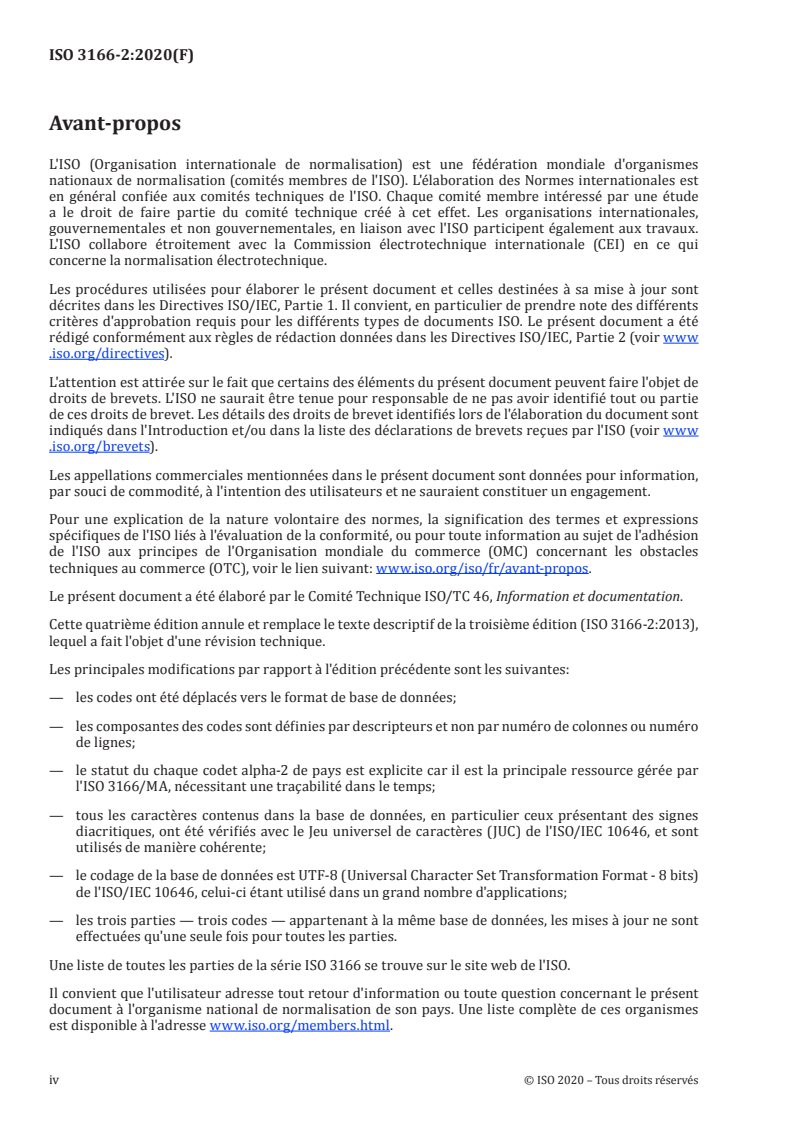
Avant-propos
L'ISO (Organisation internationale de normalisation) est une fédération mondiale d'organismes
nationaux de normalisation (comités membres de l'ISO). L'élaboration des Normes internationales est
en général confiée aux comités techniques de l'ISO. Chaque comité membre intéressé par une étude
a le droit de faire partie du comité technique créé à cet effet. Les organisations internationales,
gouvernementales et non gouvernementales, en liaison avec l'ISO participent également aux travaux.
L'ISO collabore étroitement avec la Commission électrotechnique internationale (CEI) en ce qui
concerne la normalisation électrotechnique.
Les procédures utilisées pour élaborer le présent document et celles destinées à sa mise à jour sont
décrites dans les Directives ISO/IEC, Partie 1. Il convient, en particulier de prendre note des différents
critères d'approbation requis pour les différents types de documents ISO. Le présent document a été
rédigé conformément aux règles de rédaction données dans les Directives ISO/IEC, Partie 2 (voir www
.iso .org/ directives).
L'attention est attirée sur le fait que certains des éléments du présent document peuvent faire l'objet de
droits de brevets. L'ISO ne saurait être tenue pour responsable de ne pas avoir identifié tout ou partie
de ces droits de brevet. Les détails des droits de brevet identifiés lors de l'élaboration du document sont
indiqués dans l'Introduction et/ou dans la liste des déclarations de brevets reçues par l'ISO (voir www
.iso .org/ brevets).
Les appellations commerciales mentionnées dans le présent document sont données pour information,
par souci de commodité, à l'intention des utilisateurs et ne sauraient constituer un engagement.
Pour une explication de la nature volontaire des normes, la signification des termes et expressions
spécifiques de l'ISO liés à l'évaluation de la conformité, ou pour toute information au sujet de l'adhésion
de l'ISO aux principes de l'Organisation mondiale du commerce (OMC) concernant les obstacles
techniques au commerce (OTC), voir le lien suivant: www .iso .org/ iso/ fr/ avant -propos.
Le présent document a été élaboré par le Comité Technique ISO/TC 46, Information et documentation.
Cette quatrième édition annule et remplace le texte descriptif de la troisième édition (ISO 3166-2:2013),
lequel a fait l'objet d'une révision technique.
Les principales modifications par rapport à l'édition précédente sont les suivantes:
— les codes ont été déplacés vers le format de base de données;
— les composantes des codes sont définies par descripteurs et non par numéro de colonnes ou numéro
de lignes;
— le statut du chaque codet alpha-2 de pays est explicite car il est la principale ressource gérée par
l'ISO 3166/MA, nécessitant une traçabilité dans le temps;
— tous les caractères contenus dans la base de données, en particulier ceux présentant des signes
diacritiques, ont été vérifiés avec le Jeu universel de caractères (JUC) de l'ISO/IEC 10646, et sont
utilisés de manière cohérente;
— le codage de la base de données est UTF-8 (Universal Character Set Transformation Format - 8 bits)
de l'ISO/IEC 10646, celui-ci étant utilisé dans un grand nombre d'applications;
— les trois parties — trois codes — appartenant à la même base de données, les mises à jour ne sont
effectuées qu'une seule fois pour toutes les parties.
Une liste de toutes les parties de la série ISO 3166 se trouve sur le site web de l'ISO.
Il convient que l'utilisateur adresse tout retour d'information ou toute question concernant le présent
document à l'organisme national de normalisation de son pays. Une liste complète de ces organismes
est disponible à l'adresse www .iso .org/ members .html.
iv © ISO 2020 – Tous droits réservés
Introduction
L'édition initiale de la Norme internationale ISO 3166 a été élaborée par le comité technique ISO/TC 46
avec la collaboration des Organisations internationales suivantes: Conseil de coopération douanière
(CCD) [depuis 1995, Organisation mondiale des douanes (OMD)], Chambre de commerce internationale
(CCI), Comité économique pour l'Europe des Nations Unies (CEE), Organisation des Nations Unies pour
l'alimentation et l'agriculture (FAO), Fédération internationale des associations de bibliothécaires
(IFLA), Agence internationale de l'énergie atomique (IAEA), Association du transport aérien
international (IATA), Chambre internationale de la marine marchande (ICS), Organisation mondiale de
la propriété intellectuelle (OMPI), Organisation mondiale de la santé (OMS), Organisation des Nations
Unies (ONU), Conférence des Nations Unies sur le commerce et le développement (UNCTAD), Union
internationale des chemins de fer (UIC), Union internationale des télécommunications (UIT), Union
postale universelle (UPU).
L'ISO 3166 a été publiée pour la première fois en 1974, les éditions suivantes en 1981, 1988 et 1993. En
1997, elle a été divisée en trois parties.
— Versions de l'ISO 3166-1: ISO 3166-1:1997, ISO 3166-1:2006, ISO 3166-1:2013.
— Versions de l'ISO 3166-2: ISO 3166-2:1998, ISO 3166-2:2007, ISO 3166-2:2013.
— Versions de l'ISO 3166-3: ISO 3166-3:1999, ISO 3166-3:2013.
La série ISO 3166 fournit des représentations codées, utilisables universellement, des noms de pays
(actuels ou non actuels), dépendances et autres zones d'intérêt géopolitique particulier et de leurs
subdivisions.
L'ISO 3166-1 établit des codes qui représentent les noms de pays actuels, des dépendances et autres
territoires d'intérêt géopolitique particulier, basés sur des noms de pays provenant des Nations Unies.
L'ISO 3166-2 établit un code qui représente les noms des principales divisions administratives ou des
territoires similaires des pays et entités inclus dans l'ISO 3166-1.
L'ISO 3166-3 établit un code pour représenter les noms non actuels de pays, c'est-à-dire des pays dont
les noms ont été supprimés de l'ISO 3166 depuis sa première publication en 1974.
La série ISO 3166 n'exprime aucune opinion sur le statut légal des pays, des dépendances ou autres
zones citées, ou sur la délimitation de leurs frontières ou de leurs limites.
L'édition 2013 de la série ISO 3166 a été la dernière publiée en tant que norme sur papier, avec le texte
descriptif et les codes ensemble.
La scission avait eu lieu fin 2013: les codes ISO 3166 avaient été déplacés vers le format de base de
données (en fusionnant de facto les trois parties), avec un accès depuis la Plateforme de consultation en
ligne de l'ISO (OBP), tandis que le texte descriptif attendait des mises à jour.
Cette édition 2020 de la série ISO 3166 comprend une mise à jour du texte descriptif (description des
codes) de 2013, pour chacune des trois parties. Elle prend en compte les règles plus strictes des bases
de données imposées au code lui-même, contrairement aux documents sur papier.
La Norme internationale ISO 3166 a été la toute première réalisation ISO du concept de «norme en tant
qu'une base de données», et mise en application fin 2013. La Plateforme de consultation en ligne de
l'ISO (OBP) est une application permettant de consulter les codes de l'ISO 3166 sur l'interface web, les
données étant stockées dans la base de données invisible.
La Norme internationale ISO 3166 pour chacune de ses trois parties - trois codes - comprend deux
composantes: une description documentée de son contenu et son contenu associé dans une base de
données.
Les deux termes «le présent document» et «le code correspondant au présent document» sont utilisées
dans toute cette édition 2020 de la série ISO 3166.
NORME INTERNATIONALE ISO 3166-2:2020(F)
Codes pour la représentation des noms de pays et de leurs
subdivisions —
Partie 2:
Code pour les subdivisions de pays
1 Domaine d'application
Le présent document spécifie les principes directeurs pour la mise en application et la mise à jour des
codes pour les subdivisions de pays.
Ces codes sont destinés à toute application nécessitant l'expression des noms de subdivisions de pays
sous une forme codée.
2 Références normatives
Le présent document ne contient aucune référence normative.
3 Termes et définitions
Pour les besoins du présent document, les termes et définitions suivants s'appliquent.
L'ISO et l'IEC tiennent à jour des bases de données terminologiques destinées à être utilisées en
normalisation, consultables aux adresses suivantes:
— ISO Online browsing platform: disponible à l'adresse https:// www .iso .org/ obp
— IEC Electropedia: disponible à l'adresse http:// www .electropedia .org/
3.1
code
ensemble de données transformées ou représentées sous différentes formes suivant des règles
préétablies
[SOURCE: ISO 5127:2017, 3.1.13.10]
3.2
codet
résultat de l'application d'un code à un élément d'un jeu codé
Note 1 à l'article: Dans la partie codes pour les subdivisions de pays, un codet représente un nom de subdivision
de pays.
[SOURCE: ISO/IEC 2382:2015, 2121555]
3.3
code pays
liste des noms de pays avec leur représentation codée
Note 1 à l'article: Les types de code de pays sont alpha-2, alpha-3 et num-3.
3.4
nom de pays
nom d'un pays, d'une dépendance ou d'un autre territoire d'intérêt géopolitique particulier
3.5
écriture
ensemble de caractères graphiques utilisés pour la forme écrite d'une ou de plusieurs langues
Note 1 à l'article: Les codes pour la représentation des noms d'écritures sont définis dans l'ISO 15924.
[SOURCE: ISO/IEC 10646-1:2017, 3.50]
3.6
langue de la norme ISO 3166
langue utilisée pour la définition de la terminologie, la terminologie doit être maintenue à jour
Note 1 à l'article: Anglais et français sont les langues principales de la norme ISO 3166.
3.7
langue administrative du pays
langue écrite utilisée par l'administration du pays au niveau national
3.11
codet alpha-2 du pays
code alphabétique à 2 caractères (alpha-2)
Note 1 à l'article: Un code alpha-2 est généralement recommandé pour représenter les noms de pays.
3.14
NOM court du pays
forme courte du nom de pays, mot distinctif d'abord
Note 1 à l'article: Dans une langue de la norme ISO 3166.
Note 2 à l'article: Cet item peut être inversé, pour que le mot distinctif apparaisse en premier de manière à
pouvoir trouver facilement un nom dans une liste alphabétique.
3.20
codet langue alpha-2
codet alpha-2 de l'ISO 639 de chaque langue administrative du pays (3.7)
Note 1 à l'article: Avec un hyphen-minus lorsque le codet est absent.
3.21
codet langue alpha-3
codet alpha-3 (version «T») de l'ISO 639 de chaque langue administrative du pays (3.7)
Note 1 à l'article: Lorsqu'un codet langue alpha-3 pour un nom de langue utilisé dans l'ISO 3166 est manquant
dans l'ISO 639-2 et dans l'ISO 639-3, il est indiqué par un nombre, tel que 002.
3.22
nom local court du pays
forme courte locale du nom du pays indiquée dans une langue administrative du pays
Note 1 à l'article: Il peut être noté dans une langue de la norme ISO 3166 en tant que remarque Partie 1 (3.18).
EXEMPLE 1 1
Schweiz (die) est un nom local court, en langue allemande, de la Suisse.
Svizzera (la) est un nom local court, en langue italienne, de la Suisse.
Magyarország est un nom local court, en langue hongroise, d'Hongrie.
EXEMPLE 2 2
Zhongguo est un nom local court en langue chinoise de la Chine, utilisant le système de romanisation National
1958 = ISO 7098:2015 = UN III/8 1977, pour convertir l'écriture Han (variante simplifiée) vers l'écriture latine.
2 © ISO 2020 – Tous droits réservés
Qaţar est un nom local court en langue arabe, utilisant le système de romanisation BGN/PCGN 1956, pour
convertir l'écriture arabe vers l'écriture latine.
3.23
système de romanisation utilisé
conversion d'un système d'écriture, à partir d'un système d'écriture différent vers l'écriture latine
Note 1 à l'article: Si une langue administrative l'exige.
Note 2 à l'article: Dans une langue de la norme ISO 3166.
3.24
description de la subdivision
description de la subdivision du pays
Note 1 à l'article: Avec le terme approprié en anglais, en français, et dans la langue administrative avec les
compteurs correspondants.
3.25
source de la liste de la subdivision
référence à la source de la liste
3.26
source du code de la subdivision
référence à la source du code
3.27
remarques partie 2
remarques concernant la subdivision
Note 1 à l'article: Dans une langue de la norme ISO 3166.
3.28
code de subdivision du pays
représentation codée des noms des subdivisions de pays
Note 1 à l'article: La longueur maximale des codes de subdivision de pays est de six caractères, en commençant
par un codet alpha-2 du pays, suivi d'un hyphen-minus et de 1 à 3 caractères de A-Z;0-9 en tant que code à
l'intérieur du pays.
3.29
nom de subdivision de pays
nom d'une unité résultant de la division d'un pays, d'une dépendance ou d'un autre territoire d'un
intérêt géopolitique particulier figurant dans l'ISO 3166-1
Note 1 à l'article: Dans la langue écrite utilisée par l'administration du pays pour cette subdivision.
Note 2 à l'article: Dans certains cas exceptionnels, des variantes dans la dénomination d'une même subdivision
de pays figurent entre crochets à côté de ce nom.
3.30
subdivision parent
code d'un niveau différent de subdivision régionale non utilisé comme partie du codet de la subdivision
Note 1 à l'article: Optionnelle, si disponible.
3.31
variante locale du nom de subdivision du pays
nom d'une unité résultant de la division d'un pays, d'une dépendance ou d'un autre territoire d'un
intérêt géopolitique particulier figurant dans l'ISO 3166-1
3.32
ordre de tri
d'une langue administrative
Note 1 à l'article: Optionnelle, si disponible.
4 Principes d'inclusion dans la liste des noms de subdivisions de pays
4.1 Objet de la liste
La liste des noms de subdivision pays de la Partie 2 de l'ISO 3166 contient les éléments nécessaires pour
satisfaire le plus grand nombre possible d'applications.
4.2 Sources
Les noms de subdivisions de pays qui figurent dans la Partie 2 de la base de données ISO 3166 doivent
être ceux qui correspondent parfaitement aux subdivisions des pays cités dans l'ISO 3166-1 de la base
de données ISO 3166. Les noms reflètent la subdivision des pays telle qu'elle est connue actuellement,
sans recouvrement géographique, telle que notifiée par les autorités concernées ou obtenues à partir de
sources auxquelles il est fait référence (voir Annexe A).
4.3 Correspondance exacte
La correspondance exacte avec chacun des noms de pays figurant dans la Partie 1 de la base de données
ISO 3166 est conservée. Chaque codet alpha-2 assigné à un nom de pays dans la Partie 1 de la base de
données ISO 3166 figure également dans la Partie 2 de la base de données ISO 3166.
4.4 Catégories des subdivisions
Les différents termes utilisés pour désigner les catégories de subdivisions de pays sont mentionnés.
Les noms de subdivisions de pays sont répertoriés à l'intérieur de leur catégorie. Les termes employés
pour décrire de telles catégories sont ceux qu'utilisent les pays concernés; ils sont, si nécessaires,
accompagnés d'un équivalent approximatif en anglais et en français. Dans certains cas, le terme
qualifiant une subdivision est régulièrement inclus dans le nom, car son omission modifierait la forme
grammaticale du nom de la subdivision.
EXEMPLE LT-VL Vilniaus Apskritis.
Si on supprime le terme Apskritis (comté en lituanien), le nom de la subdivision devient Vilnius (nom de
la ville).
4.5 Relation entre les catégories des subdivisions
Dans la Partie 2 de la base de données ISO 3166, chaque fois que plusieurs niveaux apparaissent, la
relation qui existe entre eux est documentée.
4.6 Choix de la langue, romanisation, jeu de caractères
Une langue administrative d'un pays est une langue écrite utilisée par l
...
Die Norm SIST ISO 3166-2:2020 bietet eine fundierte Grundlage für die Implementierung und Pflege von Ländercodes und ihren Unterteilungen. Der Fokus dieser Norm liegt auf den grundlegenden Richtlinien zur Repräsentation von Ländern und deren Unterteilungen in kodierter Form. Ein wesentlicher Stärke der Norm ist ihre universelle Anwendbarkeit. Sie ist nicht nur für internationale Organisationen von Bedeutung, sondern auch für Softwareentwickler, Datenbankmanager und Unternehmen, die geografische Daten verarbeiten. Die Standardisierung der Codes ermöglicht eine konsistente und eindeutige Identifikation von Ländern sowie deren administrativen Einheiten, was zu einer vereinheitlichten Datenkommunikation beiträgt. Darüber hinaus ist die Norm äußerst relevant in der heutigen globalisierten Welt, in der präzise geografische Identifikationen in Systemen zur Datenverarbeitung, Logistik und Internationalisierung zwingend erforderlich sind. Die klare Struktur und die detaillierten Vorgaben der Norm fördern zudem die Interoperabilität zwischen verschiedenen Datenbanken und Plattformen, was die Effizienz und Genauigkeit in der Nutzung geografischer Informationen erheblich steigert. Zusammenfassend ist die SIST ISO 3166-2:2020 nicht nur ein wichtiges Werkzeug zur Standardisierung von Ländercodes, sondern trägt auch zur Verbesserung der Datenqualität in vielen Anwendungsszenarien bei. Durch die Etablierung einheitlicher und leicht verständlicher Codes werden Missverständnisse verringert und die Nutzung geografischer Daten weltweit erleichtert.
ISO 3166-2:2020 문서는 국가 및 그 하위 구역의 이름 표현을 위한 코드에 대한 기본 지침을 제공합니다. 이 표준은 현재의 국가 하위 구역 이름을 코드 형태로 표현해야 하는 모든 응용 프로그램에서 사용할 수 있도록 설계되었습니다. ISO 3166-2:2020의 강점 중 하나는 세계 각국의 하위 구역을 일관되게 식별할 수 있는 체계를 제공한다는 것입니다. 이를 통해 데이터베이스, 행정 시스템 및 국제 통신에서 국가의 하위 구역 정보가 더욱 명확하게 전달될 수 있습니다. 또한, 다양한 언어와 문화에서 통용될 수 있는 표준화된 코드를 제공하여 국제적인 호환성을 높입니다. 이 표준은 특히 국제 무역, 여행 및 정보 시스템에서 중요한 역할을 합니다. 하위 구역 코드의 사용은 국가 간의 데이터 교류 및 정보 통합을 용이하게 하며, 하위 구역의 정치적, 행정적 경계를 이해하는 데 필수적입니다. 또한, 지속적인 유지보수와 업데이트를 통해 최신 정보가 반영될 수 있도록 지원합니다. SIST ISO 3166-2:2020 표준화 문서는 현대 사회에서 국가 하위 구역 정보를 효과적으로 관리하고 사용하기 위한 필수적인 도구로, 그 적용 범위와 실용성이 매우 크다고 할 수 있습니다. 이러한 점에서 ISO 3166-2:2020는 국가 하위 구역 코드에 대한 신뢰성과 일관성을 제공하여 다양한 산업 및 분야에서 더욱 폭넓게 활용될 수 있을 것입니다.
The ISO 3166-2:2020 standard provides comprehensive guidelines for the implementation and maintenance of country subdivision codes, successfully addressing a critical need in the global standardization of geographical data. Its scope ensures that users can accurately represent and communicate names of countries and their subdivisions in a standardized coded form, which is essential for effective data interchange and interoperability across various applications. One of the strengths of the ISO 3166-2:2020 standard is its detail-oriented approach to specifying the structure and format of country subdivision codes. This clarity aids organizations in implementing the standard consistently, thereby enhancing the reliability of geographical data management. The standard serves a wide range of users, including governmental entities, non-governmental organizations, and businesses engaged in international operations, making it highly relevant in today’s globalized environment. Moreover, the ongoing maintenance and updates of the country subdivision codes ensure that the standard remains current and applicable to changes in geopolitical landscapes, thereby increasing its longevity and continuing relevance. The adaptability of the ISO 3166-2:2020 standard means that it can accommodate various new subdivisions or changes in existing ones, which is crucial in an evolving world. In summary, the ISO 3166-2:2020 standard stands out for its clear guidelines, comprehensive coverage, and its ability to remain relevant in an ever-changing geopolitical context. It is an indispensable resource for any entity focused on the structured representation of country subdivisions, underscoring its importance in facilitating efficient global communication and data exchange.
ISO 3166-2:2020は、国名およびその下位区分名の表現に関するコードを規定した標準であり、特に国の下位区分コードの実装と維持に関する基本的なガイドラインを提供します。この標準は、コーディングされた形式で現在の国の下位区分名を表現する必要があるあらゆるアプリケーションにおいて使用されることを目的としています。 この標準の強みは、国の下位区分に関する詳細かつ一貫したコード付与の枠組みを提供する点にあります。これにより、国や地域に関連するデータの整合性と可用性が高まり、国際的な取引やビジネスプロセスにおいて極めて重要です。また、ISO 3166-2:2020は、国家の変更や行政区画の再編に対して柔軟に対応できるよう設計されているため、持続的な関連性を持っています。 さらに、この標準は、国際規格に準拠することでデータの標準化を促進し、情報システムやデータベースの間での相互運用性を向上させます。その結果、異なる国や地域の情報を容易に比較・解析できるようになり、より効率的なデータ管理が期待できるのです。 ISO 3166-2:2020の適用範囲は多岐にわたり、政府機関、国際機関、企業など、さまざまな分野での利用が見込まれています。このような背景から、標準の普及により、国の下位区分の表現がより明確になり、国内外の誰もが情報を効果的に利用できる環境が整備されつつあります。
La norme SIST ISO 3166-2:2020 est un document essentiel qui définit des directives fondamentales pour l'implémentation et la maintenance des codes de subdivision des pays. Son champ d'application est particulièrement pertinent dans des contextes où il est nécessaire d'exprimer les noms des subdivisions des pays sous forme codée. Parmi ses atouts, la norme fournit un cadre cohérent qui facilite l'harmonisation des informations à l'échelle mondiale. Ces codes renforcent l'interopérabilité entre différents systèmes et applications, propices à la gestion des données géographiques. L'utilisation des codes de subdivision contribue également à la clarté et à la précision dans la représentation des informations géographiques, en évitant les ambiguïtés liées à l'utilisation de noms au format libre. La pertinence de la norme ISO 3166-2:2020 s'étend également aux entreprises et organisations internationales qui nécessitent une référence uniforme pour les noms des subdivisions des pays dans divers secteurs. De plus, la norme permet d'assurer une mise à jour régulière des codes, garantissant ainsi leur actualité et leur fiabilité. En résumé, la norme SIST ISO 3166-2:2020 établit des bases solides pour la codification des subdivisions, améliore la communication entre les systèmes d'information et répond à des besoins concrets dans le domaine des données géographiques.
この記事では、ISO 3166-2:2020について説明されています。この文書は、国の地域のコードの実装とメンテナンスのための基本的なガイドラインを規定しています。このコードは、現在の国の地域名をコード化した形式で表現する必要があるアプリケーションで使用されることを意図しています。
この記事では、ISO 3166-2について述べられており、これは国の名前とその下位区分の名前をコード形式で表現するためのガイドラインを提供する標準です。このコードは、コード形式で現在の国の下位区分名を表現する必要があるあらゆるアプリケーションで使用することが意図されています。この標準の目的は、さまざまなアプリケーションで国の下位区分名の表現に一貫性と統一性を確保することです。
記事のタイトル:ISO 3166-2:2020- 国名およびその区分の表現のためのコード - パート2:国の区分コード 記事内容:この文書は、国の区分コードの実装と保守のための基本的なガイドラインを指定しています。このコードは、現在の国の区分名をコード形式で表現するための任意のアプリケーションで使用することを目的としています。
The article discusses ISO 3166-2:2020, which outlines guidelines for country subdivision codes. These codes are used to express the names of subdivisions within countries in a standardized format. The document is designed for applications that require coded representations of current country subdivision names.
이 문서는 국가 부속 지역 코드의 구현과 유지 관리를 위한 기본 지침을 명시합니다. 이 코드는 현재 국가 부속 지역 이름을 코드화된 형태로 표현해야 하는 모든 애플리케이션에서 사용됩니다.
The article discusses ISO 3166-2, which is a standard that provides guidelines for country subdivision codes. These codes are used to represent the names of countries and their subdivisions in a coded form. The purpose of this standard is to ensure consistency and uniformity in the expression of country subdivision names in various applications.
The article talks about ISO 3166-2:2020, which is a standard that provides codes for the representation of names of countries and their subdivisions. The purpose of this code is to express current country subdivision names in a coded form. These guidelines are meant to be used in any application that requires the use of these codes.
이 기사는 ISO 3166-2에 대해 논의하고 있으며, 이는 국가 및 그들의 하위 구획 이름을 코드 형식으로 표현하기 위한 지침을 제공하는 표준입니다. 이 코드는 현재 국가 하위 구획 이름을 코드 형식으로 표현해야 하는 모든 응용 프로그램에서 사용하기 위해 만들어졌습니다. 이 표준의 목적은 다양한 응용 프로그램에서 국가 하위 구획 이름의 표현에 일관성과 일괄성을 확보하는 것입니다.
기사 제목: ISO 3166-2:2020- 국가 및 그들의 하위 구역 이름의 표현을 위한 코드 - 파트 2: 국가 분류 코드 기사 내용: 이 문서는 국가 분류 코드의 구현과 유지를 위한 기본적인 지침을 명시하고 있습니다. 이 코드는 현재 국가 하위 구역 이름을 코드 형식으로 표현하는 모든 애플리케이션에 사용될 것을 목적으로 합니다.
Questions, Comments and Discussion
Ask us and Technical Secretary will try to provide an answer. You can facilitate discussion about the standard in here.
Loading comments...