

ISO 4217:2015
(Main)Codes for the representation of currencies
General Information
- Abstract
ISO 4217:2015 specifies the structure for a three-letter alphabetic code and an equivalent three-digit numeric code for the representation of currencies. For those currencies having minor units, it also shows the decimal relationship between such units and the currency itself. The scope of this International Standard also includes funds and precious metals. ISO 4217:2015 also includes basic guidelines for its maintenance. ISO 4217:2015 is intended for use in any application of trade, commerce and banking, where currencies and, where appropriate, funds are required to be described. It is designed to be equally suitable for manual users and for those employing automated systems.
- Status
- Published
- Publication Date
- 04-Aug-2015
- Technical Committee
- ISO/TC 68/SC 8 - Reference data for financial services
- Drafting Committee
- ISO/TC 68/SC 8 - Reference data for financial services
- Current Stage
- 9060 - Close of review
- Completion Date
- 02-Sep-2031
Buy Documents
ISO 4217:2015 - Codes for the representation of currencies
ISO 4217:2015 - Codes for the representation of currencies/5/2015
Overview
ISO 4217:2015 specifies a standardized scheme for the representation of currencies used in international trade, commerce and banking. The standard defines a three-letter alphabetic (alpha-3) code and a corresponding three-digit numeric code for each currency. It also records the decimal relationship to any minor units, and includes codes for funds and precious metals. ISO 4217 is designed to support both manual and automated systems and is aligned with ISO 3166-1 country identifiers.
Key Topics
Code structure
- Alphabetic codes: three uppercase letters (alpha-3). The first two letters normally derive from the ISO 3166-1 alpha-2 country code; the third letter is a mnemonic for the currency name.
- Numeric codes: three-digit numeric values, derived where possible from United Nations country codes, with a reserved user-assigned range for exceptions.
Minor unit
- The standard records the decimal relationship between a currency and its minor unit (e.g., 100:1). Values such as 0 or "n.a." indicate no minor unit for that currency.
Lists and maintenance
- List one: active currency, fund and precious metal codes (alphabetic, numeric and minor unit).
- List two: fund codes registered with the Maintenance Agency.
- List three: historic (withdrawn) currency and fund denominations with withdrawal dates.
- A designated Maintenance Agency (ISO 4217/MA) issues, amends and deletes entries in consultation with monetary authorities. Changes are applied upon request by monetary authorities.
Redenomination and code stability
- Redenomination rules distinguish unit-value changes (which receive new codes) from minor unit or name amendments (which normally keep existing codes).
- Assigned alpha-3 codes are not reused.
Applications
ISO 4217:2015 is applicable wherever currencies must be identified unambiguously:
- Banking systems: payments, ledger entries, international transfers.
- Financial reporting: currency tagging in accounting and reconciliation.
- Trade and commerce: invoicing, pricing, and cross-border settlement.
- Automated systems: APIs, data exchange formats, and payment rails that require machine-readable currency identifiers.
Practical benefits include reduced ambiguity in multi-currency processing, consistent interfaces between institutions, and an auditable maintenance process for code changes.
Related Standards
- ISO 3166-1: Country codes used as the basis for most alphabetic currency code elements.
- ISO/IEC Directives: procedural context for standard development and maintenance.
For implementers, use ISO 4217 lists (List one, two and three) as the authoritative reference and consult the Maintenance Agency for any requests or updates.
Relations
- Effective Date
- 22-Sep-2026
- Effective Date
- 29-Apr-2026
- Effective Date
- 20-Feb-2026
- Effective Date
- 20-Feb-2026
- Effective Date
- 20-Feb-2026
- Effective Date
- 20-Feb-2026
- Effective Date
- 20-Feb-2026
- Effective Date
- 20-Feb-2026
- Effective Date
- 20-Feb-2026
- Effective Date
- 20-Feb-2026
- Effective Date
- 09-Feb-2026
- Effective Date
- 09-Feb-2026
- Effective Date
- 09-Feb-2026
- Effective Date
- 09-Feb-2026
- Effective Date
- 09-Feb-2026
Buy Documents
ISO 4217:2015 - Codes for the representation of currencies
ISO 4217:2015 - Codes for the representation of currencies/5/2015
Get Certified
Connect with accredited certification bodies for this standard

Great Wall Tianjin Quality Assurance Center
Established 1993, first batch to receive national accreditation with IAF recognition.
Hong Kong Quality Assurance Agency (HKQAA)
Hong Kong's leading certification body.

Innovative Quality Certifications Pvt. Ltd. (IQCPL)
Known for integrity, providing ethical & impartial Assessment & Certification. CMMI Institute Partner.
Sponsored listings
Frequently Asked Questions
ISO 4217:2015 is a standard published by the International Organization for Standardization (ISO). Its full title is "Codes for the representation of currencies". This standard covers: ISO 4217:2015 specifies the structure for a three-letter alphabetic code and an equivalent three-digit numeric code for the representation of currencies. For those currencies having minor units, it also shows the decimal relationship between such units and the currency itself. The scope of this International Standard also includes funds and precious metals. ISO 4217:2015 also includes basic guidelines for its maintenance. ISO 4217:2015 is intended for use in any application of trade, commerce and banking, where currencies and, where appropriate, funds are required to be described. It is designed to be equally suitable for manual users and for those employing automated systems.
ISO 4217:2015 specifies the structure for a three-letter alphabetic code and an equivalent three-digit numeric code for the representation of currencies. For those currencies having minor units, it also shows the decimal relationship between such units and the currency itself. The scope of this International Standard also includes funds and precious metals. ISO 4217:2015 also includes basic guidelines for its maintenance. ISO 4217:2015 is intended for use in any application of trade, commerce and banking, where currencies and, where appropriate, funds are required to be described. It is designed to be equally suitable for manual users and for those employing automated systems.
ISO 4217:2015 is classified under the following ICS (International Classification for Standards) categories: 01.140.30 - Documents in administration, commerce and industry; 03.060 - Finances. Banking. Monetary systems. Insurance. The ICS classification helps identify the subject area and facilitates finding related standards.
ISO 4217:2015 has the following relationships with other standards: It is inter standard links to EN IEC 63402-2-2:2026, EN 16931-1:2026, EN IEC 62056-6-2:2023, EN IEC 61968-9:2024, EN IEC 62541-3:2026, EN IEC 62056-6-2:2018, EN IEC 61850-7-420:2021, EN 61850-8-1:2011/A1:2020, EN 61850-9-2:2011/A1:2020, EN IEC 63345:2023, EN ISO 17573-3:2023, EN ISO 19152-4:2025, EN ISO 14819-1:2021, EN ISO 15118-20:2022, CEN/TS 16931-8:2024. Understanding these relationships helps ensure you are using the most current and applicable version of the standard.
ISO 4217:2015 is available in PDF format for immediate download after purchase. The document can be added to your cart and obtained through the secure checkout process. Digital delivery ensures instant access to the complete standard document.
Standards Content (Sample)
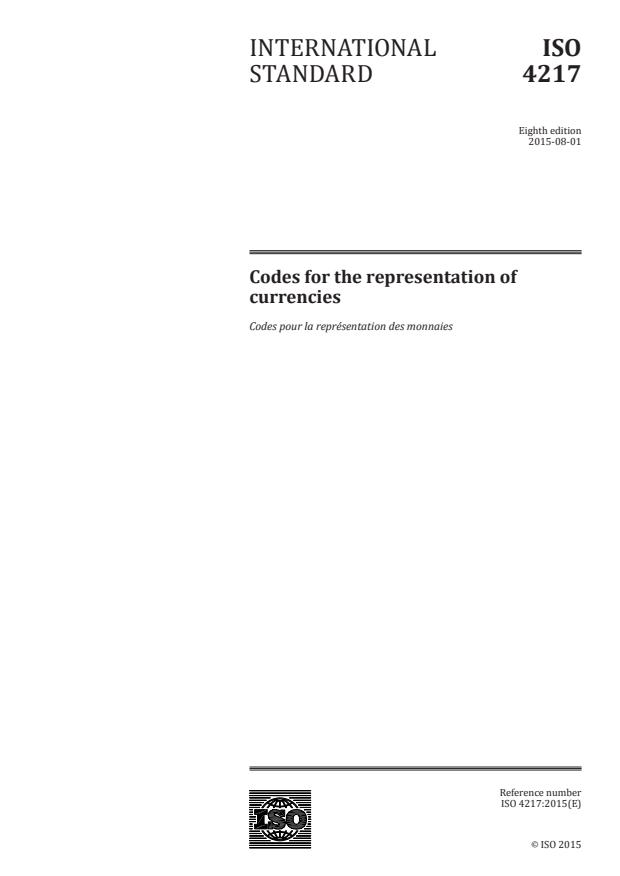
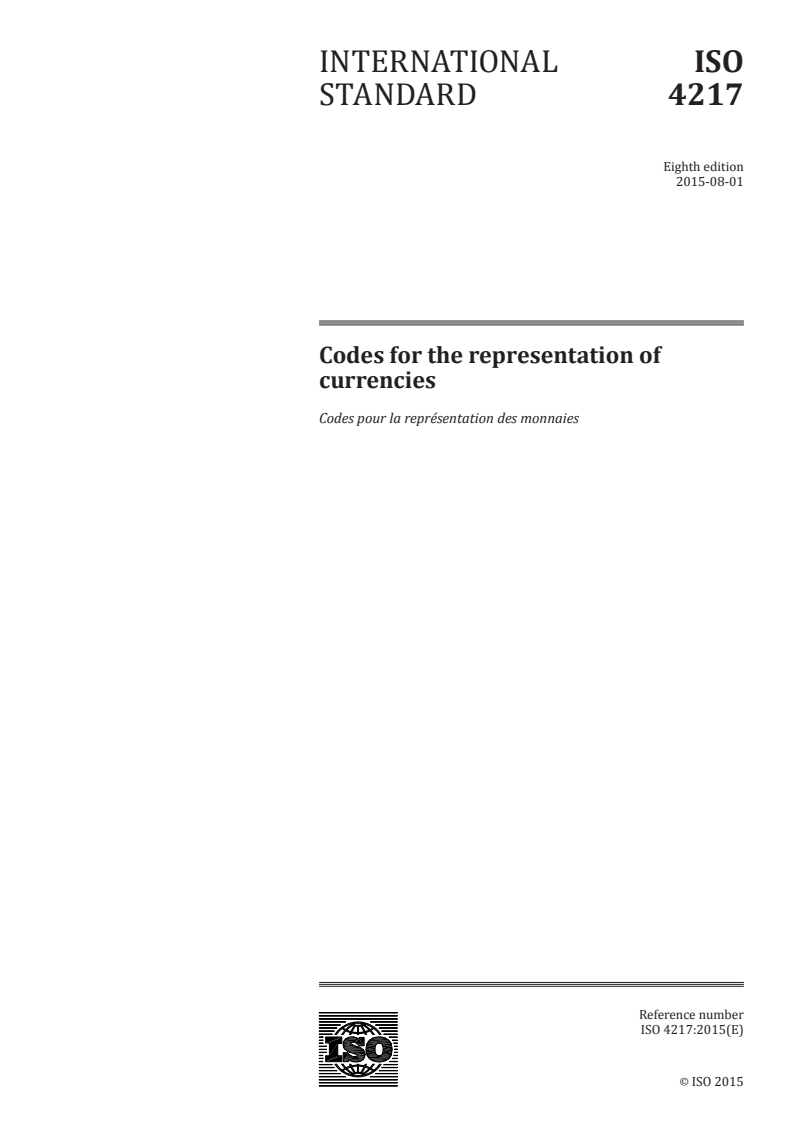
INTERNATIONAL ISO
STANDARD 4217
Eighth edition
2015-08-01
Codes for the representation of
currencies
Codes pour la représentation des monnaies
Reference number
©
ISO 2015
© ISO 2015, Published in Switzerland
All rights reserved. Unless otherwise specified, no part of this publication may be reproduced or utilized otherwise in any form
or by any means, electronic or mechanical, including photocopying, or posting on the internet or an intranet, without prior
written permission. Permission can be requested from either ISO at the address below or ISO’s member body in the country of
the requester.
ISO copyright office
Ch. de Blandonnet 8 • CP 401
CH-1214 Vernier, Geneva, Switzerland
Tel. +41 22 749 01 11
Fax +41 22 749 09 47
copyright@iso.org
www.iso.org
ii © ISO 2015 – All rights reserved
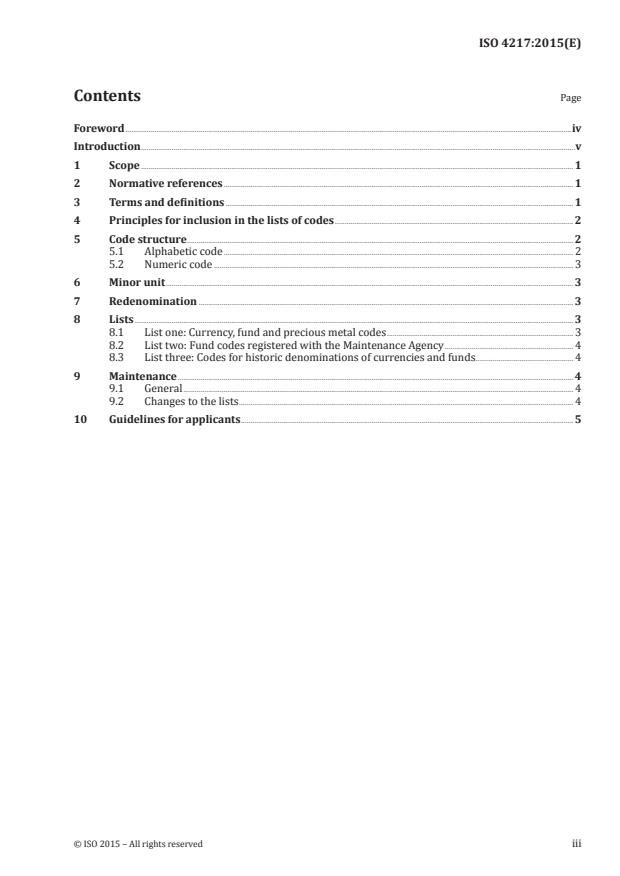
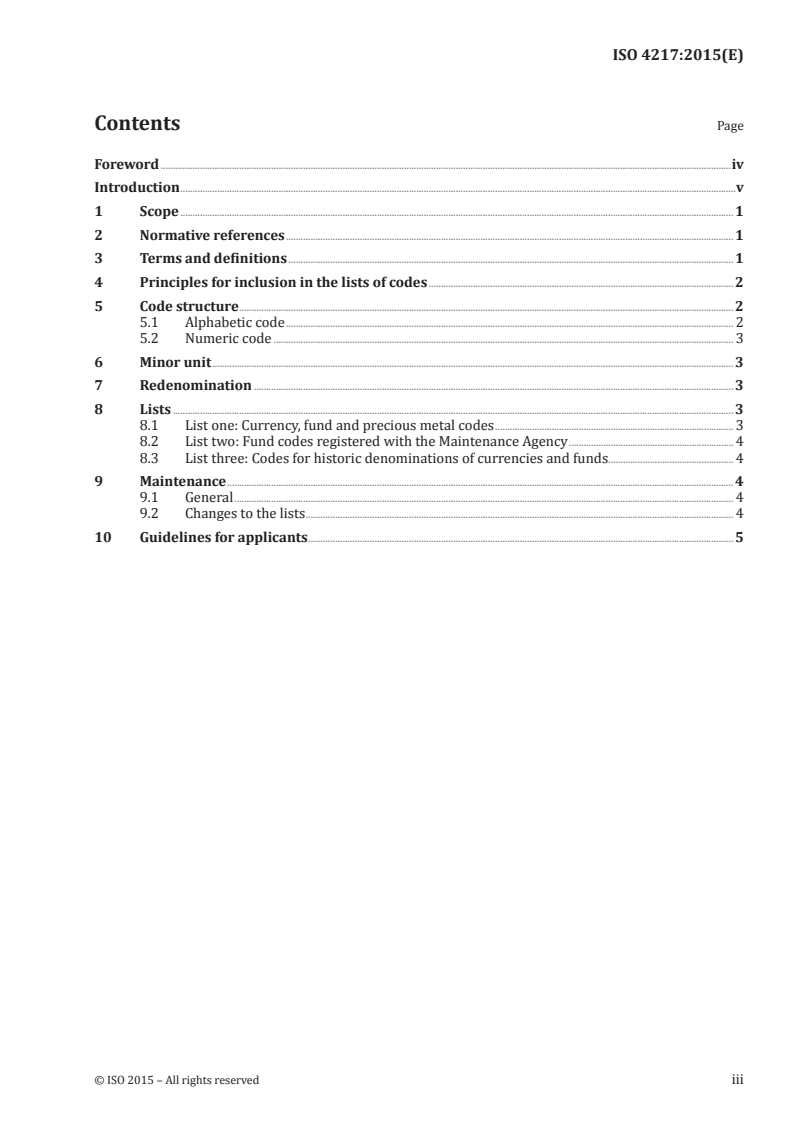
Contents Page
Foreword .iv
Introduction .v
1 Scope . 1
2 Normative references . 1
3 Terms and definitions . 1
4 Principles for inclusion in the lists of codes . 2
5 Code structure . 2
5.1 Alphabetic code . 2
5.2 Numeric code . 3
6 Minor unit . 3
7 Redenomination . 3
8 Lists . 3
8.1 List one: Currency, fund and precious metal codes . 3
8.2 List two: Fund codes registered with the Maintenance Agency . 4
8.3 List three: Codes for historic denominations of currencies and funds. 4
9 Maintenance . 4
9.1 General . 4
9.2 Changes to the lists . 4
10 Guidelines for applicants . 5
Foreword
ISO (the International Organization for Standardization) is a worldwide federation of national standards
bodies (ISO member bodies). The work of preparing International Standards is normally carried out
through ISO technical committees. Each member body interested in a subject for which a technical
committee has been established has the right to be represented on that committee. International
organizations, governmental and non-governmental, in liaison with ISO, also take part in the work.
ISO collaborates closely with the International Electrotechnical Commission (IEC) on all matters of
electrotechnical standardization.
The procedures used to develop this document and those intended for its further maintenance are
described in the ISO/IEC Directives, Part 1. In particular the different approval criteria needed for the
different types of ISO documents should be noted. This document was drafted in accordance with the
editorial rules of the ISO/IEC Directives, Part 2 (see www.iso.org/directives).
Attention is drawn to the possibility that some of the elements of this document may be the subject of
patent rights. ISO shall not be held responsible for identifying any or all such patent rights. Details of
any patent rights identified during the development of the document will be in the Introduction and/or
on the ISO list of patent declarations received (see www.iso.org/patents).
Any trade name used in this document is information given for the convenience of users and does not
constitute an endorsement.
For an explanation on the meaning of ISO specific terms and expressions related to conformity
assessment, as well as information about ISO’s adherence to the WTO principles in the Technical
Barriers to Trade (TBT) see the following URL: Foreword - Supplementary information
The committee responsible for this document is ISO/TC 68, Financial services, Subcommittee SC 7,
Core banking.
This eighth edition cancels and replaces the seventh edition (ISO 4217:2008), which has been
technically revised.
iv © ISO 2015 – All rights reserved
Introduction
There is a need for a universally applicable code for the identification of currencies. This International
Standard is the worldwide recognized multi-industry standard on currency codes based on the list of
country names obtained from the United Nations as described in ISO 3166-1. The ISO 4217 lists of codes
are used in banking and business globally in all their various domains of activities.
INTERNATIONAL STANDARD ISO 4217:2015(E)
Codes for the representation of currencies
1 Scope
This International Standard specifies the structure for a three-letter alphabetic code and an equivalent
three-digit numeric code for the representation of currencies. For those currencies having minor units,
it also shows the decimal relationship between such units and the currency itself.
The scope of this International Standard also includes funds and precious metals.
This International Standard also includes basic guidelines for its maintenance.
This International Standard is intended for use in any application of trade, commerce and banking,
where currencies and, where appropriate, funds are required to be described. It is designed to be
equally suitable for manual users and for those employing automated systems.
2 Normative references
The following documents, in whole or in part, are normatively referenced in this document and are
indispensable for its application. For dated references, only the edition cited applies. For undated
references, the latest edition of the referenced document (including any amendments) applies.
ISO 3166-1:2013, Codes for the representation of names of countries and their subdi
...
INTERNATIONAL ISO
STANDARD 4217
Eighth edition
2015-08-01
Codes for the representation of
currencies
Codes pour la représentation des monnaies
Reference number
©
ISO 2015
© ISO 2015, Published in Switzerland
All rights reserved. Unless otherwise specified, no part of this publication may be reproduced or utilized otherwise in any form
or by any means, electronic or mechanical, including photocopying, or posting on the internet or an intranet, without prior
written permission. Permission can be requested from either ISO at the address below or ISO’s member body in the country of
the requester.
ISO copyright office
Ch. de Blandonnet 8 • CP 401
CH-1214 Vernier, Geneva, Switzerland
Tel. +41 22 749 01 11
Fax +41 22 749 09 47
copyright@iso.org
www.iso.org
ii © ISO 2015 – All rights reserved
Contents Page
Foreword .iv
Introduction .v
1 Scope . 1
2 Normative references . 1
3 Terms and definitions . 1
4 Principles for inclusion in the lists of codes . 2
5 Code structure . 2
5.1 Alphabetic code . 2
5.2 Numeric code . 3
6 Minor unit . 3
7 Redenomination . 3
8 Lists . 3
8.1 List one: Currency, fund and precious metal codes . 3
8.2 List two: Fund codes registered with the Maintenance Agency . 4
8.3 List three: Codes for historic denominations of currencies and funds. 4
9 Maintenance . 4
9.1 General . 4
9.2 Changes to the lists . 4
10 Guidelines for applicants . 5
Foreword
ISO (the International Organization for Standardization) is a worldwide federation of national standards
bodies (ISO member bodies). The work of preparing International Standards is normally carried out
through ISO technical committees. Each member body interested in a subject for which a technical
committee has been established has the right to be represented on that committee. International
organizations, governmental and non-governmental, in liaison with ISO, also take part in the work.
ISO collaborates closely with the International Electrotechnical Commission (IEC) on all matters of
electrotechnical standardization.
The procedures used to develop this document and those intended for its further maintenance are
described in the ISO/IEC Directives, Part 1. In particular the different approval criteria needed for the
different types of ISO documents should be noted. This document was drafted in accordance with the
editorial rules of the ISO/IEC Directives, Part 2 (see www.iso.org/directives).
Attention is drawn to the possibility that some of the elements of this document may be the subject of
patent rights. ISO shall not be held responsible for identifying any or all such patent rights. Details of
any patent rights identified during the development of the document will be in the Introduction and/or
on the ISO list of patent declarations received (see www.iso.org/patents).
Any trade name used in this document is information given for the convenience of users and does not
constitute an endorsement.
For an explanation on the meaning of ISO specific terms and expressions related to conformity
assessment, as well as information about ISO’s adherence to the WTO principles in the Technical
Barriers to Trade (TBT) see the following URL: Foreword - Supplementary information
The committee responsible for this document is ISO/TC 68, Financial services, Subcommittee SC 7,
Core banking.
This eighth edition cancels and replaces the seventh edition (ISO 4217:2008), which has been
technically revised.
iv © ISO 2015 – All rights reserved
Introduction
There is a need for a universally applicable code for the identification of currencies. This International
Standard is the worldwide recognized multi-industry standard on currency codes based on the list of
country names obtained from the United Nations as described in ISO 3166-1. The ISO 4217 lists of codes
are used in banking and business globally in all their various domains of activities.
INTERNATIONAL STANDARD ISO 4217:2015(E)
Codes for the representation of currencies
1 Scope
This International Standard specifies the structure for a three-letter alphabetic code and an equivalent
three-digit numeric code for the representation of currencies. For those currencies having minor units,
it also shows the decimal relationship between such units and the currency itself.
The scope of this International Standard also includes funds and precious metals.
This International Standard also includes basic guidelines for its maintenance.
This International Standard is intended for use in any application of trade, commerce and banking,
where currencies and, where appropriate, funds are required to be described. It is designed to be
equally suitable for manual users and for those employing automated systems.
2 Normative references
The following documents, in whole or in part, are normatively referenced in this document and are
indispensable for its application. For dated references, only the edition cited applies. For undated
references, the latest edition of the referenced document (including any amendments) applies.
ISO 3166-1:2013, Codes for the representation of names of countries and their subdi
...