

ISO 37187:2026
(Main)Smart community infrastructures — Guidance on data exchange and sharing of city information modelling platform
- Abstract
This document provides guidance on the city information modelling (CIM) platform for the information modelling process of smart city construction, operation and maintenance. This document applies to both building and infrastructure assets. It also applies to the management of the CIM platform and its related applications and scenarios, including community infrastructures, such as transportation, communication, energy, roads and logistics, and the activities of stakeholders (both organizations and citizens) for governments, enterprises, schools, health care and families, etc. NOTE Annex A outlines case studies on data exchange and sharing using the CIM platform in smart communities.
- Status
- Published
- Publication Date
- 30-Jun-2026
- Technical Committee
- ISO/TC 268/SC 1 - Smart community infrastructures
- Drafting Committee
- ISO/TC 268/SC 1 - Smart community infrastructures
- Current Stage
- 6060 - International Standard published
- Start Date
- 01-Jul-2026
- Due Date
- 06-Jul-2026
- Completion Date
- 01-Jul-2026

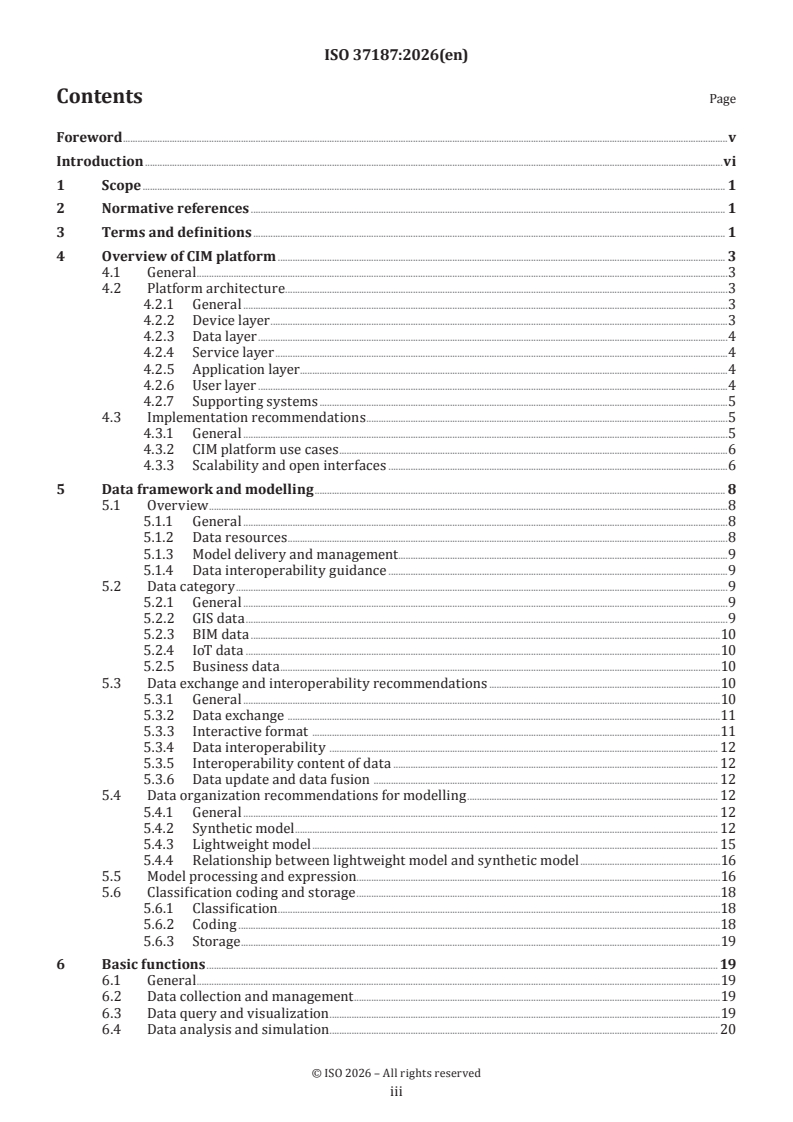
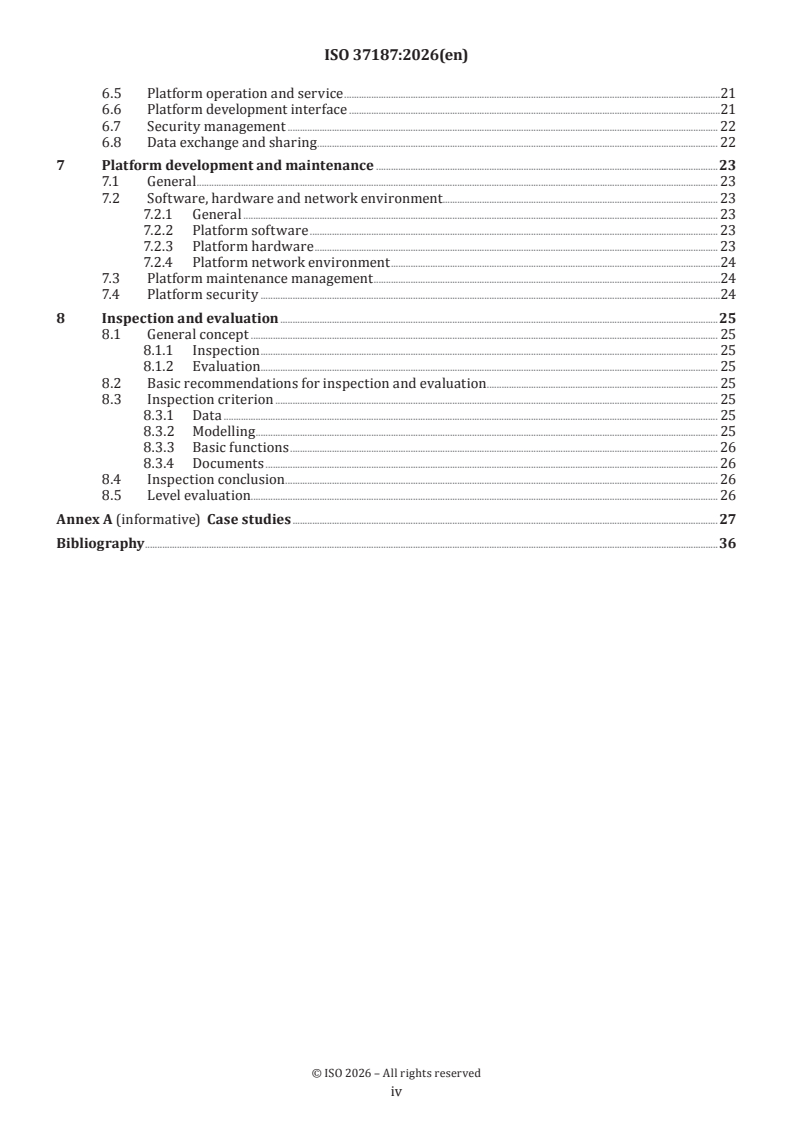
ISO 37187:2026 is an International Standard from ISO that gives guidance on data exchange and sharing for a city information modelling (CIM) platform. It is written for smart city construction, operation and maintenance, and it covers building and infrastructure assets, the CIM platform itself, and related applications and stakeholder activities. The document sets out a CIM platform framework, data modelling and interoperability guidance, core platform functions, development and maintenance advice, and inspection and evaluation points.
What does ISO 37187:2026 specify?
ISO 37187:2026 specifies guidance for the CIM platform used in the information modelling process of smart city construction, operation and maintenance. In practice, it helps organizations structure city data, share it between systems and turn it into usable models for planning, operation and decision-making.
The scope includes both building assets and infrastructure assets. It also extends to community infrastructures such as transportation, communication, energy, roads and logistics, and to stakeholder activities for governments, enterprises, schools, health care and families.
The document is organized into these main clauses:
- Clause 4 - Overview of CIM platform
- Clause 5 - Data framework and modelling
- Clause 6 - Basic functions
- Clause 7 - Platform development and maintenance
- Clause 8 - Inspection and evaluation
Annex A provides case studies on data exchange and sharing using the CIM platform in smart communities.
What are the key recommendations of ISO 37187:2026?
ISO 37187:2026 focuses on how to organize city data, build models, operate the platform and check whether the platform is ready for use. The most important recommendations are in Clauses 4 to 8 and in Annex A.
Platform structure and deployment
Clause 4 describes the CIM platform as a multi-layer platform for integrating urban data and supporting planning, construction, management and services. It identifies device, data, service, application, user and supporting-system layers, which matters because it gives a shared way to design a platform that can connect field devices, data stores and user-facing applications.
Clause 4.3 adds implementation recommendations on use cases, scalability and open interfaces. This means the platform should be able to grow with city needs and connect to other systems rather than becoming a closed silo.
Data framework, categories and interoperability
Clause 5 groups the data framework around data resources, delivery and management, and data interoperability guidance. It distinguishes GIS data, BIM data, IoT data and business data, which is important because different city data types often need different handling, formats and update patterns.
Clause 5.3 gives recommendations for data exchange, interactive formats, interoperability content, and data update and data fusion. In practice, this is the part that helps teams decide how data should move between systems and what information must stay consistent across those systems.
Modelling and model processing
Clause 5.4 recommends how to organize modelling with synthetic models and lightweight models, and how the two relate. Clause 5.5 then describes model processing and expression, including model quality check, storage, synthetic model generation, lightweight model generation, historical data handling and multi-version management.
This matters because CIM work usually needs both detailed working models and lighter models for display or resource-constrained devices. The clause also makes version control and historical traceability part of normal model management.
Core platform functions
Clause 6 sets out the basic functions the platform should provide: data collection and management, data query and visualization, data analysis and simulation, platform operation and service, development interfaces, security management, and data exchange and sharing. These functions matter because they cover the full operational chain from importing data to using it in analysis and services.
Clause 6.2 expects the platform to handle multi-source heterogeneous data and support 2D/3D convergence, cleaning, integration, compression, checking, metadata, backup and recovery. Clause 6.3 covers search and visualization functions such as spatial query, POI and AOI query, map and chart display, scene navigation and dashboards. Clause 6.4 adds spatial analysis, statistical analysis, data mining, digital modelling, simulation and DT integration. Clause 6.5 through 6.8 cover user and role management, monitoring, resource cataloguing, development interfaces and both pre-exchange and online sharing methods.
Development, maintenance, security and evaluation
Clause 7 says the platform should be built with top-level design, reliable and redundant infrastructure, security technology, and coordinated horizontal and vertical integration of information and models. It also sets expectations for maintenance organization, approval of changes that affect infrastructure, regular maintenance and record keeping.
Clause 7.4 requires a layered security approach covering physical, host, network, application and data security. This matters in real deployments because CIM platforms handle sensitive city and infrastructure information and need protection across collection, transmission, storage, processing and destruction.
Clause 8 covers inspection and evaluation. It calls for documented design, construction and trial operation, continuous stable trial operation for more than six months, an expert group after trial operation, and an inspection report covering objectives, criteria, conclusions and suggestions. It also provides for level evaluation of the CIM platform, synthetic model and lightweight model.
What terms does ISO 37187:2026 define?
Clause 3 defines several terms that shape the whole document:
- Application programming interface (API) - a set of invocation methods and parameters that lets one software system request actions from another.
- Building information modelling (BIM) - the use of a shared digital representation of an asset to support design, construction and operation decisions.
- City information modelling (CIM) - the creation of digital city representations and simulations built from large amounts of geospatial data, often with real-time data.
- Digital twin (DT) - a digital representation linked to a target entity so the physical and digital states can stay synchronized at an appropriate rate.
- External information infrastructure - the systems, technologies and frameworks that connect city data with external data sources and services.
- Lightweight model - a simplified rendering dataset derived from a synthetic model for lower memory use and better performance on constrained devices.
- Synthetic model - a fused model dataset containing geometric form, attributes, semantic composition and relationships.
Who uses ISO 37187:2026?
ISO 37187:2026 is aimed at organizations involved in smart city and smart community platforms. That includes governments, enterprises, schools, health care organizations and families, as named in the scope.
It is also relevant to urban planners, city managers, infrastructure operators, platform developers, data managers, maintenance teams and security teams. They use it for platform design, data integration, model management, visualization, analysis, service delivery, maintenance planning, security control and inspection.
Which standards are used with ISO 37187:2026?
The normative references in ISO 37187:2026 are:
- ISO 19101-1 - provides the geographic information reference model used as a base for geospatial data handling.
- ISO 19650-1 - provides BIM concepts and principles used in the document’s BIM-related terms and modelling guidance.
- ISO/IEC 20924 - provides vocabulary for IoT and digital twin concepts.
The introduction and bibliography also point to related standards and references:
- ISO/IEC 30182 - for smart city data interoperability and conceptual modelling
- ISO 37156 - for data exchange and sharing in smart community infrastructures
- IEC SRD 63273-1 - for CIM high-level analysis
- ISO/IEC 30173 - for digital twin concepts and terminology
- ISO/IEC 22989 - for artificial intelligence concepts and terminology
What does the ISO 37187:2026 document contain?
Clause 4 contains the CIM platform overview, architecture layers and implementation advice. Clause 5 contains the main data framework content, including data categories, exchange and interoperability guidance, model organization, and a model processing flowchart in Figure 3.
Clause 6 contains the basic functions expected of a CIM platform, including collection, query, visualization, analysis, simulation, operations, development interfaces, security and sharing. Clause 7 covers development, software-hardware-network environment, maintenance and security. Clause 8 covers inspection and evaluation, including criteria for data, modelling, basic functions and documents.
Annex A contains case studies showing how CIM platforms are used in municipal engineering, urban governance and smart park projects. These examples help readers see how the guidance applies in practice across full-life-cycle management, planning and supervision, and smart park services.
Relations
- Consolidated By
ISO 4210-7:2023 - Cycles — Safety requirements for bicycles — Part 7: Wheel and rim test methods - Effective Date
- 06-Mar-2023
Get Certified
Connect with accredited certification bodies for this standard

BSI Group
BSI (British Standards Institution) is the business standards company that helps organizations make excellence a habit.

DIBt (Deutsches Institut für Bautechnik)
German Institute for Building Technology.
DIN CERTCO
DIN Group product certification.
Sponsored listings
Frequently Asked Questions
ISO 37187:2026 is a standard published by the International Organization for Standardization (ISO). Its full title is "Smart community infrastructures — Guidance on data exchange and sharing of city information modelling platform". This standard covers: This document provides guidance on the city information modelling (CIM) platform for the information modelling process of smart city construction, operation and maintenance. This document applies to both building and infrastructure assets. It also applies to the management of the CIM platform and its related applications and scenarios, including community infrastructures, such as transportation, communication, energy, roads and logistics, and the activities of stakeholders (both organizations and citizens) for governments, enterprises, schools, health care and families, etc. NOTE Annex A outlines case studies on data exchange and sharing using the CIM platform in smart communities.
This document provides guidance on the city information modelling (CIM) platform for the information modelling process of smart city construction, operation and maintenance. This document applies to both building and infrastructure assets. It also applies to the management of the CIM platform and its related applications and scenarios, including community infrastructures, such as transportation, communication, energy, roads and logistics, and the activities of stakeholders (both organizations and citizens) for governments, enterprises, schools, health care and families, etc. NOTE Annex A outlines case studies on data exchange and sharing using the CIM platform in smart communities.
ISO 37187:2026 is classified under the following ICS (International Classification for Standards) categories: 35.240.99 - IT applications in other fields; 91.020 - Physical planning. Town planning. The ICS classification helps identify the subject area and facilitates finding related standards.
ISO 37187:2026 has the following relationships with other standards: It is inter standard links to ISO 4210-7:2023. Understanding these relationships helps ensure you are using the most current and applicable version of the standard.
ISO 37187:2026 is available in PDF format for immediate download after purchase. The document can be added to your cart and obtained through the secure checkout process. Digital delivery ensures instant access to the complete standard document.
Standards Content (Sample)
International
Standard
ISO 37187
First edition
Smart community infrastructures —
2026-07
Guidance on data exchange
and sharing of city information
modelling platform
Infrastructures urbaines intelligentes — Recommandations
relatives à l'échange et au partage de données de la plateforme
de modélisation des informations urbaines
Reference number
© ISO 2026
All rights reserved. Unless otherwise specified, or required in the context of its implementation, no part of this publication may
be reproduced or utilized otherwise in any form or by any means, electronic or mechanical, including photocopying, or posting on
the internet or an intranet, without prior written permission. Permission can be requested from either ISO at the address below
or ISO’s member body in the country of the requester.
ISO copyright office
CP 401 • Ch. de Blandonnet 8
CH-1214 Vernier, Geneva
Phone: +41 22 749 01 11
Email: copyright@iso.org
Website: www.iso.org
Published in Switzerland
ii
Contents Page
Foreword .v
Introduction .vi
1 Scope . 1
2 Normative references . 1
3 Terms and definitions . 1
4 Overview of CIM platform . 3
4.1 General .3
4.2 Platform architecture . .3
4.2.1 General .3
4.2.2 Device layer .3
4.2.3 Data layer .4
4.2.4 Service layer .4
4.2.5 Application layer .4
4.2.6 User layer .4
4.2.7 Supporting systems .5
4.3 Implementation recommendations .5
4.3.1 General .5
4.3.2 CIM platform use cases .6
4.3.3 Scalability and open interfaces .6
5 Data framework and modelling . 8
5.1 Overview .8
5.1.1 General .8
5.1.2 Data resources .8
5.1.3 Model delivery and management .9
5.1.4 Data interoperability guidance .9
5.2 Data category .9
5.2.1 General .9
5.2.2 GIS data .9
5.2.3 BIM data .10
5.2.4 IoT data .10
5.2.5 Business data .10
5.3 Data exchange and interoperability recommendations .10
5.3.1 General .10
5.3.2 Data exchange .11
5.3.3 Interactive format .11
5.3.4 Data interoperability . 12
5.3.5 Interoperability content of data . 12
5.3.6 Data update and data fusion . 12
5.4 Data organization recommendations for modelling . 12
5.4.1 General . 12
5.4.2 Synthetic model . 12
5.4.3 Lightweight model . 15
5.4.4 Relationship between lightweight model and synthetic model .16
5.5 Model processing and expression.16
5.6 Classification coding and storage .18
5.6.1 Classification . .18
5.6.2 Coding .18
5.6.3 Storage .19
6 Basic functions . 19
6.1 General .19
6.2 Data collection and management .19
6.3 Data query and visualization .19
6.4 Data analysis and simulation . 20
iii
6.5 Platform operation and service .21
6.6 Platform development interface .21
6.7 Security management . 22
6.8 Data exchange and sharing . 22
7 Platform development and maintenance .23
7.1 General . 23
7.2 Software, hardware and network environment. 23
7.2.1 General . 23
7.2.2 Platform software . 23
7.2.3 Platform hardware . 23
7.2.4 Platform network environment .24
7.3 Platform maintenance management .24
7.4 Platform security .24
8 Inspection and evaluation .25
8.1 General concept . 25
8.1.1 Inspection . 25
8.1.2 Evaluation . 25
8.2 Basic recommendations for inspection and evaluation . 25
8.3 Inspection criterion . 25
8.3.1 Data . 25
8.3.2 Modelling . 25
8.3.3 Basic functions . 26
8.3.4 Documents . 26
8.4 Inspection conclusion . 26
8.5 Level evaluation . . 26
Annex A (informative) Case studies .27
Bibliography .36
iv
Foreword
ISO (the International Organization for Standardization) is a worldwide federation of national standards
bodies (ISO member bodies). The work of preparing International Standards is normally carried out through
ISO technical committees. Each member body interested in a subject for which a technical committee
has been established has the right to be represented on that committee. International organizations,
governmental and non-governmental, in liaison with ISO, also take part in the work. ISO collaborates closely
with the International Electrotechnical Commission (IEC) on all matters of electrotechnical standardization.
The procedures used to develop this document and those intended for its further maintenance are described
in the ISO/IEC Directives, Part 1. In particular, the different approval criteria needed for the different types
of ISO documents should be noted. This document was drafted in accordance with the editorial rules of the
ISO/IEC Directives, Part 2 (see www.iso.org/directives).
ISO draws attention to the possibility that the implementation of this document may involve the use of (a)
patent(s). ISO takes no position concerning the evidence, validity or applicability of any claimed patent
rights in respect thereof. As of the date of publication of this document, ISO had not received notice of (a)
patent(s) which may be required to implement this document. However, implementers are cautioned that
this may not represent the latest information, which may be obtained from the patent database available at
www.iso.org/patents. ISO shall not be held responsible for identifying any or all such patent rights.
Any trade name used in this document is information given for the convenience of users and does not
constitute an endorsement.
For an explanation of the voluntary nature of standards, the meaning of ISO specific terms and expressions
related to conformity assessment, as well as information about ISO's adherence to the World Trade
Organization (WTO) principles in the Technical Barriers to Trade (TBT), see www.iso.org/iso/foreword.html.
This document was prepared by Technical Committee ISO/TC 268, Sustainable cities and communities,
Subcommittee SC 1, Smart community infrastructures.
Any feedback or questions on this document should be directed to the user’s national standards body. A
complete listing of these bodies can be found at www.iso.org/members.html.
v
Introduction
Under the impetus of global urbanization, smart cities are increasingly becoming a new paradigm for
urban development. The deep integration of advanced information and communication technologies (ICT),
empowering city management, services and sustainable development is the inevitable direction of urban
development to enhance urban operational efficiency and quality of life.
The system of smart cities is complicated, and it is not easy to understand the whole picture. Ensuring the
maximization of the interests of numerous stakeholders in the process of achieving sustainable development,
efficiency, resilience and security goals of urban development is also a challenge.
The city information modelling (CIM) platform, based on the basic geographic information of cities, collects
information models of buildings and infrastructures at different stages. It serves as an integrated platform
for the basic operational and information resources for urban planning, construction, management and
operation. CIM is the fundamental, critical and substantive information infrastructure of smart cities. As
the core carrier of smart city construction, its importance is self-evident and crucial for achieving intelligent
and refined urban management.
The data framework of the CIM platform integrates data resources from various departments and systems.
It enables information sharing and collaboration between different departments, establishes digital
models of various aspects of the city and provides important support for the planning, construction,
management, operation and development of smart cities. It also provides support for the core foundation of
city infrastructure in various fields such as energy, water resources, transportation and waste. At the same
time, specifying the functions and applications of the CIM platform can optimize urban services, contribute
to achieving sustainable urban development, improve the quality of life for citizens and promote urban
economic prosperity.
ISO/IEC 30182 focuses on the smart city conceptual model (SCCM), which is used to describe data from any
department in the city, to discuss how to achieve interoperability between data and addressing the lack of
data interoperability. ISO 37156 focuses on the data exchange and sharing of smart city infrastructure, offers
a reference for governments, enterprises, organizations and individuals to share urban infrastructure data.
At the same time, it also provides a set of methods for governing urban infrastructure data, gives a unified
framework for data exchange and sharing, following privacy and security principles. After the data can be
exchanged and shared under ISO 37156, the city data can be integrated through the city-level platform, CIM,
which can utilize the data value. However, there are also data exchange and sharing when data flows into
the CIM platform.
This document, by specifying the data, modelling, basic functions, platform construction and operation
of the CIM platform, allows data to play a greater role in the development of smart cities in aspects such
as urban planning, construction, management, and operation, based on existing data and ensuring data
exchange and sharing.
vi
International Standard ISO 37187:2026(en)
Smart community infrastructures — Guidance on data
exchange and sharing of city information modelling platform
1 Scope
This document provides guidance on the city information modelling (CIM) platform for the information
modelling process of smart city construction, operation and maintenance.
This document applies to both building and infrastructure assets. It also applies to the management of
the CIM platform and its related applications and scenarios, including community infrastructures, such
as transportation, communication, energy, roads and logistics, and the activities of stakeholders (both
organizations and citizens) for governments, enterprises, schools, health care and families, etc.
NOTE Annex A outlines case studies on data exchange and sharing using the CIM platform in smart communities.
2 Normative references
The following documents are referred to in the text in such a way that some or all of their content constitutes
requirements of this document. For dated references, only the edition cited applies. For undated references,
the latest edition of the referenced document (including any amendments) applies.
ISO 19101-1, Geographic information — Reference model — Part 1: Fundamentals
ISO 19650-1, Organization and digitization of information about buildings and civil engineering works, including
building information modelling (BIM) — Information management using building information modelling— Part
1: Concepts and principles
ISO/IEC 20924, Internet of Things (IoT) and digital twin — Vocabulary
3 Terms and definitions
For the purposes of this document, the terms and definitions given in ISO 19101-1, ISO 19650-1, ISO/IEC 20924
and the following apply.
ISO and IEC maintain terminology databases for use in standardization at the following addresses:
— ISO Online browsing platform: available at https:// www .iso .org/ obp
— IEC Electropedia: available at https:// www .electropedia .org/
3.1
application programming interface
API
collection of invocation methods and associated parameters used by one piece of software to request actions
from another piece of software
[SOURCE: ISO/IEC 18012-1:2004, 3.1.1]
3.2
building information modelling
BIM
use of a shared digital representation of an asset to facilitate design, construction and operation processes
to form a reliable basis for decisions
[SOURCE: ISO 19650-1:2018, 3.3.14, modified — The wording “a built asset” has been changed to “an asset”;
Note 1 to entry has been removed.]
3.3
city information modelling
CIM
development of digital representations and simulations of a city made up of large quantities of geospatial
data, often including real-time data, which enable better city planning and management
Note 1 to entry: The geospatial data are provided using an integration of building information modelling (BlM) (3.2)
and geographic information systems (GlS).
Note 2 to entry: The real-time data are obtained through extensive use of internet of things (loT) sensors within the
city.
Note 3 to entry: City information modelling (CIM) involves handling large amounts of big data, which is generally
brought together using cloud computing.
Note 4 to entry: Artificial intelligence is often used to generate and evaluate different scenarios using city information
modelling (CIM) data to help manage the city better.
[SOURCE: IEC SRD 63273-1:2023, 3.1.1]
3.4
digital twin
DT
w
digital representation of a target entity with data connections that enable convergence between the physical
and digital states at an appropriate rate of synchronization
Note 1 to entry: Digital twin has some or all of the capabilities of connection, integration, analysis, simulation,
visualization, optimization, collaboration, etc.
Note 2 to entry: Digital twin can provide an integrated view throughout the life cycle of the target entity.
[SOURCE: ISO/IEC 30173:2023, 3.1.1]
3.5
external information infrastructure
infrastructure of systems, technologies, and frameworks that support integrating and interacting a city's
data with external data sources and services
3.6
lightweight model
suitable rendering dataset after simplifying, compressing, and processing of the synthetic model’s (3.9) data
on geometry, texture, attributes based on lightweighting, visual effect enhancement, and other technologies
to optimize the model’s memory usage, computation and power consumption for running on resource-
constrained devices
3.7
machine learning
ML
process of optimizing model parameters through computational techniques, such that the model's behaviour
reflects the data or experience
[SOURCE: ISO/IEC 22989:2022, 3.3.5]
3.8
open data platform
a digital infrastructure of enabling the collection, storage, sharing and analysis of publicly accessible urban
data
3.9
synthetic model
outcome dataset based on format conversion, model classification and grading, data fusion, automated
modelling, semantic processing, and other technologies, containing clear semantic composition, geometric
form, attribute information and relationship information
4 Overview of CIM platform
4.1 General
The CIM platform is a comprehensive platform that integrates multidimensional data and information of
cities, aiming to provide decision support for urban planning, construction, management and services.
The CIM platform achieves efficient management and application of data by integrating various urban data
resources, thus facilitating sustainable urban development.
The CIM platform centralizes the management of CIM data, providing access interfaces for data and services.
The CIM platform's service scope includes but is not limited to urban planning and design, infrastructure
construction, environmental protection, public services and emergency management. By offering data
support and analysis tools, the CIM platform assists relevant departments and enterprises in optimizing
resource allocation, enhancing urban management efficiency and improving service quality.
The target scope of CIM platform services encompasses cities, industrial parks, parks, communities, clusters
of buildings and individual buildings. For government and urban management departments, the CIM
platform objects can also include various smart facilities and systems such as railways, emergency response,
drainage, streets, parking, utilities, facilities, fire protection, communities and industrial parks based on the
actual conditions of smart city applications.
4.2 Platform architecture
4.2.1 General
The CIM platform comprises five layers (device layer, data layer, service layer, application layer and user
layer) and three supporting systems (standards and specifications system, information security system,
and operation and maintenance guarantee system). Horizontally, there are dependencies between the upper
and lower layers, such as dependencies of basic resource, data, service and function among different layers.
Vertically, there are constraints between vertical systems and related layers, such as interface constraints,
security constraints, resource constraints, performance constraints and compatibility constraints. Each
layer carries out specific functions and tasks, and through dependency and constraint relationships, the
integrity and collaboration of the platform are ensured.
4.2.2 Device layer
The device layer serves as the physical foundation of the CIM platform, encompassing various hardware
devices such as sensors, monitoring devices, computing equipment, communication facilities and other
hardware components.
The device layer includes IoT sensor devices, open data platform, as well as external information
infrastructure such as cloud server, cloud storage, network infrastructure, blockchain and other related
components.
The primary function of the device layer is to collect, store, and transmit various data related to urban
operations, providing raw data sources and computing services for the data layer above.
4.2.3 Data layer
The data layer is the core of the CIM platform, responsible for storing, processing and managing the data
within the CIM.
The data layer includes spatiotemporal fundamental data, resource survey data, IoT sensory data, public
thematic data, engineering construction project data, planning control data, outcome data and other
datasets.
Constructing the CIM platform data resource system ensures the accuracy, completeness and availability of
data, providing data support for the services in the upper layers.
4.2.4 Service layer
The service layer provides various data processing and analysis services, serving as the middleware of the
CIM platform.
The service layer provides various common foundational computations and services, including AI-based
DT , simulation and ML.
w
The service layer provides functionalities and services such as basic functions, data ingestion, data
processing, data fusion, data storage, model management, IoT supervision, API, visualization, dashboard
and simulation.
4.2.5 Application layer
The application layer refers to a series of applications and service components built on top of the basic
functionalities and services of the CIM platform, catering to specific urban management and decision
support demands. It serves as the implementation layer for concrete business functionalities, such as smart
government services, smart healthcare and smart buildings applications.
The application layer should be divided into several categories, including urban planning and design
applications, construction management and engineering collaboration applications, urban management
and operation applications, public service and public participation applications, data analysis and decision
support applications, etc. These applications leverage the data and service resources provided by the CIM
platform and are extended through secondary development to establish smart applications on desktop, web
and mobile platforms.
The application layer serves as the crucial bridge connecting the core technology of the platform with
the final user demands. By constructing specialized, customized, and user-friendly application software,
general tools and standardized interfaces, it transforms the powerful functionalities of the CIM platform into
effective means to solve real urban problems. This fosters the scientific, refined and intelligent management
of cities, providing application services in areas such as urban planning, construction, management, services
and operations according to user needs.
4.2.6 User layer
The user layer represents the ultimate service recipients of the CIM platform, including government entities,
enterprises and the general public.
The user layer includes both mobile users and static users.
The function of the user layer is to interact with the CIM platform through user interfaces to obtain the
required information and services. Users can communicate with the middleware layer via wired or wireless
networks to complete necessary tasks. The platform provides personalized tools and services tailored to the
roles of government entities, enterprises and the general public. Additionally, it adapts to various terminals
such as large screens, PCs and mobile devices to meet the needs of users for visual effects and interaction
methods.
4.2.7 Supporting systems
Supporting systems ensure that the CIM platform adheres to essential standards and fulfils fundamental
recommendations concerning its architecture, operation and maintenance. These supporting systems
comprise three key components: the standards and specifications system, the information security system,
and the operation and maintenance guarantee system.
— Standards and specifications system: This system specifies data standards, business standards and
technical management to ensure the standardized operation of the CIM platform and alignment with
national and industry data standards and technical specifications.
— Information security system: This system safeguards the data security and privacy protection of the CIM
platform to mitigate various security threats based on relevant national policies and national network
security-level protection standards.
— Operation and maintenance guarantee system: This system ensures the stable operation of the CIM
platform's network, data, applications, and business processes, necessary technical support and the
provision of maintenance services, along with the establishment of operation, update, and security
assurance systems.
Figure 1 illustrates the overall architecture of the CIM platform with five layers and three supporting
systems.
NOTE In Figure 1, the shaded area refers to the foundational part of CIM platform.
Figure 1 — Architecture of CIM platform
4.3 Implementation recommendations
4.3.1 General
The purpose of construction is to promote collaboration and information sharing among stakeholders.
The CIM platform data governance project and data services should be closely intertwined with cross-
departmental business collaboration.
The data layer and the service layer are the foundation part of the CIM platform, and its design should
align with the overall framework to ensure effective integration and application of data. The CIM platform
infrastructure should meet the recommendations for data updates and business expansion.
The functions of the CIM platform include data collection and management, scenario configuration, data
querying and visualization, statistical analysis and application, data sharing and exchange, and operational
management interface. These functionalities of the CIM platform should be closely integrated with the
overall framework to achieve synergistic collaboration between different layers, thereby enhancing the
overall performance and service quality of the platform.
4.3.2 CIM platform use cases
CIM platform scenarios encompass a range of information generated by activities in various urban
infrastructure sectors. Common use cases include transportation, communication, energy, buildings, roads,
governance, schools and households. The application of models serves the function of verifying whether the
models and their applications comply with international standards for urban development. CIM platform
applications are evaluated by stakeholders based on their professional expertise, data management and
data interoperability.
The construction of CIM platform application scenarios should consist of the following stages:
a) stakeholder analysis, including stakeholder identification and gathering of their specific needs and
expectations;
b) data recommendations and integration, including data type identification, integration support and data
standards for interoperability;
c) functional recommendations, such as data visualization, analytics and simulation, decision support,
collaboration, user interface and user experience;
d) non-functional recommendations, such as scalability, performance, security and interoperability;
e) technical architecture, including modular design architecture, cloud integration, APIs, software
development kits (SDKs) and edge computing;
f) compliance and standards, aligning with local regulations and urban development policies;
g) data governance, including data ownership definition, access control policies, data-sharing agreements
among stakeholders and implementation of a data governance framework to ensure data quality,
accuracy and integrity;
h) use cases and scenarios, such as traffic management, emergency response, environmental monitoring,
energy optimization and urban planning;
i) training and support;
j) sustainability and future-proofing.
The construction of CIM platform application scenarios covers the entire process from data source to final
user service for a given application, emphasizing high standards in aspects such as data quality, model
accuracy, functional suitability, system integration, user experience and information security. The aim is to
ensure that CIM platform application scenarios effectively support refined urban management, intelligent
decision-making and public services.
4.3.3 Scalability and open interfaces
The application of CIM platform spans the entire process of urban development and is based on real-world
conditions.
4.3.3.1 Scalability
Scalability should meet the following recommendations:
a) Scalability should ensure that the CIM platform can handle increasing amounts of data, users and
processing needs as the city expands or as more systems are integrated. Open interfaces should ensure
interoperability and flexibility by allowing different systems and applications to communicate and work
together.
b) The platform should be capable of processing and storing large volumes of data from various sources,
such as IoT devices, sensors and city databases.
c) The platform should utilize efficient data compression techniques and indexing to improve data retrieval
times and reduce storage costs.
d) The platform should implement a distributed data architecture that can handle high data throughput
and large datasets, ensuring data processing speed remains consistent as the city grows.
e) The platform can add new servers or nodes to the system to increase capacity, provide flexibility to
grow without significant downtime.
f) The platform should allow for hardware upgrades on existing servers to enhance processing power and
memory for increased performance.
g) The platform should use a microservices-based design where each service operates independently,
making it easier to scale specific components without affecting the entire system.
h) The platform should implement robust load balancing techniques to distribute workloads evenly across
servers, avoiding bottlenecks and ensuring high availability.
i) The platform should incorporate edge computing capabilities to process data closer to its source,
reducing latency and easing the burden on the central system.
4.3.3.2 Open interfaces
Open interfaces should meet the following recommendations:
a) The platform should adhere to widely accepted data standards and protocols.
b) The platform should implement semantic data models that define clear data relationships.
c) The platform should support plug-and-play integration with third-party software, tools and platforms
(BIM, GIS, urban mobility, etc.).
d) The platform should leverage open-source frameworks and libraries to reduce costs and foster
community-driven development and innovation.
e) The platform should provide a rich set of development interfaces or development toolkits to support
CIM applications across various industries in smart cities.
f) The platform developer should offer development guidance or example files as explanatory documents.
g) The platform interfaces should be stable, open, and scalable, and provide in the form of web API or SDKs.
5 Data framework and modelling
5.1 Overview
5.1.1 General
Data framework and modelling refer to the digital information and virtual models that are utilized in urban
construction to describe, simulate and analyse aspects such as urban environments, facilities and operational
conditions. The data includes GIS data, BIM data, IoT sensing data and business data. The models are three-
dimensional (3D) urban spatial models and urban operation simulation models that are constructed based
on these data, which are used for urban planning, construction, management, operation and other purposes.
The CIM should meet the needs of collaborative work at all stages of city development and support relevant
stakeholders to obtain, update and manage information.
Support for the entire cycle of urban development: The CIM data framework should be designed to support
the information needs of various stages, including urban planning, construction, management and operation.
The CIM data framework should provide interactive 3D visualization tools.
Promotion of stakeholder collaboration: The CIM data framework should facilitate data sharing and
collaborative work among different stakeholders, such as governments, planners, designers, constructors,
operators, citizens, and so on. The CIM data framework should seamlessly integrate BIM models with GIS to
provide a holistic view of building structure and urban infrastructure.
Data interoperability and standardization: Data should be easily exchanged and used across different
software and systems, adhering to international standards and protocols. The CIM data framework should
support data standardization and federation.
Possession of scalability and flexibility: The data framework sho
...