

ISO 10545-14:2015
(Main)Ceramic tiles — Part 14: Determination of resistance to stains
General Information
- Abstract
ISO 10545-14:2015 specifies a method for determining the resistance to stains of the proper surface of ceramic tiles.
- Status
- Published
- Publication Date
- 10-Sep-2015
- Technical Committee
- ISO/TC 189 - Ceramic tile
- Drafting Committee
- ISO/TC 189/WG 1 - Test methods
- Current Stage
- 9093 - International Standard confirmed
- Start Date
- 30-Jul-2026
- Completion Date
- 29-Aug-2026
Buy Documents


ISO 10545-14:2015 - Ceramic tiles — Part 14: Determination of resistance to stains/11/2015


ISO 10545-14:2015 - Carreaux et dalles céramiques
ISO 10545-14:2015 - Carreaux et dalles céramiques — Partie 14: Détermination de la résistance aux taches/11/2015
Overview
ISO 10545-14:2015 - "Ceramic tiles - Part 14: Determination of resistance to stains" specifies a standardized laboratory method to evaluate how the proper surface of ceramic tiles resists common staining materials. The procedure defines staining agents, exposure and cleaning methods, inspection conditions and a five‑class classification (1–5) indicating ease of stain removal. This test supports quality control, product specification and comparative performance claims for ceramic tiles.
Key topics and technical requirements
- Scope: Applies to the proper surface of ceramic tiles; testing can be done on unabraded and, by agreement, after abrasion (refer to ISO 10545-7).
- Test specimens: Five unused, undamaged whole or cut tiles; dried at (105 ± 5) °C for ≥2 h and tested within 3 h after cooling.
- Staining agents:
- Pastes that leave a trace: green (Cr2O3) and red (Fe2O3) pigments in a light oil carrier (40% m/m).
- Chemical/oxidizing: iodine solution (13 g/L in alcohol).
- Film-forming: olive oil (per International Olive Oil Agreement).
- Cleaning agents:
- Hot water (55 ± 5 °C).
- Weak commercial cleaning agent (non‑abrasive, pH 6.5–7.5).
- Strong commercial cleaning agent (abrasive, pH 9–10) - no hydrofluoric compounds.
- Solvents: 3% HCl, KOH 200 g/L, acetone (used successively as needed).
- Cleaning procedures:
- Procedure A: hot water, 5 min.
- Procedure B: manual cleaning with weak agent, rinse.
- Procedure C: mechanical cleaning with strong agent (example: 8 cm rotating brush at ~500 r/min) for 2 min.
- Procedure D: immersion in solvent for 24 h.
- Test sequence and evaluation: Apply stains under a convex watch glass, leave 24 h, then attempt removal successively with Procedures A→B→C→D. After each step dry (105 ± 5 °C, ≥2 h) and visually inspect at 25–30 cm under ≥300 lx illumination. Record classification per specimen and stain.
- Reporting: Include reference to ISO 10545-14, tile description, staining/cleaning agents used and classification results.
Applications and users
- Who uses it: ceramic tile manufacturers, independent testing laboratories, QA/QC teams, architects and specifiers, distributors and regulatory bodies.
- Practical uses:
- Validate cleanability and stain resistance claims for glazed and unglazed tiles.
- Support product selection for kitchens, bathrooms, commercial flooring and facades where stain performance matters.
- Compare formulations, glazes, or surface treatments and verify performance before market release.
Related standards
- ISO 10545 series (e.g., ISO 10545-7 for abrasion testing). Use ISO 10545-14 together with other parts (dimensions, chemical resistance, abrasion) for a complete characterization of tile performance.
Keywords: ISO 10545-14:2015, ceramic tiles stain resistance, stain resistance test, tile testing standard, cleaning procedures, staining agents.
Relations
- Consolidates
EN ISO 10545-14:2015 - Ceramic tiles - Part 14: Determination of resistance to stains (ISO 10545-14:2015) - Effective Date
- 12-Feb-2026
- Effective Date
- 19-Nov-2011
Buy Documents
ISO 10545-14:2015 - Ceramic tiles — Part 14: Determination of resistance to stains/11/2015
ISO 10545-14:2015 - Carreaux et dalles céramiques
ISO 10545-14:2015 - Carreaux et dalles céramiques — Partie 14: Détermination de la résistance aux taches/11/2015
Get Certified
Connect with accredited certification bodies for this standard

DIBt (Deutsches Institut für Bautechnik)
German Institute for Building Technology.
DIN CERTCO
DIN Group product certification.

Aboma Certification B.V.
Specialized in construction, metal, and transport sectors.
Sponsored listings
Frequently Asked Questions
ISO 10545-14:2015 is a standard published by the International Organization for Standardization (ISO). Its full title is "Ceramic tiles — Part 14: Determination of resistance to stains". This standard covers: ISO 10545-14:2015 specifies a method for determining the resistance to stains of the proper surface of ceramic tiles.
ISO 10545-14:2015 specifies a method for determining the resistance to stains of the proper surface of ceramic tiles.
ISO 10545-14:2015 is classified under the following ICS (International Classification for Standards) categories: 91.100.23 - Ceramic tiles. The ICS classification helps identify the subject area and facilitates finding related standards.
ISO 10545-14:2015 has the following relationships with other standards: It is inter standard links to EN ISO 10545-14:2015, ISO 10545-14:1995. Understanding these relationships helps ensure you are using the most current and applicable version of the standard.
ISO 10545-14:2015 is available in PDF format for immediate download after purchase. The document can be added to your cart and obtained through the secure checkout process. Digital delivery ensures instant access to the complete standard document.
Standards Content (Sample)
INTERNATIONAL ISO
STANDARD 10545-14
Second edition
2015-09-15
Ceramic tiles —
Part 14:
Determination of resistance to stains
Carreaux et dalles céramiques —
Partie 14: Détermination de la résistance aux taches
Reference number
©
ISO 2015
© ISO 2015, Published in Switzerland
All rights reserved. Unless otherwise specified, no part of this publication may be reproduced or utilized otherwise in any form
or by any means, electronic or mechanical, including photocopying, or posting on the internet or an intranet, without prior
written permission. Permission can be requested from either ISO at the address below or ISO’s member body in the country of
the requester.
ISO copyright office
Ch. de Blandonnet 8 • CP 401
CH-1214 Vernier, Geneva, Switzerland
Tel. +41 22 749 01 11
Fax +41 22 749 09 47
copyright@iso.org
www.iso.org
ii © ISO 2015 – All rights reserved
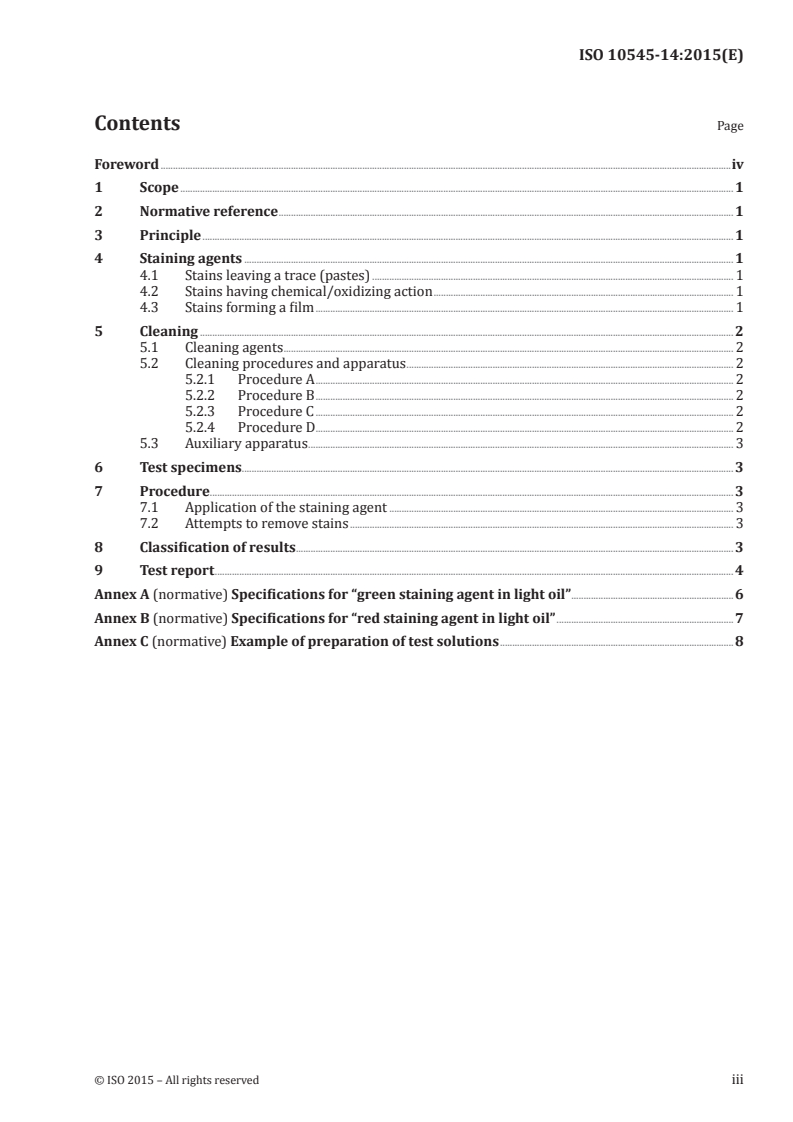
Contents Page
Foreword .iv
1 Scope . 1
2 Normative reference . 1
3 Principle . 1
4 Staining agents . 1
4.1 Stains leaving a trace (pastes) . 1
4.2 Stains having chemical/oxidizing action . 1
4.3 Stains forming a film . 1
5 Cleaning . 2
5.1 Cleaning agents . 2
5.2 Cleaning procedures and apparatus . 2
5.2.1 Procedure A . 2
5.2.2 Procedure B . 2
5.2.3 Procedure C . 2
5.2.4 Procedure D . . 2
5.3 Auxiliary apparatus . 3
6 Test specimens. 3
7 Procedure. 3
7.1 Application of the staining agent . 3
7.2 Attempts to remove stains . 3
8 Classification of results . 3
9 Test report . 4
Annex A (normative) Specifications for “green staining agent in light oil” .6
Annex B (normative) Specifications for “red staining agent in light oil” . 7
Annex C (normative) Example of preparation of test solutions . 8
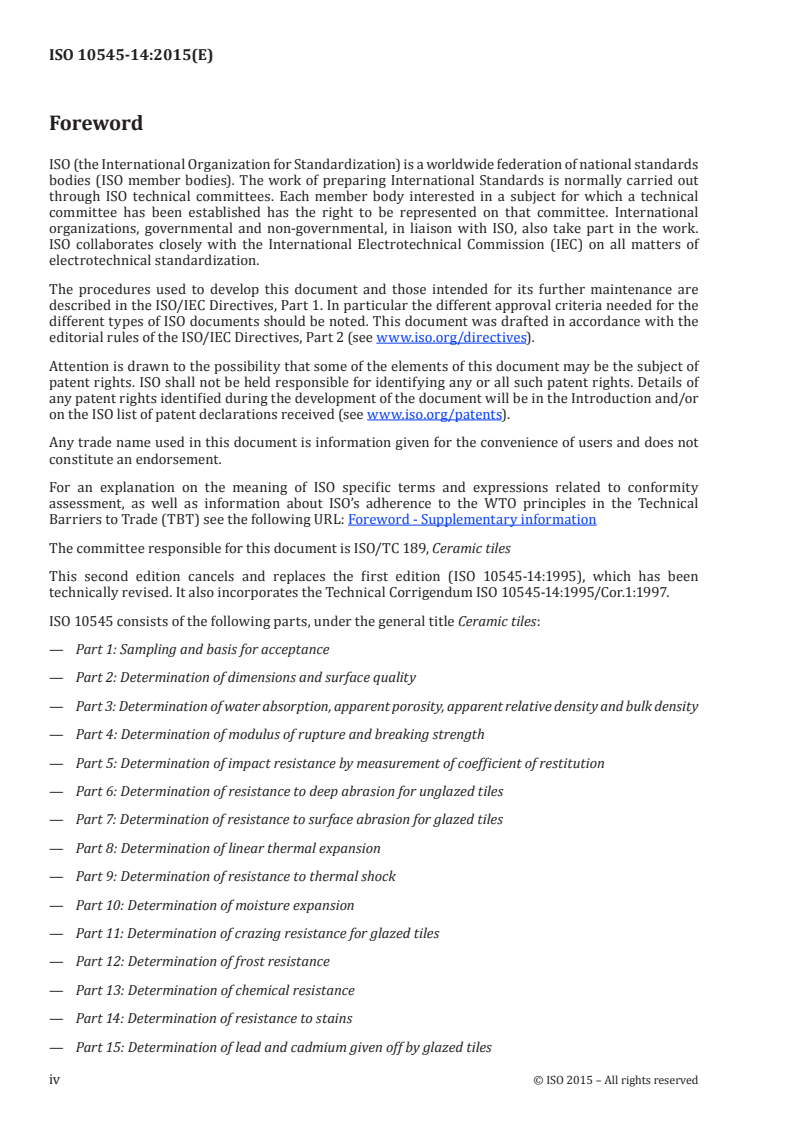
Foreword
ISO (the International Organization for Standardization) is a worldwide federation of national standards
bodies (ISO member bodies). The work of preparing International Standards is normally carried out
through ISO technical committees. Each member body interested in a subject for which a technical
committee has been established has the right to be represented on that committee. International
organizations, governmental and non-governmental, in liaison with ISO, also take part in the work.
ISO collaborates closely with the International Electrotechnical Commission (IEC) on all matters of
electrotechnical standardization.
The procedures used to develop this document and those intended for its further maintenance are
described in the ISO/IEC Directives, Part 1. In particular the different approval criteria needed for the
different types of ISO documents should be noted. This document was drafted in accordance with the
editorial rules of the ISO/IEC Directives, Part 2 (see www.iso.org/directives).
Attention is drawn to the possibility that some of the elements of this document may be the subject of
patent rights. ISO shall not be held responsible for identifying any or all such patent rights. Details of
any patent rights identified during the development of the document will be in the Introduction and/or
on the ISO list of patent declarations received (see www.iso.org/patents).
Any trade name used in this document is information given for the convenience of users and does not
constitute an endorsement.
For an explanation on the meaning of ISO specific terms and expressions related to conformity
assessment, as well as information about ISO’s adherence to the WTO principles in the Technical
Barriers to Trade (TBT) see the following URL: Foreword - Supplementary information
The committee responsible for this document is ISO/TC 189, Ceramic tiles
This second edition cancels and replaces the first edition (ISO 10545-14:1995), which has been
technically revised. It also incorporates the Technical Corrigendum ISO 10545-14:1995/Cor.1:1997.
ISO 10545 consists of the following parts, under the general title Ceramic tiles:
— Part 1: Sampling and basis for acceptance
— Part 2: Determination of dimensions and surface quality
— Part 3: Determination of water absorption, apparent porosity, apparent relative density and bulk density
— Part 4: Determination of modulus of rupture and breaking strength
— Part 5: Determination of impact resistance by measurement of coefficient of restitution
— Part 6: Determination of resistance to deep abrasion for unglazed tiles
— Part 7: Determination of resistance to surface abrasion for glazed tiles
— Part 8: Determination of linear thermal expansion
— Part 9: Determination of resistance to thermal shock
— Part 10: Determination of moisture expansion
— Part 11: Determination of crazing resistance for glazed tiles
— Part 12: Determination of frost resistance
— Part 13: Determination of chemical resistance
— Part 14: Determination of resistance to stains
— Part 15: Determination of lead and cadmium given off by glazed tiles
iv © ISO 2015 – All rights reserved
— Part 16: Determination of small colour differences
INTERNATIONAL STANDARD ISO 10545-14:2015(E)
Ceramic tiles —
Part 14:
Determination of resistance to stains
1 Scope
This part of ISO 10545 specifies a method for determining the resistance to stains of the proper surface
of ceramic tiles.
2 Normative reference
The following documents, in whole or in part, are normatively referenced in this document and are
indispensable for its application. For dated references, only the edition cited applies. For undated
references, the latest edition of the referenced document (including any amendments) applies.
ISO 10545-7, Ceramic tiles — Part 7: Determination of resistance to surface abrasion for glazed tiles
3 Principle
Determination of the resistance to stains by maintaining test solutions and materials in contact with
the proper surface of the tiles for a s
...
INTERNATIONAL ISO
STANDARD 10545-14
Second edition
2015-09-15
Ceramic tiles —
Part 14:
Determination of resistance to stains
Carreaux et dalles céramiques —
Partie 14: Détermination de la résistance aux taches
Reference number
©
ISO 2015
© ISO 2015, Published in Switzerland
All rights reserved. Unless otherwise specified, no part of this publication may be reproduced or utilized otherwise in any form
or by any means, electronic or mechanical, including photocopying, or posting on the internet or an intranet, without prior
written permission. Permission can be requested from either ISO at the address below or ISO’s member body in the country of
the requester.
ISO copyright office
Ch. de Blandonnet 8 • CP 401
CH-1214 Vernier, Geneva, Switzerland
Tel. +41 22 749 01 11
Fax +41 22 749 09 47
copyright@iso.org
www.iso.org
ii © ISO 2015 – All rights reserved
Contents Page
Foreword .iv
1 Scope . 1
2 Normative reference . 1
3 Principle . 1
4 Staining agents . 1
4.1 Stains leaving a trace (pastes) . 1
4.2 Stains having chemical/oxidizing action . 1
4.3 Stains forming a film . 1
5 Cleaning . 2
5.1 Cleaning agents . 2
5.2 Cleaning procedures and apparatus . 2
5.2.1 Procedure A . 2
5.2.2 Procedure B . 2
5.2.3 Procedure C . 2
5.2.4 Procedure D . . 2
5.3 Auxiliary apparatus . 3
6 Test specimens. 3
7 Procedure. 3
7.1 Application of the staining agent . 3
7.2 Attempts to remove stains . 3
8 Classification of results . 3
9 Test report . 4
Annex A (normative) Specifications for “green staining agent in light oil” .6
Annex B (normative) Specifications for “red staining agent in light oil” . 7
Annex C (normative) Example of preparation of test solutions . 8
Foreword
ISO (the International Organization for Standardization) is a worldwide federation of national standards
bodies (ISO member bodies). The work of preparing International Standards is normally carried out
through ISO technical committees. Each member body interested in a subject for which a technical
committee has been established has the right to be represented on that committee. International
organizations, governmental and non-governmental, in liaison with ISO, also take part in the work.
ISO collaborates closely with the International Electrotechnical Commission (IEC) on all matters of
electrotechnical standardization.
The procedures used to develop this document and those intended for its further maintenance are
described in the ISO/IEC Directives, Part 1. In particular the different approval criteria needed for the
different types of ISO documents should be noted. This document was drafted in accordance with the
editorial rules of the ISO/IEC Directives, Part 2 (see www.iso.org/directives).
Attention is drawn to the possibility that some of the elements of this document may be the subject of
patent rights. ISO shall not be held responsible for identifying any or all such patent rights. Details of
any patent rights identified during the development of the document will be in the Introduction and/or
on the ISO list of patent declarations received (see www.iso.org/patents).
Any trade name used in this document is information given for the convenience of users and does not
constitute an endorsement.
For an explanation on the meaning of ISO specific terms and expressions related to conformity
assessment, as well as information about ISO’s adherence to the WTO principles in the Technical
Barriers to Trade (TBT) see the following URL: Foreword - Supplementary information
The committee responsible for this document is ISO/TC 189, Ceramic tiles
This second edition cancels and replaces the first edition (ISO 10545-14:1995), which has been
technically revised. It also incorporates the Technical Corrigendum ISO 10545-14:1995/Cor.1:1997.
ISO 10545 consists of the following parts, under the general title Ceramic tiles:
— Part 1: Sampling and basis for acceptance
— Part 2: Determination of dimensions and surface quality
— Part 3: Determination of water absorption, apparent porosity, apparent relative density and bulk density
— Part 4: Determination of modulus of rupture and breaking strength
— Part 5: Determination of impact resistance by measurement of coefficient of restitution
— Part 6: Determination of resistance to deep abrasion for unglazed tiles
— Part 7: Determination of resistance to surface abrasion for glazed tiles
— Part 8: Determination of linear thermal expansion
— Part 9: Determination of resistance to thermal shock
— Part 10: Determination of moisture expansion
— Part 11: Determination of crazing resistance for glazed tiles
— Part 12: Determination of frost resistance
— Part 13: Determination of chemical resistance
— Part 14: Determination of resistance to stains
— Part 15: Determination of lead and cadmium given off by glazed tiles
iv © ISO 2015 – All rights reserved
— Part 16: Determination of small colour differences
INTERNATIONAL STANDARD ISO 10545-14:2015(E)
Ceramic tiles —
Part 14:
Determination of resistance to stains
1 Scope
This part of ISO 10545 specifies a method for determining the resistance to stains of the proper surface
of ceramic tiles.
2 Normative reference
The following documents, in whole or in part, are normatively referenced in this document and are
indispensable for its application. For dated references, only the edition cited applies. For undated
references, the latest edition of the referenced document (including any amendments) applies.
ISO 10545-7, Ceramic tiles — Part 7: Determination of resistance to surface abrasion for glazed tiles
3 Principle
Determination of the resistance to stains by maintaining test solutions and materials in contact with
the proper surface of the tiles for a s
...
NORME ISO
INTERNATIONALE 10545-14
Deuxième édition
2015-09-15
Carreaux et dalles céramiques —
Partie 14:
Détermination de la résistance aux
taches
Ceramic tiles —
Part 14: Determination of resistance to stains
Numéro de référence
©
ISO 2015
DOCUMENT PROTÉGÉ PAR COPYRIGHT
© ISO 2015, Publié en Suisse
Droits de reproduction réservés. Sauf indication contraire, aucune partie de cette publication ne peut être reproduite ni utilisée
sous quelque forme que ce soit et par aucun procédé, électronique ou mécanique, y compris la photocopie, l’affichage sur
l’internet ou sur un Intranet, sans autorisation écrite préalable. Les demandes d’autorisation peuvent être adressées à l’ISO à
l’adresse ci-après ou au comité membre de l’ISO dans le pays du demandeur.
ISO copyright office
Ch. de Blandonnet 8 • CP 401
CH-1214 Vernier, Geneva, Switzerland
Tel. +41 22 749 01 11
Fax +41 22 749 09 47
copyright@iso.org
www.iso.org
ii © ISO 2015 – Tous droits réservés
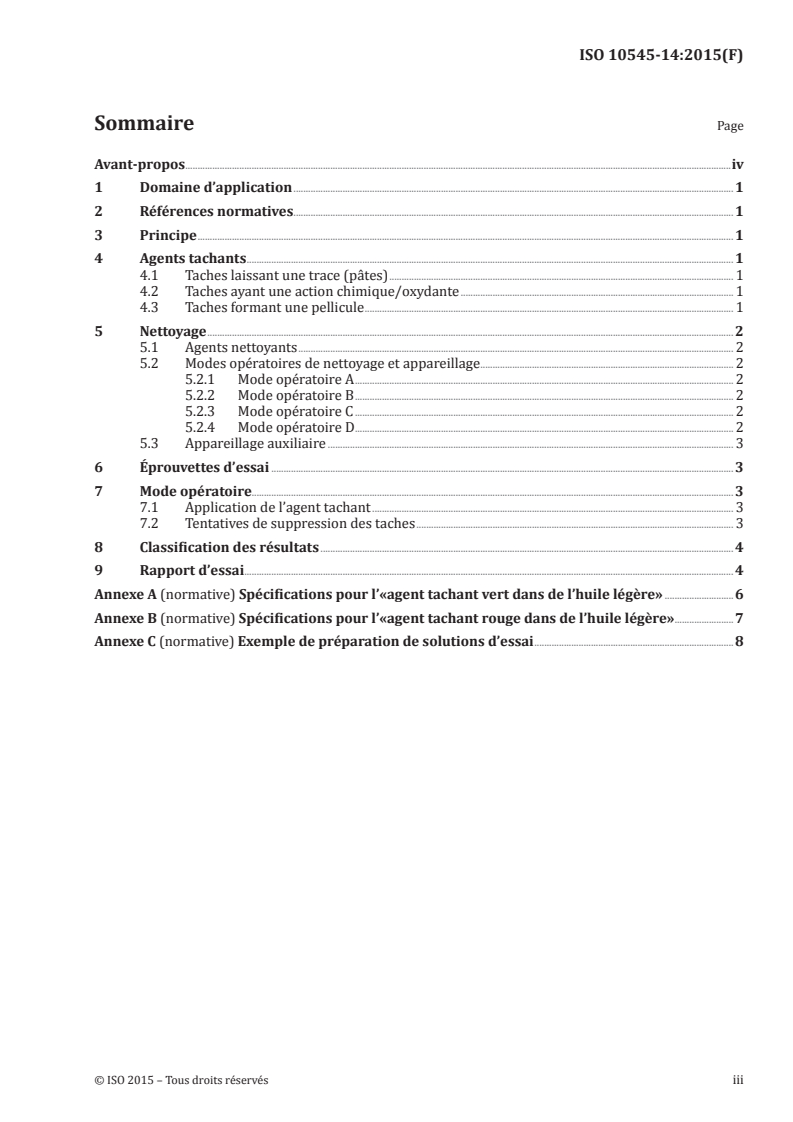
Sommaire Page
Avant-propos .iv
1 Domaine d’application . 1
2 Références normatives . 1
3 Principe . 1
4 Agents tachants . 1
4.1 Taches laissant une trace (pâtes) . 1
4.2 Taches ayant une action chimique/oxydante . 1
4.3 Taches formant une pellicule . 1
5 Nettoyage . 2
5.1 Agents nettoyants . 2
5.2 Modes opératoires de nettoyage et appareillage . 2
5.2.1 Mode opératoire A . 2
5.2.2 Mode opératoire B . 2
5.2.3 Mode opératoire C . 2
5.2.4 Mode opératoire D . 2
5.3 Appareillage auxiliaire . 3
6 Éprouvettes d’essai . 3
7 Mode opératoire. 3
7.1 Application de l’agent tachant . 3
7.2 Tentatives de suppression des taches . 3
8 Classification des résultats . 4
9 Rapport d’essai . 4
Annexe A (normative) Spécifications pour l’«agent tachant vert dans de l’huile légère» .6
Annexe B (normative) Spécifications pour l’«agent tachant rouge dans de l’huile légère» .7
Annexe C (normative) Exemple de préparation de solutions d’essai . 8
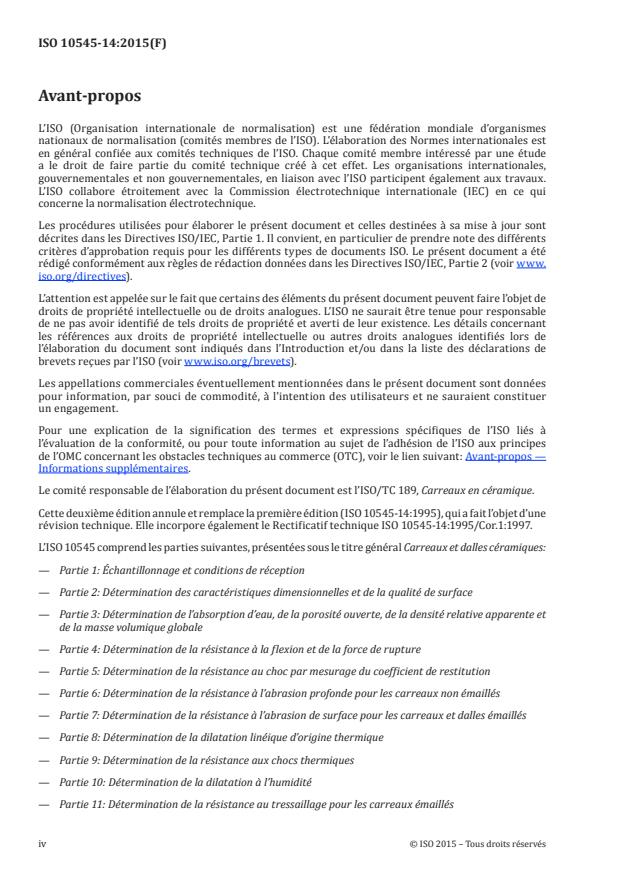
Avant-propos
L’ISO (Organisation internationale de normalisation) est une fédération mondiale d’organismes
nationaux de normalisation (comités membres de l’ISO). L’élaboration des Normes internationales est
en général confiée aux comités techniques de l’ISO. Chaque comité membre intéressé par une étude
a le droit de faire partie du comité technique créé à cet effet. Les organisations internationales,
gouvernementales et non gouvernementales, en liaison avec l’ISO participent également aux travaux.
L’ISO collabore étroitement avec la Commission électrotechnique internationale (IEC) en ce qui
concerne la normalisation électrotechnique.
Les procédures utilisées pour élaborer le présent document et celles destinées à sa mise à jour sont
décrites dans les Directives ISO/IEC, Partie 1. Il convient, en particulier de prendre note des différents
critères d’approbation requis pour les différents types de documents ISO. Le présent document a été
rédigé conformément aux règles de rédaction données dans les Directives ISO/IEC, Partie 2 (voir www.
iso.org/directives).
L’attention est appelée sur le fait que certains des éléments du présent document peuvent faire l’objet de
droits de propriété intellectuelle ou de droits analogues. L’ISO ne saurait être tenue pour responsable
de ne pas avoir identifié de tels droits de propriété et averti de leur existence. Les détails concernant
les références aux droits de propriété intellectuelle ou autres droits analogues identifiés lors de
l’élaboration du document sont indiqués dans l’Introduction et/ou dans la liste des déclarations de
brevets reçues par l’ISO (voir www.iso.org/brevets).
Les appellations commerciales éventuellement mentionnées dans le présent document sont données
pour information, par souci de commodité, à l’intention des utilisateurs et ne sauraient constituer
un engagement.
Pour une explication de la signification des termes et expressions spécifiques de l’ISO liés à
l’évaluation de la conformité, ou pour toute information au sujet de l’adhésion de l’ISO aux principes
de l’OMC concernant les obstacles techniques au commerce (OTC), voir le lien suivant: Avant-propos —
Informations supplémentaires.
Le comité responsable de l’élaboration du présent document est l’ISO/TC 189, Carreaux en céramique.
Cette deuxième édition annule et remplace la première édition (ISO 10545-14:1995), qui a fait l’objet d’une
révision technique. Elle incorpore également le Rectificatif technique ISO 10545-14:1995/Cor.1:1997.
L’ISO 10545 comprend les parties suivantes, présentées sous le titre général Carreaux et dalles céramiques:
— Partie 1: Échantillonnage et conditions de réception
— Partie 2: Détermination des caractéristiques dimensionnelles et de la qualité de surface
— Partie 3: Détermination de l’absorption d’eau, de la porosité ouverte, de la densité relative apparente et
de la masse volumique globale
— Partie 4: Détermination de la résistance à la flexion et de la force de rupture
— Partie 5: Détermination de la résistance au choc par mesurage du coefficient de restitution
— Partie 6: Détermination de la résistance à l’abrasion profonde pour les carreaux non émaillés
— Partie 7: Détermination de la résistance à l’abrasion de surface pour les carreaux et dalles émaillés
— Partie 8: Détermination de la dilatation linéique d’origine thermique
— Partie 9: Détermination de la résistance aux chocs thermiques
— Partie 10: Détermination de la dilatation à l’humidité
— Partie 11: Détermination de la résistance au tressaillage pour les carreaux émaillés
iv © ISO 2015 – Tous droits réservés
— Partie 12: Détermination de la résistance au gel
— Partie 13: Détermination de la résistance aux attaques chimiques
— Partie 14: Détermination de la résistance aux taches
— Partie 15: Détermination de la teneur en plomb et en cadmium dégagés par les carreaux émaillés
— Partie 16: Détermination de faibles différences de couleur
NORME INTERNATIONALE ISO 10545-14:2015(F)
Carreaux et dalles céramiques —
Partie 14:
Détermination de la résistance aux taches
1 Domaine d’application
La présente partie de l’ISO 10545 spécifie une méthode pour la détermination de la résistance aux
taches de la belle face des carreaux céramiques.
2 Références normatives
Les documents ci-après, dans leur intégralité ou non, sont des références normatives indispensables à
l’application du présent document. Pour les références datées, seule l’édition citée s’applique. Pour les
références non datées, la dernière édition du document de référence s’applique (y compris les éventuels
amendements).
ISO 10545-7, Carreaux et dalles céramiques — Partie 7: Détermination de la résistance à l’abrasion de
surface pour les carreaux et dalles émaillés
3 Principe
Détermination de la résistance aux taches en maintenant en contact les solutions d’essai sur la belle
face des carreaux pendant une durée appropriée; en soumettant ensuite les surfaces à des méthodes de
nettoyage définies et enfin en les exa
...
NORME ISO
INTERNATIONALE 10545-14
Deuxième édition
2015-09-15
Carreaux et dalles céramiques —
Partie 14:
Détermination de la résistance aux
taches
Ceramic tiles —
Part 14: Determination of resistance to stains
Numéro de référence
©
ISO 2015
DOCUMENT PROTÉGÉ PAR COPYRIGHT
© ISO 2015, Publié en Suisse
Droits de reproduction réservés. Sauf indication contraire, aucune partie de cette publication ne peut être reproduite ni utilisée
sous quelque forme que ce soit et par aucun procédé, électronique ou mécanique, y compris la photocopie, l’affichage sur
l’internet ou sur un Intranet, sans autorisation écrite préalable. Les demandes d’autorisation peuvent être adressées à l’ISO à
l’adresse ci-après ou au comité membre de l’ISO dans le pays du demandeur.
ISO copyright office
Ch. de Blandonnet 8 • CP 401
CH-1214 Vernier, Geneva, Switzerland
Tel. +41 22 749 01 11
Fax +41 22 749 09 47
copyright@iso.org
www.iso.org
ii © ISO 2015 – Tous droits réservés
Sommaire Page
Avant-propos .iv
1 Domaine d’application . 1
2 Références normatives . 1
3 Principe . 1
4 Agents tachants . 1
4.1 Taches laissant une trace (pâtes) . 1
4.2 Taches ayant une action chimique/oxydante . 1
4.3 Taches formant une pellicule . 1
5 Nettoyage . 2
5.1 Agents nettoyants . 2
5.2 Modes opératoires de nettoyage et appareillage . 2
5.2.1 Mode opératoire A . 2
5.2.2 Mode opératoire B . 2
5.2.3 Mode opératoire C . 2
5.2.4 Mode opératoire D . 2
5.3 Appareillage auxiliaire . 3
6 Éprouvettes d’essai . 3
7 Mode opératoire. 3
7.1 Application de l’agent tachant . 3
7.2 Tentatives de suppression des taches . 3
8 Classification des résultats . 4
9 Rapport d’essai . 4
Annexe A (normative) Spécifications pour l’«agent tachant vert dans de l’huile légère» .6
Annexe B (normative) Spécifications pour l’«agent tachant rouge dans de l’huile légère» .7
Annexe C (normative) Exemple de préparation de solutions d’essai . 8
Avant-propos
L’ISO (Organisation internationale de normalisation) est une fédération mondiale d’organismes
nationaux de normalisation (comités membres de l’ISO). L’élaboration des Normes internationales est
en général confiée aux comités techniques de l’ISO. Chaque comité membre intéressé par une étude
a le droit de faire partie du comité technique créé à cet effet. Les organisations internationales,
gouvernementales et non gouvernementales, en liaison avec l’ISO participent également aux travaux.
L’ISO collabore étroitement avec la Commission électrotechnique internationale (IEC) en ce qui
concerne la normalisation électrotechnique.
Les procédures utilisées pour élaborer le présent document et celles destinées à sa mise à jour sont
décrites dans les Directives ISO/IEC, Partie 1. Il convient, en particulier de prendre note des différents
critères d’approbation requis pour les différents types de documents ISO. Le présent document a été
rédigé conformément aux règles de rédaction données dans les Directives ISO/IEC, Partie 2 (voir www.
iso.org/directives).
L’attention est appelée sur le fait que certains des éléments du présent document peuvent faire l’objet de
droits de propriété intellectuelle ou de droits analogues. L’ISO ne saurait être tenue pour responsable
de ne pas avoir identifié de tels droits de propriété et averti de leur existence. Les détails concernant
les références aux droits de propriété intellectuelle ou autres droits analogues identifiés lors de
l’élaboration du document sont indiqués dans l’Introduction et/ou dans la liste des déclarations de
brevets reçues par l’ISO (voir www.iso.org/brevets).
Les appellations commerciales éventuellement mentionnées dans le présent document sont données
pour information, par souci de commodité, à l’intention des utilisateurs et ne sauraient constituer
un engagement.
Pour une explication de la signification des termes et expressions spécifiques de l’ISO liés à
l’évaluation de la conformité, ou pour toute information au sujet de l’adhésion de l’ISO aux principes
de l’OMC concernant les obstacles techniques au commerce (OTC), voir le lien suivant: Avant-propos —
Informations supplémentaires.
Le comité responsable de l’élaboration du présent document est l’ISO/TC 189, Carreaux en céramique.
Cette deuxième édition annule et remplace la première édition (ISO 10545-14:1995), qui a fait l’objet d’une
révision technique. Elle incorpore également le Rectificatif technique ISO 10545-14:1995/Cor.1:1997.
L’ISO 10545 comprend les parties suivantes, présentées sous le titre général Carreaux et dalles céramiques:
— Partie 1: Échantillonnage et conditions de réception
— Partie 2: Détermination des caractéristiques dimensionnelles et de la qualité de surface
— Partie 3: Détermination de l’absorption d’eau, de la porosité ouverte, de la densité relative apparente et
de la masse volumique globale
— Partie 4: Détermination de la résistance à la flexion et de la force de rupture
— Partie 5: Détermination de la résistance au choc par mesurage du coefficient de restitution
— Partie 6: Détermination de la résistance à l’abrasion profonde pour les carreaux non émaillés
— Partie 7: Détermination de la résistance à l’abrasion de surface pour les carreaux et dalles émaillés
— Partie 8: Détermination de la dilatation linéique d’origine thermique
— Partie 9: Détermination de la résistance aux chocs thermiques
— Partie 10: Détermination de la dilatation à l’humidité
— Partie 11: Détermination de la résistance au tressaillage pour les carreaux émaillés
iv © ISO 2015 – Tous droits réservés
— Partie 12: Détermination de la résistance au gel
— Partie 13: Détermination de la résistance aux attaques chimiques
— Partie 14: Détermination de la résistance aux taches
— Partie 15: Détermination de la teneur en plomb et en cadmium dégagés par les carreaux émaillés
— Partie 16: Détermination de faibles différences de couleur
NORME INTERNATIONALE ISO 10545-14:2015(F)
Carreaux et dalles céramiques —
Partie 14:
Détermination de la résistance aux taches
1 Domaine d’application
La présente partie de l’ISO 10545 spécifie une méthode pour la détermination de la résistance aux
taches de la belle face des carreaux céramiques.
2 Références normatives
Les documents ci-après, dans leur intégralité ou non, sont des références normatives indispensables à
l’application du présent document. Pour les références datées, seule l’édition citée s’applique. Pour les
références non datées, la dernière édition du document de référence s’applique (y compris les éventuels
amendements).
ISO 10545-7, Carreaux et dalles céramiques — Partie 7: Détermination de la résistance à l’abrasion de
surface pour les carreaux et dalles émaillés
3 Principe
Détermination de la résistance aux taches en maintenant en contact les solutions d’essai sur la belle
face des carreaux pendant une durée appropriée; en soumettant ensuite les surfaces à des méthodes de
nettoyage définies et enfin en les exa
...