

ISO 8146:1985
(Main)Shipbuilding and marine structures — Oval eyeplates
General Information
- Abstract
Lays down the dimensions and materials of oval eyeplates primarily intended for mounting on ships' decks and as guy eyeplates on ships' derrick booms for cargo handling purposes.
- Status
- Published
- Publication Date
- 17-Apr-1985
- Technical Committee
- ISO/TC 8/SC 4 - Outfitting and deck machinery
- Drafting Committee
- ISO/TC 8/SC 4/WG 3 - Outfitting
- Current Stage
- 9020 - International Standard under periodical review
- Start Date
- 15-Jul-2026
- Completion Date
- 15-Jul-2026
Buy Documents


ISO 8146:1985 - Shipbuilding and marine structures — Oval eyeplates Released:4/18/1985


ISO 8146:1985 - Construction navale et structures maritimes — Pitons a oeil ovale Released:4/18/1985


ISO 8146:1985 - Construction navale et structures maritimes — Pitons a oeil ovale Released:4/18/1985
Overview
ISO 8146:1985 specifies the dimensions, materials and manufacture of oval eyeplates used in shipbuilding and marine structures. Intended primarily for mounting on ships’ decks and for use as guy eyeplates on derrick booms for cargo handling, the standard defines types, nominal size designation, material minimums, production methods, surface and heat‑treatment requirements, dimension tables and marking rules.
Key topics and technical requirements
- Scope and types
- Two types are defined: Type A (general deck mounting) and Type B (guy eyeplates for derrick booms). Type B eyeplates are not intended for derrick boom headfittings covered by ISO 8148.
- Nominal size
- Nominal size is a unitless number derived from the permissible load in kilonewtons and used for ordering and reference.
- Materials
- Minimum material: structural steel to ISO 630, grade Fe 360. Ship‑quality steel with equivalent mechanical and welding properties may be used.
- Manufacture and treatment
- Eyeplates are to be formed by gas cutting and then forged or machined to the finished shape with smooth section transitions.
- After manufacturing, the forged eyeplate shall be normalized.
- Finished surfaces must be free from visible cracks and flaking.
- Dimensions and tolerances
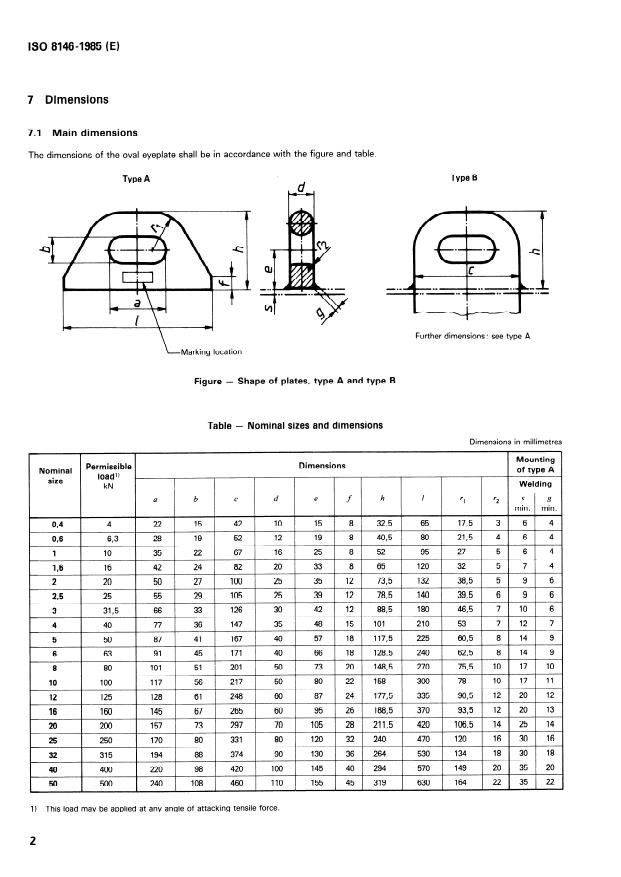
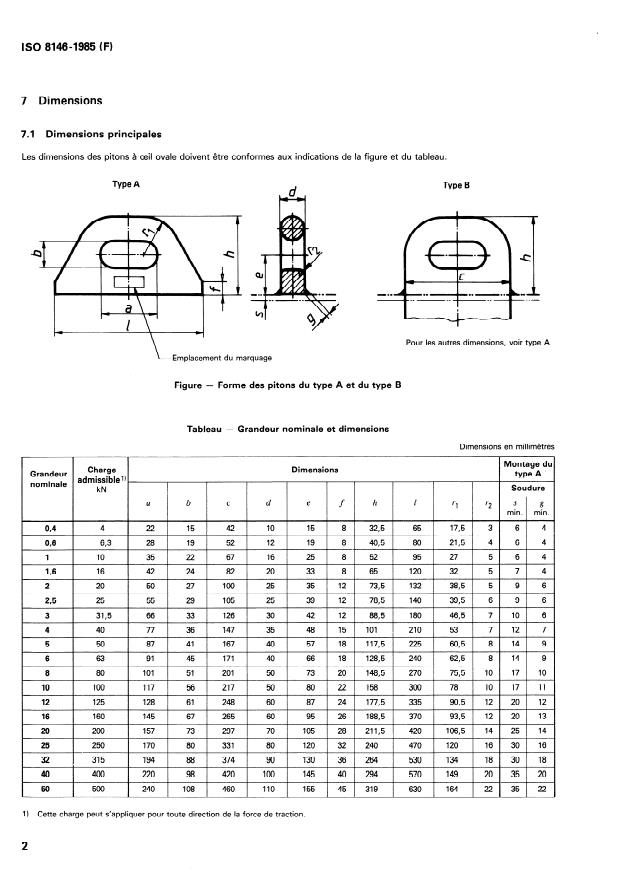
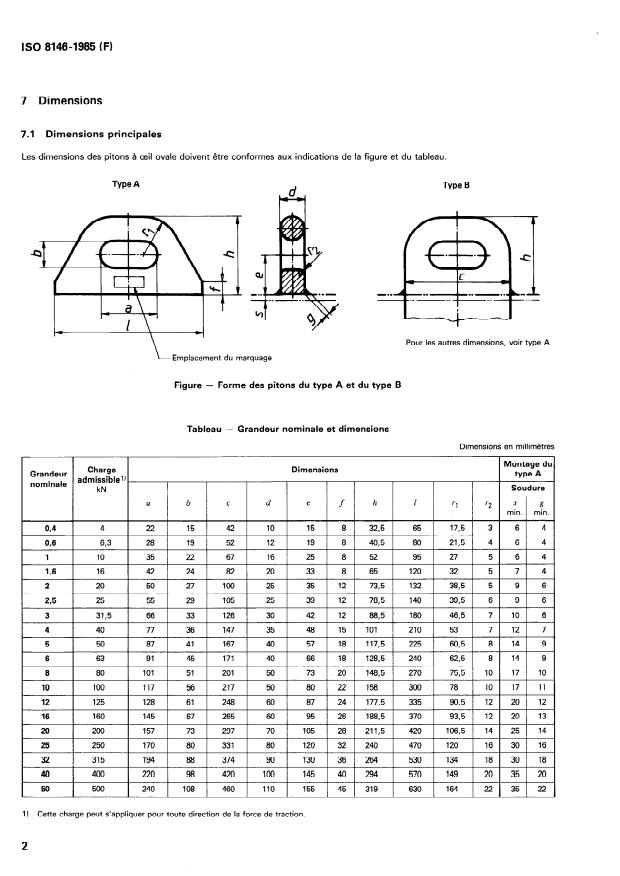
- The standard includes detailed figures and a dimension table (millimetres) correlating nominal sizes with main dimensions and permissible loads.
- Permissible variations for external and internal dimensions are specified in the standard.
- Designation and marking
- Ordering designation example: Plate ISO 8146 - A5.
- Eyeplates must be permanently and legibly marked with nominal size on a surface not subject to high stress.
Practical applications
- Selection and specification of oval eyeplates for:
- Ship decks and cargo handling fittings
- Guying systems on derrick booms
- Lifting and handling equipment interfaces on vessels
- Helps ensure compatibility between manufacturers, shipyards and purchasers by providing standardized sizes, loads and markings.
- Useful in design checks, procurement, fabrication, welding, inspection and classification processes.
Who uses this standard
- Naval architects and marine engineers
- Shipbuilding and repair yards
- Deck‑fitting manufacturers and fabricators
- Procurement and purchasing departments for vessels
- Classification societies and surveyors performing equipment inspection
Related standards
- ISO 630 - Structural steels (material reference)
- ISO 8147 - Ships’ lifting gear terminology and definitions
- ISO 8148 - Derrick boom headfittings (related derrick requirements)
Keywords: ISO 8146, oval eyeplates, shipbuilding, marine structures, Fe 360, derrick boom, deck mounting, lifting equipment, dimensions, marking, permissible load.
Buy Documents
ISO 8146:1985 - Shipbuilding and marine structures — Oval eyeplates Released:4/18/1985
ISO 8146:1985 - Construction navale et structures maritimes — Pitons a oeil ovale Released:4/18/1985
ISO 8146:1985 - Construction navale et structures maritimes — Pitons a oeil ovale Released:4/18/1985
Get Certified
Connect with accredited certification bodies for this standard

DNV
DNV is an independent assurance and risk management provider.

Lloyd's Register
Lloyd's Register is a global professional services organisation specialising in engineering and technology.

FSC International
Forest Stewardship Council certification.
Sponsored listings
Frequently Asked Questions
ISO 8146:1985 is a standard published by the International Organization for Standardization (ISO). Its full title is "Shipbuilding and marine structures — Oval eyeplates". This standard covers: Lays down the dimensions and materials of oval eyeplates primarily intended for mounting on ships' decks and as guy eyeplates on ships' derrick booms for cargo handling purposes.
Lays down the dimensions and materials of oval eyeplates primarily intended for mounting on ships' decks and as guy eyeplates on ships' derrick booms for cargo handling purposes.
ISO 8146:1985 is classified under the following ICS (International Classification for Standards) categories: 47.020.40 - Lifting and cargo handling equipment. The ICS classification helps identify the subject area and facilitates finding related standards.
ISO 8146:1985 is available in PDF format for immediate download after purchase. The document can be added to your cart and obtained through the secure checkout process. Digital delivery ensures instant access to the complete standard document.
Standards Content (Sample)
International Standard
INTERNATIONAL ORGANIZATION FOR STANDARDIZATION.MEXJlYHAPO~HAR OPI-AHM3ALWlR no CTAH~APTM3A~MM~ORGANISATlON INTERNATIONALE DE NORMALISATION
Shipbuilding and marine structures - Oval eyeplates
Construction navale et structures maritimes - Pitons a kl ovale
First edition - 19854445
UDC 629.12.011.8 Ref. No. ISO 81464985 (E)
Descriptors : shipbuilding, lifting equipment, handling equipment, eyeplates, specifications, dimensions, designation, marking.
Price based on 3 pages
Foreword
ISO (the International Organization for Standardization) is a woridwide federation of
national Standards bodies (ISO member bedies). The work of preparing International
Standards is normally carried out through ISO technical committees. Esch member
body interested in a subject for which a technical committee has been established has
the right to be represented on that committee. International organizations, gowern-
mental and non-governmental, in liaison with ISO, also take part in the work.
Draft International Standards adopted by the technical committees are circulated to
the member bodies for approval before their acceptance as International Standards by
the ISO Council. They are approved in accordance with ISO procedures requiring at
least 75 % approval by the member bodies voting.
International Standard ISO 8146 was prepared by Technical Committee lSO/TC 8,
Shipbuilding and marine structures.
0 International Organkation for Standardkation, 1985
Printed in Switzerland
ISO 81464985 (E)
INTERNATIONAL STANDARD
Shipbuilding and marine structures - Oval eyeplates
4.2 Nominal size
1 Scope and field of application
The nominal size designation of an oval eyeplate is a numericai
This International Standard lays down the dimensions and
value without unit for reference and ordering purposes, and is
materials of oval eyeplates primarily intended for mounting on
derived from the permissible load in kilonewtons.
ships’ decks and as guy eyeplates on ships’ derrick booms for
cargo handling purposes.
5 Materials
2 References
Steei according to ISO 630, grade Fe 360 (as minimum quality).
ISO 630, Structural steels.
NOTE - Alternatively ship quality steel plate may be used provided
that it has equivalent mechanical and welding properties.
Terminolog y. 1)
ISO 8147, Shipbuilding - Ships’lifting gear -
I Derrick boom
ISO 8148, Shipbuifding and marine structures
6 Manufacture
headfittings - Fixed type.
6.1 Forming
3 Definitions The eyeplate shali be formed by a gas cutting process and
subsequently forged or machined as necessary in Order to pro-
For the purposes of this International Standard, the definitions
duce the required finished section shape.
given in ISO 8147 apply.
Care shall be taken to ensure that a smooth transition is made
between the sections.
4 Classif ication
6.2 Surface
4.1 Types
The surface of the finished eyeplate shall be free from visible
Cracks and flaking.
Oval eyeplates are divided into the following two types:
- type A, for general application (e.g. mounting on ships’
6.3 Heat treatment
decks) ;
After completion of all manufacturing operations the forged
- type B, for guy eyeplates on derrick booms (sec
eyeplate shall be normalized.
ISO 8148).*)
At present at the
...
Norme internationale
INTERNATIONAL ORGANIZATION FOR STANDARDIZATION.MEXJJYHAPO,QHAR OPfAHl43AuMR l-l0 CTAHAAPTM3A~MM.ORGANISATlON INTERNATIONALE DE NORMALISATION
Construction navale et structures maritimes - Pitons à
œil ovale
Shipbuilding and marine structures - Oval eyeplates
Première édition - 1985-04-15
CDU 629.12.011.8
Réf. no : ISO 81464985 (F)
Descripteurs : construction navale, appareil de levage, matériel de manutention, plaque à œil, spécification, dimension, désignation, marquage.
Prix basé sur 3 pages
Avant-propos
L’ISO (Organisation internationale de normalisation) est une fédération mondiale
d’organismes nationaux de normalisation (comités membres de I’ISO). L’élaboration
des Normes internationales est confiée aux comités techniques de I’ISO. Chaque
comité membre intéressé par une étude a le droit de faire partie du comité technique
créé à cet effet. Les organisations internationales, gouvernementales et non gouverne-
mentales, en liaison avec I’ISO, participent également aux travaux.
Les projets de Normes internationales adoptés par les comités techniques sont soumis
aux comités membres pour approbation, avant leur acceptation comme Normes inter-
nationales par le Conseil de I’ISO. Les Normes internationales sont approuvées confor-
mément aux procédures de I’ISO qui requièrent l’approbation de 75 % au moins des
comités membres votants.
La Norme internationale ISO 8146 a été élaborée par le comité technique ISO/TC 8,
Construction navale et structures maritimes.
0 Organisation internationale de normalisation, 1985
Imprimé en Suisse
ISO 8146-1985 (F)
NORME INTERNATIONALE
Construction navale et structures maritimes -
Pitons à œil ovale
1 Objet et domaine d’application 4.2 Grandeur nominale
La présente Norme internationale fixe les dimensions et spécifie La grandeur nominale des pitons à œil ovale est une valeur
numérique sans unité derivée de la charge admissible, en kilo-
les matériaux des pitons à œil ovale utilisés principalement pour
la manutention de la cargaison. Ces pitons sont prévus pour newtons, et utilisée pour les besoins de référence et de com-
être fixés sur les ponts et en tant que pitons pour palans de mande.
garde, sur les cornes de charge.
5 Matériaux
2 Références
Acier conforme à I’ISO 630, nuance Fe 360 (comme qualité
I S 0 630, Aciers de construction métallique.
minimale).
ISO 8147, Construction navale - Appareils de levage - Termi-
NOTE
- En variante, des tôles d’acier de qualité navale peuvent être
nologie. 1) utilisées à condition qu’elles possèdent des qualités mécaniques et des
qualités de soudabilité équivalentes.
ISO 8148, Construction navale et structures maritimes - Fer-
rures de tête de corne de charge - Type fixe.
6 Fabrication
3 Définitions
6.1 Façonnage
Dans le cadre de la présente Norme internationale, les défini-
tions données dans I’ISO 8147 sont applicables.
Le piton à œil doit être façonné par oxycoupage, puis forgé ou
usiné suivant besoin pour obtenir la forme finie demandée.
On doit veiller à assurer une transition réguliére des sections.
4 Classification
6.2 Surface
4.1 Types
La surface du piton à œil terminé doit être exempte de fissures
Les pitons à œil ovale sont divisés en deux types: et de feuilletage visibles.
- type A, pour applications générales (par exemple, mon-
tage sur ponts);
6.3 Traitement thermique
- type B, pour palans de garde
...
Norme internationale
INTERNATIONAL ORGANIZATION FOR STANDARDIZATION.MEXJJYHAPO,QHAR OPfAHl43AuMR l-l0 CTAHAAPTM3A~MM.ORGANISATlON INTERNATIONALE DE NORMALISATION
Construction navale et structures maritimes - Pitons à
œil ovale
Shipbuilding and marine structures - Oval eyeplates
Première édition - 1985-04-15
CDU 629.12.011.8
Réf. no : ISO 81464985 (F)
Descripteurs : construction navale, appareil de levage, matériel de manutention, plaque à œil, spécification, dimension, désignation, marquage.
Prix basé sur 3 pages
Avant-propos
L’ISO (Organisation internationale de normalisation) est une fédération mondiale
d’organismes nationaux de normalisation (comités membres de I’ISO). L’élaboration
des Normes internationales est confiée aux comités techniques de I’ISO. Chaque
comité membre intéressé par une étude a le droit de faire partie du comité technique
créé à cet effet. Les organisations internationales, gouvernementales et non gouverne-
mentales, en liaison avec I’ISO, participent également aux travaux.
Les projets de Normes internationales adoptés par les comités techniques sont soumis
aux comités membres pour approbation, avant leur acceptation comme Normes inter-
nationales par le Conseil de I’ISO. Les Normes internationales sont approuvées confor-
mément aux procédures de I’ISO qui requièrent l’approbation de 75 % au moins des
comités membres votants.
La Norme internationale ISO 8146 a été élaborée par le comité technique ISO/TC 8,
Construction navale et structures maritimes.
0 Organisation internationale de normalisation, 1985
Imprimé en Suisse
ISO 8146-1985 (F)
NORME INTERNATIONALE
Construction navale et structures maritimes -
Pitons à œil ovale
1 Objet et domaine d’application 4.2 Grandeur nominale
La présente Norme internationale fixe les dimensions et spécifie La grandeur nominale des pitons à œil ovale est une valeur
numérique sans unité derivée de la charge admissible, en kilo-
les matériaux des pitons à œil ovale utilisés principalement pour
la manutention de la cargaison. Ces pitons sont prévus pour newtons, et utilisée pour les besoins de référence et de com-
être fixés sur les ponts et en tant que pitons pour palans de mande.
garde, sur les cornes de charge.
5 Matériaux
2 Références
Acier conforme à I’ISO 630, nuance Fe 360 (comme qualité
I S 0 630, Aciers de construction métallique.
minimale).
ISO 8147, Construction navale - Appareils de levage - Termi-
NOTE
- En variante, des tôles d’acier de qualité navale peuvent être
nologie. 1) utilisées à condition qu’elles possèdent des qualités mécaniques et des
qualités de soudabilité équivalentes.
ISO 8148, Construction navale et structures maritimes - Fer-
rures de tête de corne de charge - Type fixe.
6 Fabrication
3 Définitions
6.1 Façonnage
Dans le cadre de la présente Norme internationale, les défini-
tions données dans I’ISO 8147 sont applicables.
Le piton à œil doit être façonné par oxycoupage, puis forgé ou
usiné suivant besoin pour obtenir la forme finie demandée.
On doit veiller à assurer une transition réguliére des sections.
4 Classification
6.2 Surface
4.1 Types
La surface du piton à œil terminé doit être exempte de fissures
Les pitons à œil ovale sont divisés en deux types: et de feuilletage visibles.
- type A, pour applications générales (par exemple, mon-
tage sur ponts);
6.3 Traitement thermique
- type B, pour palans de garde
...