


ISO 9177-2:2022
(Main)Mechanical pencils for technical drawings — Part 2: Black leads — Classification and dimensions
Mechanical pencils for technical drawings — Part 2: Black leads — Classification and dimensions
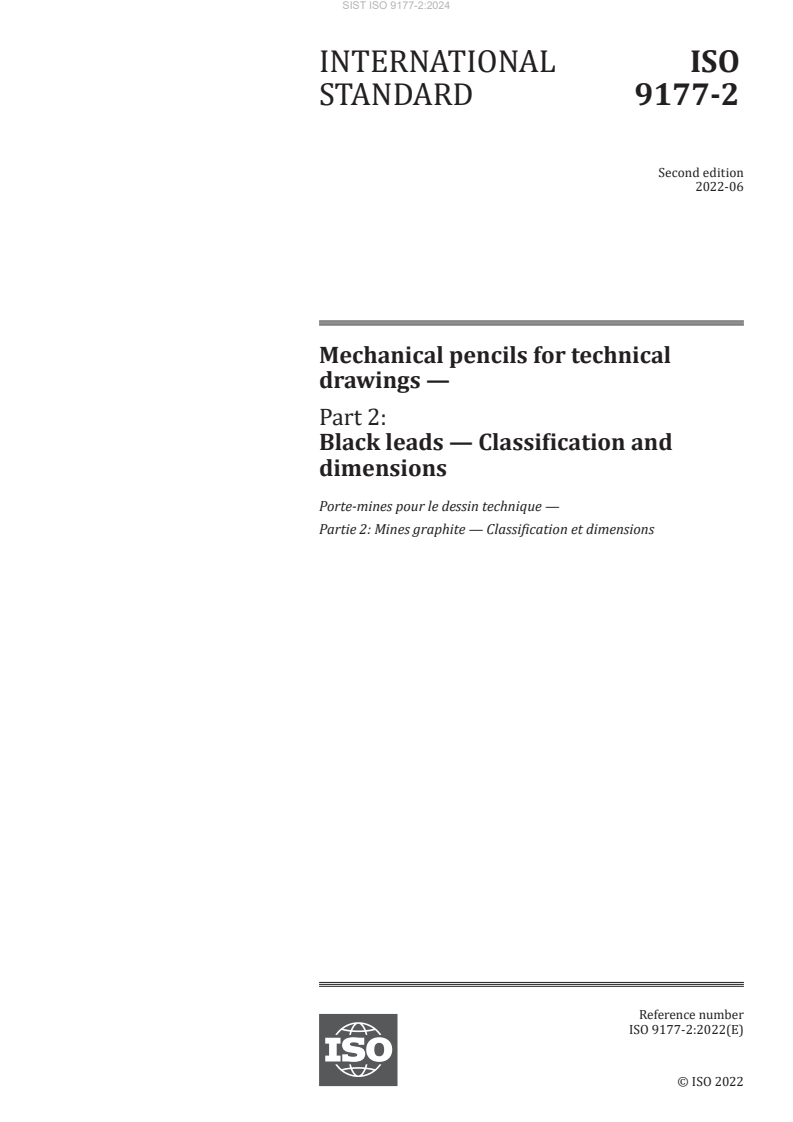
This document specifies a classification and dimensions for black leads used for mechanical pencils for technical drawings. Two types of black leads are available: — polymer leads (designated by the letter “P”); — ceramic leads (designated by the letter “C”).
Porte-mines pour le dessin technique — Partie 2: Mines graphite — Classification et dimensions
La présente partie de l'ISO 9177 spécifie une classification et les dimensions des mines graphite utilisées dans les porte-mine à dessin. Deux types de mines graphite sont disponibles : les mines polymère (désignées par la lettre «P») les mines céramique (désignées par la lettre «C»)
Tehnični svinčniki za tehnično risanje - 2. del: Grafitni vložki - Razdelitev in mere
Ta dokument določa klasifikacijo in mere za grafitne vložke, ki se uporabljajo v tehničnih svinčnikih za tehnično risanje.
Na voljo sta dve vrsti grafitnega vložka:
– polimerni vložek (označen s črko »P«);
– keramičen vložek (označen s črko »C«).
General Information
- Status
- Published
- Publication Date
- 31-May-2022
- Technical Committee
- ISO/TC 10 - Technical product documentation
- Drafting Committee
- ISO/TC 10 - Technical product documentation
- Current Stage
- 6060 - International Standard published
- Start Date
- 01-Jun-2022
- Due Date
- 05-Jan-2023
- Completion Date
- 01-Jun-2022
Relations
- Effective Date
- 06-Jun-2022
Overview
ISO 9177-2:2022 - Mechanical pencils for technical drawings - Part 2: Black leads - Classification and dimensions specifies the classification, nominal diameters and standard lengths for black leads used exclusively in mechanical pencils intended for technical drawing. The standard defines two lead types: polymer leads (P) and ceramic leads (C), and sets requirements that support consistent line quality, interchangeability and clear product designation.
Key topics
- Types of black leads: Polymer (designated “P”) and ceramic (designated “C”).
- Hardness degree: Standardized hardness scale runs from soft (6B) to hard (9H), with HB as the median. Hardness availability varies with nominal diameter (smaller diameters cover a narrower hardness range).
- Nominal diameters: Standard diameters include 0.25 mm, 0.35 mm, 0.5 mm, 0.7 mm, 1 mm, (1.4 mm noted) and 2 mm. Note: common market labels like 0.3 and 0.9 correspond to 0.35 and 1 mm respectively.
- Standard lengths: Typical standardized lead lengths include 60 mm, 90 mm, 100 mm, 30 mm, 45 mm, 25 mm, and 130 mm; actual length depends on the pencil mechanism and nominal diameter.
- Designation format: Packaging and product marking should follow the prescribed format:
- Example polymer: Black lead ISO 9177-2-P-0,5-60
- Example ceramic: Black lead ISO 9177-2-C-2-130
- Normative references: Cross-references include ISO 128-2 (line conventions) and ISO 9177-1 (classification, dimensions, performance and testing for mechanical pencils).
Applications
- Ensures interchangeability of leads across mechanical pencils used for technical drawings in architecture, engineering and drafting.
- Helps manufacturers and suppliers define product specifications, labeling and quality control for black leads.
- Assists specifiers, procurement teams and design studios in selecting leads by diameter, hardness and type for predictable line thickness and erasability.
- Useful for standards compliance, product development and technical documentation where consistent drawing materials are required.
Related standards
- ISO 9177-1 - Mechanical pencils for technical drawings: classification, dimensions, performance requirements and testing.
- ISO 128-2 - Technical product documentation: basic conventions for lines.
- ISO 20318 series - Mechanical pencils and leads for general use (classification, dimensions, quality and test methods).
Keywords: ISO 9177-2, mechanical pencils for technical drawings, black leads, polymer leads, ceramic leads, lead diameters, lead lengths, hardness degree, lead designation.



Frequently Asked Questions
ISO 9177-2:2022 is a standard published by the International Organization for Standardization (ISO). Its full title is "Mechanical pencils for technical drawings — Part 2: Black leads — Classification and dimensions". This standard covers: This document specifies a classification and dimensions for black leads used for mechanical pencils for technical drawings. Two types of black leads are available: — polymer leads (designated by the letter “P”); — ceramic leads (designated by the letter “C”).
This document specifies a classification and dimensions for black leads used for mechanical pencils for technical drawings. Two types of black leads are available: — polymer leads (designated by the letter “P”); — ceramic leads (designated by the letter “C”).
ISO 9177-2:2022 is classified under the following ICS (International Classification for Standards) categories: 01.100.40 - Drawing equipment; 97.180 - Miscellaneous domestic and commercial equipment. The ICS classification helps identify the subject area and facilitates finding related standards.
ISO 9177-2:2022 has the following relationships with other standards: It is inter standard links to ISO 9177-2:1989. Understanding these relationships helps ensure you are using the most current and applicable version of the standard.
ISO 9177-2:2022 is available in PDF format for immediate download after purchase. The document can be added to your cart and obtained through the secure checkout process. Digital delivery ensures instant access to the complete standard document.
Standards Content (Sample)
SLOVENSKI STANDARD
01-marec-2024
Nadomešča:
SIST ISO 9177-2:1995
Tehnični svinčniki za tehnično risanje - 2. del: Grafitni vložki - Razdelitev in mere
Mechanical pencils for technical drawings - Part 2: Black leads - Classification and
dimensions
Porte-mines pour le dessin technique — Partie 2: Mines graphite — Classification et
dimensions
Ta slovenski standard je istoveten z: ISO 9177-2:2022
ICS:
01.100.40 Risalna oprema Drawing equipment
97.180 Razna oprema za dom in Miscellaneous domestic and
trgovino commercial equipment
2003-01.Slovenski inštitut za standardizacijo. Razmnoževanje celote ali delov tega standarda ni dovoljeno.
INTERNATIONAL ISO
STANDARD 9177-2
Second edition
2022-06
Mechanical pencils for technical
drawings —
Part 2:
Black leads — Classification and
dimensions
Porte-mines pour le dessin technique —
Partie 2: Mines graphite — Classification et dimensions
Reference number
© ISO 2022
All rights reserved. Unless otherwise specified, or required in the context of its implementation, no part of this publication may
be reproduced or utilized otherwise in any form or by any means, electronic or mechanical, including photocopying, or posting on
the internet or an intranet, without prior written permission. Permission can be requested from either ISO at the address below
or ISO’s member body in the country of the requester.
ISO copyright office
CP 401 • Ch. de Blandonnet 8
CH-1214 Vernier, Geneva
Phone: +41 22 749 01 11
Email: copyright@iso.org
Website: www.iso.org
Published in Switzerland
ii
Contents Page
Foreword .iv
Introduction .v
1 Scope . 1
2 Normative references . 1
3 Terms and definitions . 1
4 Classification . 2
5 Dimensions .2
5.1 Diameters . 2
5.2 Lengths . 3
6 Designation . 3
Bibliography . 4
iii
Foreword
ISO (the International Organization for Standardization) is a worldwide federation of national standards
bodies (ISO member bodies). The work of preparing International Standards is normally carried out
through ISO technical committees. Each member body interested in a subject for which a technical
committee has been established has the right to be represented on that committee. International
organizations, governmental and non-governmental, in liaison with ISO, also take part in the work.
ISO collaborates closely with the International Electrotechnical Commission (IEC) on all matters of
electrotechnical standardization.
The procedures used to develop this document and those intended for its further maintenance are
described in the ISO/IEC Directives, Part 1. In particular, the different approval criteria needed for the
different types of ISO documents should be noted. This document was drafted in accordance with the
editorial rules of the ISO/IEC Directives, Part 2 (see www.iso.org/directives).
Attention is drawn to the possibility that some of the elements of this document may be the subject of
patent rights. ISO shall not be held responsible for identifying any or all such patent rights. Details of
any patent rights identified during the development of the document will be in the Introduction and/or
on the ISO list of patent declarations received (see www.iso.org/patents).
Any trade name used in this document is information given for the convenience of users and does not
constitute an endorsement.
For an explanation of the voluntary nature of standards, the meaning of ISO specific terms and
expressions related to conformity assessment, as well as information about ISO's adhe
...
INTERNATIONAL ISO
STANDARD 9177-2
Second edition
2022-06
Mechanical pencils for technical
drawings —
Part 2:
Black leads — Classification and
dimensions
Porte-mines pour le dessin technique —
Partie 2: Mines graphite — Classification et dimensions
Reference number
© ISO 2022
All rights reserved. Unless otherwise specified, or required in the context of its implementation, no part of this publication may
be reproduced or utilized otherwise in any form or by any means, electronic or mechanical, including photocopying, or posting on
the internet or an intranet, without prior written permission. Permission can be requested from either ISO at the address below
or ISO’s member body in the country of the requester.
ISO copyright office
CP 401 • Ch. de Blandonnet 8
CH-1214 Vernier, Geneva
Phone: +41 22 749 01 11
Email: copyright@iso.org
Website: www.iso.org
Published in Switzerland
ii
Contents Page
Foreword .iv
Introduction .v
1 Scope . 1
2 Normative references . 1
3 Terms and definitions . 1
4 Classification . 2
5 Dimensions .2
5.1 Diameters . 2
5.2 Lengths . 3
6 Designation . 3
Bibliography . 4
iii
Foreword
ISO (the International Organization for Standardization) is a worldwide federation of national standards
bodies (ISO member bodies). The work of preparing International Standards is normally carried out
through ISO technical committees. Each member body interested in a subject for which a technical
committee has been established has the right to be represented on that committee. International
organizations, governmental and non-governmental, in liaison with ISO, also take part in the work.
ISO collaborates closely with the International Electrotechnical Commission (IEC) on all matters of
electrotechnical standardization.
The procedures used to develop this document and those intended for its further maintenance are
described in the ISO/IEC Directives, Part 1. In particular, the different approval criteria needed for the
different types of ISO documents should be noted. This document was drafted in accordance with the
editorial rules of the ISO/IEC Directives, Part 2 (see www.iso.org/directives).
Attention is drawn to the possibility that some of the elements of this document may be the subject of
patent rights. ISO shall not be held responsible for identifying any or all such patent rights. Details of
any patent rights identified during the development of the document will be in the Introduction and/or
on the ISO list of patent declarations received (see www.iso.org/patents).
Any trade name used in this document is information given for the convenience of users and does not
constitute an endorsement.
For an explanation of the voluntary nature of standards, the meaning of ISO specific terms and
expressions related to conformity assessment, as well as information about ISO's adherence to
the World Trade Organization (WTO) principles in the Technical Barriers to Trade (TBT), see
www.iso.org/iso/foreword.html.
This document was prepared by Technical Committee ISO/TC 10, Technical product documentation.
This second edition cancels and replaces the first edition (ISO 9177-2:1989), of which it constitutes a
minor revision. The changes are as follows:
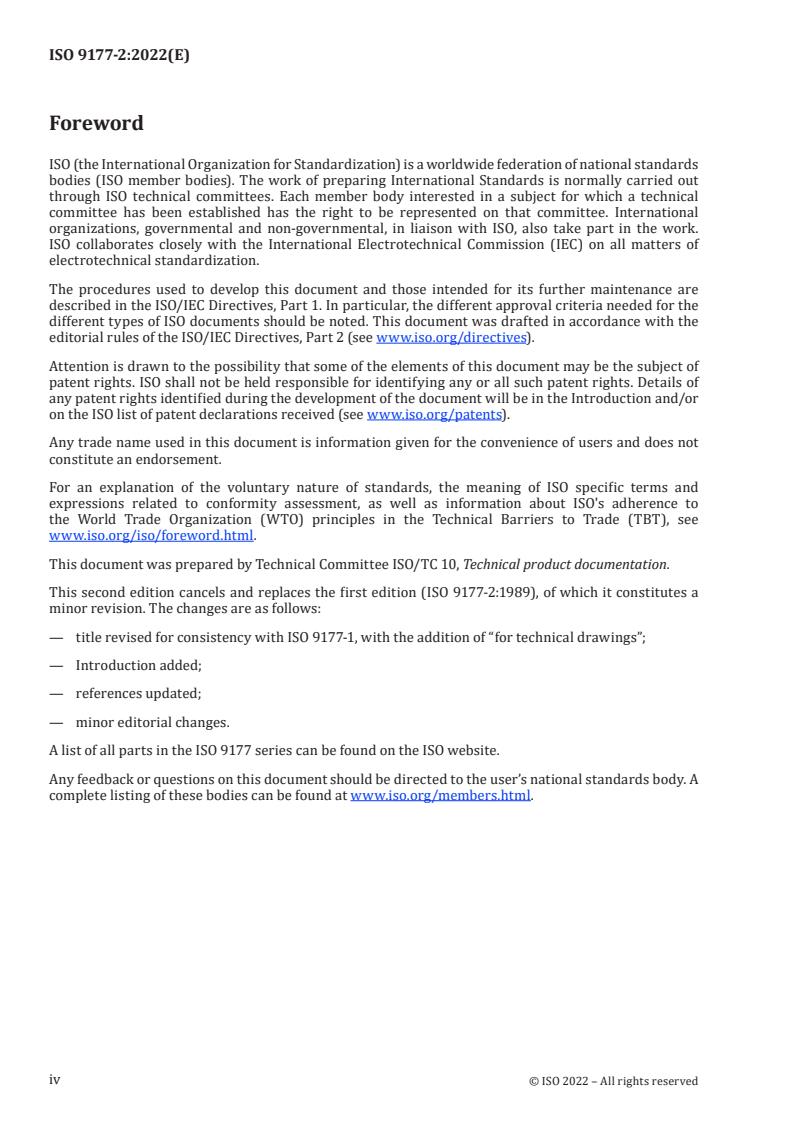
— title revised for consistency with ISO 9177-1, with the addi
...
Questions, Comments and Discussion
Ask us and Technical Secretary will try to provide an answer. You can facilitate discussion about the standard in here.
Loading comments...