

ISO 23802:2026
(Main)Gas cylinders — Seamless tubes, composite tubes and large tubes permanently mounted in a frame — Periodic inspection and testing
- Abstract
This document specifies requirements and gives recommendations for the periodic inspection and testing of permanently mounted tubes of: composite with seamless metallic liners; composite with non-load-sharing liners; seamless steel; in battery vehicles and multiple element gas containers (MEGCs) including frames and associated equipment (these components are also inspected); and large tubes of: composite with seamless metallic liners; composite with non-load-sharing liners; in modules including frames and associated equipment (these components are also inspected).
- Status
- Published
- Publication Date
- 25-Jun-2026
- Technical Committee
- ISO/TC 58/SC 4 - Operational requirements for gas cylinders
- Drafting Committee
- ISO/TC 58/SC 4/WG 19 - Inspection of tubes and frames
- Current Stage
- 6060 - International Standard published
- Start Date
- 26-Jun-2026
- Due Date
- 21-Feb-2028
- Completion Date
- 26-Jun-2026
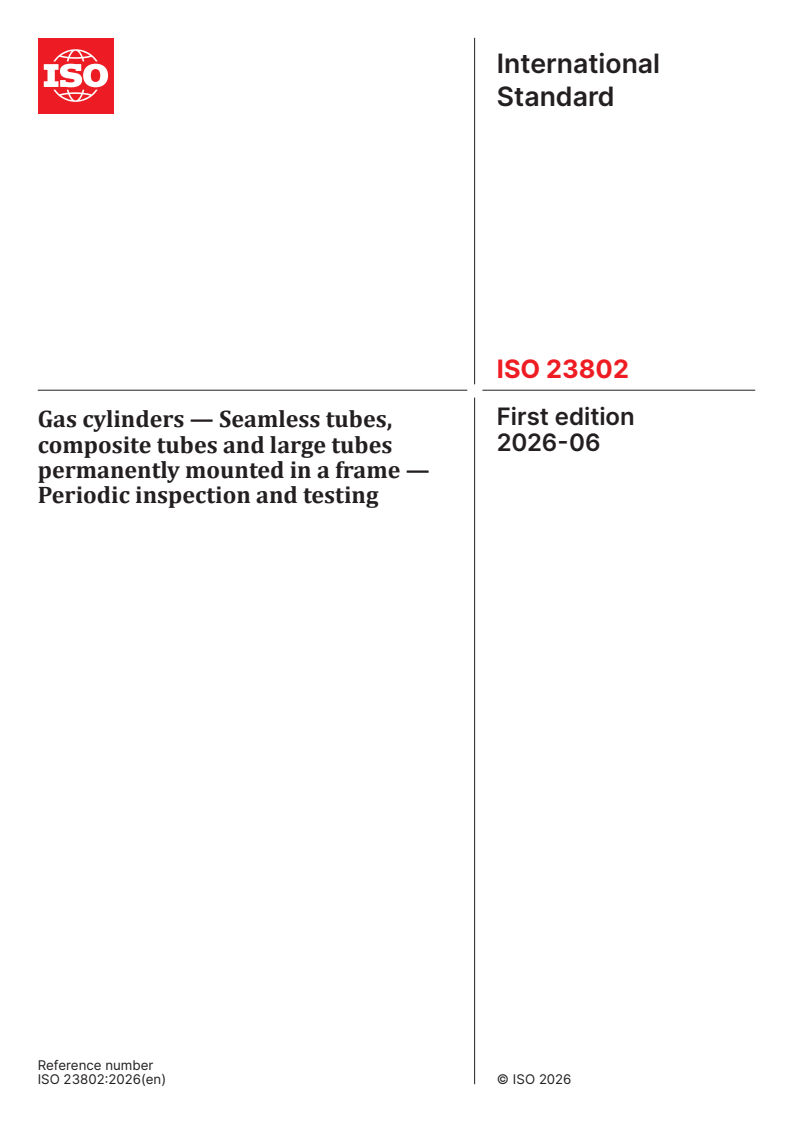
ISO 23802:2026 is an International Standard from ISO for the periodic inspection and testing of permanently mounted gas tubes and large tubes in frames. It covers composite tubes, seamless steel tubes, battery vehicles, multiple element gas containers (MEGCs), and modules with associated frames and equipment, and it is written for competent persons, inspection bodies, owners and others who keep these transport assemblies in service.
What does ISO 23802:2026 specify?
ISO 23802:2026 specifies requirements and gives recommendations for periodic inspection and testing of permanently mounted tubes and large tubes used for transport of compressed gas. It also covers the associated frames and equipment that are part of the assembly, because their condition affects whether the module can safely return to service.
The document is organized into Clauses 1 to 9, which cover scope, references, terms, preparation, inspection with disassembly, inspection without disassembly, roadworthiness, stamp marking, and decommissioning. It has one normative annex for large tubes and two informative annexes with damage examples.
| Annex | What it covers |
|---|---|
| Annex A | Normative inspection and testing of large tubes, including damage assessment, repairs, pressure test and leak test |
| Annex B | Informative examples of damage on equipment and assemblies |
| Annex C | Informative examples of damages and incidents with modules with large tubes |
What are the key requirements of ISO 23802:2026?
ISO 23802:2026 sets out two inspection paths - one for modules that are disassembled and one for modules that stay assembled. Which path is used depends on the tube type, the condition of the module, and whether the assembly has suffered impact, fire, heat or abrasion.
Preparation and safety
Clause 4 requires external examination of the frame, elements and equipment, identification of the gas content and pressure on receipt, and work by competent persons in a suitable facility. The module shall be grounded before gas is removed, and elements shall be depressurized in a safe, controlled way before internal inspection or work on individual elements.
For hazardous gases, the document requires purging and isolation steps that reduce combustion, corrosion and toxicity risks. It also points to ISO 25760 for safe removal of pressure-retaining devices and ISO 15996 for safe overriding of residual pressure valves and non-return valves. In practice, this means the inspection team must plan the depressurization method before touching valves or fittings.
Disassembly route
Clause 5 is used when the module is opened for inspection. Type I tubes are inspected and tested in accordance with ISO 18119, while Type II, III and IV tubes are inspected and tested in accordance with ISO 11623. For composite tubes, acoustic emission testing (AT) and modal acoustic emission (MAE) may be used when accepted by the authorized body.
Large tubes are handled under Annex A rather than the normal tube rules. After removal and reassembly, the module needs a new assembly check and documented leak test, and any replacement part must match the original design type and level of conformity. This matters because reusing the frame, manifold or valves is only acceptable when the part still matches the approved assembly.
Inspection without disassembly
Clause 6 allows inspection without opening the module when the assembly has not been exposed to impact, fire, heat or abrasion and when the elements can be checked as required by NDE. The inspector checks panels, exposed surfaces and equipment, then classifies any damage to the elements using the relevant tube rules or Annex A for large tubes.
If impact damage is level 1, the location is recorded and followed up at the next periodic inspection. If it is level 2, the affected elements move to the more detailed inspection and testing route in Clause 5. In practice, this clause lets an inspector keep a safe module in service without unnecessary disassembly, but it also forces escalation when damage is more than superficial.
Frames, fixings, equipment and fire protection
Clause 4 and Clauses 5 and 6 require inspection of the frame, joints, welds, lifting devices, saddles, neck mounts and fasteners, together with the valves, manifold, piping, gaskets and other equipment. Defects, corrosion, cracks, deformation or leakage have to be repaired, replaced or rendered unserviceable before the module returns to service.
If a fire protection system is fitted, it is checked against the manufacturer’s instructions, including trigger lines, vent pipes, caps and leak tightness of pressurized parts. This is important for owners because a module can pass the tube inspection and still fail if its protective or control hardware is not sound.
Records, marking and final disposition
Clauses 5 and 6 require an inspection report before the module can enter service again. The report records the module identity, frame identity when available, gas service, capacities, pressures, dates, element serial numbers, inspection body details, crack report and any conformity assessment.
Clause 8 requires the identification plate to be permanently stamp marked with the inspection date and the inspection body mark, and each element to be marked or documented as having passed inspection. Clause 9 covers decommissioning and disposal when the inspector and owner decide the module should be taken out of service.
What terms does ISO 23802:2026 define?
- Element - a permanently mounted seamless steel tube, composite tube or large tube that forms part of the assembly.
- Large tube - a composite module element with a water capacity above 3 000 litres and up to and including 15 000 litres.
- Equipment - the valves, pipes, connectors, instruments, manifold, grounding system, fire protection systems, vent pipes and related parts that let the module transport gas.
- Module - the assembly made up of the frame, the elements and the related equipment.
- Frame - the structural and non-structural members that hold the assembly together and protect its elements, valves and manifold.
- Manifold - the piping system that connects valves or fittings for receptacles or large tubes to the main valve or main connections.
- Assembler - the company that installs the elements and equipment in a frame.
- Permanently mounted - requiring tools for installation and removal.
Who uses ISO 23802:2026?
ISO 23802:2026 is used by inspection bodies, competent persons, owners and manufacturers involved with gas cylinders, battery vehicles, MEGCs and modules that transport compressed gas. It is especially relevant to inspection and maintenance teams that need to decide whether to disassemble a module, inspect it in place, repair it, test it and mark it for return to service.
It also matters to assemblers and repair organizations because the standard ties repairs, replacement parts and reassembly to the original type approval and manufacturer instructions. Buyers and fleet operators use it when they need a clear basis for periodic retest, record keeping and serviceability decisions.
Which standards are used with ISO 23802:2026?
ISO 23802:2026 depends on several referenced standards for definitions, inspection methods and valve handling:
- ISO 10286 - vocabulary for gas cylinders.
- ISO 11623 - periodic inspection and testing of composite cylinders and tubes.
- ISO 15996 - specification and type testing for residual pressure valves.
- ISO 18119 - periodic inspection and testing of seamless steel and seamless aluminium-alloy gas cylinders and tubes.
- ISO/TS 19016 - modal acoustic emission (MAE) testing for composite cylinders and tubes.
- ISO 22434 - inspection and maintenance of valves.
- ISO 23876 - acoustic emission examination (AT) for composite cylinders and tubes.
- ISO 25760 - safe operational procedures for removing valves from gas cylinders.
These references supply the inspection vocabulary, the tube-specific inspection methods and the safe valve-removal procedures that ISO 23802 builds on.
What does the ISO 23802:2026 document contain?
ISO 23802:2026 contains inspection workflows, safety precautions, reporting rules and marking rules for periodic service work. It also contains the detailed Annex A method for large tubes, including external visual inspection, internal inspection, repairs, a pressure test and a leak test.
Annex A uses tables to classify damage and decide whether a large tube is acceptable, repairable or condemned. It also includes figures that show examples of abrasion, cuts, impact, delamination, fire damage and chemical attack, which help inspectors recognize damage in the field.
The informative annexes add practical examples from equipment and incident history. Annex B shows equipment damage examples, while Annex C shows module incidents and notes how MAE has been used to assess remaining capacity in damaged large tubes.
Get Certified
Connect with accredited certification bodies for this standard

Institut za varilstvo d.o.o. (Welding Institute)
Slovenia's leading welding institute since 1952. ISO 3834, EN 1090, pressure equipment certification, NDT personnel, welder qualification. Only IIW Au
Sponsored listings
Frequently Asked Questions
ISO 23802:2026 is a standard published by the International Organization for Standardization (ISO). Its full title is "Gas cylinders — Seamless tubes, composite tubes and large tubes permanently mounted in a frame — Periodic inspection and testing". This standard covers: This document specifies requirements and gives recommendations for the periodic inspection and testing of permanently mounted tubes of: composite with seamless metallic liners; composite with non-load-sharing liners; seamless steel; in battery vehicles and multiple element gas containers (MEGCs) including frames and associated equipment (these components are also inspected); and large tubes of: composite with seamless metallic liners; composite with non-load-sharing liners; in modules including frames and associated equipment (these components are also inspected).
This document specifies requirements and gives recommendations for the periodic inspection and testing of permanently mounted tubes of: composite with seamless metallic liners; composite with non-load-sharing liners; seamless steel; in battery vehicles and multiple element gas containers (MEGCs) including frames and associated equipment (these components are also inspected); and large tubes of: composite with seamless metallic liners; composite with non-load-sharing liners; in modules including frames and associated equipment (these components are also inspected).
ISO 23802:2026 is classified under the following ICS (International Classification for Standards) categories: 23.020.35 - Gas cylinders. The ICS classification helps identify the subject area and facilitates finding related standards.
ISO 23802:2026 is available in PDF format for immediate download after purchase. The document can be added to your cart and obtained through the secure checkout process. Digital delivery ensures instant access to the complete standard document.
Standards Content (Sample)
International
Standard
ISO 23802
First edition
Gas cylinders — Seamless tubes,
2026-06
composite tubes and large tubes
permanently mounted in a frame —
Periodic inspection and testing
Reference number
© ISO 2026
All rights reserved. Unless otherwise specified, or required in the context of its implementation, no part of this publication may
be reproduced or utilized otherwise in any form or by any means, electronic or mechanical, including photocopying, or posting on
the internet or an intranet, without prior written permission. Permission can be requested from either ISO at the address below
or ISO’s member body in the country of the requester.
ISO copyright office
CP 401 • Ch. de Blandonnet 8
CH-1214 Vernier, Geneva
Phone: +41 22 749 01 11
Email: copyright@iso.org
Website: www.iso.org
Published in Switzerland
ii
Contents Page
Foreword .iv
Introduction .v
1 Scope . 1
2 Normative references . 1
3 Terms and definitions . 2
4 Preparation for periodic inspection and tests . 3
4.1 General .3
4.2 Safety precautions/depressurization of manifold and individual elements .3
4.3 Inspection of module.4
4.3.1 Inspection of frame .4
4.3.2 Inspection of fixation of elements . .4
4.4 Inspection of fire protection system (if equipped) .5
5 Inspection of a module when disassembling . 5
5.1 Preparation for inspection.5
5.2 Inspection of elements . . .6
5.2.1 Tubes .6
5.2.2 Large tubes .6
5.3 Inspection of equipment .6
5.3.1 General .6
5.3.2 Manifolds .7
5.3.3 Valves and fittings .7
5.4 Replacement of parts .7
5.5 Reassembling .7
5.6 Inspection report .7
6 Inspection of a module without disassembly . 8
6.1 General .8
6.2 Inspection for evidence of external impact on the elements. .9
6.3 Inspection of equipment .9
6.3.1 General .9
6.3.2 Emergency shutoff system (if equipped) .9
6.3.3 Replacement of parts .9
6.3.4 Rework and repair .10
6.3.5 Confirm no leaks from valves, fittings and pipes . .10
6.3.6 Inspection report .10
7 Roadworthiness of trailer chassis and gear .11
8 Stamp marking .11
9 Decommissioning and disposal .11
Annex A (normative) Inspection of Large Tubes .12
Annex B (informative) Examples of damages on equipment/assemblies .29
Annex C (informative) Examples of damages/incidents with modules with large tubes .30
Bibliography .33
iii
Foreword
ISO (the International Organization for Standardization) is a worldwide federation of national standards
bodies (ISO member bodies). The work of preparing International Standards is normally carried out through
ISO technical committees. Each member body interested in a subject for which a technical committee
has been established has the right to be represented on that committee. International organizations,
governmental and non-governmental, in liaison with ISO, also take part in the work. ISO collaborates closely
with the International Electrotechnical Commission (IEC) on all matters of electrotechnical standardization.
The procedures used to develop this document and those intended for its further maintenance are described
in the ISO/IEC Directives, Part 1. In particular, the different approval criteria needed for the different types
of ISO document should be noted. This document was drafted in accordance with the editorial rules of the
ISO/IEC Directives, Part 2 (see www.iso.org/directives).
ISO draws attention to the possibility that the implementation of this document may involve the use of (a)
patent(s). ISO takes no position concerning the evidence, validity or applicability of any claimed patent
rights in respect thereof. As of the date of publication of this document, ISO had not received notice of (a)
patent(s) which may be required to implement this document. However, implementers are cautioned that
this may not represent the latest information, which may be obtained from the patent database available at
www.iso.org/patents. ISO shall not be held responsible for identifying any or all such patent rights.
Any trade name used in this document is information given for the convenience of users and does not
constitute an endorsement.
For an explanation of the voluntary nature of standards, the meaning of ISO specific terms and expressions
related to conformity assessment, as well as information about ISO's adherence to the World Trade
Organization (WTO) principles in the Technical Barriers to Trade (TBT), see www.iso.org/iso/foreword.html.
This document was prepared by Technical Committee ISO/TC 58, Gas Cylinders, Subcommittee SC 4,
Operational requirements for gas cylinders.
Any feedback or questions on this document should be directed to the user’s national standards body. A
complete listing of these bodies can be found at www.iso.org/members.html.
iv
Introduction
This document is primarily intended for periodic inspection of assemblies with a frame, permanently
mounted tubes and composite large tubes, and related equipment for transport of compressed gas.
v
International Standard ISO 23802:2026(en)
Gas cylinders — Seamless tubes, composite tubes and large
tubes permanently mounted in a frame — Periodic inspection
and testing
1 Scope
This document specifies requirements and gives recommendations for the periodic inspection and testing of
permanently mounted tubes of:
— composite with seamless metallic liners;
— composite with non-load-sharing liners;
— seamless steel;
in battery vehicles and multiple element gas containers (MEGCs) including frames and associated equipment
(these components are also inspected);
and large tubes of:
— composite with seamless metallic liners;
— composite with non-load-sharing liners;
in modules including frames and associated equipment (these components are also inspected).
2 Normative references
The following documents are referred to in the text in such a way that some or all of their content constitutes
requirements of this document. For dated references, only the edition cited applies. For undated references,
the latest edition of the referenced document (including any amendments) applies.
ISO 10286, Gas cylinders — Vocabulary
ISO 11623, Gas cylinders — Composite cylinders and tubes — Periodic inspection and testing
ISO 15996, Gas cylinders — Residual pressure valves — Specification and type testing of cylinder valves
incorporating residual pressure devices
ISO 18119, Gas cylinders — Seamless steel and seamless aluminium-alloy gas cylinders and tubes — Periodic
inspection and testing
ISO/TS 19016, Gas cylinders — Cylinders and tubes of composite construction — Modal acoustic emission (MAE)
testing for periodic inspection and testing
ISO 22434, Gas cylinders — Inspection and maintenance of valves
ISO 23876, Gas cylinders — Cylinders and tubes of composite construction — Acoustic emission examination
(AT) for periodic inspection and testing
ISO 25760, Gas cylinders — Operational procedures for the safe removal of valves from gas cylinders
3 Terms and definitions
For the purposes of this document, the following terms and definitions apply.
ISO and IEC maintain terminology databases for use in standardization at the following addresses:
— ISO Online browsing platform: available at https:// www .iso .org/ obp
— IEC Electropedia: available at https:// www .electropedia .org/
3.1
element
permanently mounted seamless steel and composite tubes or large tubes
3.2
large tube
element of a module of composite construction, having a water capacity of more than 3 000 litres up to and
including 15 000 litres
3.3
equipment
valves, pipes, connectors, instruments, manifold, grounding system, fire protection systems, vent pipes and
other components in the module and which enable the module to be used for transport of gas
3.4
valve
component intended for control of the gas flow to, within and from the module
Note 1 to entry: This includes shutdown valves, closure valve, instrument valves, check valves, safety valves.
3.5
manifold
piping system for connecting valves or fittings for receptacles or large tubes in an assembly to a main
valve(s) or the main connection(s)
3.6
assembler
company that installs the elements and the equipment in a frame
Note 1 to entry: The assembler may be considered a manufacturer in some standards and regulations.
3.7
frame
structural and non-structural members of either a bundle, a multiple element gas container (MEGC) or
equivalent assembly which combine all other components together, while providing protection for the
assembly’s elements, valves and manifold, and which enable the assembly to be transported
3.8
panel
cladding used to protect elements from UV radiation and foreign material, and as indicator of external
impacts
3.9
module
assembly of frame, elements, and related equipment
Note 1 to entry: In case of a MEGC, the module is the complete MEGC.
3.10
permanently mounted
requiring tools for installation and removal
4 Preparation for periodic inspection and tests
4.1 General
Periodic inspection and test shall include an external examination of the frame, elements and equipment.
If identification of the elements, i.e. part number and serial number, is not possible while in the frame, either
the frame shall be disassembled, or the element shall be disassembled from the frame as required to identify
the elements.
The inspection, repair and testing of the module shall be carried out only by competent persons in a suitable
facility. Care shall be taken to ensure safety during the inspection procedure.
Applicable regulations for assessing conformity with this document can exist in the countries of use. Tests
and examinations performed to demonstrate conformity shall be conducted using instruments calibrated
before being put into service and thereafter according to an established programme.
If any element or the manifold is removed from the frame during the retest procedure or related operations,
a completely new assembly check shall be performed and documented in accordance with any type approval
of the module, the design code and mounting instructions used for the original assembly.
Disassembling is an option for elements or equipment where visual external inspection of elements or
equipment has pointed out impacts or other damage on the elements but may not be necessary to fully
disassemble if some of the elements or equipment are not involved in the impact or other damage.
Risk handling of elements shall be considered linked to their size and weight.
Upon receipt of the module for inspection, the gas content and pressure within the module shall be identified
and recorded.
The inspector should obtain inspection information and service documents from the original assembler and
report(s) of any prior inspection(s) of the module from the owner of the module.
Before any work is carried out, the relevant element data (part numbers and serial numbers) and ownership
shall be identified, and the original module approval made available to the inspection body.
These data shall be in accordance with the label on the module.
4.2 Safety precautions/depressurization of manifold and individual elements
The module shall be electrically connected or grounded before removing gas or inspecting the module.
Elements and equipment shall be depressurized to atmospheric pressure in a safe, controlled manner before
carrying out any inspection or test work on an individual element if the element is to be internally inspected.
Pressurized elements are allowed as required for non-destructive examination (NDE) inspection methods.
Particular attention shall be given to modules containing flammable, oxidizing, corrosive or toxic gases to
eliminate risks at the initial inspection stage, e.g. by purging the element, tubing and associated fittings and
components as required, prior to disconnecting equipment or removal of elements from the module. Purging
shall be accomplished through introduction of an inert gas into the system so that risk of combustion,
corrosion, or toxicity is removed.
A positive check shall be performed prior to the removal of pressure-retaining devices to ensure these
devices are isolated from all pressure sources. This check shall be performed as described in ISO 25760.
Residual pressure valves and non-return valves shall be safely overridden to ensure that the elements are
fully depressurized in accordance with the requirements of ISO 15996, when required.
When valves are found to be inoperative or blocked, the elements affected shall be depressurized in
accordance with documented procedures. In the case of elements disassembled from module and not
equipped with valves, the tube fittings shall be checked to determine whether the gas is able to pass freely
from the tube.
Additional information for the depressurisation of the module may be available in the manufacturer’s
operating and inspection manual. In case of composite type 4 tubes and large tubes, vacuum shall not be
formed at any time, unless otherwise explicitly allowed. The manufacturer may specify a value for residual
pressure in the elements during inspection if the elements are not dismantled. Procedures for safe handling,
depressurization, as applicable for the module shall be available at the authorized inspection site.
4.3 Inspection of module
Modules should be inspected in accordance with Clause 5 unless all requirements in Clause 6 are fulfilled.
Modules with large tubes should preferably be inspected without disassembling in accordance with Clause 6.
NOTE inspection in accordance with Clause 5 is a common practice for tubes of water capacity up to 3 000 L
4.3.1 Inspection of frame
Whenever the frame is intended to be reused, it shall be inspected for any signs of corrosion, contamination,
deformation or fracture. If defects are found, they shall be repaired, or the frame rendered unserviceable.
All frame members and their joints including welds shall be visually inspected for deformation, cracks and
corrosion. If doubt exists regarding the integrity of the frame, the coating shall be removed, and the frame
inspected using an appropriate method, e.g., dye penetrant. A non-destructive examination method, e.g.
X-ray, ultrasonic, dye penetrant, shall be carried out following any structural repair to the frame to verify
the integrity of the weld. The coating shall be repaired after any inspection or repair where the coating is
removed or altered.
ISO 17638, ISO 23278 or another applicable International Standard may be used to confirm the presence of
cracks.
There shall be sufficient access to all frame panels and covers so they can be removed in order to properly
carry out the inspection.
Module lifting devices shall be inspected for defects or cracks. If defects or cracks are found, the lifting
device shall be repaired or rendered unserviceable, and a crack detection report shall be written. A non-
destructive examination method, e.g., X-ray, ultrasonic, dye penetrant, shall be carried out following any
structural repairs to the lifting devices to verify the integrity of the weld.
If the frame or the lifting devices, or both, require repair, the repair shall conform to the original specification,
or be approved by the owner and a competent person or by the manufacturer.
All fasteners shall be in place and the torque checked in accordance with the manufacturer’s instruction.
Lost and broken fasteners shall be replaced in conjunction with inspection of associated brackets.
Structural members and panels that have been deformed or impacted can be replaced with new members
and panels meeting the original design and specification requirements.
Weld crack longer than 1 % of the weld length shall be blunted to prevent further growth. Crack longer than
5 % of the weld length shall be repaired.
Any repair procedure shall be approved by the owner and the manufacturer and by the authority having
jurisdiction if required. If the manufacturer no longer exists, then a competent person, knowledgeable of the
MEGC or module components, shall approve the repair.
4.3.2 Inspection of fixation of elements
4.3.2.1 General
Confirm fasteners are in-place and properly torqued.
4.3.2.2 Inspection of saddles
Saddles, if used, shall be checked for deformation, cracks, aging, corrosion or other signs of degradation.
Isolation pads, if used, shall be checked for significant wear in at least 3 accessible saddles selected by the
inspector and be replaced if needed. If significant wear is identified, the MEGC shall be disassembled in
accordance with Clause 5.
4.3.2.3 Inspection of neck mounts
Neck mounts, if used, shall be inspected for deformation, cracks, and corrosion. Confirm there is no evidence
of significant wear on the mounting. If significant wear is identified, the neck mounting elements shall be
replaced by parts meeting the module specifications.
4.4 Inspection of fire protection system (if equipped)
Confirm the specified fire protection systems, vent pipes and caps are installed and conform to their
specifications.
The inspection shall include a detailed visual examination of all components that encompass the fire
protection system as well as a leak test of the pressurized components. Perform the following and any other
items, in accordance with instructions given by the manufacturer.
— Inspect the trigger lines and components for indications of damage.
— check piping and connections for leaks.
NOTE Methods can include liquid leak detector or combustible gas detectors.
— Repair leaks as necessary.
— Check the vent lines for debris and water and ensure vent pipes are not plugged.
— Check vent caps are in place on all vents if caps are required in the design specification.
All vent pipes connected to a pressure relief device (e.g. a TPRD), which are normally unpressurized, shall be
checked for proper mounting, properly assembled so as to avoid leaks, and that the accessories and fittings
are in accordance with the design standard used.
5 Inspection of a module when disassembling
5.1 Preparation for inspection
The following procedures, when applicable, form the requirements for such inspections and tests.
a) identification of the module, including elements, valves, manifold and frame, and preparation for
inspections and tests;
b) depressurization of manifold and individual elements;
c) disassembly of the module including de-valving in accordance with 4.2 and the safe removal of tube
fittings;
NOTE The removal of the valves is not always necessary when elements are examined by a non-destructive test
method.
Inspection and testing shall be performed in accordance with 5.2 to 5.5.
5.2 Inspection of elements
5.2.1 Tubes
Type I tubes shall be inspected and tested in accordance with ISO 18119. This can include the use of
ultrasonic testing (UT) as a non-destructive test (NDT) method. Alternatively, ISO 16148 (acoustic emission
testing) may be used.
Type II, III and IV tubes shall be inspected and tested in accordance with ISO 11623. The following non-
destructive test methods may be used:
— acoustic emission test (AT) in accordance with ISO 23876;
— modal acoustic emission (MAE) in accordance with ISO TS 19016.
NDT methods need the acceptance of the authorized body
5.2.2 Large tubes
Large tubes shall be inspected and tested in accordance with Annex A. The following non-destructive test
methods may be used when approved or recognized,
— acoustic emission test (AT) in accordance with ISO 23876;
— modal acoustic emission (MAE) in accordance with ISO TS 19016.
ISO 11623 and ISO 18119 are applicable for tubes up to 3 000 l. For large tubes a specific external visual
inspection shall be based on instructions from the manufacturer; ISO 11623 or ISO 18119 may offer
additional guidance as applicable.
5.3 Inspection of equipment
5.3.1 General
Equipment shall be safely removed from the frame. Any available recommendations from original
manufacturer shall be considered to perform such operation.
If any part of the existing frame, manifold or valves are intended to be reused, the relevant equipment shall
be inspected and evaluated to be in accordance with the original specification.
The examination shall ensure that:
a) the piping, valves, and gaskets are inspected for corroded areas, defects, and other conditions, including
leakage of gaskets and connections, that might render the module unsafe for filling, discharge or
transport;
b) missing or loose bolts or nuts on any flanged connection or blank flange are replaced or tightened;
c) all emergency devices and safety valves are free from corrosion, distortion and any damage or defect
that could prevent their normal operation;
d) spindle operated shut off valves shall be operated between full open to closed position;
e) ball valves shall be operated from full open to closed position and to verify that valve handle and stop
pins are correct positioned;
f) remote closure devices and self-closing stop valves shall be operated to demonstrate proper operation;
g) required marks on the equipment are legible and in accordance with the applicable requirements; and
h) the framework, the supports and the arrangements for lifting the module are in satisfactory condition.
When evidence of any unsafe condition is discovered, the module shall not be returned to service until it has
been corrected and the applicable tests and verifications are passed.
NOTE This clause reflects the requirements in UN Model Regulations 6.7.5.12 “Inspection and testing".
5.3.2 Manifolds
Manifold intended to be reused, shall be visually inspected for damage, fire traces and local material abrasion.
The manifold shall be degreased and cleaned, if needed, in accordance with the original specification.
When repairs are necessary, they shall be carried out by a competent person in accordance with a written
procedure that meets the design approval of the module.
If a manifold is reused, it shall be subjected to a pressure test and leak checked in accordance with the
requirements of the original design specification or as per EN 13807 or equivalent. If a new manifold is
used, it does not have to be retested at time of periodic inspection provided it was pressure tested after
manufacturing.
5.3.3 Valves and fittings
Valves that are to be reused in module shall be inspected and maintained in accordance with the
requirements of ISO 22434.
If new valves are fitted, they shall conform to the type of approval of the module.
If a valve is replaced, the new valve shall conform to the original specification or replaced by an equivalent
approved valve accepted by the owner and the manufacturer. Fittings shall be inspected for defects, e.g.
thread damage. If the fitting fails this inspection, it shall be replaced.
5.4 Replacement of parts
If a replacement of any part of the module takes place at any stage during the periodic inspection and testing,
the new parts shall be compatible with the original design type specification, and with the same level of
conformity assessment, and the tare of the module shall be adjusted if necessary.
5.5 Reassembling
Depending upon the nature of the operation, an existing module may, upon disassembling, be reassembled
using the same frame, elements and equipment. Alternatively, frames, elements and equipment may be
interchanged for ease of operation during the periodic inspection and testing, provided these parts conform
with the type approval of the module.
A completely new assembly check shall be performed, including a leak test, and documented in accordance
with the original manufacturers operating manual, if available. The leak test with the gas service in use may
be performed during the first fill after reassembling rather than immediately after reassembling.
5.6 Inspection report
The current inspection report shall confirm inspection of equipment with noted defects or repairs and
identify if the noted defects have grown or recurred. Replacement of key components (e.g. elements, valves,
and manifolds, but not tubing or fasteners) shall note part number, serial number, and certification of new
components.
An inspection report is required before the module is considered to enter into service.
Records of the equipment used to assemble a module and of the history of how and where the module was
disassembled and re-assembled and tested shall be maintained for every retest and reassemble of the
module.
The module documentation prepared in accordance with the type approval shall be modified to include the
data of any new element or equipment incorporated into the module.
These records shall contain at least the following:
— unique serial number of the module;
— unique serial number of the frame, when available;
— gas service for which the module is intended;
— total water capacity of the module in litres;
— working pressure of the elements in the module;
— test pressure of the module (in accordance with the test pressure of the elements);
— previous date(s) of periodic inspections and testing;
— serial numbers of the elements in the module;
— symbol or number, or both, and country of the inspection body;
— name and address of the approved inspection body;
— date of the periodic inspection and test;
— crack detection report;
— maximum gross weight;
— conformity assessment, if applicable.
All records shall be maintained by the owner of the module for at least as long as the module remains in
service.
NOTE Sharing of inspection data and field experience between manufacturer and owner can lead to improved
safety.
6 Inspection of a module without disassembly
6.1 General
If all requirements in Clause 6 are fulfilled, a module with any element size may be inspected without
disassembling
Disassembly of the module is not necessary if the module has not been exposed to:
— external impacts;
— fire;
— heat leading to a discoloration;
— abrasion;
and no element has been in contact with another element or unintended contact with the frame or equipment
or if element(s) can be checked/evaluated by a NDE method.
If the contained gas is corrosive to the cylinder or liner, an internal inspection shall be conducted. Internal
inspection of elements is not required if the contained gas is not corrosive to the cylinder or liner.
Removal of any tubes from their mounts shall be done in accordance with the manufacturer's instructions
when available. Following any required inspection, all components, including replacement components
if they are being replaced, shall be re-installed in accordance with the manufacturer's instructions when
available. Replacement components shall meet the manufacturer’s specifications and type approvals. All re-
assembled components and connections shall be leak tested in accordance with established procedures.
6.2 Inspection for evidence of external impact on the elements.
Panels, if any, shall be checked for signs of external impacts. Any panels showing marks or holes from an
external impact shall be removed and actual element surface shall be classified in accordance with ISO 11623
or ISO 18119 for tubes, or Annex A.
Element surfaces not protected by panels shall be visually inspected for any impacts or other sign of
abrasion by an inspector. Any visual damage on an element shall be classified in accordance with ISO 11623,
ISO 18119, or Annex A for large tubes.
If evidence of external impact on elements is found, the elements showing the effect of the impact is evaluated,
and if it is a level 1 case, the location shall be noted followed up latest at the next periodic inspection. If the
impact is classified as a level 2, the elements shall be subjected to inspection and testing in accordance with
5.2. testing.
6.3 Inspection of equipment
6.3.1 General
The inspection and examination needs are dependent on the module design and shall be performed on
applicable equipment to ensure that:
— the piping, and valves are inspected for corroded areas, defects, and other conditions, including leakage
of gaskets and connections, that might render the module unsafe for filling, discharge or transport;
— missing or loose bolts or nuts on any flanged connection or blank flange are replaced or tightened;
— all emergency devices and safety valves are free from corrosion, distortion and any damage or defect
that could prevent their normal operation. Additional manufacturer’s instructions requiring specific
test or inspections shall be followed;
— spindle operated shutoff valves shall be operated between full open to closed position;
— ball valves shall be operated from full open to closed position and to verify that valve handle and stop
pins are correct positioned;
— valves are inspected externally in accordance with ISO 22434.
— remote closure devices and self-closing stop valves shall be operated to demonstrate proper operation;
— required marks on the module are legible and in accordance with the applicable requirements; and
— the framework, the supports and the arrangements for lifting the module are in satisfactory condition.
When evidence of any unsafe condition is discovered, the module shall not be returned to service until it has
been corrected and the applicable tests and verifications are passed.
6.3.2 Emergency shutoff system (if equipped)
Emergency shutoff system shall be tested and maintained in accordance with the manufacturer
specifications.
6.3.3 Replacement of parts
If a replacement of any part of the module takes place at any stage during the periodic inspection and testing:
— check all new parts for conformity with the module standard;
— check that all vent pipes connected to pressure relief device (i.e. TPRD) are properly mounted and
assembled to avoid leaks;
— check all replaced gaskets for leakage;
— adjust the tare of the module if necessary, e.g. if replacement components are different weight than
original components.
Elements and equipment shall be safely removed from the frame, if necessary, and replacements made, in
accordance with manufacturers recommendations.
6.3.4 Rework and repair
Any repair procedure shall be approved and accepted by the owner and the manufacturer, or by a competent
person if the manufacturer is no longer in business.
During the first fill after periodic inspection is done, the module shall be checked for any leakage.
6.3.5 Confirm no leaks from valves, fittings and pipes
Leak check shall be performed at working pressure or pressure developed during fill. The leak test can be
performed by isolating the elements by closing the element valves if so equipped.
6.3.6 Inspection report
A report of inspection shall be prepared. Specific findings shall be listed. Repair/rework shall be noted.
Test records of individual components or batches of components shall be maintained such that they may be
cross-referenced to individual module records. These test records shall at least cover:
— name of the manufacturer of the module;
— unique serial number of the module;
— unique serial number of the frame, when available;
— gas service for which the module is intended;
— total water capacity of the module in litres;
— working pressure of the elements in the module;
— test pressure of the module (in accordance with the test pressure of the elements);
— previous date(s) of periodic inspections and testing;
— serial numbers of the elements in the module;
— symbol or number, or both, and country of the inspection body;
— name and address of the approved inspection body;
— date of the periodic inspection and test;
— crack detection report;
— maximum gross weight;
— conformity assessment, if applicable.
All records shall be maintained by the owner of the module for at least as long as the module remains in
service.
NOTE Sharing of inspection data and field experience between manufacturer and owner can lead to improved
safety.
7 Roadworthiness of trailer chassis and gear
Modules are intended to be mounted on roadworthy trailer chassis and gear. Trailer chassis and gear are
generally subject to regulations.
8 Stamp marking
After completion of the periodic inspection and testing, the module identification plate, e.g. as specified
in the module type approval, shall be permanently stamp marked with the date of the periodic inspection
(shown as YYYY/MM or YYYY-MM) preceded by the registered mark of the inspection body. Each element
shall also be marked or documented as having passed inspection.
9 Decommissioning and disposal
Decommissioning and disposal, if recommended by the inspector and approved by the owner, shall be done
in accordance with manufacturer’s instruction or generally accepted methods. The module may need to be
made unusable if directed by the inspector.
Annex A
(normative)
Inspection of Large Tubes
A.1 Scope
This annex specifies the requirements for periodic inspection and testing and to verify the integrity for
further service of composite large tubes designed in accordance with ISO/TS 17519 or ISO 17519 when
approved.
A.2 External visual inspection
A.2.1 General
The inspection, testing and repair of large tubes shall be carried out only by competent persons in suitable
facilities for permanently mounted large tubes of the size and type being inspected. Handling procedures
recommended by the manufacturer shall be available to the inspector. Special handling methods and tooling
may be required to safely handle large tubes.
A.2.2 Inspection procedures
The large tube manufacturer shall determine the acceptance/rejection criteria for external damage,
which takes precedence over the criteria outlined in Table A.1. Table A.1 shall be followed if the large tube
manufacturer’s criteria are not available.
The external surface shall be inspected for damage to the composite overwrap. Removal of resin, paint or
coating from installed large tubes for the visual inspection is not permitted. Shields or covers that inhibit
the inspection shall be removed or opened as possible, to gain access to the large tube surface area for
inspection. There are three levels of damage that shall be considered (see A.2.3.3); of these, level 1 does not
require repair, level 2 can be repaired, and level 3 shall not be repaired (see Table A.1).
A.2.3 Damage
A.2.3.1 General
Damage to the composite overwrap can appear in many forms, and examples of these are described in A.2.3.3.
The acceptance/rejection criteria specified in Table A.1 and the large tube manufacturer’s recommendations
refer to specified damage levels and the types of damage. Care shall be taken to establish the total extent
of damage from impact (see A.2.3.3.3) and delamination (see A.2.3.3.4) as surface appearance might not
indicate the full extent of the damage.
When damage is caused by installation, the inspector should advise the large tube owner of the need to take
corrective action to prevent or reduce further large tube damage, or to prevent damage to a replacement
large tube. Such actions should be developed with the manufacturer of the large tube/frame assembly.
A.2.3.2 Damage levels
A.2.3.2.1 General
The surface of the large tube shall be inspected for evidence of damage. Damage shall be evaluated in
accordance with Table A.1. In the absence of acceptance criteria for damage not specified in this document
or by the manufacturer, such damage shall be identified as Level 3 damage unless it is demonstrated by
additional testing that the large tube is safe for continued service.
The surface inspection of the large tubes may be done while the module is assembled, or while the module is
disassembled.
NOTE Some examples of in-service damage are shown in Annex B and Annex C.
A.2.3.2.2 Level 1 damage
Large tubes with minor or superficial damage are categorized as having Level 1 damage. Such damage has
no adverse effects on the safety of the large tube and its continued use. These large tubes may be returned
to service with no repair.
Scratched paint or nicks that have no appreciable depth in metal, or similar damage in the composite large
tube paint or resin where there are no visible frayed fibres, are of this level of damage.
A.2.3.2.3 Level 2 damage
Level 2 damage is rejectable damage that requires repair, testing, or rendering the large tube unserviceable,
as advised by the large tube manufacturer, who will advise if disassembly is needed and related procedures.
Level 2 damage is also reserved for conditions specified by the manufacturer, which can
...