

ISO 18994:2026
(Main)Plastics — Water meter cabinet — Materials and design specifications
- Abstract
This document gives the specifications of the thermoplastic water meter cabinets. It specifies the thickness of material, design drawing, dimensions and accessories incorporated into the construction of it for pipe sizes from 12,7 mm to 31,75 mm.
- Status
- Published
- Publication Date
- 19-Aug-2026
- Technical Committee
- ISO/TC 61/SC 11 - Products
- Drafting Committee
- ISO/TC 61/SC 11 - Products
- Current Stage
- 6060 - International Standard published
- Start Date
- 20-Aug-2026
- Due Date
- 01-Nov-2026
- Completion Date
- 20-Aug-2026
ISO 18994:2026 is an International Standard from ISO for thermoplastic water meter cabinets. It specifies the material, design and marking features for cabinets used with pipe sizes from 12,7 mm to 31,75 mm, so manufacturers, regulators and buyers can judge whether a cabinet design suits the intended installation.
What does ISO 18994:2026 specify?
ISO 18994:2026 specifies the construction of thermoplastic water meter cabinets, including material thickness, cabinet dimensions, accessories and the design details needed for use around water meters. It is organized as a short product standard with requirements, sampling, testing and marking clauses.
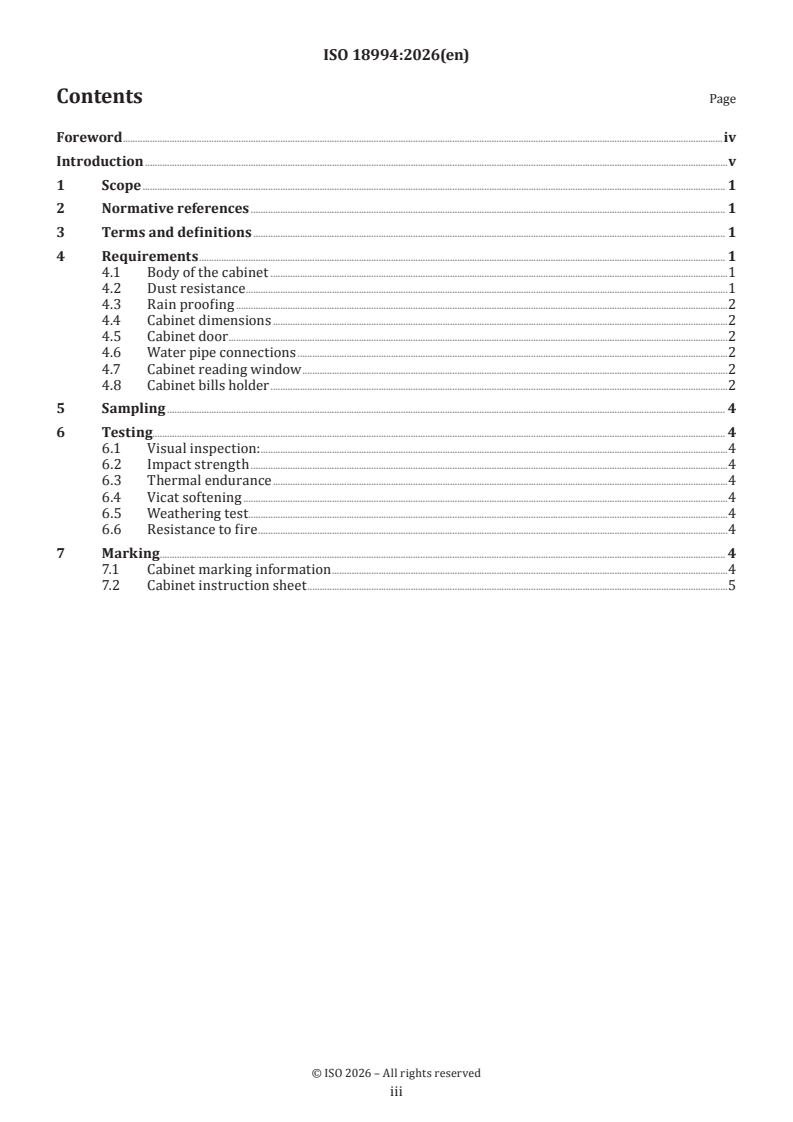
| Clause | What it covers |
|---|---|
| 1 | Scope |
| 2 | Normative references |
| 3 | Terms and definitions |
| 4 | Requirements for the cabinet body, enclosure features and accessories |
| 5 | Sampling for type tests |
| 6 | Testing methods and acceptance points |
| 7 | Marking and instruction sheet content |
The scope ties the standard to cabinets for thermoplastic construction and to the stated pipe-size range. In practice, that means the document is aimed at cabinet design and manufacture, not installation workmanship or the water meter itself.
What are the key requirements of ISO 18994:2026?
ISO 18994:2026 focuses on the cabinet body, outdoor protection, door details, pipe connections, viewing features, test samples and identification marking. These are the points that most affect whether a cabinet will survive service and remain readable and maintainable.
Cabinet body and outdoor durability
Clause 4.1 requires the body to be made from thermoplastic material with impact resistance, heat resistance, Vicat softening performance and weathering resistance verified against the named test standards. It also sets a minimum wall thickness. In practice, this tells a manufacturer to select a material and section thickness that can tolerate outdoor use, handling and temperature exposure.
Protection against dust and rain
Clauses 4.2 and 4.3 require the cabinet to keep out dust to a level that does not disturb internal accessories and to avoid internal water accumulation that would impair operation. This matters because meter cabinets are exposed outdoor enclosures, so sealing and drainage behavior affect reliability.
Cabinet layout, door and access features
Clause 4.4 leaves cabinet dimensions to the local authority responsible for water cabinets. Clause 4.5 then sets door-related details: a hinged door carries the customer number, a rubber gasket is recommended, the hinges need to allow at least 90 degrees of opening, the manufacturer logo is required, and a locking system is recommended. For users, this means the cabinet must fit local utility practice while still allowing access, identification and secure closure.
Pipe connections, reading window and bills holder
Clause 4.6 requires inlet and outlet connections to suit the required pipe size and to include rubber rings. Clauses 4.7 and 4.8 call for a transparent reading window that can be read by eye and for a transparent, unbreakable, scratch-resistant bills holder attached to the meter cover. These features matter because the cabinet must support reading and documentation without opening or damaging the enclosure.
Sampling, testing and fire behavior
Clause 5 says type tests use a sample of three units. Clause 6 then covers visual inspection, impact strength, thermal endurance, Vicat softening, weathering and fire resistance. The fire requirement uses ISO 9773 and varies with specimen thickness. For buyers and quality teams, this section is the basis for inspection plans and product qualification.
Marking and instructions
Clause 7 requires durable marking on the outside of the cover by hot moulding, including the manufacturer name, country of manufacture, water company logo and resin identification code number. It also requires an instruction sheet in English and the local language inside the cover, including the same marking information and an installation illustration. This helps traceability and field installation.
Who uses ISO 18994:2026?
ISO 18994:2026 is used by cabinet manufacturers, water utilities, local authorities, regulators, quality managers and buyers. Manufacturers use it to design the enclosure and choose materials. Utilities and regulators use it to check that cabinet designs suit service, identification and outdoor exposure. Test laboratories use it when running the specified verification tests.
Which standards are used with ISO 18994:2026?
ISO 18994:2026 cites these normative references:
- ISO 306 - provides the Vicat softening temperature test used to check heat softening behavior.
- ISO 2578 - provides the long-term heat exposure basis used for thermal endurance.
- ISO 4892-2 - provides xenon-arc weathering exposure for outdoor durability checks.
- ISO 7765-2 - provides the instrumented puncture impact test used for impact resistance.
- ISO 9773 - provides the burning behavior test used for fire resistance.
What does the ISO 18994:2026 document contain?
ISO 18994:2026 contains a schematic example of a water meter cabinet in multiple views, along with the main parts identified in the figure. It also contains the test program in Clause 6 for visual inspection, impact, heat exposure, Vicat softening, weathering and fire behavior. Clause 7 gives the required marking content for the cabinet cover and the instruction sheet. For engineering and quality work, the document is mainly a design-and-verification specification for cabinet construction, identification and type testing.
Get Certified
Connect with accredited certification bodies for this standard

DIN CERTCO
DIN Group product certification.
DIBt (Deutsches Institut für Bautechnik)
German Institute for Building Technology.

Aboma Certification B.V.
Specialized in construction, metal, and transport sectors.
Sponsored listings
Frequently Asked Questions
ISO 18994:2026 is a standard published by the International Organization for Standardization (ISO). Its full title is "Plastics — Water meter cabinet — Materials and design specifications". This standard covers: This document gives the specifications of the thermoplastic water meter cabinets. It specifies the thickness of material, design drawing, dimensions and accessories incorporated into the construction of it for pipe sizes from 12,7 mm to 31,75 mm.
This document gives the specifications of the thermoplastic water meter cabinets. It specifies the thickness of material, design drawing, dimensions and accessories incorporated into the construction of it for pipe sizes from 12,7 mm to 31,75 mm.
ISO 18994:2026 is classified under the following ICS (International Classification for Standards) categories: 83.080.20 - Thermoplastic materials; 91.140.60 - Water supply systems. The ICS classification helps identify the subject area and facilitates finding related standards.
ISO 18994:2026 is available in PDF format for immediate download after purchase. The document can be added to your cart and obtained through the secure checkout process. Digital delivery ensures instant access to the complete standard document.
Standards Content (Sample)
International
Standard
ISO 18994
First edition
Plastics — Water meter cabinet —
2026-08
Materials and design specifications
Plastiques — Armoire de compteur d'eau — Spécifications
relatives aux matériaux et à la conception
Reference number
© ISO 2026
All rights reserved. Unless otherwise specified, or required in the context of its implementation, no part of this publication may
be reproduced or utilized otherwise in any form or by any means, electronic or mechanical, including photocopying, or posting on
the internet or an intranet, without prior written permission. Permission can be requested from either ISO at the address below
or ISO’s member body in the country of the requester.
ISO copyright office
CP 401 • Ch. de Blandonnet 8
CH-1214 Vernier, Geneva
Phone: +41 22 749 01 11
Email: copyright@iso.org
Website: www.iso.org
Published in Switzerland
ii
Contents Page
Foreword .iv
Introduction .v
1 Scope . 1
2 Normative references . 1
3 Terms and definitions . 1
4 Requirements . 1
4.1 Body of the cabinet .1
4.2 Dust resistance .1
4.3 Rain proofing .2
4.4 Cabinet dimensions .2
4.5 Cabinet door .2
4.6 Water pipe connections .2
4.7 Cabinet reading window .2
4.8 Cabinet bills holder .2
5 Sampling . 4
6 Testing. 4
6.1 Visual inspection: .4
6.2 Impact strength .4
6.3 Thermal endurance .4
6.4 Vicat softening .4
6.5 Weathering test.4
6.6 Resistance to fire .4
7 Marking . . 4
7.1 Cabinet marking information .4
7.2 Cabinet instruction sheet .5
iii
Foreword
ISO (the International Organization for Standardization) is a worldwide federation of national standards
bodies (ISO member bodies). The work of preparing International Standards is normally carried out through
ISO technical committees. Each member body interested in a subject for which a technical committee
has been established has the right to be represented on that committee. International organizations,
governmental and non-governmental, in liaison with ISO, also take part in the work. ISO collaborates closely
with the International Electrotechnical Commission (IEC) on all matters of electrotechnical standardization.
The procedures used to develop this document and those intended for its further maintenance are described
in the ISO/IEC Directives, Part 1. In particular the different approval criteria needed for the different types
of ISO documents should be noted. This document was drafted in accordance with the editorial rules of the
ISO/IEC Directives, Part 2 (see www.iso.org/directives).
ISO draws attention to the possibility that the implementation of this document may involve the use of (a)
patent(s). ISO takes no position concerning the evidence, validity or applicability of any claimed patent
rights in respect thereof. As of the date of publication of this document, ISO had not received notice of (a)
patent(s) which may be required to implement this document. However, implementers are cautioned that
this may not represent the latest information, which may be obtained from the patent database available at
www.iso.org/patents. ISO shall not be held responsible for identifying any or all such patent rights.
Any trade name used in this document is information given for the convenience of users and does not
constitute an endorsement.
For an explanation of the voluntary natu
...