

ISO 10087:2022/Amd 1:2026
(Amendment)Small craft — Craft identification — Coding system — Amendment 1
- Status
- Published
- Publication Date
- 31-May-2026
- Technical Committee
- ISO/TC 188 - Small craft
- Current Stage
- 6060 - International Standard published
- Start Date
- 01-Jun-2026
- Due Date
- 03-Sep-2026
- Completion Date
- 01-Jun-2026
Buy Documents

ISO 10087:2022/Amd 1:2026 - Small craft — Craft identification — Coding system — Amendment 1

ISO 10087:2022/Amd 1:2026 - Petits navires — Identification du bateau — Système de codage — Amendement 1

REDLINE ISO 10087:2022/Amd 1:2026 - Petits navires — Identification du bateau — Système de codage — Amendement 1
ISO 10087:2022/Amd.1:2026 is an ISO amendment to the small-craft identification coding system in ISO 10087:2022. It updates the way a craft identification number is built, who can receive the manufacturer’s identification code, and how an identification mistake is corrected. The document is aimed at craft manufacturers, national authorities, and recognized organizations that assign, apply, or verify identification numbers on small craft.
What does ISO 10087:2022/Amd.1:2026 specify?
ISO 10087:2022/Amd.1:2026 specifies changes to selected clauses of the small craft craft identification coding system. It keeps the same topic - craft identification - but tightens the format of the identification number and clarifies correction of errors.
The amendment is organized by clause references:
- 4.1 - updated definition of the craft identification number format
- 4.3 - updated rules for the manufacturer’s identification code
- 4.4 - updated rules for the serial number
- 5.2 - new correction rule added as 5.2.2
In practice, this means the amendment is used together with ISO 10087:2022 when a manufacturer, authority, or inspector needs to apply or check the identification code on a craft.
What are the key requirements of ISO 10087:2022/Amd.1:2026?
ISO 10087:2022/Amd.1:2026 changes four points that matter directly to marking, registration, and verification.
Craft identification number format
Clause 4.1 now requires a craft identification number to be a unique combination of 14 consecutive characters plus a hyphen, with no spaces, slashes, or dashes between the characters. The practical effect is that the code has one fixed structure, which makes it easier to mark, read, and check consistently.
Manufacturer’s identification code
Clause 4.3 states that the next three characters are the manufacturer’s identification code. ISO 10087:2022/Amd.1:2026 says this code is assigned by a national authority either to the manufacturer or to a recognized organization, and that the code may use numerals and/or letters except 0 and 1. In practice, the assignment by authority supports traceability, and excluding 0 and 1 helps avoid confusion when reading the code.
Serial number for each craft
Clause 4.4 says the following five characters indicate the serial number for each individual craft. The serial number may use numerals and/or letters, except the letters I, O and Q. This reduces the risk of misreading similar characters during production control, registration, or inspection.
Correcting an error in the affixed identification number
Clause 5.2.2 requires the craft manufacturer to correct both the visible and hidden identification number if a mistake in the affixed craft identification number needs correction. That matters because the public marking and the concealed identification must match after a correction.
Relationship between numbering and control
The amendment also renumbers the existing paragraph in 5.2 as 5.2.1. For users, that means any internal procedures, checklists, or quality records that cite clause 5.2 should be updated to the new structure.
What terms does ISO 10087:2022/Amd.1:2026 define?
ISO 10087:2022/Amd.1:2026 uses several core terms that are important for understanding the coding system.
- Craft identification number - the full identification string used to identify a craft.
- Manufacturer’s identification code - the three-character part assigned by a national authority to a manufacturer or recognized organization.
- Recognized organization - an organization authorized by a national authority.
- Serial number - the five-character part that distinguishes each individual craft.
- Visible identification number - the identification number placed where it can be seen.
- Hidden identification number - the identification number kept in the concealed form required by the system.
- National authority - the body that assigns the manufacturer’s identification code.
Who uses ISO 10087:2022/Amd.1:2026?
ISO 10087:2022/Amd.1:2026 is used by small craft manufacturers, national authorities, and recognized organizations. Manufacturers use it when assigning and correcting craft identification numbers. Authorities and recognized organizations use it when issuing manufacturer codes and checking whether a craft identification number follows the required format.
It is also relevant to quality managers, compliance teams, and inspectors who verify that the visible marking and the hidden identification match and that character choices avoid confusing symbols.
What changed in ISO 10087:2022/Amd.1:2026 from the previous edition?
ISO 10087:2022/Amd.1:2026 is an amendment to ISO 10087:2022. It makes these changes:
- Clause 4.1 now specifies a unique 14-character combination plus a hyphen, with no spaces, slashes, or dashes.
- Clause 4.3 now states that the manufacturer’s identification code is assigned by a national authority to the manufacturer or a recognized organization.
- Clause 4.4 now states that the serial number uses five characters and excludes I, O and Q.
- Clause 5.2 adds a rule requiring correction of both the visible and hidden identification number when an affixed identification number contains an error.
- The existing paragraph in 5.2 is renumbered as 5.2.1.
Which standards are used with ISO 10087:2022/Amd.1:2026?
ISO 10087:2022 is the base standard amended by this document. The foreword also cites ISO/IEC Directives, Part 1, for the procedures used to develop and maintain ISO documents, and ISO/IEC Directives, Part 2, for the editorial rules used to draft them.
What does the ISO 10087:2022/Amd.1:2026 document contain?
ISO 10087:2022/Amd.1:2026 contains amendment text rather than a full rewrite of the standard. It replaces the wording of clauses 4.1, 4.3 and 4.4, and it adds a new paragraph in 5.2 about correcting both forms of the identification number. It also refers users to the example in 4.6 for the coding format.
For practice, the document is used when writing production marking instructions, checking identification plates or hidden markings, and updating quality or inspection procedures to match the amended code structure.
Relations
- Effective Date
- 12-Feb-2026
- Effective Date
- 08-Mar-2025
Buy Documents
ISO 10087:2022/Amd 1:2026 - Small craft — Craft identification — Coding system — Amendment 1
ISO 10087:2022/Amd 1:2026 - Petits navires — Identification du bateau — Système de codage — Amendement 1
REDLINE ISO 10087:2022/Amd 1:2026 - Petits navires — Identification du bateau — Système de codage — Amendement 1
Get Certified
Connect with accredited certification bodies for this standard

DNV
DNV is an independent assurance and risk management provider.

Lloyd's Register
Lloyd's Register is a global professional services organisation specialising in engineering and technology.

FSC International
Forest Stewardship Council certification.
Sponsored listings
Frequently Asked Questions
ISO 10087:2022/Amd 1:2026 is a standard published by the International Organization for Standardization (ISO). Its full title is "Small craft — Craft identification — Coding system — Amendment 1". This standard covers: Small craft — Craft identification — Coding system — Amendment 1
Small craft — Craft identification — Coding system — Amendment 1
ISO 10087:2022/Amd 1:2026 is classified under the following ICS (International Classification for Standards) categories: 47.080 - Small craft. The ICS classification helps identify the subject area and facilitates finding related standards.
ISO 10087:2022/Amd 1:2026 has the following relationships with other standards: It is inter standard links to EN ISO 10087:2022/A1:2026, ISO 10087:2022. Understanding these relationships helps ensure you are using the most current and applicable version of the standard.
ISO 10087:2022/Amd 1:2026 is available in PDF format for immediate download after purchase. The document can be added to your cart and obtained through the secure checkout process. Digital delivery ensures instant access to the complete standard document.
Standards Content (Sample)
International
Standard
ISO 10087
Fifth edition
Small craft — Craft identification —
2022-01
Coding system
AMENDMENT 1
AMENDMENT 1
2026-06
Petits navires — Identification du bateau — Système de codage
AMENDEMENT 1
Reference number
ISO 10087:2022/Amd.1:2026(en) © ISO 2026
ISO 10087:2022/Amd.1:2026(en)
© ISO 2026
All rights reserved. Unless otherwise specified, or required in the context of its implementation, no part of this publication may
be reproduced or utilized otherwise in any form or by any means, electronic or mechanical, including photocopying, or posting on
the internet or an intranet, without prior written permission. Permission can be requested from either ISO at the address below
or ISO’s member body in the country of the requester.
ISO copyright office
CP 401 • Ch. de Blandonnet 8
CH-1214 Vernier, Geneva
Phone: +41 22 749 01 11
Email: copyright@iso.org
Website: www.iso.org
Published in Switzerland
ii
ISO 10087:2022/Amd.1:2026(en)
Foreword
ISO (the International Organization for Standardization) is a worldwide federation of national standards
bodies (ISO member bodies). The work of preparing International Standards is normally carried out through
ISO technical committees. Each member body interested in a subject for which a technical committee
has been established has the right to be represented on that committee. International organizations,
governmental and non-governmental, in liaison with ISO, also take part in the work. ISO collaborates closely
with the International Electrotechnical Commission (IEC) on all matters of electrotechnical standardization.
The procedures used to develop this document and those intended for its further maintenance are described
in the ISO/IEC Directives, Part 1. In particular, the different approval criteria needed for the different types
of ISO document should be noted. This document was drafted in accordance with the editorial rules of the
ISO/IEC Directives, Part 2 (see www.iso.org/directives).
ISO draws attention to the possibility that the implementation of this document may involve the use of (a)
patent(s). ISO takes no position concerning the evidence, validity or applicability of any claimed patent
rights in respect thereof. As of the date of publication of this document, ISO had not received notice of (a)
patent(s) which may be required to implement this document. However, implementers are cautioned that
this may not represent the latest i
...
Norme
internationale
ISO 10087
Cinquième édition
Petits navires — Identification du
2022-01
bateau — Système de codage
AMENDEMENT 1
AMENDEMENT 1
2026-06
Small craft — Craft identification — Coding system
AMENDMENT 1
Numéro de référence
ISO 10087:2022/Amd.1:2026(fr) © ISO 2026
ISO 10087:2022/Amd.1:2026(fr)
DOCUMENT PROTÉGÉ PAR COPYRIGHT
© ISO 2026
Tous droits réservés. Sauf prescription différente ou nécessité dans le contexte de sa mise en œuvre, aucune partie de cette
publication ne peut être reproduite ni utilisée sous quelque forme que ce soit et par aucun procédé, électronique ou mécanique,
y compris la photocopie, ou la diffusion sur l’internet ou sur un intranet, sans autorisation écrite préalable. Une autorisation peut
être demandée à l’ISO à l’adresse ci-après ou au comité membre de l’ISO dans le pays du demandeur.
ISO copyright office
Case postale 401 • Ch. de Blandonnet 8
CH-1214 Vernier, Genève
Tél.: +41 22 749 01 11
E-mail: copyright@iso.org
Web: www.iso.org
Publié en Suisse
ii
ISO 10087:2022/Amd.1:2026(fr)
Avant-propos
L’ISO (Organisation internationale de normalisation) est une fédération mondiale d’organismes nationaux
de normalisation (comités membres de l’ISO). L’élaboration des Normes internationales est en général
confiée aux comités techniques de l’ISO. Chaque comité membre intéressé par une étude a le droit de faire
partie du comité technique créé à cet effet. Les organisations internationales, gouvernementales et non
gouvernementales, en liaison avec l’ISO participent également aux travaux. L’ISO collabore étroitement avec
la Commission électrotechnique internationale (IEC) en ce qui concerne la normalisation électrotechnique.
Les procédures utilisées pour élaborer le présent document et celles destinées à sa mise à jour sont
décrites dans les Directives ISO/IEC, Partie 1. Il convient, en particulier, de prendre note des différents
critères d’approbation requis pour les différents types de documents ISO. Le présent document a
été rédigé conformément aux règles de rédaction données dans les Directives ISO/IEC, Partie 2 (voir
www.iso.org/directives).
L’ISO attire l’attention sur le fait que la mise en application du présent document peut entraîner l’utilisation
d’un ou de plusieurs brevets. L’ISO ne prend pas position quant à la preuve, à la validité et à l’applicabilité de
tout droit de brevet revendiqué à cet égard. À la date de publication du présent document, l’ISO n’avait pas
reçu notification qu’un ou plusieurs brevets pouvaient être nécessaires à sa mise en application. Toutefois,
il y a lieu d’avertir les responsables de la mise en application du présent document que des informations
plus récentes sont susceptibles de figurer dans la base de données de brevets, disponible à l’adresse
www.iso.org/brevets. L’ISO ne sa
...
ISO/TC 188
Secrétariat: SIS
Cinquième édition
2026-06
Date: 2026-0506-10
Petits navires — Identification du bateau — Système de codage
AMENDEMENT 1
Small craft — Craft identification — Coding system
AMENDMENT 1
ÉPREUVE
Ce Cepr porjetoje est ets ts ousoummiiss àà uunn vvototee ppaarraallèllleèl àe àl'I lS'IO SO et eatu a CEu CN.E N.
©
Tous droits réservés. Sauf prescription différente ou nécessité dans le contexte de sa mise en œuvre, aucune partie de
cette publication ne peut être reproduite ni utilisée sous quelque forme que ce soit et par aucun procédé, électronique
ou mécanique, y compris la photocopie, ou la diffusion sur l’internet ou sur un intranet, sans autorisation écrite préalable.
Une autorisation peut être demandée à l’ISO à l’adresse ci-après ou au comité membre de l’ISO dans le pays du
demandeur.
ISO copyright office
Case postaleCP 401 • Ch. de Blandonnet 8
CH-1214 Vernier, GenèveGeneva
Tél.:Phone: + 41 22 749 01 11
E-mail: copyright@iso.org
WebWebsite: www.iso.org
Publié en Suisse
iii
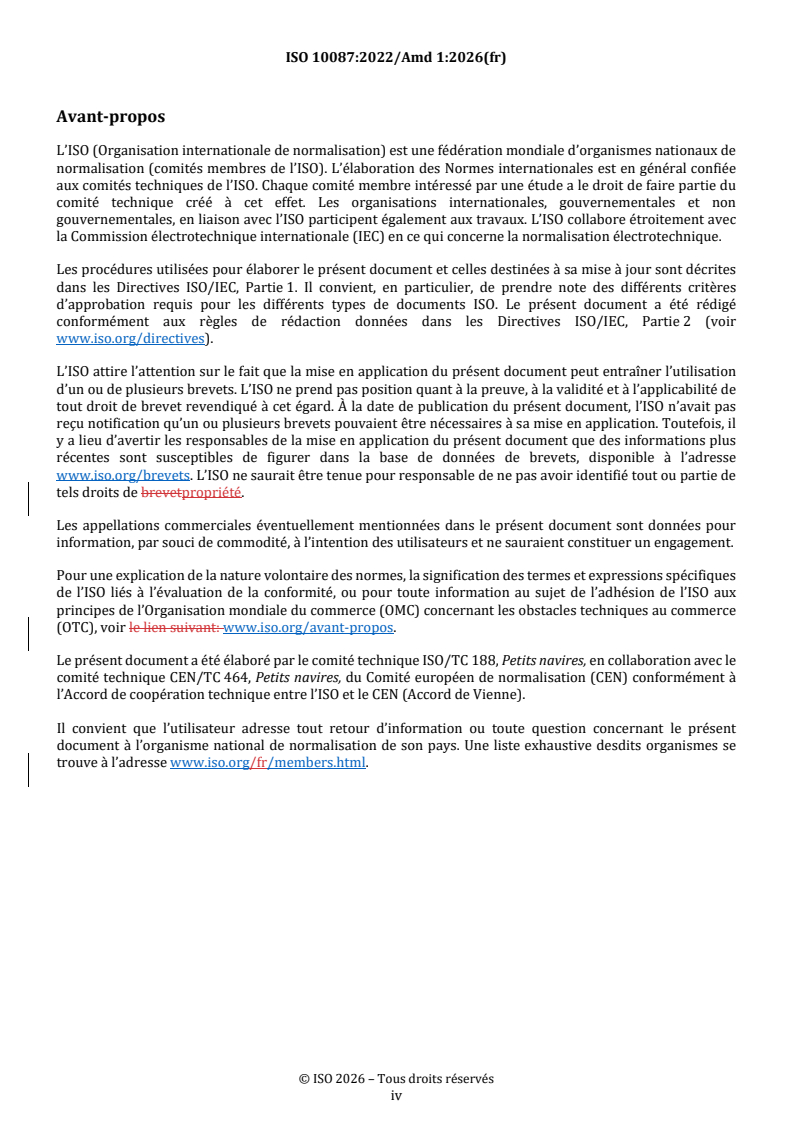
Avant-propos
L’ISO (Organisation internationale de normalisation) est une fédération mondiale d’organismes nationaux de
normalisation (comités membres de l’ISO). L’élaboration des Normes internationales est en général confiée
aux comités techniques de l’ISO. Chaque comité membre intéressé par une étude a le droit de faire partie du
comité technique créé à cet effet. Les organisations internationales, gouvernementales et non
gouvernementales, en liaison avec l’ISO participent également aux travaux. L’ISO collabore étroitement avec
la Commission électrotechnique internationale (IEC) en ce qui concerne la normalisation électrotechnique.
Les procédures utilisées pour élaborer le présent document et celles destinées à sa mise à jour sont décrites
dans les Directives ISO/IEC, Partie 1. Il convient, en particulier, de prendre note des différents critères
d’approbation requis pour les différents types de documents ISO. Le présent document a été rédigé
conformément aux règles de rédaction données dans les Directives ISO/IEC, Partie 2 (voir
www.iso.org/directives).
L’ISO attire l’attention sur le fait que la mise en application du présent document peut entraîner l’utilisation
d’un ou de plusieurs brevets. L’ISO ne prend pas position quant à la preuve, à la validité et à l’applicabilité de
tout droit de brevet revendiqué à cet égard. À la date de publication du présent document, l’ISO n’avait pas
reçu notification qu’un ou plusieurs brevets pouvaient être nécessaires à sa mise en application. Toutefois, il
y a lieu d’avertir les responsables de la mise en application du présent document que des informations plus
récentes sont susceptibles de figurer dans la base de données de brevets, disponible à l’adresse
www.iso.org/brevets. L’ISO ne saurait être tenue pour responsable de ne pas avoir identifié tout ou partie de
tels droits de brevetpropriété.
Les appellations commerciales éventuellement mentionnées dans le présent document sont données pour
information, par souci de commodité, à l’intention des utilisateurs et ne sauraient constituer un engagement.
Pour une explication de la nature volontaire des normes, la signification des termes et expressions spécifiques
de l’ISO liés à l’évaluation de la conformité, ou pour toute information au sujet de l’adhésion de l’ISO aux
principes de l’Organisation mondiale du commerce (OMC) concernant les obstacles techniques au commerce
(OTC), voir le lien suivant: www.iso.org/avant-propos.
Le présent document a été élaboré par le comité technique ISO/TC 188, Petits navires, en collaboration avec le
comité technique CEN/TC 464, Petits navires, du Comité européen de normalisation (CEN) conformément à
l’Accord de coopération technique entre l’ISO et le CEN (Accord de Vienne).
Il convient que l’utilisateur adresse tout retour d’information ou toute question concernant le présent
document à l’organisme national de normalisation de son pays. Une liste exhaustive desdits organismes se
trouve à l’adresse www.iso.org/fr/members.html.
iv
----------------------
...