

ISO 24683:2022
(Main)High fructose syrup — Specifications and test methods
General Information
- Abstract
This document specifies the chemical and microbiological requirements for and test methods of high fructose syrup.
- Status
- Published
- Publication Date
- 04-Aug-2022
- Technical Committee
- ISO/TC 93 - Starch (including derivatives and by-products)
- Drafting Committee
- ISO/TC 93 - Starch (including derivatives and by-products)
- Current Stage
- 6060 - International Standard published
- Start Date
- 05-Aug-2022
- Due Date
- 25-Feb-2023
- Completion Date
- 05-Aug-2022
Overview - ISO 24683:2022 (High fructose syrup)
ISO 24683:2022 specifies chemical, physical and microbiological requirements and associated test methods for high fructose syrup (HFS). It covers product definitions (notably HFS 42 and HFS 55), acceptance limits for quality and contaminants, and standardized analytical procedures - from pH and Brix to chromatographic determination of fructose and glucose, and HPLC measurement of hydroxymethylfurfural (HMF).
Key topics and technical requirements
- Scope: Requirements for high fructose syrup composition and laboratory test methods.
- Product types: HFS 42 (≈42% fructose) and HFS 55 (≈55% fructose).
- Physical indices: Transparent appearance; colour ≤ 20 IU; no off-odour/taste; free of foreign material.
- Chemical indices (examples):
- Brix: Min 69 (HFS 42), Min 74 (HFS 55) (ISO 1743).
- pH: 3.3–4.5.
- Sulfate ash: ≤ 0.1% dry matter.
- Sulfur dioxide: ≤ 3 mg/kg (ISBT method).
- Fructose / glucose (dry weight): Fructose ≥ 42% or 55%; glucose ≤ 52% or 42% respectively.
- HMF: ≤ 75 mg/kg (HPLC method).
- Electrical conductivity: ≤ 70 µS/cm.
- Contaminant limits: Arsenic ≤ 1 mg/kg; Lead ≤ 0.1 mg/kg; Chloride ≤ 50 mg/kg; Copper specified for HFS 55 (≤ 1.5 mg/kg).
- Microbial limits: Mould and yeast ≤ 10 CFU/g; Total plate count ≤ 20 CFU/g (ISO 21527-2, ISO 4833).
- Test methods: pH by standardized electrode; sulfur dioxide by ISBT method; fructose/glucose by ion-exchange chromatography with a metal ion-modified cation-exchange column and differential refractometer (flow 0.5 mL/min; column temp 80 °C; detector 45 °C); HMF by HPLC with defined eluents.
Applications - who uses ISO 24683:2022
- Food ingredient manufacturers and syrup producers ensuring product compliance for HFS 42 and HFS 55.
- Quality control and analytical laboratories performing acceptance testing and routine QA/QC.
- Beverage and food formulators (soft drinks, processed foods, breakfast cereals) verifying raw-material specifications.
- Regulatory agencies and procurement teams establishing supply specifications and safety limits.
- R&D groups developing processing, purification and stability studies for sweeteners.
Related standards
- ISO 1743 (Brix / dry matter by refractive index)
- ISO 5809 (Sulfated ash)
- ISO 11212-1 / -3 (Heavy metals: arsenic, lead)
- ISO 21527-2, ISO 4833-1/2 (Microbiology)
- AOAC 999.11 and referenced ISBT methods for certain contaminant analyses
ISO 24683:2022 provides a practical, standardized framework for specification, testing and compliance of high fructose syrup used across the food and beverage industry.
Get Certified
Connect with accredited certification bodies for this standard

BSI Group
BSI (British Standards Institution) is the business standards company that helps organizations make excellence a habit.

Bureau Veritas
Bureau Veritas is a world leader in laboratory testing, inspection and certification services.

DNV
DNV is an independent assurance and risk management provider.
Sponsored listings
Frequently Asked Questions
ISO 24683:2022 is a standard published by the International Organization for Standardization (ISO). Its full title is "High fructose syrup — Specifications and test methods". This standard covers: This document specifies the chemical and microbiological requirements for and test methods of high fructose syrup.
This document specifies the chemical and microbiological requirements for and test methods of high fructose syrup.
ISO 24683:2022 is classified under the following ICS (International Classification for Standards) categories: 67.180.20 - Starch and derived products. The ICS classification helps identify the subject area and facilitates finding related standards.
ISO 24683:2022 is available in PDF format for immediate download after purchase. The document can be added to your cart and obtained through the secure checkout process. Digital delivery ensures instant access to the complete standard document.
Standards Content (Sample)
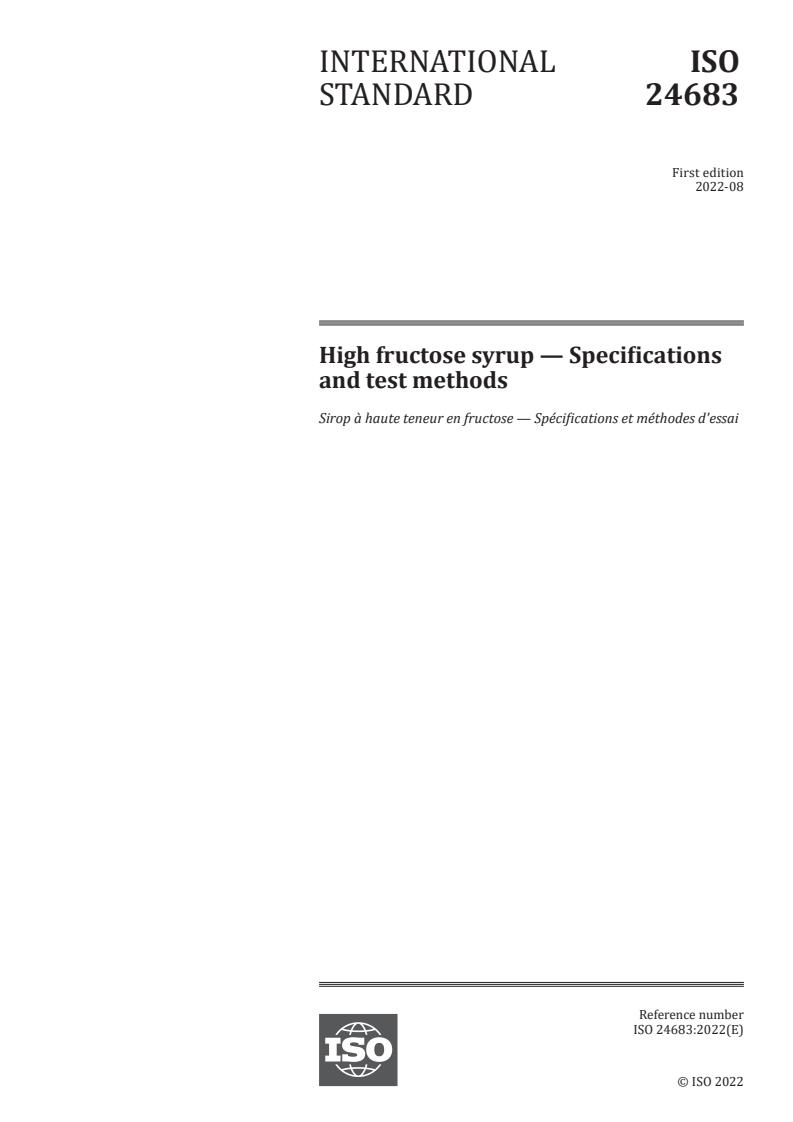
INTERNATIONAL ISO
STANDARD 24683
First edition
2022-08
High fructose syrup — Specifications
and test methods
Sirop à haute teneur en fructose — Spécifications et méthodes d'essai
Reference number
© ISO 2022
All rights reserved. Unless otherwise specified, or required in the context of its implementation, no part of this publication may
be reproduced or utilized otherwise in any form or by any means, electronic or mechanical, including photocopying, or posting on
the internet or an intranet, without prior written permission. Permission can be requested from either ISO at the address below
or ISO’s member body in the country of the requester.
ISO copyright office
CP 401 • Ch. de Blandonnet 8
CH-1214 Vernier, Geneva
Phone: +41 22 749 01 11
Email: copyright@iso.org
Website: www.iso.org
Published in Switzerland
ii
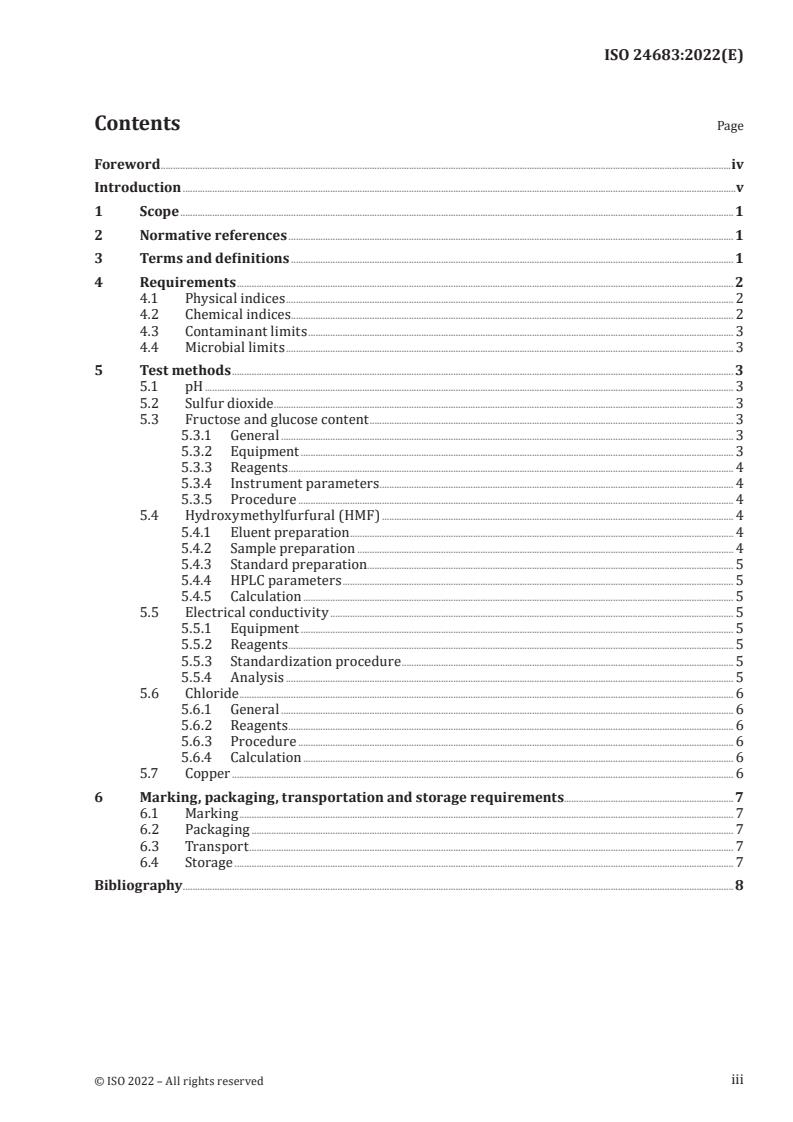
Contents Page
Foreword .iv
Introduction .v
1 Scope . 1
2 Normative references . 1
3 Terms and definitions . 1
4 Requirements . 2
4.1 Physical indices . 2
4.2 Chemical indices. 2
4.3 Contaminant limits . 3
4.4 Microbial limits . 3
5 Test methods . 3
5.1 pH . 3
5.2 Sulfur dioxide . . 3
5.3 Fructose and glucose content . 3
5.3.1 General . 3
5.3.2 Equipment . 3
5.3.3 Reagents . 4
5.3.4 Instrument parameters . 4
5.3.5 Procedure . 4
5.4 Hydroxymethylfurfural (HMF) . 4
5.4.1 Eluent preparation . 4
5.4.2 Sample preparation . 4
5.4.3 Standard preparation. 5
5.4.4 HPLC parameters . 5
5.4.5 Calculation . 5
5.5 Electrical conductivity . 5
5.5.1 Equipment . 5
5.5.2 Reagents . 5
5.5.3 Standardization procedure . 5
5.5.4 Analysis . 5
5.6 Chloride . 6
5.6.1 General . 6
5.6.2 Reagents . 6
5.6.3 Procedure . 6
5.6.4 Calculation . 6
5.7 Copper . 6
6 Marking, packaging, transportation and storage requirements.7
6.1 Marking . 7
6.2 Packaging . 7
6.3 Transport . 7
6.4 Storage . 7
Bibliography . 8
iii
Foreword
ISO (the International Organization for Standardization) is a worldwide federation of national standards
bodies (ISO member bodies). The work of preparing International Standards is normally carried out
through ISO technical committees. Each member body interested in a subject for which a technical
committee has been established has the right to be represented on that committee. International
organizations, governmental and non-governmental, in liaison with ISO, also take part in the work.
ISO collaborates closely with the International Electrotechnical Commission (IEC) on all matters of
electrotechnical standardization.
The procedures used to develop this document and those intended for its further maintenance are
described in the ISO/IEC Directives, Part 1. In particular, the different approval criteria needed for the
different types of ISO documents should be noted. This document was drafted in accordance with the
editorial rules of the ISO/IEC Directives, Part 2 (see www.iso.org/directives).
Attention is drawn to the possibility that some of the elements of this document may be the subject of
patent rights. ISO shall not be held responsible for identifying any or all such patent rights. Details of
any patent rights identified during the development of the document will be in the Introduction and/or
on the ISO list of patent declarations received (see www.iso.org/patents).
Any trade name used in this document is information given for the convenience of users and does not
constitute an endorsement.
For an explanation of the voluntary nature of standards, the meaning of ISO specific terms and
expressions related to conformity assessment, as well as information about ISO's adherence to the
World Trade Organization (WTO) principles in the Technical Barriers to Trade (TBT), see www.iso.org/
iso/foreword.html.
This document was prepared by Technical Committee ISO/TC 93, Starch (including derivatives and by-
products).
Any feedback or questions on this document should be directed to the user’s national standards body. A
complete listing of these bodies can be found at www.iso.org/members.html.
iv
Introduction
High fructose syrup (HFS) is a sweetener made from starch. The starch is first broken down into
glucose by enzymes and is then further processed by glucose isomerase to convert some of its glucose
into fructose. “HFS 42” refers to 42 % and “HFS 55” to 55 % fructose composition, respectively. HFS 42
is mainly used for processed foods and breakfast cereals, whereas HFS 55 is used mostly for the
production of soft drinks.
v
INTERNATIONAL STANDARD ISO 24683:2022(E)
High fructose syrup — Specifications and test methods
1 Scope
This document specifies the chemical and microbiological requirements for and test methods of high
fructose syrup.
2 Normative references
The following documents are referred to in the text in such a way that some or all of their content
constitutes requirements of this document. For dated references, only the edition cited applies. For
undated references, the latest edition of the referenced document (including any amendments) applies.
ISO 1743, Glucose syrup — Determination of dry matter content
...