


ISO 10934:2020
(Main)Microscopes — Vocabulary for light microscopy
Microscopes — Vocabulary for light microscopy
This document specifies terms and definitions to be used in the field of light microscopy and advanced techniques in light microscopy.
Microscopes — Vocabulaire relatif à la microscopie optique
General Information
Relations
Standards Content (Sample)
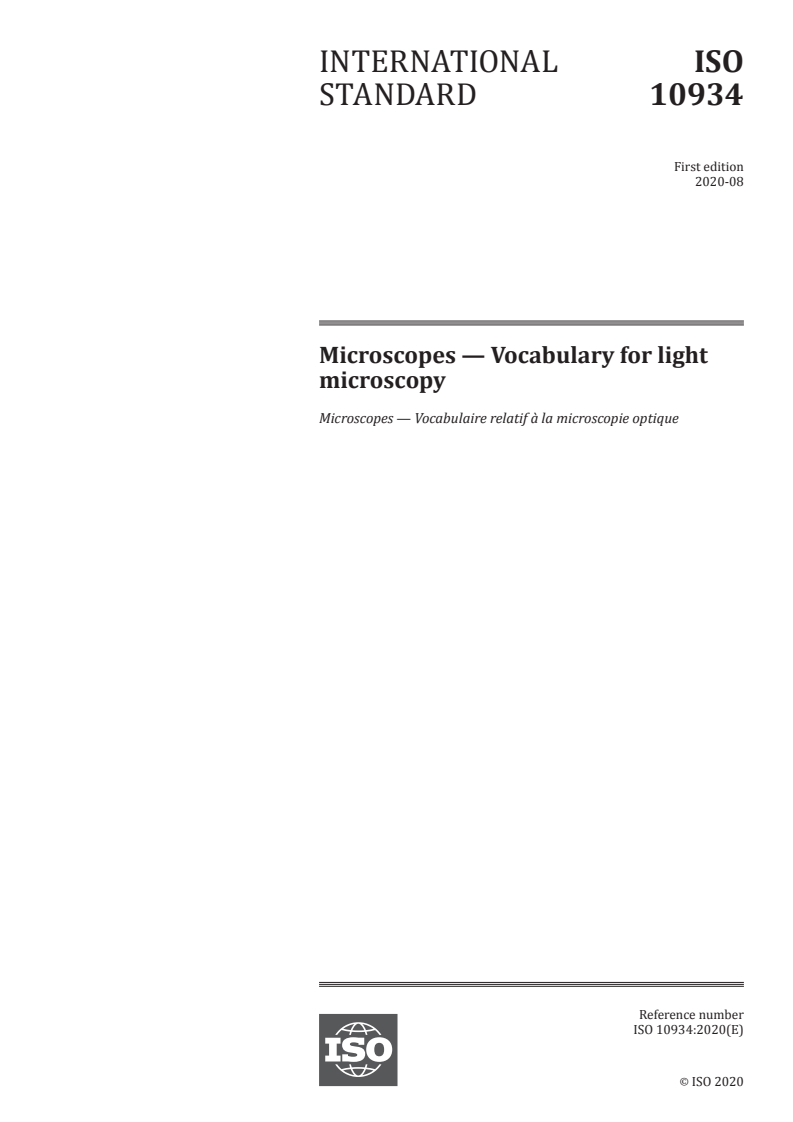
INTERNATIONAL ISO
STANDARD 10934
First edition
2020-08
Microscopes — Vocabulary for light
microscopy
Microscopes — Vocabulaire relatif à la microscopie optique
Reference number
©
ISO 2020
© ISO 2020
All rights reserved. Unless otherwise specified, or required in the context of its implementation, no part of this publication may
be reproduced or utilized otherwise in any form or by any means, electronic or mechanical, including photocopying, or posting
on the internet or an intranet, without prior written permission. Permission can be requested from either ISO at the address
below or ISO’s member body in the country of the requester.
ISO copyright office
CP 401 • Ch. de Blandonnet 8
CH-1214 Vernier, Geneva
Phone: +41 22 749 01 11
Email: copyright@iso.org
Website: www.iso.org
Published in Switzerland
ii © ISO 2020 – All rights reserved
Contents Page
Foreword .iv
1 Scope . 1
2 Normative references . 1
3 Terms and definitions . 1
3.1 Terms and definitions relating to light microscopy . 1
3.2 Terms and definitions relating to advanced techniques in light microscopy .44
Bibliography .54
Index .55
Foreword
ISO (the International Organization for Standardization) is a worldwide federation of national standards
bodies (ISO member bodies). The work of preparing International Standards is normally carried out
through ISO technical committees. Each member body interested in a subject for which a technical
committee has been established has the right to be represented on that committee. International
organizations, governmental and non-governmental, in liaison with ISO, also take part in the work.
ISO collaborates closely with the International Electrotechnical Commission (IEC) on all matters of
electrotechnical standardization.
The procedures used to develop this document and those intended for its further maintenance are
described in the ISO/IEC Directives, Part 1. In particular, the different approval criteria needed for the
different types of ISO documents should be noted. This document was drafted in accordance with the
editorial rules of the ISO/IEC Directives, Part 2 (see www .iso .org/ directives).
Attention is drawn to the possibility that some of the elements of this document may be the subject of
patent rights. ISO shall not be held responsible for identifying any or all such patent rights. Details of
any patent rights identified during the development of the document will be in the Introduction and/or
on the ISO list of patent declarations received (see www .iso .org/ patents).
Any trade name used in this document is information given for the convenience of users and does not
constitute an endorsement.
For an explanation of the voluntary nature of standards, the meaning of ISO specific terms and
expressions related to conformity assessment, as well as information about ISO's adherence to the
World Trade Organization (WTO) principles in the Technical Barriers to Trade (TBT), see www .iso .org/
is o/ f or ewor d . ht m l .
This document was prepared by Technical Committee ISO/TC 172, Optics and photonics, Subcommittee
SC 5, Microscopes and endoscopes.
This first edition cancels and replaces ISO 10934-1:2002 and ISO 10934-2:2007, which have been
combined and technically revised.
The main changes compared to the previous edition are as follows:
— update of the title;
— added new terms for light microscopy: focal length of normal tube lens, objective field number,
pixel, pixel size, Airy unit, excitation wavelength, excitation wavelength band, detection wavelength
band, OSTD added as new terms;
— added new terms for advanced techniques in light microscopy: coherent anti-stokes Raman
scattering microscopy, stimulated Raman scattering microscopy, structured illumination
microscopy, super-resolution microscopy, localization microscopy, stimulated emission depletion
microscopy, super-resolution structured illumination microscopy, light sheet microscopy, digital
holographic microscopy, optical coherence microscopy;
— terms amended: diffraction limit of resolving power, resolution;
— editorially revised.
Any feedback or questions on this document should be directed to the user’s national standards body. A
complete listing of these bodies can be found at www .iso .org/ members .html.
iv © ISO 2020 – All rights reserved
INTERNATIONAL STANDARD ISO 10934:2020(E)
Microscopes — Vocabulary for light microscopy
1 Scope
This document specifies terms and definitions to be used in the field of light microscopy and advanced
techniques in light microscopy.
2 Normative references
There are no normative references in this document.
3 Terms and definitions
For the purposes of this document, the following terms and definitions apply.
ISO and IEC maintain terminological databases for use in standardization at the following addresses:
— ISO Online browsing platform: available at https:// www .iso .org/ obp
— IEC Electropedia: available at http:// www .electropedia .org/
3.1 Terms and definitions relating to light microscopy
3.1.1
Abbe test plate
device for testing the chromatic (3.1.4.2) and spherical aberration (3.1.4.7) of microscope (3.1.99)
objectives (3.1.106)
Note 1 to entry: When testing for spherical aberration, the cover glass thickness for which the objective is best
corrected is also found. The test plate consists of a slide on which is deposited an opaque metal layer in the
form of parallel strips arranged in groups of different width. The edges of these strips are irregularly serrated to
allow the aberrations to be judged more easily. In its original and most common form, the slide is covered with a
wedge-shaped cover glass, the increasing thickness of which is marked on the slide. Additional versions without
the cover glass and/or with reflective stripes are also in use.
3.1.2
Abbe theory of image formation
explanation of the mechanism by which the microscope (3.1.99) image (3.1.75) is formed
Note 1 to entry: It assumes coherent illumination and is based on a three-step process involving diffraction.
a) First step: the object diffracts light coming from the source.
b) Second step: the objective collects some of the diffracted beams and focuses them, according to the laws of
geometrical optics, in the back focal plane of the objective to form the primary diffraction pattern of the object.
c) Third step: the diffracted beams continue on their way and are reunited; the result of their interference is
called the primary image of the microscope.
This explains the necessity for the maximum number of rays diffracted by the object to be collected by the
objective, so that they may contribute to the image. Fine detail will not be resolved if the rays it diffracts are not
allowed to contribute to the image.
3.1.3
aberration
deviation from perfect imaging by an optical system, caused by the
properties of the material of the lenses (3.1.87) or by the geometric forms of the refracting or reflecting
surfaces
3.1.4
aberration
failure of an optical system to produce a perfect image (3.1.75)
3.1.4.1
astigmatism
aberration (3.1.4) which causes rays in one plane containing an off-axis object (3.1.104) point and the
optical axis (3.1.107) to focus at a different distance from those in the plane at right angles to it
3.1.4.2
chromatic aberration
aberration (3.1.4) of a lens (3.1.87) or prism (3.1.119), due to dispersion (3.1.47) by the material from
which it is made
Note 1 to entry: This defect may be corrected by using a combination of lenses made from glasses or other
materials of different dispersion.
3.1.4.2.1
axial chromatic aberration
aberration (3.1.4) by which light (3.1.88) of different wavelengths is focused at different points along
the optical axis (3.1.107)
3.1.4.2.2
lateral chromatic aberration
chromatic difference of magnification
aberration (3.1.4) by which the images (3.1.75) formed by light (3.1.88) of different wavelengths, although
they may be brought to the same focus (3.1.65) in the optical axis (3.1.107), are of different sizes
3.1.4.3
coma
aberration (3.1.4) in which the image (3.1.75) of an off-axis point object (3.1.104) is deformed so that the
image is shaped like a comet
3.1.4.4
curvature of image field
aberration (3.1.4) resulting in a curved image field (3.1.54.4) from a plane object field (3.1.54.5)
Note 1 to entry: Curvature of the image field is particularly obvious with objectives of high magnification and
large numerical aperture, which have a restricted depth of field. It may largely be eliminated by additional
correction.
3.1.4.5
distortion
aberration (3.1.4) in which lateral magnification (3.1.90.8) varies with distance from the optical axis
(3.1.107) in the image field (3.1.54.4)
3.1.4.5.1
barrel distortion
negative distortion
difference in lateral magnification (3.1.90.8) between the central and peripheral areas of an image
(3.1.75) such that the lateral magnification is less at the periphery
EXAMPLE A square object in the centre of the field thus appears barrel shaped (i.e. with convex sides).
2 © ISO 2020 – All rights reserved
3.1.4.5.2
pincushion distortion
positive distortion
difference in lateral magnification (3.1.90.8) between the central and the peripheral areas of an image
(3.1.75) such that the lateral magnification is greater towards the periphery
EXAMPLE A square object in the centre of the field thus appears pincushion shaped (i.e. with concave sides).
3.1.4.6
monochromatic aberrations
collective term for all aberrations (3.1.4) outside the Gaussian space which appear for monochromatic
(3.1.123.2) light (3.1.88)
Note 1 to entry: The monochromatic aberrations are: spherical aberration, coma, astigmatism, curvature of
image field and distortion.
3.1.4.7
spherical aberration
aberration (3.1.4) resulting from the spherical form of the wavefront arising from an object (3.1.104)
point on the optical axis (3.1.107), on its emergence from the optical system
Note 1 to entry: As a consequence, the rays emanating from an object point on the optical axis at different angles
to the axis, or rays entering the lens parallel to the optical axis but at differing distances from it, intersect the
optical axis in the image space before (undercorrection) or behind (overcorrection) the ideal image point formed
by the paraxial rays.
3.1.5
achromat
lens (3.1.87) in which the axial chromatic aberration (3.1.4.2.1) is corrected for two
wavelengths
EXAMPLE Usually the correction is made for a wavelength below 500 nm and for a wavelength above 600 nm.
3.1.6
achromat
microscope (3.1.99) objective (3.1.106) in which chromatic aberration (3.1.4.2) is
corrected for two wavelengths and spherical aberration (3.1.4.7) and other aperture-dependent defects
are minimized for one other wavelength which is usually about 550 nm
EXAMPLE Usually the correction is made for a wavelength below 500 nm and for a wavelength above 600 nm.
Note 1 to entry: This term does not imply any degree of correction for curvature of image field; coma and
astigmatism are minimized for wavelengths within the achromatic range.
3.1.7
Airy pattern
image (3.1.75) of a primary or secondary point source (3.1.135.1) of light (3.1.88) which, due to diffraction
(3.1.41) at a circular aperture (3.1.10) of an aberration-free lens (3.1.87), takes the form of a bright disc
surrounded by a sequence of concentric dark and bright rings
3.1.7.1
Airy disc
diffraction disc
central area bounded by the first dark ring of the Airy pattern (3.1.7)
Note 1 to entry: The Airy disc contains 84 % of the energy of the Airy pattern.
3.1.7.2
Airy unit
AU
diameter of the theoretical first minimum of the Airy pattern (3.1.7) in the low numerical aperture
(3.1.10.4) approximation
λ
ref
Note 1 to entry: AU=12, 2
NA
Where λ is the reference wavelength and NA the numerical aperture.
ref
3.1.8
anisotropic
having a non-uniform spatial distribution of properties
Note 1 to entry: In polarized light microscopy, this usually refers to the preferential orientation of optical
properties with respect to the vibration plane of the polarized light.
3.1.9
apertometer
device for measuring the numerical aperture (3.1.10.4) of microscope (3.1.99) objectives (3.1.106)
3.1.10
aperture
area of a lens (3.1.87) which is available for the passage of light (3.1.88)
Note 1 to entry: In microscopy, it is usually expressed as the numerical aperture.
3.1.10.1
angular aperture
maximum plane angle subtended by a lens (3.1.87) at the centre of an object field
(3.1.54.5) or image field (3.1.54.4) by two opposite marginal rays when the lens is used in its correct
working position
Note 1 to entry: The term may be qualified by the side of the lens to which it refers (e.g. object side, illumination
side, image side).
3.1.10.2
condenser aperture
illuminating aperture
aperture (3.1.10) of the illuminating system which is defined by the diameter of the illuminating aperture
diaphragm (3.1.38.6)
3.1.10.3
imaging aperture
aperture (3.1.10) of the imaging system
Note 1 to entry: The imaging aperture is generally defined by the numerical aperture of the objective.
3.1.10.4
numerical aperture
NA
number originally defined by Abbe for objectives (3.1.106) and condensers (3.1.28), which is given by the
expression n sin u, where n is the refractive index (3.1.125) of the medium between the lens (3.1.87) and
the object (3.1.104) and u is half the angular aperture (3.1.10.1) of the lens
Note 1 to entry: Unless specified by “image-side”, the term refers to the object side.
3.1.11
aplanatic
corrected for spherical aberration (3.1.4.7) and coma (3.1.4.3)
4 © ISO 2020 – All rights reserved
3.1.12
apochromat
lens (3.1.87) in which axial chromatic aberration (3.1.4.2.1) is corrected for three
wavelengths
EXAMPLE Wavelengths of about 450 nm, 550 nm and 650 nm.
3.1.13
apochromat
microscope (3.1.99) objective (3.1.106) in which the chromatic aberration
(3.1.4.2) is corrected for three or more wavelengths and the spherical aberration (3.1.4.7) and other
aperture-dependent defects are minimized for about 550 nm as with achromats (3.1.6)
EXAMPLE Wavelengths of about 450 nm, 550 nm and 650 nm.
Note 1 to entry: This term does not imply any degree of correction for curvature of image field.
Note 2 to entry: For more information see ISO 19012-2.
3.1.14
aspherical
not forming part of the surface of a sphere
Note 1 to entry: This term is also used to describe the shape of a refracting or a reflecting surface designed to
minimize spherical aberration and some other aberrations.
3.1.15
beam splitter
means whereby a beam of light (3.1.88) may be divided into two or more separate beams
3.1.16
birefringence
Δn
quantitative expression of the maximum difference in refractive index (3.1.125) due to double refraction
(3.1.48)
3.1.17
bright field
system of illumination (3.1.73) and imaging in which the direct light (3.1.45) passes through the objective
(3.1.106) aperture (3.1.10) and illuminates the background against which the image (3.1.75) is seen
3.1.18
bulb
envelope of a lamp (3.1.85), which is usually out of glass or fused silica
Note 1 to entry: This term is commonly used to describe the lamp itself.
3.1.19
catadioptric
having optical arrangements оr optical elements which operate by both reflection and refraction
3.1.20
catoptric
having optical arrangements оr optical elements which operate by reflection
3.1.21
centring telescope
auxiliary telescope
two-stage magnifier, designed for use in place of the eyepiece (3.1.52) to enable an image (3.1.75) of the
back focal plane (3.1.62.1) of the objective (3.1.106) to be inspected
Note 1 to entry: The centring telescope is used principally for adjustment of the microscope illuminating system,
especially with phase contrast and modulation contrast. It may also be used for conoscopic observation.
3.1.22
circle of least confusion
smallest diameter image (3.1.75) spot formed from a point object (3.1.104) when spherical aberration
(3.1.4.7) and astigmatism (3.1.4.1) are present
3.1.23
clear focusing screen
sheet of clear glass or plastic material used for focusing (3.1.67) in photography and photomicrography
(3.1.115) in which a figure on the screen (3.1.132) (e.g. cross lines) serves to define the plane (3.1.117) in
which the aerial image (3.1.75.1) observed with a focusing magnifier (3.1.92.1) is located
3.1.24
coarse adjustment
focusing mechanism (3.1.68) designed to make large and rapid alterations in the distance along the
optical axis (3.1.107) between the object (3.1.104) and the objective (3.1.106)
3.1.25
coating of optical surfaces
deposit of one or more thin dielectric and/or metallic layers on a surface of an optical element for the
purpose of decreasing or increasing reflection and/or transmission
EXAMPLE Optical elements such as a lens, mirror, prism, or filter.
3.1.26
collector
lens (3.1.87) which serves to project a suitably sized image (3.1.75) of the source (3.1.135) into a given
plane (3.1.117) [e.g. in Köhler illumination (3.1.73.3) into the aperture plane (3.1.117.1) of the condenser
(3.1.28)]
Note 1 to entry: Sometimes known as the “lamp collector”.
3.1.27
compensator
retardation plate (3.1.130) of fixed or variable optical path length difference (3.1.108.1) used to measure
the optical path length differences within an object (3.1.104)
Note 1 to entry: Many types of compensator exist, often designated by the name of their originator e.g. Babinet,
Berek, Senarmont.
3.1.27.1
first-order red compensator
first-order red plate
sensitive tint plate
retardation plate (3.1.130) producing an optical path length difference (3.1.108.1) of one wavelength,
giving rise to the interference colour (3.1.82) having the typical tint of the first-order red (3.1.57)
3.1.27.2
half-wave compensator
half-wave plate
retardation plate (3.1.130) producing an optical path length difference (3.1.108.1) of half a wavelength
6 © ISO 2020 – All rights reserved
3.1.27.3
quarter-wave compensator
quarter-wave plate
retardation plate (3.1.130) producing an optical path length difference (3.1.108.1) of a quarter of a
wavelength
Note 1 to entry: The reference wavelength is selected according to the application and is individually indicated.
When oriented at 45° to the plane of polarization, it changes plane-polarized light into circularly-polarized light
and vice versa.
3.1.27.4
quartz-wedge compensator
retardation plate (3.1.130) consisting of a wedge of quartz (or two such wedges in the subtraction
position) producing optical path length differences (3.1.108.1) continuously variable between 0 λ and 3 λ
or 4 λ along its length
Note 1 to entry: This property results in the production of a series of interference colours in the form of fringes
perpendicular to the length of the wedge. With monochromatic light, the coloured fringes are seen as alternating
dark and bright bands.
3.1.28
condenser
part of the illuminating system of the microscope (3.1.99) which consists of one or more lenses (3.1.87)
(or mirrors) and their mounts, usually containing a diaphragm (3.1.38), and designed to collect, control
and concentrate radiation (3.1.123) into the illuminating numerical aperture (3.1.10.4)
Note 1 to entry: In bright field microscopy by epi-illumination, the objective serves as its own condenser.
3.1.28.1
Abbe condenser
condenser (3.1.28) of simple design introduced by Abbe, in which there is only limited correction (3.1.33)
for spherical aberration (3.1.4.7) and none for chromatic aberration (3.1.4.2)
3.1.28.2
achromatic-aplanatic condenser
condenser (3.1.28) in which chromatic aberrations (3.1.4.2) and spherical aberrations (3.1.4.7) have
been reduced
Note 1 to entry: Achromatic-aplanatic correction is particularly advantageous for high numerical aperture, oil
immersion condensers.
3.1.28.3
cardioid condenser
dark-field condenser (3.1.28.4) for transmitted-light illumination (3.1.73.6), in which the correction
(3.1.33) for spherical aberration (3.1.4.7) and coma (3.1.4.3) is calculated for a reflecting surface with
the shape of a cardioid of revolution
Note 1 to entry: In practice, the correction is achieved by using a zone of a spherical surface which differs
imperceptibly in its corrective effect from a true cardioid surface.
3.1.28.4
dark-field condenser
dark-ground condenser
condenser (3.1.28) designed for dark-field (3.1.35) microscopy
Note 1 to entry: For transmitted-light microscopy, this condenser is a separate component; for reflected-light
microscopy, it is generally within the mount of the objective, surrounding the imaging system of the objective.
3.1.28.5
pancratic condenser
condenser (3.1.28) containing a variable “zoom” (pancratic) lens (3.1.87) which allows the size of the
illuminated field (3.1.54.3) at the object (3.1.104) to be varied while the illuminated field diaphragm
(3.1.38.5) remains of constant size
Note 1 to entry: The size of the illuminating aperture varies inversely with that of the illuminated field at the
object, and the product of both sizes remains a constant.
3.1.28.6
phase-contrast condenser
condenser (3.1.28) designed for phase contrast (3.1.32.4) microscopy which forms on the phase plate
(3.1.112) in the back focal plane (3.1.62.1) of the objective (3.1.106) a suitably sized image (3.1.75) of a
diaphragm (3.1.38) (generally annular) positioned in the front focal plane (3.1.62.2) of the condenser
3.1.28.7
substage condenser
condenser (3.1.28) designed to fit beneath the stage (3.1.136) of a microscope (3.1.99)
3.1.28.8
swing-out top lens condenser
condenser (3.1.28) designed so that its top lens (3.1.87) can conveniently be removed from the optical
path by operating a lever, thus increasing the condenser’s (3.1.28) focal length (3.1.61) in order to
increase the area of the illuminated field (3.1.54.3) and decrease the illuminating numerical aperture
(3.1.10.4) for use with objectives (3.1.106) of low magnification (3.1.90)
3.1.28.9
universal condenser
condenser (3.1.28) designed for multiple contrast techniques such as bright field (3.1.17), dark-field
(3.1.35), phase contrast (3.1.32.4), differential interference contrast (3.1.32.2.1), polarized light (3.1.88.1)
and modulation contrast (3.1.32.3)
3.1.29
conjugate planes
planes (3.1.117) perpendicular to the optical axis (3.1.107) which are imaged onto another in accordance
with the rules of geometrical optics
3.1.30
conoscopic figure
interference pattern of curves linking points of equal retardation (3.1.129), formed in the back focal
plane (3.1.62.1) of the objective (3.1.106) when an optically anisotropic (3.1.8) object (3.1.104) is placed
between crossed polars (3.1.118.2) or, exceptionally, parallel polars (3.1.118.3)
3.1.31
conoscopy
observation of the conoscopic figure (3.1.30) by means of a pinhole diaphragm (3.1.38) or a centring
telescope (3.1.21) in place of the eyepiece (3.1.52), or by means of a Bertrand lens (3.1.87.2)
3.1.32
contrast
distinction between regions in an image (3.1.75) due to differences in brightness and/or colour
3.1.32.1
interference contrast
contrast (3.1.32) in the image (3.1.75) caused mainly by interference
3.1.32.2
interference contrast
enhancing the contrast (3.1.32) between features having different optical path lengths
(3.1.108)
8 © ISO 2020 – All rights reserved
3.1.32.2.1
differential interference contrast
contrast (3.1.32) due to double-beam interference (3.1.81.1) in which two waves which fall on the object
plane (3.1.117.5) or image plane (3.1.117.3) are separated laterally by a distance similar to the minimum
resolvable distance (3.1.128.2)
Note 1 to entry: This kind of contrast is characterized by an impression of unilateral oblique illumination.
Variations in optical path length due to gradients in surface relief (reflected light) or in physical thickness or
refractive index (transmitted light) appear as relief contrast in the image.
3.1.32.2.2
Nomarski differential interference contrast
form of differential interference contrast (3.1.32.2.1) using Nomarski prisms (3.1.119.2)
3.1.32.3
modulation contrast
contrast (3.1.32) technique due to Hoffman which uses a modulator in the back focal plane (3.1.62.1) of
the objective (3.1.106) or in a succeeding conjugate plane (3.1.29), and a slit aperture (3.1.10) in the front
focal plane (3.1.62.2) of the condenser (3.1.28)
Note 1 to entry: The modulator is a filter composed of three regions: a dark region, a grey region onto which the
slit in the condenser is imaged and a bright region. The modulator influences the direct light and diffracted light
in order to increase contrast.
3.1.32.4
phase contrast
form of interference contrast (3.1.32.2) (in its widest sense) due to Zernike, in which the image contrast
(3.1.32) of a phase object (3.1.111) is enhanced by altering phase (3.1.110) and amplitude of the direct
light (3.1.45) with respect to those of the diffracted light (3.1.40) and which is achieved by the action of
a phase plate (3.1.112), usually in the form of an annulus, placed in the back focal plane (3.1.62.1) of the
objective (3.1.106) (or in a succeeding plane conjugate (3.1.29) with this) conjugate with an appropriate
illuminating aperture diaphragm (3.1.38.6) in the front focal plane (3.1.62.2) of the condenser (3.1.28)
Note 1 to entry: The phase plate has two properties: it shifts the phase of the direct light by 90° and absorbs some
of its intensity. Contrast is achieved by conversion of phase differences within the light leaving the object into
intensity differences in the image. Two kinds of phase contrast are available, depending on the characteristics
of the phase plate; in positive phase contrast, objects which retard the phase of the diffracted light by a small
amount appear darker than the background, while in negative phase contrast they appear brighter.
3.1.32.5
relief contrast
form of contrast (3.1.32) which presents gradients of geometrical or optical path length differences
(3.1.108.1) in the object (3.1.104) in the form of a distribution of brightness in the image (3.1.75) which
gives an impression of relief (3.1.126)
Note 1 to entry: This impression occurs because the distribution of brightness in a relief contrast image is similar
to the distribution of light and shadow in the image of a three-dimensional object illuminated from one side.
3.1.33
correction
process whereby the aberrations (3.1.4) of an optical system are minimized
3.1.33.1
correction class
type of correction (3.1.33) of an optical system (achromatic, plan, etc.)
3.1.33.2
correction collar
mechanism provided on some objectives (3.1.106) in order to adapt their correction (3.1.33) for spherical
aberration (3.1.4.7) to compensate for deviations from correct optical path length (3.1.108) in the
cover glass (3.1.34), wall of culture chamber and/or other media between the object (3.1.104) and the
objective
3.1.33.3
correction for object to primary image distance
calculation of a microscope (3.1.99) objective (3.1.106) to optimize its corrections for a given
standardized object to primary image (3.1.80.2.2) distance
3.1.33.4
overcorrection
error in the correction (3.1.33) of spherical aberration (3.1.4.7), leading to lack of contrast (3.1.32) in the
image (3.1.75)
Note 1 to entry: In microscopy it may be caused by the use of a cover glass thicker than, or a mechanical tube
length longer than, the values assumed in the computation of the objective. The term may be used also in
connection with other aberrations, e.g. chromatic aberration.
3.1.33.5
undercorrection
error in correction (3.1.33) of spherical aberration (3.1.4.7), leading to lack of contrast (3.1.32) in the
image (3.1.75)
Note 1 to entry: In microscopy, undercorrection may be caused by the use of a cover glass thinner than, or a
mechanical tube length shorter than, the values assumed in the computation of the objectives. The term may be
used also in connection with other aberrations, e.g. chromatic aberration.
3.1.34
cover glass
rectangular or circular piece of thin glass used to cover a microscopical preparation
Note 1 to entry: Because its thickness, refractive index and dispersion affect calculation and correction, the cover
glass is regarded as part of the objective for the purpose of design. The tolerances of its thickness, refractive index
and dispersion should be considered in relation to the demands of the objective, as standardized in ISO 8255-1.
3.1.35
dark-field
system of illumination (3.1.73) and imaging in which the direct light (3.1.45) is prevented from passing
through the aperture (3.1.10) of the objective (3.1.106)
Note 1 to entry: The image is formed from light scattered by features in the object, the detail thus appearing
bright against a dark background. It may be qualified as transmitted-light or reflected-light dark-field.
3.1.35.1
dark-field stop
central opaque disc usually used in the front focal plane (3.1.62.2) of a condenser (3.1.28) to occlude all
the direct light (3.1.45) which would fall within the aperture (3.1.10) of the objective (3.1.106)
3.1.36
depth of field
axial depth of the space on both sides of the object plane (3.1.117.5) within which the
object (3.1.104) can be moved without detectable loss of sharpness in the image (3.1.75), while the
positions of the image plane (3.1.117.3) and of the objective (3.1.106) are maintained
Note 1 to entry: See Note to 3.1.37.
3.1.37
depth of focus
axial depth of the space on both sides of the image (3.1.75) within which the image
appears acceptably sharp, while the positions of the object plane (3.1.117.5) and of the objective (3.1.106)
are maintained
Note 1 to entry: In some publications, the term “depth of focus” is used to refer to object space. It is recommended
that, when the distinction is important, the full terms “depth of field (in object space)” and “depth of focus (in
image space)” be used.
10 © ISO 2020 – All rights reserved
3.1.38
diaphragm
mechanical limitation of an opening normal to the optical axis (3.1.107) which restricts the cross-
sectional area of the light (3.1.88) path at a defined place in an optical system and which may be fixed or
variable in size, shape (although usually circular) and position
3.1.38.1
aperture diaphragm
diaphragm (3.1.38) in any aperture plane (3.1.117.1)
3.1.38.2
Bertrand diaphragm
field diaphragm (3.1.38.4) placed after a Bertrand lens (3.1.87.2) to restrict the field (3.1.54) from which
a conoscopic figure (3.1.30) is formed
3.1.38.3
condenser diaphragm
diaphragm (3.1.38) which controls the effective size and shape of the condenser aperture (3.1.10.2) and
which normally functions as the illuminating aperture diaphragm (3.1.38.6) in transmitted light
3.1.38.4
field diaphragm
diaphragm (3.1.38) in any field plane (3.1.117.2)
Note 1 to entry: Field diaphragms are usually fitted just after the lamp collector and in the eyepiece.
3.1.38.5
illuminated field diaphragm
field diaphragm (3.1.38.4) whose image (3.1.75) defines the illuminated field (3.1.54.3) at the object
(3.1.104)
3.1.38.6
illuminating aperture diaphragm
aperture diaphragm (3.1.38.1) which defines the illuminating aperture (3.1.10.2) or the pupil (3.1.122) of
an illuminating system
Note 1 to entry: For transmitted light, this is usually incorporated in the front focal plane of the condenser; in
reflected-light microscopes it is found in the epi-illuminator in a plane conjugate with the back focal plane of the
objective. It is commonly known simply as the “aperture diaphragm” or the “aperture stop”.
3.1.38.7
iris diaphragm
diaphragm (3.1.38) bounded by multiple leaves, usually metal, arranged so as to provide an opening of
variable size, which is adjustable by means of a control
3.1.38.8
visual field diaphragm
diaphragm (3.1.38) which defines the field (3.1.54) of view and which is usually contained within the
eyepiece (3.1.52)
3.1.39
dichromatic mirror
dichroic mirror
special type of interference filter (3.1.55.8) used as an essential part of a fluorescence microscope
(3.1.99.5) using epi-illumination (3.1.73.2) and which is designed to reflect selectively the shorter
wavelength exciting radiation (3.1.123) and transmit the longer wavelength fluorescence (3.1.58)
Note 1 to entry: A similar device is often used as a lamp reflector, in order to transmit the longer wavelength heat
(infrared) radiation while reflecting the visible light.
3.1.40
diffracted light
light (3.1.88) which has undergone diffraction (3.1.41) at the object (3.1.104) and which gives rise to the
first-order, second-order, etc. components of the diffraction pattern (3.1.41.1)
3.1.41
diffraction
phenomenon of deviation of the direction of propagation of light (3.1.88) or other wave motion when a
wavefront passes any discontinuity in an object (3.1.104)
3.1.41.1
diffraction pattern
distribution of light (3.1.88) due to diffraction (3.1.41), which depends on the geometrical and optical
properties of the object (3.1.104), the aberrations (3.1.3) of the lens (3.1.87) and the shape of its exit
pupil (3.1.122), and the wavelength of the light
3.1.41.1.1
primary diffraction pattern
primary diffraction image
diffraction pattern (3.1.41.1) of an object (3.1.104) which takes the form of multiple images (3.1.75) of
the source (3.1.135)
Note 1 to entry: In Köhler illumination it is formed in the back focal plane of the objective.
3.1.42
diffraction grating
set of regularly repeating structures which, when illuminated, produce, by reflection or transmission,
maxima and minima of intensity (3.1.79) as a consequence of diffraction (3.1.41) and interference
Note 1 to entry: These maxima and minima vary in position according to wavelength. Radiation of any given
wavelength may thus be selected from complex radiation allowing the grating to be used for producing
monochromatic light.
3.1.43
dioptre
unit of refractive power expressed as the reciprocal of the focal length (3.1.61) of a lens (3.1.87) in metres
3.1.44
dioptric
describing optical arrangements or optical elements which operate by refraction, i.e. using lenses
(3.1.87)
3.1.45
direct light
light (3.1.88) which enters the objective (3.1.106) after undergoing no change in direction of propagation
on passing through the object field (3.1.54.5) (transmitted light), or on specular reflection at a flat
surface in the object field oriented normally to the direction of propagation of the light (reflected light)
3.1.46
dispersion
change in phase velocity of a wave group as a function of its wavelength (or frequency)
when passing from one medium to another which causes a separation of the monochromatic components
of a complex radiation (3.1.123)
3.1.47
dispersion
variation in refractive index (3.1.125) of a medium which causes a separation of the
monochromatic components of a complex radiation (3.1.123)
Note 1 to entry: The quantity characterizing this property may have a special name, e.g. the Abbe number, or the
dispersive power, of the medium.
12 © ISO 2020 – All rights reserved
3.1.47.1
dispersion curve
graph of refractive index (3.1.125) of a medium as a function of wavelength or a related parameter, at a
given temperature
3.1.48
double refraction
effect of anisotropy, by which electromagnetic waves are divided into plane-polarized (3.1.88.1.2)
components having mutually perpendicular vibration directions and being propagated with different
velocities
Note 1 to entry: Double refraction may be due to structure, orientation of particles, or strain. The quantitative
expression of double refraction is birefringence.
3.1.49
excitation
input of energy to matter leading to the emission of radiation (3.1.123)
3.1.50
exposure
total quantity of light (3.1.88) allowed to fall upon a photosensitive emulsion which is measured in lux
per second
3.1.50.1
exposure meter
device for determining the required exposure (3.1.50) for photographic materials
3.1.51
extinction
condition in which an optically anisotropic object (3.1.104) appears dark when observed between
crossed polars (3.1.118.2)
3.1.52
eyepiece
lens (3.1.87) system in a separate mount, which magnifies the microscope’s (3.1.99) final real image
(3.1.75.3), formed in a viewing tube (3.1.144.6), and projects it to infinity or to a distance comfortable
for viewing by the human eye
3.1.52.1
compensating eyepiece
eyepiece (3.1.52) designed to correct residual aberrations of the objective (3.1.106),
EXAMPLE Compensation of chromatic difference of magnification (3.1.4.2.2) or astigmatism (3.1.4.1).
3.1.52.2
external-diaphragm eyepiece
eyepiece (3.1.52) in which the field diaphragm (3.1.38.4) is located in front of the lenses (3.1.87)
Note 1 to entry: This type of eyepiece is suitable for the insertion of graticules.
3.1.52.3
filar eyepiece
micrometer-screw eyepiece
micrometer eyepiece (3.1.52.9) in which reference marks in the primary image plane (3.1.117.4) may be
adjusted by means of a micrometer screw and the resultant indicated displacement is used to derive
dimensions
3.1.52.4
focusable eyepiece
eyepiece (3.1.52) with a mechanism to focus on a graticule (3.1.70) or field diaphragm (3.1.38.4) mounted
within it
3.1.52.5
high-eyepoint eyepiece
eyepiece (3.1.52) computed so that the exit pupil of the microscope (3.1.122.2) is sufficiently far from the
eye lens (3.1.87.3.) to facilitate use of the microscope (3.1.99) by wearers of spectacles and/or for special
applications
3.1.52.6
Huygens eyepiece
term originally used for an eyepiece (3.1.52) consisting of two planoconvex lenses (3.1.87) (the field lens
(3.1.87.4) and the eye lens (3.1.87.3)) mounted with their convex sides facing the objective (3.1.106) and
with the field diaphragm (3.1.38.4) between them
3.1.52.7
internal-diaphragm eyepiece
eyepiece (3.1.52) in which the field diaphragm (3.1.38.4) is located between the field lens (3.1.87.4) and
the eye lens (3.1.87.3)
3.1.52.8
Kellner eyepiece
improved type of Ramsden eyepiece (3.1.52.11) in which the distances between the field lens (3.1.87.4)
and the diaphragm (3.1.38), and from the eye lens (3.1.87.3) to the exit pupil of the microscope (3.1.122.2),
are both increased
3.1.52.9
micrometer eyepiece
focusable eyepiece (3.1.52.4) used for measuring
Note 1 to entry: In its most common form, a measuring graticule is fitted in the primary image plane. It is
calibrated against a stage micrometer.
3.1.52.10
pointer eyepiece
eyepiece (3.1.52) containing a pointer in its primary image plane (3.1.117.4)
3.1.52.11
Ramsden eyepiece
eyepiece (3.1.52) consisting of two planoconvex lenses (3.1.87) of the same focal length (3.1.61) [the field
lens (3.1.87.4) and the eye lens (3.1.87.3)], mounted with their convex sides together and separated by a
distance equal to the focal length of the lenses
3.1.52.12
widefield eyepiece
eyepiece (3.1.52) specially computed to provide a field (3.1.54) of view greater than that of a normal
eyepiece of the same magnification (3.1.90)
3.1.53
eyepoint height
eye relief
distance measured along the optical axis (3.1.107) from the last surface of the eyepiece (3.1.52) to the
exit pupil of the microscope (3.1.122.2) where the eye is located
Note 1 to entry: Its value may be affected by optical systems which are inserted between objective and eyepiece.
3.1.54
field
area in the object plane (3.1.117.5) or any other plane conjugate (3.1.29) with it
Note 1 to entry: The term may be qualified by its location (e.g. object field, image field) or its function (e.g.
illuminated field, photometric field).
14 © ISO 2020 – All rights reserved
3.1.54.1
eyepiece field of view
part of the primary image (3.1.75.2) which is defined by the field diaphragm (3.1.38.4) of the eyepiece
(3.1.52)
3.1.54.2
field-of-view number
field number
FN
number which specifies the eyepiece field of view (3.1.54.1) and which is the actual diameter in
millimetres of the field diaphragm (3.1.38.4) in an external-diaphragm eyepiece (3.1.52.2) or the apparent
diameter of the virtual image (3.1.75.4) of the field diaphragm (3.1.38.4) in an internal-diaphragm
eyepiece (3.1.52.7)
Note 1 to entry: The field-of-view number is now one of the standard markings of the eyepiece and may be used
to calculate the diameter of the microscope field of view (object field).
3.1.54.3
illuminated field
part of the object field (3.1.54.5) which receives illumination (3.1.73)
3.1.54.4
image field
any field (3.1.54) in which an image (3.1.75) of the object (3.1.104) is formed
3.1.54.5
object field
microscope field of view
FOV
part of the object (3.1.104) which is reproduced in the final image (3.1.75) which is defined by
a) the field diaphragm (3.1.38.4) of the eyepiece (3.1.52), or
b) the dimensions of the receiving device,
together with the total magnification (3.1.90) of the optical elements lying between the object and a) or b)
3.1.54.6
objective field number
OFN
maximum field-of-view number (3.1.54.2) of the eyepiece (3.1.52) for which the objective (3.1.106) is
designed to be used
3.1.55
filter
optical device designed to control selectively the wavelengths, colour temperature, vibration direction,
and/or intensity (3.1.79) of the radiation (3.1.123) which it transmits or reflects
3.1.55.1
barrier filter
filter (3.1.55) used in fluorescence microscopy which is designed to prevent the passage towards the
image (3.1.75) of those wavelengths of light (3.1.88) used for excitation (3.1.49) but to allow the light
produced by fluorescence (3.1.58) of the object (3.1.104) to pass
3.1.55.2
broad-band-pass filter
broad-band filter
filter (3.1.55) which allows the passage of radiation (3.1.123) with a broad wavelength band (greater
than about 50 nm) around a given central wavelength
Note 1 to entry: The concept of a “broad” band is arbitrary.
...
Questions, Comments and Discussion
Ask us and Technical Secretary will try to provide an answer. You can facilitate discussion about the standard in here.
Loading comments...