

ISO 10394:2023
(Main)Dentistry — Designation system for supernumerary teeth
General Information
- Abstract
This document establishes a system for the designation of supernumerary teeth in humans using two alphanumeric characters.
- Status
- Published
- Publication Date
- 02-Feb-2023
- Technical Committee
- ISO/TC 106/SC 3 - Terminology
- Drafting Committee
- ISO/TC 106/SC 3 - Terminology
- Current Stage
- 6060 - International Standard published
- Start Date
- 03-Feb-2023
- Due Date
- 30-Jun-2023
- Completion Date
- 03-Feb-2023
Buy Documents
ISO 10394:2023 - Dentistry — Designation system for supernumerary teeth Released:2/3/2023
ISO 10394:2023 - Médecine bucco-dentaire — Code de désignation des dents surnuméraires/2/2024
REDLINE ISO 10394:2023 - Médecine bucco-dentaire — Code de désignation des dents surnuméraires/2/2024
Overview
ISO 10394:2023 - "Dentistry - Designation system for supernumerary teeth" defines a standardized, two-character alphanumeric system for identifying supernumerary (extra) human teeth. The standard preserves the two-character format familiar from tooth notation systems to maximize compatibility with existing dental forms, software and messaging, while remaining independent of ISO 3950 so as not to change meanings already assigned there.
Key topics and requirements
- Two-character code: Every supernumerary tooth is designated by two alphanumeric characters (Table 1 in the standard).
- First character - quadrant:
- A = quadrant 10 (upper right)
- B = quadrant 20 (upper left)
- C = quadrant 30 (lower left)
- D = quadrant 40 (lower right)
- Second character - position within quadrant:
- 1–8 map to locations from central incisor area through third molar area (1 = central incisor region; 8 = third molar region).
- Midline designations:
- AB = midline area of the maxilla (upper)
- DC = midline area of the mandible (lower)
- Location rules:
- Designation relates a supernumerary tooth’s location to the tooth normally present at or immediately mesial to that site.
- If a supernumerary overlaps more than one normal location, use the mesial-most position.
- Bucco-lingual (facial/lingual) position is not considered; “normal location” may include buccal or lingual to the usual site.
- Tooth set classification: Supernumerary teeth are not considered part of normal deciduous or permanent tooth sets and therefore are not classified as deciduous or permanent within this system.
- Design principles: The system follows requirements to be simple, communicable, computer-friendly, teachable, adaptable to standard charts and-critically-not to reassign any meanings already used in ISO 3950.
Applications and users
ISO 10394 is applicable for:
- Clinical charting and dental records (general dentists, orthodontists, oral surgeons)
- Radiographic reporting and intraoral examination notes
- Electronic health records (EHR) and dental practice management software
- Data exchange, research registries, public health surveillance and dental epidemiology
- Standards bodies and implementers ensuring interoperability with existing tooth-designation systems
Primary users include dentists, dental hygienists, orthodontists, oral-maxillofacial specialists, dental software developers, health informaticians and researchers.
Related standards
- ISO 3950 - Dentistry: designation system for teeth and areas of the oral cavity (related conventional tooth notation)
- ISO 1942 - Dentistry: vocabulary (terminology used by this document)
Keywords: ISO 10394, supernumerary teeth, dental notation, tooth designation, dentistry standard, tooth coding, ISO 3950, dental interoperability.
Buy Documents
ISO 10394:2023 - Dentistry — Designation system for supernumerary teeth Released:2/3/2023
ISO 10394:2023 - Médecine bucco-dentaire — Code de désignation des dents surnuméraires/2/2024
REDLINE ISO 10394:2023 - Médecine bucco-dentaire — Code de désignation des dents surnuméraires/2/2024
Get Certified
Connect with accredited certification bodies for this standard

BSI Group
BSI (British Standards Institution) is the business standards company that helps organizations make excellence a habit.

TÜV Rheinland
TÜV Rheinland is a leading international provider of technical services.

TÜV SÜD
TÜV SÜD is a trusted partner of choice for safety, security and sustainability solutions.
Sponsored listings
Frequently Asked Questions
ISO 10394:2023 is a standard published by the International Organization for Standardization (ISO). Its full title is "Dentistry — Designation system for supernumerary teeth". This standard covers: This document establishes a system for the designation of supernumerary teeth in humans using two alphanumeric characters.
This document establishes a system for the designation of supernumerary teeth in humans using two alphanumeric characters.
ISO 10394:2023 is classified under the following ICS (International Classification for Standards) categories: 11.060.01 - Dentistry in general. The ICS classification helps identify the subject area and facilitates finding related standards.
ISO 10394:2023 is available in PDF format for immediate download after purchase. The document can be added to your cart and obtained through the secure checkout process. Digital delivery ensures instant access to the complete standard document.
Standards Content (Sample)
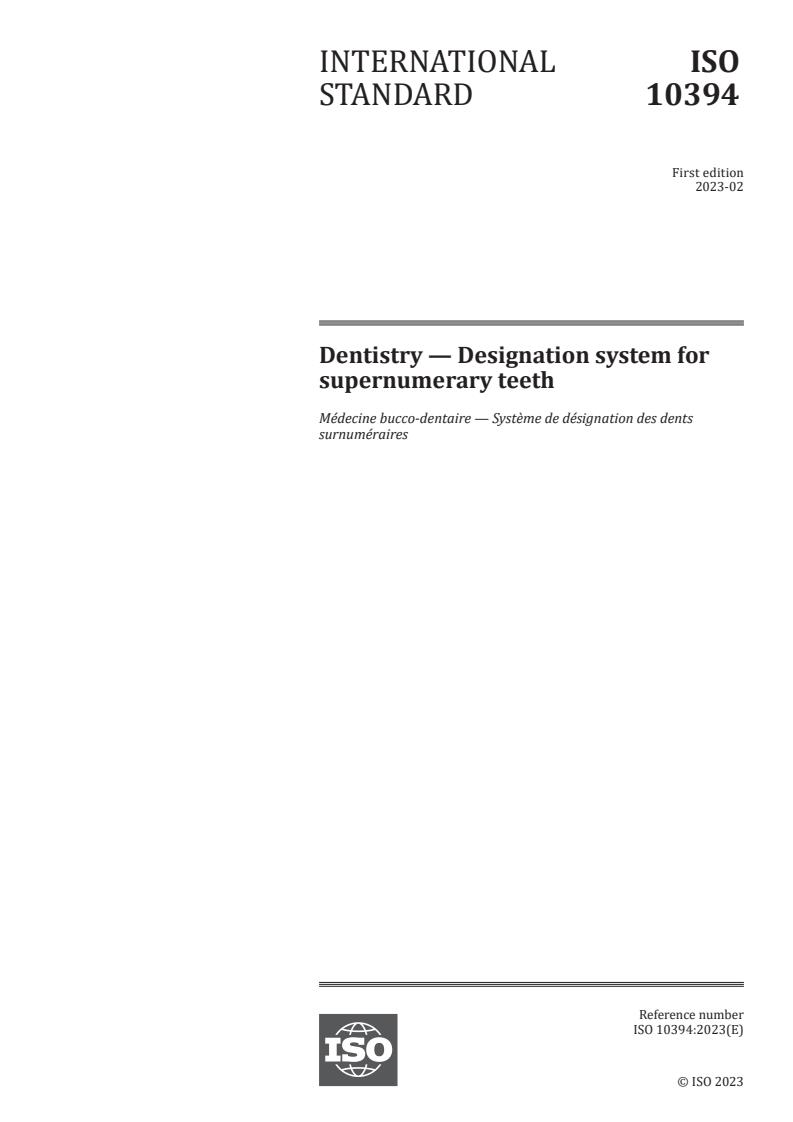
INTERNATIONAL ISO
STANDARD 10394
First edition
2023-02
Dentistry — Designation system for
supernumerary teeth
Médecine bucco-dentaire — Système de désignation des dents
surnuméraires
Reference number
© ISO 2023
All rights reserved. Unless otherwise specified, or required in the context of its implementation, no part of this publication may
be reproduced or utilized otherwise in any form or by any means, electronic or mechanical, including photocopying, or posting on
the internet or an intranet, without prior written permission. Permission can be requested from either ISO at the address below
or ISO’s member body in the country of the requester.
ISO copyright office
CP 401 • Ch. de Blandonnet 8
CH-1214 Vernier, Geneva
Phone: +41 22 749 01 11
Email: copyright@iso.org
Website: www.iso.org
Published in Switzerland
ii
Contents Page
Foreword .iv
Introduction .v
1 Scope . 1
2 Normative references . 1
3 Terms and definitions . 1
4 Principles . 1
5 Designation of supernumerary teeth . 1
5.1 Supernumerary teeth located within one of the four quadrants of the mouth . 1
5.1.1 First character . 1
5.1.2 Second character . 2
5.2 Supernumerary teeth located in the midline area . 2
Bibliography . 4
iii
Foreword
ISO (the International Organization for Standardization) is a worldwide federation of national standards
bodies (ISO member bodies). The work of preparing International Standards is normally carried out
through ISO technical committees. Each member body interested in a subject for which a technical
committee has been established has the right to be represented on that committee. International
organizations, governmental and non-governmental, in liaison with ISO, also take part in the work.
ISO collaborates closely with the International Electrotechnical Commission (IEC) on all matters of
electrotechnical standardization.
The procedures used to develop this document and those intended for its further maintenance are
described in the ISO/IEC Directives, Part 1. In particular, the different approval criteria needed for the
different types of ISO documents should be noted. This document was drafted in accordance with the
editorial rules of the ISO/IEC Directives, Part 2 (see www.iso.org/directives).
Attention is drawn to the possibility that some of the elements of this document may be the subject of
patent rights. ISO shall not be held responsible for identifying any or all such patent rights. Details of
any patent rights identified during the development of the document will be in the Introduction and/or
on the ISO list of patent declarations received (see www.iso.org/patents).
Any trade name used in this document is information given for the convenience of users and does not
constitute an endorsement.
For an explanation of the voluntary nature of standards, the meaning of ISO specific terms and
expressions related to conformity assessment, as well as information about ISO's adherence to
the World Trade Organization (WTO) principles in the Technical Barriers to Trade (TBT), see
www.iso.org/iso/foreword.html.
This document was prepared by Technical Committee ISO/TC 106, Dentistry, Subcommittee SC 3,
Terminology.
Any feedback or questions on this document should be directed to the user’s national standards body. A
complete listing of these bodies can be found at www.iso.org/members.html.
iv
Introduction
ISO 3950 has assigned a meaning to most of the available combinations of two digits. As a result,
ISO 3950 cannot be expended to satisfactorily identify supernumerary teeth without introducing
significant changes to its structure. Such changes are seen as undesirable as they would create
significant implementation and data continuity issues. Meeting the need for a standard for the
designation of supernumerary teeth while avoiding the need for undesirable modifications to ISO 3950
therefore requires the introduction of a standard that is independent of ISO 3950.
This designation system for supernumerary teeth retains the two-character format of ISO 3950 to
maximi
...
NORME ISO
INTERNATIONALE 10394
Première édition
2023-02
Médecine bucco-dentaire — Code de
désignation des dents surnuméraires
Dentistry — Designation system for supernumerary teeth
Numéro de référence
DOCUMENT PROTÉGÉ PAR COPYRIGHT
© ISO 2023
Tous droits réservés. Sauf prescription différente ou nécessité dans le contexte de sa mise en œuvre, aucune partie de cette
publication ne peut être reproduite ni utilisée sous quelque forme que ce soit et par aucun procédé, électronique ou mécanique,
y compris la photocopie, ou la diffusion sur l’internet ou sur un intranet, sans autorisation écrite préalable. Une autorisation peut
être demandée à l’ISO à l’adresse ci-après ou au comité membre de l’ISO dans le pays du demandeur.
ISO copyright office
Case postale 401 • Ch. de Blandonnet 8
CH-1214 Vernier, Genève
Tél.: +41 22 749 01 11
E-mail: copyright@iso.org
Web: www.iso.org
Publié en Suisse
ii
Sommaire Page
Avant-propos .iv
Introduction .v
1 Domaine d’application . 1
2 Références normatives .1
3 Termes et définitions . 1
4 Principes . 1
5 Désignation des dents surnuméraires . 2
5.1 Dents surnuméraires situées dans l’un des quatre quadrants de la bouche . 2
5.1.1 Premier caractère . . 2
5.1.2 Second caractère . 2
5.2 Dents surnuméraires situées dans la zone médiane . 2
Bibliographie . 4
iii
Avant-propos
L’ISO (Organisation internationale de normalisation) est une fédération mondiale d’organismes
nationaux de normalisation (comités membres de l’ISO). L’élaboration des Normes internationales est
en général confiée aux comités techniques de l’ISO. Chaque comité membre intéressé par une étude
a le droit de faire partie du comité technique créé à cet effet. Les organisations internationales,
gouvernementales et non gouvernementales, en liaison avec l’ISO, participent également aux travaux.
L’ISO collabore étroitement avec la Commission électrotechnique internationale (IEC) en ce qui
concerne la normalisation électrotechnique.
Les procédures utilisées pour élaborer le présent document et celles destinées à sa mise à jour sont
décrites dans les Directives ISO/IEC, Partie 1. Il convient, en particulier, de prendre note des différents
critères d’approbation requis pour les différents types de documents ISO. Le présent document a été
rédigé conformément aux règles de rédaction données dans les Directives ISO/IEC, Partie 2 (voir
www.iso.org/directives).
L’attention est appelée sur le fait que certains des éléments du présent document peuvent faire l’objet de
droits de propriété intellectuelle ou de droits analogues. L’ISO ne saurait être tenue pour responsable
de ne pas avoir identifié de tels droits de brevet. Les détails concernant les références aux droits de
propriété intellectuelle ou autres droits analogues identifiés lors de l’élaboration du document sont
indiqués dans l’Introduction et/ou dans la liste des déclarations de brevets reçues par l’ISO (voir
www.iso.org/brevets).
Les appellations commerciales éventuellement mentionnées dans le présent document sont données
pour information, par souci de commodité, à l’intention des utilisateurs et ne sauraient constituer un
engagement.
Pour une explication de la nature volontaire des normes, la signification des termes et expressions
spécifiques de l’ISO liés à l’évaluation de la conformité, ou pour toute information au sujet de l’adhésion
de l’ISO aux principes de l’Organisation mondiale du commerce (OMC) concernant les obstacles
techniques au commerce (OTC), voir: www.iso.org/iso/fr/avant-propos.html.
Le présent document a été élaboré par le comité technique ISO/TC 106, Médecine bucco-dentaire, sous-
comité SC 3, Terminologie.
Il convient que l’utilisateur adresse tout retour d’information ou toute question concernant le présent
document à l’organisme national de normalisation de son pays. Une liste exhaustive desdits organismes
se trouve à l’adresse www.iso.org/fr/members.html.
iv
Introduction
L’ISO 3950 attribue un sens à quasiment toutes les combinaisons de deux chiffres disponibles. En
conséquence, l’ISO 3950 ne peut pas être utilisée pour identifier les dents surnuméraires de manière
satisfaisante sans que des modifications significatives soient apportées à sa structure. De telles
modifications ne sont pas considérées comme souhaitables, car elles engendreraient de sérieuses
difficultés de mise en œuvre et de continuité des données. Pour répondre à la nécessité de disposer
d’une norme pour la désignation des dents surnuméraires tout en évitant de devoir apporter des
modifications non souhaitables à l’ISO 3950, il est nécessaire d’élaborer une norme indépendante de
l’ISO 3950.
Ce code de désignation des dents surnuméraires conserve le format à deux caractères retenu
dans l’ISO 3950, de façon à maximiser la compatibilité avec les formulaires, les logiciels et les systèmes
de messagerie existants, dans le respect des exigences identifiées co
...
ISO/TC 106/SC 3
Date: 2024-04-28
Première édition
2023-02
Médecine bucco-dentaire — Code de désignation des dents
surnuméraires
Dentistry — Designation system for supernumerary teeth
ISO 10394:2023(F)
DOCUMENT PROTÉGÉ PAR COPYRIGHT
© ISO 2023
Droits de reproductionTous droits réservés. Sauf prescription différente ou nécessité dans le contexte de sa mise
en œuvreoeuvre, aucune partie de cette publication ne peut être reproduite ni utilisée sous quelque forme que ce
soit et par aucun procédé, électronique ou mécanique, y compris la photocopie, ou la diffusion sur l’internet ou sur
un intranet, sans autorisation écrite préalable. Une autorisation peut être demandée à l’ISO à l’adresse ci-après ou
au comité membre de l’ISO dans le pays du demandeur.
ISO copyright office
CP 401 • Ch. de Blandonnet 8 • CP 401
CH-1214 Vernier, GenèveGeneva
Tel.Phone: + 41 22 749 01 11
E-mail: copyright@iso.org
www.iso.org
Website: www.iso.org
Publié en Suisse
ii © ISO 2023 – Tous droits réservés
ii © ISO 2023 – Tous droits réservés
Sommaire
Avant-propos . iv
Introduction . v
1 Domaine d’application . 1
2 Références normatives . 1
3 Termes et définitions . 1
4 Principes . 1
5 Désignation des dents surnuméraires. 2
5.1 Dents surnuméraires situées dans l’un des quatre quadrants de la bouche . 2
5.1.1 Premier caractère . 2
5.1.2 Second caractère . 2
5.2 Dents surnuméraires situées dans la zone médiane . 2
Bibliographie . 4
Avant-propos iv
Introduction v
1 Domaine d’application 1
2 Références normatives 1
3 Termes et définitions 1
4 Principes 1
5 Désignation des dents surnuméraires 2
5.1 Dents surnuméraires situées dans l’un des quatre quadrants de la bouche 2
5.1.1 Premier caractère 2
5.1.2 Second caractère 2
5.2 Dents surnuméraires situées dans la zone médiane 2
Bibliographie 4
iii
ISO 10394:2023(F)
Avant-propos
L’ISO (Organisation internationale de normalisation) est une fédération mondiale d’organismes
nationaux de normalisation (comités membres de l’ISO). L’élaboration des Normes internationales est en
général confiée aux comités techniques de l’ISO. Chaque comité membre intéressé par une étude a le droit
de faire partie du comité technique créé à cet effet. Les organisations internationales, gouvernementales
et non gouvernementales, en liaison avec l’ISO, participent également aux travaux. L’ISO collabore
étroitement avec la Commission électrotechnique internationale (IEC) en ce qui concerne la
normalisation électrotechnique.
Les procédures utilisées pour élaborer le présent document et celles destinées à sa mise à jour sont
décrites dans les Directives ISO/IEC, Partie 1. Il convient, en particulier, de prendre note des différents
critères d’approbation requis pour les différents types de documents ISO. Le présent document a été
rédigé conformément aux règles de rédaction données dans les Directives ISO/IEC, Partie 2 (voir
www.iso.org/directiveswww.iso.org/directives).
L’attention est appelée sur le fait que certains des éléments du présent document peuvent faire l’objet de
droits de propriété intellectuelle ou de droits analogues. L’ISO ne saurait être tenue pour responsable de
ne pas avoir identifié de tels droits de brevet. Les détails concernant les références aux droits de propriété
intellectuelle ou autres droits analogues identifiés lors de l’élaboration du document sont indiqués dans
l’Introduction et/ou dans la liste des déclarations de brevets reçues par l’ISO (voir
www.iso.org/brevetswww.iso.org/brevets).
Les appellations commerciales éventuellement mentionnées dans le présent document sont données
pour information, par souci de commodité, à l’intention des utilisateurs et ne sauraient constituer un
engagement.
Pour une explication de la nature volontaire des normes, la signification des termes et expressions
spécifiques de l’ISO liés à l’évaluation de la conformité, ou pour toute information au sujet de l’adhésion
de l’ISO aux principes de l’Organisation mondiale du commerce (OMC) concernant les obstacles
techniques au commerce (OTC), voir: www.iso.org/iso/fr/avant-propos.htmlwww.iso.org/iso/fr/avant-
propos.html.
Le présent document a été élaboré par le comité technique ISO/TC 106, Médecine bucco-dentaire, sous-
comité SC 3, Terminologie.
Il convient que l’utilisateur adresse tout retour d’information ou toute question concernant le présent
document à l’organisme national de normalisation de son pays. Une liste exhaustive desdits organismes
se trouve à l’adresse www.iso.org/fr/members.htmlwww.iso.org/fr/members.html.
iv © ISO 2023 – Tous droits réservés
iv © ISO 2023 – Tous droits réservés
Introduction
L’ISO 3950 attribue un sens à quasiment toutes les combinaisons de deux chiffres disponibles. En
conséquence, l’ISO 3950 ne peut pas être utilisée pour identifier les dents surnuméraires de manière
satisfaisante sans que des modifications significatives soient apportées à sa structure. De telles
modifications ne sont pas considérées comme souhaitables, car elles engendreraient de sérieuses
difficultés de mise en œuvre et de continuité des données. Pour répondre à la nécessité de disposer d’une
norme pour la désignation des dents surnuméraires tout en évitant de devoir apporter des modifications
non souhaitables à l’ISO 3950, il est nécessaire d’élaborer une norme indépendante de l’ISO 3950.
Ce code de désignation des dents surnuméraires conserve le format à deux caractères retenu
dans l’ISO 3950, de façon à maximiser la compatibilité avec les formulaires, les logiciels et les systèmes
de messagerie existants, dans le respect des
...