


ISO 13105-2:2014
(Main)Building construction machinery and equipment — Machinery for concrete surface floating and finishing — Part 2: Safety requirements and verification
Building construction machinery and equipment — Machinery for concrete surface floating and finishing — Part 2: Safety requirements and verification
ISO 13105-2:2014 specifies safety requirements for machines used for concrete surface floating and finishing. This includes pedestrian-controlled equipment and ride-on equipment. It is not applicable to internal or external vibrators or ancillary equipment used with internal and external vibrators, for example, air compressors, hydraulic power sources, and voltage transformers, to remote-controlled or hand-held smoothing machines and self-acting (robotic) smoothing machines, or to strike-off type machines commonly known as screeds. It deals with significant hazards, hazardous situations, or hazardous events relevant to machinery for concrete surface floating and finishing (power trowels) when used as intended and under conditions of misuse which are reasonably foreseeable by the manufacturer. It is not applicable to machines which are manufactured before the date of its publication.
Machines et matériels pour la construction des bâtiments — Talocheuses-lisseuses de mortier — Partie 2: Les exigences de sécurité et de vérification
General Information
- Status
- Withdrawn
- Publication Date
- 18-Nov-2014
- Technical Committee
- ISO/TC 195/SC 1 - Machinery and equipment for concrete work
- Drafting Committee
- ISO/TC 195/SC 1/WG 2 - Concrete floating machines
- Current Stage
- 9599 - Withdrawal of International Standard
- Start Date
- 27-Oct-2023
- Completion Date
- 12-Feb-2026
Relations
- Effective Date
- 11-Dec-2021
- Effective Date
- 06-Jun-2022
Get Certified
Connect with accredited certification bodies for this standard

ICC Evaluation Service
Building products evaluation and certification.

NSF International
Global independent organization facilitating standards development and certification.

QAI Laboratories
Building and construction product testing and certification.
Sponsored listings
Frequently Asked Questions
ISO 13105-2:2014 is a standard published by the International Organization for Standardization (ISO). Its full title is "Building construction machinery and equipment — Machinery for concrete surface floating and finishing — Part 2: Safety requirements and verification". This standard covers: ISO 13105-2:2014 specifies safety requirements for machines used for concrete surface floating and finishing. This includes pedestrian-controlled equipment and ride-on equipment. It is not applicable to internal or external vibrators or ancillary equipment used with internal and external vibrators, for example, air compressors, hydraulic power sources, and voltage transformers, to remote-controlled or hand-held smoothing machines and self-acting (robotic) smoothing machines, or to strike-off type machines commonly known as screeds. It deals with significant hazards, hazardous situations, or hazardous events relevant to machinery for concrete surface floating and finishing (power trowels) when used as intended and under conditions of misuse which are reasonably foreseeable by the manufacturer. It is not applicable to machines which are manufactured before the date of its publication.
ISO 13105-2:2014 specifies safety requirements for machines used for concrete surface floating and finishing. This includes pedestrian-controlled equipment and ride-on equipment. It is not applicable to internal or external vibrators or ancillary equipment used with internal and external vibrators, for example, air compressors, hydraulic power sources, and voltage transformers, to remote-controlled or hand-held smoothing machines and self-acting (robotic) smoothing machines, or to strike-off type machines commonly known as screeds. It deals with significant hazards, hazardous situations, or hazardous events relevant to machinery for concrete surface floating and finishing (power trowels) when used as intended and under conditions of misuse which are reasonably foreseeable by the manufacturer. It is not applicable to machines which are manufactured before the date of its publication.
ISO 13105-2:2014 is classified under the following ICS (International Classification for Standards) categories: 13.110 - Safety of machinery; 91.220 - Construction equipment. The ICS classification helps identify the subject area and facilitates finding related standards.
ISO 13105-2:2014 has the following relationships with other standards: It is inter standard links to ISO 13105-2:2014/Amd 1:2017, ISO 13105-2:2023. Understanding these relationships helps ensure you are using the most current and applicable version of the standard.
ISO 13105-2:2014 is available in PDF format for immediate download after purchase. The document can be added to your cart and obtained through the secure checkout process. Digital delivery ensures instant access to the complete standard document.
Standards Content (Sample)
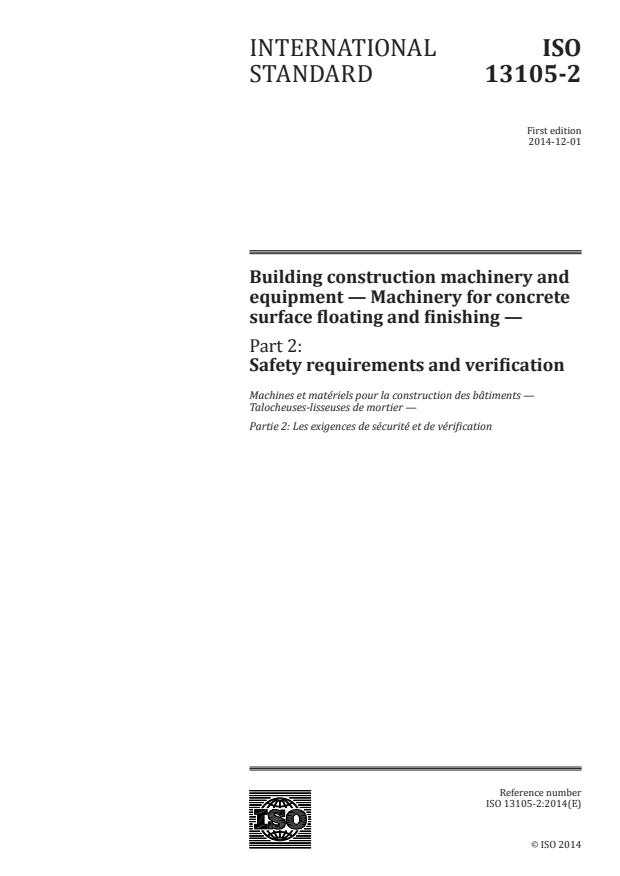
INTERNATIONAL ISO
STANDARD 13105-2
First edition
2014-12-01
Building construction machinery and
equipment — Machinery for concrete
surface floating and finishing —
Part 2:
Safety requirements and verification
Machines et matériels pour la construction des bâtiments —
Talocheuses-lisseuses de mortier —
Partie 2: Les exigences de sécurité et de vérification
Reference number
©
ISO 2014
© ISO 2014
All rights reserved. Unless otherwise specified, no part of this publication may be reproduced or utilized otherwise in any form
or by any means, electronic or mechanical, including photocopying, or posting on the internet or an intranet, without prior
written permission. Permission can be requested from either ISO at the address below or ISO’s member body in the country of
the requester.
ISO copyright office
Case postale 56 • CH-1211 Geneva 20
Tel. + 41 22 749 01 11
Fax + 41 22 749 09 47
E-mail copyright@iso.org
Web www.iso.org
Published in Switzerland
ii © ISO 2014 – All rights reserved
Contents Page
Foreword .iv
Introduction .v
1 Scope . 1
2 Normative references . 1
3 Terms and definitions . 2
4 Safety requirements and/or protective/risk reduction measures . 2
4.1 General requirements for all machines . 2
4.2 Safety requirements for pedestrian-controlled machines . 4
4.3 Safety requirements for ride-on machines . 5
5 Verification of safety requirements and/or protective/risk reduction measures .6
6 Information for use . 6
6.1 Operator’s manual. 6
6.2 Safety and instructional signs . 7
6.3 Marking . 7
Annex A (normative) Noise and vibration tests . 9
Annex B (informative) List of significant hazards.12
Bibliography .14
Foreword
ISO (the International Organization for Standardization) is a worldwide federation of national standards
bodies (ISO member bodies). The work of preparing International Standards is normally carried out
through ISO technical committees. Each member body interested in a subject for which a technical
committee has been established has the right to be represented on that committee. International
organizations, governmental and non-governmental, in liaison with ISO, also take part in the work.
ISO collaborates closely with the International Electrotechnical Commission (IEC) on all matters of
electrotechnical standardization.
The procedures used to develop this document and those intended for its further maintenance are
described in the ISO/IEC Directives, Part 1. In particular the different approval criteria needed for the
different types of ISO documents should be noted. This document was drafted in accordance with the
editorial rules of the ISO/IEC Directives, Part 2 (see www.iso.org/directives).
Attention is drawn to the possibility that some of the elements of this document may be the subject of
patent rights. ISO shall not be held responsible for identifying any or all such patent rights. Details of
any patent rights identified during the development of the document will be in the Introduction and/or
on the ISO list of patent declarations received (see www.iso.org/patents).
Any trade name used in this document is information given for the convenience of users and does not
constitute an endorsement.
For an explanation on the meaning of ISO specific terms and expressions related to conformity
assessment, as well as information about ISO’s adherence to the WTO principles in the Technical Barriers
to Trade (TBT) see the following URL: Foreword - Supplementary information
The committee responsible for this document is ISO/TC 195, Building construction machinery and
equipment, Subcommittee SC 1, Machinery and equipment for concrete work.
ISO 13105 consists of the following parts, under the general title Building construction machinery and
equipment — Machinery for concrete surface floating and finishing:
— Part 1: Terms and commercial specifications
— Part 2: Safety requirements and verification
iv © ISO 2014 – All rights reserved
Introduction
This part of ISO 13105 is a type-C standard as stated in ISO 12100.
This part of ISO 13105 is of relevance, in particular, for the following stakeholder groups representing
the market players with regard to machinery safety:
— machine manufacturers (small, medium, and large enterprises);
— health and safety bodies (regulators, accident prevention organisations, market surveillance, etc.).
Others can be affected by the level of machinery safety achieved with the means of this part of ISO 13105
by the above-mentioned stakeholder groups:
— machine users/employers (small, medium, and large enterprises);
— machine users/employees (e.g. trade unions, organizations for people with special needs);
— service providers, e.g. for maintenance (small, medium, and large enterprises);
— consumers (in the case of machinery intended for use by consumers).
The above-mentioned stakeholder groups have been given the possibility to participate at the drafting
process of this part of ISO 13105.
The machinery concerned and the extent to which hazards, hazardous situations, or hazardous events
are covered are indicated in the Scope of this part of ISO 13105.
When requirements of this type-C standard are different from those which are stated in type-A or
type-B standards, the requirements of this type-C standard take precedence over the requirements of
the other standards for machines that have been designed and built according to the requirements of
this type-C standard.
ISO 13105 deals with machinery designed for smoothing and finishing concrete on construction sites.
These machines are commonly referred to as “power trowels.”
INTERNATIONAL STANDARD ISO 13105-2:2014(E)
Building construction machinery and equipment —
Machinery for concrete surface floating and finishing —
Part 2:
Safety requirements and verification
1 Scope
This part of ISO 13105 specifies safety requirements for machines used for concrete surface floating and
finishing. This includes pedestrian-controlled equipment and ride-on equipment.
It is not applicable to
— internal or external vibrators or ancillary equipment used with internal and external vibrators, for
example, air compressors, hydraulic power sources, and voltage transformers,
— remote-controlled or hand-held smoothing machines and self-acting (robotic) smoothing machines,
and
— strike-off type machines commonly known as screeds.
This part of ISO 13105 deals with significant hazards, hazardous situations, or hazardous events relevant
to machinery for concrete surface floating and finishing (power trowels) when used as intended and
under conditions of misuse which are reasonably foreseeable by the manufacturer.
This part of ISO 13105 is not applicable to machines which are manufactured before the date of its
publication.
2 Normative references
The following documents, in whole or in part, are normatively referenced in this document and are
indispensable for its application. For dated references, only the edition cited applies. For undated
references, the latest edition of the referenced document (including any amendments) applies.
ISO 2631-1, Mechanical vibration and shock — Evaluation of human exposure to whole-body vibration —
Part 1: General requirements
ISO 3744, Acoustics — Determination of sound power levels and sound energy levels of noise sources using
sound pressure — Engineering methods for an essentially free field over a reflecting plane
ISO 4413, Hydraulic fluid power — General rules and safety requirements for systems and their components
ISO 4414, Pneumatic fluid power — General rules and safety requirements for systems and their components
ISO 5349-1, Mechanical vibration — Measurement and evaluation of human exposure to hand-transmitted
vibration — Part 1: General requirements
ISO 7000, Graphical symbols for use on equipment — Registered symbols
ISO 11201, Acoustics — Noise emitted by machinery and equipment — Determination of emission sound
pressure levels at a work station and at other specified positions in an essentially free field over a reflecting
plane with negligible environmental corrections
ISO 12100:2010, Safety of machinery — General principles for design — Risk assessment and risk reduction
ISO 13105-1:2014, Building construction machinery and equipment — Machinery for concrete surface
floating and finishing — Part 1: Terms and commercial specifications
ISO 13732-1, Ergonomics of the thermal environment — Methods for the assessment of human responses to
contact with surfaces — Part 1: Hot surfaces
ISO 13766, Earth-moving machinery — Electromagnetic compatibility
IEC 60204-1, Safety of machinery — Electrical equipment of machines — Part 1: General requirements
IEC 60309-1, Plugs, socket-outlets and couplers for industrial purposes — Part 1: General requirements
IEC 60529, Degrees of protection provided by enclosures (IP code)
3 Terms and definitions
For the purposes of this document, the terms and definitions given in ISO 12100, ISO 13105-1, and the
following shall apply.
3.1
nylon 6/6 substrate
polyhexamethylene adipamide material
Note 1 to entry: See ISO 1874-1 for more information.
4 Safety requirements and/or protective/risk reduction measures
Machinery shall comply with the safety requirements and/or protective/risk reduction measures of this
Clause.
In addition, the machine shall be designed according to the principles of ISO 12100 for relevant but not
significant hazards which are not dealt with by this part of ISO 13105.
4.1 General requirements for all machines
4.1.1 Guarding of the rotating blades
A means shall be provided to protect the operator or bystanders from inadvertently coming in contact
with rotating blades. The guarding device shall be designed so that the operator can visually see the
interaction of the blades with the concrete surface.
If the guarding device is constructed of tubes (or bars), there shall be a gap not exceeding 90 mm between
the concentric tubes (or bars). See ISO 13105-1:2014, Figures A.1 and A.2.
The lowest outer tube (or bar) of the blade guarding device shall be able to withstand an impact force
equal to two times the weight of the machine without exposing the blades to the deformation.
4.1.2 Blade guarding device ground clearance
The height of the lowest outer tube (or bar) of the blade guarding device with blades in the unpitched
position shall not exceed 60 mm from the concrete surface. See ISO 13105-1:2014, Figures A.1 and A.2.
4.1.3 Blade pitch adjustment
Whenever practicable, the adjustment of the blade pitch shall be carried out from the normal operating
position. Where this is neither possible nor practicable, means shall be provided to protect personnel
from contact with the blade, e.g. blade lock or equivalent. Instructions for blade pitch adjustment shall
be given in the operator’s manual. See 6.1.2, item t).
2 © ISO 2014 – All rights reserved
4.1.4 Electrical devices
4.1.4.1 Electrical contact of persons with live parts
4.1.4.1.1 Direct contact
Protection from direct contact with live parts shall be in accordance with IEC 60204-1, 6.2.
4.1.4.1.2 Indirect contact
Protection from indirect contact with live parts shall be in accordance with IEC 60204-1, 6.3.
4.1.4.2 External influences on electrical equipment
4.1.4.2.1 Damage to electrical equipment
The position of the electrical equipment in the machinery shall guarantee protection from mechanical
damage to electrical equipment.
Flexible leads with insulation meeting specification H 07 RN-F or A 07 RN-F per EN 50525-2-21:2011 or
at least equivalent specification shall be used.
Plug devices shall be qualified for more difficult (rough) conditions in accordance with IEC 60309-1.
4.1.4.2.2 Protection from dust
Electrical components shall meet the dust protection requirements to IP-5X of electric protection in
accordance with IEC 60529, 13.4.
4.1.4.2.3 Protection from water
Electrical components shall meet the water protection requirements to IP-X5 of electric protection in
accordance with IEC 60529, 14.2.5.
4.1.4.3 Protection against residual voltages
Live parts having a residual voltage greater than 60 V after the supply has been disconnected shall be
discharged to 60 V or less within a time period of 5 s after disconnection of the supply voltage provided
that this rate of discharge does not interfere with the proper functioning of the equipment.
4.1.4.4 Prevention of the occurrence of a touch voltage
For engine powered machines which generate electrical power above 60 V for accessories, the
requirements of IEC 60204-1, 6.3.2 shall apply.
4.1.4.5 Failure of electrical energy source
The machine shall be designed to prevent unintentional starting of the machine after re-energizing
subsequent to the failure of electrical energy supply.
4.1.5 Hot parts
The machine shall be designed to minimize risk to the operator from inadvertent contact with hot parts
in accordance with ISO 13732-1.
4.1.6 Operator exposure to harmful gases
Exhaust gases of the internal combustion engine shall be directed away from the operator.
4.1.7 Securing of machine parts
Machine parts (e.g. guards) shall be secured to prevent unintentional loosening or displacement during
operation or machine lifting.
4.1.8 Means for lifting
For machines with a gross weight of 25 kg or greater, means for lifting (e.g. lifting points) the machine
shall be provided. These provisions shall be arranged in such a way that the machine can be lifted, hel
...
Questions, Comments and Discussion
Ask us and Technical Secretary will try to provide an answer. You can facilitate discussion about the standard in here.
Loading comments...