

ISO 23693-3:2026
(Main)Determination of the resistance to gas explosions of passive fire protection materials — Part 3: Tubular and I-section substrates subject to elastic deformation only
- Abstract
This document describes methods for simulating the mechanical loads that can be imparted to passive fire protection (PFP) materials and systems by explosions resulting from releases of flammable gas, pressurized liquefied gas, flashing liquid fuels, or dust that can precede a fire. These methods can be used to determine the resistance of passive fire protection materials to such events. This document considers PFP materials applied to substrates that are subject to the combined effects of pressure and drag that occur in the flow path of an explosion. This document excludes specimens in which the substrate is subject to plastic deformation or brittle failure.
- Status
- Published
- Publication Date
- 18-Jun-2026
- Technical Committee
- ISO/TC 92/SC 2 - Fire containment
- Current Stage
- 6060 - International Standard published
- Start Date
- 19-Jun-2026
- Due Date
- 02-Nov-2026
- Completion Date
- 19-Jun-2026


ISO 23693-3:2026 is an International Standard from ISO for determining the resistance to gas explosions of passive fire protection (PFP) materials on tubular and I-section substrates that deform elastically only. It specifies test methods that simulate the combined pressure and drag loads created by explosions from flammable gas, pressurized liquefied gas, flashing liquid fuels, or dust, so test laboratories and test sponsors can assess how a PFP system responds before a fire starts.
What does ISO 23693-3:2026 specify?
ISO 23693-3:2026 specifies how to test PFP materials and systems when they are attached to tubular or I-section substrates exposed to explosion flow. The standard is aimed at specimens that experience combined overpressure and drag, and it excludes cases where the substrate undergoes plastic deformation or brittle failure.
The document is organized around the loading concept, the test methods, specimen setup, environmental and instrumentation requirements, data analysis, acceptance criteria, and reporting. It also includes two annexes: one for measuring side-on overpressure and one for describing damage to the PFP after testing.
| Annex | What it covers |
|---|---|
| Annex A | Informative guidance for measuring side-on overpressure, including surface mounting and streamlined housing arrangements |
| Annex B | Normative descriptions of damage to PFP that should be recorded and reported |
What are the key requirements of ISO 23693-3:2026?
ISO 23693-3:2026 centers on reproducing the explosion loads that matter in practice: the blast pressure and the gas flow that creates drag. The specimen must be positioned so it sees the flow path of the explosion, because the standard is not just checking resistance to pressure alone.
Explosion loading and test position
Clause 4 requires the specimen to be exposed to a combination of overpressure and drag load. In practice, that means locating it in or near the vent of a confined gas explosion, or at the edge of the congested region in an unconfined explosion, so the gas flow is fast enough to create drag.
The standard also explains that pressure load comes from the overpressure, while drag load comes from the moving gas. For users, this matters because PFP performance on this type of structure depends on both effects acting together.
Method 1 - direct measurement
Clause 5.2 describes Method 1, which measures stagnation pressure and side-on overpressure directly. The standard allows either an instrumented tubular or the test specimen itself to be instrumented, as long as the measurement arrangement does not disturb the PFP being assessed.
This method is useful when the facility can place pressure transducers where they will capture the explosion field reliably. The practical point is that the test result must represent the pressure and flow acting on the specimen, not a simplified blast reading.
Side-on overpressure measurement
Clause 5.2.3 requires side-on overpressure to be measured with pressure gauges placed either on a suitable surface or in a streamlined housing. Annex A explains these two arrangements in more detail.
This matters because side-on overpressure is the reference pressure used to characterize the blast wave without the reflected component. For the reader, it means the measurement geometry must avoid adding reflection effects that would distort the result.
Method 2 - CFD-supported testing
Clause 5.3 provides a second route based on computational fluid dynamics (CFD) modelling. ISO 23693-3:2026 allows CFD only when the model is backed by calibration testing that confirms the predicted loading conditions.
For practice, this means a user can design a test configuration by modelling the explosion flow field, then verify it in a calibration test. The standard expects the measured conditions in the test facility to match the modeled conditions closely enough for the results to be credible.
Specimens, support and loading conditions
Clause 6 requires PFP coatings or dry fit systems to be mounted on a suitable tubular or I-beam specimen. The specimen must be rigidly supported only at its ends, and its geometry and placement must suit the test facility while still placing it in the flow path.
The clause also allows other section types, but only when they are tested together with a calibration test on an instrumented tubular. In practice, that keeps non-standard shapes tied back to a known loading reference.
Data analysis, acceptance and reporting
Clause 10 requires the overpressure traces to be processed before analysis, including smoothing short-duration noise and determining rise time from the pressure profile. The same clause explains how dynamic pressure is derived from the stagnation and side-on traces.
Clause 11 sets the acceptance criteria for both methods, focusing on whether the required pressure conditions were actually achieved and recorded. Clause 12 then requires the report to include the specimen condition before test, the changes caused by the test, and the constructional details needed to confirm the specimen build.
What terms does ISO 23693-3:2026 define?
- Congested region - a part of the explosion test rig where obstacles ahead of the flame increase flame speed, energy release rate, and overpressure.
- Drag load - the load on an item caused by the flow of gas generated by a gas explosion.
- Overpressure - the difference between the actual pressure and ambient pressure.
- Side-on overpressure - overpressure measured at right angles to the direction of travel of a blast wave; the standard notes this is also called incident or free field overpressure.
- Stagnation pressure - the pressure where flowing explosion gas is brought to zero velocity.
- Projected area - the part of the vent area covered by the instrumented test specimen.
- Substrate - the section to which the PFP materials are attached or mounted.
- Streamlined housing - a housing that lets a pressure transducer measure side-on overpressure when aligned with the blast flow.
Who uses ISO 23693-3:2026?
ISO 23693-3:2026 is used by test laboratories, test sponsors, and PFP manufacturers or system suppliers who need a defined way to assess explosion resistance. It is also relevant to engineers and technical reviewers who specify the required overpressure-time history, choose the specimen configuration, and decide whether the test arrangement matches the application.
In practice, users apply it when they need to qualify PFP on tubular or I-section members that could be hit by explosion loads before a fire. Quality and safety teams also use the report and damage descriptions to decide whether follow-up fire testing or further assessment is needed.
Which standards are used with ISO 23693-3:2026?
- ISO 23693-1 - the main companion part. It provides the general requirements for the ISO 23693 series, including the explosion load generation methods, environmental conditions, instrumentation, and report content that ISO 23693-3 builds on.
What does the ISO 23693-3:2026 document contain?
ISO 23693-3:2026 contains the test framework, specimen setup rules, and data handling needed to assess PFP under gas-explosion loading. Clause 5 gives two test routes - direct measurement and CFD-supported testing - and includes the pressure-gauge layouts for tubular and I-section specimens.
The document also contains analysis procedures for overpressure traces, including rise-time handling and dynamic-pressure derivation. Annex A shows how to measure side-on overpressure, and Annex B lists the types of damage to record, such as displacement, discolouration, cracking, adhesion failure, crushing, tearing, unsupported PFP failure, and cohesive failure.
For users, that means the standard does more than define a pass/fail idea - it tells the laboratory what to measure, how to place the specimen, what to record after the test, and what information the report must carry for later technical review.
Get Certified
Connect with accredited certification bodies for this standard

CIS Institut d.o.o.
Personal Protective Equipment (PPE) certification body. Notified Body NB-2890 for EU Regulation 2016/425 PPE.

Kiwa BDA Testing
Building and construction product certification.
Kmetijski inštitut Slovenije
Agricultural Institute of Slovenia. Soil testing, plant health, agricultural product analysis.
Sponsored listings
Frequently Asked Questions
ISO 23693-3:2026 is a standard published by the International Organization for Standardization (ISO). Its full title is "Determination of the resistance to gas explosions of passive fire protection materials — Part 3: Tubular and I-section substrates subject to elastic deformation only". This standard covers: This document describes methods for simulating the mechanical loads that can be imparted to passive fire protection (PFP) materials and systems by explosions resulting from releases of flammable gas, pressurized liquefied gas, flashing liquid fuels, or dust that can precede a fire. These methods can be used to determine the resistance of passive fire protection materials to such events. This document considers PFP materials applied to substrates that are subject to the combined effects of pressure and drag that occur in the flow path of an explosion. This document excludes specimens in which the substrate is subject to plastic deformation or brittle failure.
This document describes methods for simulating the mechanical loads that can be imparted to passive fire protection (PFP) materials and systems by explosions resulting from releases of flammable gas, pressurized liquefied gas, flashing liquid fuels, or dust that can precede a fire. These methods can be used to determine the resistance of passive fire protection materials to such events. This document considers PFP materials applied to substrates that are subject to the combined effects of pressure and drag that occur in the flow path of an explosion. This document excludes specimens in which the substrate is subject to plastic deformation or brittle failure.
ISO 23693-3:2026 is classified under the following ICS (International Classification for Standards) categories: 13.220.50 - Fire-resistance of building materials and elements. The ICS classification helps identify the subject area and facilitates finding related standards.
ISO 23693-3:2026 is available in PDF format for immediate download after purchase. The document can be added to your cart and obtained through the secure checkout process. Digital delivery ensures instant access to the complete standard document.
Standards Content (Sample)
International
Standard
ISO 23693-3
First edition
Determination of the resistance
2026-06
to gas explosions of passive fire
protection materials —
Part 3:
Tubular and I-section substrates
subject to elastic deformation only
Détermination de la résistance aux explosions de gaz des
matériaux de protection passive contre l’incendie —
Partie 3: Supports tubulaires et de section en I soumis à une
déformation élastique uniquement
Reference number
© ISO 2026
All rights reserved. Unless otherwise specified, or required in the context of its implementation, no part of this publication may
be reproduced or utilized otherwise in any form or by any means, electronic or mechanical, including photocopying, or posting on
the internet or an intranet, without prior written permission. Permission can be requested from either ISO at the address below
or ISO’s member body in the country of the requester.
ISO copyright office
CP 401 • Ch. de Blandonnet 8
CH-1214 Vernier, Geneva
Phone: +41 22 749 01 11
Email: copyright@iso.org
Website: www.iso.org
Published in Switzerland
ii
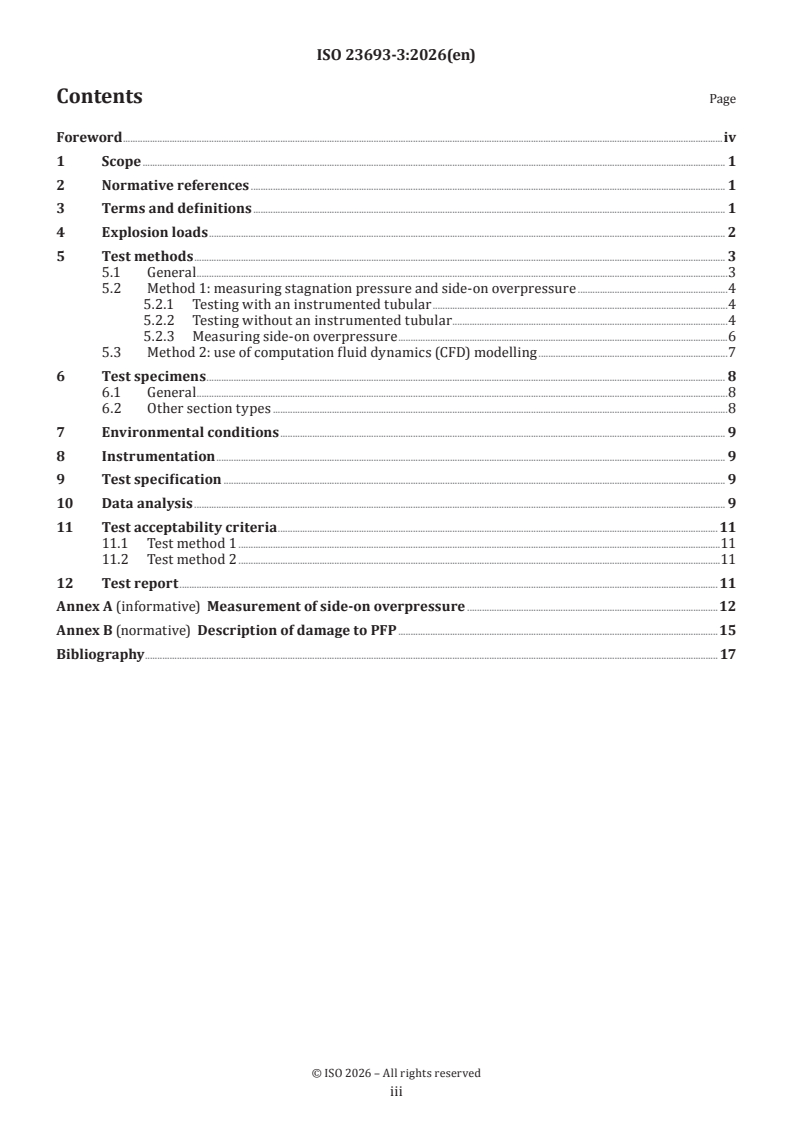
Contents Page
Foreword .iv
1 Scope . 1
2 Normative references . 1
3 Terms and definitions . 1
4 Explosion loads . 2
5 Test methods . 3
5.1 General .3
5.2 Method 1: measuring stagnation pressure and side-on overpressure .4
5.2.1 Testing with an instrumented tubular .4
5.2.2 Testing without an instrumented tubular .4
5.2.3 Measuring side-on overpressure .6
5.3 Method 2: use of computation fluid dynamics (CFD) modelling .7
6 Test specimens . 8
6.1 General .8
6.2 Other section types .8
7 Environmental conditions . 9
8 Instrumentation . 9
9 Test specification . 9
10 Data analysis . 9
11 Test acceptability criteria .11
11.1 Test method 1 .11
11.2 Test method 2 .11
12 Test report .11
Annex A (informative) Measurement of side-on overpressure .12
Annex B (normative) Description of damage to PFP .15
Bibliography . 17
iii
Foreword
ISO (the International Organization for Standardization) is a worldwide federation of national standards
bodies (ISO member bodies). The work of preparing International Standards is normally carried out through
ISO technical committees. Each member body interested in a subject for which a technical committee
has been established has the right to be represented on that committee. International organizations,
governmental and non-governmental, in liaison with ISO, also take part in the work. ISO collaborates closely
with the International Electrotechnical Commission (IEC) on all matters of electrotechnical standardization.
The procedures used to develop this document and those intended for its further maintenance are described
in the ISO/IEC Directives, Part 1. In particular, the different approval criteria needed for the different types
of ISO document should be noted. This document was drafted in accordance with the editorial rules of the
ISO/IEC Directives, Part 2 (see www.iso.org/directives).
ISO draws attention to the possibility that the implementation of this document may involve the use of (a)
patent(s). ISO takes no position concerning the evidence, validity or applicability of any claimed patent
rights in respect thereof. As of the date of publication of this document, ISO had not received notice of (a)
patent(s) which may be required to implement this document. However, implementers are cautioned that
this may not represent the latest information, which may be obtained from the patent database available at
www.iso.org/patents. ISO shall not be held responsible for identifying any or all such patent rights.
Any trade name used in this document is information given for the convenience of users and does not
constitute an endorsement.
For an explanation of the voluntary nature of standards, the meaning of ISO specific terms and expressions
related to conformity assessment, as well as information about ISO's adherence to the World Trade
Organization (WTO) principles in the Technical Barriers to Trade (TBT), see www.iso.org/iso/foreword.html.
This document was prepared by Technical Committee ISO/TC 92, Fire safety, Subcommittee SC 2, Fire
Resistance.
A list of all parts in the ISO 23693 series can be found on the ISO website.
Any feedback or questions on this document should be directed to the user’s national standards body. A
complete listing of these bodies can be found at www.iso.org/members.html.
iv
International Standard ISO 23693-3:2026(en)
Determination of the resistance to gas explosions of passive
fire protection materials —
Part 3:
Tubular and I-section substrates subject to elastic
deformation only
1 Scope
This document describes methods for simulating the mechanical loads that can be imparted to passive fire
protection (PFP) materials and systems by explosions resulting from releases of flammable gas, pressurized
liquefied gas, flashing liquid fuels, or dust that can precede a fire.
These methods can be used to determine the resistance of passive fire protection materials to such events.
This document considers PFP materials applied to substrates that are subject to the combined effects of
pressure and drag that occur in the flow path of an explosion. This document excludes specimens in which
the substrate is subject to plastic deformation or brittle failure
2 Normative references
The following documents are referred to in the text in such a way that some or all of their content constitutes
requirements of this document. For dated references, only the edition cited applies. For undated references,
the latest edition of the referenced document (including any amendments) applies.
ISO 23693-1, Determination of the resistance to gas explosions of passive fire protection materials — Part 1:
General requirements
3 Terms and definitions
For the purposes of this document, the following terms and definitions apply.
ISO and IEC maintain terminology databases for use in standardization at the following addresses:
— ISO Online browsing platform: available at https:// www .iso .org/ obp
— IEC Electropedia: available at https:// www .electropedia .org/
3.1
congested region
region that is occupied by items that provide obstacles to flow ahead of the flame,
thereby increasing flame velocity, the rate at which energy is released, and the overpressure produced
3.2
drag load
load on items resulting from the flow of gas generated by a gas explosion
3.3
overpressure
difference between actual pressure and ambient pressure
3.4
pressure load
load on an object resulting from the overpressure (3.3) generated by a gas explosion
3.5
projected area
part of the vent area that the instrumented test specimen covers
3.6
rise time
time for the pressure in a blast wave to rise to the peak overpressure (3.3)
3.7
side-on overpressure
overpressure (3.3) measured at right angles to the direction of travel of a blast wave
Note 1 to entry: This can also be described as incident or free field overpressure.
3.8
stagnation pressure
pressure at a location perpendicular to and facing the direction of the flow, where the velocity of the
explosion gases has been reduced to zero
3.9
streamlined housing
housing that a pressure transducer can be mounted into, which, if aligned with the direction of travel of the
blast wave and flow generated by a gas explosion, allows the side-on overpressure (3.7) to be measured
3.10
substrate
section to which the passive fire protection (PFP) materials are attached or mounted
4 Explosion loads
Methods for generating explosive loads are described in ISO 23693-1. Due to the nature of the specimen
being tested, it will be exposed to a combination of overpressure and drag loads. Pressure loads come from
the overpressure generated by the explosion; the drag loads are generated by the high velocity gas flow
around the object. To ensure that PFP systems applied to this type of object can survive a gas explosion it is
necessary to test them against a combination of pressure and drag loads.
To achieve a combination of pressure and drag loads, the test specimen shall be located in, or near, the vent
of a confined gas explosion or at the edge of the congested region of an unconfined gas explosion, where the
velocity of the gas flow will produce a drag load.
The pressure load is obtained by measuring the side-on overpressure.
Drag load is characterized either by measuring the stagnation pressure on an instrumented tubular
positioned so as to receive the same drag load as the specimen being tested or by instrumenting the
specimen being tested. When the instrumented tubular is used, it shall be located in the same position as the
specimen during a calibration test conducted under the same test conditions.
The drag load on an object in a flow is given by Formula (1):
D = C A p (1)
L D dyn
where
D is the drag load, in newtons (N);
L
C is the drag coefficient of object;
D
A is the projected area of object normal to flow direction, in square metres (m );
p is the dynamic pressure, in newtons per square metre (N/m ), and is calculated using
dyn
Formula (2):
p = ρu /2 (2)
dyn
where
ρ is the gas density, in kilograms per cubic metre (kg/m );
u is the flow velocity, in metres per second (m/s).
It is difficult to know the actual drag coefficient of an object as it changes with shape, orientation, flow
velocity and flow conditions. When computer programs that model the effects of a gas explosion calculate
drag load they typically assume a C of unity, so drag load is equal to the dynamic pressure.
D
When conducting gas explosion trials, the dynamic pressure can be calculated from the measured stagnation
pressure and side-on pressure using Formula (3):
p = p – p (3)
dyn stag side
where
p is the stagnation pressure, in newtons per square metre, (N/m );
stag
p side-on pressure, in newtons per square metre, (N/m ).
side
NOTE 1 The actual drag load on an object is dependent both on the flow velocity and the drag coefficient of the
object. The drag coefficient is dependent on the geometry and orientation of the object being considered.
NOTE 2 This document does not consider bending or deflection of samples. If used for rating PFP performance of
bending and deflection, it is necessary to perform additional analysis.
Test laboratories should be aware of the significant potential hazards involved in gas explosion resistance
testing and take appropriate steps to ensure the safety of all concerned.
5 Test methods
5.1 General
Two test methods are available, both designed to ensure that the required levels of overpressure and drag
load are attained. The two methods are:
a) Method 1: quantifying the drag and pressure loads by direct measurement of the stagnation pressure
and side-on overpressure.
b) Method 2: using computational fluid dynamic modelling to simulate the gas explosion such that the drag
load and overpressure load on the specimen under test can be calculated.
These methods are described in 5.2 and 5.3.
5.2 Method 1: measuring stagnation pressure and side-on overpressure
5.2.1 Testing with an instrumented tubular
An instrumented tubular shall have a minimum external diameter of 100 mm. Its external diameter shall
be within ±20 % of the tubular diameter or I-beam depth of the specimen to be tested. For testing involving
an I-beam section, the depth of the section is the dimension of the specimen measured perpendicular to
the flow direction and perpendicular to the span. The instrumented tubular shall have three pressure
gauges mounted to measure the stagnation pressure of the flow, see Figure 1. The pressure gauges shall
be mounted in the central 50 % of the length of the tubular spaced 100 mm apart (see Figures 1 and 2). If
multiple specimens are to be tested then the same number of instrumented tubulars shall be required in a
calibration test and put in the same positions in which the specimens are to be mounted. When a calibration
test has been carried out using an instrumented tubular(s) the result of the test will be considered valid for
any specimen tested to the same test conditions. The calibration would only need to be repeated if there is
a change in the test conditions.
NOTE I-beam refers to I sections of any dimension.
5.2.2 Testing without an instrumented tubular
If an instrumented tubular is not used then the specimen(s) being tested shall be instrumented to measure
stagnation pressure. This shall be done without impairing the PFP systems being tested. If the test specimen
is a tubular, the three pressure gauges shall be mounted as shown in Figures 1 and 2. If the specimen to be
instrumented is an I-beam then three pressure gauges are to be mounted on it as shown in Figures 3 or 4
depending on the orientation of the I-beam relative to the flow path.
Dimensions in millimetres
Key
p stagnation pressure transducer
stag
1 direction of gas flow
Figure 1 — Pressure gauge layout on an instrumented tubular
Key
1 instrumented tubular or specimen
2 region in which pressure gauges can be located
3 supports
L length of instrumented tubular or specimen
Figure 2 — Region in which pressure gauges can be located on instrumented tubular or I-beam
specimens
Dimensions in millimetres
Key
Y section
d section depth
1 direction of gas flow
Figure 3 — Pressure gauge layout on an instrumented I-beam – Flow impacting on web
Dimensions in millimetres
Key
Z section
d section depth
1 direction of gas flow
Figure 4 — Pressure gauge layout on an instrumented I-beam – Flow impacting on flange
5.2.3 Measuring side-on overpressure
Side-on overpressure shall
...