

ISO 8207:2026
(Main)Gas welding equipment — Specification for hose assemblies for equipment for welding, cutting and allied processes
- Abstract
This document specifies the performance and test requirements of hose assemblies supplied in assembled condition using rubber hose according to ISO 3821 up to and including nominal size 20,0, for gas welding, cutting and allied processes. This document is not applicable to high-pressure hose assemblies upstream of the pressure regulators.
- Status
- Published
- Publication Date
- 24-Sep-2026
- Technical Committee
- ISO/TC 44/SC 8 - Equipment for gas welding, cutting and allied processes
- Drafting Committee
- ISO/TC 44/SC 8 - Equipment for gas welding, cutting and allied processes
- Current Stage
- 6060 - International Standard published
- Start Date
- 25-Sep-2026
- Due Date
- 13-Nov-2026
- Completion Date
- 25-Sep-2026
Buy Documents
ISO 8207:2026 - Gas welding equipment — Specification for hose assemblies for equipment for welding, cutting and allied processes
ISO 8207:2026 - Matériel de soudage au gaz — Spécifications relatives aux flexibles pour matériel de soudage, coupage et techniques connexes
ISO 8207:2026 is an International Standard from ISO for hose assemblies used in gas welding, cutting and allied processes. It specifies performance and test requirements for assembled hose sets made with rubber hose to ISO 3821, up to nominal size 20,0, so manufacturers, assemblers, and test labs can check that the assembly is suitable for gas service. ISO 8207:2026 is not for high-pressure hose assemblies upstream of pressure regulators.
What does ISO 8207:2026 specify?
ISO 8207:2026 specifies the construction, marking, performance requirements, and test methods for hose assemblies supplied in assembled condition. The scope is limited to rubber hose to ISO 3821 and to gas welding, cutting, and allied processes.
The document is organized into six clauses plus one informative annex.
| Part | What it covers |
|---|---|
| Clause 1 | Scope |
| Clause 2 | Normative references |
| Clause 3 | Terms and definitions |
| Clause 4 | Construction |
| Clause 5 | Marking |
| Clause 6 | Performance requirements, operational criteria, and test methods |
| Annex A | Informative examples of kinking protection design |
What are the key requirements of ISO 8207:2026?
ISO 8207:2026 focuses on safe assembly, clear identification, and type testing of hose assemblies. In practice, it tells the manufacturer what materials and design features are acceptable, what has to be marked, and how to verify that the assembly stays gas tight and does not separate under load.
Construction and materials
- Clause 4 requires hose assemblies to use hoses complying with ISO 3821 and suitable hose fittings. This matters because the hose body must already meet the hose standard before it is assembled into a complete set.
- Parts that come into direct contact with the gas supply have to comply with ISO 9539, and hose clamping device materials have to be corrosion resistant or protected against corrosion. This helps the assembly keep its integrity in service.
- No greases or pastes may be used during manufacture. In practice, the assembly process has to rely on the mechanical design, not on lubricants or sealing compounds.
- The hose tail profile must avoid sharp edges and must provide enough mounting area for the hose clamping device. That reduces the risk of cutting or damaging the hose during assembly or use.
- The hose must be fixed to the hose tail with a compatible hose clamping device that gives repeatable resistance to separation under axial load. Worm drive screws and similar detachable clips or clamps are not permitted for this purpose.
Marking
- Clause 5 requires durable marking with the manufacturer name or trade mark and a reference to ISO 8207. The mark may be on the end fitting or on a separate band next to it.
- The document also allows date coding such as the last two digits of the year of assembly plus the month or week. This helps trace production batches and support quality control.
Performance and test methods
- Clause 6 says the tests are used for type testing. That means the standard is aimed at proving a design or construction, not just checking every finished item.
- Gas tightness is checked by applying ISO 9090. The assembly passes if it meets the leakage limit in that standard.
- Resistance to separation under pressure is checked by pressurizing a hose assembly at a multiple of its maximum working pressure for one minute at laboratory temperature. The hose must stay attached to the hose tail.
- Resistance to separation under axial load is checked on an unpressurized assembly under an axial force for two minutes. The assembly must not separate, its parts must not fracture, and it must still be gas tight after the test.
- Table 1 links nominal hose sizes to the axial load to be applied. This gives the test laboratory the load to use for each size instead of leaving it open to interpretation.
What terms does ISO 8207:2026 define?
- hose assembly - A hose fitted with one or two hose fittings at its ends.
- hose clamping device - A ferrule, permanent clamp, or similar device that provides gas tightness and resistance to separation under axial load.
- hose tail - The part of the fitting that engages with the hose and must be shaped so it does not damage the hose.
- kinking protection - A design feature used to limit hose movement near the hose tail and reduce damage to the hose lining.
- maximum working pressure - The pressure level used as the basis for the pressure-separation test in Clause 6.
- type testing - The verification testing used to show that a hose assembly design meets the standard’s performance requirements.
Who uses ISO 8207:2026?
ISO 8207:2026 is used by manufacturers of gas welding equipment, hose assemblers, and suppliers of hose fittings and clamping devices. It is also used by test laboratories, quality managers, and purchasers who need a common basis for checking hose assembly design, marking, and performance.
The standard is relevant in welding, cutting, and allied processes where hose assemblies carry gas to the point of use. It helps users confirm that the assembled hose set is built and tested for its intended gas service.
What changed in ISO 8207:2026 from the previous edition?
ISO 8207:2026 replaces ISO 8207:1996 and states that it has been technically revised. The revision notes say the main changes are:
- the scope was clarified to point to rubber hose according to ISO 3821 up to and including nominal size 20,0;
- the terms hose assembly and hose clamping devices were added in Clause 3;
- the definitions were aligned with ISO 8330;
- Clause 4 on construction was revised;
- a clause on operational criteria was added;
- nominal sizes 12,5, 16,0, and 20,0 and the corresponding axial loads were added to the separation test;
- the former Annex A was replaced by a new annex with examples of kinking protection design.
Which standards are used with ISO 8207:2026?
ISO 8207:2026 cites these normative references:
- ISO 3821 - Rubber hoses for welding, cutting and allied processes; it defines the hose used in the assembly.
- ISO 8330 - Vocabulary for rubber and plastics hoses and hose assemblies; it supports the terminology in Clause 3.
- ISO 9090 - Gas tightness of equipment for gas welding and allied processes; it provides the gas-tightness test and acceptance basis.
- ISO 9539 - Materials for equipment used in gas welding, cutting and allied processes; it governs materials for parts in direct contact with the gas supply.
The bibliography also lists ISO 15296:2017 and ISO/TR 28821 as related references on vocabulary and hose connections.
What does the ISO 8207:2026 document contain?
ISO 8207:2026 contains a construction specification, marking rules, and three main performance checks: gas tightness, resistance to separation under pressure, and resistance to separation under axial load. It includes figures showing hose assemblies with a permanent ferrule and with a permanent clamp, plus informative examples of kinking protection design in Annex A.
It also includes Table 1 for the axial-load test by nominal hose size, which is used during type testing and quality verification. The document is aimed at defining how to build and test hose assemblies so they can be identified and assessed in a consistent way.
Relations
- Effective Date
- 12-Feb-2026
- Effective Date
- 18-Nov-2023
Buy Documents
ISO 8207:2026 - Gas welding equipment — Specification for hose assemblies for equipment for welding, cutting and allied processes
ISO 8207:2026 - Matériel de soudage au gaz — Spécifications relatives aux flexibles pour matériel de soudage, coupage et techniques connexes
Get Certified
Connect with accredited certification bodies for this standard

DIN CERTCO
DIN Group product certification.
DVS-ZERT GmbH
German welding certification society.
CARES (UK Certification Authority for Reinforcing Steels)
UK certification for reinforcing steels and construction.
Sponsored listings
Frequently Asked Questions
ISO 8207:2026 is a standard published by the International Organization for Standardization (ISO). Its full title is "Gas welding equipment — Specification for hose assemblies for equipment for welding, cutting and allied processes". This standard covers: This document specifies the performance and test requirements of hose assemblies supplied in assembled condition using rubber hose according to ISO 3821 up to and including nominal size 20,0, for gas welding, cutting and allied processes. This document is not applicable to high-pressure hose assemblies upstream of the pressure regulators.
This document specifies the performance and test requirements of hose assemblies supplied in assembled condition using rubber hose according to ISO 3821 up to and including nominal size 20,0, for gas welding, cutting and allied processes. This document is not applicable to high-pressure hose assemblies upstream of the pressure regulators.
ISO 8207:2026 is classified under the following ICS (International Classification for Standards) categories: 25.160.30 - Welding equipment; 83.140.40 - Hoses. The ICS classification helps identify the subject area and facilitates finding related standards.
ISO 8207:2026 has the following relationships with other standards: It is inter standard links to EN ISO 8207:2026, ISO 8207:1996. Understanding these relationships helps ensure you are using the most current and applicable version of the standard.
ISO 8207:2026 is available in PDF format for immediate download after purchase. The document can be added to your cart and obtained through the secure checkout process. Digital delivery ensures instant access to the complete standard document.
Standards Content (Sample)
International
Standard
ISO 8207
Second edition
Gas welding equipment —
2026-09
Specification for hose assemblies
for equipment for welding, cutting
and allied processes
Matériel de soudage au gaz — Spécifications relatives aux
flexibles pour matériel de soudage, coupage et techniques
connexes
Reference number
© ISO 2026
All rights reserved.
This ISO publication is protected by copyright and is owned by ISO and/or its licensors.
The content of this ISO publication is provided under licence, not sold. Use is subject to the applicable licence terms issued by ISO,
an ISO member body, or an authorized third-party distributor.
Except as required for implementation or expressly permitted by a separate licence, no part of this ISO publication may be
reproduced, distributed, modified, used, or made available in any form or by any means – electronic or mechanical, including
photocopying, scanning, recording, or posting on internal or external digital platforms.
Any use beyond the scope of the granted rights is prohibited and may result in legal action.
ISO copyright office
CP 401 • CH-1214 Vernier, Geneva
Phone: +41 22 749 01 11
Email: copyright@iso.org
Website: www.iso.org
Published in Switzerland
ii
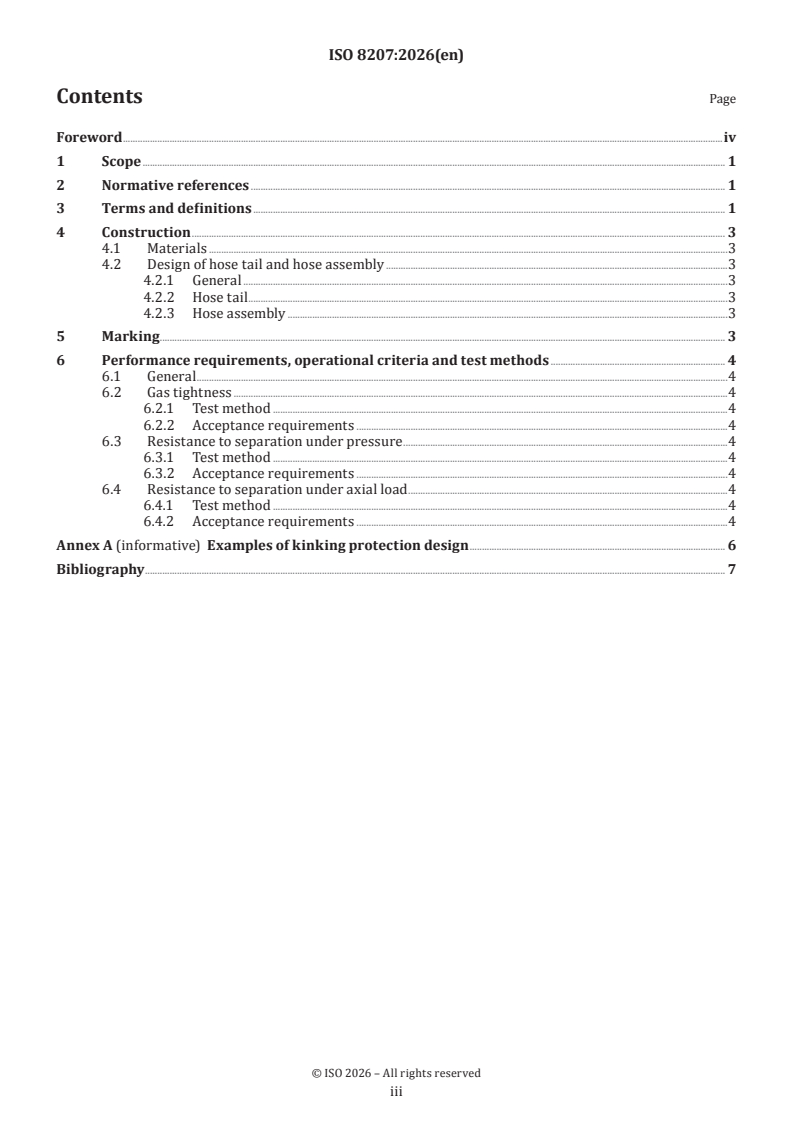
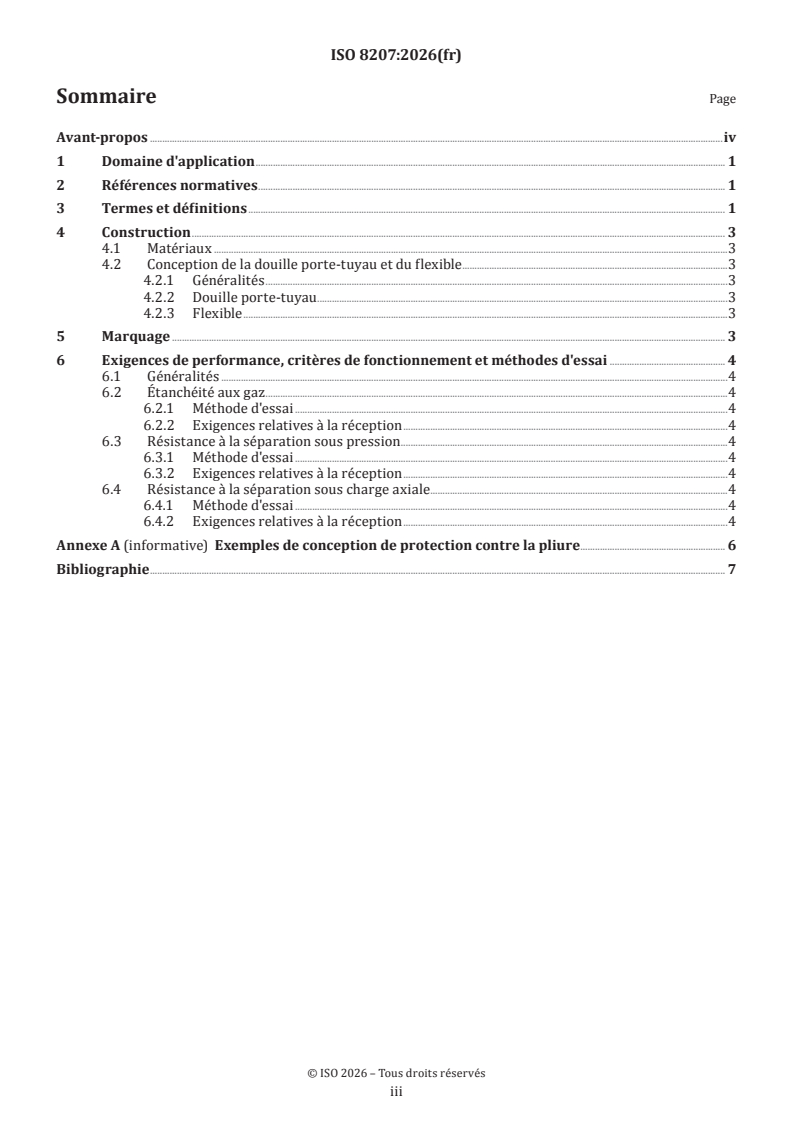
Contents Page
Foreword .iv
1 Scope . 1
2 Normative references . 1
3 Terms and definitions . 1
4 Construction . 3
4.1 Materials .3
4.2 Design of hose tail and hose assembly .3
4.2.1 General .3
4.2.2 Hose tail .3
4.2.3 Hose assembly .3
5 Marking . . 3
6 Performance requirements, operational criteria and test methods . 4
6.1 General .4
6.2 Gas tightness .4
6.2.1 Test method .4
6.2.2 Acceptance requirements .4
6.3 Resistance to separation under pressure .4
6.3.1 Test method .4
6.3.2 Acceptance requirements .4
6.4 Resistance to separation under axial load .4
6.4.1 Test method .4
6.4.2 Acceptance requirements .4
Annex A (informative) Examples of kinking protection design . 6
Bibliography . 7
iii
Foreword
ISO (the International Organization for Standardization) is a worldwide federation of national standards
bodies (ISO member bodies). The work of preparing International Standards is normally carried out through
ISO technical committees. Each member body interested in a subject for which a technical committee
has been established has the right to be represented on that committee. International organizations,
governmental and non-governmental, in liaison with ISO, also take part in the work. ISO collaborates closely
with the International Electrotechnical Commission (IEC) on all matters of electrotechnical standardization.
The procedures used to develop this document and those intended for its further maintenance are described
in the ISO/IEC Directives, Part 1. In particular, the different approval criteria needed for the different types
of ISO document should be noted. This document was drafted in accordance with the editorial rules of the
ISO/IEC Directives, Part 2 (see www.iso.org/directives).
ISO draws attention to the possibility that the implementation of this document may involve the use of (a)
patent(s). ISO takes no position concerning the evidence, validity or applicability of any claimed patent
rights in respect thereof. As of the date of publication of this document, ISO had not received notice of (a)
patent(s) which may be required to implement this document. However, implementers are cautioned that
this may not represent the latest information, which may be obtained from the patent database available at
www.iso.org/patents. ISO shall not be held responsible for identifying any or all such patent rights.
Any trade name used in this document is information given for the convenience of users and does not
constitute an endorsement.
For an explanation of the voluntary nature of standards, the meaning of ISO specific terms and expressions
related to conformity assessment, as well as information about ISO's adherence to the World Trade
Organization (WTO) principles in the Technical Barriers to Trade (TBT), see www.iso.org/iso/foreword.html.
This document was prepared by Technical Committee ISO/TC 44, Welding and allied processes, Subcommittee
SC 8, Equipment for gas welding, cutting and allied processes, in collaboration with the European Committee
for Standardization (CEN
...
Norme
internationale
ISO 8207
Deuxième édition
Matériel de soudage au gaz —
2026-09
Spécifications relatives aux flexibles
pour matériel de soudage, coupage
et techniques connexes
Gas welding equipment — Specification for hose assemblies for
equipment for welding, cutting and allied processes
Numéro de référence
DOCUMENT PROTÉGÉ PAR COPYRIGHT
© ISO 2026
Tous droits réservés.
La présente publication de l’ISO est protégée par le droit d’auteur et demeure la propriété de l’ISO et/ou de ses concédants de
licence.
Le contenu de la présente publication de l’ISO est fourni sous licence, et n’est pas vendu. Son utilisation est soumise aux conditions
de licence applicables définies par l’ISO, un organisme membre de l’ISO, ou un distributeur tiers agréé.
Sous réserve des besoins liés à sa mise en œuvre ou d’une autorisation expresse prévue aux termes d’une licence distincte, aucune
partie de la présente publication de l’ISO ne peut être reproduite, distribuée, modifiée, utilisée ou mise à disposition sous quelque
forme ou par quelque moyen que ce soit – électronique ou mécanique, y compris la photocopie, la numérisation, l’enregistrement
ou la publication sur des plateformes numériques internes ou externes.
Toute utilisation hors du champ d’application des droits accordés est interdite et peut donner lieu à des poursuites judiciaires.
ISO copyright office
Case postale 401 • CH-1214 Vernier, Genève
Tél.: +41 22 749 01 11
E-mail: copyright@iso.org
Web: www.iso.org
Publié en Suisse
ii
Sommaire Page
Avant-propos .iv
1 Domaine d'application . 1
2 Références normatives . 1
3 Termes et définitions . 1
4 Construction . 3
4.1 Matériaux .3
4.2 Conception de la douille porte-tuyau et du flexible .3
4.2.1 Généralités .3
4.2.2 Douille porte-tuyau .3
4.2.3 Flexible .3
5 Marquage . 3
6 Exigences de performance, critères de fonctionnement et méthodes d'essai . 4
6.1 Généralités .4
6.2 Étanchéité aux gaz .4
6.2.1 Méthode d'essai .4
6.2.2 Exigences relatives à la réception .4
6.3 Résistance à la séparation sous pression .4
6.3.1 Méthode d'essai .4
6.3.2 Exigences relatives à la réception .4
6.4 Résistance à la séparation sous charge axiale .4
6.4.1 Méthode d'essai .4
6.4.2 Exigences relatives à la réception .4
Annexe A (informative) Exemples de conception de protection contre la pliure . 6
Bibliographie . 7
iii
Avant-propos
L'ISO (Organisation internationale de normalisation) est une fédération mondiale d'organismes nationaux
de normalisation (comités membres de l'ISO). L'élaboration des Normes internationales est en général
confiée aux comités techniques de l'ISO. Chaque comité membre intéressé par une étude a le droit de faire
partie du comité technique créé à cet effet. Les organisations internationales, gouvernementales et non
gouvernementales, en liaison avec l'ISO participent également aux travaux. L'ISO collabore étroitement avec
la Commission électrotechnique internationale (IEC) en ce qui concerne la normalisation électrotechnique.
Les procédures utilisées pour élaborer le présent document et celles destinées à sa mise à jour sont
décrites dans les Directives ISO/IEC, Partie 1. Il convient, en particulier, de prendre note des différents
critères d'approbation requis pour les différents types de documents ISO. Le présent document a
été rédigé conformément aux règles de rédaction données dans les Directives ISO/IEC, Partie 2 (voir
www.iso.org/directives).
L’ISO attire l’attention sur le fait que la mise en application du présent document peut entraîner l’utilisation
d’un ou de plusieurs brevets. L’ISO ne prend pas position quant à la preuve, à la validité et à l’applicabilité de
tout droit de propriété revendiqué à cet égard. À la date de publication du présent document, l’ISO n'avait pas
reçu notification qu’un ou plusieurs brevets pouvaient être nécessaires à sa mise en application. Toutefois,
il y a lieu d’avertir les responsables de la mise en application du présent document que des informations
plus récentes sont susceptibles de figurer dans la base de données de brevets, disponible à l'adresse
www.iso.org/brevets. L’ISO ne saurait être tenue pour responsable de ne pas avoir identifié tout ou partie de
tels droits de propriété.
Les appellations commerciales éventuellement mentionnées dans le présent document sont données pour
information, par souci de commodité, à l’intention des utilisateurs et ne sauraient constituer un engagement.
Pour une explication de la nature volontaire des normes, la signification des termes et expressions
spécifiques de l'ISO liés à l'évaluation de la conformité, ou pour toute information au sujet de l'adhésion de
l'ISO aux principes de l’Organisation mondiale du commerce (OMC) concernant les obstacles techniques au
commerce (OTC), voir www.iso.org/avant-propos.
Le présent document a été élaboré par le comité technique ISO TC 44 Soudage et techniques connexes, sous-
comité SC 8, Matériel pour le soudage au gaz, le coupage et les techniques connexes.
Cette deuxième édition annule et remplace la première édition (ISO 8207:1996), qui a fait l’objet d’une
révision technique.
Les principales modifications sont les suivantes:
— clarification du domaine d'application selon lequel les tuyaux en caoutchouc sont conformes à l’ISO 3821
jusqu'à la dimension nominale 20,0 incluse;
— ajout de la définition d’un «flexible» dans l'Article 3;
— ajout de la définition des «dispositifs de serrage de tuyaux» dans l’Article 3;
— les définitions ont été alignées avec l’ISO 8330;
— modification de l'Artic
...