

ISO 2918:1975
(Main)Meat and meat products — Determination of nitrite content (Reference method)
General Information
- Abstract
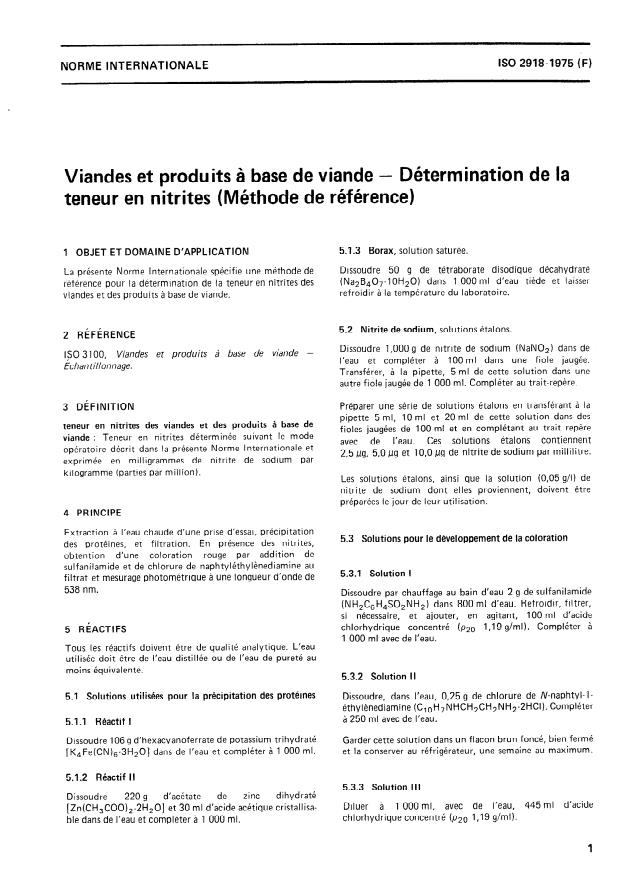
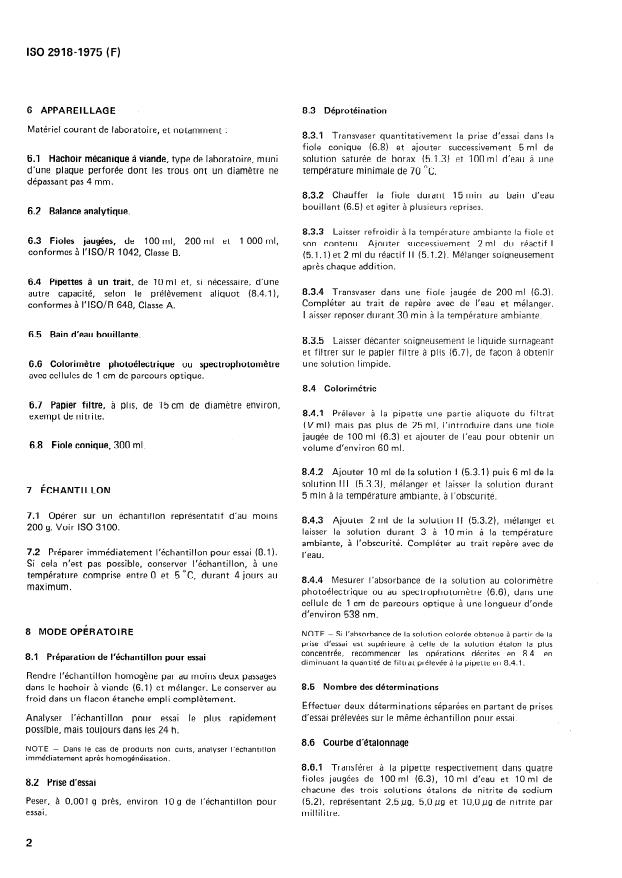
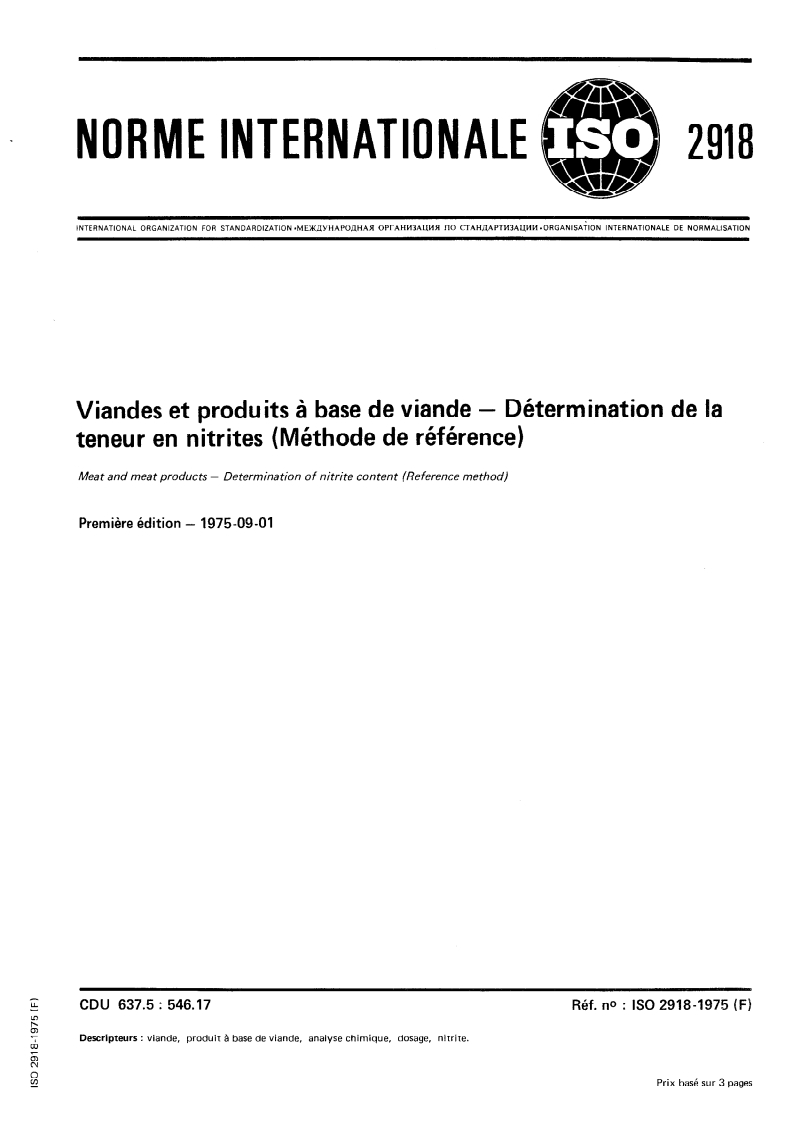
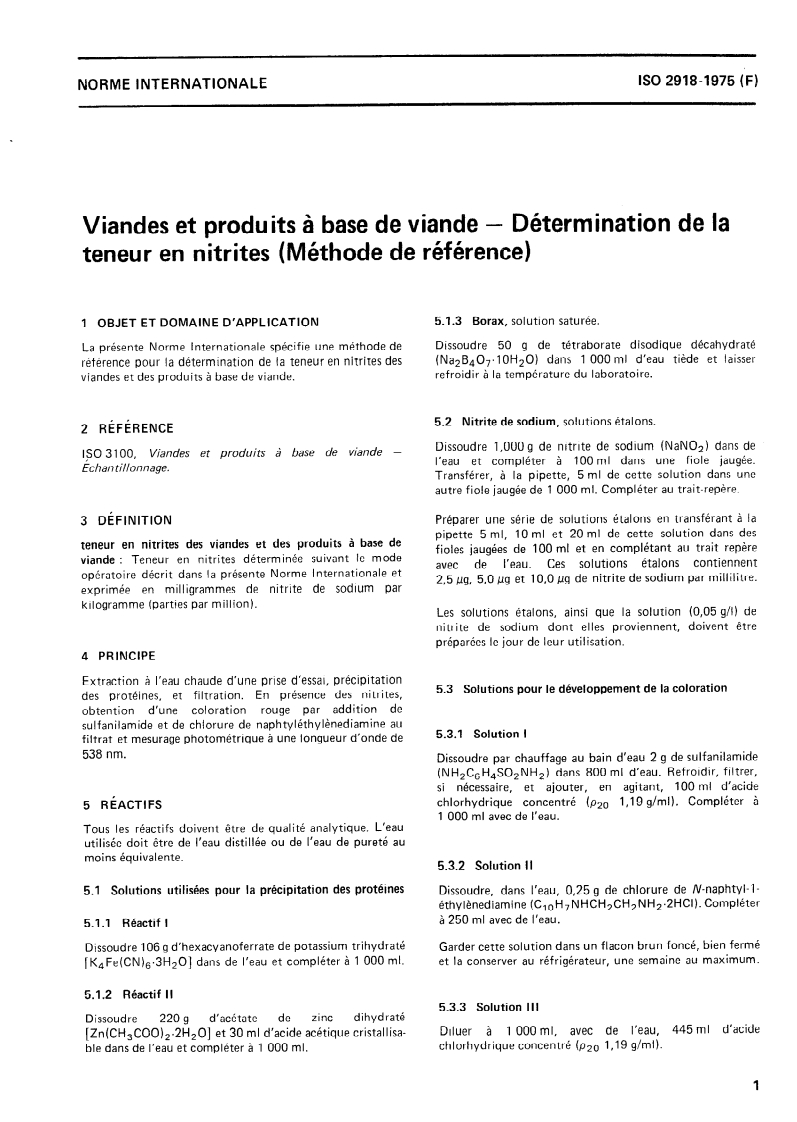
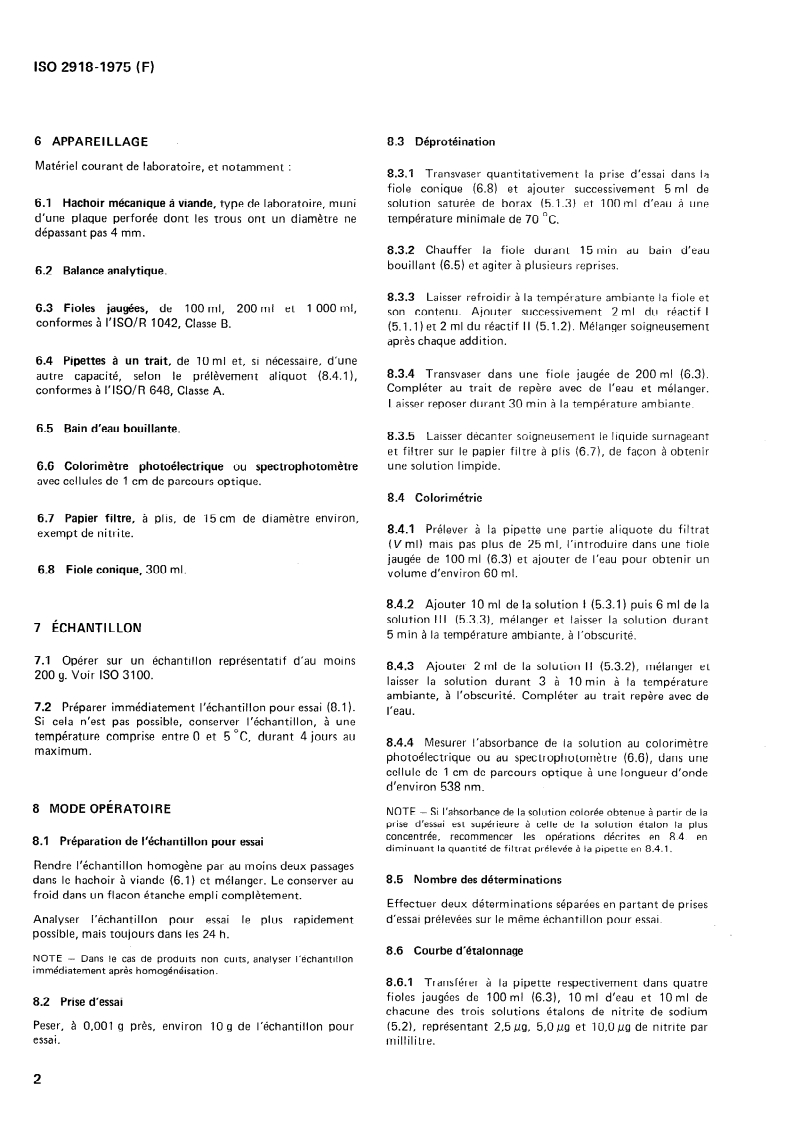
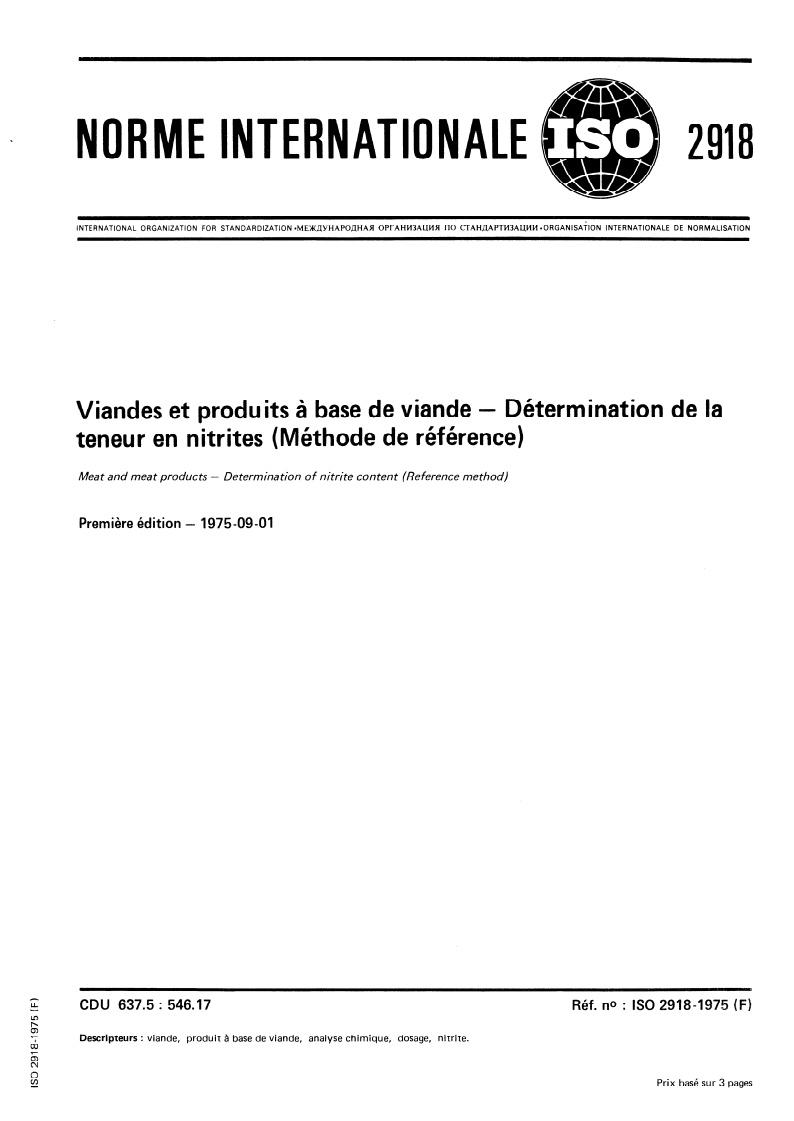
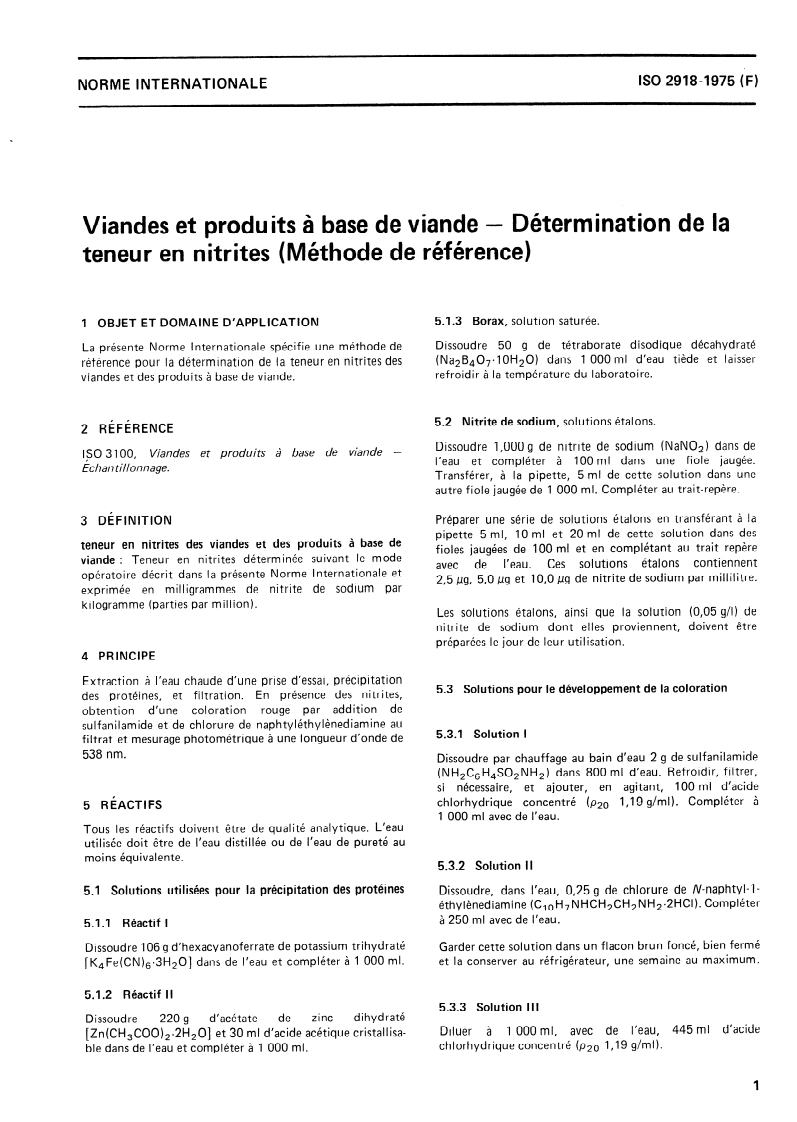
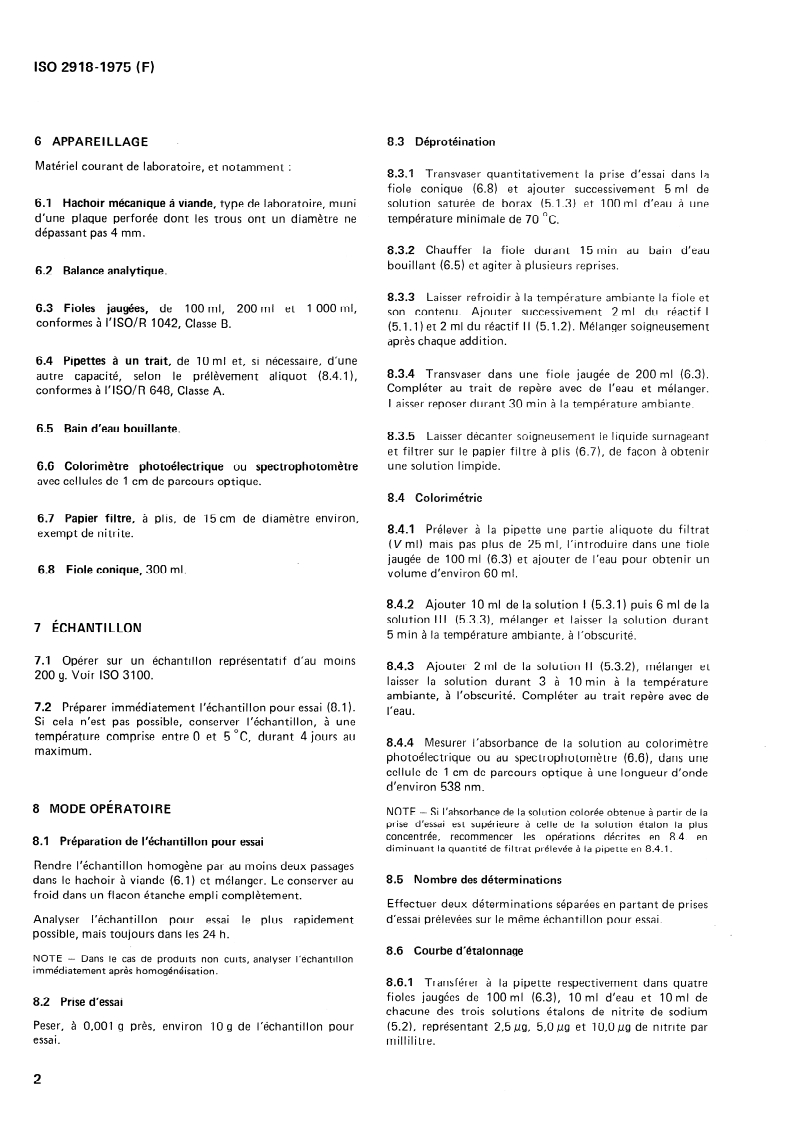
The method consists in extracting of a test portion with hot water, precipitating of proteine and filtrating. In presence of nitrits formation of a red cloured complex by adding sulfanilamide and naphthylethylenediamine hydrochloride, and photometric measurement at a wavelength of 538 nm.
- Status
- Published
- Publication Date
- 31-Aug-1975
- Technical Committee
- ISO/TC 34/SC 6 - Meat, poultry, fish, eggs and their products
- Drafting Committee
- ISO/TC 34/SC 6 - Meat, poultry, fish, eggs and their products
- Current Stage
- 9093 - International Standard confirmed
- Start Date
- 20-Feb-2024
- Completion Date
- 29-Aug-2026
Buy Documents
ISO 2918:1975 - Meat and meat products -- Determination of nitrite content (Reference method)
ISO 2918:1975 - Meat and meat products — Determination of nitrite content (Reference method)/1/1975
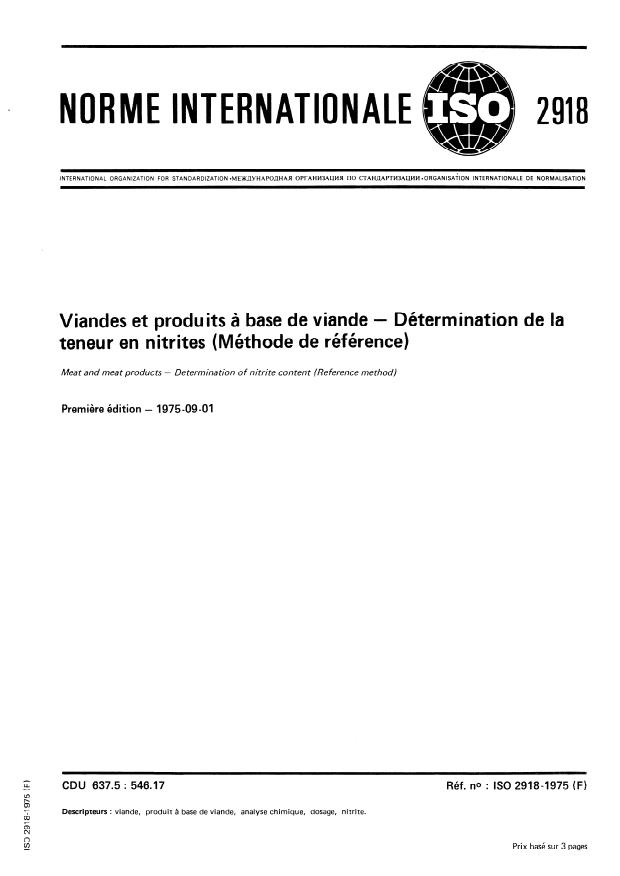
ISO 2918:1975 - Viandes et produits a base de viande -- Détermination de la teneur en nitrites (Méthode de référence)
ISO 2918:1975 - Viandes et produits a base de viande -- Détermination de la teneur en nitrites (Méthode de référence)
ISO 2918:1975 - Viandes et produits à base de viande — Détermination de la teneur en nitrites (Méthode de référence)/1/1975
ISO 2918:1975 - Viandes et produits à base de viande — Détermination de la teneur en nitrites (Méthode de référence)/1/1975
Overview
ISO 2918:1975 - "Meat and meat products - Determination of nitrite content (Reference method)" is a reference analytical procedure published by ISO for quantifying nitrite levels in meat and processed meat. The method is a colorimetric/photometric reference technique based on hot‑water extraction, protein precipitation, diazotization with sulfanilamide and coupling with N‑naphthyl‑ethylenediamine to form a red azo‑complex, and photometric measurement at 538 nm.
Key topics and technical requirements
- Sample preparation: Homogenize a representative test portion (sample handling and minimum representative mass described). Typical test portion described in the standard is about 10 g, with specific instructions for homogenization and storage.
- Extraction and deproteinization: Hot‑water extraction of the test portion, addition of saturated borax, heating (bath), then precipitation of proteins using hexacyanoferrate (Reagent I) and zinc acetate/acetic acid (Reagent II), with subsequent decantation and filtration.
- Color development reagents:
- Sulfanilamide solution (acidified) and
- N‑naphthyl‑1‑ethylenediamine hydrochloride (coupling agent, often abbreviated NED).
These produce a red colored complex in presence of nitrite.
- Measurement: Photometric/colorimetric determination at approximately 538 nm using a spectrophotometer or photoelectric colorimeter in 1 cm cells.
- Calibration and quantification: Prepare fresh sodium nitrite standard solutions the day of use; construct a calibration curve (µg/mL) and derive sample concentration. The standard defines the symbols used in the calculation (c = concentration from calibration curve in µg/mL; m = sample mass in g; V = aliquot volume in mL) and specifies how to express results as mg sodium nitrite/kg.
- Quality criteria: The method requires duplicate determinations and specifies repeatability limits (difference between two determinations by same analyst should not exceed 10% of the mean). Reagents must be analytical grade; some prepared solutions have short shelf lives and cold storage requirements.
Practical applications and users
- Food testing laboratories performing routine or regulatory nitrite monitoring in raw and processed meat.
- Meat processors and QA/QC teams for specification control and product safety verification (curing salts and residual nitrite).
- Regulatory authorities and inspection bodies verifying compliance with permissible nitrite limits.
- Research and development groups studying nitrite behavior in meat processing or developing alternative curing methods.
Related standards
- ISO 3100 - Sampling of meat and meat products (referenced for representative sampling)
- ISO/R 1042, ISO/R 648 - Specifications for volumetric glassware and pipettes used in the method
Keywords: ISO 2918:1975, nitrite determination, meat and meat products, photometric method, sulfanilamide, N‑naphthyl‑ethylenediamine, colorimetric assay, food safety, analytical method, calibration curve.
Buy Documents
ISO 2918:1975 - Meat and meat products -- Determination of nitrite content (Reference method)
ISO 2918:1975 - Meat and meat products — Determination of nitrite content (Reference method)/1/1975
ISO 2918:1975 - Viandes et produits a base de viande -- Détermination de la teneur en nitrites (Méthode de référence)
ISO 2918:1975 - Viandes et produits a base de viande -- Détermination de la teneur en nitrites (Méthode de référence)
ISO 2918:1975 - Viandes et produits à base de viande — Détermination de la teneur en nitrites (Méthode de référence)/1/1975
ISO 2918:1975 - Viandes et produits à base de viande — Détermination de la teneur en nitrites (Méthode de référence)/1/1975
Get Certified
Connect with accredited certification bodies for this standard

BSI Group
BSI (British Standards Institution) is the business standards company that helps organizations make excellence a habit.

Bureau Veritas
Bureau Veritas is a world leader in laboratory testing, inspection and certification services.

DNV
DNV is an independent assurance and risk management provider.
Sponsored listings
Frequently Asked Questions
ISO 2918:1975 is a standard published by the International Organization for Standardization (ISO). Its full title is "Meat and meat products — Determination of nitrite content (Reference method)". This standard covers: The method consists in extracting of a test portion with hot water, precipitating of proteine and filtrating. In presence of nitrits formation of a red cloured complex by adding sulfanilamide and naphthylethylenediamine hydrochloride, and photometric measurement at a wavelength of 538 nm.
The method consists in extracting of a test portion with hot water, precipitating of proteine and filtrating. In presence of nitrits formation of a red cloured complex by adding sulfanilamide and naphthylethylenediamine hydrochloride, and photometric measurement at a wavelength of 538 nm.
ISO 2918:1975 is classified under the following ICS (International Classification for Standards) categories: 67.120.10 - Meat and meat products. The ICS classification helps identify the subject area and facilitates finding related standards.
ISO 2918:1975 is available in PDF format for immediate download after purchase. The document can be added to your cart and obtained through the secure checkout process. Digital delivery ensures instant access to the complete standard document.
Standards Content (Sample)
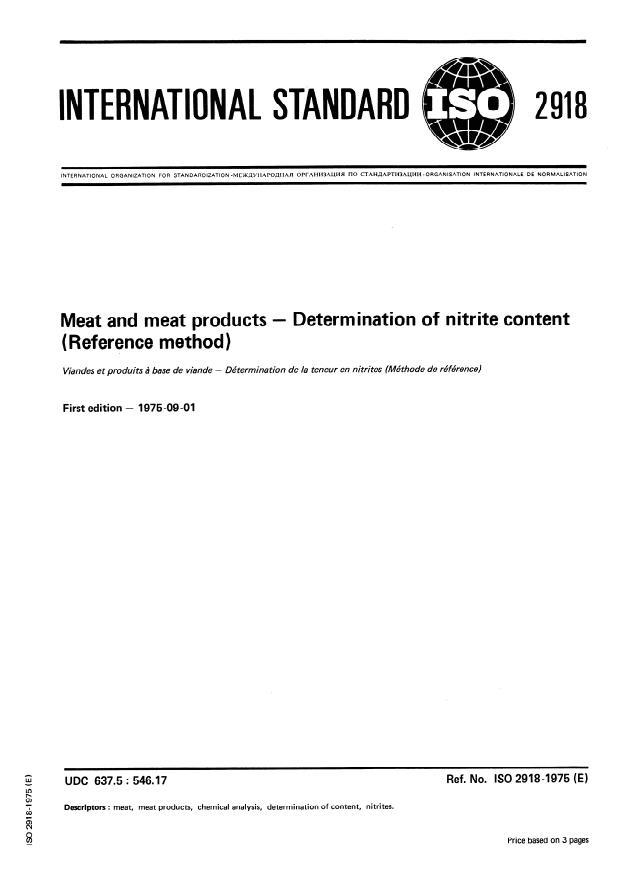
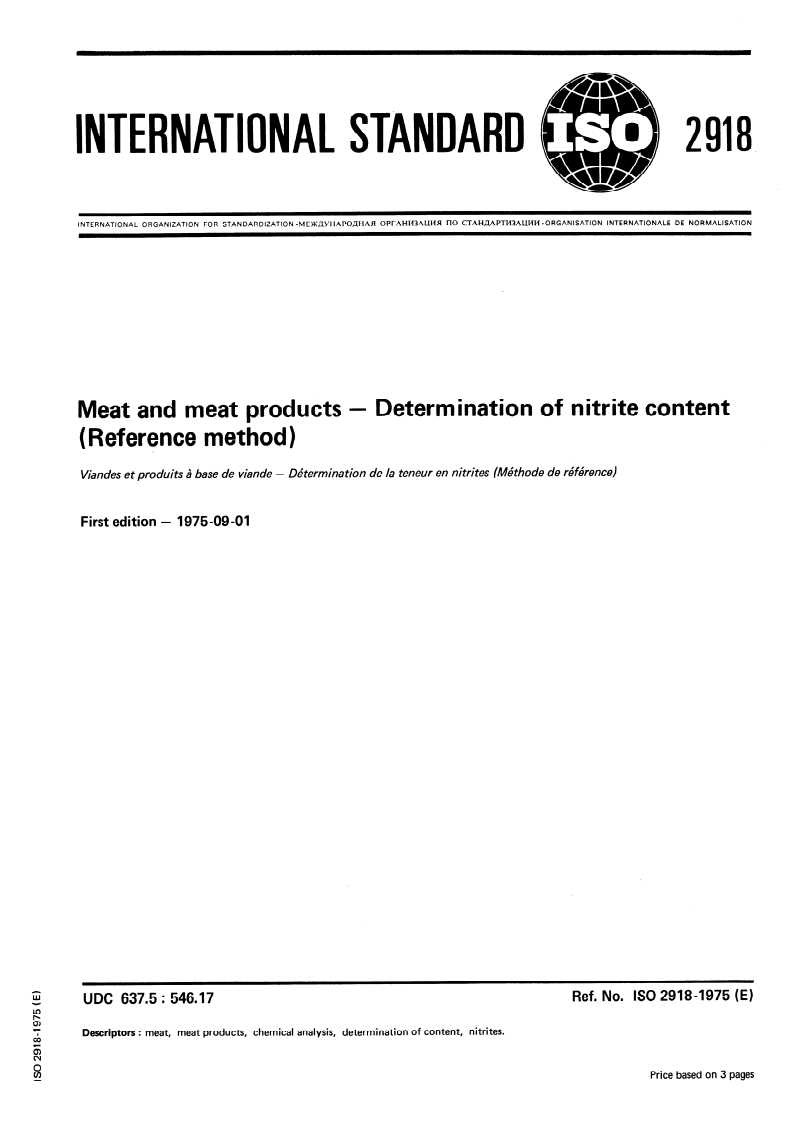
2918.
INTERNATIONSTANDARD AL
INTERNATIONAL ORGANIZATION FOR STANDARDIZATION #MEXfiYHAPOAHAII OPTAHM3AUMR I-IO CTAHAAPTM3ALWi~ORGANISATION INTERNATIONALE DE NORMALISATION
Determination of nitrite content
Meat and meat products -
(Reference method)
Viandes et produits ;i base de viande - De ’termination de la teneur en nitrites (M&ode de re ’fkrence)
F irst edition - 1975-09-01
iii
Ref. No. IS0 2918-1975 (E)
Y UDC 637.5 : 546.17
Descriptors : meat, meat products, chemical analysis, determination of content, nitrites.
Price based on 3 pages
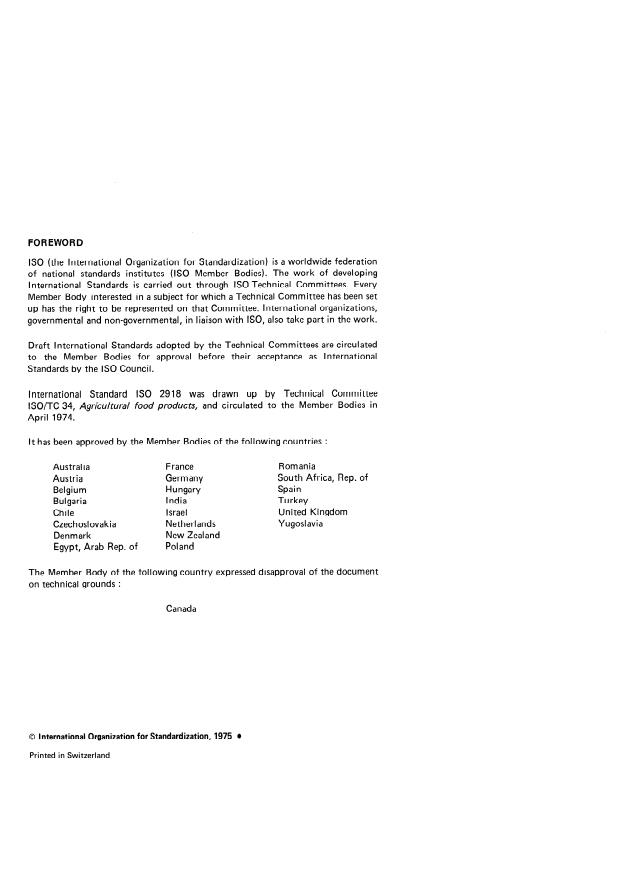
FOREWORD
IS0 (the International Organization for Standardization) is a worldwide federation
of national standards institutes (IS0 Member Bodies). The work of developing
International Standards is carried out through IS0 Technical Committees. Every
Member Body interested in a subject for which a Technical Committee has been set
up has the right to be represented on that Committee. International organizations,
governmental and non-governmental, in liaison with ISO, also take part in the work.
Draft International Standards adopted by the Technical Committees are circulated
to the Member Bodies for approval before their acceptance as International
Standards by the IS0 Council.
International Standard IS0 2918 was drawn up by Technical Committee
ISO/TC 34, Agricultural food products, and circulated to the Member Bodies in
April 1974.
It has been approved by the Member Bodies of the following countries :
Australia France Romania
Austria Germany South Africa, Rep. of
Belgium Hungary Spain
Turkey
Bulgaria India
Israel United Kingdom
Chile
Netherlands Yugoslavia
Czechoslovakia
Denmark New Zealand
Poland
Egypt, Arab Rep. of
of the document
The Member Body of the following country expressed disapproval
on technical grounds :
Canada
@ International Organization for Standardization, 1975 l
Printed in Switzerland
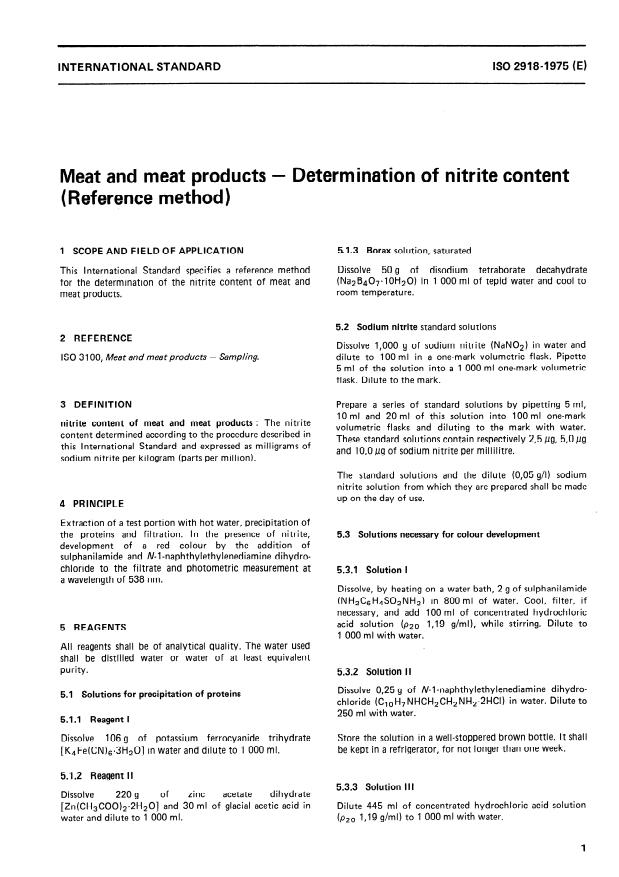
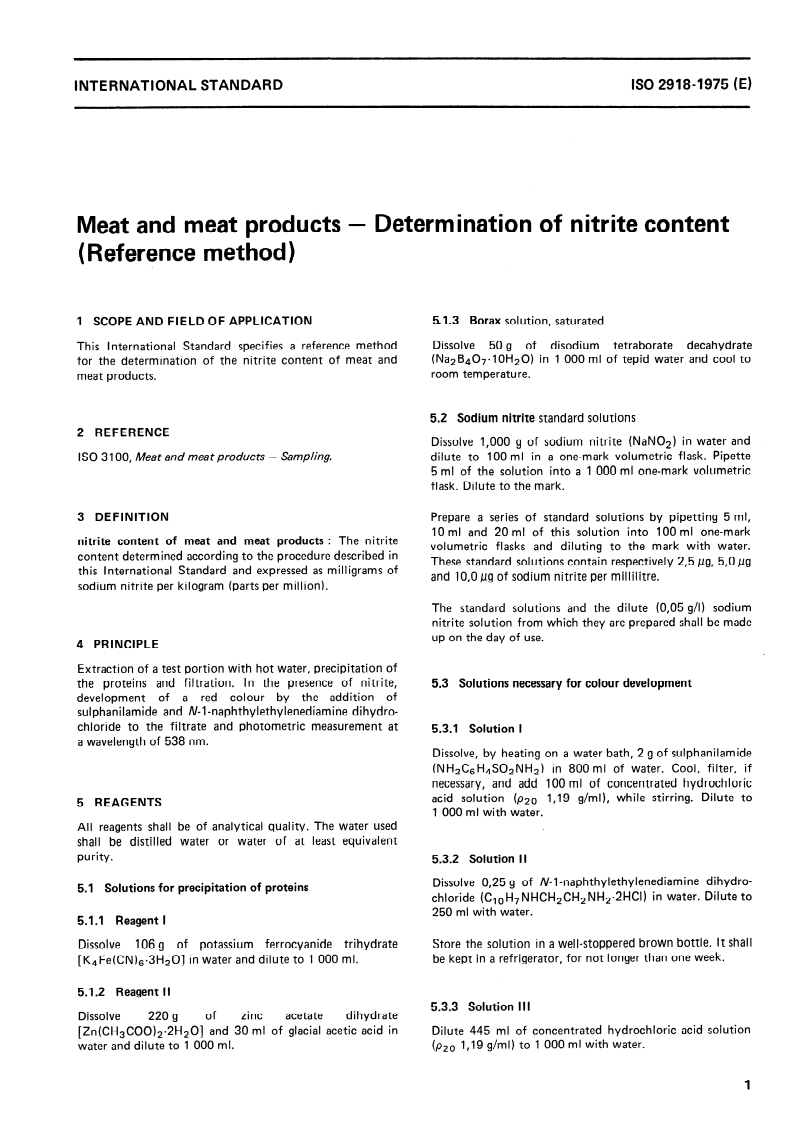
INTERNATIONAL STANDARD IS0 29184975 (E)
Determination of nitrite content
Meat and meat products -
(Reference method)
5 1.3 Borax solution, saturated
1 SCOPE AND FIELD OF APPLICATION
This International Standard specifies a reference method Dissolve 50 g of disodium tetraborate decahydrate
(Na2B~07~10H20) in 1 000 ml of tepid water and cool to
for the determination of the nitrite content of meat and
room temperature.
meat products.
5.2 Sodium nitrite standard solutions
2 REFERENCE
Dissolve 1,000 g of sodium nitrite (NaN02) in water and
dilute to 100 ml in a one-mark volumetric flask. Pipette
IS0 3100, Meat and meat products - Sampling.
5 ml of the solution into a 1 000 ml one-mark volumetric
flask. Dilute to the mark.
3 DEFINITION Prepare a series of standard solutions by pipetting 5 ml,
10 ml and 20 ml of this solution into 100 ml one-mark
nitrite content of meat and meat products : The nitrite
volumetric flasks and diluting to the mark with water.
content determined according to the procedure described in
These standard solutions contain respectively 2,5 rug, 5,0 ,ug
this International Standard and expressed as milligrams of
and 10,Opg of sodium nitrite per millilitre.
sodium nitrite per kilogram (parts per million).
The standard solutions and the dilute (0,05 g/l) sodium
nitrite solution from which they are prepared shall be made
up on the day of use.
4 PRINCIPLE
Extraction of a test portion with hot water, precipitation of
the proteins and filtration. In the presence of nitrite,
5.3 Solutions necessary for colour development
development of a red colour by the addition of
sulphanilamide and N-I-naphthylethylenediamine dihydro-
chloride to the filtrate and photometric measurement at
5.3.1 Solution I
a wavelength of 538 nm.
Dissolve, by heating on a water bath, 2 g of sulphanilamide
(NH2CeH4S02NH2) in 800 ml of water. Cool, filter, if
necessary, and add 100 ml of concentrated hydrochloric
acid solution (p2c I,19 g/ml), while stirring. Dilute to
5 REAGENTS
1 000 ml with water.
All reagents shall be of analytical quality. The water used
shall be distilled water or water of at least equivalent
purity.
5.3.2 Solution II
Dissolve 0,25 g of N-I-naphthylethylenediamine dihydro-
5.1 Solutions for precipitation of proteins
chloride (C,oH7 NHCH2CH2NH2m2HCI) in water. Dilute to
250 ml with water.
5.1.1 Reagent I
Store the solution in a well-stoppered brown bottle. It shall
Dissolve 106 g of potassium ferrocyanide trihydrate
in water and dilute to 1 000 ml. be kept in a refrigerator, for not longer than one week.
[ K~Fe(CN)e~3H201
5.1.2 Reagent II
5.3.3 Solution Ill
dihydrate
Dissolve 220 g of zinc acetate
2 _ and 30 ml of glacial acetic acid in Dilute 445 ml of concentrated hydrochloric acid solution
[Zn(CH3C00)2m2H 01
(p2c I,19 g/ml) to 1 000 ml with water.
water and dilute to 1 000 ml.
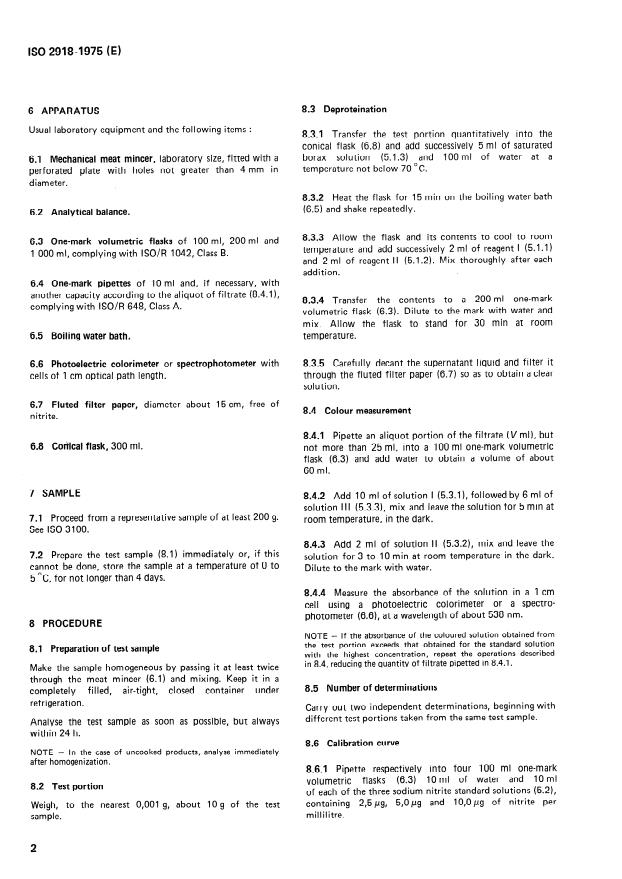
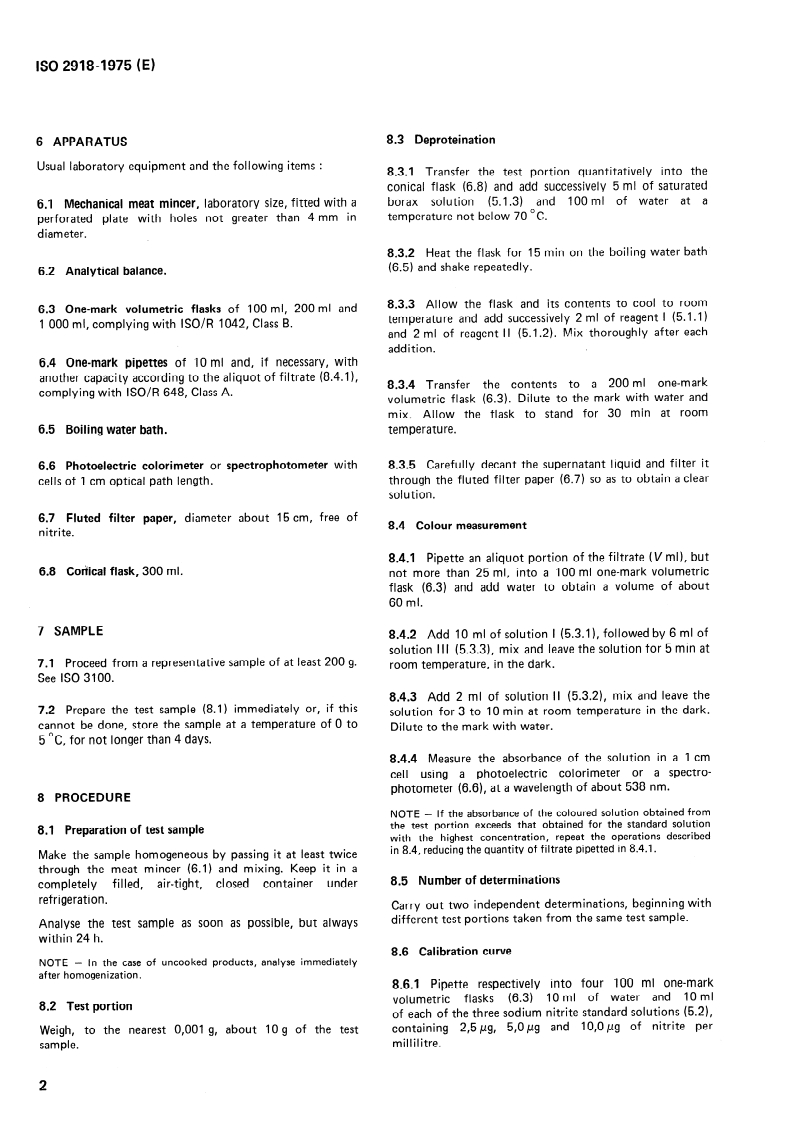
lSO2918-1975(E)
6 APPARATUS 8.3 Deproteination
Usual laboratory equipment and the following items :
8.3.1 Transfer the test portion quantitatively into the
conical flask (6.8) and add successively 5 ml of saturated
borax solution (5.1.3) and 100 ml of water at a
6.1 Mechanical meat mincer, laboratory size, fit
...
2918.
INTERNATIONSTANDARD AL
INTERNATIONAL ORGANIZATION FOR STANDARDIZATION #MEXfiYHAPOAHAII OPTAHM3AUMR I-IO CTAHAAPTM3ALWi~ORGANISATION INTERNATIONALE DE NORMALISATION
Determination of nitrite content
Meat and meat products -
(Reference method)
Viandes et produits ;i base de viande - De ’termination de la teneur en nitrites (M&ode de re ’fkrence)
F irst edition - 1975-09-01
iii
Ref. No. IS0 2918-1975 (E)
Y UDC 637.5 : 546.17
Descriptors : meat, meat products, chemical analysis, determination of content, nitrites.
Price based on 3 pages
FOREWORD
IS0 (the International Organization for Standardization) is a worldwide federation
of national standards institutes (IS0 Member Bodies). The work of developing
International Standards is carried out through IS0 Technical Committees. Every
Member Body interested in a subject for which a Technical Committee has been set
up has the right to be represented on that Committee. International organizations,
governmental and non-governmental, in liaison with ISO, also take part in the work.
Draft International Standards adopted by the Technical Committees are circulated
to the Member Bodies for approval before their acceptance as International
Standards by the IS0 Council.
International Standard IS0 2918 was drawn up by Technical Committee
ISO/TC 34, Agricultural food products, and circulated to the Member Bodies in
April 1974.
It has been approved by the Member Bodies of the following countries :
Australia France Romania
Austria Germany South Africa, Rep. of
Belgium Hungary Spain
Turkey
Bulgaria India
Israel United Kingdom
Chile
Netherlands Yugoslavia
Czechoslovakia
Denmark New Zealand
Poland
Egypt, Arab Rep. of
of the document
The Member Body of the following country expressed disapproval
on technical grounds :
Canada
@ International Organization for Standardization, 1975 l
Printed in Switzerland
INTERNATIONAL STANDARD IS0 29184975 (E)
Determination of nitrite content
Meat and meat products -
(Reference method)
5 1.3 Borax solution, saturated
1 SCOPE AND FIELD OF APPLICATION
This International Standard specifies a reference method Dissolve 50 g of disodium tetraborate decahydrate
(Na2B~07~10H20) in 1 000 ml of tepid water and cool to
for the determination of the nitrite content of meat and
room temperature.
meat products.
5.2 Sodium nitrite standard solutions
2 REFERENCE
Dissolve 1,000 g of sodium nitrite (NaN02) in water and
dilute to 100 ml in a one-mark volumetric flask. Pipette
IS0 3100, Meat and meat products - Sampling.
5 ml of the solution into a 1 000 ml one-mark volumetric
flask. Dilute to the mark.
3 DEFINITION Prepare a series of standard solutions by pipetting 5 ml,
10 ml and 20 ml of this solution into 100 ml one-mark
nitrite content of meat and meat products : The nitrite
volumetric flasks and diluting to the mark with water.
content determined according to the procedure described in
These standard solutions contain respectively 2,5 rug, 5,0 ,ug
this International Standard and expressed as milligrams of
and 10,Opg of sodium nitrite per millilitre.
sodium nitrite per kilogram (parts per million).
The standard solutions and the dilute (0,05 g/l) sodium
nitrite solution from which they are prepared shall be made
up on the day of use.
4 PRINCIPLE
Extraction of a test portion with hot water, precipitation of
the proteins and filtration. In the presence of nitrite,
5.3 Solutions necessary for colour development
development of a red colour by the addition of
sulphanilamide and N-I-naphthylethylenediamine dihydro-
chloride to the filtrate and photometric measurement at
5.3.1 Solution I
a wavelength of 538 nm.
Dissolve, by heating on a water bath, 2 g of sulphanilamide
(NH2CeH4S02NH2) in 800 ml of water. Cool, filter, if
necessary, and add 100 ml of concentrated hydrochloric
acid solution (p2c I,19 g/ml), while stirring. Dilute to
5 REAGENTS
1 000 ml with water.
All reagents shall be of analytical quality. The water used
shall be distilled water or water of at least equivalent
purity.
5.3.2 Solution II
Dissolve 0,25 g of N-I-naphthylethylenediamine dihydro-
5.1 Solutions for precipitation of proteins
chloride (C,oH7 NHCH2CH2NH2m2HCI) in water. Dilute to
250 ml with water.
5.1.1 Reagent I
Store the solution in a well-stoppered brown bottle. It shall
Dissolve 106 g of potassium ferrocyanide trihydrate
in water and dilute to 1 000 ml. be kept in a refrigerator, for not longer than one week.
[ K~Fe(CN)e~3H201
5.1.2 Reagent II
5.3.3 Solution Ill
dihydrate
Dissolve 220 g of zinc acetate
2 _ and 30 ml of glacial acetic acid in Dilute 445 ml of concentrated hydrochloric acid solution
[Zn(CH3C00)2m2H 01
(p2c I,19 g/ml) to 1 000 ml with water.
water and dilute to 1 000 ml.
lSO2918-1975(E)
6 APPARATUS 8.3 Deproteination
Usual laboratory equipment and the following items :
8.3.1 Transfer the test portion quantitatively into the
conical flask (6.8) and add successively 5 ml of saturated
borax solution (5.1.3) and 100 ml of water at a
6.1 Mechanical meat mincer, laboratory size, fit
...
NORME INTERNATIONALE
INTERNATIONAL ORGANIZATION FOR STANDARDIZATION l MEXfiYHAPOAHAII OP~AHM3AUWi l-l0 CTAHAAPTM3ALW-i *ORGANISAiION INTERNATIONALE DE NORMALISATION
Viandes et produits à base de viande - Détermination de
teneur en nitrites (Méthode de référence)
Meat and meat products - Determination of nitrite content (Reference method)
Première édition - 1975-09-01
CDU 637.5 : 546.17 Réf. no : ISO 29’i8-1975 (IF)
Descripteurs : viande, produit à base de viande, analyse chimique, dosage, nitrite.
Prix basé sur 3 pages
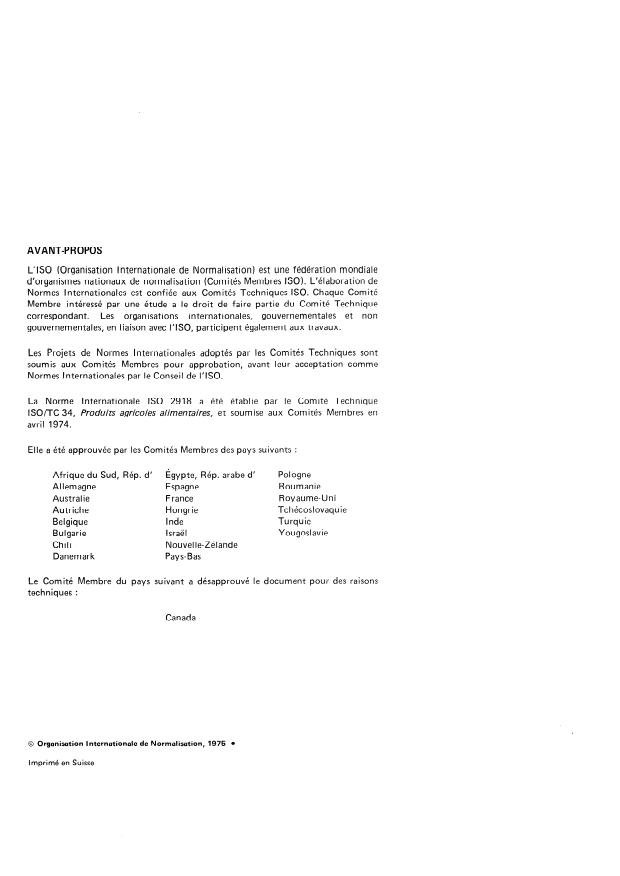
AVANT-PROPOS
L’ISO (Organisation Internationale de Normalisation) est une fédération mondiale
d’organismes nationaux de normalisation (Comités Membres 60). L’élaboration de
Normes Internationales est confiée aux Comités Techniques ISO. Chaque Comité
Membre intéressé par une étude a le droit de faire partie du Comité Technique
correspondant. Les organisations internationales, gouvernementales et non
gouvernementales, en liaison avec I’ISO, participent également aux travaux.
Les Projets de Normes Internationales adoptés par les Comités Techniques sont
soumis aux Comités Membres pour approbation, avant leur acceptation comme
Normes Internationales par le Conseil de I’ISO.
La Norme Internationale ISO 2918 a été établie par le Comité Technique
ISO/TC 34, Produits agricoles alimentaires, et soumise aux Comités Membres en
avril 1974.
Elle a été approuvée par les Comités Membres des pays suivants :
Afrique du Sud, Rép. d’ Égypte, Rép. arabe d’ Pologne
Al lemagne Roumanie
Espagne
Australie Royaume-Uni
France
Tchécoslovaquie
Autriche Hongrie
Turquie
Belgique Inde
Yougoslavie
Bulgarie Israël
Chili Nouvel le-Zélande
Danemark Pays-Bas
Le Comité Membre
du pays suivant a désapprouvé le document pour des raisons
techniques
Canada
0 Organisation Internationale de Normalisation, 1975 l
Imprimé en Suisse
ISO 2918-1975 (F)
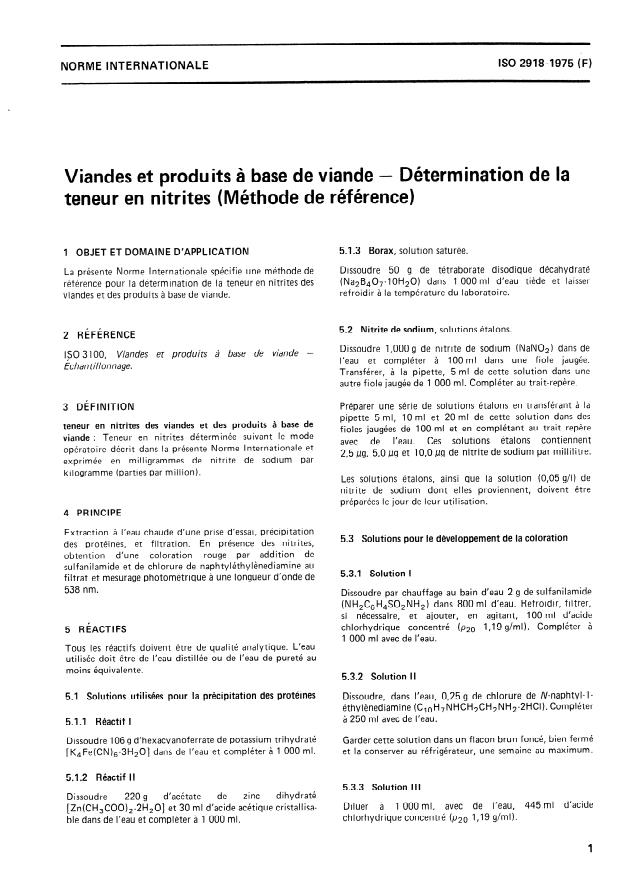
NORME INTERNATIONALE
Viandes et produits à base de viande - Détermination de la
teneur en nitrites (Méthode de référence)
5.1.3 Borax, solution saturée.
1 OBJET ET DOMAINE D’APPLICATION
Dissoudre 50 g de tétraborate disodique décahydraté
La présente Norme Internationale spécifie une méthode de
(Na~Bq07.10H~O) dans 1 000 ml d’eau tiède et laisser
référence pour la détermination de la teneur en nitrites des
refroidir à la température du laboratoire.
viandes et des produits à base de viande.
5.2 Nitrite de sodium, solutions étalons.
2 RÉFÉRENCE
Dissoudre 1,000 g de nitrite de sodium (NaNO*) dans de
ISO 3 100, Viandes et produits à base de viande -
l’eau et compléter à 100 ml dans une fiole jaugée.
khan tillonnage.
Transférer, à la pipette, 5 ml de cette solution dans une
autre fiole jaugée de 1 000 ml. Compléter au trait-repère.
3 DÉFINITION Préparer une série de solutions étalons en transférant à la
pipette 5 ml, 10 ml et 20 ml de cette solution dans des
teneur en nitrites des viandes et des produits à base de
fioles jaugées de 100 ml et en complétant au trait repère
viande : Teneur en nitrites déterminée suivant le mode
avec de l’eau. Ces solutions étalons contiennent
opératoire décrit dans la présente Norme Internationale et
25 pg, 5,O pg et 10,O pg de nitrite de sodium par millilitre.
de nitrite de sodium par
exprimée en milligrammes
kilogramme (parties par million).
Les solutions étalons, ainsi que la solution (0,05 g/l) de
nitrite de sodium dont elles proviennent, doivent être
préparées le jour de leur utilisation.
4 PRINCIPE
Extraction à l’eau chaude d’une prise d’essai, précipitation
5.3 Solutions pour le développement de la coloration
des protéines, et filtration. En présence des nitrites,
obtention d’une coloration rouge par addition de
sulfanilamide et de chlorure de naphtyléthylènediamine au
5.3.1 Solution I
filtrat et mesurage photométrique à une longueur d’onde de
538 nm.
Dissoudre par chauffage au bain d’eau 2 g de sulfanilamide
(NH,C6H4S02NH2) dans 800 ml d’eau. Refroidir, filtrer,
si nécessaire, et ajouter, en agitant, 100 ml d’acide
chlorhydrique concentré (p20 1,19 g/ml). Compléter à
5 RÉACTIFS
1 000 ml avec de l’eau.
Tous les réactifs doivent être de qualité analytique. L’eau
utilisée doit être de l’eau distillée ou de l’eau de pureté au
moins équivalente.
5.3.2 Solution II
5.1 Solutions utilisées pour la précipitation des protéines
Dissoudre, dans l’eau, 0,25 g de chlorure de N-naphtyl-l-
éthylènediamine (C,oH,NHCH&H,NH202HCI). Compléter
à 250 ml avec de l’eau.
5.1.1 Réactif I
Dissoudre 106 g d’hexacyanoferrate de potassium trihydraté Garder cette solution dans un flacon brun foncé, bien fermé
[KqFe(CN)e.3H20] dans de l’eau et compléter à 1 000 ml. et la conserver au réfrigérateur, une semaine au maximum.
5.1.2 Réactif II
5.3.3 Solution Ill
Dissoudre 220 g d’acétate de zinc dihydraté
Diluer à 1 000 ml, avec de l’eau, 445 ml d’acide
[Zn(CH,C00)*.2H20] et 30 ml d’acide acétique cristallisa-
chlorhydrique concentré (p2c 1,19 g/ml).
ble dans de l’eau et compléter à 1 000 ml.
ISO 2918-1975 (F)
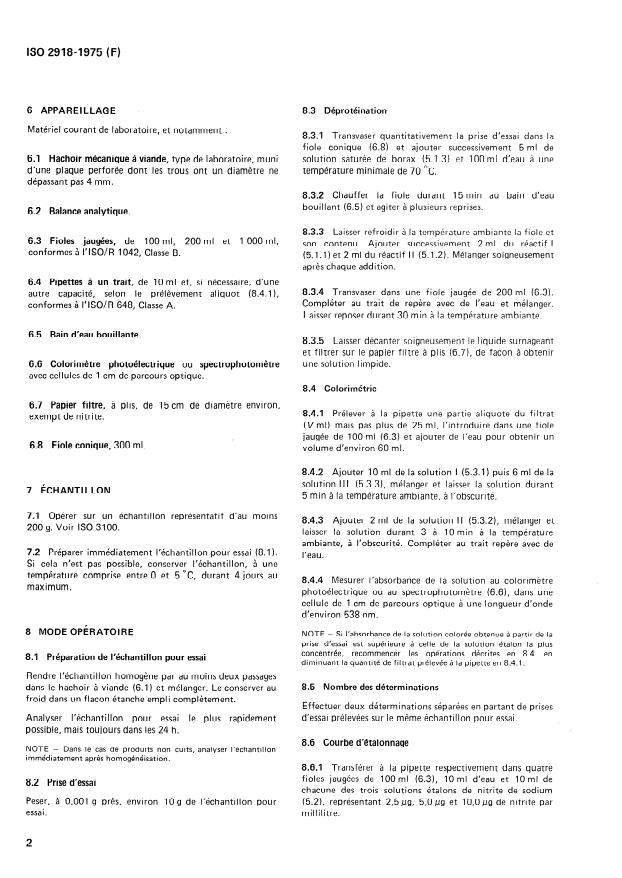
6 APPAREILLAGE -
Matériel courant de laboratoire, et notamment :
8.3.1 Transvaser quantitativement la prise d’essai dans la
fiole conique (6.8) et ajouter successivement 5 ml de
solution saturée de borax (5.1.3) et 100 ml d’eau à une
6.1 Hachoir mécanique à viande, type de laboratoire, muni
température minimale de 70 “C.
d’une plaque perforée dont les trous
...
NORME INTERNATIONALE
INTERNATIONAL ORGANIZATION FOR STANDARDIZATION l MEXfiYHAPOAHAII OP~AHM3AUWi l-l0 CTAHAAPTM3ALW-i *ORGANISAiION INTERNATIONALE DE NORMALISATION
Viandes et produits à base de viande - Détermination de
teneur en nitrites (Méthode de référence)
Meat and meat products - Determination of nitrite content (Reference method)
Première édition - 1975-09-01
CDU 637.5 : 546.17
Réf. no : ISO 29’i8-1975 (IF)
Descripteurs : viande, produit à base de viande, analyse chimique, dosage, nitrite.
Prix basé sur 3 pages
AVANT-PROPOS
L’ISO (Organisation Internationale de Normalisation) est une fédération mondiale
d’organismes nationaux de normalisation (Comités Membres 60). L’élaboration de
Normes Internationales est confiée aux Comités Techniques ISO. Chaque Comité
Membre intéressé par une étude a le droit de faire partie du Comité Technique
correspondant. Les organisations internationales, gouvernementales et non
gouvernementales, en liaison avec I’ISO, participent également aux travaux.
Les Projets de Normes Internationales adoptés par les Comités Techniques sont
soumis aux Comités Membres pour approbation, avant leur acceptation comme
Normes Internationales par le Conseil de I’ISO.
La Norme Internationale ISO 2918 a été établie par le Comité Technique
ISO/TC 34, Produits agricoles alimentaires, et soumise aux Comités Membres en
avril 1974.
Elle a été approuvée par les Comités Membres des pays suivants :
Afrique du Sud, Rép. d’ Égypte, Rép. arabe d’ Pologne
Al lemagne Roumanie
Espagne
Australie Royaume-Uni
France
Tchécoslovaquie
Autriche Hongrie
Turquie
Belgique Inde
Yougoslavie
Bulgarie Israël
Chili Nouvel le-Zélande
Danemark Pays-Bas
Le Comité Membre du pays suivant a désapprouvé le document pour des raisons
techniques :
Canada
0 Organisation Internationale de Normalisation, 1975 l
Imfximé en Suisse
ISO 2918-1975 (F)
NORME INTERNATIONALE
Viandes et produits à base de viande - Détermination de la
teneur en nitrites (Méthode de référence)
5.1.3 Borax, solution saturée.
1 OBJET ET DOMAINE D’APPLICATION
Dissoudre 50 g de tétraborate disodique décahydraté
La présente Norme Internationale spécifie une méthode de
(Na~Bq07.10H~O) dans 1 000 ml d’eau tiède et laisser
référence pour la détermination de la teneur en nitrites des
refroidir à la température du laboratoire.
viandes et des produits à base de viande.
5.2 Nitrite de sodium, solutions étalons.
2 RÉFÉRENCE
Dissoudre 1,000 g de nitrite de sodium (NaNO*) dans de
ISO 3 100, Viandes et produits à base de viande -
l’eau et compléter à 100 ml dans une fiole jaugée.
Échantillonnage.
Transférer, à la pipette, 5 ml de cette solution dans une
autre fiole jaugée de 1 000 ml. Compléter au trait-repère.
3 DÉFINITION
Préparer une série de solutions étalons en transférant à la
pipette 5 ml, 10 ml et 20 ml de cette solution dans des
teneur en nitrites des viandes et des produits à base de
fioles jaugées de 100 ml et en complétant au trait repère
Teneur en nitrites déterminée suivant le mode
viande :
avec de l’eau. Ces solutions étalons contiennent
opératoire décrit dans la présente Norme Internationale et
25 pg, 5,O pg et 10,O pg de nitrite de sodium par millilitre.
de nitrite de sodium par
exprimée en milligrammes
kilogramme (parties par million).
Les solutions étalons, ainsi que la solution (0,05 g/l) de
nitrite de sodium dont elles proviennent, doivent être
préparées le jour de leur utilisation.
4 PRINCIPE
Extraction à l’eau chaude d’une prise d’essai, précipitation
5.3 Solutions pour le développement de la coloration
des protéines, et filtration. En présence des nitrites,
obtention d’une coloration rouge par addition de
sulfanilamide et de chlorure de naphtyléthylènediamine au
5.3.1 Solution I
filtrat et mesurage photométrique à une longueur d’onde de
538 nm.
Dissoudre par chauffage au bain d’eau 2 g de sulfanilamide
(NH,C6H4S02NH2) dans 800 ml d’eau. Refroidir, filtrer,
si nécessaire, et ajouter, en agitant, 100 ml d’acide
chlorhydrique concentré (p20 1,19 g/ml). Compléter à
5 RÉACTIFS
1 000 ml avec de l’eau.
Tous les réactifs doivent être de qualité analytique. L’eau
utilisée doit être de l’eau distillée ou de l’eau de pureté au
moins équivalente.
5.3.2 Solution II
5.1 Solutions utilisées pour la précipitation des protéines
Dissoudre, dans l’eau, 0,25 g de chlorure de N-naphtyl-l-
éthylènediamine (C,oH,NHCH&H,NH202HCI). Compléter
à 250 ml avec de l’eau.
5.1.1 Réactif I
Dissoudre 106 g d’hexacyanoferrate de potassium trihydraté Garder cette solution dans un flacon brun foncé, bien fermé
[KqFe(CN)e.3H20] dans de l’eau et compléter à 1 000 ml. et la conserver au réfrigérateur, une semaine au maximum.
5.1.2 Réactif II
5.3.3 Solution Ill
Dissoudre 220 g d’acétate de zinc dihydraté
Diluer à 1 000 ml, avec de l’eau, 445 ml d’acide
[Zn(CH,C00)*.2H20] et 30 ml d’acide acétique cristallisa-
chlorhydrique concentré (p2c 1,19 g/ml).
ble dans de l’eau et compléter à 1 000 ml.
ISO 2918-1975 (F)
83 Déprotéinafion
6 APPAREILLAGE -
Matériel courant de laboratoire, et notamment :
8.3.1 Transvaser quantitativement la prise d’essai dans la
fiole conique (6.8) et ajouter successivement 5 ml de
solution saturée de borax (5.1.3) et 100 ml d’eau à une
6.1 Hachoir mécanique à viande, type de laboratoire, muni
température minimale de 70 “C.
d’une plaque per
...
NORME INTERNATIONALE
INTERNATIONAL ORGANIZATION FOR STANDARDIZATION l MEXfiYHAPOAHAII OP~AHM3AUWi l-l0 CTAHAAPTM3ALW-i *ORGANISAiION INTERNATIONALE DE NORMALISATION
Viandes et produits à base de viande - Détermination de
teneur en nitrites (Méthode de référence)
Meat and meat products - Determination of nitrite content (Reference method)
Première édition - 1975-09-01
CDU 637.5 : 546.17 Réf. no : ISO 29’i8-1975 (IF)
Descripteurs : viande, produit à base de viande, analyse chimique, dosage, nitrite.
Prix basé sur 3 pages
AVANT-PROPOS
L’ISO (Organisation Internationale de Normalisation) est une fédération mondiale
d’organismes nationaux de normalisation (Comités Membres 60). L’élaboration de
Normes Internationales est confiée aux Comités Techniques ISO. Chaque Comité
Membre intéressé par une étude a le droit de faire partie du Comité Technique
correspondant. Les organisations internationales, gouvernementales et non
gouvernementales, en liaison avec I’ISO, participent également aux travaux.
Les Projets de Normes Internationales adoptés par les Comités Techniques sont
soumis aux Comités Membres pour approbation, avant leur acceptation comme
Normes Internationales par le Conseil de I’ISO.
La Norme Internationale ISO 2918 a été établie par le Comité Technique
ISO/TC 34, Produits agricoles alimentaires, et soumise aux Comités Membres en
avril 1974.
Elle a été approuvée par les Comités Membres des pays suivants :
Afrique du Sud, Rép. d’ Égypte, Rép. arabe d’ Pologne
Al lemagne Roumanie
Espagne
Australie Royaume-Uni
France
Tchécoslovaquie
Autriche Hongrie
Turquie
Belgique Inde
Yougoslavie
Bulgarie Israël
Chili Nouvel le-Zélande
Danemark Pays-Bas
Le Comité Membre
du pays suivant a désapprouvé le document pour des raisons
techniques
Canada
0 Organisation Internationale de Normalisation, 1975 l
Imprimé en Suisse
ISO 2918-1975 (F)
NORME INTERNATIONALE
Viandes et produits à base de viande - Détermination de la
teneur en nitrites (Méthode de référence)
5.1.3 Borax, solution saturée.
1 OBJET ET DOMAINE D’APPLICATION
Dissoudre 50 g de tétraborate disodique décahydraté
La présente Norme Internationale spécifie une méthode de
(Na~Bq07.10H~O) dans 1 000 ml d’eau tiède et laisser
référence pour la détermination de la teneur en nitrites des
refroidir à la température du laboratoire.
viandes et des produits à base de viande.
5.2 Nitrite de sodium, solutions étalons.
2 RÉFÉRENCE
Dissoudre 1,000 g de nitrite de sodium (NaNO*) dans de
ISO 3 100, Viandes et produits à base de viande -
l’eau et compléter à 100 ml dans une fiole jaugée.
khan tillonnage.
Transférer, à la pipette, 5 ml de cette solution dans une
autre fiole jaugée de 1 000 ml. Compléter au trait-repère.
3 DÉFINITION Préparer une série de solutions étalons en transférant à la
pipette 5 ml, 10 ml et 20 ml de cette solution dans des
teneur en nitrites des viandes et des produits à base de
fioles jaugées de 100 ml et en complétant au trait repère
viande : Teneur en nitrites déterminée suivant le mode
avec de l’eau. Ces solutions étalons contiennent
opératoire décrit dans la présente Norme Internationale et
25 pg, 5,O pg et 10,O pg de nitrite de sodium par millilitre.
de nitrite de sodium par
exprimée en milligrammes
kilogramme (parties par million).
Les solutions étalons, ainsi que la solution (0,05 g/l) de
nitrite de sodium dont elles proviennent, doivent être
préparées le jour de leur utilisation.
4 PRINCIPE
Extraction à l’eau chaude d’une prise d’essai, précipitation
5.3 Solutions pour le développement de la coloration
des protéines, et filtration. En présence des nitrites,
obtention d’une coloration rouge par addition de
sulfanilamide et de chlorure de naphtyléthylènediamine au
5.3.1 Solution I
filtrat et mesurage photométrique à une longueur d’onde de
538 nm.
Dissoudre par chauffage au bain d’eau 2 g de sulfanilamide
(NH,C6H4S02NH2) dans 800 ml d’eau. Refroidir, filtrer,
si nécessaire, et ajouter, en agitant, 100 ml d’acide
chlorhydrique concentré (p20 1,19 g/ml). Compléter à
5 RÉACTIFS
1 000 ml avec de l’eau.
Tous les réactifs doivent être de qualité analytique. L’eau
utilisée doit être de l’eau distillée ou de l’eau de pureté au
moins équivalente.
5.3.2 Solution II
5.1 Solutions utilisées pour la précipitation des protéines
Dissoudre, dans l’eau, 0,25 g de chlorure de N-naphtyl-l-
éthylènediamine (C,oH,NHCH&H,NH202HCI). Compléter
à 250 ml avec de l’eau.
5.1.1 Réactif I
Dissoudre 106 g d’hexacyanoferrate de potassium trihydraté Garder cette solution dans un flacon brun foncé, bien fermé
[KqFe(CN)e.3H20] dans de l’eau et compléter à 1 000 ml. et la conserver au réfrigérateur, une semaine au maximum.
5.1.2 Réactif II
5.3.3 Solution Ill
Dissoudre 220 g d’acétate de zinc dihydraté
Diluer à 1 000 ml, avec de l’eau, 445 ml d’acide
[Zn(CH,C00)*.2H20] et 30 ml d’acide acétique cristallisa-
chlorhydrique concentré (p2c 1,19 g/ml).
ble dans de l’eau et compléter à 1 000 ml.
ISO 2918-1975 (F)
6 APPAREILLAGE -
Matériel courant de laboratoire, et notamment :
8.3.1 Transvaser quantitativement la prise d’essai dans la
fiole conique (6.8) et ajouter successivement 5 ml de
solution saturée de borax (5.1.3) et 100 ml d’eau à une
6.1 Hachoir mécanique à viande, type de laboratoire, muni
température minimale de 70 “C.
d’une plaque perforée dont les trous
...
NORME INTERNATIONALE
INTERNATIONAL ORGANIZATION FOR STANDARDIZATION l MEXfiYHAPOAHAII OP~AHM3AUWi l-l0 CTAHAAPTM3ALW-i *ORGANISAiION INTERNATIONALE DE NORMALISATION
Viandes et produits à base de viande - Détermination de
teneur en nitrites (Méthode de référence)
Meat and meat products - Determination of nitrite content (Reference method)
Première édition - 1975-09-01
CDU 637.5 : 546.17
Réf. no : ISO 29’i8-1975 (IF)
Descripteurs : viande, produit à base de viande, analyse chimique, dosage, nitrite.
Prix basé sur 3 pages
AVANT-PROPOS
L’ISO (Organisation Internationale de Normalisation) est une fédération mondiale
d’organismes nationaux de normalisation (Comités Membres 60). L’élaboration de
Normes Internationales est confiée aux Comités Techniques ISO. Chaque Comité
Membre intéressé par une étude a le droit de faire partie du Comité Technique
correspondant. Les organisations internationales, gouvernementales et non
gouvernementales, en liaison avec I’ISO, participent également aux travaux.
Les Projets de Normes Internationales adoptés par les Comités Techniques sont
soumis aux Comités Membres pour approbation, avant leur acceptation comme
Normes Internationales par le Conseil de I’ISO.
La Norme Internationale ISO 2918 a été établie par le Comité Technique
ISO/TC 34, Produits agricoles alimentaires, et soumise aux Comités Membres en
avril 1974.
Elle a été approuvée par les Comités Membres des pays suivants :
Afrique du Sud, Rép. d’ Égypte, Rép. arabe d’ Pologne
Al lemagne Roumanie
Espagne
Australie Royaume-Uni
France
Tchécoslovaquie
Autriche Hongrie
Turquie
Belgique Inde
Yougoslavie
Bulgarie Israël
Chili Nouvel le-Zélande
Danemark Pays-Bas
Le Comité Membre du pays suivant a désapprouvé le document pour des raisons
techniques :
Canada
0 Organisation Internationale de Normalisation, 1975 l
Imfximé en Suisse
ISO 2918-1975 (F)
NORME INTERNATIONALE
Viandes et produits à base de viande - Détermination de la
teneur en nitrites (Méthode de référence)
5.1.3 Borax, solution saturée.
1 OBJET ET DOMAINE D’APPLICATION
Dissoudre 50 g de tétraborate disodique décahydraté
La présente Norme Internationale spécifie une méthode de
(Na~Bq07.10H~O) dans 1 000 ml d’eau tiède et laisser
référence pour la détermination de la teneur en nitrites des
refroidir à la température du laboratoire.
viandes et des produits à base de viande.
5.2 Nitrite de sodium, solutions étalons.
2 RÉFÉRENCE
Dissoudre 1,000 g de nitrite de sodium (NaNO*) dans de
ISO 3 100, Viandes et produits à base de viande -
l’eau et compléter à 100 ml dans une fiole jaugée.
Échantillonnage.
Transférer, à la pipette, 5 ml de cette solution dans une
autre fiole jaugée de 1 000 ml. Compléter au trait-repère.
3 DÉFINITION
Préparer une série de solutions étalons en transférant à la
pipette 5 ml, 10 ml et 20 ml de cette solution dans des
teneur en nitrites des viandes et des produits à base de
fioles jaugées de 100 ml et en complétant au trait repère
Teneur en nitrites déterminée suivant le mode
viande :
avec de l’eau. Ces solutions étalons contiennent
opératoire décrit dans la présente Norme Internationale et
25 pg, 5,O pg et 10,O pg de nitrite de sodium par millilitre.
de nitrite de sodium par
exprimée en milligrammes
kilogramme (parties par million).
Les solutions étalons, ainsi que la solution (0,05 g/l) de
nitrite de sodium dont elles proviennent, doivent être
préparées le jour de leur utilisation.
4 PRINCIPE
Extraction à l’eau chaude d’une prise d’essai, précipitation
5.3 Solutions pour le développement de la coloration
des protéines, et filtration. En présence des nitrites,
obtention d’une coloration rouge par addition de
sulfanilamide et de chlorure de naphtyléthylènediamine au
5.3.1 Solution I
filtrat et mesurage photométrique à une longueur d’onde de
538 nm.
Dissoudre par chauffage au bain d’eau 2 g de sulfanilamide
(NH,C6H4S02NH2) dans 800 ml d’eau. Refroidir, filtrer,
si nécessaire, et ajouter, en agitant, 100 ml d’acide
chlorhydrique concentré (p20 1,19 g/ml). Compléter à
5 RÉACTIFS
1 000 ml avec de l’eau.
Tous les réactifs doivent être de qualité analytique. L’eau
utilisée doit être de l’eau distillée ou de l’eau de pureté au
moins équivalente.
5.3.2 Solution II
5.1 Solutions utilisées pour la précipitation des protéines
Dissoudre, dans l’eau, 0,25 g de chlorure de N-naphtyl-l-
éthylènediamine (C,oH,NHCH&H,NH202HCI). Compléter
à 250 ml avec de l’eau.
5.1.1 Réactif I
Dissoudre 106 g d’hexacyanoferrate de potassium trihydraté Garder cette solution dans un flacon brun foncé, bien fermé
[KqFe(CN)e.3H20] dans de l’eau et compléter à 1 000 ml. et la conserver au réfrigérateur, une semaine au maximum.
5.1.2 Réactif II
5.3.3 Solution Ill
Dissoudre 220 g d’acétate de zinc dihydraté
Diluer à 1 000 ml, avec de l’eau, 445 ml d’acide
[Zn(CH,C00)*.2H20] et 30 ml d’acide acétique cristallisa-
chlorhydrique concentré (p2c 1,19 g/ml).
ble dans de l’eau et compléter à 1 000 ml.
ISO 2918-1975 (F)
83 Déprotéinafion
6 APPAREILLAGE -
Matériel courant de laboratoire, et notamment :
8.3.1 Transvaser quantitativement la prise d’essai dans la
fiole conique (6.8) et ajouter successivement 5 ml de
solution saturée de borax (5.1.3) et 100 ml d’eau à une
6.1 Hachoir mécanique à viande, type de laboratoire, muni
température minimale de 70 “C.
d’une plaque per
...