


ISO 15551-1:2015
(Main)Petroleum and natural gas industries — Drilling and production equipment — Part 1: Electric submersible pump systems for artificial lift
Petroleum and natural gas industries — Drilling and production equipment — Part 1: Electric submersible pump systems for artificial lift
ISO 15551-1:2015 provides requirements for the design, design verification and validation, manufacturing and data control, performance ratings, functional evaluations, handling, and storage of tubing-deployed electrical submersible pump (ESP) systems as defined herein. This part of ISO 15551 is applicable to those components meeting the definition of centrifugal pumps including gas handling devices, discharge heads, seal chamber sections, intake systems, mechanical gas separators, induction motors (herein motor), shaft couplings, motor lead extension, pothead, and power cables, as defined herein. Components supplied under the requirements of this part of ISO 15551 exclude previously used subcomponents. Additionally, this International Standard provides requirements for assembled ESP systems. ISO 15551-1:2015 includes normative annexes addressing design validation performance rating requirements by component, requirements for determining ratings as an assembled system, functional evaluation: single component and cable reference information. ISO 15551-1:2015 includes informative annexes addressing functional evaluation guidelines for assembled ESP systems, establishing recommended operating range (ROR) of the ESP system, example user/purchaser ESP functional specification form, considerations for the use of 3-phase low and medium voltage adjustable speed drives for ESP applications, analysis after ESP use, downhole monitoring of ESP assembly operation, and information on permanent magnet motors for ESP applications. Equipment not covered by this part of ISO 15551 includes wireline and coiled tubing-deployed ESP systems, motor and pump shrouds, electric penetrators and feed-through systems, cable clamps and banding, centralizers, intake screens, passive gas separators, by-pass tools, check and bleeder valves, component adaptors, capillary lines, electric surface equipment, downhole permanent magnet motors, and non-conventionally configured ESP systems such as inverted systems. Repair and redress equipment requirements are not covered in this part of ISO 15551. The terminologies used within this part of ISO 15551 are; "ESP assembly" for a system of products combined into an operational machine, "component" for individual products such as, pumps or seal chamber sections, and "subcomponent" for individual parts or subassemblies that are used in the construction of an individual component.
Industries du pétrole et du gaz naturel — Équipement de forage et de production — Partie 1: Systèmes électriques de pompes submersibles pour l'ascension artificielle
General Information
- Status
- Withdrawn
- Publication Date
- 05-May-2015
- Technical Committee
- ISO/TC 67/SC 4 - Drilling and production equipment
- Drafting Committee
- ISO/TC 67/SC 4/WG 4 - Production equipment
- Current Stage
- 9599 - Withdrawal of International Standard
- Start Date
- 22-Sep-2023
- Completion Date
- 12-Feb-2026
Relations
- Effective Date
- 12-Feb-2026
- Effective Date
- 23-Apr-2020


Get Certified
Connect with accredited certification bodies for this standard

ABS Quality Evaluations Inc.
American Bureau of Shipping quality certification.

Element Materials Technology
Materials testing and product certification.

ABS Group Brazil
ABS Group certification services in Brazil.
Sponsored listings
Frequently Asked Questions
ISO 15551-1:2015 is a standard published by the International Organization for Standardization (ISO). Its full title is "Petroleum and natural gas industries — Drilling and production equipment — Part 1: Electric submersible pump systems for artificial lift". This standard covers: ISO 15551-1:2015 provides requirements for the design, design verification and validation, manufacturing and data control, performance ratings, functional evaluations, handling, and storage of tubing-deployed electrical submersible pump (ESP) systems as defined herein. This part of ISO 15551 is applicable to those components meeting the definition of centrifugal pumps including gas handling devices, discharge heads, seal chamber sections, intake systems, mechanical gas separators, induction motors (herein motor), shaft couplings, motor lead extension, pothead, and power cables, as defined herein. Components supplied under the requirements of this part of ISO 15551 exclude previously used subcomponents. Additionally, this International Standard provides requirements for assembled ESP systems. ISO 15551-1:2015 includes normative annexes addressing design validation performance rating requirements by component, requirements for determining ratings as an assembled system, functional evaluation: single component and cable reference information. ISO 15551-1:2015 includes informative annexes addressing functional evaluation guidelines for assembled ESP systems, establishing recommended operating range (ROR) of the ESP system, example user/purchaser ESP functional specification form, considerations for the use of 3-phase low and medium voltage adjustable speed drives for ESP applications, analysis after ESP use, downhole monitoring of ESP assembly operation, and information on permanent magnet motors for ESP applications. Equipment not covered by this part of ISO 15551 includes wireline and coiled tubing-deployed ESP systems, motor and pump shrouds, electric penetrators and feed-through systems, cable clamps and banding, centralizers, intake screens, passive gas separators, by-pass tools, check and bleeder valves, component adaptors, capillary lines, electric surface equipment, downhole permanent magnet motors, and non-conventionally configured ESP systems such as inverted systems. Repair and redress equipment requirements are not covered in this part of ISO 15551. The terminologies used within this part of ISO 15551 are; "ESP assembly" for a system of products combined into an operational machine, "component" for individual products such as, pumps or seal chamber sections, and "subcomponent" for individual parts or subassemblies that are used in the construction of an individual component.
ISO 15551-1:2015 provides requirements for the design, design verification and validation, manufacturing and data control, performance ratings, functional evaluations, handling, and storage of tubing-deployed electrical submersible pump (ESP) systems as defined herein. This part of ISO 15551 is applicable to those components meeting the definition of centrifugal pumps including gas handling devices, discharge heads, seal chamber sections, intake systems, mechanical gas separators, induction motors (herein motor), shaft couplings, motor lead extension, pothead, and power cables, as defined herein. Components supplied under the requirements of this part of ISO 15551 exclude previously used subcomponents. Additionally, this International Standard provides requirements for assembled ESP systems. ISO 15551-1:2015 includes normative annexes addressing design validation performance rating requirements by component, requirements for determining ratings as an assembled system, functional evaluation: single component and cable reference information. ISO 15551-1:2015 includes informative annexes addressing functional evaluation guidelines for assembled ESP systems, establishing recommended operating range (ROR) of the ESP system, example user/purchaser ESP functional specification form, considerations for the use of 3-phase low and medium voltage adjustable speed drives for ESP applications, analysis after ESP use, downhole monitoring of ESP assembly operation, and information on permanent magnet motors for ESP applications. Equipment not covered by this part of ISO 15551 includes wireline and coiled tubing-deployed ESP systems, motor and pump shrouds, electric penetrators and feed-through systems, cable clamps and banding, centralizers, intake screens, passive gas separators, by-pass tools, check and bleeder valves, component adaptors, capillary lines, electric surface equipment, downhole permanent magnet motors, and non-conventionally configured ESP systems such as inverted systems. Repair and redress equipment requirements are not covered in this part of ISO 15551. The terminologies used within this part of ISO 15551 are; "ESP assembly" for a system of products combined into an operational machine, "component" for individual products such as, pumps or seal chamber sections, and "subcomponent" for individual parts or subassemblies that are used in the construction of an individual component.
ISO 15551-1:2015 is classified under the following ICS (International Classification for Standards) categories: 75.180.10 - Exploratory, drilling and extraction equipment. The ICS classification helps identify the subject area and facilitates finding related standards.
ISO 15551-1:2015 has the following relationships with other standards: It is inter standard links to EN ISO 15551-1:2015, ISO 15551:2023. Understanding these relationships helps ensure you are using the most current and applicable version of the standard.
ISO 15551-1:2015 is available in PDF format for immediate download after purchase. The document can be added to your cart and obtained through the secure checkout process. Digital delivery ensures instant access to the complete standard document.
Standards Content (Sample)
INTERNATIONAL ISO
STANDARD 15551-1
First edition
2015-05-01
Petroleum and natural gas industries —
Drilling and production equipment —
Part 1:
Electric submersible pump systems
for artificial lift
Industries du pétrole et du gaz naturel — Équipement de forage et
de production —
Partie 1: Systèmes électriques de pompes submersibles pour
l’ascension artificielle
Reference number
©
ISO 2015
© ISO 2015, Published in Switzerland
All rights reserved. Unless otherwise specified, no part of this publication may be reproduced or utilized otherwise in any form
or by any means, electronic or mechanical, including photocopying, or posting on the internet or an intranet, without prior
written permission. Permission can be requested from either ISO at the address below or ISO’s member body in the country of
the requester.
ISO copyright office
Ch. de Blandonnet 8 • CP 401
CH-1214 Vernier, Geneva, Switzerland
Tel. +41 22 749 01 11
Fax +41 22 749 09 47
copyright@iso.org
www.iso.org
ii © ISO 2015 – All rights reserved
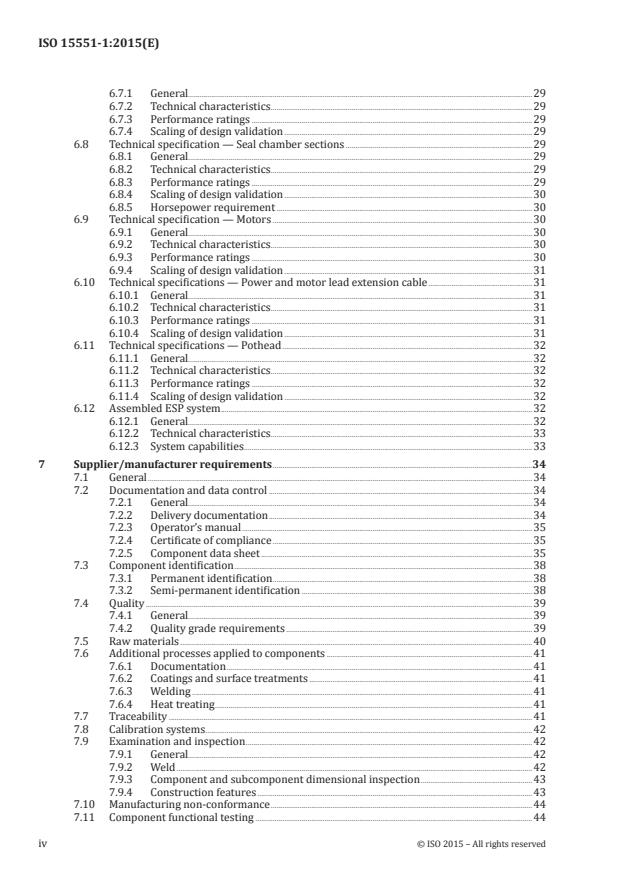
Contents Page
Foreword .vi
Introduction .vii
1 Scope . 1
2 Normative references . 1
3 Terms and definitions . 2
4 Symbols and abbreviated terms .13
5 Functional specification .16
5.1 General .16
5.2 Component type .16
5.3 Functional requirements .16
5.3.1 General.16
5.3.2 Application parameters .16
5.3.3 Environmental compatibility .18
5.3.4 Compatibility with related well equipment and services .19
5.4 User/purchaser selections .20
5.4.1 General.20
5.4.2 Design validation .20
5.4.3 Component functional evaluation .20
5.4.4 Quality grades.20
5.4.5 Shipping, handling, and storage .21
5.4.6 Additional documentation or requirements .21
6 Technical specification .21
6.1 General .21
6.2 Design criteria .22
6.2.1 General.22
6.2.2 Design documentation .22
6.2.3 Materials .22
6.2.4 Dimensional information .25
6.2.5 Component and assembled system design verification .26
6.2.6 Component design validation .26
6.2.7 Component functional evaluation requirements .26
6.2.8 Assembled system functional evaluation .26
6.2.9 Design changes .26
6.3 Technical specification — All components .26
6.3.1 Technical characteristics .26
6.3.2 Performance rating .27
6.4 Technical specification — Bolt-on discharge .27
6.4.1 General.27
6.4.2 Technical characteristics for the discharge .27
6.4.3 Performance ratings .27
6.4.4 Scaling of design validation .27
6.5 Technical specification — Pump and gas handler .27
6.5.1 General.27
6.5.2 Technical characteristics for the pump and gas handler .27
6.5.3 Performance ratings .28
6.5.4 Scaling of design validation .28
6.6 Technical specification — Bolt-on intake .28
6.6.1 General.28
6.6.2 Technical characteristics for the intake .28
6.6.3 Performance ratings .28
6.6.4 Scaling of design validation .28
6.7 Technical specification — Mechanical gas separators .29
6.7.1 General.29
6.7.2 Technical characteristics .29
6.7.3 Performance ratings .29
6.7.4 Scaling of design validation .29
6.8 Technical specification — Seal chamber sections .29
6.8.1 General.29
6.8.2 Technical characteristics .29
6.8.3 Performance ratings .29
6.8.4 Scaling of design validation .30
6.8.5 Horsepower requirement .30
6.9 Technical specification — Motors .30
6.9.1 General.30
6.9.2 Technical characteristics .30
6.9.3 Performance ratings .30
6.9.4 Scaling of design validation .31
6.10 Technical specifications — Power and motor lead extension cable .31
6.10.1 General.31
6.10.2 Technical characteristics .31
6.10.3 Performance ratings .31
6.10.4 Scaling of design validation .31
6.11 Technical specifications — Pothead .32
6.11.1 General.32
6.11.2 Technical characteristics .32
6.11.3 Performance ratings .32
6.11.4 Scaling of design validation .32
6.12 Assembled ESP system .32
6.12.1 General.32
6.12.2 Technical characteristics .33
6.12.3 System capabilities . .33
7 Supplier/manufacturer requirements .34
7.1 General .34
7.2 Documentation and data control .34
7.2.1 General.34
7.2.2 Delivery documentation .34
7.2.3 Operator’s manual .35
7.2.4 Certificate of compliance .35
7.2.5 Component data sheet .35
7.3 Component identification .38
7.3.1 Permanent identification .38
7.3.2 Semi-permanent identification .38
7.4 Quality .39
7.4.1 General.39
7.4.2 Quality grade requirements .39
7.5 Raw materials .40
7.6 Additional processes applied to components .41
7.6.1 Documentation .41
7.6.2 Coatings and surface treatments .41
7.6.3 Welding .41
7.6.4 Heat treating .41
7.7 Traceability .41
7.8 Calibration systems .42
7.9 Examination and inspection .42
7.9.1 General.42
7.9.2 Weld .42
7.9.3 Component and subcomponent dimensional inspection .43
7.9.4 Construction features .43
7.10 Manufacturing non-conformance .44
7.11 Component functional testing .44
iv © ISO 2015 – All rights reserved
8 Repair/redress .44
9 Shipping, handling, and storage .44
9.1 General .44
9.2 Storage .45
Annex A (normative) Design validation performance rating requirements by component .46
Annex B (normative) Requirements for determining performance ratings as an
assembled system.74
Annex C (normative) Functional evaluation: single component .77
Annex D (normative) Cable reference information .85
Annex E (informative) Functional evaluation guideline — Assembled ESP system .91
Annex F (informative) Establishing recommended operating range (ROR) of ESP system .93
Annex G (informative) Example user/purchaser ESP functional specification form .95
Annex H (informative) Considerations for use of 3-phase low and medium voltage
adjustable speed drives for ESP applications .99
Annex I (informative) Analysis after ESP use .105
Annex J (informative) Downhole monitoring of ESP assembly .117
Annex K (informative) Information on permanent magnet motors for ESP applications .119
Bibliography .121
Foreword
ISO (the International Organization for Standardization) is a worldwide federation of national standards
bodies (ISO member bodies). The work of preparing International Standards is normally carried out
through ISO technical committees. Each member body interested in a subject for which a technical
committee has been established has the right to be represented on that committee. International
organizations, governmental and non-governmental, in liaison with ISO, also take part in the work.
ISO collaborates closely with the International Electrotechnical Commission (IEC) on all matters of
electrotechnical standardization.
The procedures used to develop this document and those intended for its further maintenance are
described in the ISO/IEC Directives, Part 1. In particular the different approval criteria needed for the
different types of ISO documents should be noted. This document was drafted in accordance with the
editorial rules of the ISO/IEC Directives, Part 2 (see www.iso.org/directives).
Attention is drawn to the possibility that some of the elements of this document may be the subject of
patent rights. ISO shall not be held responsible for identifying any or all such patent rights. Details of any
patent rights identified during the development of the document will be in the Introduction and/or on
the ISO list of patent declarations received (see www.iso.org/patents).
Any trade name used in this document is information given for the convenience of users and does not
constitute an endorsement.
For an explanation on the meaning of ISO specific terms and expressions related to conformity
assessment, as well as information about ISO’s adherence to the WTO principles in the Technical Barriers
to Trade (TBT), see the following URL: Foreword — Supplementary information.
The committee responsible for this document is ISO/TC 67, Materials, equipment and offshore structures for
petroleum, petrochemical and natural gas industries, Subcommittee SC 4, Drilling and production equipment.
vi © ISO 2015 – All rights reserved
Introduction
This part of ISO 15551 has been developed by users/purchasers and suppliers/manufacturers of electric
submersible pumps and is intended for use in the petroleum and natural gas industry worldwide. This
part of ISO 15551 provides requirements and information to both parties in the selection, manufacturing,
testing, and use of electric submersible pumps as defined in the scope. Further, this part of ISO 15551
addresses supplier requirements, which set the minimum parameters for claiming conformity with this
International Standard.
This part of ISO 15551 provides grades of requirements for design validation, quality control, and
functional evaluations allowing the user/purchaser to select each for a specific application. There are
two grades of design validation, three grades of quality control, and up to three grades of functional
testing, depending on the component. Design validation grade V2 is restricted to legacy products,
and the highest grade is V1. Quality control grade 3 is the standard grade and grades 2 and 1 provide
additional requirements. Of the three functional evaluation grades, the lowest grade is the standard
grade and higher grades provide additional requirements. The user/purchaser can specify requirements
supplemental to these grades.
Users of this International Standard are informed that requirements above those outlined in this
International Standard can be needed for individual applications. This International Standard is not
intended to inhibit a supplier/manufacturer from offering, or the user/purchaser from accepting,
alternative equipment or engineering solutions. This can be particularly applicable where there is
innovative or developing technology.
INTERNATIONAL STANDARD ISO 15551-1:2015(E)
Petroleum and natural gas industries — Drilling and
production equipment —
Part 1:
Electric submersible pump systems for artificial lift
1 Scope
This part of ISO 15551 provides requirements for the design, design verification and validation, manufacturing
and data control, performance ratings, functional evaluations, handling, and storage of tubing-deployed
electrical submersible pump (ESP) systems as defined herein. This part of ISO 15551 is applicable to those
components meeting the definition of centrifugal pumps including gas handling devices, discharge heads,
seal chamber sections, intake systems, mechanical gas separators, induction motors (herein motor), shaft
couplings, motor lead extension, pothead, and power cables, as defined herein. Components supplied under
the requirements of this part of ISO 15551 exclude previously used subcomponents. Additionally, this
International Standard provides requirements for assembled ESP systems.
This part of ISO 15551 includes normative annexes addressing design validation performance rating
requirements by component, requirements for determining ratings as an assembled system, functional
evaluation: single component and cable reference information.
This part of ISO 15551 includes informative annexes addressing functional evaluation guidelines for
assembled ESP systems, establishing recommended operating range (ROR) of the ESP system, example
user/purchaser ESP functional specification form, considerations for the use of 3-phase low and medium
voltage adjustable speed drives for ESP applications, analysis after ESP use, downhole monitoring of ESP
assembly operation, and information on permanent magnet motors for ESP applications.
Equipment not covered by this part of ISO 15551 includes wireline and coiled tubing-deployed ESP
systems, motor and pump shrouds, electric penetrators and feed-through systems, cable clamps and
banding, centralizers, intake screens, passive gas separators, by-pass tools, check and bleeder valves,
component adaptors, capillary lines, electric surface equipment, downhole permanent magnet motors,
and non-conventionally configured ESP systems such as inverted systems. Repair and redress equipment
requirements are not covered in this part of ISO 15551.
The terminologies used within this part of ISO 15551 are; “ESP assembly” for a system of products
combined into an operational machine, “component” for individual products such as, pumps or seal
chamber sections, and “subcomponent” for individual parts or subassemblies that are used in the
construction of an individual component.
2 Normative references
The following documents, in whole or in part, are normatively referenced in this document and are
indispensable for its application. For dated references, only the edition cited applies. For undated
references, the latest edition of the referenced document (including any amendments) applies.
ISO 9712, Non-destructive testing — Qualification and certification of NDT personnel
ISO 29001, Petroleum, petrochemical and natural gas industries — Sector-specific quality management
systems — Requirements for product and service supply
API RP 11S2, Electric Submersible Pump Testing
API RP 11S7, Recommended Practice of Application and Testing of Electric Submersible Pump Seal
Chamber Section
API RP 11S8, Practice on Electric Submersible Pump System Vibrations
ASTM B3, Standard Specification for Soft or Annealed Copper Wire
ASTM B8, Standard Specification for Concentric-Lay-Stranded Copper Conductors, Hard, Medium-Hard, or Soft
ASTM B33, Standard Specification for Tin Coated Soft or Annealed Copper Wire for Electrical Purposes
ASTM B189, Standard Specification for Lead-Coated and Lead-Alloy-Coated Soft Copper Wire for
Electrical Purposes
ASTM B193, Standard Test Method for Resistivity of Electrical Conductor Materials
ASTM B258, Standard Specification for Standard Nominal Diameters and Cross-Sectional Areas of AWG
Sizes of Solid Round Wires Used as Electrical Conductors
ASTM B496, Standard Specification for Compact-Round Concentric-Lay-Stranded Copper Conductors
ASTM D471, Rubber Property — Effect of Liquids, Test Method for
ASTM E8, Standard Test Methods for Tension Testing of Metallic Materials
NEMA WC 53, Standard Test Methods for Extruded Dielectric Power, Control, Instrumentation and Portable
Cables for Test
3 Terms and definitions
For the purposes of this document, the following definitions shall apply. For quality system related
terms used in this document and not defined below, see ISO 29001.
3.1
adapter
device used to connect components that are not directly compatible
3.2
adjustable speed drive
device which controls an electric motor’s speed by manipulating the power frequency being supplied to
the motor
Note 1 to entry: The term “adjustable speed drive” is interchangeable with other common industry names for this
device such as “variable frequency drive” or “variable speed drive”.
3.3
ampacity
maximum current that can pass through a power cable without exceeding its temperature limit for a
specific operating environment
3.4
ampacity coefficient
temperature rise of the power cable divided by the square of the amperage for a specific operating
environment
3.5
armor
outer covering to the power cable that can provide protection from mechanical damage and provides
mechanical constraint against swelling or expansion of underlying materials on exposure to well fluids
2 © ISO 2015 – All rights reserved
3.6
assembled ESP system
assembly of downhole equipment which includes some or all components as identified in this part of
ISO 15551
3.7
auxiliary equipment
equipment or components that are outside the scope of this part of ISO 15551 and are typically selected
and/or installed by the user/purchaser
EXAMPLE Cable protectors, motor shrouds, by-pass tools, and electrical penetrators.
3.8
axial stage type
type of stage with inlet and exit flow path essentially parallel to the shaft axis
3.9
bag
bladder
bellows
flexible subcomponent of a seal chamber section that functions as a positive barrier that isolates the
wellbore production fluid from the motor fluid
3.10
bag chamber
bladder chamber
bellows chamber
chamber which houses the bag/bladder/bellows
3.11
barrier
subcomponent of an ESP power cable that can be applied over the insulated conductors and provides
fluid protection, hoop strength, or both
3.12
best efficiency point
BEP
pump performance values at the flow rate where the pump efficiency is highest
3.13
bleeder valve
valve placed above a check valve for the purpose of reducing pressure or draining the fluid from within
the production tubing
3.14
braid
supplementary layer of material used to provide mechanical performance characteristics to the power
cable system such as hoop strength for gas decompression
3.15
bubble point
pressure at which gas begins to break out of under-saturated oil/fluid and form a free gas phase
3.16
by-pass tool
device that is installed into the wellbore along with the ESP assembly that divides the tubing system to
permit the installation of additional tubing string parallel to the ESP
3.17
cable band
metal band which is used to secure ESP power cable to production tubing
3.18
cable clamp
device, usually of rigid material, for strengthening or supporting power cable to production tubing
3.19
capillary line
independent tubing string commonly used for hydraulic control of safety valves and sliding sleeves or
for chemical injection
Note 1 to entry: This device is also commonly referred to as a chemical injection line or control line.
3.20
casing
pipe extending from the surface and intended to line the walls of a drilled well
3.21
casing size
nominal casing outside diameter (od), mass (weight), inside diameter (id), and/or drift diameter as
specified in ISO 11960
3.22
centralizers
device used to keep the ESP assembly or other downhole equipment in the centre of the tubing,
casing, or wellbore
3.23
centrifugal pump
component of an ESP system that uses rotating impeller(s) to impart kinetic energy (velocity) by centrifugal
force to a fluid and stationary diffusers to convert the kinetic energy to potential energy (pressure)
3.24
chamber
subcomponent of the seal chamber section
3.25
check valve
device that allows one-directional flow of fluid when a differential pressure exists
3.26
coefficient of determination
statistic used to determine the strength of a fit between a mathematical model and a set of observed
data values
Note 1 to entry: The coefficient of determination is typically calculated using the following equation:
n
Yy−
()
ii
∑
2 i=1
R =−1
n
yy−
()
∑ ii
i=1
3.27
coiled tubing
pipe typically supplied and installed in one continuous length and wound onto a reel or spool
3.28
coiled tubing deployed ESP
ESP system which is deployed into the wellbore using coiled tubing rather than by other deployment
means such as jointed tubing or wireline
4 © ISO 2015 – All rights reserved
3.29
common hardware
hardware that does not require traceability and is included as part of an ESP component
EXAMPLE Bolts, washers, screws, and snap rings.
3.30
compact stranded cable
electrical conductor configuration in which a multiple-strand conductor has been compacted to reduce
its circumference while maintaining conductor area
3.31
compression pump construction
configuration where the impeller is fixed to the shaft to prevent axial movement
3.32
conductor
subcomponent of the power cable that functions to conduct electrical power
3.33
conductor shield
layer adjacent to the conductor to distribute voltage stress evenly over the surface of the conductor
3.34
configuration
component designation that identifies the end connection designs for attaching additional
components in series
EXAMPLE Upper tandem, lower tandem, middle/centre tandem, and single tandem.
3.35
contraction capacity
volume that a chamber or set of parallel chambers can draw in due to temperature and pressure cycles
without allowing wellbore fluid ingress through the chamber or causing damage
3.36
coupling
device which connects the shafts of ESP components
3.37
deployment method
conveyance method
method used to deploy the ESP downhole equipment to its setting location
3.38
design validation
process of proving a design by testing to demonstrate conformity of the product to design requirements
3.39
design verification
process of examining the premise of a given design by calculation, comparison, or investigation, to
substantiate conformity with specified requirements
3.40
deviation survey
measurement of a borehole’s trajectory over the wellbore length for the purposes of ESP design and
application
3.41
diffuser
stationary stage segment of a centrifugal pump which converts the pumped fluid velocity (kinetic
energy) to a pressure (potential energy)
3.42
discharge head
component on the output end of the pump for connecting to the production tubing
3.43
dogleg severity
total angular inclination and azimuth in the wellbore, casing or liner, calculated over a standard length
such as degrees per 30 metres, or degrees per 100 feet
3.44
effective diameter
theoretical minimum diameter through which the assembled ESP system passes including installation
of all required ESP ancillary equipment
3.45
efficiency
output work divided by input work
3.46
elastomer
polymer with the property of viscoelasticity (elasticity), generally having a low Young’s modulus and a
high yield strain
3.47
electric penetrator
electrical connector that functions to transition power cable and/or instrument wires through a
sealing barrier
EXAMPLE Wellhead, wellbore packer, ESP pod, or canister.
3.48
electric surface control equipment
electrical equipment used to control the operation of the ESP assembly commonly referred to as an
adjustable speed drive or switchboard
3.49
electromagnetic region
region of an induction motor relative to the cylindrical boundary defined by the outside diameter of the
stator laminations, and the axial length which encompasses all the coiled wire of the stator
3.50
feed-through system
fixture which allows the passage of electricity from one side of a barrier to another while maintaining a
seal of gas or liquid through the barrier
3.51
floating pump construction
configuration where the impeller is not fixed to the shaft to permit limited axial movement
3.52
flowing pressure
pressure in the wellbore at a specific vertical depth at a specific flow rate
3.53
functional evaluation
test(s) performed to confirm ESP component operation or assembled ESP system operation as per design
Note 1 to entry: Occasionally referred to as factory acceptance test in case of ESP component and as string test in
case of assembled ESP system.
6 © ISO 2015 – All rights reserved
3.54
gas handler
component of an ESP system that conditions multiphase flow, without gas separation, to decrease the
degradation of pump performance
3.55
gas-oil ratio
produced gas-oil ratio
volumetric ratio of gas to oil at standard conditions
3.56
gas separator
component of an ESP system that mechanically separates a portion of the free gas from the wellbore
fluids prior to the fluids entering the pump or gas handler
3.57
head curve
amount of head generated by the pump as a function of flow rate for a specific speed
3.58
housing pressure rating
value of the maximum allowable difference of internal less external pressure
3.59
impeller
stage segment rotated by the shaft which adds kinetic energy (velocity) to the fluid being pumped
3.60
inclination
angle, measured in degrees, by which the wellbore or survey-instrumented axis varies from a true
vertical line
3.61
induction motor
component of an ESP system where alternating current power input is transformed to mechanical
torque by means of electromagnetic induction
Note 1 to entry: Also referred to as an asynchronous or squirrel cage motor.
3.62
intake
subcomponent of a pump which provides a flow path to the first impeller, constructed either integral to
the pump or bolted-on to the pump
3.63
intake screen
attachment to the pump intake used to filter solid particles from the produced fluid to protect the
internal components of the pump
3.64
insulation
isolates the electrical potential between conductors and other conducting materials and minimizes
leakage current from the conductors
3.65
inversion point
water cut percentage at which the emulsion viscosity is at its maximum
3.66
inverted system
ESP system configured with the pump on the bottom and motor on the top
3.67
jacket
subcomponent of an ESP power cable that covers the insulated conductors and provides mechanical
protection from the downhole environment
3.68
labyrinth chamber
chamber which utilizes a vertical U-tube, maze-like, or tortuous flow path to delay wellbore fluid ingress
through the chamber
3.69
lamination
thin electrical grade metallic subcomponents that form the magnetic core of the stator and the rotor(s)
3.70
liner
pipe extending from the surface or another point lower in the wellbore to a depth within or below the
existing casing
3.71
manufacturing
process and action performed by an equipment supplier/manufacturer that are necessary to provide
finished component(s), assembly(ies), and related documentation, that fulfil the requests of the
user/purchaser and meet the standards of the supplier/manufacturer
Note 1 to entry: Manufacturing begins when the supplier/manufacturer receives the order and is completed at the
moment the component(s), assembly(ies), and related documentation are surrendered to a transportation provider.
3.72
mechanical seal
subcomponent used to prevent flow between a rotating shaft and a stationary body
3.73
megger
instrument that generates a high voltage in order to test the resistance of insulation, etc.
3.74
mixed flow stage type
type of stage with inlet flow path essentially parallel to shaft axis and exit between perpendicular and
parallel to the shaft axis
3.75
model
equipment with unique components and operating characteristics which differentiate it from other
equipment of the same type
3.76
modular pump construction
configuration that utilizes both compression and floating pump constructions within the same
single component
3.77
motor fluid
fluid internal to the motor and s
...
Questions, Comments and Discussion
Ask us and Technical Secretary will try to provide an answer. You can facilitate discussion about the standard in here.
Loading comments...