


ISO/IEC 9075-1:2016
(Main)Information technology — Database languages — SQL — Part 1: Framework (SQL/Framework)
Information technology — Database languages — SQL — Part 1: Framework (SQL/Framework)
ISO/IEC 9075-1:2016 describes the conceptual framework used in other parts of ISO/IEC 9075 to specify the grammar of SQL and the result of processing statements in that language by an SQL-implementation. ISO/IEC 9075-1:2016 also defines terms and notation used in the other parts of ISO/IEC 9075.
Technologies de l'information — Langages de base de données — SQL — Partie 1: Charpente (SQL/Charpente)
General Information
- Status
- Withdrawn
- Publication Date
- 13-Dec-2016
- Technical Committee
- ISO/IEC JTC 1/SC 32 - Data management and interchange
- Drafting Committee
- ISO/IEC JTC 1/SC 32/WG 3 - Database language
- Current Stage
- 9599 - Withdrawal of International Standard
- Start Date
- 01-Jun-2023
- Completion Date
- 14-Feb-2026
Relations
- Effective Date
- 06-Jun-2022
- Effective Date
- 23-Apr-2020
- Effective Date
- 16-Feb-2013
Get Certified
Connect with accredited certification bodies for this standard

BSI Group
BSI (British Standards Institution) is the business standards company that helps organizations make excellence a habit.

NYCE
Mexican standards and certification body.
Sponsored listings
Frequently Asked Questions
ISO/IEC 9075-1:2016 is a standard published by the International Organization for Standardization (ISO). Its full title is "Information technology — Database languages — SQL — Part 1: Framework (SQL/Framework)". This standard covers: ISO/IEC 9075-1:2016 describes the conceptual framework used in other parts of ISO/IEC 9075 to specify the grammar of SQL and the result of processing statements in that language by an SQL-implementation. ISO/IEC 9075-1:2016 also defines terms and notation used in the other parts of ISO/IEC 9075.
ISO/IEC 9075-1:2016 describes the conceptual framework used in other parts of ISO/IEC 9075 to specify the grammar of SQL and the result of processing statements in that language by an SQL-implementation. ISO/IEC 9075-1:2016 also defines terms and notation used in the other parts of ISO/IEC 9075.
ISO/IEC 9075-1:2016 is classified under the following ICS (International Classification for Standards) categories: 35.060 - Languages used in information technology. The ICS classification helps identify the subject area and facilitates finding related standards.
ISO/IEC 9075-1:2016 has the following relationships with other standards: It is inter standard links to ISO/IEC 9075-1:2016/Cor 1:2022, ISO/IEC 9075-1:2023, ISO/IEC 9075-1:2011. Understanding these relationships helps ensure you are using the most current and applicable version of the standard.
ISO/IEC 9075-1:2016 is available in PDF format for immediate download after purchase. The document can be added to your cart and obtained through the secure checkout process. Digital delivery ensures instant access to the complete standard document.
Standards Content (Sample)
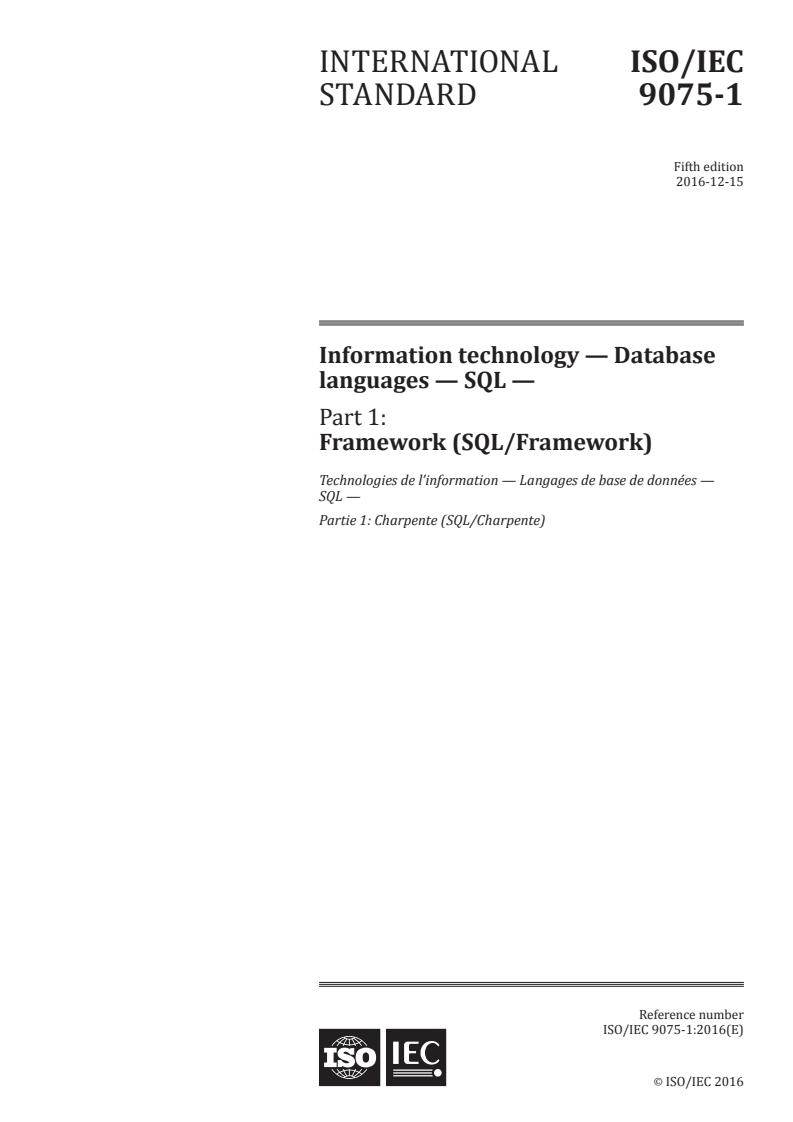
INTERNATIONAL ISO/IEC
STANDARD 9075-1
Fifth edition
2016-12-15
Information technology — Database
languages — SQL —
Part 1:
Framework (SQL/Framework)
Technologies de l’information — Langages de base de données —
SQL —
Partie 1: Charpente (SQL/Charpente)
Reference number
©
ISO/IEC 2016
© ISO/IEC 2016, Published in Switzerland
All rights reserved. Unless otherwise specified, no part of this publication may be reproduced or utilized otherwise in any form
or by any means, electronic or mechanical, including photocopying, or posting on the internet or an intranet, without prior
written permission. Permission can be requested from either ISO at the address below or ISO’s member body in the country of
the requester.
ISO copyright office
Ch. de Blandonnet 8 • CP 401
CH-1214 Vernier, Geneva, Switzerland
Tel. +41 22 749 01 11
Fax +41 22 749 09 47
copyright@iso.org
www.iso.org
ii © ISO/IEC 2016 – All rights reserved
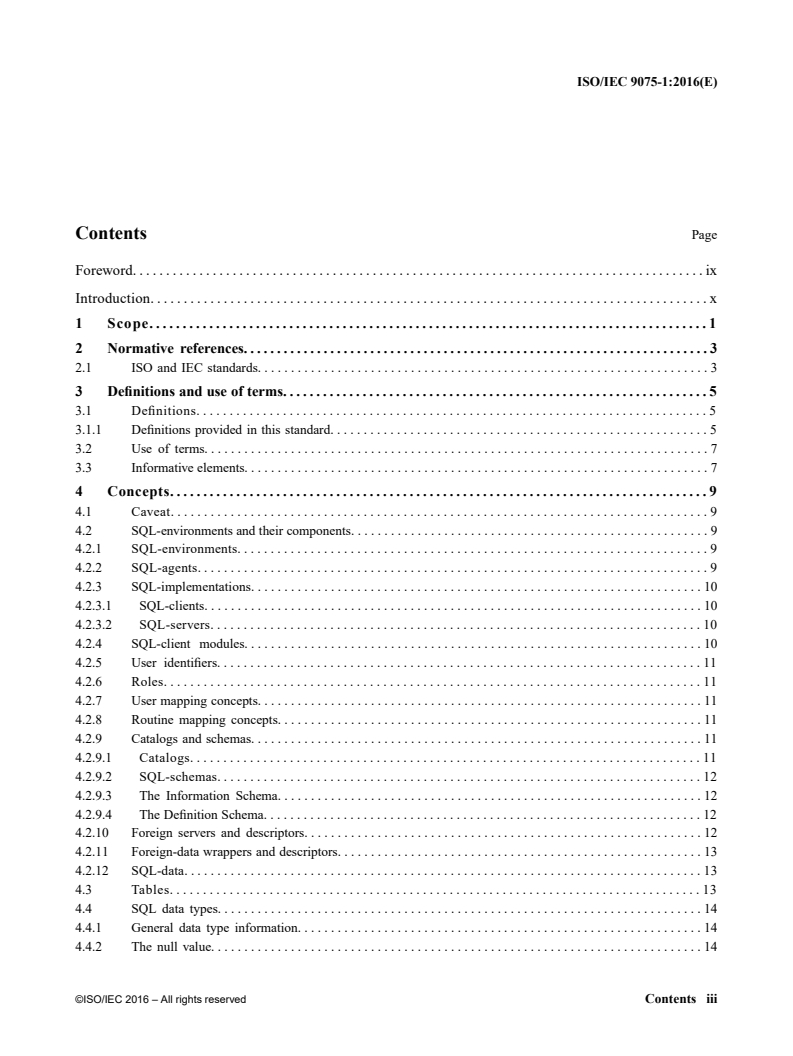
Contents Page
Foreword. . . . . . . . . . . . . . . . . . . . . . . . . . . . . . . . . . . . . . . . . . . . . . . . . . . . . . . . . . . . . . . . . . . . . . . . . . . . . . . . . . . . . . ix
Introduction. . . . . . . . . . . . . . . . . . . . . . . . . . . . . . . . . . . . . . . . . . . . . . . . . . . . . . . . . . . . . . . . . . . . . . . . . . . . . . . . . . . . x
1 Scope. . . . . . . . . . . . . . . . . . . . . . . . . . . . . . . . . . . . . . . . . . . . . . . . . . . . . . . . . . . . . . . . . . . . . . . . . . . . . . . . . . . . 1
2 Normative references. . . . . . . . . . . . . . . . . . . . . . . . . . . . . . . . . . . . . . . . . . . . . . . . . . . . . . . . . . . . . . . . . . . . . .3
2.1 ISO and IEC standards. . . . . . . . . . . . . . . . . . . . . . . . . . . . . . . . . . . . . . . . . . . . . . . . . . . . . . . . . . . . . . . . . . . . 3
3 Definitions and use of terms. . . . . . . . . . . . . . . . . . . . . . . . . . . . . . . . . . . . . . . . . . . . . . . . . . . . . . . . . . . . . . . . 5
3.1 Definitions. . . . . . . . . . . . . . . . . . . . . . . . . . . . . . . . . . . . . . . . . . . . . . . . . . . . . . . . . . . . . . . . . . . . . . . . . . . . . 5
3.1.1 Definitions provided in this standard. . . . . . . . . . . . . . . . . . . . . . . . . . . . . . . . . . . . . . . . . . . . . . . . . . . . . . . . . 5
3.2 Use of terms. . . . . . . . . . . . . . . . . . . . . . . . . . . . . . . . . . . . . . . . . . . . . . . . . . . . . . . . . . . . . . . . . . . . . . . . . . . . 7
3.3 Informative elements. . . . . . . . . . . . . . . . . . . . . . . . . . . . . . . . . . . . . . . . . . . . . . . . . . . . . . . . . . . . . . . . . . . . . . 7
4 Concepts. . . . . . . . . . . . . . . . . . . . . . . . . . . . . . . . . . . . . . . . . . . . . . . . . . . . . . . . . . . . . . . . . . . . . . . . . . . . . . . . . 9
4.1 Caveat. . . . . . . . . . . . . . . . . . . . . . . . . . . . . . . . . . . . . . . . . . . . . . . . . . . . . . . . . . . . . . . . . . . . . . . . . . . . . . . . . 9
4.2 SQL-environments and their components. . . . . . . . . . . . . . . . . . . . . . . . . . . . . . . . . . . . . . . . . . . . . . . . . . . . . . 9
4.2.1 SQL-environments. . . . . . . . . . . . . . . . . . . . . . . . . . . . . . . . . . . . . . . . . . . . . . . . . . . . . . . . . . . . . . . . . . . . . . . 9
4.2.2 SQL-agents. . . . . . . . . . . . . . . . . . . . . . . . . . . . . . . . . . . . . . . . . . . . . . . . . . . . . . . . . . . . . . . . . . . . . . . . . . . . . 9
4.2.3 SQL-implementations. . . . . . . . . . . . . . . . . . . . . . . . . . . . . . . . . . . . . . . . . . . . . . . . . . . . . . . . . . . . . . . . . . . . 10
4.2.3.1 SQL-clients. . . . . . . . . . . . . . . . . . . . . . . . . . . . . . . . . . . . . . . . . . . . . . . . . . . . . . . . . . . . . . . . . . . . . . . . . . . 10
4.2.3.2 SQL-servers. . . . . . . . . . . . . . . . . . . . . . . . . . . . . . . . . . . . . . . . . . . . . . . . . . . . . . . . . . . . . . . . . . . . . . . . . . 10
4.2.4 SQL-client modules. . . . . . . . . . . . . . . . . . . . . . . . . . . . . . . . . . . . . . . . . . . . . . . . . . . . . . . . . . . . . . . . . . . . .10
4.2.5 User identifiers. . . . . . . . . . . . . . . . . . . . . . . . . . . . . . . . . . . . . . . . . . . . . . . . . . . . . . . . . . . . . . . . . . . . . . . . .11
4.2.6 Roles. . . . . . . . . . . . . . . . . . . . . . . . . . . . . . . . . . . . . . . . . . . . . . . . . . . . . . . . . . . . . . . . . . . . . . . . . . . . . . . . . 11
4.2.7 User mapping concepts. . . . . . . . . . . . . . . . . . . . . . . . . . . . . . . . . . . . . . . . . . . . . . . . . . . . . . . . . . . . . . . . . . . 11
4.2.8 Routine mapping concepts. . . . . . . . . . . . . . . . . . . . . . . . . . . . . . . . . . . . . . . . . . . . . . . . . . . . . . . . . . . . . . . . 11
4.2.9 Catalogs and schemas. . . . . . . . . . . . . . . . . . . . . . . . . . . . . . . . . . . . . . . . . . . . . . . . . . . . . . . . . . . . . . . . . . . . 11
4.2.9.1 Catalogs. . . . . . . . . . . . . . . . . . . . . . . . . . . . . . . . . . . . . . . . . . . . . . . . . . . . . . . . . . . . . . . . . . . . . . . . . . . . . 11
4.2.9.2 SQL-schemas. . . . . . . . . . . . . . . . . . . . . . . . . . . . . . . . . . . . . . . . . . . . . . . . . . . . . . . . . . . . . . . . . . . . . . . . . 12
4.2.9.3 The Information Schema. . . . . . . . . . . . . . . . . . . . . . . . . . . . . . . . . . . . . . . . . . . . . . . . . . . . . . . . . . . . . . . . 12
4.2.9.4 The Definition Schema. . . . . . . . . . . . . . . . . . . . . . . . . . . . . . . . . . . . . . . . . . . . . . . . . . . . . . . . . . . . . . . . . . 12
4.2.10 Foreign servers and descriptors. . . . . . . . . . . . . . . . . . . . . . . . . . . . . . . . . . . . . . . . . . . . . . . . . . . . . . . . . . . . 12
4.2.11 Foreign-data wrappers and descriptors. . . . . . . . . . . . . . . . . . . . . . . . . . . . . . . . . . . . . . . . . . . . . . . . . . . . . . . 13
4.2.12 SQL-data. . . . . . . . . . . . . . . . . . . . . . . . . . . . . . . . . . . . . . . . . . . . . . . . . . . . . . . . . . . . . . . . . . . . . . . . . . . . . . 13
4.3 Tables. . . . . . . . . . . . . . . . . . . . . . . . . . . . . . . . . . . . . . . . . . . . . . . . . . . . . . . . . . . . . . . . . . . . . . . . . . . . . . . . 13
4.4 SQL data types. . . . . . . . . . . . . . . . . . . . . . . . . . . . . . . . . . . . . . . . . . . . . . . . . . . . . . . . . . . . . . . . . . . . . . . . . 14
4.4.1 General data type information. . . . . . . . . . . . . . . . . . . . . . . . . . . . . . . . . . . . . . . . . . . . . . . . . . . . . . . . . . . . . 14
4.4.2 The null value. . . . . . . . . . . . . . . . . . . . . . . . . . . . . . . . . . . . . . . . . . . . . . . . . . . . . . . . . . . . . . . . . . . . . . . . . . 14
©ISO/IEC 2016 – All rights reserved Contents iii
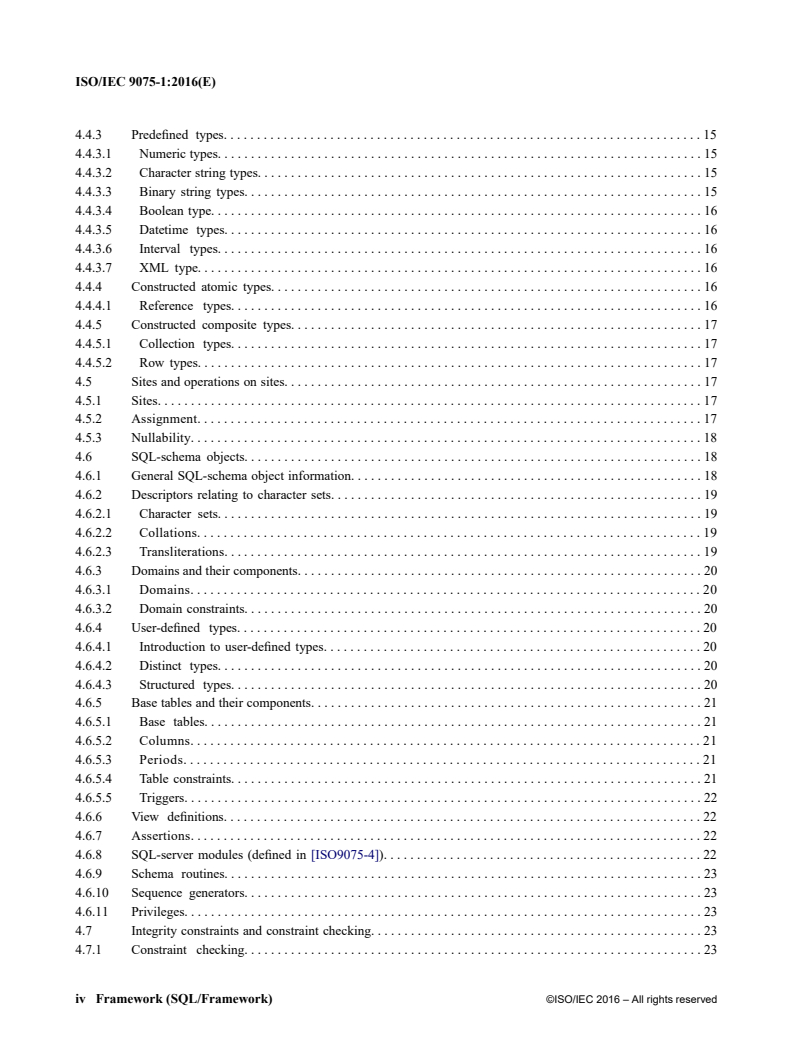
4.4.3 Predefined types. . . . . . . . . . . . . . . . . . . . . . . . . . . . . . . . . . . . . . . . . . . . . . . . . . . . . . . . . . . . . . . . . . . . . . . .15
4.4.3.1 Numeric types. . . . . . . . . . . . . . . . . . . . . . . . . . . . . . . . . . . . . . . . . . . . . . . . . . . . . . . . . . . . . . . . . . . . . . . . . 15
4.4.3.2 Character string types. . . . . . . . . . . . . . . . . . . . . . . . . . . . . . . . . . . . . . . . . . . . . . . . . . . . . . . . . . . . . . . . . . . 15
4.4.3.3 Binary string types. . . . . . . . . . . . . . . . . . . . . . . . . . . . . . . . . . . . . . . . . . . . . . . . . . . . . . . . . . . . . . . . . . . . . 15
4.4.3.4 Boolean type. . . . . . . . . . . . . . . . . . . . . . . . . . . . . . . . . . . . . . . . . . . . . . . . . . . . . . . . . . . . . . . . . . . . . . . . . . 16
4.4.3.5 Datetime types. . . . . . . . . . . . . . . . . . . . . . . . . . . . . . . . . . . . . . . . . . . . . . . . . . . . . . . . . . . . . . . . . . . . . . . .16
4.4.3.6 Interval types. . . . . . . . . . . . . . . . . . . . . . . . . . . . . . . . . . . . . . . . . . . . . . . . . . . . . . . . . . . . . . . . . . . . . . . . .16
4.4.3.7 XML type. . . . . . . . . . . . . . . . . . . . . . . . . . . . . . . . . . . . . . . . . . . . . . . . . . . . . . . . . . . . . . . . . . . . . . . . . . . . 16
4.4.4 Constructed atomic types. . . . . . . . . . . . . . . . . . . . . . . . . . . . . . . . . . . . . . . . . . . . . . . . . . . . . . . . . . . . . . . . . 16
4.4.4.1 Reference types. . . . . . . . . . . . . . . . . . . . . . . . . . . . . . . . . . . . . . . . . . . . . . . . . . . . . . . . . . . . . . . . . . . . . . .16
4.4.5 Constructed composite types. . . . . . . . . . . . . . . . . . . . . . . . . . . . . . . . . . . . . . . . . . . . . . . . . . . . . . . . . . . . . . 17
4.4.5.1 Collection types. . . . . . . . . . . . . . . . . . . . . . . . . . . . . . . . . . . . . . . . . . . . . . . . . . . . . . . . . . . . . . . . . . . . . . .17
4.4.5.2 Row types. . . . . . . . . . . . . . . . . . . . . . . . . . . . . . . . . . . . . . . . . . . . . . . . . . . . . . . . . . . . . . . . . . . . . . . . . . . . 17
4.5 Sites and operations on sites. . . . . . . . . . . . . . . . . . . . . . . . . . . . . . . . . . . . . . . . . . . . . . . . . . . . . . . . . . . . . . . 17
4.5.1 Sites. . . . . . . . . . . . . . . . . . . . . . . . . . . . . . . . . . . . . . . . . . . . . . . . . . . . . . . . . . . . . . . . . . . . . . . . . . . . . . . . . . 17
4.5.2 Assignment. . . . . . . . . . . . . . . . . . . . . . . . . . . . . . . . . . . . . . . . . . . . . . . . . . . . . . . . . . . . . . . . . . . . . . . . . . . . 17
4.5.3 Nullability. . . . . . . . . . . . . . . . . . . . . . . . . . . . . . . . . . . . . . . . . . . . . . . . . . . . . . . . . . . . . . . . . . . . . . . . . . . . . 18
4.6 SQL-schema objects. . . . . . . . . . . . . . . . . . . . . . . . . . . . . . . . . . . . . . . . . . . . . . . . . . . . . . . . . . . . . . . . . . . . . 18
4.6.1 General SQL-schema object information. . . . . . . . . . . . . . . . . . . . . . . . . . . . . . . . . . . . . . . . . . . . . . . . . . . . . 18
4.6.2 Descriptors relating to character sets. . . . . . . . . . . . . . . . . . . . . . . . . . . . . . . . . . . . . . . . . . . . . . . . . . . . . . . . 19
4.6.2.1 Character sets. . . . . . . . . . . . . . . . . . . . . . . . . . . . . . . . . . . . . . . . . . . . . . . . . . . . . . . . . . . . . . . . . . . . . . . . .19
4.6.2.2 Collations. . . . . . . . . . . . . . . . . . . . . . . . . . . . . . . . . . . . . . . . . . . . . . . . . . . . . . . . . . . . . . . . . . . . . . . . . . . . 19
4.6.2.3 Transliterations. . . . . . . . . . . . . . . . . . . . . . . . . . . . . . . . . . . . . . . . . . . . . . . . . . . . . . . . . . . . . . . . . . . . . . . . 19
4.6.3 Domains and their components. . . . . . . . . . . . . . . . . . . . . . . . . . . . . . . . . . . . . . . . . . . . . . . . . . . . . . . . . . . . . 20
4.6.3.1 Domains. . . . . . . . . . . . . . . . . . . . . . . . . . . . . . . . . . . . . . . . . . . . . . . . . . . . . . . . . . . . . . . . . . . . . . . . . . . . . 20
4.6.3.2 Domain constraints. . . . . . . . . . . . . . . . . . . . . . . . . . . . . . . . . . . . . . . . . . . . . . . . . . . . . . . . . . . . . . . . . . . . . 20
4.6.4 User-defined types. . . . . . . . . . . . . . . . . . . . . . . . . . . . . . . . . . . . . . . . . . . . . . . . . . . . . . . . . . . . . . . . . . . . . .20
4.6.4.1 Introduction to user-defined types. . . . . . . . . . . . . . . . . . . . . . . . . . . . . . . . . . . . . . . . . . . . . . . . . . . . . . . . . 20
4.6.4.2 Distinct types. . . . . . . . . . . . . . . . . . . . . . . . . . . . . . . . . . . . . . . . . . . . . . . . . . . . . . . . . . . . . . . . . . . . . . . . .20
4.6.4.3 Structured types. . . . . . . . . . . . . . . . . . . . . . . . . . . . . . . . . . . . . . . . . . . . . . . . . . . . . . . . . . . . . . . . . . . . . . .20
4.6.5 Base tables and their components. . . . . . . . . . . . . . . . . . . . . . . . . . . . . . . . . . . . . . . . . . . . . . . . . . . . . . . . . . . 21
4.6.5.1 Base tables. . . . . . . . . . . . . . . . . . . . . . . . . . . . . . . . . . . . . . . . . . . . . . . . . . . . . . . . . . . . . . . . . . . . . . . . . . .21
4.6.5.2 Columns. . . . . . . . . . . . . . . . . . . . . . . . . . . . . . . . . . . . . . . . . . . . . . . . . . . . . . . . . . . . . . . . . . . . . . . . . . . . . 21
4.6.5.3 Periods. . . . . . . . . . . . . . . . . . . . . . . . . . . . . . . . . . . . . . . . . . . . . . . . . . . . . . . . . . . . . . . . . . . . . . . . . . . . . . 21
4.6.5.4 Table constraints. . . . . . . . . . . . . . . . . . . . . . . . . . . . . . . . . . . . . . . . . . . . . . . . . . . . . . . . . . . . . . . . . . . . . . . 21
4.6.5.5 Triggers. . . . . . . . . . . . . . . . . . . . . . . . . . . . . . . . . . . . . . . . . . . . . . . . . . . . . . . . . . . . . . . . . . . . . . . . . . . . . . 22
4.6.6 View definitions. . . . . . . . . . . . . . . . . . . . . . . . . . . . . . . . . . . . . . . . . . . . . . . . . . . . . . . . . . . . . . . . . . . . . . . .22
4.6.7 Assertions. . . . . . . . . . . . . . . . . . . . . . . . . . . . . . . . . . . . . . . . . . . . . . . . . . . . . . . . . . . . . . . . . . . . . . . . . . . . . 22
4.6.8 SQL-server modules (defined in [ISO9075-4]). . . . . . . . . . . . . . . . . . . . . . . . . . . . . . . . . . . . . . . . . . . . . . . . 22
4.6.9 Schema routines. . . . . . . . . . . . . . . . . . . . . . . . . . . . . . . . . . . . . . . . . . . . . . . . . . . . . . . . . . . . . . . . . . . . . . . .23
4.6.10 Sequence generators. . . . . . . . . . . . . . . . . . . . . . . . . . . . . . . . . . . . . . . . . . . . . . . . . . . . . . . . . . . . . . . . . . . . . 23
4.6.11 Privileges. . . . . . . . . . . . . . . . . . . . . . . . . . . . . . . . . . . . . . . . . . . . . . . . . . . . . . . . . . . . . . . . . . . . . . . . . . . . . . 23
4.7 Integrity constraints and constraint checking. . . . . . . . . . . . . . . . . . . . . . . . . . . . . . . . . . . . . . . . . . . . . . . . . . 23
4.7.1 Constraint checking. . . . . . . . . . . . . . . . . . . . . . . . . . . . . . . . . . . . . . . . . . . . . . . . . . . . . . . . . . . . . . . . . . . . .23
iv Framework (SQL/Framework) ©ISO/IEC 2016 – All rights reserved
4.7.2 Determinism and constraints. . . . . . . . . . . . . . . . . . . . . . . . . . . . . . . . . . . . . . . . . . . . . . . . . . . . . . . . . . . . . . 24
4.8 Communication between an SQL-agent and an SQL-server. . . . . . . . . . . . . . . . . . . . . . . . . . . . . . . . . . . . . . 24
4.8.1 Host languages. . . . . . . . . . . . . . . . . . . . . . . . . . . . . . . . . . . . . . . . . . . . . . . . . . . . . . . . . . . . . . . . . . . . . . . . .24
4.8.2 Parameter passing and data type correspondences. . . . . . . . . . . . . . . . . . . . . . . . . . . . . . . . . . . . . . . . . . . . . . 25
4.8.2.1 General parameter passing and data type correspondence information. . . . . . . . . . . . . . . . . . . . . . . . . . . . . 25
4.8.2.2 Data type correspondences. . . . . . . . . . . . . . . . . . . . . . . . . . . . . . . . . . . . . . . . . . . . . . . . . . . . . . . . . . . . . . . 25
4.8.2.3 Locators. . . . . . . . . . . . . . . . . . . . . . . . . . . . . . . . . . . . . . . . . . . . . . . . . . . . . . . . . . . . . . . . . . . . . . . . . . . . . 25
4.8.2.4 Status parameters. . . . . . . . . . . . . . . . . . . . . . . . . . . . . . . . . . . . . . . . . . . . . . . . . . . . . . . . . . . . . . . . . . . . . .26
4.8.2.5 Indicator parameters. . . . . . . . . . . . . . . . . . . . . . . . . . . . . . . . . . . . . . . . . . . . . . . . . . . . . . . . . . . . . . . . . . . . 26
4.8.3 Descriptor areas. . . . . . . . . . . . . . . . . . . . . . . . . . . . . . . . . . . . . . . . . . . . . . . . . . . . . . . . . . . . . . . . . . . . . . . .26
4.8.4 Diagnostic information. . . . . . . . . . . . . . . . . . . . . . . . . . . . . . . . . . . . . . . . . . . . . . . . . . . . . . . . . . . . . . . . . . . 26
4.8.5 SQL-transactions. . . . . . . . . . . . . . . . . . . . . . . . . . . . . . . . . . . . . . . . . . . . . . . . . . . . . . . . . . . . . . . . . . . . . . . 27
4.9 Modules. . . . . . . . . . . . . . . . . . . . . . . . . . . . . . . . . . . . . . . . . . . . . . . . . . . . . . . . . . . . . . . . . . . . . . . . . . . . . . 27
4.10 Routines. . . . . . . . . . . . . . . . . . . . . . . . . . . . . . . . . . . . . . . . . . . . . . . . . . . . . . . . . . . . . . . . . . . . . . . . . . . . . . 28
4.10.1 General routine information. . . . . . . . . . . . . . . . . . . . . . . . . . . . . . . . . . . . . . . . . . . . . . . . . . . . . . . . . . . . . . . 28
4.10.2 Type preserving functions. . . . . . . . . . . . . . . . . . . . . . . . . . . . . . . . . . . . . . . . . . . . . . . . . . . . . . . . . . . . . . . . . 28
4.11 SQL-statements. . . . . . . . . . . . . . . . . . . . . . . . . . . . . . . . . . . . . . . . . . . . . . . . . . . . . . . . . . . . . . . . . . . . . . . . . 29
4.11.1 Classes of SQL-statements. . . . . . . . . . . . . . . . . . . . . . . . . . . . . . . . . . . . . . . . . . . . . . . . . . . . . . . . . . . . . . . . 29
4.11.2 SQL-statements classified by function. . . . . . . . . . . . . . . . . . . . . . . . . . . . . . . . . . . . . . . . . . . . . . . . . . . . . . . 29
5 The parts of ISO/IEC 9075. . . . . . . . . . . . . . . . . . . . . . . . . . . . . . . . . . . . . . . . . . . . . . . . . . . . . . . . . . . . . . . . 31
5.1 Overview. . . . . . . . . . . . . . . . . . . . . . . . . . . . . . . . . . . . . . . . . . . . . . . . . . . . . . . . . . . . . . . . . . . . . . . . . . . . . . 31
5.2 ISO/IEC 9075-1: Framework (SQL/Framework). . . . . . . . . . . . . . . . . . . . . . . . . . . . . . . . . . . . . . . . . . . . . . . 31
5.3 ISO/IEC 9075-2: Foundation (SQL/Foundation). . . . . . . . . . . . . . . . . . . . . . . . . . . . . . . . . . . . . . . . . . . . . . . 32
5.3.1 Data types specified in [ISO9075-2]. . . . . . . . . . . . . . . . . . . . . . . . . . . . . . . . . . . . . . . . . . . . . . . . . . . . . . . . 32
5.3.2 Tables. . . . . . . . . . . . . . . . . . . . . . . . . . . . . . . . . . . . . . . . . . . . . . . . . . . . . . . . . . . . . . . . . . . . . . . . . . . . . . . . 32
5.3.3 Bindings methods. . . . . . . . . . . . . . . . . . . . . . . . . . . . . . . . . . . . . . . . . . . . . . . . . . . . . . . . . . . . . . . . . . . . . . . 32
5.3.3.1 Embedded SQL. . . . . . . . . . . . . . . . . . . . . . . . . . . . . . . . . . . . . . . . . . . . . . . . . . . . . . . . . . . . . . . . . . . . . . .32
5.3.3.2 Dynamic SQL. . . . . . . . . . . . . . . . . . . . . . . . . . . . . . . . . . . . . . . . . . . . . . . . . . . . . . . . . . . . . . . . . . . . . . . . . 32
5.3.3.3 Direct invocation of SQL. . . . . . . . . . . . . . . . . . . . . . . . . . . . . . . . . . . . . . . . . . . . . . . . . . . . . . . . . . . . . . . . 33
5.3.4 SQL-statements specified in [ISO9075-2]. . . . . . . . . . . . . . . . . . . . . . . . . . . . . . . . . . . . . . . . . . . . . . . . . . . . 33
5.4 ISO/IEC 9075-3: Call Level Interface (SQL/CLI). . . . . . . . . . . . . . . . . . . . . . . . . . . . . . . . . . . . . . . . . . . . . . 34
5.5 ISO/IEC 9075-4: Persistent Stored Modules (SQL/PSM). . . . . . . . . . . . . . . . . . . . . . . . . . . . . . . . . . . . . . . . 34
5.5.1 SQL-statements specified in [ISO9075-4]. . . . . . . . . . . . . . . . . . . . . . . . . . . . . . . . . . . . . . . . . . . . . . . . . . . . 35
5.6 ISO/IEC 9075-9: Management of External Data (SQL/MED). . . . . . . . . . . . . . . . . . . . . . . . . . . . . . . . . . . . 35
5.7 ISO/IEC 9075-10: Object Language Bindings (SQL/OLB). . . . . . . . . . . . . . . . . . . . . . . . . . . . . . . . . . . . . . . 35
5.8 ISO/IEC 9075-11: Information and Definition Schemas (SQL/Schemata). . . . . . . . . . . . . . . . . . . . . . . . . . . 35
5.9 ISO/IEC 9075-13: SQL Routines and Types Using the Java™ Programming Language (SQL/JRT). . . . . . . 36
5.10 ISO/IEC 9075-14: XML-Related Specifications (SQL/XML). . . . . . . . . . . . . . . . . . . . . . . . . . . . . . . . . . . . . 36
6 Notation and conventions used in other parts of ISO/IEC 9075. . . . . . . . . . . . . . . . . . . . . . . . . . . . . . . 37
6.1 Notation taken from [ISO10646]. . . . . . . . . . . . . . . . . . . . . . . . . . . . . . . . . . . . . . . . . . . . . . . . . . . . . . . . . . . 37
6.2 Notation provided in this International Standard. . . . . . . . . . . . . . . . . . . . . . . . . . . . . . . . . . . . . . . . . . . . . . . 37
6.3 Conventions. . . . . . . . . . . . . . . . . . . . . . . . . . . . . . . . . . . . . . . . . . . . . . . . . . . . . . . . . . . . . . . . . . . . . . . . . . . 39
6.3.1 Specification of syntactic elements. . . . . . . . . . . . . . . . . . . . . . . . . . . . . . . . . . . . . . . . . . . . . . . . . . . . . . . . . . 39
©ISO/IEC 2016 – All rights reserved Contents v
6.3.2 Specification of the Information and Definition Schemata. . . . . . . . . . . . . . . . . . . . . . . . . . . . . . . . . . . . . . . 39
6.3.3 Use of terms. . . . . . . . . . . . . . . . . . . . . . . . . . . . . . . . . . . . . . . . . . . . . . . . . . . . . . . . . . . . . . . . . . . . . . . . . . . 40
6.3.3.1 Syntactic containment. . . . . . . . . . . . . . . . . . . . . . . . . . . . . . . . . . . . . . . . . . . . . . . . . . . . . . . . . . . . . . . . . .40
6.3.3.2 Terms denoting rule requirements. . . . . . . . . . . . . . . . . . . . . . . . . . . . . . . . . . . . . . . . . . . . . . . . . . . . . . . . . 41
6.3.3.3 Rule evaluation order. . . . . . . . . . . . . . . . . . . . . . . . . . . . . . . . . . . . . . . . . . . . . . . . . . . . . . . . . . . . . . . . . . . 41
6.3.3.4 Conditional rules. . . . . . . . . . . . . . . . . . . . . . . . . . . . . . . . . . . . . . . . . . . . . . . . . . . . . . . . . . . . . . . . . . . . . .42
6.3.3.5 Syntactic substitution. . . . . . . . . . . . . . . . . . . . . . . . . . . . . . . . . . . . . . . . . . . . . . . . . . . . . . . . . . . . . . . . . . . 43
6.3.3.6 Other terms. . . . . . . . . . . . . . . . . . . . . . . . . . . . . . . . . . . . . . . . . . . . . . . . . . . . . . . . . . . . . . . . . . . . . . . . . . . 43
6.3.3.7 Exceptions. . . . . . . . . . . . . . . . . . . . . . . . . . . . . . . . . . . . . . . . . . . . . . . . . . . . . . . . . . . . . . . . . . . . . . . . . . . 44
6.3.3.8 General Rules not terminated on exception conditions. . . . . . . . . . . . . . . . . . . . . . . . . . . . . . . . . . . . . . . . . 44
6.3.4 Descriptors. . . . . . . . . . . . . . . . . . . . . . . . . . . . . . . . . . . . . . . . . . . . . . . . . . . . . . . . . . . . . . . . . . . . . . . . . . . . 45
6.3.5 Relationships of parts within ISO/IEC 9075. . . . . . . . . . . . . . . . . . . . . . . . . . . . . . . . . . . . . . . . . . . . . . . . . . 46
6.3.5.1 New and modified Clauses, Subclauses, and Annexes. . . . . . . . . . . . . . . . . . . . . . . . . . . . . . . . . . . . . . . . . . 46
6.3.5.2 New and modified tables and figures. . . . . . . . . . . . . . . . . . . . . . . . . . . . . . . . . . . . . . . . . . . . . . . . . . . . . . . 47
6.3.5.3 Functions. . . . . . . . . . . . . . . . . . . . . . . . . . . . . . . . . . . . . . . . . . . . . . . . . . . . . . . . . . . . . . . . . . . . . . . . . . . . 48
6.3.5.4 New and modified Format items. . . . . . . . . . . . . . . . . . . . . . . . . . . . . . . . . . . . . . . . . . . . . . . . . . . . . . . . . . 48
6.3.5.5 New and modified paragraphs and rules. . . . . . . . . . . . . . . . . . . . . . . . . . . . . . . . . . . . . . . . . . . . . . . . . . . . 49
6.3.5.6 Modified annexes. . . . . . . . . . . . . . . . . . . . . . . . . . . . . . . . . . . . . . . . . . . . . . . . . . . . . . . . . . . . . . . . . . . . . . 50
6.3.6 Subclauses used as subroutines. . . . . . . . . . . . . . . . . . . . . . . . . . . . . . . . . . . . . . . . . . . . . . . . . . . . . . . . . . . . . 50
6.3.7 Index typography. . . . . . . . . . . . . . . . . . . . . . . . . . . . . . . . . . . . . . . . . . . . . . . . . . . . . . . . . . . . . . . . . . . . . . .51
6.3.8 Feature ID and Feature Name. . . . . . . . . . . . . . . . . . . . . . . . . . . . . . . . . . . . . . . . . . . . . . . . . . . . . . . . . . . . . . 51
7 Annexes to the parts of ISO/IEC 9075. . . . . . . . . . . . . . . . . . . . . . . . . . . . . . . . . . . . . . . . . . . . . . . . . . . . . 53
7.1 SQL conformance summary. . . . . . . . . . . . . . . . . . . . . . . . . . . . . . . . . . . . . . . . . . . . . . . . . . . . . . . . . . . . . . . 53
7.2 Implementation-defined elements. . . . . . . . . . . . . . . . . . . . . . . . . . . . . . . . . . . . . . . . . . . . . . . . . . . . . . . . . . . 53
7.3 Implementation-dependent elements. . . . . . . . . . . . . . . . . . . . . . . . . . . . . . . . . . . . . . . . . . . . . . . . . . . . . . . .53
7.4 Deprecated features. . . . . . . . . . . . . . . . . . . . . . . . . . . . . . . . . . . . . . . . . . . . . . . . . . . . . . . . . . . . . . . . . . . . . . 53
7.5 Incompatibilities with previous versions. . . . . . . . . . . . . . . . . . . . . . . . . . . . . . . . . . . . . . . . . . . . . . . . . . . . . 53
7.6 SQL feature taxonomy. . . . . . . . . . . . . . . . . . . . . . . . . . . . . . . . . . . . . . . . . . . . . . . . . . . . . . . . . . . . . . . . . . . 54
7.7 Defect Reports. . . . . . . . . . . . . . . . . . . . . . . . . . . . . . . . . . . . . . . . . . . . . . . . . . . . . . . . . . . . . . . . . . . . . . . . .54
8 Conformance. . . . . . . . . . . . . . . . . . . . . . . . . . . . . . . . . . . . . . . . . . . . . . . . . . . . . . . . . . . . . . . . . . . . . . . . . . . . 55
8.1 Minimum conformance. . . . . . . . . . . . . . . . . . . . . . . . . . . . . . . . . . . . . . . . . . . . . . . . . . . . . . . . . . . . . . . . . . . 55
8.2 Conformance to parts. . . . . . . . . . . . . . . . . . . . . . . . . . . . . . . . . . . . . . . . . . . . . . . . . . . . . . . . . . . . . . . . . . . . 55
8.3 Conformance to features. . . . . . . . . . . . . . . . . . . . . . . . . . . . . . . . . . . . . . . . . . . . . . . . . . . . . . . . . . . . . . . . . . 55
8.4 Extensions and options. . . . . . . . . . . . . . . . . . . . . . . . . . . . . . . . . . . . . . . . . . . . . . . . . . . . . . . . . . . . . . . . . . . 56
8.5 SQL flagger. . . . . . . . . . . . . . . . . . . . . . . . . . . . . . . . . . . . . . . . . . . . . . . . . . . . . . . . . . . . . . . . . . . . . . . . . . . . 57
8.6 Claims of conformance. . . . . . . . . . . . . . . . . . . . . . . . . . . . . . . . . . . . . . . . . . . . . . . . . . . . . . . . . . . . . . . . . . . 58
8.6.1 Requirements for SQL applications. . . . . . . . . . . . . . . . . . . . . . . . . . . . . . . . . . . . . . . . . . . . . . . . . . . . . . . . . 58
8.6.2 Requirements for SQL-implementations. . . . . . . . . . . . . . . . . . . . . . . . . . . . . . . . . . . . . . . . . . . . . . . . . . . . . 59
Annex A (informative) Maintenance and interpretation of SQL. . . . . . . . . . . . . . . . . . . . . . . . . . . . . . . . . . 61
Annex B (informative) Implementation-defined elements. . . . . . . . . . . . . . . . . . . . . . . . . . . . . . . . . . . . . . . .63
Annex C (informative) Implementation-dependent elements. . . . . . . . . . . . . . . . . . . . . . . . . . . . . . . . . . . . .65
Annex D (infomative) Deprecated features. . . . . . . . . . . . . . . . . . . . . . . . . . . . . . . . . . . . . . . . . . . . . . . . . . . . .67
vi Framework (SQL/Framework) ©ISO/IEC 2016 – All rights reserved
Annex E (informative) Incompatibilities with ISO/IEC 9075:2011. . . . . . . . . . . . . . . . . . . . . . . . . . . . . . . . 69
Annex F (informative) SQL feature taxonomy. . . . . . . . . . . . . . . . . . . . . . . . . . . . . . . . . . . . . . . . . . . . . . . . . .71
Annex G (informative) Defect reports not addressed in this edition of this part of ISO/IEC 9075. . . . 73
Index. . . . . . . . . . . . . . . . . . . . . . . . . . . . . . . . . . . . . . . . . . . . . . . . . . . . . . . . . . . . . . . . . . . . . . . . . . . . . . . . . . . . . . . . 75
©ISO/IEC 2016 – All rights reserved Contents vii
Tables
Table Page
1 Relationships between externally-invoked and SQL-invoked routines. . . . . . . . . . . . . . . . . . . . . . . . . . . . . . . . . . 28
2 Symbols used in BNF. . . . . . . . . . . . . . . . . . . . . . . . . . . . . . . . . . . . . . . . . . . . . . . . . . . . . . . . . . . . . . . . . . . . . . . 37
viii Framework (SQL/Framework) ©ISO/IEC 2016 – All rights reserved
Foreword
ISO (the International Organization for Standardization) and IEC (the International Electrotechnical
Commission) form the specialized system for worldwide standardization. National bodies that are members
of ISO or IEC participate in the development of International Standards through technical committees
established by the respective organization to deal with particular fields of technical activity. ISO and IEC
technical committees collaborate in fields of mutual interest. Other international organizations, governmental
and non-governmental, in liaison with ISO and IEC, also take part in the work. In the field of information
technology, ISO and IEC have established a joint technical committee, ISO/IEC JTC 1.
The procedures used to develop this document and those intended for its further maintenance are described in
the ISO/IEC Directives, Part 1. In particular the different approval criteria needed for the different types of
document should be noted. This document was drafted in accordance with the editorial rules of the ISO/IEC
Directives, Part 2 (see www.iso.org/directives).
Attention is drawn to the possibility that some of the elements of this document may be the subject of patent
rights. ISO and IEC shall not be held responsible for identifying any or all such patent rights. Details of any
patent rights identified during the development of the document will be in the Introduction and/or on the ISO
list of patent declarations received (see www.iso.org/patents).
Any trade name used in this document is information given for the convenience of users and does not
constitute an endorsement.
For an explanation on the meaning of ISO specific terms and expressions related to conformity assessment, as
well as information about ISO's adherence to the World Trade Organization (WTO) principles in the
Technical Barriers to Trade (TBT) see the following URL: www.iso.org/iso/foreword.html.
The committee responsible for this document is ISO/IEC JTC 1, Information technology, SC 32, Data
management and interchange.
This fifth edition of ISO/IEC 9075-1 cancels and replaces the fourth edition (ISO/IEC 9075-1:2011), which
has been technically revised. It also incorporates Technical Corrigendum ISO/IEC 9075-1:2011/Cor.1:2013.
A list of all parts in the ISO/IEC 9075 series, published under the general title Information technology —
Database languages — SQL, can be found on the ISO website.
NOTE The individual parts of multi-part standards are not necessarily published together. New editions of one or more parts
can be published without publication of new editions of other parts.
©ISO/IEC 2016 – All rights reserved Foreword ix
Introduction
The organization of this part of ISO/IEC 9075 is as follows:
1) Clause 1, “Scope”, specifies the scope of this part of ISO/IEC 9075.
2) Clause 2, “Normative references”, identifies additional standards that, through reference in this part of
ISO/IEC 9075, constitute provisions of ISO/IEC 9075.
3) Clause 3, “Definitions and use of terms”, defines terms used in this and other parts of ISO/IEC 9075.
4) Clause 4, “Concepts”, describes the concepts used in ISO/IEC 9075.
5) Clause 5, “The parts of ISO/IEC 9075”, summarises the content of each of the parts of ISO/IEC 9075, in
terms of the concepts described in Clause 4, “Concepts”.
6) Clause 6, “Notation and conventions used in other parts of ISO/IEC 9075”, defines notation and conventions
used in other parts of ISO/IEC 9075.
7) Clause 7, “Annexes to the parts of ISO/IEC 9075”, describes the content of annexes of other parts of
ISO/IEC 9075.
8) Clause 8, “Conformance”, specifies requirements that apply to claims of conformance to all or some of
the parts of ISO/IEC 9075.
9) Annex A, “Maintenance and interpretation of SQL”, is an informative Annex. It describes the formal pro-
cedures for maintenance and interpretation of ISO/IEC 9075.
10) Annex B, “Implementation-defined elements”, is an informative Annex. It lists those features for which
the body of this part of ISO/IEC 9075 states that the syntax, the meaning, the returned results, the effect
on SQL-data and/or schemas, or any other behavior is partly or wholly implementation-defined.
11) Annex C, “Implementation-dependent elements”, is an informative Annex. It lists those features for which
the body of this part of ISO/IEC 9075 states that the syntax, the meaning, the returned results, the effect
on SQL-data and/or schemas, or any other behavior is partly or wholly implementation-dependent.
12) Annex D, “Deprecated features”, is an informative Annex. It lists features that the responsible Technical
Committee intend will not appear in a future revised version of this part of ISO/IEC 9075.
13) Annex E, “Incompatibilities with ISO/IEC 9075:2011”, is an informative Annex. It lists incompatibilities
with the previous version of this part of ISO/IEC 9075.
14) Annex F, “SQL feature taxonomy”, is an informative Annex. It identifies features of the SQL language
specified in this part of ISO/IEC 9075 by an identifier and a short descriptive name. This taxonomy is used
to specify conformance.
15) Annex G, “Defect reports not addressed in this edition of this part of ISO/IEC 9075”, is an informative
Annex. It describes the Defect Reports that were known at the time of publication of this part of this
International Standard. Each of these problems is a problem carried forward from the previous edition of
this part of ISO/IEC 9075. No new problems have been created in the drafting of this edition of this Inter-
national Standard.
In the text of this part of ISO/IEC 9075, Clauses and Annexes begin new odd-numbered pages. Any resulting
blank space is not significant.
x Framework (SQL/Framework) ©ISO/IEC 2016 – All rights reserved
INTERNATIONAL STANDARD ISO 9075-1:2016(E)
Information technology — Database languages — SQL —
Part 1:
Framework (SQL/Framework)
1 Scope
This part of ISO/IEC 9075 describes the conceptual framework used in other parts of ISO/IEC 9075 to specify
the grammar of SQL and the result of processing statements in that language by an SQL-implementation.
This part of ISO/IEC 9075 also defines terms and notation used in the other parts of ISO/IEC 9075.
©ISO/IEC 2016 – All rights reserved Scope 1
(Blank page)
2 Framework (SQL/Framework) ©ISO/IEC 2016 – All rights reserved
2.1 ISO and IEC standards
2 Normative references
The following referenced documents are indispensable for the application of this document. For dated references,
only the edition cited applies. For undated references, the latest edition of the referenced document (including
any amendments) applies.
2.1 ISO and IEC standards
[ISO9075-2] ISO/IEC 9075-2:2016, Information technology — Database languages — SQL — Part 2:
Foundation (SQL/Foundation)
[ISO9075-3] ISO/IEC 9075-3:2016, Information technology — Database languages — SQL — Part 3:
Call-Level Interface (SQL/CLI)
[ISO9075-4] ISO/IEC 9075-4:2016, Information technology — Database languages — SQL — Part 4:
Persistent Stored Modules (SQL/PSM)
[ISO9075-9] ISO/IEC 9075-9:2016, Information technology — Database languages — SQL — Part 9:
Management of External Data (SQL/MED)
[ISO9075-10] ISO/IEC 9075-10:2016, Information technology — Database languages — SQL — Part 10:
Object Language Bindings (SQL/OLB)
[ISO9075-11] ISO/IEC 9075-11:2016, Information technology — Database languages — SQL — Part 11:
Information and Definition Schemas (SQL/Schemata)
[ISO9075-13] ISO/IEC 9075-13:2016, Information technology — Database languages — SQL — Part 13:
SQL Routines and Types Using the Java™ Programming Language (SQL/JRT)
[ISO9075-14] ISO/IEC 9075-14:2016, Information technology — Database languages — SQL — Part 14:
XML-Related Specifications (SQL/XML)
[ISO10646] ISO/IEC 10646, Information technology — Universal Multiple-Octet Coded Character Set
(UCS).
[ISO14651] ISO/IEC 14651, Information technology — International string ordering and comparison —
Method for comparing character strings and description of the common template tailorable ordering.
©ISO/IEC 2016 – All rights reserved Normative references 3
(Blank page)
4 Framework (SQL/Framework) ©ISO/IEC 2016 – All rights reserved
3.1 Definitions
3 Definitions and use of terms
3.1 Definitions
3.1.1 Definitions provided in this standard
In this document, the definition of a verb defines every voice, mood, and tense of that verb.
For the purposes of this document and other parts of ISO/IEC 9075, the following definitions apply:
3.1.1.1 atomic
incapable of being subdivided
3.1.1.2 column
field of the row type of a table
3.1.1.3 compilation unit
segment of executable code, possibly consisting of one or more subprograms
3.1.1.4 data type
set of representable values
3.1.1.5 descriptor
coded description of an SQL object
NOTE 2 — It includes all of the information about the object that a conforming SQL-implementation requires.
3.1.1.6 field
(field name, data type) pair
NOTE 3 — A value of a field is a value of its data type.
3.1.1.7 fully qualified (of a name of some SQL object)
with all optional components specified explicitly
NOTE 4 — A fully qualified name does not necessarily identify an object uniquely. For example, although a fully
qualified specific name, consisting of a catalog name, a schema name and a specific name, uniquely identifies a
routine, a fully qualified routine name doesn't necessarily do so.
3.1.1.8 identifier
object by which something is identified
3.1.1.9 identify
to reference something without ambiguity
3.1.1.10 implementation-defined
possibly differing between SQL-implementations, but specified by the implementor for each partic-
ular SQL-implementation
3.1.1.11 implementation-dependent
©ISO/IEC 2016 – All rights reserved Definitions and use of terms 5
3.1 Definitions
possibly differing between SQL-implementations, but not specified by ISO/IEC 9075, and not
required to be specified by the implementor for any particular SQL-implementation
3.1.1.12 instance (of a value)
physical representation of a value
NOTE 5 — Each instance is at exactly one site. An instance has a data type that is the data type of its value.
3.1.1.13 null value
special value that is used to indicate the absence of any data value
3.1.1.14 object (as in 'x object')
thing that is a component of, or is otherwise associated with, some x and cannot exist independently
of that x
NOTE 6 — For example, an SQL object is an object that exists only in the context of SQL; an SQL-schema object
is an object that exists in some SQL-schema.
3.1.1.15 persistent
continuing to exist indefinitely, until destroyed deliberately
NOTE 7 — Referential and cascaded actions are regarded as deliberate. Actions incidental to the termination of an
SQL-transaction or an SQL-session are not regarded as deliberate.
3.1.1.16 property (of an object)
attribute, quality, or characteristic of the object
3.1.1.17 row
value of a row type, i.e., a sequence of field values; for rows in a table, a sequence of column values
3.1.1.18 scope (of a standard)
clause in the standard that defines the subject of the standard and the aspects covered, thereby indi-
cating the limits of applicability of the standard or of particular parts of it
3.1.1.19 scope (of a name or declaration)
one or more BNF non-terminal symbols within which the name or declaration is effective
3.1.1.20 scope (of a reference type)
table that a value of that reference type references
3.1.1.21 sequence
ordered collection of objects that are not necessarily distinct
3.1.1.22 site
place occupied by an instance of a value of some specified data type (or subtype of that data type)
3.1.1.23 SQL-connection
association between an SQL-client and an SQL-server
3.1.1.24 SQL-environment
context in which SQL-data exists and SQL-statements are executed
3.1.1.25 SQL-implementation
processor that processes SQL-statements
NOTE 8 — A conforming SQL-implementation is an SQL-implementation that satisfies the requirements for SQL-
implementations as defined in Clause 8, “Conformance”.
3.1.1.26 SQL-session
6 Framework (SQL/Framework) ©ISO/IEC 2016 – All rights reserved
3.1 Definitions
context within which a single user, from a single SQL-agent, executes a sequence of consecutive
SQL-statements over a single SQL-connection
3.1.1.27 SQL-statement
string of characters that conforms to the Format and Syntax Rules specified in the parts of ISO/IEC
3.1.1.28 table
collection of zero or more rows
3.2 Use of terms
The concepts on which ISO/IEC 9075 is based are described in terms of objects, in the usual sense of the word.
An object might be considered to be a component of the object on which it depends. If an objects ceases to
exist, then every object dependent on that objects also ceases to exist. The representation of an object is known
as a descriptor. The descriptor of an object represents everything that needs to be known about the object. See
also Subclause 6.3.4, “Descriptors”.
3.3 Informative elements
In several places in the body of ISO/IEC 9075, informative notes appear. For example:
NOTE 9 — This is an example of a note.
Those notes do not belong to the normative part ISO/IEC 9075. A claim of conformance to material in a Note
is not meaningful.
©ISO/IEC 2016 – All rights reserved Definitions and use of terms 7
(Blank page)
8 Framework (SQL/Framework) ©ISO/IEC 2016 – All rights reserved
4.1 Caveat
4 Concepts
4.1 Caveat
This Clause describes concepts that are, for the most part, specified precisely in other parts of ISO/IEC 9075.
In any case of discrepancy, the specification in the other part is to be presumed correct.
4.2 SQL-environments and their components
4.2.1 SQL-environments
An SQL-environment comprises:
— One SQL-agent.
— One SQL-implementation.
— Zero or more SQL-client modules, containing externally-invoked procedures available to the SQL-agent.
— Zero or more authorization identifiers.
— Zero or more user mappings.
— Zero or more routine mappings.
— Zero or more catalogs, each of which contains one or more SQL-schemas, zero or more foreign server
descriptors, and zero or more foreign-data wrapper descriptors.
— The sites, principally base tables, that contain SQL-data, as described by the contents of the schemas. This
data may be thought of as “the database”, but the term is not used in ISO/IEC 9075, because it has different
meanings in the general context.
4.2.2 SQL-agents
An SQL-agent is that which causes the execution of SQL-statements. In the case of the direct invocation of
SQL (see Subclause 5.3.3.3, “Direct invocation of SQL”), it is implementation-defined. Alternatively, it may
consist of one or more compilation units that, when executed, invoke externally-invoked procedures in an SQL-
client module.
©ISO/IEC 2016 – All rights reserved Concepts 9
ISO/IE
...
Questions, Comments and Discussion
Ask us and Technical Secretary will try to provide an answer. You can facilitate discussion about the standard in here.
Loading comments...