

ISO 12467-3
(Main)Chemical analysis of lithium composite oxides — Part 3: Determination of lithium carbonate and lithium hydroxide contents
- Abstract
This document specifies potentiometric titration methods for the determination of lithium carbonate and lithium hydroxides content in lithium composite oxides for lithium-ion batteries (LIBs). The method is applicable to lithium composite oxides for LIBs with a mass fraction of lithium carbonate and lithium hydroxides in the range from 0.001% to 2.500%.
- Status
- Not Published
- Technical Committee
- ISO/TC 333 - Lithium
- Drafting Committee
- ISO/TC 333/WG 6 - Analysis for lithium cathode materials
- Current Stage
- 6000 - International Standard under publication - 60 Publication
- Start Date
- 12-Nov-2026
Buy Documents

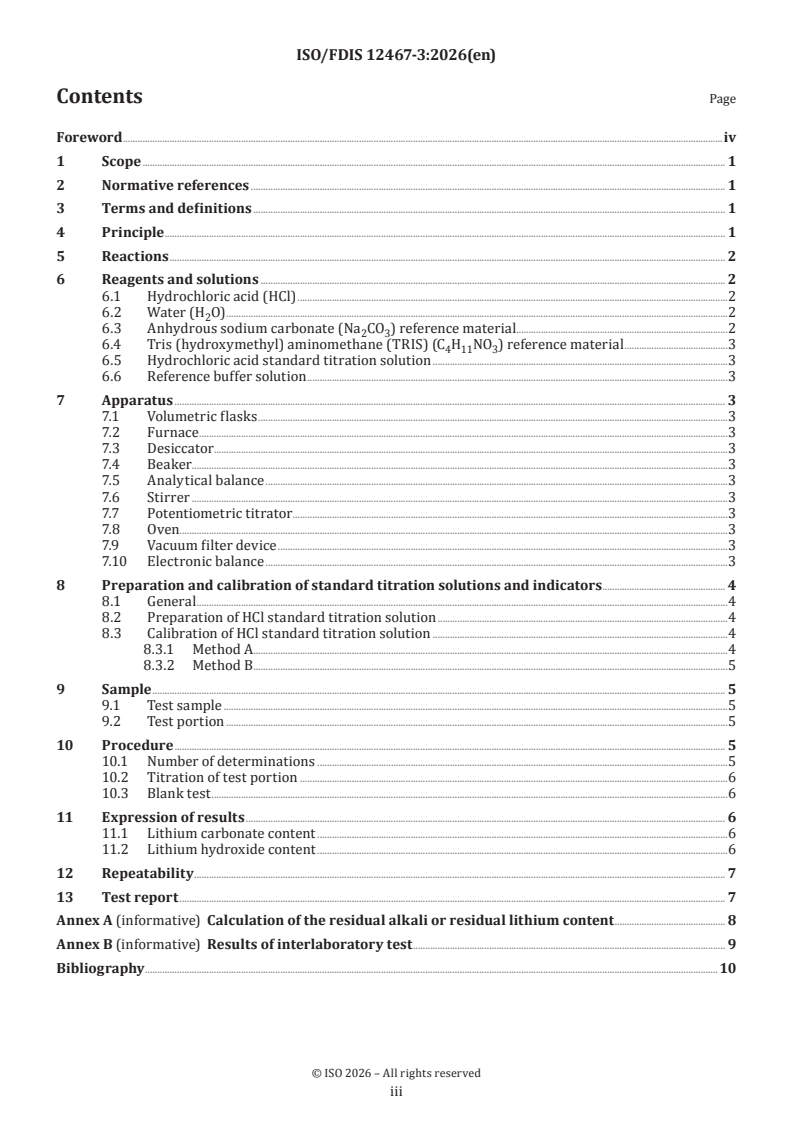

ISO/FDIS 12467-3 - Chemical analysis of lithium composite oxides — Part 3: Determination of lithium carbonate and lithium hydroxide contents
REDLINE ISO/FDIS 12467-3 - Chemical analysis of lithium composite oxides — Part 3: Determination of lithium carbonate and lithium hydroxide contents
ISO 12467-3, published by ISO, specifies a potentiometric titration method for determining lithium carbonate and lithium hydroxide in lithium composite oxides for lithium-ion batteries (LIBs). It is written for analytical laboratories and battery-material users who need to measure surface-related lithium compounds in materials such as lithium cobalt oxide, lithium nickel cobalt manganese oxide, lithium iron phosphate and lithium manganese oxide.
What does ISO 12467-3 specify?
ISO 12467-3 specifies the analytical procedure, the reagents and apparatus, the calibration of hydrochloric acid titrant, the sample preparation steps, the calculation of results, and the test report items. The method is based on extracting the sample with excess water and titrating the filtrate potentiometrically to identify lithium carbonate and lithium hydroxide from two equivalence points.
The document is organized into clauses 1 to 13 and two informative annexes.
| Annex | What it covers |
|---|---|
| Annex A | Calculation of residual alkali and residual lithium content |
| Annex B | Results of an interlaboratory test |
What are the key requirements of ISO 12467-3?
Sample preparation and extraction
ISO 12467-3 requires the test sample to be stored sealed and moisture-free before drying, then dried at 110 °C ± 5 °C for 2 h and cooled in a desiccator. The test portion is weighed to 0,000 1 g, then mixed with water at 25 °C ± 2 °C.
In practice, this means the analyst must control moisture and weighing accuracy because both affect the measured lithium carbonate and lithium hydroxide contents.
Filtration and titration timing
ISO 12467-3 requires mixing at 800 r/min for 5 min, followed by immediate vacuum filtration. The note in the procedure limits filtration to within 30 min after mixing and titration to within 3 h after filtration to reduce the influence of carbon dioxide from air.
This matters because dissolved CO2 can change the alkali balance and shift the titration result.
Potentiometric titration principle
ISO 12467-3 uses hydrochloric acid titration to measure the acid consumed up to the first and second equivalence points, Ep1 and Ep2. These points correspond to the conversion of lithium hydroxide and lithium carbonate-related species in the filtrate.
For the user, the key task is to record the two equivalence-point volumes correctly, because the final contents are calculated from those volumes and a blank correction.
Reagents, titrant preparation and calibration
ISO 12467-3 specifies hydrochloric acid (HCl), carbon-dioxide-free water, anhydrous sodium carbonate reference material, TRIS (tris(hydroxymethyl) aminomethane) reference material, and a reference buffer solution meeting ISO 23496. The HCl titration solution may be prepared and then standardized using either anhydrous sodium carbonate or TRIS.
In practice, the titrant must be calibrated before use, and the pH electrode must be calibrated with ISO 23496 buffer solutions.
Calculation, repeatability and reporting
ISO 12467-3 gives formulas for lithium carbonate content and lithium hydroxide content, both corrected by a blank test and reported to the third decimal place. Clause 12 sets a repeatability limit of ±0,05 %, and clause 13 lists the required test report items, including sample identification, method reference, mean results, deviations and anomalies.
Annex A also provides conversions to residual alkali content and residual lithium content, which are often used in battery-material control.
What terms does ISO 12467-3 define?
- Lithium composite oxides - Cathode-type materials for LIBs that are analyzed for surface lithium carbonate and lithium hydroxide.
- LIBs - Lithium-ion batteries, the application area named in the scope.
- Potentiometric titration - A titration that uses electrode potential to detect equivalence points instead of a color indicator.
- Ep1 and Ep2 - The first and second equivalence points used to calculate lithium hydroxide and lithium carbonate content.
- Blank test - A titration run without the sample to correct for acid consumption from reagents and the system.
- Test portion - The weighed portion of sample used for the actual determination.
- Residual alkali - A derived value calculated from lithium hydroxide and lithium carbonate in Annex A.
- Residual lithium - A derived value calculated from residual alkali in Annex A.
Who uses ISO 12467-3?
ISO 12467-3 is used by analytical laboratories, quality control teams, battery-material manufacturers, and purchasing or specification teams working with lithium composite oxides. It supports routine production testing, incoming inspection, comparative analysis between suppliers, and reporting of lithium carbonate and lithium hydroxide levels in LIB materials.
Which standards are used with ISO 12467-3?
- ISO 1042 - Provides the requirement for the one-mark volumetric flasks used to prepare solutions.
- ISO 3696 - Specifies the water quality used for the reagents and solutions.
- ISO 7819 - Provides the lithium vocabulary used for the terms and definitions.
- ISO 23496 - Provides the reference buffer solutions used to calibrate the pH measuring equipment.
- ISO 5725-1 - Supports the repeatability language and repeatability limit used in clause 12.
What does the ISO 12467-3 document contain?
ISO 12467-3 contains the principle of the method, the reactions used in the titration, and the detailed reagent and apparatus lists. It also includes preparation and calibration steps for HCl standard titration solution, sample drying and weighing instructions, the titration procedure, blank correction, and formulas for calculating lithium carbonate and lithium hydroxide contents.
The informative annexes extend the main method with conversion formulas for residual alkali and residual lithium, plus interlaboratory data in Annex B. Those results help users judge how the method performed across multiple laboratories and sample types such as NMC and LFP.
Buy Documents
ISO/FDIS 12467-3 - Chemical analysis of lithium composite oxides — Part 3: Determination of lithium carbonate and lithium hydroxide contents
REDLINE ISO/FDIS 12467-3 - Chemical analysis of lithium composite oxides — Part 3: Determination of lithium carbonate and lithium hydroxide contents
Get Certified
Connect with accredited certification bodies for this standard

ECOCERT
Organic and sustainability certification.

Eurofins Food Testing Global
Global leader in food, environment, and pharmaceutical product testing.

Intertek Bangladesh
Intertek certification and testing services in Bangladesh.
Sponsored listings
Frequently Asked Questions
ISO 12467-3 is a draft published by the International Organization for Standardization (ISO). Its full title is "Chemical analysis of lithium composite oxides — Part 3: Determination of lithium carbonate and lithium hydroxide contents". This standard covers: This document specifies potentiometric titration methods for the determination of lithium carbonate and lithium hydroxides content in lithium composite oxides for lithium-ion batteries (LIBs). The method is applicable to lithium composite oxides for LIBs with a mass fraction of lithium carbonate and lithium hydroxides in the range from 0.001% to 2.500%.
This document specifies potentiometric titration methods for the determination of lithium carbonate and lithium hydroxides content in lithium composite oxides for lithium-ion batteries (LIBs). The method is applicable to lithium composite oxides for LIBs with a mass fraction of lithium carbonate and lithium hydroxides in the range from 0.001% to 2.500%.
ISO 12467-3 is classified under the following ICS (International Classification for Standards) categories: 71.040.40 - Chemical analysis. The ICS classification helps identify the subject area and facilitates finding related standards.
ISO 12467-3 is available in PDF format for immediate download after purchase. The document can be added to your cart and obtained through the secure checkout process. Digital delivery ensures instant access to the complete standard document.
Standards Content (Sample)
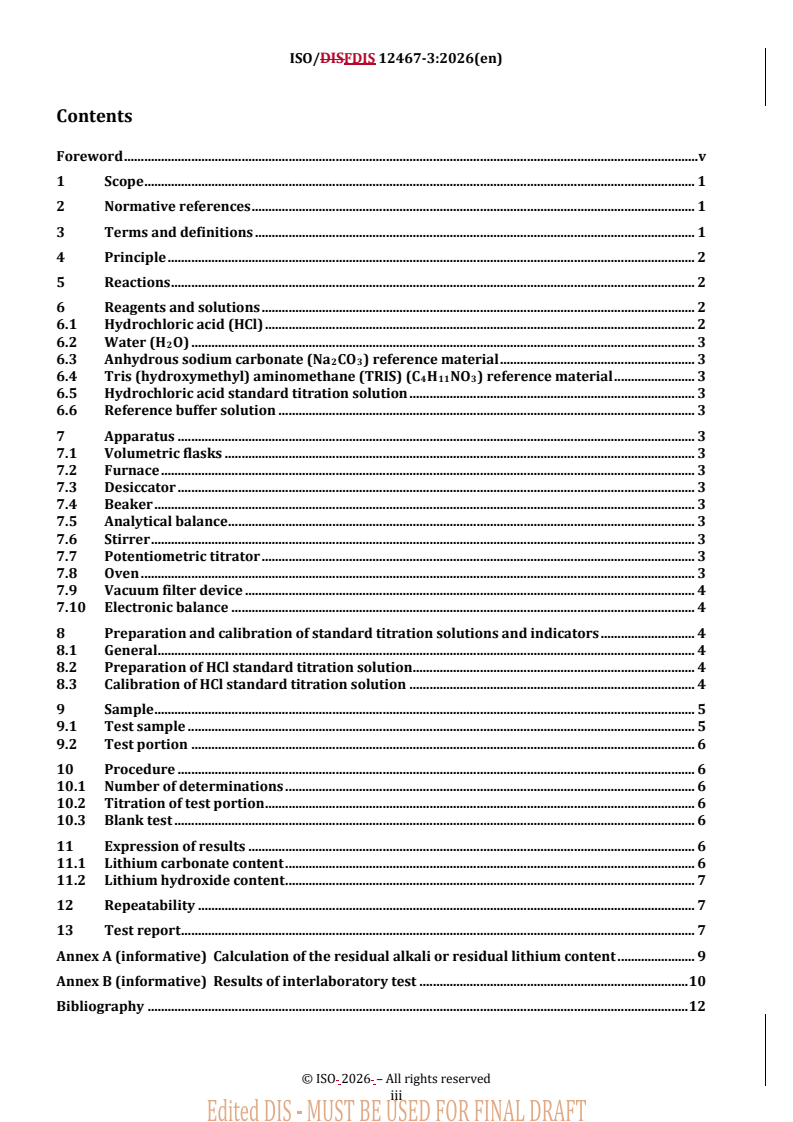
Contents
- 1 Scope
- 2 Normative references
- 3 Terms and definitions
- 4 Principle
- 5 Reactions
- 6 Reagents and solutions
- 6.1 Hydrochloric acid (HCl)
- 6.2 Water (H O)
- 6.3 Anhydrous sodium carbonate (Na CO ) reference material
- 6.4 Tris (hydroxymethyl) aminomethane (TRIS) (C H NO ) reference material
- 6.5 Hydrochloric acid standard titration solution
- 6.6 Reference buffer solution
- 7 Apparatus
- 7.1 Volumetric flasks
- 7.2 Furnace
- 7.3 Desiccator
- 7.4 Beaker
- 7.5 Analytical balance
- 7.6 Stirrer
- 7.7 Potentiometric titrator
- 7.8 Oven
- 7.9 Vacuum filter device
- 7.10 Electronic balance
- 8 Preparation and calibration of standard titration solutions and indicators
- 8.1 General
- 8.2 Preparation of HCl standard titration solution
- 8.3 Calibration of HCl standard titration solution
- 9 Sample
- 9.1 Test sample
- 9.2 Test portion
- 10 Procedure
- 10.1 Number of determinations
- 10.2 Titration of test portion
- 10.3 Blank test
- 11 Expression of results
- 11.1 Lithium carbonate content
- 11.2 Lithium hydroxide content
- 12 Repeatability
- 13 Test report
- Annex A
- Annex B
- Bibliography
1 Scope
This document specifies an analytical procedure for the determination of lithium carbonate and lithium hydroxides content in lithium composite oxides, such as lithium cobalt oxide, lithium nickel cobalt manganese oxide, lithium iron phosphate, lithium manganese oxide and so on. This document also specifies a potentiometric titration method for the determination of lithium carbonate and hydroxide content in lithium composite oxides for lithium-ion batteries (LIBs). The method is applicable to lithium composite oxides for LIBs with a mass fraction of lithium carbonate contents in the range from 0,001 % to 1,500 % and lithium hydroxide contents in the range from 0,001 % to 1,000 %.
2 Normative references
The following documents are referred to in the text in such a way that some or all of their content constitutes requirements of this document. For dated references, only the edition cited applies. For undated references, the latest edition of the referenced document (including any amendments) applies. ISO 1042, Laboratory glassware — One-mark volumetric flasks ISO 3696, Water for analytical laboratory use — Specification and test methods ISO 7819, Lithium — Vocabulary ISO 23496, Determination of pH value — Reference buffer solutions for the calibration of pH measuring equipment
3 Terms and definitions
For the purposes of this document, the terms and definitions given in ISO 7819 apply. ISO and IEC maintain terminological databases for use in standardization at the following addresses:
- ISO Online browsing platform: available at https:// www .iso .org/ obp
- IEC Electropedia: available at http:// www .electropedia .org/
4 Principle
The residual lithium exists on the surface of the materials which can be dissolved in excessive water. By mixing the sample and excessive water, the solution will contain the lithium, carbonate and hydroxide ions.
ISO/FDIS 12467-3:2026(en) By using the titration method, the content of carbonate and hydroxide ions in the filtrated solution can be determined. In this document, the potentiometric titration method is adopted. The order of reaction with the acid solution is different for carbonate and hydroxide ions. By locating the potential equivalence of the solution, the content of carbonate and hydroxide can be calculated from the acid consumption of the twoequivalence points.
5 Reactions
The lithium carbonate and lithium hydroxide in the sample are permitted to dissolve in water and are then filtered. When the filtrate is subjected to auto-potentiometric titration using a hydrochloric acid standard titration solution, the following reaction occurs:
LiOH+HCl→LiCl+H O
Li CO +HCl→LiHCO +LiCl 2 3 3 With the continuous addition of hydrochloric acid standard titration solution, all of the lithium hydroxide is transformed into LiCl and H O, and all of the lithium carbonate is transformed into LiHCO and LiCl. At this 2 3 stage, the pH value is about 8,5 ± 0,5, and the potential of the automatic potentiometric titrator electrode will reach an equivalence point Ep . Then, continue to add the drop of hydrochloric acid standard titration
solution, and the following reaction occurs:
LiHCO +HCl→LiCl+CO ↑+H O 3 2 2 Lithium bicarbonate will be completely transformed into LiCl, CO and H O. At this stage, the pH value is 2 2 about 4,5 ± 0,5, and the potential of the automatic potentiometric titrator electrode will reach another equivalence point Ep . By recording the potential equivalence point Ep1 and Ep corresponding to the 2 2 consumption of hydrochloric acid standard titration solution, lithium carbonate and lithium hydroxide content in the sample can be calculated respectively.
6 Reagents and solutions
WARNING — Concentrated mineral acids (6.1) are corrosive, highly reactive and acid vapour is an irritant. Avoid contact with the skin or eyes, or inhalation of the vapour. Use suitable personal protective equipment (e.g., gloves, face shield or safety goggles, etc.) when working with concentrated or dilute acid. Handle open vessels containing concentrated acid in a fume hood. Do not add water to acid, as the reaction is violent. Small aliquots of acid shall be added slowly to larger volumes of water. The vapour pressure of acid is high; beware of pressure build-up in stoppered flasks when preparing acid and water mixtures.
6.1 Hydrochloric acid (HCl)
®1) CAS Registry Number 7647-01-0, specific gravity 1,19 g/ml.
6.2 Water (H O)
CAS RN 7732-18-5, conforming to Grade 2 as defined in ISO 3696. All water used shall be boiled and then cooled to room temperature or purged with inert gas to ensure it is free of carbon dioxide.
6.3 Anhydrous sodium carbonate (Na CO ) reference material
2 3
CAS RN 497-19-8, reference grade, purity ≧99,9 % (mass fraction), used for HCl standardization. 1) CAS Registry Number® is a trademark of the American Chemical Society (ACS). This information is given for the convenience of users of this document and does not constitute an endorsement by ISO of the product named. Equivalent products may be used if they can be shown to lead to the same results.
ISO/FDIS 12467-3:2026(en)
6.4 Tris (hydroxymethyl) aminomethane (TRIS) (C H NO ) reference material
4 11 3
CAS RN 77-86-1, reference grade, purity ≧99,88 % (mass fraction), used for HCl standardization.
6.5 Hydrochloric acid standard titration solution
Concentration of 0,1 mol/l (0,10 N), preferably obtained commercially with a certificate of analysis.
6.6 Reference buffer solution
Meet the requirements of ISO 23496.
NOTE During the analysis, use only reagents of recognized grade.
7 Apparatus
7.1 Volumetric flasks
Use volumetric flasks with graduation markings that conform to the requirements of ISO 1042, Class A.
7.2 Furnace
7.3 Desiccator
7.4 Beaker
7.5 Analytical balance
Readable to the nearest 0,000 1 g and equipped with tare compensation.
7.6 Stirrer
Generally, propeller and magnetic stirrers are recommended. Magnetic stirrer will require a magnetic stirrer bar. Speed should be set to sufficient to ensure rapid mixing of the solution without vortexing around the electrode or dosing tips.
7.7 Potentiometric titrator
With pH glass acid-base electrode. The pH electrode of the potentiometric titrator shall be calibrated in accordance with ISO 23496 before titration. The potentiometer shall have 2,0 mV sensitivity, covering the range −1,0 V to +1,0 V.
7.8 Oven
Operate in air, and temperature range and control shall meet the drying requirements which is 110 ± 5 °C.
7.9 Vacuum filter device
7.10 Electronic balance
Readable to the nearest 0,001 g and equipped with tare compensation.
ISO/FDIS 12467-3:2026(en)
8 Preparation and calibration of standard titration solutions and indicators
8.1 General
Certified, commercially available titrants should be used, in the form of ready-for-use solutions whose concentration has been standardized by the manufacturer. Standard titration solutions with a calibration certificate or self-prepared and calibrated solutions shall be used, and the calibrated concentration before use shall prevail.
...
Contents
- 1 Scope
- 2 Normative references
- 3 Terms and Definitionsdefinitions
- 4 Principle
- 5 Reactions
- 6 Reagents and solutions
- 6.1 Hydrochloric acid (HCl)
- 6.2 Water (H O)
- 6.3 Anhydrous sodium carbonate (Na CO ) reference material
- 6.4 Tris (hydroxymethyl) aminomethane (TRIS) (C4H11NO3) reference material
- 6.5 Hydrochloric acid standard titration solution
- 6.6 Reference buffer solution
- 7 Apparatus
- 7.1 Volumetric flasks
- 7.2 Furnace
- 7.3 Desiccator
- 7.4 Beaker
- 7.5 Analytical balance
- 7.6 Stirrer
- 7.7 Potentiometric titrator
- 7.8 Oven
- 7.9 Vacuum filter device
- 7.10 Electronic balance
- 8 Preparation and calibration of standard titration solutions and indicators
- 8.1 General
- 8.2 Preparation of HCl standard titration solution
- 8.3 Calibration of HCl standard titration solution
- 9 Sample
- 9.1 Test sample
- 9.2 Test portion
- 10 Procedure
- 10.1 Number of determinations
- 10.2 Titration of test portion
- 10.3 Blank test
- 11 Expression of results
- 11.1 Lithium carbonate content
- 10 ×𝑚𝑚 ×𝑚𝑚
- 11.2 Lithium hydroxide content
- 10 ×𝑚𝑚 ×𝑚𝑚
- 12 Repeatability
- 13 Test report
- Annex A
- Annex B
- Bibliography
1 Scope
This document specifies an analytical procedure for the determination of lithium carbonate and lithium hydroxides content in lithium composite oxides, such as lithium cobalt oxide, lithium nickel cobalt manganese oxide, lithium iron phosphate, lithium manganese oxide and so on. This document also specifies a potentiometric titration method for the determination of lithium carbonate and hydroxide content in lithium composite oxides for lithium-ion batteries (LIBs). The method is applicable to lithium composite oxides for LIBs with a mass fraction of lithium carbonate contents in the range from 0,001 % to 1,500 % and lithium hydroxide contents in the range from 0,001 % to 1,000 %.
2 Normative references
The following documents are referred to in the text in such a way that some or all of their content constitutes requirements of this document. For dated references, only the edition cited applies. For undated references, the latest edition of the referenced document (including any amendments) applies. ISO 1042, Laboratory glassware — One-mark volumetric flasks ISO 3696, Water for analytical laboratory use — Specification and test methods ISO 7819, Lithium — Vocabulary ISO 23496, Determination of pH value — Reference buffer solutions for the calibration of pH measuring equipment
3 Terms and Definitionsdefinitions
For the purposes of this document, the terms and definitions given in ISO 7819 apply. ISO and IEC maintain terminological databases for use in standardization at the following addresses:
- — ISO Online browsing platform: available at https://www.iso.org/obphttps://
- — IEC Electropedia: available at http://www.electropedia.org/
ISO/FDIS 12467-3:2026(en)
4 Principle
The residual lithium exists on the surface of the materials which can be dissolved in excessive water. By mixing the sample and excessive water, the solution will contain the lithium, carbonate and hydroxide ions. By using the titration method, the content of carbonate and hydroxide ions in the filtrated solution can be determined. In this document, the potentiometric titration method is adopted. The order of reaction with the acid solution is different for carbonate and hydroxide ions. By locating the potential equivalence of the solution, the content of carbonate and hydroxide can be calculated from the acid consumption of the two-equivalence points.
5 Reactions
The lithium carbonate and lithium hydroxide in the sample are permitted to dissolve in water and are then filtered. When the filtrate is subjected to auto-potentiometric titration using a hydrochloric acid standard titration solution, the following reaction occurs:
LiOH+HCl→LiCl+H O
Li CO +HCl→LiHCO +LiCl 2 3 3 With the continuous addition of hydrochloric acid standard titration solution, all of the lithium hydroxide is transformed into LiCl and H O, and all of the lithium carbonate is transformed into LiHCO and LiCl. At this 2 3 stage, the pH value is about 8,5 ± 0,5, and the potential of the automatic potentiometric titrator electrode will reach aan equivalence point Ep . Then, continue to add the drop of hydrochloric acid standard titration
solution, and the following reaction occurs:
LiHCO +HCl→LiCl+CO ↑+H O 3 2 2 Lithium bicarbonate will be completely transformed into LiCl, CO and H O. At this stage, the pH value is about 2 2 4,5 ± 0,5, and the potential of the automatic potentiometric titrator electrode will reach another equivalence point Ep . By recording the potential equivalence point Ep1 and Ep corresponding to the consumption of 2 2 hydrochloric acid standard titration solution, lithium carbonate and lithium hydroxide content in the sample can be calculated respectively.
6 Reagents and solutions
WARNING –— Concentrated mineral acids (6.1(6.1)) are corrosive, highly reactive and acid vapour is an irritant. Avoid contact with the skin or eyes, or inhalation of the vapour. Use suitable personal protective equipment (e.g., gloves, face shield or safety goggles, etc.) when working with concentrated or dilute acid. Handle open vessels containing concentrated acid in a fume hood. Do not add water to acid, as the reaction is violent. Small aliquots of acid shall be added slowly to larger volumes of water. The vapour pressure of acid is high; therefore beware of pressure build-up in stoppered flasks when preparing acid and water mixtures.
6.1 Hydrochloric acid (HCl)
®11) CAS Registry Number 7647-01-0, specific gravity 1,19 g/ml.
1) CAS Registry Number® is a trademark of the American Chemical Society (ACS). This information is given for the convenience of users of this document and does not constitute an endorsement by ISO of the product named. Equivalent products may be used if they can be shown to lead to the same results.
ISO/DISFDIS 12467-3:2026(en)
6.2 Water (H O)
CAS RN 7732-18-5, conforming to Grade 2 as defined in ISO 3696. All water used shall be boiled and then cooled to room temperature or purged with inert gas to ensure it is free of carbon dioxide.
6.3 Anhydrous sodium carbonate (Na CO ) reference material
2 3
CAS RN 497-19-8, reference grade, purity ≧99,9 % (mass fraction), used for HCl standardization.
6.4 Tris (hydroxymethyl) aminomethane (TRIS) (C4H11NO3) reference material
CAS RN 77-86-1, reference grade, purity ≧99,88 % (mass fraction), used for HCl standardization.
6.5 Hydrochloric acid standard titration solution
Concentration of 0,1 mol/l (0,10 N), preferably obtained commercially with a certificate of analysis.
6.6 Reference buffer solution
Meet the requirements of ISO 23496.
NOTE During the analysis, use only reagents of recognized grade.
7 Apparatus
7.1 Volumetric flasks
Use volumetric flasks with graduation markings that conform to the requirements of ISO 1042, Class A.
7.2 Furnace
7.3 Desiccator
7.4 Beaker
7.5 Analytical balance
Readable to the nearest 0,000 1 g and equipped with tare compensation.
7.6 Stirrer
Generally, propeller and magnetic stirrers are recommended. Magnetic stirrer will require a magnetic stirrer bar. Speed should be set to sufficient to ensure rapid mixing of the solution without vortexing around the electrode or dosing tips.
7.7 Potentiometric titrator
With pH glass acid-base electrode. The pH electrode of the potentiometric titrator shall be calibrated in accordance with ISO 23496 before titration. The potentiometer shall have 2,0 mV sensitivity, covering the range −1,0 V to +1,0 V.
7.8 Oven
Operate in air, and temperature range and control shall meet the drying requirements which is 110 ± 5 °C.
ISO/FDIS 12467-3:2026(en)
7.9 Vacuum filter device
7.10 Electronic balance
Readable to the nearest 0,001 g and equipped with tare compensation.
8 Preparation and calibration of standard titration solutions and indicators
8.1 General
Certified, commercially available titrants should be used, in the form of ready-for-use solutions whose concentration has been standardized by the manufacturer. Standard titration solutions with a calibration certificate or self-prepared and calibrated solutions shall be used, and the calibrated concentration before use shall prevail.
If no certified HCl solution is available, procedure specified in subclause 8.2subclause 8.2, 8.3 and 8.3 is recommended.
...