

ISO 12467-2
(Main)Chemical analysis of lithium composite oxides — Part 2: Determination of trace elemental impurities by inductively coupled plasma optical emission spectrometry
- Abstract
This document describes an analytical procedure for the determination of trace elements in Li composite oxides for Li-ion battery (LiB). These are in particular the elements: aluminium (Al), barium (Ba), calcium (Ca), copper (Cu), iron (Fe), lead (Pb), magnesium (Mg), molybdenum (Mo), phosphorus (P), sodium (Na), strontium (Sr), titanium (Ti), zinc (Zn), zirconium (Zr) in Li composite oxides. The determination is performed by optical emission spectrometry with inductively coupled plasma (ICP-OES).
- Status
- Not Published
- Technical Committee
- ISO/TC 333 - Lithium
- Drafting Committee
- ISO/TC 333/WG 6 - Analysis for lithium cathode materials
- Current Stage
- 6000 - International Standard under publication - 60 Publication
- Start Date
- 22-Oct-2026
Buy Documents

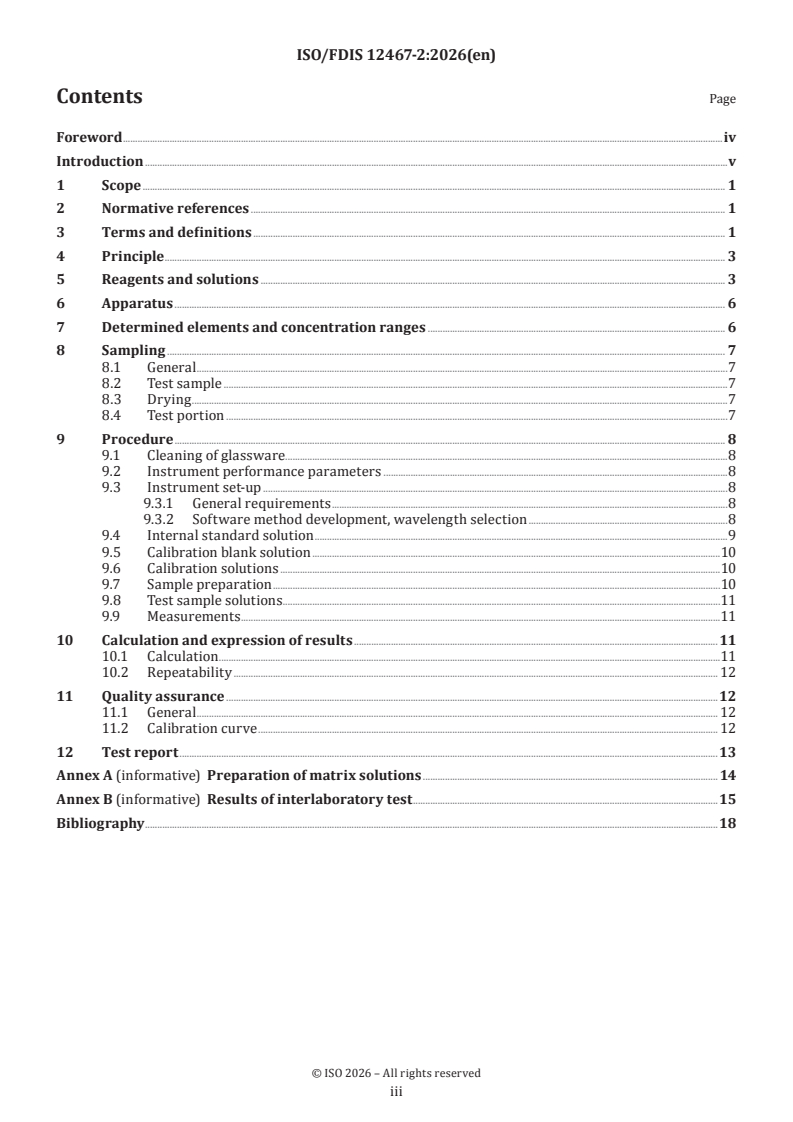

ISO/FDIS 12467-2 - Chemical analysis of lithium composite oxides — Part 2: Determination of trace elemental impurities by inductively coupled plasma optical emission spectrometry


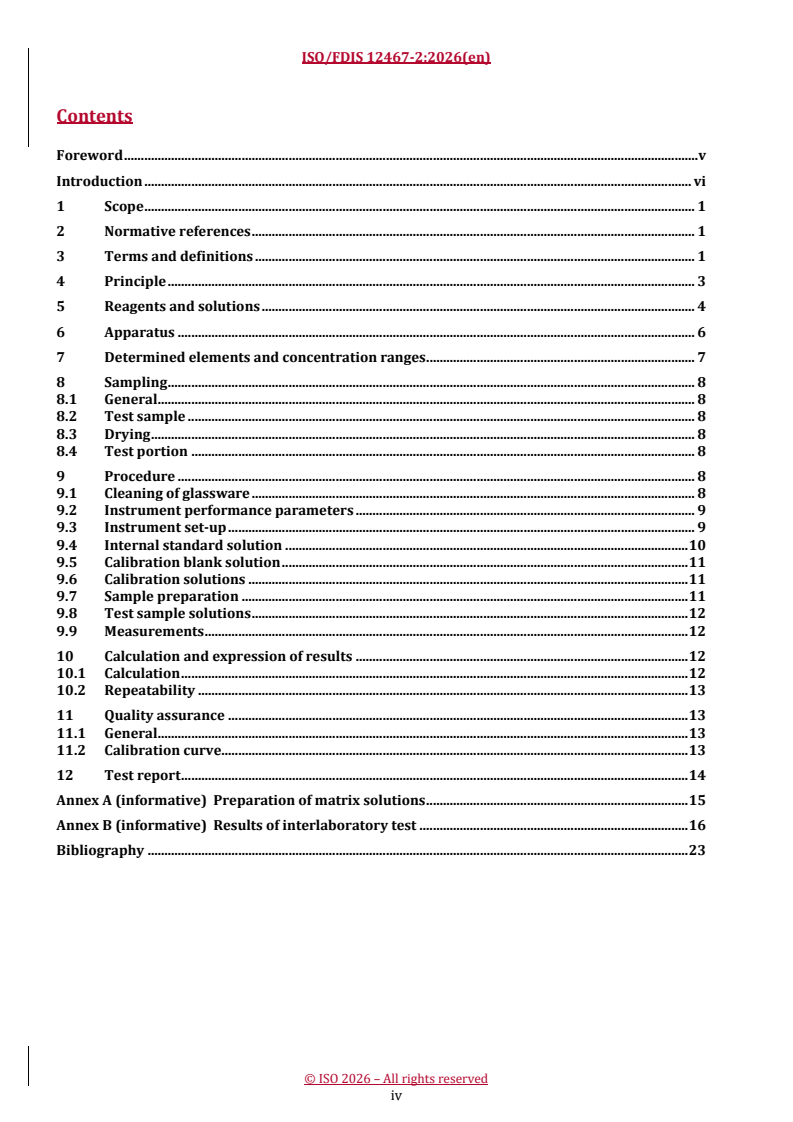
REDLINE ISO/FDIS 12467-2 - Chemical analysis of lithium composite oxides — Part 2: Determination of trace elemental impurities by inductively coupled plasma optical emission spectrometry
ISO 12467-2 is an International Standard from ISO for the chemical analysis of lithium composite oxides. It specifies an inductively coupled plasma optical emission spectrometry (ICP-OES) procedure for measuring trace elemental impurities in lithium composite oxides used for Li-ion batteries (LiBs), for laboratories and other users who need to check impurity content. It is focused on trace analysis, not on determining the main components of the material.
What does ISO 12467-2 specify?
ISO 12467-2 specifies a test method for trace elements in lithium composite oxides for LiBs, using ICP-OES after sample dissolution. The scope includes the listed impurity elements and notes that the method is for trace impurities rather than the main components.
The document is organized into clauses on scope, normative references, terms and definitions, principle, reagents and solutions, apparatus, working ranges, sampling, procedure, calculation and expression of results, quality assurance, and test report. It also includes two informative annexes.
| Annex | What it covers |
|---|---|
| Annex A | Preparation of matrix solutions |
| Annex B | Results of interlaboratory test |
Clause 1 notes that the term lithium composite oxides covers lithium-containing cathode materials such as layered oxides, spinel oxides and phosphate-based materials. It also says the method can be applied to the other listed elements if the user has verified applicability in their case.
What are the key requirements of ISO 12467-2?
ISO 12467-2 is built around solution-based ICP-OES measurement with matrix matching, internal standardization, and calibration control. In practice, that means the laboratory must control sample preparation, instrument settings, and quality checks closely enough to keep trace-element results reliable.
Principle and measurement approach
Clause 4 states that the sample is measured by ICP-OES, where the dissolved sample is nebulized into an argon plasma and the emitted spectral lines are used for quantification. The document describes using emission intensity compared with standards, and it allows an internal standard to improve accuracy.
For the reader, this means the material must be brought into solution before analysis, and the lab needs a spectrometer setup that can compare analyte lines with known calibration solutions.
Reagents, solutions, and matrix matching
Clause 5 requires analytical-grade reagents or better and deionized water or equivalent purity. It lists the acids and stock solutions used to prepare calibration and matrix solutions, and it gives examples of stock solutions for different lithium composite oxide types in Table 1.
This matters because trace analysis is sensitive to contamination and matrix effects. The lab has to prepare calibration solutions that match the sample matrix closely, and it must handle the acids safely, especially hydrofluoric acid (HF), perchloric acid, and concentrated mineral acids.
Apparatus and instrument capability
Clause 6 requires an ICP-OES with simultaneous measurement of analyte and internal standard wavelengths and a minimum optical resolution of 0.02 nm. It also calls for controlled gas flows, a balance accurate to 0.1 mg, acid-resistant sample containers and volumetric flasks, and argon with purity of at least 99.995% by mass.
In practice, the instrument must be stable enough for trace work, and the labware must not introduce contamination or attack by acids. The standard also points to the need for a clean torch, spray chamber, and sample uptake lines.
Sampling and test portion
Clause 8 says sampling should follow ISO 8656-1 unless otherwise agreed. The laboratory sample is homogenized, dried if needed, and a test portion of about 500 mg is weighed to the nearest 0.1 mg.
This is important because non-representative sampling can dominate the result. The method assumes a homogeneous portion that can be digested consistently and compared across laboratories.
Sample preparation and blank control
Clause 9 describes acid digestion, typically with aqua regia, and gives an alternate stronger acid mixture for insoluble material. A blank test solution must be prepared in parallel through the same preparation steps without the test portion.
For routine work, this means the digestion step is part of the analytical result, not just a pre-treatment. The blank checks contamination from reagents, vessels, and handling.
Calibration, wavelength choice, and quality checks
Clause 9 requires calibration with a blank and at least three standards, linearity checking, and a calibration curve control prepared from a different lot, batch, or supplier. It also requires checking instrument performance, selecting suitable wavelengths, and using only wavelengths without interference.
Clause 11 adds calibration-curve acceptance criteria, including linear regression through the blank, minimum replicates, precision limits, and a determination coefficient requirement. In practice, the laboratory has to demonstrate that the calibration behaves properly before reporting sample values.
Calculation, repeatability, and reporting
Clause 10 bases the calculation on internal-standard ratios and gives the expression for converting solution concentration to mg/kg in the sample. Duplicate determinations must agree within 10.0% relative, otherwise the digestion is repeated.
Clause 12 requires the test report to identify the sample, sampling procedure, method reference, analyte content, deviations, unusual observations, test date, laboratory, and responsible personnel. That makes the result traceable for quality control, supplier approval, or dispute resolution.
What terms does ISO 12467-2 define?
ISO 12467-2 defines the sample chain used in chemical analysis, from the laboratory sample to the test portion and test solution.
- Laboratory sample - the sample prepared for sending to the laboratory and intended for inspection or testing.
- Test sample - the sample prepared from the laboratory sample from which test portions are taken.
- Test portion - the quantity actually taken for the test or observation.
- Test sample solution - the solution obtained after extraction or digestion of the test sample, before any further dilution or internal-standard addition.
- Stock solution - a solution of known analyte concentration used to prepare working standards or calibration solutions.
- Calibration solution - a diluted standard used to calibrate the analytical instrument.
- Calibration blank solution - a calibration solution prepared without stock standard addition.
- Calibration curve control - an independently prepared standard used to check the calibration curve near its midpoint.
- Linearity - the straight-line relationship between signal and concentration over the calibration range.
- Instrument detection limit - the lowest concentration detectable with defined statistical probability using a clean instrument and clean solution.
Who uses ISO 12467-2?
ISO 12467-2 is used by analytical laboratories that test lithium composite oxides for battery applications. It is also relevant to quality control teams in battery-material manufacturing, suppliers who need to verify impurity levels, and buyers who need incoming or acceptance testing.
The method is most useful where trace impurities matter to product quality and consistency. It supports routine release testing, supplier verification, method validation, and interlaboratory comparison.
Which standards are used with ISO 12467-2?
ISO 12467-2 refers to several standards that support sampling, terminology, and lab practice.
- ISO 7819 - provides the lithium vocabulary used for terms and definitions.
- ISO 1042 - specifies one-mark volumetric flasks used for solution preparation.
- ISO 8656-1 - provides the sampling scheme used for collecting the material.
- ISO 12467-1 - gives the method for determining the main components of lithium composite oxides.
- ISO 3696 - is cited for grade 1 water used in reagent preparation.
- ISO/IEC 17025 - is referenced for laboratory competence and quality assurance.
- ISO 78-2, ISO 15202-1, ISO 15202-3, ISO 17294-1, ISO/IEC Guide 99, ISO 22036 - appear as source standards for definitions used in Clause 3.
What does the ISO 12467-2 document contain?
ISO 12467-2 contains the full workflow for trace-element analysis of lithium composite oxides by ICP-OES. The body of the document covers principle, reagents, apparatus, sampling, digestion, measurement, calculation, quality assurance, and reporting.
The tables are practically important: Table 1 gives recommended stock solutions for different lithium composite oxide types, Table 2 gives the working ranges for the determined elements, Table 3 gives example analytical wavelengths, Table 4 gives an example calibration set, and Table 5 gives internal-standard wavelengths. Annex A provides example matrix solutions, and Annex B summarizes interlaboratory test results used for method validation.
Buy Documents
ISO/FDIS 12467-2 - Chemical analysis of lithium composite oxides — Part 2: Determination of trace elemental impurities by inductively coupled plasma optical emission spectrometry
REDLINE ISO/FDIS 12467-2 - Chemical analysis of lithium composite oxides — Part 2: Determination of trace elemental impurities by inductively coupled plasma optical emission spectrometry
Get Certified
Connect with accredited certification bodies for this standard

ECOCERT
Organic and sustainability certification.

Eurofins Food Testing Global
Global leader in food, environment, and pharmaceutical product testing.

Intertek Bangladesh
Intertek certification and testing services in Bangladesh.
Sponsored listings
Frequently Asked Questions
ISO 12467-2 is a draft published by the International Organization for Standardization (ISO). Its full title is "Chemical analysis of lithium composite oxides — Part 2: Determination of trace elemental impurities by inductively coupled plasma optical emission spectrometry". This standard covers: This document describes an analytical procedure for the determination of trace elements in Li composite oxides for Li-ion battery (LiB). These are in particular the elements: aluminium (Al), barium (Ba), calcium (Ca), copper (Cu), iron (Fe), lead (Pb), magnesium (Mg), molybdenum (Mo), phosphorus (P), sodium (Na), strontium (Sr), titanium (Ti), zinc (Zn), zirconium (Zr) in Li composite oxides. The determination is performed by optical emission spectrometry with inductively coupled plasma (ICP-OES).
This document describes an analytical procedure for the determination of trace elements in Li composite oxides for Li-ion battery (LiB). These are in particular the elements: aluminium (Al), barium (Ba), calcium (Ca), copper (Cu), iron (Fe), lead (Pb), magnesium (Mg), molybdenum (Mo), phosphorus (P), sodium (Na), strontium (Sr), titanium (Ti), zinc (Zn), zirconium (Zr) in Li composite oxides. The determination is performed by optical emission spectrometry with inductively coupled plasma (ICP-OES).
ISO 12467-2 is classified under the following ICS (International Classification for Standards) categories: 71.040.40 - Chemical analysis. The ICS classification helps identify the subject area and facilitates finding related standards.
ISO 12467-2 is available in PDF format for immediate download after purchase. The document can be added to your cart and obtained through the secure checkout process. Digital delivery ensures instant access to the complete standard document.
Standards Content (Sample)
Contents
- Introduction
- 1 Scope
- 2 Normative references
- 3 Terms and definitions
- 3.1 laboratory sample
- 3.2 test sample
- 3.3 test portion
- 3.4 test sample solution
- 3.5 standard solution
- 3.6 stock solution
- 3.7 calibration solution
- 3.8 calibration blank solution
- 3.9 blank test solution
- 3.10 calibration curve
- 3.11 calibration curve control
- 3.12 linearity
- 4 Principle
- 5 Reagents and solutions
- 5.8 Single element standard stock solutions
- 5.10 Matrix solution
- 6 Apparatus
- 6.1 Inductively coupled argon plasma optical emission spectrometer
- 6.5 Argon gas supply, purity ≥ 99,995 % (mass fraction)
- 7 Determined elements and concentration ranges
- 8 Sampling
- 8.1 General
- 8.2 Test sample
- 8.3 Drying
- 8.4 Test portion
- 9 Procedure
- 9.1 Cleaning of glassware
- 9.2 Instrument performance parameters
- 9.3 Instrument set-up
- 9.4 Internal standard solution
- 9.5 Calibration blank solution
- 9.6 Calibration solutions
- 9.7 Sample preparation
- 9.8 Test sample solutions
- 9.9 Measurements
- 10 Calculation and expression of results
- 10.1 Calculation
- 10.2 Repeatability
- 11 Quality assurance
- 11.1 General
- 11.2 Calibration curve
- 12 Test report
- Annex A
- Annex B
- Bibliography
Introduction
Lithium, its alloys and compounds are technologically important and highly versatile materials, and are used in various industries, such as electronics, ceramics, glasses, medicine, etc. Lithium is the lightest solid element, and due to the high electrochemical potential of the redox couple Li/ Li+, its main use is as cathode material in lithium ion batteries in electric vehicles, laptops, mobile phones and digital cameras. Lithium materials are classified into different grades, according to their chemical and physical characteristics, including purity, impurities, and particle size. The metal impurity ions, such as aluminium (Al), barium (Ba), boron (B), calcium (Ca), cobalt (Co), chromium (Cr), copper (Cu), iron (Fe), lead (Pb), manganese (Mn), magnesium (Mg), molybdenum (Mo), nickel (Ni), phosphorus (P), potassium (K), sodium (Na), strontium (Sr), sulfur (S), tin (Sn), titanium (Ti), vanadium (V), zinc (Zn), and zirconium (Zr) in lithium materials have a higher reduction potential than lithium ions. Therefore, the content of metal impurity ions are an important index to monitor product quality. The determination of metal ion content by inductively coupled plasma optical emission spectrometry (ICP-OES) has numerous advantages, such as simple sample-pre-treatment, high accuracy and low detection limit.
FINAL DRAFT International Standard ISO/FDIS 12467-2:2026(en) Chemical analysis of lithium composite oxides — Part 2:
Determination of trace elemental impurities by inductively coupled plasma optical emission spectrometry WARNING — The use of this document can involve hazardous materials, operations, and equipment. This document does not purport to address any safety problems associated with its use. It is the responsibility of the user of this document to establish appropriate safety and health practices and determine the applicability of regulatory limitations prior to use.
1 Scope
This document specifies an analytical procedure for the determination of trace elements in lithium composite oxides for Li-Ion batteries (LiBs).
This method applies to the following elements: aluminum (Al), barium (Ba), boron (B), calcium (Ca), cobalt (Co), chromium (Cr), copper (Cu), iron (Fe), lead (Pb), manganese (Mn), magnesium (Mg), molybdenum (Mo), nickel (Ni), phosphorus (P), potassium (K), sodium (Na), strontium (Sr), sulfur (S), tin (Sn), titanium (Ti), vanadium (V), zinc (Zn), zirconium (Zr) can be found in lithium materials. NOTE 1 For the purposes of this document, the term "lithium composite oxides" includes lithium-containing cathode materials such as layered oxides, spinel oxides and phosphate-based materials. This document does not apply to the determination of the main components of lithium composite oxide. NOTE 2 For methods for the determination of main components, see ISO 12467-1. NOTE 3 The method is applicable for the other elements listed above, provided the user has verified the applicability.
2 Normative references
The following documents are referred to in the text in such a way that some or all of their content constitutes requirements of this document. For dated references, only the edition cited applies. For undated references, the latest edition of the referenced document (including any amendments) applies. ISO 1042, Laboratory glassware — One-mark volumetric flasks ISO 7819, Lithium — Vocabulary ISO 8656-1, Refractory products — Sampling of raw materials and unshaped products — Part 1: Sampling scheme
3 Terms and definitions
For the purposes of this document, the terms and definitions given in ISO 7819 and the following apply. ISO and IEC maintain terminology databases for use in standardization at the following addresses:
- ISO Online browsing platform: available at https:// www .iso .org/ obp
- IEC Electropedia: available at https:// www .electropedia .org/
ISO/FDIS 12467-2:2026(en)
3.1 laboratory sample
sample as prepared for sending to the laboratory and intended for inspection or testing [SOURCE: ISO 78-2:1999, 3.1]
3.2 test sample
sample prepared from the laboratory sample (3.1) and from which test portions (3.3) will be taken [SOURCE: ISO 78-2:1999, 3.2]
3.3 test portion
quantity of material drawn from the test sample (3.2) (or from the laboratory sample if both are the same) and on which the test or observation is actually carried out [SOURCE: ISO 78-2:1999, 3.3]
3.4 test sample solution
solution prepared after extraction or digestion of the test sample according to appropriate specifications Note 1 to entry: A sample solution can be subjected to further operations, e.g., dilution and/or addition of an internal standard, in order to produce a test solution that is ready for analysis. [SOURCE: ISO 22036:2024, 3.10]
3.5 standard solution
solution of accurately known concentration of an element, an ion, a compound or a group derived from the substance used for its preparation [SOURCE: ISO 78-2:1999, 3.6]
3.6 stock solution
solution used for preparation of working standard solutions and/or calibration solutions, containing the analyte(s) of interest at a certified concentration(s) traceable to national standards.
3.7 calibration solution
solution prepared by dilution of the stock standard solution(s) or working standard solution(s), containing the analyte(s) of interest at a concentration(s) suitable for use in calibration of the analytical instrument Note 1 to entry: The technique of matrix-matching is normally used when preparing calibration solutions. [SOURCE: ISO 15202-3:2004, 3.4]
3.8 calibration blank solution
calibration solution (3.7) prepared without the addition of any stock standard solution or working standard solution Note 1 to entry: The technique of matrix-matching is normally used when preparing calibration solutions. [SOURCE: ISO 15202-1:2020, 3.2.2]
ISO/FDIS 12467-2:2026(en)
3.9 blank test solution
solution prepared by adding to the solvent the same amounts of reagents as those added to the test sample solution and with the same final volume [SOURCE: ISO 17294-1:2024, 3.19]
3.10 calibration curve
expression of the relation between indication and corresponding measured quantity value [SOURCE: ISO/IEC Guide 99:2007, 4.31]
3.11 calibration curve control
standard prepared independently of the calibration curve, the concentration of which is near the midpoint of the calibration range
3.12 linearity
straight-line relationship between the mean result of measurement (intensity) and the quantity (concentration) of the analyte over a specified calibration range
4 Principle
The determination is carried out by means of the analytical technique of optical emission spectroscopy with inductively coupled plasma (ICP-OES), which allows the detection and quantitative determination of most of the elements from the periodic table from samples in solution. In the ICP-OES technique, the continuous introduction of the liquid sample and a nebulization system forms an aerosol that is transported by Argon to the plasma torch, inductively coupled by radio frequency. In the plasma, due to the high temperatures generated, the analytes are atomized and ionized, generating the atomic emission spectra of characteristic lines. The spectra are scattered by the diffraction grating and the light-sensitive detector measures the spectral line intensities. The information is processed by the computer software system of the ICP-OES equipment.
For elemental impurity component determination at trace and ultra-trace levels, the analyte content of the sample solution is measured by comparison of the intensities of the spectral emission of all analytes with the intensities for solutions containing known masses of analyte. For better accuracy, an internal standard can be used.
5 Reagents and solutions
During the analysis, unless otherwise stated, use only reagents of recognized analytical grade or higher grade and only deionized water or water of equivalent purity.
WARNING — Concentrated mineral acids (5.2, 5.3, 5.4, 5.5, 5.6, 5.7) are corrosive and acid vapor is an irritant. Avoid contact with the skin or eyes, or inhalation of the vapor. Use suitable personal protective equipment (e.g., gloves, face shield or safety goggles, etc.) when working with concentrated or dilute acid. Handle open vessels containing concentrated acid in a fume hood until they have been diluted to less than the concentration that can produce fumes. Do not add water to acid, as the reaction is violent. Small aliquots of acid shall be added slowly to larger volumes of water with constant mixing. Do not handle diluted acid solutions until fully cooled to room temperature. The vapor pressure of acid is high; therefore beware of pressure build-up in stoppered flasks when preparing acid and water mixtures. Make sure the protective shield on the fume hood is drawn down as much as possible without interfering with the ongoing work. 5.1 Water (H O), (refer to ISO 3696), grade 1.
ISO/FDIS 12467-2:2026(en) ®1) 5.2 Hydrochloric acid (HCl), (CAS RN 7647-01-0), 30 % to 37 % HCl (mass fraction). 5.3 Nitric acid (HNO ), (CAS RN 7697-37-2), minimum 65 % HNO (mass fraction). 3 3 5.4 Perchloric acid (HClO ), (CAS RN 7601-90-3), 70 % to 73 % HClO (mass fraction). 4 4 WARNING — Perchloric acid represents an explosion hazard and requires additional precautions. 5.5 Sulfuric acid (H SO ), (CAS RN 7664-93-9), minimum 95 % H SO (mass fraction). 2 4 2 4 WARNING — Dilution of concentrated sulfuric acid liberates a substantial amount of heat. 5.6 Hydrofluoric acid (HF), (CAS RN 7664-39-3), 40 % to 48 % HF (mass fraction). WARNING — Concentrated hydrofluoric acid is very toxic in contact with the skin and if inhaled or swallowed. It is corrosive and causes severe burns. Take extreme care when using hydrofluoric acid. Avoid contact with the skin or eyes, or inhalation of the vapor. Suitable personal protective equipment (including suitable gloves, face shield, etc.) must be used when working with concentrated or dilute hydrofluoric acid. Handle open vessels containing concentrated hydrofluoric acid in a fume hood. Ensure that the nature and seriousness of hydrofluoric acid burns is understood before commencing work with this substance. Carry hydrofluoric acid burn cream (containing calcium gluconate) at all times whilst working with hydrofluoric acid and for 24 h afterwards. Apply the cream to any contaminated skin, after washing the affected area with copious amounts of water. Obtain medical advice immediately in case of an accident.
NOTE 1 The burning sensation associated with many concentrated acid burns is not immediately apparent on exposure to hydrofluoric acid and might not be felt for several hours. Relatively dilute solutions of hydrofluoric acid can also be absorbed through the skin, with serious effects similar to those resulting from exposure to the concentrated acid.
When using hydrofluoric acid, it is recommended that a pair of disposable gloves be worn underneath suitable acid-resistant gloves to provide added protection for the hands. It is recommended to use face shield to provide additional protection for inhalation hazard.
NOTE 2 Hydrofluoric acid is not chemically compatible with glassware. 5.7 Aqua regia (should be prepared just before use).
Mix three volumes of hydrochloric acid (5.2) and one volume of nitric acid (5.3).
5.8 Single element standard stock solutions
Single element standard stock solutions with adequate specification stating the acid used and the preparation technique are commercially available. Single-element standard stock solutions can be made from high purity metals or salts.
For stability of the solutions, refer to manufacturer guarantee statement. Examples of recommended stock solutions for different Li composite oxides used in LiBs are given in Table 1. 1) CAS Registry Number® is a trademark of the American Chemical Society (ACS). This information is given for the convenience of users of this document and does not constitute an endorsement by ISO of the product named. Equivalent products may be used if they can be shown to lead to the same results.
ISO/FDIS 12467-2:2026(en) Table 1 — Recommended stock solutions in different LiBs Li composite oxides Stock solution mg/L ρ(ele- LCO LMO NCA NMC ment) Al, B, Ba, Ca, Cu, Cr. Al, B, Ba, Ca, Cu, Cr.
B, Ba, Ca, Cu, Cr. Fe, K, Al, B, Ba, Ca, Cu, Cr. Fe, Target ele- Fe, K, Pb, Mg, Mo, P, Fe, K, Pb, Mg, Mo, P, Pb, Mg, Mo, P, Na, S, K, Pb, Mg, Mo, P, Na, S, 1 000 ments Na, S, Sn, Sr, Ti, V, Zn, Na, S, Sn, Sr, Ti, V, Zn, Sn, Sr, Ti, V, Zn, Zr, Mn Sn, Sr, Ti, V, Zn, Zr Zr, Mn, Ni Zr, Ni, Co Internal standard e.g., Ge, Lu, Sc or Y 1 000 solution Matrix solu- Co, Li Mn, Li Ni, Co, Al, Li Ni, Co, Mn, Li 10 000 tion Li composite oxides Stock solution mg/L ρ(ele- LFP LNO LMP LTO ment) Al, B, Ba, Ca, Cu, Cr. Al, B, Ba, Ca, Cu, Cr. Al, B, Ba, Ca, Cu, Cr. Al, B, Ba, Ca, Cu, Cr. Target ele- K, Pb, Mg, Mo, Na, S, Fe, K, Pb, Mg, Mo, P, Fe, K, Pb, Mg, Mo, P, Fe, K, Pb, Mg, Mo, P, 1 000 ments Sn, Sr, Ti, V, Zn, Zr, Ni, Na, S, Sn, Sr, Ti, V, Zn, Na, S, Sn, Sr, Ti, V, Zn, Na, S, Sn, Sr, V, Zn, Zr, Mn, Co Zr Mn, Co Zr, Ni, Co Ni, Mn, Co Internal standard e.g., Ge, Lu, Sc or Y 1 000 solution Matrix solu- Fe, P, Li Ni, Li Mn, P, Li Ti, Li 10 000 tion Li composite oxides Stock solution mg/L ρ(ele- LMFP ment) Al, B, Ba, Ca, Cu, Cr.
Target ele- K, Pb, Mg, Mo, Na, S, 1 000 ments Sn, Sr, Ti, V, Zn, Zr, Ni, Co Internal standard e.g., Ge, Lu, Sc or Y 1 000 solution Matrix solu- Mn, Fe, P, Li 10 000 tion NOTE For axial viewed ICP-systems, it can be useful to add Cesium as matrix modifier to analyse Na and K. 5.9 Multi-element stock standard solutions, (each element 50 mg/L). Place 5 mL of each of the solutions prepared from Clause 5.8 into a volumetric flask. Dilute with water (5.1) to 100 mL and mix well. Attention shall be paid to ensure that no precipitation occurs during mixing. Adding acid to the solutions will improve stability and shelf-life. Multi element standard stock solutions with adequate specification stating the acid used and the preparation technique are commercially available.
5.10 Matrix solution
Prepare a solution followed by matrix solution(5.8) depending on Li composite oxides material. Some examples are in Annex A for information.
NOTE The matrix solutions can be prepared from 10 000 mg/L single element stock solutions or pure metal or metal salts.
ISO/FDIS 12467-2:2026(en)
6 Apparatus
All apparatus shall be carefully cleaned prior to use.
6.1 Inductively coupled argon plasma optical emission spectrometer
The ICP optical emission spectrometer consists of a sample introduction system, the plasma (as an excitation/emission source), a plasma torch, an optical system, a detector and a computer system. The sample introduction system usually consists of a peristaltic pump for sample transport to the nebulizer, the nebulizer and a spray chamber. The most common nebulizers are the concentric nebulizer, the cross-flow nebulizer and the V-groove nebulizer. They are made from glass, quartz, polytetrafluoroethylene (PTFE), fluorinated ethylene propylene (FEP), perfluoroalkoxy (PFA), or other acid-resistant polymer materials. For higher salt tolerance, it is recommended to use an argon humidifier. In addition, many types of spray chambers are applied in commercial systems. The most common, beside the cyclonic type with a baffle is the Scott type where double concentric tubes separate larger droplets from the fine aerosol which is introduced into the plasma torch.
...
Contents
- Introduction
- 1 Scope
- 2 Normative references
- 3 Terms and definitions
- 3.13 instrument detection limit
- 3.14 method detection limit
- 4 Principle
- 5 Reagents and solutions
- 6 Apparatus
- 7 Determined elements and concentration ranges
- 8 Sampling
- 8.1 General
- 8.2 Test sample
- 8.3 Drying
- 8.4 Test portion
- 9 Procedure
- 9.1 Cleaning of glassware
- 9.2 Instrument performance parameters
- 9.3 Instrument set-up
- 9.4 Internal standard solution
- 9.5 Calibration blank solution
- 9.6 Calibration solutions
- 9.7 Sample preparation
- 9.8 Test sample solutions
- 9.9 Measurements
- 10 Calculation and expression of results
- 10.1 Calculation
- 10.2 Repeatability
- 11 Quality assurance
- 11.1 General
- 11.2 Calibration curve
- 12 Test report
- Annex A
- Annex B
- 0 D 3 9 D D 7 3 D D
- 0 D 5 6 D D 7 8 D D
- 23 N N N N N 3., N N
- 23 N N N N N 3., N N
- Bibliography
Introduction
Lithium, its alloys and compounds are technologically important and highly versatile materials, and are used in various industries, such as electronics, ceramics, glasses, medicine, etc. Lithium is the lightest solid element, and due to the high electrochemical potential of the redox couple Li/Li+, its main use is as cathode material in lithium ion batteries in electric vehicles, laptops, mobile phones and digital cameras. Lithium materials are classified into different grades, according to their chemical and physical characteristics, including purity, impurities, and particle size. The metal impurity ions, such as aluminium (Al), barium (Ba), boron (B), calcium (Ca), cobalt (Co), chromium (Cr), copper (Cu), iron (Fe), lead (Pb), manganese (Mn), magnesium (Mg), molybdenum (Mo), nickel (Ni), phosphorus (P), potassium (K), sodium (Na), strontium (Sr), sulfur (S), tin (Sn), titanium (Ti), vanadium (V), zinc (Zn), and zirconium (Zr) in lithium materials have a higher reduction potential than lithium ions. Therefore, the content of metal impurity ions are an important index to monitor product quality. The determination of metal ion content by Inductively Coupled Plasma Optical Emission Spectrometryinductively coupled plasma optical emission spectrometry (ICP-OES) has numerous advantages, such as simple samplepre-treatment, high accuracy and low detection limit.
DRAFT International Standard ISO/DIS 12467-2:2026(en)
Chemical analysis of lithium composite oxides – — Part 2:
Determination of trace elemental impurities by inductively coupled plasma optical emission spectrometry WARNING –— The use of this document can involve hazardous materials, operations, and equipment. This document does not purport to address any safety problems associated with its use. It is the responsibility of the user of this document to establish appropriate safety and health practices and determine the applicability of regulatory limitations prior to use.
1 Scope
This document specifies an analytical procedure for the determination of trace elements in lithium composite oxides for Li-Ion batteries (LiBs).
This method applies to the following elements: aluminum (Al), barium (Ba), boron (B), calcium (Ca), cobalt (Co), chromium (Cr), copper (Cu), iron (Fe), lead (Pb), manganese (Mn), magnesium (Mg), molybdenum (Mo), nickel (Ni), phosphorus (P), potassium (K), sodium (Na), strontium (Sr), sulfur (S), tin (Sn), titanium (Ti), vanadium (V), zinc (Zn), zirconium (Zr) can be found in lithium materials. NOTE 1 For the purposes of this document, the term 'lithium"lithium composite oxides'oxides" includes lithiumcontaining cathode materials such as layered oxides, spinel oxides and phosphate-based materials. NOTE 2 This document does not apply to the determination of the main components of lithium composite oxide.
NOTE 2 For methods for the determination of main components, see ISO 12467-1. NOTE 3 The method is applicable for the other elements listed above, provided the user has verified the applicability.
2 Normative references
The following documents are referred to in the text in such a way that some or all of their content constitutes requirements of this document. For dated references, only the edition cited applies. For undated references, the latest edition of the referenced document (including any amendments) applies. ISO 1042, Laboratory glassware — One-mark volumetric flasks ISO 7819, Lithium -— Vocabulary ISO 8656--1, Refractory products — Sampling of raw materials and unshaped products — Part 1: Sampling scheme
3 Terms and definitions
For the purposes of this document, the terms and definitions given in ISO 7819, Lithium — Vocabulary, and the following apply.
ISO/FDIS 12467-2:2026(en) ISO and IEC maintain terminology databases for use in standardization at the following addresses:
- — ISO Online browsing platform: available at https://www.iso.org/obp
- — IEC Electropedia: available at https://www.electropedia.org/ 3.1 3.1 laboratory sample sample as prepared for sending to the laboratory and intended for inspection or testing [SOURCE: ISO 78-2:1999, 3.1] 3.2 3.2 test sample sample prepared from the laboratory sample (3.1(3.1)) and from which test portions (3.3(3.3)) will be taken [SOURCE: ISO 78-2:1999, 3.2] 3.3 3.3 test portion the quantity of material drawn from the test sample (3.2(3.2)) (or from the laboratory sample if both are the same) and on which the test or observation is actually carried out [SOURCE: ISO 78-2:1999, 3.3] 3.4 3.4 test sample solution solution prepared after extraction or digestion of the test sample according to appropriate specifications Note 1 to entry: A sample solution can be subjected to further operations, e.g., dilution and/or addition of an internal standard, in order to produce a test solution that is ready for analysis. [SOURCE: ISO 22036:2024, 3.10] 3.5 3.5 standard solution solution of accurately known concentration of an element, an ion, a compound or a group derived from the substance used for its preparation [SOURCE: ISO 78-2:1999, 3.6] 3.6 3.6 stock solution solution used for preparation of working standard solutions and/or calibration solutions, containing the analyte(s) of interest at a certified concentration(s) traceable to national standards. 3.7 3.7 calibration solution solution prepared by dilution of the stock standard solution(s) or working standard solution(s), containing the analyte(s) of interest at a concentration(s) suitable for use in calibration of the analytical instrument Note 1 to entry: The technique of matrix-matching is normally used when preparing calibration solutions. [SOURCE: ISO 15202-3:2004, 3.4]
ISO/DISFDIS 12467-2:2026(en) 3.8 3.8 calibration blank solution calibration solution (3.7(3.7)) prepared without the addition of any stock standard solution or working standard solution Note 1 to entry: The technique of matrix-matching is normally used when preparing calibration solutions. [SOURCE: ISO 15202-1:2020, 3.2.2] 3.9 3.9 blank test solution solution prepared by adding to the solvent the same amounts of reagents as those added to the test sample solution and with the same final volume [SOURCE: ISO 17294-1:2024, 3.19] 3.10 3.10 calibration curve expression of the relation between indication and corresponding measured quantity value [SOURCE: ISO/IEC Guide 99:2007, 4.31] 3.11 3.11 calibration curve control standard prepared independently of the calibration curve, the concentration of which is near the midpoint of the calibration range 3.12 3.12 linearity straight-line relationship between the mean result of measurement (intensity) and the quantity (concentration) of the analyte over a specified calibration range
3.13 instrument detection limit
lowest concentration that can be detected with a defined statistical probability using a clean instrument and a clean solution
3.14 method detection limit
lowest concentration that can be detected using a specific analytical method with a defined statistical probability for defined maximum matrix element concentrations
4 Principle
The determination is carried out by means of the analytical technique of optical emission spectroscopy with inductively coupled plasma (ICP-OES), which allows the detection and quantitative determination of most of the elements from the periodic table from samples in solution. In the ICP-OES technique, the continuous introduction of the liquid sample and a nebulization system forms an aerosol that is transported by Argon to the plasma torch, inductively coupled by radio frequency. In the plasma, due to the high temperatures generated, the analytes are atomized and ionized, generating the atomic emission spectra of characteristic lines. The spectra are scattered by the diffraction grating and the lightsensitive detector measures the spectral line intensities. The information is processed by the computer software system of the ICP-OES equipment.
ISO/FDIS 12467-2:2026(en) For elemental impurity component determination at trace and ultra-trace levels, the analyte content of the sample solution is measured by comparison of the intensities of the spectral emission of all analytes with the intensities for solutions containing known masses of analyte. For better accuracy, an internal standard can be used.
5 Reagents and solutions
During the analysis, unless otherwise stated, use only reagents of recognized analytical grade or higher grade and only deionized water or water of equivalent purity.
WARNING — Concentrated mineral acids (5.2, 5.3, 5.4, 5.5, 5.6, 5.7(5.2, 5.3, 5.4, 5.5, 5.6, 5.7)) are corrosive and acid vapor is an irritant. Avoid contact with the skin or eyes, or inhalation of the vapor. Use suitable personal protective equipment (e.g., gloves, face shield or safety goggles, etc.) when working with concentrated or dilute acid. Handle open vessels containing concentrated acid in a fume hood until they have been diluted to less than the concentration that can produce fumes. Do not add water to acid, as the reaction is violent. Small aliquots of acid shall be added slowly to larger volumes of water with constant mixing. Do not handle diluted acid solutions until fully cooled to room temperature. The vapor pressure of acid is high; therefore beware of pressure build-up in stoppered flasks when preparing acid and water mixtures. Make sure the protective shield on the fume hood is drawn down as much as possible without interfering with the ongoing work. 5.1 5.1 Water (H2O), (refer to ISO 3696), grade 1.
11) 5.2 5.2 Hydrochloric acid (HCl), (CAS RN 7647-01-0), 30 % to 37 % HCl (mass fraction). 5.3 5.3 Nitric acid (HNO3), (CAS RN 7697-37-2), minimum 65 % HNO (mass fraction).
5.4 5.4 Perchloric acid (HClO ), (CAS RN 7601-90-3), 70 % to 73 % HClO (mass fraction). 4 4 WARNING –— Perchloric acid represents an explosion hazard and requires additional precautions. 5.5 5.5 Sulfuric acid (H2SO4), (CAS RN 7664-93-9), minimum 95 % H SO (mass fraction). 2 4 WARNING – dilution— Dilution of concentrated sulfuric acid liberates a substantial amount of heat. 5.6 5.6 Hydrofluoric acid (HF), (CAS RN 7664-39-3), 40 % to 48 % HF (mass fraction). WARNING — Concentrated hydrofluoric acid is very toxic in contact with the skin and if inhaled or swallowed. It is corrosive and causes severe burns. Take extreme care when using hydrofluoric acid. Avoid contact with the skin or eyes, or inhalation of the vapor. It is ESSENTIAL that suitableSuitable personal protective equipment (including suitable gloves, face shield, etc.) ismust be used when working with concentrated or dilute hydrofluoric acid. Handle open vessels containing concentrated hydrofluoric acid in a fume hood. Ensure that the nature and seriousness of hydrofluoric acid burns is understood before commencing work with this substance. Carry hydrofluoric acid burn cream (containing calcium gluconate) at all times whilst working with hydrofluoric acid and for 24 h afterwards. Apply the cream to any contaminated skin, after washing the affected area with copious amounts of water. Obtain medical advice immediately in case of an accident.
1) CAS Registry Number® is a trademark of the American Chemical Society (ACS). This information is given for the convenience of users of this document and does not constitute an endorsement by ISO of the product named. Equivalent products may be used if they can be shown to lead to the same results.
ISO/DISFDIS 12467-2:2026(en) NOTE 1 The burning sensation associated with many concentrated acid burns is not immediately apparent on exposure to hydrofluoric acid and might not be felt for several hours. Relatively dilute solutions of hydrofluoric acid can also be absorbed through the skin, with serious effects similar to those resulting from exposure to the concentrated acid. When using hydrofluoric acid, it is recommended that a pair of disposable gloves be worn underneath suitable acid-resistant gloves to provide added protection for the hands. It is recommended to use face shield to provide additional protection for inhalation hazard.
NOTE 2 Hydrofluoric acid is not chemically compatible with glassware. 5.7 5.7 Aqua regia (should be prepared just before use).
Mix three volumes of hydrochloric acid (5.2(5.2)) and one volume of nitric acid (5.3(5.3).). 5.8 5.8 Single element standard stock solutions Single element standard stock solutions with adequate specification stating the acid used and the preparation technique are commercially available. Single-element standard stock solutions can be made from high purity metals or salts.
For stability of the solutions, refer to manufacturer guarantee statement. Examples of recommended stock solutions for different Li composite oxides used in LiBs are given in Table 1Table 1..
Table 1 — Recommended stock solutions in different LiBs Stock Li composite oxides solution mg/L LCO LMO NCA NMC ρ(element) Al, B, Ba, Ca, Cu, Cr. Al, B, Ba, Ca, Cu, Cr. B, Ba, Ca, Cu, Cr. Fe, Al, B, Ba, Ca, Cu, Cr. Target Fe, K, Pb, Mg, Mo, Fe, K, Pb, Mg, Mo, K, Pb, Mg, Mo, P, Fe, K, Pb, Mg, Mo, 1 000 elements P, Na, S, Sn, Sr, Ti, P, Na, S, Sn, Sr, Ti, Na, S, Sn, Sr, Ti, V, P, Na, S, Sn, Sr, Ti, V, Zn, Zr, Mn, Ni V, Zn, Zr, Ni, Co Zn, Zr, Mn V, Zn, Zr Internal standard e.g., Ge, Lu, Sc or Y 1 000 solution Matrix Co, Li Mn, Li Ni, Co, Al, Li Ni, Co, Mn, Li 10 000 solution Stock Li composite oxides solution mg/L LFP LNO LMP LTO ρ(element) Al, B, Ba, Ca, Cu, Cr. Al, B, Ba, Ca, Cu, Cr. Al, B, Ba, Ca, Cu, Cr. Al, B, Ba, Ca, Cu, Cr. Target K, Pb, Mg, Mo, Na, Fe, K, Pb, Mg, Mo, Fe, K, Pb, Mg, Mo, Fe, K, Pb, Mg, Mo, 1 000 elements S, Sn, Sr, Ti, V, Zn, P, Na, S, Sn, Sr, Ti, P, Na, S, Sn, Sr, Ti, P, Na, S, Sn, Sr, V, Zr, Ni, Mn, Co V, Zn, Zr Mn, Co V, Zn, Zr, Ni, Co Zn, Zr, Ni, Mn, Co Internal standard e.g., Ge, Lu, Sc or Y 1 000 solution Matrix Fe, P, Li Ni, Li Mn, P, Li Ti, Li 10 000 solution
ISO/FDIS 12467-2:2026(en) Stock Li composite oxides solution mg/L LCO LMO NCA NMC ρ(element) Stock Li composite oxides solution mg/L LMFP ρ(element) Al, B, Ba, Ca, Cu, Cr.
Target K, Pb, Mg, Mo, Na, 1 000 elements S, Sn, Sr, Ti, V, Zn, Zr, Ni, Co Internal standard e.g., Ge, Lu, Sc or Y 1 000 solution Matrix Mn, Fe, P, Li 10 000 solution NOTE For axial viewed ICP-systems, it can be useful to add Cesium as matrix modifier to analyse Na and K. 5.9 5.9 Multi-element stock standard solutions, (each element 50 mg/L)). Place 5 mL of each of the solutions prepared from Clause 5.8Clause 5.8 into a volumetric flask. Dilute with water (5.1(5.1)) to 100 mL and mix well. Attention shall be paid to ensure that no precipitation occurs during mixing.
Adding acid to the solutions will improve stability and shelf-life. Multi element standard stock solutions with adequate specification stating the acid used and the preparation technique are commercially available.
5.10 5.10 Matrix solution Prepare a solution followed by matrix solution (5.8(5.8)) depending on Li composite oxides material. Some examples are in Annex AAnnex A for information.
NOTE: The matrix solutions can be prepared from 10 000 mg/L single element stock solutions or pure metal or metal salts.
6 Apparatus
All apparatus shall be carefully cleaned prior to use.
6.1 6.1 Inductively coupled argon plasma optical emission spectrometer The ICP optical emission spectrometer consists of a sample introduction system, the plasma (as an excitation/emission source), a plasma torch, an optical system, a detector and a computer system. The sample introduction system usually consists of a peristaltic pump for sample transport to the nebulizer, the nebulizer and a spray chamber. The most common nebulizers are the concentric nebulizer, the cross-flow nebulizer and the V-groove nebulizer. They are made from glass, quartz, polytetrafluoroethylene (PTFE), fluorinated ethylene propylene (FEP), perfluoroalkoxy (PFA), or other acid-resistant polymer materials. For higher salt tolerance, it is recommended to use an argon humidifier.
ISO/DISFDIS 12467-2:2026(en) In addition, many types of spray chambers are applied in commercial systems. The most common, beside the cyclonic type with a baffle is the Scott type where double concentric tubes separate larger droplets from the fine aerosol which is introduced into the plasma torch.
Typical ICP-OES instruments have a variety of configurations, and the following factors shall be considered for better stability for high matrix and sensitivity: adjustable gas flow control, selectable analytical wavelengths, optical resolution, selectable view [from the side (radial view) or both sides (dual radial view) or from the torch central symmetrical axis (axial view)], simultaneous acquisition of spectra and background correction of spectra.
The ICP-OES instrument shall conform to the following requirements: the analyte and internal standard wavelength shall be measured and registered in a simultaneous manner with a minimum optical resolution of 0,02 nm. All plasma gas, auxiliary gas and nebulizer gas flows shall employ flow controllers. For higher salt tolerance, it is recommended to use an argon humidifier.
...