

ISO 12467-1
(Main)Chemical analysis of lithium composite oxides — Part 1: Determination of main components by inductively coupled plasma optical emission spectrometry
- Abstract
This International Standard specifies methods for the chemical analysis of lithium nickel manganese cobalt oxide (NMC) powders used as the raw material for cathode materials. This document stipulates the determination methods of nickel, manganese, cobalt, aluminium, barium, calcium, copper, iron, lead, magnesium, molybdenum, phosphorus, sodium, strontium, titanium, zinc, zirconium, lithium hydroxide (LiOH) and lithium carbonate (Li2CO3) contents in NMC powders. NMC powders are decomposed by an acid decomposition method. The nickel, manganese, cobalt, aluminium, barium, calcium, copper, iron, lead, magnesium, molybdenum, phosphorus, sodium, strontium, titanium, zinc and zirconium contents in the test solution are determined by an inductively coupled plasma—optical emission spectrometry (ICP-OES). Li2CO3 and LiOH are determined by using an acid-base titration.
- Status
- Not Published
- Technical Committee
- ISO/TC 333 - Lithium
- Drafting Committee
- ISO/TC 333/WG 6 - Analysis for lithium cathode materials
- Current Stage
- 6000 - International Standard under publication - 60 Publication
- Start Date
- 12-Nov-2026
Buy Documents

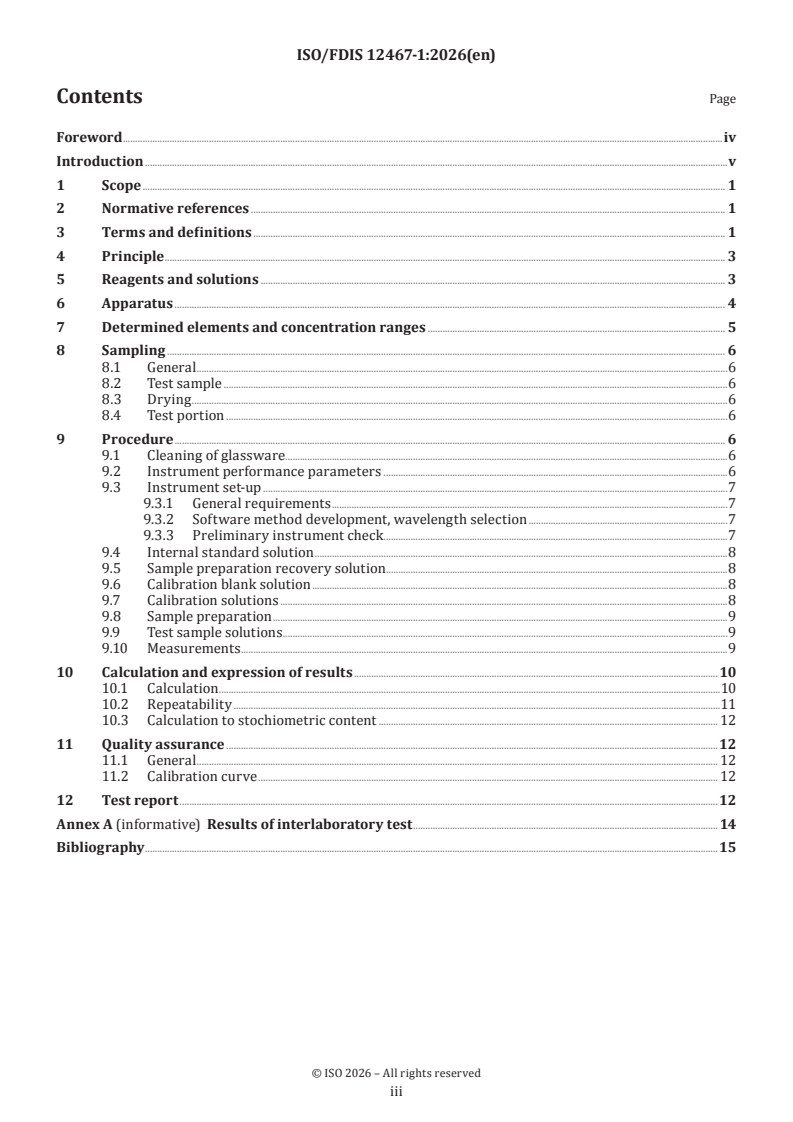

ISO/FDIS 12467-1 - Chemical analysis of lithium composite oxides — Part 1: Determination of main components by inductively coupled plasma optical emission spectrometry
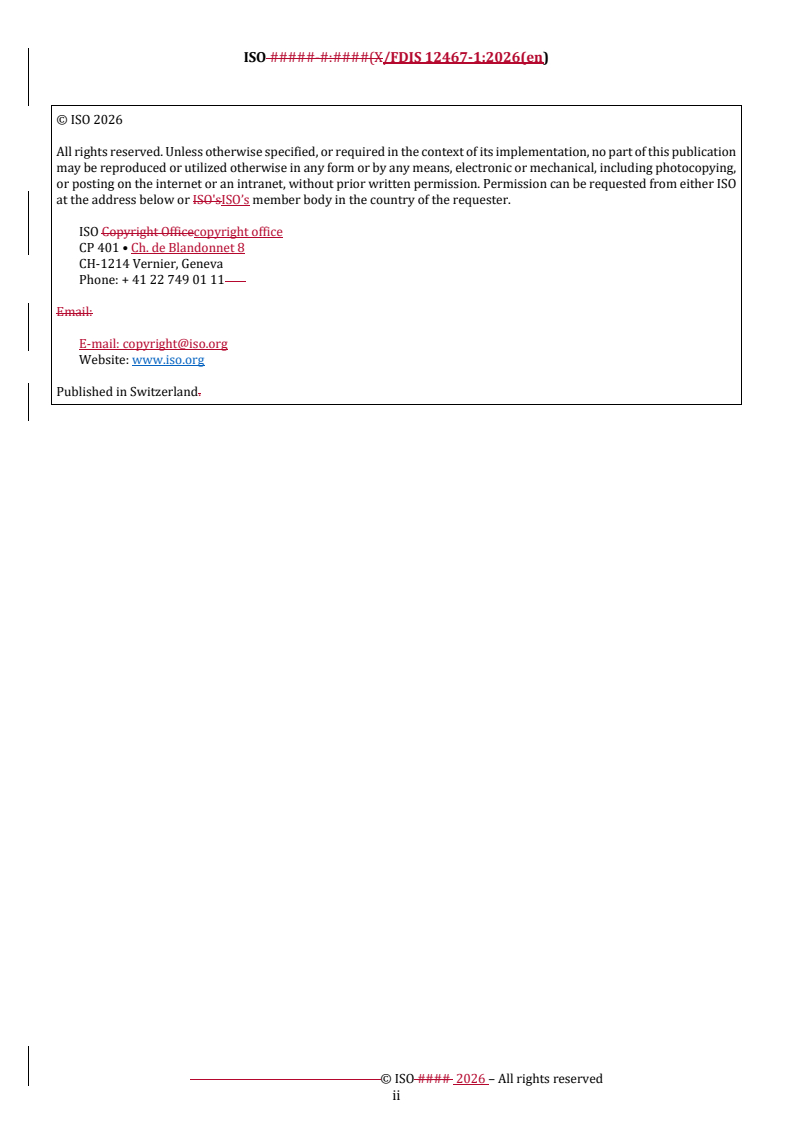

REDLINE ISO/FDIS 12467-1 - Chemical analysis of lithium composite oxides — Part 1: Determination of main components by inductively coupled plasma optical emission spectrometry
ISO 12467-1 is an International Standard from ISO for the chemical analysis of lithium composite oxides, especially lithium nickel manganese cobalt oxide (NMC) powders used as raw material for cathode materials. It specifies how laboratories determine listed metal components by inductively coupled plasma optical emission spectrometry (ICP-OES) with an internal standard, and how LiOH and Li2CO3 are determined by acid-base titration.
What does ISO 12467-1 specify?
ISO 12467-1 specifies a test method for lithium composite oxides used in lithium-ion battery (LiB) materials, with a focus on NMC powders. The document is built around solution preparation, ICP-OES measurement, and calculation of composition from calibrated intensity ratios.
The scope names the elements and compounds covered in the analysis: nickel, manganese, cobalt, aluminium, barium, calcium, copper, iron, lead, magnesium, molybdenum, phosphorus, sodium, strontium, titanium, zinc, zirconium, lithium hydroxide (LiOH) and lithium carbonate (Li2CO3). In practice, that means the standard is aimed at chemical composition control rather than physical testing.
The method is organized into clauses on:
- scope, normative references, terms and principles
- reagents, apparatus, and determined element ranges
- sampling and sample preparation
- ICP-OES set-up, calibration, measurement, calculation, QA, and reporting
Annex A is informative and gives interlaboratory test results that support the method’s validation. That matters when a user needs to judge whether the procedure has been exercised across multiple laboratories.
What are the key requirements of ISO 12467-1?
ISO 12467-1 requires a controlled analytical workflow: prepare a representative sample, dissolve it in acid, measure the elements by ICP-OES using an internal standard, and calculate the result from bracketing calibration solutions. The practical point is that the method is not a simple instrument check - it depends on careful sample handling, calibration, and recovery control.
Sample taking and preparation
Clause 8 requires sampling in accordance with ISO 8656-1 unless the laboratory and customer agree otherwise. The laboratory sample is homogenized, dried, and reduced to a test portion of about 100 mg. This matters because NMC powders can vary within a batch, so representativeness drives the quality of the result.
Reagents, glassware, and equipment
Clauses 5 and 6 specify analytical-grade reagents, grade 1 water, acid-resistant containers and volumetric flasks, an analytical balance, and an ICP-OES instrument. The method also uses strong acids, including hydrofluoric acid (HF) and aqua regia, so the user must apply suitable safety practices and contamination control. In practice, clean acid-resistant labware is needed to avoid trace-element contamination.
ICP-OES set-up and wavelength choice
Clause 9 requires the instrument to be set up according to the manufacturer’s instructions, allowed to stabilize, and checked for repeatability and sensitivity before use. Table 3 lists example analyte wavelengths, and the text asks the user to select lines without interference. This matters because spectral overlap can distort results if the wrong line is used.
Calibration and quality checks
Clause 9.7 requires at least three calibration solutions and a linearity check, and Clause 9.10 uses bracketing around the sample with low and high standards. A calibration curve control solution is measured after calibration, and the Cd recovery check is used to confirm digestion performance. In practice, this gives the analyst a way to confirm that the calibration is valid and that the digestion released the analytes properly.
Internal standard use
Clause 9.4 uses an internal standard element that is not analyzed and not present in the sample, such as Sc, Y, In, Ge, or Lu. The internal standard corrects for instrument drift and sample-introduction variation. For the user, that means the reported concentrations are less sensitive to small fluctuations in aspiration or plasma behavior.
Calculation and precision control
Clause 10 calculates concentration from the analyte/internal-standard intensity ratio and corrects for the actual mass of internal standard solution used. The method also requires duplicate determinations to agree within a stated relative difference, otherwise the digestion is repeated. This gives a clear rule for accepting or rejecting a result set.
Stoichiometric composition and reporting
Clause 10.3 converts concentration to amount of substance and stoichiometric ratio when the user needs composition data rather than only elemental content. Clause 12 then defines what the test report has to contain, including sample identification, sampling procedure, method reference, results, deviations, date, and laboratory identification. That makes the result traceable for quality records and supply-chain decisions.
What terms does ISO 12467-1 define?
- Laboratory sample - the sample prepared for sending to the laboratory for inspection or testing.
- Test sample - the sample prepared from the laboratory sample from which test portions are taken.
- Test portion - the measured quantity of material on which the test is actually carried out.
- Test sample solution - the solution obtained after digestion or extraction of the test sample and prepared for analysis.
- Calibration solution - a solution used to calibrate the instrument, prepared from stock solutions or a certified standard.
- Calibration blank solution - a calibration solution prepared without the analyte, used to establish the baseline.
- Bracketing - a measurement approach where the sample is measured between two calibration solutions of neighboring concentrations.
- Calibration curve control - a standard prepared independently of the calibration curve and checked near the midpoint of the range.
Who uses ISO 12467-1?
ISO 12467-1 is used by analytical laboratories, battery-material producers, and quality-control teams that need composition data for lithium composite oxides. It is relevant where NMC powders are checked as raw material for cathode production and where stoichiometric composition must be confirmed.
The document is also useful to testing and calibration laboratories working for the LiB supply chain, including labs supporting electric vehicles, laptops, mobile phones, and digital cameras. In practice, these users need the method for incoming inspection, product release, process control, and dispute resolution.
Which standards are used with ISO 12467-1?
| Standard | What it contributes |
|---|---|
| ISO 1042 | Grade A one-mark volumetric flasks used for accurate solution preparation. |
| ISO 7819 | Lithium vocabulary used for terms and definitions. |
| ISO 8656-1 | Sampling scheme for raw materials and unshaped products. |
| ISO/IEC 17025 | Laboratory competence and quality assurance framework. |
| ISO 3696 | Grade 1 water for analytical work. |
| ISO 78-2 | Source for the definitions of laboratory sample, test sample, test portion, standard solution, and stock solution. |
| ISO 17294-1 | Source for calibration solution and calibration blank solution terminology. |
| ISO 22036 | Source for the definition of test sample solution. |
| ISO/IEC Guide 99 | Source for the definition of calibration curve. |
| ISO 19919 | Source for the definition of bracketing. |
What does the ISO 12467-1 document contain?
ISO 12467-1 contains the full analytical procedure, from sampling and drying to digestion, calibration, measurement, and result calculation. It also includes example working ranges for the main elements and example analytical wavelengths for the ICP-OES method.
The document gives:
- a principle section describing ICP-OES with internal standardization
- reagent and apparatus lists, including acids, stock solutions, argon, and acid-resistant labware
- a sample preparation path for NMC powders, including digestion, blank preparation, and test solution preparation
- calibration and measurement instructions, including calibration blank solution, calibration solutions, and bracketing
- calculation formulas for concentration, repeatability, and stoichiometric content
- a test report list and an informative annex with interlaboratory results
Tables in the document support practical method set-up, including wavelengths, concentration ranges, internal-standard lines, and an example calibration set for NMC material. For a laboratory, these tables are the parts that turn the standard into a working method.
Buy Documents
ISO/FDIS 12467-1 - Chemical analysis of lithium composite oxides — Part 1: Determination of main components by inductively coupled plasma optical emission spectrometry
REDLINE ISO/FDIS 12467-1 - Chemical analysis of lithium composite oxides — Part 1: Determination of main components by inductively coupled plasma optical emission spectrometry
Get Certified
Connect with accredited certification bodies for this standard

ECOCERT
Organic and sustainability certification.

Eurofins Food Testing Global
Global leader in food, environment, and pharmaceutical product testing.

Intertek Bangladesh
Intertek certification and testing services in Bangladesh.
Sponsored listings
Frequently Asked Questions
ISO 12467-1 is a draft published by the International Organization for Standardization (ISO). Its full title is "Chemical analysis of lithium composite oxides — Part 1: Determination of main components by inductively coupled plasma optical emission spectrometry". This standard covers: This International Standard specifies methods for the chemical analysis of lithium nickel manganese cobalt oxide (NMC) powders used as the raw material for cathode materials. This document stipulates the determination methods of nickel, manganese, cobalt, aluminium, barium, calcium, copper, iron, lead, magnesium, molybdenum, phosphorus, sodium, strontium, titanium, zinc, zirconium, lithium hydroxide (LiOH) and lithium carbonate (Li2CO3) contents in NMC powders. NMC powders are decomposed by an acid decomposition method. The nickel, manganese, cobalt, aluminium, barium, calcium, copper, iron, lead, magnesium, molybdenum, phosphorus, sodium, strontium, titanium, zinc and zirconium contents in the test solution are determined by an inductively coupled plasma—optical emission spectrometry (ICP-OES). Li2CO3 and LiOH are determined by using an acid-base titration.
This International Standard specifies methods for the chemical analysis of lithium nickel manganese cobalt oxide (NMC) powders used as the raw material for cathode materials. This document stipulates the determination methods of nickel, manganese, cobalt, aluminium, barium, calcium, copper, iron, lead, magnesium, molybdenum, phosphorus, sodium, strontium, titanium, zinc, zirconium, lithium hydroxide (LiOH) and lithium carbonate (Li2CO3) contents in NMC powders. NMC powders are decomposed by an acid decomposition method. The nickel, manganese, cobalt, aluminium, barium, calcium, copper, iron, lead, magnesium, molybdenum, phosphorus, sodium, strontium, titanium, zinc and zirconium contents in the test solution are determined by an inductively coupled plasma—optical emission spectrometry (ICP-OES). Li2CO3 and LiOH are determined by using an acid-base titration.
ISO 12467-1 is classified under the following ICS (International Classification for Standards) categories: 71.040.40 - Chemical analysis. The ICS classification helps identify the subject area and facilitates finding related standards.
ISO 12467-1 is available in PDF format for immediate download after purchase. The document can be added to your cart and obtained through the secure checkout process. Digital delivery ensures instant access to the complete standard document.
Standards Content (Sample)
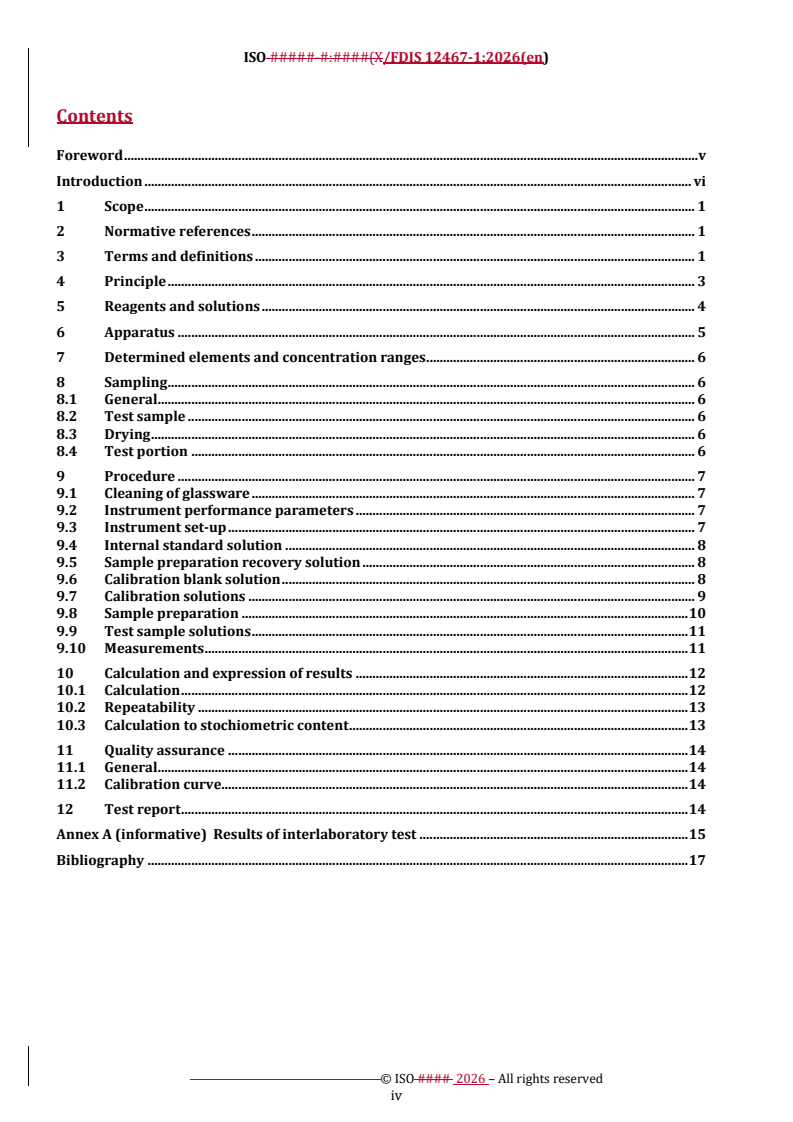
Contents
- Introduction
- 1 Scope
- 2 Normative references
- 3 Terms and definitions
- 3.1 laboratory sample
- 3.2 test sample
- 3.3 test portion
- 3.4 test sample solution
- 3.5 standard solution
- 3.6 stock solution
- 3.7 calibration solution
- 3.8 calibration blank solution
- 3.9 blank test solution
- 3.10 bracketing
- 3.11 calibration curve
- 3.12 calibration curve control
- 3.13 linearity
- 4 Principle
- 5 Reagents and solutions
- 5.8 Single element standard stock solutions, 1 000 or 10 000 mg/L
- 6 Apparatus
- 6.1 Inductively coupled argon plasma optical emission spectrometer
- 7 Determined elements and concentration ranges
- 8 Sampling
- 8.1 General
- 8.2 Test sample
- 8.3 Drying
- 8.4 Test portion
- 9 Procedure
- 9.1 Cleaning of glassware
- 9.2 Instrument performance parameters
- 9.3 Instrument set-up
- 9.4 Internal standard solution
- 9.5 Sample preparation recovery solution
- 9.6 Calibration blank solution
- 9.7 Calibration solutions
- 9.8 Sample preparation
- 9.9 Test sample solutions
- 9.10 Measurements
- 10 Calculation and expression of results
- 10.1 Calculation
- 10.2 Repeatability
- 10.3 Calculation to stochiometric content
- 11 Quality assurance
- 11.1 General
- 11.2 Calibration curve
- 12 Test report
- Annex A
- Bibliography
Introduction
Lithium, its alloys and compounds are technologically important and highly versatile materials, and are used in various industries, such as electronics, ceramics, glasses, medicine, etc. Lithium is the lightest solid element, and due to the high electrochemical potential of the redox couple Li/ Li+, its main use is as cathode material in lithium ion batteries (LiBs) in electric vehicles, laptops, mobile phones and digital cameras. Examples of commonly used lithium composite oxide cathode materials and their principal constituents are shown in Table 1. Lithium materials are classified into different grades, according to their chemical and physical characteristics, including purity, impurities, and particle size. Therefore, the content of lithium materials are an important index to monitor product quality. The determination of content by inductively coupled plasma optical emission spectrometry (ICP-OES) have numerous advantages, such as simple sample-pre-treatment, high accuracy and low detection limit. Table 1 — Types of Li composite oxides for LiBs Acronym Chemical formula LCO Li-xCoO
LMO Li-xMn O 2 4 NCA Li-xNiCoAlO
NMC Li-x(Ni Mn Co )O x y z 2 LFP Li-xFePO
LNO Li-xNiO
LMP Li-xMnPO
LMFP Li-xMnFePO
LTO Li-xTi O 5 12 OLO - NOTE 1 For the purposes of this document, the term 'lithium composite oxides' includes lithium-containing cathode materials such as layered oxides, spinel oxides and phosphate-based materials. NOTE 2 New types of LiB can also be analysed by this method.
NOTE 3 The method is applicable for the other elements listed above, provided the user has verified the applicability. This document specifies an analytical procedure for the determination of main components in Li composite oxides for Li-ion batteries (LiB). The determination is applicable to all types of LiBs (see Table 1). The determination is performed by optical emission spectrometry with inductively coupled plasma (ICP OES) using an internal standard. The method of atomic emission spectrometry with inductively coupled plasma (ICP AES) is interchangeable with ICP OES.
This test is recommended as the preferred method for determining the stoichiometric composition of several elements in LiBs.
FINAL DRAFT International Standard ISO/FDIS 12467-1:2026(en) Chemical analysis of lithium composite oxides — Part 1:
Determination of main components by inductively coupled plasma optical emission spectrometry WARNING — The use of this document can involve hazardous materials, operations, and equipment. This document does not purport to address any safety problems associated with its use. It is the responsibility of the user of this document to establish appropriate safety and health practices and determine the applicability of regulatory limitations prior to use.
1 Scope
This document specifies an analytical procedure for the determination of main components in Li composite oxides for Li-ion batteries (LiB), in particular the elements: lithium, cobalt, iron, manganese, nickel, phosphorus, titanium and aluminium, depending on the composite oxide of interest. This document establishes a test procedure for a high precision determination of stoichiometric composition of the elements in LiBs.
2 Normative references
The following documents are referred to in the text in such a way that some or all of their content constitutes requirements of this document. For dated references, only the edition cited applies. For undated references, the latest edition of the referenced document (including any amendments) applies. ISO 1042, Laboratory glassware — One-mark volumetric flasks ISO 7819, Lithium — Vocabulary ISO 8656-1, Refractory products — Sampling of raw materials and unshaped products — Part 1: Sampling scheme ISO/IEC 17025, General requirements for the competence of testing and calibration laboratories
3 Terms and definitions
For the purposes of this document, the terms and definitions given in ISO 7819 and the following apply. ISO and IEC maintain terminology databases for use in standardization at the following addresses:
- ISO Online browsing platform: available at https:// www .iso .org/ obp
- IEC Electropedia: available at https:// www .electropedia .org/
3.1 laboratory sample
sample as prepared for sending to the laboratory and intended for inspection or testing [SOURCE: ISO 78-2:1999, 3.1]
ISO/FDIS 12467-1:2026(en)
3.2 test sample
sample prepared from the laboratory sample (3.1) and from which test portions (3.3) will be taken [SOURCE: ISO 78-2:1999, 3.2]
3.3 test portion
quantity of material drawn from the test sample (3.2) (or from the laboratory sample if both are the same) and on which the test or observation is actually carried out [SOURCE: ISO 78-2:1999, 3.3]
3.4 test sample solution
solution prepared after extraction or digestion of the test sample according to appropriate specifications Note 1 to entry: A sample solution can be subjected to further operations, e.g., dilution and/or addition of an internal standard, in order to produce a test solution that is ready for analysis. [SOURCE: ISO 22036:2024, 3.10]
3.5 standard solution
solution of accurately known concentration of an element, an ion, a compound or a group derived from the substance used for its preparation [SOURCE: ISO 78-2:1999, 3.6]
3.6 stock solution
solution of accurately known analyte concentration(s), prepared from pure chemicals
3.7 calibration solution
solution used to calibrate the instrument, prepared from (a) stock solution(s) or from a certified standard [SOURCE: ISO 17294-1:2024, 3.4]
3.8 calibration blank solution
solution prepared in the same way as the calibration solution (3.7) but leaving out the analyte [SOURCE: ISO 17294-1:2024, 3.3]
3.9 blank test solution
solution prepared by adding to the solvent the same amounts of reagents as those added to the test sample solution and with the same final volume [SOURCE: ISO 17294-1:2024, 3.19]
3.10 bracketing
analytical method consisting of bracketing the measured emission line intensity of the sample between two measurements made on calibration solutions of neighbouring concentrations within the optimum working range Note 1 to entry: Running of standards and samples in the following sequence: low standard – sample – high standard – sample – low standard – sample – high standard.
[SOURCE: ISO 19919:2025, 3.2]
ISO/FDIS 12467-1:2026(en)
3.11 calibration curve
expression of the relation between indication and corresponding measured quantity value [SOURCE: ISO/IEC Guide 99:2007, 4.31]
3.12 calibration curve control
standard prepared independently of the calibration curve, the concentration of which is near the midpoint of the calibration range
3.13 linearity
straight-line relationship between the mean result of measurement and the quantity (concentration) of the analyte
4 Principle
The determination is carried out by means of the analytical technique of optical emission spectroscopy with inductively coupled plasma (ICP-OES), which allows the detection and quantitative determination of most of the elements from the periodic table from samples in solution. In the ICP-OES technique, the continuous introduction of the liquid sample and a nebulization system forms an aerosol that is transported by Argon to the plasma torch, inductively coupled by radio frequency. In the plasma, due to the high temperatures generated, the analytes are atomized and ionized, generating the atomic emission spectra of characteristic lines. The spectra are scattered by the diffraction grating and the light-sensitive detector measures the spectral line intensities. The information is processed by the computer software system of the ICP-OES equipment.
At least two accurately weighed samples are dissolved in a suitable acid mixture. After dissolution, this sample solution is mixed with an exact mass of an internal standard solution and made up to the measurement final volume. Using ICP-OES, the main contents of the sample solution are measured by comparing the intensities of the spectral emissions of the main components and (a) suitable internal standard line(s) with the intensities of a solution where the contained mass of these elements and internal standard is precisely known. The bracketing method is used for this purpose.
5 Reagents and solutions
During the analysis, unless otherwise stated, use only reagents of recognized analytical grade. WARNING — Concentrated mineral acids (5.2, 5.3, 5.4, 5.5, 5.6, 5.7) are corrosive and acid vapour is an irritant. Avoid contact with the skin or eyes, or inhalation of the vapour. Use suitable personal protective equipment (e.g., gloves, face shield or safety goggles, etc.) when working with concentrated or dilute acid. Handle open vessels containing concentrated acid in a fume hood. Do not add water to acid, as the reaction is violent. Small aliquots of acid shall be added slowly to larger volumes of water. The vapour pressure of acid is high; therefore beware of pressure build-up in stoppered flasks when preparing acid/water mixtures.
5.1 Water (H O), (see ISO 3696), grade 1.
®1) 5.2 Hydrochloric acid (HCl), (CAS RN 7647-01-0), 30 % to 37 % HCl (mass fraction). 5.3 Nitric acid (HNO ), (CAS RN 7697-37-2), 65 % minimum HNO (mass fraction). 3 3 1) CAS Registry Number® is a trademark of the American Chemical Society (ACS). This information is given for the convenience of users of this document and does not constitute an endorsement by ISO of the product named. Equivalent products may be used if they can be shown to lead to the same results.
ISO/FDIS 12467-1:2026(en) 5.4 Perchloric acid (HClO ), (CAS RN 7601-90-3), 70 % to 73 % HClO (mass fraction). 4 4 5.5 Sulfuric acid (H SO ), (CAS RN 7664-93-9), 95 % minimum H SO (mass fraction). 2 4 2 4 5.6 Hydrofluoric acid (HF), (CAS RN 7664-39-3), 40 % to 42 % HF (mass fraction). WARNING — Concentrated hydrofluoric acid is very toxic in contact with the skin and if inhaled or swallowed. It is corrosive and causes severe burns. Take extreme care when using hydrofluoric acid. Avoid contact with the skin or eyes, or inhalation of the vapour. It is essential that suitable personal protective equipment (including suitable gloves, face shield, etc.) is used when working with concentrated or dilute hydrofluoric acid. Handle open vessels containing concentrated hydrofluoric acid in a fume hood. Ensure that the nature and seriousness of hydrofluoric acid burns is understood before commencing work with this substance. Carry hydrofluoric acid burn cream (containing calcium gluconate) at all times whilst working with hydrofluoric acid and for 24 h afterwards. Apply the cream to any contaminated skin, after washing the affected area with copious amounts of water. Obtain medical advice immediately in case of an accident.
NOTE The burning sensation associated with many concentrated acid burns is not immediately apparent on exposure to hydrofluoric acid and will possibly not be felt for several hours. Relatively dilute solutions of hydrofluoric acid can also be absorbed through the skin, with serious effects similar to those resulting from exposure to the concentrated acid.
When using hydrofluoric acid, it is recommended that a pair of disposable gloves be worn underneath suitable acid-resistant gloves to provide added protection for the hands. 5.7 Aqua regia (should be prepared just before use).
Mix three volumes of hydrochloric acid (5.2) and one volume of nitric acid (5.3).
5.8 Single element standard stock solutions, 1 000 or 10 000 mg/L
where c(element) is the concentration of the element.
Al, Co, Fe, Li, Mn, Ni, P, Ti; c = 1 000 or 10 000 mg/L each.
(element) For internal standard the following elements can be used :
Be, Cd, Ge, In, Ru, Sc, Y; c = 1 000 or 10 000 mg/L each.
(element) Single element standard stock solutions with adequate specification stating the acid used and the preparation technique are commercially available. Single-element standard stock solutions can be made from high purity metals or salts or oxides.
For stability of the solutions, refer to the manufacturer guarantee statement. 5.9 Argon gas (CAS RN 7440-37-1), purity ≥ 99,995 % (mass fraction).
6 Apparatus
All apparatus shall be carefully cleaned prior to use.
6.1 Inductively coupled argon plasma optical emission spectrometer
The ICP optical emission spectrometer consists of a sample introduction system, the plasma (an excitation or emission source), a plasma torch, an optical system, a detector and a computer. The sample introduction system usually consists of a peristaltic pump for sample transport to the nebulizer, the nebulizer and a spray chamber. The most common nebulizers are the concentric nebulizer, the cross-flow nebulizer and the V-groove nebulizer. They are made from glass, quartz, polytetrafluoroethylene (PTFE), fluorinated ethylene
...
Contents
- Introduction
- 1 Scope
- 2 Normative references
- 3 Terms and definitions
- 4 Principle
- 5 Reagents and solutions
- 6 Apparatus
- 7 Determined elements and concentration ranges
- 8 Sampling
- 8.1 General
- 8.2 Test sample
- 8.3 Drying
- 8.4 Test portion
- 9 Procedure
- 9.1 Cleaning of glassware
- 9.2 Instrument performance parameters
- 9.3 Instrument set-up
- 9.4 Internal standard solution
- 9.5 Sample preparation recovery solution
- 9.6 Calibration blank solution
- 9.7 Calibration solutions
- 9.8 Sample preparation
- 9.9 Test sample solutions
- 9.10 Measurements
- 10 Calculation and expression of results
- 10.1 Calculation
- 10.2 Repeatability
- 10.3 Calculation to stochiometric content
- 11 Quality assurance
- 11.1 General
- 11.2 Calibration curve
- 12 Test report
- Annex A
- Bibliography
Introduction
Lithium, its alloys and compounds are technologically important and highly versatile materials, and are used in various industries, such as electronics, ceramics, glasses, medicine, etc. Lithium is the lightest solid element, and due to the high electrochemical potential of the redox couple Li/Li+, its main use is as cathode material in lithium ion batteries (LiBs) in electric vehicles, laptops, mobile phones and digital cameras. Examples of commonly used lithium composite oxide cathode materials and their principal constituents are shown in Table 1Table 1.. Lithium materials are classified into different grades, according to their chemical and physical characteristics, including purity, impurities, and particle size. Therefore, the content of lithium materials are an important index to monitor product quality. The determination of content by inductively coupled plasma optical emission spectrometry (ICP-OES) have numerous advantages, such as simple sample-pre-treatment, high accuracy and low detection limit. Table 1 — Types of Li composite oxides for LiBs Acronym Chemical formula LCO Li-xCoO
LMO Li-xMn2O4 NCA Li-xNiCoAlO
NMC Li-x(NixMnyCoz)O2 LFP Li-xFePO
LNO Li-xNiO2 LMP Li-xMnPO
LMFP Li-xMnFePO4 LTO Li-xTi O 5 12 OLO - NOTE 1 For the purposes of this document, the term 'lithium composite oxides' includes lithium-containing cathode materials such as layered oxides, spinel oxides and phosphate-based materials. NOTE 2 New types of LiB can also be analysed by this method.
NOTE 3 The method is applicable for the other elements listed above, provided the user has verified the applicability. This document specifies an analytical procedure for the determination of main components in Li composite oxides for Li-ion batteries (LiB). The determination is applicable to all types of LiBs (see Table 1). The determination is performed by optical emission spectrometry with inductively coupled plasma (ICP OES) using an internal standard. The method of atomic emission spectrometry with inductively coupled plasma (ICP AES) is interchangeable with ICP OES.
This test is recommended as the preferred method for determining the stoichiometric composition of several elements in LiBs.
DRAFT International Standard ISO/DIS 12467-1:2025(en)
Chemical analysis of lithium composite oxides – — Part 1:
Determination of main components by inductively coupled plasma optical emission spectrometry WARNING — The use of this document can involve hazardous materials, operations, and equipment. This document does not purport to address any safety problems associated with its use. It is the responsibility of the user of this document to establish appropriate safety and health practices and determine the applicability of regulatory limitations prior to use.
1 Scope
This document specifies an analytical procedure for the determination of main components in Li composite oxides for Li-ion batteries (LiB), in particular the elements: lithium, cobalt, iron, manganese, nickel, phosphorus, titanium and aluminium, depending on the composite oxide of interest. The determination is applicable to all types of LiBs (Table 1).This document The determination is performed by optical emission spectrometry with inductively coupled plasma (ICP OES) using an internal standard. The method of atomic emission spectrometry with inductively coupled plasma (ICP AES) is interchangeable with ICP OES.
This test is recommended as the preferred method for determining the stoichiometric composition of several elements in LiBs. This standard establishes a test procedure for a high precision determination of stoichiometric composition of the elements in LiBs.
2 Normative references
The following documents are referred to in the text in such a way that some or all of their content constitutes requirements of this document. For dated references, only the edition cited applies. For undated references, the latest edition of the referenced document (including any amendments) applies. ISO 1042, Laboratory glassware — One-mark volumetric flasks ISO 7819, Lithium — Vocabulary ISO 8656--1, Refractory products — Sampling of raw materials and unshaped products — Part 1: Sampling scheme ISO/IEC 17025, General requirements for the competence of testing and calibration laboratories
3 Terms and definitions
For the purposes of this document, the terms and definitions given in ISO 7819, Lithium — Vocabulary, and the following apply.
ISO and IEC maintain terminology databases for use in standardization at the following addresses:
ISO #####-#:####(X/FDIS 12467-1:2026(en) - — ISO Online browsing platform: available at https://www.iso.org/obp - — IEC Electropedia: available at https://www.electropedia.org/ 3.1 3.1 laboratory sample sample as prepared for sending to the laboratory and intended for inspection or testing [SOURCE: ISO 78-2:1999, 3.1] 3.2 3.2 test sample sample prepared from the laboratory sample (3.1(3.1)) and from which test portions (3.3(3.3)) will be taken [SOURCE: ISO 78-2:1999, 3.2] 3.3 3.3 test portion quantity of material drawn from the test sample (3.2(3.2)) (or from the laboratory sample if both are the same) and on which the test or observation is actually carried out [SOURCE: ISO 78-2:1999, 3.3] 3.4 3.4 test sample solution solution prepared after extraction or digestion of the test sample according to appropriate specifications Note 1 to entry: A sample solution can be subjected to further operations, e.g., dilution and/or addition of an internal standard, in order to produce a test solution that is ready for analysis. [SOURCE: ISO 22036:2024, 3.10] 3.5 3.5 standard solution solution of accurately known concentration of an element, an ion, a compound or a group derived from the substance used for its preparation [SOURCE: ISO 78-2:1999, 3.6] 3.6 3.6 stock solution solution of accurately known analyte concentration(s), prepared from pure chemicals 3.7 3.7 calibration solution solution used to calibrate the instrument, prepared from (a) stock solution(s) or from a certified standard [SOURCE: ISO 17294-1:2024, 3.4] 3.8 3.8 calibration blank solution solution prepared in the same way as the calibration solution (3.7(3.7)) but leaving out the analyte [SOURCE: ISO 17294-1:2024, 3.3]
ISO/DISFDIS 12467-1:2026(en) 3.9 3.9 blank test solution solution prepared by adding to the solvent the same amounts of reagents as those added to the test sample solution and with the same final volume [SOURCE: ISO 17294-1:2024, 3.19] 3.10 3.10 bracketing analytical method consisting of bracketing the measured emission line intensity of the sample between two measurements made on calibration solutions of neighbouring concentrations within the optimum working range Note 1 to entry: Running of standards and samples in the following sequence: low standard – sample – high standard – sample – low standard – sample – high standard .
[SOURCE: ISO 19919:2025, 3.2] 3.11 3.11 calibration curve expression of the relation between indication and corresponding measured quantity value [SOURCE: ISO/IEC Guide 99:2007, 4.31] 3.12 3.12 calibration curve control standard prepared independently of the calibration curve, the concentration of which is near the midpoint of the calibration range 3.13 3.13 linearity straight-line relationship between the mean result of measurement and the quantity (concentration) of the analyte
4 Principle
The determination is carried out by means of the analytical technique of optical emission spectroscopy with inductively coupled plasma (ICP-OES), which allows the detection and quantitative determination of most of the elements from the periodic table from samples in solution. In the ICP-OES technique, the continuous introduction of the liquid sample and a nebulization system forms an aerosol that is transported by Argon to the plasma torch, inductively coupled by radio frequency. In the plasma, due to the high temperatures generated, the analytes are atomized and ionized, generating the atomic emission spectra of characteristic lines. The spectra are scattered by the diffraction grating and the lightsensitive detector measures the spectral line intensities. The information is processed by the computer software system of the ICP-OES equipment.
At least two accurately weighed samples are dissolved in a suitable acid mixture. After dissolution, this sample solution is mixed with an exact mass of an internal standard solution and made up to the measurement final volume. Using ICP-OES, the main contents of the sample solution are measured by comparing the intensities of the spectral emissions of the main components and (a) suitable internal standard line(s) with the intensities of a solution where the contained mass of these elements and internal standard is precisely known. The bracketing method is used for this purpose.
ISO #####-#:####(X/FDIS 12467-1:2026(en)
5 Reagents and solutions
During the analysis, unless otherwise stated, use only reagents of recognized analytical grade. WARNING — Concentrated mineral acids (5.2, 5.3, 5.4, 5.5, 5.6, 5.7(5.2, 5.3, 5.4, 5.5, 5.6, 5.7)) are corrosive and acid vapour is an irritant. Avoid contact with the skin or eyes, or inhalation of the vapour. Use suitable personal protective equipment (e.g., gloves, face shield or safety goggles, etc.) when working with concentrated or dilute acid. Handle open vessels containing concentrated acid in a fume hood. Do not add water to acid, as the reaction is violent. Small aliquots of acid shall be added slowly to larger volumes of water. The vapour pressure of acid is high; therefore beware of pressure build-up in stoppered flasks when preparing acid/water mixtures. 5.1 5.1 Water (H O), (see ISO 3696), grade 1.
®11) 5.2 5.2 Hydrochloric acid (HCl), (CAS RN 7647-01-0), 30 % to 37 % HCl (mass fraction). 5.3 5.3 Nitric acid (HNO ), (CAS RN 7697-37-2), 65 % minimum HNO (mass fraction). 3 3 5.4 5.4 Perchloric acid (HClO ), (CAS RN 7601-90-3), 70 % to 73 % HClO (mass fraction). 4 4 5.5 5.5 Sulfuric acid (H SO ), (CAS RN 7664-93-9), 95 % minimum H SO (mass fraction). 2 4 2 4 5.6 5.6 Hydrofluoric acid (HF), (CAS RN 7664-39-3), 40 % to 42 % HF (mass fraction). WARNING — Concentrated hydrofluoric acid is very toxic in contact with the skin and if inhaled or swallowed. It is corrosive and causes severe burns. Take extreme care when using hydrofluoric acid. Avoid contact with the skin or eyes, or inhalation of the vapour. It is essential that suitable personal protective equipment (including suitable gloves, face shield, etc.) is used when working with concentrated or dilute hydrofluoric acid. Handle open vessels containing concentrated hydrofluoric acid in a fume hood. Ensure that the nature and seriousness of hydrofluoric acid burns is understood before commencing work with this substance. Carry hydrofluoric acid burn cream (containing calcium gluconate) at all times whilst working with hydrofluoric acid and for 24 h afterwards. Apply the cream to any contaminated skin, after washing the affected area with copious amounts of water. Obtain medical advice immediately in case of an accident.
NOTE The burning sensation associated with many concentrated acid burns is not immediately apparent on exposure to hydrofluoric acid and will possibly not be felt for several hours. Relatively dilute solutions of hydrofluoric acid can also be absorbed through the skin, with serious effects similar to those resulting from exposure to the concentrated acid.
When using hydrofluoric acid, it is recommended that a pair of disposable gloves be worn underneath suitable acid-resistant gloves to provide added protection for the hands. 5.7 5.7 Aqua regia (should be prepared just before use).
Mix three volumes of hydrochloric acid (5.2(5.2)) and one volume of nitric acid (5.3(5.3).). 5.8 5.8 Single element standard stock solutions, 1 000 or 10 000 mg/L
CAS Registry Number® is a trademark of the American Chemical Society (ACS). This information is given for the convenience of users of this document and does not constitute an endorsement by ISO of the product named. Equivalent products may be used if they can be shown to lead to the same results. 1) CAS Registry Number® is a trademark of the American Chemical Society (ACS). This information is given for the convenience of users of this document and does not constitute an endorsement by ISO of the product named. Equivalent products may be used if they can be shown to lead to the same results.
ISO/DISFDIS 12467-1:2026(en) where c(element) is the concentration of the element.
Al, Co, Fe, Li, Mn, Ni, P, Ti; c = 1 000 or 10 000 mg/L each.
(element) For internal standard the following elements can be used :
Be, Cd, Ge, In, Ru, Sc, Y; c = 1 000 or 10 000 mg/L each.
(element) Single element standard stock solutions with adequate specification stating the acid used and the preparation technique are commercially available. Single-element standard stock solutions can be made from high purity metals or salts or oxides.
For stability of the solutions, refer to the manufacturer guarantee statement. 5.9 5.9 Argon gas (CAS RN 7440-37-1), purity ≥ 99,995 % (mass fraction)).
6 Apparatus
All apparatus shall be carefully cleaned prior to use.
...