

ISO/FDIS 12467-3
(Main)Chemical analysis of lithium composite oxides — Part 3: Determination of lithium carbonate and lithium hydroxide contents
- Abstract
This document specifies potentiometric titration methods for the determination of lithium carbonate and lithium hydroxides content in lithium composite oxides for lithium-ion batteries (LIBs). The method is applicable to lithium composite oxides for LIBs with a mass fraction of lithium carbonate and lithium hydroxides in the range from 0.001% to 2.500%.
- Status
- Not Published
- Technical Committee
- ISO/TC 333 - Lithium
- Drafting Committee
- ISO/TC 333 - Lithium
- Current Stage
- 5020 - FDIS ballot initiated: 2 months. Proof sent to secretariat
- Start Date
- 16-Sep-2026
- Completion Date
- 16-Sep-2026
Buy Documents
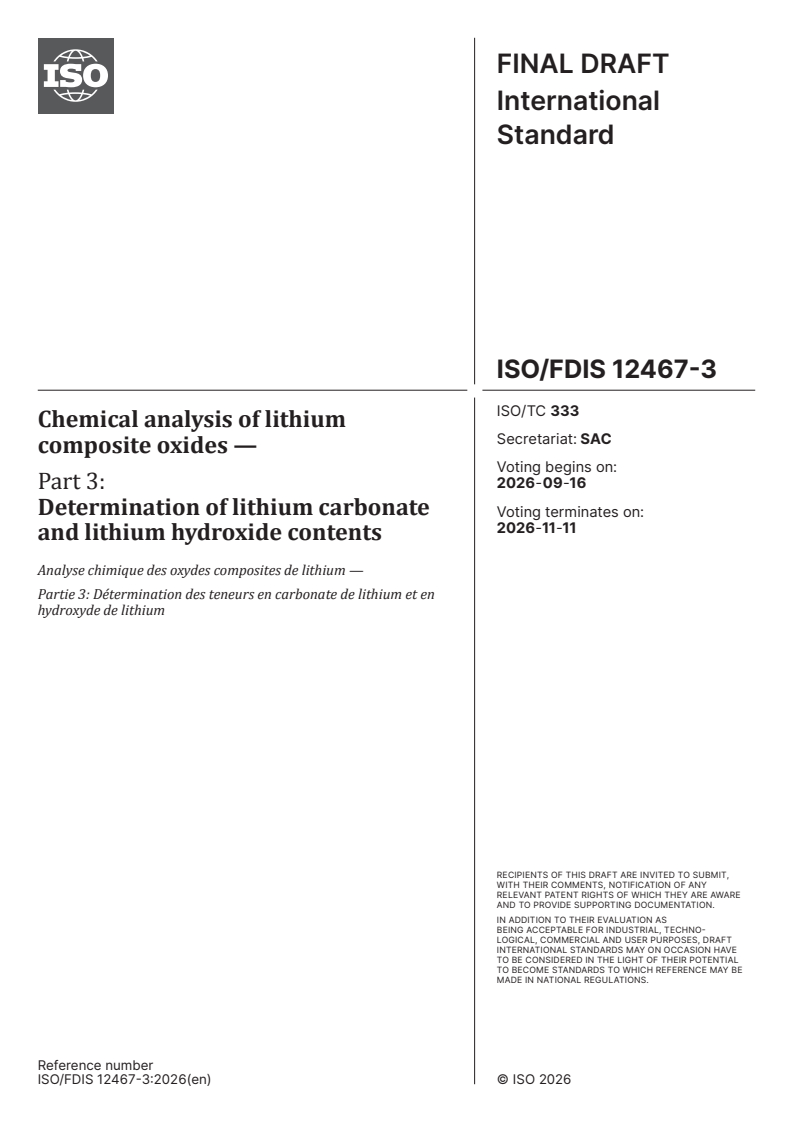


ISO/FDIS 12467-3 - Chemical analysis of lithium composite oxides — Part 3: Determination of lithium carbonate and lithium hydroxide contents
REDLINE ISO/FDIS 12467-3 - Chemical analysis of lithium composite oxides — Part 3: Determination of lithium carbonate and lithium hydroxide contents
ISO/FDIS 12467-3 is an ISO draft International Standard for the chemical analysis of lithium composite oxides used in lithium-ion batteries (LIBs). It specifies a potentiometric titration method for determining lithium carbonate and lithium hydroxide contents in these materials, so laboratories can measure low levels of surface residual alkali species in battery cathode powders.
What does ISO/FDIS 12467-3 specify?
ISO/FDIS 12467-3 specifies an analytical procedure for lithium composite oxides such as lithium cobalt oxide, lithium nickel cobalt manganese oxide, lithium iron phosphate, and lithium manganese oxide. The document focuses on a potentiometric titration method and gives the working range for lithium carbonate and lithium hydroxide in the sample.
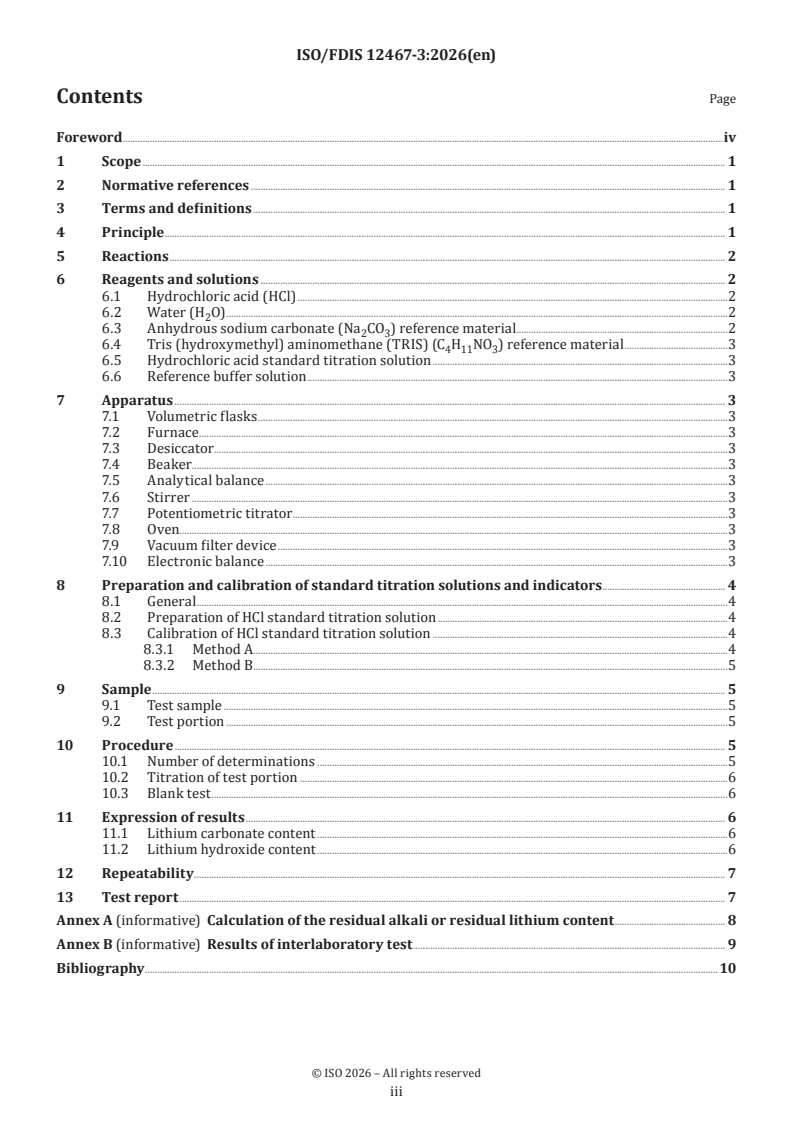
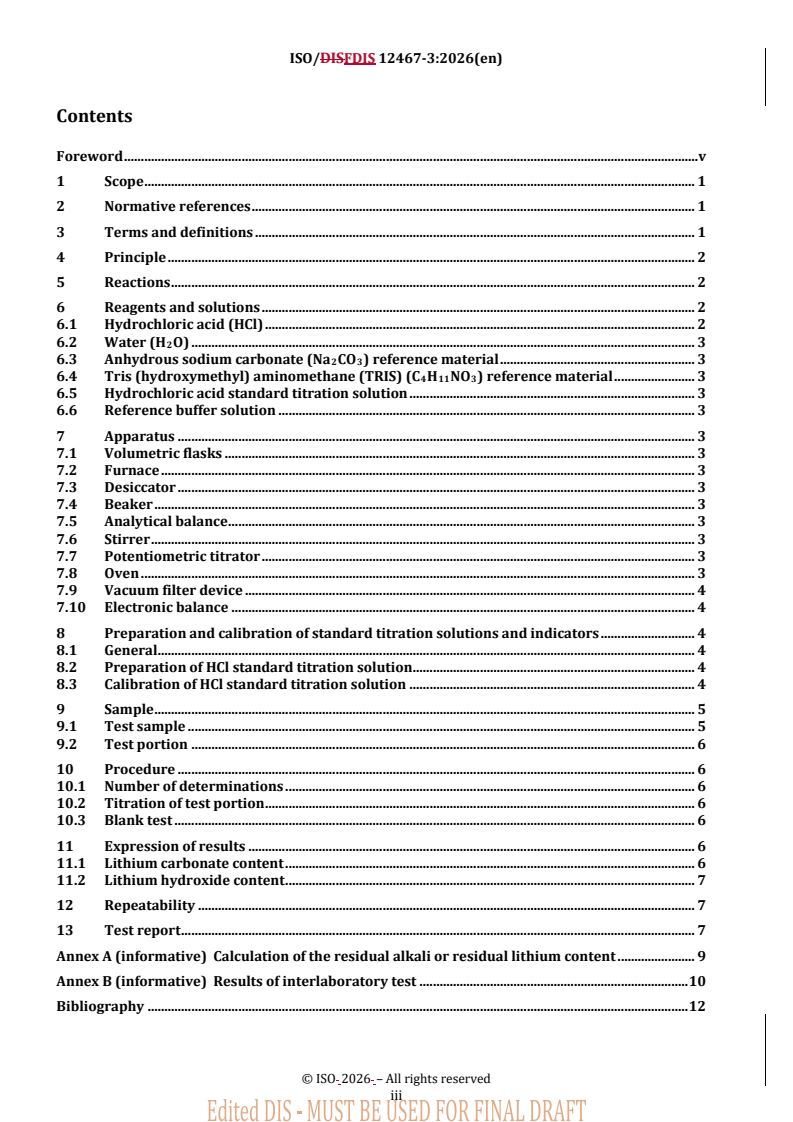
The standard is organized into clauses on scope, normative references, terms and definitions, principle, reactions, reagents and solutions, apparatus, preparation and calibration of titration solutions, sample preparation, procedure, expression of results, repeatability, and test report. It also includes two informative annexes.
| Annex | What it covers |
|---|---|
| Annex A | Calculation of residual alkali content and residual lithium content |
| Annex B | Results of the interlaboratory test |
What are the key requirements of ISO/FDIS 12467-3?
ISO/FDIS 12467-3 requires a titration workflow built around controlled sample preparation, calibrated hydrochloric acid, and two potentiometric equivalence points. In practice, the method turns the measured acid consumption into separate contents for lithium carbonate and lithium hydroxide.
- Clause 4, Principle - The sample is mixed with excess water, filtered, and the dissolved species are measured by potentiometric titration. This matters because only the soluble surface residues are targeted, not the whole bulk crystal.
- Clause 5, Reactions - The method uses the different reaction behavior of lithium hydroxide, lithium carbonate, and lithium bicarbonate with hydrochloric acid. The two equivalence points are the basis for separating the two analytes.
- Clauses 6 and 7, Reagents and apparatus - The document requires Grade 2 water, hydrochloric acid, reference materials for calibration, Class A volumetric flasks, a calibrated pH electrode, and balances with stated readability. This matters because small weighing and titration errors directly affect the reported percentage.
- Clause 8, Preparation and calibration - The hydrochloric acid titrant may be prepared and then standardized using either anhydrous sodium carbonate or TRIS. Users need this step so the titrant concentration used in calculations is known, not assumed.
- Clause 9, Sample - The test sample is dried before testing, and a 5.0 g test portion is weighed. Drying and sealed storage reduce moisture effects that would otherwise change the measured surface residues.
- Clause 10, Procedure - The test portion is mixed with water, filtered quickly, and the filtrate is titrated; a blank test is also required. The document notes timing limits to reduce interference from carbon dioxide in air.
- Clause 11, Expression of results - Separate formulas are given for lithium carbonate and lithium hydroxide, and results are reported to the third decimal place. This is the output most buyers, suppliers, and labs will use for acceptance or comparison.
- Clause 12, Repeatability - The repeatability limit is given as ±0.05 %. This helps labs judge whether two measurements on the same material are close enough to be considered consistent.
What terms does ISO/FDIS 12467-3 define?
ISO/FDIS 12467-3 uses terms and definitions from ISO 7819, and several document-specific terms are central to the method.
- Lithium composite oxides - Cathode materials such as lithium cobalt oxide and lithium nickel cobalt manganese oxide that are analyzed for surface residues.
- Lithium-ion batteries (LIBs) - The application area for which the method is intended.
- Potentiometric titration - A titration method that detects equivalence points by electrode potential rather than by color change.
- Equivalence point Ep1 - The first titration point used to calculate the lithium hydroxide contribution.
- Equivalence point Ep2 - The second titration point used to complete the lithium carbonate calculation.
- TRIS - Tris(hydroxymethyl)aminomethane, used as a reference material for standardizing hydrochloric acid.
- Residual alkali content - A calculated combined measure reported from lithium hydroxide and lithium carbonate.
- Residual lithium content - A calculated value derived from the residual alkali content.
Who uses ISO/FDIS 12467-3?
ISO/FDIS 12467-3 is used by laboratory analysts, quality control teams, and materials engineers working with LIB cathode powders. It is relevant to battery-material producers, incoming inspection laboratories, and buyers who need a repeatable chemical test for residual lithium compounds.
The method is especially useful when a supplier and customer need to compare surface chemistry on lithium composite oxides and document results in a test report.
Which standards are used with ISO/FDIS 12467-3?
ISO/FDIS 12467-3 relies on several ISO standards that support the measurements and calculations.
- ISO 1042 - Specifies the one-mark volumetric flasks used for preparing solutions.
- ISO 3696 - Specifies laboratory water quality for the water used in the method.
- ISO 7819 - Provides the vocabulary used for lithium terminology.
- ISO 23496 - Provides reference buffer solutions for calibrating pH measuring equipment.
- ISO 5725-1 - Provides the repeatability concept used when the document states the repeatability limit.
What does the ISO/FDIS 12467-3 document contain?
ISO/FDIS 12467-3 contains the full laboratory method, from reagent preparation through calculation of results. It gives the reactions behind the titration, the apparatus list, calibration steps for hydrochloric acid, sample drying and weighing, the filtration and titration sequence, and the equations for calculating lithium carbonate and lithium hydroxide.
The document also includes a test report checklist, so users know what information to record with the result. Annex A provides formulas for converting the two measured contents into residual alkali and residual lithium content, and Annex B summarizes interlaboratory test results for NMC and LFP samples.
Buy Documents
ISO/FDIS 12467-3 - Chemical analysis of lithium composite oxides — Part 3: Determination of lithium carbonate and lithium hydroxide contents
REDLINE ISO/FDIS 12467-3 - Chemical analysis of lithium composite oxides — Part 3: Determination of lithium carbonate and lithium hydroxide contents
Get Certified
Connect with accredited certification bodies for this standard

ECOCERT
Organic and sustainability certification.

Eurofins Food Testing Global
Global leader in food, environment, and pharmaceutical product testing.

Intertek Bangladesh
Intertek certification and testing services in Bangladesh.
Sponsored listings
Frequently Asked Questions
ISO/FDIS 12467-3 is a draft published by the International Organization for Standardization (ISO). Its full title is "Chemical analysis of lithium composite oxides — Part 3: Determination of lithium carbonate and lithium hydroxide contents". This standard covers: This document specifies potentiometric titration methods for the determination of lithium carbonate and lithium hydroxides content in lithium composite oxides for lithium-ion batteries (LIBs). The method is applicable to lithium composite oxides for LIBs with a mass fraction of lithium carbonate and lithium hydroxides in the range from 0.001% to 2.500%.
This document specifies potentiometric titration methods for the determination of lithium carbonate and lithium hydroxides content in lithium composite oxides for lithium-ion batteries (LIBs). The method is applicable to lithium composite oxides for LIBs with a mass fraction of lithium carbonate and lithium hydroxides in the range from 0.001% to 2.500%.
ISO/FDIS 12467-3 is classified under the following ICS (International Classification for Standards) categories: 71.040.40 - Chemical analysis. The ICS classification helps identify the subject area and facilitates finding related standards.
ISO/FDIS 12467-3 is available in PDF format for immediate download after purchase. The document can be added to your cart and obtained through the secure checkout process. Digital delivery ensures instant access to the complete standard document.
Standards Content (Sample)
FINAL DRAFT
International
Standard
ISO/TC 333
Chemical analysis of lithium
Secretariat: SAC
composite oxides —
Voting begins on:
2026-09-16
Part 3:
Determination of lithium carbonate
Voting terminates on:
2026-11-11
and lithium hydroxide contents
Analyse chimique des oxydes composites de lithium —
Partie 3: Détermination des teneurs en carbonate de lithium et en
hydroxyde de lithium
RECIPIENTS OF THIS DRAFT ARE INVITED TO SUBMIT,
WITH THEIR COMMENTS, NOTIFICATION OF ANY
RELEVANT PATENT RIGHTS OF WHICH THEY ARE AWARE
AND TO PROVIDE SUPPOR TING DOCUMENTATION.
IN ADDITION TO THEIR EVALUATION AS
BEING ACCEPTABLE FOR INDUSTRIAL, TECHNO-
LOGICAL, COMMERCIAL AND USER PURPOSES, DRAFT
INTERNATIONAL STANDARDS MAY ON OCCASION HAVE
TO BE CONSIDERED IN THE LIGHT OF THEIR POTENTIAL
TO BECOME STAN DARDS TO WHICH REFERENCE MAY BE
MADE IN NATIONAL REGULATIONS.
Reference number
FINAL DRAFT
International
Standard
ISO/TC 333
Chemical analysis of lithium
Secretariat: SAC
composite oxides —
Voting begins on:
Part 3:
Determination of lithium carbonate
Voting terminates on:
and lithium hydroxide contents
Analyse chimique des oxydes composites de lithium —
Partie 3: Détermination des teneurs en carbonate de lithium et en
hydroxyde de lithium
RECIPIENTS OF THIS DRAFT ARE INVITED TO SUBMIT,
WITH THEIR COMMENTS, NOTIFICATION OF ANY
RELEVANT PATENT RIGHTS OF WHICH THEY ARE AWARE
AND TO PROVIDE SUPPOR TING DOCUMENTATION.
© ISO 2026
IN ADDITION TO THEIR EVALUATION AS
All rights reserved. Unless otherwise specified, or required in the context of its implementation, no part of this publication may
BEING ACCEPTABLE FOR INDUSTRIAL, TECHNO-
LOGICAL, COMMERCIAL AND USER PURPOSES, DRAFT
be reproduced or utilized otherwise in any form or by any means, electronic or mechanical, including photocopying, or posting on
INTERNATIONAL STANDARDS MAY ON OCCASION HAVE
the internet or an intranet, without prior written permission. Permission can be requested from either ISO at the address below
TO BE CONSIDERED IN THE LIGHT OF THEIR POTENTIAL
or ISO’s member body in the country of the requester.
TO BECOME STAN DARDS TO WHICH REFERENCE MAY BE
MADE IN NATIONAL REGULATIONS.
ISO copyright office
CP 401 • Ch. de Blandonnet 8
CH-1214 Vernier, Geneva
Phone: +41 22 749 01 11
Email: copyright@iso.org
Website: www.iso.org
Published in Switzerland Reference number
ii
Contents Page
Foreword .iv
1 Scope . 1
2 Normative references . 1
3 Terms and definitions . 1
4 Principle . 1
5 Reactions . 2
6 Reagents and solutions . 2
6.1 Hydrochloric acid (HCl) .2
6.2 Water (H O) .2
6.3 Anhydrous sodium carbonate (Na CO ) reference material.2
2 3
6.4 Tris (hydroxymethyl) aminomethane (TRIS) (C H NO ) reference material .3
4 11 3
6.5 Hydrochloric acid standard titration solution .3
6.6 Reference buffer solution .3
7 Apparatus . 3
7.1 Volumetric flasks .3
7.2 Furnace . .3
7.3 Desiccator.3
7.4 Beaker.3
7.5 Analytical balance .3
7.6 Stirrer .3
7.7 Potentiometric titrator.3
7.8 Oven.3
7.9 Vacuum filter device .3
7.10 Electronic balance .3
8 Preparation and calibration of standard titration solutions and indicators . 4
8.1 General .4
8.2 Preparation of HCl standard titration solution .4
8.3 Calibration of HCl standard titration solution .4
8.3.1 Method A . .4
8.3.2 Method B . .5
9 Sample . 5
9.1 Test sample .5
9.2 Test portion .5
10 Procedure . 5
10.1 Number of determinations .5
10.2 Titration of test portion .6
10.3 Blank test .6
11 Expression of results . 6
11.1 Lithium carbonate content .6
11.2 Lithium hydroxide content .6
12 Repeatability . 7
13 Test report . 7
Annex A (informative) Calculation of the residual alkali or residual lithium content . 8
Annex B (informative) Results of interlaboratory test . 9
Bibliography .10
iii
Foreword
ISO (the International Organization for Standardization) is a worldwide federation of national standards
bodies (ISO member bodies). The work of preparing International Standards is normally carried out through
ISO technical committees. Each member body interested in a subject for which a technical committee
has been established has the right to be represented on that committee. International organizations,
governmental and non-governmental, in liaison with ISO, also take part in the work. ISO collaborates closely
with the International Electrotechnical Commission (IEC) on all matters of electrotechnical standardization.
The procedures used to develop this document and those intended for its further maintenance are described
in the ISO/IEC Directives, Part 1. In particular, the different approval criteria needed for the different types
of ISO document should be noted. This document was drafted in accordance with the editorial rules of the
ISO/IEC Directives, Part 2 (see www.iso.org/directives).
ISO draws attention to the possibility that the implementation of this document may involve the use of (a)
patent(s). ISO takes no position concerning the evidence, validity or applicability of any claimed patent
rights in respect thereof. As of the date of publication of this document, ISO had not received notice of (a)
patent(s) which may be required to implement this document. However, implementers are cautioned that
this may not represent the latest information, which may be obtained from the patent database available at
www.iso.org/patents. ISO shall not be held responsible for identifying any or all such patent rights.
Any trade name used in this document is information given for the convenience of users and does not
constitute an endorsement.
For an explanation of the voluntary nature of standards, the meaning of ISO specific terms and expressions
related to conformity assessment, as well as information about ISO's adherence to the World Trade
Organization (WTO) principles in the Technical Barriers to Trade (TBT), see www.iso.org/iso/foreword.html.
This document was prepared by Technical Committee ISO/TC333, Lithium.
A list of all parts in the ISO 12467 series can be found on the ISO website.
Any feedback or questions on this document should be directed to the user’s national standards body. A
complete listing of these bodies can be found at www.iso.org/members.html.
iv
FINAL DRAFT International Standard ISO/FDIS 12467-3:2026(en)
Chemical analysis of lithium composite oxides —
Part 3:
Determination of lithium carbonate and lithium hydroxide
contents
WARNING — The use of this document can involve hazardous materials, operations, and equipment.
This document does not purport to address any safety problems associated with its use. It is the
responsibility of the user of this document to establish appropriate safety and health practices and
determine the applicability of regulatory limitations prior to use.
1 Scope
This document specifies an analytical procedure for the determination of lithium carbonate and lithium
hydroxides content in lithium composite oxides, such as lithium cobalt oxide, lithium nickel cobalt manganese
oxide, lithium iron phosphate, lithium manganese oxide and so on.
This document also specifies a potentiometric titration method for the determination of lithium carbonate
and hydroxide content in lithium composite oxides for lithium-ion batteries (LIBs). The method is applicable
to lithium composite oxides for LIBs with a mass fraction of lithium carbonate contents in the range from
0,001 % to 1,500 % and lithium hydroxide contents in the range from 0,001 % to 1,000 %.
2 Normative references
The following documents are referred to in the text in such a way that some or all of their content constitutes
requirements of this document. For dated references, only the edition cited applies. For undated references,
the latest edition of the referenced document (including any amendments) applies.
ISO 1042, Laboratory glassware — One-mark volumetric flasks
ISO 3696, Water for analytical laboratory use — Specification and test methods
ISO 7819, Lithium — Vocabulary
ISO 23496, Determination of pH value — Reference buffer solutions for the calibration of pH measuring
equipment
3 Terms and definitions
For the purposes of this document, the terms and definitions given in ISO 7819 apply.
ISO and IEC maintain terminological databases for use in standardization at the following addresses:
— ISO Online browsing platform: available at https:// www .iso .org/ obp
— IEC Electropedia: available at http:// www .electropedia .org/
4 Principle
The residual lithium exists on the surface of the materials which can be dissolved in excessive water. By
mixing the sample and excessive water, the solution will contain the lithium, carbonate and hydroxide ions.
By using the titration method, the content of carbonate and hydroxide ions in the filtrated solution can be
determined. In this document, the potentiometric titration method is adopted. The order of reaction with
the acid solution is different for carbonate and hydroxide ions. By locating the potential equivalence of the
solution, the content of carbonate and hydroxide can be calculated from the acid consumption of the two-
equivalence points.
5 Reactions
The lithium carbonate and lithium hydroxide in the sample are permitted to dissolve in water and are then
filtered. When the filtrate is subjected to auto-potentiometric titration using a hydrochloric acid standard
titration solution, the following reaction occurs:
LiOH+HCl→LiCl+H O
Li CO +HCl→LiHCO +LiCl
2 3 3
With the continuous addition of hydrochloric acid standard titration solution, all of the lithium hydroxide is
transformed into LiCl and H O, and all of the lithium carbonate is transformed into LiHCO and LiCl. At this
2 3
stage, the pH value is about 8,5 ± 0,5, and the potential of the automatic potentiometric titra
...
ISO/DISFDIS 12467-3:2026(en)
ISO /TC 333/WG6
Secretariat: SAC
Date: 2026-04-1309-01
Chemical analysis of lithium composite oxides — —
Part 3:
Determination of lithium carbonate and lithium hydroxide contents
Analyse chimique des oxydes composites de lithium —
Partie 3: Détermination des teneurs en carbonate de lithium et en hydroxyde de lithium
FDIS stage
All rights reserved. Unless otherwise specified, or required in the context of its implementation, no part of this publication
may be reproduced or utilized otherwise in any form or by any means, electronic or mechanical, including photocopying,
or posting on the internet or an intranet, without prior written permission. Permission can be requested from either ISO
at the address below or ISO'sISO’s member body in the country of the requester.
ISO Copyright Officecopyright office
CP 401 • Ch. de Blandonnet 8
CH-1214 Vernier, Geneva
Phone: + 41 22 749 01 11
Email:
E-mail: copyright@iso.org
Website: www.iso.org
Published in Switzerland.
ii
ISO/DISFDIS 12467-3:2026(en)
Contents
Foreword . v
1 Scope . 1
2 Normative references . 1
3 Terms and definitions . 1
4 Principle . 2
5 Reactions . 2
6 Reagents and solutions . 2
6.1 Hydrochloric acid (HCl) . 2
6.2 Water (H O) . 3
6.3 Anhydrous sodium carbonate (Na CO ) reference material . 3
2 3
6.4 Tris (hydroxymethyl) aminomethane (TRIS) (C H NO ) reference material . 3
4 11 3
6.5 Hydrochloric acid standard titration solution . 3
6.6 Reference buffer solution . 3
7 Apparatus . 3
7.1 Volumetric flasks . 3
7.2 Furnace . 3
7.3 Desiccator . 3
7.4 Beaker . 3
7.5 Analytical balance . 3
7.6 Stirrer . 3
7.7 Potentiometric titrator . 3
7.8 Oven . 3
7.9 Vacuum filter device . 4
7.10 Electronic balance . 4
8 Preparation and calibration of standard titration solutions and indicators . 4
8.1 General . 4
8.2 Preparation of HCl standard titration solution . 4
8.3 Calibration of HCl standard titration solution . 4
9 Sample . 5
9.1 Test sample . 5
9.2 Test portion . 6
10 Procedure . 6
10.1 Number of determinations . 6
10.2 Titration of test portion . 6
10.3 Blank test . 6
11 Expression of results . 6
11.1 Lithium carbonate content . 6
11.2 Lithium hydroxide content . 7
12 Repeatability . 7
13 Test report . 7
Annex A (informative) Calculation of the residual alkali or residual lithium content . 9
Annex B (informative) Results of interlaboratory test . 10
Bibliography . 12
© ISO 2026 – All rights reserved
iii
Foreword .i
1. Scope . 1
2. Normative Reference . 1
3. Terms and Definitions . 1
4. Principle . 1
5. Reactions . 1
6. Reagents and solutions . 2
7. Apparatus . 2
8. Preparation and calibration of standard titration solution and indicators . 3
9. Sample . 3
10. Procedure . 3
11. Express of results . 4
12. Precision . 5
13. Test Report . 5
Annex A (informative) Calculation of the residual alkali or residue lithium content . 6
iv
ISO/DISFDIS 12467-3:2026(en)
Foreword
ISO (the International Organization for Standardization) is a worldwide federation of national standards
bodies (ISO member bodies). The work of preparing International Standards is normally carried out through
ISO technical committees. Each member body interested in a subject for which a technical committee has been
established has the right to be represented on that committee. International organizations, governmental and
non-governmental, in liaison with ISO, also take part in the work. ISO collaborates closely with the
International Electrotechnical Commission (IEC) on all matters of electrotechnical standardization.
The procedures used to develop this document and those intended for its further maintenance are described
in the ISO/IEC Directives, Part 1. In particular, the different approval criteria needed for the different types of
ISO document should be noted. This document was drafted in accordance with the editorial rules of the
ISO/IEC Directives, Part 2 (see www.iso.org/directives).
ISO draws attention to the possibility that the implementation of this document may involve the use of (a)
patent(s). ISO takes no position concerning the evidence, validity or applicability of any claimed patent rights
in respect thereof. As of the date of publication of this document, ISO had not received notice of (a) patent(s)
which may be required to implement this document. However, implementers are cautioned that this may not
represent the latest information, which may be obtained from the patent database available at
www.iso.org/patents. ISO shall not be held responsible for identifying any or all such patent rights.
Any trade name used in this document is information given for the convenience of users and does not
constitute an endorsement.
For an explanation of the voluntary nature of standards, the meaning of ISO specific terms and expressions
related to conformity assessment, as well as information about ISO's adherence to the World Trade
Organization (WTO) principles in the Technical Barriers to Trade (TBT), see www.iso.org/iso/foreword.html.
This document was prepared by Technical Committee ISO/TC333, Lithium.
A list of all parts in the ISO 12467 series can be found on the ISO website.
Any feedback or questions on this document should be directed to the user’s national standards body. A
complete listing of these bodies can be found at www.iso.org/members.html.
© ISO 2026 – All rights reserved
v
DRAFT International Standard ISO/DIS 12467-3:2026(en)
Lithium Chemical analysis of lithium composite oxides— —
Part 3:
Determination of lithium carbonate and lithium hydroxide contents
WARNING –— The use of this document can involve hazardous materials, operations, and equipment.
This document does not purport to address any safety problems associated with its use. It is the
responsibility of the user of this document to establish appropriate safety and health practices and
determine the applicability of regulatory limitations prior to use.
1 Scope
This document specifies an analytical procedure for the determination of lithium carbonate and lithium
hydroxides content in lithium composite oxides, such as lithium cobalt oxide, lithium nickel cobalt manganese
oxide, lithium iron phosphate, lithium manganese oxide and so on.
This document also specifies a potentiometric titration method for the determination of lithium carbonate and
hydroxide content in lithium composite oxides for lithium-ion batteries (LIBs). The method is applicable to
lithium composite oxides for LIBs with a mass fraction of lithium carbonate contents in the range from
0,001 % to 1,500 % and lithium hydroxide contents in the range from 0,001 % to 1,000 %.
2 Normative references
The following documents are referred to in the text in such a way that some or all of their content constitutes
requirements of this document. For dated references, only the edition cited applies. For undated references,
the latest edition of the referenced document (including any amendments) applies.
ISO 1042, Laboratory glassware — One-mark volumetric flasks
ISO 3696, Water for analytical laboratory use — Specification and test methods
ISO 7819, Lithium — Vocabulary
ISO 23496, Determination of pH value — Reference buffer solutions for the calibration of pH measuring
equipment
3 Terms and Definitionsdefinitions
For the purposes of this document, the terms and definitions given in ISO 7819 apply.
ISO and IEC maintain terminological databases for use in standardization at the following addresses:
— — ISO Online browsing platform: available at https://www.iso.org/obphttps://
— — IEC Electropedia: available at http://www.electropedia.org/
4 Principle
The residual lithium exists on the surface of the materials which can be dissolved in excessive water. By mixing
the sample and excessive water, the solution will contain the lithium, carbonate and hydroxide ions. By using
the titration method, the content of carbonate and hydroxide ions in the filtrated solution can be determined.
In this document, the potentiometric titration method is adopted. The order of reaction with the acid solution
is different for carbonate and hydroxide ions. By locating the potential equivalence of the solution, the content
of carbonate and hydroxide can be calculated from the acid consumption of the two-equivalence points.
5 Reactions
The lithium carbonate and lithium hydroxide in the sample are permitted to dissolve in water and are then
filtered. When the filtrate is subjected to auto-potentiometric titration using a hydrochloric acid standard
titration solution, the following reaction occurs:
LiOH+HCl→LiCl+H O
Li CO +HCl→LiHCO +LiCl
2 3 3
With the continuous addition of hydrochloric acid standard titration solution, all of the lithium hydroxide is
transformed into LiCl and H O, and all of the lithium carbonate is transformed into LiHCO and LiCl. At this
2 3
stage, the pH value is about 8,5 ± 0,5, and the potential of the automatic potentiometric titrator electrode will
reach aan equivalence point Ep . Then, continue to add the drop of hydrochloric acid standard titration
solution, and the following reaction occurs:
LiHCO +HCl→LiCl+CO ↑+H O
3 2 2
Lithium bicarbonate will be completely transformed into LiCl, CO and H O. At this stage, the pH value is about
2 2
4,5 ± 0,5, and the potential of the automatic potentiometric titrator electrode will reach another equivalence
point Ep . By recording the potential equivalence point Ep1 and Ep corresponding to the consumption of
2 2
hydrochloric acid standard titration solution, lithium carbonate and lithium hydroxide content in the sample
can be calculated respectively.
6 Reagents and solutions
WARNING –— Concentrated mineral acids (6.1(6.1)) are corrosive, highly reactive and acid vapour is
an irritant. Avoid contact with the skin or eyes, or inhalation of the vapour. Use suitable personal
protective equipment (e.g., gloves, face shield or safety goggles, etc.) when working with concentrated
or dilute acid. Handle open vessels containing concentrated acid in a fume hood. Do not add water to
acid, as the reaction is violent. Small aliquots of acid shall be added slowly to larger volumes of water.
The vapour pressure of acid is high; therefore beware of pressure build-up in stoppered flasks when
preparing acid and water mixtures.
6.1 Hydrochloric acid (HCl)
®11)
...