

ISO/FDIS 12467-2
(Main)Chemical analysis of lithium composite oxides — Part 2: Determination of trace elemental impurities by inductively coupled plasma optical emission spectrometry
- Abstract
This document describes an analytical procedure for the determination of trace elements in Li composite oxides for Li-ion battery (LiB). These are in particular the elements: aluminium (Al), barium (Ba), calcium (Ca), copper (Cu), iron (Fe), lead (Pb), magnesium (Mg), molybdenum (Mo), phosphorus (P), sodium (Na), strontium (Sr), titanium (Ti), zinc (Zn), zirconium (Zr) in Li composite oxides. The determination is performed by optical emission spectrometry with inductively coupled plasma (ICP-OES).
- Status
- Not Published
- Technical Committee
- ISO/TC 333 - Lithium
- Drafting Committee
- ISO/TC 333 - Lithium
- Current Stage
- 5020 - FDIS ballot initiated: 2 months. Proof sent to secretariat
- Start Date
- 26-Aug-2026
- Completion Date
- 26-Aug-2026
Buy Documents

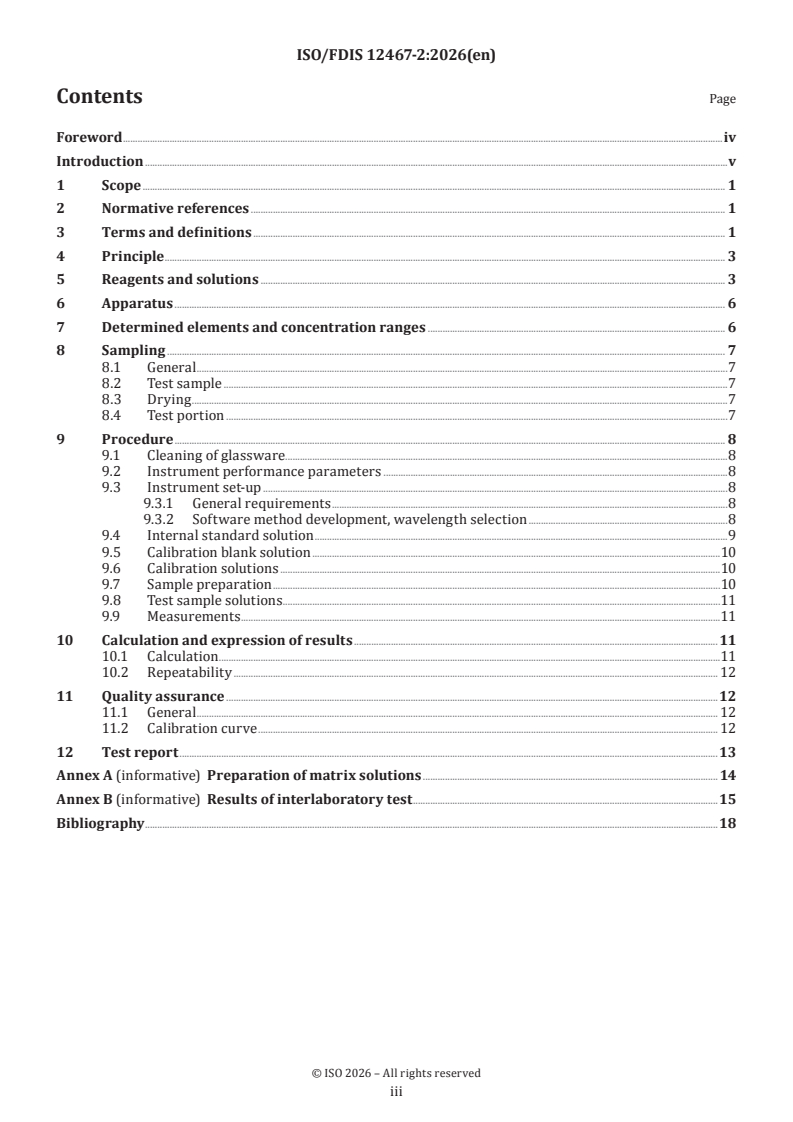

ISO/FDIS 12467-2 - Chemical analysis of lithium composite oxides — Part 2: Determination of trace elemental impurities by inductively coupled plasma optical emission spectrometry


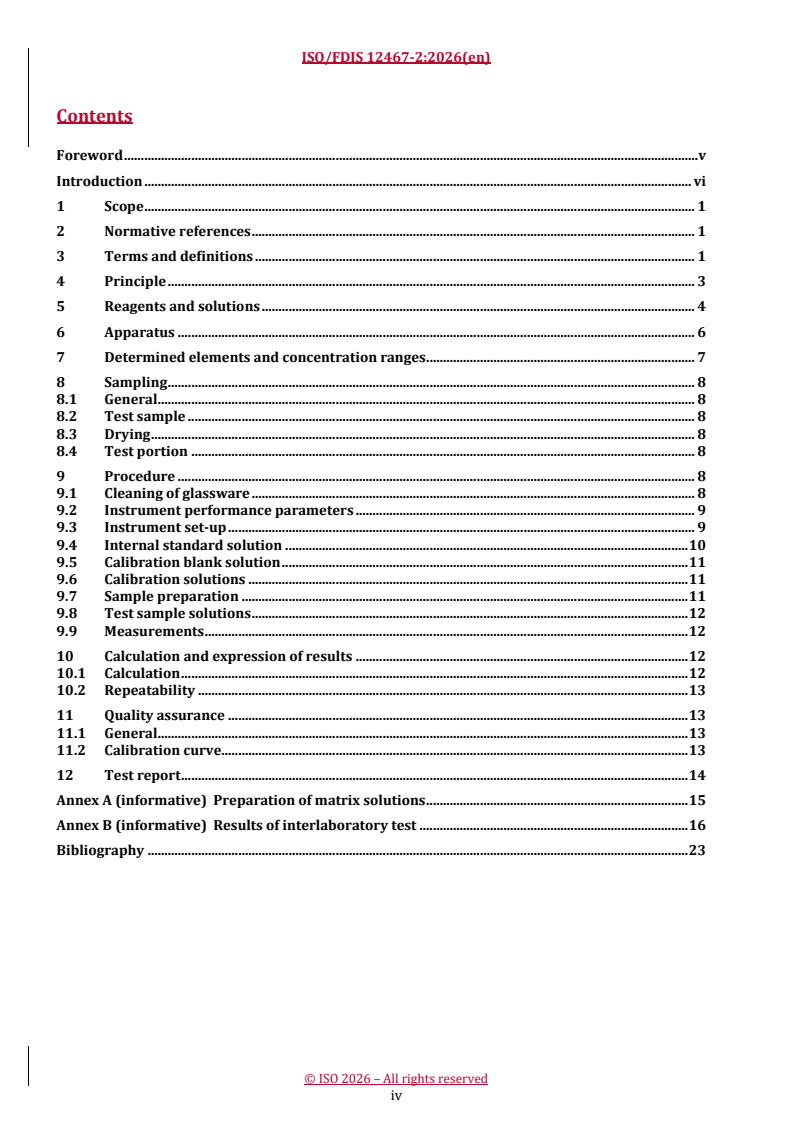
REDLINE ISO/FDIS 12467-2 - Chemical analysis of lithium composite oxides — Part 2: Determination of trace elemental impurities by inductively coupled plasma optical emission spectrometry
ISO/FDIS 12467-2 is an ISO document for the chemical analysis of lithium composite oxides used in Li-ion batteries. It specifies an inductively coupled plasma optical emission spectrometry (ICP-OES) procedure for measuring trace elemental impurities in those materials, so laboratories can check impurity levels in a consistent way.
What does ISO/FDIS 12467-2 specify?
ISO/FDIS 12467-2 specifies an analytical procedure for trace elements in lithium composite oxides for Li-ion batteries (LiBs). The method is based on ICP-OES and is intended for impurity measurement, not for the main components of the material.
The document treats lithium composite oxides as a family that includes layered oxides, spinel oxides and phosphate-based materials. Clause 1 also notes that the procedure can be applied to other listed elements if the user verifies suitability in their own case.
ISO/FDIS 12467-2 is organized into clauses on scope, references, terms, principle, reagents, apparatus, working ranges, sampling, procedure, calculation, quality assurance and the test report.
| Annex | What it covers |
|---|---|
| Annex A | Preparation of matrix solutions for selected lithium composite oxides |
| Annex B | Results of an interlaboratory test used for method validation |
What are the key requirements of ISO/FDIS 12467-2?
ISO/FDIS 12467-2 requires controlled sample preparation, calibrated ICP-OES measurement and documented quality checks. In practice, the method works only if contamination is controlled, the instrument is stable and the calibration behaves linearly.
Sample preparation and digestion
Clause 8 requires the sample to be collected and prepared in accordance with ISO 8656-1 unless buyer and analyst agree otherwise. The laboratory sample is homogenized, a representative test sample is prepared, and a test portion of about 500 mg is weighed for digestion.
Clause 9 requires the test portion to be digested with suitable acids, with aqua regia given as an example, and any insoluble residue to be redigested with a stronger acid mixture if needed. Practically, this means the analyst must obtain a complete solution before measurement, because incomplete dissolution can bias the impurity result.
Reagents, solutions and cleanliness
Clause 5 specifies analytical-grade reagents or better, water of suitable purity, and careful handling of acids. Clause 9.1 requires glassware and other labware to be cleaned before use, for example with nitric acid followed by rinsing.
This matters because trace analysis is easily affected by contamination. A small residue in a flask or pipette can add false impurity signal.
Instrument and measurement setup
Clause 6 specifies an inductively coupled argon plasma optical emission spectrometer with simultaneous measurement of analyte and internal standard wavelengths and a minimum optical resolution of 0.02 nm. It also requires controlled gas flows and suitable acid-resistant sample-handling parts.
Clause 9.2 and 9.3 require the analyst to follow the instrument manufacturer's settings, let the plasma stabilize, choose wavelengths, and verify performance before sample measurement. In practice, the laboratory must prove that the chosen lines, background correction and rinsing time work for the matrix being measured.
Calibration and internal standardization
Clause 9.4 to 9.6 use an internal standard, calibration blank and at least three calibration solutions. Clause 9.9 says the calibration curve is checked for linearity, and a calibration curve control is measured after calibration.
This is important because ICP-OES signals can drift with time or matrix load. The internal standard helps correct that drift, while the calibration check confirms the instrument is still reading correctly.
Working ranges and analytes
Clause 7 gives working ranges for the analytes covered by the method, expressed in mg/kg. The document covers many trace elements, including Al, Ba, B, Ca, Co, Cr, Cu, Fe, Pb, Mg, Mn, Mo, Ni, P, K, Na, S, Sn, Sr, Ti, V, Zn and Zr.
For users, this section is the quick fit check. If expected impurity levels fall outside the working range, the laboratory needs to adjust dilution or choose a different approach.
Calculation, repeatability and quality assurance
Clause 10 uses internal-standard ratios and linear regression to calculate the analyte content in mg/kg from the measured solution concentration, sample mass and final volume. Clause 10.2 requires duplicate results to agree within 10.0% relative, otherwise the digestion is repeated.
Clause 11 gives calibration acceptance criteria, including a linear model, regression through the blank, multiple calibration points and limits on precision and residuals. Practically, these checks show whether the run is valid before the result is reported.
Test report
Clause 12 requires the report to identify the sample, sampling procedure, method reference, analyte content, deviations, unusual features, test date, laboratory and responsible personnel. That gives buyers, suppliers and quality teams a traceable record they can review later.
What terms does ISO/FDIS 12467-2 define?
ISO/FDIS 12467-2 defines the key sampling and solution terms used in the method. These definitions matter because the calculation and reporting steps depend on everyone using the same meaning.
- Laboratory sample - the sample prepared for sending to the laboratory for inspection or testing.
- Test sample - the portion prepared from the laboratory sample from which test portions are taken.
- Test portion - the actual quantity of material on which the test is carried out.
- Test sample solution - the solution obtained after extraction or digestion of the test sample.
- Calibration solution - a solution made from stock or working standards and used to calibrate the instrument.
- Calibration blank solution - a calibration solution made without adding stock or working standard.
- Internal standard (IS) - an element not analyzed and not present in the sample, used to correct measurement variation.
- Method detection limit (MDL) - the lowest concentration detectable by the full analytical method with defined statistical probability.
Who uses ISO/FDIS 12467-2?
ISO/FDIS 12467-2 is used by laboratories that test lithium composite oxides for LiBs, especially where trace impurities affect product quality. It is relevant to cathode material producers, incoming inspection teams, contract test laboratories, quality managers and buyers who need comparable impurity data.
The method is also useful for suppliers and customers who need to agree on what is being measured, how the sample is prepared and what counts as an acceptable analytical run. In practice, it supports quality control, product release and supplier comparison.
Which standards are used with ISO/FDIS 12467-2?
| Standard | How ISO/FDIS 12467-2 uses it |
|---|---|
| ISO 7819 | Provides Lithium vocabulary used in the terms and definitions clause |
| ISO 8656-1 | Provides the sampling scheme referenced for collecting the material |
| ISO 1042 | Provides the specification for one-mark volumetric flasks used in preparation |
| ISO 12467-1 | Covers the determination of main components in lithium composite oxides |
| ISO/IEC 17025 | Is named in quality assurance guidance for laboratory competence and calibration control |
What does the ISO/FDIS 12467-2 document contain?
ISO/FDIS 12467-2 contains the full analytical workflow from sampling to reporting. It gives the principle of ICP-OES measurement, lists the reagents and apparatus, and sets out sample digestion, calibration, measurement and calculation steps.
The document also includes tables that help the analyst choose stock solutions, working ranges, example analytical wavelengths and internal standard wavelengths. Those tables are used in method setup and in checking whether a given instrument and matrix are suitable.
Annex A provides example matrix solution preparations for selected NMC compositions, which supports calibration matching for specific cathode chemistries. Annex B summarizes interlaboratory test results, which gives users validation context for the method.
The document also includes the result calculation approach, repeatability check, calibration acceptance criteria and test report content. That makes it useful not only for routine testing, but also for quality systems, audits and method verification.
Buy Documents
ISO/FDIS 12467-2 - Chemical analysis of lithium composite oxides — Part 2: Determination of trace elemental impurities by inductively coupled plasma optical emission spectrometry
REDLINE ISO/FDIS 12467-2 - Chemical analysis of lithium composite oxides — Part 2: Determination of trace elemental impurities by inductively coupled plasma optical emission spectrometry
Get Certified
Connect with accredited certification bodies for this standard

ECOCERT
Organic and sustainability certification.

Eurofins Food Testing Global
Global leader in food, environment, and pharmaceutical product testing.

Intertek Bangladesh
Intertek certification and testing services in Bangladesh.
Sponsored listings
Frequently Asked Questions
ISO/FDIS 12467-2 is a draft published by the International Organization for Standardization (ISO). Its full title is "Chemical analysis of lithium composite oxides — Part 2: Determination of trace elemental impurities by inductively coupled plasma optical emission spectrometry". This standard covers: This document describes an analytical procedure for the determination of trace elements in Li composite oxides for Li-ion battery (LiB). These are in particular the elements: aluminium (Al), barium (Ba), calcium (Ca), copper (Cu), iron (Fe), lead (Pb), magnesium (Mg), molybdenum (Mo), phosphorus (P), sodium (Na), strontium (Sr), titanium (Ti), zinc (Zn), zirconium (Zr) in Li composite oxides. The determination is performed by optical emission spectrometry with inductively coupled plasma (ICP-OES).
This document describes an analytical procedure for the determination of trace elements in Li composite oxides for Li-ion battery (LiB). These are in particular the elements: aluminium (Al), barium (Ba), calcium (Ca), copper (Cu), iron (Fe), lead (Pb), magnesium (Mg), molybdenum (Mo), phosphorus (P), sodium (Na), strontium (Sr), titanium (Ti), zinc (Zn), zirconium (Zr) in Li composite oxides. The determination is performed by optical emission spectrometry with inductively coupled plasma (ICP-OES).
ISO/FDIS 12467-2 is classified under the following ICS (International Classification for Standards) categories: 71.040.40 - Chemical analysis. The ICS classification helps identify the subject area and facilitates finding related standards.
ISO/FDIS 12467-2 is available in PDF format for immediate download after purchase. The document can be added to your cart and obtained through the secure checkout process. Digital delivery ensures instant access to the complete standard document.
Standards Content (Sample)
FINAL DRAFT
International
Standard
ISO/TC 333
Chemical analysis of lithium
Secretariat: SAC
composite oxides —
Voting begins on:
2026-08-26
Part 2:
Determination of trace elemental
Voting terminates on:
2026-10-21
impurities by inductively
coupled plasma optical emission
spectrometry
Analyse chimique des oxydes composites de lithium —
Partie 2: Détermination des impuretés élémentaires à l'état de
traces par spectrométrie d'émission optique à plasma induit
RECIPIENTS OF THIS DRAFT ARE INVITED TO SUBMIT,
WITH THEIR COMMENTS, NOTIFICATION OF ANY
RELEVANT PATENT RIGHTS OF WHICH THEY ARE AWARE
AND TO PROVIDE SUPPOR TING DOCUMENTATION.
IN ADDITION TO THEIR EVALUATION AS
BEING ACCEPTABLE FOR INDUSTRIAL, TECHNO-
LOGICAL, COMMERCIAL AND USER PURPOSES, DRAFT
INTERNATIONAL STANDARDS MAY ON OCCASION HAVE
TO BE CONSIDERED IN THE LIGHT OF THEIR POTENTIAL
TO BECOME STAN DARDS TO WHICH REFERENCE MAY BE
MADE IN NATIONAL REGULATIONS.
Reference number
FINAL DRAFT
International
Standard
ISO/TC 333
Chemical analysis of lithium
Secretariat: SAC
composite oxides —
Voting begins on:
Part 2:
Determination of trace elemental
Voting terminates on:
impurities by inductively
coupled plasma optical emission
spectrometry
Analyse chimique des oxydes composites de lithium —
Partie 2: Détermination des impuretés élémentaires à l'état de
traces par spectrométrie d'émission optique à plasma induit
RECIPIENTS OF THIS DRAFT ARE INVITED TO SUBMIT,
WITH THEIR COMMENTS, NOTIFICATION OF ANY
RELEVANT PATENT RIGHTS OF WHICH THEY ARE AWARE
AND TO PROVIDE SUPPOR TING DOCUMENTATION.
© ISO 2026
IN ADDITION TO THEIR EVALUATION AS
All rights reserved. Unless otherwise specified, or required in the context of its implementation, no part of this publication may
BEING ACCEPTABLE FOR INDUSTRIAL, TECHNO-
LOGICAL, COMMERCIAL AND USER PURPOSES, DRAFT
be reproduced or utilized otherwise in any form or by any means, electronic or mechanical, including photocopying, or posting on
INTERNATIONAL STANDARDS MAY ON OCCASION HAVE
the internet or an intranet, without prior written permission. Permission can be requested from either ISO at the address below
TO BE CONSIDERED IN THE LIGHT OF THEIR POTENTIAL
or ISO’s member body in the country of the requester.
TO BECOME STAN DARDS TO WHICH REFERENCE MAY BE
MADE IN NATIONAL REGULATIONS.
ISO copyright office
CP 401 • Ch. de Blandonnet 8
CH-1214 Vernier, Geneva
Phone: +41 22 749 01 11
Email: copyright@iso.org
Website: www.iso.org
Published in Switzerland Reference number
ii
Contents Page
Foreword .iv
Introduction .v
1 Scope . 1
2 Normative references . 1
3 Terms and definitions . 1
4 Principle . 3
5 Reagents and solutions . 3
6 Apparatus . 6
7 Determined elements and concentration ranges . 6
8 Sampling . 7
8.1 General .7
8.2 Test sample .7
8.3 Drying .7
8.4 Test portion .7
9 Procedure . 8
9.1 Cleaning of glassware.8
9.2 Instrument performance parameters .8
9.3 Instrument set-up .8
9.3.1 General requirements .8
9.3.2 Software method development, wavelength selection .8
9.4 Internal standard solution .9
9.5 Calibration blank solution .10
9.6 Calibration solutions .10
9.7 Sample preparation .10
9.8 Test sample solutions . .11
9.9 Measurements .11
10 Calculation and expression of results .11
10.1 Calculation .11
10.2 Repeatability . 12
11 Quality assurance .12
11.1 General . 12
11.2 Calibration curve . 12
12 Test report .13
Annex A (informative) Preparation of matrix solutions . 14
Annex B (informative) Results of interlaboratory test .15
Bibliography .18
iii
Foreword
ISO (the International Organization for Standardization) is a worldwide federation of national standards
bodies (ISO member bodies). The work of preparing International Standards is normally carried out through
ISO technical committees. Each member body interested in a subject for which a technical committee
has been established has the right to be represented on that committee. International organizations,
governmental and non-governmental, in liaison with ISO, also take part in the work. ISO collaborates closely
with the International Electrotechnical Commission (IEC) on all matters of electrotechnical standardization.
The procedures used to develop this document and those intended for its further maintenance are described
in the ISO/IEC Directives, Part 1. In particular, the different approval criteria needed for the different types
of ISO document should be noted. This document was drafted in accordance with the editorial rules of the
ISO/IEC Directives, Part 2 (see www.iso.org/directives).
ISO draws attention to the possibility that the implementation of this document may involve the use of (a)
patent(s). ISO takes no position concerning the evidence, validity or applicability of any claimed patent
rights in respect thereof. As of the date of publication of this document, ISO had not received notice of (a)
patent(s) which may be required to implement this document. However, implementers are cautioned that
this may not represent the latest information, which may be obtained from the patent database available at
www.iso.org/patents. ISO shall not be held responsible for identifying any or all such patent rights.
Any trade name used in this document is information given for the convenience of users and does not
constitute an endorsement.
For an explanation of the voluntary nature of standards, the meaning of ISO specific terms and expressions
related to conformity assessment, as well as information about ISO's adherence to the World Trade
Organization (WTO) principles in the Technical Barriers to Trade (TBT), see www.iso.org/iso/foreword.html.
This document was prepared by Technical Committee ISO/TC 333, Lithium.
Any feedback or questions on this document should be directed to the user’s national standards body. A
complete listing of these bodies can be found at www.iso.org/members.html.
iv
Introduction
Lithium, its alloys and compounds are technologically important and highly versatile materials, and are
used in various industries, such as electronics, ceramics, glasses, medicine, etc.
Lithium is the lightest solid element, and due to the high electrochemical potential of the redox couple Li/
Li+, its main use is as cathode material in lithium ion batteries in electric vehicles, laptops, mobile phones
and digital cameras. Lithium materials are classified into different grades, according to their chemical and
physical characteristics, including purity, impurities, and particle size.
The metal impurity ions, such as aluminium (Al), barium (Ba), boron (B), calcium (Ca), cobalt (Co), chromium
(Cr), copper (Cu), iron (Fe), lead (Pb), manganese (Mn), magnesium (Mg), molybdenum (Mo), nickel (Ni),
phosphorus (P), potassium (K), sodium (Na), strontium (Sr), sulfur (S), tin (Sn), titanium (Ti), vanadium
(V), zinc (Zn), and zirconium (Zr) in lithium materials have a higher reduction potential than lithium ions.
Therefore, the content of metal impurity ions are an important index to monitor product quality. The
determination of metal ion content by inductively coupled plasma optical emission spectrometry (ICP-OES)
has numerous advantages, such as simple sample-pre-treatment, high accuracy and low detection limit.
v
FINAL DRAFT International Standard ISO/FDIS 12467-2:2026(en)
Chemical analysis of lithium composite oxides —
Part 2:
Determination of trace elemental impurities by inductively
coupled plasma optical emission spectrometry
WARNING — The use of this document can involve hazardous materials, operations, and equipment.
This document does not purport to address any safety problems associated with its use. It is the
responsibility of the user of this document to establish appropriate safety and health practices and
determine the applicability of regulatory limitations prior to use.
1 Scope
This document specifies an analytical procedure for the determination of trace elements in lithium
composite oxides for Li-Ion batteries (LiBs).
This method applies to the following elements: aluminum (Al), barium (Ba), boron (B), calcium (Ca), cobalt
(Co), chromium (Cr), copper (Cu), iron (Fe), lead (Pb), manganese (Mn), magnesium (Mg), molybdenum (Mo),
nickel (Ni), phosphorus (P), potassium (K), sodium (Na), strontium (Sr), sulfur (S), tin (Sn), titanium (Ti),
vanadium (V), zinc (Zn), zirconium (Zr) can be found in lithium materials.
NOTE 1 For the purposes of this document, the term "lithium composite oxides" includes lithium-containing
cathode materials such as layered oxides, spinel oxides and phosphate-based materials.
This document does not apply to the determination of the main components of lithium composite oxide.
NOTE 2 For methods for the determination of main components, see ISO 12467-1.
NOTE 3 The method is applicable for the other elements listed above, provided the user has verified the applicability.
2 Normative references
The following documents are referred to in the text in such a way that some or all of their content constitutes
requirements of this document. For dated references, only the edition cited applies. For undated references,
the latest edition of the referenced document (including any amendments) applies.
ISO 1042, Laboratory glassware — One-mark volumetric flasks
ISO 7819, Lithium — Vocabulary
ISO 8656-1, Refractory products — Sampling of raw materials and unshaped products — Part 1: Sampling
scheme
3 Terms and definitions
For the purposes of this document, the terms and definitions given in ISO 7819 and the following apply.
ISO and IEC maintain terminology databases for use in standardization at the following addresses:
— ISO Online browsing platform: available at https:// www .iso .org/ obp
— IEC Electropedia: available at https:// www .electropedia .org/
3.1
laboratory sample
sample as prepared for sending to the laboratory and intended for inspection or testing
[SOURCE: ISO 78-2:1999, 3.1]
3.2
test sample
sample prepared from the laboratory sample (3.1) and from which test portions (3.3) will be taken
[SOURCE: ISO 78-2:1999, 3.2]
3.3
test portion
quantity of material drawn from the test sample (3.2) (or from the laboratory sample if both are the same)
and on which the test or observation is actually carried out
[SOURCE: ISO 78-2:1999, 3.3]
3.4
test sample solution
solution prepared after extraction or digestion of the test sample according to appropriate specifications
Note 1 to entry: A sample solution can be subjected to further operations, e.g., dilution and/or addition of an internal
standard, in order to produce a test solution that is ready for analysis.
[SOURCE: ISO 22036:2024, 3.10]
3.5
standard solution
solution of accurately known concentration of an element, an ion, a compound or a group derived from the
substance used for its preparation
[SOURCE: ISO 78-2:1999, 3.6]
3.6
stock solution
solution used for preparation of working standard solutions and/or calibration solutions, containing the
analyte(s) of interest at a certified concentration(s) traceable to national standards.
3.7
calibration solution
solution prepared by dilution of the stock standard solution(s) or working standard solution(s), containing
the analyte(s) of interest at a concentration(s) suitable for use in calibration of the analytical instrument
Note 1 to entry: The technique of matrix-matching is normally used when preparing calibration solutions.
[SOURCE: ISO 15202-3:2004, 3.4]
3.8
calibration blank solution
calibration solution (3.7) prepared without the addition of any stock standard solution or working standard
solution
Note 1 to entry: The technique of matrix-matching is normally used when preparing calibration solutions.
[SOURCE: ISO 15202-1:2020, 3.2.2]
3.9
blank test solution
solution prepared by adding to the solvent the same amounts of reagents as those added to the test sample
solution and with the same final volume
[SOURCE: ISO 17294-1:2024, 3.19]
3.10
calibration curve
expression of the relation between indication and corresponding measured quantity value
[SOURCE: ISO/IEC Guide 99:2007, 4.31]
3.11
calibration curve control
standard prepared independently of the calibration curve, the concentration of which is near the midpoint
of the calibration range
3.12
linearity
straight-line relationship between the mean result of measurement (intensity) and the quantity
(concentration) of the analyte over a specified calibration range
4 Principle
The determination is carried out by means of the analytical technique of optical emission spectroscopy with
inductively coupled plasma (ICP-OES), which allows the detection and quantitative determination of most of
the elements from the periodic table from samples in solution.
In the ICP-OES technique, the continuous introduction of the liquid sample and a nebulization system forms
an aerosol that is transported by Argon to the plasma torch, inductively coupled by radio frequency. In the
plasma, due to the high temperatures generated, the analytes are atomized and ionized, generating the
atomic emission spectra of characteristic lines. The spectra are scattered by the diffraction grating and the
light-sensitive detector measures the spectral line intensities. The information is processed by the computer
software system of the ICP-OES equipment.
For elemental impurity component determination at trace and ultra-trace levels, the analyte content of the
sample solution is measured by comparison of the intensities of the spectral emission of all analytes with
the intensities for solutions containing known masses of analyte. For better accuracy, an internal standard
can be used.
5 Reagents and solutions
During the analysis, unless otherwise stated, use only reagents of recognized analytical grade or higher
grade and only deionized water or water of equivalent purity.
WARNING — Concentrated mineral acids (5.2, 5.3, 5.4, 5.5, 5.6, 5.7) are corrosive and acid
vapor is an irritant. Avoid contact with the skin or eyes, or inhalation of the vapor. Use suitable
personal protective equipment (e.g., gloves, face shield or safety goggles, etc.) when working with
concentrated or dilute acid. Handle open vessels containing concentrated acid in a fume hood until
they have been diluted to less than the concentration that can produce fumes. Do not add water to
acid, as the reaction is violent. Small aliquots of acid shall be added slowly to larger volumes of water
with constant mixing. Do not handle diluted acid solutions until fully cooled to room temperature.
The vapor pressure of acid is high; therefore beware of pressure build-up in stoppered flasks when
preparing acid and water mixtures. Make sure the protective shield on the fume hood is drawn down
as much as possible without interfering with the ongoing work.
5.1 Water (H O), (refer to ISO 3696), grade 1.
®1)
5.2 Hydrochloric acid (HCl), (CAS RN 7647-01-0), 30 % to 37 % HCl (mass fraction).
5.3 Nitric acid (HNO ), (CAS RN 7697-37-2), minimum 65 % HNO (mass fraction).
3 3
5.4 Perchloric acid (HClO ), (CAS RN 7601-90-3), 70 % to 73 % HClO (mass fraction).
4 4
WARNING — Perchloric acid represents an explosion hazard and requires additional precautions.
5.5 Sulfuric acid (H SO ), (CAS RN 7664-93-9), minimum 95 % H SO (mass fraction).
2 4 2 4
WARNING — Dilution of concentrated sulfuric acid liberates a substantial amount of heat.
5.6 Hydrofluoric acid (HF), (CAS RN 7664-39-3), 40 % to 48 % HF (mass fraction).
WARNING — Concentrated hydrofluoric acid is very toxic in contact with the skin and if inhaled or
swallowed. It is corrosive and causes severe burns. Take extreme care when using hydrofluoric acid.
Avoid contact with the skin or eyes, or inhalation of the vapor. Suitable personal protective equipment
(including suitable gloves, face shield, etc.) must be used when working with concentrated or dilute
hydrofluoric acid. Handle open vessels containing concentrated hydrofluoric acid in a fume hood.
Ensure that the nature and seriousness of hydrofluoric acid burns is understood before commencing
work with this substance. Carry hydrofluoric acid burn cream (containing calcium gluconate) at
all times whilst working with hydrofluoric acid and for 24 h afterwards. Apply the cream to any
contaminated skin, after washing the affected area with copious amounts of water. Obtain medical
advice immediately in case of an accident.
NOTE 1 The burning sensation associated with many concentrated acid burns is not immediately apparent on
exposure to hydrofluoric acid and might not be felt for several hours. Relatively dilute solutions of hydrofluoric acid can
also be absorbed through the skin, with serious effects similar to those resulting from exposure to the concentrated
acid.
When using hydrofluoric acid, it is recommended that a pair of disposable gloves be worn underneath
suitable acid-resistant gloves to provide added protection for the hands. It is recommended to use face shield
to provide additional protection for inhalation hazard.
NOTE 2 Hydrofluoric acid is not chemically compatible with glassware.
5.7 Aqua regia (should be prepared just before use).
Mix three volumes of hydrochloric acid (5.2) and one volume of nitric acid (5.3).
5.8 Single element standard stock solutions
Single element standard stock solutions with adequate specification stating the acid used and the
preparation technique are commercially available. Single-element standard stock solutions can be made
from high purity metals or salts.
For stability of the solutions, refer to manufacturer guarantee statement.
Examples of recommended stock solutions for different Li composite oxides used in LiBs are given in Table 1.
1) CAS Registry Number® is a trademark of the American Chemical Society (ACS). This information is given for the
convenience of users of this document and does not constitute an endorsement by ISO of the product named. Equivalent
products may be used if they can be shown to lead to the same results.
Table 1 — Recommended stock solutions in different LiBs
Li composite oxides Stock solution
mg/L ρ(ele-
LCO LMO NCA NMC
ment)
Al, B, Ba, Ca, Cu, Cr. Al, B, Ba, Ca, Cu, Cr.
B, Ba, Ca, Cu, Cr. Fe, K, Al, B, Ba, Ca, Cu, Cr. Fe,
Target ele- Fe, K, Pb, Mg, Mo, P, Fe, K, Pb, Mg, Mo, P,
Pb, Mg, Mo, P, Na, S, K, Pb, Mg, Mo, P, Na, S, 1 000
ments Na, S, Sn, Sr, Ti, V, Zn, Na, S, Sn, Sr, Ti, V, Zn,
Sn, Sr, Ti, V, Zn, Zr, Mn Sn, Sr, Ti, V, Zn, Zr
Zr, Mn, Ni Zr, Ni, Co
Internal
standard e.g., Ge, Lu, Sc or Y 1 000
solution
Matrix solu-
Co, Li Mn, Li Ni, Co, Al, Li Ni, Co, Mn, Li 10 000
tion
Li composite oxides Stock solution
mg/L ρ(ele-
LFP LNO LMP LTO
ment)
Al, B, Ba, Ca, Cu, Cr. Al, B, Ba, Ca, Cu, Cr. Al, B, Ba, Ca, Cu, Cr. Al, B, Ba, Ca, Cu, Cr.
Target ele- K, Pb, Mg, Mo, Na, S, Fe, K, Pb, Mg, Mo, P, Fe, K, Pb, Mg, Mo, P, Fe, K, Pb, Mg, Mo, P,
1 000
ments Sn, Sr, Ti, V, Zn, Zr, Ni, Na, S, Sn, Sr, Ti, V, Zn, Na, S, Sn, Sr, Ti, V, Zn, Na, S, Sn, Sr, V, Zn, Zr,
Mn, Co Zr Mn, Co Zr, Ni, Co Ni, Mn, Co
Internal
standard e.g., Ge, Lu, Sc or Y 1 000
solution
Matrix solu-
Fe, P, Li Ni, Li Mn, P, Li Ti, Li 10 000
tion
Li composite oxides Stock solution
mg/L ρ(ele-
LMFP
ment)
Al, B, Ba, Ca, Cu, Cr.
Target ele- K, Pb, Mg, Mo, Na, S,
1 000
ments Sn, Sr, Ti, V, Zn, Zr,
Ni, Co
Internal
standard e.g., Ge, Lu, Sc or Y 1 000
solution
Matrix solu-
Mn, Fe, P, Li 10 000
tion
NOTE For axial viewed ICP-systems, it can be useful to add Cesium as matrix modifier to analyse Na and K.
5.9 Multi-element stock standard solutions, (each element 50 mg/L).
Place 5 mL of each of the solutions prepared from Clause 5.8 into a volumetric flask. Dilute with water (5.1)
to 100 mL and mix well. Attention shall be paid to ensure that no precipitation occurs during mixing.
Adding acid to the solutions will improve stability and shelf-life.
Multi element standard stock solutions with adequate specification stating the acid used and the preparation
technique are commercially available.
5.10 Matrix solution
Prepare a solution followed by matrix solution(5.8) depending on Li composite oxides material. Some
examples are in Annex A for information.
NOTE The matrix solutions can be prepared from 10 000 mg/L single element stock solutions or pure metal or
metal salts.
6 Apparatus
All apparatus shall be carefully cleaned prior to use.
6.1 Inductively coupled argon plasma optical emission spectrometer
The ICP optical emission spectrometer consists of a sample introduction system, the plasma (as an
excitation/emission source), a plasma torch, an optical system, a detector and a computer system.
The sample introduction system usually consists of a peristaltic pump for sample transport to the nebulizer,
the nebulizer and a spray chamber. The most common nebulizers are the concentric nebulizer, the cross-flow
nebulizer and the V-groove nebulizer. They are made from glass, quartz, polytetrafluoroethylene (PTFE),
fluorinated ethylene propylene (FEP), perfluoroalkoxy (PFA), or other acid-resistant polymer materials. For
higher salt tolerance, it is recommended to use an argon humidifier.
In addition, many types of spray chambers are applied in commercial systems. The most common, beside the
cyclonic type with a baffle is the Scott type where double concentric tubes separate larger droplets from the
fine aerosol which is introduced into the plasma torch.
Typical ICP-OES instruments have a variety of configurations, and the following factors shall be considered
for better stability for high matrix and sensitivity: adjustable gas flow control, selectable analytical
wavelengths, optical resolution, selectable view [from the side (radial view) or both sides (dual radial view)
or from the torch central symmetrical axis (axial view)], simultaneous acquisition of spectra and background
correction of spectra.
The ICP-OES instrument shall conform to the following requirements: the analyte and internal standard
wavelength shall be measured and registered in a simultaneous manner with a minimum optical resolution
of 0,02 nm. All plasma gas, auxiliary gas and nebulizer gas flows shall employ flow controllers. For higher
salt tolerance, it is recommended to use an argon humidifier.
NOTE 1 The computerized registration
...
ISO/DISFDIS 12467-2:2025(en)
ISO /TC 333/SC /WG 6
Secretariat: SAC
Date: 2026-02-0908-11
Chemical analysis of lithium composite oxides — —
Part 2:
Determination of trace elemental impurities by inductively coupled
plasma optical emission spectrometry
Analyse chimique des oxydes composites de lithium —
Partie 2: Détermination des impuretés élémentaires à l'état de traces par spectrométrie d'émission optique à
plasma induit
FDIS stage
All rights reserved. Unless otherwise specified, or required in the context of its implementation, no part of this publication
may be reproduced or utilized otherwise in any form or by any means, electronic or mechanical, including photocopying,
or posting on the internet or an intranet, without prior written permission. Permission can be requested from either ISO
at the address below or ISO'sISO’s member body in the country of the requester.
ISO Copyright Officecopyright office
CP 401 • Ch. de Blandonnet 8
CH-1214 Vernier, Geneva
Phone: + 41 22 749 01 11
Email:
E-mail: copyright@iso.org
Website: www.iso.org
Published in Switzerland.
ii
ISO/DISFDIS 12467-2:2026(en)
Content
iii
Contents
Foreword . v
Introduction . vi
1 Scope . 1
2 Normative references . 1
3 Terms and definitions . 1
4 Principle . 3
5 Reagents and solutions . 4
6 Apparatus . 6
7 Determined elements and concentration ranges . 7
8 Sampling . 8
8.1 General . 8
8.2 Test sample . 8
8.3 Drying . 8
8.4 Test portion . 8
9 Procedure . 8
9.1 Cleaning of glassware . 8
9.2 Instrument performance parameters . 9
9.3 Instrument set-up . 9
9.4 Internal standard solution . 10
9.5 Calibration blank solution . 11
9.6 Calibration solutions . 11
9.7 Sample preparation . 11
9.8 Test sample solutions . 12
9.9 Measurements . 12
10 Calculation and expression of results . 12
10.1 Calculation . 12
10.2 Repeatability . 13
11 Quality assurance . 13
11.1 General . 13
11.2 Calibration curve. 13
12 Test report . 14
Annex A (informative) Preparation of matrix solutions . 15
Annex B (informative) Results of interlaboratory test . 16
Bibliography . 23
iv
ISO/DISFDIS 12467-2:2026(en)
Foreword
ISO (the International Organization for Standardization) is a worldwide federation of national standards
bodies (ISO member bodies). The work of preparing International Standards is normally carried out through
ISO technical committees. Each member body interested in a subject for which a technical committee has been
established has the right to be represented on that committee. International organizations, governmental and
non-governmental, in liaison with ISO, also take part in the work. ISO collaborates closely with the
International Electrotechnical Commission (IEC) on all matters of electrotechnical standardization.
The procedures used to develop this document and those intended for its further maintenance are described
in the ISO/IEC Directives, Part 1. In particular, the different approval criteria needed for the different types of
ISO document should be noted. This document was drafted in accordance with the editorial rules of the
ISO/IEC Directives, Part 2 (see www.iso.org/directives).
ISO draws attention to the possibility that the implementation of this document may involve the use of (a)
patent(s). ISO takes no position concerning the evidence, validity or applicability of any claimed patent rights
in respect thereof. As of the date of publication of this document, ISO [had/had not] received notice of (a)
patent(s) which may be required to implement this document. However, implementers are cautioned that this
may not represent the latest information, which may be obtained from the patent database available at
www.iso.org/patents. ISO shall not be held responsible for identifying any or all such patent rights.
Any trade name used in this document is information given for the convenience of users and does not
constitute an endorsement.
For an explanation of the voluntary nature of standards, the meaning of ISO specific terms and expressions
related to conformity assessment, as well as information about ISO's adherence to the World Trade
Organization (WTO) principles in the Technical Barriers to Trade (TBT), see www.iso.org/iso/foreword.html.
This document was prepared by Technical Committee ISO/TC 333, Lithium.
Any feedback or questions on this document should be directed to the user’s national standards body. A
complete listing of these bodies can be found at www.iso.org/members.html.
v
Introduction
Lithium, its alloys and compounds are technologically important and highly versatile materials, and are used
in various industries, such as electronics, ceramics, glasses, medicine, etc.
Lithium is the lightest solid element, and due to the high electrochemical potential of the redox couple Li/Li+,
its main use is as cathode material in lithium ion batteries in electric vehicles, laptops, mobile phones and
digital cameras. Lithium materials are classified into different grades, according to their chemical and physical
characteristics, including purity, impurities, and particle size.
The metal impurity ions, such as aluminium (Al), barium (Ba), boron (B), calcium (Ca), cobalt (Co), chromium
(Cr), copper (Cu), iron (Fe), lead (Pb), manganese (Mn), magnesium (Mg), molybdenum (Mo), nickel (Ni),
phosphorus (P), potassium (K), sodium (Na), strontium (Sr), sulfur (S), tin (Sn), titanium (Ti), vanadium (V),
zinc (Zn), and zirconium (Zr) in lithium materials have a higher reduction potential than lithium ions.
Therefore, the content of metal impurity ions are an important index to monitor product quality. The
determination of metal ion content by Inductively Coupled Plasma Optical Emission Spectrometryinductively
coupled plasma optical emission spectrometry (ICP-OES) has numerous advantages, such as simple sample-
pre-treatment, high accuracy and low detection limit.
vi
DRAFT International Standard ISO/DIS 12467-2:2026(en)
Chemical analysis of lithium composite oxides – —
Part 2:
Determination of trace elemental impurities by inductively coupled
plasma optical emission spectrometry
WARNING –— The use of this document can involve hazardous materials, operations, and equipment.
This document does not purport to address any safety problems associated with its use. It is the
responsibility of the user of this document to establish appropriate safety and health practices and
determine the applicability of regulatory limitations prior to use.
1 Scope
This document specifies an analytical procedure for the determination of trace elements in lithium composite
oxides for Li-Ion batteries (LiBs).
This method applies to the following elements: aluminum (Al), barium (Ba), boron (B), calcium (Ca), cobalt
(Co), chromium (Cr), copper (Cu), iron (Fe), lead (Pb), manganese (Mn), magnesium (Mg), molybdenum (Mo),
nickel (Ni), phosphorus (P), potassium (K), sodium (Na), strontium (Sr), sulfur (S), tin (Sn), titanium (Ti),
vanadium (V), zinc (Zn), zirconium (Zr) can be found in lithium materials.
NOTE 1 For the purposes of this document, the term 'lithium"lithium composite oxides'oxides" includes lithium-
containing cathode materials such as layered oxides, spinel oxides and phosphate-based materials.
NOTE 2 This document does not apply to the determination of the main components of lithium
composite oxide.
NOTE 2 For methods for the determination of main components, see ISO 12467-1.
NOTE 3 The method is applicable for the other elements listed above, provided the user has verified the applicability.
2 Normative references
The following documents are referred to in the text in such a way that some or all of their content constitutes
requirements of this document. For dated references, only the edition cited applies. For undated references,
the latest edition of the referenced document (including any amendments) applies.
ISO 1042, Laboratory glassware — One-mark volumetric flasks
ISO 7819, Lithium -— Vocabulary
ISO 8656--1, Refractory products — Sampling of raw materials and unshaped products — Part 1: Sampling
scheme
3 Terms and definitions
For the purposes of this document, the terms and definitions given in ISO 7819, Lithium — Vocabulary, and
the following apply.
ISO and IEC maintain terminology databases for use in standardization at the following addresses:
— — ISO Online browsing platform: available at https://www.iso.org/obp
— — IEC Electropedia: available at https://www.electropedia.org/
3.1 3.1
laboratory sample
sample as prepared for sending to the laboratory and intended for inspection or testing
[SOURCE: ISO 78-2:1999, 3.1]
3.2 3.2
test sample
sample prepared from the laboratory sample (3.1(3.1)) and from which test portions (3.3(3.3)) will be taken
[SOURCE: ISO 78-2:1999, 3.2]
3.3 3.3
test portion
the quantity of material drawn from the test sample (3.2(3.2)) (or from the laboratory sample if both are the
same) and on which the test or observation is actually carried out
[SOURCE: ISO 78-2:1999, 3.3]
3.4 3.4
test sample solution
solution prepared after extraction or digestion of the test sample according to appropriate specifications
Note 1 to entry: A sample solution can be subjected to further operations, e.g., dilution and/or addition of an internal
standard, in order to produce a test solution that is ready for analysis.
[SOURCE: ISO 22036:2024, 3.10]
3.5 3.5
standard solution
solution of accurately known concentration of an element, an ion, a compound or a group derived from the
substance used for its preparation
[SOURCE: ISO 78-2:1999, 3.6]
3.6 3.6
stock solution
solution used for preparation of working standard solutions and/or calibration solutions, containing the
analyte(s) of interest at a certified concentration(s) traceable to national standards.
3.7 3.7
calibration solution
solution prepared by dilution of the stock standard solution(s) or working standard solution(s), containing
the analyte(s) of interest at a concentration(s) suitable for use in calibration of the analytical instrument
Note 1 to entry: The technique of matrix-matching is normally used when preparing calibration solutions.
[SOURCE: ISO 15202-3:2004, 3.4]
ISO/DISFDIS 12467-2:2026(en)
3.8 3.8
calibration blank solution
calibration solution (3.7(3.7)) prepared without the addition of any stock standard solution or working
standard solution
Note 1 to entry: The technique of matrix-matching is normally used when preparing calibration solutions.
[SOURCE: ISO 15202-1:2020, 3.2.2]
3.9 3.9
blank test solution
solution prepared by adding to the solvent the same amounts of reagents as those added to the test sample
solution and with the same final volume
[SOURCE: ISO 17294-1:2024, 3.19]
3.10 3.10
calibration curve
expression of the relation between indication and corresponding measured quantity value
[SOURCE: ISO/IEC Guide 99:2007, 4.31]
3.11 3.11
calibration curve control
standard prepared independently of the calibration curve, the concentration of which is near the midpoint of
the calibration range
3.12 3.12
linearity
straight-line relationship between the mean result of measurement (intensity) and the quantity
(concentration) of the analyte over a specified calibration range
3.13
instrument detection limit
lowest concentration that can be detected with a defined statistical probability using a clean instrument and
a clean solution
3.14
method detection limit
lowest concentration that can be detected using a specific analytical method with a defined statistical
probability for defined maximum matrix element concentrations
4 Principle
The determination is carried out by means of the analytical technique of optical emission spectroscopy with
inductively coupled plasma (ICP-OES), which allows the detection and quantitative determination of most of
the elements from the periodic table from samples in solution.
In the ICP-OES technique, the continuous introduction of the liquid sample and a nebulization system forms
an aerosol that is transported by Argon to the plasma torch, inductively coupled by radio frequency. In the
plasma, due to the high temperatures generated, the analytes are atomized and ionized, generating the atomic
emission spectra of characteristic lines. The spectra are scattered by the diffraction grating and the light-
sensitive detector measures the spectral line intensities. The information is processed by the computer
software system of the ICP-OES equipment.
For elemental impurity component determination at trace and ultra-trace levels, the analyte content of the
sample solution is measured by comparison of the intensities of the spectral emission of all analytes with the
intensities for solutions containing known masses of analyte. For better accuracy, an internal standard can be
used.
5 Reagents and solutions
During the analysis, unless otherwise stated, use only reagents of recognized analytical grade or higher grade
and only deionized water or water of equivalent purity.
WARNING — Concentrated mineral acids (5.2, 5.3, 5.4, 5.5, 5.6, 5.7(5.2, 5.3, 5.4, 5.5, 5.6, 5.7)) are
corrosive and acid vapor is an irritant. Avoid contact with the skin or eyes, or inhalation of the vapor.
Use suitable personal protective equipment (e.g., gloves, face shield or safety goggles, etc.) when
working with concentrated or dilute acid. Handle open vessels containing concentrated acid in a fume
hood until they have been diluted to less than the concentration that can produce fumes. Do not add
water to acid, as the reaction is violent. Small aliquots of acid shall be added slowly to larger volumes
of water with constant mixing. Do not handle diluted acid solutions until fully cooled to room
temperature. The vapor pressure of acid is high; therefore beware of pressure build-up in stoppered
flasks when preparing acid and water mixtures. Make sure the protective shield on the fume hood is
drawn down as much as possible without interfering with the ongoing work.
5.1 5.1 Water (H2O), (refer to ISO 3696), grade 1. ®
11)
5.2 5.2 Hydrochloric acid (HCl), (CAS RN 7647-01-0), 30 % to 37 % HCl (mass fraction).
5.3 5.3 Nitric acid (HNO3), (CAS RN 7697-37-2), minimum 65 % HNO (mass fraction).
5.4 5.4 Perchloric acid (HClO ), (CAS RN 7601-90-3), 70 % to 73 % HClO (mass fraction).
4 4
WARNING –— Perchloric acid represents an explosion hazard and requires additional precautions.
5.5 5.5 Sulfuric acid (H2SO4), (CAS RN 7664-93-9), minimum 95 % H SO (mass fraction).
2 4
WARNING – dilution— Dilution of concentrated sulfuric acid liberates a substantial amount of heat.
5.6 5.6 Hydrofluoric acid (HF), (CAS RN 7664-39-3), 40 % to 48 % HF (mass fraction).
WARNING — Concentrated hydrofluoric acid is very toxic in contact with the skin and if inhaled or
swallowed. It is corrosive and causes severe burns. Take extreme care when using hydrofluoric acid.
Avoid contact with the skin or eyes, or inhalation of the vapor. It is ESSENTIAL that suitableSuitable
personal protective equipment (including suitable gloves, face shield, etc.) ismust be used when
working with concentrated or dilute hydrofluoric acid. Handle open vessels containing concentrated
hydrofluoric acid in a fume hood. Ensure that the nature and seriousness of hydrofluoric acid burns is
understood before commencing work with this substance. Carry hydrofluoric acid burn cream
(containing calcium gluconate) at all times whilst working with hydrofluoric acid and for 24 h
afterwards. Apply the cream to any contaminated skin, after washing the affected area with copious
amounts of water. Obtain medical advice immediately in case of an accident.
1)
CAS Registry Number® is a trademark of the American Chemical Society (ACS). This information is given for the
convenience of users of this document and does not constitute an endorsement by ISO of the product named. Equivalent
products may be used if they can be shown to lead to the same results.
ISO/DISFDIS 12467-2:2026(en)
NOTE 1 The burning sensation associated with many concentrated acid burns is not immediately apparent on
exposure to hydrofluoric acid and might not be felt for several hours. Relatively dilute solutions of hydrofluoric acid can
also be absorbed through the skin, with serious effects similar to those resulting from exposure to the concentrated acid.
When using hydrofluoric acid, it is recommended that a pair of disposable gloves be worn underneath suitable
acid-resistant gloves to provide added protection for the hands. It is recommended to use face shield to
provide additional protection for inhalation hazard.
NOTE 2 Hydrofluoric acid is not chemically compatible with glassware.
5.7 5.7 Aqua regia (should be prepared just before use).
Mix three volumes of hydrochloric acid (5.2(5.2)) and one volume of nitric acid (5.3(5.3).).
5.8 5.8 Single element standard stock solutions
Single element standard stock solutions with adequate specification stating the acid used and the preparation
technique are commercially available. Single-element standard stock solutions can be made from high purity
metals or salts.
For stability of the solutions, refer to manufacturer guarantee statement.
Examples of recommended stock solutions for different Li composite oxides used in LiBs are given in
Table 1Table 1.
Table 1 — Recommended stock solutions in different LiBs
Stock
Li composite oxides
solution
mg/L
LCO LMO NCA NMC
ρ(element)
Al, B, Ba, Ca, Cu, Cr. Al, B, Ba, Ca, Cu, Cr. B, Ba, Ca, Cu, Cr. Fe, Al, B, Ba, Ca, Cu, Cr.
Target Fe, K, Pb, Mg, Mo, Fe, K, Pb, Mg, Mo, K, Pb, Mg, Mo, P, Fe, K, Pb, Mg, Mo,
1 000
elements P, Na, S, Sn, Sr, Ti, P, Na, S, Sn, Sr, Ti, Na, S, Sn, Sr, Ti, V, P, Na, S, Sn, Sr, Ti,
V, Zn, Zr, Mn, Ni V, Zn, Zr, Ni, Co Zn, Zr, Mn V, Zn, Zr
Internal
standard e.g., Ge, Lu, Sc or Y 1 000
solution
Matrix
Co, Li Mn, Li Ni, Co, Al, Li Ni, Co, Mn, Li 10 000
solution
Stock
Li composite oxides
solution
mg/L
LFP LNO LMP LTO
ρ(element)
Al, B, Ba, Ca, Cu, Cr. Al, B, Ba, Ca, Cu, Cr. Al, B, Ba, Ca, Cu, Cr. Al, B, Ba, Ca, Cu, Cr.
Target K, Pb, Mg, Mo, Na, Fe, K, Pb, Mg, Mo, Fe, K, Pb, Mg, Mo, Fe, K, Pb, Mg, Mo,
1 000
elements S, Sn, Sr, Ti, V, Zn, P, Na, S, Sn, Sr, Ti, P, Na, S, Sn, Sr, Ti, P, Na, S, Sn, Sr, V,
Zr, Ni, Mn, Co V, Zn, Zr Mn, Co V, Zn, Zr, Ni, Co Zn, Zr, Ni, Mn, Co
Internal
standard e.g., Ge, Lu, Sc or Y 1 000
solution
Matrix
Fe, P, Li Ni, Li Mn, P, Li Ti, Li 10 000
solution
Stock
Li composite oxides
solution
mg/L
LCO LMO NCA NMC
ρ(element)
Stock
Li composite oxides
solution
mg/L
LMFP
ρ(element)
Al, B, Ba, Ca, Cu, Cr.
Target K, Pb, Mg, Mo, Na,
1 000
elements S, Sn, Sr, Ti, V, Zn,
Zr, Ni, Co
Internal
standard e.g., Ge, Lu, Sc or Y 1 000
solution
Matrix
Mn, Fe, P, Li 10 000
solution
NOTE For axial viewed ICP-systems, it can be useful to add Cesium as matrix modifier to analyse Na and K.
5.9 5.9 Multi-element stock standard solutions, (each element 50 mg/L)).
Place 5 mL of each of the solutions prepared from Clause 5.8Clause 5.8 into a volumetric flask. Dilute with
water (5.1(5.1)) to 100 mL and mix well. Attention shall be paid to ensure that no precipitation occurs during
mixing.
Adding acid to the solutions will improve stability and shelf-life.
Multi element standard stock solutions with adequate specification stating the acid used and the preparation
technique are commercially available.
5.10 5.10 Matrix solution
Prepare a solution followed by matrix solution (5.8(5.8)) depending on Li composite oxides material. Some
examples are in Annex AAnnex A for information.
NOTE: The matrix solutions can be prepared from 10 000 mg/L single element stock solutions or pure metal or
metal salts.
6 Apparatus
All apparatus shall be carefully cleaned prior to use.
6.1 6.1 Inductively coupled argon plasma optical emission spectrometer
The ICP optical emission spectrometer consists of a sample introduction system, the plasma (as an
excitation/emission source), a plasma torch, an optical system, a detector and a computer system.
The sample introduction system usually consists of a peristaltic pump for sample transport to the nebulizer,
the nebulizer and a spray chamber. The most common nebulizers are the concentric nebulizer, the cross-flow
nebulizer and the V-groove nebulizer. They are made from glass, quartz, polytetrafluoroethylene (PTFE),
fluorinated ethylene propylene (FEP), perfluoroalkoxy (PFA), or other acid-resistant polymer materials. For
higher salt tolerance, it is recommended to use an argon humidifier.
ISO/DISFDIS 12467-2:2026(en)
In addition, many types of spray chambers are applied in commercial systems. The most common, beside the
cyclonic type with a baffle is the Scott type where double concentric tubes separate larger droplets from the
fine aerosol which is introduced into the plasma torch.
Typical ICP-OES instruments have a variety of configurations, and the following factors shall be considered for
better stability for high matrix and sensitivity: adjustable gas flow control, selectable analytical wavelengths,
optical resolution, selectable view [from the side (radial view) or both sides (dual radial view) or from the
torch central symmetrical axis (axial view)], simultaneous acquisition of spectra and background correction
of spectra.
The ICP-OES instrument shall conform to the following requirements: the analyte and internal standard
wavelength shall be measured and registered in a simultaneous manner with a minimum optical resolution of
0,02 nm. All plasma gas, auxiliary gas and nebulizer gas flows shall employ flow controllers. For higher salt
tolerance, it is recommended to use an argon humidifier.
NOTE 1 The computerized registration of light intensities by several element lines is converted into concentrations
using appropriate software packages from the instrument manufacturers.
NOTE 2 To run the ICP-OES with a large number of samples, an autosampler can be used.
6.2 6.2 Analytical balance, e.g., electronic balance with tare compensation and accurate to 0,1 mg. For
powder samples, it is recommended to use anti-static device when weighing the sample.
6.3 6.3 Sample containers, preferably made of acid-resistant polymer materials. Vessels made of
polyethylene (PE), polypropylene (PP), polytetrafluoroethylene (PTFE), perfluoroalkoxy (PFA) or fluorinated
ethylene propylene (FEP) are suitable.
6.4 6.4 Volumetric flasks, Grade A, in accordance with ISO 1042, preferably made of acid-resistant
polymer materials. Flasks made of polyethylene (PE), polypropylene (PP), polytetrafluoroethylene (PTFE),
perfluoroalkoxy (PFA) or fluorinated ethylene propylene (FEP) are suitable.
6.5 6.5 Argon gas supply, purity ≥ 99,995 % (mass fraction)
7 Determined elements and concentration ranges
The concentration ranges of elements that may be appropriately analysed by this method are given in
Table 2Table 2.
Table 2 — Method working ranges for determined elements
Element Working range mg/kg
Al 2 to 50
B 5 to 100
Ba 2 to 50
Ca 2 to 150
Cr 2 to 50
Cu 2 to 50
Fe 2 to 50
Na 5 to 100
Mg 2 to 100
Mn 2 to 50
Element Working range mg/kg
Mo 2 to 50
Ni 2 to 50
P 5 to 50
Pb 2 to 50
S 10 to 1 000
Sn 2 to 50
Sr 2 to 50
Ti 2 to 50
V 2 to 50
Zn 2 to 50
Zr 2 to 50
Co 2 to 50
8 Sampling
8.1 General
The sample shall be collected and the preparation method shall be in accordance with ISO 8656-1, unless
otherwise mutually agreed upon by the analyser and customer.
8.2 Test sample
Homogenize the laboratory sample in a sample separator, or manually, to divide the sample into halves,
quarters, eighths, sixteenths, etc. until obtaining at least 3 g of a homogeneous and representative sample for
the required analyses.
8.3 Drying
If needed, place the flat-type weighing bottle in a drying oven at (110 ± 5) °C for 2 h, uncovered, and cool in a
desiccator (e.g. silica gel), covered, for 1 h.
8.4 Test portion
Obtain a sample mass of the required quantity (500 mg) to the nearest 0,1 mg using a balance (6.2(6.2).).
9 Procedure
WARNING –— The use of this document can involve hazardous materials, operations, and equipment.
This document does not purport to address any safety problems associated with its use. It is the
responsibility of the user of this document to establish appropriate safety and health practices and
determine the applicability of regulatory limitations prior to use.
9.1 Cleaning of glassware
All labware used in the determination of trace element concentrations shall be cleaned carefully before use,
e.g., by immersion in 5 % (v/v) aqueous nitric acid solution for a few hours, followed by rinsing with water
(5.1(5.1)) before use. The nitric acid (5.3(5.3)) should be replaced regularly.
ISO/DISFDIS 12467-2:2026(en)
9.2 Instrument performance parameters
Due to differences between various models of instruments, no detailed instructions can
...